

Shallow Sea Bathymetric Inversion of Active–Passive Satellite Remote Sensing Data Based on Virtual Control Point Inverse Distance Weighting

 , ,
, ,
Highlights
- The ICESat-2 photons distributed along the trajectory have difficulty controlling the entire bathymetry inversion area.
- Pixels with identical spectral properties in an image typically correspond to similar bathymetric values.
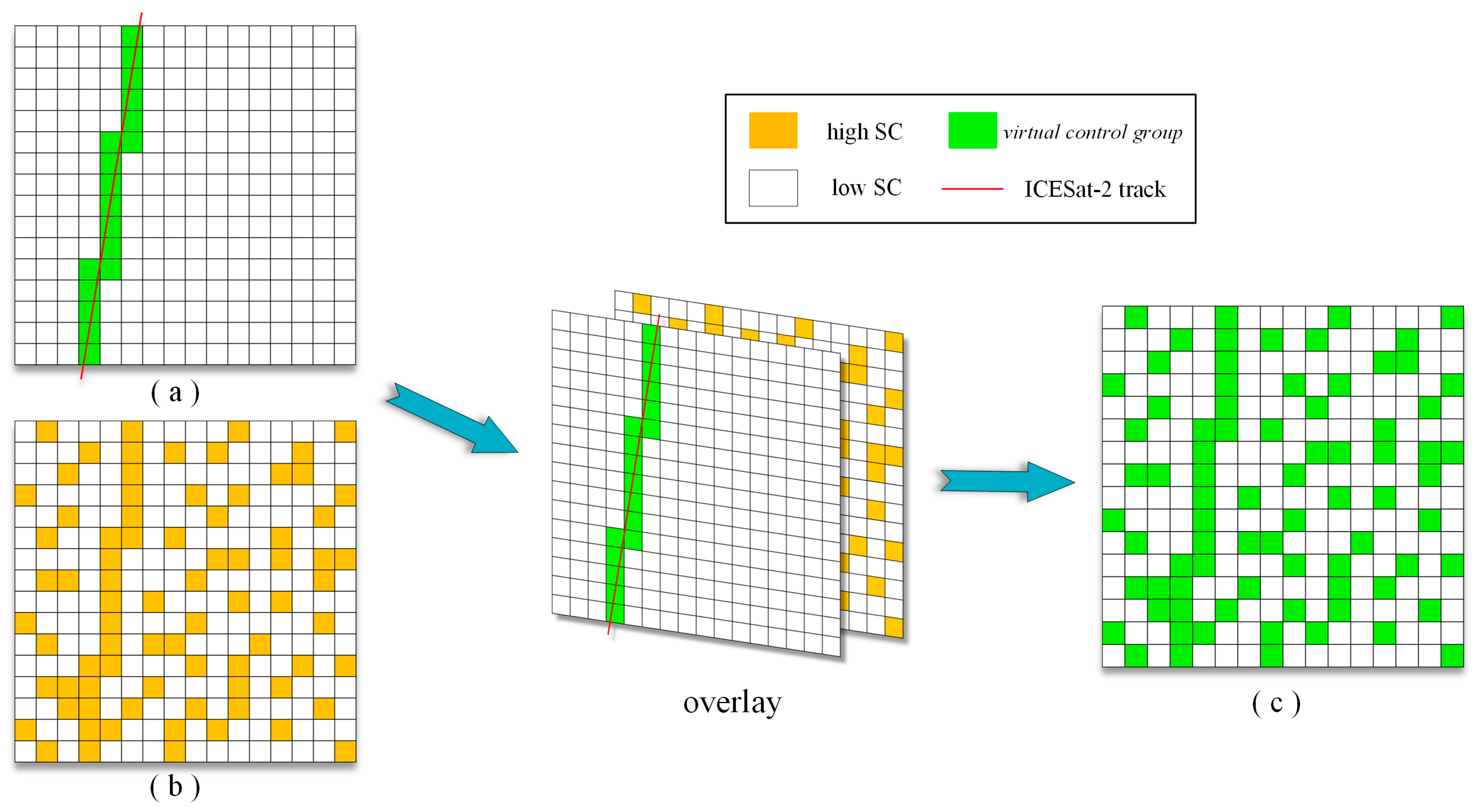
- Based on the spectral values of image pixels corresponding to ICESat-2 photons, bathymetric values can be obtained for other pixels with identical spectral properties.
- ICESat-2 photons and virtual control points can uniformly control the entire bathymetry inversion area.
Abstract
1. Introduction
- On the basis of our known information, this is the first work to propose a bathymetry method based on virtual control points.
- This is also the first study to rectify bathymetry mapping via IDW of virtual control points and fuse spatial information in the resulting bathymetry.
- The proposed method fits well in areas with varying water depths and differing shallow seafloor terrains.
2. Materials and Methods
2.1. Study Area
2.2. Data
2.2.1. ICESat-2 ALT03 Data
2.2.2. Sentinel-2 Images
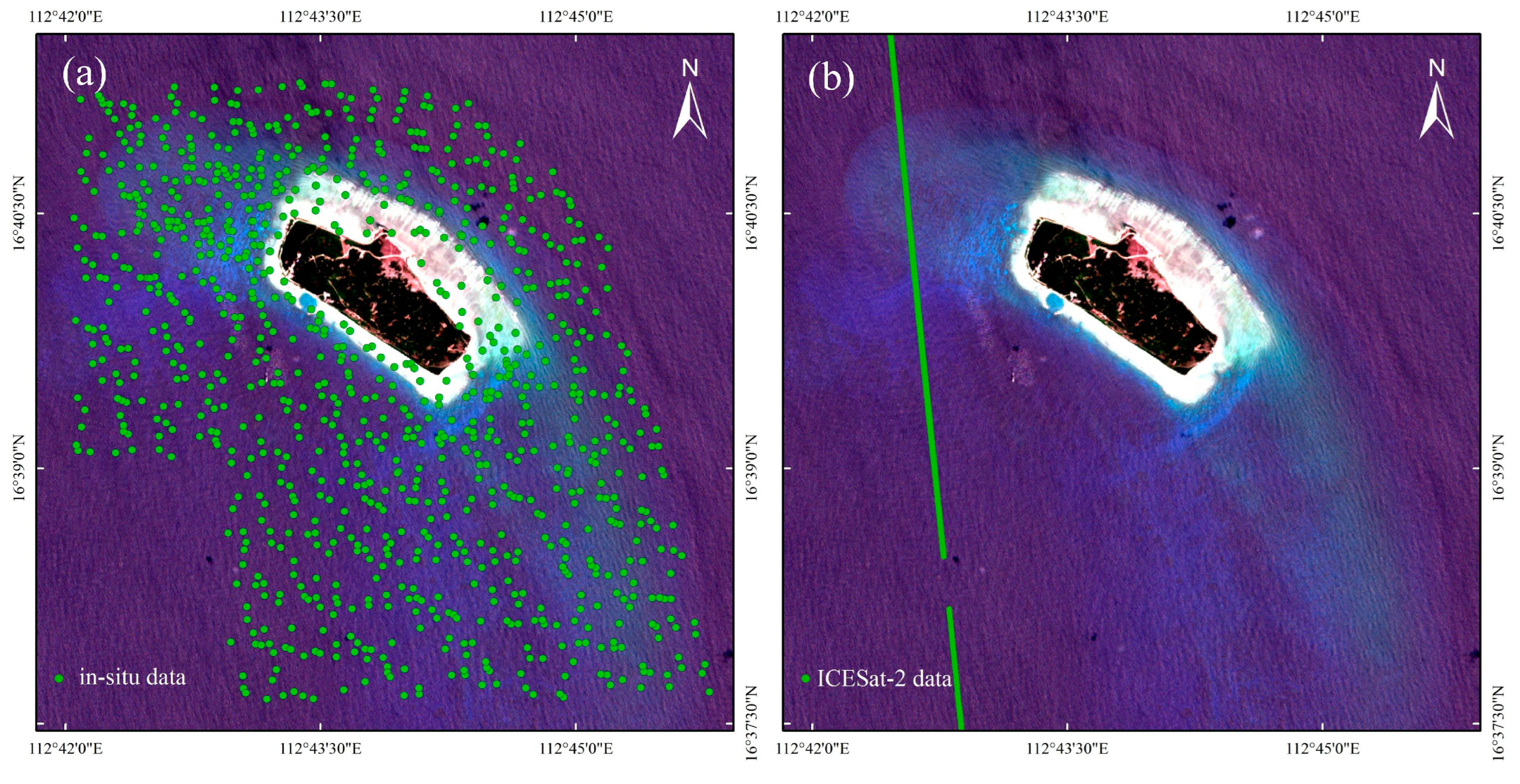
2.2.3. In Situ Bathymetry Data
2.3. Methods
2.3.1. ICESat-2 Data Preprocessing
2.3.2. Sentinel-2 Image Preprocessing
2.3.3. Preliminary Bathymetry Inversion
2.3.4. Extraction of Virtual Control Points
2.3.5. Bathymetry Rectification Based on Virtual Control Points
2.3.6. Evaluation Criteria
3. Results
3.1. Bathymetry Results for Dong Island
3.1.1. Visualization of Bathymetric Mapping
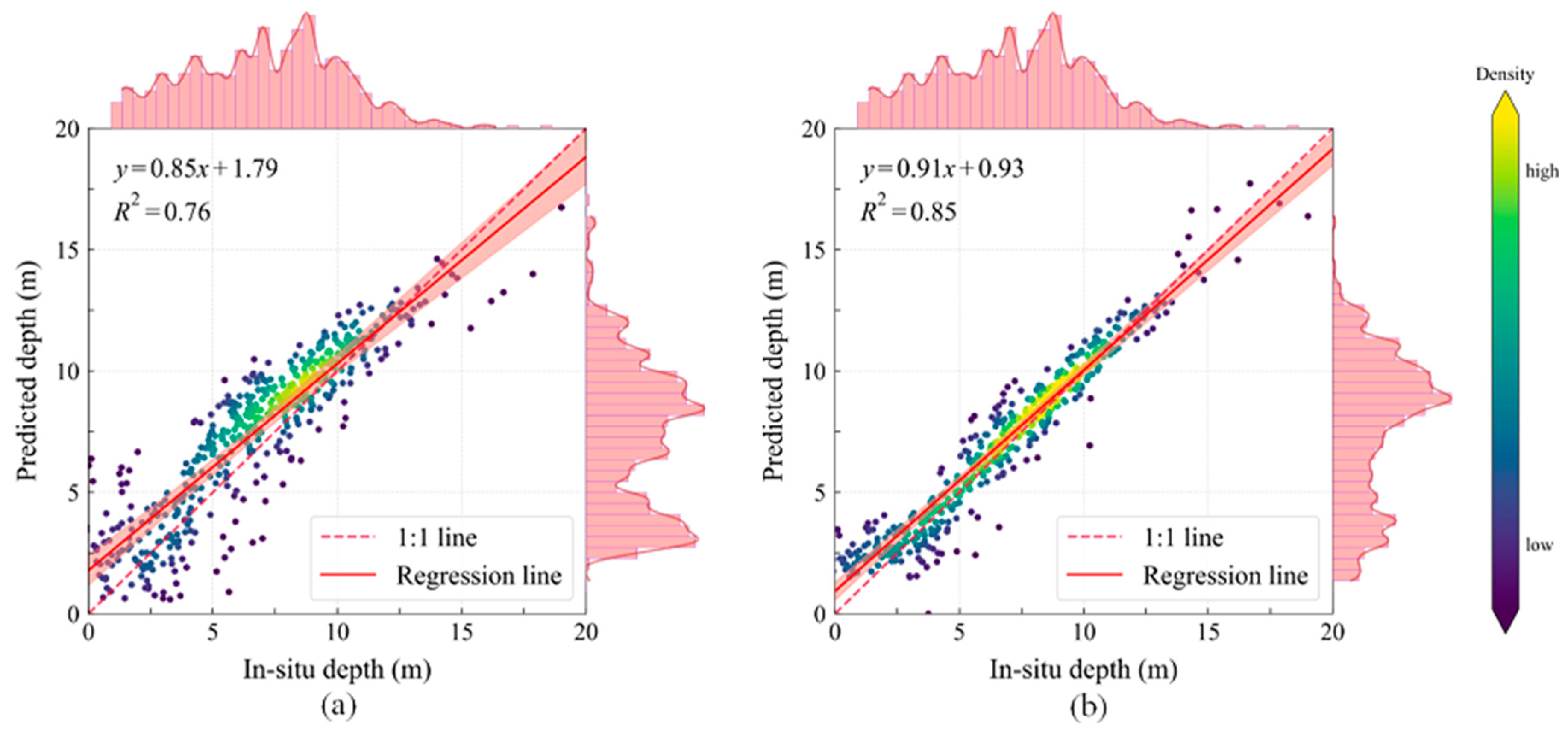
3.1.2. Accuracy Assessment
3.1.3. Residual Analysis Based on In-Situ Data
3.2. Bathymetry Results for Ganquan Island
3.2.1. Visualization of Bathymetric Mapping
3.2.2. Accuracy Assessment
3.2.3. Residual Analysis Based on In-Situ Data
3.3. Bathymetry Results for Wuzhizhou Island
3.3.1. Visualization of Bathymetric Mapping
3.3.2. Accuracy Assessment
3.3.3. Residual Analysis Based on In-Situ Data
4. Discussion
4.1. Comparative Analysis of Different Bathymetric Inversion Methods
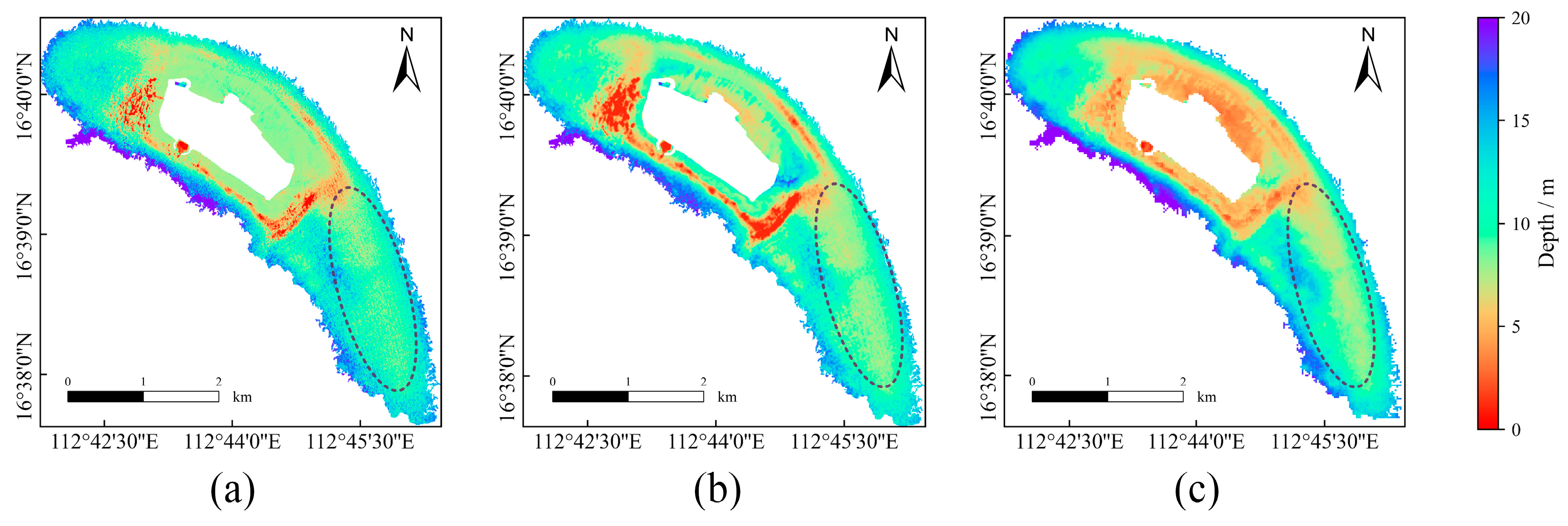
4.1.1. Bathymetry Visualization via Different Methods
4.1.2. Overall Accuracy Evaluation for Different Methods
4.1.3. Accuracy Analysis in Different Bathymetric Intervals
4.2. Analysis of Advantages and Disadvantages of the Proposed Method
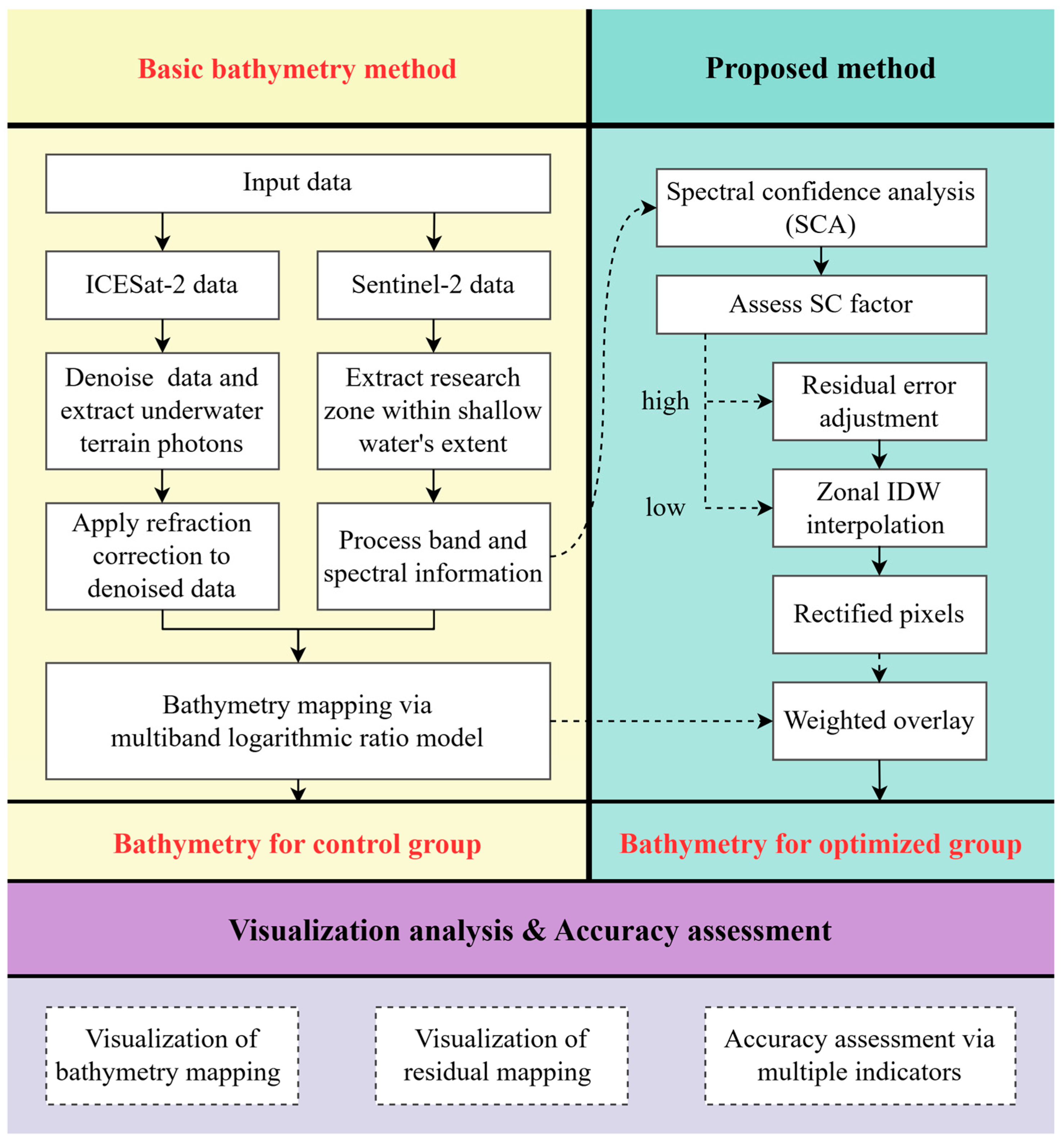
- Virtual control point extraction: The extraction of virtual control points not only augments the quantity of control points but also ensures their homogeneous spatial distribution within the study area, thereby resolving the uneven distribution issue inherent in ICESat-2-derived sample points.
- Spectral confidence analysis: For low-confidence pixels, the SCA framework employs spatial interpolation of high-confidence neighboring pixels to estimate bathymetric values, which are used for weighting incorporation into the final bathymetric product. This integration enables the results to encapsulate both spectral information from the inversion model and spatial contextual information, with the multi-dimensional information input significantly enhancing the reliability of inversion outcomes compared to conventional spectral-only approaches.
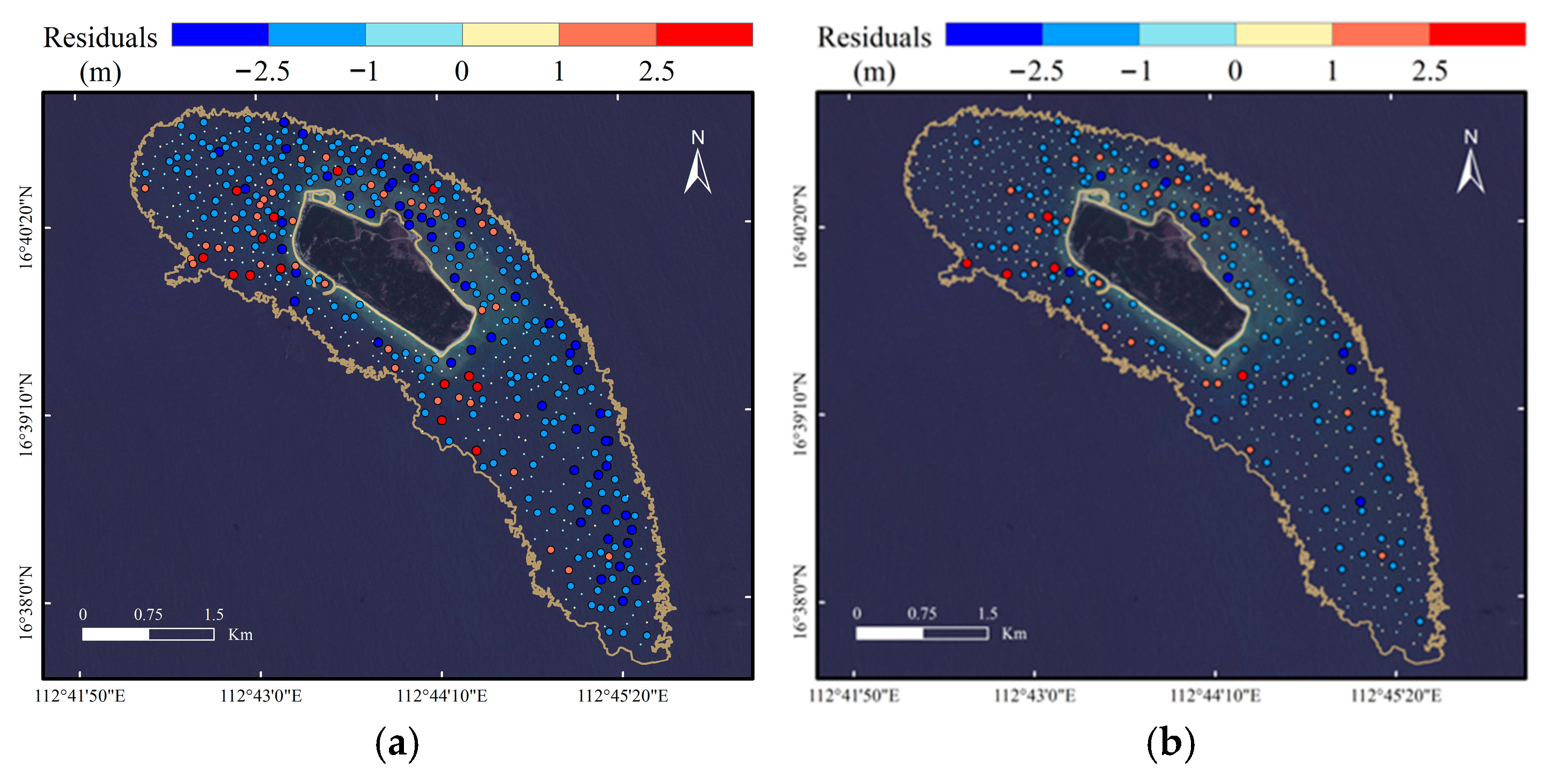
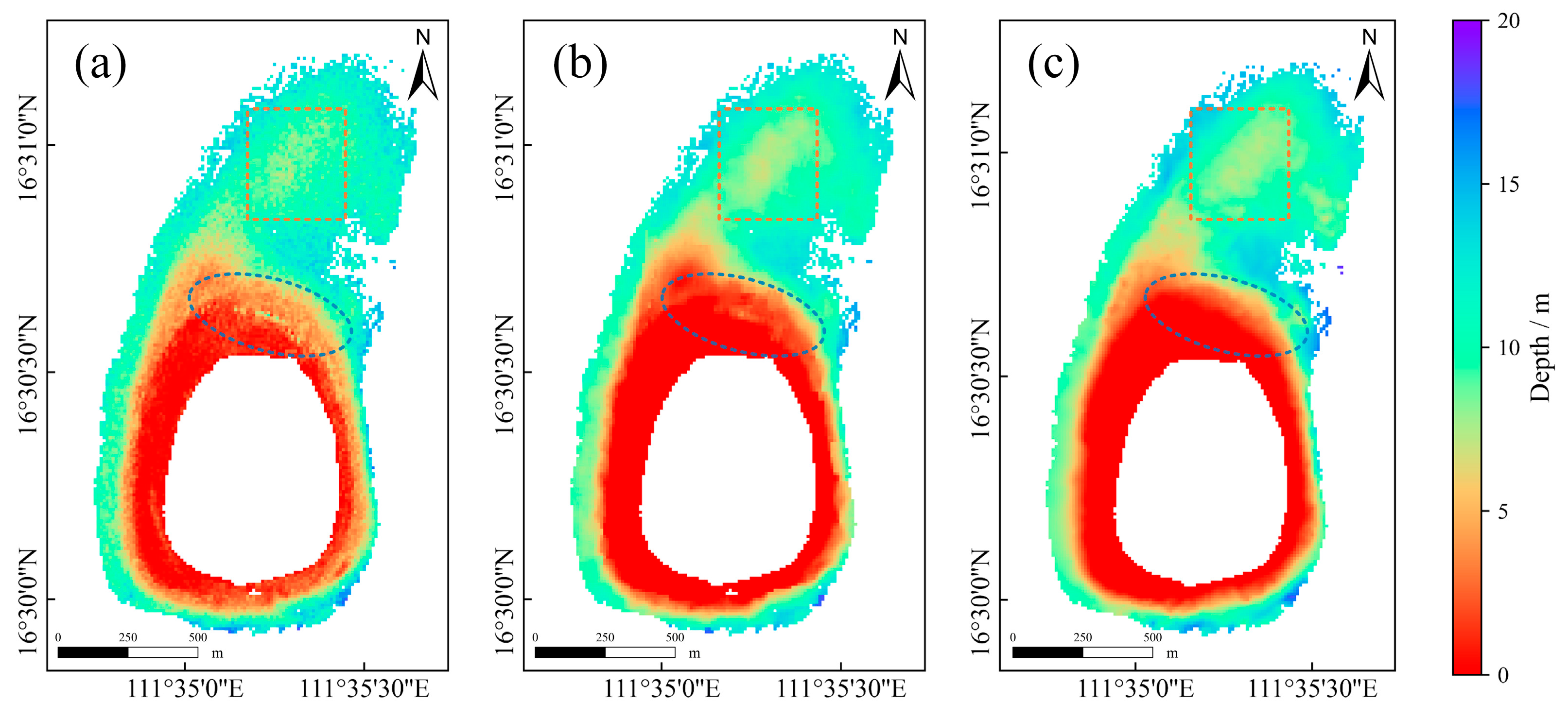
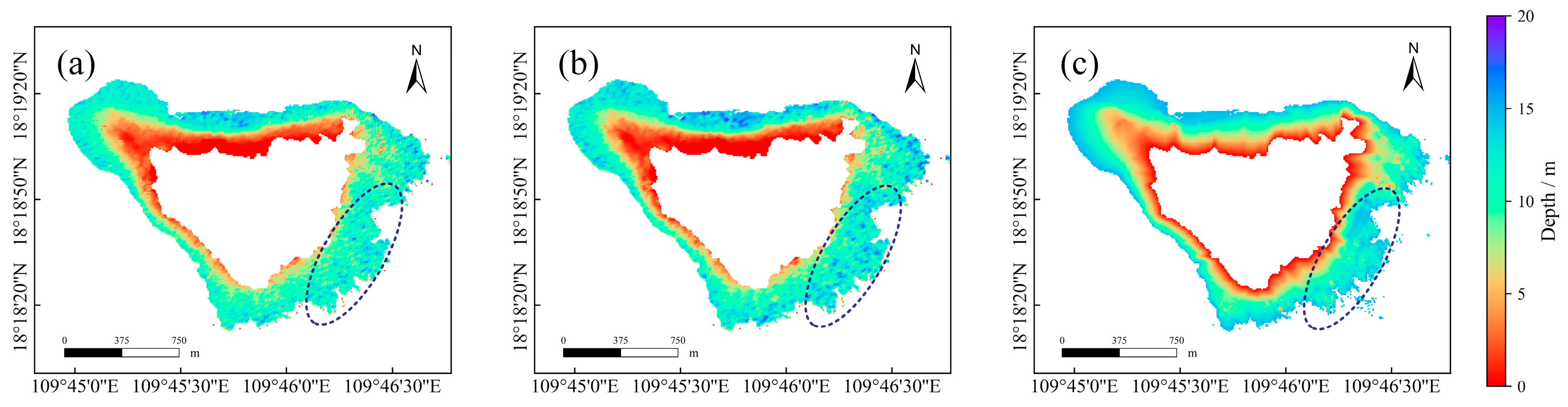
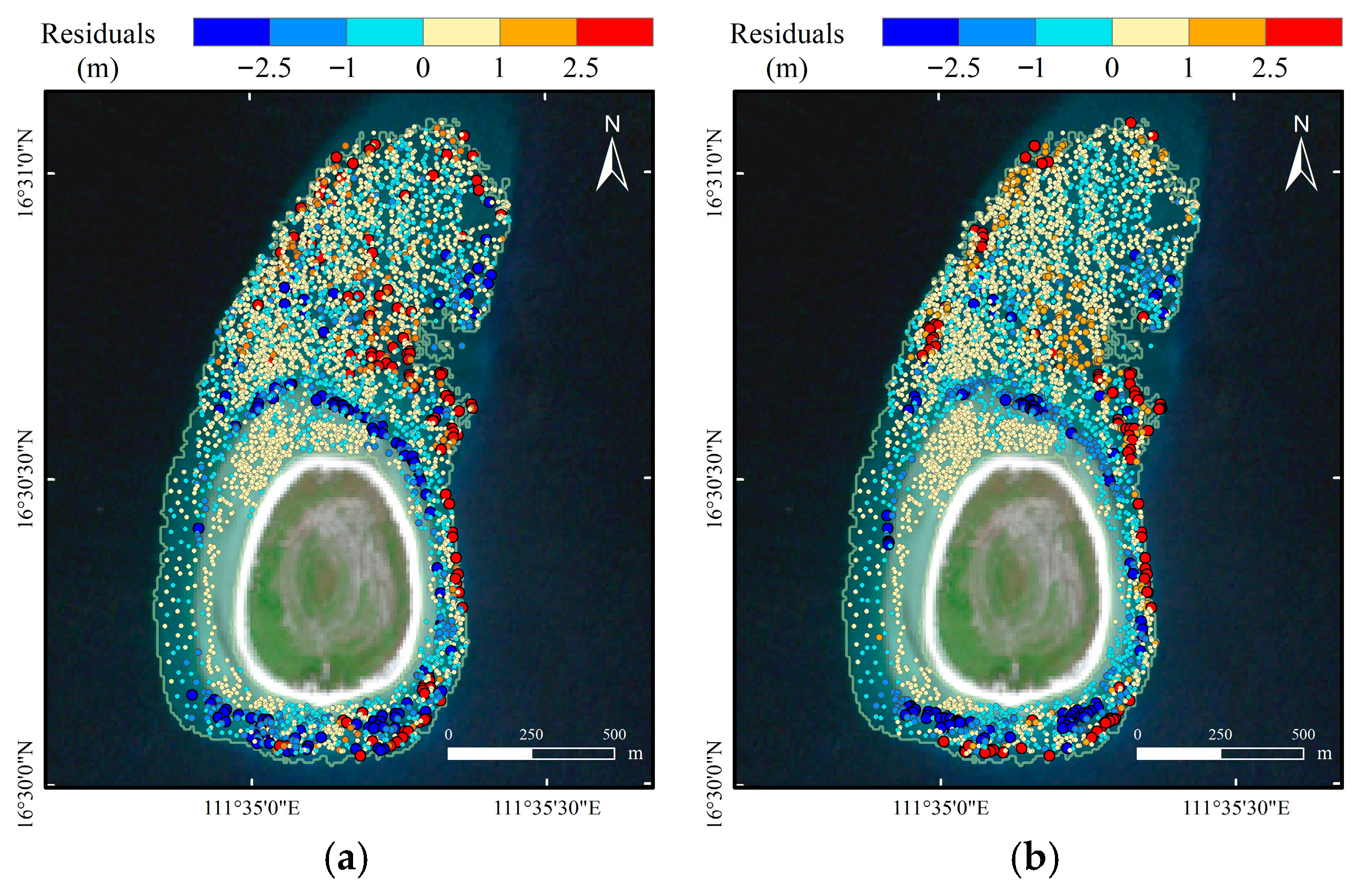
- Our method only requires a small increase in computational complexity to greatly improve the accuracy of the basic water depth inversion model and obtain water depth inversion results that are closer to the in situ data. Our method can obtain reliable water depth values in remote areas that are difficult for humans to reach. However, our method still demonstrates noticeable deviations from in situ bathymetry maps in certain cases, particularly in regions with dramatic terrain variations. By correlating in situ bathymetry maps with residual distribution patterns, it is observed that high-error zones predominantly coincide with areas of abrupt water depth changes. This suggests that when performing spatial interpolation on low-confidence pixels, significant elevation differences within neighboring areas may lead to substantial deviations. Context-aware neighborhood size adjustment is used. For example, the interpolation window size is dynamically reduced in rugged terrains, which could potentially improve accuracy by better maintaining spatial correlation information. Additionally, ICESat-2 photons serve as bathymetric control points, and the accuracy of bathymetric inversion is directly influenced by ICESat-2 processing results, such as denoising and refraction correction. Therefore, ICESat-2 requires more refined processing to deliver high-precision bathymetric control points.
5. Conclusions
Author Contributions
Funding
Data Availability Statement
Acknowledgments
Conflicts of Interest
References
- Mason, D.C.; Gurney, C.; Kennett, M. Beach topography mapping—A comparison of techniques. J. Coast Conserv. 2000, 6, 113–124. [Google Scholar] [CrossRef]
- Cesbron, G.; Melet, A.; Almar, R.; Lifermann, A.; Tullot, D.; Crosnier, L. Pan-european satellite-derived costal bathymetry—Review, user needs and future services. Front. Mar. Sci. 2021, 8, 1591. [Google Scholar] [CrossRef]
- Zhang, X.; Chen, Y.; Le, Y.; Zhang, D.; Yan, Q.; Dong, Y. Nearshore Bathymetry Based on ICESat–2 and Multispectral Images: Comparison Between Sentinel–2, Landsat–8, and Testing Gaofen–2. IEEE J. Sel. Top. Appl. Earth Obs. Remote Sens. 2022, 15, 2449–2462. [Google Scholar] [CrossRef]
- Jagalingam, P.; Akashaya, B.; Hegde, A.V. Bathymetry mapping using Landsat-8 satellite imagery. Procedia Eng. 2015, 116, 560–566. [Google Scholar] [CrossRef]
- Li, Y.; Zhou, J.; Li, J.; Li, N.; Zhu, F.; Sun, H. Global marine gravity from 27 cycles of SWOT satellite data: Accuracy and spatial resolution evaluation. J. Geod. 2025, 99, 51. [Google Scholar] [CrossRef]
- Kutser, T.; Hedley, J.; Giardino, C.; Roelfsema, C.; Brando, V.E. Remote sensing of shallow waters—A 50 year retrospective and future directions. Remote Sens. Environ. 2020, 240, 111619. [Google Scholar] [CrossRef]
- Melet, A.; Teatini, P.; Le, C.G.; Jamet, C.; Conversi, A.; Benveniste, J.; Almar, R. Earth observations for monitoring marine coastal hazards and their drivers. Surv. Geophys. 2020, 41, 1489–1534. [Google Scholar] [CrossRef]
- Duplančić, L.T.; Leder, N.; Peroš, J. Satellite derived bathymetry survey method—Example of Hramina Bay. Trans. Marit. Sci. 2019, 8, 99–108. [Google Scholar] [CrossRef]
- Lee, Z.; Carder, K.L.; Mobley, C.D.; Steward, R.G.; Patch, J.S. Hyperspectral remote sensing for shallow waters: 2. Deriving bottom depths and water properties by optimization. Appl. Opt. 1999, 38, 3831–3843. [Google Scholar] [CrossRef]
- Stumpf, R.P.; Holderied, K.; Sinclair, M. Determination of water depth with high-resolution satellite imagery over variable bottom types. Limnol. Oceanogr. 2003, 48, 547–556. [Google Scholar] [CrossRef]
- Vinayaraj, P.; Raghavan, V.; Masumoto, S. Satellite-derived bathymetry using adaptive geographically weighted regression model. Mar. Geod. 2016, 39, 458–478. [Google Scholar] [CrossRef]
- Mobley, C.D. Radiative transfer in the ocean. In Encyclopedia of Ocean Sciences; Academic Press: Cambridge, MA, USA, 2001; pp. 2321–2330. [Google Scholar]
- Vinayaraj, P. Development of Algorithms for Near-Shore Satellite Derived Bathymetry Using Multispectral Remote Sensing Images. Ph.D. Thesis, Osaka Municipal University, Osaka, Japan, 2017. [Google Scholar]
- Su, H. Geographically adaptive inversion model for improving bathymetric retrieval from satellite multispectral imagery. IEEE Trans. Geosci. Remote Sens. 2014, 52, 465–476. [Google Scholar] [CrossRef]
- Herrmann, J.; Magruder, L.A.; Markel, J.; Parrish, C.E. Assessing the ability to quantify bathymetric change over time using solely satellite-based measurements. Remote Sens. 2022, 14, 1232. [Google Scholar] [CrossRef]
- Le, Q.A.; Collin, A.; Jasinski, M.F.; Devillers, R. Very high-resolution satellite-derived bathymetry and habitat mapping using pleiades-1 and ICESat-2. Remote Sens. 2022, 14, 133. [Google Scholar]
- Selamat, M.B.; Muhiddin, A.H.; Yusuf, S.; Jompa, J. Toward geomorphic mapping of reef habitat by laser altimeter on ICESat-2 Satellite. IOP Conf. Ser. Earth Environ. Sci. 2021, 860, 012080. [Google Scholar] [CrossRef]
- Van, A.N.; Quang, N.H.; Son, T.P.H.; An, T.T. High-resolution benthic habitat mapping from machine learning on Planet Scope imagery and ICESat-2 data. Geocarto Int. 2023, 38, 2184875. [Google Scholar] [CrossRef]
- Ma, Y.; Xu, N.; Liu, Z.; Yang, B.; Yang, F.; Wang, X.; Li, S. Satellite-derived bathymetry using the ICESat-2 lidar and Sentinel-2 imagery datasets. Remote Sens. Environ. 2020, 250, 112047. [Google Scholar] [CrossRef]
- Xie, T.; Kong, R.; Nurunnbi, A.; Bai, S.; Zhang, X. Machine-learning-method-based inversion of shallow bathymetric maps using ICESat-2 ATL03 data. IEEE J Sel. Top. Appl. Earth Obs. Remote Sens. 2023, 16, 3697–3714. [Google Scholar] [CrossRef]
- Dietrich, J.T.; Rackley, R.A.; Gibbons, A.; Magruder, L.A.; Parrish, C.E. Analysis of ICESat-2 data acquisition algorithm parameter enhancements to improve worldwide bathymetric coverage. Earth Space Sci. 2024, 11, e2023EA003270. [Google Scholar] [CrossRef]
- Chen, Y.; Zhu, Z.; Le, Y.; Qiu, Z.; Chen, G.; Wang, L. Refraction correction and coordinate displacement compensation in nearshore bathymetry using ICESat-2 lidar data and remote sensing images. Opt. Express 2021, 29, 2411–2430. [Google Scholar] [CrossRef]
- Ranndal, H.; Sigaard, C.P.; Kliving, P.; Baltazar Andersen, O.; Nielsen, K. Evaluation of a statistical approach for extracting shallow water bathymetry signals from ICESat-2 ATL03 photon data. Remote Sens. 2021, 13, 3548. [Google Scholar] [CrossRef]
- Watkins, R.H.; Sayers, M.J.; Shuchman, R.A.; Bosse, K.R. Validation of ICESat-2 derived data products on freshwater lakes: Bathymetry, diffuse attenuation coefficient for downwelling irradiance (Kd), and particulate backscatter coefficient (bbp). IEEE Geosci. Remote Sens. Lett. 2023, 20, 1501405. [Google Scholar] [CrossRef]
- Zhang, D.; Chen, Y.; Le, Y.; Dong, Y.; Dai, G.; Wang, L. Refraction and coordinate correction with the JONSWAP model for ICESat-2 bathymetry. ISPRS J. Photogramm. Remote Sens. 2020, 86, 285–300. [Google Scholar] [CrossRef]
- Neumann, T.A.; Martino, A.J.; Markus, T.; Bae, S.; Bock, M.R.; Brenner, A.C.; Brunt, K.M.; Cavanaugh, J.; Fernandes, S.T.; Hancock, D.W.; et al. The ice, cloud, and land elevation satellite—2 mission: A global product derived from the advanced topographic laser altimeter system. Remote Sens. Environ. 2019, 233, 111325. [Google Scholar] [CrossRef] [PubMed]
- Babbel, B.J.; Parrish, C.E.; Magruder, L.A. ICESat-2 elevation retrievals in support of satellite derived bathymetry for global science applications. Geophys. Res. Lett. 2021, 48, e2020GL090629. [Google Scholar] [CrossRef]
- Hsu, H.; Huang, C.; Michael, J.; Li, Y.; Gao, H.; Tsutomu, Y.; Wang, C.; Chang, T.; Ren, H.; Kuo, C.; et al. A semi-empirical scheme for bathymetric mapping in shallow water by ICESat-2 and Sentinel-2: A case study in the South China Sea. ISPRS J. Photogramm. Remote Sens. 2021, 178, 1–19. [Google Scholar] [CrossRef]
- Leng, Z.; Zhang, J.; Ma, Y.; Zhang, J. ICESat-2 bathymetric signal reconstruction method based on a deep learning model with active–passive data fusion. Remote Sens. 2023, 15, 460. [Google Scholar] [CrossRef]
- Xie, C.; Chen, P.; Pan, D. Bathymetric inversion method for active-passive remote sensing fused radiative transfer information convolutional neural networks. Acta Photon. Sin. 2024, 53, 46–58. [Google Scholar]
- Wicaksono, P.; Harahap, S.D.; Hendriana, R. Satellite-derived bathymetry from WorldView-2 based on linear and machine learning regression in the optically complex shallow water of the coral reef ecosystem of Kemujan island. Remote Sens. Appl. 2024, 33, 101085. [Google Scholar] [CrossRef]
- Li, J.; Dong, Z.; Chen, L.; Tang, Q.; Hao, J.; Zhang, Y. Multi-temporal image fusion-based shallow-water bathymetry inversion method using active and passive satellite remote sensing data. Remote Sens. 2025, 17, 265. [Google Scholar] [CrossRef]
- Xie, C.; Chen, P.; Jamet, C.; Pan, D. New reference bathymetric point cloud datasets derived from ICESat-2 observations: A case in the Caribbean Sea. IEEE Trans. Geosci. Remote Sens. 2024, 62, 4200824. [Google Scholar] [CrossRef]
- Chen, Y.; Wu, L.; Le, Y.; Zhao, Q.; Zhang, D.; Qiu, Z. High-accuracy bathymetric method fusing ICESAT-2 datasets and the two-media photogrammetry model. Int. J. Appl. Earth Obs. Geoinf. 2024, 134, 104179. [Google Scholar] [CrossRef]
- Xie, C.; Chen, P.; Zhang, S.; Huang, H. Nearshore bathymetry from ICESat-2 LiDAR and Sentinel-2 imagery datasets using physics-informed CNN. Remote Sens. 2024, 16, 511. [Google Scholar] [CrossRef]
- Li, N.; Wang, M.; Yang, B.; Pan, J.; Pi, Y.; Fan, Z. SCBMLD: A photon signal extraction method for ICESat-2 satellite-derived bathymetry. Opt. Express 2025, 33, 9023–9040. [Google Scholar] [CrossRef] [PubMed]
- Huang, G.; Dong, Z.; Liu, Y.; Chen, Y.; Li, J.; Wang, Y.; Meng, W. An optimized denoising method for ICESat-2 photon-counting data considering heterogeneous density and weak connectivity. Opt. Express 2023, 31, 41496–41517. [Google Scholar] [CrossRef]
- Zhang, B.; Liu, Y.; Dong, Z.; Li, J.; Chen, Y.; Tang, Q.; Huang, G.; Tao, J. An optimal denoising method for spaceborne photon-counting LiDAR based on a multiscale quadtree. Remote Sens. 2024, 16, 2475. [Google Scholar] [CrossRef]
- Zhu, X.; Wang, C.; Xi, X.; Nie, S.; Yang, X.; Li, D. Research progress of ICESat-2/ATLAS data processing and applications. Infrared Laser Eng. 2020, 49, 76–85. [Google Scholar]
- Leng, Z.; Zhang, J.; Ma, Y.; Zhang, J.; Zhu, H. A novel bathymetry signal photon extraction algorithm for photon-counting LiDAR based on adaptive elliptical neighborhood. Int. J. Appl. Earth Obs. Geoinf. 2022, 115, 103080. [Google Scholar] [CrossRef]
- Parrish, C.E.; Magruder, L.A.; Neuenschwander, A.L.; Forfinski-Sarkozi, N.; Alonzo, M.; Jasinski, M. Validation of ICESat-2 ATLAS bathymetry and analysis of ATLAS’s bathymetric mapping performance. Remote Sens. 2019, 11, 1634. [Google Scholar] [CrossRef]
- Guo, X. Shallow Water Bathymetry Based on ICESat-2 and Sentinel-2. Master’s Thesis, Nanjing University of Information Science & Technology, Nanjing, China, 2023; pp. 20–24. [Google Scholar]
- Klonowski, W.; Fearns, P.; Lynch, M. Retrieving key benthic cover types and bathymetry from hyperspectral imagery. J. Appl. Remote Sens. 2007, 1, 011505. [Google Scholar] [CrossRef]
- Peng, K.; Xie, H.; Xu, Q.; Huang, P.; Liu, Z. Physics-assisted convolutional neural network for bathymetric mapping using ICESat-2 and Sentinel-2 data. IEEE Trans. Geosci. Remote Sens. 2022, 60, 4210513. [Google Scholar] [CrossRef]
- Lyzenga, D.R.; Malinas, N.P.; Tanis, F.J. Multispectral bathymetry using a simple physically based algorithm. IEEE Trans. Geosci. Remote Sens. 2006, 44, 2251–2259. [Google Scholar] [CrossRef]
- Huang, Y.; Yang, H.; Tang, S.; Liu, Y.; Li, Y. An appraisal of atmospheric correction and inversion algorithms for mapping high-resolution bathymetry over coral reef waters. IEEE Trans. Geosci. Remote Sens. 2023, 61, 4204511. [Google Scholar] [CrossRef]






| Study Area | Dong Island | Ganquan Island | Wuzhizhou Island | |
|---|---|---|---|---|
| ICESat-2 | Acquisition date | 10 September 2022 | 15 August 2023 | 28 June 2022 |
| Track ID | 1238 | 0857 | 1607 | |
| Latitude range | 16°35′55″N~16°39′7″N | 16°32′52″N~16°33′7″N | 18°15′24″N~18°19′1″N | |
| Photon counts | 830 | 621 | 395 | |
| Sentinel-2 | Acquisition date | 19 May 2023 | 8 February 2024 | 16 April 2024 |
| Processing level | S2A | S2A | S2B | |
| Spatial resolution (m) | 10 | 10 | 10 | |
| Strategy | R2 | RMSE (m) | MRE (%) | MAE (m) |
|---|---|---|---|---|
| Control group | 0.76 | 1.63 | 13.37 | 1.16 |
| Optimized group | 0.85 | 1.24 | 12.29 | 0.97 |
| Strategy | R2 | RMSE (m) | MRE (%) | MAE (m) |
|---|---|---|---|---|
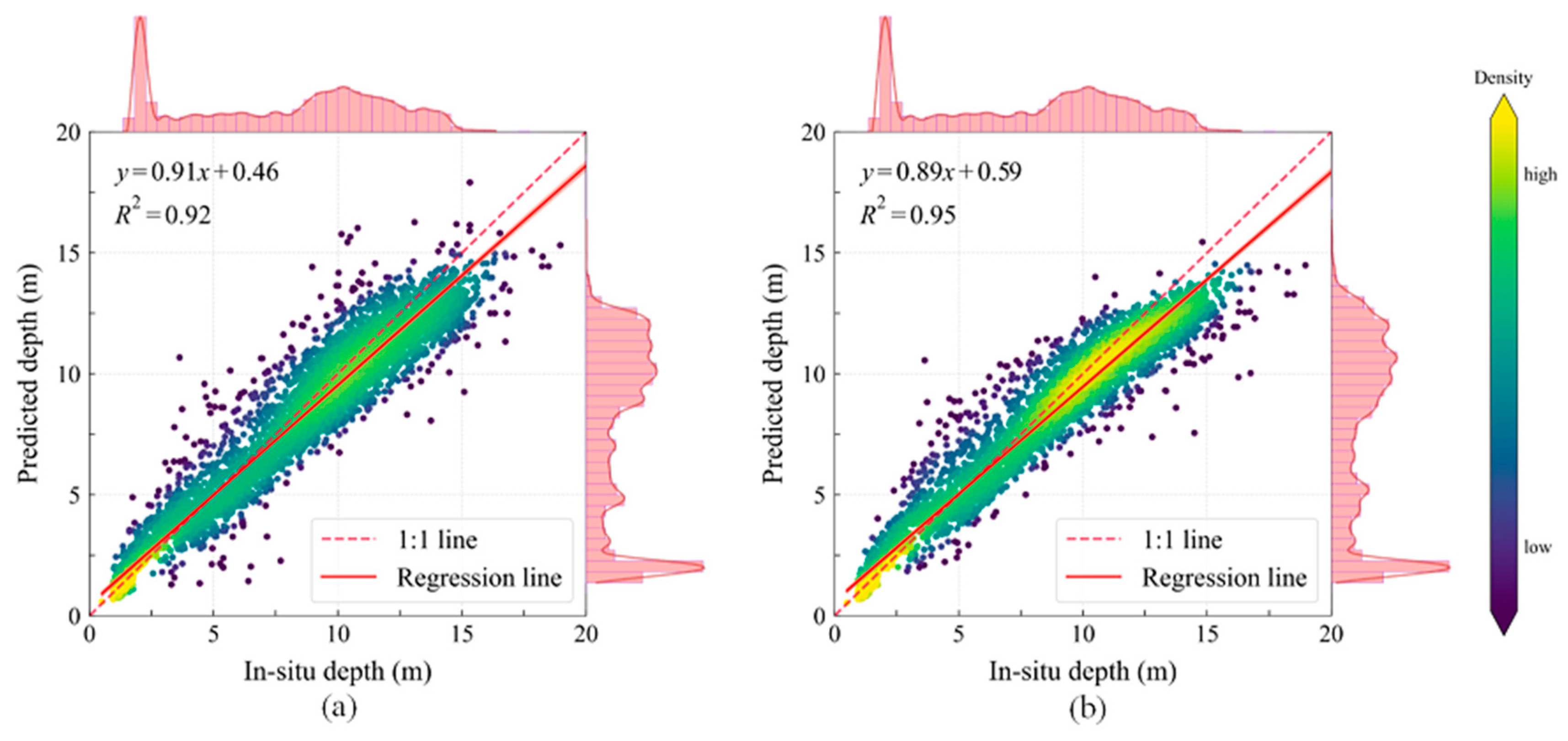
| Control group | 0.92 | 1.15 | 12.82 | 0.98 |
| Optimized group | 0.95 | 1.07 | 11.67 | 0.86 |
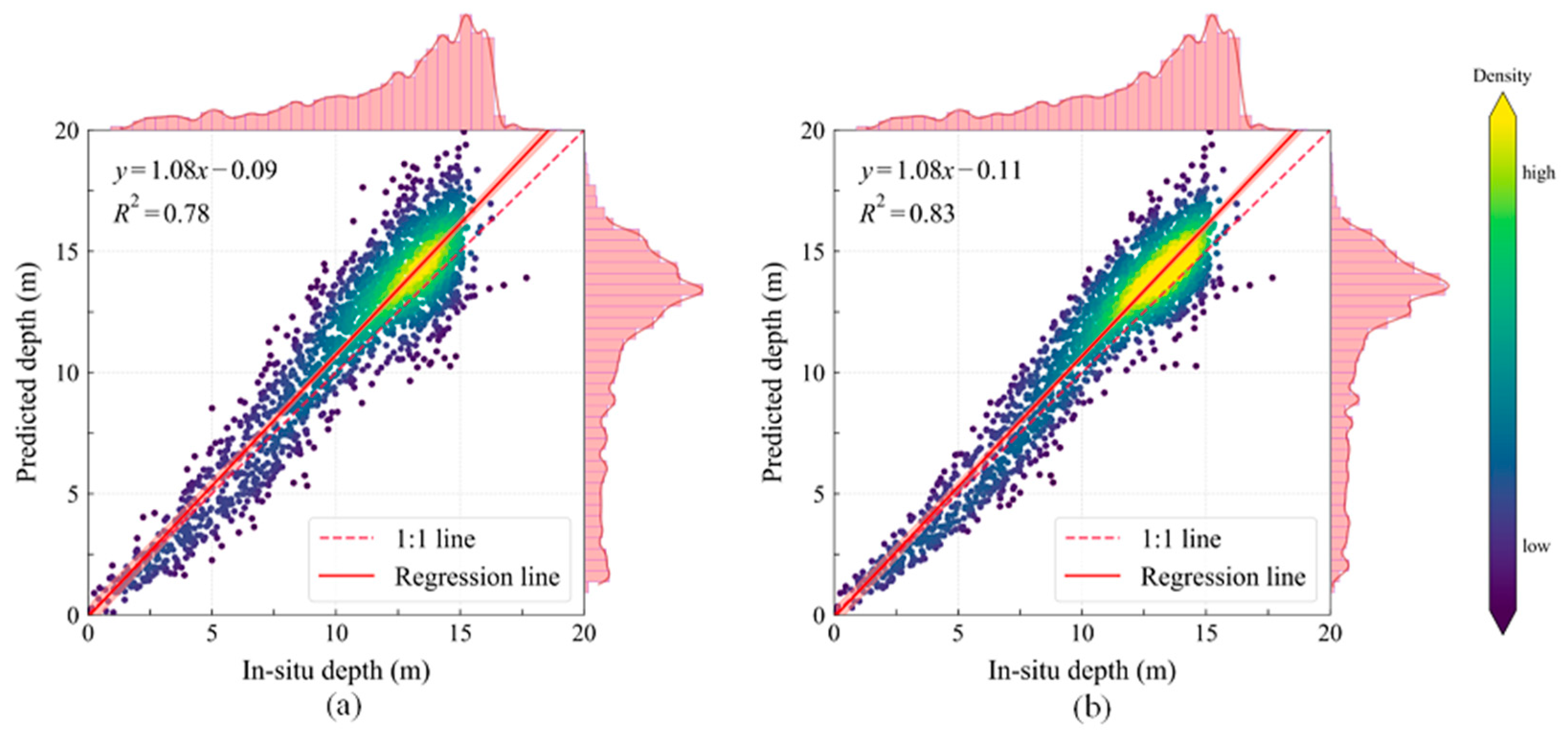
| Strategy | R2 | RMSE (m) | MRE (%) | MAE (m) |
|---|---|---|---|---|
| Control group | 0.78 | 1.72 | 14.14 | 1.65 |
| Optimized group | 0.83 | 1.48 | 12.36 | 1.22 |
| Study Area | Method | R2 | RMSE (m) | MRE (%) | MAE (m) |
|---|---|---|---|---|---|
| DongIsland | BRM | 0.79 | 1.60 | 16.36 | 1.73 |
| MRM | 0.65 | 2.11 | 14.71 | 1.87 | |
| BRQFM | 0.79 | 1.65 | 16.38 | 1.77 | |
| Proposed Method | 0.85 | 1.24 | 12.29 | 0.97 | |
| GanquanIsland | BRM | 0.73 | 2.31 | 23.71 | 1.69 |
| MRM | 0.70 | 2.48 | 25.08 | 1.84 | |
| BRQFM | 0.85 | 1.70 | 17.74 | 1.13 | |
| Proposed Method | 0.95 | 1.07 | 11.67 | 0.86 | |
| WuzhizhouIsland | BRM | 0.76 | 2.87 | 18.79 | 2.30 |
| MRM | 0.72 | 4.00 | 26.84 | 3.34 | |
| BRQFM | 0.79 | 2.12 | 16.66 | 1.51 | |
| Proposed Method | 0.83 | 1.48 | 12.36 | 1.22 |
Disclaimer/Publisher’s Note: The statements, opinions and data contained in all publications are solely those of the individual author(s) and contributor(s) and not of MDPI and/or the editor(s). MDPI and/or the editor(s) disclaim responsibility for any injury to people or property resulting from any ideas, methods, instructions or products referred to in the content. |
© 2025 by the authors. Licensee MDPI, Basel, Switzerland. This article is an open access article distributed under the terms and conditions of the Creative Commons Attribution (CC BY) license (https://creativecommons.org/licenses/by/4.0/).
Share and Cite
Dong, Z.; Tao, J.; Liu, Y.; Feng, Y.; Chen, Y.; Wang, Y. Shallow Sea Bathymetric Inversion of Active–Passive Satellite Remote Sensing Data Based on Virtual Control Point Inverse Distance Weighting. Remote Sens. 2025, 17, 3621. https://doi.org/10.3390/rs17213621
Dong Z, Tao J, Liu Y, Feng Y, Chen Y, Wang Y. Shallow Sea Bathymetric Inversion of Active–Passive Satellite Remote Sensing Data Based on Virtual Control Point Inverse Distance Weighting. Remote Sensing. 2025; 17(21):3621. https://doi.org/10.3390/rs17213621
Chicago/Turabian StyleDong, Zhipeng, Junlin Tao, Yanxiong Liu, Yikai Feng, Yilan Chen, and Yanli Wang. 2025. "Shallow Sea Bathymetric Inversion of Active–Passive Satellite Remote Sensing Data Based on Virtual Control Point Inverse Distance Weighting" Remote Sensing 17, no. 21: 3621. https://doi.org/10.3390/rs17213621
APA StyleDong, Z., Tao, J., Liu, Y., Feng, Y., Chen, Y., & Wang, Y. (2025). Shallow Sea Bathymetric Inversion of Active–Passive Satellite Remote Sensing Data Based on Virtual Control Point Inverse Distance Weighting. Remote Sensing, 17(21), 3621. https://doi.org/10.3390/rs17213621