Simulation and Analysis of Sea Surface Skin Temperature Diurnal Variation Using a One-Dimensional Mixed Layer Model and Himawari-8 Data
 , ,
, ,
Highlights
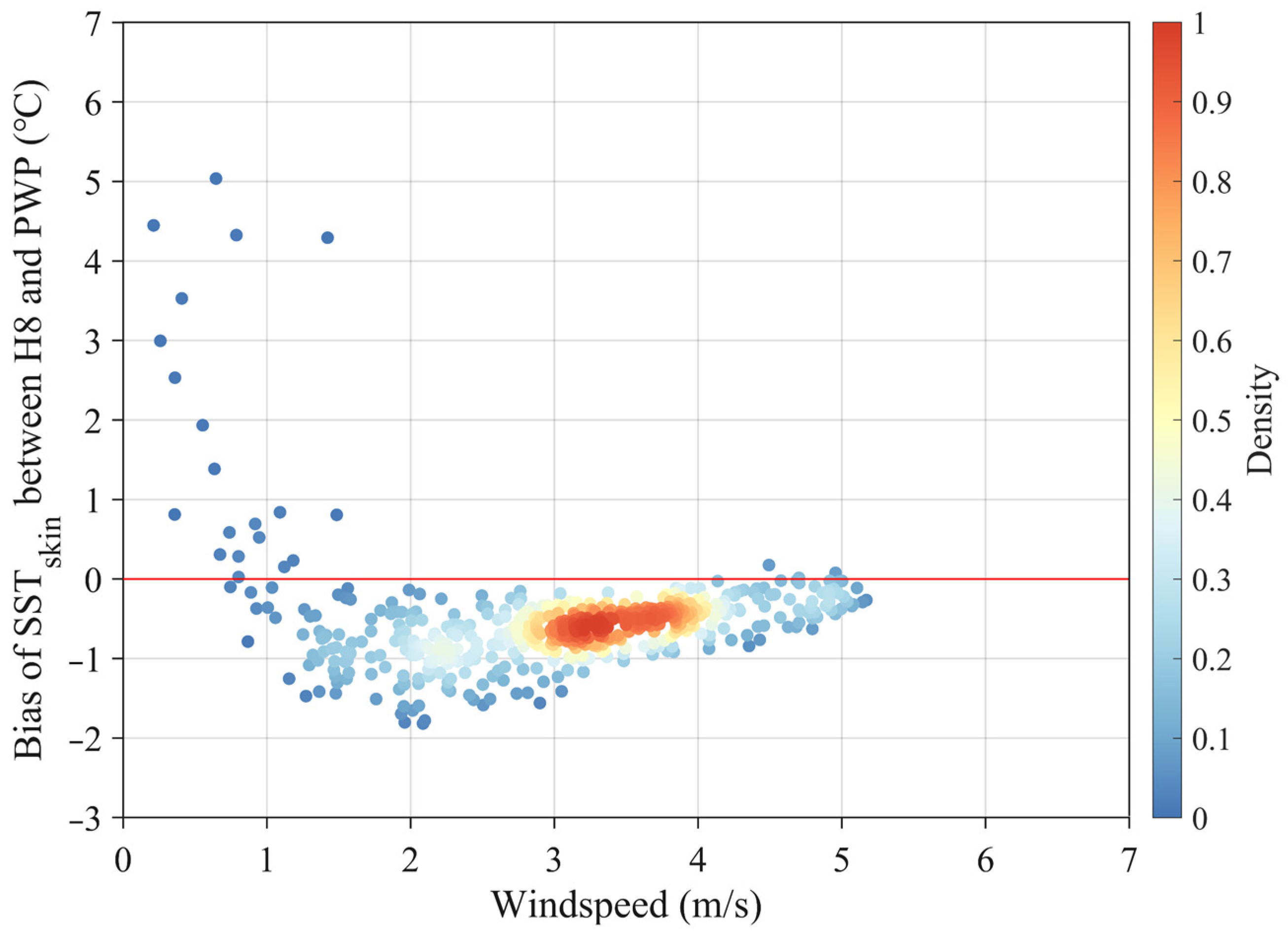
- The improved PWP model reproduced the SSTskin diurnal cycle consistently with observations of Himawari-8, matching significant warming regions and achieving a mean bias of −0.37 °C. Identified abnormal SSTskin overestimation in low-wind-speed areas when using the improved PWP model, which is attributed to rapid mixed-layer thinning and the lack of horizontal diffusion in this 1D model.
- The improved PWP model provides a computationally efficient tool for studying upper-ocean vertical processes, thanks to its stable SSTskin parameterization scheme. The finding of PWP’s limitation under low wind speeds points out a direction for future model optimization—evaluating vertical mixing schemes in low-wind conditions to enhance the capability of numerical models to simulate SSTskin.
Abstract
1. Introduction
2. Materials and Methods
2.1. Materials
2.1.1. Himawari-8 Data
2.1.2. In Situ Data
2.1.3. Meteorological Data
2.2. Methods
2.2.1. The Improved PWP Model
2.2.2. Parameterization of SSTskin
3. Results
3.1. A Diurnal Warming Event Observed by Himawari-8
3.1.1. Validation
3.1.2. The Spatiotemporal Distribution of Diurnal Warming Events
3.2. Simulation of SSTskin Diurnal Variation by PWP
3.2.1. Simulation Results
3.2.2. SSTskin Diurnal Variation Between Himawari-8 and PWP
3.3. Impact Factors of SSTskin Simulation
4. Discussion
5. Conclusions
Author Contributions
Funding
Data Availability Statement
Acknowledgments
Conflicts of Interest
References
- Minnett, P.J.; Alvera-Azcárate, A.; Chin, T.M.; Corlett, G.K.; Gentemann, C.L.; Karagali, I.; Li, X.; Marsouin, A.; Marullo, S.; Maturi, E.; et al. Half a century of satellite remote sensing of sea-surface temperature. Remote Sens. Environ. 2019, 233, 111366–111415. [Google Scholar] [CrossRef]
- Minnett, P.; Kaiser-Weiss, A. Group for High Resolution Sea-Surface Temperature Discussion Document: Near-Surface Oceanic Temperature Gradients; The Group for High Resolution Sea Surface Temperature: Leicester, UK, 2012. [Google Scholar]
- Bernie, D.J.; Guilyardi, E.; Madec, G.; Slingo, J.M.; Woolnough, S.J.; Cole, J. Impact of resolving the diurnal cycle in an ocean-atmosphere GCM. Part 2: A diurnally coupled CGCM. Clim. Dyn. 2008, 31, 909–925. [Google Scholar] [CrossRef]
- Bellenger, H.; Duvel, J.P. The event-to-event variability of the boreal winter MJO. Geophys. Res. Lett. 2012, 39, 8–15. [Google Scholar] [CrossRef]
- Stramma, L.; Cornillon, P.; Weller, R.A.; Price, J.F.; Briscoe, M.G. Large diurnal sea-surface temperature variability—Satellite and insitu measurements. J. Phys. Oceanogr. 1986, 16, 827–837. [Google Scholar] [CrossRef]
- Kilpatrick, K.A.; Podestá, G.; Walsh, S.; Williams, E.; Halliwell, V.; Szczodrak, M.; Brown, O.B.; Minnett, P.J.; Evans, R. A decade of sea surface temperature from MODIS. Remote Sens. Environ. 2015, 165, 27–41. [Google Scholar] [CrossRef]
- Giri, R.K.; Prakash, S.; Yadav, R.; Kaushik, N.; Shukla, M.V.; Thapliyal, P.; Saikrishnan, K. A review of the global operational geostationary meteorological satellites. Remote Sens. Appl. Soc. Environ. 2024, 37, 101403. [Google Scholar] [CrossRef]
- Paul McClain, E. Passive radiometry of the ocean from space—An overview. Bound.-Layer Meteorol. 1980, 18, 7–24. [Google Scholar] [CrossRef]
- Hursen, K.A.; Ross, R. GOES imager: Overview and evolutionary development. GOES-8 Beyond 1996, 2812, 160–173. [Google Scholar] [CrossRef]
- Legeckis, R. Long waves in the eastern equatorial Pacific Ocean: A view from a geostationary satellite. Science 1977, 197, 1179–1181. [Google Scholar] [CrossRef]
- Bessho, K.; Date, K.; Hayashi, M.; Ikeda, A.; Imai, T.; Inoue, H.; Kumagai, Y.; Miyakawa, T.; Murata, H.; Ohno, T.; et al. An Introduction to Himawari-8/9— Japan’s New-Generation Geostationary Meteorological Satellites. J. Meteorol. Soc. Japan. Ser. II 2016, 94, 151–183. [Google Scholar] [CrossRef]
- Bayler, E.; Chang, P.S.; De La Cour, J.L.; Helfrich, S.R.; Ignatov, A.; Key, J.; Lance, V.; Leuliette, E.W.; Byrne, D.A.; Liu, Y. Satellite Oceanography in NOAA: Research, Development, Applications, and Services Enabling Societal Benefits from Operational and Experimental Missions. Remote Sens. 2024, 16, 2656. [Google Scholar] [CrossRef]
- Wethey, D.S.; Weidberg, N.; Woodin, S.A.; Vazquez-Cuervo, J. Characterization and validation of ECOSTRESS sea surface temperature measurements at 70 m spatial scale. Remote Sens. 2024, 16, 1876. [Google Scholar] [CrossRef]
- Price, J.F.; Weller, R.A.; Pinkel, R. Diurnal cycling: Observations and models of the upper ocean response to diurnal heating, cooling, and wind mixing. J. Geophys. Res. Oceans 1986, 91, 8411–8427. [Google Scholar] [CrossRef]
- Fairall, C.; Bradley, E.; Godfrey, J.; Wick, G.; Edson, J.B.; Young, G. Cool-skin and warm-layer effects on sea surface temperature. J. Geophys. Res. Oceans 1996, 101, 1295–1308. [Google Scholar] [CrossRef]
- Zeng, X.; Beljaars, A. A prognostic scheme of sea surface skin temperature for modeling and data assimilation. Geophys. Res. Lett. 2005, 32, 14–18. [Google Scholar] [CrossRef]
- Schiller, A.; Godfrey, J. A diagnostic model of the diurnal cycle of sea surface temperature for use in coupled ocean-atmosphere models. J. Geophys. Res. Oceans 2005, 110, 11014–11023. [Google Scholar] [CrossRef]
- Gentemann, C.L.; Minnett, P.J.; Ward, B. Profiles of ocean surface heating (POSH): A new model of upper ocean diurnal warming. J. Geophys. Res. Oceans 2009, 114, 7017–7038. [Google Scholar] [CrossRef]
- Webster, P.J.; Clayson, C.A.; Curry, J.A. Clouds, radiation, and the diurnal cycle of sea surface temperature in the tropical western Pacific. J. Clim. 1996, 9, 1712–1730. [Google Scholar] [CrossRef]
- Clayson, C.; Curry, J. Determination of surface turbulent fluxes for the Tropical Ocean-Global Atmosphere Coupled Ocean-Atmosphere Response Experiment: Comparison of satellite retrievals and in situ measurements. J. Geophys. Res. Oceans 1996, 101, 28515–28528. [Google Scholar] [CrossRef]
- Kawai, Y.; Kawamura, H. Evaluation of the diurnal warming of sea surface temperature using satellite-derived marine meteorological data. J. Oceanogr. 2002, 58, 805–814. [Google Scholar] [CrossRef]
- Gentemann, C.L.; Donlon, C.J.; Stuart-Menteth, A.; Wentz, F.J. Diurnal signals in satellite sea surface temperature measurements. Geophys. Res. Lett. 2003, 30, 3–7. [Google Scholar] [CrossRef]
- Stuart-Menteth, A.; Robinson, I.; Donlon, C. Sensitivity of the diurnal warm layer to meteorological fluctuations. Part 2: A new parameterisation for diurnal warming. J. Atmos. Ocean Sci. 2005, 10, 209–234. [Google Scholar] [CrossRef]
- Filipiak, M.; Merchant, C.; Kettle, H.; Le Borgne, P. A statistical model for sea surface diurnal warming driven by numerical weather prediction fluxes and winds. Ocean Sci. 2012, 8, 197–209. [Google Scholar] [CrossRef]
- Zhang, H.; Beggs, H.; Merchant, C.J.; Wang, X.H.; Majewski, L.; Kiss, A.E.; Rodríguez, J.; Thorpe, L.; Gentemann, C.; Brunke, M. Comparison of SST Diurnal Variation Models Over the Tropical Warm Pool Region. J. Geophys. Res. Oceans 2018, 123, 3467–3488. [Google Scholar] [CrossRef]
- Karagali, I.; Høyer, J. Characterisation and quantification of regional diurnal SST cycles from SEVIRI. Ocean Sci. 2014, 10, 745–758. [Google Scholar] [CrossRef]
- Artale, V.; Iudicone, D.; Santoleri, R.; Rupolo, V.; Marullo, S.; D’Ortenzio, F. Role of surface fluxes in ocean general circulation models using satellite sea surface temperature: Validation of and sensitivity to the forcing frequency of the Mediterranean thermohaline circulation. J. Geophys. Res. Oceans 2002, 107, 3120–3149. [Google Scholar] [CrossRef]
- Takaya, Y.; Bidlot, J.R.; Beljaars, A.C.M.; Janssen, P.A.E.M. Refinements to a prognostic scheme of skin sea surface temperature. J. Geophys. Res. Oceans 2010, 115, 6009–6016. [Google Scholar] [CrossRef]
- de Toma, V.; Ciani, D.; Hesham Essa, Y.; Yang, C.; Artale, V.; Pisano, A.; Cavaliere, D.; Santoleri, R.; Storto, A. Skin sea surface temperature schemes in coupled ocean–atmosphere modelling: The impact of chlorophyll-interactive e-folding depth. Geosci. Model Dev. 2024, 17, 5145–5165. [Google Scholar] [CrossRef]
- Tu, Q.; Hao, Z. Validation of Sea Surface Temperature Derived From Himawari-8 by JAXA. IEEE J. Sel. Top. Appl. Earth Obs. Remote Sens. 2020, 13, 448–459. [Google Scholar] [CrossRef]
- Kramar, M.; Ignatov, A.; Petrenko, B.; Kihai, Y.; Dash, P. Near real time SST retrievals from Himawari-8 at NOAA using ACSPO system. In Proceedings of the Ocean Sensing and Monitoring VIII, Baltimore, MD, USA, 19–20 April 2016; pp. 149–159. [Google Scholar]
- Park, K.-A.; Woo, H.-J.; Chung, S.-R.; Cheong, S.-H. Development of Sea Surface Temperature Retrieval Algorithms for Geostationary Satellite Data (Himawari-8/AHI). Asia-Pac. J. Atmos. Sci. 2019, 56, 187–206. [Google Scholar] [CrossRef]
- Xu, F.; Ignatov, A. In situ SST Quality Monitor (iQuam). J. Atmos. Ocean. Technol. 2014, 31, 164–180. [Google Scholar] [CrossRef]
- Zhang, H.; Beggs, H.; Wang, X.H.; Kiss, A.E.; Griffin, C. Seasonal patterns of SST diurnal variation over the Tropical Warm Pool region. J. Geophys. Res. Oceans 2016, 121, 8077–8094. [Google Scholar] [CrossRef]
- Hersbach, H.; Bell, B.; Berrisford, P.; Hirahara, S.; Horányi, A.; Muñoz-Sabater, J.; Nicolas, J.; Peubey, C.; Radu, R.; Schepers, D. The ERA5 global reanalysis. Q. J. R. Meteorol. Soc. 2020, 146, 1999–2049. [Google Scholar] [CrossRef]
- Jin, Z.; Qiao, Y.; Wang, Y.; Fang, Y.; Yi, W. A new parameterization of spectral and broadband ocean surface albedo. Opt. Express 2011, 19, 26429–26443. [Google Scholar] [CrossRef]
- Zhang, Y.; Zhang, X. Ocean haline skin layer and turbulent surface convections. J. Geophys. Res. Oceans 2012, 117, 4017–4032. [Google Scholar] [CrossRef]
- Breivik, Ø.; Mogensen, K.; Bidlot, J.-R.; Balmaseda, M.A.; Janssen, P.A.E.M. Surface wave effects in the NEMO ocean model: Forced and coupled experiments. J. Geophys. Res. Oceans 2015, 120, 2973–2992. [Google Scholar] [CrossRef]
- Ye, X.; Liu, J.; Lin, M.; Ding, J.; Zou, B.; Song, Q. Sea Surface Temperatures Derived From COCTS Onboard the HY-1C Satellite. IEEE J. Sel. Top. Appl. Earth Obs. Remote Sens. 2021, 14, 1038–1047. [Google Scholar] [CrossRef]
- Zhang, H.; Beggs, H.; Majewski, L.; Wang, X.H.; Kiss, A. Investigating sea surface temperature diurnal variation over the Tropical Warm Pool using MTSAT-1R data. Remote Sens. Environ. 2016, 183, 1–12. [Google Scholar] [CrossRef]
- Swapna, M.; Nayak, R.K.; Santhoshi, T.; Sesha Sai, M.V.R.; Rajashekhar, S.S. INSAT-3D SST and its diurnal variability assessment using in-situ and MODIS observations. Prog. Oceanogr. 2022, 201, 102739–102779. [Google Scholar] [CrossRef]
- Ditri, A.; Minnett, P.; Liu, Y.; Kilpatrick, K.; Kumar, A. The Accuracies of Himawari-8 and MTSAT-2 Sea-Surface Temperatures in the Tropical Western Pacific Ocean. Remote Sens. 2018, 10, 212. [Google Scholar] [CrossRef]
- Zhang, X.; Mao, Z.; Zhang, L.; Sang, X. Investigating SST diurnal variation and its response to the MJO in the North Indian Ocean using FY-4A data. Front. Mar. Sci. 2025, 12, 1587000–1587015. [Google Scholar] [CrossRef]
- Merchant, C.J.; Le Borgne, P.; Marsouin, A.; Roquet, H. Optimal estimation of sea surface temperature from split-window observations. Remote Sens. Environ. 2008, 112, 2469–2484. [Google Scholar] [CrossRef]
- Witte, C.R.; Zappa, C.J.; Edson, J.B. The Response of Ocean Skin Temperature to Rain: Observations and Implications for Parameterization of Rain-Induced Fluxes. J. Geophys. Res. Oceans 2023, 128, e2022JC019146. [Google Scholar] [CrossRef]
- Bellenger, H.; Drushka, K.; Asher, W.; Reverdin, G.; Katsumata, M.; Watanabe, M. Extension of the prognostic model of sea surface temperature to rain-induced cool and fresh lenses. J. Geophys. Res. Oceans 2017, 122, 484–507. [Google Scholar] [CrossRef]
- Seo, H.; Subramanian, A.C.; Miller, A.J.; Cavanaugh, N.R. Coupled Impacts of the Diurnal Cycle of Sea Surface Temperature on the Madden–Julian Oscillation. J. Clim. 2014, 27, 8422–8443. [Google Scholar] [CrossRef]
- Shenoi, S.S.C.; Nasnodkar, N.; Rajesh, G.; Joseph, K.J.; Suresh, I.; Almeida, A.M. On the diurnal ranges of Sea Surface Temperature (SST) in the north Indian Ocean. J. Earth Syst. Sci. 2009, 118, 483–496. [Google Scholar] [CrossRef][Green Version]
- Hsu, J.-Y.; Feng, M.; Wijffels, S. Observing Upper Ocean Stratification during Strong Diurnal SST Variation Events in the Suppressed Phase of the MJO. Earth Space Sci. Open Arch. 2021, 74, 1–50. [Google Scholar] [CrossRef]
- Voldoire, A.; Roehrig, R.; Giordani, H.; Waldman, R.; Zhang, Y.; Xie, S.; Bouin, M.-N. Assessment of the sea surface temperature diurnal cycle in CNRM-CM6-1 based on its 1D coupled configuration. Geosci. Model Dev. 2022, 15, 3347–3370. [Google Scholar] [CrossRef]





| Parameter | Configuration |
|---|---|
| time step | 300 s |
| upper water layer thickness | 0.1 m |
| simulated mixed layer depth | 150 m |
| threshold for bulk Richardson number | 0.65 |
| threshold for gradient Richardson number | 0.25 |
| background diffusion coefficient | 1 × 10⁻⁵ m2/s |
| maximum bottom temperature rise threshold | 0.012 °C |
| bottom absorption rate threshold | 0.001 |
| mixed-layer calculation scheme | the density gradient method |
| the density gradient threshold | 1 × 10⁻⁴ (kg·m−3)/m |
| calculation scheme | Runge–Kutta |
Disclaimer/Publisher’s Note: The statements, opinions and data contained in all publications are solely those of the individual author(s) and contributor(s) and not of MDPI and/or the editor(s). MDPI and/or the editor(s) disclaim responsibility for any injury to people or property resulting from any ideas, methods, instructions or products referred to in the content. |
© 2025 by the authors. Licensee MDPI, Basel, Switzerland. This article is an open access article distributed under the terms and conditions of the Creative Commons Attribution (CC BY) license.
Share and Cite
Zhang, X.; Xu, P.; Mao, Z.; Zhang, L.; Sang, X.; Mao, Z. Simulation and Analysis of Sea Surface Skin Temperature Diurnal Variation Using a One-Dimensional Mixed Layer Model and Himawari-8 Data. Remote Sens. 2026, 18, 43. https://doi.org/10.3390/rs18010043
Zhang X, Xu P, Mao Z, Zhang L, Sang X, Mao Z. Simulation and Analysis of Sea Surface Skin Temperature Diurnal Variation Using a One-Dimensional Mixed Layer Model and Himawari-8 Data. Remote Sensing. 2026; 18(1):43. https://doi.org/10.3390/rs18010043
Chicago/Turabian StyleZhang, Xianliang, Pinyan Xu, Zexi Mao, Longwei Zhang, Xuan Sang, and Zhihua Mao. 2026. "Simulation and Analysis of Sea Surface Skin Temperature Diurnal Variation Using a One-Dimensional Mixed Layer Model and Himawari-8 Data" Remote Sensing 18, no. 1: 43. https://doi.org/10.3390/rs18010043
APA StyleZhang, X., Xu, P., Mao, Z., Zhang, L., Sang, X., & Mao, Z. (2026). Simulation and Analysis of Sea Surface Skin Temperature Diurnal Variation Using a One-Dimensional Mixed Layer Model and Himawari-8 Data. Remote Sensing, 18(1), 43. https://doi.org/10.3390/rs18010043