Article

Multi-Method and Multi-Depth Geophysical Data Integration for Archaeological Investigations: First Results from the Greek City of Gela (Sicily, Italy)


1
Department of Geosciences, University of Malta, MSD 2080 Msida, Malta
2
Department of Civil, Environmental Engineering and Architecture, University of Cagliari, Via Marengo 2, 09123 Cagliari, Italy
3
Department of Ancient and Modern Civilizations, University of Messina, Polo Universitario SS Annunziata, 98168 Messina, Italy
4
Dipartimento di Scienze Matematiche e Informatiche, Scienze Fisiche e Scienze della Terra, Università degli Studi di Messina, Via F. Stagno d’Alcontres, 98166 Messina, Italy
*
Author to whom correspondence should be addressed.
Remote Sens. 2025, 17(21), 3561; https://doi.org/10.3390/rs17213561
Submission received: 19 June 2025 / Revised: 12 September 2025 / Accepted: 24 October 2025 / Published: 28 October 2025

Highlights

What are the main findings?
  • A new tool/approach to inspect GPR data-cubes is designed, implemented and validated in a classical archaeological context. It consists of a multi-depth/multi-time holistic and parametric visualization of the datasets at different levels of processing, distinguishing the most significant signal patterns.
  • A flexible investigation protocol is experimented with to study buried archaeological features depending on their specific physical properties (materials and geometries), including the new GPR interpretation-aiding tool, state of the art geophysics, and archaeological knowledge of the sites.
What are the implications of the main findings?
  • The new tool proposed (RGB analysis of GPR data-cubes) provides a new parametric and controlled instrument in a global context of the synergistic analysis of GPR experimental datasets, integrating consolidated approaches with further reliable support to data interpretation.
  • The application to two quite different archaeological areas of the RGB approach and the flexible investigation protocol provides guidance for approaches for different archaeological and diagnostic contexts.

Abstract

Geophysical techniques are a core toolkit of modern archeology, thanks to their effectiveness in reconstructing important pieces of evidence for buried ruins, which are relics of the past usage of an inspected site. Some methodological approaches and advancements are proposed for investigating the site of Gela, which was one of the most important western Greek colonies, founded in 689–688 BC on the southern coast of Sicily, Italy. The ancient settlement was developed on a hill, mostly flat on the top, and over its sides. The archeological evidence discovered so far in the acropolis of the city can be attributed to two main architectural typologies: urban blocks and archaic temples. Based on these targets, a geophysical protocol has been tested, utilizing passive seismic, electrical resistivity tomography (ERT), and ground-penetrating radar (GPR) methods. Where the lowest physical contrast was expected among possible archeological remains and burying soil (close to the urban blocks area), the three geophysical techniques have been jointly applied, while an innovative support-to-interpretation approach for GPR datasets is proposed and developed over both kinds of archeological targets. Our experimental outcomes underline the effectiveness (and possible weaknesses) of the two geophysical investigation strategies against various targets producing different signal-to-noise responses, thanks to the synergistic contributions from multi-method and multi-depth approaches. The integrated use of GPR, ERT, and passive seismic methods allowed the reconstruction of complementary information, with each method compensating for the limitations of the others. This combined approach provided a more robust and comprehensive understanding of the subsurface features than would have been achieved through the application of any single technique.

1. Introduction

The management of archeological sites requires support from a wide range of investigations. Among them, the applied geophysics surveys are to be specially mentioned as capable of gathering a large number of diagnostics of the dug and undug areas. Thanks to their very low- or often totally non-invasive nature, geophysical techniques are a formidable tool for archeologists and site managers, by which it is possible to retrieve rapid, cost-effective, and reliable information about delicate and precious cultural heritage sites, in particular for their inaccessible parts, like still ground-covered assets.
Geophysical techniques successfully applied to archeology and cultural heritage sites include electrical resistivity, induction electromagnetics, magnetics, georadar, seismics, thermography, multispectral, ground-based radar interferometry, and aerial and satellite remote sensing [1,2]. In this research, we investigate the capabilities of both commonly used and less conventional geophysical techniques, and we develop innovative approaches to obtain meaningful subsurface information that supports the ongoing archeological excavations and studies at the historical site of Gela, Sicily, Italy.
One of the most widely used geophysical methods in archeological studies is electrical resistivity tomography (ERT): thanks to the ERT technique, it is possible to reconstruct the main electrical heterogeneities perpendicular to the direction of the profile, which is an effective method to highlight both vertical and lateral electrical resistivity anomalous patterns of the underground [3,4,5,6,7,8,9,10]. The ERT is widely used for archeological investigations but is also considered more expensive and time-consuming than other ground-based geophysical techniques [2].
The ERT method allows for deriving the distribution of apparent resistivity of subsurface materials by generally using a set of fixed-surface steel electrodes. The electrical current flows in the ground through a transmitter dipole (current dipole), and the electrical potential is measured by a second dipole (potential dipole) [10]. Two-dimensional ERTs usually use linear, equally spaced electrode profiles with different quadrupolar configurations of acquisition. The use of the specific electrode array is suggested based on the purpose of the survey (e.g., depth of investigation, signal decay, spatial resolution, etc.). The electrical model of the subsurface is derived from the inversion of the experimental data of apparent resistivity [10].
The use of seismic methods in archeological prospection is relatively rare in archeological prospection; it is the use of seismic methods, which establishes their diagnostic capabilities on the variations in the elastic properties of the subsoil, primarily P- and S-waves velocities and density [11,12]. Seismic refraction, seismic reflection, and passive seismic methods are among the most used in shallow geophysics. The seismic reflection method finds the most challenging application in archeological investigations, because of the involved frequencies/wavelength ranges, and the resulting low spatial resolution [2,13]. In engineering-related studies, some very high-resolution (for the method) and very shallow seismic reflection techniques have been proposed [14], thanks to a substantial physical contrast between the built anomalies and the background filling soil. In archeology, seismic reflection has mainly been applied to the structural characterization of local geology beneath the archeological sites [15] and the search for very large buried historic infrastructures [13,16]. Seismic refraction is a physical phenomenon that can be exploited with different diagnostic approaches, from transillumination to linear surface layouts [11]. Vertically oriented seismic refraction prospection is again rare in preventive archeology, both in detecting complete-refraction profiles and in tomographic reconstructions, but a shallower focus and a better spatial resolution than in reflection surveys is possible [17,18]. Seismic reflection and refraction surveys are typically time- and energy-intensive. By contrast, passive seismic surveys are less demanding and generally benefit from lower equipment costs, since they rely on single-station triaxial sensors that can be deployed repeatedly at multiple locations within the study area [19,20]. The single-station environmental noise approach is based on the simplifying assumption that the ground at the station could be explained as a 1D vertical model of homogeneous layering of mechanical properties [20].
Ground-penetrating radar (GPR) is one of the most flexible and common methods due to its effectiveness (provided suitable environmental conditions) in identifying shallow archeological features with a high spatial resolution [21,22,23,24,25,26,27,28,29]. GPR methods comprise numerous techniques of measurement, which mainly differ in the use of reflected or transmitted electromagnetic (EM) signals to study inaccessible domains of the medium. In half-space investigations, the most usual applications involve the use of zero- or quasi-zero-offset acquisitions by moving the GPR device in contact with the ground surface and recording the electromagnetic signals backscattered by the underlying scenario [29]. Reflections, refractions, and diffractions are generated in correspondence to the variations in the electromagnetic properties of the materials, depending on the differences in velocity between the two subdomains [30,31]. When a target inside the background medium has edges or dimensions comparable with the radar wavelength (that is, related to the velocity of the signal), diffraction is produced and electromagnetic waves are scattered in various directions. Even the minimum size of a recognizable target (spatial resolution) strongly depends on the wavelength of the electromagnetic signal, but it is also a function of the depth, having better resolutions for the shallowest domains [30,31]. Signal attenuation across a medium is mostly due to the frequency of each component of the EM waves and to the properties of the crossed material, especially its electrical conductivity [30,31].
These three methods were applied in selected test areas within the archeological site. The areas were expected to contain different types of archeological remains, leading to variable geophysical responses. In contexts with durable construction techniques, the anomalies were expected to be more easily interpretable. By contrast, in contexts with weaker construction techniques and lower signal-to-noise ratios, the integrated multi-method approach was expected to provide greater benefits in terms of cost-effectiveness (Figure 1). Ultimately, the effectiveness of geophysical prospection depends on the physical property contrasts between the buried archeological features and the surrounding sediments.

1.1. The Archeological Site

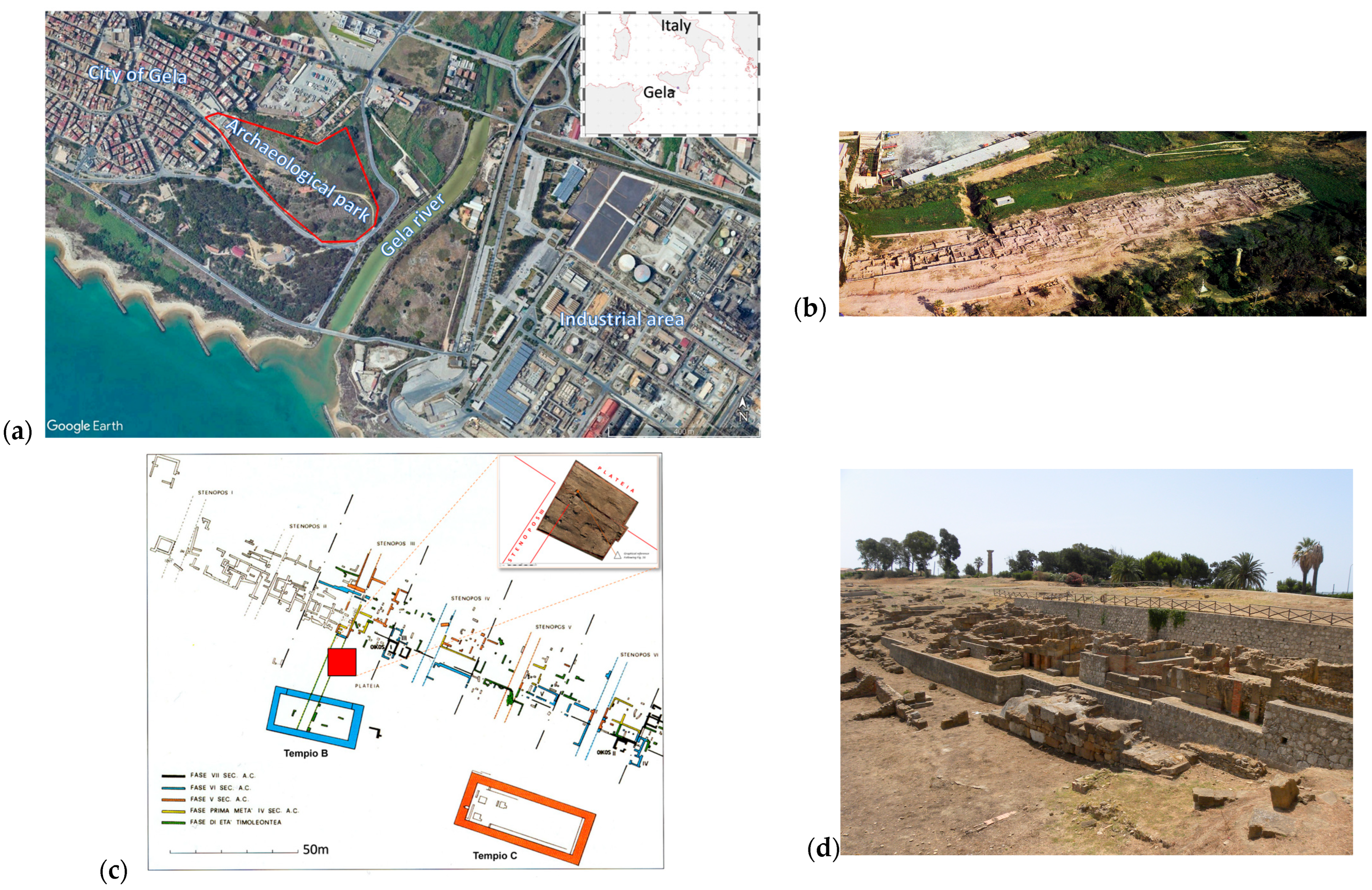
Gela was one of the most important western Greek colonies, which was founded in 689–688 BC at the center of a wide gulf on the southern coast of Sicily (Figure 2a). The ancient settlement developed on an east–west-oriented coastal hill, which was mostly flat on the top and on its sides (Figure 2a,b). Since the early 20th century, numerous archeologists have investigated the site [32,33,34,35,36,37,38,39,40], uncovering significant remains of the Greek city—such as sanctuaries, residential quarters, workshops, and necropoleis—and enhancing knowledge of its urban and extra-urban organization [41,42,43].
The most extensive excavations were carried out above all in the area called “Molino a Vento”, in the easternmost part of the hill (Figure 2a–d). Here, on the south side, the remains of two temples were found, probably attributable to the main sanctuary of the city’s acropolis (7th-5th centuries BC) [32,33,35,36,44] dedicated to the goddess Athena. While on the north side, a residential neighborhood (7th-5th centuries BC) was also brought to light, where the houses were organized in rectangular blocks (Figure 2c,d) [34,45], approximately 31 m wide, according to a street grid made up of north–south secondary roads (stenopoi) that cross orthogonally an east–west main road (plateia) (Figure 2c,d). But, despite fruitful research, archeologists still do not have sufficient data to completely reconstruct, on the one hand, the entire urban grid scheme on the remaining part of the hill, and on the other the architectural development of the sanctuary of Athena.
Taking this into account, we decided to carry out multidisciplinary investigations in the Molino a Vento area, where a drone photogrammetric survey was first conducted (and is summarized below to give a clearer context of the wider project). Then, the geophysical research developed along two lines, reflecting the themes mentioned in the introduction and above. The first of these concerns the definition of the route of the main road (plateia), of which, in 2013–2015, only a 13 m-long stretch had been brought to light (inset in Figure 2c) [42], but its direction towards the west was not yet known with precision. The second theme specifically concerns the archaic temple of Athena, called temple B (Figure 2c), where the investigations aim to better define the construction phases of the monument and the possible presence of other structures in the area.

1.2. UAV Photogrammetry

Over the Molino a Vento archeological area, a UAV photogrammetric survey was conducted using a DJI Mavic 2 Pro equipped with a 20 MP Hasselblad L1D-20c camera. Photogrammetric reconstruction relies on the triangulation of the apparent positions of target points visible in multiple images. By capturing photographs from at least two locations, “lines of sight” are intersected to derive three-dimensional point coordinates [46]. Therefore, it is possible to calculate the 3D coordinates of any point represented in at least two photos, enabling the generation of three-dimensional models from UAV surveys.
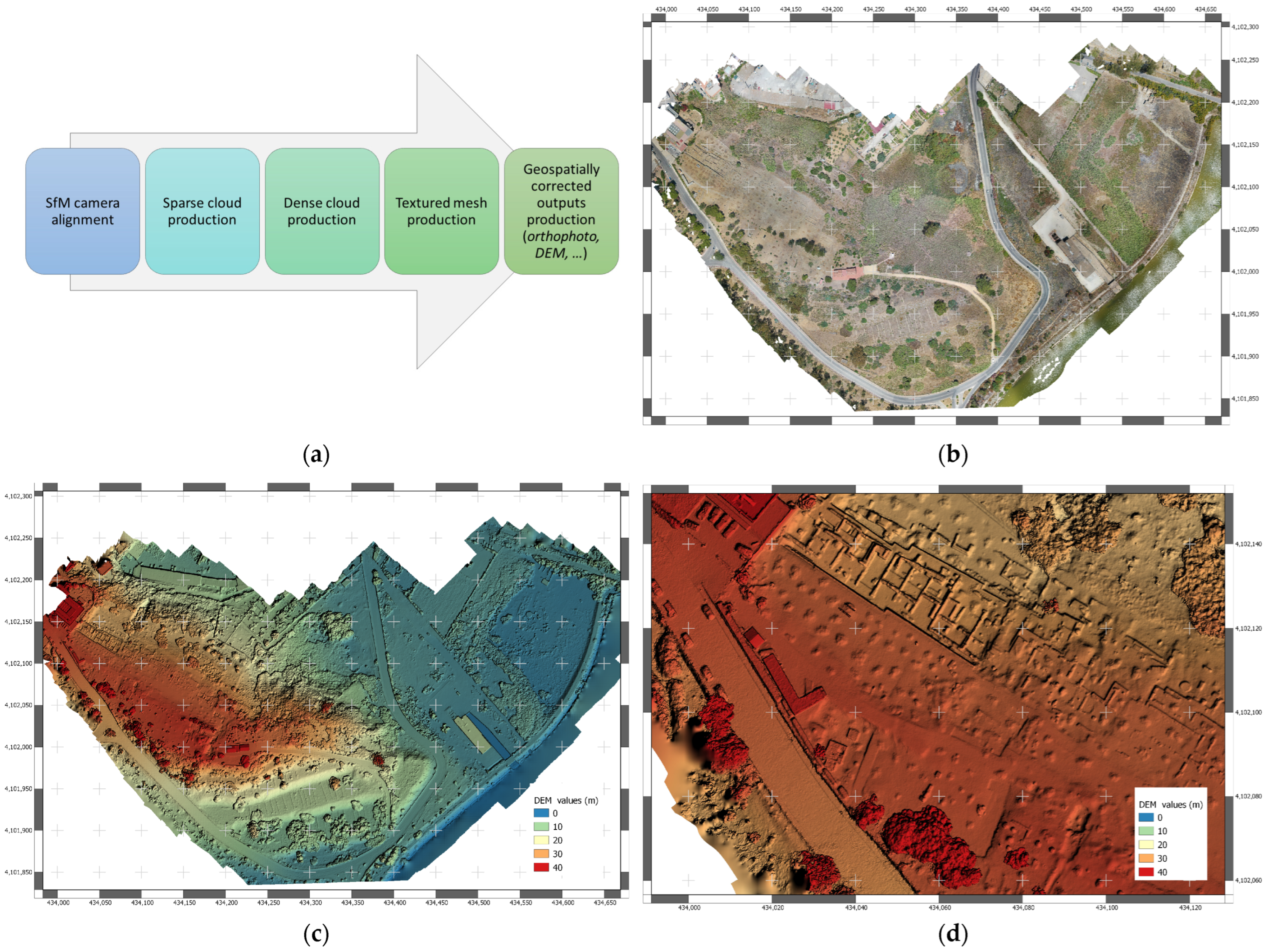
The photogrammetric workflow is represented in Figure 3a. First, within the structure-from-motion (SfM) technique, significant points are extracted from individual images, camera parameters are retrieved, and homologous points are correlated across different photos to reconstruct their coordinates in real space. At this step, both the image-pair correlations and the geolocation of the dataset can be improved with the assistance of ground control points (GCPs) arranged on the surveyed area at known positions and recognizable in the imagery. After this initial stage (image matching and sparse reconstruction), the multi-view stereo reconstruction is applied to generate a dense point cloud, which is subsequently interpolated into a continuous surface (typically textured with true-color imagery) of the investigated scenario. The final step is the production of georeferenced digital outputs, such as orthophotos and digital elevation models (Figure 3b–d).

2. Materials, Methods, and Techniques

2.1. Geophysical Data Collection

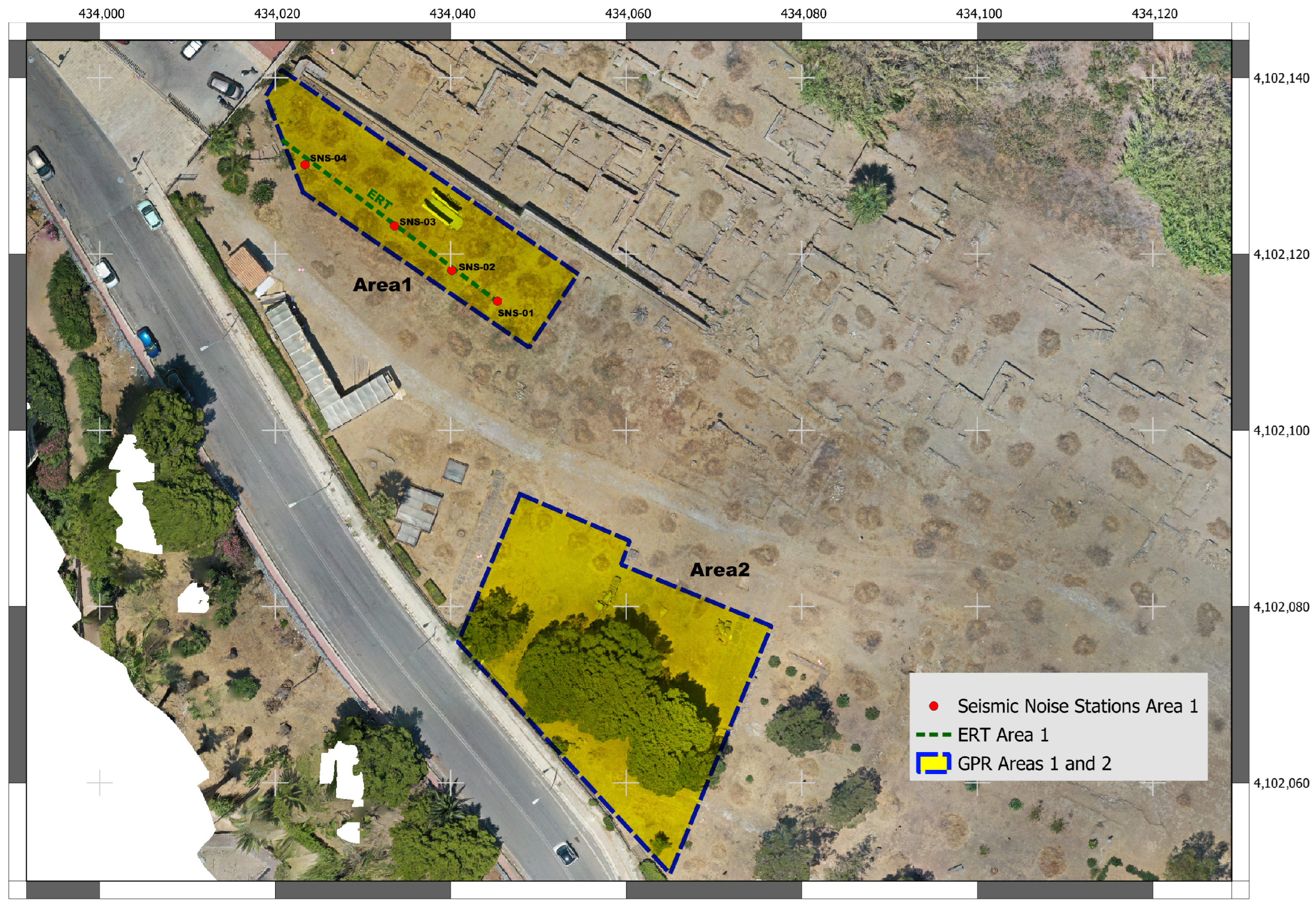
After the photogrammetric survey of the entire Molino a Vento area, it was decided to concentrate the geophysical research on two specific areas (Figure 4, setups in Table 1):
  • Area 1, along the hypothetical westward continuation of the main road (plateia);
  • Area 2, corresponding to the area of the so-called Temple B of the sanctuary.
The two areas have been investigated with the ground-penetrating radar (GPR) technique, with data acquired using a dual-channel Cobra CBD 200/400/800 MHz system manufactured by RADARTEAM Sweden AB (Figure 4). As already mentioned, they were chosen to represent different archeological contexts and target characteristics. Area 1 GPR data were collected with a line spacing of 40 cm, lines ranging 31 to 41 m, and covering a 10 × 41 m area, with an inset rectangle not investigated due to the presence of a modern monument. Area 2 GPR data were collected also with a 40 cm spacing between the radar profiles, for acquisition lengths ranging 17.8 to 30.5 m, excluding obstacles constituted by the trunks of trees present on the site and the irregular shape of the parcel, and an investigated region included in a rectangle 33.5 × 32.5 m.
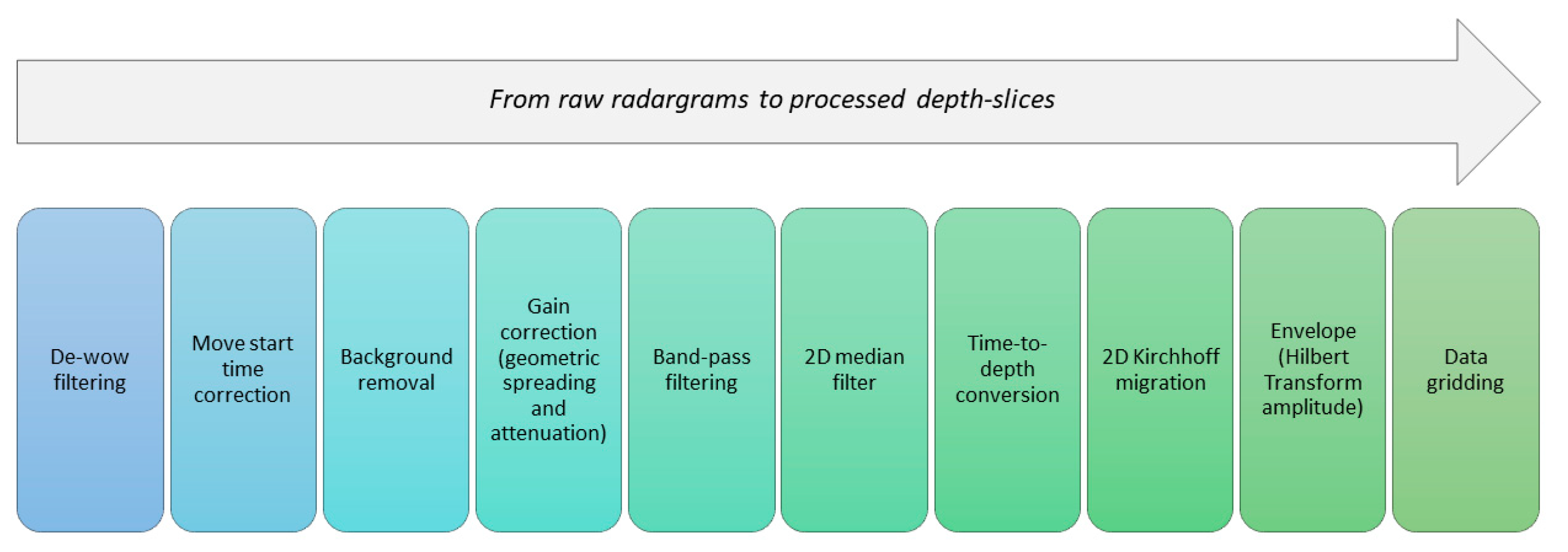
The standard GPR processing [29,47,48,49] was included (Figure 5): de-wow filtering, time-zero correction, background removal, gain correction (geometric spreading and attenuation), band-pass filtering, 2D median filter, time-to-depth conversion, 2D Kirchhoff migration, andenvelope (Hilbert Transform amplitude).
In Area 1, four seismic noise stations (SNSs) were also deployed along a profile with three-dimensional Tromino sensors produced by Moho s.r.l. (Venice, Italy) and processed with the Horizontal-to-Vertical Spectral Ratio technique (Figure 4). In addition, we decided to apply this HVSR method (not often used in archeology) in order to gain further confirmation and to identify potential layers with peculiar geological features. Over the same profile, three ERT surveys were carried out using 64 electrodes with 0.5 m spacing, for a total profile length of 31.5 m. Data were acquired with dipole–dipole, Wenner, and Schlumberger arrays. The surveys were conducted using an Electra multichannel resistivimeter (Moho s.r.l.) operating with alternating current. ERT inversions were performed with the robust constraint, which is a preferred choice in most archeological applications [50,51,52,53].

2.2. Integration of Diagnostic Methods

It is widely recognized that complex geophysical scenarios are best investigated using multiple methods, sometimes including non-geophysical approaches in order to compare different subtle response signals linked to different physical properties or working principles [54,55,56,57,58]. Integrating datasets from multiple sources reduces degrees of freedom and subjective assumptions in subsurface interpretation: in fact, single physical response of materials are gathered into range values often (if not always) overlapping, at least partially [31,59,60,61]. This generally implies the impossibility of directly reconducting a distribution of the retrieved physical properties to a definite model of underground bodies and materials. To test the effectiveness of an integrated approach within the most challenging parcel chosen, a line of multiple acquisitions has been studied, aiming also to pick useful information for the future developments of the archeological prospections of the large area of study. The datasets were processed independently, without normalization or joint inversion. Comparison and validation were carried out after processing [58,62].

2.3. Visual Multi-Depth Integration of Geophysical Data

For the analysis of the GPR results, we propose an innovative approach to identify spatial and signal patterns in the datasets. Within this technique, GPR data related to different depth slices are analyzed together by means of a false-color planimetric representation, in which envelope amplitude data from one or more depth slices are converted into grayscale channels, each assigned to a primary color in an RGB (red, green, and blue) image. Similar approaches are exploited in many contexts, especially but not exclusively with remote sensing data, to compare different physical parameters or indices of multilayer information cubes [63,64,65,66,67,68,69,70].
Within the (processed) georadar datasets, this technique is expected to highlight spatial patterns of targets with interfaces, into which the electromagnetic waves could have bumped at different depths. In such cases, standard reconstructions at fixed depths are discontinuous, making interpretation challenging—for example, roots that extend in three dimensions may shift from one depth slice to another. Furthermore, it is very important to underline that GPR data-cubes are not only a direct representation of buried subsurface but they are a 3D record of many interactions of EM waves with the investigated scenario, and coherent 3D patterns are equally due to the geometries and the physical properties involved. This approach also enables the isolation of clusters in the 3D GPR response, such as multiples and reverberations.
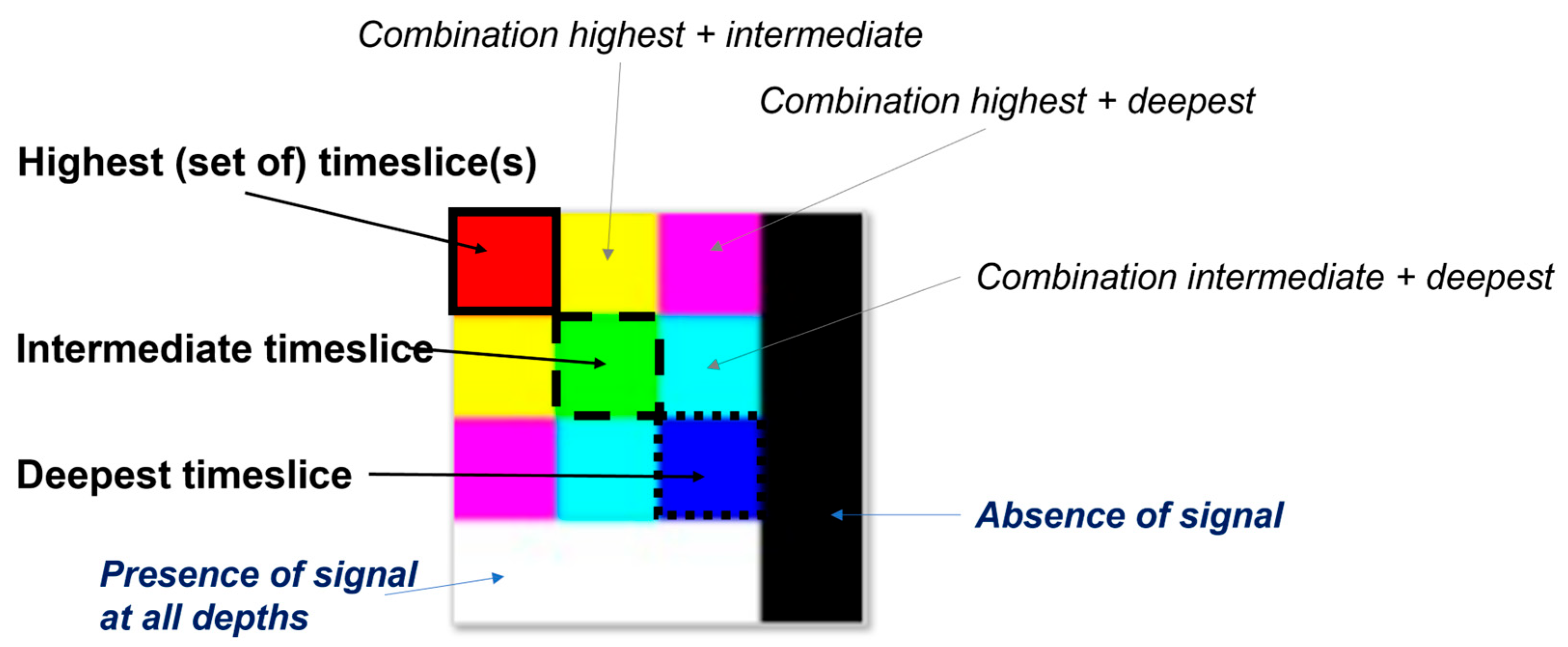
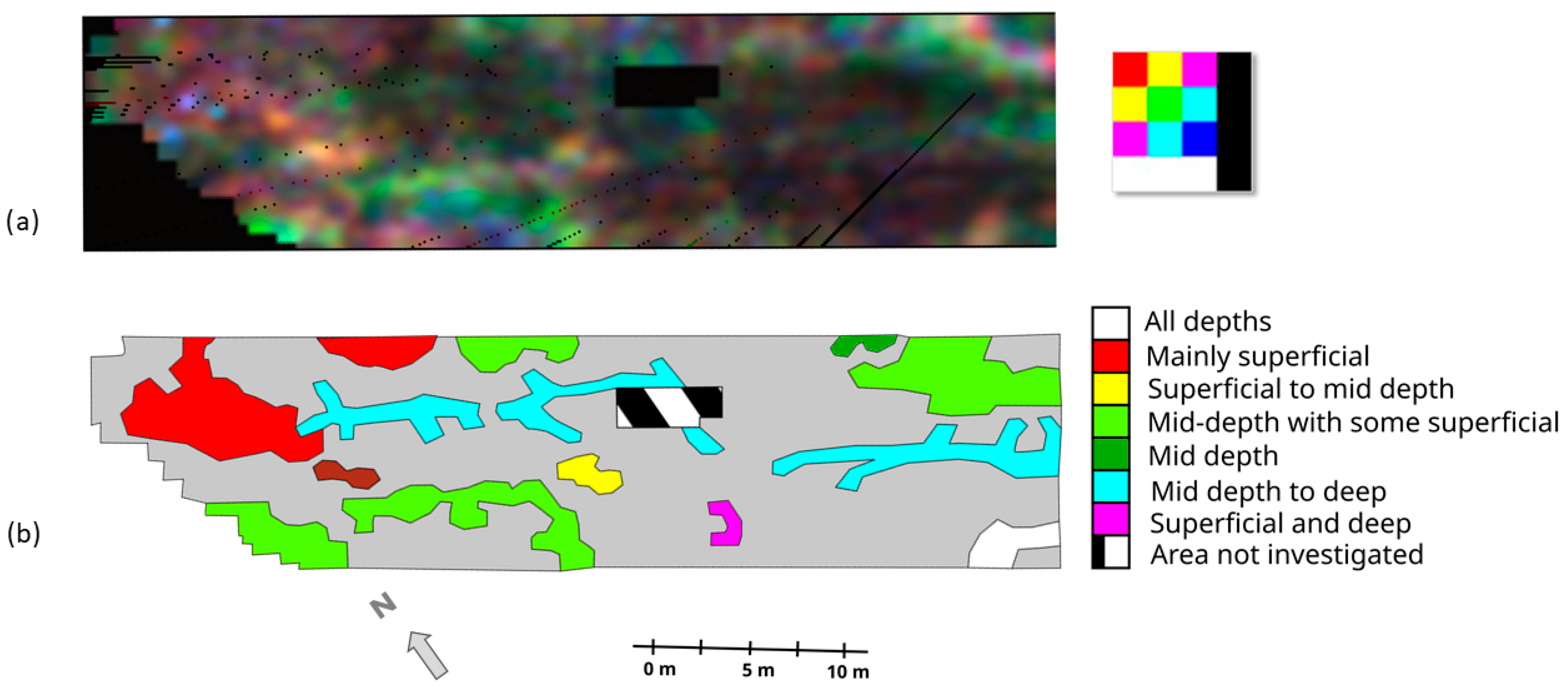
The working principle of this technique, which has proven useful in the heuristic analysis of experimental datasets, is illustrated in Figure 6: pixels or patterns with pure red color (or its tones) are indicative of signals belonging only to the first informative layer (the highest time slice or set of time slices); greens and blues are due to intermediate and deepest time slices, respectively. Signals present in two or more informative layers produce blended colors (or their tones), like yellow (highest + intermediate), magenta (highest + deepest), cyan (intermediate + deepest), or white (highest + intermediate + deepest). The total absence of signals creates a black color, while the intensity of GPR amplitudes is expressed by the colors’ brightness.

3. First Experimental Results

3.1. Geophysical Surveys of Area 1

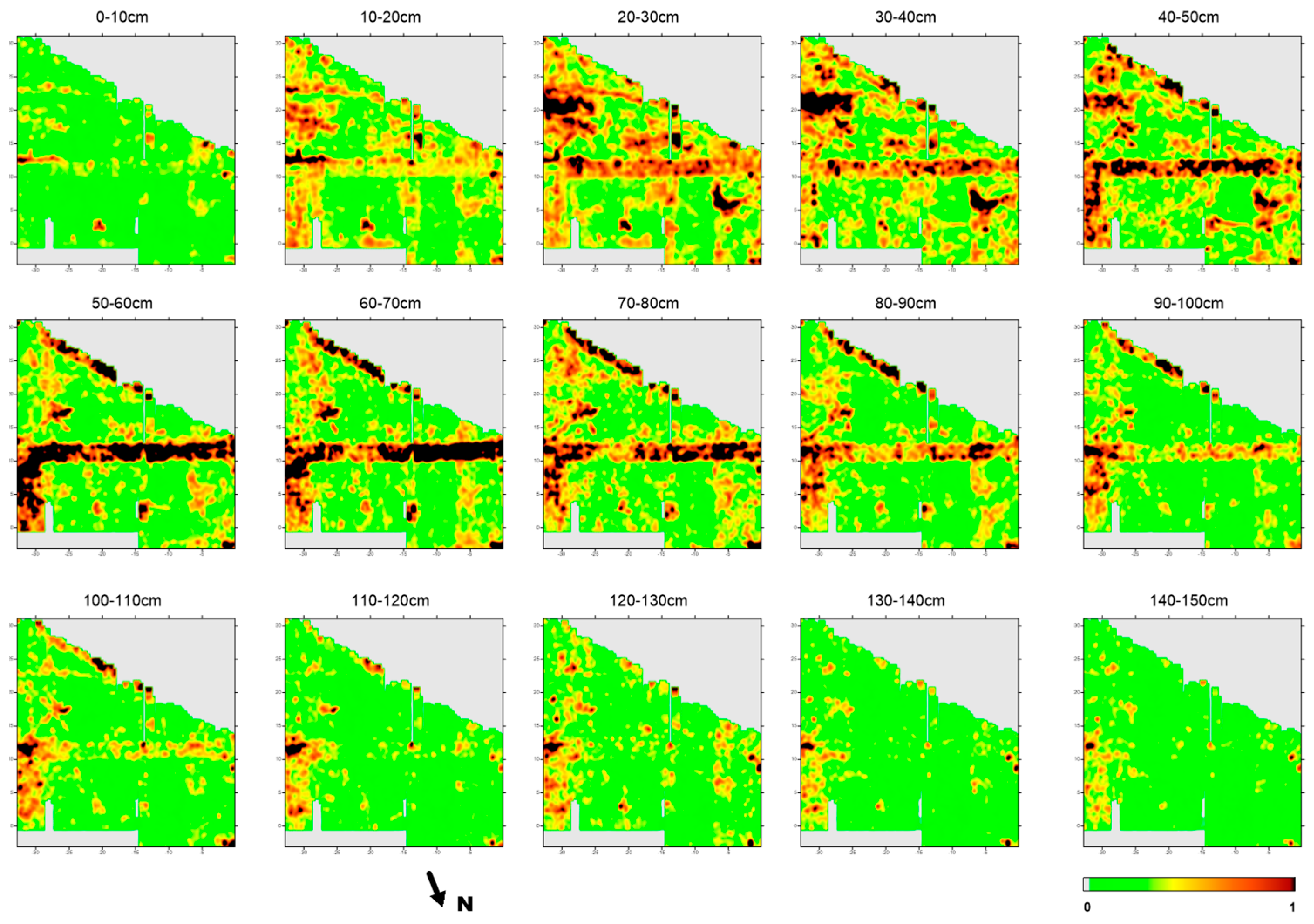
GPR depth slices of Area 1 are shown in Figure 7: it is possible to notice that geometrically coherent reflection patterns are present quite early, starting from some weak signals, in the 10–20 cm slice, that reach a significant signal-to-noise ratio (SNR) in the following 20–30 cm depth slice. Here, some alignments are already detectable and it is possible to recognize the polygonal shapes probably corresponding to walls bordering the ancient main road (plateia). At greater depth, GPR anomalies present higher amplitudes until the 40–60 cm slices, while in the 60–70 cm slice, the SNR gradually decreases, and in the 80–90 cm slice, only sparse anomalies without clear geometry are observed.
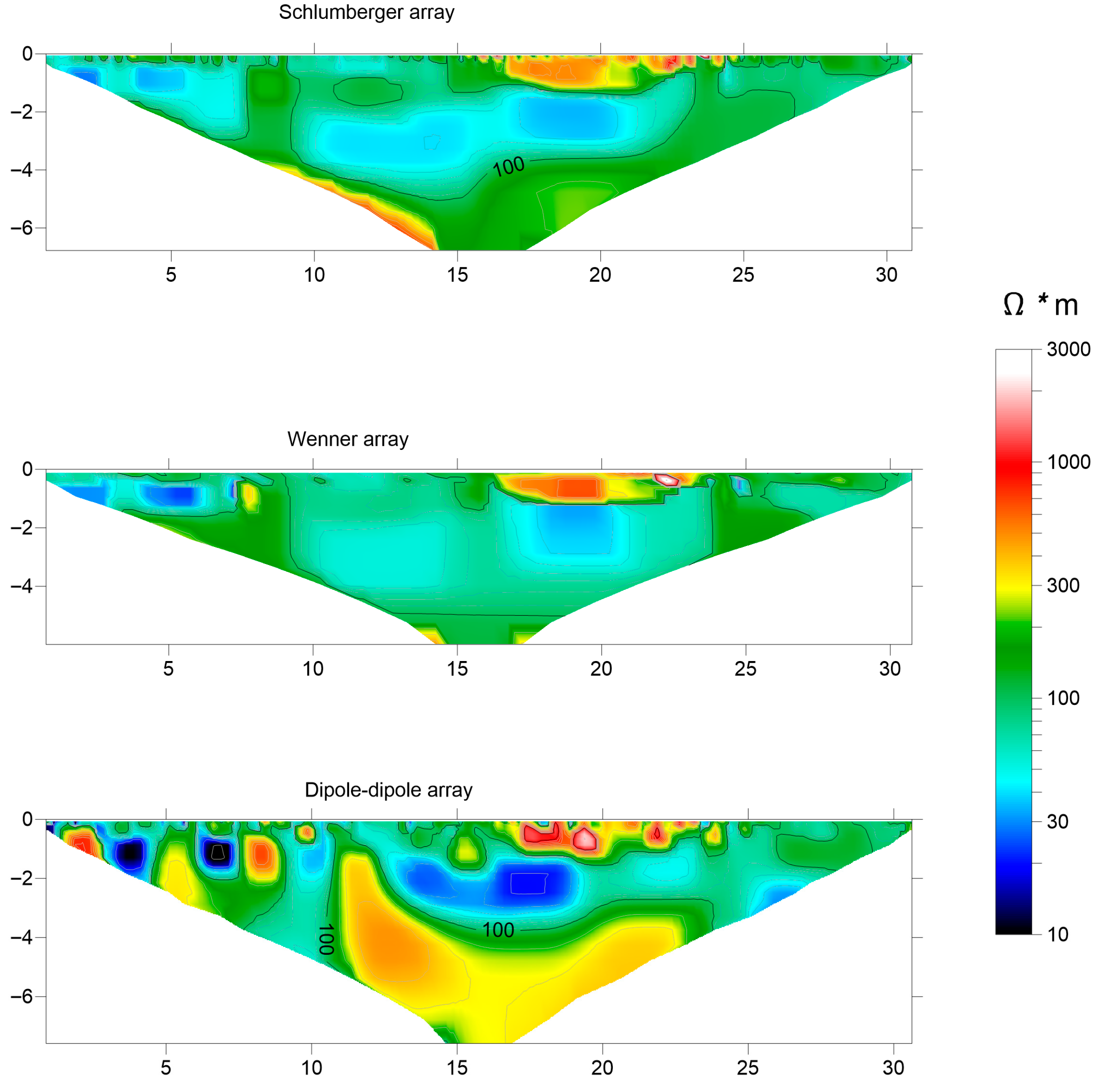
The ERT results for the three kinds of arrays collected are presented in Figure 8, where we can appreciate the different responses linked to the well-known characteristics of each of them, with the Schlumberger array emphasizing horizontal bodies while the dipole–dipole array highlights sub-vertical anomalies. Keeping this aspect in mind, the three ERTs are coherent with each other, showing a shallow layer from the ground surface to about 1–2 m depth: this layer is characterized by significant transversal variability in resistivity values that could reasonably suggest that archeological stratification is concentrated in this stratum. Under this superficial layer and up to a depth of 4–4.5 m, the ERTs show a moderately conductive layer, while under this body, the electrical resistivity increases with quite a clear interface. Notably, at about 8 m along the profile, a locally resistive anomaly is present with a certain vertical electrical homogeneity to the supposed bedrock.
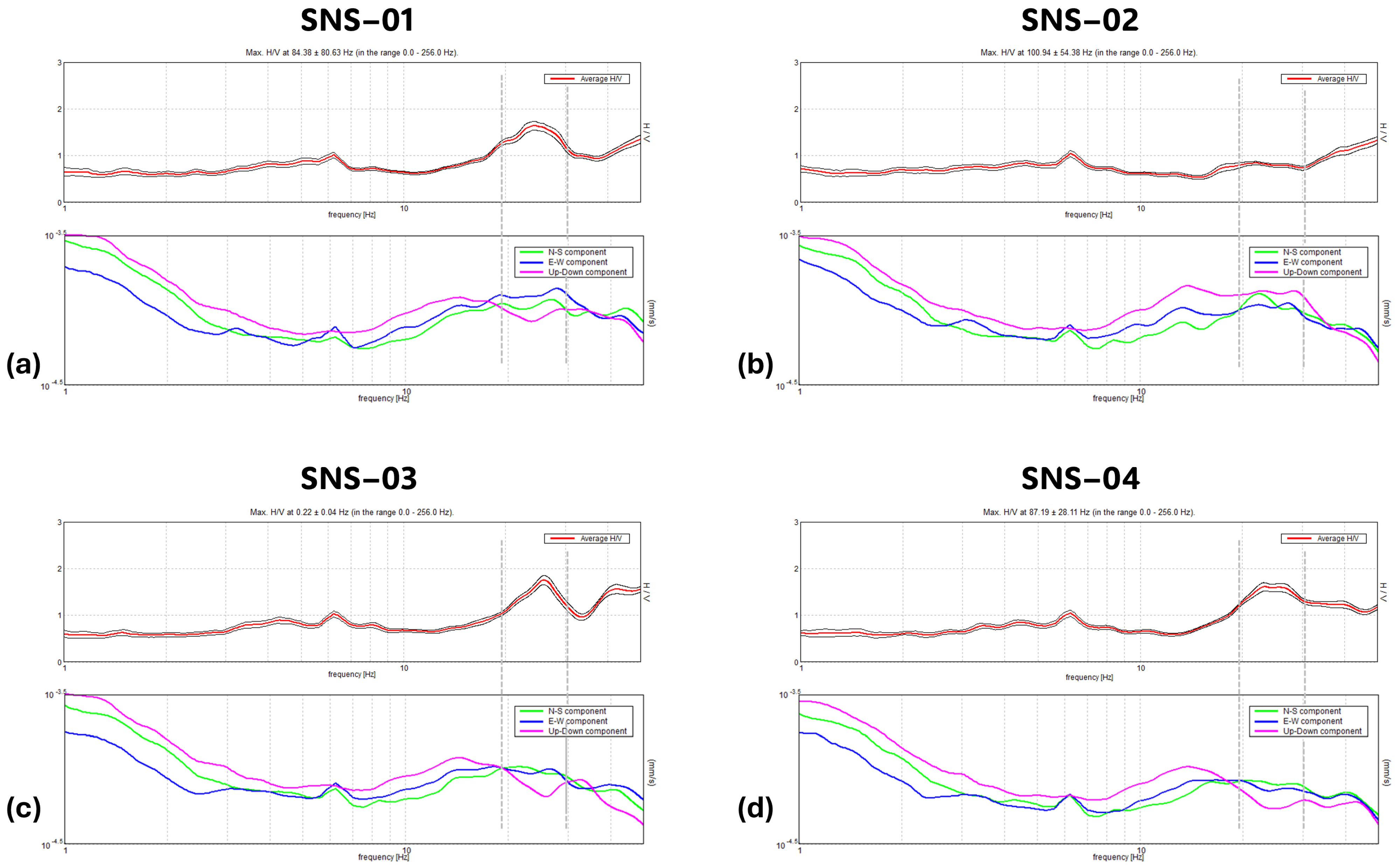
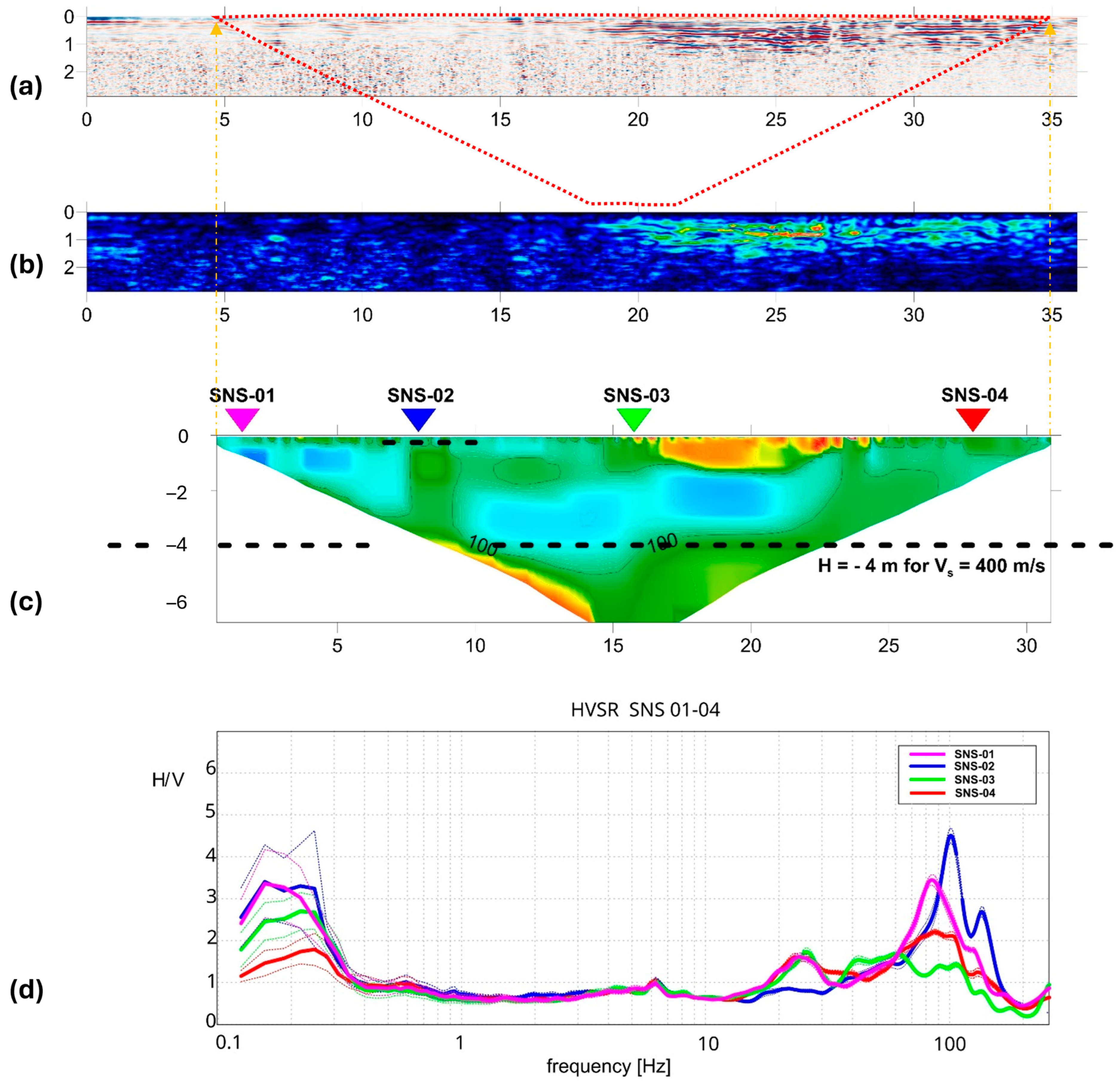
Figure 9 reports the Horizontal-to-Vertical Spectral Ratio (HVSR) curves obtained from the seismic environmental noise, acquired at the four seismic noise stations (SNSs) located along the ERT profile (with a progressive numeration from south to north). After analyzing the data, the reported plots have been limited to a frequency range from 1 to 50 Hz, but a wider range is visible in the overlaid plot of Figure 9d. In fact, the lowest-frequency maximum (around 0.2 Hz), which was substantially shared between all the stations, could be due to a deep bedrock interface, but the frequency is very low compared to the main frequency of the sensors, so this cannot be said for sure. Even the highest (80–105 Hz) frequency maxima can be heavily contaminated by local disturbances during the acquisitions, while important information comes from the behavior of the curves in the 20–30 Hz frequency range (red curves on the top of each pane). Three curves (Figure 9a,c,d), here, present a maximum, while the remaining one (Figure 9b) is flat. To confirm the geological origin of these peaks, the corresponding Fourier amplitude spectra of the three-component noise traces are also plotted just below each HVSR curve, and we can notice the presence of a minimum in the vertical traces spectra (magenta curves) in correspondence to the 20–30 Hz frequency range, in accordance with the geophysical literature [20,71,72,73,74,75]. The HVSR plots present very narrow confidence windows at the frequencies of interest, confirming the reliability and accuracy of the experimental data collection in agreement with the specific scientific literature [76,77,78,79,80].
Assuming a horizontally layered medium and a clear impedance contrast at depth, the shear-wave velocity (Vs) of the soft layer overlying the stiffer substratum can be estimated using the fundamental resonance frequency (f0) and the layer thickness (H), according to the simplified relation:
V s = 4 · H · f 0
Assuming a sediment thickness of 4 m and a resonance frequency of 25 Hz:
V s = 4 · 4   m · 25   H z = 400   m s
This value is consistent with typical shear-wave velocities observed in unconsolidated sedimentary soils.
An important observation from the HVSR survey is the absence of the 25 Hz peak in one of the curves. This discrepancy corresponds to a location where ambient noise was recorded near a quasi-vertical resistive anomaly identified in the ERT results, which likely disrupted the expected resonance behavior.

3.2. Geophysical Survey of Area 2

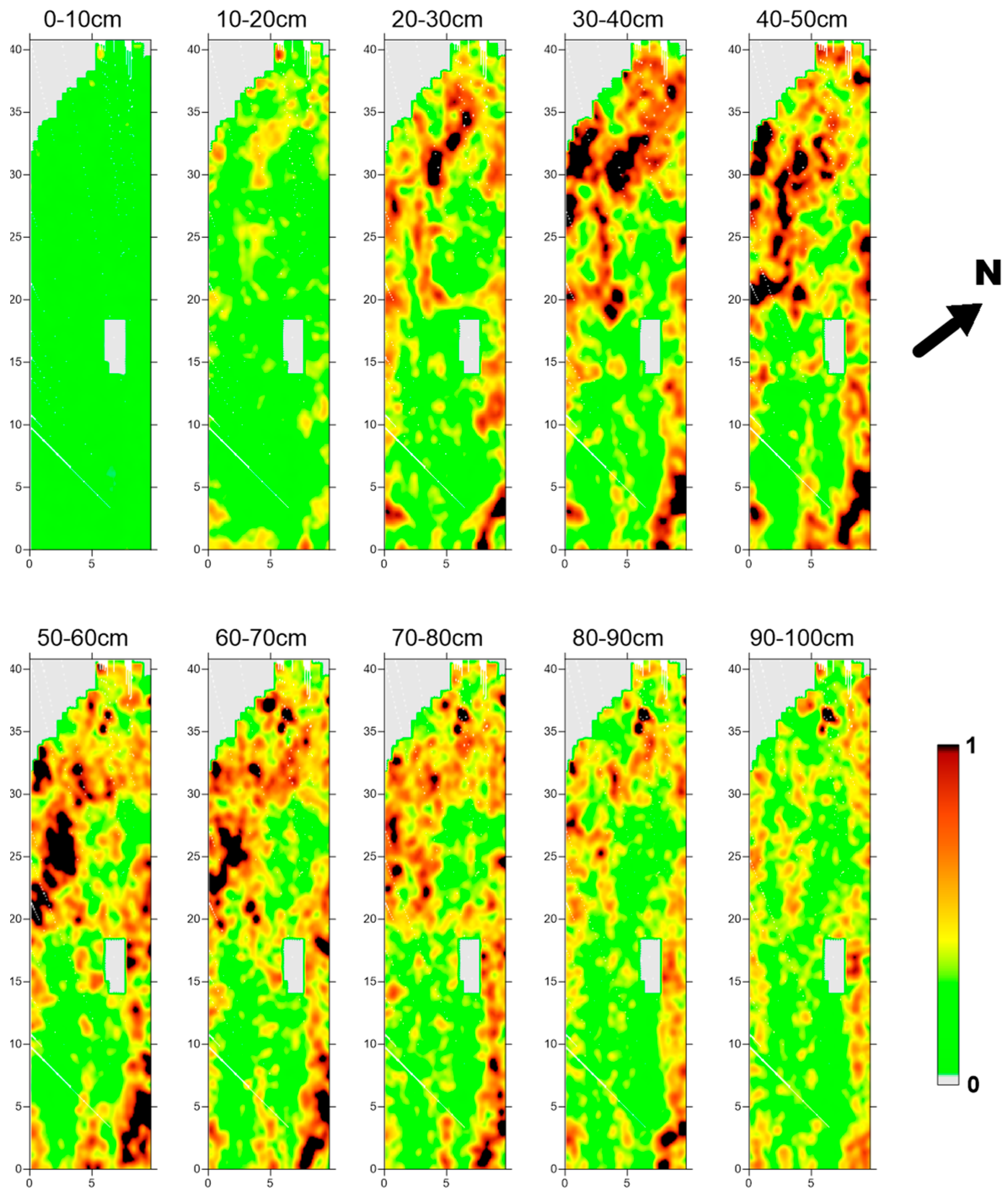
GPR depth slices of Area 2 are shown in Figure 10: for this area, weak but spatially coherent signals are visible, but spatially coherent signals are already at the surface or just below (0–10 cm depth).
Gradually, the SNR of the time slices increases, having its maximum at the 50–60 and 60–70 cm depth slices. Some punctual anomalies are present in all the time slices, especially within the first half meter of terrain (the effect is obviously influenced also by the reduction in the horizontal resolution with depth). Regarding the most extended anomalies, we can notice that on the first depth slices, a large linear feature is present, bordering the map on the south-east side, that changes with increasing depth: in fact, from 40 to 50 cm going down, the southern half of this feature breaks into multiple anomalies, while the northern half increases in EM wave amplitudes and forms an L-shaped anomaly with another highly reflective linear feature, orthogonal to it toward the west, and extending across the entire map. At almost the same depths, another highly reflective linear feature is recognizable at the oblique south-western border of the maps: this feature is significantly narrower than the previous two linear patterns. Below 80–90 cm, the SNR and geometrical coherence decrease, and only sparse spot anomalies remain visible. Many potentially interesting anomalies are detected at this stage inside and outside the temple B perimeter, but it is difficult to distinguish and interpret archeologically.

4. Data Integration and Calibration of the Results

4.1. Multi-Methods Integrated Comparison and Results

The visual comparison of the multi-method geophysical results of Area 1 is proposed in Figure 11: GPR, ERT, and seismic data are collected along the same line (e.g., [81,82]). From top to bottom, the first two panes show the GPR B-scan at two processing steps: before migration (top) and after Hilbert transform (middle). It is worth noting that, although GPR backscattered signals are present across the whole radargram, they are mainly concentrated on the central-to-right side of the images. At almost the same positions, the ERT data show their highest resistivity and local variability values, already interpreted as indicators of ground inhomogeneity due to archeological features. As described in the paragraph on the seismic results, they indicate the same geological features as the ERT for a realistic velocity of the soil’s first layer. As can also be appreciated in the Hilbert transform radargram, at seismic noise station 02—where the first interface between soft soil and a more rigid substratum appears to be very shallow—the GPR signal is attenuated compared to the background signal across the radargram. This attenuation is probably due to superficial absorption caused by locally high conductivity or by a buried vertical feature with high internal homogeneity. This specific multi-method pattern is certainly interesting but would require a 2D survey extended to the ERT and seismic prospections to be more robustly interpreted, which was not a main goal of the present research due to cost constraints.
The punctual geophysical multi-method characterization, although rapid, has allowed the identification of an area of major archeological potential inside Area 1 that probably corresponds to the remains of walls bordering the city blocks along the main road (plateia). Probably due to its punctual nature, the opposite block bordering the plateia was not crossed by the survey profile and is not visible in these data. Even for these kinds of outputs, a mapping approach is needed, as evidenced by the volumes below SNS02. The characterization of the soft soil/bedrock interface is particularly important for stability and dynamic vulnerability issues affecting archeological features in elevation after excavation, and a good characterization in this respect can be achieved even with a lower density of measurements than that required for the detection of archeological elements.

4.2. RGB Simultaneous Representation of GPR Depth Slices and Data Interpretation

To inspect the GPR datasets, a multi-depth visual comparison was adopted. In Figure 12a, an RGB map summarizes the most important depth slices of the GPR dataset over Area 1, with the sum of the instantaneous amplitudes as follows: Red (20–40 cm), Green (40–60 cm), and Blue (60–80 cm). Based on the additive color response of this map, in Figure 12b, several spatially coherent anomalies were detected and classified according to their distribution and stability with depth, represented by the resulting color from the GPR multi-depth amplitude map. The null data region of the map (black in Figure 12a and black-and-white pseudo-rectangle in Figure 12b) corresponds to the location of a modern artistic installation.
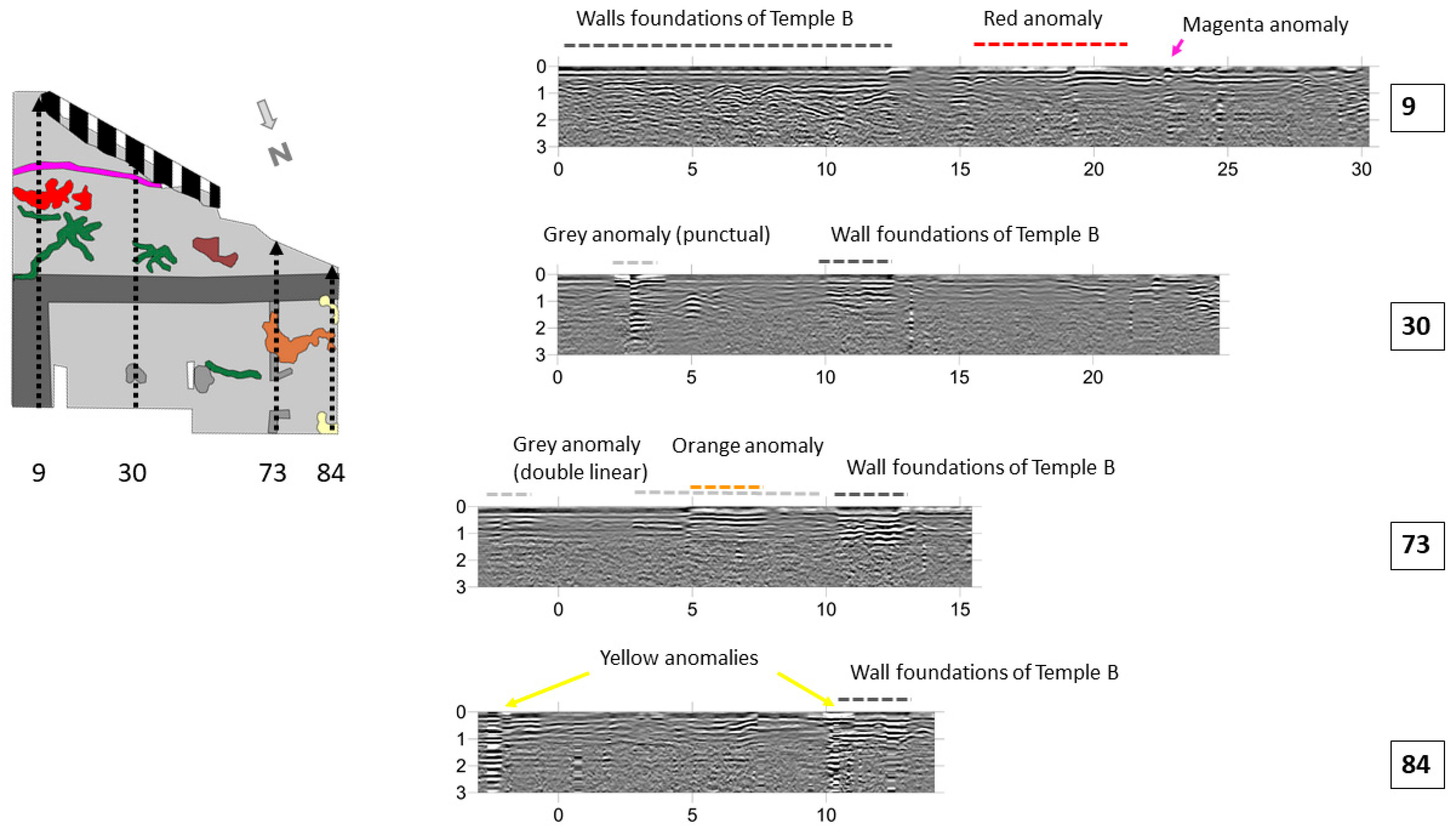
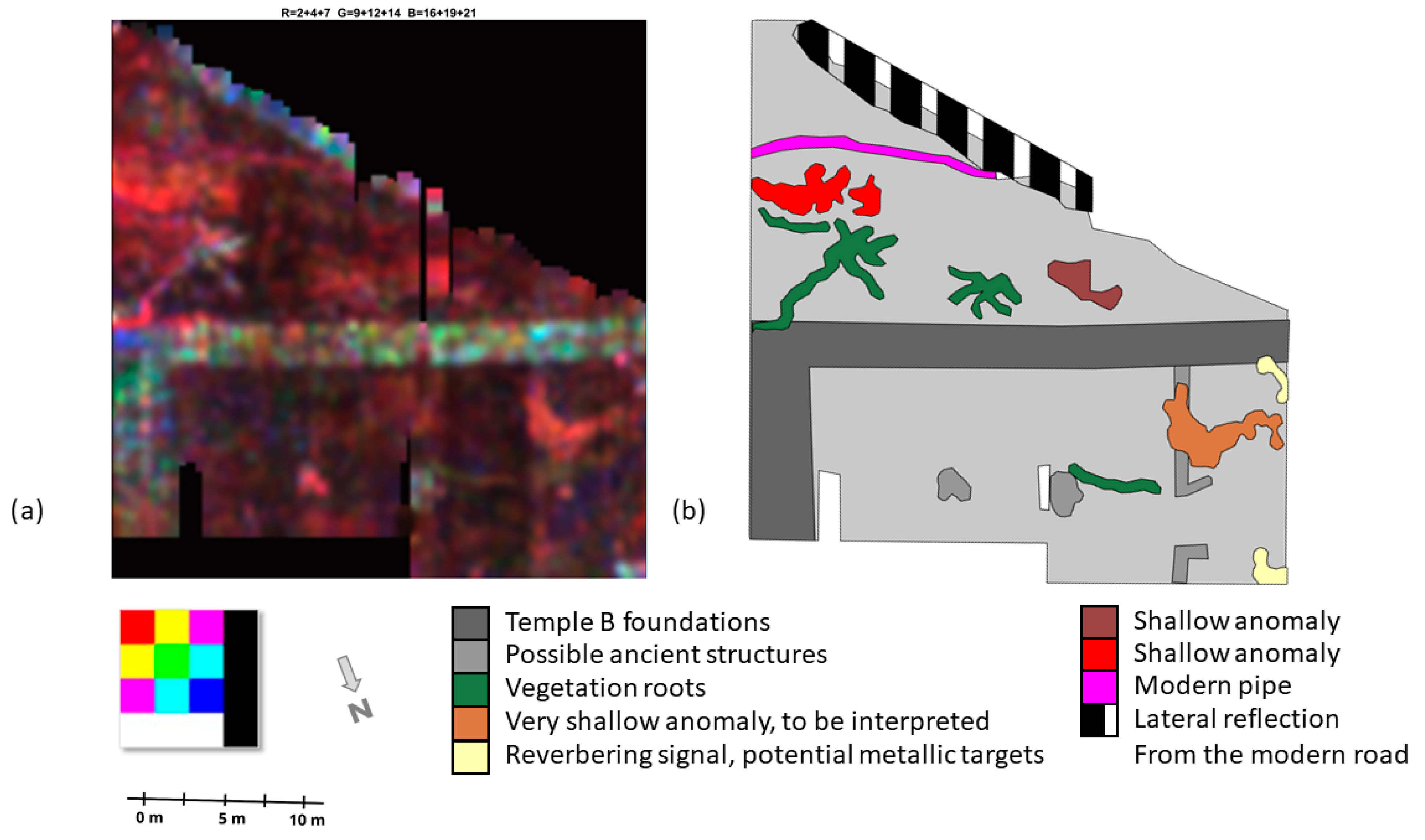
In Figure 13a, the RGB map summarizes the most important depth slices of the GPR dataset over Area 2, with the sum of the instantaneous amplitudes as follows: red (10–40 cm), green (40–70 cm), and blue (70–100 cm). Based on the additive color response of this map, in Figure 13b, several spatially coherent anomalies were detected and preliminarily classified. The shapes of large linear features in dark gray are attributable to the foundations of the ancient temple known as Temple B. Other spatial features (linear and punctual) with different depth behavior are likely related to building elements (light gray, inside the Temple B area). Orange, brown, and red patterns indicate shallow GPR signals that are difficult to interpret archeologically at this stage. Yellow points mark small anomalies with vertical persistence of the GPR signal, potentially due to metallic reverberation. Green elements are most probably related to tree roots, while the curved linear shape in magenta could correspond to a shallow modern utility pipe. The black-and-white dashed region is due to lateral reflections/diffractions produced at the escarpment of the hill near the present highway. White rectangles inside Temple B indicate null data regions corresponding to tree trunks.

Multi-Depth Analysis Calibration Through Radargrams Interpretation

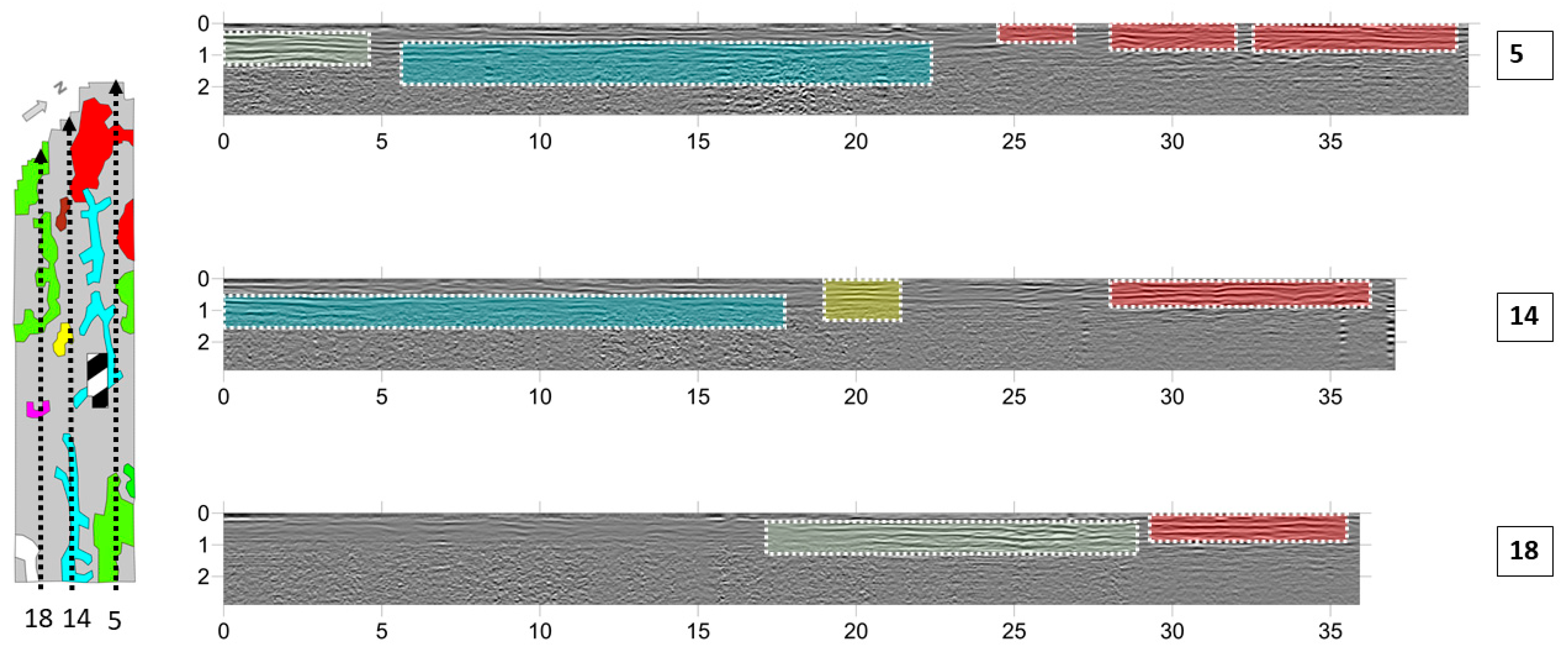
In Figure 14 and Figure 15, sample radargrams are shown to provide a punctual verification of GPR anomalies detected with the multi-depth method. Through iterative comparison with C-scan data, reflective patterns can be better characterized in terms of their electromagnetic response and, consequently, their potential archeological interpretation.
In Figure 14, three sample radargrams from Area 1 are presented, with the anomalous horizontal patterns of Figure 12b indicated in vertical section. These volumes of influence are greater than the ranges indicated in the RGB analysis because, although the median behavior corresponds quite well to the planimetric multi-depth classification, some local signals exhibit a larger range of variability due to punctual volumetric and material variations in the inspected bodies.
Figure 15, in contrast, fully confirms the RGB multi-depth analysis carried out in Area 2, for which a preliminary archeological interpretation was also possible thanks to the clearer dataset.

5. Discussion: Coherence of the Geophysical Results with the Archeological Context

The final step of the recursive analysis of the experimental datasets is the comparison with the archeological context to highlight elements of coherence and incoherence.
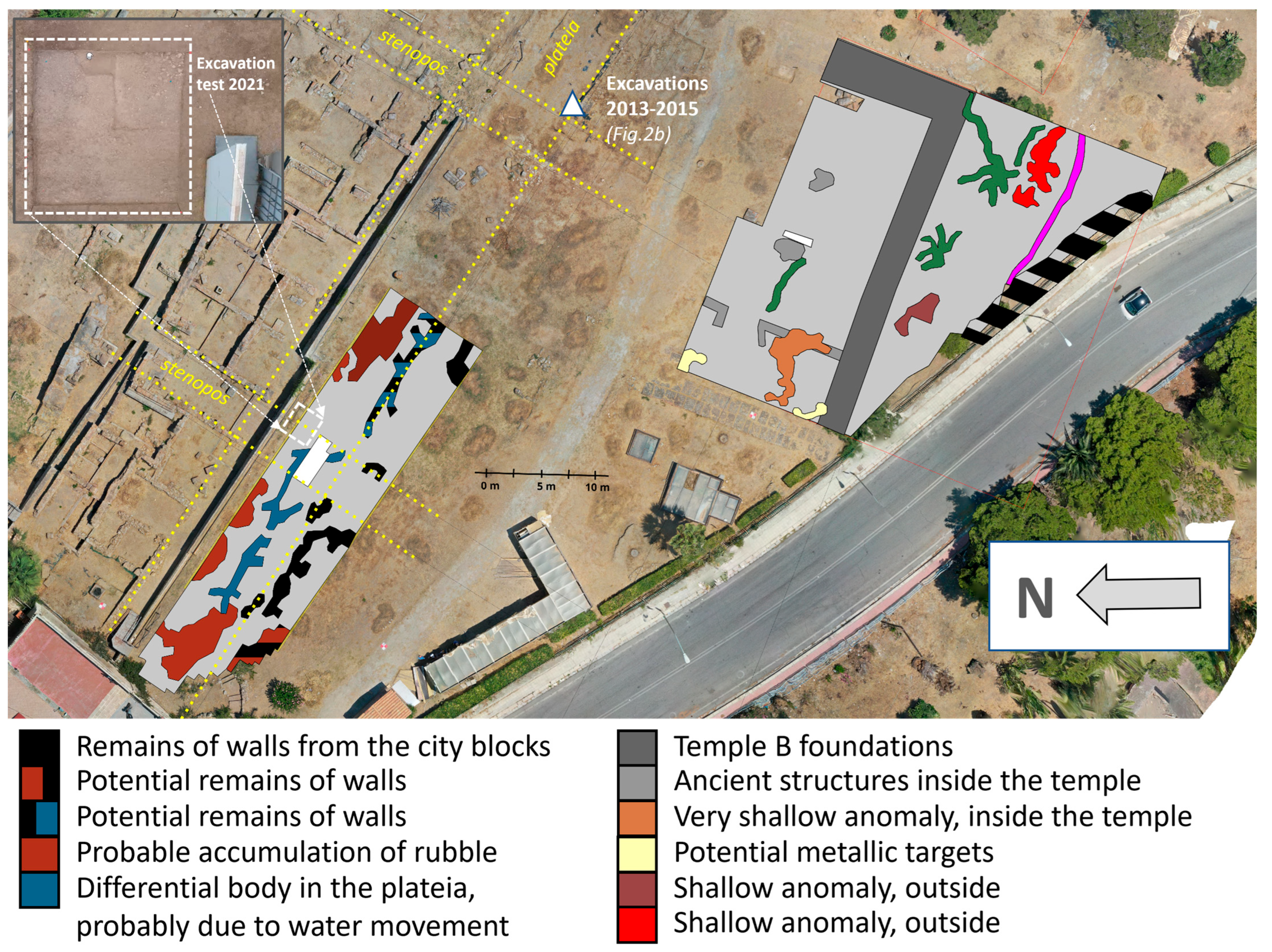
The archeological context of Area 1 consists of an urban district dating between the 7th and 5th centuries BC, organized according to a regular grid of streets: a main one, the plateia, and many narrower orthogonal streets, and the stenopoi. The subtle signal differentiation in the geophysical datasets (and the strategic design of the multimethod trial) in this area requires the urban layout to be used as a strong interpretative constraint. To explain this diagnostic behavior, in 2021, a shallow excavation test was conducted (inset in Figure 16) at a probable road intersection west of the one discovered during the 2013–2015 excavations (inset in Figure 2b) [42]. This direct investigation revealed the surface of a probable mixed-technique structure, i.e., a wall with a stone base and a raw clay elevation, the latter having a composition comparable to the surrounding soil. Within these constraints, the GPR anomalies bordering the plateia and stenopoi patterns are interpreted as potential or certain remains of the walls belonging to the ancient city blocks, depending on their shape and position. Specifically, the mid- to deep anomaly (eastern cyan pattern in Figure 12b) bordering the plateia is interpreted as a potential remain (black and blue in Figure 16) of the walls of a residential block because it shows a different depth response and a more irregular shape than anomalies more confidently interpreted as the remains of the southern boundary wall of the plateia (black patterns in Figure 16). Other mid- to deep-GPR signal patterns in the middle of the surveyed area were confirmed by the excavation test to be due to scattered stones in the road center, probably accumulated by rainwater. Finally, massive patterns of GPR anomalies in the residential neighborhood are interpreted as probable large accumulations of rubble from the destruction of houses adjacent to the road (reddish-brown patterns in Figure 16).
Unlike the residential blocks, Area 2 pertains to the sanctuary of Athena and specifically to the archaic Temple B (6th–5th centuries BC). The materials and building techniques used—together with some outcropping remains—allowed some anomalies to be more firmly characterized as building remains (dark and light gray in Figure 16). Thanks to the multi-depth analysis, some anomalies were easily attributed to the roots of trees and bushes (green in Figure 16). The magenta polygon was interpreted as a modern pipe, while three massive anomalies (red, orange, and light gray) could represent potential building elements of the archaic temple, to be further investigated by excavation. Finally, two small yellow anomalies are interpreted as evidence of metallic targets, based on the signal behavior highlighted by the multi-depth analysis.

6. Conclusions

Geophysical techniques are an essential pre-excavation tool in modern archeology, thanks to their effectiveness in inferring important information about still-underground signs of past usage of the sites under investigation. In the present paper, three different non-invasive methods have been employed to test their diagnostic capabilities against archeological targets, for which a certain preliminary typological knowledge was assumed from the archeological context already excavated and studied within the test site.
The most innovative methodological contribution of the research to the applied geophysics state-of-the-art literature is an imaging approach to the GPR datasets that helps the interpreter to heuristically and simultaneously analyze and interpret the processed data related to three different (to be chosen depending on any specific case study diagnostic goals) ranges of depth/time values, reporting them to one (or more) composed false-color RGB planimetric image. This 3D RGB approach can eventually be repeated with different and reciprocally supporting depth samplings to highlight specific 3D signal patterns. The specific application to the Gela test case has proven able to distinguish many signals and significantly help in the interpretation of the processed data in the most favorable parcel of study, where it was also possible to evidence the nature of the imaged amplitudes as a sign of the 3D electromagnetic interaction across the investigated scenario, despite a sometimes ‘too easy’ interpretation of GPR data as a direct image of the subsoil geometries. For the most challenging research parcel, this approach was useful in defining homogeneous clusters of the studied GPR signals, but the interpretation was still somewhat underdetermined, and the final classification needed the help of ancillary information from the urban archeological context. Currently, traditional GPR interpretation in archeological research is most often based on qualitative comparison of C-scans and eventually B-scans (this joint cross-analysis is becoming a standard in recent years). The rationale of our approach is not to provide an alternative but a synergistic tool to the most consolidated traditional approach, exactly as C- and B-scans (often at different levels of processing) are different views of the same experimental datasets. At this stage of the research, this innovative approach is presented in a qualitative evaluation (compared jointly and not against traditional analysis) of two GPR datasets over archeological sites. It allows inspection of the same experimental data-hypercube (given the different levels of processing available) and simplifies the recognition of peculiar patterns of the GPR signal (in the present research exemplified by tree roots or reverberations due to probable metallic targets).
The synergistic use of multiple data sources is a well-known approach to complex diagnostic problems, and in the investigated area with the expected minor SNR, it has been adopted and tested along a common experimental profile in which ERT, HVSR, and GPR data were collected and, after standard and consolidated processing, interpreted. Some important evidence of underground probable anthropic and natural features was produced thanks to such a multi-method investigation. To overcome some interpretation issues where uncertainty still remained, extensive use of the approach was shown to be helpful, and in future diagnostic protocols, the areal approach, or at least a more detailed spatial sampling rate, will be used. Further tests and developments are planned towards the joint normalization and/or joint inversion of the geophysical datasets.
It is also important to underline the pivotal role of archeological context knowledge (thanks to literature analyses and direct excavation tests) of the area under study for the design and interpretation of the geophysical datasets. Thanks to the synergies among technological and humanities sciences, it was possible to calibrate an investigation protocol for the specific case study. In this way, it will be possible to carefully plan new excavations that verify the responses of the ground to the anomalies highlighted by the geophysical surveys.
The customized geophysical prospection, based on the characteristics of each study area, has defined the quality of the archeological potential according to the problems posed by previous archeological research. In Area 1, the integration of different methods (including the 3D RGB GPR approach) has provided significant data for defining the direction and route of the city’s main road (plateia), of which, until now, only a short stretch was known. The data have been substantially confirmed by an excavation test and will contribute to the reconstruction of the urban grid plan in the period between the 7th and 5th centuries BC. In Area 2, however, anomalies of a presumably different nature were indicated. Some of these are probably attributable to traces left in the ground by old excavations and, together with the others, may guide future choices of excavation locations aimed at defining architectural and chronological problems of what can be considered the most important sacred area of Gela.

Author Contributions

Conceptualization, L.P., S.D., E.C., C.I. and G.S.; methodology, L.P.; S.D., E.C. and L.G. validation, L.P., E.C., S.D., L.G., C.I., G.S., A.S. and L.Z.; formal analysis, L.P., E.C. and L.G.; investigation, E.C., S.D., L.G., C.I., G.S., A.S., L.Z., A.C., S.L. and G.R.; resources, S.D., C.I. and G.S.; writing—original draft preparation, L.P., S.D., E.C., C.I. and G.S.; writing—review and editing, L.P., E.C., S.D., L.G., C.I., G.S., A.S. and L.Z.; visualization, L.P.; supervision, S.D., C.I. and G.S.; project administration, S.D., C.I. and G.S.; funding acquisition, S.D., C.I. and G.S. All authors have read and agreed to the published version of the manuscript.

Funding

This research received no external funding.

Data Availability Statement

Data available on request.

Acknowledgments

The authors are deeply grateful to the Parco Archeologico di Gela—Assessorato Regionale dei Beni Culturali e dell’Identità Siciliana for generously granting them permission to access the archaeological site of Molino a Vento to conduct the geophysical survey.

Conflicts of Interest

The authors declare no conflicts of interest.

References

  1. Piroddi, L.; Abu Zeid, N.; Calcina, S.V.; Capizzi, P.; Capozzoli, L.; Catapano, I.; Cozzolino, M.; D’Amico, S.; Lasaponara, R.; Tapete, D. Imaging Cultural Heritage at Different Scales: Part I, the Micro-Scale (Manufacts). Remote Sens. 2023, 15, 2586. [Google Scholar] [CrossRef]
  2. Piroddi, L.; Abu Zeid, N.; Calcina, S.V.; Capizzi, P.; Capozzoli, L.; Catapano, I.; Cozzolino, M.; D’Amico, S.; Lasaponara, R.; Tapete, D. Imaging Cultural Heritage at Different Scales: Part II, the Meso-Scale (Sites). Remote Sens. 2025, 17, 598. [Google Scholar] [CrossRef]
  3. Papadopoulos, N.G.; Sarris, A.; Parkinson, W.A.; Gyucha, A.; Yerkes, R.W.; Duffy, P.R.; Tsourlos, P. Electrical resistivity tomography for the modelling of cultural deposits and geomophological landscapes at Neolithic sites: A case study from Southeastern Hungary. Archaeol. Prospect. 2014, 21, 169–183. [Google Scholar] [CrossRef]
  4. Piroddi, L.; Vignoli, G.; Trogu, A.; Deidda, G.P. Non-destructive Diagnostics of Architectonic Elements in San Giuseppe Calasanzio’s Church in Cagliari: A Test-case for Micro-geophysical Methods within the Framework of Holistic/integrated Protocols for Artefact Knowledge. In Proceedings of the 2018 Metrology for Archaeology and Cultural Heritage (MetroArchaeo), Cassino, Italy, 22–24 October 2018; pp. 17–21. [Google Scholar]
  5. Fischanger, F.; Catanzari0ti, G.; Comina, C.; Sambuelli, L.; Morelli, G.; Barsuglia, F.; Ellaithy, A.; Porcelli, F. Geophysical anomalies detected by electrical resistivity tomography in the area surrounding Tutankhamun’s tomb. J. Cult. Herit. 2019, 36, 63–71. [Google Scholar] [CrossRef]
  6. Cozzolino, M.; Gentile, V.; Mauriello, P.; Peditrou, A. Non-destructive techniques for building evaluation in urban areas: The case study of the redesigning project of Eleftheria square (Nicosia, Cyprus). Appl. Sci. 2020, 10, 4296. [Google Scholar] [CrossRef]
  7. Piroddi, L.; Calcina, S.V.; Trogu, A.; Ranieri, G. Automated Resistivity Profiling (ARP) to explore wide archaeological areas: The prehistoric site of Mont’e Prama, Sardinia, Italy. Remote Sens. 2020, 12, 461. [Google Scholar] [CrossRef]
  8. Soupios, P.M.; Georgakopoulos, P.; Papadopoulos, N.; Saltas, V.; Andreadakis, A.; Vallianatos, F.; Sarris, A.; Makris, J.P. Use of engineering geophysics to investigate a site for a building foundation. J. Geophys. Eng. 2007, 4, 94–103. [Google Scholar] [CrossRef]
  9. Dahlin, T.; Zhou, B. A numerical comparison of 2D resistivity imaging with 10 electrode arrays. Geophys. Prospect. 2004, 52, 379–398. [Google Scholar] [CrossRef]
  10. Binley, A.; Slater, L. Resistivity and Induced Polarization: Theory and Applications to the Near-Surface Earth; Cambridge University Press: Cambridge, UK, 2020. [Google Scholar]
  11. Gadallah, M.R.; Fisher, R. Exploration Geophysics; Springer Science & Business Media: Berlin/Heidelberg, Germany, 2008. [Google Scholar]
  12. Yilmaz, Ö. Seismic Data Analysis: Processing, Inversion, and Interpretation of Seismic Data; Society of Exploration Geophysicists: Houston, TX, USA, 2001. [Google Scholar]
  13. Karastathis, V.K.; Papamarinopoulos, S.P. The detection of King Xerxes’ Canal by the use of shallow reflection and refraction seis-mics—Preliminary results. Geophys. Prospect. 1997, 45, 389–401. [Google Scholar] [CrossRef]
  14. Deidda, G.P.; Balia, R. An ultrashallow SH-wave seismic reflection experiment on a subsurface ground model. Geophysics 2001, 66, 1097–1104. [Google Scholar] [CrossRef]
  15. Balia, R. Shallow reflection survey in the Selinunte National Archaeological Park (Sicily, Italy). Boll. Di Geofis. Teor. Ed. Appl. 1992, 34, 121–131. [Google Scholar]
  16. Karastathis, V.K.; Papamarinopoulos, S.; Jones, R.E. 2-D velocity structure of the buried ancient canal of Xerxes: An application of seismic methods in archaeology. J. Appl. Geophys. 2001, 47, 29–43. [Google Scholar] [CrossRef]
  17. Balia, R.; Pirinu, A. Geophysical surveying of the ancient walls of the town of Cagliari, Italy, by means of refraction and up-hole seismic tomography techniques. Archaeol. Prospect. 2018, 25, 147–153. [Google Scholar] [CrossRef]
  18. Pirinu, A.; Balia, R.; Piroddi, L.; Trogu, A.; Utzeri, M.; Vignoli, G. Deepening the knowledge of military architecture in an urban context through digital representations integrated with geophysical surveys. The city walls of Cagliari (Italy). In Proceedings of the Metrology for Archaeology and Cultural Heritage (MetroArchaeo), Cassino, Italy, 22–24 October 2018; IEEE: New York, NY, USA, 2018; pp. 211–215. [Google Scholar]
  19. Nogoshi, M.; Igarashi, T. On the propagation characteristics of microtremors. J. Seism. Soc. Jpn. 1970, 23, 264–280. [Google Scholar]
  20. Nakamura, Y. A method for dynamic characteristics estimation of subsurface using microtremor on the ground surface. Railw. Tech. Res. Inst. Q. Rep. 1989, 30, 25–33. [Google Scholar]
  21. Papadopoulos, N.; Sarris, A.; Yi, M.J.; Kim, J.H. Urban archaeological investigations using surface 3D ground penetrating radar and electrical resistivity tomography methods. Explor. Geophys. 2009, 40, 56–68. [Google Scholar] [CrossRef]
  22. Conyers, L.B.; Leckebusch, J. Geophysical archaeology research agendas for the future: Some ground-penetrating radar examples. Archaeol. Prospect. 2010, 17, 117–123. [Google Scholar] [CrossRef]
  23. Piro, S.; Campana, S. GPR investigation in different archaeological sites in Tuscany (Italy). Anal. Comp. Obtained results. Near Surf. Geophys. 2012, 10, 47–56. [Google Scholar] [CrossRef]
  24. Zhao, W.; Forte, E.; Levi, S.T.; Pipan, M.; Tian, G. Improved high-resolution GPR imaging and characterization of prehistoric archaeological features by means of attribute analysis. J. Archaeol. Sci. 2015, 54, 77–85. [Google Scholar] [CrossRef]
  25. Trinks, I.; Hinterleitner, A.; Neubauer, W.; Nau, E.; Löcker, K.; Wallner, M.; Gabler, M.; Filzwieser, R.; Wilding, J.; Schiel, H.; et al. Large-area high-resolution ground-penetrating radar measurements for archaeological prospection. Archaeol. Prospect. 2018, 25, 171–195. [Google Scholar] [CrossRef]
  26. Persico, R.; D’Amico, S.; Matera, L.; Colica, E.; De Giorgio, C.; Alescio, A.; Sammut, C.; Galea, P. GPR Investigations at St John’s Co-Cathedral in Valletta. Near Surf. Geophys. 2019, 17, 213–229. [Google Scholar] [CrossRef]
  27. Colica, E.; Antonazzo, A.; Auriemma, R.; Coluccia, L.; Catapano, I.; Ludeno, G.; D’Amico, S.; Persico, R. GPR investigation at the archaeological site of Le Cesine, Lecce, Italy. Information 2021, 12, 412. [Google Scholar] [CrossRef]
  28. Manataki, M.; Vafidis, A.; Sarris, A. GPR data interpretation approaches in archaeological prospection. Appl. Sci. 2021, 11, 7531. [Google Scholar] [CrossRef]
  29. Piroddi, L.; Rassu, M. Application of GPR Prospection to Unveil Historical Stratification inside Monumental Buildings: The Case of San Leonardo de Siete Fuentes in Santu Lussurgiu, Sardinia, Italy. Land 2023, 12, 590. [Google Scholar] [CrossRef]
  30. Jol, H.M. Ground Penetrating Radar Theory and Applications, 1st ed.; Elsevier: Amsterdam, The Netherlands, 2008. [Google Scholar]
  31. Reynolds, J.M. An Introduction to Applied and Environmental Geophysics; John Wiley & Sons: Hoboken, NJ, USA, 2011. [Google Scholar]
  32. Orsi, P. Gela: Scavi del 1900–1905. Monumenti Antichi 1906, 17, 5–758. [Google Scholar]
  33. Orsi, P. Gela (Terranova di Sicilia). Nuovo tempio greco arcaico in contrada Molino a vento. Not. Scavi Antich. 1907, 4, 38–40. [Google Scholar]
  34. Orlandini, P. La Terza Campagna di Scavo Sull’Acropoli di Gela (rapporto Preliminare). Kokalos 1961, 7, 137–144. [Google Scholar]
  35. Orlandini, P. Topografia dei santuari e documentazione archeologica dei culti. Riv. dell’Istituto Naz. d’Archeol. Stor. dell’Arte 1968, XV, 20–66. [Google Scholar]
  36. Fiorentini, G. Gela: La Città Antica e il suo Territorio. Il Museo; Regione Siciliana, Ass. Reg. BB.CC.AA.: Palermo, Italy, 1985. [Google Scholar]
  37. Canzanella, M.G.; Buongiovanni, A.M. Gela. In BTCGI VIII; Scuola Normale Superiore, École Française de Rome, Centre Jean Bérard: Pisa-Roma, 1990; Volume VIII, pp. 5–65. [Google Scholar]
  38. Fiorentini, G.s.v. Gela. In EAA; Treccani: Roma, Italy, 1994; Volume II, Suppl. 2, pp. 728–732. [Google Scholar]
  39. Spagnolo, G. Gela. In Magna Grecia. Città greche di Magna Grecia e Sicilia; D’Andria, F., Guzzo, P.G., Tagliamonte, G., Eds.; Istituto della Enciclopedia Italiana: Roma, Italy, 2012; pp. 211–217. [Google Scholar]
  40. Ingoglia, C.; Santostefano, A.; Spagnolo, G. Ricerche e studi dell’Università di Messina a Gela: Urbanistica, cronologia delle fasi di vita della città, produzioni artigianali, territorio. In L’Isola dei Tesori, Ricerca Archeologica e Nuove Acquisizioni; Parello, M.C., Ed.; Ante Quem: Bologna, Italy, 2024; pp. 463–478. [Google Scholar]
  41. Ingoglia, C. Nascita del paesaggio urbano a Gela: Rilettura cronologica e funzionale. In Schemata. La Città oltre la Forma; Brancato, R., Caliò, L.M., Figuera, M., Gerogiannis, G.M., Pappalardo, E., Todaro, S., Eds.; Università di Catania: Roma, Italy, 2022; pp. 93–121. [Google Scholar]
  42. Spagnolo, G. Sviluppo del paesaggio urbano a Gela: La maglia stradale e il perimetro dell’asty in età arcaica e classica. In Schemata. La Città Oltre la Forma; Brancato, R., Caliò, L.M., Figuera, M., Gerogiannis, G.M., Pappalardo, E., Todaro, S., Eds.; Università di Catania: Roma, Italy, 2022; pp. 123–149. [Google Scholar]
  43. Gafà, A.D.V. L’urbanistica. In Sikanie. Storia e Civiltà della Sicilia Greca; Pugliese Carratelli, G., Ed.; Istituto Veneto di Arti Grafiche: Milano, Italy, 1985; pp. 361–414. [Google Scholar]
  44. Ingoglia, C. Le più antiche fasi di vita di Gela: Contesti e cultura materiale. In Ktiseis. Fondazioni d’Occidente. Intrecci Culturali tra Gela, Agrigento, Creta e Rodi; Caminneci, V., D’Acunto, M., Lambrugo, C., Parello, M.C., Eds.; All’Insegna del Giglio: Sesto Fiorentino, Italy, 2024; pp. 167–185. [Google Scholar]
  45. Santostefano, A. Gela, Molino a Vento. In Gli isolati I e II (Scavi Orlandini 1955–1961); Dipartimento di Civiltà Antiche e Moderne dell’Università degli Studi di Messina: Roma, Italy, 2024. [Google Scholar]
  46. Colica, E.; Galone, L.; D’amico, S.; Gauci, A.; Iannucci, R.; Martino, S.; Pistillo, D.; Iregbeyen, P.; Valentino, G. Evaluating characteristics of an active coastal spreading area combining geophysical data with satellite, aerial, and unmanned aerial vehicles images. Remote Sens. 2023, 15, 1465. [Google Scholar] [CrossRef]
  47. Persico, R.; Colica, E.; Zappatore, T.; Giardino, C.; D’Amico, S. Ground-Penetrating Radar and Photogrammetric Investigation on Prehistoric Tumuli at Parabita (Lecce, Italy) Performed with an Unconventional Use of the Position Markers. Remote Sens. 2022, 14, 1280. [Google Scholar] [CrossRef]
  48. Goodman, D.; Piro, S.S. GPR Remote Sensing in Archaeology; Springer: Berlin/Heidelberg, Germany, 2013. [Google Scholar]
  49. Persico, R. Introduction to Ground Penetrating Radar: Inverse Scattering and Data Processing; John Wiley & Sons: Hoboken, NJ, USA, 2014. [Google Scholar]
  50. Loke, M.H.; Papadopoulos, N.; Wilkinson, P.B.; Oikonomou, D.; Simyrdanis, K.; Rucker, D.F. The inversion of data from very large three-dimensional electrical resistivity tomography mobile surveys. Geophys. Prospect. 2020, 68, 2579–2597. [Google Scholar] [CrossRef]
  51. Zakirov, A.; Yanbukhtin, I.; Mamarozikov, T.; Alimukhamedov, I.; Omonova, F.; Musaev, U.; Oripov, N.; Aripjanov, O. ERT, GPR, and magnetic surveying: The case study of Khayrabadtepa settlement (Southern Uzbekistan). Acta IMEKO 2024, 13, 1–6. [Google Scholar] [CrossRef]
  52. Trogu, A.; Ranieri, G.; Calcina, S.; Piroddi, L. The ancient Roman aqueduct of Karales (Cagliari, Sardinia, Italy): Applicability of geophysics methods to finding the underground remains. Archaeol. Prospect. 2014, 21, 157–168. [Google Scholar] [CrossRef]
  53. Ibraheem, I.M.; Bergers, R.; Tezkan, B. Archaeogeophysical exploration in Neuss-Norf, Germany using electrical resistivity tomography and magnetic data. Near Surf. Geophys. 2021, 19, 603–623. [Google Scholar] [CrossRef]
  54. Piro, S.; Mauriello, P.; Cammarano, F. Quantitative integration of geophysical methods for archaeological prospection. Archaeol. Prospect. 2000, 7, 203–213. [Google Scholar] [CrossRef]
  55. Ogden, J.; Strutt, K.; Keay, S.; Earl, G.; Kay, S. Geophysical prospection at Portus: An evaluation of an integrated approach to interpreting subsurface archaeological features. In Proceedings of the 37th International Conference of the Computing Applications and Quantitative Methods Conference, Williamsburg, VI, USA, 22–26 March 2010; pp. 273–284. [Google Scholar]
  56. Keay, S.; Earl, G.; Hay, S.; Kay, S.; Ogden, J.; Strutt, K.D. The role of integrated geophysical survey methods in the assessment of archaeological landscapes: The case of Portus. Archaeol. Prospect. 2009, 16, 154–166. [Google Scholar] [CrossRef]
  57. Piga, C.; Piroddi, L.; Pompianu, E.; Ranieri, G.; Stocco, S.; Trogu, A. Integrated geophysical and aerial sensing methods for archaeology: A case history in the Punic Site of Villamar (Sardinia, Italy). Remote Sens. 2014, 6, 10986–11012. [Google Scholar] [CrossRef]
  58. Persico, R.; Piro, S.; Linford, N. (Eds.) Innovation in Near-Surface Geophysics: Instrumentation, Application, and Data Processing Methods; Elsevier: Amsterdam, The Netherlands, 2018. [Google Scholar]
  59. Dentith, M.; Mudge, S.T. Geophysics for the Mineral Exploration Geoscientist; Cambridge University Press: Cambridge, UK, 2014. [Google Scholar]
  60. Butler, D.K. Near-Surface Geophysics; Society of Exploration Geophysicists: Houston, TX, USA, 2005. [Google Scholar]
  61. Everett, M.E. Near-Surface Applied Geophysics; Cambridge University Press: Cambridge, UK, 2013. [Google Scholar]
  62. Wilson, C.R. Essentials of geophysical data processing. Cambridge University Press: Cambridge, UK, 2021. [Google Scholar]
  63. Georgoula, O.; Kaimaris, D.; Tsakiri-Strati, M.; Patias, P. From the aerial photo to high resolution satellite image. Tools for the archaeological research. In ISPRS Archives–XXth ISPRS Congress Technical Commission VII (No. IKEECONF-2015-1378, pp. 1055–1060); Aristotle University of Thessaloniki: Thessaloniki, Greece, 2004. [Google Scholar]
  64. Lasaponara, R.; Masini, N. Detection of archaeological crop marks by using satellite QuickBird multispectral imagery. J. Archaeol. Sci. 2007, 34, 214–221. [Google Scholar] [CrossRef]
  65. Sarris, A.; Papadopoulos, N.; Agapiou, A.; Salvi, M.C.; Hadjimitsis, D.G.; Parkinson, W.A.; Yerkes, R.W.; Gyucha, A.; Duffy, P.R. Integration of geophysical surveys, ground hyperspectral measurements, aerial and satellite imagery for archaeological prospection of prehistoric sites: The case study of Vésztő-Mágor Tell, Hungary. J. Archaeol. Sci. 2013, 40, 1454–1470. [Google Scholar] [CrossRef]
  66. Piroddi, L.; Ranieri, G.; Cogoni, M.; Trogu, A.; Loddo, F. Time and spectral multiresolution remote sensing for the study of ancient wall drawings at san salvatore hypogeum, Italy. In Proceedings of the 22nd European Meeting of Environmental and Engineering Geophysics, Near Surface Geoscience 2016, Barcelona, Spain, 4–8 September 2016; p. 5. [Google Scholar]
  67. Agapiou, A.; Alexakis, D.D.; Sarris, A.; Hadjimitsis, D.G. Orthogonal Equations of Multi-Spectral Satellite Imagery for the Identification of Un-Excavated Archaeological Sites. Remote Sens. 2013, 5, 6560–6586. [Google Scholar] [CrossRef]
  68. Piroddi, L.; Calcina, S.V.; Fiorino, D.R.; Grillo, S.; Trogu, A.; Vignoli, G. Geophysical and remote sensing techniques for evaluating historical stratigraphy and assessing the conservation status of defensive structures heritage: Preliminary results from the military buildings at San Filippo Bastion, Cagliari, Italy. In Computational Science and Its Applications—ICCSA 2020; Lecture Notes in Computer Science; Gervasi, O., Murgante, B., Misra, S., Garau, C., Blečić, I., Taniar, D., Apduhan, B.O., Rocha, A.M., Tarantino, E., Torre, C.M., et al., Eds.; Springer Nature: Cham, Switzerland, 2020; Volume 12255, pp. 944–959. [Google Scholar]
  69. Piroddi, L.; Calcina, S.V.; Trogu, A.; Vignoli, G. Towards the definition of a low-cost toolbox for qualitative inspection of painted historical vaults by means of modified DSLR cameras, open source programs and signal processing techniques. In Computational Science and Its Applications—ICCSA 2020; Lecture Notes in Computer Science; Gervasi, O., Murgante, B., Misra, S., Garau, C., Blečić, I., Taniar, D., Apduhan, B.O., Rocha, A.M., Tarantino, E., Torre, C.M., et al., Eds.; Springer Nature: Cham, Switzerland, 2020; Volume 12255, pp. 971–991. [Google Scholar]
  70. Vergnano, A.; de Vingo, P.; Rosso, G.; Uggè, S.; Comina, C. Integration of satellite and aerial images with multichannel GPR surveys in the archaeological area of Augusta Bagiennorum for an improved description of the urban setting. J. Appl. Geophys. 2025, 232, 105579. [Google Scholar] [CrossRef]
  71. Castellaro, S.; Imposa, S.; Barone, F.; Chiavetta, F.; Gresta, S.; Mulargia, F. Georadar and passive seismic survey in the Roman Amphitheatre of Catania (Sicily). J. Cult. Herit. 2008, 9, 357–366. [Google Scholar] [CrossRef]
  72. Leucci, G.; Persico, R.; De Giorgi, L.; Lazzari, M.; Colica, E.; Martino, S.; Iannucci, R.; D’Amico, S. Stability Assessment and Geomorphological Evolution of Sea Natural Arches by Geophysical Measurement: The Case Study of Wied Il-Mielaħ Window (Gozo, Malta). Sustainability 2021, 13, 12538. [Google Scholar] [CrossRef]
  73. Panzera, F.; D’Amico, S.; Colica, E.; Viccaro, M. Ambient vibration measurements to support morphometric analysis of a pyroclastic cone. Bull. Volcanol. 2019, 81, 1–11. [Google Scholar] [CrossRef]
  74. Galone, L.; Panzera, F.; Colica, E.; Fucks, E.; Carol, E.; Cellone, F.; Rivero, L.; Agius, M.R.; D’amico, S. A Seismic Monitoring Tool for Tidal-Forced Aquifer Level Changes in the Río de la Plata Coastal Plain, Argentina. Sustainability 2024, 16, 1432. [Google Scholar] [CrossRef]
  75. Galone, L.; D’Amico, S.; Colica, E.; Iregbeyen, P.; Galea, P.; Rivero, L.; Villani, F. Assessing Shallow Soft Deposits through Near-Surface Geophysics and UAV-SfM: Application in Pocket Beaches Environments. Remote Sens. 2023, 16, 40. [Google Scholar] [CrossRef]
  76. Cox, B.R.; Cheng, T.; Vantassel, J.P.; Manuel, L. A statistical representation and frequency-domain window-rejection algorithm for single-station HVSR measurements. Geophys. J. Int. 2020, 221, 2170–2183. [Google Scholar] [CrossRef]
  77. Dal Moro, G.; Panza, G.F. Multiple-peak HVSR curves: Management and statistical assessment. Eng. Geol. 2022, 297, 106500. [Google Scholar] [CrossRef]
  78. Lunedei, E.; Albarello, D. Theoretical HVSR curves from full wavefield modelling of ambient vibrations in a weakly dissipative layered Earth. Geophys. J. Int. 2010, 181, 1093–1108. [Google Scholar] [CrossRef]
  79. Cheng, T.; Cox, B.R.; Vantassel, J.P.; Manuel, L. A statistical approach to account for azimuthal variability in single-station HVSR measurements. Geophys. J. Int. 2020, 223, 1040–1053. [Google Scholar] [CrossRef]
  80. Senkaya, M. Feasibility of Utilizing Continuous Records from Weak And Strong-Motion Recorder Channels of Permanent Stations for Horizontal To Vertical Spectral Ratio (HVSR) Analysis During Calm-Day Conditions. Pure Appl. Geophys. 2025, 182, 537–555. [Google Scholar] [CrossRef]
  81. Pistillo, D.; Colica, E.; D’Amico, S.; Farrugia, D.; Feliziani, F.; Galone, L.; Iannucci, R.; Martino, S. Engineering Geological and Geophysical Investigations to Characterise the Unstable Rock Slope of the Sopu Promontory (Gozo, Malta). Geosciences 2024, 14, 39. [Google Scholar] [CrossRef]
  82. Galone, L.; Villani, F.; Colica, E.; Pistillo, D.; Baccheschi, P.; Panzera, F.; Galindo-Zaldivar, J.; D’Amico, S. Integrating near-surface geophysical methods and remote sensing techniques for reconstructing fault-bounded valleys (Mellieha valley, Malta). Tectonophysics 2024, 875, 230263. [Google Scholar] [CrossRef]
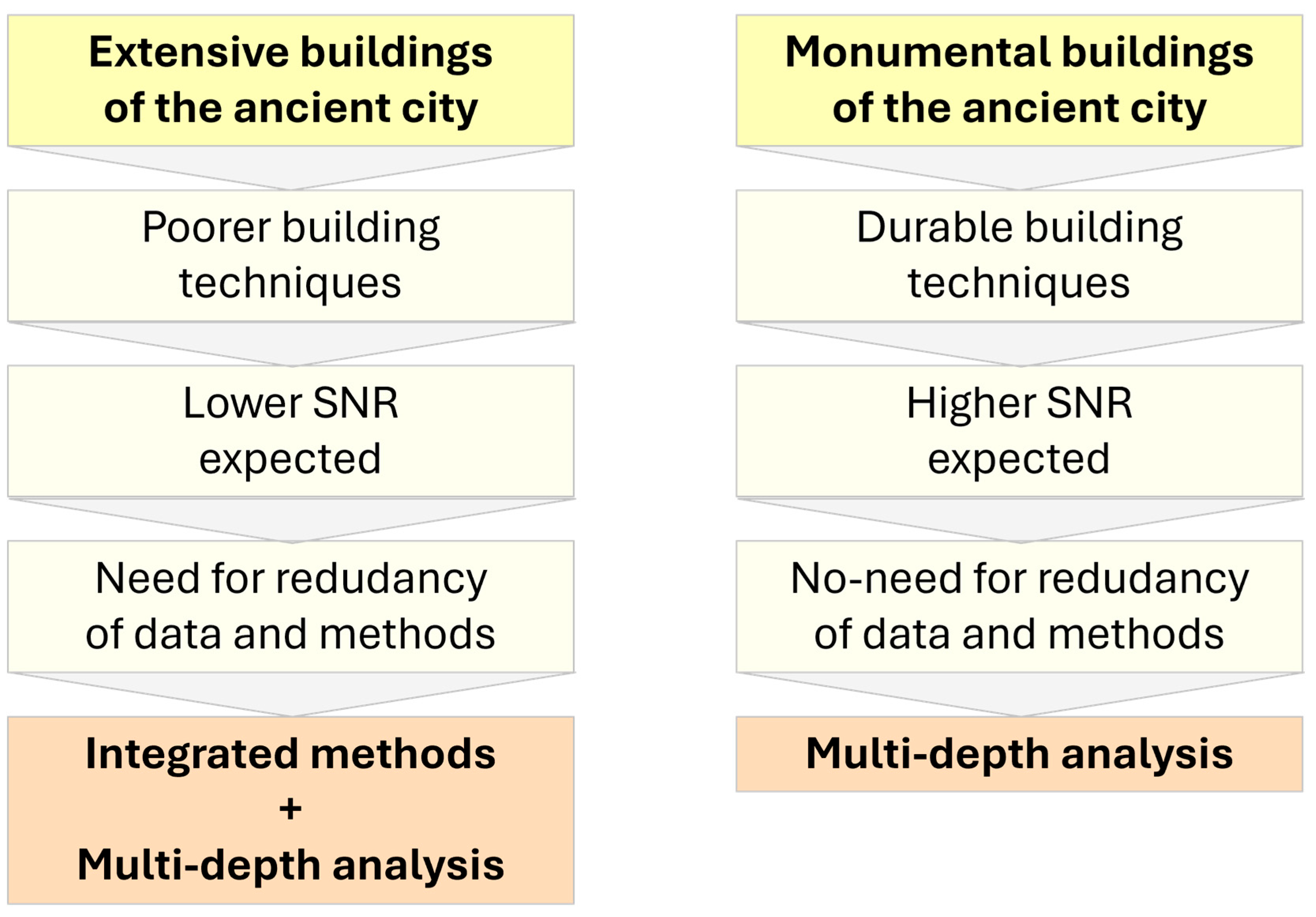
Figure 1. Conceptual representation of the research approach.
Remotesensing 17 03561 g001
Figure 2. The archeological site of Gela: geographical location in the Central Mediterranean Sea (inset) and aerial view with the archeological area of Molino a Vento, bordered in red, (a); aerial view of the archeological area of Molino a Vento (from [43]), (b); archeological map (North oriented) of the Molino a Vento area with the indication and photographic documentation of a 2013–2015 excavation on the plateia, (c); panoramic view of the remains of the ancient urban blocks from the northwest, (d).
Remotesensing 17 03561 g002
Figure 3. Photogrammetric workflow for the processing of the UAV imagery (a). Aerial orthophoto (b), and digital elevation model (c,d) produced with the photogrammetric method applied to drone imagery (d), show a zoom view of the excavated archeological site. Internal cross-marks and lateral UTM projection coordinates have an inter-distance of 50 m (b,c) and 20 m (d).
Remotesensing 17 03561 g003
Figure 4. Geophysical measurements: plan view of the data collection activity.
Remotesensing 17 03561 g004
Figure 5. GPR standard processing workflow applied to the experimental datasets.
Remotesensing 17 03561 g005
Figure 6. Color coding of the multi-depth integration of the geophysical (GPR) data.
Remotesensing 17 03561 g006
Figure 7. GPR depth slices every 10 cm in Area 1, for a wave velocity of 12 cm/ns. Planimetric local coordinates are indicated in meters. The small gray polygon visible in the images corresponds to the area occupied by a modern installation, which prevented investigations in that spot. Color values correspond to normalized envelope.
Remotesensing 17 03561 g007
Figure 8. Electrical resistivity tomography for three array types at Area 1. Vertical and horizontal coordinates are indicated in meters.
Remotesensing 17 03561 g008
Figure 9. Horizontal-to-Vertical Spectral Ratios (top part of each panel, red) and raw three-dimensional spectra (bottom part, green–blue–magenta) for the four stations of environmental noise deployed along the ERT profile at Area 1, SNS–01 (a), SNS–02 (b), SNS–03 (c), SNS–04 (d).
Remotesensing 17 03561 g009
Figure 10. GPR depth slices every 10 cm at Area 2, for a wave velocity of 12 cm/ns. Planimetric local coordinates are indicated in meters. Color values correspond to normalize envelope.
Remotesensing 17 03561 g010
Figure 11. Visual comparison of the integrated geophysical results for Area 1: radargram acquired on the same line as ERTs and seismic noise measurements (a) and its instantaneous amplitude, obtained with the envelope calculation (b), and aligned with the Schlumberger array ERT, over which are indicated the interface detection for the HVSR technique (c). Overlaying of the HVSR curves derived from the four seismic noise stations (SNS), (d). Vertical and horizontal distances in (ac) are indicated in meters (local coordinate of each acquisition line).
Remotesensing 17 03561 g011
Figure 12. Multi-depth RGB map of GPR data at Area 1 (a): the red channel represents the GPR amplitudes of the most shallow layers included (20–40 cm depth), the green channel represents the mid-depth reflections (40–60 cm), and the blue channel represents the deepest ones (60–80 cm), with the indication on the right of the additive mixing behavior inside the map. Identification of the most significant RGB GPR patterns (b), classified with respect to their colors and, by these, to their presence at the various levels of the multi-depth analysis.
Remotesensing 17 03561 g012
Figure 13. Multi-depth RGB map of GPR data at Area 2 (a): the red channel represents the GPR amplitudes of the shallowest layers included (10–40 cm depth), the green channel represents the mid-depth reflections (40–70 cm), and the blue channel represents the deepest (70–100 cm). Detection of most significant anomalies with a preliminary classification based on their spatial (planimetric) and temporal (vertical) features (b).
Remotesensing 17 03561 g013
Figure 14. Identification of the GPR signals in three radargrams for Area 1 as recognized by the RGB analysis of Figure 12. GPR profile IDs correspond to the progressive acquisition numbers, depths, and abscissas that are provided in meters (local coordinates related to the whole GPR data-cube).
Remotesensing 17 03561 g014
Figure 15. Identification of the GPR signals in four radargrams for Area 2, as recognized by the RGB analysis in Figure 13. GPR profile IDs correspond to the progressive acquisition numbers, depths, and abscissas that are provided in meters (local coordinates related to the whole GPR data-cube).
Remotesensing 17 03561 g015
Figure 16. The geophysical results with the most probable archeological features, the urban plan of the ancient settlement (7th-5th centuries BC) with the location of the excavations 2013–2015 (documented in Figure 2c), and of the excavation test 2021 (documented here, in the inset).
Remotesensing 17 03561 g016
Table 1. Geophysical survey acquisition parameters.
MethodInstrumentType/ConfigurationAcquisition Parameters
Ground-Penetrating Radar (GPR)Cobra CBD (shielded)Single antenna, reflection modeGPR Area 1 and 2
Central Frequency: 400 MHz (area 1) 800 MHz (area 2)
Time window: 50 ns
Trace interval: 0.05 m
Lateral distance between the lines: 0.40 m
Electrical Resistivity Tomography (ERT)ELECTRA Multichannel Digital Resistivimeter (MoHo srl)64-channel arrayERT Area 1
Electrode spacing: 0.5 m
Number of electrodes: 64
Array type: Wenner, dipole–dipole and Schlumberger
Horizontal to Vertical Spectral Ratio (HVSR)Tromino seismograph
(MoHo srl)
Passive Single-station measurementsH/V Area 1
Sampling frequency: 128 Hz
Recording time: 20 min per station
Number of stations: 4
Disclaimer/Publisher’s Note: The statements, opinions and data contained in all publications are solely those of the individual author(s) and contributor(s) and not of MDPI and/or the editor(s). MDPI and/or the editor(s) disclaim responsibility for any injury to people or property resulting from any ideas, methods, instructions or products referred to in the content.