The Driving Mechanism and Spatio-Temporal Nonstationarity of Oasis Urban Green Landscape Pattern Changes in Urumqi



Abstract
1. Introduction
2. Study Area
3. Data Resources and Method
3.1. Data Resources

3.2. Landscape Pattern Metrics
3.3. GeoDetector
3.4. Geographically Weighted Regression
4. Results
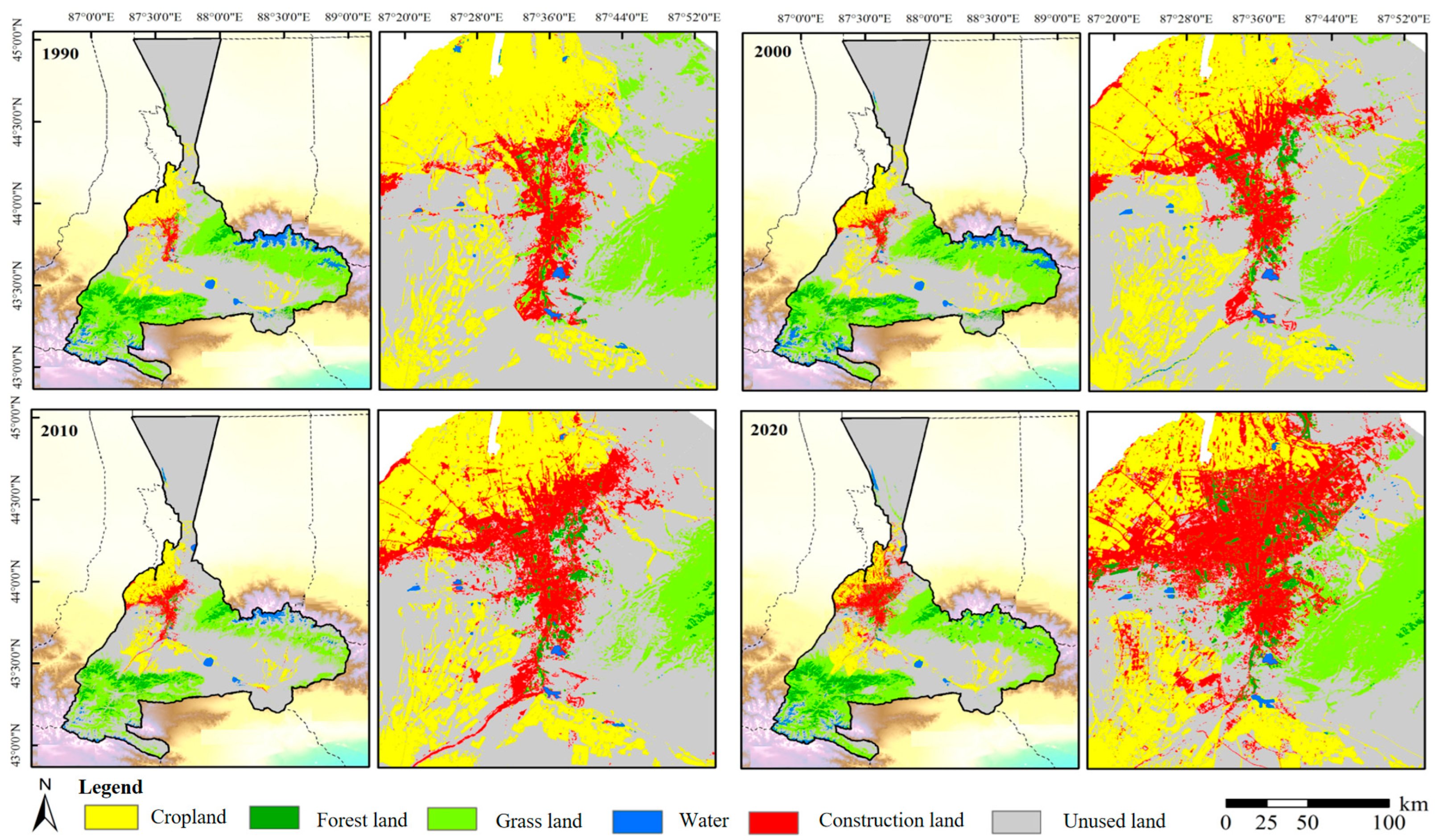
4.1. Quantity and Spatial Distribution Characteristics of Landscape Patterns
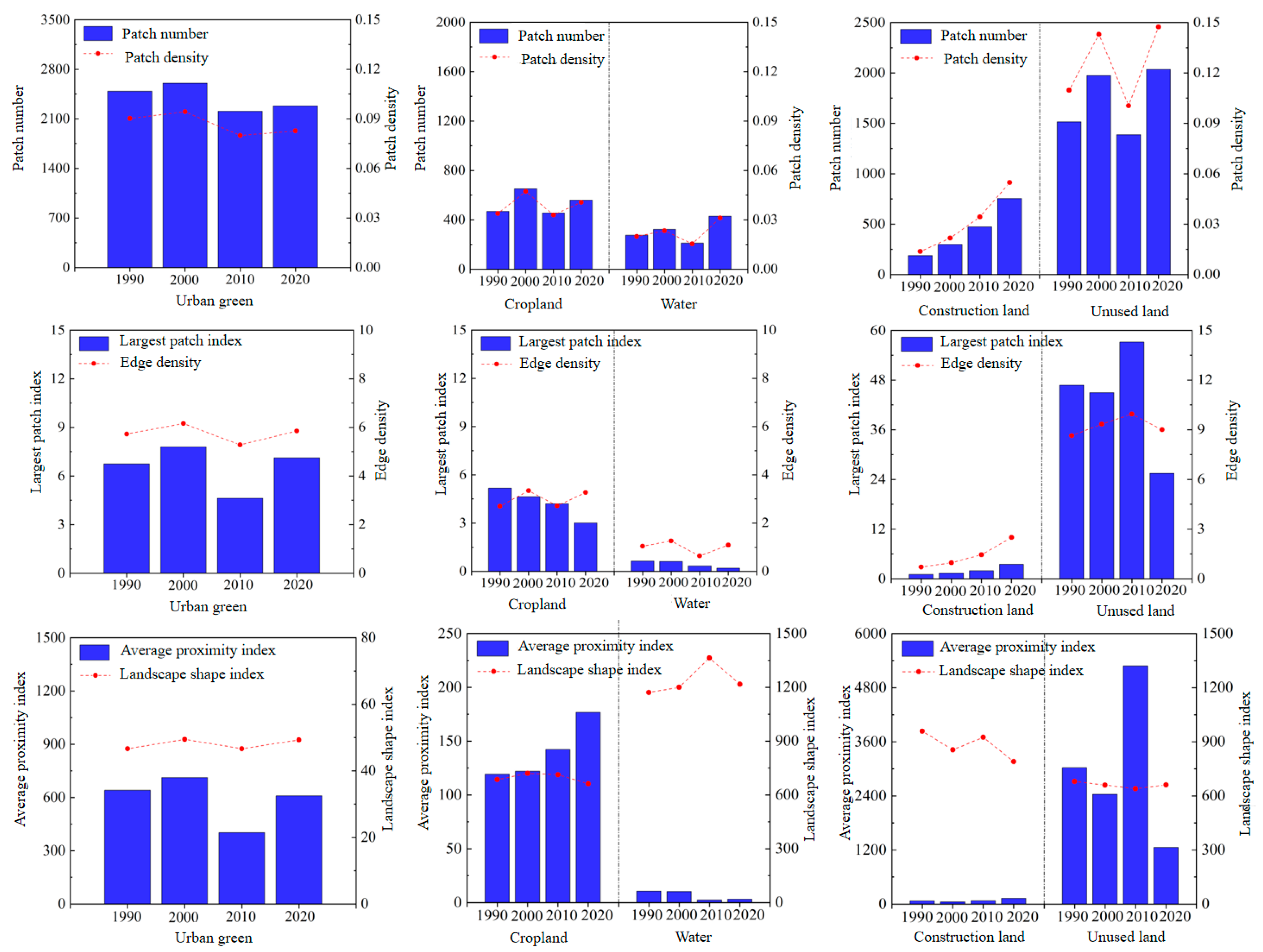
4.2. Temporal and Spatial Dynamic Changes in Landscape Pattern Metrics
4.3. Driving Mechanism and Spatio-Temporal Nonstationarity of Urban Green Landscape Pattern Changes
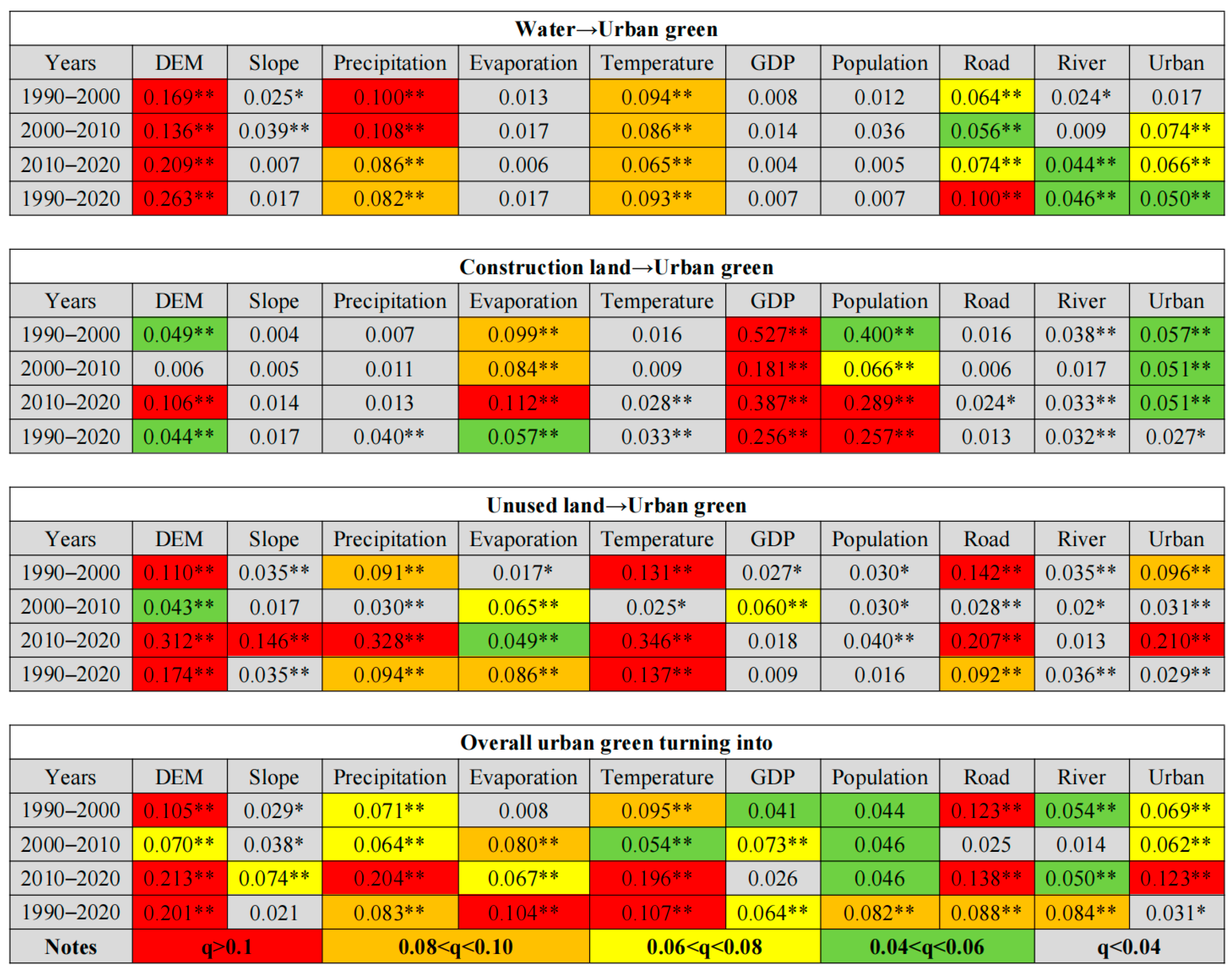
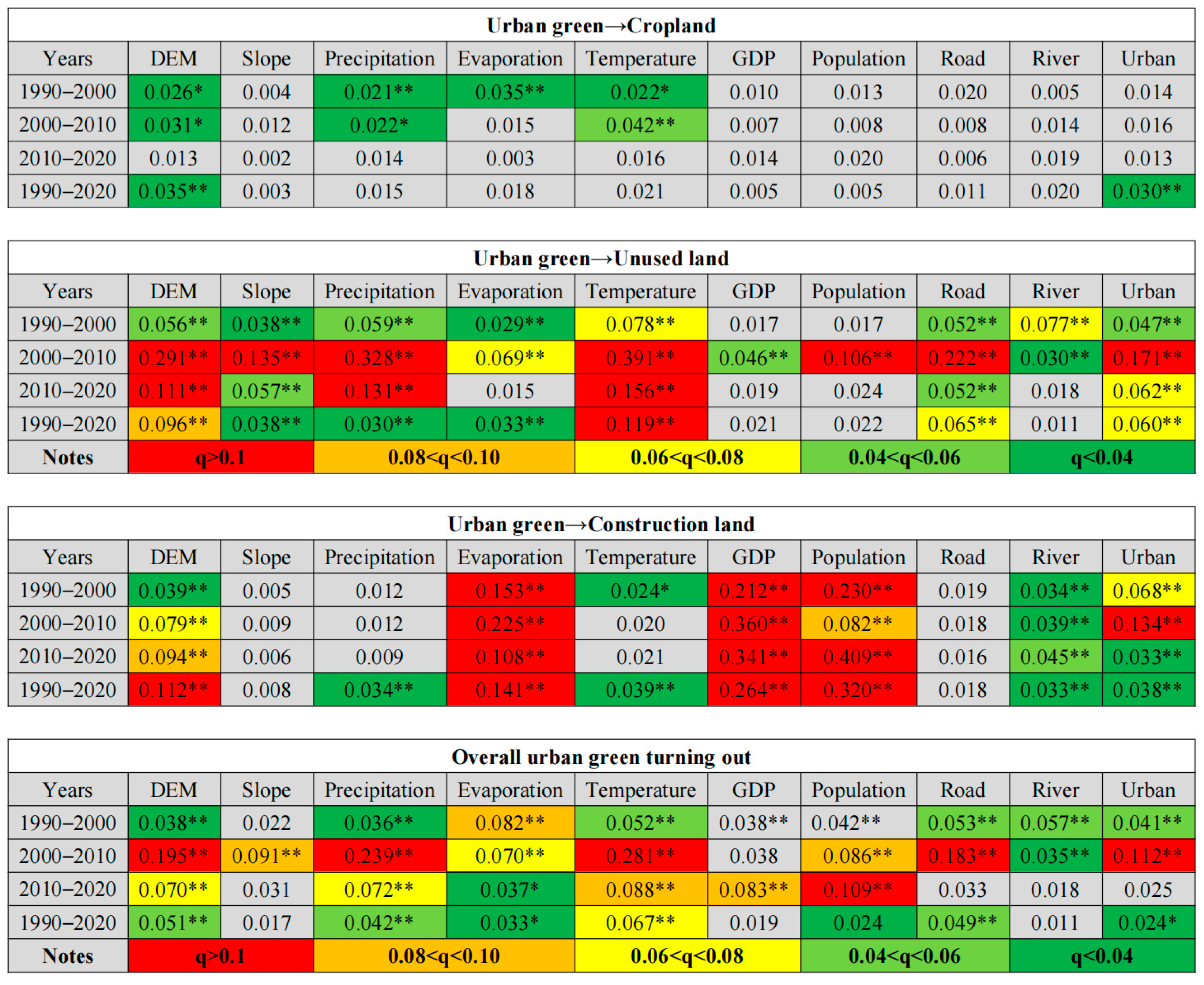
4.3.1. Temporal Variation Characteristics of Driving Forces for Urban Green Landscape Patterns
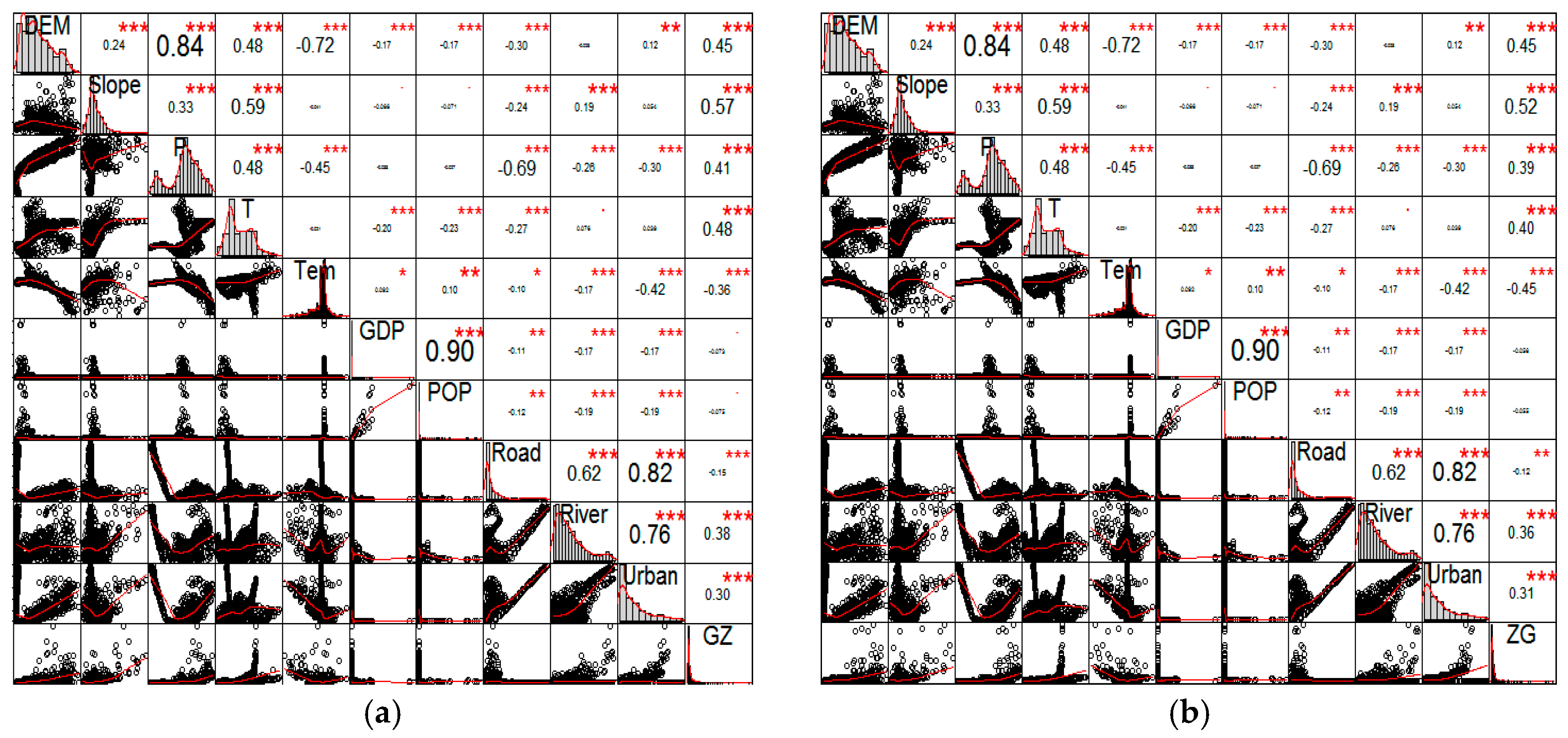
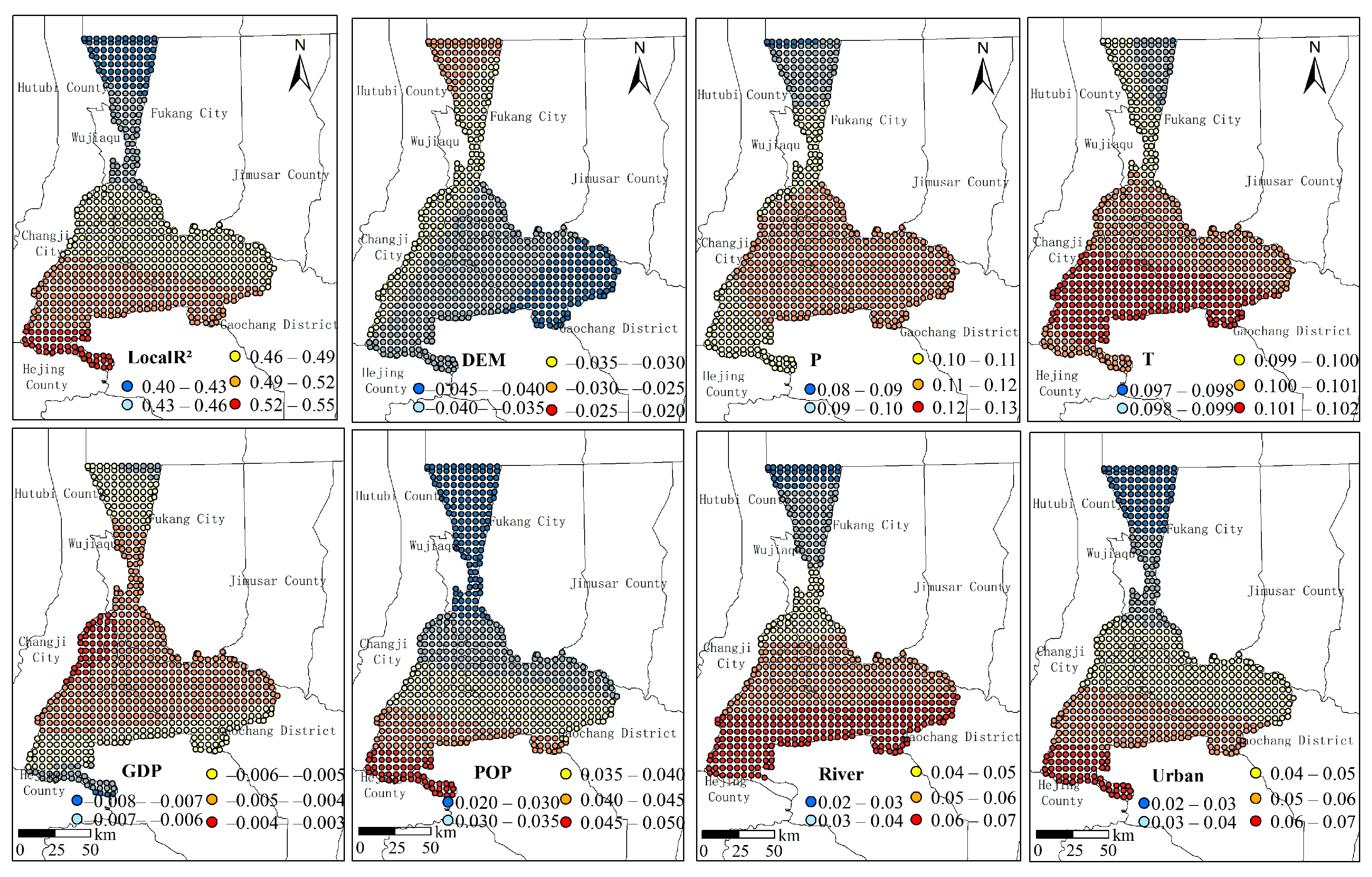
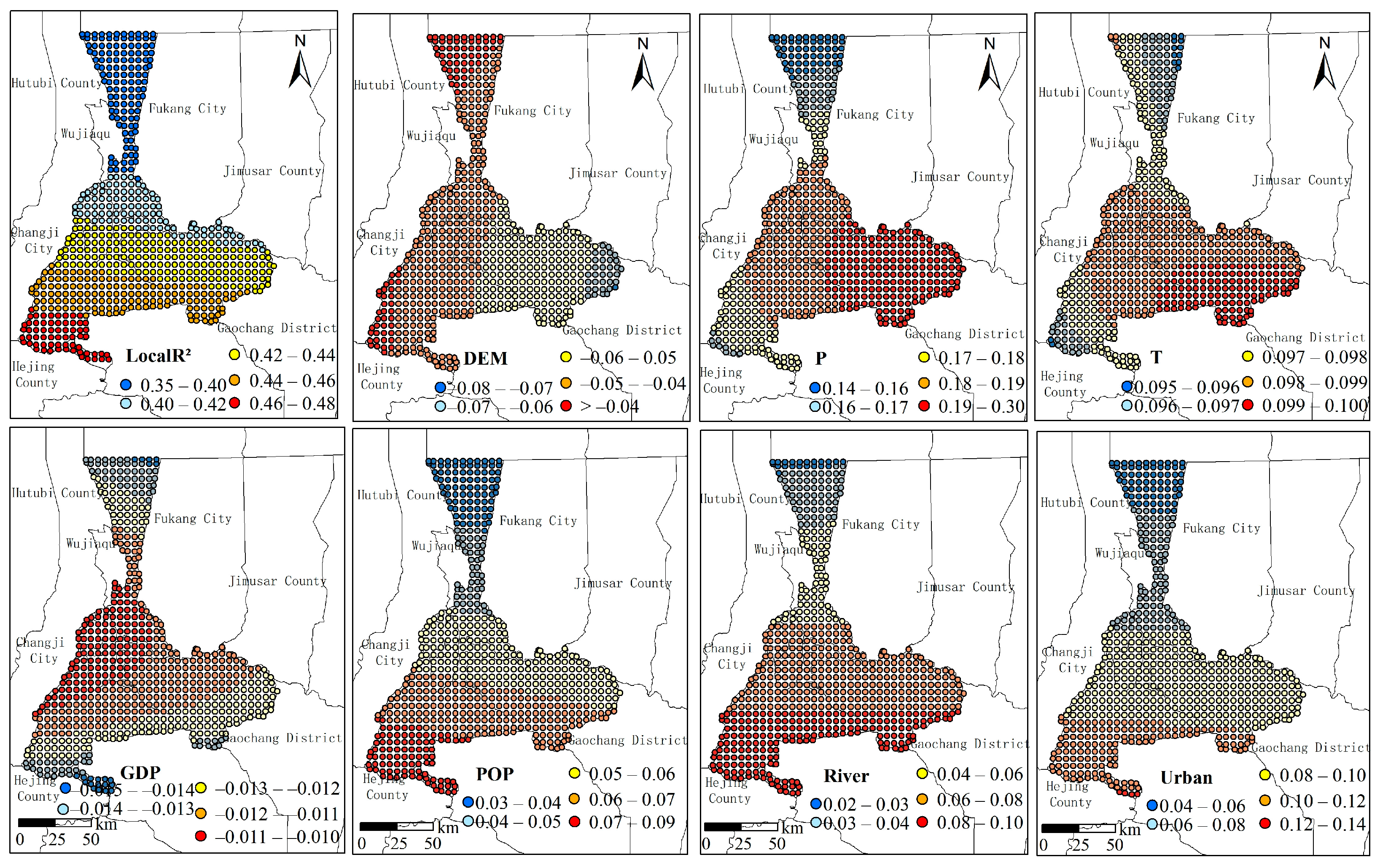
4.3.2. Spatial Nonstationarity of Driving Forces for Urban Green Landscape Patterns
5. Discussion
5.1. Landscape Pattern Changes and Driving Mechanisms
5.2. Contributions and Limitations
6. Conclusions
Author Contributions
Funding
Data Availability Statement
Acknowledgments
Conflicts of Interest
References
- Wang, Z.; Yu, Y.; Zhou, R. A longitudinal exploration of the spatiotemporal coupling relationship and driving factors between regional urban development and ecological quality of green space. Ecol. Indic. 2024, 164, 112134. [Google Scholar] [CrossRef]
- Zhang, L.L.; Meng, Q.Y.; Yao, S.; Qian, J.K.; Gao, J.F.; Wu, J.H. How to optimize urban blue space to maximize its cooling benefits? A case study in megacity of Beijing. Build. Environ. 2025, 270, 112502. [Google Scholar] [CrossRef]
- Jiang, S.M.; Feng, F.; Zhang, X.N.; Xu, C.Y.; Jia, B.Q.; Lafortezza, R. Driving factors of fragmentation in urban landscapes: Local contributions, spatial relationships, and causal effects. Ecol. Indic. 2025, 174, 113454. [Google Scholar] [CrossRef]
- Tian, Y.H.; Jim, C.Y.; Wang, H.Q. Assessing the landscape and ecological quality of urban green spaces in a compact city. Landsc. Urban Plan. 2014, 141, 97–108. [Google Scholar] [CrossRef]
- Bian, H.Y.; Gao, J.; Wu, J.G.; Sun, X.; Du, Y. Hierarchical analysis of landscape urbanization and its impacts on regional sustainability: A case study of the Yangtze River Economic Belt of China. J. Clean. Prod. 2020, 279, 123267. [Google Scholar] [CrossRef]
- Shi, L.; Halik, Ü.; Abliz, A.; Mamat, Z.; Welp, M. Urban Green Space Accessibility and Distribution Equity in an Arid Oasis City: Urumqi, China. Forests 2020, 11, 690. [Google Scholar] [CrossRef]
- Liu, M.; Li, J.; Song, D.; Dong, J.; Ren, D.; Wei, X. Spatiotemporal Dynamics Effects of Green Space and Socioeconomic Factors on Urban Agglomeration in Central Yunnan. Forests 2024, 15, 1598. [Google Scholar] [CrossRef]
- Liu, C.J.; Zhang, F.; Johnson, V.C.; Duan, P.; Kung, H. Spatio-temporal variation of oasis landscape pattern in arid area: Human or natural driving. Ecol. Indic. 2021, 125, 107495. [Google Scholar] [CrossRef]
- Kong, F.H.; Nakagoshi, N. Spatial-temporal gradient analysis of urban green spaces in Jinan, China. Landsc. Urban Plan. 2006, 3, 147–164. [Google Scholar] [CrossRef]
- Gonzalez-Mendez, B.; Chavez-Garcia, E. Re-thinking the Technosol design for greenery systems: Challenges for the provision of ecosystem services in semiarid and arid cities. J. Arid. Environ. 2020, 179, 104191. [Google Scholar] [CrossRef]
- Pan, Y.J.; Teng, T.W.; Wang, S.P.; Wang, T.T. Impact and mechanism of urbanization on urban green development in the Yangtze River Economic Belt. Ecol. Indic. 2024, 158, 111612. [Google Scholar] [CrossRef]
- Yuan, Y.Y.; Tang, S.Q.; Zhang, J.Q.; Guo, W. Quantifying the relationship between urban blue-green landscape spatial pattern and carbon sequestration: A case study of Nanjing’s central city. Ecol. Indic. 2023, 154, 110483. [Google Scholar] [CrossRef]
- Liu, X.Y.; Li, Y.F.; Zhang, S.; Niu, Q. Spatiotemporal patterns, driving mechanism, and multi-scenario simulation of urban expansion in Min Delta Region, China. Ecol. Indic. 2024, 158, 111312. [Google Scholar] [CrossRef]
- Duan, Z.; Huang, L.; Zhu, Z.; Long, S.; Liu, Y. Transformation and Inequity of Urban Green Space in Guangzhou: Drivers and Policy Implications Under Rapid Urbanization. Sustainability 2025, 17, 2217. [Google Scholar] [CrossRef]
- Zhu, Y.; Ling, G.H.T. Spatio-Temporal Changes and Driving Forces Analysis of Urban Open Spaces in Shanghai between 1980 and 2020: An Integrated Geospatial Approach. Remote Sens. 2024, 16, 1184. [Google Scholar] [CrossRef]
- He, X.; Zhou, Y.Q. Urban spatial growth and driving mechanisms under different urban morphologies: An empirical analysis of 287 Chinese cities. Landsc. Urban Plan. 2024, 248, 105096. [Google Scholar] [CrossRef]
- Yang, H.; Jin, C.; Li, T. Megacity urban green space equity evaluation and its driving factors from supply and demand perspective: A case study of Tianjin. J. Clean. Prod. 2024, 474, 143583. [Google Scholar] [CrossRef]
- Li, X.Q.; Xiao, L.M. The impact of urban green business environment on FDI quality and its driving mechanism: Evidence from China. World Dev. 2024, 175, 106494. [Google Scholar] [CrossRef]
- Gao, C.; Dang, Q.; Li, C.; Fan, Y. Analysis of Landscape Fragmentation Evolution Characteristics and Driving Factors in the Wei River Basin, China. Land 2025, 14, 538. [Google Scholar] [CrossRef]
- Wang, H.; Lin, C.; Ou, S.; Feng, Q.; Guo, K.; Wei, X.; Xie, J. Multilevel Change of Urban Green Space and Spatiotemporal Heterogeneity Analysis of Driving Factors. Sustainability 2024, 16, 4762. [Google Scholar] [CrossRef]
- Ge, G.B.; Shi, Z.J.; Zhu, Y.J.; Yang, X.H.; Hao, Y.G. Land use/cover classification in an arid desert-oasis mosaic landscape of China using remote sensed imagery: Performance assessment of four machine learning algorithms. Glob. Ecol. Conserv. 2020, 22, e00971. [Google Scholar] [CrossRef]
- McGarigal, K.; Marks, B.J. FRAGSTATS: Spatial Pattern Analysis Program for Quantifying Landscape Structure (General Technical Report PNW-GTR-351); USDA Forest Service, Pacific Northwest Research Station: Corvallis, OR, USA, 1995; p. 122. [Google Scholar]
- Dai, E.; Wu, Z.; Du, X. A gradient analysis on urban sprawl and urban landscape pattern between 1985 and 2000 in the Pearl River Delta, China. Front. Earth Sci. 2018, 12, 791–807. [Google Scholar] [CrossRef]
- Chen, Y.; Zhen, W.; Li, Y.; Zhang, N.; Shi, Y.; Shi, D. Spatiotemporal Analysis of Urban Blue Space in Beijing and the Identification of Multifactor Driving Mechanisms Using Remote Sensing. Remote Sens. 2023, 15, 5182. [Google Scholar] [CrossRef]
- Wang, J.F.; Xu, C.D. Geodetector: Principle and prospective. Acta Geo Sin. 2017, 72, 116–134. (In Chinese) [Google Scholar]
- Fotheringham, A.S.; Charlton, M.E.; Brunsdon, C. Geographically weighted regression: A natural evolution of the expansion method for spatial data analysis. Environ. Plan. A Econ. Space 1998, 30, 1905–1927. [Google Scholar] [CrossRef]
- Yan, Z.; Wang, Y.; Wang, Z.; Zhang, C.; Wang, Y.; Li, Y. Spatiotemporal Analysis of Landscape Ecological Risk and Driving Factors: A Case Study in the Three Gorges Reservoir Area, China. Remote Sens. 2023, 15, 4884. [Google Scholar] [CrossRef]
- Zhao, Y.Y.; Kasim, A.; Gao, W.P.; Liang, H.W. Quantitative analysis of urban expansion and response factors in Urumqi City based on random forest algorithm and geographical detector. Arid. Land. Geo 2021, 44, 1729–1739. (In Chinese) [Google Scholar]
- Zhang, Q.Q.; Shao, Z.L.; Lin, J.; Meng, L. Analysis on the temporal and spatial pattern evolution of land use function transformation in western oasis cities from the perspective of ‘Production-living-Ecological Space’: A case study of Urumqi. J. Chin. Agric. Mech. 2022, 43, 176–185+194. (In Chinese) [Google Scholar]
- Huang, L. Analysis of Temporal and Spatial Pattern Changes and Driving Factors of Oasis in Turpan City. Master’s Thesis, Xinjiang University, Xinjiang, China, 2019. (In Chinese). [Google Scholar]
- Liu, Y.W. The Changes of Landscape Pattern and Driving Forces in Urumqi County. Master’s Thesis, Xinjiang University, Xinjiang, China, 2019. (In Chinese). [Google Scholar]





| Level | Landscape Metrics | Connotation of Metrics |
|---|---|---|
| Class level | Patch number (NP) | The number of patches of a certain landscape type. |
| Patch density (PD) | The number of patches per unit area of a certain landscape. | |
| Edge density (ED) | Describes the boundary relationship between a certain landscape and its adjacent elements. | |
| Largest patch index (LPI) | The proportion of the largest patch of a certain type to the landscape area. | |
| Landscape shape index (LSI) | The deviation degree of the patch shape from a circle of the same area. | |
| Average proximity index (API) | Characterizes the degree of proximity and fragmentation within a certain landscape. | |
| Landscape level | Connectivity index (COHESION) | Explores the degree of connection between patches in the landscape. |
| Richness index (PI) | Characterizes the richness among landscapes. | |
| Contagion index (CONTAG) | Reflects the agglomeration characteristics and spread trends among landscapes. | |
| Shannon diversity index (SHDI) | Reveals the spatio-temporal heterogeneity characteristics of the landscape. | |
| Shannon equitability index (SHEI) | Describes the uniformity of the spatio-temporal distribution of the landscape. |
| Years | CONTAG | COHESION | PI | SHDI | SHEI |
|---|---|---|---|---|---|
| 1990 | 50.894 | 99.311 | 6.000 | 1.211 | 0.745 |
| 2000 | 47.525 | 99.249 | 6.000 | 1.274 | 0.771 |
| 2010 | 54.796 | 99.436 | 6.000 | 1.079 | 0.635 |
| 2020 | 46.584 | 99.048 | 6.000 | 1.298 | 0.779 |
Disclaimer/Publisher’s Note: The statements, opinions and data contained in all publications are solely those of the individual author(s) and contributor(s) and not of MDPI and/or the editor(s). MDPI and/or the editor(s) disclaim responsibility for any injury to people or property resulting from any ideas, methods, instructions or products referred to in the content. |
© 2025 by the authors. Licensee MDPI, Basel, Switzerland. This article is an open access article distributed under the terms and conditions of the Creative Commons Attribution (CC BY) license (https://creativecommons.org/licenses/by/4.0/).
Share and Cite
Shi, L.; Zhang, X.; Halik, Ü. The Driving Mechanism and Spatio-Temporal Nonstationarity of Oasis Urban Green Landscape Pattern Changes in Urumqi. Remote Sens. 2025, 17, 3123. https://doi.org/10.3390/rs17173123
Shi L, Zhang X, Halik Ü. The Driving Mechanism and Spatio-Temporal Nonstationarity of Oasis Urban Green Landscape Pattern Changes in Urumqi. Remote Sensing. 2025; 17(17):3123. https://doi.org/10.3390/rs17173123
Chicago/Turabian StyleShi, Lei, Xinhan Zhang, and Ümüt Halik. 2025. "The Driving Mechanism and Spatio-Temporal Nonstationarity of Oasis Urban Green Landscape Pattern Changes in Urumqi" Remote Sensing 17, no. 17: 3123. https://doi.org/10.3390/rs17173123
APA StyleShi, L., Zhang, X., & Halik, Ü. (2025). The Driving Mechanism and Spatio-Temporal Nonstationarity of Oasis Urban Green Landscape Pattern Changes in Urumqi. Remote Sensing, 17(17), 3123. https://doi.org/10.3390/rs17173123