1. Introduction
Accurate and reliable carrier phase integer ambiguity resolution (IAR) is crucial for the precise positioning of global navigation satellite systems (GNSSs). Currently, the primary integer estimators include integer rounding (IR), integer bootstrapping (IB), and integer least squares (ILS) [
1]. Particularly, the ILS estimation is generally adopted attributed to its highest success rate [
2,
3].
The procedures of ILS estimation can be summarized as follows: (a) Ignoring the integer characteristic of ambiguities, the float solution and its variance–covariance (VC) matrix can be solved by the least squares (LS) estimation in the real domain. (b) Considering the integer property of ambiguities, based on the float ambiguity solution and its VC matrix, the optimal integer candidate can be selected as the fixed ambiguity solution. (c) The reliability of the fixed ambiguity solution is assessed through a validation test. (d) If the fixed ambiguity solution passes the validation test, then other unknown parameters will be updated accordingly; otherwise, the float solution will be retained.
In ILS estimation, once the fixed ambiguity solution is accepted by the validation test, it is regarded as the true value of ambiguities with minimal variance, and the remaining unknown parameters will be calculated based on it. Therefore, to avoid significant positioning errors, the wrongly fixed ambiguities are required to be effectively rejected. The most popular validation tests can be categorized as follows: (a) discriminant tests based on the quadratic form of ambiguity residual, such as the F-ratio test, R-ratio test, different test, and W-ratio test [
4,
5,
6,
7]; (b) success and failure rate methods established on the framework of ambiguity estimation theory [
8]; (c) validation tests combining (a) and (b) [
9].
To flexibly control the reliability of integer estimation, Teunissen [
10,
11] proposed the integer aperture (IA) estimation, which incorporates validation methods into the process of IAR. Within the framework of IA estimation, the ellipsoidal integer aperture (EIA) method and the penalized method were introduced [
12,
13]. To achieve better control over the size of aperture, several validation methods combined with a controlled failure rate were developed, which necessitate an appropriate threshold to realize the excellent performance of IA estimation [
14,
15,
16,
17,
18,
19]. Additionally, due to the difficulty of performing complex integrals over a high-dimensional integer space, the practical application of the optimal IA estimation is limited [
20].
With the rapid development of multi-frequency and multi-constellation GNSS, precise IAR can be achieved in the majority of application scenarios. However, in certain complex situations, accurate and reliable IAR is difficult to realize as a result of outliers and unmodeled errors, such as ionospheric and tropospheric residuals. Under these conditions, the fixed solution is at a significantly higher risk of severe errors. On the one hand, if the threshold for the validation test is set too strict, then numerous correctly fixed ambiguities will be rejected, resulting in a substantial decrease in the accuracy of ILS estimation. On the other hand, if the threshold is set excessively loose, then it will be challenging to exclude the several erroneous fixed solutions, leading to a steep decline in the reliability of ILS estimation. To overcome this problem, the best integer equivariant (BIE) estimation has been widely applied in practical positioning [
21,
22,
23,
24,
25]. The BIE estimation was first introduced into the GNSS ambiguity resolution (AR) by Teunissen [
21], and compared to the ILS estimation, the BIE estimation can strike a superior balance between accuracy and reliability.
The BIE estimation has proven to be optimal in the sense of minimum mean square error (MMSE) [
21]. Teunissen [
21] and Verhagen et al. [
26] theoretically and experimentally verified that the accuracy of the BIE solution lies between that of float and fixed solutions. It resembles the float solution at low ILS success rates, alleviating the risk of severe positioning errors. Conversely, it approximates the fixed solution at sufficiently high success rates, meeting the requirements for high-precision positioning. Moreover, Yu et al. [
27] derived the posterior variance of BIE estimation and demonstrated that, when the positioning error of the BIE solution is increased due to unmodeled errors in the observations, the posterior variance of the BIE estimation will facilitate effective error warning capability. To deal with the high occlusion, strong reflection, and frequent maneuvering in urban canyon environments, Zhang et al. [
28] developed the BIE estimation with quality control, effectively enhancing the positioning precision and reliability. Zhang et al. [
29] applied the unsupervised machine learning to improve the reliability of ambiguity candidate selection. Duong et al. [
30] developed the BIE estimation with multivariant t-distribution to achieve the reliable and fast solution convergence time in precise point positioning with AR. To address significant observation errors and outliers in complex urban environments, Liu et al. [
31] proposed the BIE estimation with Laplacian distribution.
In environments with a limited number of satellites or poor satellite geometry, the GNSS observation model is weak or even ill-posed, which is reflected by a larger matrix condition number. Under these conditions, slight systematic errors tend to cause severe biases in the float solution, and the inconsistency between the float solution and its posterior variance becomes particularly pronounced. Additionally, the VC matrix of the float ambiguity solution is probably ill-conditioned. Due to the aforementioned issues, a seriously biased integer candidate is highly likely to be mistakenly identified as the optimal solution during the ILS ambiguity search. In BIE estimation, the accuracy of weight allocation for ambiguity candidates will deteriorate. The wrongly selected best candidate is likely to be assigned an excessively high weight, while the contributions of other candidates to the BIE estimation are negligible. Therefore, the BIE solution is probably identical to the fixed solution, exhibiting significant positioning errors. Furthermore, caused by the overly high weight allocated to the optimal candidate, the posterior variance of the BIE estimation will be consistent with that of a fixed solution, losing its error warning capability. As a result, the reliability of BIE estimation in weak GNSS observation models could even be worse than that of ILS estimation.
Regularization methods are commonly utilized to address ill-posed problems [
32,
33,
34,
35,
36,
37,
38]. The general idea is to employ a regularization term to stabilize the estimators in ill-posed models. Among these methods, Tikhonov regularization is one of the most widely used approaches [
33]. Hansen [
34] established Tikhonov regularization as a fundamental framework for obtaining stable solutions and analyzed and extended the L-curve method for determining the regularization parameter. In the field of geodesy, Li et al. [
39] applied ridge estimation to mitigate the model’s ill-condition, realizing the superior performance of regularized AR. Wu et al. [
40] recommended the regularized ILS estimation, increasing the success rate of IAR in a weak GNSS model. In this contribution, a BIE AR method based on Tikhonov regularization is proposed to enhance the positioning performance under weak GNSS models, which exhibit a certain degree of ill-posedness caused by a limited number of satellites or poor satellite geometry. The method introduces Tikhonov regularization into the LS estimation and ILS ambiguity search, which significantly improves the accuracy of ambiguity candidates’ selection and weight allocation in the BIE estimation. Simulation experiments and field tests with 10 km and 18 km baselines have demonstrated that the proposed method can effectively enhance positioning accuracy and reliability in weak observation models.
2. Methods
2.1. Principle of GNSS Integer Ambiguity Resolution
2.1.1. Mixed Integer Model
The observation equations for GNSS precise positioning can be represented as the following Gaussian–Markov model:
where
denotes the
vector of double-difference (DD) GNSS observations,
denotes the
vector of random errors,
denotes the
vector of DD ambiguities,
denotes the
vector of other unknown parameters involving baseline coordinates,
and
denote the corresponding design matrix, respectively, and
denotes the VC matrix of
. The float solution and its VC matrix can be obtained by the following LS estimation:
Taking the integer characteristic of ambiguities into account, the fixed ambiguity solution
can be acquired by the ILS estimation. If the fixed ambiguity solution is accepted by the validation test, then other unknown parameters and their posterior VC matrix will be updated accordingly [
2,
41]:
Otherwise, the float solution will be retained.
2.1.2. Best Integer Equivariant Estimation
According to statistical theory, it is fundamentally impossible to obtain the true value of an unknown parameter from observations that contain random errors. Hence, it is irrational to constrain the ambiguity solution to the integer domain due to its integer property. In fact, all integer vectors have the potential to be the true value of ambiguities. Accordingly, an appropriate approach is to make a weighted sum of all integer candidates. Based on the assumption of Gaussian distribution, the BIE ambiguity estimation can be derived as follows [
21]:
where
represents the BIE ambiguity solution, and
represents
. Since there are countless n-dimensional integer vectors, it is unfeasible to apply the BIE estimation in practical scenarios. Fortunately, a finite set of candidates with the highest posterior probability can be utilized to approximate the BIE estimation, with its integer equivariant characteristic maintained [
42]. The set is required to satisfy the following inequality:
where
denotes the posterior probability of
,
is the lower bound of the posterior probability that should be satisfied by the finite set, and
denotes the total number of candidates within the set. Teunissen [
16] proposed an n-dimensional hyperellipsoid determined by a given confidence level. The finite set can be defined based on the following hyperellipsoid:
where
is the given confidence level. To ensure the reliability of the finite candidate set,
is usually set to be less than
.
is the chi-square value determined by
. The feasible formula for the approximate BIE estimation can be written as follows:
where
denotes the BIE solution of other unknown parameters. The posterior VC matrix of BIE estimation can be obtained as follows [
27]:
The detailed derivation of the
matrix is provided in the
Appendix A.
In certain complicated scenarios, such as complex urban environments, caused by the poor reliability of the fixed solution and the low precision of the float solution, it is difficult to achieve the excellent performance of ILS estimation. If the threshold for the validation test is overly strict, then frequent false-alarm errors will lead to a decrease in the precision of ILS estimation. While, when the threshold is excessively loose, several miss-detection errors will result in a sharp decline in the positioning reliability. The BIE estimation can realize a superior balance between accuracy and reliability. It approximates the high-precision fixed solution at sufficiently high success rates, while it is closer to the relatively reliable float solution at low success rates. Moreover, when there are unmodeled errors contained in the observations, which are likely to be partially or completely absorbed by ambiguity solutions through the LS estimation, the integer characteristic of ambiguities will be weakened or destroyed. In this case, the accuracy of the fixed BIE solution could possibly be worse than that of a float solution. In ILS estimation, once the fixed ambiguity solution passes the validation test, it is considered the true ambiguity with negligible variance, and the remaining unknown parameters, along with their posterior variances, will be subsequently obtained according to it. Therefore, if the incorrectly determined optimal candidates are not successfully excluded by the validation test, then the variance of ILS estimation will be misleadingly low and thus lack effective error warning. According to Equations (14) and (15), the posterior variance of the BIE estimation is calculated based on all selected ambiguity candidates and their weight allocation, which provides a better capability of reliability evaluation.
2.2. Best Integer Equivariant Ambiguity Resolution Method Based on Tikhonov Regularization
When the integer property of ambiguities is weakened by unmodeled errors in the observations, the weight allocation for integer candidates in the BIE estimation should become balanced, with the weight of the best candidate significantly reduced, while the weight assigned to other candidates increases. In this case, the BIE solution approximates the relatively reliable float solution. However, in challenging environments such as urban canyons, the limited number and poor geometry of visible satellites lead to a weak or even ill-posed GNSS observation model. Under these conditions, the stability of estimators deteriorates markedly. When there is a minor degree of unmodeled errors in the observations, the float solution is likely to be seriously biased, and the inconsistency between the float solution and its posterior variance will be particularly prominent. Additionally, its posterior VC matrix will exhibit a severe ill condition.
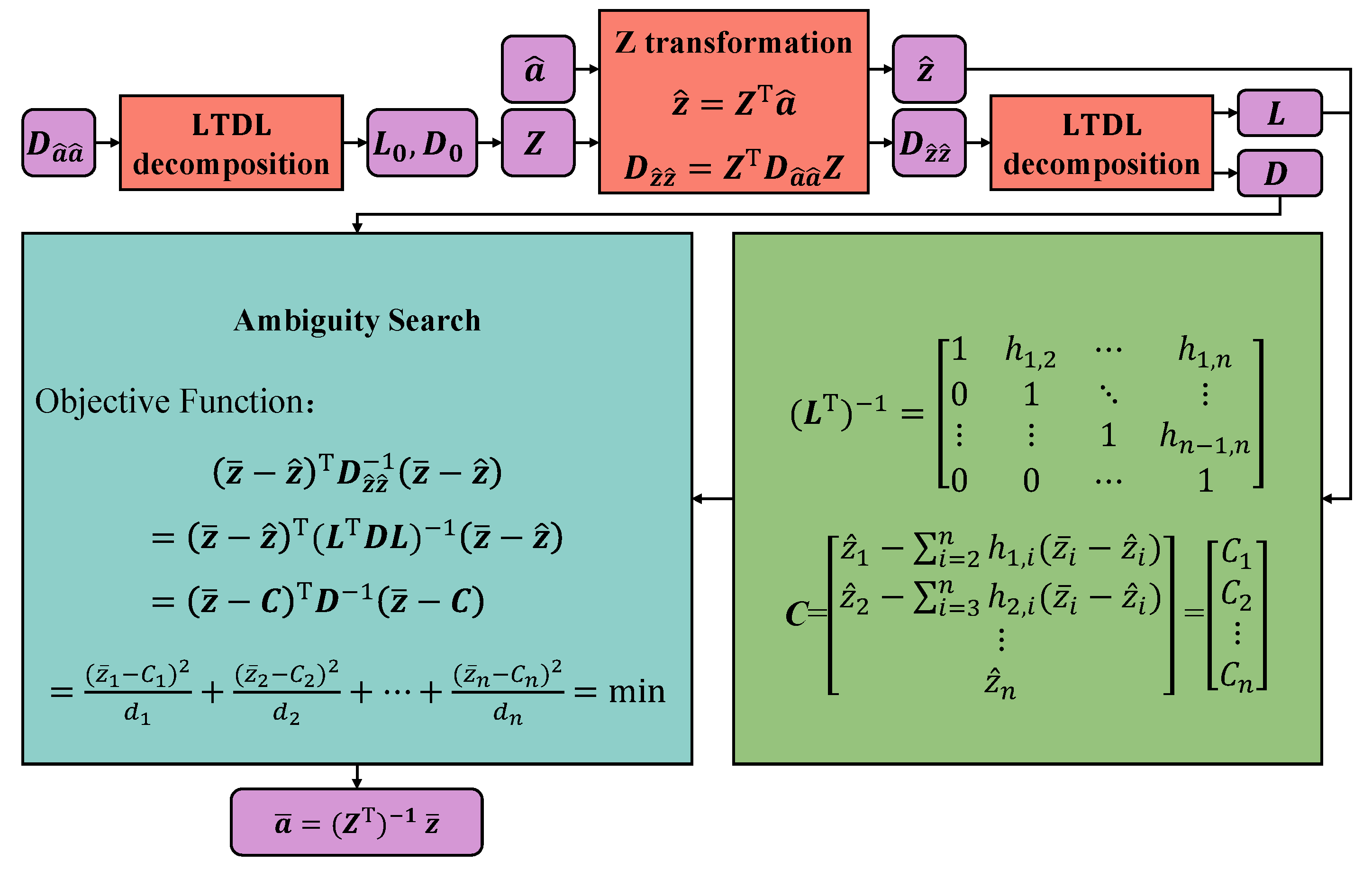
The framework of least square ambiguity decorrelation adjustment (LAMBDA) algorithm is depicted in
Figure 1. In
Figure 1, the purple rounded rectangles represent the inputs or outputs involved in the process; the red rectangles represent the decorrelation operations, including Z-transform and LTDL decomposition; the cyan rectangle represents the ambiguity search process; the green rectangle shows the details of the
and
matrices; and the arrows indicate the directions of parameter inputs and outputs and the execution order of the algorithm.
Due to the aforementioned problems, the correlation between ambiguities is strong, and there is a significant disparity between the larger and smaller diagonal elements in the matrix obtained by the LTDL decomposition of . It can be assumed that , where denotes the diagonal element in the matrix. When is much greater than , the impact of on the objective function is extremely negligible compared to , where represents the integer ambiguity to be solved in the decorrelated space mapped by Z-transform, is the float solution mapped to the decorrelated space, and is the parameter affected by and its correlation with other ambiguities. According to the objective function, to minimize the weighted quadratic form of the ambiguity residual, it is necessary to ensure to be sufficiently small, while can be relatively large. Thus, is permitted an extremely wide selection range. When the high-weight is biased due to unmodeled errors, not only is it possible for to be wrongly determined, but , which is strongly correlated with , is highly likely to be severely biased. Therefore, in cases of weak GNSS models, the selected best candidate probably exhibits significant errors under the influence of unmodeled errors.
Table 1 presents the ambiguity solutions and reference true value in an epoch in the field test with a 10 km baseline. The reference true value of ambiguities is obtained based on the real baseline coordinates. In
Table 1, it can be seen that the BIE solution is identical to the fixed solution, with some ambiguities deviating from the true value by more than 10 cycles. This indicates that the weight assigned to the significantly biased optimal candidate approximately achieves 100% in BIE estimation.
Table 2 shows the parameters corresponding to the optimal and suboptimal ambiguity candidates obtained by the LAMBDA algorithm, where
is calculated according to Equation (13). It can be learned from
Table 2 that the suboptimal candidate is entirely consistent with the true ambiguity. Moreover, the residual weighted quadratic form of the optimal candidate is comparable to that of the suboptimal candidate. However, based on the assumption of Gaussian distribution, the weight of the optimal candidate is
times that of the suboptimal candidate after the exponential operation. As a result, the weight allocated to the incorrectly selected optimal candidate nearly achieves 100% in BIE estimation.
Furthermore, according to the widely used R-ratio test:
The
in this epoch is 1.09. In ILS estimation, even if an extremely loose threshold is applied, the R-ratio test is able to reject the severely biased fixed ambiguity solution. However, in BIE estimation, due to the excessively high weight assigned to the optimal candidate, the approximation of
can be calculated according to the following Equation (14):
where
is the wrongly determined best integer candidate, and
is the weight of
, which approximates 100%. By substituting
into Equation (14), the posterior variance of the BIE estimation nearly resembles that of a fixed solution. In the east (E), north (N), and up (U) direction, the posterior variances of the BIE estimation are
m,
m, and
m, respectively. Hence, the variance of the BIE solution is not capable of error warning. Therefore, the reliability of BIE estimation is sharply decreased in cases of weak GNSS observation models.
Tikhonov regularization is one of the widely applied approaches to address ill-posed problems. In this contribution, Tikhonov regularization is introduced into the LS estimation and ILS ambiguity search, aiming to mitigate the serious negative impact of unmodeled errors on BIE AR under weak observation conditions. Through the proposed method, the positioning performance in weak GNSS models can be effectively improved.
2.2.1. Regularized Least Squares Estimation
For the sake of brevity, Equation (1) can be simplified as follows:
where
. The objective function of LS estimation can be represented as follows:
The LS estimation can be formulated as follows:
where
,
denotes the VC matrix of LS estimation.
Under weak observation conditions,
is likely to be strongly ill-conditioned; hence, slight unmodeled errors in
can cause significant biases in
, along with the inconsistency between
and
. Additionally,
will probably exhibit a certain degree of ill-condition. In this case, the accuracy of weight allocation for integer candidates in BIE estimation will be seriously affected. Therefore, Tikhonov regularization is utilized to enhance the stability of LS estimation in this paper. The objective function of regularized LS estimation can be expressed as follows:
where
denotes the regularization matrix, and
denotes the regularization factor. The appropriate selection of
and
is crucial for the performance of regularized LS estimation. According to the principle of Tikhonov regularization, the following regularization matrix
is adopted [
43]:
The dimension of
is equal to that of
,
is a
diagonal matrix, and its diagonal elements are identical to the smallest diagonal element of the submatrix corresponding to the baseline parameters in
. The regularization factor
can be obtained by the L-curve method [
44]. According to the L-curve method, a curve can be plotted with
on the horizontal axis and
on the vertical axis, and these are shown as follows:
The regularization factor
can be determined as
corresponding to the inflection point of the curve. The regularized LS estimation can be expressed as follows:
According to the law of error propagation, the VC matrix of
can be written as follows:
Based on Tikhonov regularization, the LS estimation can be stabilized. In the following, the float solution obtained by the regularized LS estimation is denoted as the regularized float solution.
2.2.2. Regularized Integer Least Squares Estimation
Through the regularized LS estimation, the reliability of float solution in a weak observation model has been enhanced. However, the inconsistency between the float ambiguity solution and its ill-conditioned VC matrix has not been resolved, which will severely affect the accuracy of the ILS ambiguity search. Therefore, Tikhonov regularization is further incorporated into the ILS estimation. The objective function of ILS estimation can be represented as follows:
where
represents the integer ambiguity to be determined. According to the principle of Tikhonov regularization, the objective function of regularized ILS estimation can be represented as follows:
The regularization matrix
can be selected as [
43]:
where
is an
diagonal matrix, and
is equal to the minimum diagonal element of
. The regularization factor
can be obtained by the L-curve method. By employing the L-curve method, a curve is plotted with
and
on the horizontal and vertical axis, respectively, as follows:
where
is the optimal candidate in the ILS ambiguity search based on the following objective function:
can be determined as
corresponding to the inflection point of the curve. The fixed solution obtained by the optimal candidate in the regularized ILS estimation is denoted as the regularized fixed solution.
By applying Tikhonov regularization to both LS and ILS estimation, the stability of ambiguity candidates’ selection and weight allocation is effectively improved. Consequently, the accuracy and reliability of BIE AR method based on Tikhonov regularization can be significantly enhanced under weak GNSS models.
2.2.3. Optimized Approach for Regularization Parameter Determination
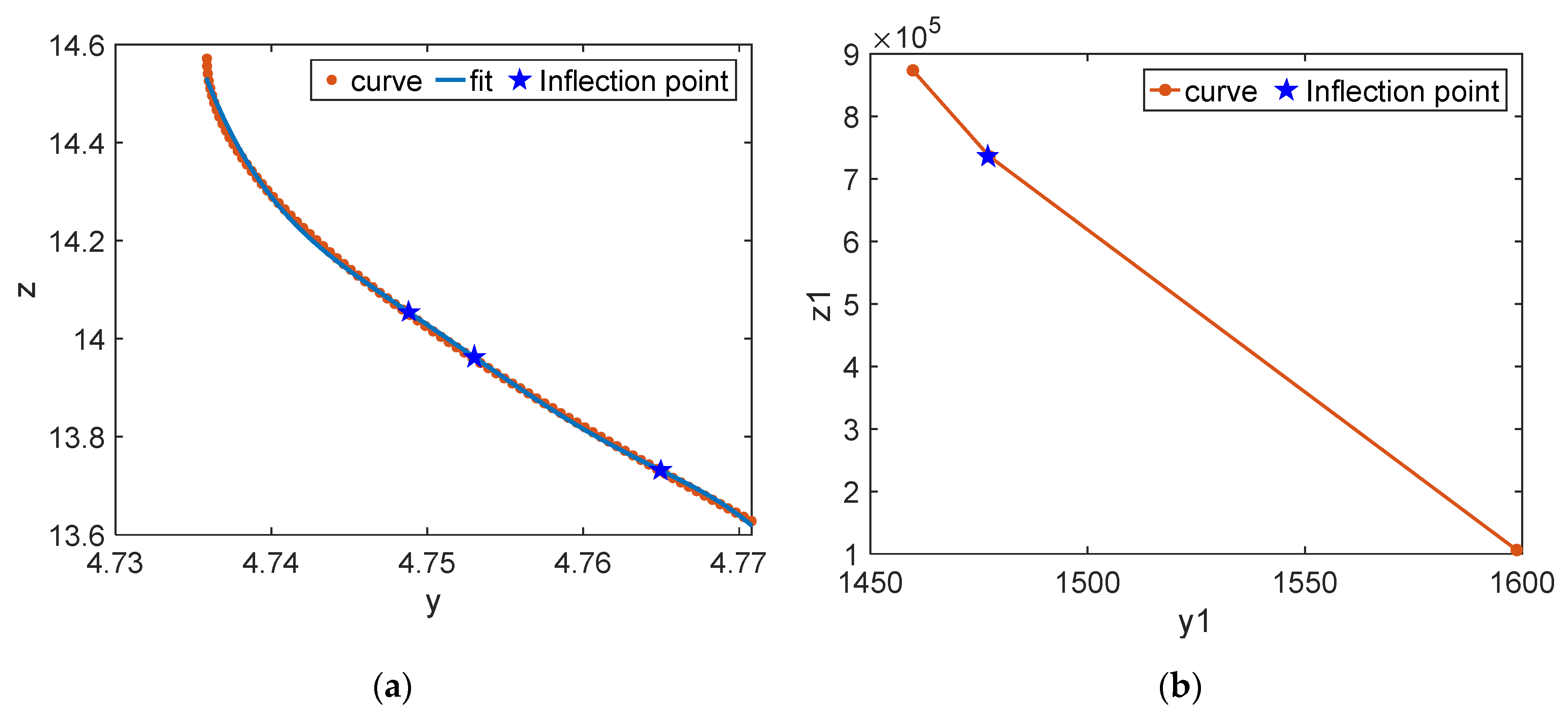
Figure 2 shows the L-curve with inflection points obtained during the regularized LS and ILS estimation in an epoch in the field test with a 10 km baseline. In
Figure 2, the red dots represent the scatter points generated from iterations of
or
, the blue curve represents the fit to the scatter points, and the blue pentagons indicate the inflection points of the L-curve.
Since a great number of
and
are necessary for drawing the L-curve, particularly to obtain each
, the LAMBDA algorithm is required to be performed. Additionally, as can be seen in
Figure 2a, the L-curve may lack an obvious inflection point, making it difficult to select the optimal regularization factor in each epoch. According to the analysis of L-curves in numerous epochs under weak observation conditions, choosing
enables a satisfactory optimization effect of regularization in ill-posed models. Accordingly, to facilitate practical application, an optimized approach for regularization factor selection can be designed as follows:
where
represents the computation of the matrix’s condition number.
Based on the extensive simulations and field experiments, the regularization factor determined by the aforementioned approach is demonstrated to achieve a favorable effect of Tikhonov regularization. For brevity, the positioning solution obtained by the BIE AR method based on Tikhonov regularization is denoted as the regularized BIE solution in the following.
Table 3 shows the RMSE of regularized BIE solutions based on different
threshold,
α, and
β values in both the field tests with 10 km and 18 km baselines and the simulation experiment, where the IB success rate is 99.1% and the unmodeled errors are contained in the observations. In
Table 3,
threshold denotes the threshold of matrix condition number for regularization. According to
Table 3, it is illustrated that the improved performance of BIE estimation in a weak GNSS model can be better realized using the proposed approach based on the selected
,
, and
.
3. Results
In order to verify the improved performance of the proposed method in cases of weak GNSS models, both simulation experiments and field tests are conducted in this contribution. The simulation experiments are set to demonstrate the serious negative impact of unmodeled errors on positioning accuracy due to the ill-posed problem, and the improvements in the float, BIE, and fixed positioning based on Tikhonov regularization. The field tests with 10 km and 18 km baselines are set to confirm the superior performance of the proposed method. To ensure the experiments to be conducted under weak observation conditions, the number of available satellites is kept limited, with GPS and BDS-3 constellations used in the simulation experiments and field tests.
3.1. Simulation Experiments
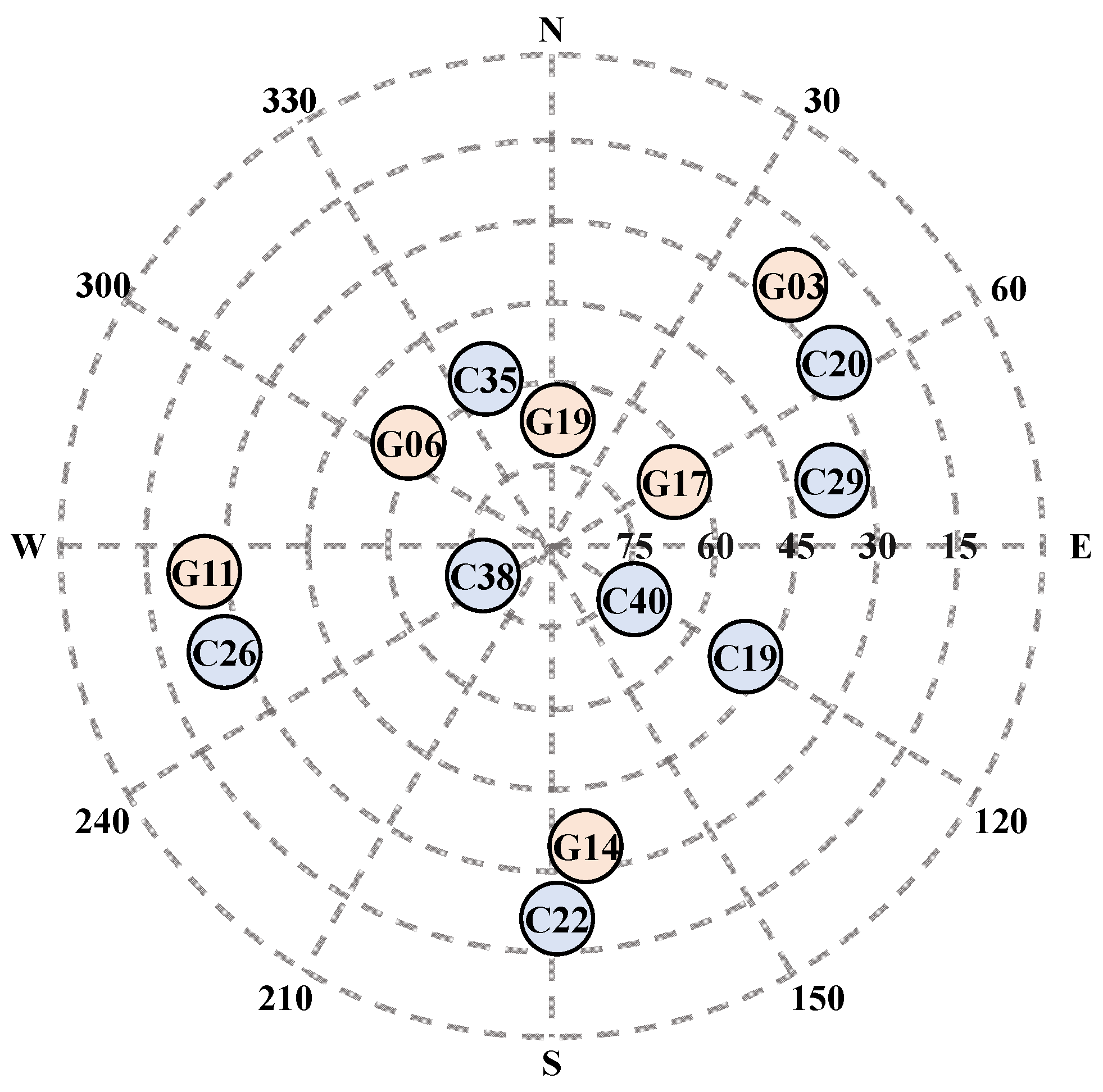
The GPS and BDS-3 constellations are obtained through broadcast ephemeris. The skyplot of available satellites with an elevation cut-off angle of 15° is illustrated in
Figure 3. It can be seen from
Figure 4 that the total number of available satellites is 14. The coordinates of satellites in the broadcast ephemeris are assumed to be the true value in the simulation experiments. In the first simulation, only random errors are contained in the observations, and the observation VC matrix
is constructed according to the magnitude of random errors. In the second simulation, the observations include random errors of equal magnitude, and the VC matrix of observations is kept the same as in the first simulation. In addition, unmodeled errors of 0.5 cycles and 1 m are introduced into the carrier phase and pseudorange observations of two satellites, respectively.
3.1.1. Only Random Errors Are Contained in the Observations
In the simulation experiments with only random errors contained in the observations, the magnitude of white noise in the observations is adjusted, and the
matrix will be constructed based on it. Therefore, the priori success rate of IB can be determined. As a lower bound of the ILS success rate [
45], the IB success rate
can be expressed as follows:
where
denotes the total number of ambiguities, and
denotes the diagonal element of the
matrix, which is obtained by LTDL decomposition of the
matrix. For each level of white noise, 100,000 samples are simulated, and the corresponding
are 100.0%, 99.1%, and 76.0%, respectively.
The root mean square errors (RMSE) of float, BIE, and fixed solutions at each success rate are shown in
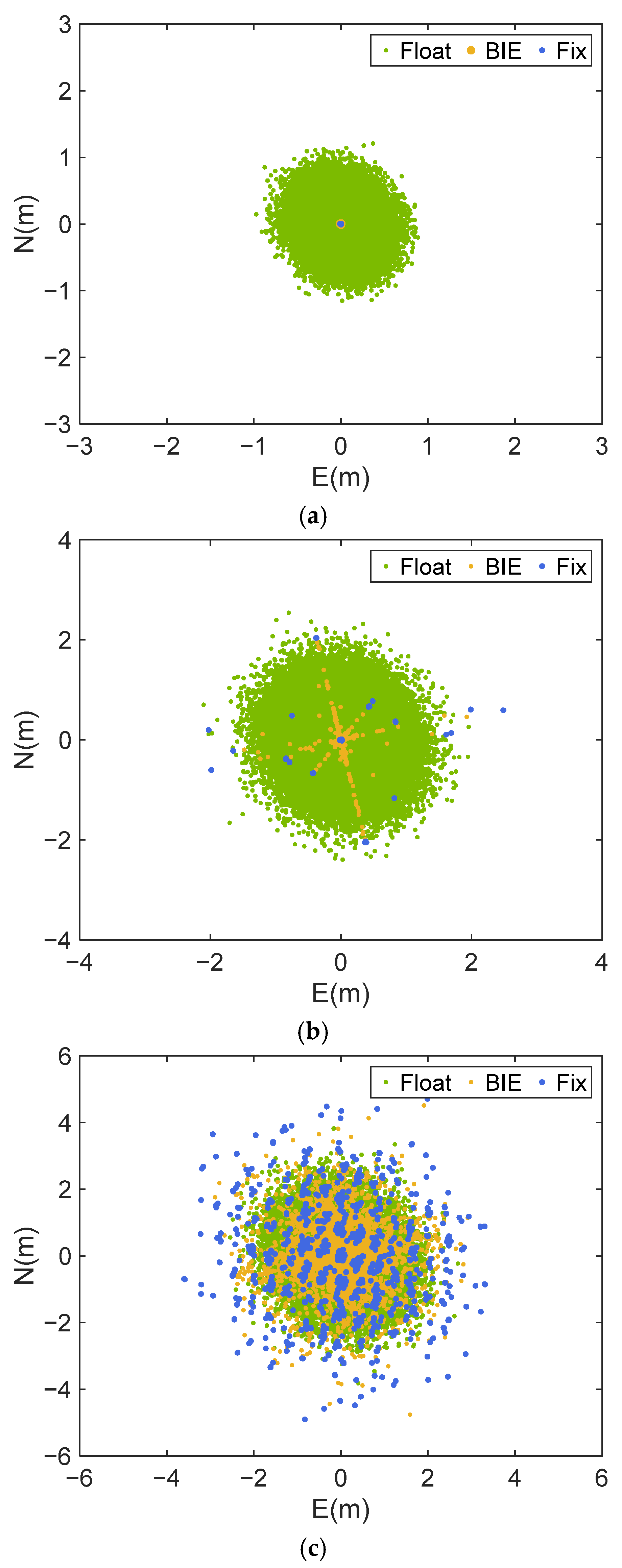
Table 4. The horizontal scatter plot of float, BIE, and fixed positioning is depicted in
Figure 4. From
Figure 4 and
Table 4, it can be concluded that, when only random errors are contained in the observations, the BIE estimation is always optimal in the sense of MMSE. When
is 76.0%, although the RMSE of fixed solutions is lower than that of float solutions, the risk of significant positioning errors is dramatically increased due to the incorrectly fixed ambiguities. In this case, the error distribution of BIE solutions resembles that of float solutions, and the RMSE of BIE solutions is smaller than both float and fixed solutions. When
achieves 99.1%, the BIE solutions exhibit a star-like error distribution, achieving notably higher accuracy than the float solutions and a significantly lower likelihood of large positioning errors compared to the fixed solutions. When
reaches 100.0%, the BIE solutions approximate the high-precision fixed solutions.
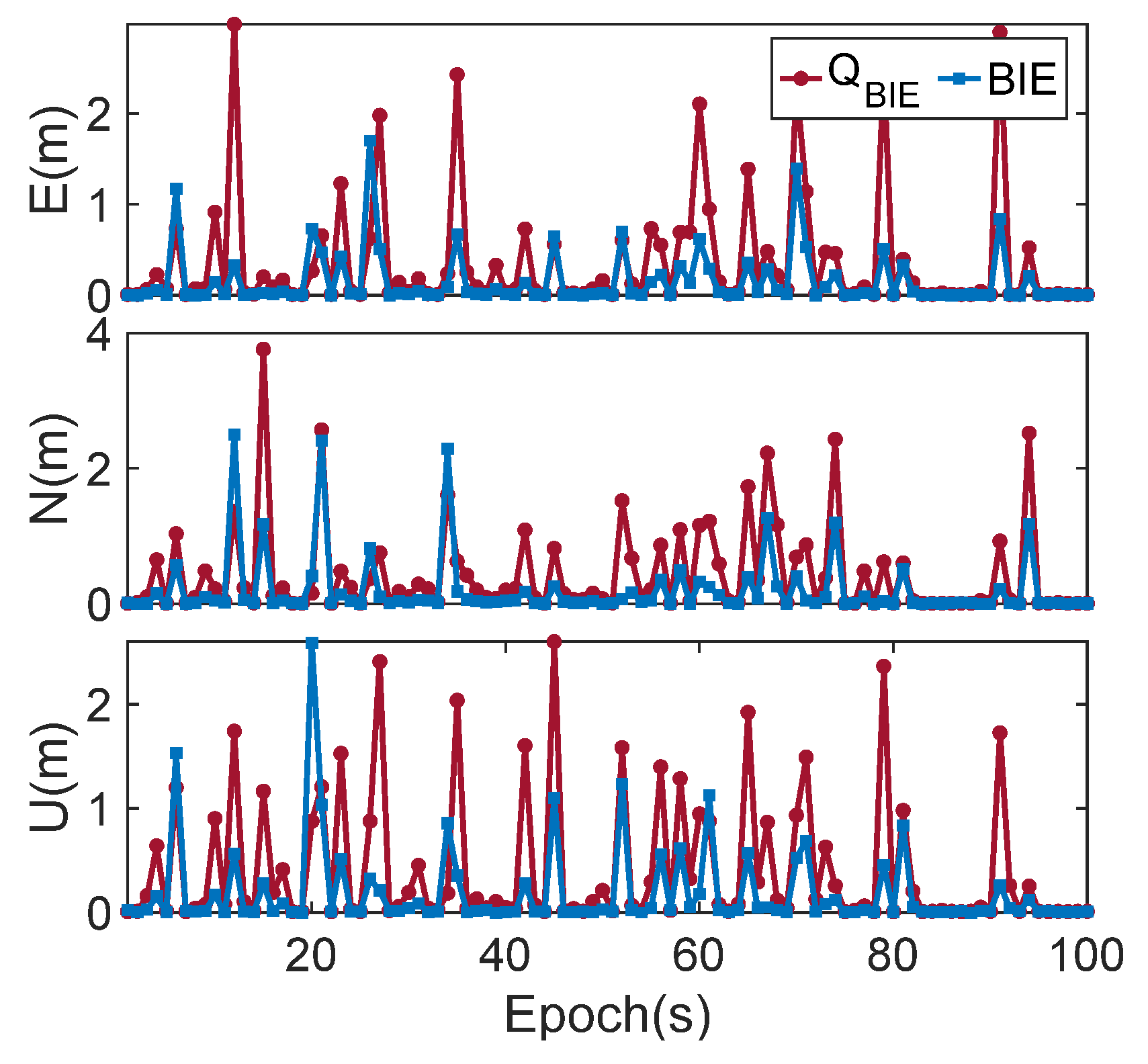
Figure 5 presents the positioning error and posterior variance of BIE estimation under the influence of random errors. For clear display, the results of 100 samples are depicted. It can be seen in
Figure 5 that, when the BIE solution exhibits a large positioning error, its posterior variance will correspondingly increase. It is demonstrated that, in ideal environments with only random errors included in the observations, the posterior variance of BIE estimation is capable of reliability evaluation.
3.1.2. Unmodeled Errors Are Contained in the Observations
The magnitude of white noise and the VC matrix of observations are kept the same as in the first simulation experiments, maintaining
values of 100.0%, 99.1%, and 76.0%, respectively. In addition, unmodeled errors of 0.5 cycles and 1 m are added into the carrier phase and pseudorange observations of two satellites, respectively. The RMSE of traditional float, BIE, and fixed solutions at each success rate is shown in
Table 5.
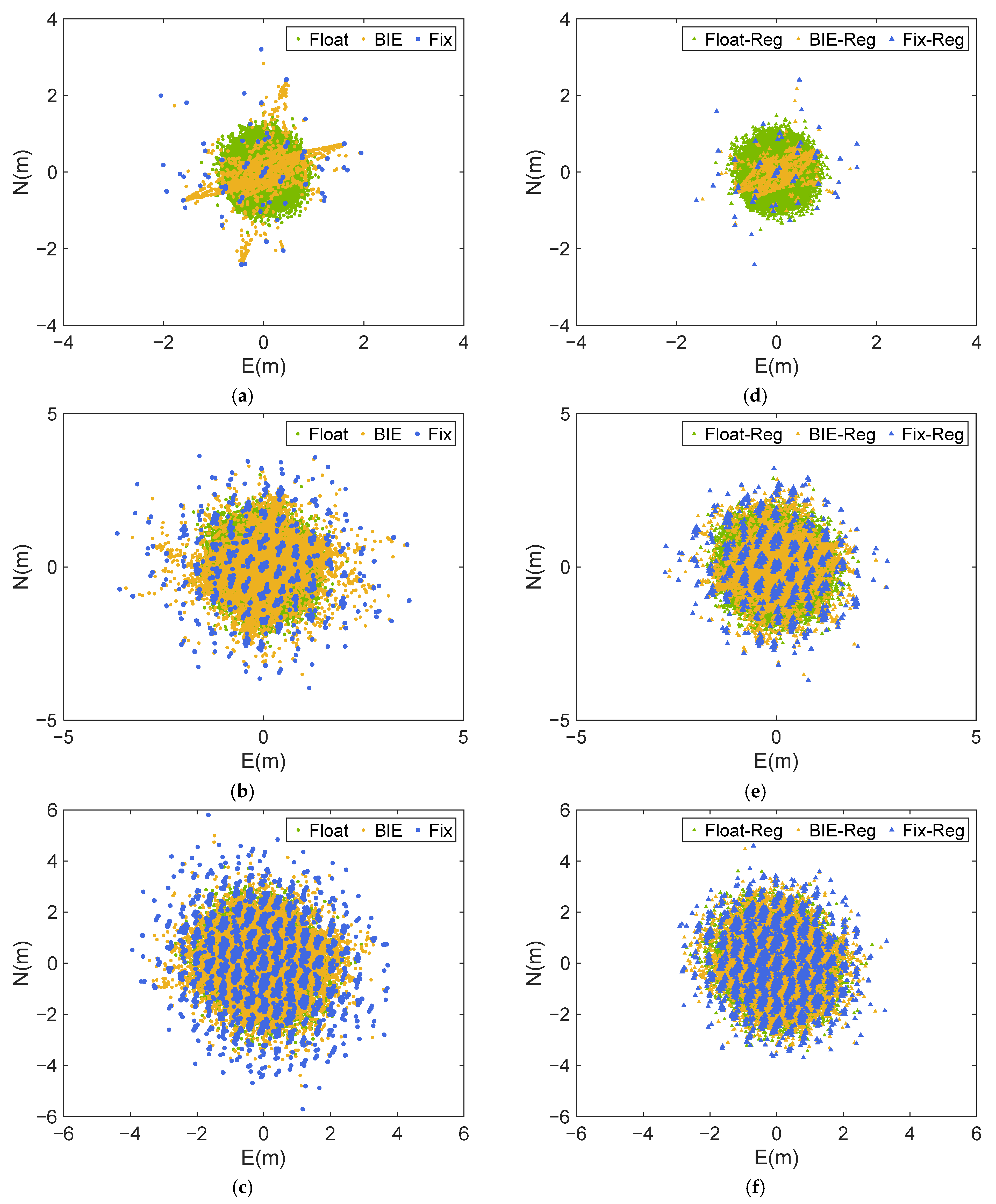
Figure 6a–c illustrates the horizontal scatter plots of traditional float, BIE, and fixed solutions at different success rates when unmodeled errors are contained in the observations. From
Table 5, it can be seen that the RMSE of float, BIE, and fixed solutions is significantly deteriorated. Additionally, by comparing
Figure 4 with
Figure 6a–c, it can be observed that the exactness of the LAMBDA algorithm is seriously reduced due to the additional unmodeled errors, leading to a steep decline in the reliability of BIE solutions. The RMSE of regularized float, BIE, and fixed solutions at each success rate is shown in
Table 6. According to
Table 6, the accuracy of all regularized solutions is optimized. Additionally, compared to the regularized float and fixed estimation, the regularized BIE estimation is superior in the sense of MMSE at all success rates.
Figure 6d–f illustrates the horizontal scatter plots of regularized float, BIE, and fixed solutions. Although the RMSE of regularized BIE and fixed solutions is effectively reduced, according to
Figure 6d–f, the regularized fixed solutions still present a remarkably high risk of severe errors at all success rates. However, the positioning errors of regularized BIE solutions exhibit a star-like distribution at high success rates, realizing higher precision than the float solutions and a lower possibility of serious positioning errors compared to the fixed solutions. At low success rates, the error distribution of BIE solutions is similar to that of float solutions, indicating relatively reliable performance.
3.2. Field Tests
To demonstrate the improved performance of the proposed method under weak observation conditions, field tests with 10 km and 18 km baselines are conducted in this contribution.
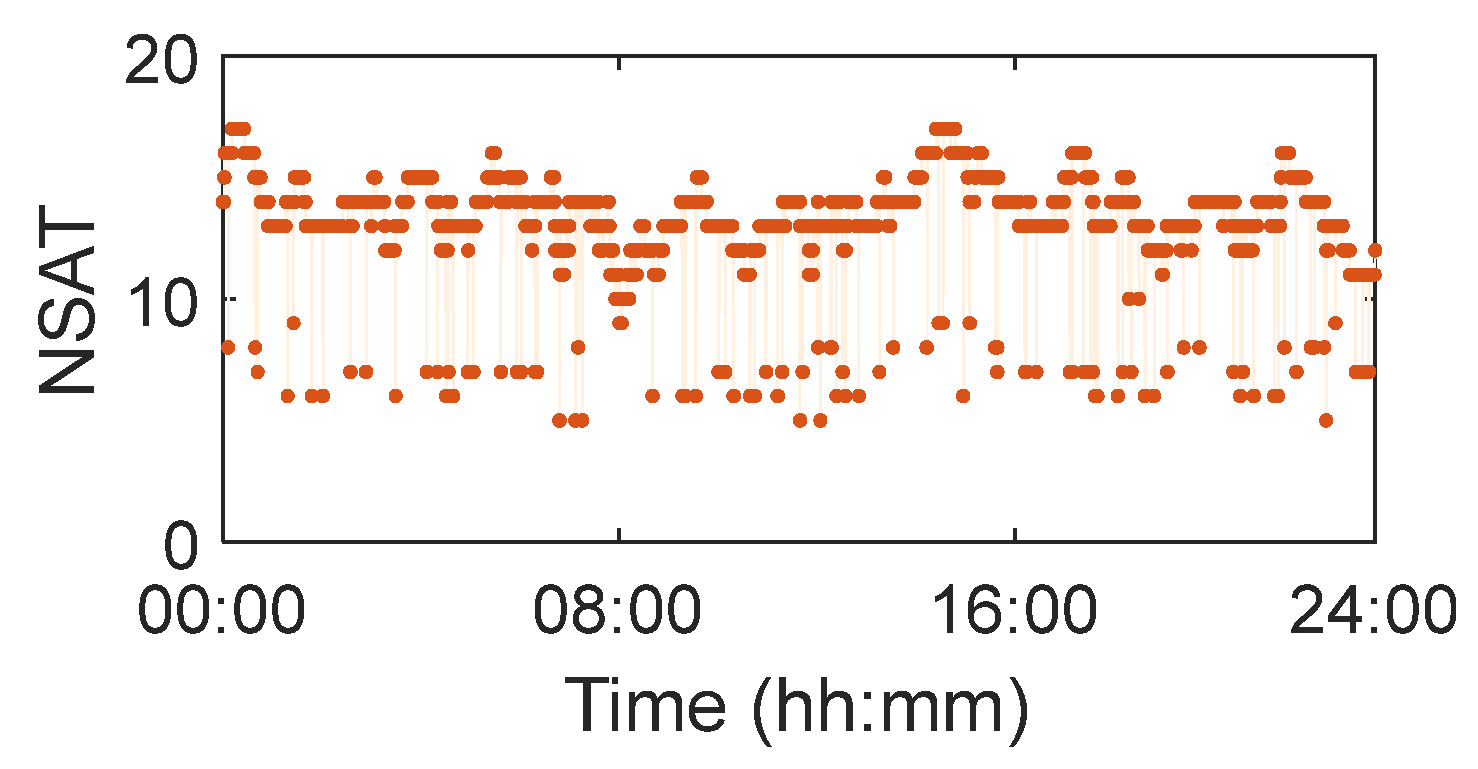
In the experiment with a 10 km baseline, GPS and BDS-3 with an elevation cut-off angle of 15° are employed. The results of 24 h RTK positioning are recorded.
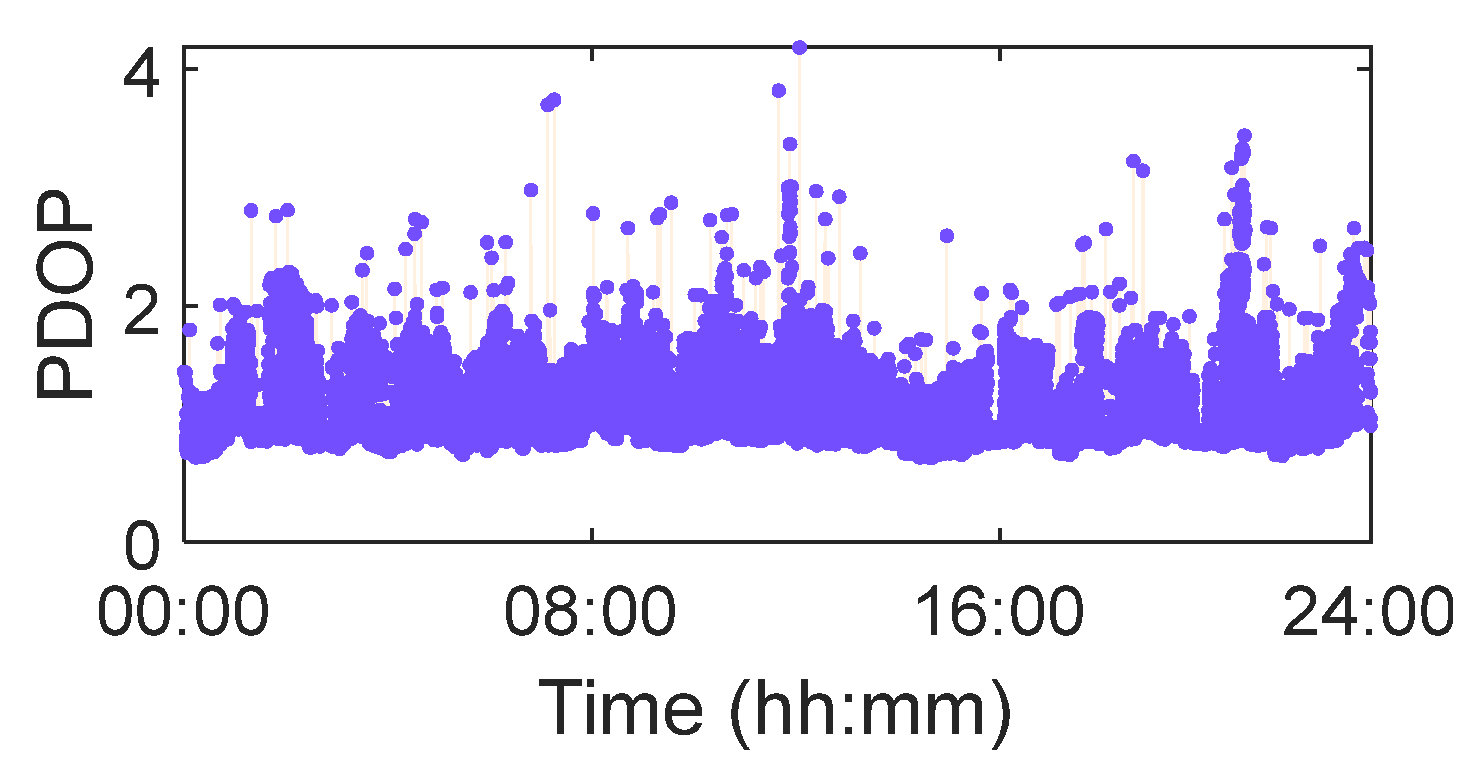
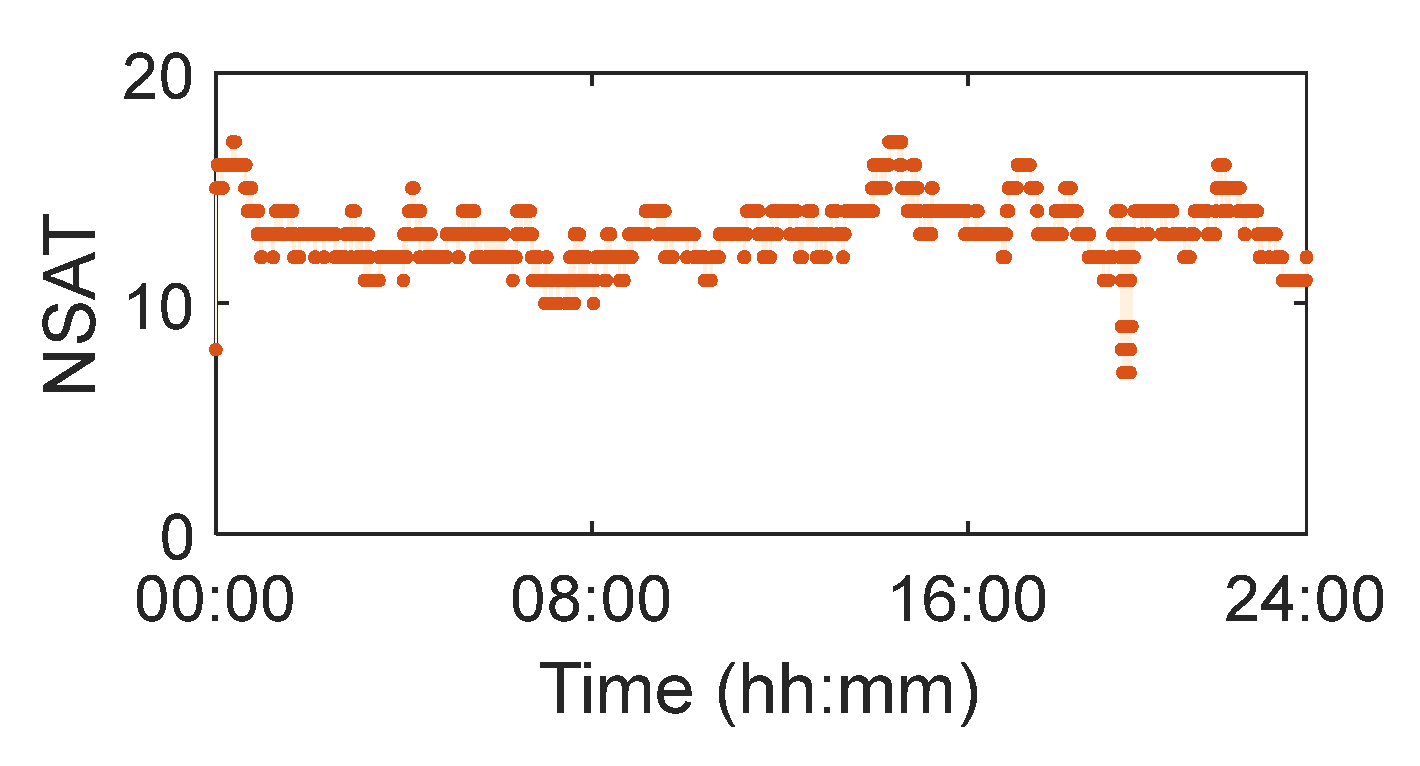
Figure 7 and
Figure 8 depict the visible satellite number and position dilution of precision (PDOP) in the experiment, respectively.
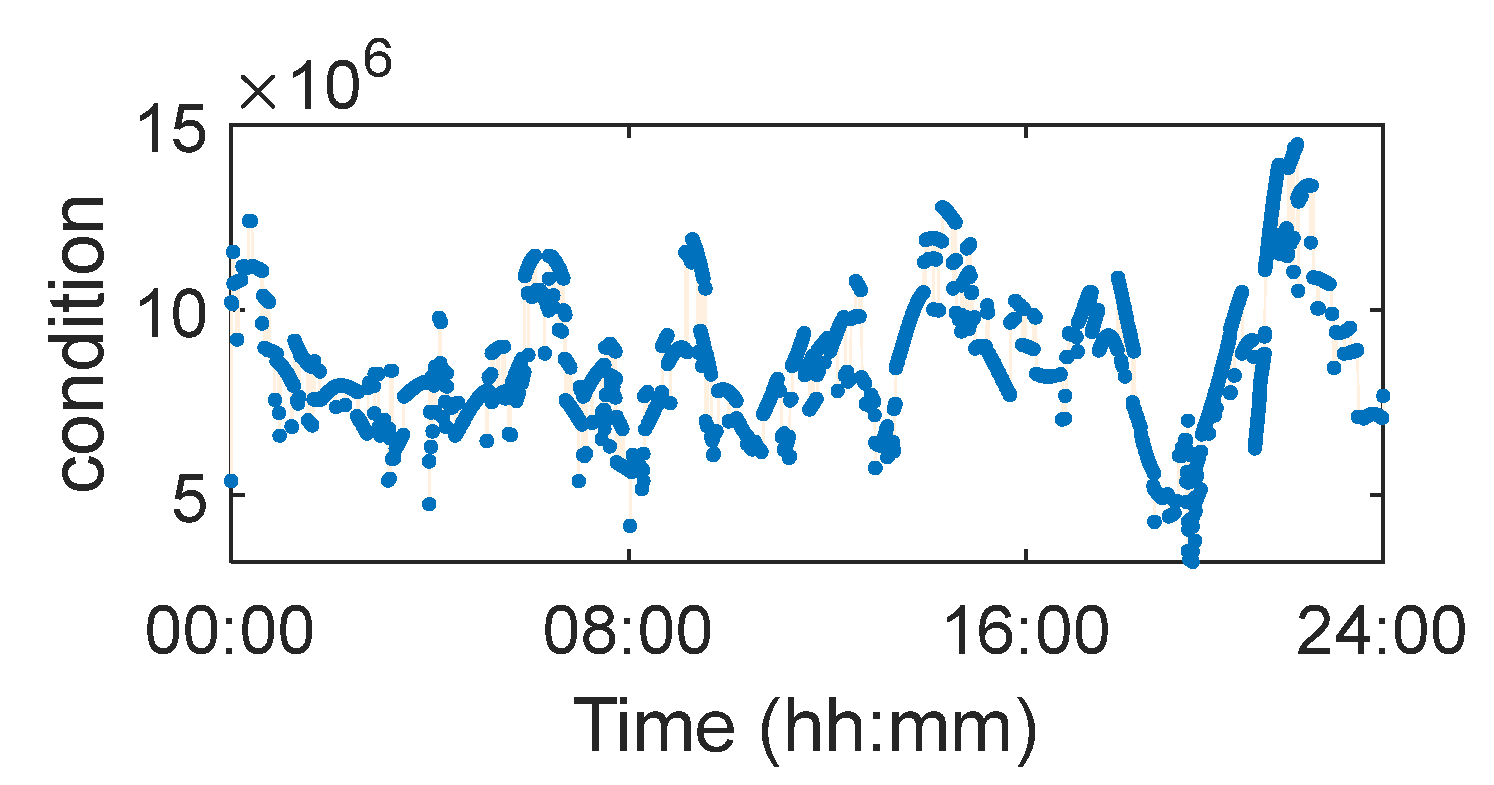
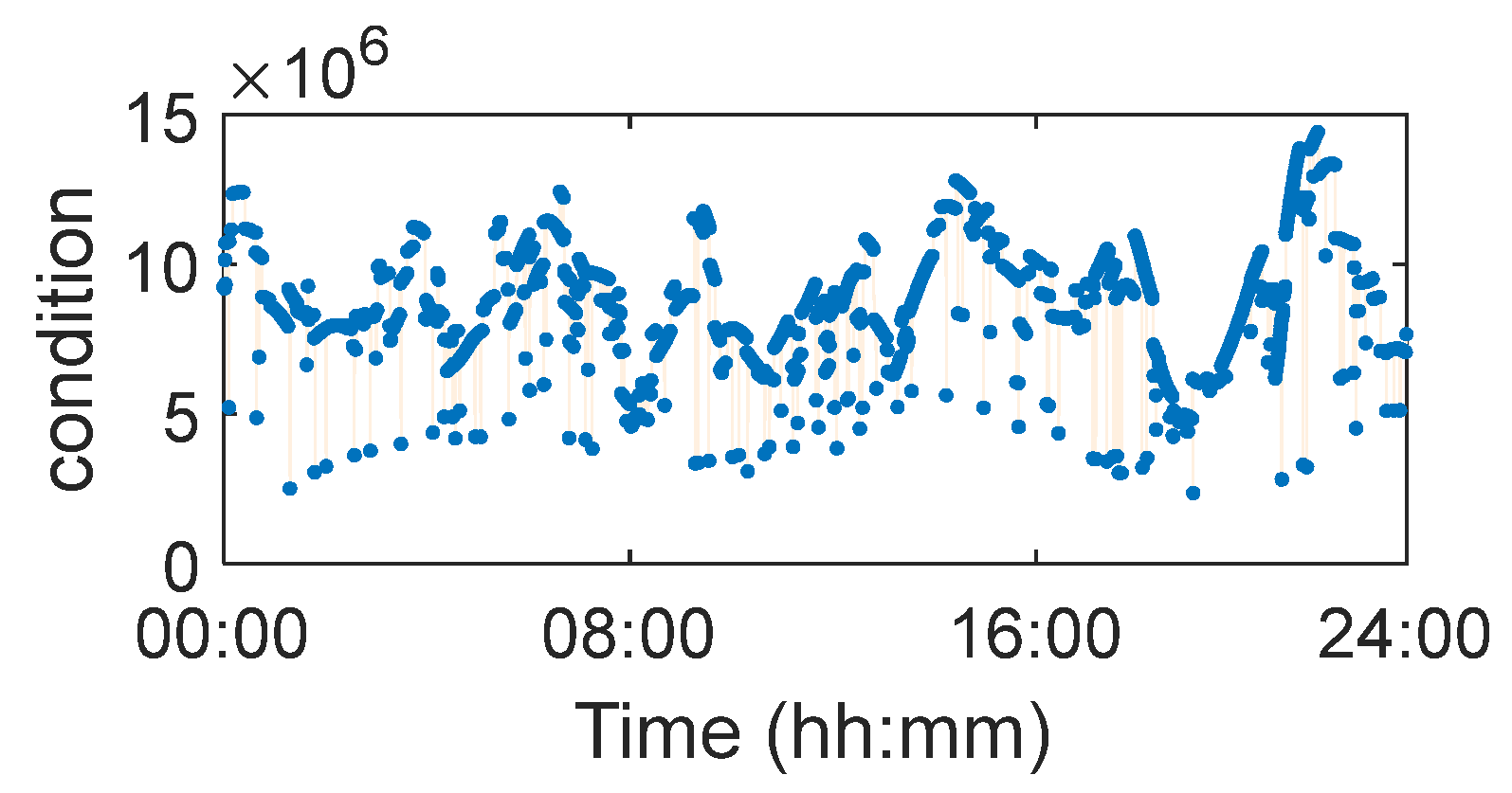
Figure 9 depicts the condition number of the
matrix.
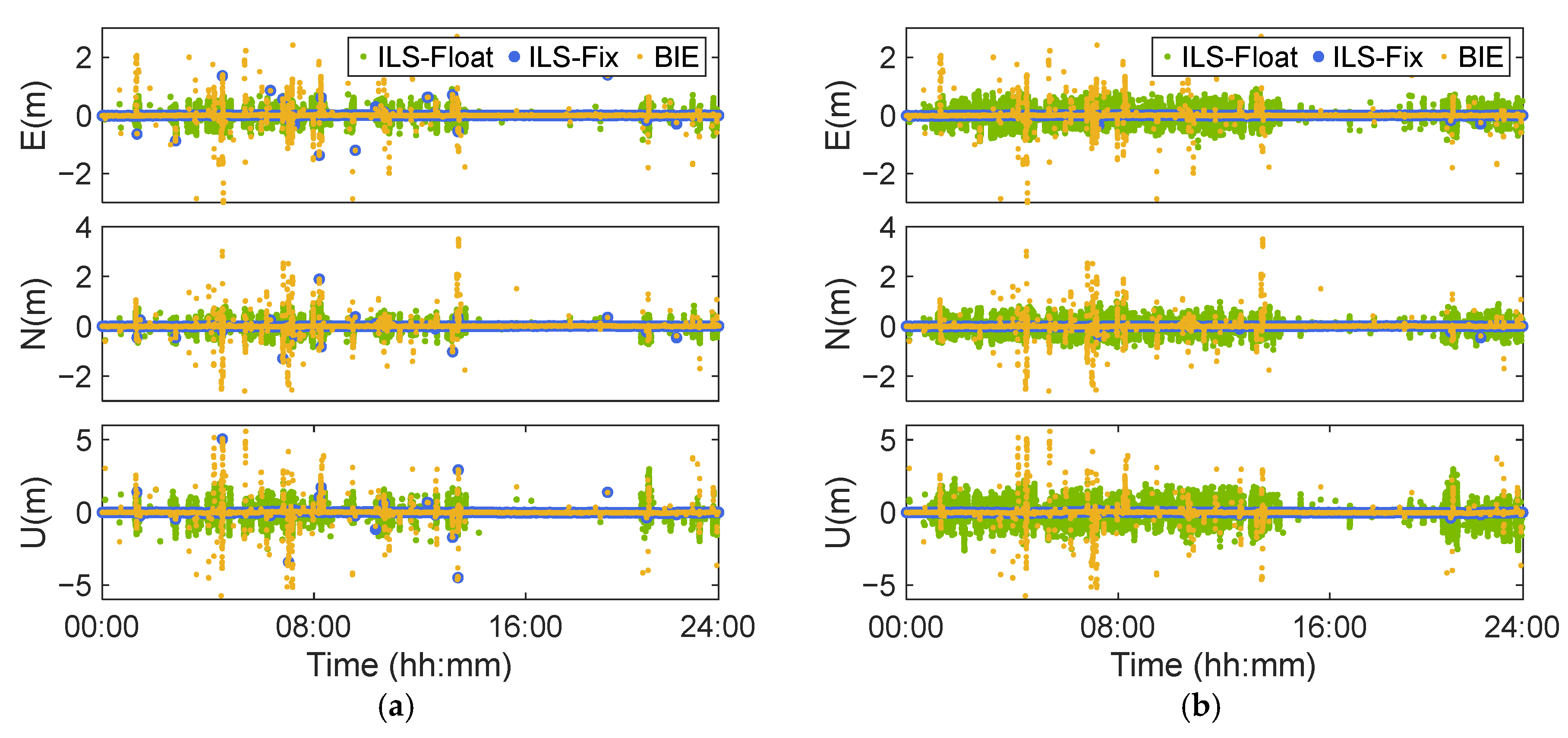
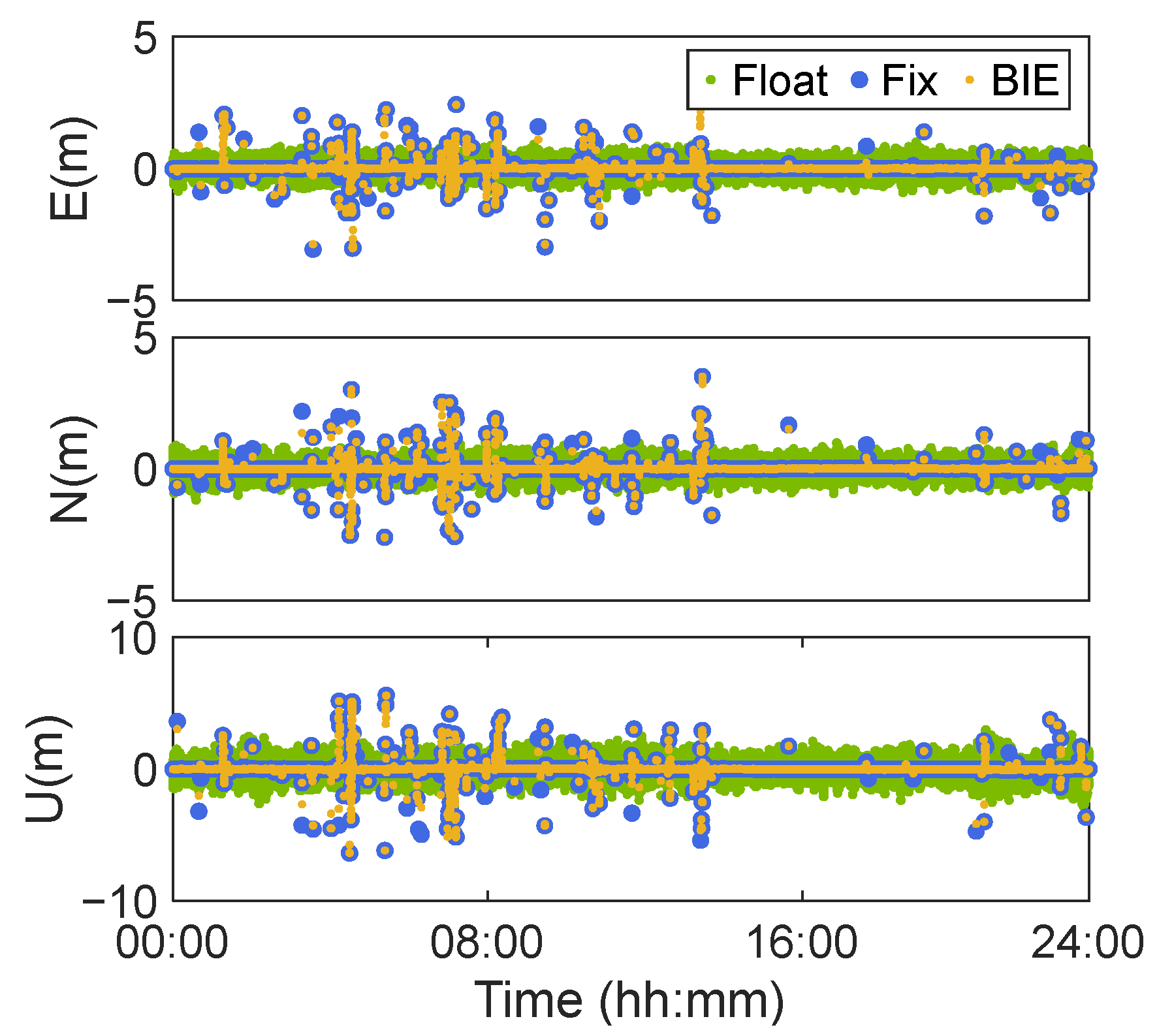
Figure 10 illustrates the positioning errors of traditional float, BIE, and fixed solutions in the E, N, and U directions. The RMSE of traditional positioning solutions and regularized BIE solutions is presented in
Table 7. The fixed solution in
Figure 10 is obtained by the optimal ambiguity without validation test. It can be seen from
Figure 10 that the positioning errors of BIE solutions are similar to those of fixed solutions, which are likely to be severely biased. From
Table 7, it can be learned that the accuracy of BIE estimation is sharply decreased in weak observation models.
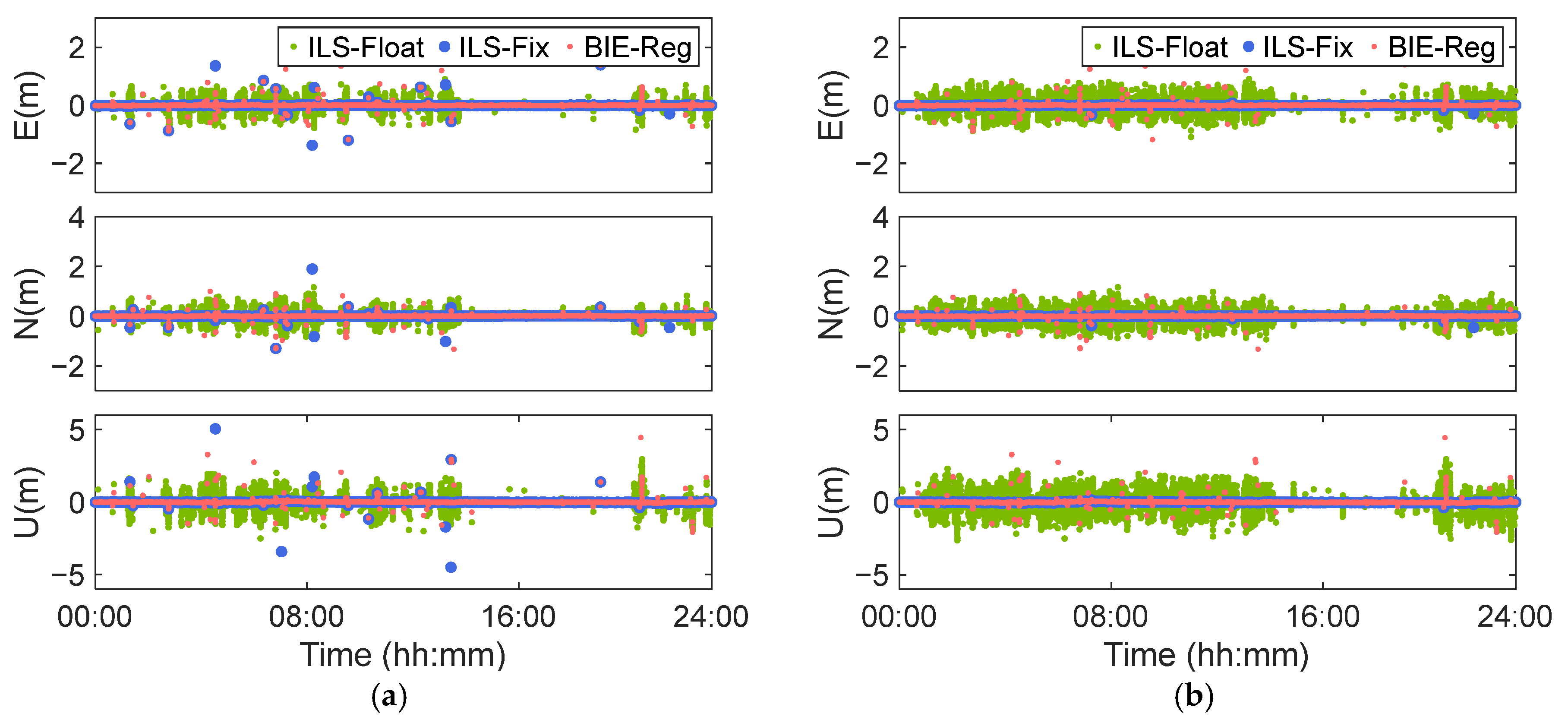
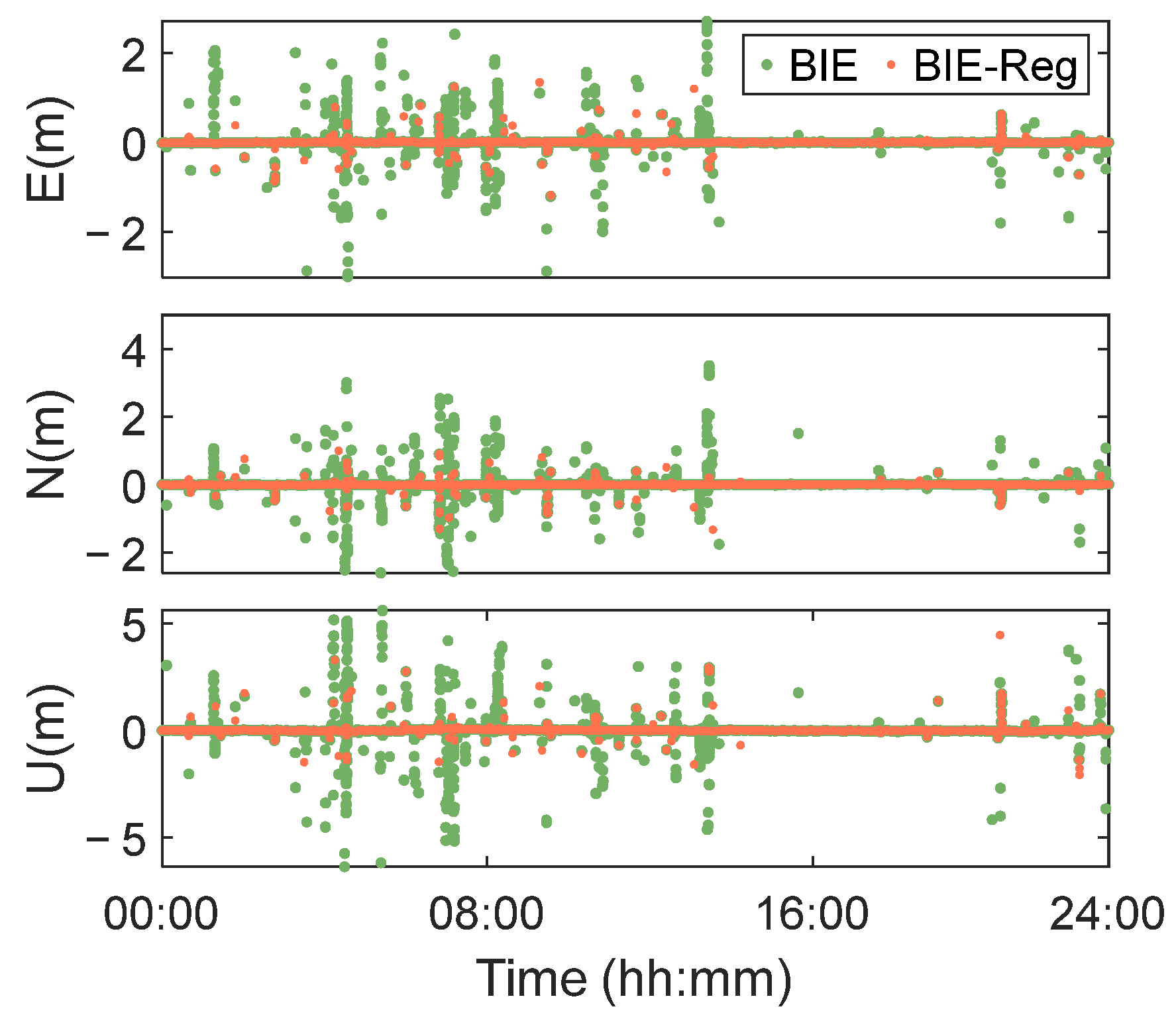
Figure 11 illustrates the positioning errors of traditional and regularized BIE solutions in the E, N, and U directions. As shown in
Figure 11, the possibility of severe positioning errors in the regularized BIE solutions is effectively reduced. Accordingly, the reliability of regularized BIE estimation is significantly improved. Additionally, according to
Table 7, the accuracy of regularized BIE solutions is obviously enhanced and superior to the float and fixed solutions, with improvements of 77.4%, 75.7%, and 75.0% in the E, N, and U directions compared to that of traditional BIE solutions.
Figure 12 and
Figure 13 show the positioning errors of traditional and regularized BIE estimation, compared to the ILS estimation based on the R-ratio test employing a threshold of 1.5 and 2.5, respectively. From
Figure 12, it can be learned that the reliability of traditional BIE estimation is significantly inferior to the ILS estimation under weak observation conditions. According to
Figure 13, the regularized BIE estimation proposed in this paper is demonstrated to strike a better balance between accuracy and reliability than the ILS estimation.
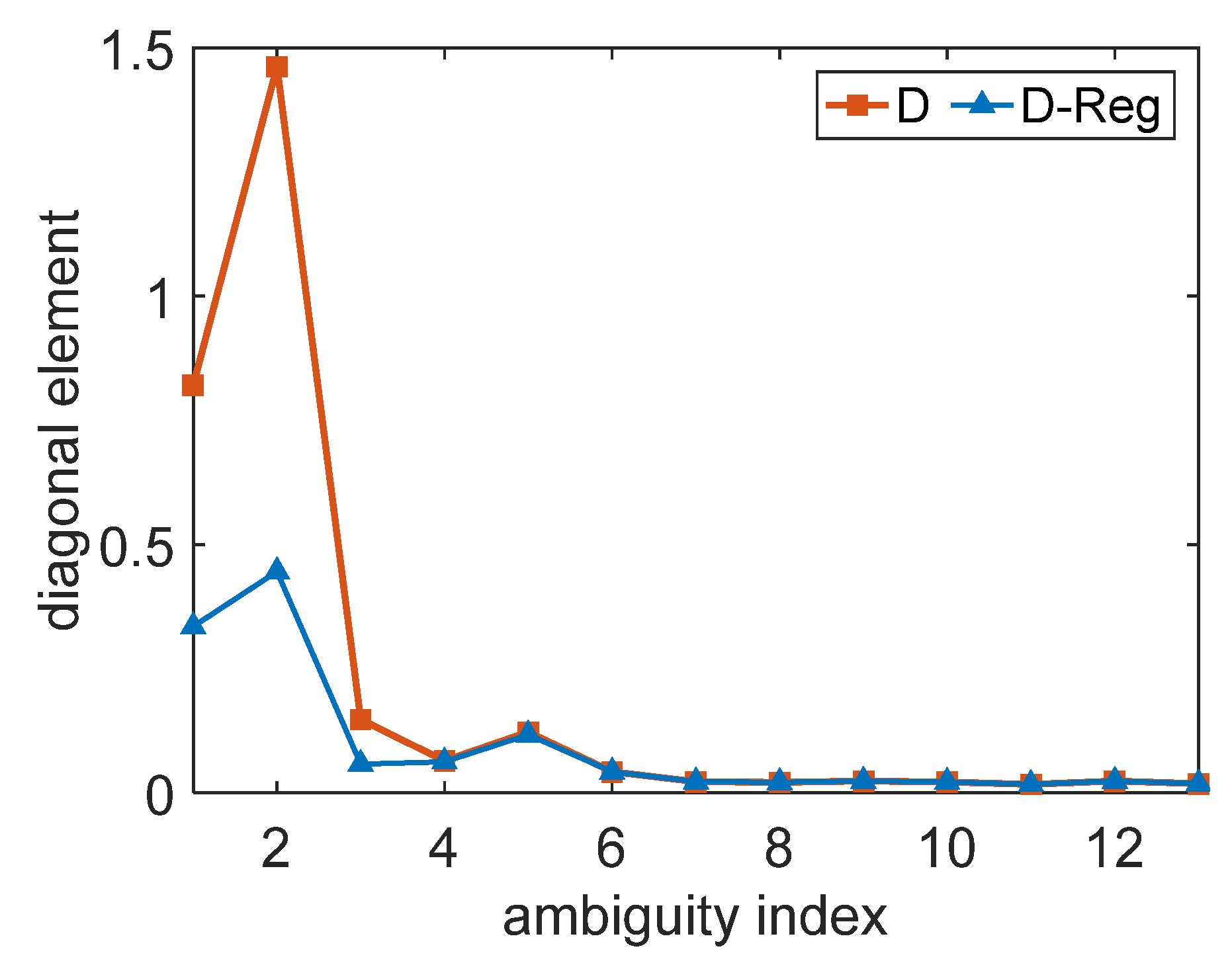
Figure 14 illustrates the diagonal elements of traditional and regularized
matrix in an epoch in the experiment. The traditional and regularized
matrix represent the
matrix obtained by the LTDL decomposition of the traditional and regularized ambiguity VC matrix, respectively. It can be seen in
Figure 14 that there is a substantial gap between larger and smaller diagonal elements in the traditional
matrix; particularly, the first and second diagonal elements are significantly larger than others. Based on the proposed regularization method, the largest diagonal elements are obviously diminished, while others exhibit negligible changes. Consequently, the spread of diagonal elements in the regularized
matrix is reduced, thereby decreasing the differences in the weights assigned to the ambiguities within the integer vectors during the LAMBDA algorithm.
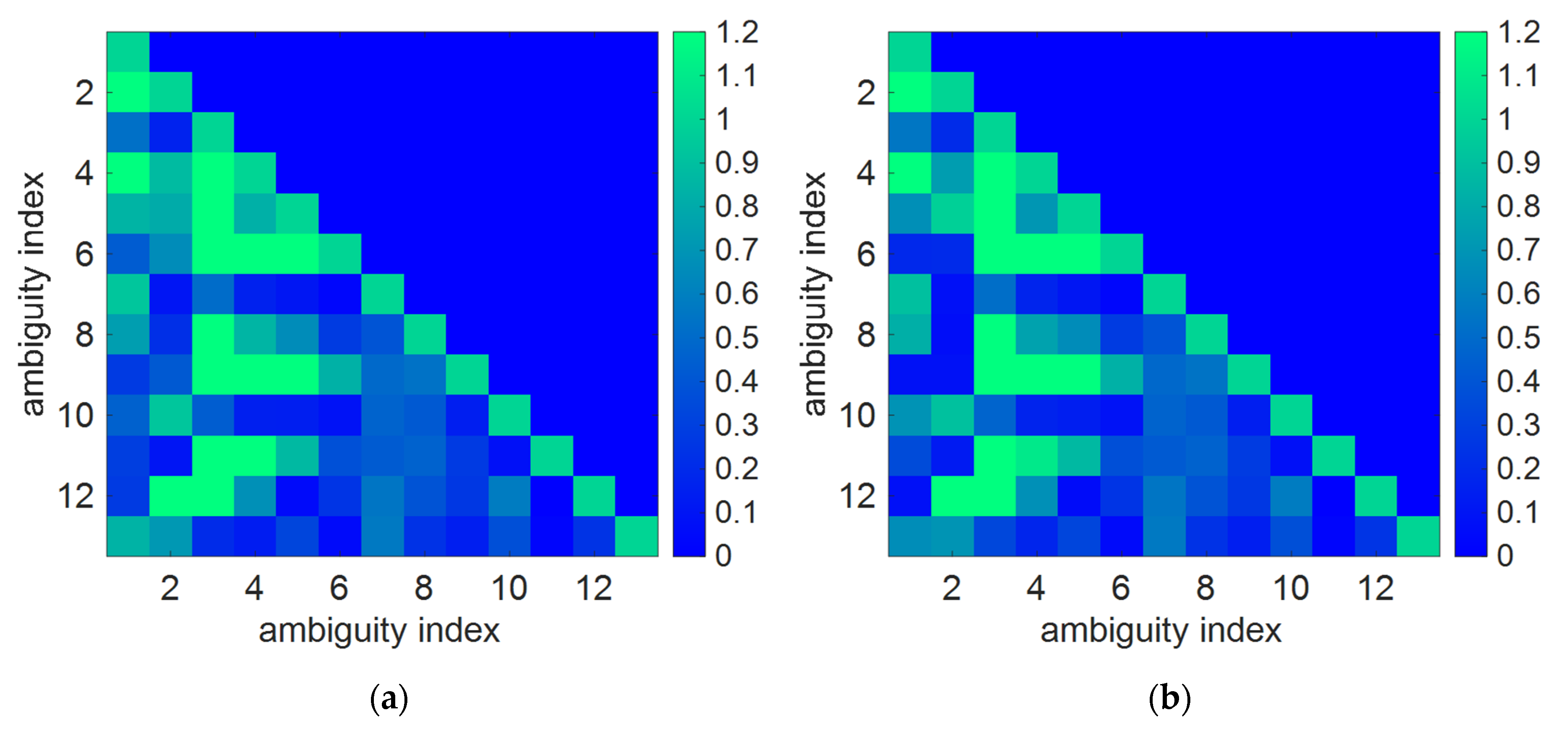
Figure 15 presents the heatmap of the traditional and regularized
matrix, which are obtained by the LTDL decomposition of traditional and regularized ambiguity VC matrix in this epoch. Through the proposed regularization method, the color of the second column in the heatmap becomes deeper, indicating a weakened correlation between the second ambiguity and other ambiguities.
In this epoch, the condition numbers of the traditional and regularized ambiguity VC matrices are 71,985 and 5112, respectively. Accordingly, the ill condition of the matrix is effectively alleviated. The positioning errors of BIE solutions in the E, N, and U directions decrease from −1.07 m, 2.01 m, and −1.04 m to −0.0145 m, −0.0008 m, and −0.0222 m, respectively.
Figure 16 and
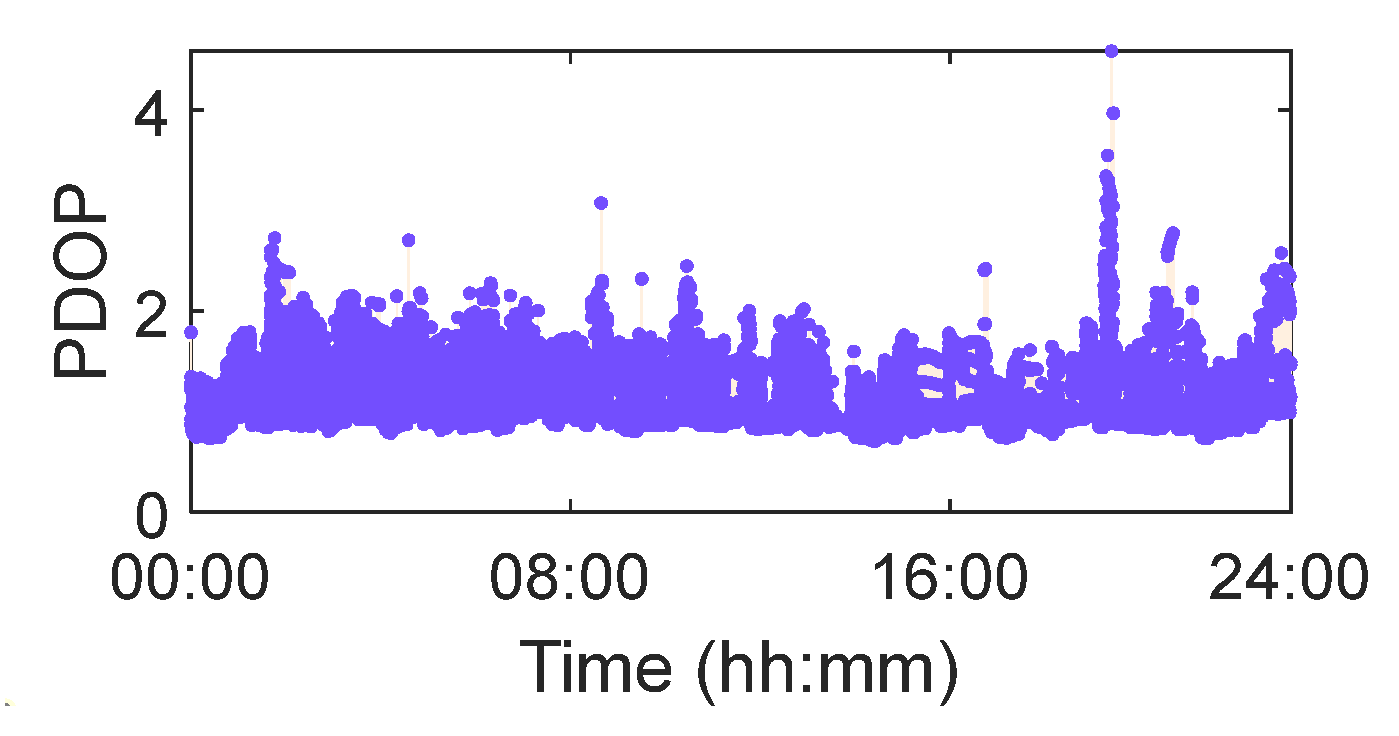
Figure 17 depict the visible satellite number and PDOP in the field test with an 18 km baseline, respectively.
Figure 18 depicts the condition number of the VC matrix of the float ambiguity solution.
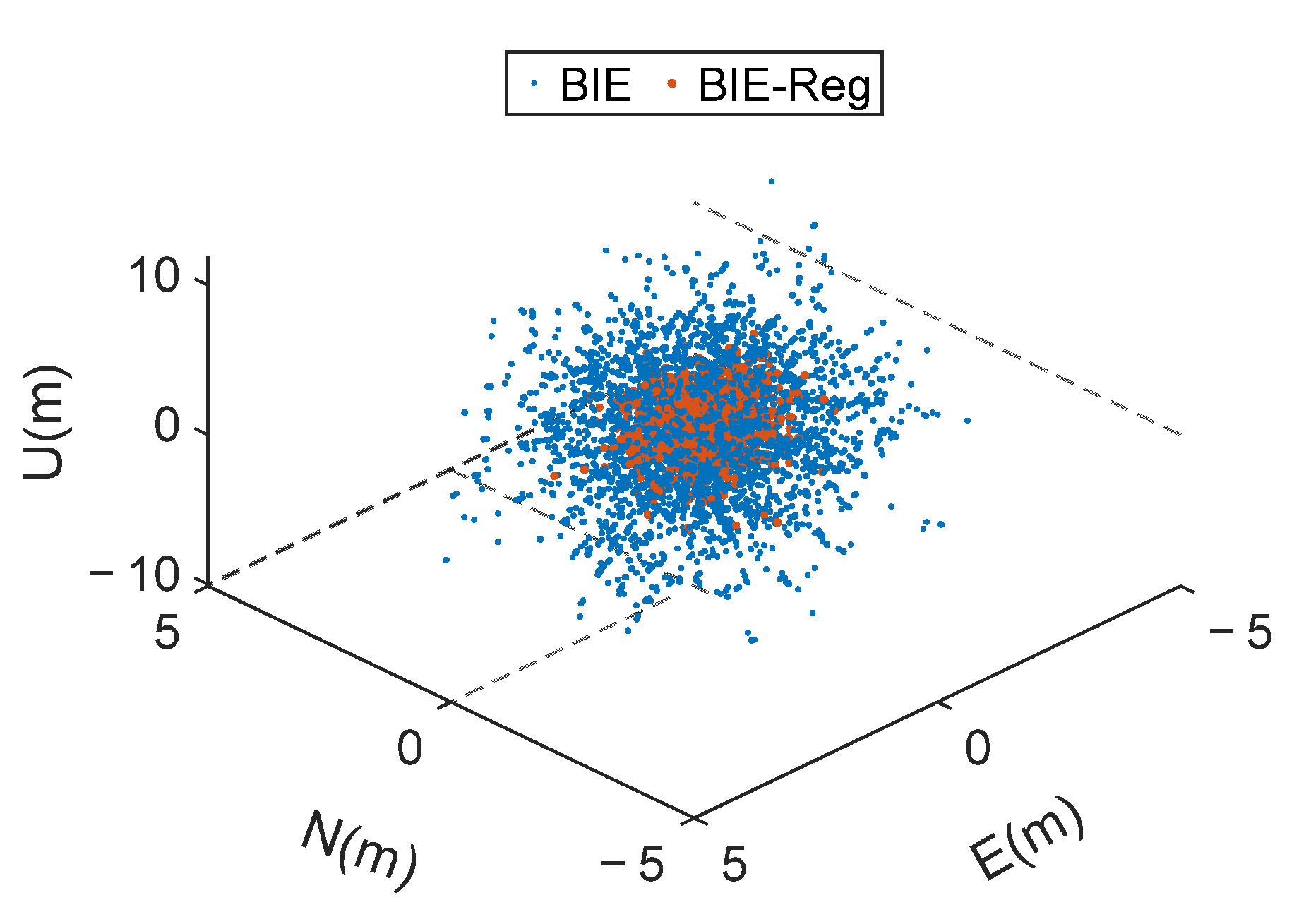
Figure 19 shows the three-dimensional error distribution of traditional and regularized BIE estimation in the experiment with an 18 km baseline.
Table 8 presents the RMSE of traditional positioning solutions and regularized BIE solutions in the experiment. In
Figure 19, the risk of severe errors in regularized BIE solutions is effectively decreased, resulting in enhanced positioning reliability. In
Table 8, the RMSE of regularized BIE solutions is significantly reduced, with accuracy improvements of 69.1%, 66.6%, and 68.5% in three directions compared to that of traditional BIE solutions.
4. Discussion
In complex scenarios, due to the poor reliability of fixed solutions and the low precision of float solutions, it is difficult for the ILS estimation to achieve a balance between accuracy and reliability based on a validation test. When the threshold for the validation test is set overly strict, numerous correctly fixed ambiguities will be excluded, leading to a steep decline in accuracy. Conversely, when the threshold is set excessively loose, wrongly fixed ambiguities with significant biases will probably be accepted, resulting in a sharp decrease in reliability. In
Figure 4, the BIE solution is demonstrated to be closer to the relatively reliable float solution at a low success rate, and it can realize high-precision positioning consistent with the fixed solution when the success rate is sufficiently high. Furthermore, based on
Figure 5, the posterior variance of BIE estimation is proven to be capable of reliability evaluation.
However, when the GNSS observation model exhibits a certain degree of ill condition, as shown in
Figure 6a–c, the positioning performance of the float, BIE, and fixed solutions will be seriously deteriorated due to slight unmodeled errors. Accordingly, the Tikhonov regularization is introduced to address the ill-posed problem. Although the application of Tikhonov regularization can effectively stabilize the estimators, a certain degree of bias may be introduced into the positioning solutions. Accordingly, an optimized approach for regularization parameter determination is developed, which employs the regularization method when the observation model is ill-posed, as indicated by the matrix condition number. Additionally, the selected regularization factors are proven to enable a satisfactory and generalizable regularization performance based on the results of numerous experiments. According to the results of simulation experiments and field tests presented in
Figure 6d–f,
Figure 11, and
Figure 19 and
Table 6,
Table 7 and
Table 8, the BIE AR method based on Tikhonov regularization proposed in this paper is validated to effectively improve the positioning accuracy and reliability.
5. Conclusions
In environments with a limited number of visible satellites or poor satellite configuration, the GNSS observation model will be weak or even ill-conditioned. In this case, even slight unmodeled errors in the observations can lead to significant biases in the float solution, making its inconsistency with the posterior variance particularly evident. Additionally, the VC matrix of the float ambiguity solution is probably ill-conditioned. Due to the aforementioned issues, integer candidates with significant biases are likely to be incorrectly selected as the optimal ambiguity candidate during the ILS ambiguity search. Moreover, the accuracy of weight allocation for integer candidates in BIE estimation will be deteriorated. There is a great likelihood that the wrongly determined best candidate is assigned an extremely high weight, causing serious positioning errors in the BIE solution, which is approximately identical to the erroneous fixed solution. Consequently, the reliability of BIE estimation in a weak observation model is likely to be worse than that of ILS estimation.
To deal with this dilemma, a BIE AR method based on Tikhonov regularization is proposed in this contribution. The method introduces Tikhonov regularization into the LS estimation and ILS ambiguity search to mitigate the severe negative impact of weak observation conditions on BIE AR. According to the results of simulation experiments and field tests conducted in this paper, the method is demonstrated to effectively reduce the risk of significant positioning errors in the BIE estimation, improving the positioning performance in cases of weak GNSS models.