Article

Effects of Large- and Meso-Scale Circulation on Uprising Dust over Bodélé in June 2006 and June 2011


Centre Eau Terre Environnement, INRS, 490 De la Couronne Street, Québec City, QC G1K 9A9, Canada
*
Author to whom correspondence should be addressed.
Remote Sens. 2025, 17(15), 2674; https://doi.org/10.3390/rs17152674
Submission received: 26 May 2025 / Revised: 17 July 2025 / Accepted: 31 July 2025 / Published: 2 August 2025

Abstract

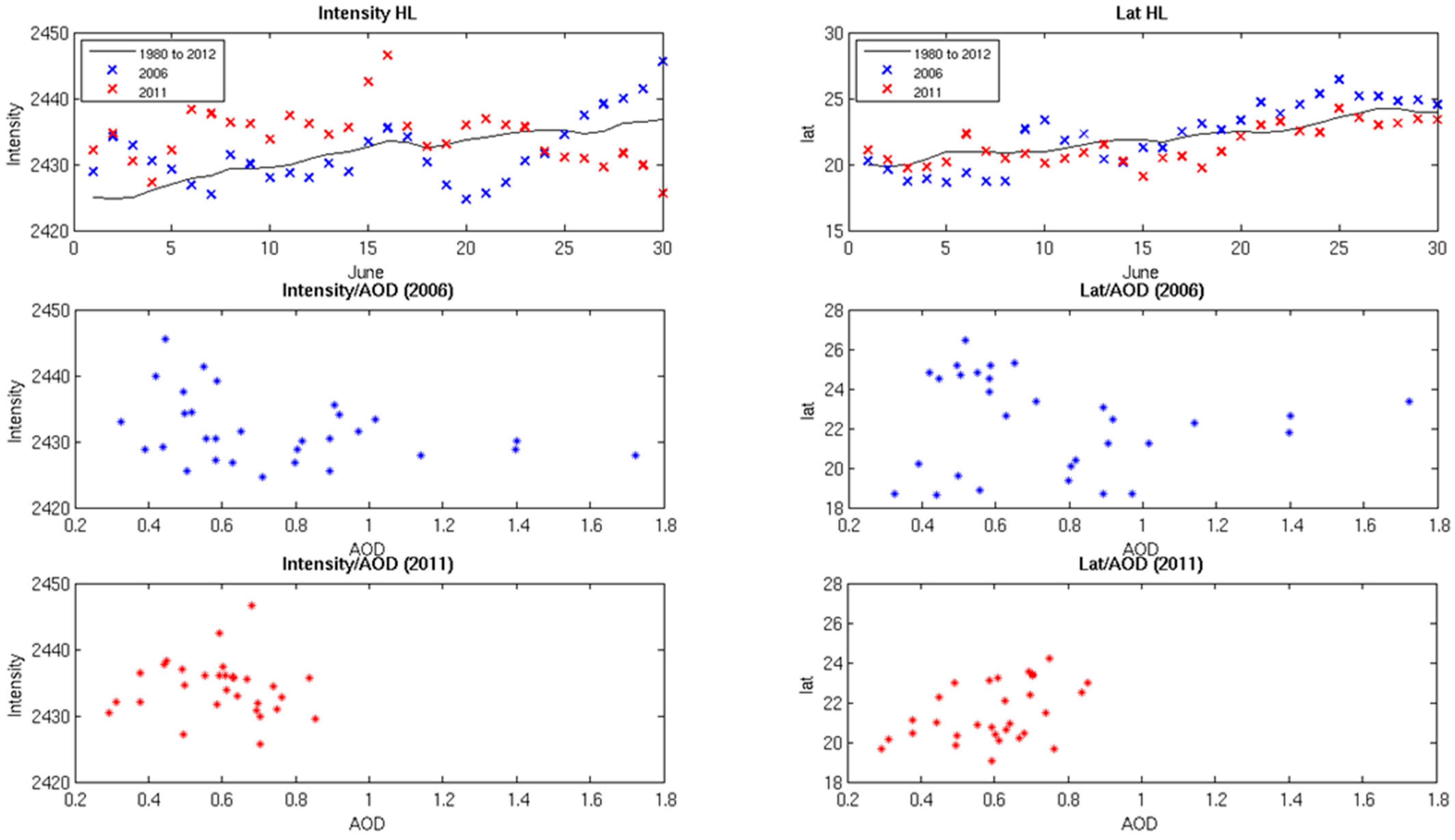
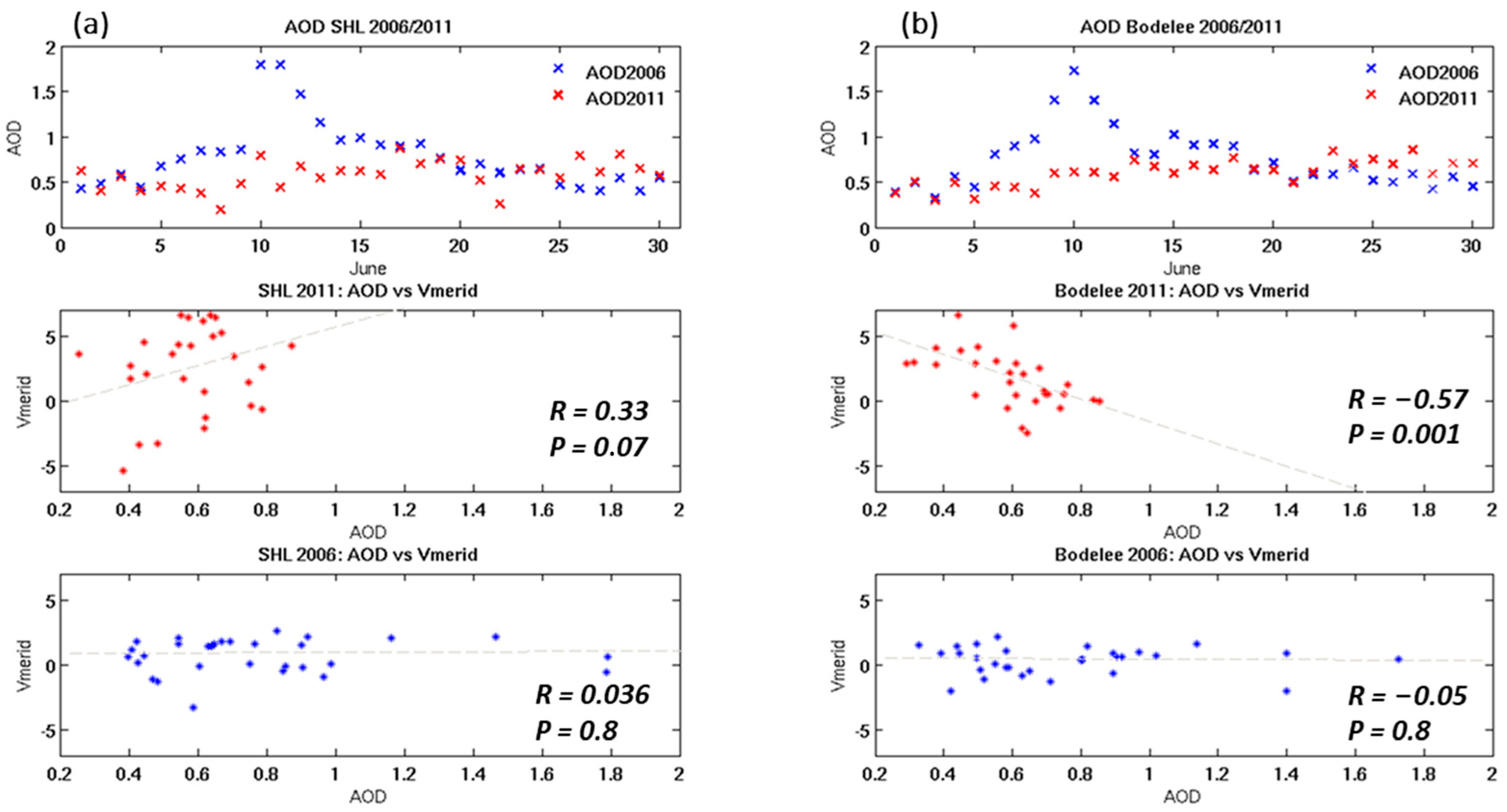
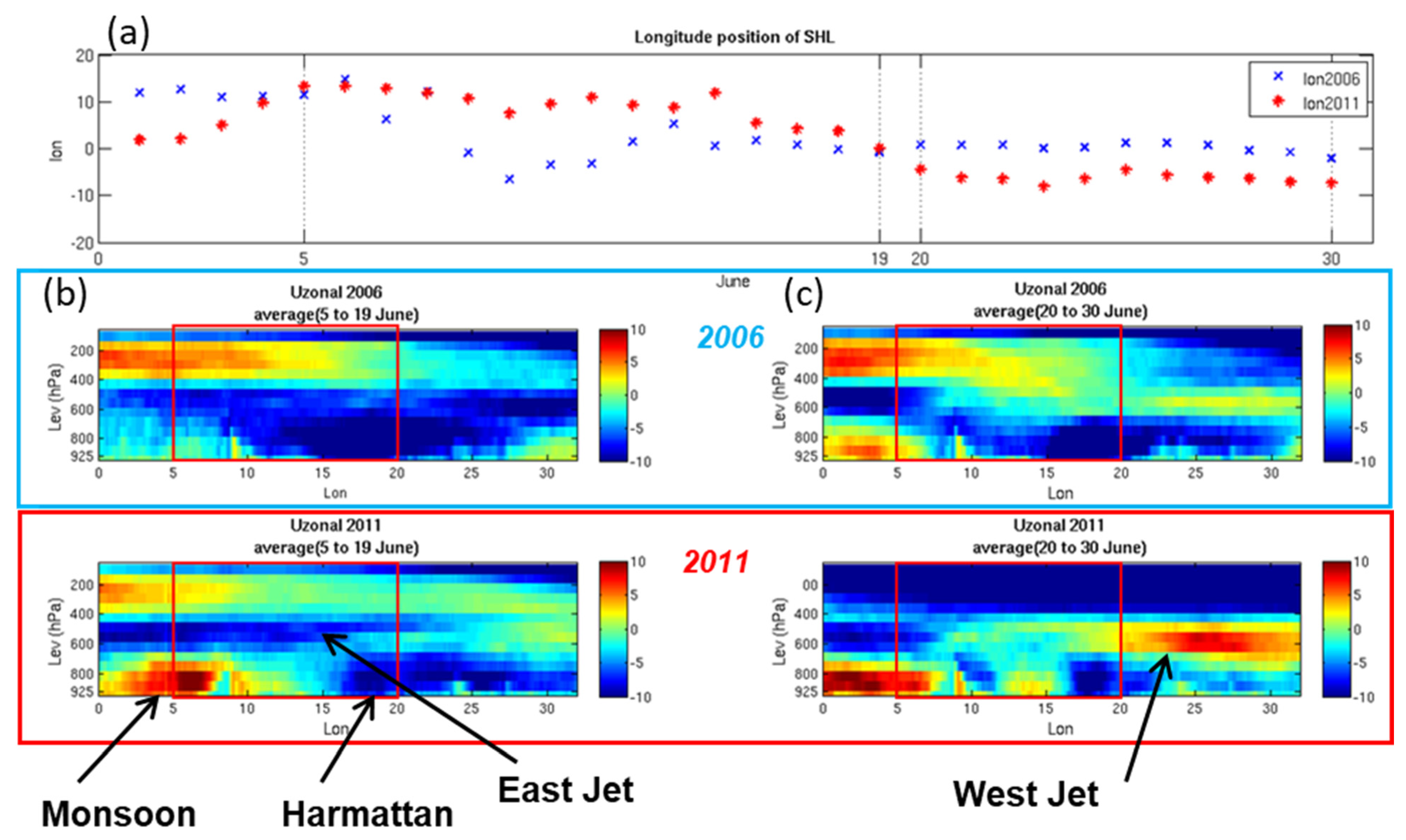
This study investigates the effects of key atmospheric features on mineral dust emissions and transport in the Sahara–Sahel region, focusing on the Bodélé Depression, during June 2006 and 2011. We use a combination of high-resolution atmospheric simulations (AROME model), satellite observations (MODIS), and reanalysis data (ERA5, ECMWF) to examine the roles of the low-level jet (LLJ), Saharan heat low (SHL), Intertropical Discontinuity (ITD), and African Easterly Jet (AEJ) in modulating dust activity. Our results reveal significant interannual variability in aerosol optical depth (AOD) between the two periods, with a marked decrease in June 2011 compared to June 2006. The LLJ emerges as a dominant factor in dust uplift over Bodélé, with its intensity strongly influenced by local topography, particularly the Tibesti Massif. The position and intensity of the SHL also play crucial roles, affecting the configuration of monsoon flow and Harmattan winds. Analysis of wind patterns shows a strong negative correlation between AOD and meridional wind in the Bodélé region, while zonal wind analysis emphasizes the importance of the AEJ and Tropical Easterly Jet (TEJ) in dust transport. Surprisingly, we observe no significant correlation between ITD position and AOD measurements, highlighting the complexity of dust emission processes. This study is the first to combine climatological context and case studies to demonstrate the effects of African monsoon variability on dust uplift at intra-seasonal timescales, associated with the modulation of ITD latitude position, SHL, LLJ, and AEJ. Our findings contribute to understanding the complex relationships between large-scale atmospheric features and dust dynamics in this key source region, with implications for improving dust forecasting and climate modeling efforts.
Keywords: aerosol optical depth; Saharan heat low; intertropical discontinuity; African easterly jet; Bodélé; climate change aerosol optical depth; Saharan heat low; intertropical discontinuity; African easterly jet; Bodélé; climate change