Article

Modeling of Biologically Effective Daily Radiant Exposures over Europe from Space Using SEVIRI Measurements and MERRA-2 Reanalysis


by
Agnieszka Czerwińska
and
Janusz Krzyścin
*
Institute of Geophysics, Polish Academy of Sciences, 01-452 Warsaw, Poland
*
Author to whom correspondence should be addressed.
Remote Sens. 2024, 16(20), 3797; https://doi.org/10.3390/rs16203797
Submission received: 28 August 2024 / Revised: 8 October 2024 / Accepted: 10 October 2024 / Published: 12 October 2024
(This article belongs to the Section Environmental Remote Sensing)

Abstract

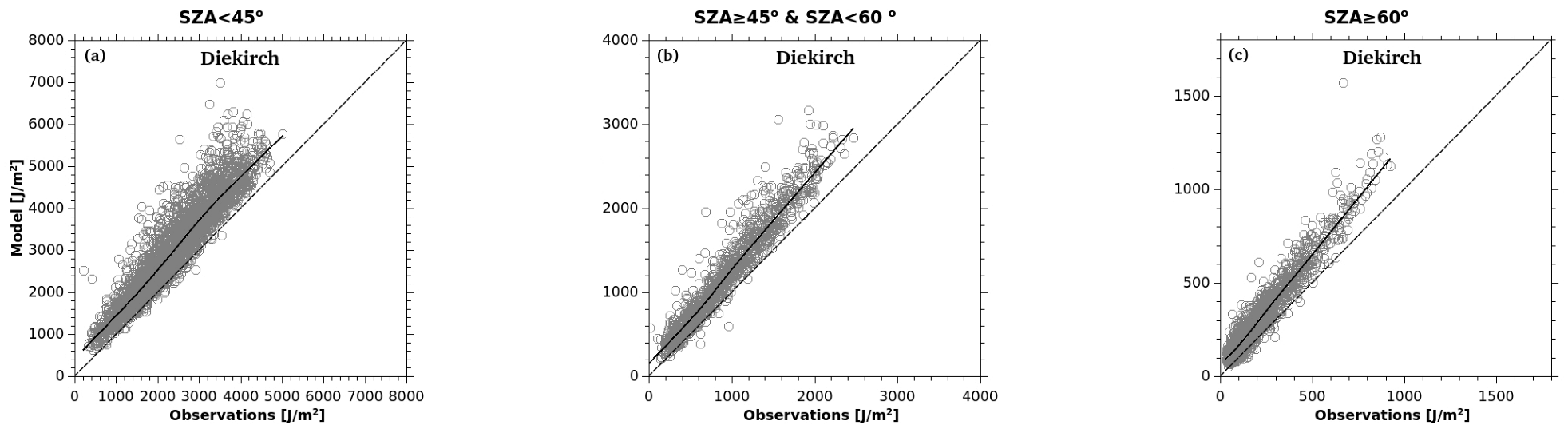
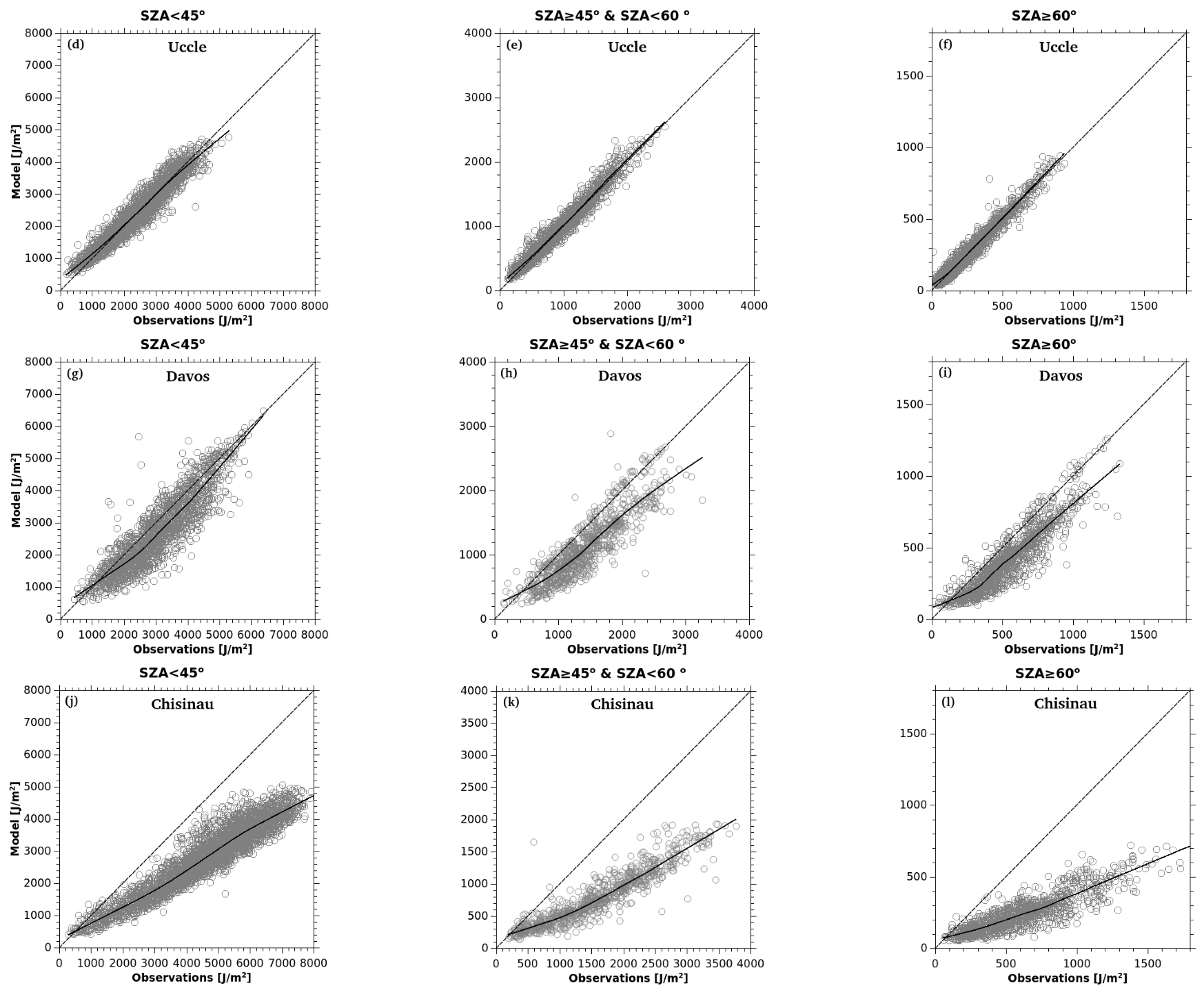
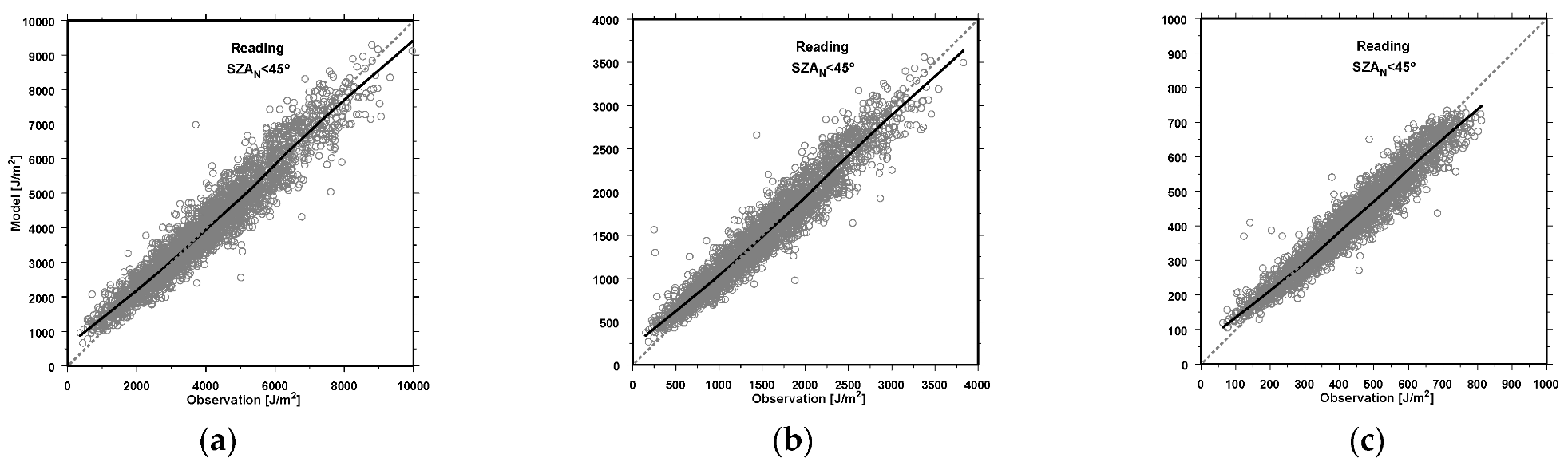
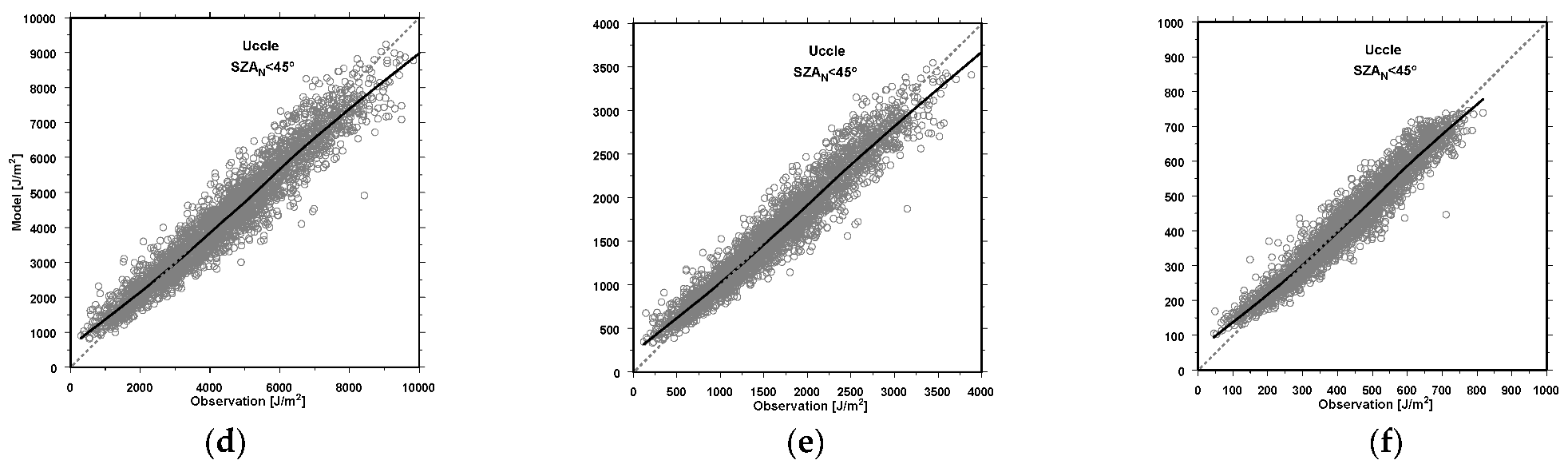
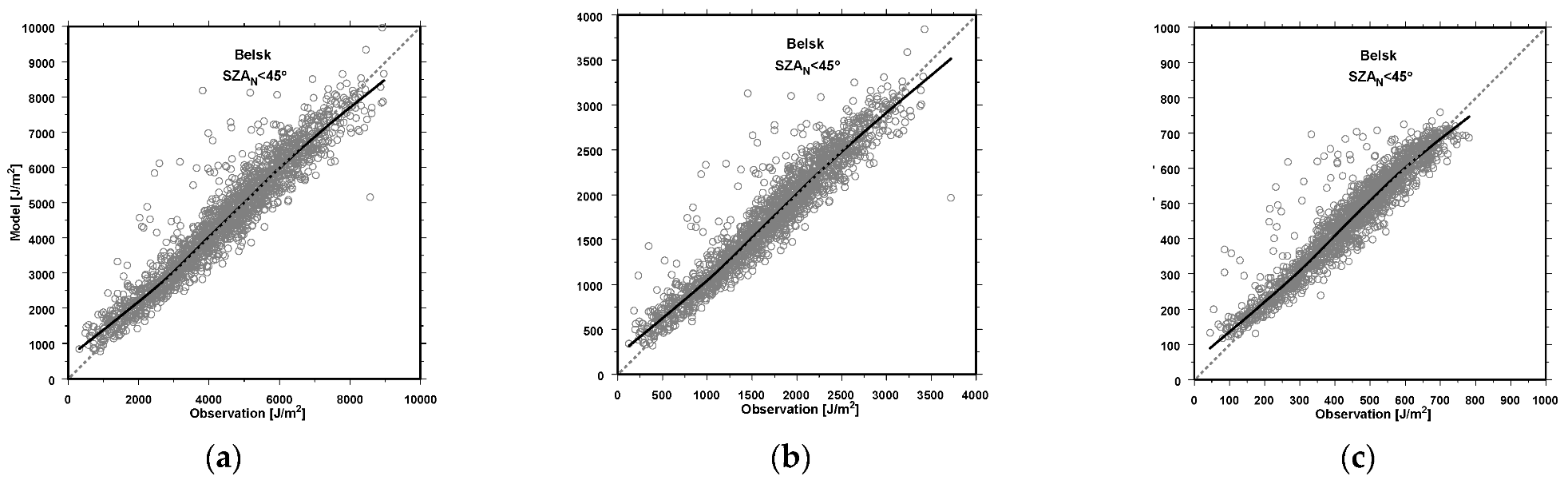
Ultraviolet solar radiation at the Earth’s surface significantly impacts both human health and ecosystems. A biologically effective daily radiant exposure (BEDRE) model is proposed for various biological processes with an analytical formula for its action spectrum. The following processes are considered: erythema formation, previtamin D3 synthesis, psoriasis clearance, and inactivation of SARS-CoV-2 virions. The BEDRE model is constructed by multiplying the synthetic BEDRE value under cloudless conditions by a cloud modification factor (CMF) parameterizing the attenuation of radiation via clouds. The CMF is an empirical function of the solar zenith angle (SZA) at midday and the daily clearness index from the Spinning Enhanced Visible and Infrared Imager (SEVIRI) measurements on board the second-generation Meteosat satellites. Total column ozone, from MERRA-2 reanalysis, is used in calculations of clear-sky BEDRE values. The proposed model was trained and validated using data from several European ground-based spectrophotometers and biometers for the periods 2014–2023 and 2004–2013, respectively. The model provides reliable estimates of BEDRE for all biological processes considered. Under snow-free conditions and SZA < 45° at midday, bias and standard deviation of observation-model differences are approximately ±5% and 15%, respectively. The BEDRE model can be used as an initial validation tool for ground-based UV data.
Keywords: UV radiation; satellite observations; reanalysis; biological effects; erythema appearance; previtamin D3 synthesis; psoriasis clearance; inactivation SARS-CoV-2 virions UV radiation; satellite observations; reanalysis; biological effects; erythema appearance; previtamin D3 synthesis; psoriasis clearance; inactivation SARS-CoV-2 virions