Article

IfCMD: A Novel Method for Radar Target Detection under Complex Clutter Backgrounds
by
Chenxi Zhang
,
Yishi Xu
,
Wenchao Chen
*,
Bo Chen
,
Chang Gao
and
Hongwei Liu
National Key Lab of Radar Signal Processing, Institute of Information Sensing, Xidian University, Xi’an 710071, China
*
Author to whom correspondence should be addressed.
Remote Sens. 2024, 16(12), 2199; https://doi.org/10.3390/rs16122199
Submission received: 5 April 2024 / Revised: 27 May 2024 / Accepted: 30 May 2024 / Published: 17 June 2024
(This article belongs to the Topic Radar Signal and Data Processing with Applications)

Abstract

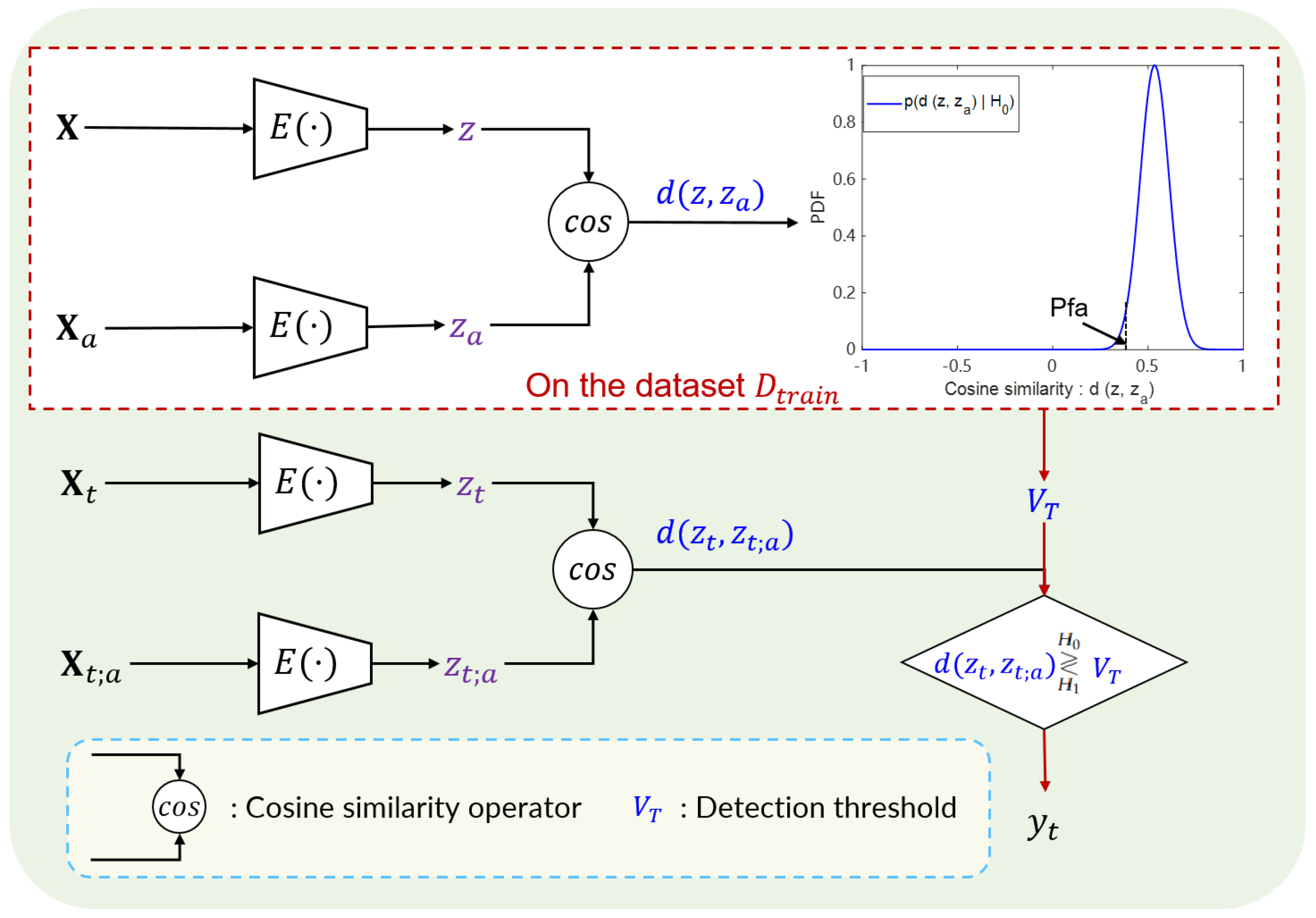
Traditional radar target detectors, which are model-driven, often suffer remarkable performance degradation in complex clutter environments due to the weakness in modeling the unpredictable clutter. Deep learning (DL) methods, which are data-driven, have been introduced into the field of radar target detection (RTD) since their intrinsic non-linear feature extraction ability can enhance the separability between targets and the clutter. However, existing DL-based detectors are unattractive since they require a large amount of independent and identically distributed (i.i.d.) training samples of target tasks and fail to be generalized to the other new tasks. Given this issue, incorporating the strategy of meta-learning, we reformulate the RTD task as a few-shot classification problem and develop the Inter-frame Contrastive Learning-Based Meta Detector (IfCMD) to generalize to the new task efficiently with only a few samples. Moreover, to further separate targets from the clutter, we equip our model with Siamese architecture and introduce the supervised contrastive loss into the proposed model to explore hard negative samples, which have the targets overwhelmed by the clutter in the Doppler domain. Experimental results on simulated data demonstrate competitive detection performance for moving targets and superior generalization ability for new tasks of the proposed method.
Keywords: clutter; artificial intelligence; deep learning (DL); radar target detection (RTD); meta-learning; contrastive learning clutter; artificial intelligence; deep learning (DL); radar target detection (RTD); meta-learning; contrastive learning