Article

SSAformer: Spatial–Spectral Aggregation Transformer for Hyperspectral Image Super-Resolution

1
College of Advanced Interdisciplinary Studies, National University of Defense Technology, Changsha 410073, China
2
State Key Laboratory of Pulsed Power Laser Technology, Changsha 410073, China
3
Hunan Provincial Key Laboratory of High Energy Laser Technology, Changsha 410073, China
4
The State Key Laboratory of High Performance Computing, College of Computer Science and Technology, National University of Defense Technology, Changsha 410073, China
*
Author to whom correspondence should be addressed.
These authors contributed equally to this work.
Remote Sens. 2024, 16(10), 1766; https://doi.org/10.3390/rs16101766
Submission received: 28 March 2024 / Revised: 13 May 2024 / Accepted: 14 May 2024 / Published: 16 May 2024
(This article belongs to the Special Issue Deep Learning for the Analysis of Multi-/Hyperspectral Images II)

Abstract

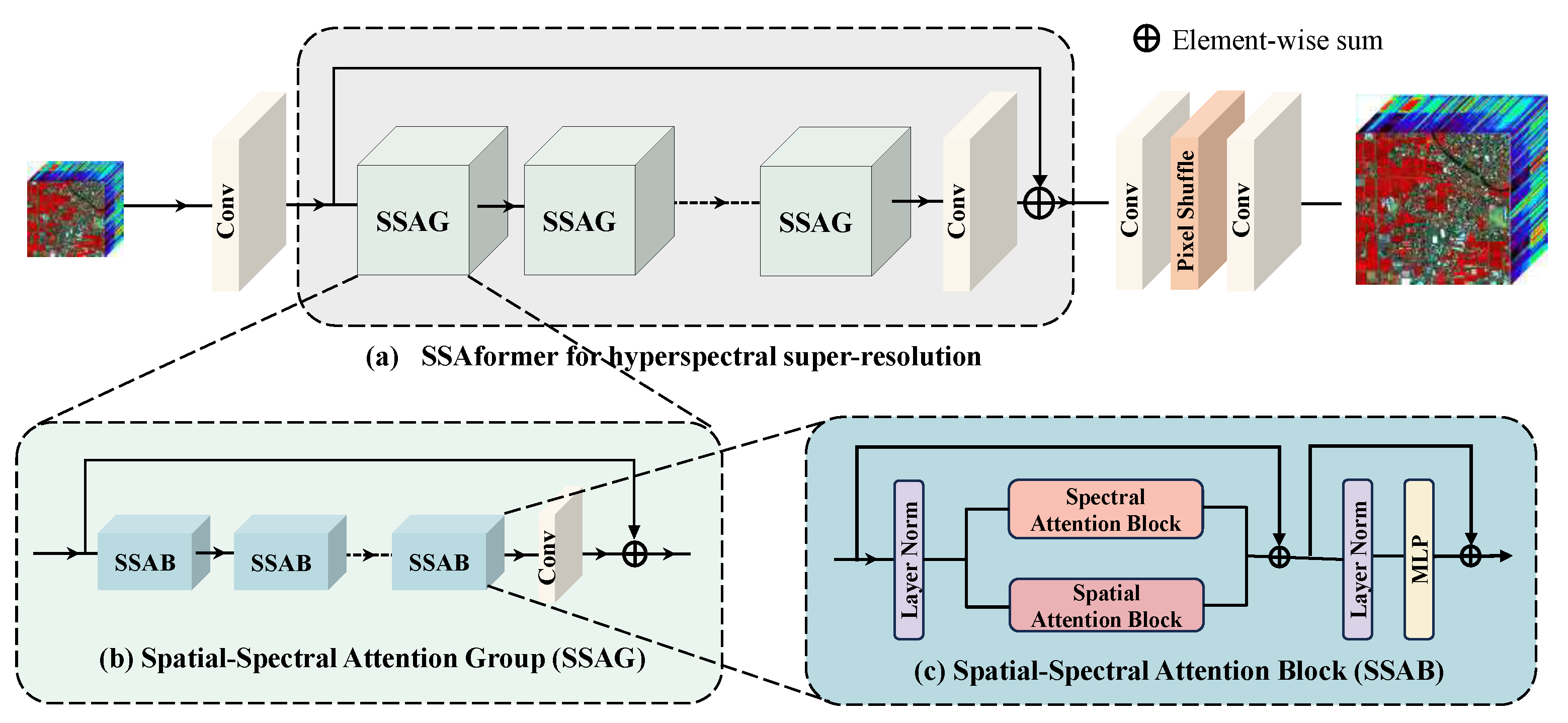
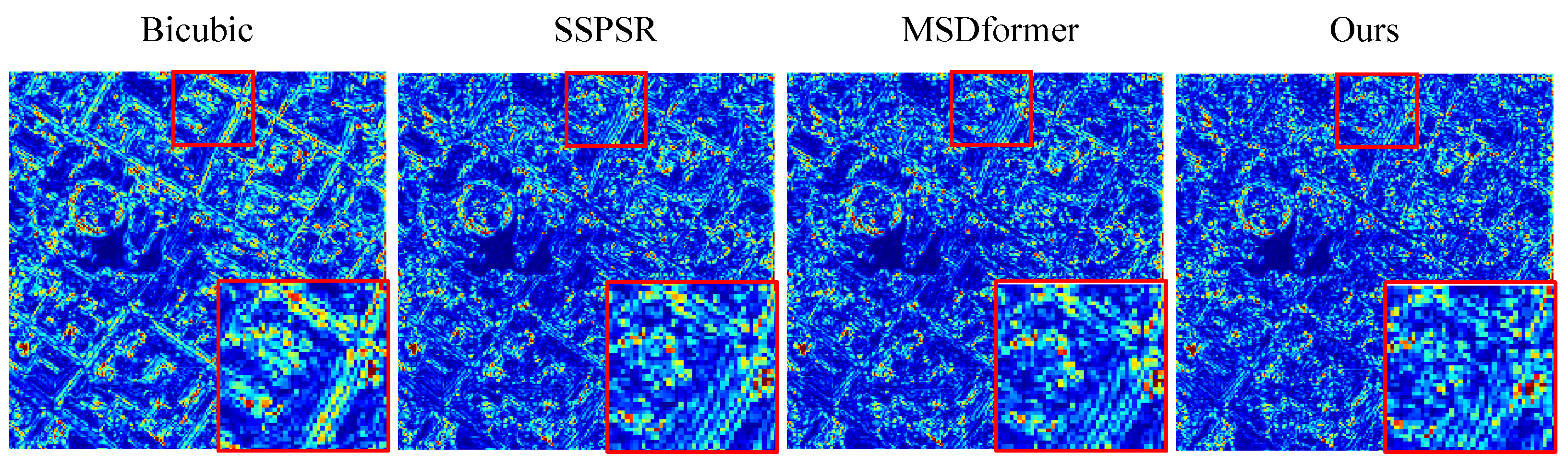
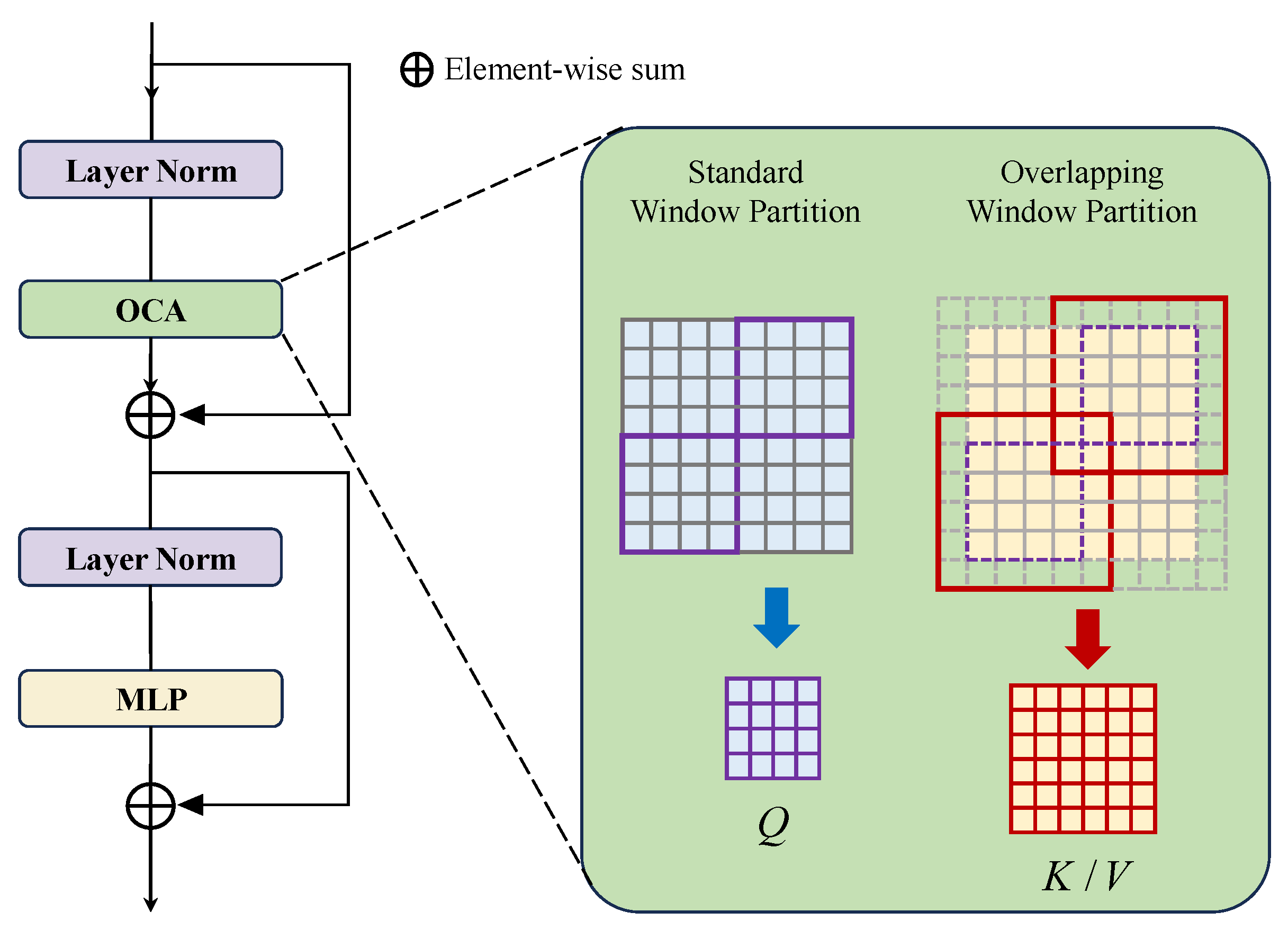
The hyperspectral image (HSI) distinguishes itself in material identification through its exceptional spectral resolution. However, its spatial resolution is constrained by hardware limitations, prompting the evolution of HSI super-resolution (SR) techniques. Single HSI SR endeavors to reconstruct high-spatial-resolution HSI from low-spatial-resolution inputs, and recent progress in deep learning-based algorithms has significantly advanced the quality of reconstructed images. However, convolutional methods struggle to extract comprehensive spatial and spectral features. Transformer-based models have yet to harness long-range dependencies across both dimensions fully, thus inadequately integrating spatial and spectral data. To solve the above problem, in this paper, we propose a new HSI SR method, SSAformer, which merges the strengths of CNNs and Transformers. It introduces specially designed attention mechanisms for HSI, including spatial and spectral attention modules, and overcomes the previous challenges in extracting and amalgamating spatial and spectral information. Evaluations on benchmark datasets show that SSAformer surpasses contemporary methods in enhancing spatial details and preserving spectral accuracy, underscoring its potential to expand HSI’s utility in various domains, such as environmental monitoring and remote sensing.
Keywords: hyperspectral image; super-resolution; deep learning; transformer hyperspectral image; super-resolution; deep learning; transformer