Article

Impacts of Water Resources Management on Land Water Storage in the Lower Lancang River Basin: Insights from Multi-Mission Earth Observations


Institute of Geographic Sciences and Natural Resources Research, Chinese Academy of Sciences, Beijing 100101, China
Remote Sens. 2023, 15(7), 1747; https://doi.org/10.3390/rs15071747
Submission received: 11 February 2023 / Revised: 11 March 2023 / Accepted: 23 March 2023 / Published: 24 March 2023
(This article belongs to the Special Issue Remote Sensing Approaches to Groundwater Management and Mapping)

Abstract

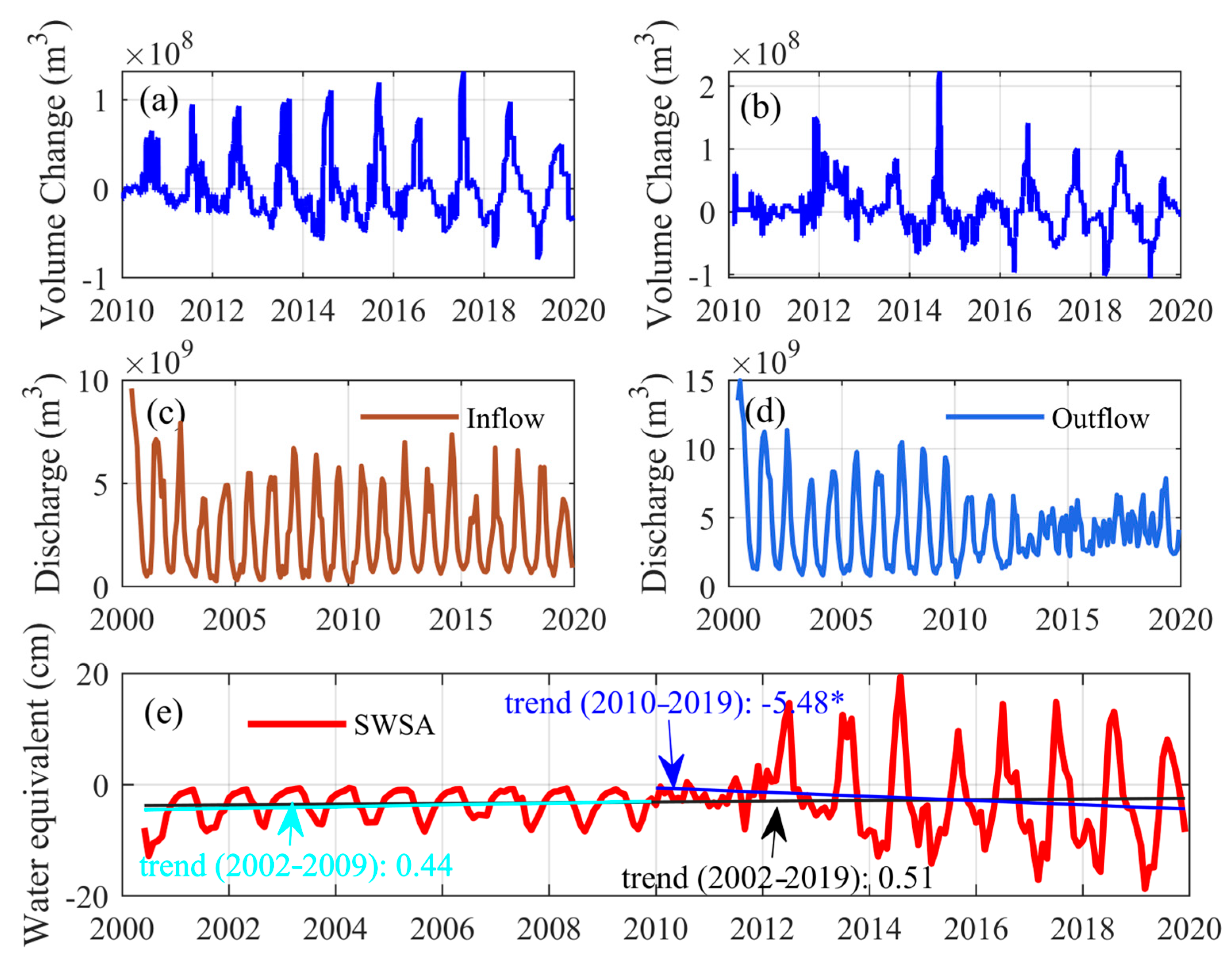
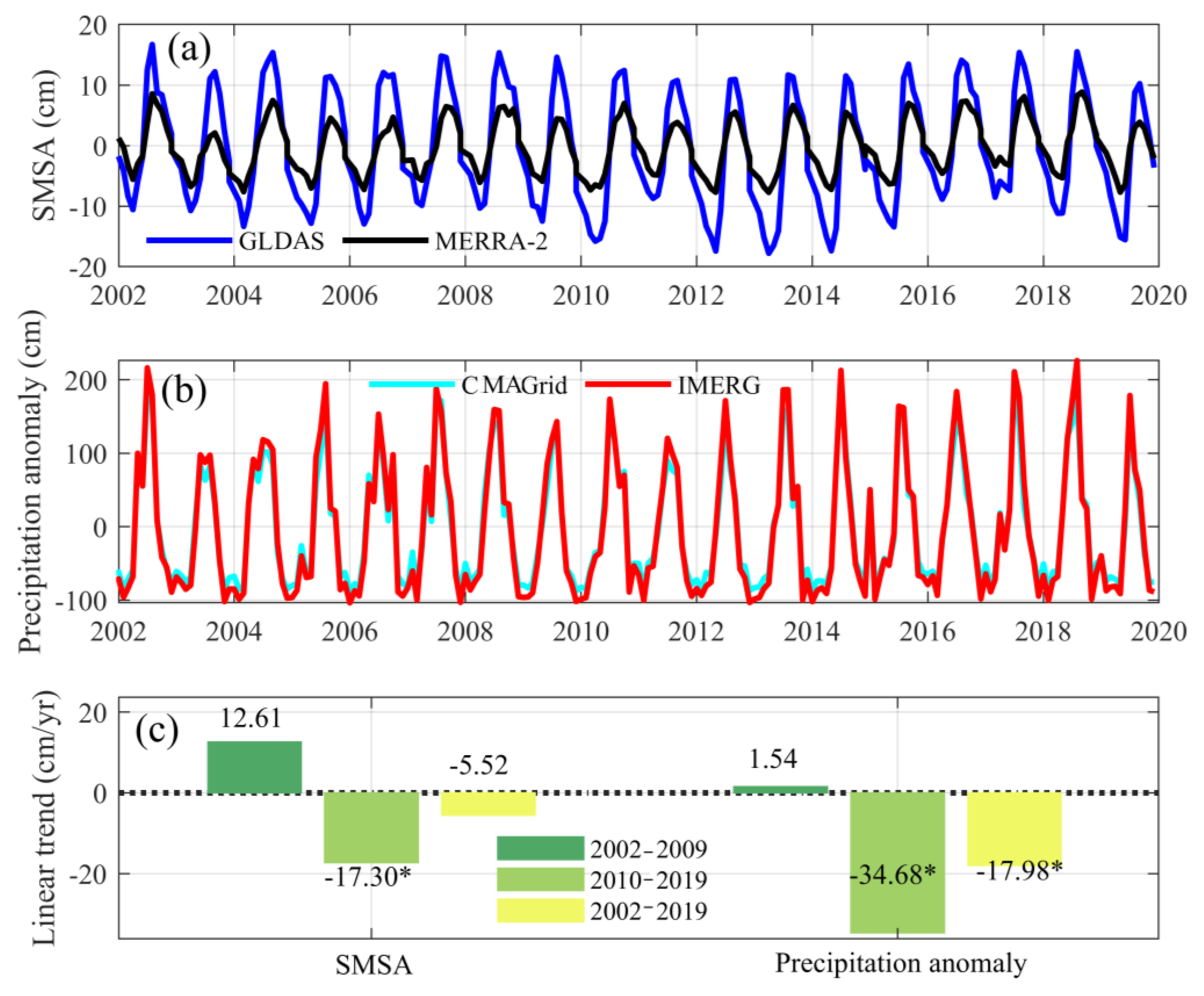
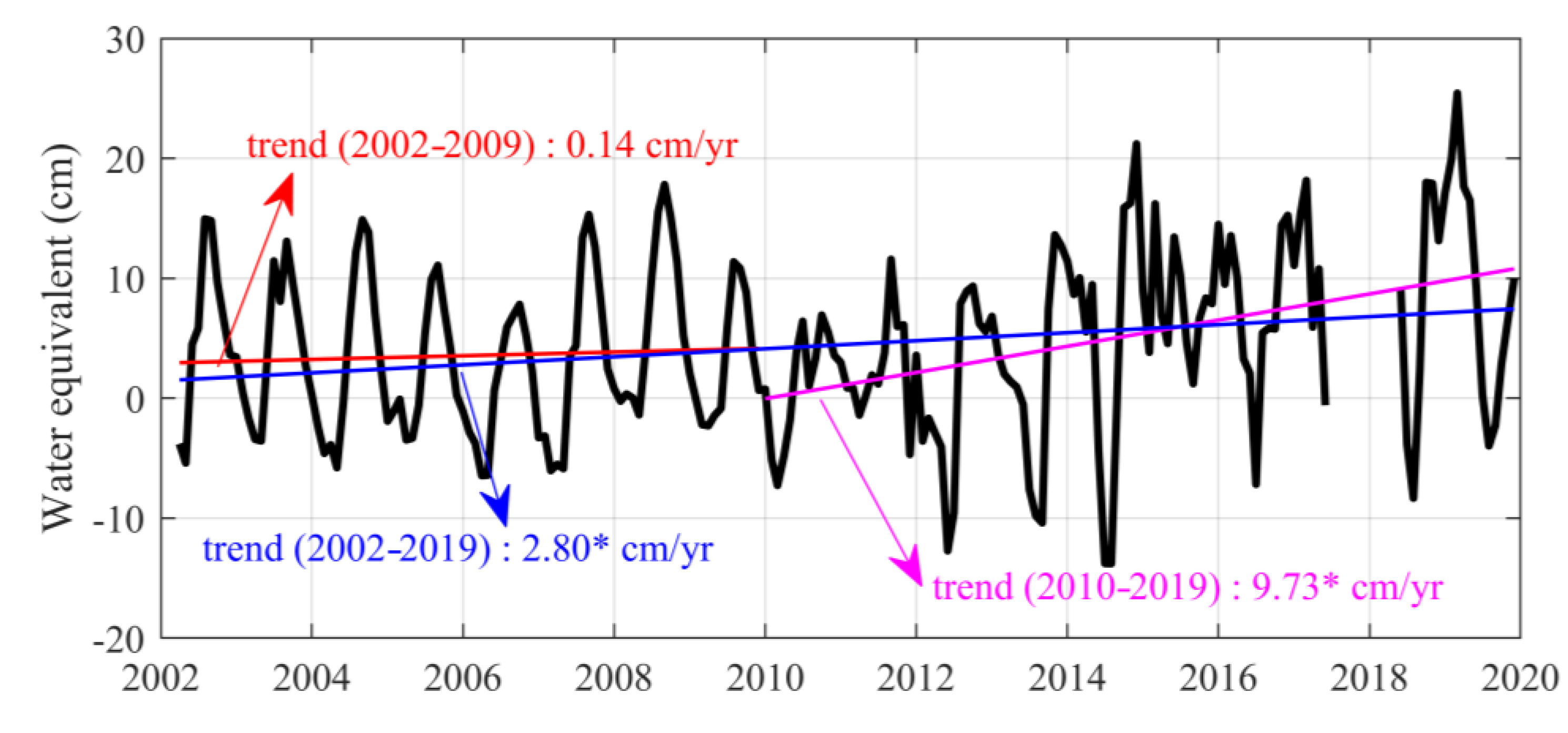
Climate change and heavy reservoir regulation in the lower Lancang River basin (LLRB) have caused significant impacts on terrestrial water storage (TWS) in several ways, including changes in surface water storage (SWS), soil moisture storage (SMS), and groundwater storage (GWS). Understanding these impacts is crucial for promoting comprehensive cooperation in managing and utilizing water resources within the basin. This study utilized multi-mission Earth observation (EO) datasets, i.e., gravimetry (GRACE/-FO), altimetry (Jason-2, Sentinel-3, and Cryosat-2), imagery (Sentinel-1/2), and microwave sensors (IMERG), as well as gauged meteorological, hydrological data and reanalysis products, to investigate the spatial-temporal variation of water resources in the LLRB. The study shows that the fluctuations in precipitation and the construction of reservoirs are the primary drivers of changes in the TWS anomaly (TWSA) in the region. Precipitation decreased significantly from 2010 to 2019 (−34.68 cm/yr), but the TWSA showed a significant increase (8.96 cm/yr) due to enhanced water storage capacity in the Xiaowan and Nuozhadu reservoirs. SWS and GWS were also analyzed, with SWS showing a decrease (−5.48 cm/yr) from 2010 to 2019 due to declining precipitation and increasing evaporation. GWS exhibited a steady rise (9.73 cm/yr) due to the maintenance of groundwater levels by the reservoirs. This study provides valuable insights into the potential of EO data for monitoring water resources at a regional scale.
Keywords: terrestrial water storage; satellite earth observations; reservoirs; lower Lancang River basin; water balance terrestrial water storage; satellite earth observations; reservoirs; lower Lancang River basin; water balance