Article

Thick Cloud Removal in Multi-Temporal Remote Sensing Images via Frequency Spectrum-Modulated Tensor Completion


1
Aerospace Information Research Institute, Chinese Academy of Sciences, Beijing 100094, China
2
Key Laboratory of Technology in Geo-Spatial Information Processing and Application System, Chinese Academy of Sciences, Beijing 100190, China
3
School of Electronic, Electrical and Communication Engineering, University of Chinese Academy of Sciences, Beijing 100049, China
*
Author to whom correspondence should be addressed.
Remote Sens. 2023, 15(5), 1230; https://doi.org/10.3390/rs15051230
Submission received: 4 January 2023 / Revised: 9 February 2023 / Accepted: 21 February 2023 / Published: 23 February 2023
(This article belongs to the Special Issue Recent Trends for Image Restoration Techniques Used in Remote Sensing)

Abstract

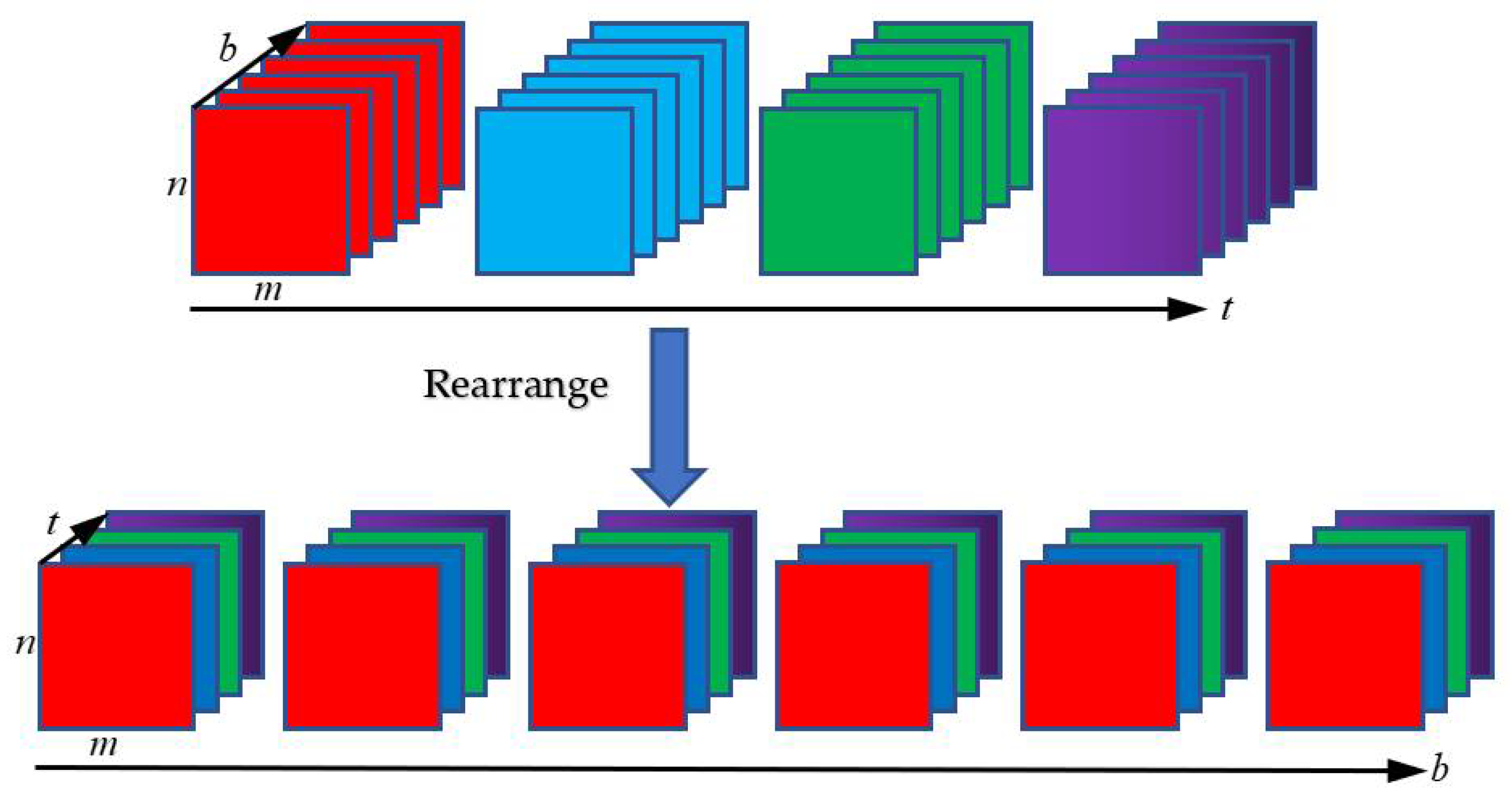
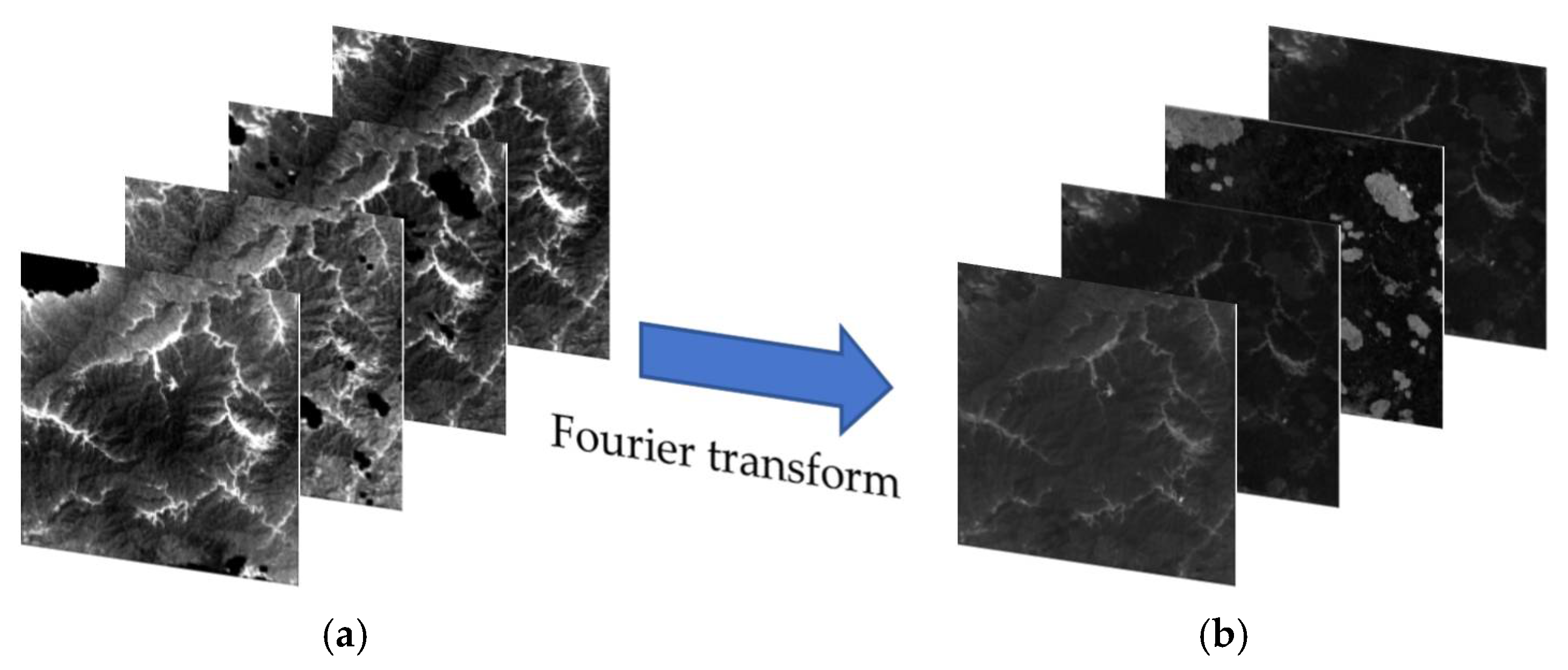
Clouds often contaminate remote sensing images, which leads to missing land feature information and subsequent application degradation. Low-rank tensor completion has shown great potential in the reconstruction of multi-temporal remote sensing images. However, existing methods ignore different low-rank properties in the spatial and temporal dimensions, such that they cannot utilize spatial and temporal information adequately. In this paper, we propose a new frequency spectrum-modulated tensor completion method (FMTC). First, remote sensing images are rearranged as third-order spatial–temporal tensors for each band. Then, Fourier transform (FT) is introduced in the temporal dimension of the rearranged tensor to generate a spatial–frequential tensor. In view of the fact that land features represent low-frequency components and fickle clouds represent high-frequency components in the time domain, we chose adaptive weights for the completion of different low-rank spatial matrixes, according to the frequency spectrum. Then, Invert Fourier Transform (IFT) was implemented. Through this method, the joint low-rank spatial–temporal constraint was achieved. The simulated data experiments demonstrate that FMTC is applicable on different land-cover types and different missing sizes. With real data experiments, we have validated the effectiveness and stability of FMTC for time-series remote sensing image reconstruction. Compared with other algorithms, the performance of FMTC is better in quantitative and qualitative terms, especially when considering the spectral accuracy and temporal continuity.
Keywords: multi-temporal remote sensing images; image reconstruction; low-rank tensor completion; Fourier transform multi-temporal remote sensing images; image reconstruction; low-rank tensor completion; Fourier transform