Article

Winter–Spring Prediction of Snow Avalanche Susceptibility Using Optimisation Multi-Source Heterogeneous Factors in the Western Tianshan Mountains, China
1
College of Resource and Environment Science, Xinjiang University, Urumqi 830046, China
2
Key Laboratory of Oasis Ecology, Ministry of Education, Xinjiang University, Urumqi 830046, China
3
China Institute of Desert Meteorology, CMA, Urumqi 830046, China
4
CAS Research Center for Ecology and Environment of Central Asia, Urumqi 830011, China
5
State Key Laboratory of Desert and Oasis Ecology, Xinjiang Institute of Ecology and Geography, Chinese Academy of Sciences, Urumqi 830011, China
*
Author to whom correspondence should be addressed.
Remote Sens. 2022, 14(6), 1340; https://doi.org/10.3390/rs14061340
Submission received: 11 January 2022 / Revised: 28 February 2022 / Accepted: 4 March 2022 / Published: 10 March 2022
(This article belongs to the Section Remote Sensing in Geology, Geomorphology and Hydrology)

Abstract

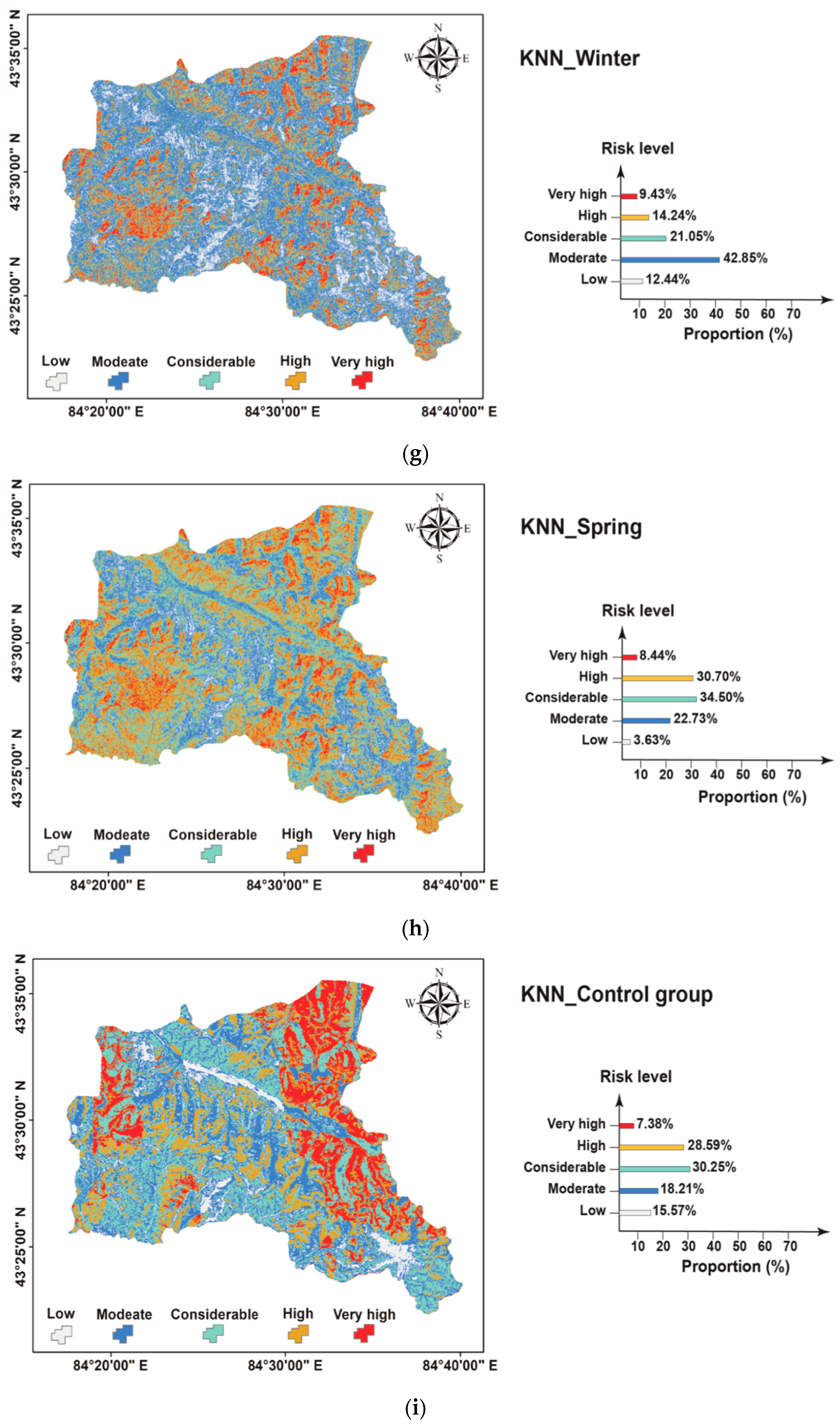
Data-driven methods are commonly applied in avalanche hazard evaluation. However, few studies have tapped into the relationship between the explanatory variables and avalanche hazard in arid–frigid areas, and the seasonal dynamics of avalanche hazard and its attribution has not been discussed. Therefore, to fill the gap in the hazard assessment of a dry–cold snow avalanche, quantify the dynamic driving process of seasonal nonlinear explanatory variables on avalanche hazard, and improve the reliability of the assessments, this study used Support Vector Machine (SVM), Random Forest (RF) and K-Nearest Neighbour (KNN) algorithms to construct three assessment models; these were used and verified in the western Tianshan Mountains, China. The following results were obtained: The causative factors of avalanches varied based on the season. In winter, terrain and snow depth played a major role, whereas spring was mainly influenced by snow depth and meteorological factors. The dynamic process of avalanche hazard was mainly governed by the seasonality of snow depth and temperature. The seasonal changes in avalanche hazard increased from low to high. The performance of all models was consistent for season and more reliable than the inter-annual evaluations. Among them, the RF model had the best prediction accuracy, with AUC values of 0.88, 0.91 and 0.78 in winter, spring and the control group, respectively. The overall accuracy of the model with multi-source heterogeneous factors was 0.212–0.444 higher than that of exclusive terrain factors. In general, the optimised model could accurately describe the complex nonlinear collaborative relationship between avalanche hazard and its explanatory variables, coupled with a more accurate evaluation. Moreover, free from inter-annual scale, the seasonal avalanche hazard assessment tweaked the model to the best performance.
Keywords: snow avalanche susceptibility; multicollinearity; relief-F; SVM; RF; KNN snow avalanche susceptibility; multicollinearity; relief-F; SVM; RF; KNN