Article

An Inverse Method for Drop Size Distribution Retrieval from Polarimetric Radar at Attenuating Frequency

1
Géoscience Environnement Toulouse, GET (CNRS-IRD-Université de Toulouse III-CNES), 31500 Toulouse, France
2
Géotechnique, Environnement, Risques Naturels et Sciences de la Terre, GERS-LEE, IFSTTAR, Universite Gustave Eiffel, 44344 Bouguenais, France
*
Author to whom correspondence should be addressed.
Remote Sens. 2022, 14(5), 1116; https://doi.org/10.3390/rs14051116
Submission received: 20 January 2022 / Revised: 7 February 2022 / Accepted: 11 February 2022 / Published: 24 February 2022

Abstract

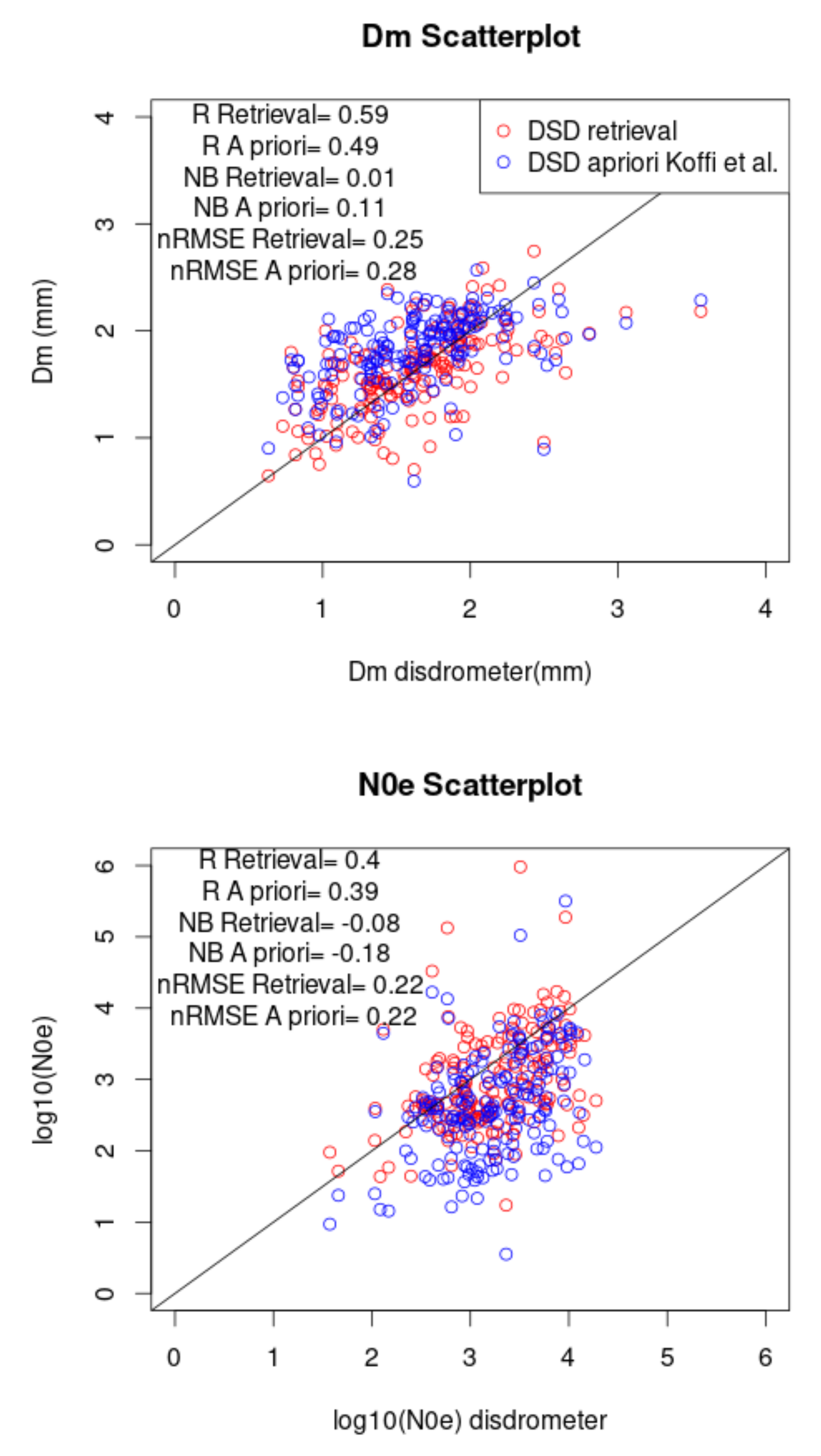
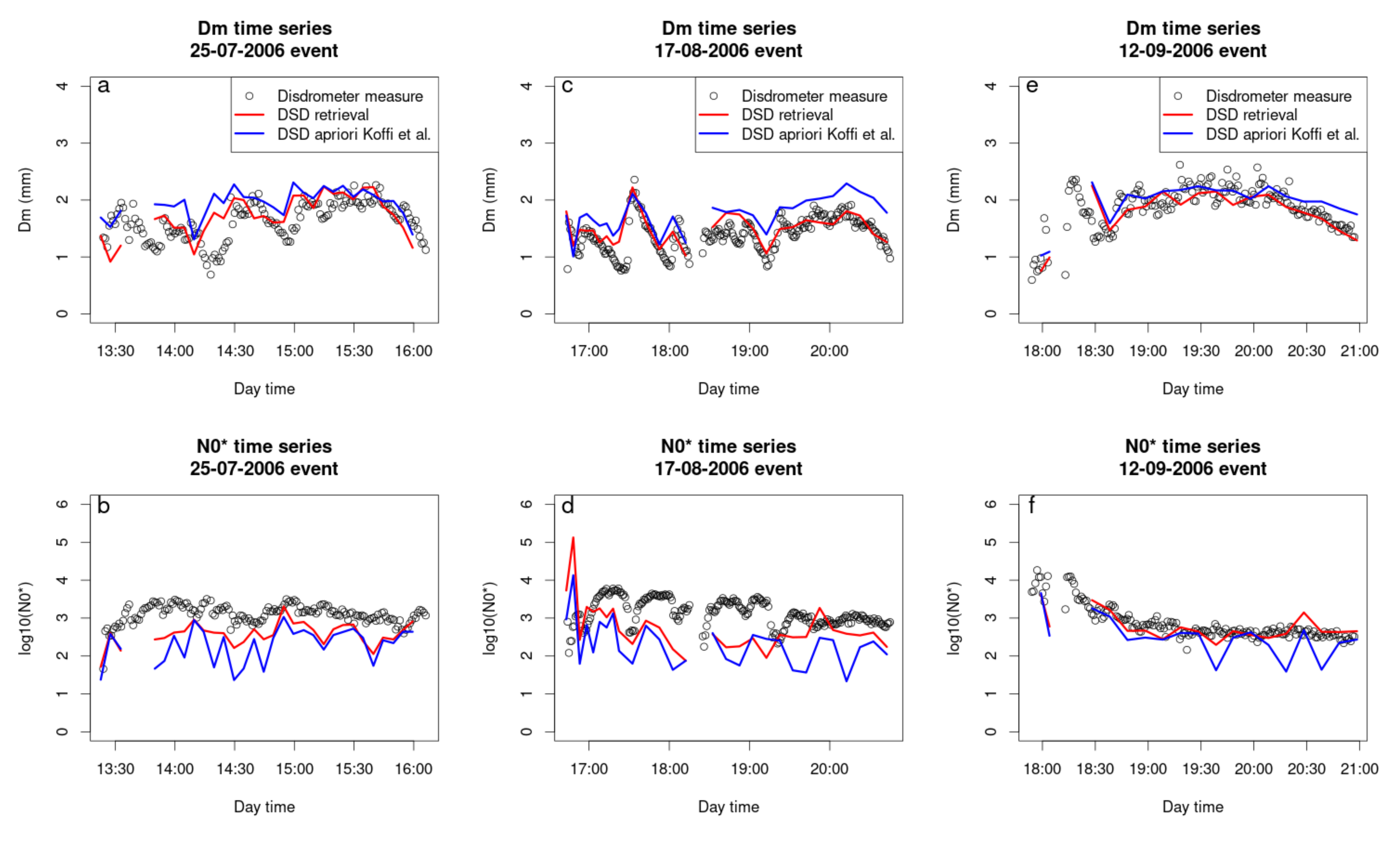
A method that formulates the retrieval of drop size distribution (DSD) parameters from polarimetric radar variables at attenuating frequency as the solution of an inverse problem is presented. The DSD in each radar bin is represented by a normalized Gamma distribution defined by three parameters (Dm,N0*,μ). The direct problem that describes polarimetric radar observables—scattering and propagation terms—and their dependency on DSD parameters is analyzed based on T-matrix scattering simulations. The inverse algorithm and its application to the DSD retrieval are then presented. The inverse method is applied to an African Monsoon Multidisciplinary Analysis (AMMA) field campaign that deployed an X-band dual-polarization Doppler radar and optical disdrometers in Benin, West Africa, in 2006 and 2007. The dataset is composed of X-band polarimetric radar PPIs and disdrometer data for 15 organized convective systems observed in 2006. A priori information on DSD parameters (benchmark method) is derived from the polarimetric radar observables by applying power law relationships. The proposed retrieval method of DSD parameters leads to the following results as compared to the benchmark: (i) we found a better spatial consistency of the retrieved parameters, (ii) the reconstructed polarimetric radar observables are closer to the observations, (iii) The validation with disdrometer data confirms an improved estimation of the DSD parameters.
Keywords: radar polarimetry; drop size distribution retrieval; inverse problem; attenuation correction; X-band radar; tropical rainfall; convective rainfall radar polarimetry; drop size distribution retrieval; inverse problem; attenuation correction; X-band radar; tropical rainfall; convective rainfall