Article

The Distribution of pCO2W and Air-Sea CO2 Fluxes Using FFNN at the Continental Shelf Areas of the Arctic Ocean

by
Iwona Wrobel-Niedzwiecka
1,*,
Małgorzata Kitowska
1,
Przemyslaw Makuch
1 and
Piotr Markuszewski
1,2,3
1
Institute of Oceanology of the Polish Academy of Sciences, 81-578 Sopot, Poland
2
Department of Environmental Science, Stockholm University, 10691 Stockholm, Sweden
3
Bolin Centre for Climate Research, Stockholm University, 10691 Stockholm, Sweden
*
Author to whom correspondence should be addressed.
Remote Sens. 2022, 14(2), 312; https://doi.org/10.3390/rs14020312
Submission received: 15 November 2021 / Revised: 3 January 2022 / Accepted: 4 January 2022 / Published: 11 January 2022
(This article belongs to the Special Issue Remote Sensing of the Polar Oceans)

Abstract

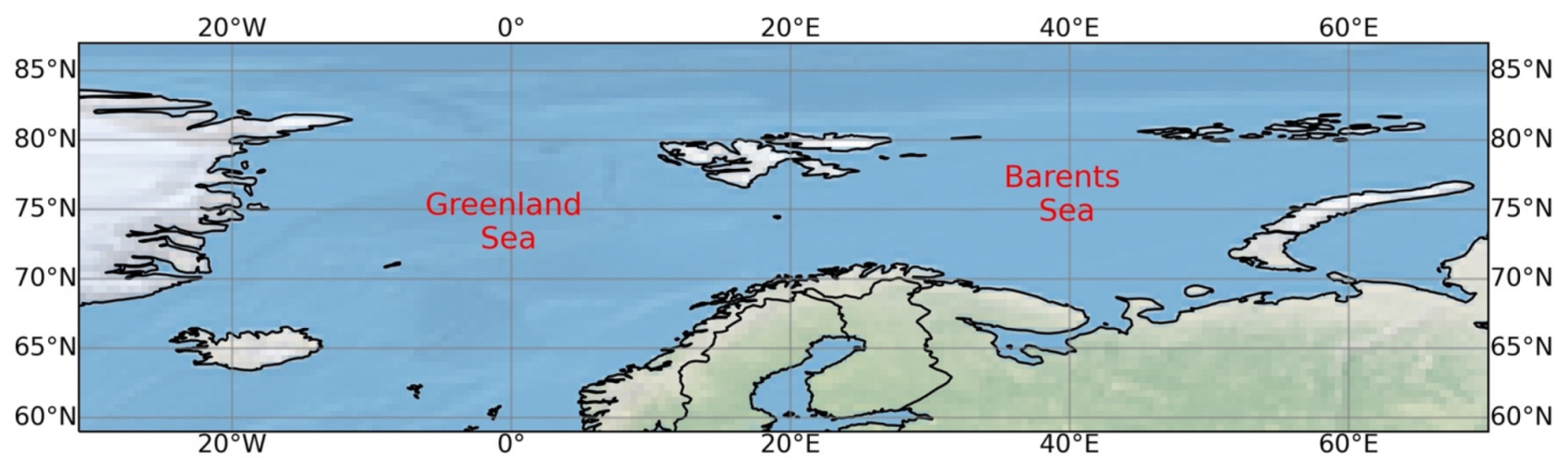
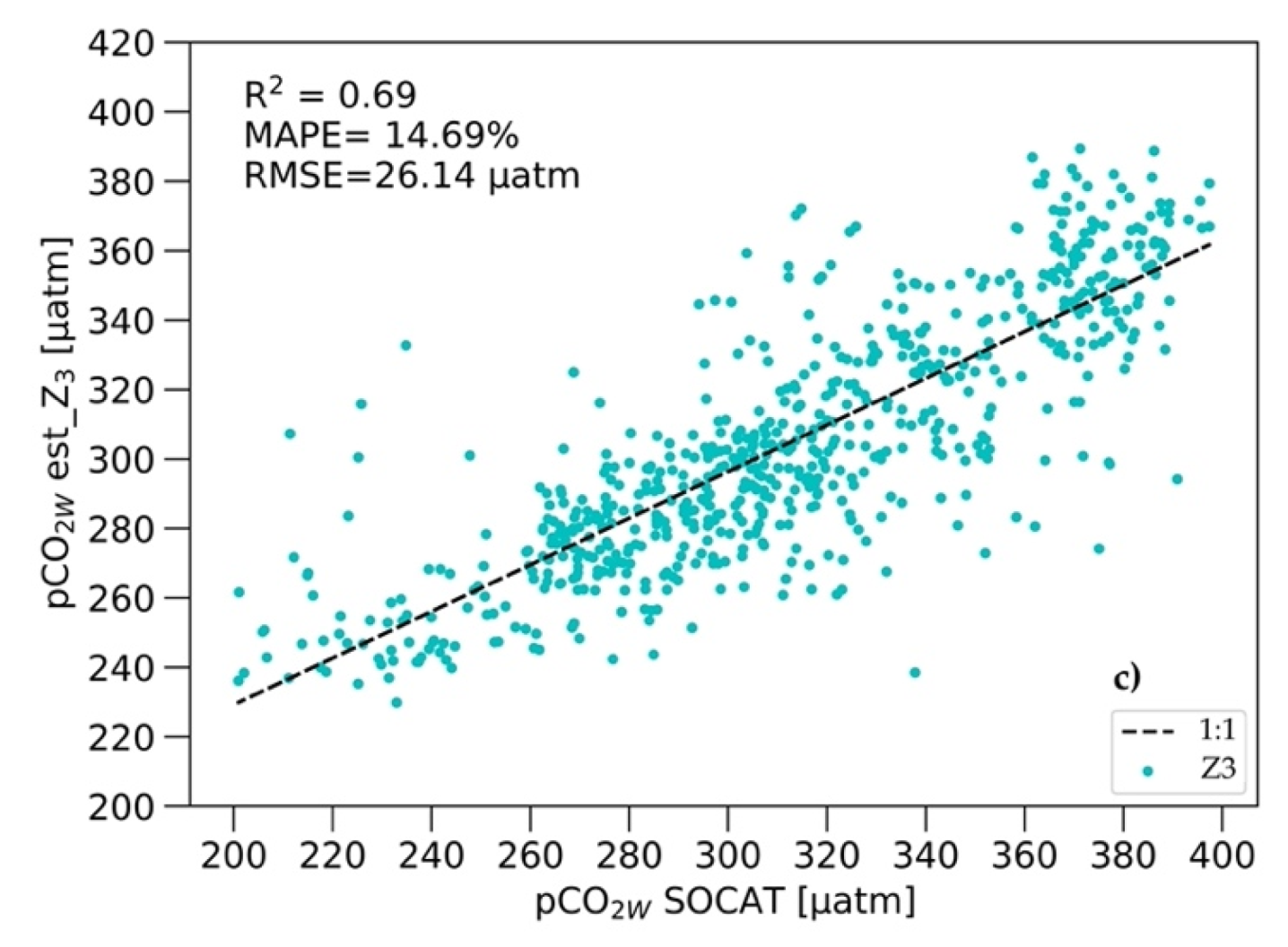
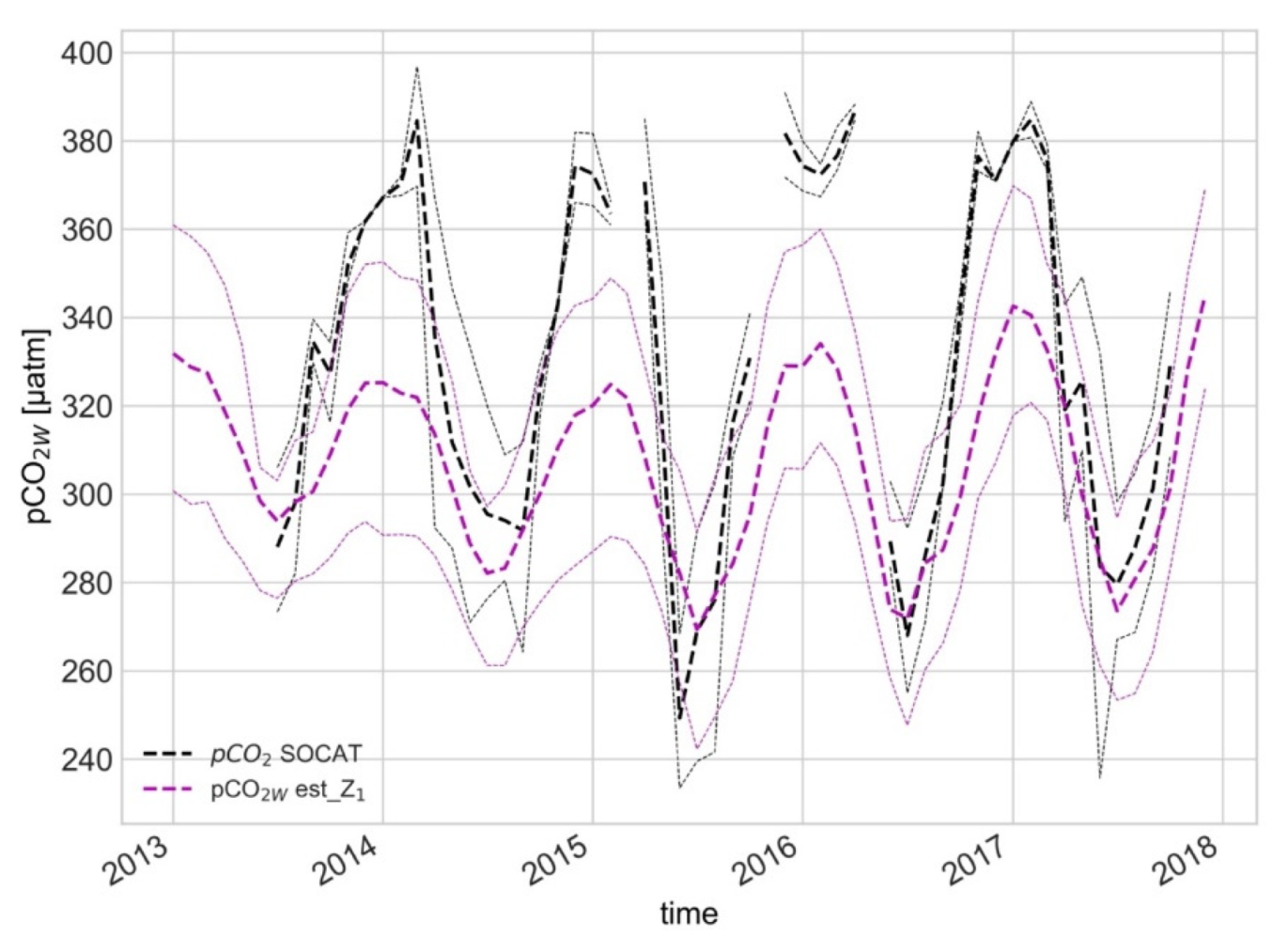
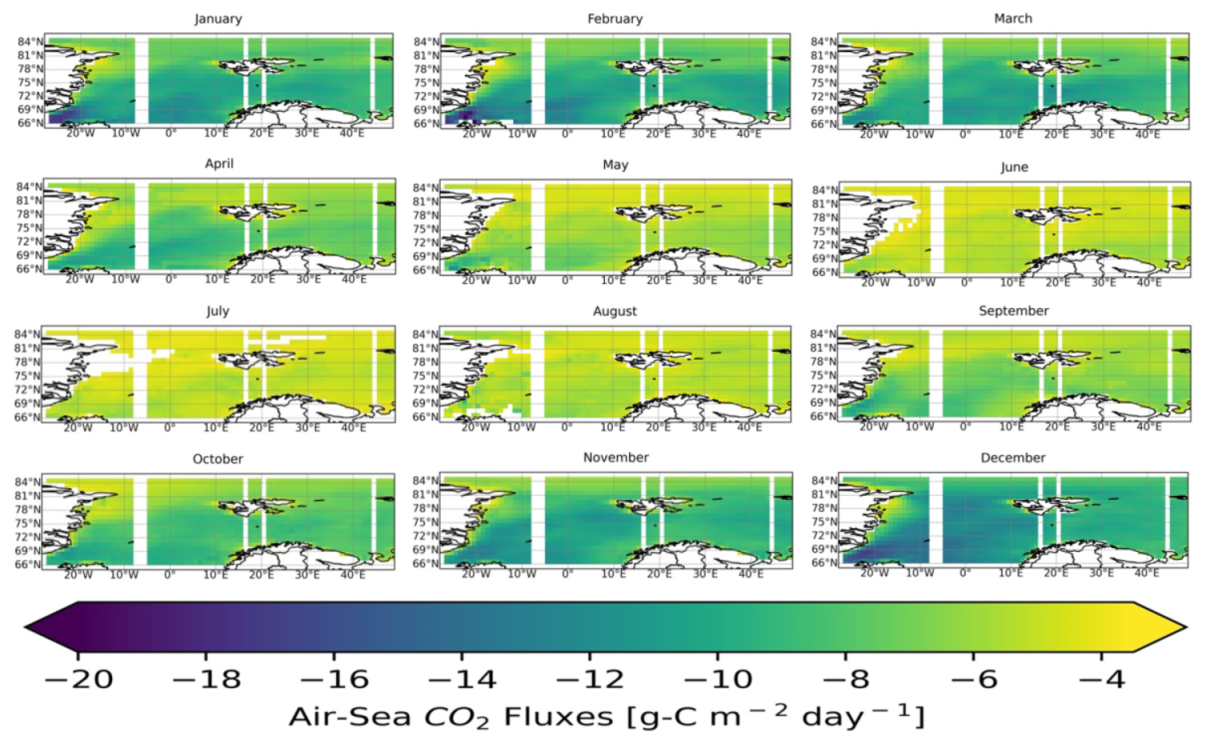
A feed-forward neural network (FFNN) was used to estimate the monthly climatology of partial pressure of CO2 (pCO2W) at a spatial resolution of 1° latitude by 1° longitude in the continental shelf of the European Arctic Sector (EAS) of the Arctic Ocean (the Greenland, Norwegian, and Barents seas). The predictors of the network were sea surface temperature (SST), sea surface salinity (SSS), the upper ocean mixed-layer depth (MLD), and chlorophyll-a concentration (Chl-a), and as a target, we used 2 853 pCO2W data points from the Surface Ocean CO2 Atlas. We built an FFNN based on three major datasets that differed in the Chl-a concentration data used to choose the best model to reproduce the spatial distribution and temporal variability of pCO2W. Using all physical–biological components improved estimates of the pCO2W and decreased the biases, even though Chl-a values in many grid cells were interpolated values. General features of pCO2W distribution were reproduced with very good accuracy, but the network underestimated pCO2W in the winter and overestimated pCO2W values in the summer. The results show that the model that contains interpolating Chl-a concentration, SST, SSS, and MLD as a target to predict the spatiotemporal distribution of pCO2W in the sea surface gives the best results and best-fitting network to the observational data. The calculation of monthly drivers of the estimated pCO2W change within continental shelf areas of the EAS confirms the major impact of not only the biological effects to the pCO2W distribution and Air-Sea CO2 flux in the EAS, but also the strong impact of the upper ocean mixing. A strong seasonal correlation between predictor and pCO2W seen earlier in the North Atlantic is clearly a yearly correlation in the EAS. The five-year monthly mean CO2 flux distribution shows that all continental shelf areas of the Arctic Ocean were net CO2 sinks. Strong monthly CO2 influx to the Arctic Ocean through the Greenland and Barents Seas (>12 gC m−2 day−1) occurred in the fall and winter, when the pCO2W level at the sea surface was high (>360 µatm) and the strongest wind speed (>12 ms−1) was present.
Keywords: feed-forward neural network; the European Arctic Sector; partial pressure of CO2; Air-Sea CO2 flux feed-forward neural network; the European Arctic Sector; partial pressure of CO2; Air-Sea CO2 flux