The Use of Superspheroids as Surrogates for Modeling Electromagnetic Wave Scattering by Ice Crystals

Abstract
1. Introduction
2. Methods and Definitions
2.1. Superspheroidal Models and Shape Index
2.2. Optical Properties
3. Microwave Bands
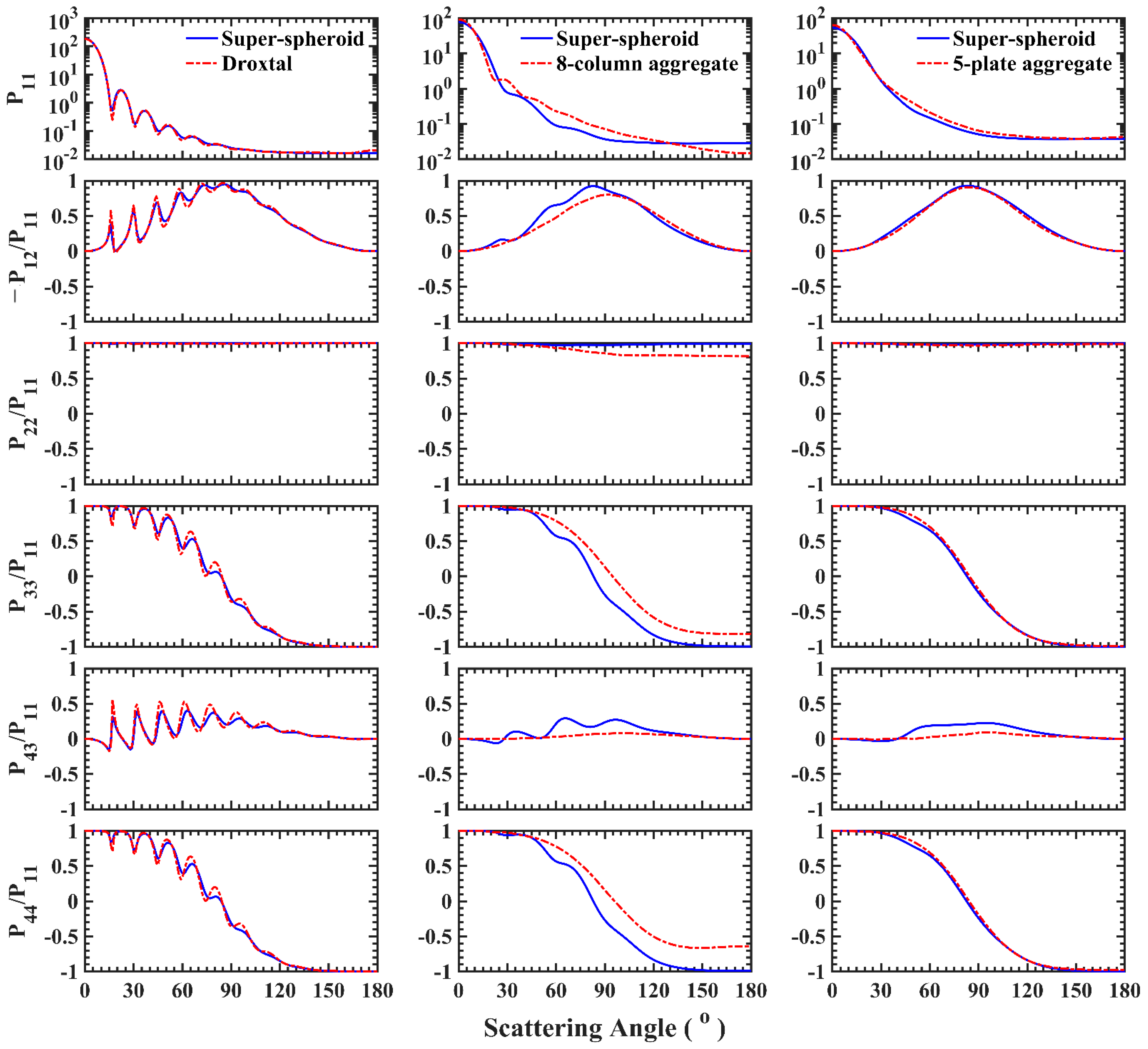
3.1. Superspheroids for Droxtal
3.2. Superspheroids for Columns
3.3. Superspheroids for Plates
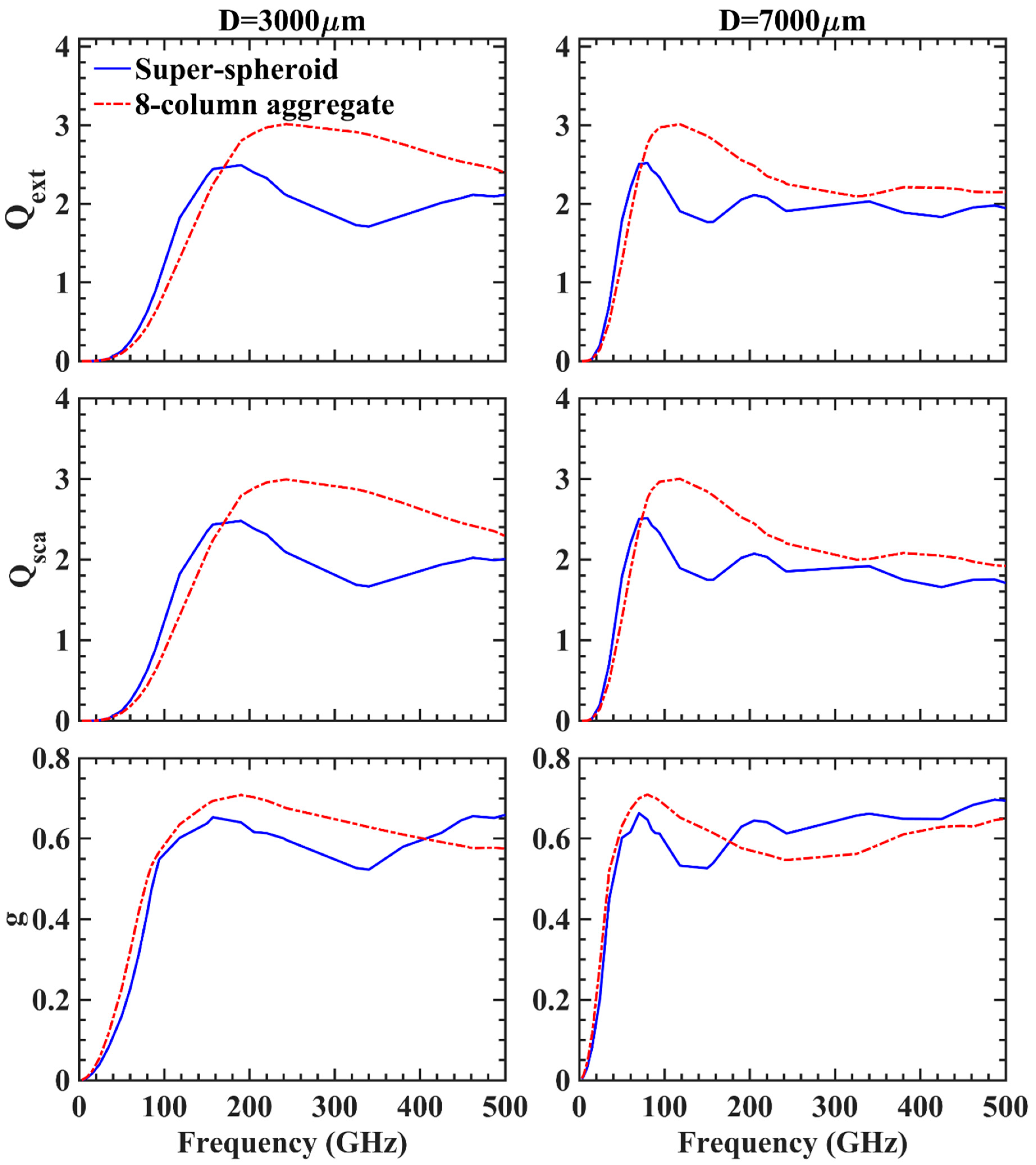
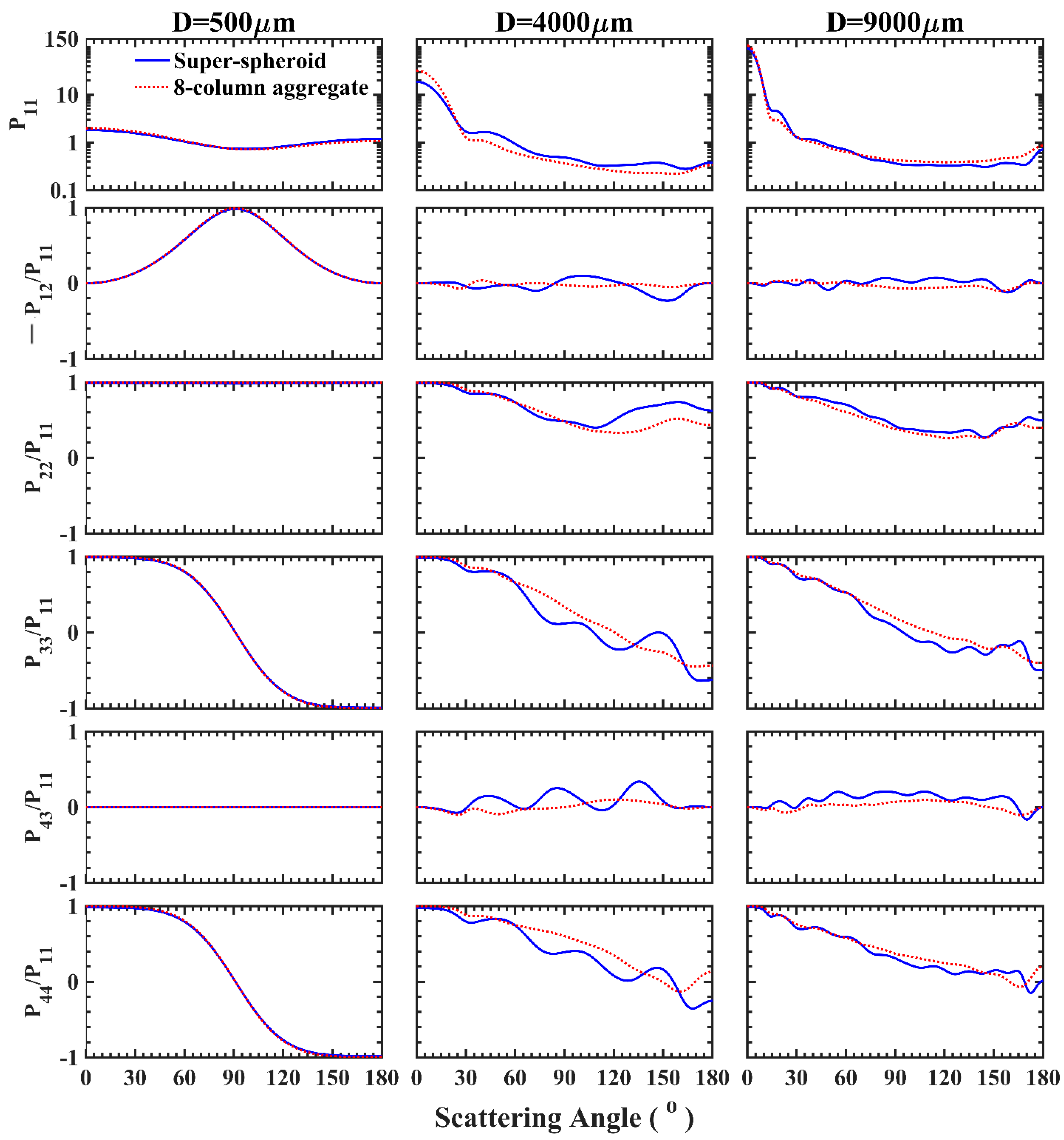
3.4. Superspheroids for an 8-Column Aggregate
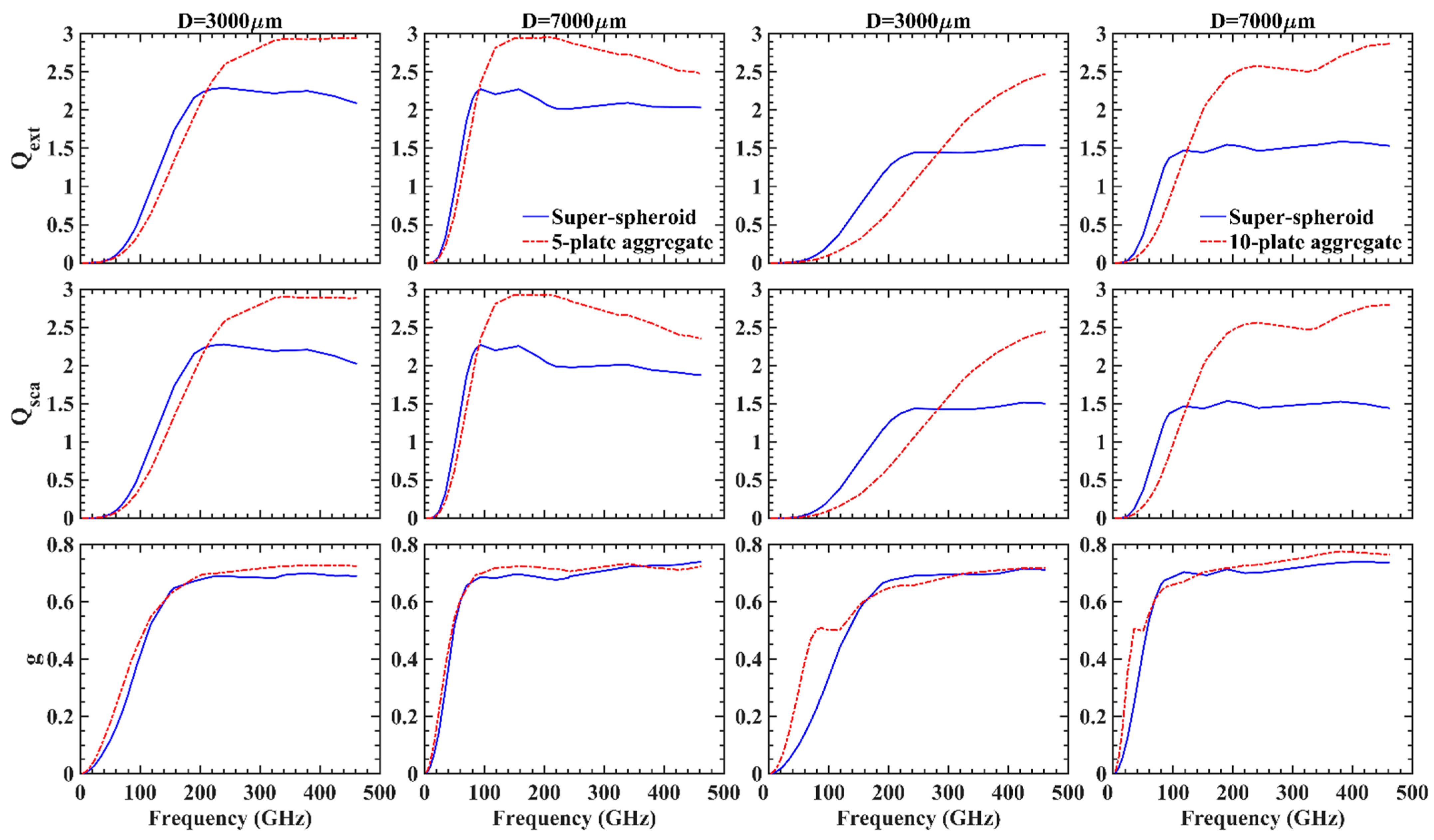
3.5. Superspheroids for Sparse Aggregate Shapes: 5-Plate and 10-Plate Aggregates
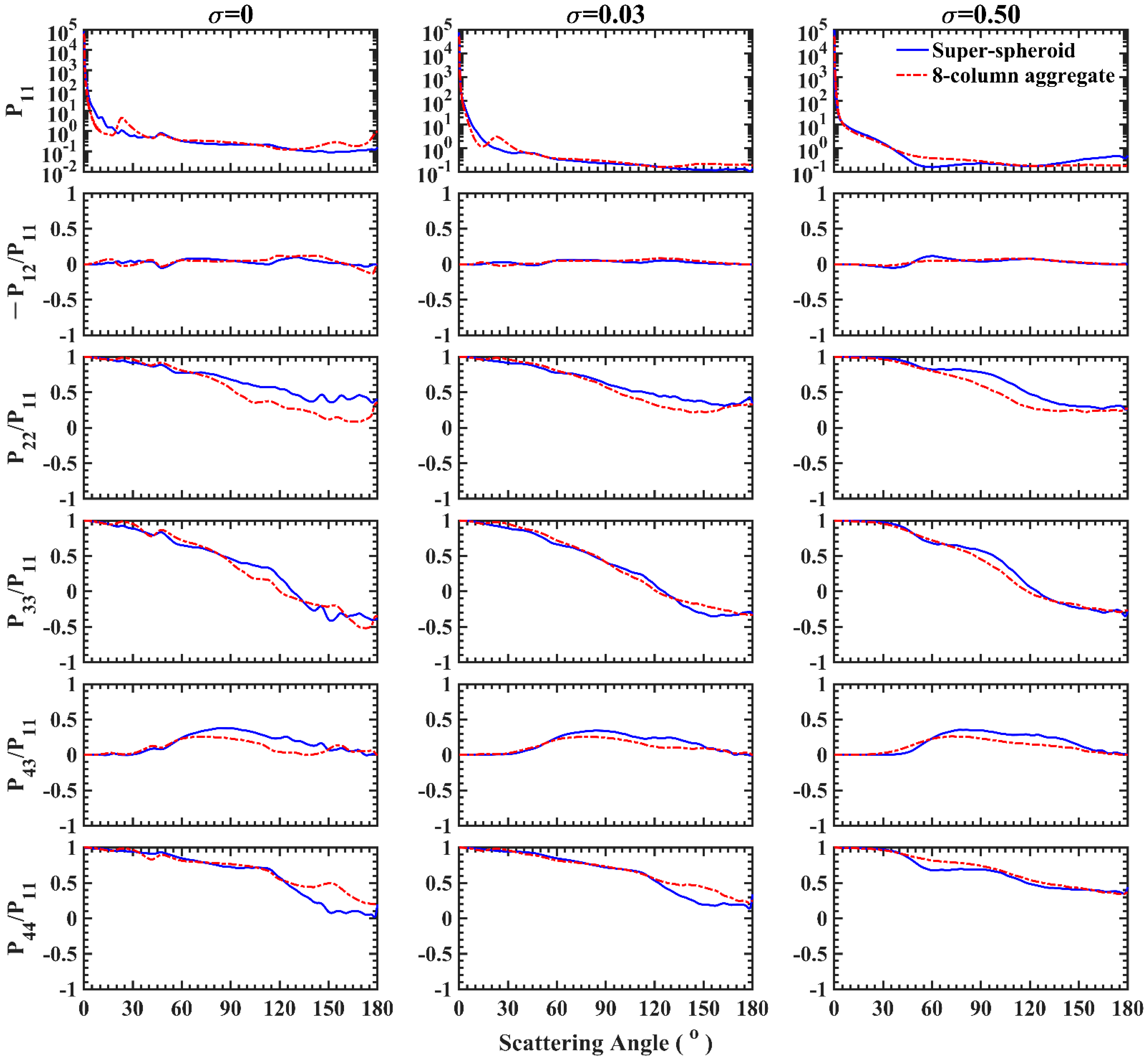
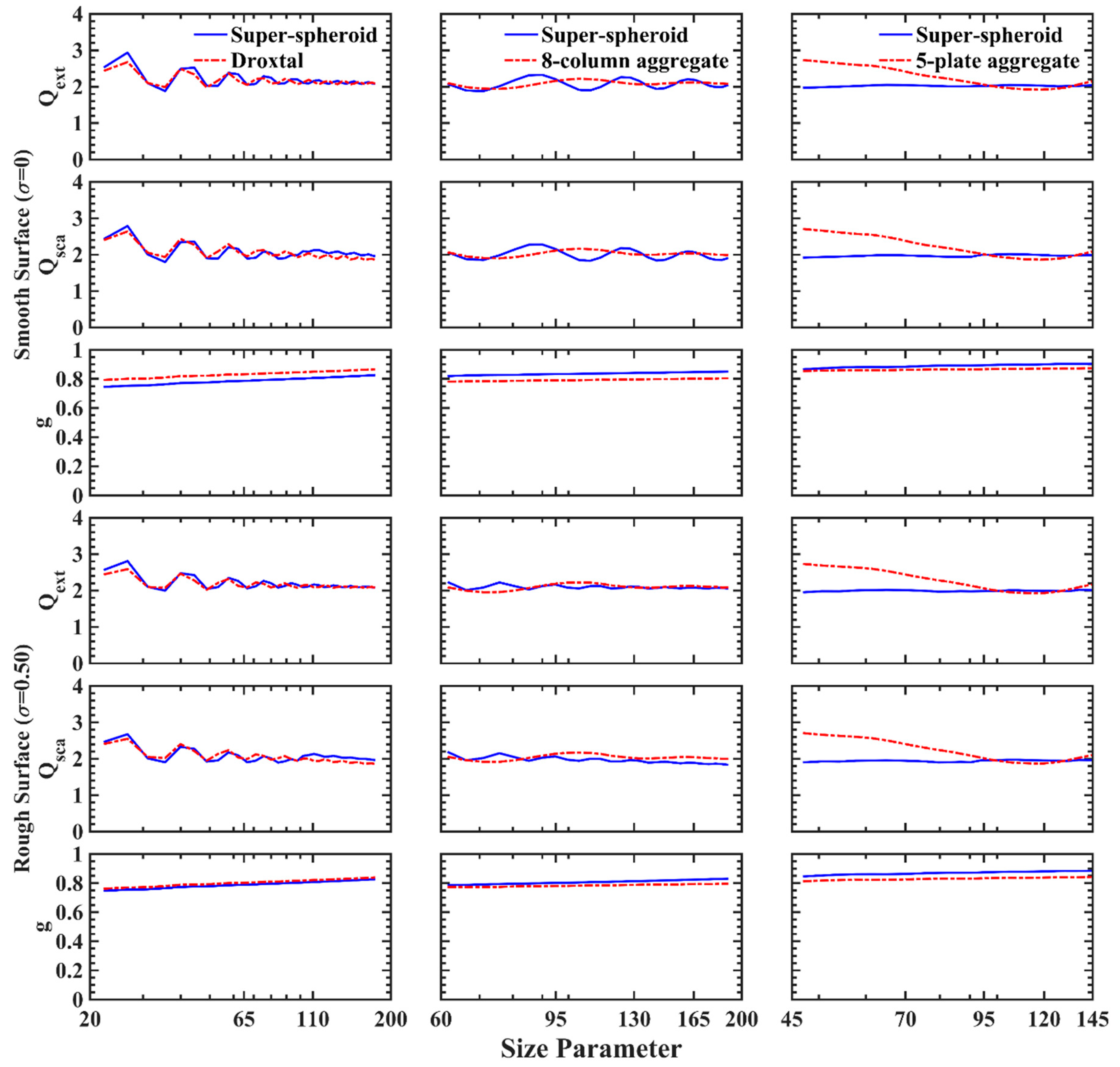
4. Visible and Infrared Wavelengths
5. Discussions
6. Conclusions
Author Contributions
Funding
Acknowledgments
Conflicts of Interest
References
- Ramaswamy, V.; Detwiler, A. Interdependence of radiation and microphysics in cirrus clouds. J. Atmos. Sci. 1986, 43, 2289–2301. [Google Scholar] [CrossRef] [Scilit]
- Liou, K.N. Influence of cirrus clouds on weather and climate processes: A global perspective. Mon. Weather Rev. 1986, 114, 1167–1199. [Google Scholar] [CrossRef] [Scilit]
- Baran, A.J. From the single-scattering properties of ice crystals to climate prediction: A way forward. Atmos. Res. 2012, 112, 45–69. [Google Scholar] [CrossRef] [Scilit]
- Baran, A.J. A review of the light scattering properties of cirrus. J. Quant. Spectrosc. Radiat. Transfer. 2009, 110, 1239–1260. [Google Scholar] [CrossRef] [Scilit]
- Yang, P.; Liou, K.N.; Bi, L.; Liu, C.; Yi, B.; Baum, B.A. On the radiative properties of ice clouds: Light scattering, remote sensing, and radiation parameterization. Adv. Atmos. Sci. 2015, 32, 32–63. [Google Scholar] [CrossRef] [Scilit]
- Luo, Z.; Rossow, W.B. Characterizing Tropical Cirrus Life Cycle, Evolution, and Interaction with Upper-Tropospheric Water Vapor Using Lagrangian Trajectory Analysis of Satellite Observations. J. Clim. 2004, 17, 4541–4563. [Google Scholar] [CrossRef] [Scilit]
- Gultepe, I.; Heymsfield, A.J.; Gallagher, M.; Ickes, L.; Baumgardner, D. Ice Fog: The Current State of Knowledge and Future Challenges. Chapter 4, Ice formation and Evolution in Clouds and Precipitation: Measurement and Modelling Challenges. Meteor. Monogr. 2017, 58, 4.1–4.24. [Google Scholar] [CrossRef] [Scilit]
- Heymsfield, A.J.; Miloshevich, L.M. Parameterizations for the Cross-Sectional Area and Extinction of Cirrus and Stratiform Ice Cloud Particles. J. Atmos. Sci. 2003, 60, 936–956. [Google Scholar] [CrossRef] [Scilit]
- Lawson, R.P.; Woods, S.; Jensen, E.; Erfani, E.; Gurganus, C.; Gallagher, M.; Connolly, P.; Whiteway, J.; Baran, A.J.; May, P.; et al. A Review of Ice Particle Shapes in Cirrus formed In Situ and in Anvils. J. Geophys. Res. 2019, 124, 10049–10090. [Google Scholar] [CrossRef] [Scilit]
- Yang, P.; Hioki, S.; Saito, M.; Kuo, C.P.; Baum, B.A.; Liou, K.N. A Review of Ice Cloud Optical Property Models for Passive Satellite Remote Sensing. Atmosphere 2018, 9, 499. [Google Scholar] [CrossRef] [Scilit]
- Gayet, J.F.; Ovarlez, J.; Shcherbakov, V.; Ström, J.; Schumann, U.; Minikin, A.; Auriol, F.; Petzold, A.; Monier, M. Cirrus cloud microphysical and optical properties at southern and northern midlatitudes during the INCA experiment. J. Geophys. Res. 2004, 109, D20206. [Google Scholar] [CrossRef] [Scilit]
- Houghton, J.T.; Hunt, G.E. The detection of ice clouds from remote measurements of their emission in the far-infrared. Quart. J. Roy. Meteor. Soc. 1971, 97, 1–17. [Google Scholar] [CrossRef]
- Baran, A.J.; Hill, P.; Furtado, K.; Field, P.; Manners, J. A Coupled Cloud Physics–Radiation Parameterization of the Bulk Optical Properties of Cirrus and Its Impact on the Met Office Unified Model Global Atmosphere 5.0 Configuration. J. Clim. 2014, 27, 7725–7752. [Google Scholar] [CrossRef] [Scilit]
- Yang, P.; Bi, L.; Baum, B.A.; Liou, K.N.; Kattawar, G.W.; Mishchenko, M.I.; Cole, B. Spectrally Consistent Scattering, Absorption, and Polarization Properties of Atmospheric Ice Crystals at Wavelengths from 0.2 to 100 μm. J. Atmos. Sci. 2013, 70, 330–347. [Google Scholar] [CrossRef] [Scilit]
- Gayet, J.F.; Shcherbakov, V.; Mannstein, H.; Minikin, A.; Schumann, U.; Ström, J.; Petzold, A.; Ovarlez, J.; Immler, F. Microphysical and optical properties of midlatitude cirrus clouds observed in the southern hemisphere during INCA. Quart. J. Roy. Meteor. Soc. 2006, 132, 2719–2748. [Google Scholar] [CrossRef] [Scilit]
- Gultepe, I.; Isaac, G.A.; Joe, P.; Kucera, P.A.; Theriault, J.M.; Fisico, T. Roundhouse (RND) mountain top research site: Measurements and uncertainties for winter alpine weather conditions. Pure Appl. Geophys. 2014, 171, 59–85. [Google Scholar] [CrossRef] [Scilit]
- Gultepe, I. Mountain weather: Observation and modeling. Adv. Geophys. 2015, 56, 229–312. [Google Scholar]
- Liou, K.N. Electromagnetic scattering by arbitrarily oriented ice cylinders. Appl. Opt. 1972, 11, 667–674. [Google Scholar] [CrossRef] [Scilit]
- Liou, K.N. Light scattering by ice clouds in the visible and infrared: A theoretical study. J. Atmos. Sci. 1972, 29, 524–536. [Google Scholar] [CrossRef] [Scilit]
- Stephens, G.L. Radiative properties of cirrus clouds in the infrared region. J. Atmos. Sci. 1980, 37, 435–446. [Google Scholar] [CrossRef] [Scilit]
- Stephens, G.L. Radiative transfer on a linear lattice: Application to anisotropic ice crystal clouds. J. Atmos. Sci. 1980, 37, 2095–2104. [Google Scholar] [CrossRef] [Scilit]
- Liu, L.; Mishchenko, M.I.; Cairns, B.; Carlson, B.E.; Travis, L.D. Modeling single-scattering properties of small cirrus particles by use of a size-shape distribution of ice spheroids and cylinders. J. Quant. Spectrosc. Radiat. Transfer. 2006, 101, 488–497. [Google Scholar] [CrossRef] [Scilit]
- Bohren, C.; Huffman, D. Absorption and Scattering of Light by Small Particles; Wiley: New York, NY, USA, 1983. [Google Scholar]
- Waterman, P.C. Matrix formulation of electromagnetic scattering. Proc. IEEE 1965, 53, 805–812. [Google Scholar] [CrossRef] [Scilit]
- Mishchenko, M.I.; Travis, L.D. Capabilities and limitations of a current fortran implementation of the T-matrix method for randomly oriented rotationally symmetric scatterers. J. Quant. Spectrosc. Radiat. Transfer. 1998, 60, 309–324. [Google Scholar] [CrossRef] [Scilit]
- Lee, Y.K.; Yang, P.; Mishchenko, M.I.; Baum, B.A.; Hu, Y.X.; Huang, H.L.; Wiscombe, W.J.; Baran, A.J. Use of circular cylinders as surrogates for hexagonal pristine ice crystals in scattering calculations at infrared wavelengths. Appl. Opt. 2003, 42, 2653–2664. [Google Scholar] [CrossRef] [Scilit] [PubMed]
- Mishchenko, M.I.; Macke, A. How big should hexagonal ice crystals be to produce halos? Appl. Opt. 1999, 38, 1626–1629. [Google Scholar] [CrossRef] [Scilit]
- Draine, B.T.; Flatau, P.J. Discrete dipole approximation for scattering calculations. J. Opt. Soc. Am. A 1994, 11, 1491–1499. [Google Scholar] [CrossRef] [Scilit]
- Yurkin, M.A.; Hoekstra, A.G. The discrete-dipole-approximation code ADDA: Capabilities and known limitations. J. Quant. Spectrosc. Radiat. Transfer. 2011, 112, 2234–2247. [Google Scholar] [CrossRef] [Scilit]
- Yee, K. Numerical solution of initial boundary value problems involving Maxwell’s equations in isotropic media. Proc. IEEE 1966, 14, 302–307. [Google Scholar]
- Yang, P.; Liou, K.N. Finite-difference time domain method for light scattering by small ice crystals in three-dimensional space. J. Opt. Soc. Am. A 1996, 13, 2072–2085. [Google Scholar] [CrossRef] [Scilit]
- Liu, Q.H. The PSTD algorithm: A time-domain method requiring only two cells per wavelength. Microw. Opt. Technol. Lett. 1997, 15, 158–165. [Google Scholar] [CrossRef]
- Liu, C.; Panetta, R.L.; Yang, P. Application of the pseudo-spectral time domain method to compute particle single-scattering properties for size parameters up to 200. J. Quant. Spectrosc. Radiat. Transfer. 2012, 113, 1728–1740. [Google Scholar] [CrossRef] [Scilit]
- Groth, S.P.; Baran, A.J.; Betcke, T.; Havemann, S.; Śmigaj, W. The boundary element method for light scattering by ice crystals and its implementation in BEM++. J. Quant. Spectrosc. Radiat. Transfer. 2015, 167, 40–52. [Google Scholar] [CrossRef] [Scilit]
- Johnson, B.R. Invariant imbedding T-matrix approach to electromagnetic scattering. Appl. Opt. 1988, 27, 4861–4873. [Google Scholar] [CrossRef] [Scilit]
- Bi, L.; Yang, P. Efficient implementation of the invariant imbedding T-matrix method and the separation of variables method applied to large nonspherical inhomogeneous particles. J. Quant. Spectrosc. Radiat. Transfer. 2013, 116, 169–183. [Google Scholar] [CrossRef] [Scilit]
- Bi, L.; Yang, P.; Kattawar, G.W.; Mishchenko, M.I. A numerical combination of extended boundary condition method and invariant imbedding method to light scattering by large spheroids and cylinders. J. Quant. Spectrosc. Radiat. Transfer. 2013, 123, 17–22. [Google Scholar] [CrossRef] [Scilit]
- Bi, L.; Yang, P. Accurate simulation of the optical properties of atmospheric ice crystals with invariant imbedding T-matrix method. J. Quant. Spectrosc. Radiat. Transfer. 2014, 138, 17–35. [Google Scholar] [CrossRef] [Scilit]
- Takano, Y.; Liou, K.N. Solar radiative transfer in cirrus clouds. Part I: Single-scattering and optical properties of hexagonal ice crystals. J. Atmos. Sci. 1989, 46, 3–19. [Google Scholar] [CrossRef] [Scilit]
- Macke, A.; Mueller, J.; Raschke, E. Single scattering properties of atmospheric ice crystal. J. Atmos. Sci. 1996, 53, 2813–2825. [Google Scholar] [CrossRef] [Scilit]
- Wendling, P.; Wendling, R. Scattering of solar radiation by hexagonal ice crystals. Appl. Opt. 1979, 18, 2663–2671. [Google Scholar] [CrossRef] [Scilit] [PubMed]
- Borovoi, A.G.; Grishin, I.A. Scattering matrices for large ice crystal particles. J. Opt. Soc. Am. A 2003, 20, 2071–2080. [Google Scholar] [CrossRef] [Scilit]
- Muinonen, K. Scattering of light by crystals: A modified Kirchhoff approximation. Appl. Opt. 1989, 28, 3044–3050. [Google Scholar] [CrossRef] [Scilit]
- Yang, P.; Liou, K.N. Geometric-optics-integral- equation method for light scattering by nonspherical ice crystals. Appl. Opt. 1996, 35, 6568–6584. [Google Scholar] [CrossRef] [Scilit] [PubMed]
- Bi, L.; Yang, P.; Kattawar, G.W.; Hu, Y.; Baum, B.A. Scattering and absorption of light by ice particles: Solution by a new physical-geometric optics hybrid method. J. Quant. Spectrosc. Radiat. Transfer. 2011, 112, 1492–1508. [Google Scholar] [CrossRef] [Scilit]
- Masuda, K.; Ishimoto, H.; Mano, Y. Efficient method for computing a geometric optics integral for light scattering. Meteorol. Geophys. 2012, 63, 15–19. [Google Scholar] [CrossRef] [Scilit]
- Hess, M.; Wiegner, M. COP: A data library of optical properties of hexagonal ice crystals. Appl. Opt. 1994, 33, 7740–7746. [Google Scholar] [CrossRef] [Scilit]
- Bi, L.; Yang, P. Improved ice particle optical property simulations in the ultraviolet to far-infrared regime. J. Quant. Spectrosc. Radiat. Transfer. 2017, 189, 228–237. [Google Scholar] [CrossRef] [Scilit]
- Hong, G. Parameterization of scattering and absorption properties of nonspherical ice crystals at microwave frequencies. J. Geophys. Res. 2007, 112, 11. [Google Scholar] [CrossRef] [Scilit]
- Kim, M.J. Single scattering parameters of randomly oriented snow particles at microwave frequencies. J. Geophys. Res. 2006, 111, D14201. [Google Scholar] [CrossRef] [Scilit]
- Liu, G. A Database of Microwave Single-Scattering Properties for Nonspherical Ice Particles. Bull. Am. Meteorol. Soc. 2008, 89, 1563–1570. [Google Scholar] [CrossRef] [Scilit]
- Ding, J.; Bi, L.; Yang, P.; Kattawar, G.W.; Weng, F.; Liu, Q.; Greenwald, T. Single-scattering properties of ice particles in the microwave regime: Temperature effect on the ice refractive index with implications in remote sensing. J. Quant. Spectrosc. Radiat. Transfer. 2017, 190, 26–37. [Google Scholar] [CrossRef] [Scilit]
- Eriksson, P.; Ekelund, R.; Mendrok, J.; Brath, M.; Lemke, O.; Buehler, S.A. A general database of hydrometeor single scattering properties at microwave and sub-millimetre wavelengths. Earth Syst. Sci. Data 2018, 10, 1301–1326. [Google Scholar] [CrossRef] [Scilit]
- Bi, L.; Lin, W.; Liu, D.; Zhang, K. Assessing the depolarization capabilities of nonspherical particles in a super-ellipsoidal shape space. Opt. Express 2018, 26, 1726–1742. [Google Scholar] [CrossRef] [Scilit]
- Lin, W.; Bi, L.; Dubovik, O. Assessing Superspheroids in Modeling the Scattering Matrices of Dust Aerosols. J. Geophys. Res. 2018, 123, 917–943. [Google Scholar] [CrossRef] [Scilit]
- Bi, L.; Lin, W.; Wang, Z.; Tang, X.; Zhang, X.; Yi, B. Optical modeling of sea salt aerosols: The effects of nonsphericity and inhomogeneity. J. Geophys. Res. 2018, 123, 543–558. [Google Scholar] [CrossRef] [Scilit]
- Tang, X.; Bi, L.; Lin, W.; Liu, D.; Zhang, K.; Li, W. Backscattering ratios of soot-contaminated dusts at triple LiDAR wavelengths: T-matrix results. Opt. Express 2019, 27, A92–A116. [Google Scholar] [CrossRef] [Scilit]
- Ishimoto, H.; Masuda, K.; Mano, Y.; Orikasa, N.; Uchiyama, A. Irregularly shaped ice aggregates in optical modeling of convectively generated ice clouds. J. Quant. Spectrosc. Radiat. Transfer. 2012, 113, 632–634. [Google Scholar] [CrossRef] [Scilit]
- Letu, H.; Ishimoto, H.; Riedi, J.; Nakajima, T.Y.; Sekiguchi, M. Investigation of ice particle habits to be used for ice cloud remote sensing for the GCOM-C satellite mission. Atmos. Chem. Phys. 2016, 16, 12287–12303. [Google Scholar] [CrossRef] [Scilit]
- Nousiainen, T.; McFarquhar, G.M. Light scattering by quasi-spherical ice crystals. J. Atmos. Sci. 2004, 61, 2229–2248. [Google Scholar] [CrossRef] [Scilit]
- Barr, A.H. Superquadrics and Angle-Preserving Transformations. IEEE Comput. Graph. Appl. 1981, 1, 11–23. [Google Scholar] [CrossRef] [Scilit]
- Wriedt, T. Using the T-matrix method for light scattering computations by non-axisymmetric particles: Superellipsoids and realistically shaped particles. Part. Part. Syst. Charact. 2002, 19, 256–268. [Google Scholar] [CrossRef] [Scilit]
- Hansen, J.E.; Travis, L.D. Light scattering in planetary atmospheres. Space Sci. Rev. 1974, 16, 527–610. [Google Scholar] [CrossRef] [Scilit]
- Iwabuchi, H.; Yang, P. Temperature dependence of ice optical constants: Implications for simulating the single-scattering properties of cold ice clouds. J. Quant. Spectrosc. Radiat. Transfer. 2011, 112, 2520–2525. [Google Scholar] [CrossRef] [Scilit]
- Yang, P.; Baum, B.A.; Heymsfield, A.J.; Hu, Y.X.; Huang, H.L.; Tsay, S.C.; Ackerman, S. Single-scattering properties of droxtals. J. Quant. Spectrosc. Radiat. Transfer. 2003, 79–80, 1159–1169. [Google Scholar] [CrossRef] [Scilit]
- Auer Jr, A.H.; Veal, D.L. The dimension of ice crystals in natural clouds. J. Atmos. Sci. 1970, 27, 919–926. [Google Scholar] [CrossRef] [Scilit]
- Mitchell, D.L.; Arnott, W.P. A model predicting the evolution of ice particle size spectra and radiative properties of cirrus clouds. Part II: Dependence of absorption and extinction on ice crystal morphology. J. Atmos. Sci. 1994, 51, 817–832. [Google Scholar] [CrossRef] [Scilit]
- Pruppacher, H.; Klett, J. Microphysics of Clouds and Precipitation; Springer: Berlin/Heidelberg, Germany, 1980. [Google Scholar]
- Platnick, S.; Meyer, K.G.; King, M.D.; Wind, G.; Amarasinghe, N.; Marchant, B.; Arnold, G.T.; Zhang, Z.; Hubanks, P.A.; Holz, R.E.; et al. The MODIS cloud optical and microphysical products: Collection 6 updates and examples from Terra and Acqua. IEEE Trans. Geosci. Remote Sens. 2016, 55, 502–525. [Google Scholar] [CrossRef] [Scilit]
- Fox, S. An Evaluation of Radiative Transfer Simulations of Cloudy Scenes from a Numerical Weather Prediction Model at Sub-Millimetre Frequencies Using Airborne Observations. Remote Sens. 2020, 12, 2758. [Google Scholar] [CrossRef] [Scilit]

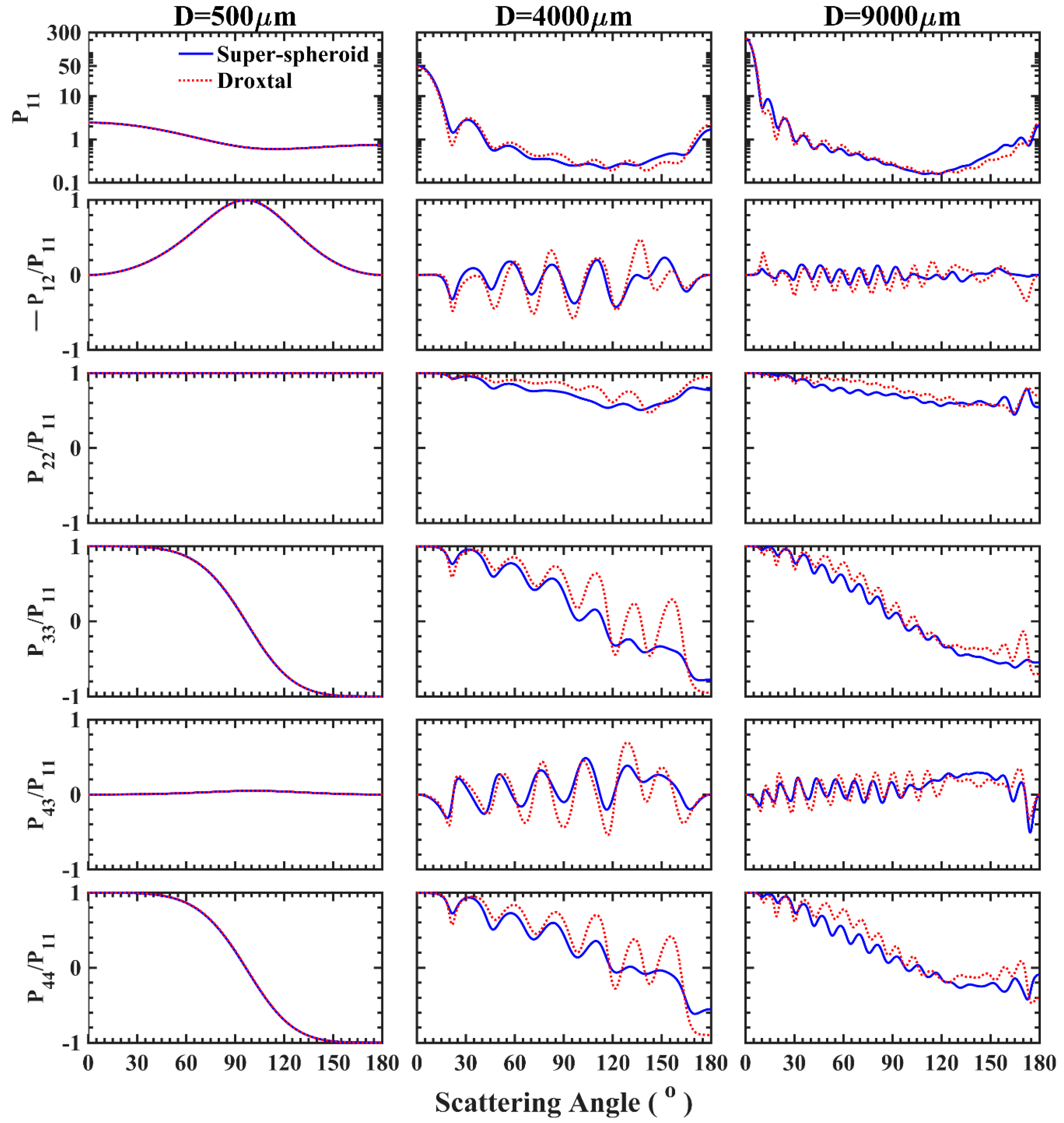


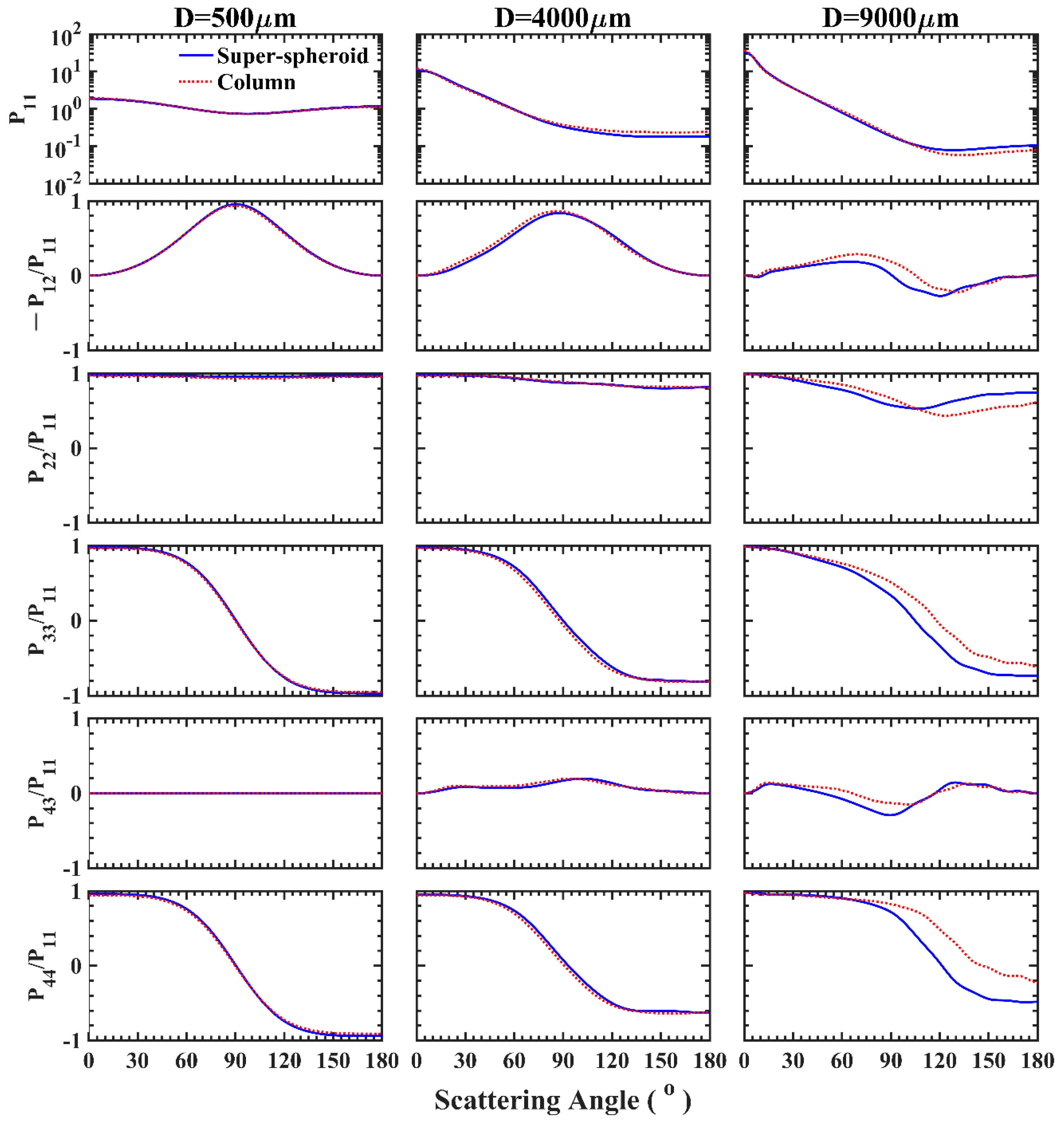


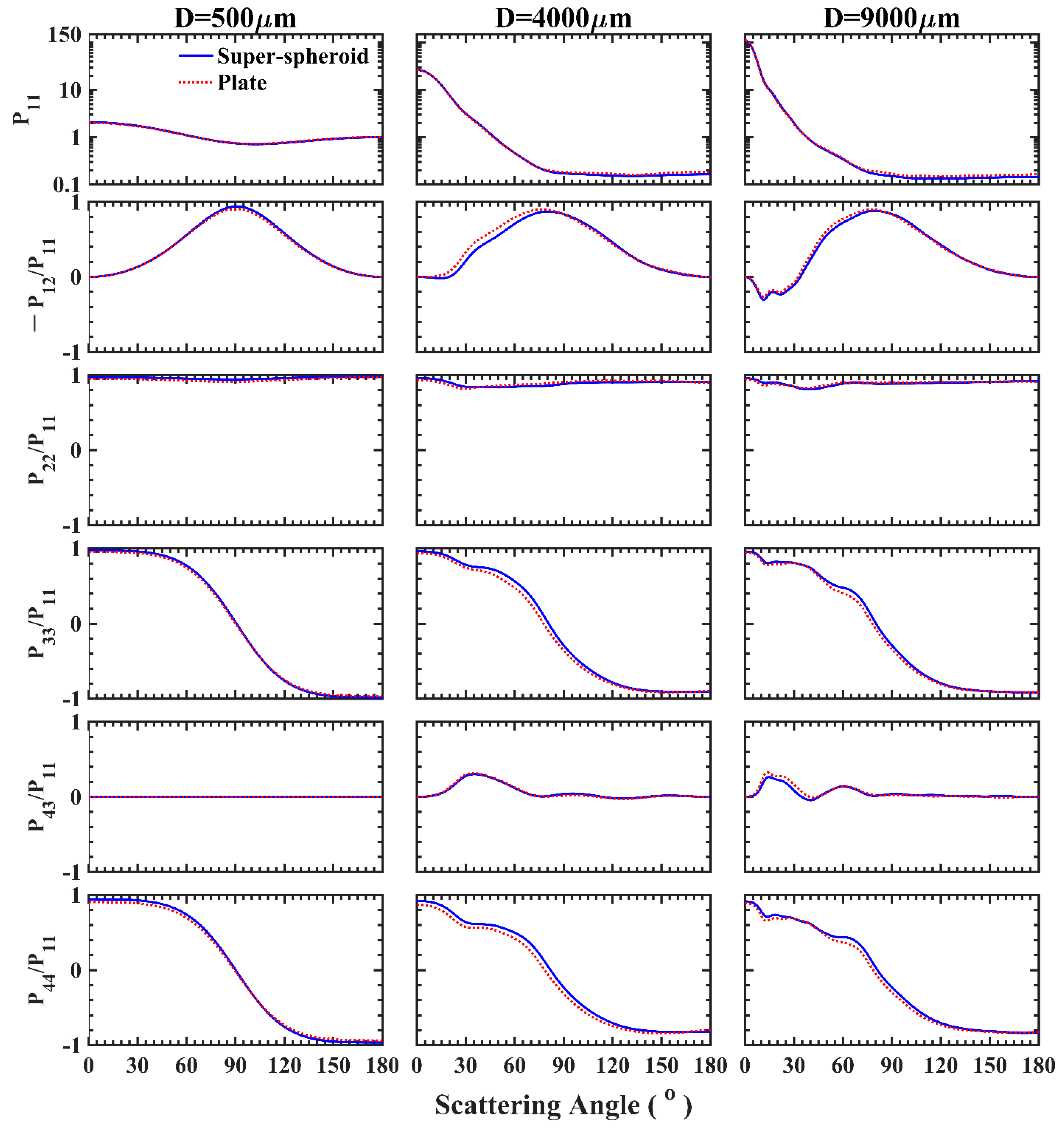
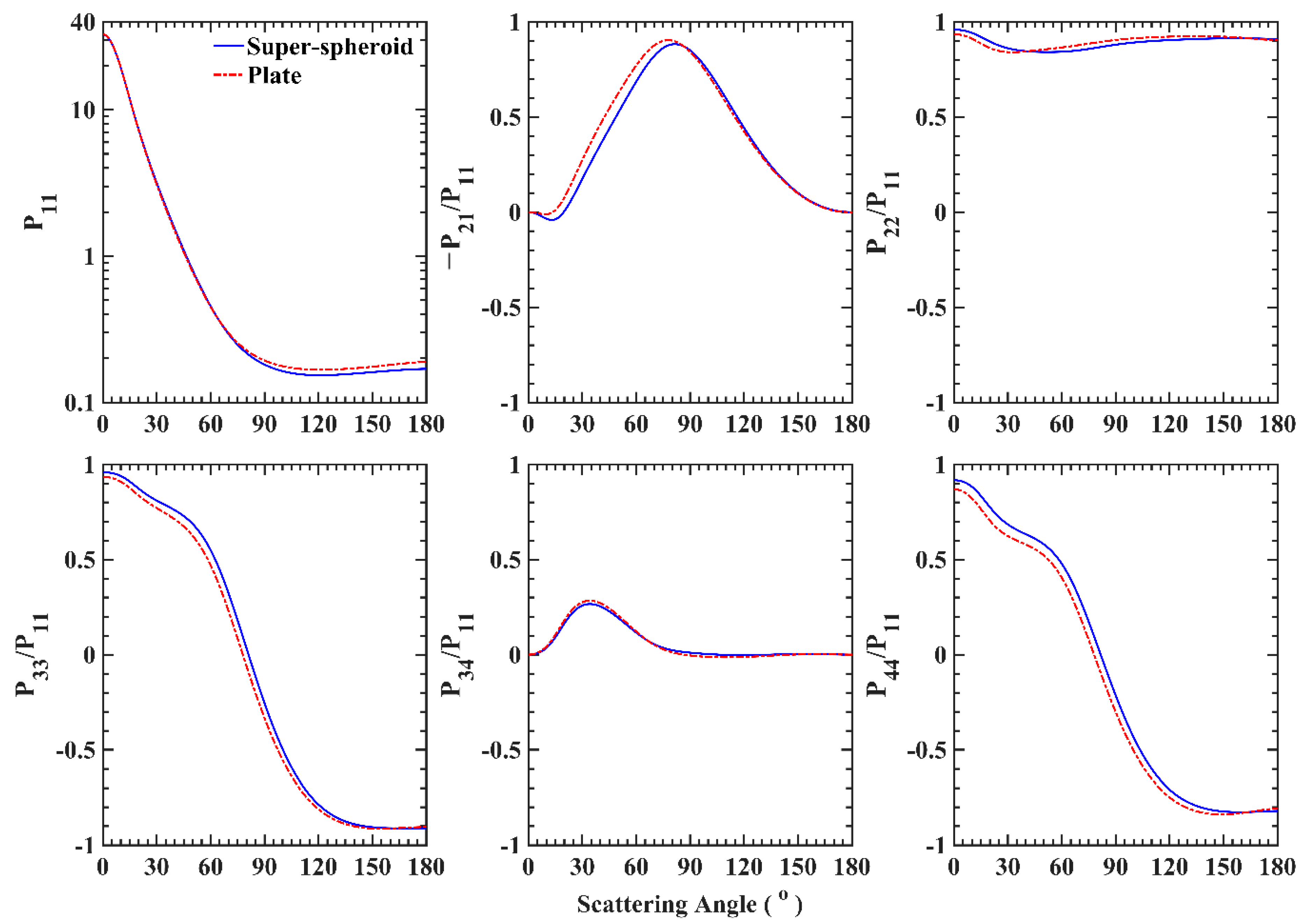



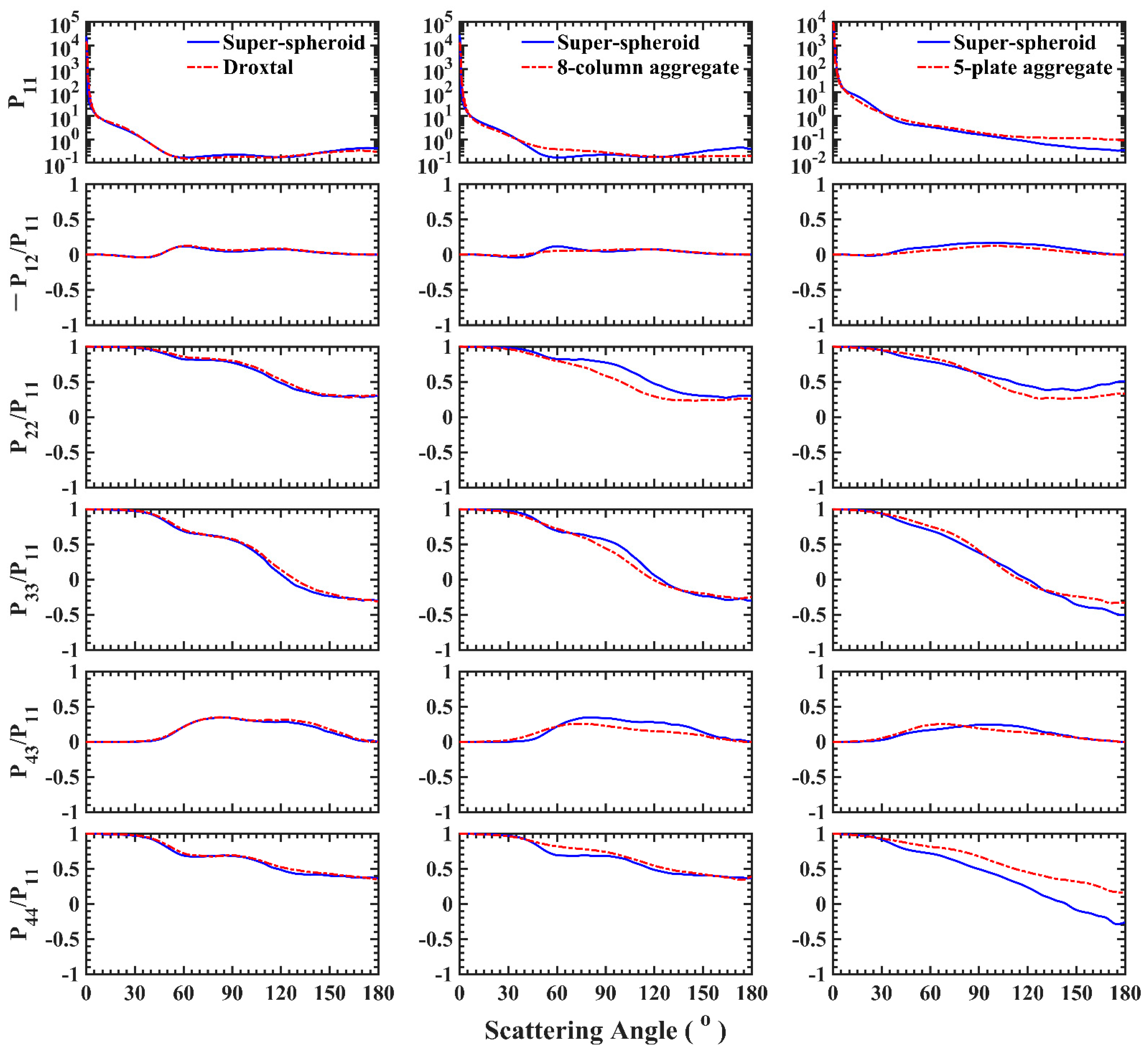
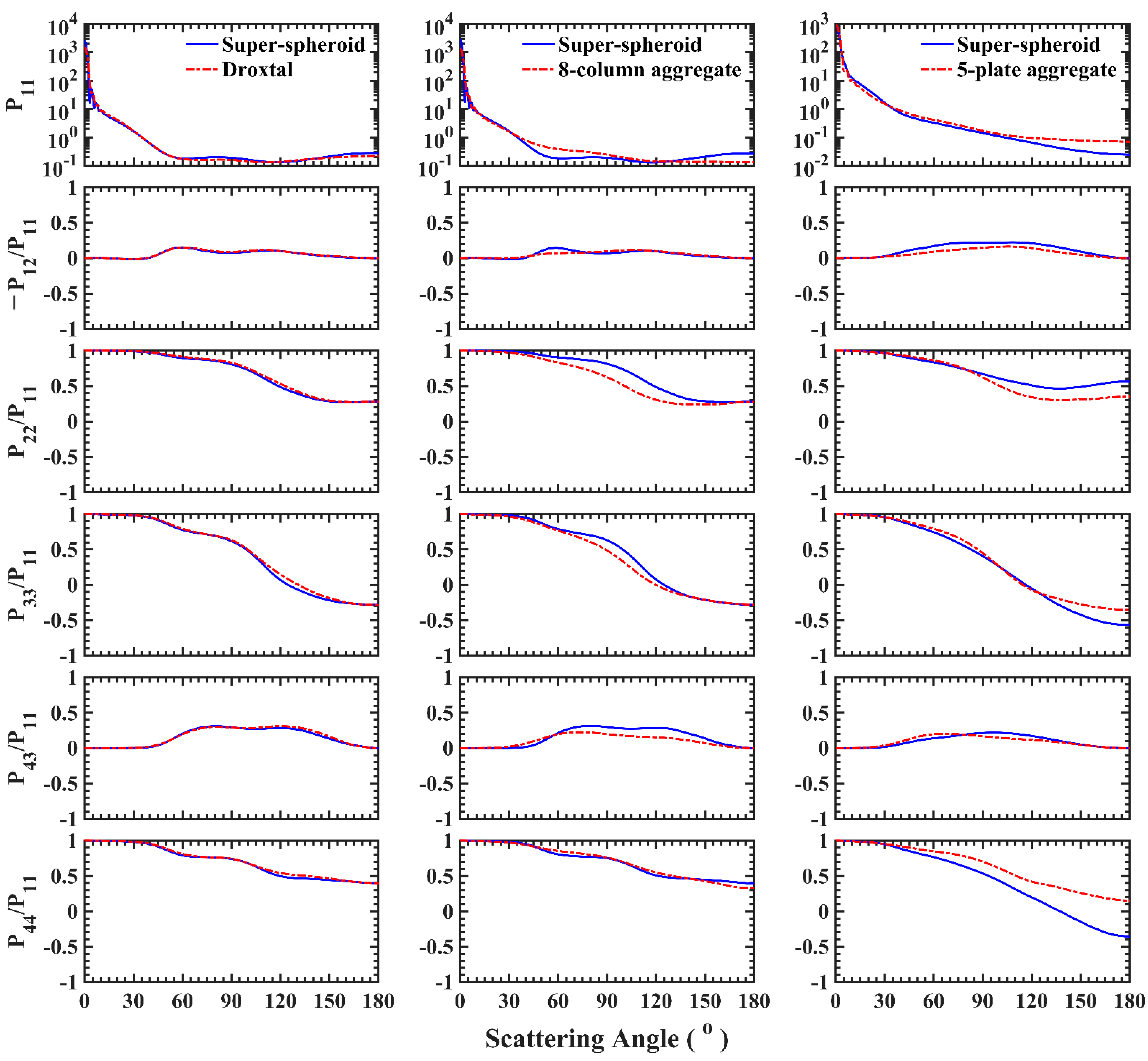

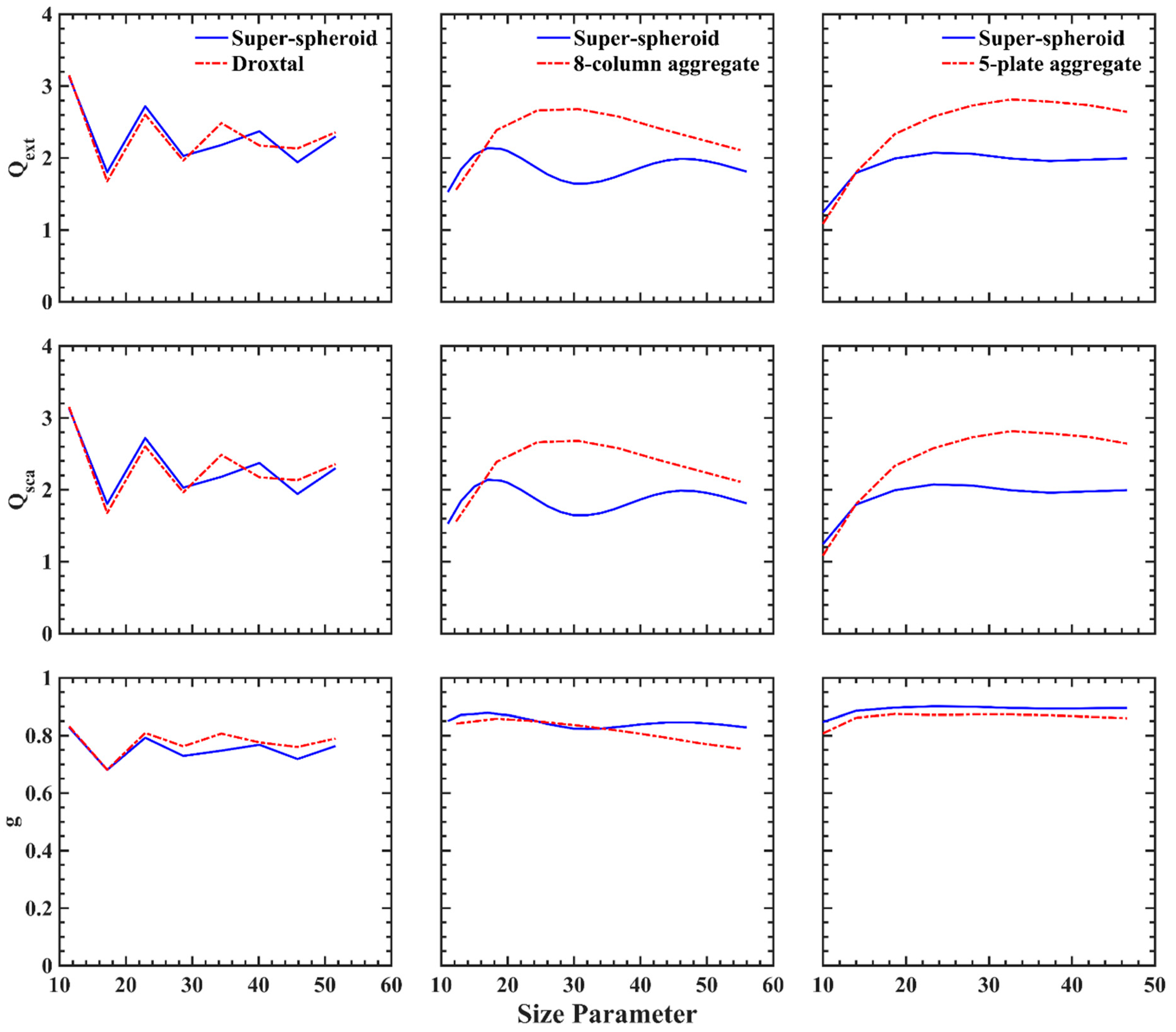
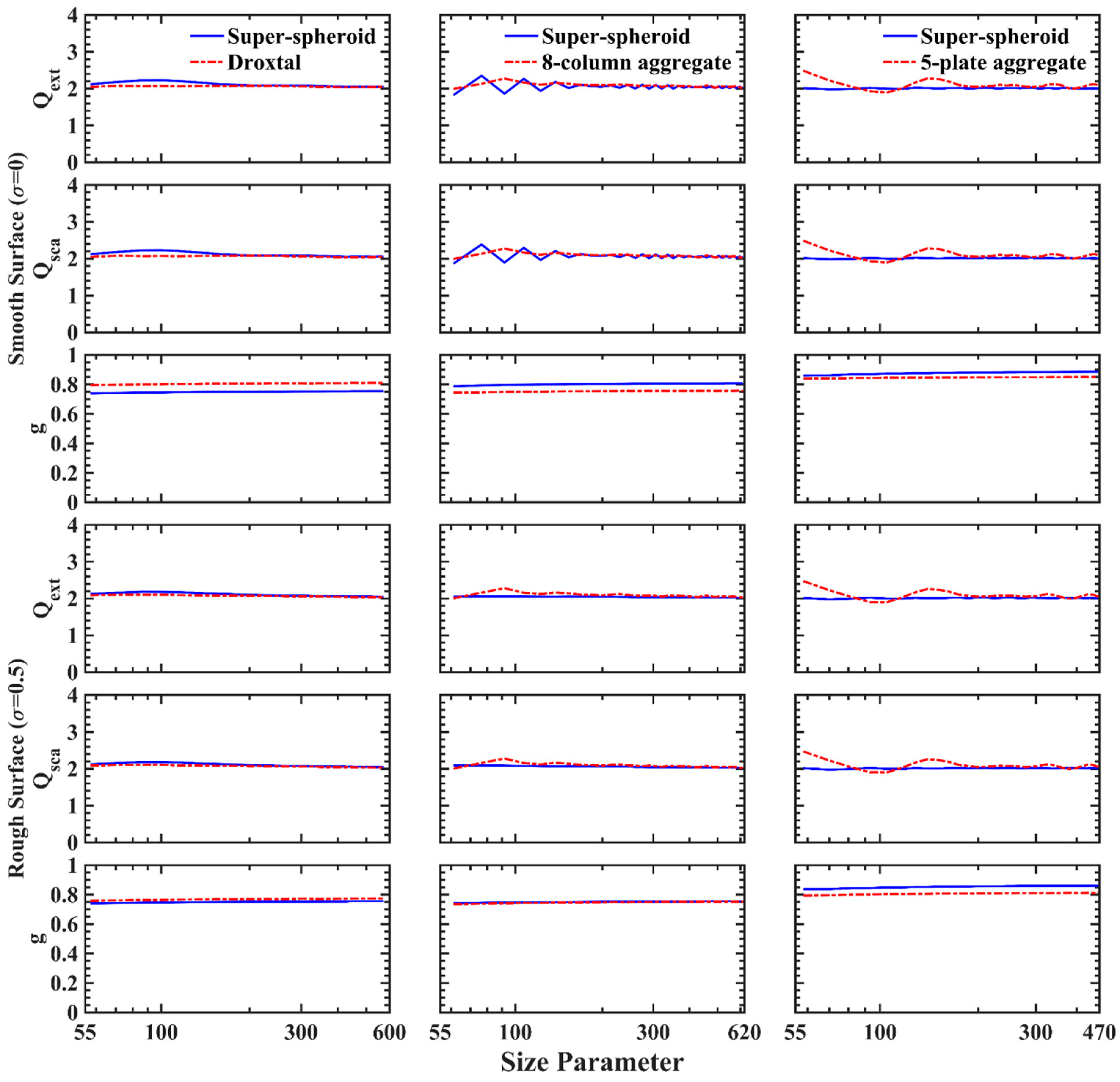

| Ice Habits | Superspheroid Model | SI | |
|---|---|---|---|
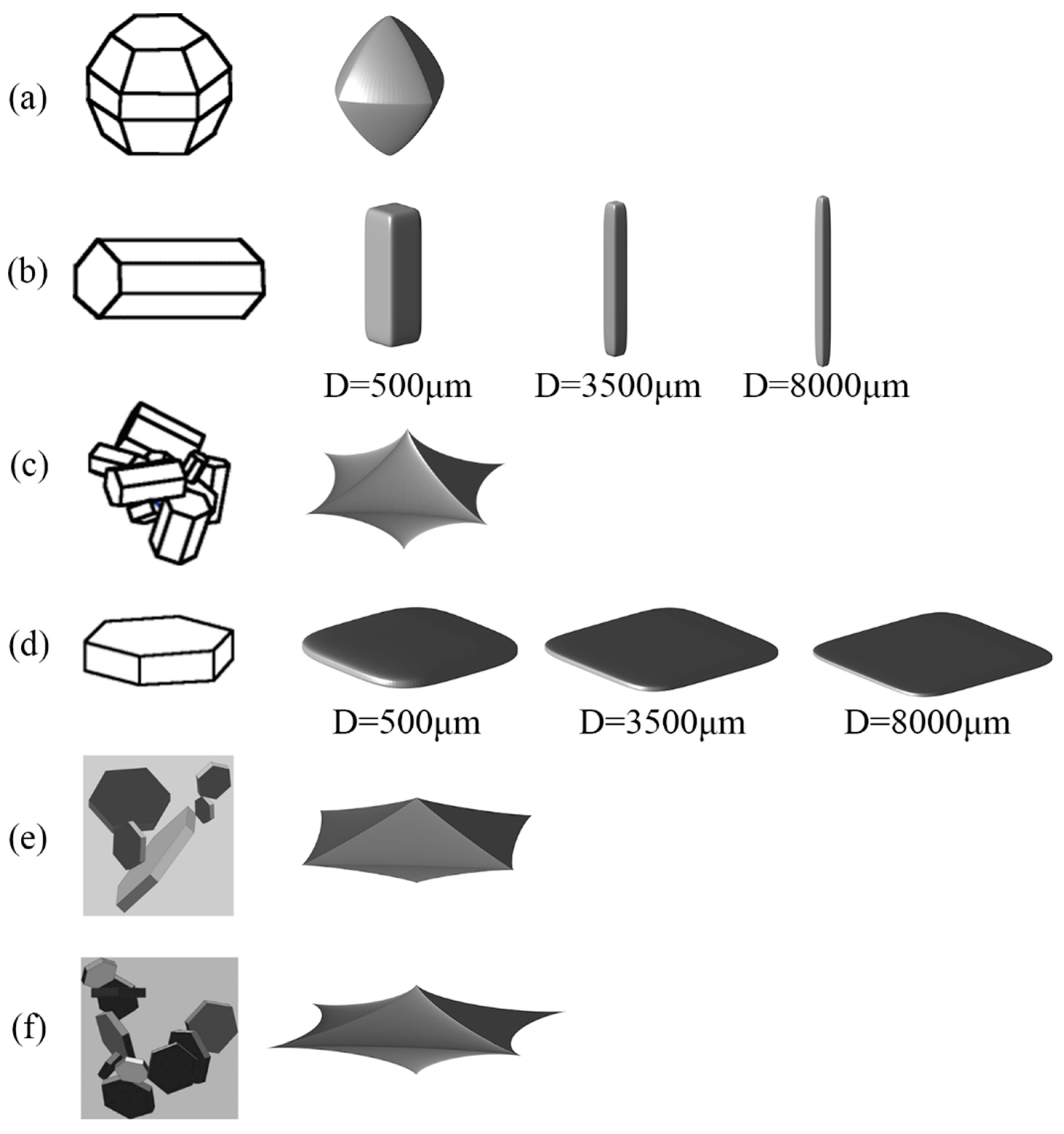
| droxtal | ξ = 0.889, n = 1.6 | 0.9114 | |
| column | D = 500 μm | ξ = 0.31, n = 0.21 | 0.6135 |
| D = 3500 μm | ξ = 0.12, n = 0.29 | 0.1176 | |
| D = 8000 μm | ξ = 0.08, n = 0.33 | 0.3528 | |
| plate | D = 500 μm | ξ = 14.67, n = 0.79 | 0.2554 |
| D = 3500 μm | ξ = 40.83, n = 0.35 | 0.1052 | |
| D = 8000 μm | ξ = 60.07, n = 0.32 | 0.0701 | |
| 8-column aggregate | ξ = 2, n = 2.7 | 0.4468 | |
| 5-plate aggregate | ξ = 3.4, n = 2.2 | 0.4202 | |
| 10-plate aggregate | ξ = 4, n = 2.7 | 0.2269 | |
| Ice Habits | bsca (bext) (m−1) | |
|---|---|---|
| Realistic Model | Superspheroid | |
| droxtal | 18.00 (18.68) | 18.43 (19.03) |
| column | 1.50 (1.50) | 1.56 (1.56) |
| plate | 2.07 (2.08) | 2.03 (2.04) |
| 8-column aggregate | 26.97 (27.41) | 20.48 (20.94) |
| 5-plate aggregate | 21.26 (21.47) | 15.60 (15.84) |
| 10-plate aggregate | 18.97 (19.07) | 12.17 (12.31) |
Publisher’s Note: MDPI stays neutral with regard to jurisdictional claims in published maps and institutional affiliations. |
© 2021 by the authors. Licensee MDPI, Basel, Switzerland. This article is an open access article distributed under the terms and conditions of the Creative Commons Attribution (CC BY) license (https://creativecommons.org/licenses/by/4.0/).
Share and Cite
Sun, L.-H.; Bi, L.; Yi, B. The Use of Superspheroids as Surrogates for Modeling Electromagnetic Wave Scattering by Ice Crystals. Remote Sens. 2021, 13, 1733. https://doi.org/10.3390/rs13091733
Sun L-H, Bi L, Yi B. The Use of Superspheroids as Surrogates for Modeling Electromagnetic Wave Scattering by Ice Crystals. Remote Sensing. 2021; 13(9):1733. https://doi.org/10.3390/rs13091733
Chicago/Turabian StyleSun, Lan-Hui, Lei Bi, and Bingqi Yi. 2021. "The Use of Superspheroids as Surrogates for Modeling Electromagnetic Wave Scattering by Ice Crystals" Remote Sensing 13, no. 9: 1733. https://doi.org/10.3390/rs13091733
APA StyleSun, L.-H., Bi, L., & Yi, B. (2021). The Use of Superspheroids as Surrogates for Modeling Electromagnetic Wave Scattering by Ice Crystals. Remote Sensing, 13(9), 1733. https://doi.org/10.3390/rs13091733