Article

Determination of Process Noise for Underwater Target Tracking with Forward Looking Sonar

by
Witold Kazimierski
* and
Grzegorz Zaniewicz
Faculty of Navigation, Chair of Geoinformatics, Maritime University of Szczecin, 70-500 Szczecin, Poland
*
Author to whom correspondence should be addressed.
Remote Sens. 2021, 13(5), 1014; https://doi.org/10.3390/rs13051014
Submission received: 6 February 2021 / Revised: 28 February 2021 / Accepted: 4 March 2021 / Published: 8 March 2021
(This article belongs to the Special Issue 2nd Edition Radar and Sonar Imaging and Processing)

Abstract

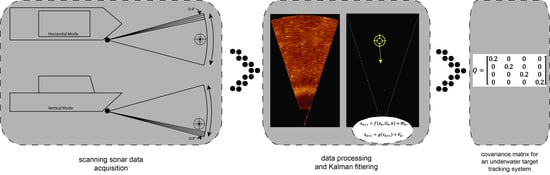
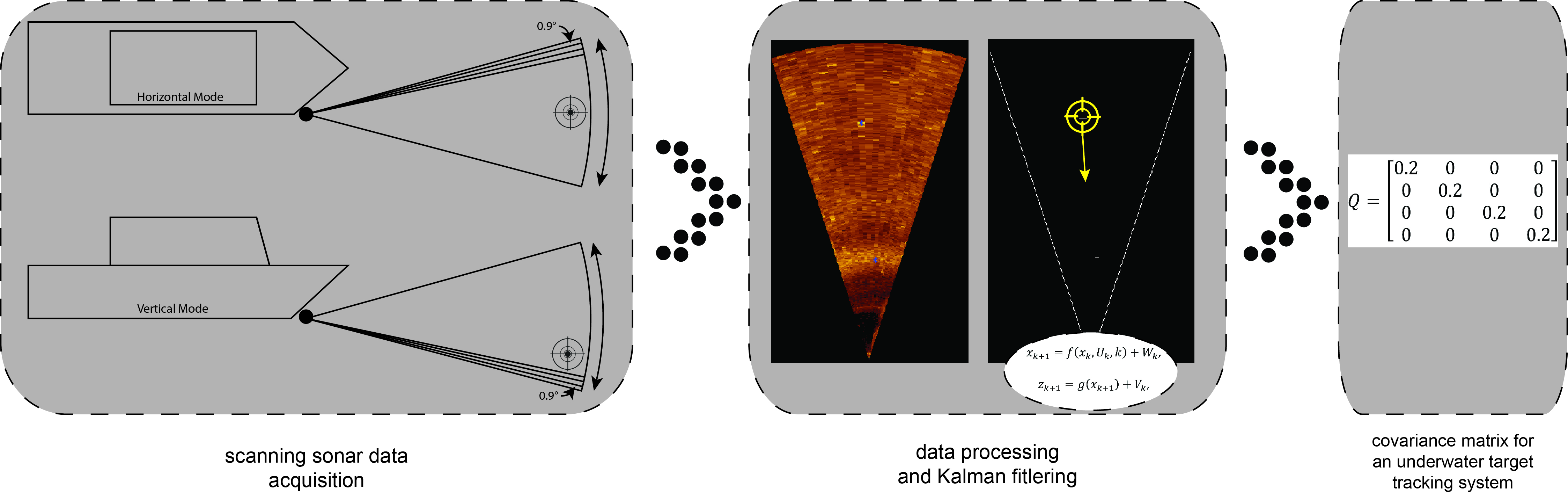
Target tracking is a process that provides information about targets in a specific area and is one of the key issues affecting the safety of any vehicle navigating in water. The main sensor used for underwater target tracking is sonar, with one of the most popular configurations being forward looking sonar (FLS). The target tracking state vector is usually estimated with the use of numerical filter algorithms, such as the Kalman filter (KF) and its modification, or the particle filter (PF). This requires the definition of a process model, including process noise, and a measurement model. This study focused on process noise definition. It is usually implemented as Gaussian noise, with a covariance matrix defined by the author. An analytical and empirical analysis was conducted, including a verification of the existing approaches and a survey of the published literature. Additionally, a theoretical analysis of the factors influencing process noise was conducted, which was followed by an empirical verification. The results were discussed, leading to the conclusions. The results of the theoretical analysis were confirmed by the empirical experiment and the results were compared with commonly used values of process noise in underwater target tracking processes.
Keywords: sonar target tracking; AUV; anti-collision; Kalman filter; underwater surveillance sonar target tracking; AUV; anti-collision; Kalman filter; underwater surveillance
Graphical Abstract