Article

Modeling the Relationship of ≥2 MeV Electron Fluxes at Different Longitudes in Geostationary Orbit by the Machine Learning Method

1
National Space Science Center, Chinese Academy of Sciences, Beijing 100190, China
2
University of Chinese Academy of Sciences, Beijing 100049, China
3
Key Laboratory of Science and Technology on Environmental Space Situation Awareness, CAS, Beijing 100190, China
4
Innovation Academy for Microsatellites of CAS, Shanghai 20050, China
*
Author to whom correspondence should be addressed.
Remote Sens. 2021, 13(17), 3347; https://doi.org/10.3390/rs13173347
Submission received: 30 June 2021 / Revised: 10 August 2021 / Accepted: 18 August 2021 / Published: 24 August 2021

Abstract

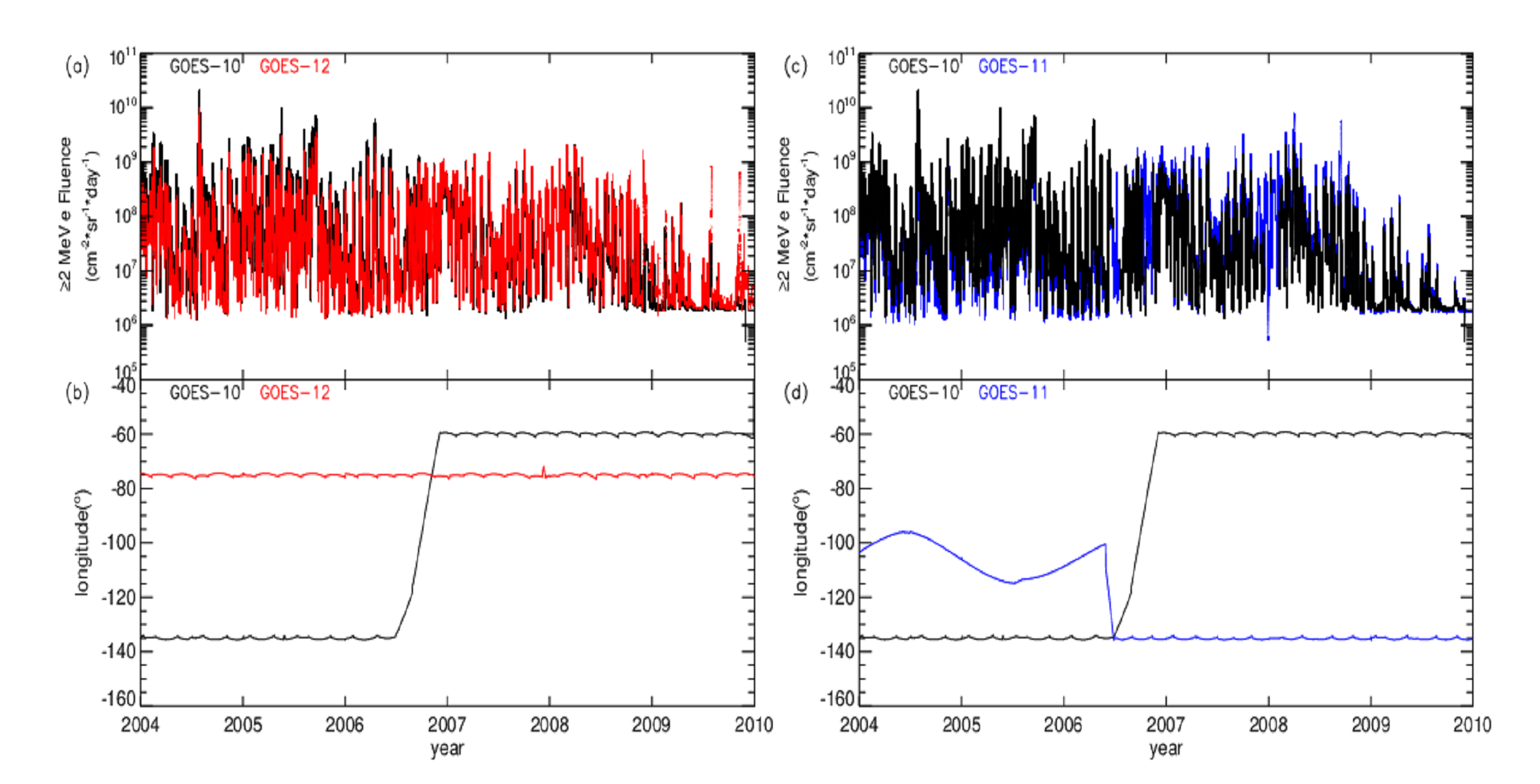
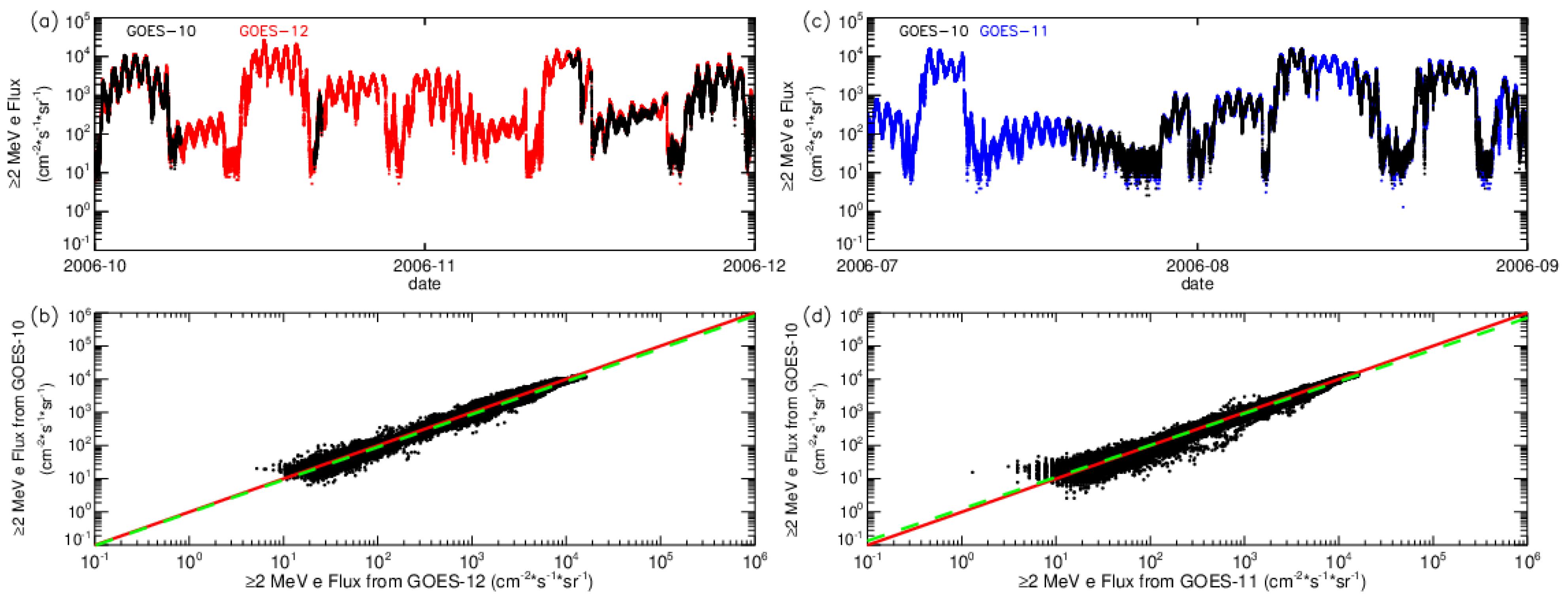
The energetic electrons in the Earth’s radiation belt, known as “killer electrons”, are one of the crucial factors for the safety of geostationary satellites. Geostationary satellites at different longitudes encounter different energetic electron environments. However, organizations of space weather prediction usually only display the real-time ≥2 MeV electron fluxes and the predictions of ≥2 MeV electron fluxes or daily fluences within the next 1–3 days by models at one location in GEO orbit. In this study, the relationship of ≥2 MeV electron fluxes at different longitudes is investigated based on observations from GOES satellites, and the relevant models are developed. Based on the observations from GOES-10 and GOES-12 after calibration verification, the ratios of the ≥2 MeV electron daily fluences at 135° W to those at 75° W are mainly in the range from 1.0 to 4.0, with an average of 1.92. The models with various combinations of two or three input parameters are developed by the fully connected neural network for the relationship between ≥2 MeV electron fluxes at 135° W and 75° W in GEO orbit. According to the prediction efficiency (PE), the model only using log10 (fluxes) and MLT from GOES-10 (135° W), whose PE can reach 0.920, has the best performance to predict ≥2 MeV electron fluxes at the locations of GOES-12 (75° W). Its PE is larger than that (0.882) of the linear model using log10 (fluxes four hours ahead) from GOES-10 (135° W). We also develop models for the relationship between ≥2 MeV electron fluxes at 75° W and at variable longitudes between 95.8° W and 114.9° W in GEO orbit by the fully connected neural network. The PE values of these models are larger than 0.90. These models realize the predictions of ≥2 MeV electron fluxes at arbitrary longitude between 95.8° W and 114.9° W in GEO orbit.
Keywords: ≥2 MeV electron fluxes; GOES satellites; fully connected neural network; relativistic electron enhancement event ≥2 MeV electron fluxes; GOES satellites; fully connected neural network; relativistic electron enhancement event
Graphical Abstract