Article

Analysing the Impact of Climate Change on Hydrological Ecosystem Services in Laguna del Sauce (Uruguay) Using the SWAT Model and Remote Sensing Data

by
Celina Aznarez
1,2,*,
Patricia Jimeno-Sáez
3,
Adrián López-Ballesteros
3,
Juan Pablo Pacheco
4,5,6 and
Javier Senent-Aparicio
3
1
Basque Centre for Climate Change (BC3), Scientific Park UPV/EHU, Barrio Sarriena s/n, 48940 Leioa, Spain
2
Institute of Environmental Science and Technology (ICTA), Campus de la UAB, Universitat Autónoma de Barcelona (UAB), Carrer de les Columnes s/n, 08193 Cerdanyola del Vallès, Spain
3
Department of Civil Engineering, Campus de los Jerónimos s/n, Catholic University of San Antonio, 30107 Guadalupe, Spain
4
Department of Ecology and Environmental Management, CURE—University of the Republic, Maldonado 20000, Uruguay
5
Department of Bioscience, Aarhus University, 8600 Silkeborg, Denmark
6
Sino-Danish Centre for Education and Research (SDC), Beijing 100049, China
*
Author to whom correspondence should be addressed.
Remote Sens. 2021, 13(10), 2014; https://doi.org/10.3390/rs13102014
Submission received: 26 February 2021 / Revised: 25 April 2021 / Accepted: 17 May 2021 / Published: 20 May 2021

Abstract

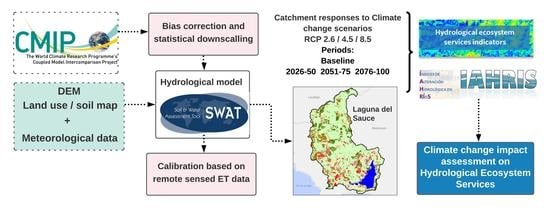
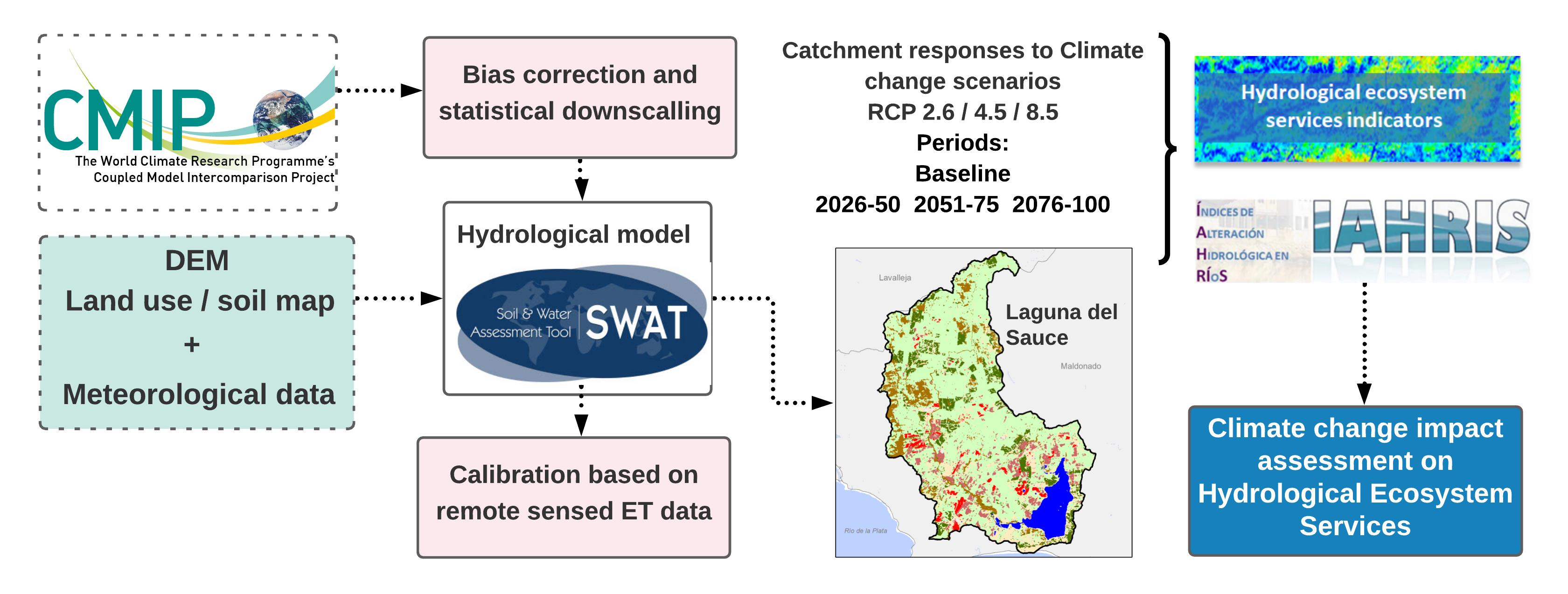
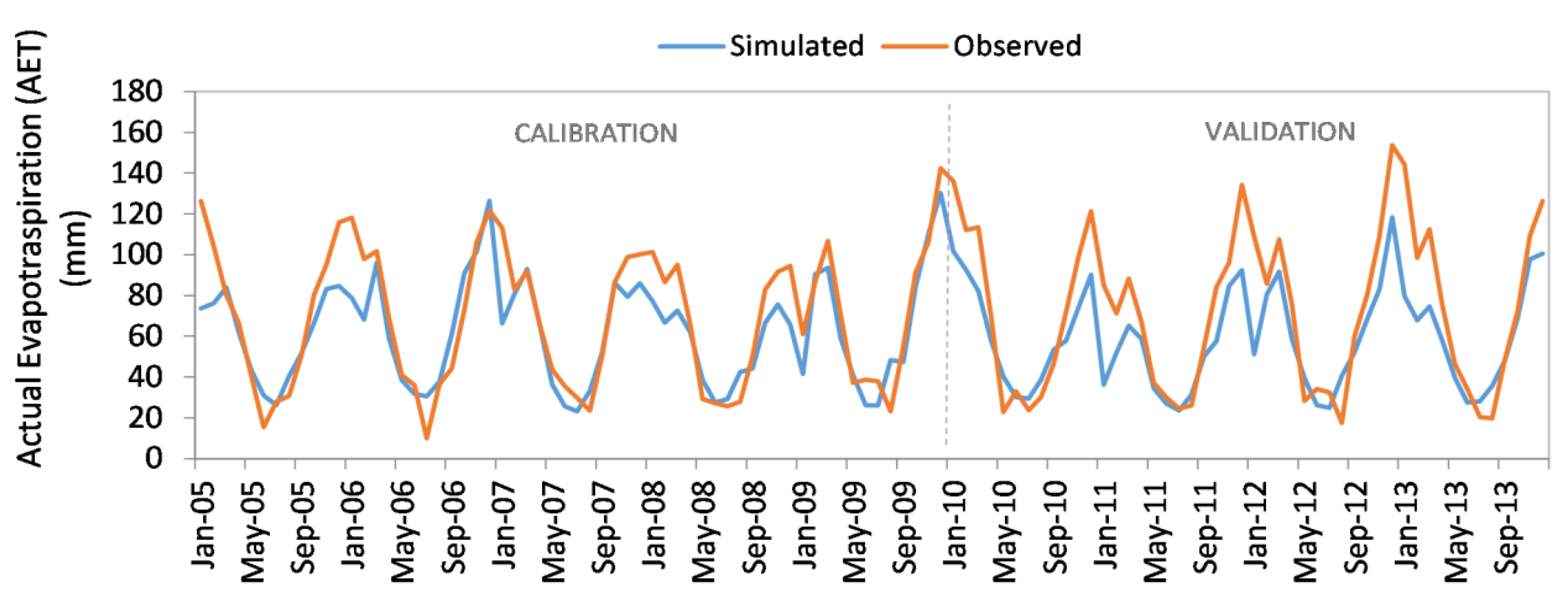
Assessing how climate change will affect hydrological ecosystem services (HES) provision is necessary for long-term planning and requires local comprehensive climate information. In this study, we used SWAT to evaluate the impacts on four HES, natural hazard protection, erosion control regulation and water supply and flow regulation for the Laguna del Sauce catchment in Uruguay. We used downscaled CMIP-5 global climate models for Representative Concentration Pathways (RCP) 2.6, 4.5 and 8.5 projections. We calibrated and validated our SWAT model for the periods 2005–2009 and 2010–2013 based on remote sensed ET data. Monthly NSE and R2 values for calibration and validation were 0.74, 0.64 and 0.79, 0.84, respectively. Our results suggest that climate change will likely negatively affect the water resources of the Laguna del Sauce catchment, especially in the RCP 8.5 scenario. In all RCP scenarios, the catchment is likely to experience a wetting trend, higher temperatures, seasonality shifts and an increase in extreme precipitation events, particularly in frequency and magnitude. This will likely affect water quality provision through runoff and sediment yield inputs, reducing the erosion control HES and likely aggravating eutrophication. Although the amount of water will increase, changes to the hydrological cycle might jeopardize the stability of freshwater supplies and HES on which many people in the south-eastern region of Uruguay depend. Despite streamflow monitoring capacities need to be enhanced to reduce the uncertainty of model results, our findings provide valuable insights for water resources planning in the study area. Hence, water management and monitoring capacities need to be enhanced to reduce the potential negative climate change impacts on HES. The methodological approach presented here, based on satellite ET data can be replicated and adapted to any other place in the world since we employed open-access software and remote sensing data for all the phases of hydrological modelling and HES provision assessment.
Keywords: climate change; SWAT model; hydrological ecosystem services; data scarcity; laguna del Sauce; remote sensing climate change; SWAT model; hydrological ecosystem services; data scarcity; laguna del Sauce; remote sensing
Graphical Abstract