Article

PyTirCam-1.0: A Python Model to Manage Thermal Infrared Camera Data


1
Istituto Nazionale di Geofisica e Vulcanologia, Sezione di Pisa, 56125 Pisa, Italy
2
Istituto Nazionale di Geofisica e Vulcanologia, Osservatorio Etneo, 95032 Catania, Italy
*
Author to whom correspondence should be addressed.
These authors contributed equally to this work.
Remote Sens. 2020, 12(24), 4056; https://doi.org/10.3390/rs12244056
Submission received: 5 October 2020 / Revised: 10 November 2020 / Accepted: 6 December 2020 / Published: 11 December 2020
(This article belongs to the Special Issue Multi-Sensor Remote Sensing Data for Volcanic Hazards Monitoring)

Abstract

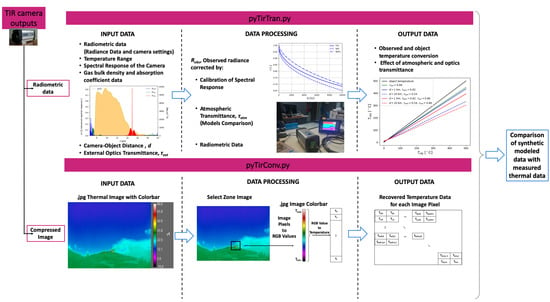
Thermal-infrared remote sensing is used to monitor and study hazardous volcanic phenomena. Thermal cameras are often used by monitoring centers and laboratories. A physical comprehension of their behavior is needed to perform quantitative measurements, which are strongly dependent on camera features and settings. This makes it possible to control the radiance measurements related to volcanic processes and, thus, to detect thermal anomalies, validate models, and extract source parameters. We review the theoretical background related to the camera behavior beside the main features affecting thermal measurements: Atmospheric transmission, object emissivity and reflectivity, camera characteristics, and external optics. We develop a Python package, PythTirCam-1.0, containing pyTirTran, a radiative transfer model based on the HITRAN database and the camera spectral response. This model is compared with the empirical algorithm implemented into a commercial camera. These two procedures are validated using a simple experiment involving pyTirConv, an algorithm developed to recover the radiometric thermal data from compressed images collected by monitoring centers. Python scripts corresponding to the described methods are provided as open-source code. This study can be applied to a wide variety of applications and, specifically, to different volcanic processes, from earth and space.
Keywords: volcano monitoring; image processing; thermal imaging; eruption data; atmospheric transmission; HITRAN database volcano monitoring; image processing; thermal imaging; eruption data; atmospheric transmission; HITRAN database
Graphical Abstract