Next Article in Journal
Green Vegetation Cover Dynamics in a Heterogeneous Grassland: Spectral Unmixing of Landsat Time Series from 1999 to 2014
Next Article in Special Issue
Accuracy of Vaisala RS41 and RS92 Upper Tropospheric Humidity Compared to Satellite Hyperspectral Infrared Measurements
Previous Article in Journal
Wildfire Smoke Particle Properties and Evolution, From Space-Based Multi-Angle Imaging II: The Williams Flats Fire during the FIREX-AQ Campaign
Previous Article in Special Issue
Tropical Cyclone Climatology from Satellite Passive Microwave Measurements
 
 
Erratum published on 29 January 2021, see Remote Sens. 2021, 13(3), 467.
Article

Applying Deep Learning to Clear-Sky Radiance Simulation for VIIRS with Community Radiative Transfer Model—Part 2: Model Architecture and Assessment


by
Xingming Liang
1,* and
Quanhua (Mark) Liu
2
1
Earth System Science Interdisciplinary Center, University of Maryland, College Park, MD 20740, USA
2
Center for Satellite Applications and Research, National Environmental Satellite (STAR), Data, and Information Service (NESDIS), National Oceanic and Atmospheric Administration (NOAA), College Park, MD 20740, USA
*
Author to whom correspondence should be addressed.
Remote Sens. 2020, 12(22), 3825; https://doi.org/10.3390/rs12223825
Submission received: 2 November 2020 / Revised: 13 November 2020 / Accepted: 16 November 2020 / Published: 21 November 2020

Abstract

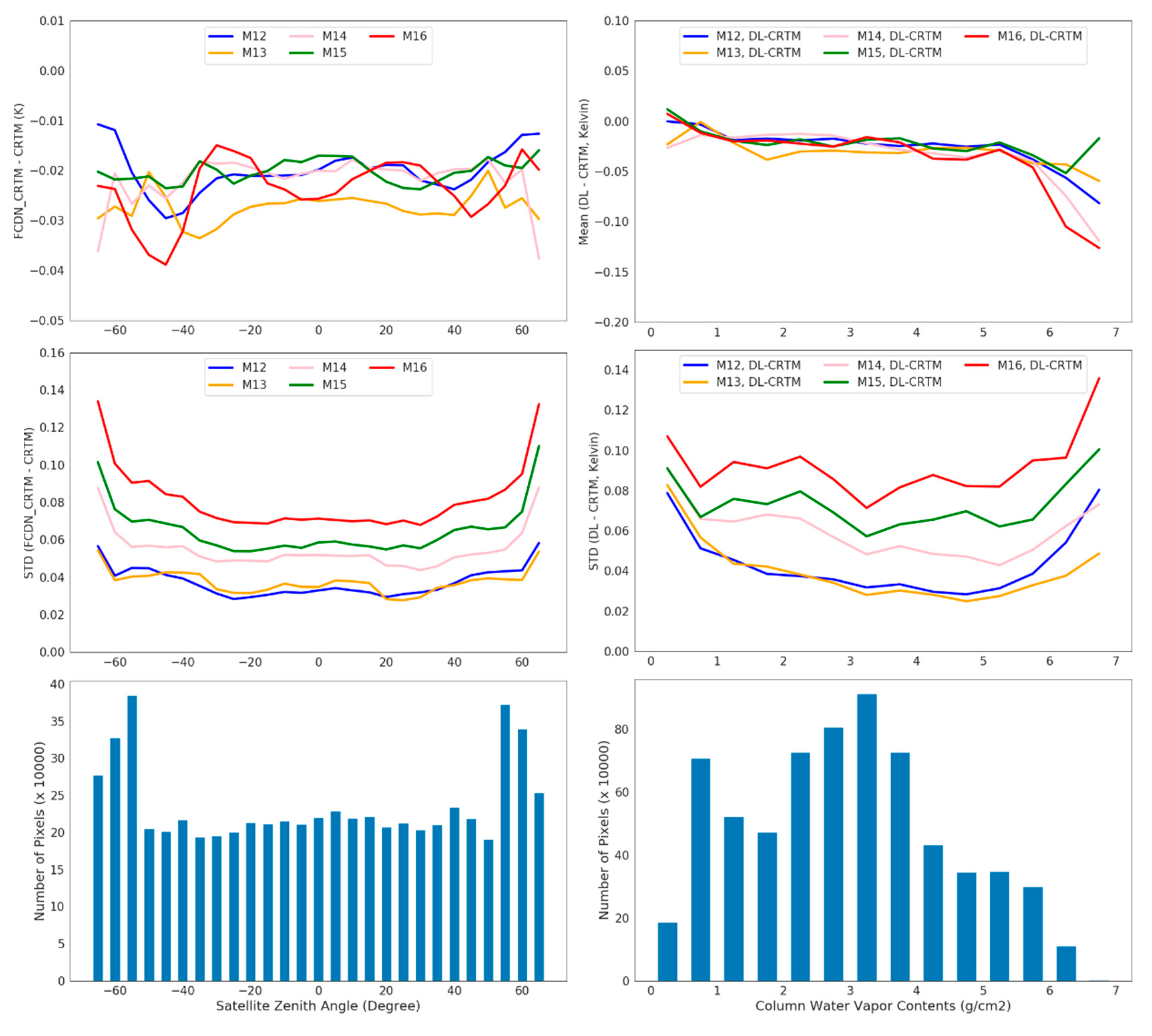
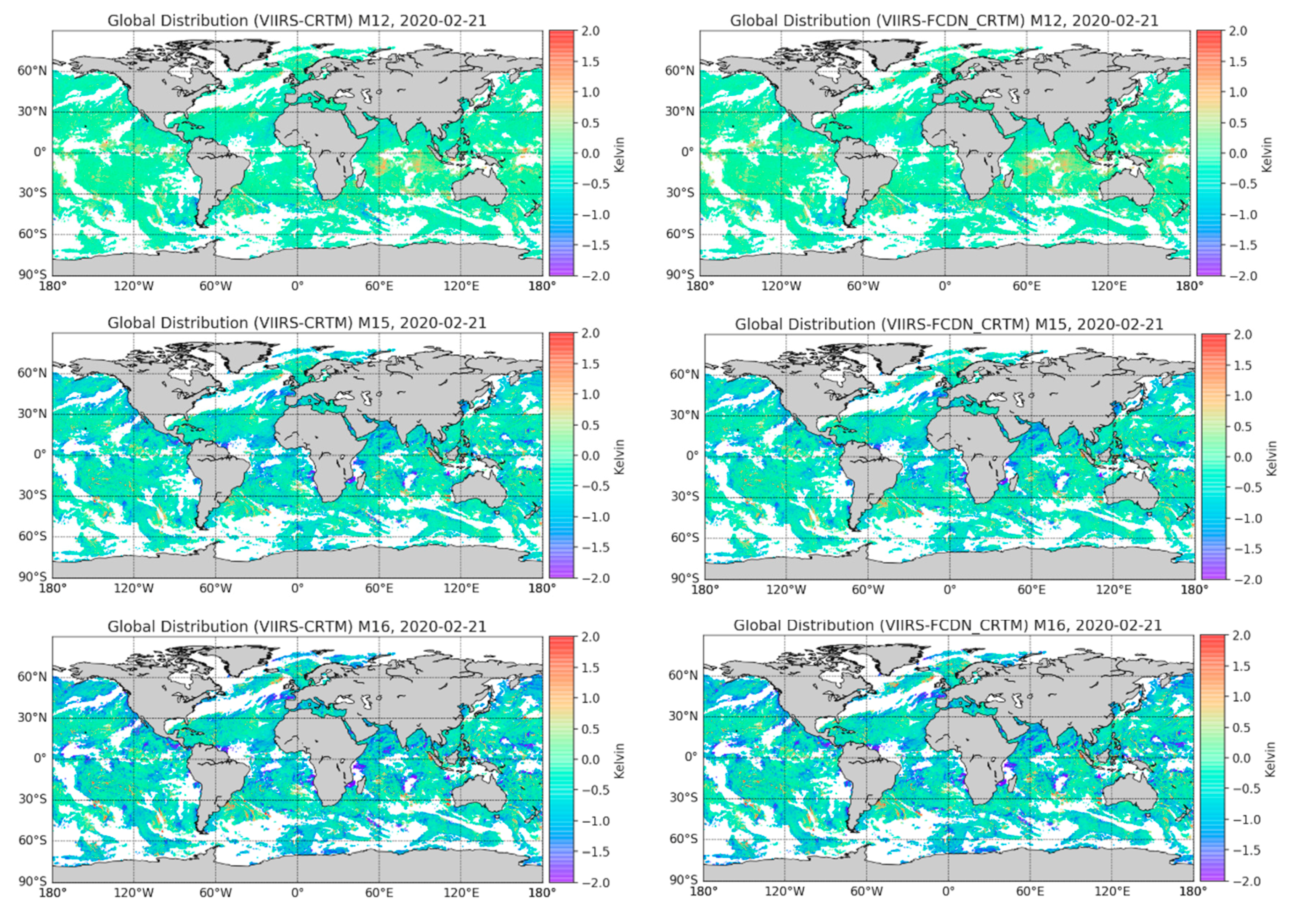
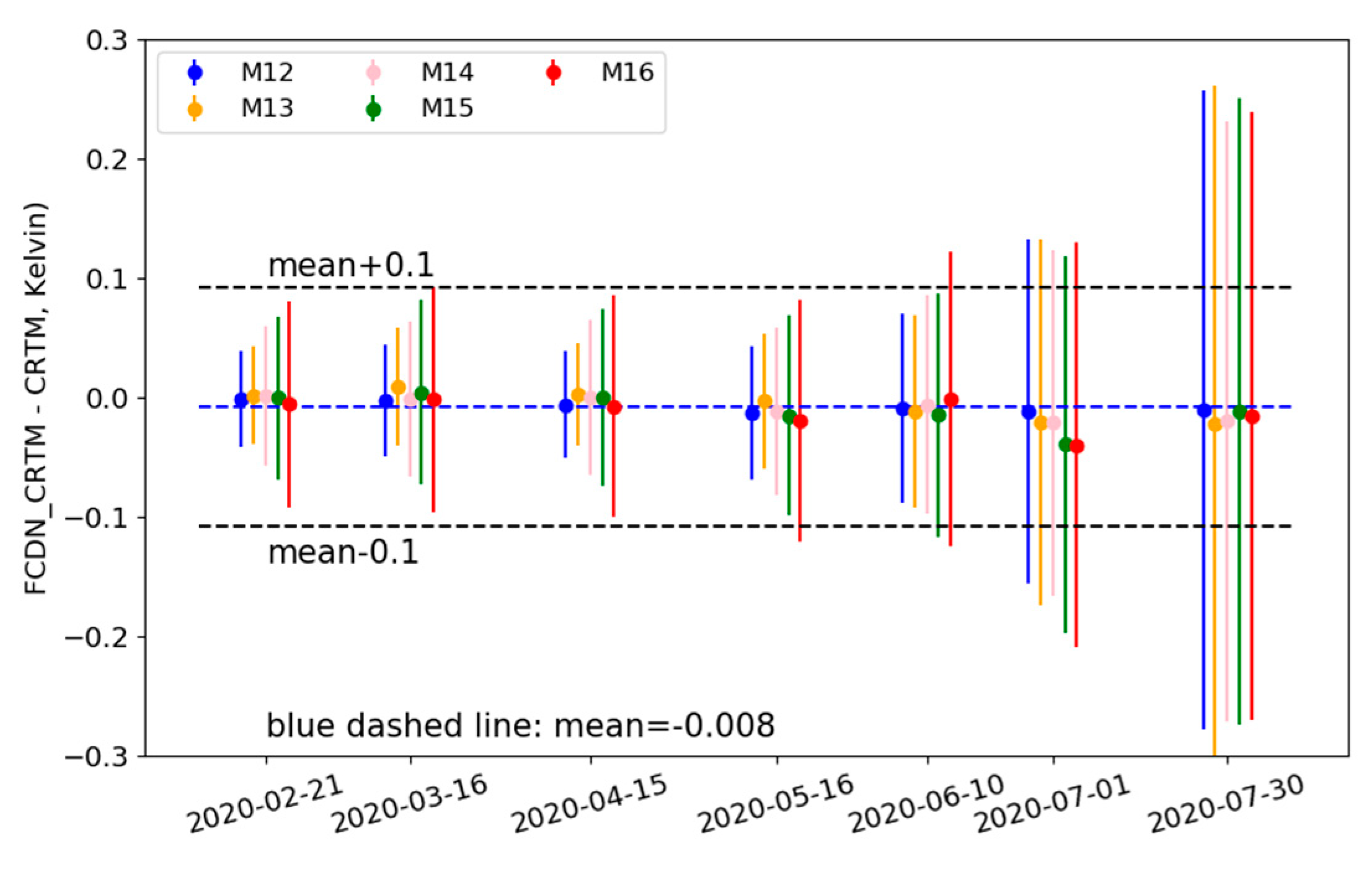
A fully connected “deep” neural network algorithm with the Community Radiative Transfer Model (FCDN_CRTM) is proposed to explore the efficiency and accuracy of reproducing the Visible Infrared Imaging Radiometer Suite (VIIRS) radiances in five thermal emission M (TEB/M) bands. The model was trained and tested in the nighttime global ocean clear-sky domain, in which the VIIRS observation minus CRTM (O-M) biases have been well validated in recent years. The atmosphere profile from the European Centre for Medium-Range Weather Forecasts (ECMWF) and sea surface temperature (SST) from the Canadian Meteorology Centre (CMC) were used as FCDN_CRTM input, and the CRTM-simulated brightness temperatures (BTs) were defined as labels. Six dispersion days’ data from 2019 to 2020 were selected to train the FCDN_CRTM, and the clear-sky pixels were identified by an enhanced FCDN clear-sky mask (FCDN_CSM) model, which was demonstrated in Part 1. The trained model was then employed to predict CRTM BTs, which were further validated with the CRTM BTs and the VIIRS sensor data record (SDR) for both efficiency and accuracy. With iterative refinement of the model design and careful treatment of the input data, the agreement between the FCDN_CRTM and the CRTM was generally good, including the satellite zenith angle and column water vapor dependencies. The mean biases of the FCDN_CRTM minus CRTM (F-C) were typically ~0.01 K for all five bands, and the high accuracy persisted during the whole analysis period. Moreover, the standard deviations (STDs) were generally less than 0.1 K and were consistent for approximately half a year, before they significantly degraded. The validation with VIIRS SDR data revealed that both the predicted mean biases and the STD of the VIIRS observation minus FCDN_CRTM (V-F) were comparable with the VIIRS minus direct CRTM simulation (V-C). Meanwhile, both V-F and V-C exhibited consistent global geophysical and statistical distribution, as well as stable long-term performance. Furthermore, the FCDN_CRTM processing time was more than 40 times faster than CRTM simulation. The highly efficient, accurate, and stable performances indicate that the FCDN_CRTM is a potential solution for global and real-time monitoring of sensor observation minus model simulation, particularly for high-resolution sensors.
Keywords: community radiative transfer model (CRTM); deep learning; fully connected “deep” neural network (FCDN); radiative transfer; artificial neural network (ANN); batch normalization (BN); real time; the visible infrared imaging radiometer suite (VIIRS) community radiative transfer model (CRTM); deep learning; fully connected “deep” neural network (FCDN); radiative transfer; artificial neural network (ANN); batch normalization (BN); real time; the visible infrared imaging radiometer suite (VIIRS)