Letter

Multipath Exploitation with Time Reversal Waveform Covariance Matrix for SNR Maximization


College of Electronic Science and Technology, National University of Defense Technology, Changsha 410073, China
*
Author to whom correspondence should be addressed.
These authors contributed equally to this work.
Remote Sens. 2020, 12(21), 3565; https://doi.org/10.3390/rs12213565
Submission received: 6 September 2020 / Revised: 14 October 2020 / Accepted: 24 October 2020 / Published: 30 October 2020

Abstract

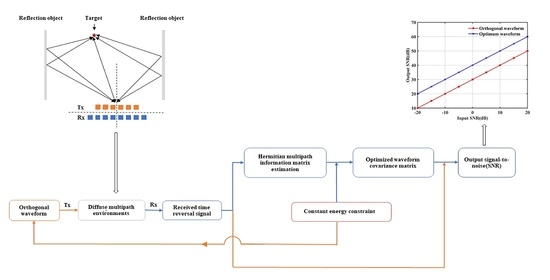
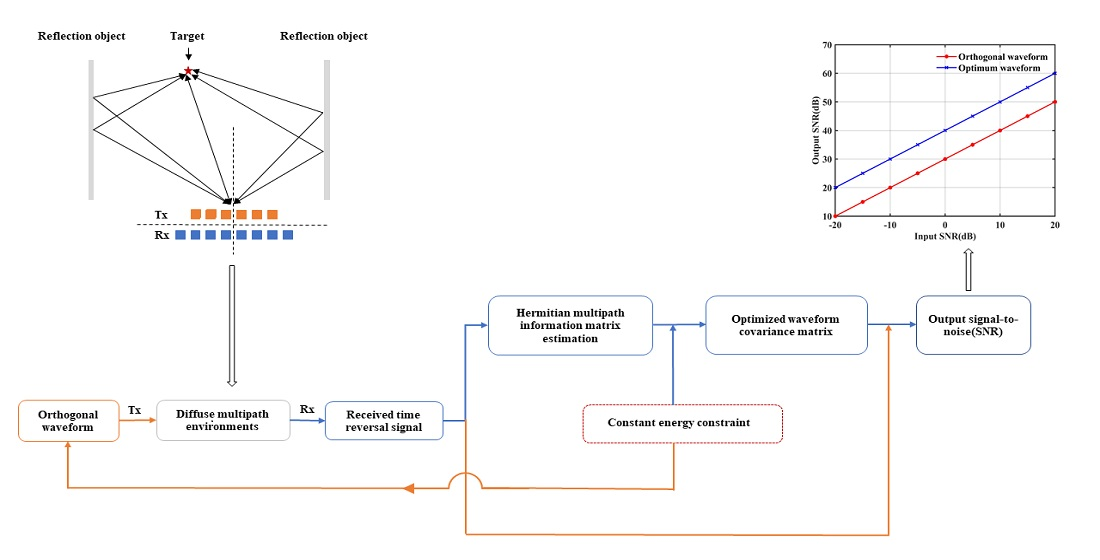
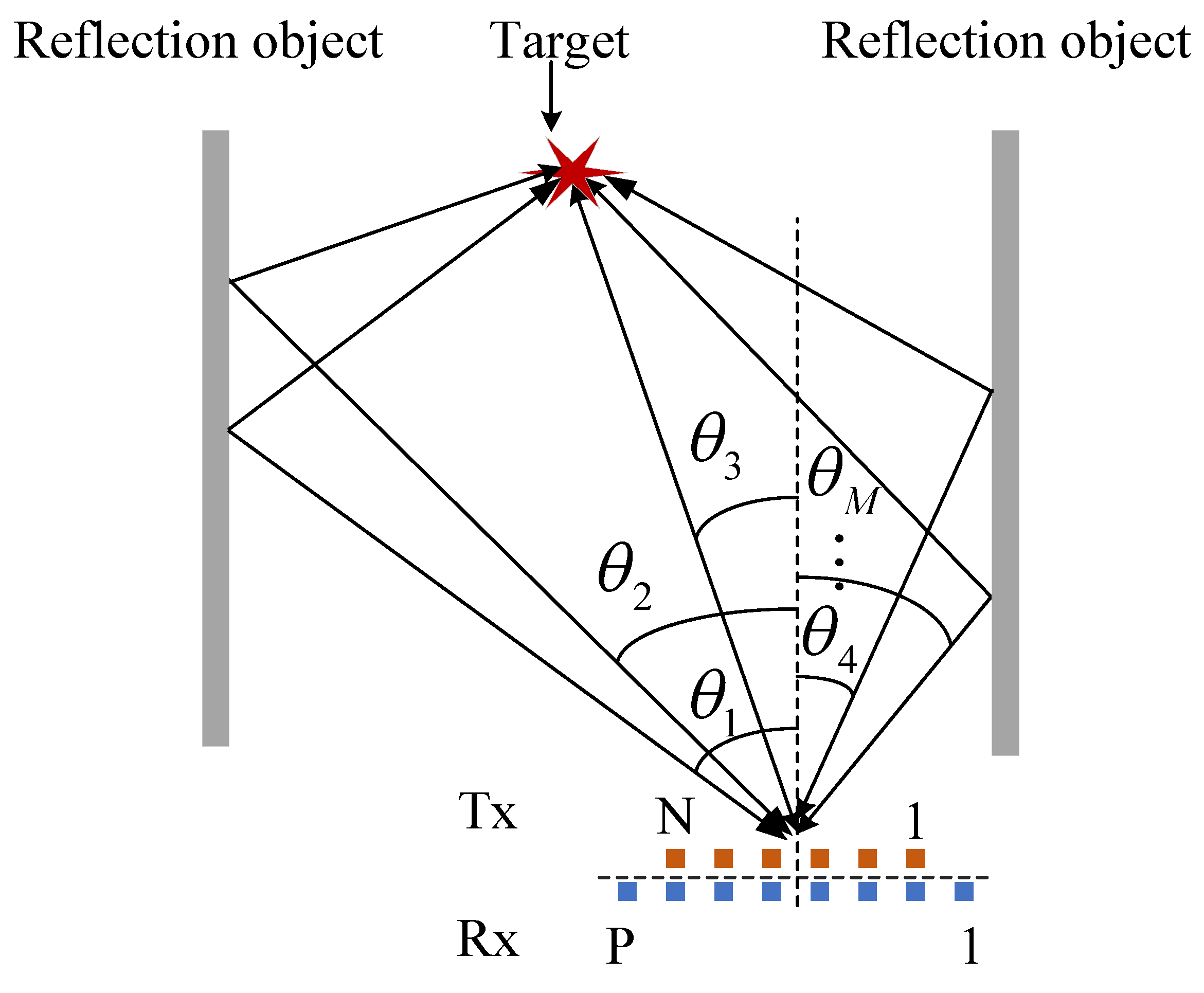
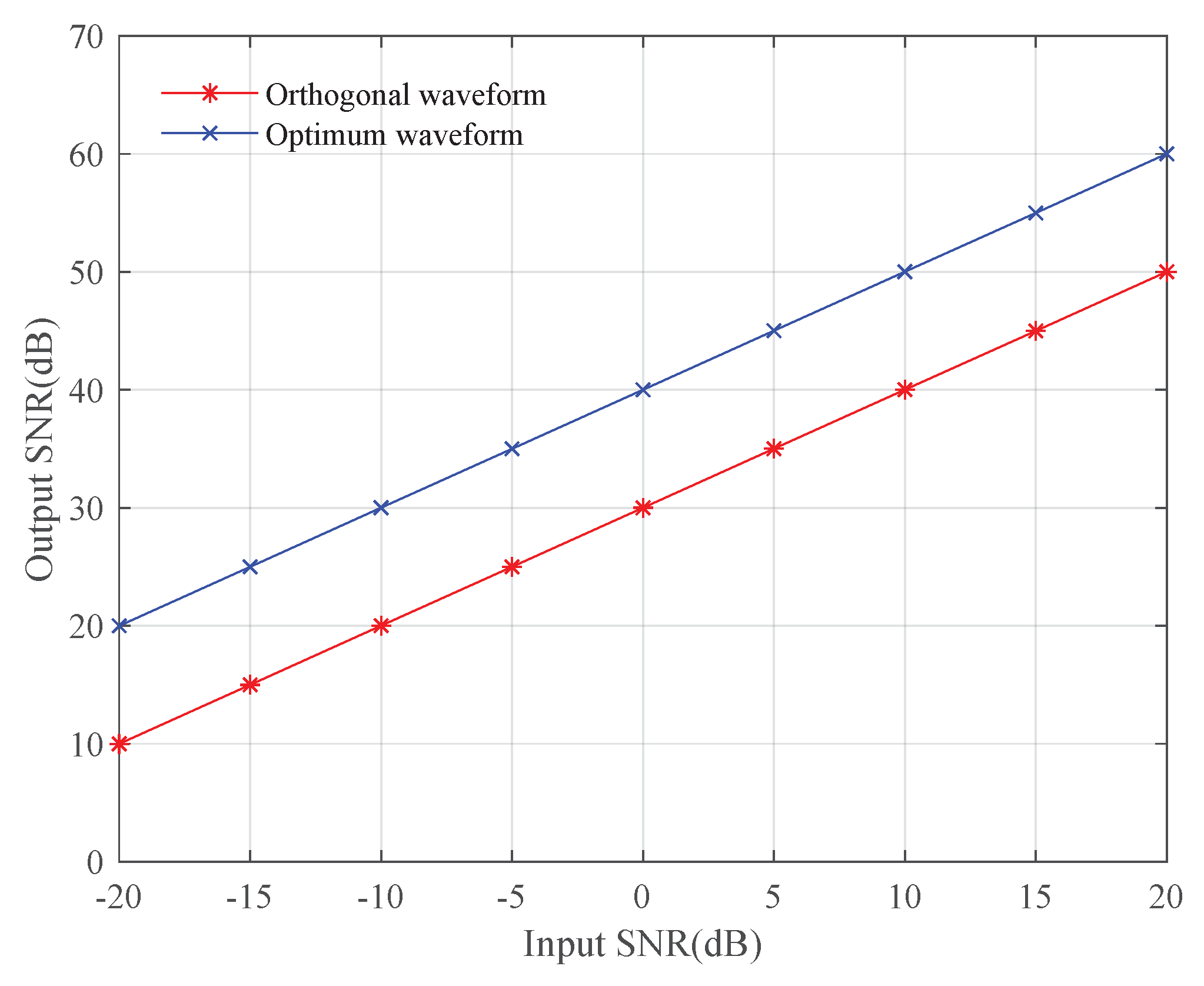
Radar target detection has a wide range of applications in the military and civilian remote sensing fields; in particular, the target detection in multipath environments has attracted many scholars’ attention in recent years. The abundant multipath signals severely interfere with the detection performance and accuracy of parameter estimation of traditional algorithms. Under Gaussian white noise environments, this letter proposes an adaptive time reversal (TR) waveform covariance matrix (WCM) design method with multipath exploitation to improve the maximum signal-to-noise ratio (SNR) at the receiver in multipath environments. This equivalently improves the detection probability. The proposed two-stage algorithm firstly adapts the time-reversal echo to construct a multipath information matrix with a Hermitian structure. Secondly, the letter transforms the maximized SNR problem into semidefinite programming (SDP), which is constrained by a constant total transmit power. Consequently, the waveform covariance matrix is obtained by solving semidefinite programming. Simulation experiments verify the adaptability and effectiveness of the proposed algorithm.
Keywords: multiple-input multiple-output (MIMO); multipath exploitation; signal-to-noise ratio (SNR); time reversal (TR); waveform covariance matrix (WCM) multiple-input multiple-output (MIMO); multipath exploitation; signal-to-noise ratio (SNR); time reversal (TR); waveform covariance matrix (WCM)
Graphical Abstract