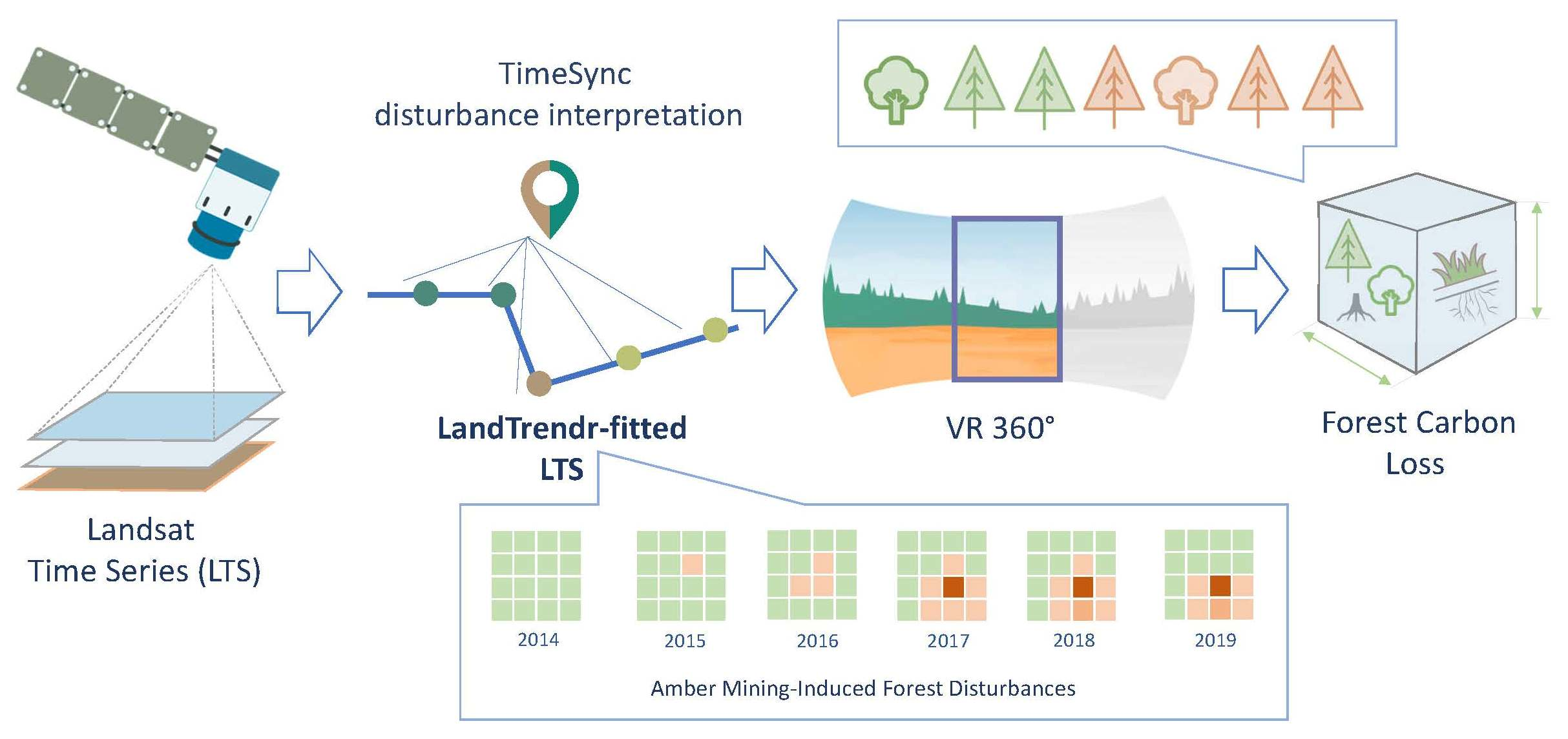
Tracking Rates of Forest Disturbance and Associated Carbon Loss in Areas of Illegal Amber Mining in Ukraine Using Landsat Time Series

 ,
,  ,
, 

Abstract
1. Introduction
2. Materials and Methods
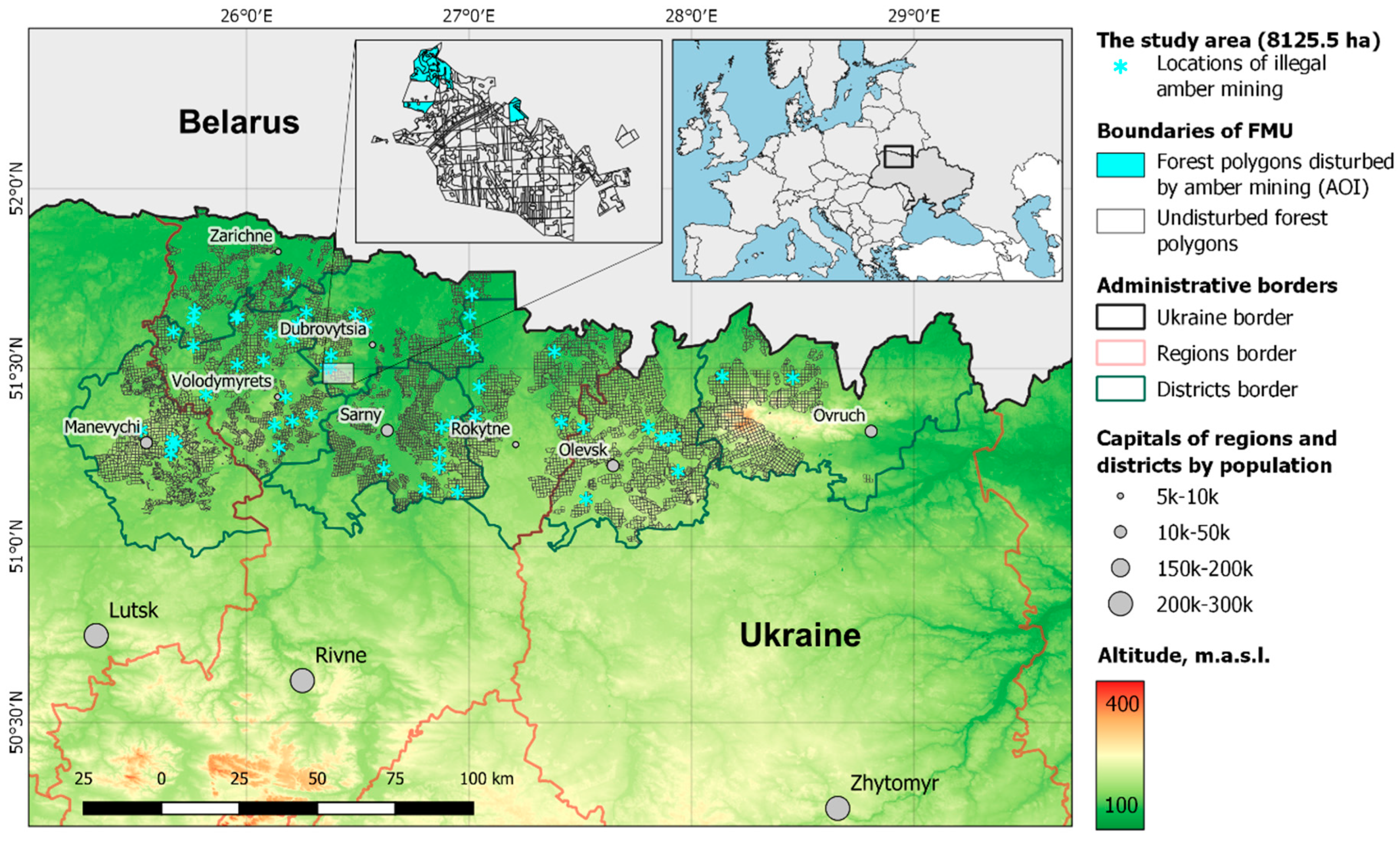
2.1. Study Area
2.2. Reference Data
2.2.1. Field Survey Data
2.2.2. TimeSync Reference Data
2.2.3. Field Validation Data
2.2.4. Dataset for Biomass Estimation
2.2.5. Live Biomass Model
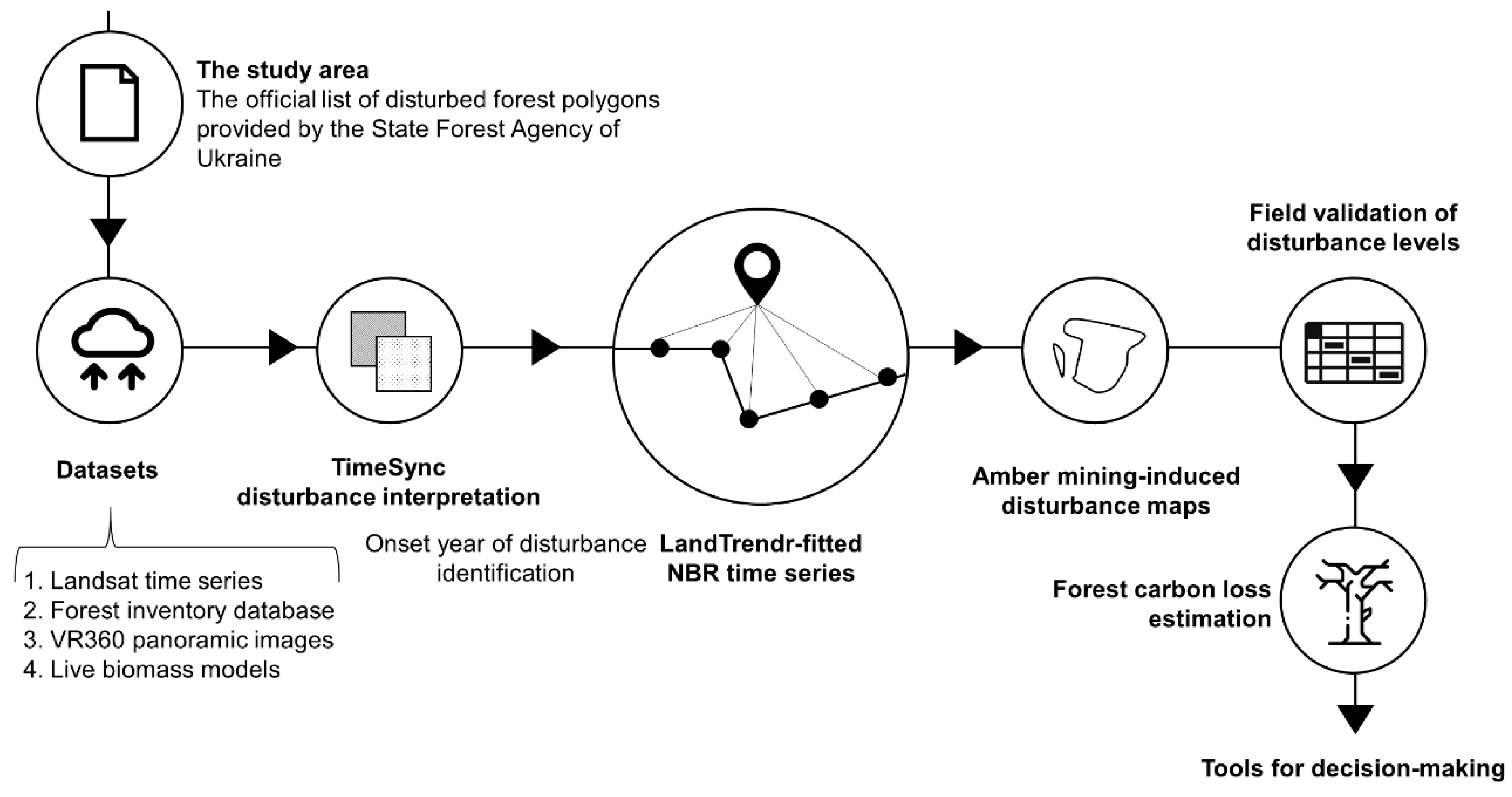
2.3. Mapping Approach
2.3.1. LTS Pre-Processing and Segmentation
2.3.2. Detecting Forest Disturbance and Recovery
2.3.3. Map Accuracy Assessment
2.4. Assessing Forest Carbon Loss
3. Results
3.1. Spatiotemporal Pattern of Amber Mining
3.1.1. Disturbance and Recovery Rates
3.1.2. Accuracy of Amber Mapping
3.2. Carbon Loss Assessment
4. Discussion
4.1. Mapping Approach
4.1.1. Tracking Forest Disturbance and Recovery
4.1.2. Detecting Forest Disturbance Magnitude
4.2. Implication for Responsible Forest Management and Carbon Loss Reporting
5. Conclusions
Supplementary Materials
Author Contributions
Funding
Acknowledgments
Conflicts of Interest
References
- Pan, Y.; Birdsey, R.A.; Fang, J.; Houghton, R.; Kauppi, P.E.; Kurz, W.A.; Phillips, O.L.; Shvidenko, A.; Lewis, S.L.; Canadell, J.G.; et al. A Large and Persistent Carbon Sink in the World’s Forests. Science 2011, 333, 988–993. [Google Scholar] [CrossRef] [PubMed]
- Schepaschenko, D.; Chave, J.; Phillips, O.L.; Lewis, S.L.; Davies, S.J.; Réjou-Méchain, M.; Sist, P.; Scipal, K.; Perger, C.; Herault, B.; et al. The Forest Observation System, building a global reference dataset for remote sensing of forest biomass. Sci. Data 2019, 6, 198. [Google Scholar] [CrossRef] [PubMed]
- Lakyda, P.; Shvidenko, A.; Bilous, A.; Myroniuk, V.; Matsala, M.; Zibtsev, S.; Schepaschenko, D.; Holiaka, D.; Vasylyshyn, R.; Lakyda, I.; et al. Impact of Disturbances on the Carbon Cycle of Forest Ecosystems in Ukrainian Polissya. Forests 2019, 10, 337. [Google Scholar] [CrossRef]
- Pacheco-Angulo, C.; Vilanova, E.; Aguado, I.; Monjardin, S.; Martinez, S. Carbon Emissions from Deforestation and Degradation in a Forest Reserve in Venezuela between 1990 and 2015. Forests 2017, 8, 291. [Google Scholar] [CrossRef]
- Shvidenko, A.; Schepaschenko, D.; McCallum, I.; Nilsson, S. Can the uncertainty of full carbon accounting of forest ecosystems be made acceptable to policymakers? Clim. Change 2010, 103, 137–157. [Google Scholar] [CrossRef]
- Huang, Y.; Tian, F.; Wang, Y.; Wang, M.; Hu, Z. Effect of coal mining on vegetation disturbance and associated carbon loss. Environ. Earth Sci. 2015, 73, 2329–2342. [Google Scholar] [CrossRef]
- Piechal, T. The Amber Rush in Ukraine. OSW Comment. 2017, 241, 1–6. [Google Scholar]
- Wendle, J. Ukraine’s Illegal Amber Mining Has Big Social and Environmental Impacts. Available online: https://news.nationalgeographic.com/2017/01/illegal-amber-mining-ukraine.html (accessed on 10 July 2020).
- Nguyen, T.H.; Jones, S.; Soto-Berelov, M.; Haywood, A.; Hislop, S. Landsat Time-Series for Estimating Forest Aboveground Biomass and Its Dynamics across Space and Time: A Review. Remote Sens. 2019, 12, 98. [Google Scholar] [CrossRef]
- Wulder, M.A.; Loveland, T.R.; Roy, D.P.; Crawford, C.J.; Masek, J.G.; Woodcock, C.E.; Allen, R.G.; Anderson, M.C.; Belward, A.S.; Cohen, W.B.; et al. Current status of Landsat program, science, and applications. Remote Sens. Environ. 2019, 225, 127–147. [Google Scholar] [CrossRef]
- Kennedy, R.E.; Yang, Z.; Cohen, W.B. Detecting trends in forest disturbance and recovery using yearly Landsat time series: 1. LandTrendr—Temporal segmentation algorithms. Remote Sens. Environ. 2010, 114, 2897–2910. [Google Scholar] [CrossRef]
- Hermosilla, T.; Wulder, M.A.; White, J.C.; Coops, N.C.; Hobart, G.W.; Campbell, L.B. Mass data processing of time series Landsat imagery: Pixels to data products for forest monitoring. Int. J. Digit. Earth 2016, 9, 1035–1054. [Google Scholar] [CrossRef]
- Hermosilla, T.; Wulder, M.A.; White, J.C.; Coops, N.C.; Pickell, P.D.; Bolton, D.K. Impact of time on interpretations of forest fragmentation: Three-decades of fragmentation dynamics over Canada. Remote Sens. Environ. 2019, 222, 65–77. [Google Scholar] [CrossRef]
- Nguyen, T.H.; Jones, S.D.; Soto-Berelov, M.; Haywood, A.; Hislop, S. A spatial and temporal analysis of forest dynamics using Landsat time-series. Remote Sens. Environ. 2018, 217, 461–475. [Google Scholar] [CrossRef]
- Pasquarella, V.J.; Holden, C.E.; Kaufman, L.; Woodcock, C.E. From imagery to ecology: Leveraging time series of all available Landsat observations to map and monitor ecosystem state and dynamics. Remote Sens. Ecol. Conserv. 2016, 2, 152–170. [Google Scholar] [CrossRef]
- Kennedy, R.E.; Ohmann, J.; Gregory, M.; Roberts, H.; Yang, Z.; Bell, D.M.; Kane, V.; Hughes, M.J.; Cohen, W.B.; Powell, S.; et al. An empirical, integrated forest biomass monitoring system. Environ. Res. Lett. 2018, 13, 025004. [Google Scholar] [CrossRef]
- Zhu, Z. Change detection using landsat time series: A review of frequencies, preprocessing, algorithms, and applications. ISPRS J. Photogramm. Remote Sens. 2017, 130, 370–384. [Google Scholar] [CrossRef]
- Woodcock, C.E.; Allen, R.; Anderson, M.; Belward, A.; Bindschadler, R.; Cohen, W.; Gao, F.; Goward, S.N.; Helder, D.; Helmer, E.; et al. Free Access to Landsat Imagery. Science 2008, 320, 1011. [Google Scholar] [CrossRef]
- Roy, D.P.; Ju, J.; Kline, K.; Scaramuzza, P.L.; Kovalskyy, V.; Hansen, M.C.; Vermote, E.; Zhang, C. Web-enabled Landsat Data (WELD): Landsat ETM+ composited mosaics of the conterminous United States. Remote Sens. Environ. 2010, 114, 35–49. [Google Scholar] [CrossRef]
- Potapov, P.; Hansen, M.C.; Kommareddy, I.; Kommareddy, A.; Turubanova, S.; Pickens, A.; Adusei, B.; Tyukavina, T.; Ying, Y. Landsat Analysis Ready Data for Global Land Cover and Land Cover Change Mapping. Remote Sens. 2020, 12, 426. [Google Scholar] [CrossRef]
- Wulder, M.A.; Masek, J.G.; Cohen, W.B.; Loveland, T.R.; Woodcock, C.E. Opening the archive: How free data has enabled the science and monitoring promise of Landsat. Remote Sens. Environ. 2012, 122, 2–10. [Google Scholar] [CrossRef]
- White, J.C.; Wulder, M.A.; Hobart, G.W.; Luther, J.E.; Hermosilla, T.; Griffiths, P.; Coops, N.C.; Hall, R.J.; Hostert, P.; Dyk, A.; et al. Pixel-Based Image Compositing for Large-Area Dense Time Series Applications and Science. Can. J. Remote Sens. 2014, 40, 192–212. [Google Scholar] [CrossRef]
- Flood, N. Seasonal Composite Landsat TM/ETM plus Images Using the Medoid (a Multi-Dimensional Median). Remote Sens. 2013, 5, 6481–6500. [Google Scholar] [CrossRef]
- Hansen, M.C.; Loveland, T.R. A review of large area monitoring of land cover change using Landsat data. Remote Sens. Environ. 2012, 122, 66–74. [Google Scholar] [CrossRef]
- Banskota, A.; Kayastha, N.; Falkowski, M.J.; Wulder, M.A.; Froese, R.E.; White, J.C. Forest Monitoring Using Landsat Time Series Data: A Review. Can. J. Remote Sens. 2014, 40, 362–384. [Google Scholar] [CrossRef]
- Schroeder, T.A.; Schleeweis, K.G.; Moisen, G.G.; Toney, C.; Cohen, W.B.; Freeman, E.A.; Yang, Z.; Huang, C. Testing a Landsat-based approach for mapping disturbance causality in U.S. forests. Remote Sens. Environ. 2017, 195, 230–243. [Google Scholar] [CrossRef]
- Senf, C.; Pflugmacher, D.; Hostert, P.; Seidl, R. Using Landsat time series for characterizing forest disturbance dynamics in the coupled human and natural systems of Central Europe. ISPRS J. Photogramm. Remote Sens. 2017, 130, 453–463. [Google Scholar] [CrossRef] [PubMed]
- Healey, S.P.; Cohen, W.B.; Yang, Z.; Kenneth Brewer, C.; Brooks, E.B.; Gorelick, N.; Hernandez, A.J.; Huang, C.; Joseph Hughes, M.; Kennedy, R.E.; et al. Mapping forest change using stacked generalization: An ensemble approach. Remote Sens. Environ. 2018, 204, 717–728. [Google Scholar] [CrossRef]
- Hislop, S.; Jones, S.; Soto-Berelov, M.; Skidmore, A.; Haywood, A.; Nguyen, T.H. A fusion approach to forest disturbance mapping using time series ensemble techniques. Remote Sens. Environ. 2019, 221, 188–197. [Google Scholar] [CrossRef]
- Gorelick, N.; Hancher, M.; Dixon, M.; Ilyushchenko, S.; Thau, D.; Moore, R. Google Earth Engine: Planetary-scale geospatial analysis for everyone. Remote Sens. Environ. 2017, 202, 18–27. [Google Scholar] [CrossRef]
- Zhu, Z.; Woodcock, C.E. Continuous change detection and classification of land cover using all available Landsat data. Remote Sens. Environ. 2014, 144, 152–171. [Google Scholar] [CrossRef]
- Huang, C.; Goward, S.N.; Masek, J.G.; Thomas, N.; Zhu, Z.; Vogelmann, J.E. An automated approach for reconstructing recent forest disturbance history using dense Landsat time series stacks. Remote Sens. Environ. 2010, 114, 183–198. [Google Scholar] [CrossRef]
- Kennedy, R.E.; Yang, Z.; Gorelick, N.; Braaten, J.; Cavalcante, L.; Cohen, W.; Healey, S. Implementation of the LandTrendr Algorithm on Google Earth Engine. Remote Sens. 2018, 10, 691. [Google Scholar] [CrossRef]
- Masek, J.G.; Vermote, E.F.; Saleous, N.E.; Wolfe, R.; Hall, F.G.; Huemmrich, K.F.; Gao, F.; Kutler, J.; Lim, T.-K. A Landsat Surface Reflectance Dataset for North America, 1990–2000. IEEE Geosci. Remote Sens. Lett. 2006, 3, 68–72. [Google Scholar] [CrossRef]
- Vermote, E.; Justice, C.; Claverie, M.; Franch, B. Preliminary analysis of the performance of the Landsat 8/OLI land surface reflectance product. Remote Sens. Environ. 2016, 185, 46–56. [Google Scholar] [CrossRef]
- Foga, S.; Scaramuzza, P.L.; Guo, S.; Zhu, Z.; Dilley, R.D.; Beckmann, T.; Schmidt, G.L.; Dwyer, J.L.; Joseph Hughes, M.; Laue, B. Cloud detection algorithm comparison and validation for operational Landsat data products. Remote Sens. Environ. 2017, 194, 379–390. [Google Scholar] [CrossRef]
- Bright, B.C.; Hudak, A.T.; Kennedy, R.E.; Braaten, J.D.; Henareh Khalyani, A. Examining post-fire vegetation recovery with Landsat time series analysis in three western North American forest types. Fire Ecol. 2019, 15, 8. [Google Scholar] [CrossRef]
- Hu, Y.; Hu, Y. Detecting Forest Disturbance and Recovery in Primorsky Krai, Russia, Using Annual Landsat Time Series and Multi–Source Land Cover Products. Remote Sens. 2020, 12, 129. [Google Scholar] [CrossRef]
- Dlamini, L.Z.D.; Xulu, S. Monitoring Mining Disturbance and Restoration over RBM Site in South Africa Using LandTrendr Algorithm and Landsat Data. Sustainability 2019, 11, 6916. [Google Scholar] [CrossRef]
- Key, C.H.; Benson, N.C. Landscape Assessment (LA): Sampling and Analysis Methods. In Firemon: Fire Effects Monitoring and Inventory System; Lutes, D., Keane, R.E., Caratti, J.F., Key, C.H., Benson, N.C., Sutherland, S., Gangi, L., Eds.; RMRS-GTR-164; Rocky Mountain Research Station, US Department of Agriculture, Forest Service: Fort Collins, CO, USA, 2006; pp. LA-1–LA-51. [Google Scholar]
- Liu, S.; Wei, X.; Li, D.; Lu, D. Examining Forest Disturbance and Recovery in the Subtropical Forest Region of Zhejiang Province Using Landsat Time-Series Data. Remote Sens. 2017, 9, 479. [Google Scholar] [CrossRef]
- Rathnayake, C.W.M.; Jones, S.; Soto-Berelov, M. Mapping Land Cover Change Over a 25-Year Period (1993–2018) in Sri Lanka Using Landsat Time-Series. Land 2020, 9, 27. [Google Scholar] [CrossRef]
- Hislop, S.; Jones, S.; Soto-Berelov, M.; Skidmore, A.; Haywood, A.; Nguyen, T. Using Landsat Spectral Indices in Time-Series to Assess Wildfire Disturbance and Recovery. Remote Sens. 2018, 10, 460. [Google Scholar] [CrossRef]
- Crist, E.P.; Cicone, R.C. Comparisons of the dimensionality and features of simulated Landsat-4 MSS and TM data. Remote Sens. Environ. 1984, 14, 235–246. [Google Scholar] [CrossRef]
- Senf, C.; Pflugmacher, D.; Wulder, M.A.; Hostert, P. Characterizing spectral–temporal patterns of defoliator and bark beetle disturbances using Landsat time series. Remote Sens. Environ. 2015, 170, 166–177. [Google Scholar] [CrossRef]
- Kennedy, R.E.; Yang, Z.; Cohen, W.B.; Pfaff, E.; Braaten, J.; Nelson, P. Spatial and temporal patterns of forest disturbance and regrowth within the area of the Northwest Forest Plan. Remote Sens. Environ. 2012, 122, 117–133. [Google Scholar] [CrossRef]
- FSC. The FSC National Forest Stewardship Standard of Ukraine; FSC-STD-UKR-01-2019 V1-0 EN; Forest Stewardship Council (International Centre): Bonn, Germany, 2019. [Google Scholar]
- Myroniuk, V.; Kutia, M.; Sarkissian, A.J.; Bilous, A.; Liu, S. Regional-Scale Forest Mapping Over Fragmented Landscapes Using Global Forest Products and Landsat Time Series Classification. Remote Sens. 2020, 12, 187. [Google Scholar] [CrossRef]
- Koivuniemi, J.; Korhonen, K.T. Inventory by Compartments. In Forest Inventory; Kangas, A., Maltamo, M., Eds.; Managing Forest Ecosystems; Kluwer Academic Publishers: Dordrecht, The Netherlands, 2006; Volume 10, pp. 271–278. ISBN 978-1-4020-4379-6. [Google Scholar]
- Cohen, W.B.; Yang, Z.; Kennedy, R. Detecting trends in forest disturbance and recovery using yearly Landsat time series: 2. TimeSync—Tools for calibration and validation. Remote Sens. Environ. 2010, 114, 2911–2924. [Google Scholar] [CrossRef]
- Bonneau, G.-P.; Ertl, T.; Nielson, G.M. (Eds.) Scientific Visualization: The Visual Extraction of Knowledge from Data; Springer: Berlin/Heidelberg, Germany, 2006. [Google Scholar]
- See, Z.S.; Cheok, A.D. Virtual reality 360 interactive panorama reproduction obstacles and issues. Virtual Real. 2015, 19, 71–81. [Google Scholar] [CrossRef]
- Sutcliffe, A. Multimedia and Virtual Reality: Designing Multisensory User Interfaces, 1st ed.; Psychology Press: New York, NY, USA, 2003; ISBN 978-1-4106-0715-7. [Google Scholar]
- Lakyda, P.I.; Vasylyshyn, R.D.; Blyshchyk, V.I.; Lakyda, I.P.; Terentiev, A.Y.; Domashovets, H.S.; Sratii, N.V. Experimental Data on Live Biomass of Ukrainian Coniferous Forests; PC Comprint LLC: Kyiv, Ukraine, 2018. [Google Scholar]
- Shvidenko, A.; Schepaschenko, D.; Nilsson, S.; Bouloui, Y. Semi-empirical models for assessing biological productivity of Northern Eurasian forests. Ecol. Model. 2007, 204, 163–179. [Google Scholar] [CrossRef]
- Bilous, A.; Myroniuk, V.; Holiaka, D.; Bilous, S.; See, L.; Schepaschenko, D. Mapping growing stock volume and forest live biomass: A case study of the Polissya region of Ukraine. Environ. Res. Lett. 2017, 12, 13. [Google Scholar] [CrossRef]
- Roy, D.P.; Kovalskyy, V.; Zhang, H.K.; Vermote, E.F.; Yan, L.; Kumar, S.S.; Egorov, A. Characterization of Landsat-7 to Landsat-8 reflective wavelength and normalized difference vegetation index continuity. Remote Sens. Environ. 2016, 185, 57–70. [Google Scholar] [CrossRef]
- Congalton, R.G.; Green, K. Assessing the Accuracy of Remotely Sensed Data: Principles and Practices, 2nd ed.; CRC Press: Boca Raton, FL, USA, 2008. [Google Scholar]
- Kuhn, M. Building Predictive Models in R Using the caret Package. J. Stat. Softw. 2008, 28, 1–26. [Google Scholar] [CrossRef]
- R Core Team. R: A Language and Environment for Statistical Computing; R Foundation for Statistical Computing: Vienna, Austria, 2018. [Google Scholar]
- Parks, S.; Holsinger, L.; Voss, M.; Loehman, R.; Robinson, N. Mean Composite Fire Severity Metrics Computed with Google Earth Engine Offer Improved Accuracy and Expanded Mapping Potential. Remote Sens. 2018, 10, 879. [Google Scholar] [CrossRef]
- Kaspruk, O. FSC Forest Management Certification 3rd Surveillance Report for: Rivne Regional Administration of Forest and Hunting Economy; NEPCon: Tartu, Estonia, 2017; p. 33. [Google Scholar]
- FSC. Ecosystem Services Procedure: Impact Demonstration and Market Tools; FSC-PRO-30-006 V1-0 EN; Forest Stewardship Council (International Centre): Bonn, Germany, 2018. [Google Scholar]

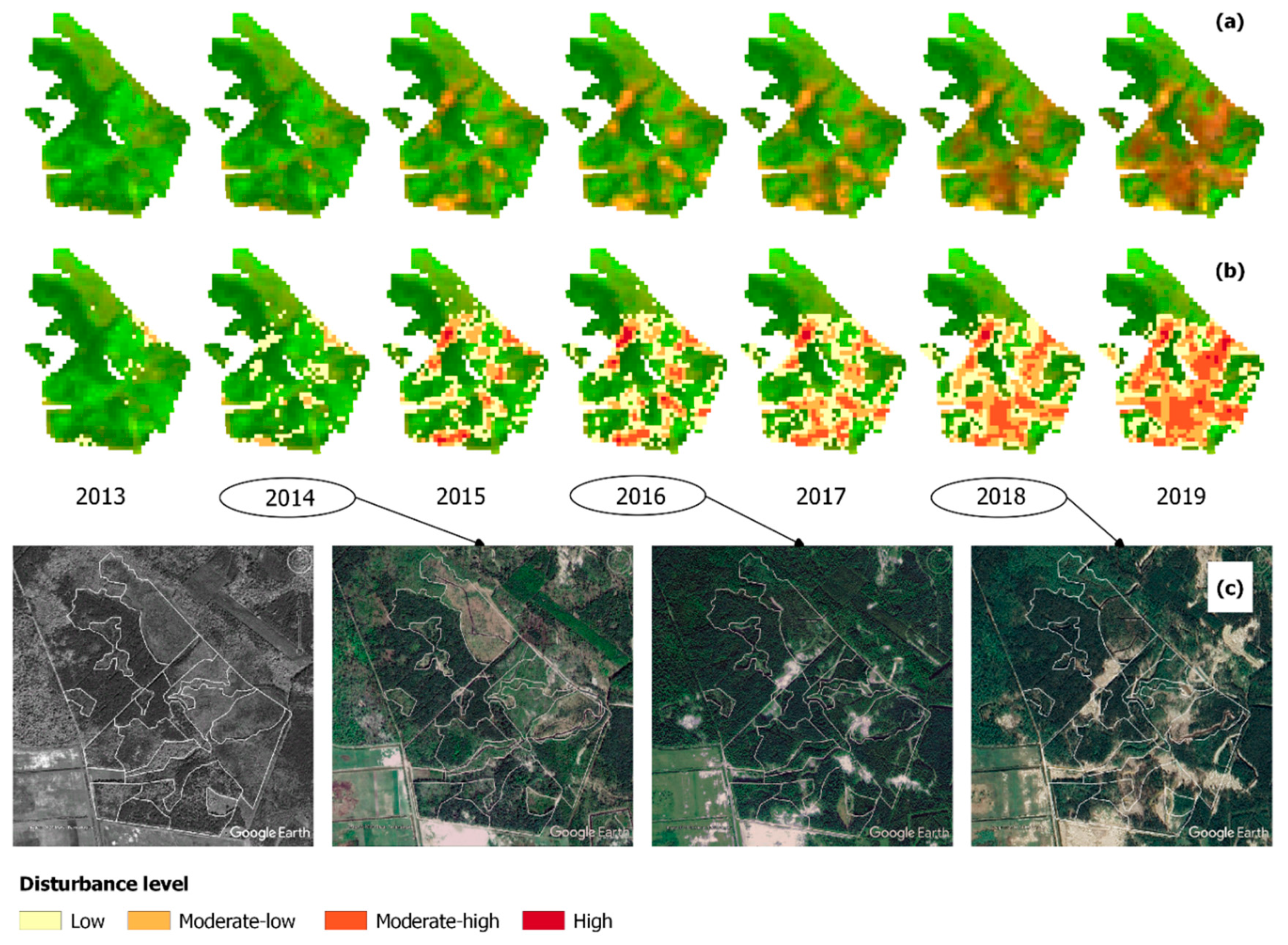
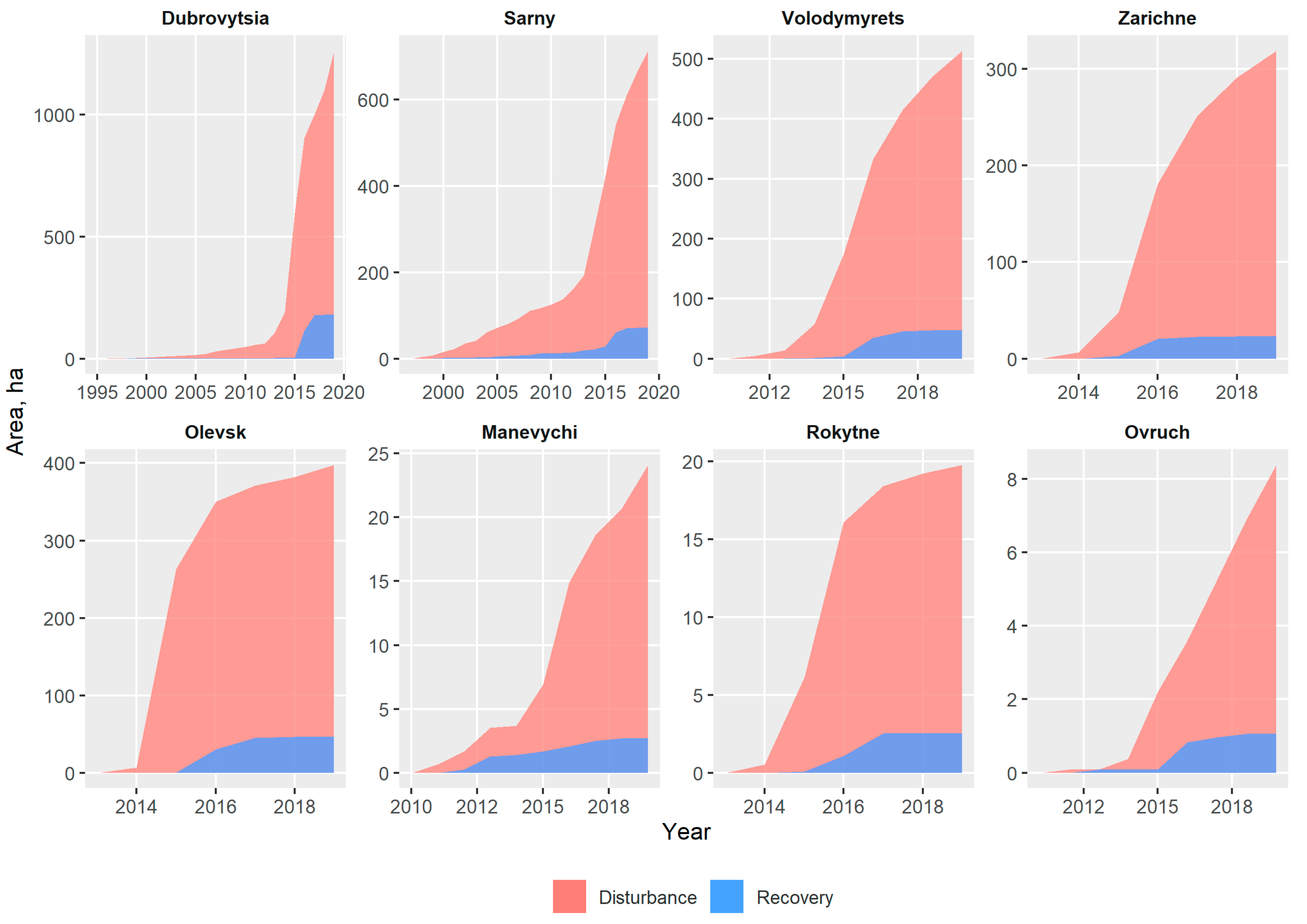
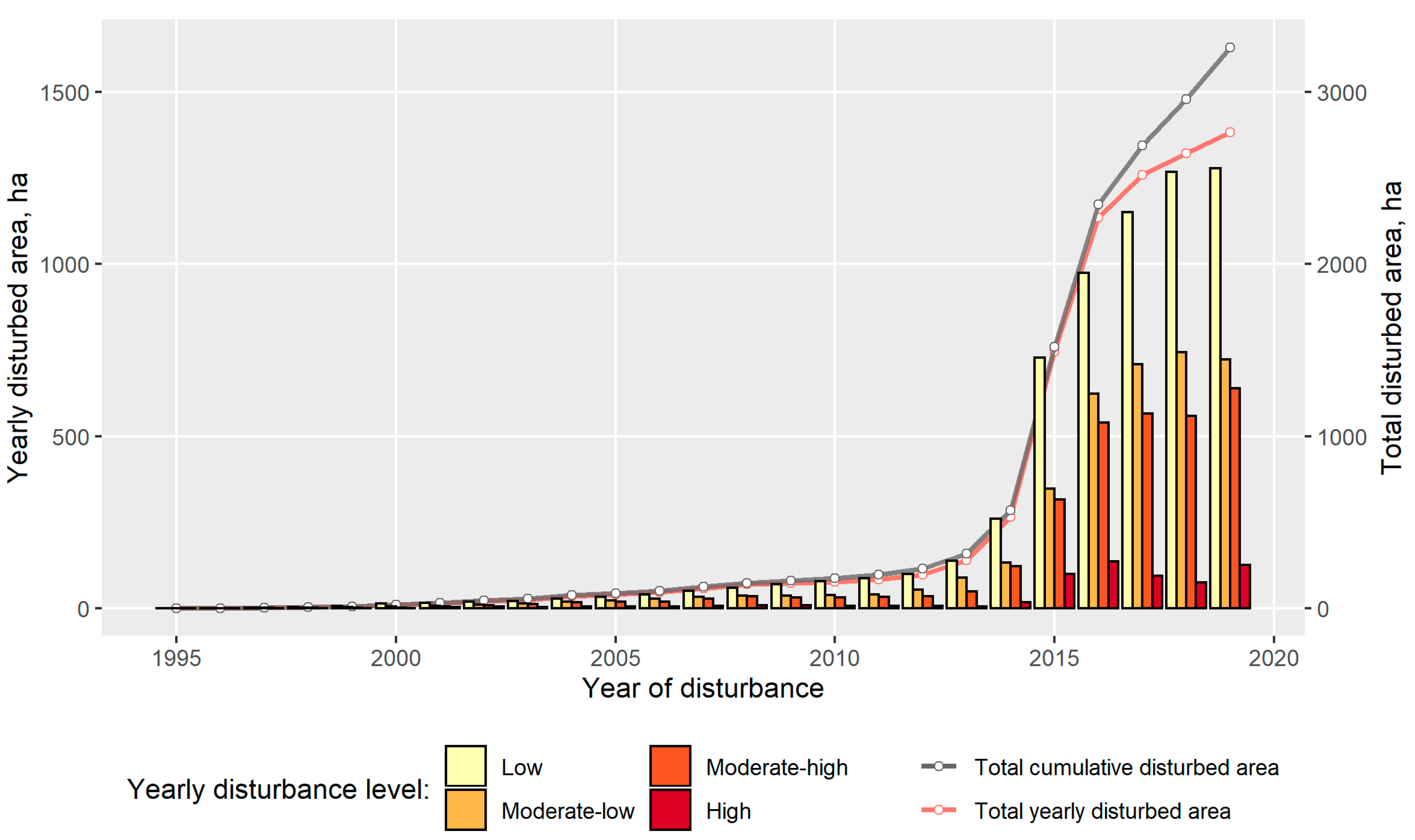

| Land Cover Class | Area in ha | Percentage |
|---|---|---|
| Forested areas | 6133.6 | 75.5 |
| Unforested areas | 514.5 | 6.4 |
| Wetlands | 1319.8 | 16.2 |
| Grasslands | 75.0 | 0.9 |
| Other non-productive lands | 82.6 | 1.0 |
| Total | 8125.5 | 100 |
| Live Biomass Components | Equation Parameter Estimation | R2 | N | |||||
|---|---|---|---|---|---|---|---|---|
| a0 | a1 | a2 | a3 | a4 | a5 | |||
| Stem | 0.19019 | 0.23911 | 0.03204 | 0.02692 | −0.00419 | −0.00974 | 0.70 | 144 |
| Branches | 10.94139 | −1.60625 | 0.14183 | 0.31989 | 0.01728 | −0.84985 | 0.77 | 144 |
| Foliage | 9.88521 | −1.51104 | 0.90958 | 1.57075 | 0.00718 | −2.63022 | 0.86 | 144 |
| Level of Forest Disturbance | dNBR Thresholds | Disturbance Description | Live Biomass and Carbon Loss | Percentage Loss |
|---|---|---|---|---|
| Low | 100–269 | This level refers to primary forest disturbance during the initial amber survey operations using shovels; major changes associated with the removal of the understory and forest litter that cause loss of canopy cover and structural forest changes. | GFF Understory | 100% 100% |
| Moderate-low | 270–439 | Forest stands are partially or completely removed without significant damage to the herbaceous vegetation; the level also refers to forest dieback, which usually occurs after interventions by miners. | Stand GFF Understory | 50% 100% 100% |
| Moderate-high | 440–459 | Forests are completely removed; sparse vegetation patches are scattered between crater-like disturbed surfaces due to pumping water into the ground. | Stand GFF Understory | 100% 100% 100% |
| High | ≥ 460 | The forest landscape is converted into unproductive lands with sand and water released onto the surface. | Stand GFF Understory | 100% 100% 100% |
| Mapped Class of Disturbance | Reference Class of Disturbance | Total | User’s Accuracy | Producer’s Accuracy | ||
|---|---|---|---|---|---|---|
| Undisturbed | Non-Stand-Replacing | Stand-Replacing | ||||
| Undisturbed | 845 | 47 | 19 | 911 | 0.928 | 0.979 |
| Non-stand-replacing | 18 | 205 | 37 | 260 | 0.789 | 0.748 |
| Stand-replacing | 0 | 22 | 361 | 383 | 0.943 | 0.866 |
| Total | 863 | 274 | 417 | 1554 | – | – |
| Mapped Class of Forest Disturbance | Reference Class of Forest Disturbance | Total | User’s Accuracy | Producer’s Accuracy | ||
|---|---|---|---|---|---|---|
| Undisturbed | Non-Stand-Replacing | Stand-Replacing | ||||
| Undisturbed | 694 | 40 | 11 | 745 | 0.932 | 0.978 |
| Non-stand-replacing | 16 | 173 | 27 | 216 | 0.801 | 0.736 |
| Stand-replacing | 0 | 22 | 278 | 300 | 0.927 | 0.880 |
| Total | 710 | 235 | 316 | 1261 | – | – |
| Mapped Level of Disturbance | Reference Level of Disturbance | Total | ||||
|---|---|---|---|---|---|---|
| Undisturbed | Low | Moderate-Low | Moderate-High | High | ||
| Undisturbed | 8 | 6 | 1 | 0 | 0 | 15 |
| Low | 2 | 16 | 6 | 1 | 0 | 25 |
| Moderate-low | 0 | 2 | 9 | 5 | 3 | 19 |
| Moderate-high | 0 | 0 | 0 | 4 | 2 | 6 |
| High | 0 | 0 | 0 | 0 | 4 | 4 |
| Total | 10 | 24 | 16 | 10 | 9 | 69 |
| Level of Disturbance | Carbon, Gg C | Total | |||||
|---|---|---|---|---|---|---|---|
| Stem | Branches | Foliage | Tree Roots | GFF | Understory | ||
| Undisturbed | - | - | - | - | - | - | - |
| Low | - | - | - | - | 0.7 | 0.7 | 1.4 |
| Moderate-low | 13.9 | 1.3 | 0.5 | 4.0 | 0.4 | 0.4 | 20.6 |
| Moderate-high | 28.1 | 2.6 | 1.0 | 8.0 | 0.3 | 0.4 | 40.3 |
| High | 7.1 | 0.7 | 0.3 | 2.0 | 0.1 | 0.1 | 10.2 |
| Total | 49.1 | 4.6 | 1.7 | 14.1 | 1.5 | 1.6 | 72.6 |
| Categories/ Criteria | Dynamics over the Last Two Years | Duration of Illegal Amber Operations in Years | ||
|---|---|---|---|---|
| Disturbed Area | Number of Disturbed Forest Polygons | Levels of Disturbance | ||
| Ongoing mining | Increased or no significant changes | Increased or no significant changes | Increased | ≥3 |
| Mining or stabilization | Decreased or no significant changes | Decreased or no significant changes | Increased or decreased | ≥3 |
| Stabilization or reduction of mining | Decreased or no significant changes | Decreased | Decreased | <3 |
© 2020 by the authors. Licensee MDPI, Basel, Switzerland. This article is an open access article distributed under the terms and conditions of the Creative Commons Attribution (CC BY) license (http://creativecommons.org/licenses/by/4.0/).
Share and Cite
Myroniuk, V.; Bilous, A.; Khan, Y.; Terentiev, A.; Kravets, P.; Kovalevskyi, S.; See, L. Tracking Rates of Forest Disturbance and Associated Carbon Loss in Areas of Illegal Amber Mining in Ukraine Using Landsat Time Series. Remote Sens. 2020, 12, 2235. https://doi.org/10.3390/rs12142235
Myroniuk V, Bilous A, Khan Y, Terentiev A, Kravets P, Kovalevskyi S, See L. Tracking Rates of Forest Disturbance and Associated Carbon Loss in Areas of Illegal Amber Mining in Ukraine Using Landsat Time Series. Remote Sensing. 2020; 12(14):2235. https://doi.org/10.3390/rs12142235
Chicago/Turabian StyleMyroniuk, Viktor, Andrii Bilous, Yevhenii Khan, Andrii Terentiev, Pavlo Kravets, Sergii Kovalevskyi, and Linda See. 2020. "Tracking Rates of Forest Disturbance and Associated Carbon Loss in Areas of Illegal Amber Mining in Ukraine Using Landsat Time Series" Remote Sensing 12, no. 14: 2235. https://doi.org/10.3390/rs12142235
APA StyleMyroniuk, V., Bilous, A., Khan, Y., Terentiev, A., Kravets, P., Kovalevskyi, S., & See, L. (2020). Tracking Rates of Forest Disturbance and Associated Carbon Loss in Areas of Illegal Amber Mining in Ukraine Using Landsat Time Series. Remote Sensing, 12(14), 2235. https://doi.org/10.3390/rs12142235