Article

Decoupling Food from Land: The Evolution of Spanish Agriculture from 1960 to 2010


by
Manuel González de Molina
*,
David Soto Fernández
,
Juan Infante-Amate
,
Eduardo Aguilera
,
Jaime Vila Traver
and
Gloria I. Guzmán
Agroecosystems History Laboratory, Universidad Pablo de Olavide, 41013 Sevilla, Spain
*
Author to whom correspondence should be addressed.
Sustainability 2017, 9(12), 2348; https://doi.org/10.3390/su9122348
Submission received: 16 November 2017 / Revised: 9 December 2017 / Accepted: 11 December 2017 / Published: 16 December 2017
(This article belongs to the Special Issue Natural Resources Economics)

Abstract

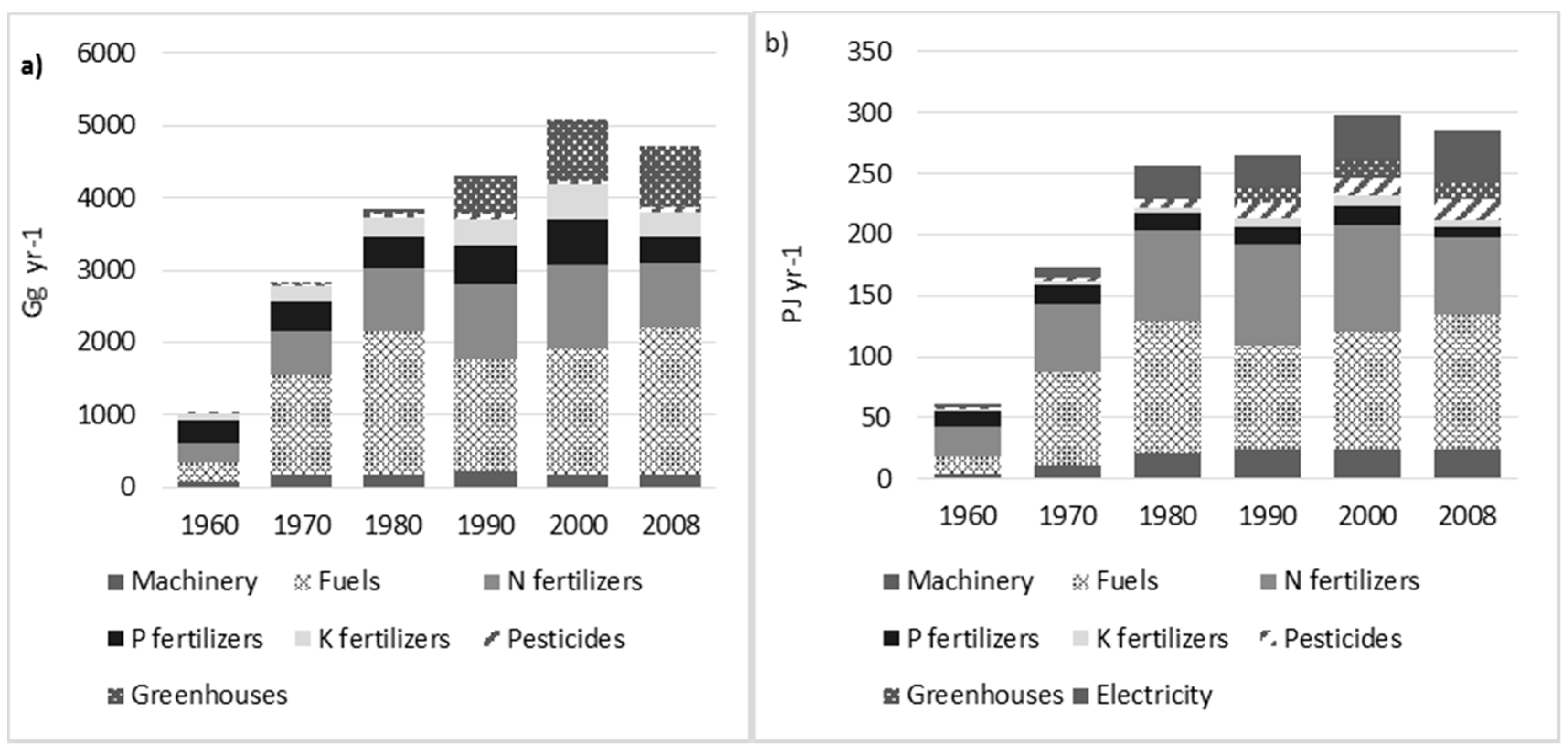
For a large extent of historiography, the history of Spanish agriculture during the twentieth century is a story of success. However, this narrative has been built on monetary analysis, and it does not usually take into account the effects on rural society and agroecosystems. The aim of this paper is to analyze what has happened from a biophysical perspective to ascertain whether transformations linked with industrialization of agriculture have also been positive. For this, we have integrated the results—some unpublished and others already published—of a broader research project about different aspects of food production from a biophysical perspective in Spain, applying methodologies pertaining to the Social Metabolism. Our research seeks to provide a new narrative, emerging through the consideration of environmental aspects of the process, providing a more complex vision of the process of industrialization in European agriculture. The results show that the industrialization of Spanish agriculture has brought about profound changes in land uses and in the functionality of the biomass produced, increasing pressure on croplands and, paradoxically, facilitating the abandonment of an important proportion of pasture and croplands. This has led to the subordination of a very significant portion of Spanish agroecosystems to the feed demands of intensive livestock farming. This process has been based on the injection of large quantities of external energy. Agricultural production has undergone significant growth since the 1960s, but this has been insufficient to deal with the growing demand created by the change in the Spanish diet and the increasing trend to focus on livestock farming. The process of globalization has allowed both roles to be reconciled, although in recent decades Spain has accentuated its role as a net importer of biomass from a biophysical perspective, with very significant impacts on third party countries, particularly in Latin America. From a biophysical perspective, the industrialization of Spanish agriculture has entailed negative consequences that threaten the sustainability of Spanish agroecosystems and also negatively affect the sustainability of other territories.
Keywords: agricultural history; agricultural industrialization; Spain; agroecosystems change; social metabolism; diet change agricultural history; agricultural industrialization; Spain; agroecosystems change; social metabolism; diet change