Article

Investigating the Determinants of Renewable Energy Adoption: A Survey of Consumers’ Intention in Saudi Arabia

Department of Management, College of Business Administration, Prince Sattam Bin Abdulaziz University, Hawtat Bani Tamim 16622, Saudi Arabia
Sustainability 2026, 18(9), 4589; https://doi.org/10.3390/su18094589
Submission received: 19 January 2026 / Revised: 3 April 2026 / Accepted: 13 April 2026 / Published: 6 May 2026

Abstract

The accelerating global transition toward sustainable energy necessitates a more profound comprehension of the behavioral and contextual determinants influencing household adoption intentions, particularly in policy-driven economies. This research analyses household renewable energy adoption in Saudi Arabia employing a Theory of Planned Behavior-informed, attitude-centric framework. Awareness, environmental concern, and perceptions of governmental policy are evaluated as contextual precursors of attitude, while perceived financial cost is conceptualized as a moderating constraint on the attitude–intention nexus. Data were amassed through a cross-sectional survey of 300 household decision-makers in Saudi Arabia and analyzed utilizing Partial Least Squares Structural Equation Modeling (PLS-SEM). The outcomes reveal that perceptions of governmental policy, environmental concern, and awareness are positively correlated with attitudes toward renewable energy, with policy perception demonstrating the most robust relationship. Attitude, in turn, is strongly correlated with adoption intention. Furthermore, perceived financial cost negatively moderates the attitude–intention relationship, indicating that financial apprehensions diminish the transference of favorable evaluations into adoption intentions. By situating the Theory of Planned Behavior within a policy-oriented energy framework, this study underscores the pivotal roles of institutional perception and affordability in shaping household renewable energy intentions through attitudinal mechanisms. The findings furnish practical insights for policymakers by accentuating the significance of policy credibility, financial accessibility, and targeted communication strategies aligned with Saudi Vision 2030’s sustainability objectives.

1. Introduction

The global shift towards sustainable energy has emerged as a central priority in addressing climate change, enhancing energy security, and fostering long-term socio-economic resilience. Renewable energy technologies, particularly solar and wind power, are pivotal in achieving the United Nations Sustainable Development Goals, specifically Goal 7 (Affordable and Clean Energy) and Goal 13 (Climate Action) [1]. In response, governments worldwide have implemented policy frameworks, financial incentives, and regulatory reforms to expedite the adoption of renewable energy across industrial, commercial, and residential sectors [2]. In the global context, Saudi Arabia serves as a particularly pertinent case study. Through its Vision 2030 agenda, the Kingdom has articulated a robust commitment to diversifying its energy portfolio, reducing reliance on fossil fuels, and enhancing the utilization of clean and sustainable energy sources [3]. Significant investments have been directed towards renewable energy infrastructure, policy instruments, and public awareness initiatives aimed at promoting household-level adoption, including incentives for rooftop solar systems and regulatory facilitation [4,5]. Despite these initiatives, the adoption of renewable energy technologies at the residential level remains limited, indicating that the mere availability of policies and technological readiness may not suffice to induce widespread behavioral change at the household level [6,7]. This gap between policy objectives and actual implementation at the domestic level accentuates the critical need to comprehend the psychological factors that influence renewable energy decision-making. Prior investigations demonstrate that adoption selections are influenced not solely by economic or technical factors but also by psychological assessments, ecological values, and perceptions of institutional backing [8]. Consequently, behavioral theories have been progressively utilized to elucidate pro-environmental intentions and selections within the energy sector. Among these, the Theory of Planned Behavior (TPB) has been extensively applied as a theoretical framework to elucidate environmentally responsible actions such as energy conservation, sustainable purchasing, and renewable energy adoption [9,10]. TPB conceptualizes behavioral intention as a function of attitude towards behavior, subjective norms, and perceived behavioral control [11]. However, the present study does not incorporate all TPB components and instead adopts a focused perspective that emphasizes the attitudinal dimension as the primary explanatory mechanism. Within sustainability scholarship, attitude has consistently surfaced as a pivotal explanatory mechanism, often demonstrating a more robust and stable correlation with intention than other TPB components, particularly in environmentally focused decision-making contexts. Building on this corpus of literature, contemporary investigations increasingly accentuate the necessity to contextualize Theory of Planned Behavior (TPB)-based analyses by integrating institutional and economic circumstances that influence individual assessments of sustainable behaviors [12]. In policy-oriented energy systems such as that of Saudi Arabia, perceptions of governmental action, credibility, and efficacy play a pivotal role in shaping how individuals appraise renewable energy technologies. When governmental initiatives are perceived as transparent, trustworthy, and advantageous, they may cultivate more propitious attitudes toward adoption; conversely, ambiguous or ineffective policies may engender skepticism and diminish favorable evaluations [3,13]. Despite this significance, perceptions of governmental policy are frequently regarded as background variables rather than being explicitly scrutinized as attitudinal precursors within TPB-informed renewable energy investigations. In addition to the institutional milieu, economic constraints persist as a fundamental challenge in transmuting favorable attitudes into adoption intentions. Although numerous consumers articulate positive perspectives toward renewable energy, they often regard technologies such as residential solar systems as financially onerous due to elevated initial costs, uncertainty pertaining to payback durations, or restricted access to financing instruments [14,15]. Prior investigations consistently identify perceived cost as a principal obstacle to adoption; however, it is most frequently modeled as a direct predictor rather than being examined as a contextual constraint that conditions the attitude–intention nexus [16]. Drawing upon insights from behavioral economics and sustainability research, perceived financial cost can be elucidated as a control-related limitation that may attenuate the transference of positive attitudes into tangible behavioral intentions [17,18]. Against this contextual backdrop, the current inquiry adopts an attitude-centric framework informed by the Theory of Planned Behavior to evaluate household renewable energy adoption intentions in Saudi Arabia. Rather than assessing the complete TPB model, the inquiry concentrates on attitude as the principal psychological mechanism connecting contextual perceptions to intention. In doing so, this study does not seek to test or contribute to the full Theory of Planned Behavior but rather draws on its attitudinal component as a conceptual lens to structure the analysis of household renewable energy intentions. Specifically, it explores how awareness, environmental concern, and perceptions of governmental policy are correlated with attitudes toward renewable energy, and how these attitudes pertain to adoption intention. These factors were selected because they are particularly salient in the Saudi residential energy context and have been repeatedly shown in prior research to shape evaluative judgments rather than social pressure or perceived capability. Furthermore, this study examines whether perceived financial cost functions as a contextual constraint that moderates the attitude–intention relationship. These associations are analyzed utilizing survey data gathered from 300 household decision-makers in Saudi Arabia and assessed through Partial Least Squares Structural Equation Modeling (PLS-SEM). This investigation makes three pivotal contributions. First, it offers a context-sensitive behavioral analysis of renewable energy adoption in a policy-driven economy, accentuating the role of institutional perceptions in shaping consumer attitudes. Second, it contributes to the literature by clarifying the conditioning role of perceived financial cost in the attitude–intention relationship, providing insight into why favorable environmental attitudes do not invariably convert into adoption intentions. Third, it contributes empirical evidence from Saudi Arabia, a context that remains underrepresented in TPB-informed renewable energy research despite its strategic significance under Vision 2030. Collectively, these contributions furnish nuanced insights for policymakers and sustainability practitioners endeavoring to align behavioral motivations with institutional and economic conditions to expedite household-level renewable energy adoption.

2. Literature Review and Theoretical Framework

2.1. Theory of Planned Behavior as a Conceptual Lens

The Theory of Planned Behavior (TPB) constitutes one of the most extensively utilized theoretical frameworks in behavioral research, aimed at elucidating and interpreting individual decision-making across a variety of contexts, encompassing behaviors related to the environment and energy [19]. TPB posits that behavioral intention is shaped by three core components: attitude toward the behavior, subjective norms, and perceived behavioral control, with intention serving as the immediate antecedent of behavior [20]. In the realm of renewable energy adoption, TPB has been recurrently utilized to investigate how individuals assess renewable technologies, perceive societal expectations, and evaluate their capacity to embrace such alternatives [21]. Within the fields of sustainability and energy research, attitude has persistently emerged as a pivotal explanatory factor, often exhibiting a more robust and stable correlation with intention than subjective norms or perceived behavioral control, particularly in contexts oriented toward environmental decision-making [22,23].
Consequently, numerous empirical investigations have employed a partial or selective application of TPB, concentrating on the attitudinal pathway to more accurately capture the evaluative processes that underpin pro-environmental intentions. Building on this line of inquiry, contemporary studies increasingly underscore the necessity of contextualizing TPB-informed analyses by integrating institutional, economic, and informational conditions that influence individual assessments of sustainable behaviors [16,24]. In policy-driven energy systems, such as that of Saudi Arabia, these contextual elements are particularly significant in shaping the formation of attitudes toward renewable energy. Accordingly, the present study does not endeavor to test or contribute to the entirety of the TPB model. Rather, it utilizes the attitudinal component of TPB as a conceptual framework, employing it to structure an attitude–intention model that incorporates contextually pertinent antecedents and constraints. In this context, subjective norms may exert a limited influence, as renewable energy adoption is less driven by direct social pressure and more by institutional and policy frameworks. Similarly, perceived behavioral control is partially embedded within contextual constraints such as financial affordability and policy support, which are explicitly captured in the model. Unlike perceived behavioral control, which reflects overall capability, perceived financial cost is conceptualized here as a context-specific constraint affecting the translation of attitudes into intention. Therefore, excluding these components allows for a more focused examination of the attitudinal pathway while maintaining theoretical coherence.

2.2. Behavioral Determinants of Renewable Energy Adoption

Awareness pertains to an individual’s cognizance of renewable energy technologies, encompassing their availability, advantages, and environmental significance. Prior research consistently indicates that elevated levels of awareness correlate with more favorable assessments of renewable energy [25]. For instance, Wall et al. (2021) discovered that awareness had a significant impact on attitudes and behavioral tendencies among urban consumers in Thailand [18], whereas Shakeel and Rahman (2018) noted that awareness primarily influenced intention indirectly via attitude in the context of Pakistan [26]. Further recent investigations suggest that awareness related to economic or environmental benefits may, in certain situations, exert a direct effect on intention [27,28]. However, this relationship remains inadequately explored within Saudi Arabia; its collective examination within an attitude-centered behavioral framework is notably scarce, where public knowledge of residential renewable energy remains uneven across regions and income groups.
Environmental concern encapsulates the extent to which individuals acknowledge environmental issues and perceive a personal obligation to address them. Empirical findings illustrate that environmental concern positively impacts attitudes toward sustainable products, energy-efficient devices, and renewable energy technologies [29]. Research conducted in developing and Gulf-region contexts affirms its significance in shaping both attitudes and intentions regarding solar energy adoption [30,31]. Nevertheless, the results remain heterogeneous, as financial and social priorities may eclipse environmental considerations in specific contexts [32,33]. However, prior studies report inconsistent findings regarding the role of environmental concern and awareness, with some studies finding strong effects while others report weak or non-significant relationships. These discrepancies may be attributed to contextual differences, measurement approaches, and policy environments. These inconsistencies highlight the importance of examining environmental concern as a key attitudinal antecedent within the Saudi residential energy context.
Perceptions of government policy significantly influence regulated and state-directed energy systems. Supportive measures, including subsidies, incentives, and educational programs, are acknowledged to augment consumer confidence and cultivate positive attitudes towards renewable energy [34]. In the context of Saudi Arabia, where the state exerts considerable control over the energy sector, perceptions pertaining to policy credibility and efficacy are particularly pronounced. Previous research suggests that well-structured and effectively communicated policies can significantly influence attitudes and, in certain instances, directly enhance adoption intentions by mitigating perceived risks and signaling sustained market stability [35,36,37]. Nevertheless, empirical evidence that explicitly investigates these mechanisms at the household level within the Saudi context remains sparse.
The attitude–intention relationship is among the most robustly established connections in behavioral research concerning renewable energy adoption. Attitude encapsulates an individual’s comprehensive assessment of renewable energy technologies with respect to desirability, feasibility, and perceived advantages [15]. Meta-analytic findings affirm that positive attitudes serve as strong predictors of adoption intention, frequently surpassing the influence of social norms or perceptions of control [23]. Empirical investigations further reveal that attitude often mediates the impact of awareness and policy-related factors on renewable energy adoption [18,31], highlighting its pivotal role in converting contextual perceptions into behavioral impetus.
Furthermore, perceived financial cost encompasses individuals’ evaluations regarding the affordability of renewable energy technologies, inclusive of upfront investment demands and perceived financial encumbrance. Despite the global decline in technological costs, perceptions of high expenses persist and continue to represent a significant obstacle to household adoption [38]. Prior investigations consistently indicate that cost perceptions adversely affect the willingness to invest in renewable energy [16,31,36]. Rather than viewing perceived cost merely as a direct determinant, emerging scholarship posits that it may operate as a contextual constraint, diminishing the translation of favorable attitudes into adoption intentions. This viewpoint aligns with control-related considerations in behavioral theory and is particularly salient in Saudi Arabia, where fossil-fuel subsidies and price sensitivity influence household energy decisions.

2.3. Research Gaps

Despite the increasing scholarly attention directed towards household renewable energy adoption, notable gaps persist within the existing literature. Firstly, a relatively small number of studies have investigated perceived financial cost as a moderating constraint within the attitude–intention nexus, with the majority treating cost as an independent barrier rather than a conditioning variable [39]. Secondly, empirical investigations utilizing Theory of Planned Behavior (TPB)-informed Structural Equation Modeling (SEM) approaches remain limited within the Saudi context, notwithstanding the nation’s extensive energy reforms under Vision 2030 [3]. Thirdly, while awareness, environmental concern, and perceptions of governmental policy have been extensively studied, their collective examination within an attitude-centered behavioral framework that explicitly accounts for institutional context is notably scarce, especially in Gulf-region contexts where institutional influence and household decision-making converge [40]. Finally, there exists a dearth of research exploring whether these factors exert both direct and indirect influences on adoption intention, leaving unresolved inquiries regarding the mediating function of attitude [23]. This study addresses these gaps by offering a context-sensitive, TPB-informed analysis of renewable energy adoption intentions in Saudi Arabia.

2.4. Conceptual Model

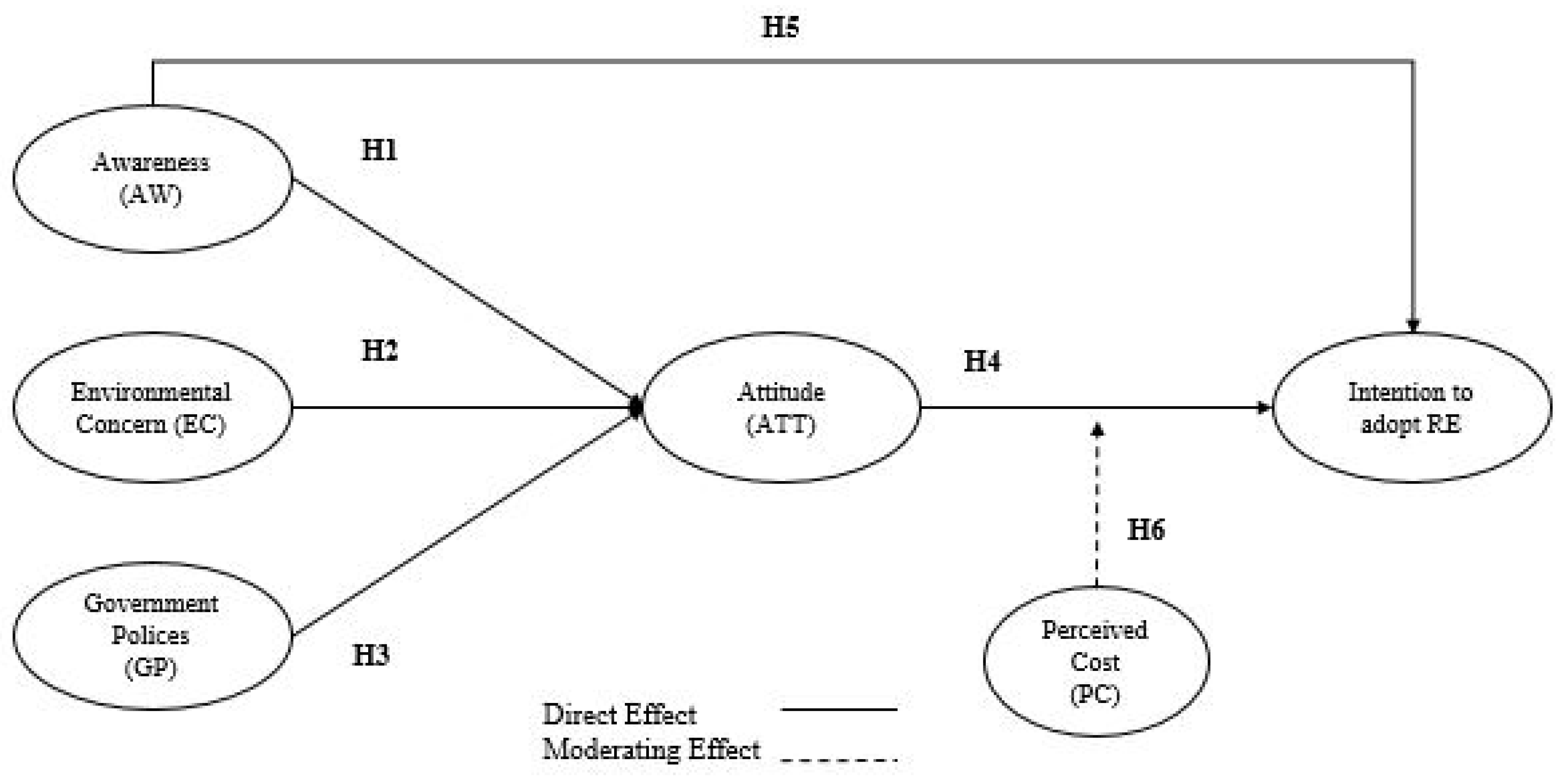
The conceptual framework formulated in this investigation employs an attitude-centric paradigm informed by the Theory of Planned Behavior. As illustrated in Figure 1, Awareness, environmental concern, and perceptions of governmental policy are conceptualized as antecedents shaping consumer attitudes toward renewable energy, which in turn are correlated with adoption intention. Furthermore, these contextual factors are scrutinized for potential direct associations with intention of evaluating whether their effects are entirely or partially mediated by attitude. Ultimately, perceived financial expenditure is integrated as a moderating constraint on the attitude–intention relationship, encapsulating the degree to which financial considerations influence the conversion of favorable evaluations into adoption intentions.

3. Hypotheses Development

The theoretical framework of this investigation is guided by the Theory of Planned Behavior (TPB), which delineates attitude as a pivotal psychological construct connecting beliefs and evaluations to behavioral intention [20]. Consistent with antecedent inquiries in sustainability and energy assimilation, the current investigation employs an attitude-centric methodology, utilizing TPB as a conceptual lens rather than empirically testing its comprehensive set of components. In accordance with this viewpoint, awareness, environmental concern, and perceptions of governmental policy are scrutinized as contextual precursors of attitude, while perceived financial expenditure is regarded as a contextual constraint that may modulate the attitude–intention nexus. In this model, awareness, environmental concern, and government policy are specified as antecedents of attitude, which in turn is associated with intention. Awareness is also modeled as a direct predictor of intention, while perceived financial cost moderates the relationship between attitude and intention.

3.1. Antecedents of Attitude

3.1.1. Awareness and Attitude

Awareness denotes individuals’ cognizance and comprehension of renewable energy technologies, encompassing their advantages and practical ramifications. Prior investigations consistently indicate that elevated awareness is correlated with more favorable evaluations of renewable energy. For instance, Ref. [18] discovered that awareness was positively correlated with attitudes toward renewable energy among urban consumers in Thailand. This relationship is further supported by prior studies demonstrating that environmental knowledge and awareness positively shape consumer attitudes toward sustainable and renewable energy behaviors [41,42,43]. Other inquiries suggest that awareness predominantly functions through attitudinal mechanisms rather than exerting a direct impact on behavioral intention [26]. Consequently, in the Saudi context, awareness is anticipated to be positively correlated with attitudes toward renewable energy.
H1. 
Awareness is positively associated with consumer attitudes toward renewable energy.

3.1.2. Environmental Concern and Attitude

Environmental concern encapsulates the degree to which individuals acknowledge environmental issues and perceive a moral obligation to confront them. Empirical investigations reveal that heightened levels of environmental concern are associated with more favorable attitudes toward sustainable technologies [30,31]. However, evidence also suggests that the strength of this relationship may vary depending on economic and contextual conditions, as financial and practical barriers can weaken the influence of environmental concern on consumer evaluations of renewable energy [33]. In Saudi Arabia, where environmental awareness has gained significance under Vision 2030, environmental concern is expected to be positively correlated with attitudes toward renewable energy.
H2. 
Environmental concern is positively associated with consumer attitudes toward renewable energy.

3.1.3. Government Policy Perception and Attitude

Perceptions of governmental policy assume a particularly salient role in regulated and state-led energy systems. Supportive policies, such as subsidies, incentives, and public communication initiatives, can bolster consumer confidence and cultivate favorable evaluations of renewable energy technologies [34]. Prior investigations indicate that perceived policy credibility and efficacy are associated with more affirmative attitudes toward renewable energy adoption, particularly in nascent and policy-driven markets [36,44]. In the Saudi context, where governmental measures significantly influence the energy landscape, perceptions of governmental policy are expected to be positively correlated with attitudes toward renewable energy.
H3. 
Positive perceptions of government policy are positively associated with consumer attitudes toward renewable energy.

3.2. Attitude → Intention

Attitude signifies an individual’s comprehensive assessment of renewable energy technologies regarding desirability, feasibility, and perceived advantages. Within Theory of Planned Behavior (TPB)-informed investigations, attitude has consistently been recognized as a robust correlate of behavioral intention across an extensive array of environmental and energy-related actions. Empirical investigations conducted in varied contexts indicate that more favorable attitudes are linked to stronger intentions to embrace renewable energy technologies [23,31]. In Saudi Arabia, where sustainability has emerged as an increasingly prominent policy aspiration, positive attitudes toward renewable energy are anticipated to be correlated with heightened adoption intentions.
H4. 
Attitudes toward renewable energy are positively associated with the intention to adopt renewable energy.

3.3. Direct Effects on Intention

Although disposition constitutes the central psychological mechanism linking evaluations to behavioral intention, prior research suggests that awareness of renewable energy technologies may, in certain contexts, be directly associated with adoption intention, particularly when individuals perceive explicit personal, financial, or practical advantages. In such scenarios, awareness may function not only as a precursor to disposition but also as a more immediate cognitive signal informing intention formation. For instance, investigations in the Saudi residential context indicate that augmented awareness of solar energy benefits and cost implications can directly fortify adoption intentions when consumers recognize palpable economic benefits and feasibility [16]. Examining this potential direct association enables the evaluation of whether the influence of awareness on intention is fully mediated by disposition or whether partial mediation exists within household renewable energy decision-making.
H5. 
Awareness is positively associated with the intention to adopt renewable energy.

3.4. Moderation Effect of Perceived Financial Cost

While positive dispositions are generally correlated with heightened adoption intentions, financial factors may moderate this connection. Perceived financial expenditure embodies individuals’ evaluations of the accessibility and economic strain associated with the adoption of renewable energy technologies, particularly concerning initial investment prerequisites. Prior investigations consistently reveal that elevated perceived costs are linked to diminished adoption intentions [16,31]. Rather than conceptualizing perceived costs merely as a direct impediment, this inquiry embraces a contextual viewpoint, proposing that perceived financial expenditure may attenuate the relationship between positive dispositions and adoption intention. This interpretation corresponds with control-related considerations in behavioral theory and is particularly pertinent in Saudi Arabia, where price sensitivity and subsidy frameworks impact household energy choices.
H6. 
Perceived financial cost negatively moderates the relationship between attitude toward renewable energy and the intention to adopt renewable energy.

4. Methodology

4.1. Research Design

This research adopts a quantitative, cross-sectional methodological approach founded on survey data to analyze relationships among attitudes, contextual perceptions, and intentions related to household renewable energy adoption in Saudi Arabia. A cross-sectional methodology is appropriate for investigating behavioral relationships at a specific point in time and for evaluating theoretically substantiated association-based models within the domains of sustainability and energy research. The analysis utilizes Partial Least Squares Structural Equation Modeling (PLS-SEM) through SmartPLS 4.0. PLS-SEM is particularly suited for prediction-oriented research, for models incorporating multiple constructs, indirect relationships, and interaction effects, and for studies emphasizing theory development and contextual exploration rather than strict theory testing [45]. Notably, the application of PLS-SEM in this study is designed to evaluate associative relationships and explanatory patterns, rather than to establish causal linkages.

4.2. Population and Sampling

As shown in Table 1, The target demographic consists of adult household decision-makers engaged in energy consumption determinations in Saudi Arabia, inclusive of homeowners and heads of households. Data were gathered employing a non-probability sampling methodology, integrating purposive and snowball sampling techniques. A purposive strategy was utilized to engage respondents possessing fundamental awareness of household electricity consumption and energy alternatives, while snowball sampling facilitated extensive dissemination of the questionnaire. The survey was executed online via Google Forms and disseminated through social media platforms. This strategy permitted access to respondents across various regions of Saudi Arabia but may introduce selection bias, particularly favoring more educated and digitally connected respondents, as well as individuals with a higher predisposition toward environmental issues. Consequently, the sample is not asserted to be statistically representative of the Saudi population; rather, it represents a diverse exploratory sample appropriate for analyzing behavioral associations within a Theory of Planned Behavior-informed framework. A total of 300 valid responses were retained for analysis. This sample size is considered adequate for PLS-SEM and provides sufficient statistical power to estimate the structural model and interaction effects.

4.3. Measurement Development

Data was acquired utilizing a structured questionnaire comprising two segments. The initial segment collected demographic and socio-economic data, encompassing age, gender, educational attainment, income classification, and geographical locale. The subsequent segment evaluated six latent constructs: awareness, environmental concern, perceptions of government policy, perceived financial cost, attitude toward renewable energy, and intention to adopt renewable energy. Measurement items were adapted from established and validated scales within the domains of sustainability, energy adoption, and behavioral research literature. Items were slightly rephrased to ensure contextual relevance to the Saudi residential energy milieu while maintaining their original conceptual significance. Perceived financial burden items specifically concentrated on respondents’ perceptions of affordability and initial financial encumbrance, rather than objective investment returns, in accordance with the study’s conceptualization of cost as a perceived limitation. The study does not capture objective financial indicators such as payback period, return on investment, or financing conditions. All items were evaluated utilizing a five-point Likert scale, ranging from 1 (“Strongly disagree”) to 5 (“Strongly agree”). Prior to full data collection, the questionnaire was pilot tested with 15 participants to assess clarity, wording, and cultural appropriateness. In line with common practice in survey research, this sample size is considered sufficient for identifying ambiguities in instrument design. Feedback from the pilot study led to minor refinements in item phrasing. A summary of construct operationalization and item sources is presented in Table 2.

4.4. Data Analysis Procedure

Data analysis adhered to a two-step methodology consistent with PLS-SEM guidelines. First, the measurement model was examined to assess internal consistency reliability, convergent validity, and discriminant validity. Second, the structural model was evaluated to determine the strength and significance of hypothesized associations, predictive relevance, and the moderating effect of perceived financial burden. Bootstrapping with 5000 resamples was employed to estimate path significance and confidence intervals.

5. Results

5.1. Measurement Model Assessment

The evaluative framework for the measurement model was conducted antecedent to the examination of structural interrelations to ascertain indicator dependability, internal coherence reliability, and construct validity. As delineated in Table 3, the preponderance of indicator loadings surpasses the prescribed threshold of 0.70, signifying robust interrelations between observed items and their corresponding latent constructs. One indicator pertaining to environmental concern (EC2) manifested a loading of 0.560, which is marginally beneath the traditional threshold. Notwithstanding, the construct’s average variance extracted (AVE) remained superior to the advisable minimum of 0.50, and composite reliability transcended 0.70, signifying acceptable convergent validity at the construct level [45].Cronbach’s alpha values fluctuated from 0.671 to 0.893, while composite reliability values ranged from 0.815 to 0.927, corroborating satisfactory internal consistency across all constructs. To mitigate apprehensions regarding the relatively diminished loading of EC2, an ancillary robustness assessment was executed by re-evaluating the model devoid of this indicator. The findings revealed marginal enhancements in Cronbach’s alpha and composite reliability for environmental concern, whilst structural path coefficients and their significance levels remained substantively unchanged. Given the theoretical significance of the item and the stability of the structural outcomes, EC2 was preserved in the definitive model. Specifically, EC2 captures the dimension of personal responsibility toward environmental protection, which is particularly relevant in the Saudi context, where sustainability awareness is increasingly promoted through national initiatives such as Vision 2030.
All constructs exhibited AVE values exceeding 0.50 (spanning from 0.597 to 0.864), indicating that each latent variable explains more than half of the variance in its indicators, thereby confirming convergent validity. Discriminant validity was appraised employing the Fornell–Larcker criterion. As illustrated in Table 4, the square root of each construct’s AVE surpasses its correlations with all other constructs, thereby confirming adequate discriminant validity and conceptual distinctiveness among the constructs.
In addition, the heterotrait–monotrait ratio (HTMT) was assessed as a more stringent criterion for discriminant validity. All HTMT values were below the recommended threshold of 0.90, indicating that discriminant validity is established across all constructs and confirming satisfactory discriminant validity (see Table 5).
Harman’s single-factor test was conducted to assess common method variance. The results indicate that no single factor accounted for the majority of the variance, suggesting that common method bias is unlikely to be a significant concern in this study. Additionally, all variance inflation factor (VIF) values were below the recommended threshold of 3.3, further supporting the absence of common method bias.

5.2. Structural Model Evaluation

After the validation of the measurement model, the structural model was evaluated to scrutinize the hypothesized associations among constructs. The analysis utilized a bootstrapping procedure with 5000 resamples to estimate path coefficients, standard errors, and significance levels. The coefficient of determination (R2) denotes that awareness, environmental concern, and perceptions of governmental policy collectively elucidate 52.5% of the variance in attitude towards renewable energy, as shown in Table 6. Similarly, attitude, perceived financial cost, and contextual variables elucidate 62.3% of the variance in intention to adopt renewable energy. These values suggest considerable explanatory power in behavioral research contexts [45]. The Stone–Geisser Q2 values for attitude (0.509) and intention (0.475) exceed zero, thereby validating the model’s predictive relevance.
Moreover, the Standardized Root Mean Square Residual (SRMR) was computed to evaluate overall model fit. The SRMR value was below the recommended threshold of 0.08, indicating acceptable model fit. Effect size estimates (f2) were also calculated to evaluate the relative contribution of each predictor. Government policy exhibited a substantial effect on attitude, environmental concern demonstrated a moderate effect, and awareness illustrated a small to moderate effect, whilst attitude exhibited a substantial effect on intention.
Table 7 presents the standardized path coefficients, t-values, and p-values for the hypothesized relationships.
Awareness, environmental concern, and perceptions of governmental policy exhibited a positive correlation with attitudes toward renewable energy, with governmental policy presenting the most substantial association (β = 0.448, p < 0.001), followed by environmental concern (β = 0.263, p < 0.01) and awareness (β = 0.176, p < 0.05). These results imply that institutional credibility and environmental values are particularly significant in influencing favorable attitudes toward renewable energy within the context of Saudi Arabia.
Attitudes toward renewable energy were found to be strongly and positively correlated with adoption intention (β = 0.602, p < 0.001), underscoring its pivotal role in connecting evaluative perceptions to behavioral motivations at the household level.
Awareness did not demonstrate a statistically significant direct association with the intention to adopt renewable energy (β = 0.066, p = 0.145). Consequently, H5 is not supported, indicating that awareness alone does not directly translate into household adoption intention in the Saudi context.
The interaction term between attitude and perceived financial cost was negative and statistically significant (β = −0.038, p < 0.05), indicating that an elevated perception of financial cost attenuates the relationship between favorable attitudes and adoption intention. This finding implies that even when households possess positive evaluations of renewable energy, perceived financial limitations may constrain their readiness to convert these evaluations into definitive adoption intentions. In summary, the TPB-informed, attitude-centric model exhibits considerable explanatory and predictive potential, providing insightful understanding of the behavioral mechanisms that underlie household renewable energy adoption in Saudi Arabia.

6. Discussion and Interpretation of Findings

This study assessed household renewable energy adoption intentions in Saudi Arabia through a Theory of Planned Behavior-informed, attitude-centric framework that prioritizes attitude as a foundational mechanism while integrating contextually relevant institutional and economic factors. Collectively, the model demonstrates considerable explanatory strength (R2 = 0.525 for attitude; R2 = 0.623 for intention), offering a complex account of how household intentions are shaped within a policy-driven energy transition framework.

6.1. Attitudinal Antecedents in a Policy-Driven Energy Transition

The findings illustrate that cognizance (β = 0.176, p = 0.031), ecological apprehension (β = 0.263, p = 0.001), and governmental policy perception in particular (β = 0.448, p < 0.001) are positively correlated with attitudes towards renewable energy. The predominance of policy perception indicates that, in Saudi Arabia, institutional credibility and policy signaling are fundamental to the development of favorable assessments. In other words, when households regard governmental initiatives as credible, accessible, and effective, renewable energy is psychologically conceptualized as a viable and valuable household alternative rather than a remote societal aspiration. This trend corresponds with evidence in emerging and regulated markets demonstrating that institutional trust can act as a pivotal attitudinal catalyst in contexts where market experience and independent provider ecosystems are still maturing.
Environmental concern shows a significant correlation with attitude, indicating that value-based and ethical considerations continue to be paramount in shaping assessments of renewable energy even in scenarios where energy decisions have historically been governed by price and infrastructural elements. Cognizance is noteworthy but comparatively less robust, suggesting that knowledge alone is inadequate unless it is coupled with unequivocal institutional support and perceived viability.

6.2. Attitude as the Central Mechanism Linking Evaluations to Intention

Attitude demonstrates the most substantial correlation with intention (β = 0.602, p < 0.001), reinforcing the notion that favorable assessments of renewable energy are intimately linked with households’ articulated willingness to adopt. Substantively, this discovery implies that household adoption intentions are less about general pro-ecological endorsement and more about whether renewable energy is perceived as personally beneficial, feasible, and congruent with household priorities.

6.3. Limited Direct Association of Awareness with Intention

Awareness does not exhibit a statistically significant direct association with adoption intention (β = 0.066, p = 0.145). This indicates that knowledge of renewable energy technologies alone is insufficient to directly stimulate household adoption intentions. Instead, awareness appears to affect intention indirectly by molding perceptions toward renewable energy, reinforcing the significance of evaluative processes in domestic decision-making. From a pragmatic standpoint, this implies that informational campaigns are unlikely to be efficacious in isolation unless they are accompanied by mechanisms that enhance perceived feasibility, relevance, and institutional credibility.

6.4. Government Policy as a Central Attitudinal Driver

These findings emphasize the crucial role of governmental policy perception in molding household attitudes toward renewable energy. Among all antecedents, policy perception exerted the most substantial effect on attitude, underscoring the importance of institutional credibility, clarity, and consistency in policy-driven energy transitions. In the Saudi context, where the state assumes a preeminent role in energy governance, supportive and trustworthy policy frameworks appear essential for cultivating favorable assessments of renewable energy at the household level. These results indicate that governmental policy primarily influences adoption intentions indirectly, by shaping attitudes rather than functioning as an independent behavioral trigger.

6.5. Perceived Financial Cost and the Attitude–Intention Gap

The moderation analysis indicates that perceived financial cost is negatively associated with the relationship between attitude and intention (β = −0.038, p = 0.036). Although the magnitude of this effect is modest, it provides insight into an important behavioral pattern: households may express favorable attitudes toward renewable energy yet report lower intention when affordability concerns are salient. This finding supports the interpretation of perceived cost as a contextual constraint associated with the translation of positive attitudes into adoption intention, particularly in contexts where subsidy structures and price expectations are salient for households. Rather than directly determining behavior, perceived financial cost appears to condition the strength of the relationship between attitudes and intention. Although statistically significant, the magnitude of the moderation effect is relatively small, suggesting a limited but meaningful conditional influence on the relationship between attitude and intention.

7. Conclusions

This study offers an attitude-centric explanation of household renewable energy adoption intentions in Saudi Arabia, informed by the Theory of Planned Behavior. The outcomes demonstrate that awareness, environmental apprehension, and particular perceptions of governmental policy are positively correlated with attitudes toward renewable energy, while attitude is strongly linked with adoption intention. Policy perception emerges as a central attitudinal driver, accentuating the significance of institutional credibility in shaping household evaluations within state-led energy transitions. Lastly, perceived financial cost attenuates the attitude–intention connection, signifying that affordability issues can impede the transformation of favorable evaluations into adoption intention. Collectively, these findings imply that expediting household renewable energy adoption under Vision 2030 necessitates more than infrastructure and policy declarations: it requires fortifying the credibility of policy signals, alleviating affordability concerns through accessible financing and coherent incentive design and translating awareness into household-relevant value propositions. By emphasizing the synergistic roles of institutional perceptions and economic constraints in shaping evaluative and intentional processes, this study contributes to behavioral sustainability research and offers actionable guidance for policymakers seeking to bridge the gap between national ambitions and household-level adoption.

7.1. Theoretical Implications

This study contributes to the behavioral sustainability literature in three ways.
Firstly, it contributes to TPB-informed renewable energy research by adopting an attitude-centric perspective, showing that in policy-driven environments, institutional perceptions, particularly policy credibility, are strongly associated with attitude formation. Instead of regarding government policy as a peripheral condition, the model situates it as a pivotal contextual precursor that molds how households assess renewable energy. Secondly, the findings elucidate the mechanistic function of attitude as the primary conduit through which awareness and environmental concern are related to intention. The absence of significant direct correlations from awareness and environmental concern to intention implies that information and moral apprehension are not sufficient catalysts unless they coalesce into favorable evaluations. This elucidates why awareness-raising initiatives alone frequently foster attitudinal endorsement without consistently engendering household adoption intentions. Thirdly, the results furnish evidence that perceived financial cost acts as a conditioning constraint on the attitude–intention connection. This enhances comprehension of the “attitude–intention gap” in sustainable technology adoption by demonstrating that positive evaluations can be behaviorally tenuous when affordability concerns persist. Conceptually, this endorses the integration of economic constraints as boundary conditions in attitude-based adoption models, particularly in emerging markets experiencing rapid policy-induced transitions.

7.2. Practical Implications

The findings present clear implications for policymakers and practitioners endeavoring to expedite household renewable energy adoption under Vision 2030. First, enhancing policy credibility is essential. Given that policy perception is the most robust correlation of attitude, adoption strategies should prioritize transparency, consistency, and accessibility of programs (e.g., explicit eligibility criteria, stable incentive regulations, and straightforward application processes). For example, policymakers could enhance credibility by implementing transparent digital platforms detailing subsidy eligibility, application timelines, and expected financial returns, as well as showcasing successful local adoption cases through public communication campaigns. Policy communication should underscore predictability and reliability to mitigate household uncertainty. Diminish perceived affordability barriers to bridge the attitude–intention gap. The significant negative moderation indicates that affordability concerns attenuate the transmutation of favorable attitudes into intention. Financial mechanisms such as low-interest green loans, installment schemes, leasing modalities, or targeted subsidies can alleviate perceived burdens. Communication should also elucidate realistic payback expectations utilizing straightforward, household-centered scenarios. Transition from awareness to household relevance. Awareness is associated with attitude but is weaker than policy perception and environmental concern. Campaigns should, therefore, pivot generic information to localized, concrete, and household-level framing (e.g., savings, reliability, energy autonomy, and practical installation guidance), ideally bolstered by demonstrations, community case studies, and visible success narratives. They should also connect environmental concerns to culturally resonant narratives. Environmental concern is associated with attitude, indicating receptiveness to value-based motivations. Programs that link sustainability to shared responsibility, through educational institutions, universities, community organizations, and trusted local figures, can foster durable attitudinal alignment with renewable adoption objectives.
These recommendations are indicative and should be interpreted in light of the observed associations rather than as directly tested policy mechanisms. Moreover, the study does not explicitly evaluate the sensitivity of adoption intentions to specific financing structures (e.g., interest rates or repayment conditions), and therefore, policy implications should be considered exploratory.

7.3. Limitations and Future Research Directions

This study possesses constraints that indicate pathways for forthcoming inquiry. Initially, the cross-sectional framework facilitates the examination of associations but does not permit causal inference. Additionally, the use of PLS-SEM with cross-sectional data is primarily predictive and may be subject to endogeneity and reverse causality. For instance, individuals with stronger adoption intentions may perceive government policies more favorably. Longitudinal or experimental methodologies could therefore be employed in future research to better assess directional relationships and the impact of policy or financial interventions over time. Secondly, data were collected using an online, non-probabilistic approach, which may introduce self-selection and coverage biases; future studies could employ probability-based or quota-based sampling and compare respondent profiles more explicitly with demographic benchmarks.
Thirdly, the study relies on self-reported measures of behavioral intention rather than observable adoption behavior. This may introduce hypothetical bias and social desirability bias, as stated intentions do not necessarily translate into actual financial decisions or investment commitments. Consequently, these findings should be interpreted as reflecting psychological readiness rather than realized economic behavior. Future research could integrate objective indicators such as installation data or financial investment records or adopt mixed-method approaches to validate the intention–behavior relationship. Fourthly, the model is attitude-centric and does not encompass subjective norms and perceived behavioral control; broadening the model to incorporate social influence and capability limitations could furnish a more holistic behavioral elucidation in collectivist or community-oriented contexts. Finally, perceived financial cost was operationalized as a subjective affordability perception and does not capture objective financial parameters such as investment cost, payback period, return on investment, or access to financing. Additionally, structural factors specific to the Saudi energy context, such as fossil-fuel subsidies and electricity tariffs, were not explicitly incorporated. Future research could integrate objective financial indicators and decompose costs into multiple dimensions (e.g., upfront investment, financing conditions, perceived repayment uncertainty) to provide a more comprehensive economic analysis.
Furthermore, although socio-demographic variables such as income and education were collected, they were not included as control variables in the structural model. Given that financial capacity and property ownership may significantly influence renewable energy adoption decisions, their omission may introduce omitted variable bias. Future research should incorporate these variables to enhance model robustness.

Funding

This research was funded by Prince Sattam Bin Abdulaziz University, grant number PSAU/2024/01/31330.

Institutional Review Board Statement

The study was conducted in accordance with the Declaration of Helsinki, and approved by the Ethics Committee of Prince Sattam bin Abdulaziz University (protocol code SCBR-607/2025) on 2 September 2025.

Informed Consent Statement

Informed consent for participation was obtained from all subjects involved in the study.

Data Availability Statement

The original contributions presented in this study are included in the article. Further inquiries can be directed to the corresponding author.

Acknowledgments

The authors extend their appreciation to Prince Sattam bin Abdulaziz University for funding this research work through the project number (PSAU/2024/01/31330).

Conflicts of Interest

The author declares no conflicts of interest.

References

  1. Raman, R.; Gunasekar, S.; Kaliyaperumal, D.; Nedungadi, P. Navigating the Nexus of Artificial Intelligence and Renewable Energy for the Advancement of Sustainable Development Goals. Sustainability 2024, 16, 9144. [Google Scholar] [CrossRef]
  2. Juaidi, A.; Anayah, F.; Assaf, R.; Hasan, A.A.; Monna, S.; Herzallah, L.; Abdallah, R.; Dutournié, P.; Jeguirim, M. An overview of renewable energy strategies and policies in Palestine: Strengths and challenges. Energy Sustain. Dev. 2022, 68, 258–272. [Google Scholar] [CrossRef]
  3. Al-Gahtani, S.F. Saudi Arabia’s Journey toward a Renewable Future. Energies 2024, 17, 2444. [Google Scholar] [CrossRef]
  4. Alsulami, A.; Fairbrass, J.; Botelho, T.; Assadinia, S. Renewable energy and innovation in Saudi Arabia: An exploration of factors affecting consumers’ intention to adopt Solar PV. Technol. Forecast. Soc. Change 2024, 204, 123430. [Google Scholar] [CrossRef]
  5. Mosly, I.; Makki, A.A. Current Status and Willingness to Adopt Renewable Energy Technologies in Saudi Arabia. Sustainability 2018, 10, 4269. [Google Scholar] [CrossRef]
  6. Gimpel, H.; Graf, V.; Graf-Drasch, V. A comprehensive model for individuals’ acceptance of smart energy technology—A meta-analysis. Energy Policy 2020, 138, 111196. [Google Scholar] [CrossRef]
  7. Newell, P.; Twena, M.; Daley, F. Scaling behaviour change for a 1.5-degree world: Challenges and opportunities. Glob. Sustain. 2021, 4, e22. [Google Scholar] [CrossRef]
  8. Asif, M.H.; Zhongfu, T.; Dilanchiev, A.; Irfan, M.; Eyvazov, E.; Ahmad, B. Determining the influencing factors of consumers’ attitude toward renewable energy adoption in developing countries: A roadmap toward environmental sustainability and green energy technologies. Environ. Sci. Pollut. Res. 2023, 30, 47861–47872. [Google Scholar] [CrossRef]
  9. Ajzen, I. The theory of planned behavior: Frequently asked questions. Hum. Behav. Emerg. Technol. 2020, 2, 314–324. [Google Scholar] [CrossRef]
  10. Maulana, H.; Nur, H.; Erik, E.; Firdaus, F.; Damanik, N. Pro-environmental choices in Indonesia’s campus life: Examining the extended theory of planned behavior (TPB) for sustainable behavior in a university setting. Int. J. Sustain. High. Educ. 2024, 26, 872–889. [Google Scholar] [CrossRef]
  11. Yoo, H. Factors Influencing Future Music Participation: A Review of Literature Based on the Theory of Planned Behavior. Updat. Appl. Res. Music Educ. 2020, 38, 18–28. [Google Scholar] [CrossRef]
  12. Passaro, R.; Quinto, I.; Scandurra, G.; Thomas, A. Applying the Theory of Planned Behaviour to Predict Investment Intention in Energy Transition by Small Businesses’ Owners. Bus. Strategy Environ. 2025, 35, 5378–5393. [Google Scholar] [CrossRef]
  13. Hoes, E.; Aitken, B.; Zhang, J.; Gackowski, T.; Wojcieszak, M. Prominent misinformation interventions reduce misperceptions but increase scepticism. Nat. Hum. Behav. 2024, 8, 1545–1553. [Google Scholar] [CrossRef]
  14. Dutta, B. Evaluation of Political and Economic Factors Affecting Energy Policies: Addressing Contemporary Challenges from Taiwan’s Perspective. Energies 2025, 18, 1286. [Google Scholar] [CrossRef]
  15. Wong, G.-Z.; Wong, K.-H.; Lau, T.-C.; Lee, J.-H.; Kok, Y.-H. Study of intention to use renewable energy technology in Malaysia using TAM and TPB. Renew. Energy 2024, 221, 119787. [Google Scholar] [CrossRef]
  16. Bouaguel, W.; Alsulimani, T. Understanding the Factors Influencing Consumers’ Intention toward Shifting to Solar Energy Technology for Residential Use in Saudi Arabia Using the Technology Acceptance Model. Sustainability 2022, 14, 11356. [Google Scholar] [CrossRef]
  17. Jung, H.J.; Choi, Y.J.; Oh, K.W. Influencing Factors of Chinese Consumers’ Purchase Intention to Sustainable Apparel Products: Exploring Consumer ‘Attitude–Behavioral Intention’ Gap. Sustainability 2020, 12, 1770. [Google Scholar] [CrossRef]
  18. Wall, W.P.; Khalid, B.; Urbański, M.; Kot, M. Factors Influencing Consumer’s Adoption of Renewable Energy. Energies 2021, 14, 5420. [Google Scholar] [CrossRef]
  19. Yuriev, A.; Dahmen, M.; Paillé, P.; Boiral, O.; Guillaumie, L. Pro-environmental behaviors through the lens of the theory of planned behavior: A scoping review. Resour. Conserv. Recycl. 2020, 155, 104660. [Google Scholar] [CrossRef]
  20. Ajzen, I. The theory of planned behavior. Organ. Behav. Hum. Decis. Process. 1991, 50, 179–211. [Google Scholar] [CrossRef]
  21. Neves, C.; Oliveira, T.; Santini, F. Sustainable technologies adoption research: A weight and meta-analysis. Renew. Sustain. Energy Rev. 2022, 165, 112627. [Google Scholar] [CrossRef]
  22. Harorli, E.; Erciş, A. Examining household intentions to use green power: Insights from TPB. Energy Strategy Rev. 2023, 50, 101230. [Google Scholar] [CrossRef]
  23. Zaremohzzabieh, Z.; Ismail, N.; Ahrari, S.; Samah, A.A. The effects of consumer attitude on green purchase intention: A meta-analytic path analysis. J. Bus. Res. 2021, 132, 732–743. [Google Scholar] [CrossRef]
  24. Khan, S.; Thomas, G. Examining the Impact of Pro-Environmental Factors on Sustainable Consumption Behavior and Pollution Control. Behav. Sci. 2023, 13, 163. [Google Scholar] [CrossRef] [PubMed]
  25. Batool, K.; Zhao, Z.-Y.; Irfan, M. Factors influencing consumers’ willingness to adopt renewable energy technologies: A paradigm to alleviate energy poverty. Energy 2024, 309, 133005. [Google Scholar] [CrossRef]
  26. Shakeel, S.R.; Rahman, S.U. Towards the establishment of renewable energy technologies’ market: An assessment of public acceptance and use in Pakistan. J. Renew. Sustain. Energy 2018, 10, 045907. [Google Scholar] [CrossRef]
  27. Okada, T.; Tamaki, T.; Managi, S. Effect of environmental awareness on purchase intention and satisfaction pertaining to electric vehicles in Japan. Transp. Res. Part D Transp. Environ. 2019, 67, 503–513. [Google Scholar] [CrossRef]
  28. Shehawy, Y.M.; Khan, S.M.F.A. Consumer readiness for green consumption: The role of green awareness as a moderator of the relationship between green attitudes and purchase intentions. J. Retail. Consum. Serv. 2024, 78, 103739. [Google Scholar] [CrossRef]
  29. Zeng, Z.; Zhong, W.; Naz, S. Can Environmental Knowledge and Risk Perception Make a Difference? The Role of Environmental Concern and Pro-Environmental Behavior in Fostering Sustainable Consumption Behavior. Sustainability 2023, 15, 4791. [Google Scholar] [CrossRef]
  30. Aslam, W.; Farhat, K.; Arif, I. Regular to sustainable products: An account of environmentally concerned consumers in a developing economy. Int. J. Green Energy 2021, 18, 243–257. [Google Scholar] [CrossRef]
  31. Al Maalouf, N.J.; Sayegh, E.; Inati, D.; Sarkis, N. Consumer Motivations for Solar Energy Adoption in Economically Challenged Regions. Sustainability 2024, 16, 8777. [Google Scholar] [CrossRef]
  32. Kollmuss, A.; Agyeman, J. Mind the Gap: Why do people act environmentally and what are the barriers to pro-environmental behavior? Environ. Educ. Res. 2002, 8, 239–260. [Google Scholar] [CrossRef]
  33. Claudy, M.C.; Peterson, M.; O’Driscoll, A. Understanding the Attitude-Behavior Gap for Renewable Energy Systems Using Behavioral Reasoning Theory. J. Macromark. 2013, 33, 273–287. [Google Scholar] [CrossRef]
  34. Chidembo, R.; Francis, J.; Kativhu, S. An intervention framework for the adoption of solar home system technology in rural Vhembe district, South Africa. Energy Sustain. Soc. 2024, 14, 66. [Google Scholar] [CrossRef]
  35. Berbés-Blázquez, M.; Mitchell, C.L.; Burch, S.L.; Wandel, J. Understanding climate change and resilience: Assessing strengths and opportunities for adaptation in the Global South. Clim. Change 2017, 141, 227–241. [Google Scholar] [CrossRef]
  36. Vu, T.D.; Nguyen, H.V.; Nguyen, T.M.N. Extend theory of planned behaviour model to explain rooftop solar energy adoption in emerging market. Moderating mechanism of personal innovativeness. J. Open Innov. Technol. Mark. Complex. 2023, 9, 100078. [Google Scholar] [CrossRef]
  37. Chonsalasin, D.; Champahom, T.; Jomnonkwao, S.; Karoonsoontawong, A.; Runkawee, N.; Ratanavaraha, V. Exploring the Influence of Thai Government Policy Perceptions on Electric Vehicle Adoption: A Measurement Model and Empirical Analysis. Smart Cities 2024, 7, 2258–2282. [Google Scholar] [CrossRef]
  38. Khan, A.; Ravikumar, B. Costly technology adoption and capital accumulation. Rev. Econ. Dyn. 2002, 5, 489–502. [Google Scholar] [CrossRef][Green Version]
  39. Li, W.; Zhu, J.; Li, Y.; Li, Y.; Ding, Z. Determinants of Solar Photovoltaic Adoption Intention among Households: A Meta-Analysis. Sustainability 2024, 16, 8204. [Google Scholar] [CrossRef]
  40. Altassan, A. Sustainable Integration of Solar Energy, Behavior Change, and Recycling Practices in Educational Institutions: A Holistic Framework for Environmental Conservation and Quality Education. Sustainability 2023, 15, 15157. [Google Scholar] [CrossRef]
  41. Alam, S.S.; Hashim, N.H.N.; Rashid, M.; Omar, N.A.; Ahsan, N.; Ismail, M.D. Small-scale households renewable energy usage intention: Theoretical development and empirical settings. Renew. Energy 2014, 68, 255–263. [Google Scholar] [CrossRef]
  42. Maichum, K.; Parichatnon, S.; Peng, K.-C. Application of the Extended Theory of Planned Behavior Model to Investigate Purchase Intention of Green Products among Thai Consumers. Sustainability 2016, 8, 1077. [Google Scholar] [CrossRef]
  43. Paul, J.; Modi, A.; Patel, J. Predicting green product consumption using theory of planned behavior and reasoned action. J. Retail. Consum. Serv. 2016, 29, 123–134. [Google Scholar] [CrossRef]
  44. Rastegar, H.; Eweje, G.; Sajjad, A. The impact of environmental policy on renewable energy innovation: A systematic literature review and research directions. Sustain. Dev. 2024, 32, 3859–3876. [Google Scholar] [CrossRef]
  45. Hair, J.F.; Hult, G.T.M.; Ringle, C.M.; Sarstedt, M.; Danks, N.P.; Ray, S. Book Partial Least Squares Structural Equation Modeling (PLS-SEM) Using R; Springer Nature: Dordrecht, The Netherlands, 2021. [Google Scholar] [CrossRef]
  46. Blazquez, J.; Hunt, L.C.; Manzano, B. Oil Subsidies and Renewable Energy in Saudi Arabia: A General Equilibrium Approach. Energy J. 2017, 38, 29–46. [Google Scholar] [CrossRef]
Figure 1. Conceptual Model.
Sustainability 18 04589 g001
Table 1. Descriptive statistics: socio-demographic characteristics of the sample.
CharacteristicsItems%
GenderMale 69
Female 31
AgeLess than 3033
31–4025
41–6032
More than 6010
EducationDiploma or Less34
Bachelor’s Degree35
Master’s Degree12
Doctorate19
IncomeLess than 5000 SAR34
5000–9999 SAR29
10,000–14,999 SAR20
15,000–19,990 SAR11
20,000 SAR and Above6
Table 2. Measurement items.
ConstructItemsSample SourceReferences
Awareness2Adapted from renewable energy awareness studies[18]
Environmental Concern3TPB and green behavior literature[30,31]
Government Policy5Policy perception scales[36,46]
Perceived Cost3Energy economics and consumer adoption research[16]
Attitude toward RE5TPB-based energy attitude scales[16,20]
Intention to Adopt RE4Renewable energy adoption intention scales[31]
Table 3. Reliability and Convergent Validity Results.
Variables NameItemsLoadingCACRAVE
Awareness (AW)AWAR10.9270.8430.9270.864
AWAR20.932
Environmental Concerns (EC)EC10.8780.6710.8160.605
EC20.560
EC30.855
Government Policies (GP)GP10.8180.8770.9180.672
GP20.879
GP30.808
GP40.739
GP50.847
Perceived Cost (PC)PC10.7120.7180.8150.597
PC20.863
PC30.736
Attitude (ATT)ATT10.7750.8930.9220.703
ATT20.842
ATT30.905
ATT40.797
ATT50.806
Intention to Adopt RE (INT)INT10.7940.8760.9150.729
INT20.854
INT30.887
INT40.879
Table 4. Discriminant Validity (Fornell–Larcker Criterion).
AttitudeAwareness (AW)Environmental Concerns (EC)Government Policies (GP)Intention to Adopt REPerceived Cost (PC)
Attitude0.838
Awareness (AW)0.4900.930
Environmental Concerns (EC)0.5590.4520.778
Government Policies (GP)0.6520.4360.4850.820
Intention to Adopt RE (INT)0.7730.4510.5440.6250.854
Perceived Cost (PC)0.5930.4220.4540.5740.5750.773
Table 5. HTMT ratios for discriminant validity.
ConstructsHTMT
Awareness ↔ Attitude0.565
Environmental Concern ↔ Attitude0.692
Environmental Concern ↔ Awareness0.594
Government Policy ↔ Attitude0.727
Government Policy ↔ Awareness0.509
Government Policy ↔ Environmental Concern0.580
Intention ↔ Attitude0.864
Intention ↔ Awareness0.521
Intention ↔ Environmental Concern0.681
Intention ↔ Government Policy0.697
Perceived Cost ↔ Attitude0.616
Perceived Cost ↔ Awareness0.444
Perceived Cost ↔ Environmental Concern0.535
Perceived Cost ↔ Government Policy0.771
Perceived Cost ↔ Intention0.608
Table 6. Coefficient of Determination (R2) and Predictive Relevance (Q2).
Endogenous ConstructR2Q2
Intention to Adopt RE0.6230.475
Attitude towards RE0.5250.509
Table 7. Structural Path Coefficients and Hypothesis Testing Results.
HypothesisPathβt-Valuep-ValueDecision
H1Awareness → Attitude0.1763.5270.000Supported
H2Environmental Concern → Attitude0.2634.8050.000Supported
H3Government Policies → Attitude0.4487.2050.000Supported
H4Attitude → Intention to Adopt RE0.60210.7300.000Supported
H5Awareness → Intention to Adopt RE0.0661.4570.145Not Supported
H6Attitude × Perceived Cost → Intention to Adopt RE−0.0382.1000.036Supported
Disclaimer/Publisher’s Note: The statements, opinions and data contained in all publications are solely those of the individual author(s) and contributor(s) and not of MDPI and/or the editor(s). MDPI and/or the editor(s) disclaim responsibility for any injury to people or property resulting from any ideas, methods, instructions or products referred to in the content.