


Abstract
Sustainable agriculture requires careful evaluation of crop production materials, such as conventional mulching films, which improve yields and water efficiency but raise concerns related to waste, emissions, and supply chains. Assessing sustainable alternatives is therefore essential. This study compares the environmental life cycle impacts (LCA) and social impacts (S-LCA) of three agricultural mulching films: PLA-based, PBAT-based, and conventional LDPE film. The environmental assessment reflects conditions relevant to Lithuania, while the social assessment considers production contexts in Lithuania, Poland, and China. Results show that the highest environmental impacts occur during plastic granulate production, with PBAT generating 7.3 kg CO2eq, compared to 1.9 kg CO2eq for LDPE and 1.8 kg CO2eq for PLA (IPCC 100a method). Social risk analysis indicates that the main risks are associated with petroleum-based materials and, in the case of PLA, corn cultivation. PBAT-based films show the highest overall environmental impact; however, their ability to degrade in soil reduces the need for collection and transport. In contrast, LDPE films require removal and waste management but may offer more favorable outcomes when managed efficiently. Overall, while bioplastics involve diverse raw materials and energy-intensive production, conventional plastics may still provide lower environmental impacts under certain conditions.
1. Introduction
Polymers have existed in nature for millions of years; however, the first development of artificial polymeric materials began in the 19th century, finally resulting in the emergence of a separate industry, currently responsible for millions of jobs and billions of euros in added value [1]. The demand and production volumes of plastics are constantly growing due to their versatility and wide application [1,2]. In 2022, approximately 436.66 million tons (Mt) of plastics were traded and the main plastics used were polyolefins—polyethylene (PE) and polypropylene (PP) [3,4].
Plastic, due to its wide applicability, has also started to be applied in agriculture. In the latter, plastic used outside of packaging is usually defined as agrotextiles and is increasingly applied and used for protecting plants from birds, pests, weeds, etc. [5,6]. The applicability and benefits generated by plastics in agriculture are valued in terms of increased production [7]; however, it has been observed that plastic agrotextiles used in agriculture can create not only benefits but can also affect other ecosystems. If plastic is not properly collected and removed from the soil, it becomes environmentally harmful waste that can remain in the soil for up to 500 years, or due to its longevity and ability to migrate to other systems (water bodies, groundwater, etc.) [3,8,9]. The majority (81%) of plastic used in agriculture is made of LDPE and is in the form of a film not intended for product packaging; therefore, the use and collection of this plastic is associated with agricultural activities and responsibility. Although LDPE plastic is designated as suitable for recycling, only 24% of non-packaging plastic used in agriculture is recycled because not all plastic is properly collected and sent for recycling, and the collected plastic can often be contaminated with soil, making its recycling difficult [10,11]. Mulch films are mostly a seasonal product, covering fields once a year, which indicates their relatively short lifetime and the regenerated amounts of contaminated plastic waste [12]. Since PE mulch film left in the soil does not degrade, there is a need to properly collect and remove this film from the ground after use. However, collecting and removing mulch film from the soil is expensive and inefficient, according to CIPA: “270–370 euros per hectare” [13] or “the average collection cost of 150 euros per ton of such waste corresponds to 600 euros per ton of the actual plastic content in that waste.” [11].
To address the problems caused by conventional plastic use in agriculture, researchers began looking for alternatives, one of which is bioplastic mulch films [8,10,14]. These materials were proposed largely because of their end-of-life advantages, with biodegradation considered a more favorable option both economically and environmentally [12,15,16]. But biodegradation is a process that depends on many environmental factors, and even established standards do not guarantee that biodegradable films are completely safe for the environment and for the crops being grown [12,15]. Thus, the literature shows that biodegradation is still under investigation and is not without criticism. Some argue that instead of focusing solely on biodegradation, greater attention should be given to the types of materials used in polymer production in the first place [16,17]. In order to properly integrate a developing innovation (in this case, bioplastic products) into an existing or future system, it must be examined from beginning to end. This ensures that while solving problems related to waste management or other aspects of production or use, a greater negative impact is not created at another stage of the product’s manufacturing or life cycle [18]. This study focuses on PLA and PBAT as representative alternative materials, as they are among the most commonly used components in commercially available biodegradable mulching films. These materials reflect different feedstock origins and degradation behaviors, making them relevant comparators to conventional LDPE films.
For this reason, the LCA principle has been used for evaluations, which provides an opportunity to compare the products in question (in this case, the mulching film) and identify problem areas [18]. First comparative LCA studies of traditional plastic and bioplastic films used for mulching have been conducted not so long ago, since 2007, and although the environmental issue is increasing, it is mostly examined only through the topic of waste treatment without covering the full life cycle, and the obtained results still show many disagreements between different authors or chosen methods, as well as due to the lack of data or their quality [15,19,20]. When assessing bioplastic products across their full life cycle, studies often include different waste management scenarios to evaluate potential environmental impacts. However, these scenarios are usually theoretical, based on assumptions or data from similar processes (e.g., using kitchen waste composting data to represent bioplastic composting), or taken from previous research [18,21,22]. As a result, the focus is often on modeled scenarios like composting or recycling, or only on specific stages after processing, without considering the entire life cycle [23]. Meanwhile, waste management options for conventional plastics are already well-studied and supported by established databases [18,22]. In contrast, different authors propose varying treatment methods for bioplastic waste, depending on local conditions and material composition. For example, only 8 out of 24 studies considered mechanical recycling suitable for PLA, while industrial composting was suggested in 16 of them [24,25]. These choices are based on assumptions about environmental factors, existing or future waste infrastructure, and product properties. Because of this variability, more studies are needed to compare results and better understand how bioplastic waste should be managed under different conditions [18,20,24,25].
Despite the need for additional, high-quality LCAs to evaluate mulch films made from different materials, broader-scale studies could bring even more clarity to the assessment of these eco-innovations [26]. S-LCA is a newly proposed evaluation method which, due to its recent development and still-evolving methodologies, does not yet have fully established standards [27]. However, S-LCA can be carried out together with environmental LCA by applying the same methodological requirements and assessing the same processes or products, while adapting the data for both social and environmental evaluation. S-LCA was developed as a tool to expand upon the existing LCA framework [26,27,28]. The methodological differences between LCA and S-LCA do not allow their results to be combined into a single overall conclusion. However, they draw attention to problematic areas from both environmental and social perspectives and can help prevent additional negative impacts when improving the product under study [28]. A relatively small number of such studies have been conducted (compared to environmental LCA), and an assessment of mulch films using both environmental and S-LCA principles has not yet been carried out.
The purpose of this study is to perform a comparative environmental and S-LCA of polyethylene and bioplastic-based films. To achieve this goal, the main tasks have been set: to find potential, environmentally problematic areas when choosing different products or their final processing methods, as well as to assess the social risks of mulching films made of polyethylene and bioplastics during the extraction of raw materials.
2. Materials and Methods
2.1. LCA Materials and Methods
The environmental impact of three types of agricultural mulching films (PLA, PABT and LDPE) was assessed using LCA methods. LDPE was selected as the reference material because it is the conventional and widely used polymer for agricultural mulching films. PLA and PBAT were selected as alternative materials because they represent commonly discussed bio-based and/or biodegradable options with different feedstocks, degradation behavior, and waste management implications. Therefore, these three films provide a relevant basis for comparing conventional and alternative mulching film materials.
LCA analysis has been performed following the ISO 14040:2006 and 14044:2006 Standards, made up of four parts: goal and scope, life cycle inventory analysis, impact assessment and interpretation [29,30]. The LCA software SimaPro v.9.1. (PRé Sustainability, Amersfoort, The Netherlands) [31] and Ecoinvent v. 3.6 database (Ecoinvent Association, Zürich, Switzerland) [32] has been used for modeling and computing the environmental impacts of the studied processes.
2.1.1. LCA Goal, Boundaries, and Functional Unit
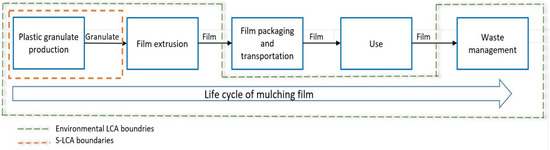
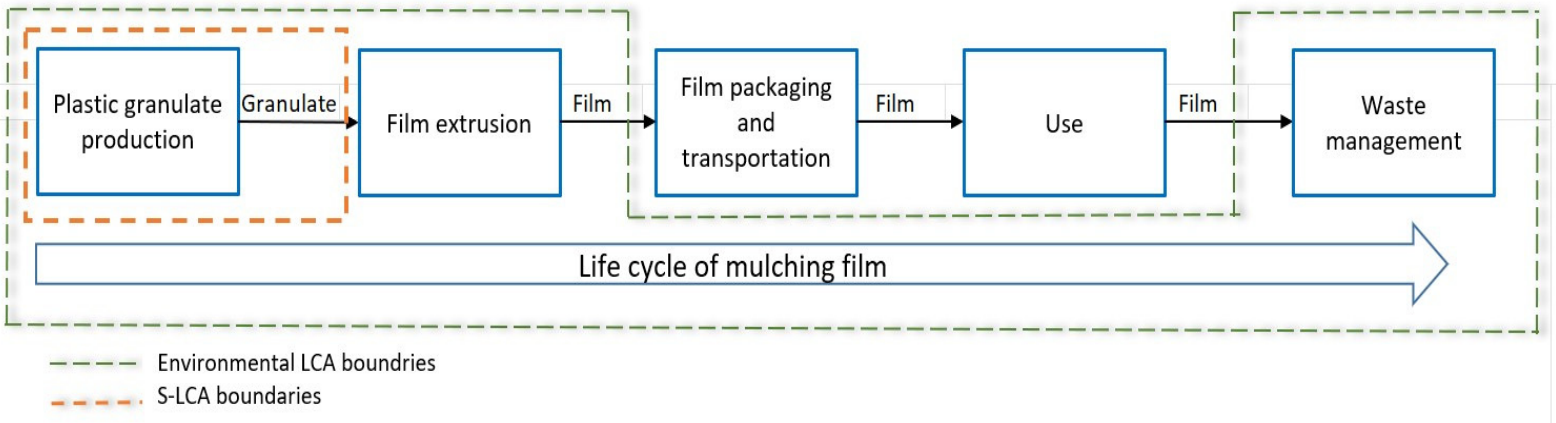
The goal of the study is clearly defined in the introduction. Figure 1 illustrates the system boundaries applied in this study. The environmental LCA covers the life cycle from raw material extraction to product disposal (“cradle to grave”), excluding the use phase, packaging, and transportation, as these were assumed to be comparable across all film types and were not expected to affect the comparative results.
Figure 1.
Environmental and social life cycle boundaries and structure (developed by the authors).
The S-LCA is limited to upstream stages, namely raw material extraction and polymer granule production. This reflects the scope of the Social Hotspot Database.
The functional unit (FU) in the LCA part was defined as 1 kg of transparent mulching film produced.
The average degradation time of PBAT films in soil is approximately two months. Although PLA is considered nonpersistent in soil, its faster degradation compared with conventional plastics limits its use to shorter periods, such as one season. Conventional plastic films, on the other hand, can last three years or more depending on their thickness and other properties. This study did not consider the potential service life of the films, assuming all films were used for the same duration.
Uncertainty analysis, such as Monte Carlo simulation, was not performed in this study. Variability in the system was partly addressed through scenario analysis, including different waste management pathways and country-specific energy mixes. The main objective of the study was to compare alternative scenarios rather than to conduct a full probabilistic assessment.
2.1.2. Inventory of Mulching Film Production
In this study, mostly generic data were used for the LCA models. The data were taken from the LCA database “Ecoinvent v. 3.6” [32]. Ecoinvent contains [32] data on 25,000 different processes and materials. Where no representative data were available in Ecoinvent, it was supplemented with statistical data or information from scientific literature. For this research, data were collected from databases and relevant literature examining identical or similar products. To ensure consistency, all data were converted to uniform mass or energy units per FU for the LCA (Table 1).
Table 1.
Inventory data sources for agricultural mulching film production.
The mulching film made from PLA is produced from 100% PLA plastic. Data on granulate production were collected from the scientific literature [20], focusing on the environmental profile and providing information on overall material and energy consumption rather than on specific production processes. One component of the production process, corn cultivation, was adjusted in the SimaPro 9.1 [31] modeling software by calculating avoided burdens and adding an additional negative carbon dioxide emission of −1.34 kg CO2eq/kg to account for the CO2 absorbed during corn growth. This value was taken from a scientific literature source [33].
In the study involving the modeling of granules using PBAT plastic, a combination of 99% PBAT and 1% UV stabilizer (Irganox 1010) was selected [20]. The stabilizer consists mainly of 2,6-di-tert-butylphenol and is used as an additive.
Film production was modeled using extrusion processes based on datasets available in SimaPro 9.1 (Ecoinvent v3.6). For LDPE, the corresponding extrusion dataset was applied directly, with electricity inputs adapted to the Lithuanian energy mix [31]. For PBAT and PLA, specific extrusion datasets were not available; therefore, extrusion was modeled using the same LDPE-based processing dataset. In these cases, LDPE granulate inputs were replaced with PBAT and PLA granulates, respectively, while maintaining the same process structure and adapting electricity inputs to Lithuanian conditions [32].
When selecting energy inputs for the mulching films granule production process, the Lithuanian electricity mix used in the country was considered. The required thermal energy was introduced accordingly based on the fuel types specified by [20], as well as considering energy production processes modeled in Lithuania. Lithuanian energy was assumed for the production energy, while the components of the product were appropriately accounted for in the global market on data available in the Ecoinvent database [32].
2.1.3. Inventory of Waste Treatment Scenarios
Waste management scenarios can be very different, depending on the waste itself, its collection method, and the existing waste treatment system. In this study, the environmental LCA was modeled with different film waste management scenarios (Table 2). The scenarios were chosen based on the capabilities and availability of waste treatment infrastructure, as well as information from scientific literature, databases, and European waste statistics.
Table 2.
Waste treatment scenarios that have been examined in the study.
2.1.4. PLA Waste Treatment Inventory
This study evaluated three technologically feasible scenarios for processing PLA plastic waste: composting, anaerobic digestion, and incineration (Table 3). PLA was modeled only under industrial composting conditions, as effective degradation requires controlled environments with elevated temperatures and specific microbial activity. Therefore, home composting was not considered a suitable end-of-life scenario for PLA in this study. Data on the anaerobic digestion and composting processes, as well as the resulting residues, were collected from the scientific literature [34]. However, to increase accuracy, the industrial composting data were adjusted based on information regarding the captured carbon and nitrogen content in the soil. These were considered avoided products that enrich the soil in the modeling [33]. Data on the incineration scenario were selected from the Ecoinvent database [32] using SimaPro 9.1 software [31], choosing the process of burning a plastic mixture as an equivalent but adjusting the amount of energy produced according to the calorific value of PLA (19.5 MJ/kg) [20].
Table 3.
The overview of inputs and outputs for treatment of 1 kg of PLA film waste [20,31,33,34].
2.1.5. LDPE Waste Treatment Inventory
In Lithuania, the LDPE waste stream exists, but it is not separately categorized. Agricultural waste is combined into general figures, including all agriculture, fisheries, and forestry. The amounts of separately collected plastic (excluding packaging) are recorded very poorly, so the waste management scenario for mulching LDPE films wasn’t based on Lithuanian agricultural statistics. Instead, statistical data reflecting the collected and processed waste in the EU 2020 with waste code 02 01 04 (plastic waste excluding packaging) were reviewed. Since 51% of the waste was left for subsequent years (unprocessed) or prepared for disposal or treatment, it is unclear what will happen to the remaining waste [35].
Therefore, this model utilized European statistics defining plastics used in agriculture and their management methods. Plastic waste is contaminated, so the waste is composed of 722 kt of plastic and 453 kt of soil, but excluding the soil and considering only the net plastic quantity (722) [10]. Additional data were used to calculate what happens to plastic entering the municipal waste stream in Europe [10]. The obtained results were modeled and referred to as the “combined scenario” (Table 4) [19,35].
Table 4.
“Combined scenario” of LDPE mulching film waste treatment.
To compare scenarios for LDPE plastic film with other examined films, two additional waste management scenarios for LDPE plastic were created: recycling and incineration. Data on these processes were used from the Ecoinvent database [32], adding avoided products. In the recycling scenario, the avoided quantity of new plastic production (0.45 kg) was included, based on the fact that although LDPE is considered a plastic with high recyclability, due to its soil contamination, prolonged exposure to sunlight and soil (as UV radiation and soil microflora degrade this plastic), the yield after recycling such plastic was reduced to 23% [36,37]. In the waste incineration scenario, the avoided need for new electricity and thermal energy production was added, considering the energy generated from incinerating this waste, with a calorific value of 45 MJ/kg for LDPE. The landfill scenario was used from the databases, selecting a modern landfill with gas collection and utilization.
2.1.6. PBAT Waste Treatment Inventory
PBAT contains Irganox 1010, a UV stabilizer that is not biodegradable and can persist in the environment. Therefore, when modeling the home composting scenario for film composting (Table 5), it is assumed that the UV stabilizer will be released into the soil. The remaining quantity of PBAT is calculated based on documented gas emissions and the resulting fraction, equivalent to the formation of compost-like material. This fraction will be converted into organic carbon and nitrogen that is locked in the soil. The model assumes that the fraction captured in the soil represents an avoidance of the additional input of these substances into the soil, as described in the literature [21,38,39]. The waste management data used in this scenario were based on the most detailed available source. Although this data may not fully represent the current situation in 2026, they were used to develop a representative scenario for agricultural plastic waste treatment. Therefore, the results should be interpreted as indicative rather than as a precise reflection of current waste management conditions.
Table 5.
The overview of inputs and outputs for treatment of 1 kg of PBAT film waste [39].
The incineration scenario was chosen based on one generated in the LDPE databases. Additionally, avoided burdens from new electricity and thermal energy production were added based on the energy generated from incinerating the waste [39].
2.1.7. LCA Categories
The ReCiPe Midpoint (H) V1.11 and single IPCC GWP 100a methods were used to assess the environmental impacts. This approach is widely used to evaluate midpoint impacts. The evaluation focused on seven impact categories: global warming potential (GWP 100 years), terrestrial ecotoxicity potential (TETP), freshwater aquatic ecotoxicity potential (FAETP), human toxicity potential (HTP), land use (LU), mineral resource scarcity (MRS), and fossil resource scarcity (FRS). These categories were selected to address the main concerns related to plastic products and their waste. GWP 100 years measures the impact on climate change and carbon emissions. Terrestrial ecotoxicity potential (TETP) reflects the toxicity and persistence of the chemical substance in dry conditions, freshwater aquatic ecotoxicity potential (FAETP) indicates the toxicity and persistence of the chemical substance in freshwater, human toxicity potential (HTP) represents the toxicity and accumulation of the chemical substance in the human food chain, land use (LU) reflects quantity of transformed or temporarily used land, mineral resource scarcity (MRS) expresses the scarcity of mineral resources is based on the excess ore potential, and fossil resource scarcity (FRS) indicates the scarcity of fossil resources is based on the upper heating value. To enable comparisons across different impact categories and scenarios, normalization of the life cycle impact results was conducted using the “ReCiPe 2016 Midpoint (H) V1.04” normalization values, based on the world in the year 2000.
2.2. Social Life Cycle Assessment Methodology
The social impacts of three types of agricultural mulching films (PLA, PBAT, and LDPE) were assessed using S-LCA methods. The LCA software SimaPro v.9.1 [31] and the Ecoinvent [32] were used to model and compute the environmental impacts of the studied processes. In addition, the United Nations Environment Programme Guidelines were followed [40]. Regarding S-LCA, potential social risks were measured by applying SimaPro v. 9.1 and the “Social Hotspots Database” (SHDB) (New Earth B, USA) [41].
2.2.1. S-LCA Methods
This method identifies problematic locations in product or service supply chains that pose the highest risk to humans based on the materials used throughout the manufacturing process. However, this methodology was developed only for production processes and cannot be used to evaluate film production, agricultural use, and end-of-life treatment processes. Thus, this method will assess the socioeconomic risks associated with producing different types of plastic granules (PLA, LDPE, and PBAT).
In addition, granulate production is the most material and resource-intensive stage of the life cycle and contributes a large share of the overall environmental impact, which makes it a relevant focus for the social assessment.
The S-LCA analysis is based on the Social Hotspot Database (SHDB), which uses economic and social indicators referenced to 2011 and adjusted to 2017 conditions. Although these data may not fully reflect the current situation, they provide a consistent basis for comparing relative social risks across regions.
2.2.2. S-LCA Goal, Boundaries, and Functional Unit
The FU for this evaluation is the quantity of materials required to produce one ton of granules, with the value of the materials expressed in United States dollars (USD). Socioeconomic risks associated with producing different types of plastic granulate (PLA, PBAT, and LDPE) were assessed for S-LCA. The stages included in the environmental and social impact assessment are defined by the green line (Figure 1).
2.2.3. Inventory
Based on the data provided in the LCA methodology regarding the materials and quantities required for pellet production, the amounts of raw materials used were converted into monetary values according to their market prices in Lithuania in 2017 (USD 2017) [42]. Since the SHDB [41] is based on 2011 data, the monetary values had to be recalculated to match 2011 levels. Therefore, it was assumed that from 2011 to 2017 inflation reduced the value of USD by 9%, and the values were accordingly adjusted by 9% (USD 2011). The inputs must be assigned to industry sectors according to the codes developed in the “Global Trade Analysis Project” (GTAP category) [43]. All calculations were performed in Microsoft Excel, and the data for the analyzed pellets are presented in the table (Table 6).
Table 6.
The inventory data of S-LCA for PLA, LDPE and PBAT granulate production [42,43].
To gain a more profound understanding of the significance of the location of raw material procurement, a comparative analysis was conducted on the same products from three distinct countries: Lithuania, Poland, and China. It was hypothesized that the created product value would be equivalent in all three countries under investigation. Table 6 presents the results of the inventory data, which were used for the S-LCA analysis and modeled separately for three different countries (Lithuania, Poland, and China). Moreover, the current modeling approach only considers the materials that were directly consumed, while the existing databases are not yet configured to evaluate the impact of the energy consumed in the process.
Data were compiled into the SimaPro 9.1 [31], software using the SHDB database [41], which is module-based and includes key components: information on trade flows between countries or segmented world regions based on GATP (Global Trade Analysis Project) [43]; information on the working hours of the economic sector, calculated in monetary value and converted into USD; information on social risks and opportunities in each country and its economic sectors [41]. Therefore, utilizing this database allows the identification of social risks and hotspots.
2.2.4. Categories
To obtain the results, the collected data, converted into monetary value, was organized according to the mentioned GTAP categories [43]. These categories assign each product to the relevant industry branch in a general sense. The GTAP is coordinated by the Global Trade Analysis Center within the Department of Agricultural Economics at Purdue University. The project receives primary support and advice from international and national agencies worldwide, including the WTO, EU JRC, World Bank, US EPA, and others [43].
The SHDB database consists of information related to 160 indicators associated with 26 subcategories, 5 categories and 4 stakeholder groups: workers, local communities, value chain participants, and society (Table 7). Social risks and opportunities are expressed in average hours equivalent for each country. This expression allows for the calculation of the social footprint and the identification of problematic areas.
Table 7.
Categories of social impact and their subcategories of social indicators [40,41].
In modeling the results, it was chosen to examine five categories of social impact (Table 7) to provide a broader overview of possible social impacts.
3. Results
3.1. LCA of Plastic Granulate Production
The scenarios were modeled for producing 3 different types of plastic granules (PLA, PBAT, and LDPE), and the results were evaluated and compared in terms of LCA characterization in 7 different impact categories. These impacts categories reflect the most relevant aspects related to the production of these materials.
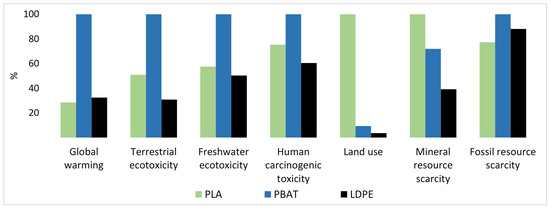
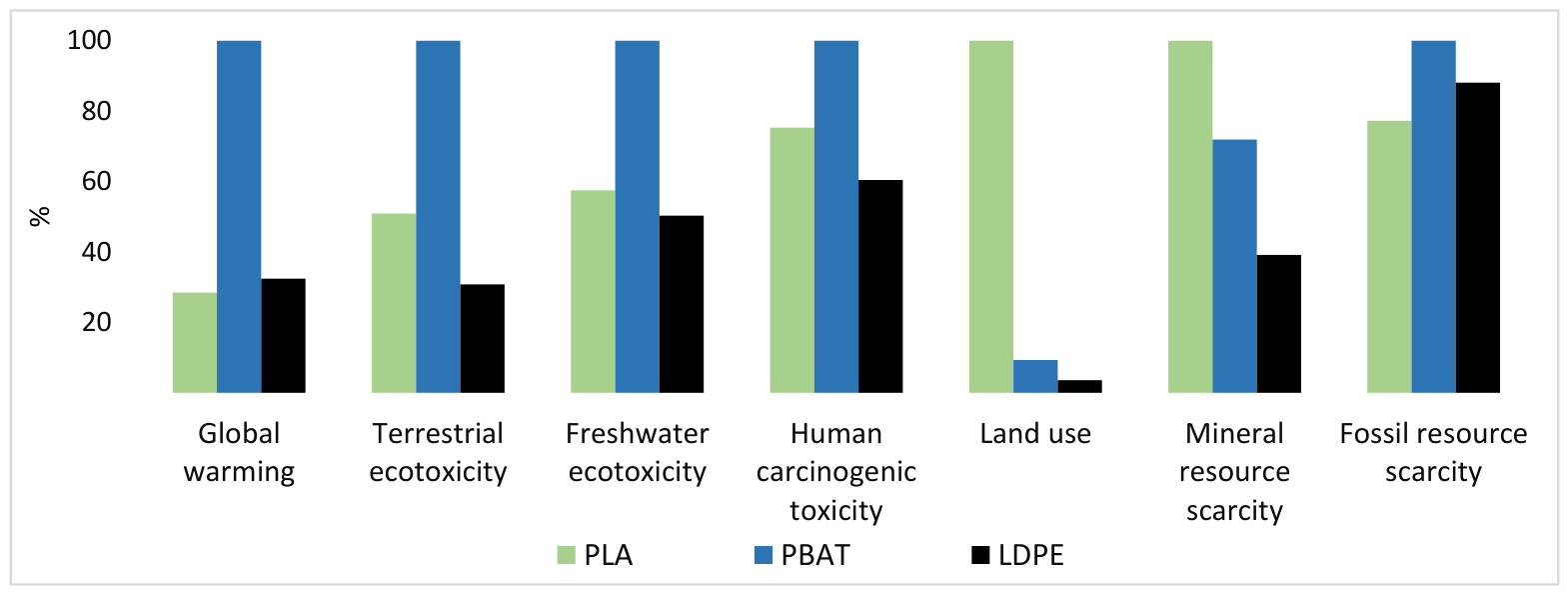
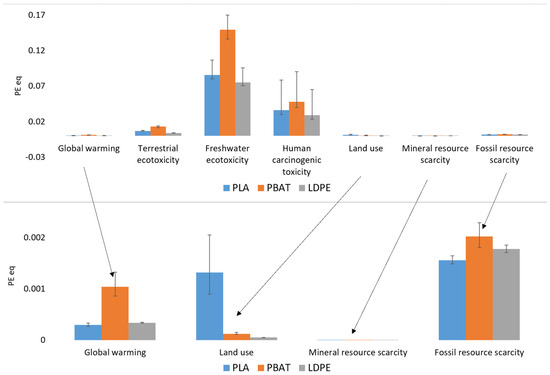
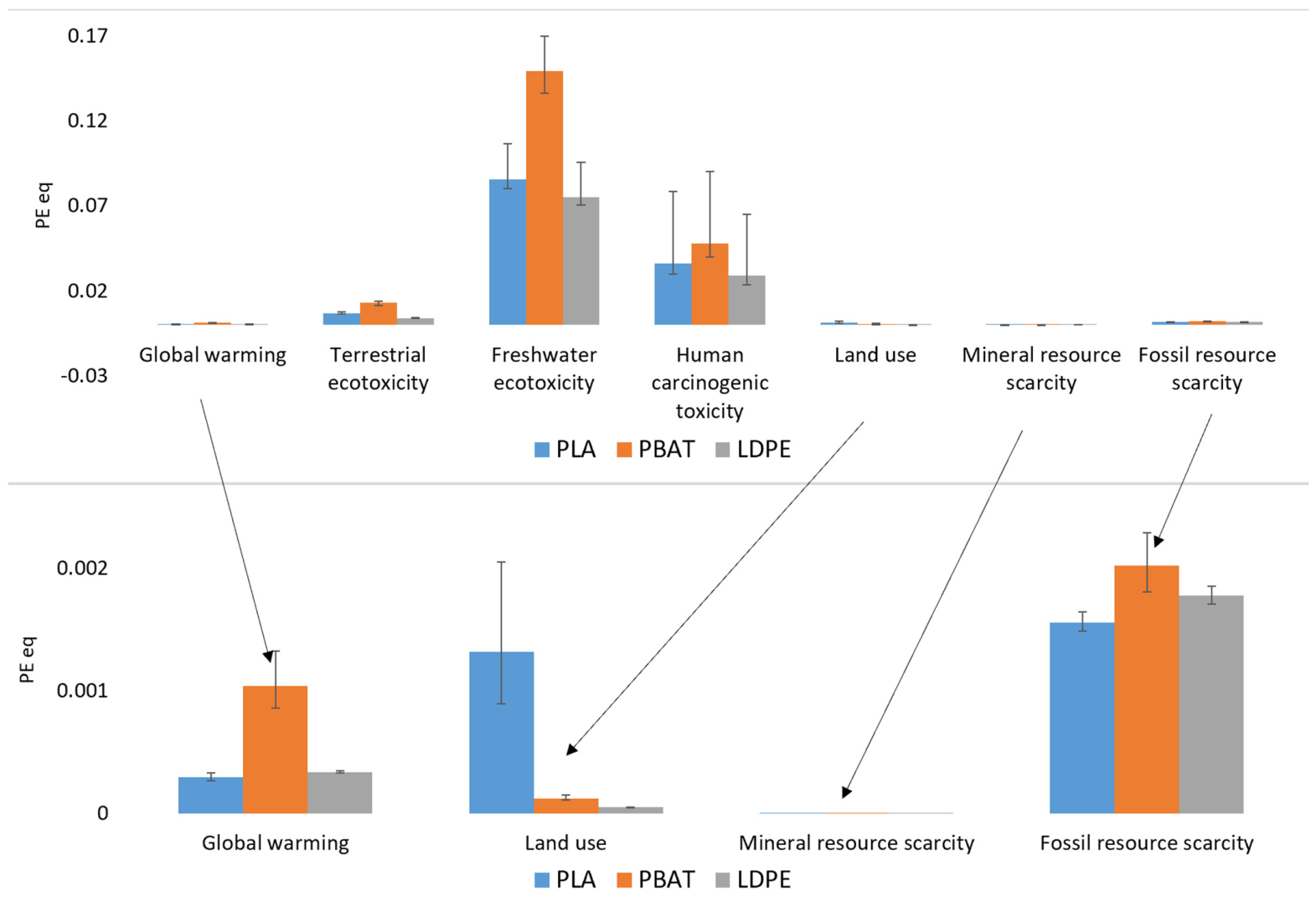
The results show that PBAT granules have the highest impact in five out of seven categories. PLA granules are associated with the highest potential impact in the land use and mineral resource depletion categories. For LDPE, the highest impact is in the fossil resource depletion category (Figure 2).
Figure 2.
Comparison of relative impact of plastic granule production processes based on characterization assessment (LCA method: Recipe 2016 Midpoint (H) V1.04).
When evaluating global warming potential, PBAT granule production has the highest potential impact, while PLA granulate production has 3.5 times less impact and LDPE production has 3 times less impact. PLA has about 2 times less impact on terrestrial ecotoxicity compared to PBAT, while LDPE has 3.2 times less impact compared to PBAT. Similar proportions were found in the evaluation of freshwater ecotoxicity, with PLA and LDPE granules having nearly half the impact of PBAT. One of the smallest differences was found in the evaluation of human carcinogenic toxicity: PBAT creates only 1.3 times less impact than PLA, despite having the highest value. However, land use is a problematic area for PLA because PBAT and LDPE create footprints that are 10.8 and 28.5 times smaller, respectively, than PLA’s footprint. The mineral resource scarcity category also shows that PLA granule production has the greatest impact in this area. Fossil resource scarcity is associated with all three types of granules, even with PLA, which is treated as biologically sourced plastic (Figure 2) [20,23,44].
After normalizing the data, it has been found that the greatest impact could be associated with freshwater ecotoxicity and human carcinogenic toxicity (Figure 3). The greatest impact in both categories was attributed to the production of PBAT granules. PBAT granule production creates a 2 times greater risk compared to PLA and to LDPE. The risk ratio remains similar for human carcinogenic toxicity, but this impact is associated with a lower overall impact. The normalization analysis indicates that the remaining impact categories do not raise significant potential impact due to their expected small contribution to environmental impact. Impacts category values of land use has the highest values associated with PLA production and global warming, fossil resource scarcity—with PBAT production (Figure 3).
Figure 3.
The environmental impact of plastic granule production processes based on normalization results (LCA Method: ReCiPe 2016 Midpoint (H) V1.04/World (2010) H/Normalization).
3.1.1. PBAT Plastic Granulate Production
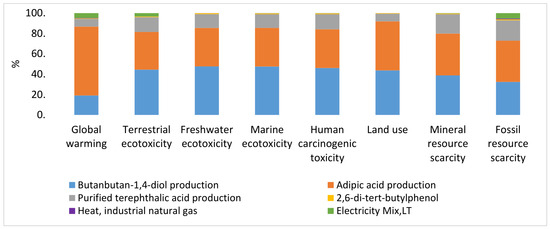
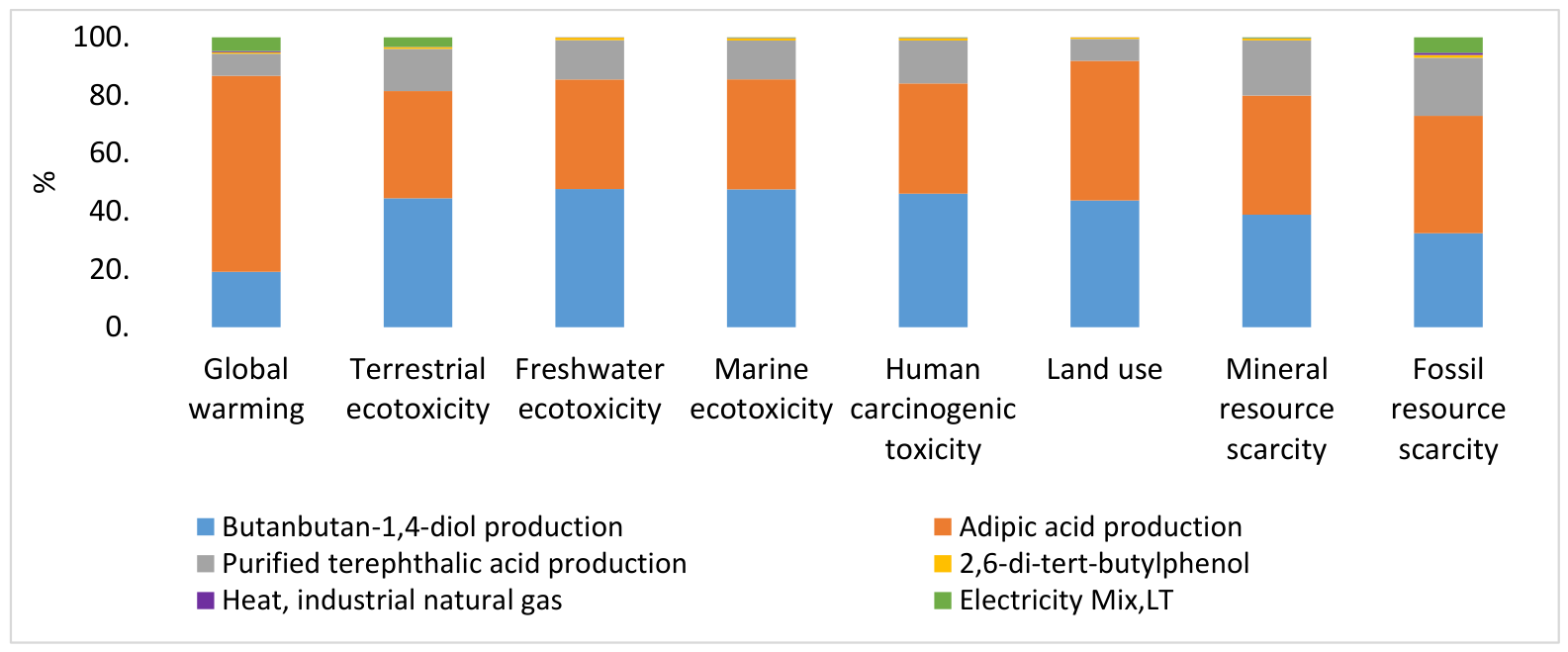
To gain a deeper understanding of the environmental impact pathways and causes, the highest environmental risk associated with production processes and inputs was examined in more detail. Firstly, the production process for PBAT granules was modeled, revealing three main inputs contributing the most potential environmental impact of the granulates (Figure 4): the production of butan-1,4-diol, the production of adipic acid, and the production of purified terephthalic acid. According to the characterization data, the production of butan-1,4-diol and adipic acid is responsible for approximately 85% of the impact created by PBAT.
Figure 4.
Contribution of different components of PBAT to the total granulate production impact (Method: “ReCiPe 2016 Midpoint (H) V1.04”, characterization).
3.1.2. PLA Plastic Granulate Production
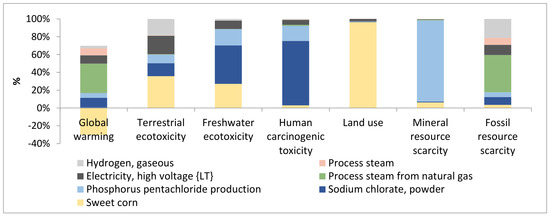
Further modeling with the characterization data of PLA granule production (Figure 5) shows that the cultivation of sweet corn, the production of phosphorus pentachloride, and the production of sodium chlorate powder have the biggest environmental impact potential.
Figure 5.
Contribution of different components of PLA to the total granulate production impact (Method: “ReCiPe 2016 Midpoint (H) V1.04”, characterization).
The production of phosphorus pentachloride only contributes significantly to the depletion of mineral resources indicator, while the cultivation of sweet corn contributes to the land use indicator. The production of sodium chlorate powder mainly contributes to the risk of environmental impact associated with carcinogenic toxicity and ecotoxicity to freshwater, although its contribution based on characterization is only 55% and 28%, respectively, as mentioned earlier in the normalization results; these two impact categories are responsible for the greatest potential harm (Figure 5). Therefore, the use of sodium chlorate in the production of PLA granules may be responsible for a significant portion of the environmental impact associated with toxicity to freshwater and humans.
The use and production of thermal energy in the factory also showed a relatively high contribution to the indicators of global warming and depletion of fossil resources (Figure 5). It is believed that these data obtained indicate the issue of energy consumption in PLA granule production compared to PBAT and LDPE, which have the highest energy demand. The results thus obtained are compatible with other studies, which indicated that the generation of energy used is crucial when evaluating PLA life cycle environmental aspects and suggested that changing traditional power sources to 100% renewable sources can reduce the environmental impact of PLA production [33].
3.1.3. LDPE Plastic Granulate Production
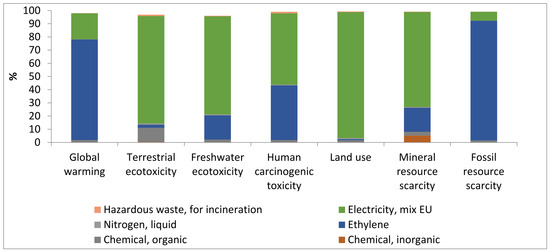
Further analysis of the potential environmental impact of LDPE granules showed that the majority of the possible negative impact of this process is created by electricity production (specifically, the amount of electricity consumed in granule production) and ethylene production (Figure 6). The latter has the biggest impact in the areas of fossil resource depletion and global warming, generating 91% and 76% of the total impact, respectively. However, the amount of electricity used in granule production is the main driver that creates the biggest impact in the remaining five impact categories, ranging from 54% for human cancer toxicity risk to 96% for all impacts related to land use (Figure 6).
Figure 6.
Contribution of different components of LDPE to the total granulate production impact (Method: “ReCiPe 2016 Midpoint (H) V1.04”, characterization).
3.2. Evaluation of LCA of Waste Management Scenarios
Several possible waste-management scenarios were examined for each film, taking into account the methods discussed in the literature [3,5,13,19,39,44,45,46] for these and similar waste-management options. The IPCC GWP 100a method was applied to assess the global warming potential.
3.2.1. LCA of PBAT Waste Management Scenarios
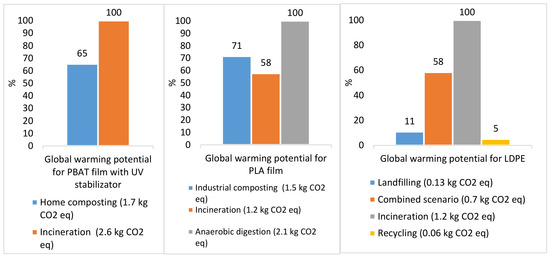
First, two possible scenarios were modeled for the PBAT film made from waste: home composting and incineration. Anaerobic digestion and recycling of this type of film were considered impossible or inapplicable. Among those examined, this film is the only one that can decompose in soil due to its relatively short expected decomposition time (70% decomposes in 50–60 days [39]. Home composting could result in 1.5 times less global warming potential impact compared to incinerating these films (Figure 7). However, home composting of the PBAT film would not result in 100% decomposition of the material. This is primarily because the PBAT additive “Irganox 1010”, which was used in the modeling, is not biodegradable. It remains in the soil after the plastic decomposes and could contribute to a negative environmental impact. Additionally, composted PBAT breaks down into an organic compost similar to peat, which is expected to capture carbon and nitrogen that will be released into the environment over time. Furthermore, the amount and composition of gases produced during composting can vary greatly due to composting conditions (e.g., air temperature and moisture). In other words, while home composting of PBAT films can improve soil quality by adding carbon and nitrogen, the potential for negative environmental impact remains due to the additives used and the gases emitted during decomposition [3,23].
Figure 7.
The results of the global warming potential of processing 1 kg of mulching film waste in different scenarios (LCA method: IPCC GWP 100a, characterization).
As shown (Figure 7), the incineration scenario of PBAT films has a higher environmental impact compared to home composting. This is mainly related to the direct release of greenhouse gases during combustion, where most of the carbon contained in the material is emitted as CO2 [39]. Although a significant amount of energy can be obtained by incinerating PBAT, it is expected that a larger quantity of greenhouse gases will be released into the atmosphere. Additionally, this process requires the transportation of the necessary fuel to bring the waste to the incineration facilities. On the other hand, when leaving the film for home composting, its transportation to distant locations would not be necessary.
3.2.2. LCA of PLA Waste Management Scenarios
The use of PLA films raises discussions about their ability to biodegrade. While in some cases, this type of film is presented as biodegradable [23,47,48], others show that PLA products are unsuitable for home composting [39]. However, scientific literature discusses industrial composting, anaerobic digestion, and incineration as potential methods for treating PLA waste. Therefore, this study modeled these potential waste scenarios (Figure 7).
The obtained results indicate that the incineration scenario of PLA has the lowest potential environmental impact (1.7 times lower than anaerobic digestion and 1.4 times lower than industrial composting scenarios), while anaerobic digestion showed the highest impact (Figure 7). These results are related to the overall balance between emissions generated during combustion and the environmental benefits associated with energy recovery, as represented in the LCA model. Although the amount of recovered energy is lower compared to other materials, controlled incineration of PLA waste may result in a relatively lower environmental impact per functional unit. When compared to studies conducted by other authors, the incineration scenario shows similar ranges of impact, reaching 0.8–1.8 kg CO2eq [24,34,36]. However, some studies report lower impacts when additional avoided products, such as reduced fertilizer use, are included in the system boundaries [39]. Other authors describe PLA as capable of degrading into compost, leaving primarily carbon in the composting process [34], which is consistent with the approach followed in this study.
During the study conducted in this work, industrial anaerobic digestion (with gas collection) showed the highest global warming potential. These results align with the general trend observed in other studies, indicating that such waste treatment (excluding recycling and landfilling) can be responsible for the largest impact, ranging from 1.4 to 2.1 kg CO2eq [24,39]. It is believed that the associated risk with this waste treatment scenario arises due to increased methane emissions, the combustion of methane byproducts, and the requirement for maintaining specific temperature conditions and other processes that demand additional energy input [39].
In addition, this study evaluated the possibility of industrial (aerobic) composting. This process showed the potential to generate 1.5 kg CO2eq (the literature review indicated a range of 1.47–1.5 kg CO2eq [24,39]. This impact may have occurred because the gases generated during waste treatment or the available calorific value are not utilized for energy production. Only compost is obtained as a beneficial output, but it contains only small amounts of carbon (Table 4). Such compost cannot be considered a suitable substitute for required fertilizers (the quantity of avoided fertilizers cannot be included in the modeling) [34]. Therefore, according to the literature, its agronomic value may be limited compared to conventional organic fertilizers, which show a minimal positive contribution to the overall kg CO2eq footprint, so this process can generate a greater impact than incineration.
3.2.3. LCA of LDPE Waste Management Scenarios
Four scenarios were evaluated for the treatment of LDPE films: three potential scenarios from Ecoinvent [32] or the literature and one “combined scenario” (see methodology) (Figure 7). Even when considering the additional energy generated, the incineration scenario shows the highest anticipated impact. It generates a pollution risk that is 1.75 times higher than the combined scenario, 9.3 times higher than the landfilling scenario, and 20.8 times higher than the recycling scenario.
When modeling the combustion scenario, data were taken from a used Ecoinvent database [32], subtracting the amounts of energy produced. LDPE plastic is made from oil, so when burned, it releases anthropogenic pollutants (CO2, CH4, etc.), with LDPE combustion identified as the scenario causing the greatest possible impact, reaching the limit of 1.4 kg CO2eq in other studies of this nature [36], also using the Ecoinvent database [32]. The combined waste management scenario includes recycling, landfilling, recycling again, and open and closed incineration, with a large portion still being attributed to controlled (closed) incineration (45%) and open incineration (4%) (Figure 7). The impact of this scenario is higher compared to others, except for combustion.
One of the least impactful scenarios is LDPE film disposal in a landfill (only 0.130 kg CO2), even though this waste management method is not considered good practice. However, when evaluating it based on the generated kg CO2eq, the results are low due to the slow degradation of plastic in landfills. The model predicts that only 1% of this material will decompose over 100 years. Another study using Ecoinvent [32] data also showed that this scenario generates relatively low emissions [36]. The least likely impact on the environment is expected when recycling such waste (Figure 7).
3.3. LCA of the Full Life Cycle of Mulch Film
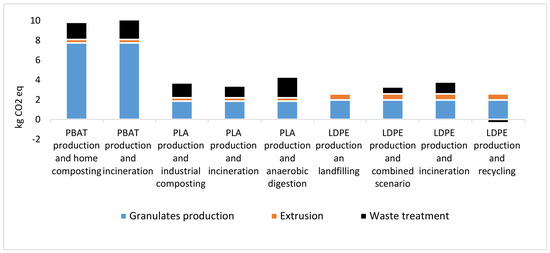
In order to integrate all the obtained results into a comprehensive assessment of the entire life cycle of mulch film, the processes involved (granule production, film manufacturing (extrusion process), and film end-of-life treatment) were combined into a single graph and recalculated using the “IPCC GWP 100a” method, which expresses the potential environmental impact in kg CO2eq (Figure 8).
Figure 8.
The environmental impact of LDPE/PLA/PBAT films using the “IPCC GWP 100a, kg CO2eq” method.
Based on the assessment of these data, it can be concluded that LDPE films can have the lowest environmental impact compared to PLA and PBAT films. PLA and PBAT films have a higher impact due to their manufacturing processes and chemical composition.
The findings indicate that the production of granules represents the most significant environmental burden across the life cycle of all analyzed films, consistent with conclusions reported in similar studies [25,36]. Granule production, in all the scenarios examined, accounts for no less than 50% of all the risk generated. The second most important process is the chosen method of waste disposal, which is responsible for −4 to 28% of the total generated impact, while extrusion accounts for only 4–6% (Figure 8).
Compared to the other analyzed films, PBAT plastic films generate the highest potential environmental impact, ranging from 9.3 to 10.2 kg CO2eq, depending on the chosen waste disposal method (Figure 8). PLA plastic films showed a potential environmental impact that is, on average, 2.6 times lower than that of PBAT, but on average 1.3 times higher than that of LDPE scenarios. PLA’s life cycle is significantly affected not only by granule production but also by waste disposal. The LCA of LDPE plastic films showed the lowest possible impact if the films are recycled or disposed of in a landfill at the end of their life cycle.
Therefore, when evaluating the life cycle using the “IPCC GWP 100a” method, the results indicate that the best environmentally friendly option should be LDPE film, produced by extrusion and directed for recycling at the end of its life cycle. And the worst option, in terms of environmental impact, should be PBAT film, produced by extrusion and directed for incineration at the end of its life cycle.
3.4. S-LCA of Plastic Granulate Production
To gain a broader perspective on the product under consideration, we decided to assess the potential social impact and risks associated with the granules used to produce plastic film by comparing them. The possibility of producing identical products in different countries was also discussed: Lithuania (LT), Poland (PL), and China (CN).
3.4.1. S-LCA of LDPE Plastic Granulate Production
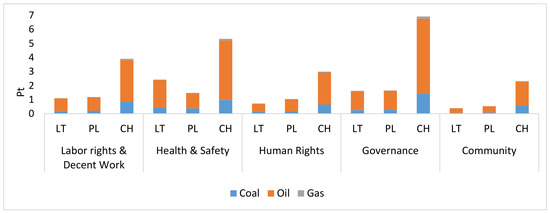
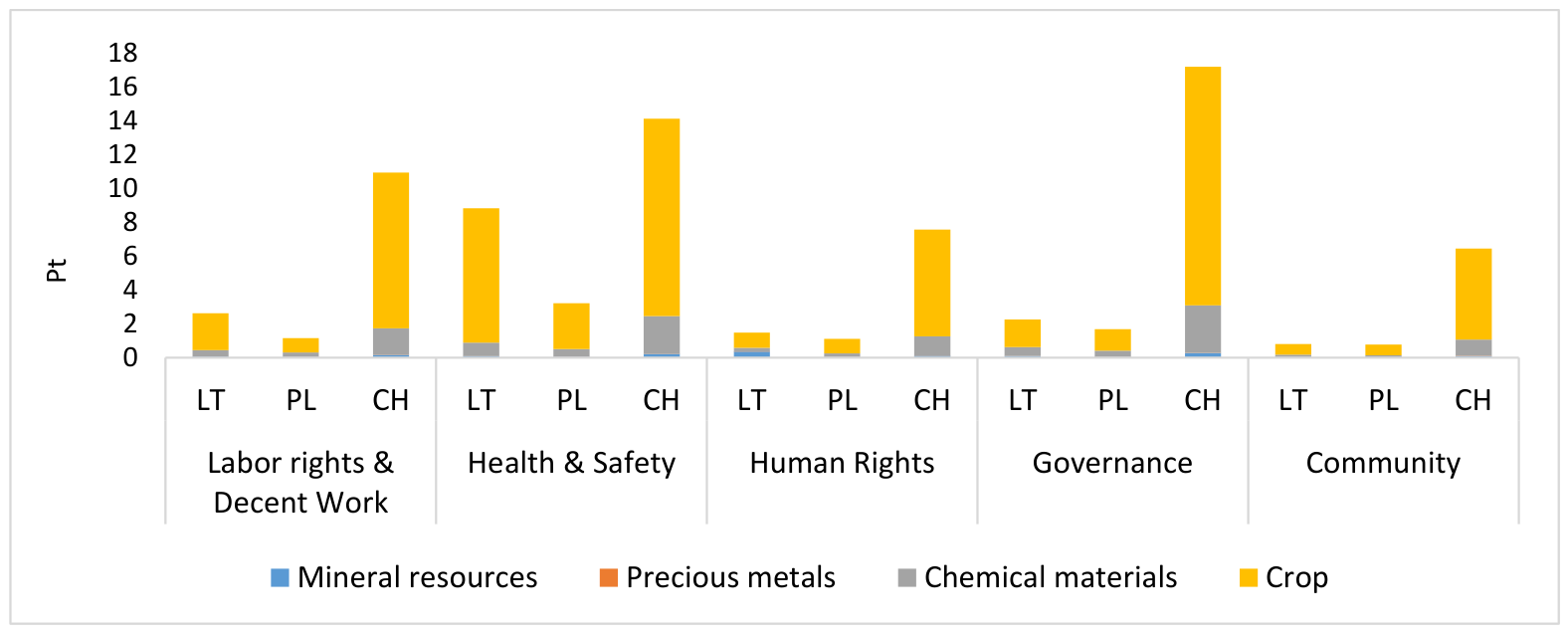
Using this approach, the results showed that the greatest likelihood of negative social impact associated with the product could arise from the use of petroleum-based products in the production of LDPE granules (Figure 9), indicating that attention should be paid to the suppliers of these materials and their social responsibility in order to produce socially responsible LDPE granules.
Figure 9.
Comparison of S-LCA of the raw materials used to produce LDPE granules among different countries: Lithuania (LT), Poland (PL), and China (CN) (method: Social Hotspot 2019 Category Method w Weights).
However, social risk is distributed differently across 5 categories and heavily depends on the country in which these products will be manufactured and extracted. The results showed that when producing the necessary raw materials in LT and PL, a very similar level of risk will be created in all categories, but the highest risk is related to worker health and safety, indicating that when producing plastics from oil, it would be necessary to pay the most attention to conditions related to worker health and safety in LT or PL (Figure 9).
CN showed the highest deviation in this study, measuring risk compared to LT and PL. This indicates that when producing the same products in CN instead of LT or PL, the probability of social risk can increase by up to almost 6 times, depending on the risk categories, ranging from double the impact on the health and safety category to almost 6 times the risk associated with the local community (Figure 9).
3.4.2. S-LCA of PBAT Plastic Granulate Production
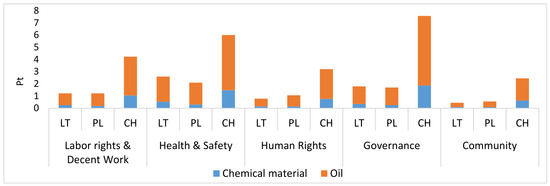
Examining the raw materials used to produce other granules (PBAT), the results showed that the highest likelihood of negative social impact associated with the product may arise from the use of petroleum-based products (as with LDPE) (Figure 10), which means that, in order to produce socially responsible PBAT granules, attention should also be paid to the social responsibility of the raw material suppliers.
Figure 10.
Comparison of S-LCA of the raw materials used to produce PBAT granules among different countries: Lithuania (LT), Poland (PL), and China (CN) (method: Social Hotspot 2019 Category Method w Weights).
Looking at SLCA for PBAT granules, CN (China) showed the highest level of risk when assessing social risks compared to LT and PL. This indicates that when producing the same products in CN instead of LT or PL, the probability of social risks, according to risk categories, can increase from 2.8 times higher impact on health and safety category to nearly 4.7 times higher risk associated with governance (Figure 10).
3.4.3. S-LCA of PLA Plastic Granulate Production
Regarding the production of other granules (PLA), the results showed that the highest probability of negative social impact can arise from the use of natural products grown as crops (in this case, corn cultivation) (Figure 11). This means that to produce socially responsible PLA granules, attention should be paid to the suppliers of this raw material and their social responsibility.
Figure 11.
Comparison of S-LCA of the raw materials used to produce PLA granules among different countries: Lithuania (LT), Poland (PL), and China (CN) (method: Social Hotspot 2019 Category Method w Weights).
However, when simulating scenarios with different countries, the results showed that during the production of necessary raw materials, Lithuania (LT) and Poland (PL) would have a similar level of risk in all categories, except for the “health and safety” category. In the second category, LT had a 2.3 times higher risk for workers in this industry compared to PL and a 1.6 times lower risk compared to China (CN).
In this study, CN, like other examined granules, exhibited the highest level of differentiation in terms of risk when compared to LT and PL. This indicates that when producing the same products, the probability of social risks in CN, instead of LT or PL, can increase from 1.4 times higher impact in the health and safety category to almost 10 times higher risk associated with governance (Figure 11). Therefore, it can be assumed that when choosing raw materials for PLA production, the fewest social challenges would arise when selecting raw materials from Poland (PL). When choosing raw materials from Lithuania (LT), the greatest attention should be paid to the quality of suppliers’ health and safety policies and their implementation. Meanwhile, when selecting raw materials from China (CN), the highest potential risk arises across all analyzed categories, and additional attention should be given to all categories.
4. Conclusions
This study examined plastic mulching films and alternative products made from bioplastics. The literature review indicated that most of these films are made from LDPE plastic, and at the end of their life cycle, they become contaminated with soil or are difficult to collect, posing a long-term risk of plastic pollution [7,8,15]. The raw materials used in LDPE production come from non-renewable resources, whose use will be increasingly restricted in the future [2].
Bioplastic alternatives proposed for replacing traditional LDPE films can address the mentioned problems encountered with LDPE films. However, even commercially available films made from PLA or PBAT may not necessarily exhibit the desired properties, as this strongly depends on the composition of the films (including additives and mixture ratios), their usage conditions, changes in soil and temperature, and the raw materials, processes, or final waste treatment methods used in their production [2,15,17,19]. Some studies report that biodegradable mulch films can improve soil carbon and nitrogen pools, although their long-term sustainability is strongly influenced by local conditions and degradation processes, which remain insufficiently studied [49].
The LCA conducted to compare three types of mulch films (made from PLA, PBAT, or LDPE) revealed that the highest impact on the environment (within the boundaries of the analyzed life cycle) is generated during the production of plastic granules. This process accounts for at least 50% of the overall potential environmental impact of the film. However, although granule production is responsible for the largest impacts among all the studied processes, PBAT granule production generates 7.3 kg CO2eq, while LDPE generates only 1.9 kg CO2eq, and PLA granules have the least impact, 1.86 kg CO2eq, when considering the global warming potential with the IPCC 100a method. These findings are consistent with the results reported by de Sadeleer and Woodhouse (2024), who also showed that PBAT raw material production generates higher CO2eq emissions than the production of LDPE raw materials. All of this indicates that improving sustainability in mulch film systems should primarily target raw material production, including the use of renewable energy, secondary materials, or waste-based feedstocks [25].
The largest environmental impact generated throughout the studied life cycle is assessed for the PBAT plastic films, which create a potential environmental impact ranging from 9.3 to 10.2 kg CO2eq, depending on the chosen waste treatment method. Studies conducted by Hermann et al. (2011) [39] demonstrated that different waste management options can significantly influence LCA results. For this reason, various end-of-life treatment scenarios for plastic films were also examined in detail order to perform a robust sensitivity analysis [20].
Accordingly, the present study also evaluated several realistic waste treatment scenarios, which further highlighted the importance of the end-of-life phase when comparing PLA, PBAT, and LDPE plastics. The modeling of LDPE waste management takes into account real-world limitations of recycling, such as contamination and reduced material quality. A “combined scenario” was used to better reflect typical conditions, while a separate full recycling scenario represents an ideal case. The results suggest that full recycling of LDPE mulching films is currently difficult to achieve in practice. However, if such conditions were reached, it could significantly reduce the overall carbon footprint, highlighting the importance of improving recycling systems. The lowest environmental impact is expected when selecting traditional plastic (LDPE), but if these are collected as waste and sent for recycling, even a low recycling rate (estimated at 23%) still compensates for the damage that would be created when producing new plastic (−0.33 kg CO2eq). Recycling of agricultural plastics remains technically challenging due to contamination and degradation during use, which limits the practical sustainability of this option in many agricultural systems [37].
The social life cycle analysis, which assessed the social impact of materials used in the production of plastic granules, indicated that the highest social risks in LDPE granule production are associated with components derived from petroleum products. However, when producing these components in Lithuania (LT) or Poland (PL), one can expect a more socially responsible production compared to China (CN). PBAT granule production demonstrated a similar nature and magnitude of risks, as the highest social risk indicators were linked to raw materials derived from petroleum. Moreover, when producing these components in Lithuania (LT) or Poland (PL), one can expect a more socially responsible production compared to China (CN). PLA granule production stood out, as the highest social risk was associated with crop cultivation (specifically, the cultivation of corn). Therefore, when choosing suppliers in Lithuania or Poland to ensure social responsibility, particular attention should be paid to social risks related to health and safety.
A limitation of this study is the absence of a formal uncertainty analysis. Although different scenarios were used to reflect variability in waste management options, a probabilistic approach, such as Monte Carlo simulation, was not applied. This is particularly relevant for the environmental LCA results, where uncertainty analysis could improve the robustness and comparability of the findings. For the S-LCA, the application of such methods remains challenging due to the semi-quantitative nature of the data and limited system boundaries. Future research should aim to incorporate uncertainty analysis, especially for environmental LCA, when more consistent data become available.
The results primarily reflect conditions relevant to Lithuania, as well as selected production contexts in Poland and China. However, as many data inputs are based on widely used databases and literature, the findings may also provide useful insights for similar assessments in other regions. A more detailed analysis of regional variability was beyond the scope of this study.
5. Discussions
The study showed that, throughout their life cycles, PBAT-based mulching films can have a greater environmental impact than other alternatives, such as mulch films made from LDPE and PLA. However, the following uncertainties and limitations may influence the final conclusions. The model does not account for the practical benefit that it can degrade in soil. This eliminates the need for collecting and transporting the film after use. This may improve sustainability by reducing fuel consumption, labor requirements, and waste management processes in agricultural systems.
This study evaluates both well-established and emerging production systems. Conventional plastics have been produced and widely used for over 100 years, while bioplastics still represent a relatively small and developing market, especially in the case of mulch films, which have only been used more widely in recent decades. As a result, data for biobased films remain limited, likely due to commercial and developmental factors. Another limitation is that materials were modeled as general polymer types, whereas in practice their composition can vary depending on additives and formulations used by different producers, which may influence environmental and health-related impacts. These variations were not explicitly included, so the results should be interpreted as representative rather than product-specific, and future studies could further refine the assessment by considering material-specific compositions.
When assessing land use for plastics made from natural versus petroleum-based feedstocks, the model includes the land area required for growing raw materials and related processes for bio-based plastics. In contrast, for petroleum-based feedstocks, the model does not account for land needed for securing oil extraction sites or the potential environmental impacts of ecological disasters (e.g., oil spills, fires) on land use. These factors may influence sustainability comparisons, particularly when considering long-term ecosystem impacts.
Also, LCA is not designed to evaluate the likelihood and impact of littering - the accidental disposal of waste in the environment. However, one of the most emphasized issues related to plastics is their entry into terrestrial and aquatic ecosystems through littering. Assessing this phenomenon is particularly important when comparing biodegradable and non-biodegradable plastics, given their drastically different degradation rates in the environment (from a few months to several centuries or more).
Although PBAT is considered biodegradable, its degradation under real conditions may be incomplete, and fragmentation can lead to microplastic formation. Degradation rates depend on factors such as temperature, moisture, and microbial activity. Over the long term, both biodegradable and conventional mulching films may contribute to plastic accumulation in soil. Studies suggest that after 10 years of repeated application, biodegradable and conventional mulching films may result in approximately 450 kg/ha of plastic residues in soil [12,47]. These findings indicate that both materials may pose similar long-term risks depending on management practices, although this aspect was beyond the scope of this study and remains a topic for future research.
Soil type was not explicitly considered in this study, as the applied datasets do not include it as a variable. While soil characteristics may influence degradation processes, their inclusion would require a more detailed, site-specific analysis and is therefore identified as a topic for future research.
S-LCA has been in use since 2011 and is still considered an emerging method with limited databases and no fully established standardization, although it has strong potential. In contrast, environmental LCA is a well-developed and standardized approach supported by numerous databases and widely applied in similar studies. As a result, S-LCA outcomes are generally less precise and may evolve as methods and data improve. In this study, environmental and social results were presented in parallel rather than combined into a single sustainability indicator, reflecting methodological differences between environmental LCA, which is fully quantitative and S-LCA, which often relies on semi-quantitative indicators. Due to differences in system boundaries, data structure, and methodological maturity, direct integration remains challenging, and separate interpretation was considered more appropriate, while integrated approaches remain an important direction for future research.
The results and reviewed literature indicate that while bioplastic production still requires diverse raw materials, energy-intensive processes, and waste management systems not suited for these residues, responsible use of conventional plastics in agriculture currently shows better environmental prospects. However, this principle does not apply universally, and farmers using these films should select products only after carefully evaluating current and potential usage and disposal conditions, as well as considering the composition and country of origin of the supplied materials. Improving sustainability in agricultural mulching systems will require material innovation, improved recycling infrastructure, and consideration of long-term soil health and circular economy principles.
Author Contributions
Conceptualization, D.L. and D.K.; methodology, D.L. and D.K.; software, V.V. and D.K.; validation, V.L., V.V. and D.K.; formal analysis, D.L. and D.K.; investigation, D.L., V.V. and D.K.; resources D.L., V.L. and D.K.; data curation, D.K.; writing—original draft preparation, D.K., D.L. and V.V.; writing—review and editing, D.L. and D.K.; visualization, D.L.; supervision, V.V. and D.K.; project administration, V.V.; funding acquisition, V.V. All authors have read and agreed to the published version of the manuscript.
Funding
Research was conducted as part of the execution of Project “Mission-driven Implementation of Science and Innovation Programmes” (No. 02-002-P-0001), funded by the Economic Revitalization and Resilience Enhancement Plan “New Generation Lithuania”.
Institutional Review Board Statement
Not applicable.
Informed Consent Statement
Not applicable.
Data Availability Statement
The raw data supporting the conclusions of this article will be made available by the authors on request.
Conflicts of Interest
The authors declare no conflicts of interest. The funders had no role in the design of the study; in the collection, analyses, or interpretation of data; in the writing of the manuscript; or in the decision to publish the results.
Abbreviations
| LCA | Environmental life cycle assessment |
| S-LCA | Social life cycle assessment |
| LDPE | Low-density polyethylene |
| PLA | Polylactic acid |
| PBAT | Polybutylene Adipate Terephthalate |
| PE | Polyethylene |
| PP | Polypropylen |
| CIPA | Comité International des Plastiques en Agriculture (International Committee of Plastics in Agriculture) |
| ISO | International Organization for Standardization |
| FU | Functional unit |
| UV | Ultraviolet |
| EU | European Union |
| IPCC | Intergovernmental Panel on Climate Change |
| GWP | global warming potential |
| TETP | Terrestrial ecotoxicity potential |
| FAETP | Freshwater aquatic ecotoxicity potential |
| HTP | human toxicity potential |
| LU | Land use |
| MRS | Mineral resource scarcity |
| FRS | Fossil resource scarcity |
| USD | United States dollars |
| SHDB | Social Hotspots Database |
| GTAP | Global Trade Analysis Project |
| WTO | World Trade Organization |
| JRC | Joint Research Centre |
| US EPA | United States Environmental Protection Agency |
References
- Porta, R. Anthropocene, the plastic age and future perspectives. FEBS Open Bio 2021, 11, 948–953. [Google Scholar] [CrossRef] [Scilit]
- Plastic Europe. The Circular Economy for Plastics; Plastic Europe: Brussels, Belgium, 2024; pp. 1–114. Available online: https://plasticseurope.org/knowledge-hub/the-circular-economy-for-plastics-a-european-analysis-2024/ (accessed on 21 September 2025).
- Fredi, G.; Dorigato, A. Recycling of bioplastic waste: A review. Adv. Ind. Eng. Polym. Res. 2021, 4, 159–177. [Google Scholar] [CrossRef] [Scilit]
- Houssini, K.; Li, J.; Tan, Q. Complexities of the global plastics supply chain revealed in a trade-linked material flow analysis. Commun. Earth Environ. 2025, 6, 257. [Google Scholar] [CrossRef] [Scilit]
- Lee, N.; Joo, J.; Lin, K.A.; Lee, J. Thermochemical conversion of mulching film waste via pyrolysis with the addition of cattle excreta. J. Environ. Chem. Eng. 2021, 9, 106362. [Google Scholar] [CrossRef] [Scilit]
- Debnath, S. 13—Sustainable production and application of natural fibre-based nonwoven. In Sustainable Fibres and Textiles; Muthu, S.S., Ed.; Woodhead Publishing: Sawston, UK, 2017; pp. 367–391. [Google Scholar]
- Li, S.; Ding, F.; Flury, M.; Wang, Z.; Xu, L.; Li, S.; Jones, D.L.; Wang, J. Macro- and microplastic accumulation in soil after 32 years of plastic film mulching. Environ. Pollut. 2022, 300, 118945. [Google Scholar] [CrossRef] [Scilit] [PubMed]
- Griffin-LaHue, D.; Ghimire, S.; Yu, Y.; Scheenstra, E.J.; Miles, C.A.; Flury, M. In-field degradation of soil-biodegradable plastic mulch films in a Mediterranean climate. Sci. Total Environ. 2022, 806, 150238. [Google Scholar] [CrossRef] [Scilit]
- Auta, H.S.; Emenike, C.U.; Fauziah, S.H. Distribution and importance of microplastics in the marine environment: A review of the sources, fate, effects, and potential solutions. Environ. Int. 2017, 102, 165–176. [Google Scholar] [CrossRef] [Scilit]
- European Commission. Conventional and Biodegradable Plastics in Agriculture; Publications Office of the European Union: Luxembourg, 2021; pp. 1–272. Available online: https://environment.ec.europa.eu/system/files/2021-09/Agricultural%20Plastics%20Final%20Report.pdf (accessed on 13 November 2025).
- APE Europe EPS-EPA-2021.pdf. 2020. Available online: https://apeeurope.eu/wp-content/uploads/2021/10/EPS-EPA-2021.pdf (accessed on 13 November 2025).
- Miles, C.; DeVetter, L.; Ghimire, S.; Hayes, D.G. Suitability of Biodegradable Plastic Mulches for Organic and Sustainable Agricultural Production Systems. HortScience 2017, 52, 10–15. [Google Scholar] [CrossRef] [Scilit]
- Piotr, S.; Iwona, D.; Piotr, B.; Michał, P. View of Biodegradable agroplastics in 21st century horticulture. Polimery 2019, 64, 480–486. [Google Scholar] [CrossRef] [Scilit]
- Liu, X.; Chen, C.; Sun, J.; Wang, X. Development of natural fiber-based degradable nonwoven mulch from recyclable mill waste. Waste Manag. 2021, 121, 432–440. [Google Scholar] [CrossRef] [Scilit]
- Liu, L.; Zou, G.; Zuo, Q.; Li, S.; Bao, Z.; Jin, T.; Liu, D.; Du, L. It is still too early to promote biodegradable mulch film on a large scale: A bibliometric analysis. Environ. Technol. Innov. 2022, 27, 102487. [Google Scholar] [CrossRef] [Scilit]
- Dilkes-Hoffman, L.S.; Pratt, S.; Lant, P.A.; Laycock, B. The Role of Biodegradable Plastic in Solving Plastic Solid Waste Accumulation. In Plastics to Energy; William Andrew Publishing: Waltham, MA, USA, 2019; pp. 469–505. [Google Scholar]
- Hayes, D.G. Enhanced end-of-life performance for biodegradable plastic mulch films through improving standards and addressing research gaps. Curr. Opin. Chem. Eng. 2021, 33, 100695. [Google Scholar] [CrossRef] [Scilit]
- Bishop, G.; Styles, D.; Lens, P.N.L. Environmental performance comparison of bioplastics and petrochemical plastics: A review of life cycle assessment (LCA) methodological decisions. Resour. Conserv. Recycl. 2021, 168, 105451. [Google Scholar] [CrossRef] [Scilit]
- Razza, F.; Briani, C.; Breton, T.; Marazza, D. Metrics for quantifying the circularity of bioplastics: The case of bio-based and biodegradable mulch films. Resour. Conserv. Recycl. 2020, 159, 104753. [Google Scholar] [CrossRef] [Scilit]
- Benavides, P.T.; Lee, U.; Zarè-Mehrjerdi, O. Life cycle greenhouse gas emissions and energy use of polylactic acid, bio-derived polyethylene, and fossil-derived polyethylene. J. Clean. Prod. 2020, 277, 124010. [Google Scholar] [CrossRef] [Scilit]
- Schrijvers, D.L.; Leroux, F.; Verney, V.; Patel, M.K. Ex-ante life cycle assessment of polymer nanocomposites using organo-modified layered double hydroxides for potential application in agricultural films. Green. Chem. 2014, 16, 4969–4984. [Google Scholar] [CrossRef] [Scilit]
- Beigbeder, J.; Soccalingame, L.; Perrin, D.; Bénézet, J.; Bergeret, A. How to manage biocomposites wastes end of life? A life cycle assessment approach (LCA) focused on polypropylene (PP)/wood flour and polylactic acid (PLA)/flax fibres biocomposites. Waste Manag. 2019, 83, 184–193. [Google Scholar] [CrossRef] [Scilit]
- Weng, Y.; Jin, Y.; Meng, Q.; Wang, L.; Zhang, M.; Wang, Y. Biodegradation behavior of poly(butylene adipate-co-terephthalate) (PBAT), poly(lactic acid) (PLA), and their blend under soil conditions. Polym. Test. 2013, 32, 918–926. [Google Scholar] [CrossRef] [Scilit]
- Spierling, S.; Röttger, C.; Venkatachalam, V.; Mudersbach, M.; Herrmann, C.; Endres, H. Bio-based Plastics—A Building Block for the Circular Economy? Procedia CIRP 2018, 69, 573–578. [Google Scholar] [CrossRef] [Scilit]
- de Sadeleer, I.; Woodhouse, A. Environmental impact of biodegradable and non-biodegradable agricultural mulch film: A case study for Nordic conditions. Int. J. Life Cycle Assess. 2024, 29, 275–290. [Google Scholar] [CrossRef] [Scilit]
- Valdivia, S.; Backes, J.G.; Traverso, M.; Sonnemann, G.; Cucurachi, S.; Guinée, J.B.; Schaubroeck, T.; Finkbeiner, M.; Leroy-Parmentier, N.; Ugaya, C.; et al. Principles for the application of life cycle sustainability assessment. Int. J. Life Cycle Assess. 2021, 26, 1900–1905. [Google Scholar] [CrossRef] [Scilit]
- Reinales, D.; Zambrana-Vasquez, D.; Saez-De-Guinoa, A. Social Life Cycle Assessment of Product Value Chains Under a Circular Economy Approach: A Case Study in the Plastic Packaging Sector. Sustainability 2020, 12, 6671. [Google Scholar] [CrossRef] [Scilit]
- Fauzi, R.T.; Lavoie, P.; Sorelli, L.; Heidari, M.D.; Amor, B. Exploring the Current Challenges and Opportunities of Life Cycle Sustainability Assessment. Sustainability 2019, 11, 636. [Google Scholar] [CrossRef] [Scilit]
- ISO 14040:2006; Environmental Management—Life Cycle Assessment—Principles and Framework. International Organization for Standardization: Geneva, Switzerland, 2006.
- ISO 14044:2006; Environmental Management—Life Cycle Assessment—Requirements and Guidelines. International Organization for Standardization: Geneva, Switzerland, 2006.
- PRé Sustainability. SimaPro LCA Software, version 9.1; PRé Sustainability: Amersfoort, The Netherlands, 2022. Available online: https://simapro.com (accessed on 5 March 2022).
- Ecoinvent Association. Ecoinvent Database v3.6; Ecoinvent Association: Zürich, Switzerland, 2019; Available online: https://www.ecoinvent.org (accessed on 5 March 2022).
- Nikoliae, S.; Kiss, F.; Mladenoviae, V.; Bukurov, M.; Stankoviae, J. Corn-based Polylactide vs. PET Bottles—Cradle-to-gate LCA and Implications. Mater. Plast. 2015, 52, 517–521. [Google Scholar]
- Rossi, V.; Cleeve-Edwards, N.; Lundquist, L.; Schenker, U.; Dubois, C.; Humbert, S.; Jolliet, O. Life cycle assessment of end-of-life options for two biodegradable packaging materials: Sound application of the European waste hierarchy. J. Clean. Prod. 2015, 86, 132–145. [Google Scholar] [CrossRef] [Scilit]
- Eurostat. Treatment of Waste by Waste Category, Hazardousness and Waste Management Operations; Eurostat: Luxembourg, 2022. [Google Scholar] [CrossRef]
- Choi, B.; Yoo, S.; Park, S. Carbon Footprint of Packaging Films Made from LDPE, PLA, and PLA/PBAT Blends in South Korea. Sustainability 2018, 10, 2369. [Google Scholar] [CrossRef] [Scilit]
- Briassoulis, D.; Hiskakis, M.; Babou, E. Technical specifications for mechanical recycling of agricultural plastic waste. Waste Manag. 2013, 33, 1516–1530. [Google Scholar] [CrossRef] [Scilit]
- Chaves, R.; Fechine, G.J.M. Thermo stabilisation of poly (butylene adipate-co-terephthalate). Polímeros 2016, 26, 102–105. [Google Scholar] [CrossRef] [Scilit]
- Hermann, B.G.; Debeer, L.; De Wilde, B.; Blok, K.; Patel, M.K. To compost or not to compost: Carbon and energy footprints of biodegradable materials’ waste treatment. Polym. Degrad. Stab. 2011, 96, 1159–1171. [Google Scholar] [CrossRef] [Scilit]
- Life Cycle Initiative. Guidelines for Social Life Cycle Assessment (S-LCA) 2020. 2020. Available online: https://www.lifecycleinitiative.org/wp-content/uploads/2021/01/Guidelines-for-Social-Life-Cycle-Assessment-of-Products-and-Organizations-2020-22.1.21sml.pdf (accessed on 7 April 2026).
- Social Hotspots Database. Available online: https://www.socialhotspot.org/ (accessed on 5 March 2022).
- International Trade in Goods Database. Available online: https://ec.europa.eu/eurostat/web/international-trade-in-goods/database (accessed on 10 March 2022).
- Global Trade Analysis Project (GTAP). Available online: https://www.gtap.agecon.purdue.edu/databases/v12/ (accessed on 7 April 2026).
- Farah, S.; Anderson, D.G.; Langer, R. Physical and mechanical properties of PLA, and their functions in widespread applications—A comprehensive review. Adv. Drug. Deliv. Rev. 2016, 107, 367–392. [Google Scholar] [CrossRef] [Scilit] [PubMed]
- Maga, D.; Hiebel, M.; Thonemann, N. Life cycle assessment of recycling options for polylactic acid. Resour. Conserv. Recycl. 2019, 149, 86–96. [Google Scholar] [CrossRef] [Scilit]
- Fogt Jacobsen, L.; Pedersen, S.; Thøgersen, J. Drivers of and barriers to consumers’ plastic packaging waste avoidance and recycling—A systematic literature review. Waste Manag. 2022, 141, 63–78. [Google Scholar] [CrossRef] [Scilit]
- Ive, V.; Tom, R.; Anna, T. ETC/WMGE Report 3/2021: Greenhouse Gas Emissions and Natural Capital Implications of Plastics (Including Biobased Plastics); European Environment Agency: Copenhagen, Denmark, 2021; Volume 68, Available online: https://share.google/fzlcNspCAh0XNzG99 (accessed on 7 April 2026).
- Steinmetz, Z.; Wollmann, C.; Schaefer, M.; Buchmann, C.; David, J.; Tröger, J.; Muñoz, K.; Frör, O.; Schaumann, G.E. Plastic mulching in agriculture. Trading short-term agronomic benefits for long-term soil degradation? Sci. Total Environ. 2016, 550, 690–705. [Google Scholar] [CrossRef] [Scilit] [PubMed]
- Mazzon, M.; Edo, C.; Guerrini, S.; Gioacchini, P.; Cupi, J.; Malena, P.; Rosal, R.; Marzadori, C. Long-term biodegradable mulch films application in agricultural fields: Effects on soil functionality and microplastic generation. J. Environ. Manag. 2026, 398, 128594. [Google Scholar] [CrossRef] [Scilit] [PubMed]

Disclaimer/Publisher’s Note: The statements, opinions and data contained in all publications are solely those of the individual author(s) and contributor(s) and not of MDPI and/or the editor(s). MDPI and/or the editor(s) disclaim responsibility for any injury to people or property resulting from any ideas, methods, instructions or products referred to in the content. |
© 2026 by the authors. Licensee MDPI, Basel, Switzerland. This article is an open access article distributed under the terms and conditions of the Creative Commons Attribution (CC BY) license.