1. Introduction
Electric distribution networks constitute the last stage of the power system, delivering electricity from substations to end users. Their radial structure and the relatively high resistance-to-reactance ratio of distribution lines cause non-negligible technical losses and voltage drops, especially under heavy loading and long feeders. These losses represent both economic cost and additional energy consumption. Consequently, distribution network reconfiguration (DNR) has been widely studied as a practical operational strategy that modifies the feeder topology by opening and closing sectional and tie switches to reduce losses and improve voltage profiles while maintaining a radial, secure network.
DNR is a combinatorial optimization problem with a discrete decision space, nonlinear AC power flow constraints, and the fundamental radiality requirement. Comprehensive reviews have highlighted the relevance of both static and dynamic reconfiguration formulations, as well as the practical challenges related to radiality, switching coordination, and operating constraints [
1]. In this context, the GWO has been adopted for DNR due to its balance between exploration and exploitation [
2,
3], while hybrid population-based variants have been proposed to improve robustness and convergence quality [
4,
5]. Nevertheless, repeated AC power flow evaluations remain a computational bottleneck, and premature convergence remains a recognized limitation when the operating point changes due to DG integration.
In parallel, machine learning-based surrogate models have been explored to approximate power system responses and reduce evaluation times in optimization loops. Recent work on surrogate modeling for physical systems [
6] and low-voltage grids [
7] shows that neural predictors can be useful when a full numerical solution is expensive. For this reason, this paper adopts a feedforward neural network (FFNN) surrogate to rapidly screen neighboring configurations during local refinement. The role of the FFNN in the proposed workflow is therefore primarily computational; it reduces the number of full AC power flow calls required during the local search stage, while the final acceptance of a candidate is always validated against the exact AC model.
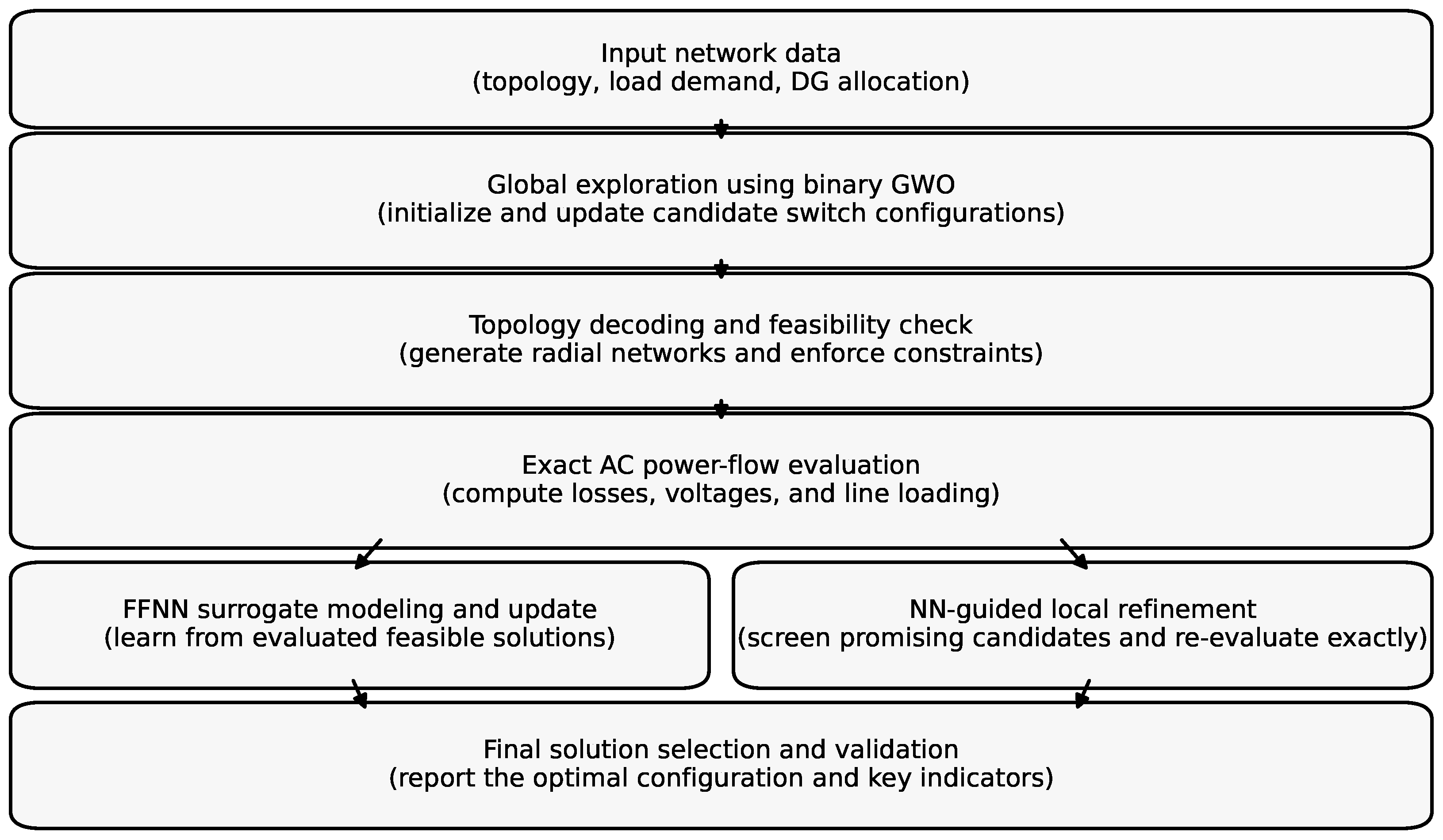
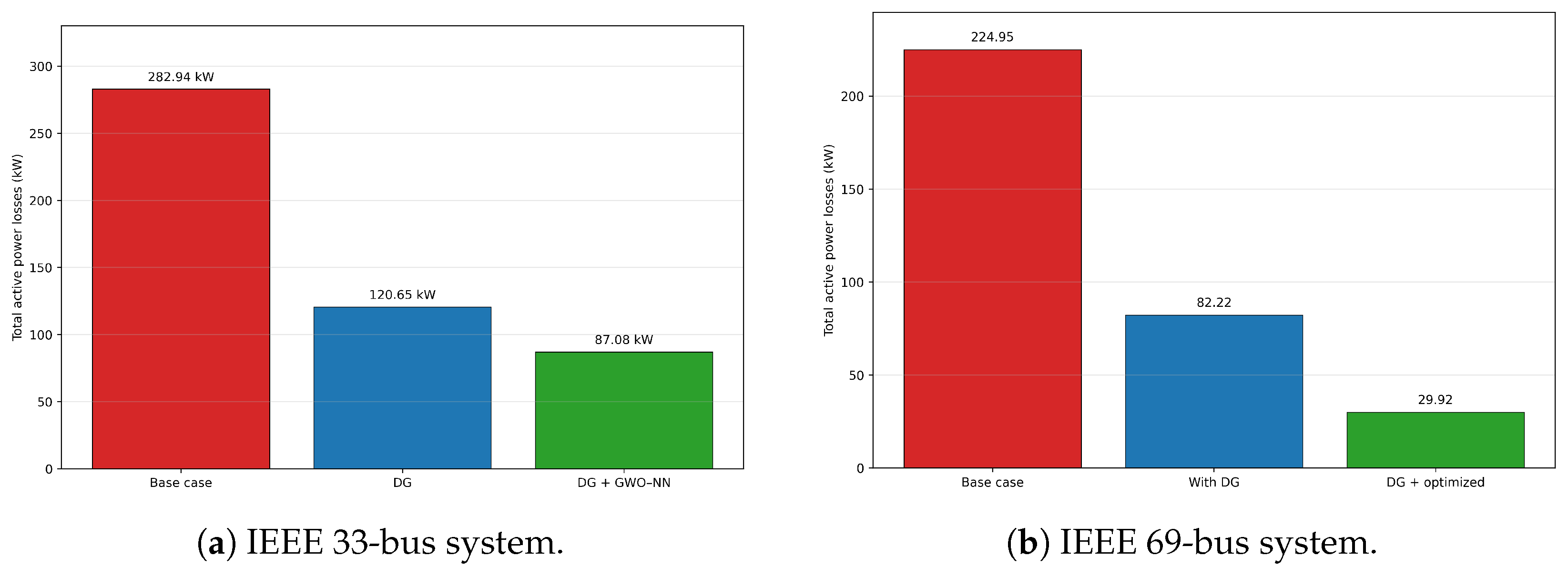
To address the combined challenges of discrete search complexity and the high cost of AC evaluations, this study develops a hybrid GWO–NN method for reconfiguring a distribution network with DG. The GWO is used as the global optimizer, and an FFNN is trained progressively with the evaluated candidates to provide rapid loss predictions that guide a local refinement step. For the detailed IEEE 33-bus benchmark, DG alone reduces active losses from 282.94 kW to 120.65 kW, and the subsequent hybrid reconfiguration lowers them further to 87.08 kW, which corresponds to an additional 27.8% reduction relative to the DG case and a 69.2% reduction relative to the base case. The manuscript also reports benchmark results for the IEEE 69-bus feeder, for which total active losses decrease from 224.95 kW to 82.22 kW with DG and to 29.92 kW after reconfiguration. Together, the IEEE 33-bus and IEEE 69-bus results indicate that the proposed workflow remains effective across benchmark feeders of varying sizes and structural characteristics, while the present evidence should be interpreted as benchmark-level validation rather than as proof of broad generalization. The main contributions are as follows:
A hybrid optimization workflow that integrates a binary adaptation of the GWO with an FFNN surrogate model for loss prediction and accelerated local improvement;
A coordinated evaluation process that enforces radiality and operational constraints (voltage bounds and thermal limits) during the search, avoiding infeasible configurations;
A comparative performance assessment for the IEEE 33-bus and IEEE 69-bus feeders, including voltage profiles, voltage deviations, loss allocation by bus and by line, line loading, and total active losses.
The remainder of the manuscript is organized as follows.
Section 2 presents the theoretical background and mathematical formulation.
Section 3 describes the proposed hybrid GWO–NN technique and its algorithmic components.
Section 4 introduces the benchmark systems and study assumptions.
Section 5 discusses the results for both benchmark feeders.
Section 6 presents the main conclusions, and
Section 7 outlines future work.
4. Benchmark Systems: IEEE 33-Bus and IEEE 69-Bus Distribution Networks
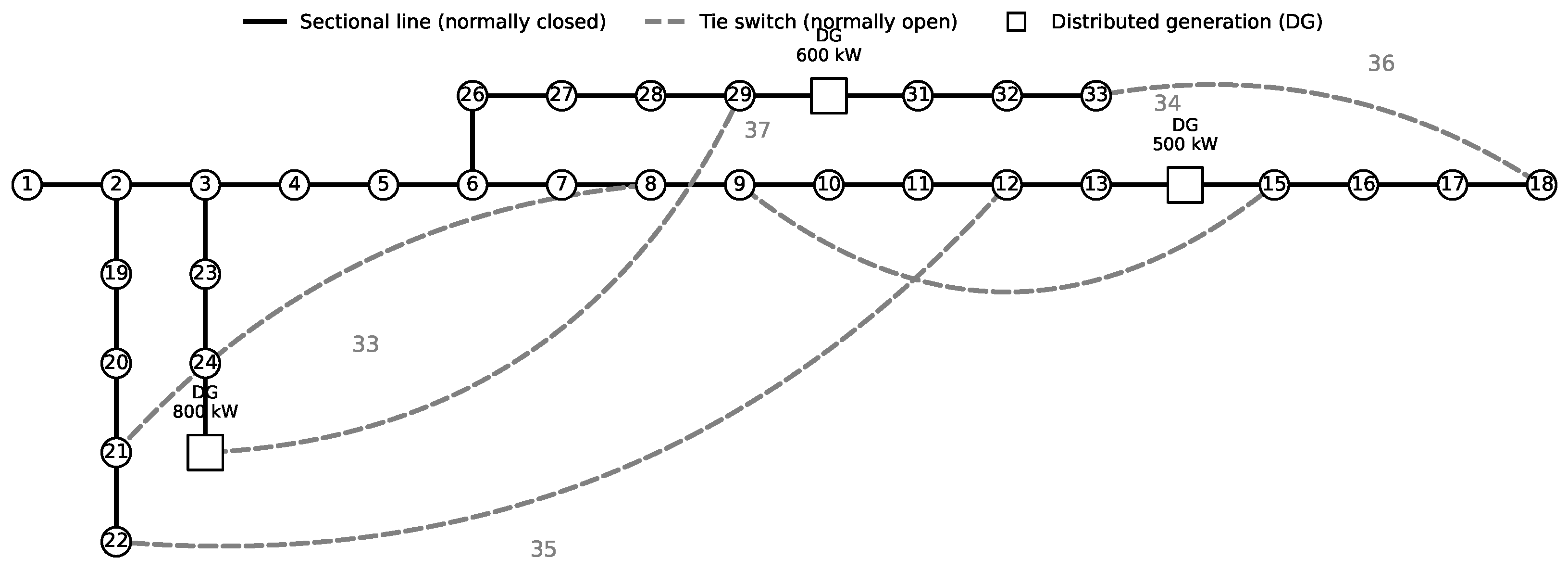
The proposed method was evaluated on the IEEE 33-bus and IEEE 69-bus radial distribution test systems. In both feeders, three operating conditions were analyzed: (1) the base case without DG, (2) the case with DG in the original topology, and (3) the DG + GWO–NN reconfiguration case. The IEEE 33-bus system (
Figure 2) [
25] comprised 33 buses, 32 normally closed sectional switches, and 5 normally open tie-switches, enabling reconfiguration while preserving radial operation. The total load was 3.715 MW and 2.300 MVAr, and the feeder operated at 12.66 kV. DG units were installed at buses 14, 25, and 30, with nominal active power ratings of 500 kW, 800 kW, and 600 kW, respectively. This DG placement and sizing was treated as a fixed study scenario for benchmarking the reconfiguration method; that is, DG allocation was not optimized in the present work. In the IEEE 33-bus implementation, the binary tie-switch decision vector was ordered as
, where 1 denotes a closed tie-switch and 0 denotes an open tie-switch.
The IEEE 69-bus feeder is included in the manuscript as a second benchmark network with a larger size and longer radial structure. Its results were not treated as a peripheral appendix; rather, they were integrated into the surrogate learning, voltage profile, voltage deviation, bus loss, line loss, line loading, and total loss comparisons reported in
Section 5. Therefore, the revised manuscript presents both feeders as part of the benchmark evidence used to assess the proposed GWO–NN workflow.
The following figure illustrates the IEEE 33-bus distribution test feeder used as one of the benchmark systems, including sectionalizing, tie-switches, and the DG placement buses.
5. Results and Discussion
Three scenarios were evaluated in each benchmark: (1) base system without DG, (2) system with DG in the original topology, and (3) system with DG and the topology optimized by the hybrid GWO–NN method.
Table 1 summarizes the detailed numerical indicators for the IEEE 33-bus feeder, whereas
Figure 3,
Figure 4,
Figure 5,
Figure 6,
Figure 7,
Figure 8 and
Figure 9 compare the behavior of the IEEE 33-bus and IEEE 69-bus systems. The indicators were extracted from converged AC power flow solutions for the evaluated configurations.
As shown in
Table 1, the IEEE 33-bus case exhibited consistent improvements in losses, minimum voltage magnitude, voltage deviation range, and maximum line loading when DG and reconfiguration were combined.
Table 2 summarizes the benchmark-level numerical evidence reported in the manuscript for both the IEEE 33-bus and IEEE 69-bus feeders.
5.1. NN Surrogate Training Behavior
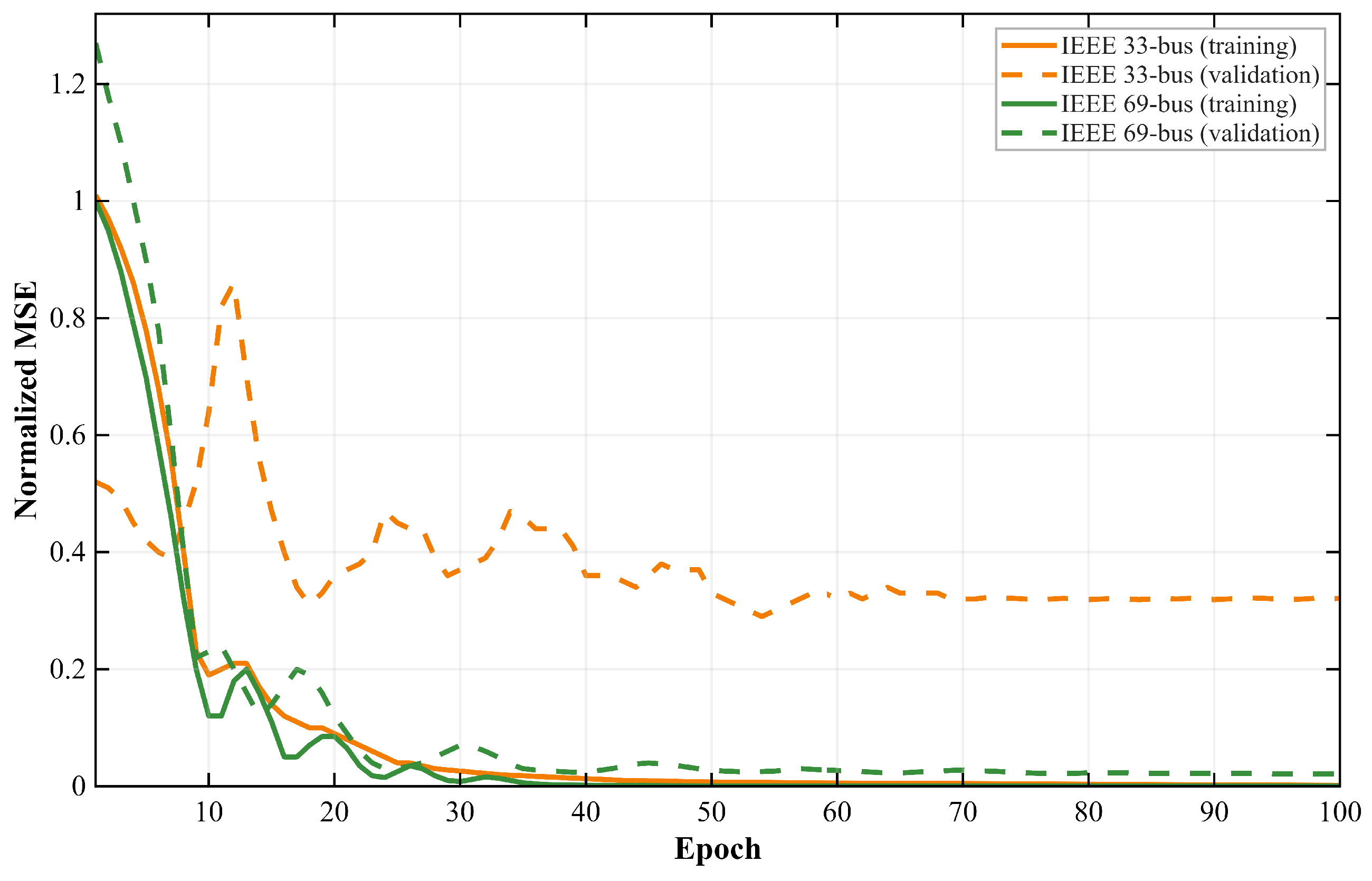
Although the validation trajectories were not strictly monotonic, their overall behavior was consistent with the corresponding training curves, supporting the use of the FFNN as a screening model during the local refinement stage. Because both the input configurations and target losses were standardized during training, the reported values are expressed in normalized units and should therefore be interpreted as relative convergence indicators rather than as direct physical error measures. Overall, the comparison shows that the surrogate’s predictive behavior was feeder-dependent and varied with the network topology and structure of the evaluated search space while remaining suitable for surrogate-assisted refinement in both benchmark systems.
Figure 3 summarizes the FFNN learning behavior for the IEEE 33-bus and IEEE 69-bus test systems over 100 epochs using both training and validation loss. In both feeders, the normalized mean-squared error decreased sharply during the initial epochs and then gradually stabilized, indicating that the surrogate learned an increasingly accurate approximation of the mapping between switch configurations and active power losses. However, the convergence patterns differed across the two benchmarks. For the IEEE 33-bus case, the training curve decayed more slowly and stabilized at comparatively higher error levels, while the validation curve showed more pronounced oscillations, suggesting that the loss landscape of this feeder was harder for the surrogate to approximate consistently under the adopted dataset and model settings. By contrast, the IEEE 69-bus case exhibited a steeper initial reduction in both training and validation loss and converged to lower normalized error values, indicating a more stable fitting process for the evaluated samples.
Figure 3.
Training and validation loss evolution of the FFNN surrogate over 100 epochs for the IEEE 33-bus and IEEE 69-bus test systems.
Figure 3.
Training and validation loss evolution of the FFNN surrogate over 100 epochs for the IEEE 33-bus and IEEE 69-bus test systems.
Table 3 reports a complementary hold-out validation for the IEEE 33-bus benchmark in physical units, while
Table 4 summarizes the surrogate validation evidence currently included in the manuscript and the items that remain outside the present scope. Using the feasible configurations evaluated by the current Python 3.14.4 implementation, the surrogate achieved a mean absolute error (MAE) of 11.35 kW, a root mean square error (RMSE) of 12.86 kW, and a Spearman rank correlation of 1.00 on the validation subset. Moreover, the candidate with the best predicted loss also matched the best exact-ranked candidate within the evaluated validation set. These results support the interpretation of the FFNN as a ranking-oriented screening model for local refinement, although they do not yet replace a broader sensitivity study across multiple random splits and benchmark feeders.
In optimization terms, the most relevant consequence of surrogate error is not that an infeasible or numerically inaccurate solution is finally accepted, because shortlisted candidates are always rechecked through exact AC power flow, but rather that an imprecise ranking may bias which neighbors are explored during local refinement. Therefore, lower surrogate accuracy can reduce the efficiency of the search and may lead the refinement stage to converge to a locally suboptimal solution, even when the final reported solution remains AC-validated.
5.2. Optimal Configuration and Resulting Topology
For the detailed IEEE 33-bus case, the hybrid GWO–NN method identified the binary tie-switch configuration
as the optimal solution, yielding a total active power loss of 87.083 kW. This configuration corresponded to closing tie-switches 34, 35, and 37 while keeping tie-switches 33 and 36 open. Under the complementary mapping used to maintain radiality, sectional lines 9, 12, and 28 were opened, yielding a feasible radial topology. Tie-switch 34 connected bus 9 to bus 15, consistent with a redistribution of power flows toward the mid-feeder area, where the DG was installed. Tie-switch 37 connected bus 25 with bus 29, creating a shorter path between the main feeder and the region of higher DG injection, which is consistent with the observed reduction in upstream line currents and losses. In the final implementation, the best run converged in 67.87 s and required 1023 exact fitness evaluations on a workstation running Windows 11 Home 25H2 with an Intel Core Ultra 7 265 processor at 2.40 GHz and 64 GB of RAM.
Table 5 reports the full operating status of all lines in the obtained configuration, including the end buses, active and reactive losses, and line loading.
5.3. Computational Performance and Literature Benchmark
Because the retained runtime logs reported in this manuscript correspond explicitly to the IEEE 33-bus benchmark, the wall-clock behavior is presented numerically for that feeder. This does not imply that the IEEE 69-bus case is secondary in the manuscript; rather, it reflects the level of benchmark logging currently preserved for direct runtime tabulation. For the IEEE 33-bus case studied in this article, the final GWO–NN configuration was obtained in 67.87 s with 1023 exact fitness evaluations. This count is particularly relevant because the FFNN-guided local screening avoids performing a full AC evaluation for every neighboring candidate, and thus the reported runtime corresponds to the exact validation workload that remained after surrogate filtering.
To place this result in context,
Table 6 compiles the representative execution times reported by other optimizers in the literature for IEEE 33-bus reconfiguration studies. The comparison must be interpreted cautiously because stopping criteria, objective functions, DG assumptions, coding details, and hardware platforms differ across publications. Therefore,
Table 6 is intended as a practical reference benchmark rather than as a strict apples-to-apples ranking. Even with this caveat, the proposed GWO–NN runtime lies in the same order of magnitude as several recent metaheuristic reports, remaining clearly below older GA-based implementations and below one PSO-based report, while still preserving exact AC feasibility checks during the final acceptance step [
26,
27].
In practical terms, these results suggest that the proposed hybridization is computationally competitive for an AC-validated DNR workflow with DG while providing a transparent evaluation count.
Table 7 reports an exploratory same-code comparison between a GWO-only run and the full GWO + FFNN workflow for the IEEE 33-bus benchmark. In the tested run, both approaches reached the same best feasible solution, namely the switch configuration [0, 1, 1, 0, 1], with total active losses of 87.083 kW. Under this single-run comparison, the surrogate-assisted version did not improve the final objective value and did not reduce the exact AC evaluation count. Therefore, these results should be interpreted only as a preliminary ablation check rather than as a definitive assessment of the surrogate contribution. A statistically grounded comparison across multiple random seeds remains necessary before drawing stronger conclusions about computational benefits or robustness.
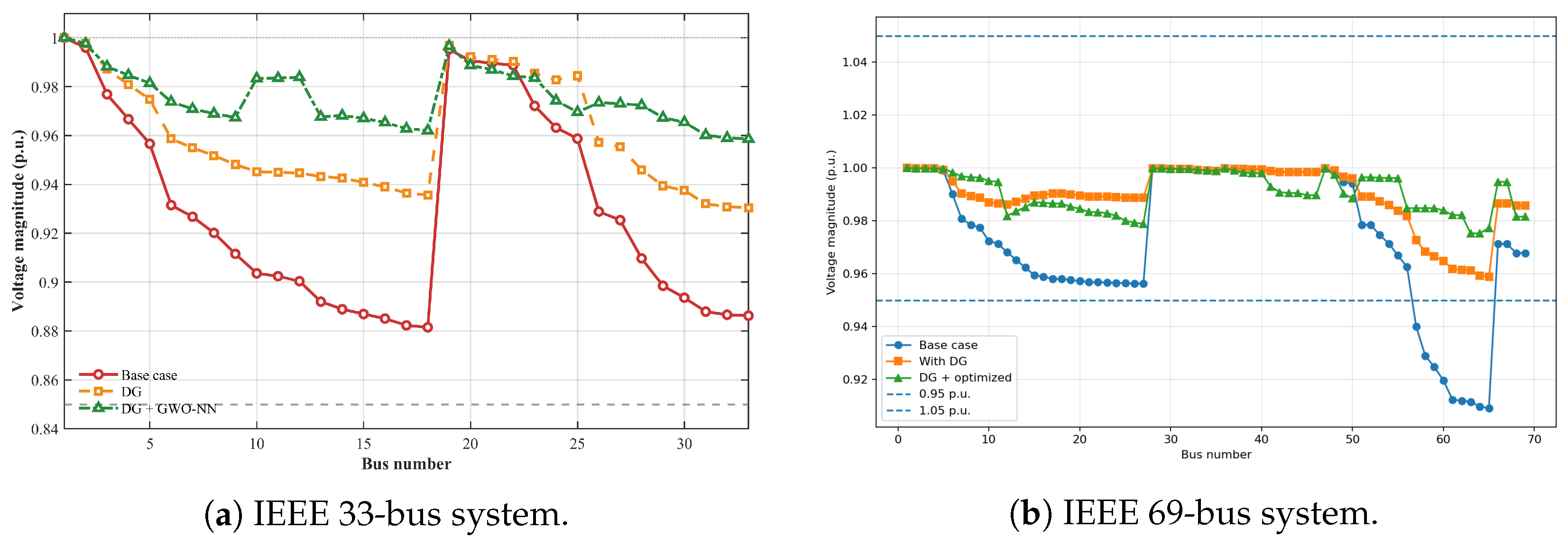
For the IEEE 33-bus system, the base case showed a pronounced voltage drop, with a minimum value of 0.8829 p.u. near bus 18. When DG was connected in the original topology, the minimum voltage increased to 0.9363 p.u., and the overall profile became noticeably flatter. After network reconfiguration with the proposed hybrid method, the minimum voltage further increased to 0.9587 p.u., confirming that the optimized topology improved voltage regulation while preserving acceptable operating conditions. The IEEE 69-bus system followed the same overall behavior, but with a longer feeder and a more spatially extended low-voltage region in the base case. In that feeder, DG integration also mitigated the downstream voltage drop, and the optimized configuration yielded the smoothest voltage trajectory, demonstrating that the proposed method remained effective in larger, more complex networks.
Figure 4 summarizes the bus voltage magnitude profiles for both feeders under the base, DG, and optimized DG + GWO–NN scenarios. In both test feeders, the base case exhibited the largest voltage drop along the feeder, especially toward the remote buses, whereas DG integration improved the overall voltage profile by reducing the depth of the voltage sag. The optimized DG + GWO–NN configuration provided the best voltage regulation in both systems, yielding a flatter profile and maintaining bus voltages closer to the nominal value.
Figure 4.
Voltage profile comparison for the base case, DG case, and optimized DG + GWO–NN case in the IEEE 33-bus and IEEE 69-bus test systems.
Figure 4.
Voltage profile comparison for the base case, DG case, and optimized DG + GWO–NN case in the IEEE 33-bus and IEEE 69-bus test systems.
5.4. Percentage Voltage Deviations
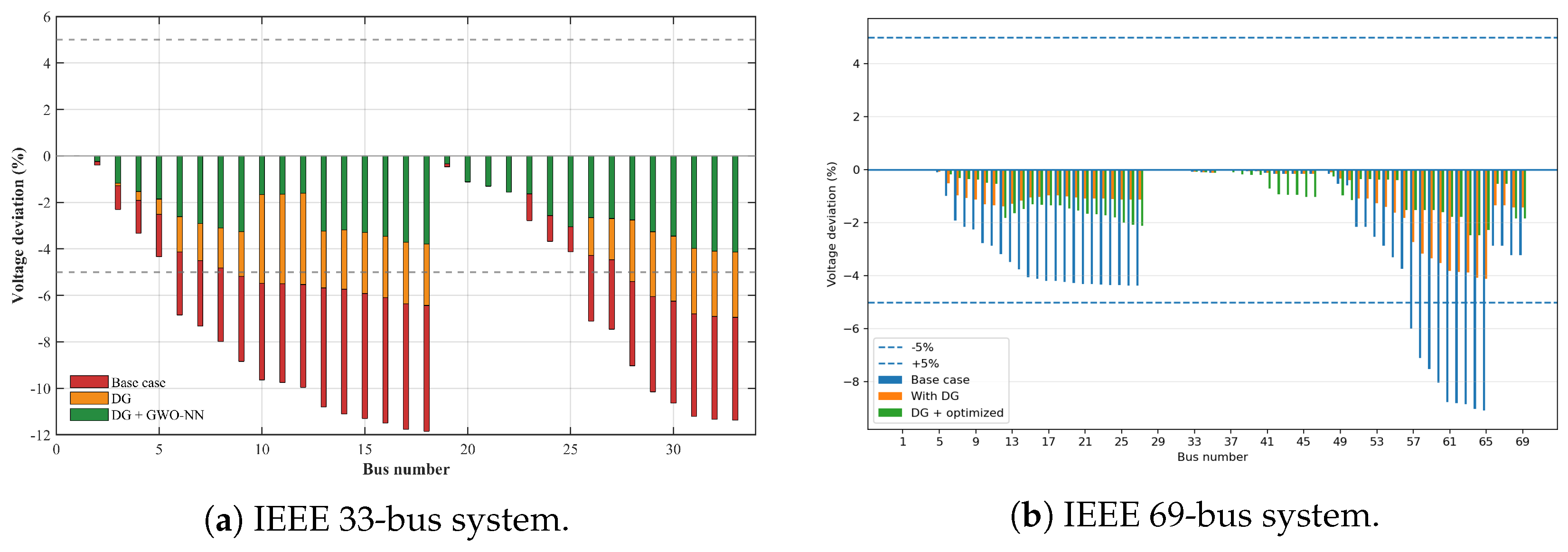
For the IEEE 33-bus system, the base case presented a deviation range from approximately to , indicating poor regulation near the feeder end. When DG was added without reconfiguration, the minimum deviation improved to approximately . After applying the proposed reconfiguration method, the deviation range was further narrowed from approximately to , placing the optimized case within the commonly adopted practical voltage regulation band. The IEEE 69-bus system exhibited the same qualitative improvement, although the deviations were distributed across a larger number of downstream buses due to its longer radial structure. In that case, DG noticeably mitigated the most severe negative deviations, and the optimized configuration produced the most favorable profile by reducing both the depth and spatial extent of the low-voltage region.
Figure 5 summarizes the percentage voltage deviation with respect to the nominal value for both feeders under the three evaluated scenarios. In both feeders, the base case exhibited the largest negative voltage deviations, particularly toward the remote buses, reflecting the weak voltage regulation of the original radial topology under the given loading conditions. The integration of DG reduced the magnitude of these deviations by providing local active power support, while the optimized DG + GWO–NN configuration further compressed the deviation range and shifted the voltage profile closer to the nominal value.
Figure 5.
Percentage voltage deviation per bus for the base case, DG case, and optimized DG + GWO–NN case in the IEEE 33-bus and IEEE 69-bus test systems.
Figure 5.
Percentage voltage deviation per bus for the base case, DG case, and optimized DG + GWO–NN case in the IEEE 33-bus and IEEE 69-bus test systems.
5.5. Loss Distribution by Bus
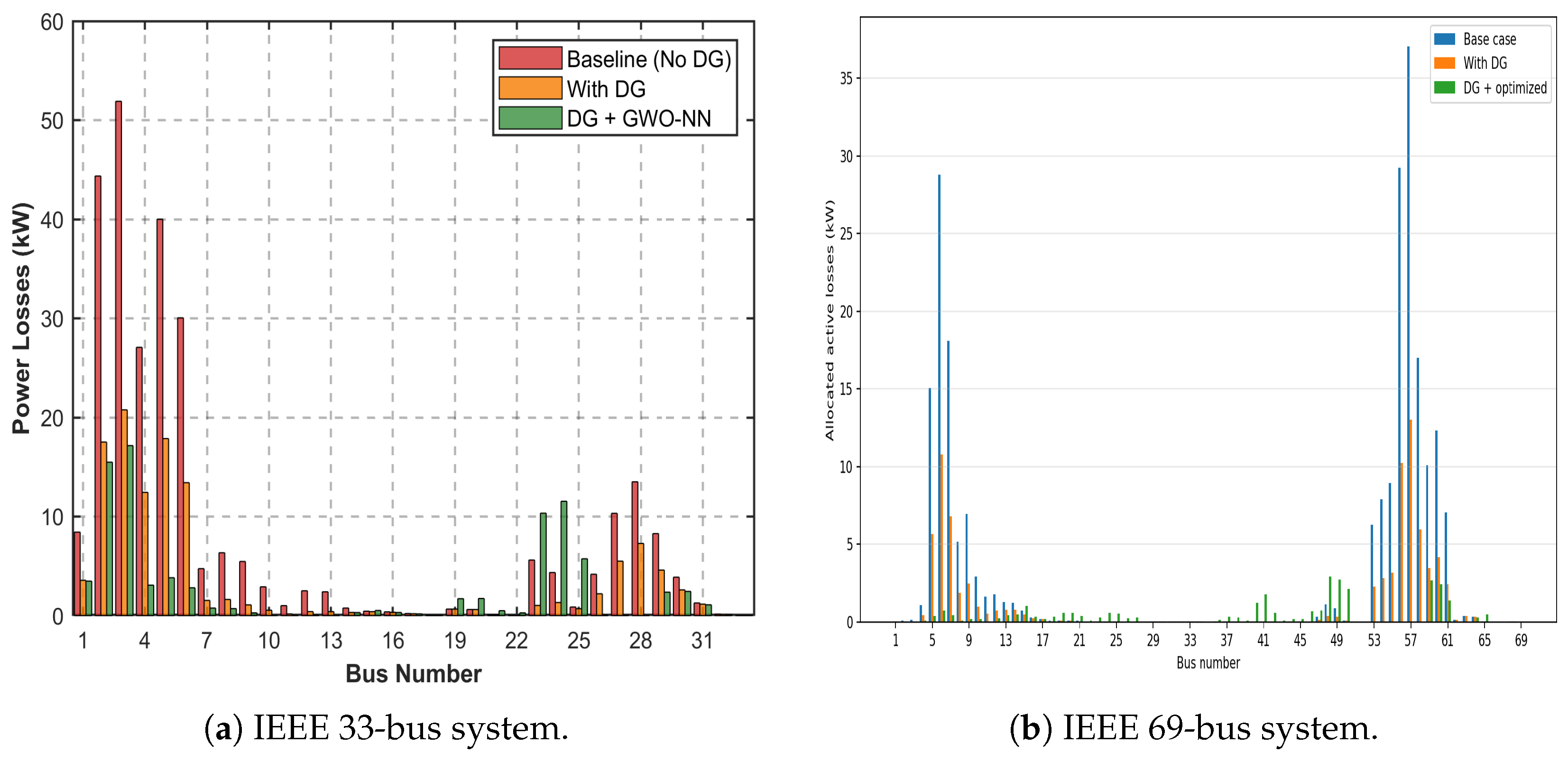
For the IEEE 33-bus system, the base case concentrated the largest allocated losses in the upstream portion of the feeder, with the most pronounced peak around bus 3 and additional peaks around buses 2, 5, and 6. With DG connected in the original topology, these upstream concentrations dropped substantially. After reconfiguration, the dominant upstream peaks were further reduced, although some localized loss concentrations appeared around buses 23–25 because the new radial topology redistributed branch currents. The overall pattern was therefore not simply lower at every bus; rather, it was more spatially redistributed, with the feeder-wide total losses decreasing. The IEEE 69-bus system exhibited the same general effect but with a more complex spatial pattern due to the larger feeder size. In that case, the base scenario also showed concentrated losses at a limited number of critical buses, whereas DG and the optimized topology progressively reduced the dominant peaks and smoothed the overall allocation of losses across the network.
Figure 6 summarizes the allocation of active power losses by bus for both feeders under the three evaluated scenarios. In both feeders, the base case concentrated the largest losses in a limited number of buses located along the main feeder and in downstream sections, reflecting the higher current flow and the cumulative effect of line losses in the original radial topology. The integration of DG reduced both the magnitude and concentration of these losses by supplying part of the local demand, while the optimized DG + GWO–NN configuration further redistributed the losses and lowered the maximum allocated value at the most critical buses.
Figure 6.
Allocated active power losses per bus for the base case, DG case, and optimized DG + GWO–NN case in the IEEE 33-bus and IEEE 69-bus test systems.
Figure 6.
Allocated active power losses per bus for the base case, DG case, and optimized DG + GWO–NN case in the IEEE 33-bus and IEEE 69-bus test systems.
5.6. Line Losses and Activated Tie-Switches
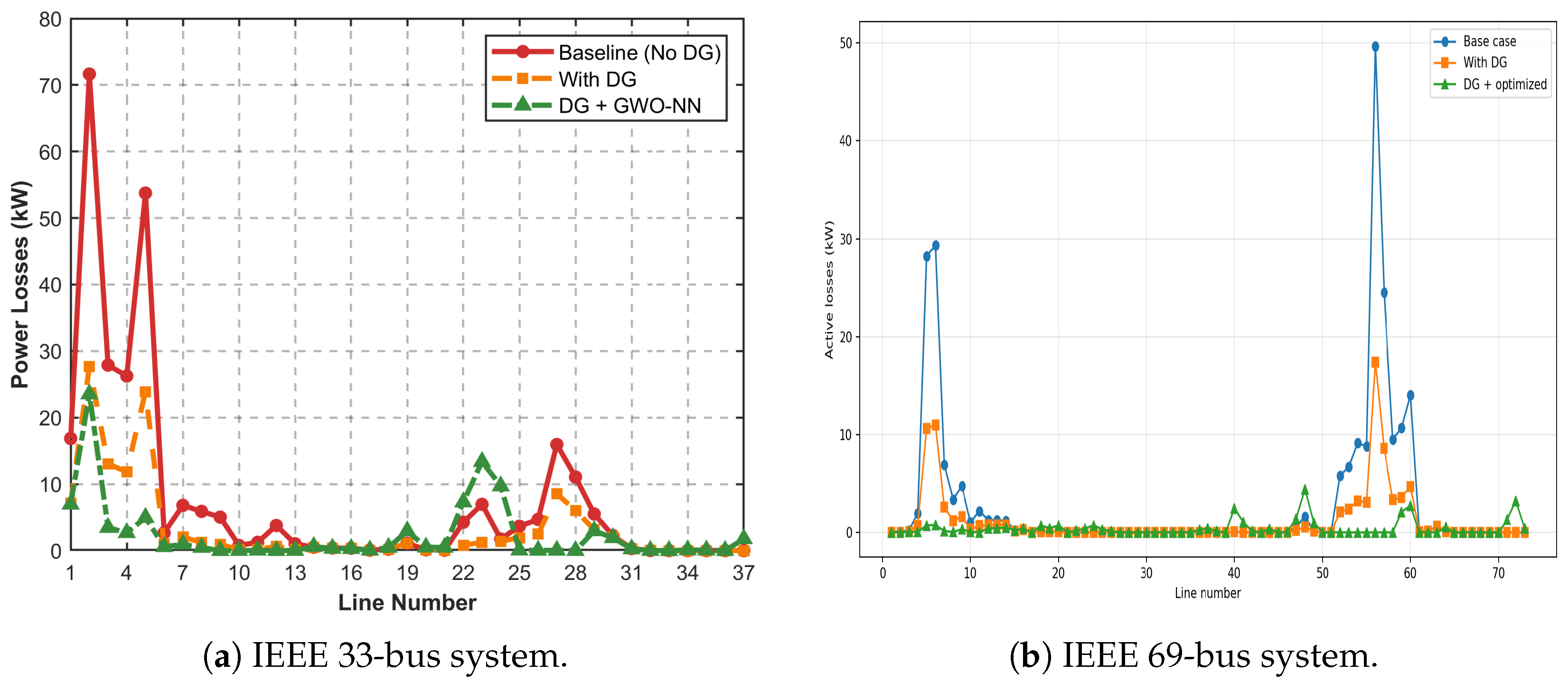
For the IEEE 33-bus system, the base case showed the largest line loss concentrations in the first few branches, especially around lines 2 and 5, with secondary peaks toward the end of the feeder. When DG was connected without reconfiguration, these upstream peaks decreased substantially. After applying the proposed hybrid reconfiguration, the dominant upstream losses were further reduced, and part of the loss burden shifted to a narrower set of branches around lines 22–24, consistent with the new power-routing pattern. The activated tie lines themselves introduced only small additional losses compared with the savings achieved in the previously critical sections. The IEEE 69-bus system exhibited the same trend, although the distribution was more spatially dispersed due to the larger feeder sizes and more complex topology. In that feeder, DG reduced the most severe line loss peaks, and the optimized configuration further smoothed the profile by relieving the most critical branches and redistributing the losses more evenly across the network.
Figure 7 summarizes the active power losses computed per line for both feeders under the three evaluated scenarios. In both feeders, the base case exhibited the largest loss concentrations in a few critical lines located near the beginning of the feeder and in heavily loaded downstream sections. The integration of DG significantly reduced these peaks by decreasing current flow through the most stressed branches, while the optimized DG + GWO–NN configuration further redistributed the line losses and lowered the most severe concentrations, yielding an overall more balanced loss profile.
Figure 7.
Active power losses per line for the base case, DG case, and optimized DG + GWO–NN case in the IEEE 33-bus and IEEE 69-bus test systems.
Figure 7.
Active power losses per line for the base case, DG case, and optimized DG + GWO–NN case in the IEEE 33-bus and IEEE 69-bus test systems.
5.7. Line Loading
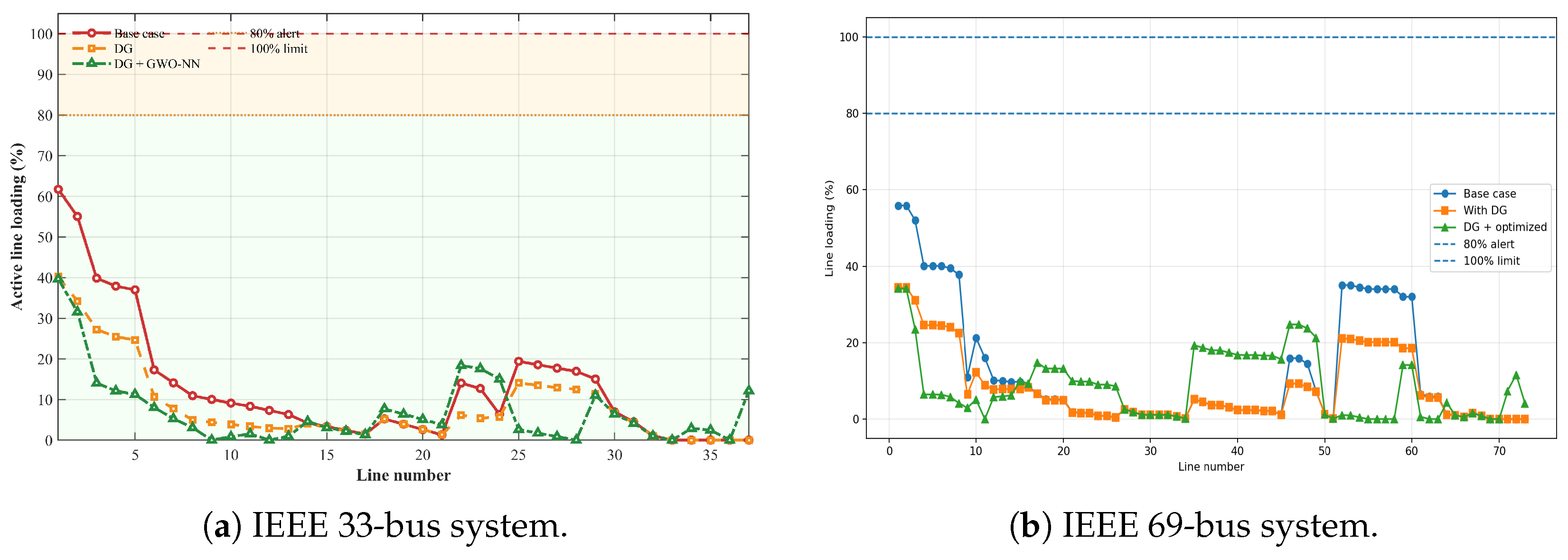
For the IEEE 33-bus system, the base case reached a maximum line loading of 61.72% on line 1, indicating that the feeder head carried the largest current burden in the original topology. When DG was connected without reconfiguration, the maximum loading decreased to 40.17% on the same line, reflecting a significant decentralization of power flow. After applying the proposed GWO–NN reconfiguration, the maximum loading remained at a similarly reduced level of 39.67%, while the activated tie lines operated at relatively low loading levels, confirming that the new topology improved current sharing without creating additional congestion. The IEEE 69-bus system exhibited the same qualitative improvement, although the loading pattern was more spatially distributed due to the larger feeder sizes and more complex network structure. In that feeder, the DG case reduced the most pronounced loading peaks, and the optimized configuration further redistributed current flow while keeping all lines well below the 80% alert threshold and the 100% operating limit.
Figure 8 summarizes the active line-loading profiles of both feeders under the base, DG, and optimized DG + GWO–NN scenarios. In both feeders, the base case exhibited the highest loading levels in the upstream branches, where the cumulative demand current was concentrated. The integration of DG reduced these loading levels by supplying part of the load locally, thereby relieving the most stressed sections. The optimized DG + GWO–NN configuration further redistributed the power flow and smoothed the loading pattern without introducing new highly stressed lines.
Figure 8.
Active line loading for the base case, DG case, and optimized DG + GWO–NN case in the IEEE 33-bus and IEEE 69-bus test systems.
Figure 8.
Active line loading for the base case, DG case, and optimized DG + GWO–NN case in the IEEE 33-bus and IEEE 69-bus test systems.
5.8. Total Active Power Losses
For the IEEE 33-bus system, the total active power losses decreased from 282.94 kW in the base case to 120.65 kW when DG was connected, corresponding to a reduction of 57.4%. After applying the proposed GWO–NN reconfiguration, the losses were further reduced to 87.08 kW, representing an additional 27.8% reduction compared with the DG case and a total reduction of 69.2% relative to the original configuration. The IEEE 69-bus system showed the same overall pattern, with total active power losses decreasing from 224.95 kW in the base case to 82.22 kW with DG and then to 29.92 kW after network reconfiguration. These results confirm that the proposed hybrid strategy remained effective not only for the IEEE 33-bus benchmark but also for a larger, more complex feeder, where the combined action of DG placement and topology reconfiguration yielded a marked improvement in overall efficiency.
Figure 9 summarizes the total active power losses obtained for both feeders under the three evaluated operating conditions. In both test feeders, the base case yielded the highest losses, as all demand was supplied from the substation via the original radial topology. The integration of DG substantially reduced the total losses by supplying part of the demand locally and lowering the current magnitudes in the most heavily loaded sections. The optimized DG + GWO–NN configuration yielded an additional reduction, confirming that network reconfiguration complemented DG integration by further improving power flow distribution.
Figure 9.
Total active power losses for the base case, DG case, and optimized DG + GWO–NN case in the IEEE 33-bus and IEEE 69-bus test systems.
Figure 9.
Total active power losses for the base case, DG case, and optimized DG + GWO–NN case in the IEEE 33-bus and IEEE 69-bus test systems.
5.9. Scope and Practical Limitations
The present study focuses on electrical-performance indicators, namely losses, voltage regulation, and line loading. It includes benchmark results for both the IEEE 33-bus and IEEE 69-bus feeders, but it still does not provide a broad multi-feeder validation campaign beyond those two systems. Three elements remain especially relevant for stronger practical claims: (1) a same-code, same-hardware wall clock comparison against a conventional GWO baseline across repeated runs, (2) an explicit economic assessment of switching costs, breaker wear, and maintenance implications, and (3) a broader quantitative validation of the surrogate model, including multi-split sensitivity, rank-based metrics across feeders, and systematic ablation statistics. These omissions do not invalidate the reported benchmark results, but they do limit the strength of any generalization beyond the feeders and DG scenarios considered here.
Table 8 clarifies the level of detail currently documented in the manuscript for each benchmark feeder. Both the IEEE 33-bus and IEEE 69-bus systems are now part of the reported benchmark evidence, although the IEEE 33-bus case still retains the most extensive line-by-line operating table and explicit runtime logging within the current paper.
6. Conclusions
The manuscript presented benchmark results for the IEEE 33-bus and IEEE 69-bus distribution feeders under the same three operating scenarios: the base case, the DG case, and the DG + GWO–NN reconfiguration case. In the IEEE 33-bus benchmark, DG alone reduced losses from 282.94 kW to 120.65 kW, and the optimized reconfiguration further reduced them to 87.08 kW while increasing the minimum voltage magnitude to 0.9587 p.u. In the IEEE 69-bus benchmark, the total active losses decreased from 224.95 kW to 82.22 kW with DG and to 29.92 kW after reconfiguration, together with visibly improved voltage profiles and line-loading patterns.
Overall, the proposed workflow combines global exploration via the binary GWO with fast surrogate-assisted screening by an FFNN, followed by exact AC validation of the accepted candidates. The benchmark results indicate that this coordination can reduce losses and improve operating profiles in feeders of different sizes. The revised manuscript also included a complementary quantitative FFNN validation for the IEEE 33-bus case and an exploratory same-code ablation comparing GWO-only and GWO + FFNN screening. Even so, broader multi-run ablation statistics, additional quantitative surrogate metrics for the IEEE 69-bus case, and validation on further feeder topologies remain necessary before claiming broad generality at the journal level.
In particular, because the surrogate influences the ranking of candidates during local refinement, its accuracy can affect the efficiency of the search and the risk of suboptimal convergence, even though the final accepted candidates are always checked with the exact AC model.
7. Future Work
One relevant extension is to incorporate uncertainty in renewable generation and demand. The current formulation optimizes a single deterministic operating point. A stochastic or scenario-based extension could evaluate each candidate topology under multiple DG and load scenarios and minimize expected losses (or another risk-aware objective), capturing variability and supporting robust operation [
19,
28].
Another important pathway is the coordinated treatment of new flexible loads, particularly electric vehicle charging, whose spatial and temporal variability can strongly modify feeder operating conditions [
29,
30,
31]. As discussed by Amann et al. [
31], managed charging can also serve as a flexibility asset rather than only a source of grid stress, making it an attractive context for future multi-period DNR studies. The proposed GWO–NN structure could therefore be extended toward receding-horizon operation in the presence of EV charging clusters and renewable intermittency. A further methodological extension is the use of reinforcement learning-based decision layers for adaptive topology control under time-varying conditions, while preserving the exact AC validation and radiality checks used in the present work [
32].
From a practical planning perspective, a future version of the framework should also incorporate an economic layer that explicitly balances loss reduction against switching operation costs and potential equipment wear. In addition, the relaxed voltage band adopted here (0.85–1.05 p.u.) is acceptable for benchmark-oriented algorithmic studies, but future utility-oriented validations should tighten these limits to the operational standards of the target distribution operator. Finally, broader external validation on feeders beyond the IEEE 33-bus and IEEE 69-bus benchmarks, including alternative DG placements and loading conditions, remains necessary before claiming broad applicability in journal form.