1. Introduction
Modern electric power systems operate under a combination of rising demand, tighter quality requirements, progressive renewable-energy integration, and increasing pressure to use existing infrastructure more efficiently. In that context, reactive power management remains essential because it directly affects voltage control, system losses, corridor utilization, and operating security [
1,
2,
3,
4]. Poor reactive power support increases circulating current, intensifies voltage depression under stressed conditions, and reduces the effective capability of the transmission network to deliver active power reliably.
Among the available planning strategies, shunt compensation stands out as one of the most practical and scalable solutions for enhancing voltage support and reducing power losses. When properly located, shunt devices help reinforce weak areas of the network, limit excessive reactive power flows, and contribute to more stable operation under both normal and contingency conditions [
5,
6,
7,
8]; these benefits go beyond purely technical improvements. Reducing technical losses means less wasted generation, while improved voltage performance enhances system reliability and extends the lifespan of transmission infrastructure. In this sense, reactive power planning is closely aligned with sustainability objectives. It supports more efficient and resilient power systems, contributing to broader goals such as access to clean and affordable energy, the development of reliable infrastructure, and the reduction of emissions through improved operational efficiency.
A broad body of literature has addressed optimal reactive power dispatch (ORPD) and compensation placement by means of deterministic optimization, metaheuristics, hybrid methods, and FACTS-based control frameworks [
9,
10,
11,
12,
13,
14,
15,
16]. Several studies focus on minimizing active power losses and voltage deviation; others extend the problem to multi-objective settings including generation cost, stability, or renewable uncertainty [
3,
17,
18,
19,
20]. Additional works address contingency conditions and device placement using post-contingency voltage or overload criteria [
21,
22,
23]. However, many of these approaches still present three recurrent limitations from the planning viewpoint.
First, many contributions rely mainly on heuristic or metaheuristic search processes whose final decision is difficult to interpret physically and difficult to reproduce in practical planning studies. Second, a large part of the literature either focuses on normal operating conditions or treats contingency analysis as a posterior validation step, rather than incorporating N–1 security explicitly into the placement criterion itself. Third, candidate buses are often prioritized only by local voltage depression, even though compensation placement should ideally respond to its global impact on post-contingency system performance rather than to a single local indicator. In other words, identifying the most stressed bus is not sufficient by itself; planning also requires a measure of how much the whole network benefits when reactive support is injected at that location [
24,
25].
This paper addresses that gap by proposing a contingency-aware, sensitivity-based framework for shunt compensation placement in transmission systems. The method first identifies the most severe N–1 contingency using a global severity index. It then constructs a reduced candidate set from the five load buses with the lowest post-contingency voltages. Finally, the candidate buses are ranked by a positive sensitivity score derived from the reduction of the global severity index with respect to reactive power injection. In this way, the final decision is based on system-wide performance improvement rather than on local voltage weakness alone. The selected compensation location is then validated through AC optimal power flow (AC–OPF) simulations, which quantify the resulting voltage recovery, loss reduction, and flow redistribution [
26].
The main contributions of this work are summarized as follows:
- 1.
A structured two-stage framework that integrates N–1 contingency screening with sensitivity-based bus ranking for planning-oriented shunt compensation placement.
- 2.
A physically interpretable decision criterion based on the positive score , which quantifies the global benefit of reactive power injection at each candidate bus.
- 3.
A full AC–OPF validation under normal and post-contingency operating conditions to evaluate voltage profile improvement, active power loss reduction, and branch power-flow behavior.
- 4.
A multi-system assessment on the IEEE 14-, 30-, and 57-bus transmission networks, including additional candidate-ranking figures for each benchmark and an advanced comparative analysis of ranking selectivity.
- 5.
Explicit alignment of the planning problem with SDG-oriented power-system operation by emphasizing energy-efficiency and infrastructure-resilience outcomes.
- 6.
Furthermore, the proposed methodology supports the development of robust and scalable planning practices by providing a structured decision criterion that can be consistently applied across different network sizes. This facilitates the transferability of planning methodologies and supports improved operational efficiency, which is aligned with sustainability objectives in modern power systems.
- 7.
A clear methodological distinction from traditional voltage-based, sensitivity-based, and optimization-based approaches through the introduction of a system-wide contingency-driven sensitivity index.
The remainder of the paper is organized as follows.
Section 2 reviews the most relevant related work and the contribution of this study.
Section 3 presents the mathematical background, including the ORPD model, the contingency index, and the proposed sensitivity score.
Section 4 details the methodology and benchmark systems.
Section 5 discusses the results for the IEEE 14-, 30-, and 57-bus systems and introduces the advanced cross-system analysis.
Section 6 concludes the paper.
2. Related Work and Research Gap
2.1. Reactive Power Dispatch and Compensation Placement
The search for effective reactive power management strategies has produced a large body of research spanning optimization, intelligent search, and device-placement methods. In classical ORPD studies, the objective is often to minimize active power losses while keeping bus voltages, generator outputs, and branch flows within admissible limits [
3,
4,
11]. From that basis, the literature has evolved toward more flexible formulations that also include voltage deviation, stability margins, renewable uncertainty, and multiple operating criteria [
12,
14,
15,
20,
27].
Metaheuristic methods have become widely adopted in the ORPD literature due to their ability to handle nonlinear and nonconvex search spaces. Techniques such as particle swarm optimization, nature-inspired algorithms, and hybrid approaches have shown strong numerical performance in solving reactive power dispatch and device placement problems [
9,
12,
13,
28].
However, despite their effectiveness, these methods often provide limited insight into the underlying reasons behind the selected solution. In particular, they may not clearly explain why a specific compensation location is preferable from a system perspective. This becomes a limitation in planning contexts, where the objective is not only to obtain an optimal numerical result but also to define a decision-making criterion that can be interpreted, justified, and consistently applied across different systems [
29].
In parallel, another line of research focuses on the strategic placement of reactive compensation devices, including fixed shunt capacitors, SVCs, STATCOMs, and other FACTS technologies [
7,
10,
16,
30,
31]. These devices are well known for their ability to reduce reactive power transfers, improve voltage profiles, and enhance system stability, particularly under stressed operating conditions. Nevertheless, many of these placement approaches still rely on local indicators or device-oriented search procedures, without explicitly linking the placement decision to a system-wide measure of post-contingency severity. As a result, the selected locations may not fully reflect their impact on overall system performance.
To further clarify the methodological positioning of this work,
Table 1 summarizes the main differences between the proposed framework and conventional approaches for reactive power compensation placement. The comparison highlights that the proposed method explicitly combines N–1 contingency screening, system-wide impact assessment, and physical interpretability, which are not simultaneously addressed by traditional voltage-based, local sensitivity-based, or metaheuristic approaches.
2.2. Contingency-Oriented Planning Studies
Security assessment under N–1 contingencies plays a key role in transmission planning, since the outage of critical lines can quickly lead to voltage drops, overloaded corridors, and reduced operating margins [
21,
22,
23,
29]. Because of this, contingency-based approaches have been widely used to identify vulnerable areas in the network and guide decisions on where to reinforce the system or install reactive support. For instance, previous studies have incorporated contingency analysis into SVC placement, transmission switching, and other reinforcement strategies [
8,
21,
23,
29].
These works clearly show how important it is to include security considerations during the planning stage. Still, there is a noticeable gap between identifying critical contingencies and deciding where compensation should actually be placed. In many cases, even when the most severe contingency is correctly identified, the selection of candidate buses continues to depend on local voltage indicators or on optimization procedures that are not always easy to interpret. As a result, the link between contingency severity, nodal vulnerability, and the overall impact of reactive compensation is not yet fully captured in a consistent decision framework.
2.3. Research Gap and Positioning of This Work
The present paper is positioned precisely at that interface. It does not propose another general-purpose metaheuristic for ORPD, nor does it formulate a full economic VAR expansion problem. Instead, it develops a transparent planning-support criterion whose purpose is to answer the following question: Given a critical N–1 contingency, which vulnerable load bus produces the greatest reduction in global contingency severity when reactive support is injected?
Despite the extensive literature on reactive power planning, existing approaches can be broadly classified into three categories: (i) voltage-based heuristics, (ii) sensitivity-based local indicators, and (iii) optimization-driven methods such as metaheuristics. Voltage-based approaches typically identify weak buses based on minimum voltage magnitude but fail to capture system-wide effects. Conventional sensitivity indices, such as voltage or loss sensitivities, provide local information but do not explicitly link reactive support to global contingency severity. On the other hand, metaheuristic optimization methods can achieve near-optimal solutions but often lack physical interpretability and reproducibility, limiting their applicability in planning contexts.
In contrast, the proposed framework integrates contingency severity assessment with a system-wide sensitivity metric, enabling a structured and physically interpretable decision process. This distinguishes the proposed approach from conventional methods by explicitly quantifying the global impact of local reactive power support under N–1 security constraints.
This distinction is important for three reasons. First, it separates vulnerability identification from the final decision logic. The candidate region is identified through post-contingency voltage screening, but the final bus is selected according to its global effect on the severity index. Second, it improves interpretability because the selected bus is justified by a measurable sensitivity score rather than by a heuristic rule. Third, it provides a scalable methodology that can be applied consistently across systems of different sizes without changing the fundamental decision criterion.
An important nuance emerging from the case studies is that in the three benchmarks reported here, the first-ranked bus also happens to be the bus with the lowest post-contingency voltage. This does not reduce the value of the proposed method; rather, it shows that the sensitivity score provides a quantitative confirmation of the final decision and, importantly, refines the remaining order of the candidate set. In the IEEE 30-bus system, for example, buses 18 and 20 are reordered by the sensitivity criterion even though their post-contingency voltages are very close. The added value of the proposed framework is therefore not limited to disagreement cases; it also provides ranking robustness when local voltage differences are small.
3. Mathematical Background
3.1. Optimal Reactive Power Dispatch
A conventional objective in reactive power planning is the minimization of active power losses subject to the AC network equations and the operating limits of the power system. Using the
model of the transmission network, the active power loss objective is expressed as
where
and
are the voltage magnitudes at buses
i and
j,
is the line conductance,
is the angular difference between those buses, and
is the number of buses in the system.
The problem is restricted by the active and reactive power balance equations
and by the operating limits
where
and
are the generator active and reactive powers,
and
are the demands,
is the branch susceptance,
is the reactive injection of the compensation device, and
denotes the apparent-power limit considered for the branch.
Equation (
8) provides a general representation of shunt compensation. When
is fixed, the formulation corresponds to conventional shunt capacitor banks. When
is allowed to vary continuously inside its limits, the same expression can emulate a controllable device such as an SVC or STATCOM, with the AC–OPF determining the corresponding reactive injection under the given operating condition [
31]. In the present work, the case studies correspond to capacitive support because the identified critical contingencies generate undervoltage conditions. The formulation, however, remains general enough to represent inductive compensation as well.
It should be noted that fixed shunt capacitors and dynamically controllable devices such as SVCs or STATCOMs differ in terms of installation cost, operational flexibility, and control constraints. The case studies reported in this work correspond to steady-state capacitive shunt support under under voltage conditions. Therefore, the results should be interpreted as a planning-oriented assessment of shunt compensation placement rather than as a dynamic VAR control study. Device-specific dynamic models and techno-economic comparisons can be incorporated as extensions of the proposed framework.
3.2. Contingency Severity Index
The contingency index
J is used to evaluate the impact of N–1 outages and identify the operating condition associated with the largest system stress [
23]. In weighted form, the index can be written as
where
is the weight of monitored variable
i,
is the monitored quantity, and
is its admissible maximum value.
For the present study, equal weighting is adopted and the exponent is simplified so that the contingency index takes the form
meaning that larger values of
J indicate more severe post-contingency system states. In the proposed framework, this index is used first to identify the critical contingency
and only after that to support the sensitivity calculation.
3.3. Sensitivity-Based Candidate Ranking
The contingency index is not used as the final placement criterion. Instead, once the critical contingency is identified, the five load buses with the lowest post-contingency voltages are selected as the candidate set
. Those candidates are ranked through the positive sensitivity score
where
is the reactive power injected at candidate bus
k. Under this definition, larger values of
mean that reactive support at bus
k produces a greater reduction of the global contingency severity index.
It is important to highlight the physical interpretation of the proposed sensitivity index. The term quantifies how a marginal reactive power injection at bus k affects the global contingency severity index J. Unlike conventional local sensitivity indices, such as or loss sensitivity factors, which measure localized effects, the proposed metric captures the system-wide response by evaluating the variation of a global performance indicator. Therefore, it provides a direct measure of how effective a local reactive support action is in reducing overall system stress under contingency conditions.
As shown in (
14), the sensitivity index is computed using a finite-difference approximation. A small perturbation
is applied at bus
k, and the corresponding variation in the contingency index is evaluated as a centered finite-difference approximation.
where
is a small perturbation in reactive power. This score differs from classical local sensitivity factors because it is referenced to a global security-performance index rather than to a single local voltage magnitude. Consequently, it supports a planning-oriented interpretation: the preferred bus is the one that yields the greatest overall reduction in contingency severity across the system.
This formulation represents a key distinction from traditional sensitivity-based approaches. While classical methods evaluate the impact of reactive power injection on individual variables, such as voltage magnitude or line losses, the proposed index evaluates its effect on a composite system-level performance indicator. This enables a planning-oriented interpretation, where decisions are guided by their contribution to reducing overall contingency severity rather than improving isolated local variables.
In this study, is selected as a small fraction of the base power, corresponding to 1 Mvar in the 100 MVA system base. This value was adopted to ensure numerical stability while preserving sensitivity accuracy. Additional tests confirmed that the ranking of candidate buses remains consistent for small variations of , indicating robustness of the proposed metric.
4. Methodology and Benchmark Systems
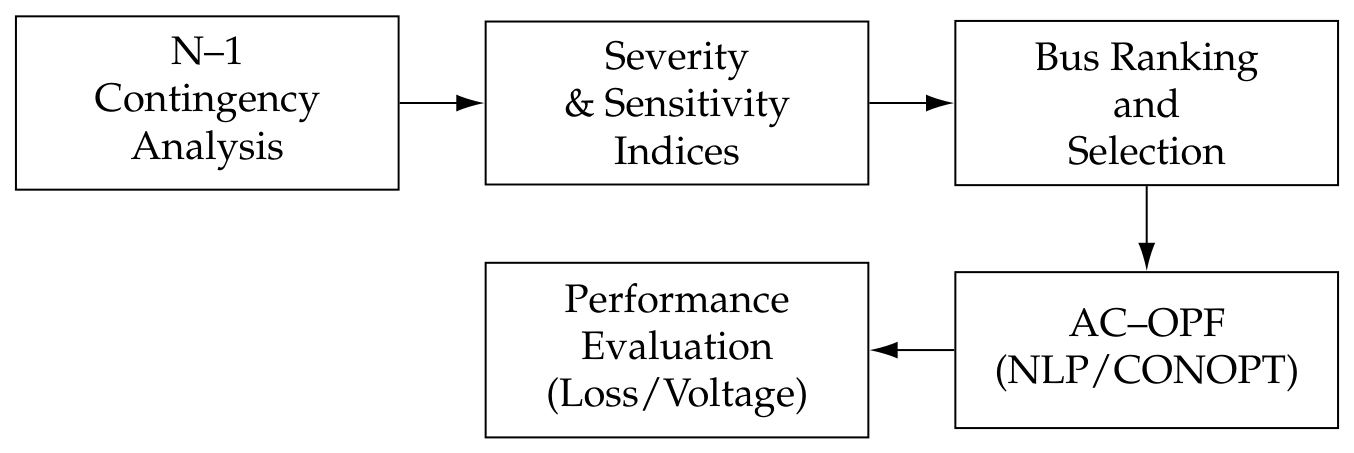
The proposed methodology is summarized in
Figure 1. It begins with N–1 screening, identifies the most severe contingency by means of the index
J, restricts the search space to the five most voltage-stressed load buses, and then applies the sensitivity score
to determine the final compensation location. Generator buses are excluded from the candidate set because their voltages are already associated with generator-side regulation and their inclusion would blur the interpretation of additional shunt support in the planning stage.
The method is organized in two main stages, which form the basis of the proposed approach. First, the analysis is used to identify the most vulnerable part of the network under the critical contingency. Once that region is identified, the second step focuses on determining which bus within that area provides the greatest overall benefit when reactive support is added.
This separation is particularly useful from a practical point of view. Instead of evaluating every possible location in the system, the search is naturally narrowed down to a smaller set of relevant candidates. At the same time, it avoids relying only on local indicators, such as selecting the bus with the lowest voltage, which does not always lead to the best overall solution.
It is important to note that the size of the candidate set is defined as a fixed and reduced subset of buses to ensure computational tractability and reproducibility of the methodology. The selection of the five lowest-voltage load buses under the critical contingency provides a balance between capturing the most vulnerable regions of the network and limiting the computational burden associated with sensitivity evaluation.
Although this choice represents a design decision, additional tests indicated that expanding or reducing the candidate set (e.g., top 3, top 5, or top 10 lowest-voltage buses) does not significantly alter the ranking of the most effective compensation location. This suggests that the proposed sensitivity-based framework is robust with respect to the size of the candidate set, as the most influential buses consistently exhibit higher impact on the global contingency index.
To evaluate the proposed approach, three standard test systems are considered: the IEEE 14-, 30-, and 57-bus networks. These systems allow observing how the method behaves as the network becomes larger and more complex. The IEEE 14-bus system is used as the main example because it makes it easier to follow each step of the process. The IEEE 30- and 57-bus cases are then used to check whether the results remain consistent when the system size and the number of contingencies increase.
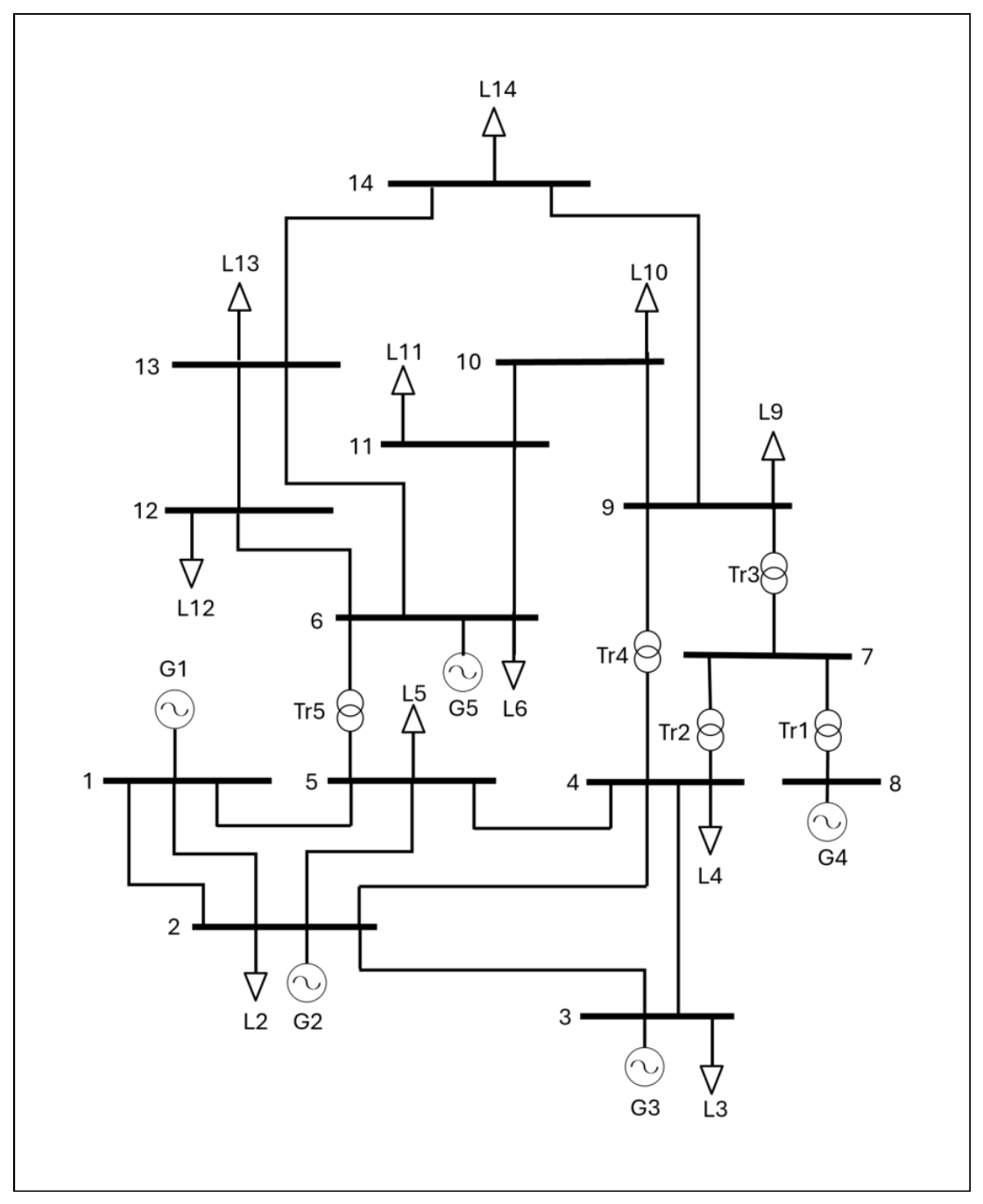
The IEEE 14-bus system consists of five generators connected to buses 1, 2, 3, 6, and 8, together with 21 branches (16 transmission lines and five transformers).
Figure 2 presents its single-line diagram, and
Table 2,
Table 3 and
Table 4 summarize the data used in the simulations. All simulations use a 100 MVA base. Voltage magnitudes are limited to ±10% around nominal values and bus-angle limits are defined in the interval
rad. The IEEE 30- and 57-bus systems use standard literature data sets and are evaluated under the same methodological sequence.
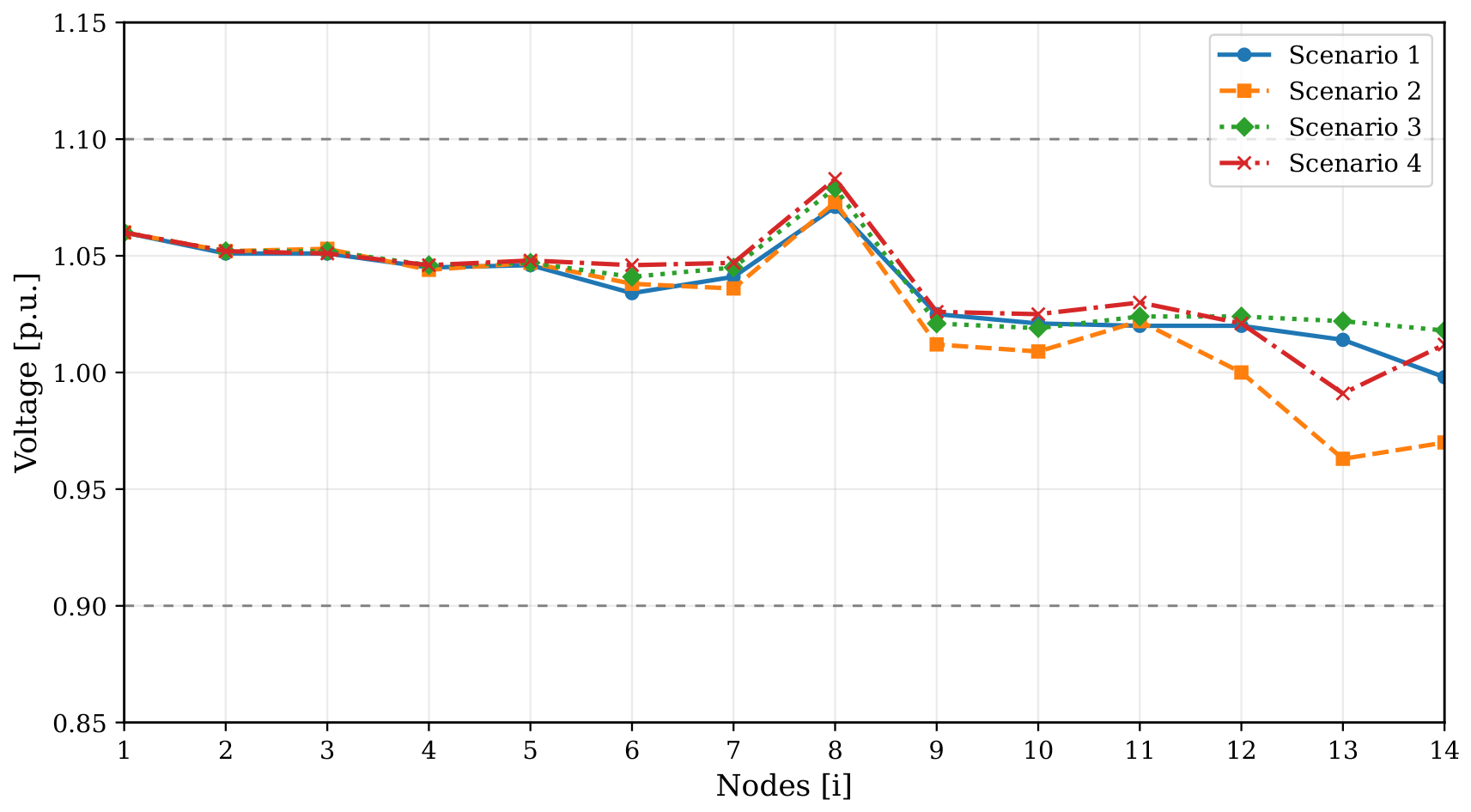
For the detailed IEEE 14-bus discussion, four operating scenarios are considered: (i) normal operation without compensation; (ii) critical contingency without compensation; (iii) normal operation with compensation; and (iv) critical contingency with compensation in service. This scenario-based structure helps isolate the effect of the contingency from the effect of the proposed shunt installation.
The optimization models were solved in GAMS V52.5.0 (GAMS Development Corporation, Fairfax, VA, USA) using the CONOPT solver (ARKI Consulting and Development A/S, Bagsværd, Denmark). Simulations were executed on a computer equipped with an Intel(R) Core(TM) i7-8550U CPU @ 1.80 GHz and 8 GB of RAM. Because AC–OPF is nonlinear and nonconvex, several starting points were used to verify consistency of the reported results.
Algorithm 1 summarizes the complete planning sequence adopted in this work.
| Algorithm 1 Contingency-driven shunt compensation placement. |
- 1:
Step 1: Input data - 2:
Read generator, branch, and load data of the selected test system - 3:
Step 2: Base operating point - 4:
Solve AC–OPF under normal operation - 5:
Compute the base contingency index - 6:
Store voltage magnitudes, angles, and branch flows - 7:
Step 3: N–1 screening - 8:
- 9:
- 10:
for to do - 11:
Apply contingency c and solve the AC model - 12:
if the model converges then - 13:
Compute using ( 12) - 14:
if then - 15:
- 16:
- 17:
end if - 18:
else - 19:
Mark contingency c as non-convergent/infeasible - 20:
end if - 21:
end for - 22:
Step 4: Candidate-set definition - 23:
Under the critical contingency , rank load buses by post-contingency voltage magnitude - 24:
Define as the five load buses with the lowest voltage magnitudes - 25:
Step 5: Sensitivity-based ranking - 26:
for each do - 27:
Compute the sensitivity score from ( 13) or ( 14) - 28:
end for - 29:
Select - 30:
Step 6: Compensation placement and validation - 31:
Install shunt compensation at bus with - 32:
Re-solve the AC–OPF under normal and critical-contingency conditions - 33:
Evaluate voltage profile, active losses, and branch-flow behavior - 34:
Step 7: Report results - 35:
Report , , , and the resulting performance indicators
|
5. Results and Discussion
5.1. IEEE 14-Bus System: Critical Contingency and Ranking
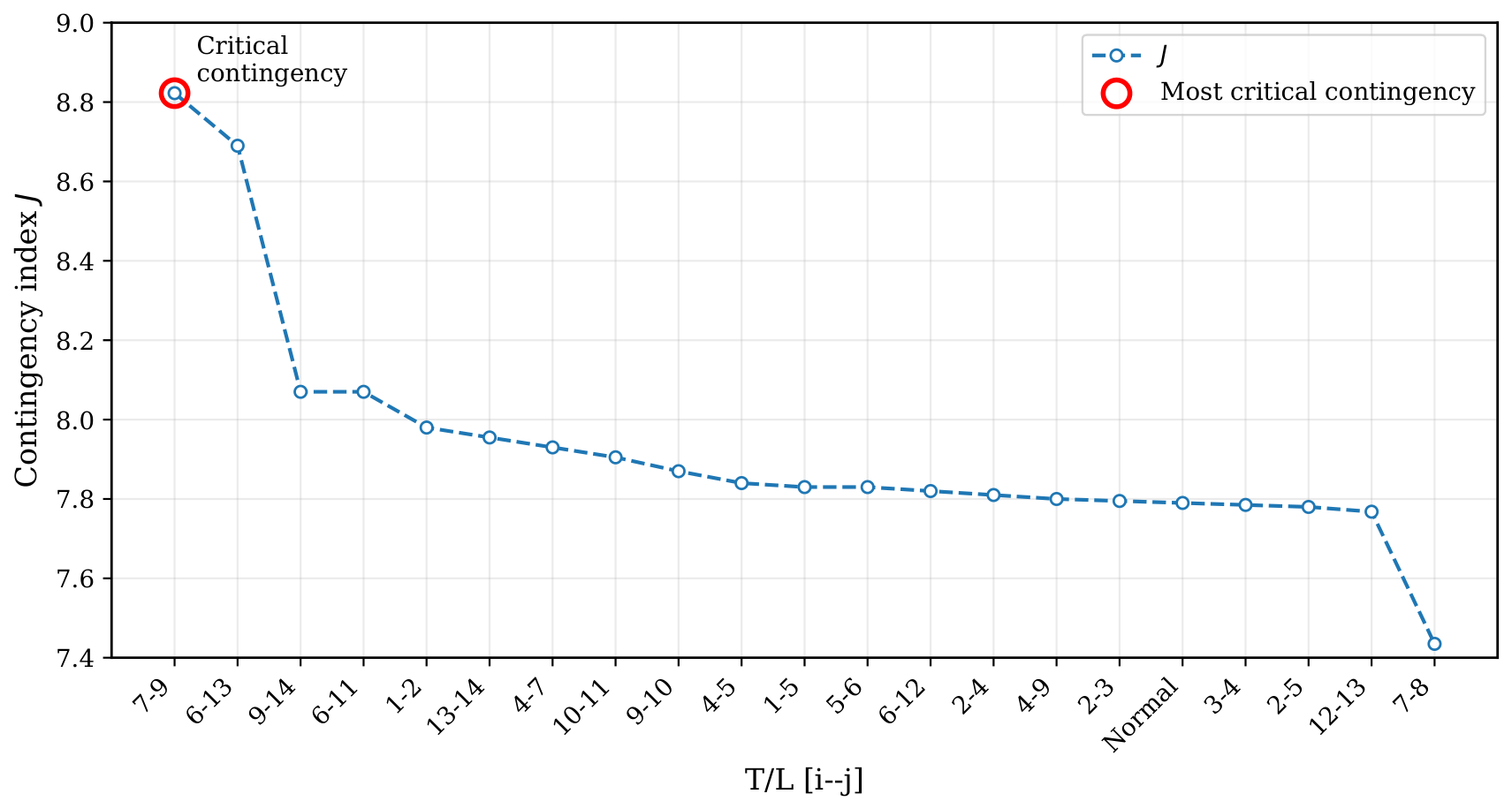
Figure 3 presents the contingency-severity ranking for the IEEE 14-bus system. The outage of line 7–9 produces the largest severity value,
J = 8.8225, and is therefore identified as the critical N–1 contingency. This outage also generates the most stressed voltage condition in the system, with Bus 14 reaching 0.943 p.u. before compensation, which points to the weak end of the network that must be examined in the next stage.
Once the critical contingency is identified, the five load buses with the lowest post-contingency voltages are selected as the candidate set.
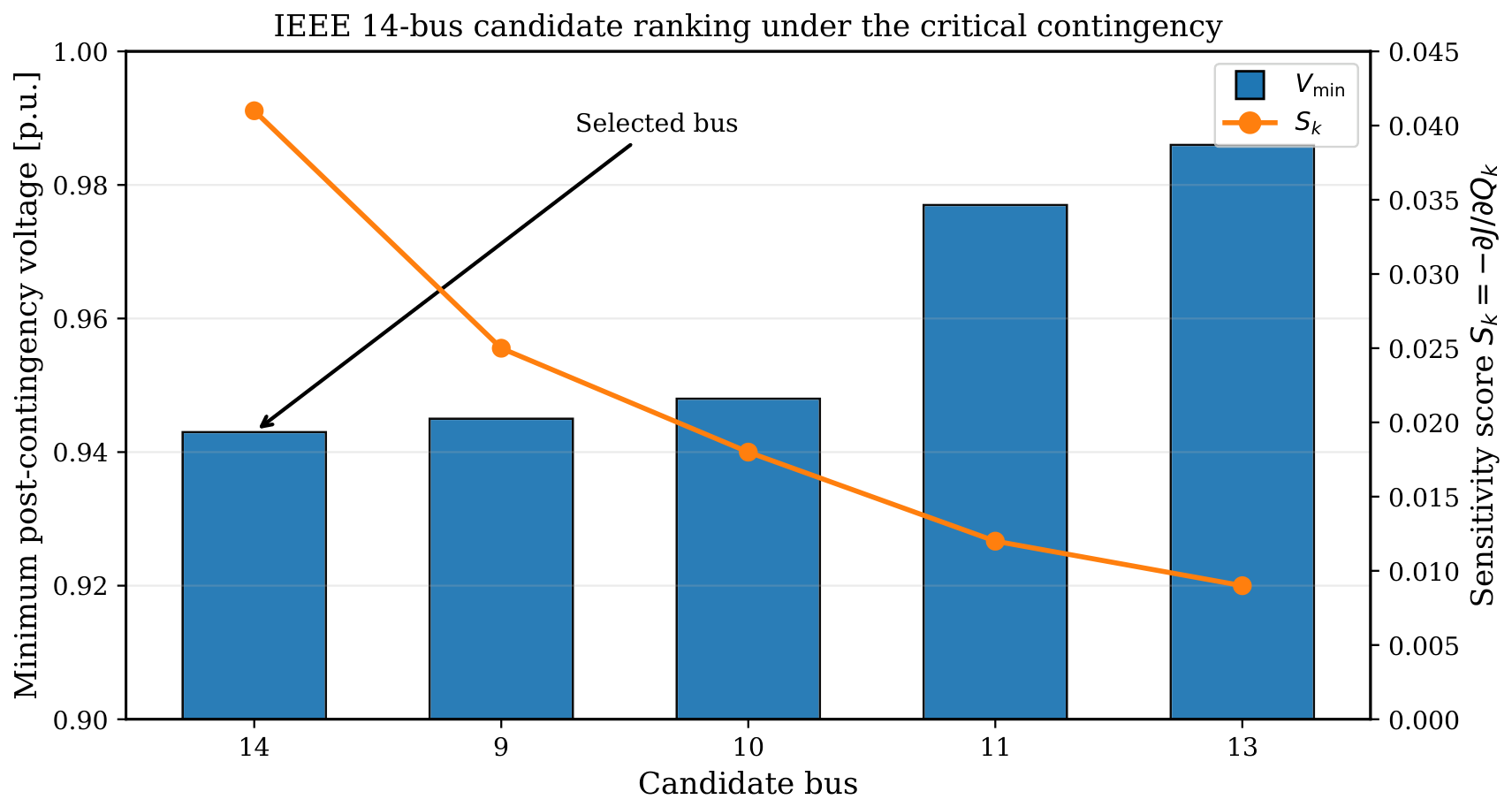
Figure 4 combines the voltage screening with the sensitivity-based ranking, and
Table 5 reports the exact numerical values.
The results show that Bus 14 yields the highest sensitivity score and therefore the largest reduction of the global contingency index per unit of injected reactive power. The margin with respect to the second-ranked candidate is substantial: , meaning that the best candidate is 64% stronger than the next option in terms of the proposed severity-reduction criterion. In this benchmark, Bus 14 is also the bus with the lowest post-contingency voltage, so the local screening and the global ranking point to the same final location. The important point is that the placement decision is not based on local voltage alone; it is quantitatively validated by the global sensitivity score.
To further assess the effectiveness of the proposed sensitivity-based criterion, a comparison with a conventional voltage-based selection approach was performed. In the voltage-based method, the compensation location is selected as the bus exhibiting the lowest post-contingency voltage magnitude. For the IEEE 14-bus system under the critical contingency (line 7–9), both approaches identify Bus 14 as the most critical node in terms of voltage magnitude. However, the sensitivity-based framework provides additional insight by quantifying the system-wide impact of reactive power injection, allowing a more informed ranking of candidate buses.
It is worth noting that although the lowest-voltage bus coincides with the optimal location in this case, the sensitivity-based ranking reveals significant differences among candidate buses that are not captured by voltage magnitude alone. This confirms that voltage-based criteria may be insufficient for identifying the most effective compensation location from a system-wide perspective.
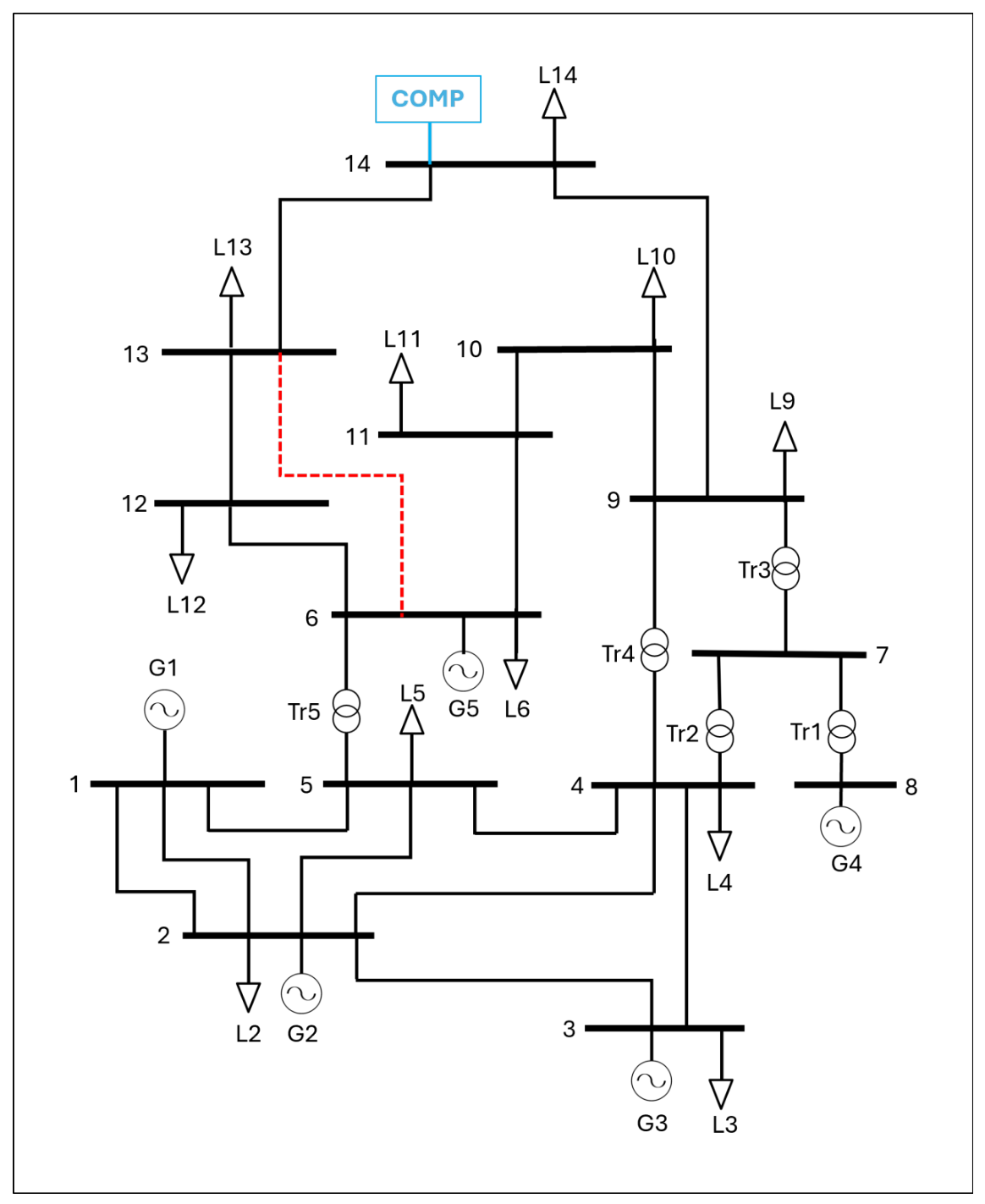
Once Bus 14 is selected, the ORPD formulation determines an optimal capacitive injection of 12.5 Mvar.
Figure 5 shows the final placement of the compensation device, and
Table 6 summarizes the main decision variables.
5.2. IEEE 14-Bus System: Four-Scenario Operating Analysis
The remaining analysis uses the scenario structure of
Table 7 to separate the isolated effect of the contingency from the effect of the final compensation decision.
Figure 6 presents the voltage profiles for the four scenarios. The most relevant effect appears at the weak end of the system. Under the critical contingency without compensation, Bus 14 drops to 0.943 p.u. After installing 12.5 Mvar at the selected location, the same bus rises to 1.012 p.u. under the critical contingency, and the neighboring buses also show moderate improvement. This indicates that the selected intervention does not act as an isolated local correction only; it reinforces the broader corridor associated with the stressed operating condition.
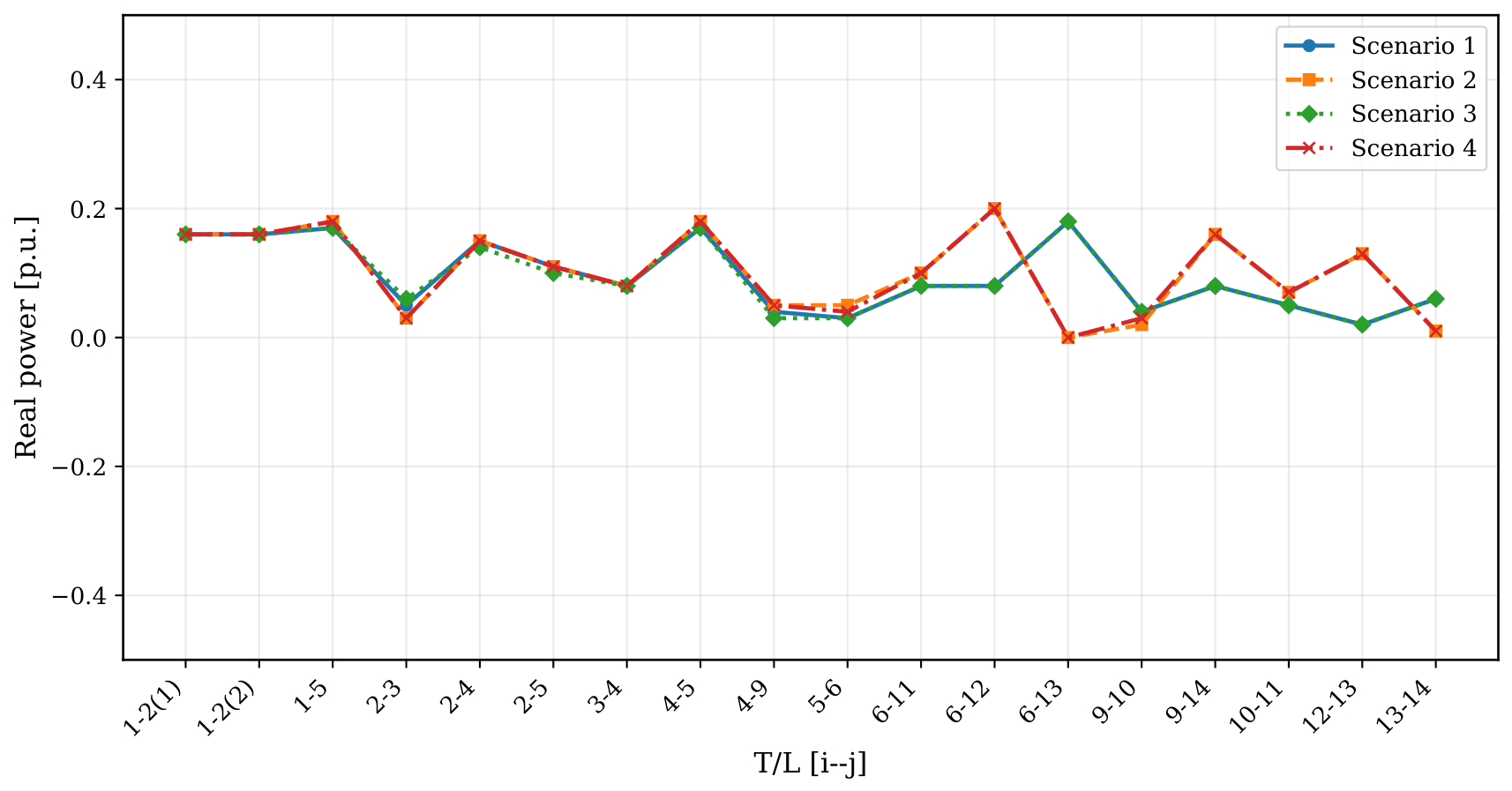
Figure 7 compares the active power flows in the main branches. The contingency and the subsequent compensation cause only moderate redistributions of real power. This is a desirable outcome because the proposed shunt support improves voltage performance and reduces losses without creating disruptive changes in the active-power transfer pattern of the system.
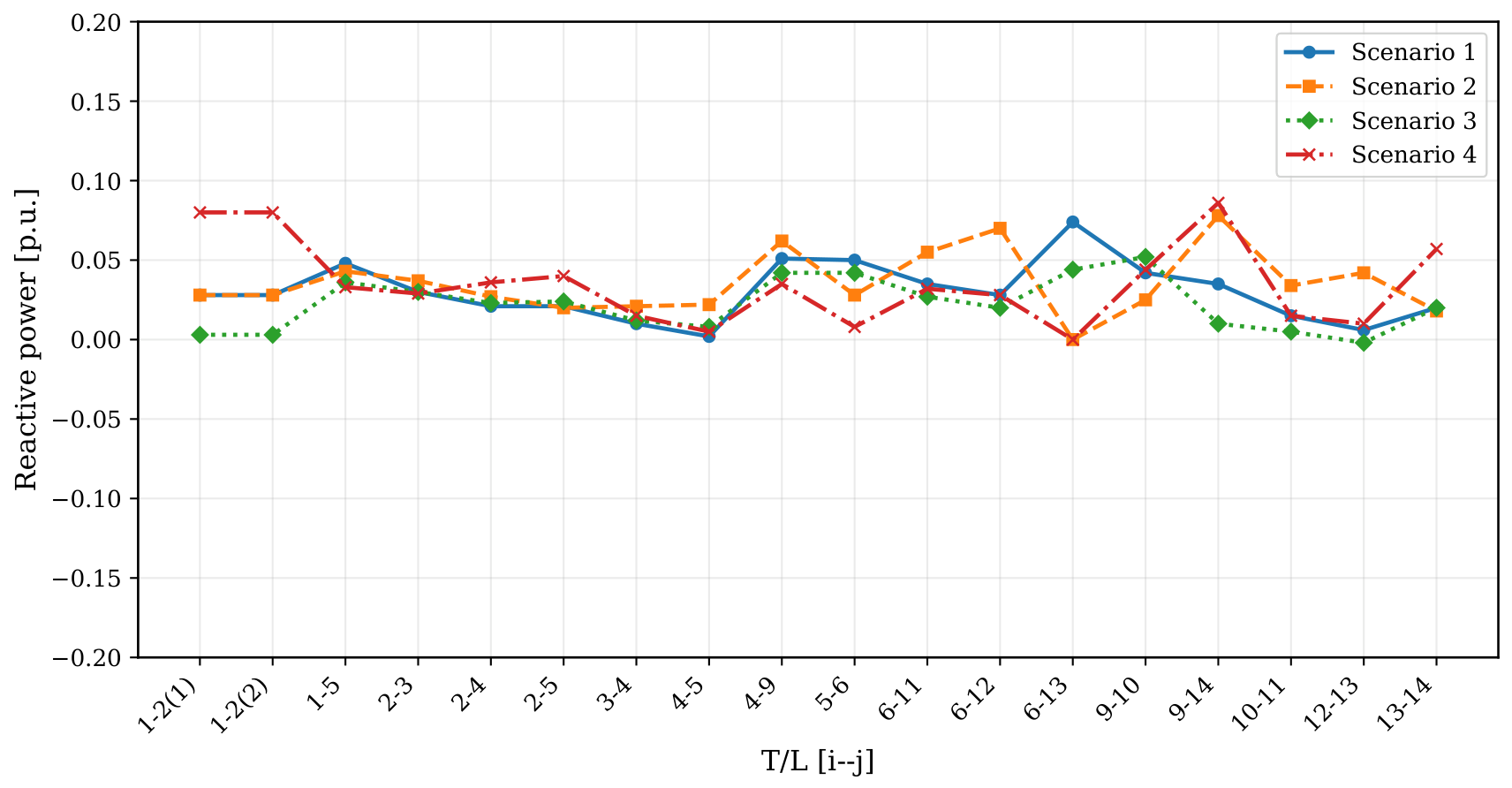
Reactive power flows are more sensitive to the compensation decision, as shown in
Figure 8. Under the critical contingency without support, several branches must carry larger reactive burdens to sustain the affected corridor. Once compensation is installed at Bus 14, part of that burden is supplied locally, reducing long-distance reactive transfer and improving the voltage profile in the vulnerable area.
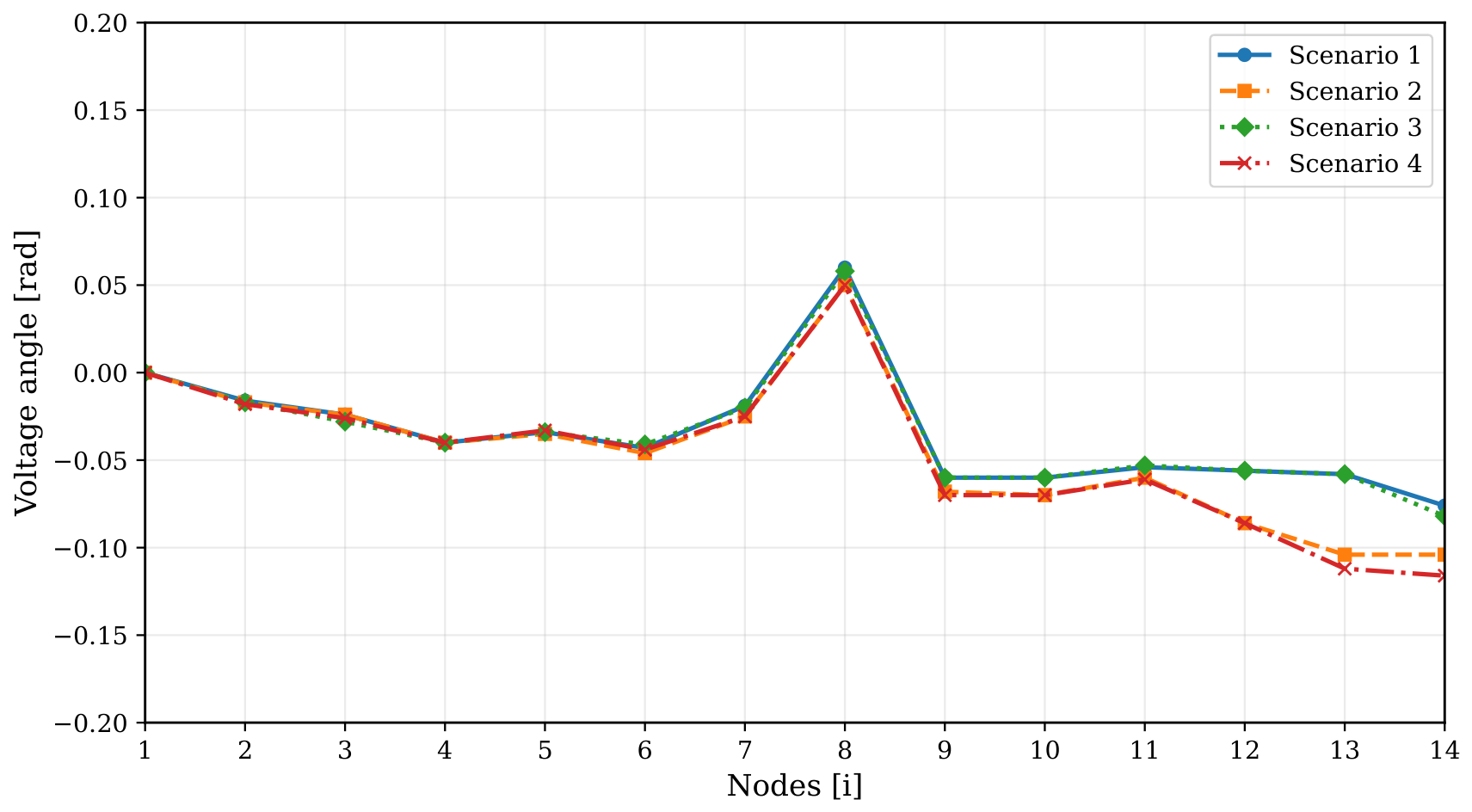
Finally,
Figure 9 presents the voltage-angle profiles. As expected, the compensation primarily influences voltage magnitudes and reactive-flow distribution, while the angle pattern remains comparatively stable. This is consistent with the physical role of shunt compensation as a local voltage-support measure rather than a direct active-power control element.
Taken together, the IEEE 14-bus results show that the proposed framework is operationally meaningful: it first isolates the most severe contingency, then identifies the compensation location with the greatest system-wide impact, and finally yields measurable improvements in voltage support and active-loss behavior.
5.3. Scalability Assessment on the IEEE 30-Bus System
The IEEE 30-bus system introduces a larger N–1 contingency space and therefore a more demanding ranking problem. During the screening stage, the outages of lines 12–14, 15–18, and 28–27 did not yield convergent AC solutions and were therefore classified as infeasible post-contingency operating conditions. Among the feasible outages, the contingency associated with line 1–2 produced the highest severity value, , and was selected as the critical condition for the subsequent candidate analysis.
From a planning perspective, these non-convergent contingencies can be interpreted as highly severe or infeasible operating conditions, potentially associated with system instability, voltage collapse, or network islanding. Although they cannot be directly included in the numerical evaluation of the contingency index due to the lack of a feasible solution, their occurrence provides valuable information regarding system vulnerability.
Therefore, these contingencies are reported separately and should be considered as critical scenarios requiring preventive planning actions, such as network reinforcement or additional reactive power support, even though they are not part of the sensitivity-based ranking process.
Table 8 summarizes the contingency-screening results for the IEEE 30-bus system.
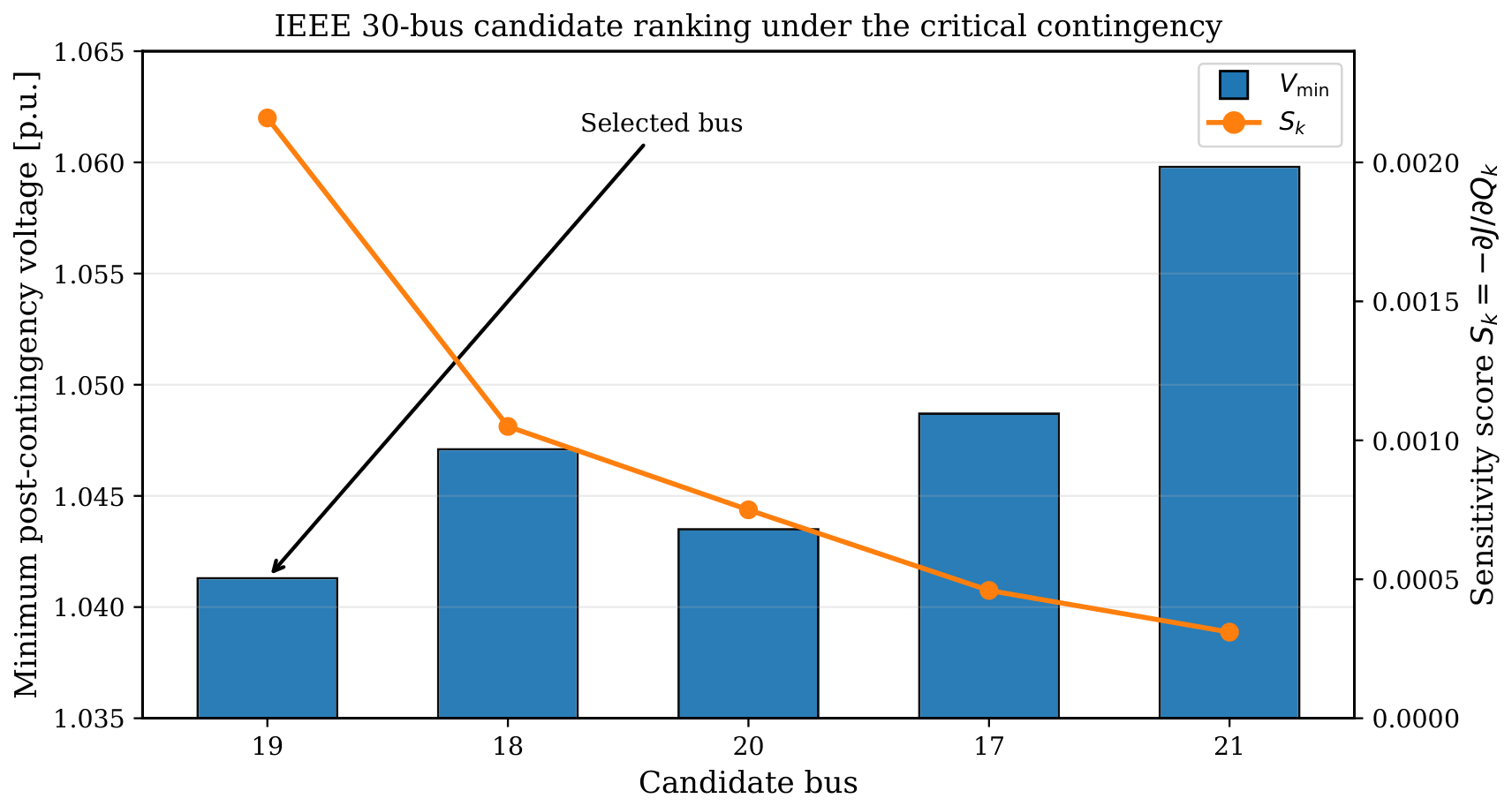
Table 9 and
Figure 10 report the candidate ranking under the identified critical contingency. Bus 19 exhibits the highest sensitivity and is therefore selected as the preferred compensation location in the IEEE 30-bus system.
A relevant feature of the IEEE 30-bus case is that voltage screening and sensitivity ranking are not identical beyond the best candidate. If the buses were ordered only by the minimum post-contingency voltage, Bus 20 would appear ahead of Bus 18 because p.u. However, the sensitivity score reverses this order because is larger than . This shows that two buses with similar voltage severity can have different global effects on the contingency index, which is exactly the type of ambiguity that the proposed score is designed to resolve.
This result provides a direct comparison with a voltage-only placement criterion. A purely voltage-based approach would rank Bus 20 ahead of Bus 18 because of its slightly lower post-contingency voltage. In contrast, the proposed sensitivity-based criterion ranks Bus 18 above Bus 20 because its reactive support produces a larger reduction in the global contingency index. This confirms that voltage magnitude alone may not fully capture the system-wide benefit of reactive power compensation.
5.4. Scalability Assessment on the IEEE 57-Bus System
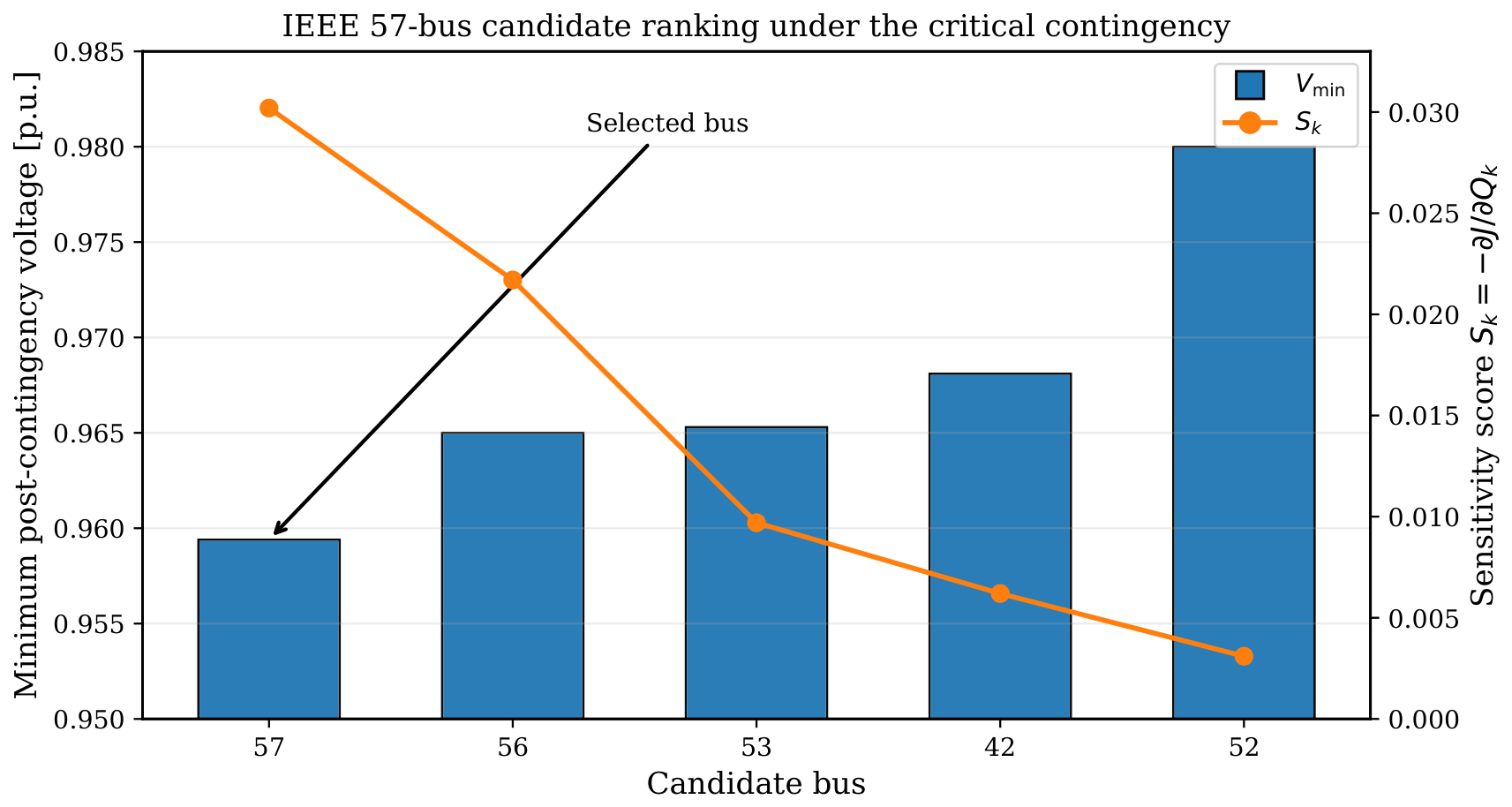
A second scalability test was performed on the IEEE 57-bus system. In this network, the outages of lines 7–8, 37–39, and 11–41 did not yield convergent AC solutions and were excluded from the numerical ranking. Among the feasible contingencies, line 9–11 produced the largest contingency index, , and was therefore selected as the critical post-contingency operating condition.
As in the IEEE 30-bus case, these non-convergent contingencies are not simply discarded from the planning interpretation. They indicate highly stressed or infeasible post-contingency states that may require preventive reinforcement measures. Since no feasible AC operating point is available, the contingency index cannot be consistently evaluated for these cases; however, they remain relevant from a security-assessment perspective and are therefore reported separately.
Table 10 summarizes the contingency-screening results for the IEEE 57-bus system.
Table 11 and
Figure 11 present the corresponding candidate ranking. Bus 57 obtains the highest sensitivity score and is therefore selected as the preferred compensation location in this benchmark.
The IEEE 57-bus results preserve the same decision logic observed in the smaller cases: voltage screening identifies the vulnerable region, while the sensitivity score quantifies which bus in that region has the greatest global mitigation effect. Although the absolute values of are system-dependent and therefore should not be compared directly across networks without normalization, the ranking itself remains transparent and interpretable.
5.5. Advanced Cross-System Comparative Analysis
To complement the case-by-case discussion, a comparative analysis was performed using the candidate tables of the three benchmarks. Because the absolute magnitude of
depends on the size of the system and on the scaling of the severity index, cross-system comparison is more meaningful after normalization.
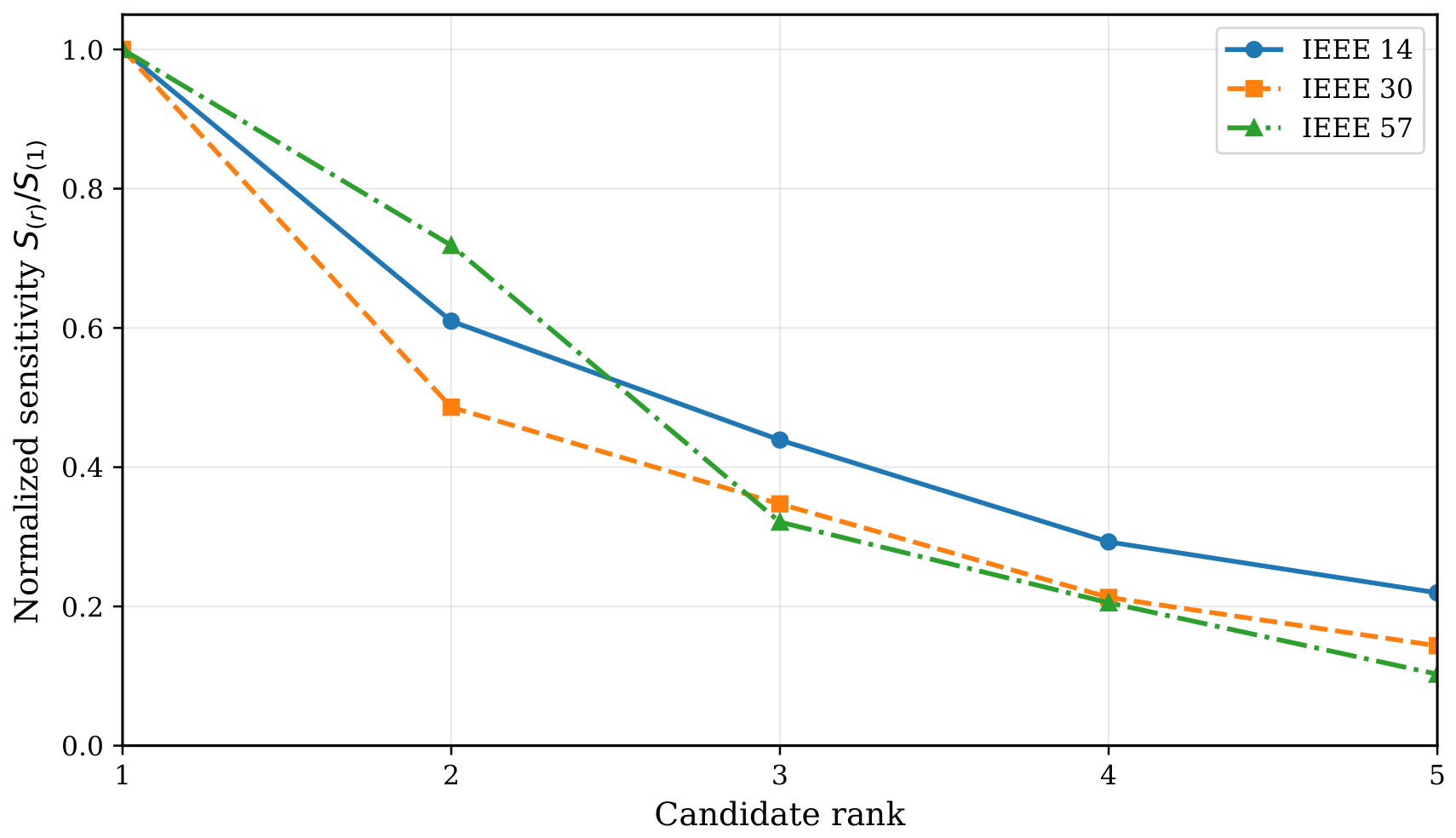
Figure 12 therefore plots the normalized sensitivity decay
as a function of the candidate rank
r, where
is the score of the selected bus in each benchmark.
The normalized curves reveal that the proposed ranking produces a clear decision in all three benchmarks. The second candidate retains 61% of the best score in the IEEE 14-bus system, 48.6% in the IEEE 30-bus system, and 71.9% in the IEEE 57-bus system. This means that the IEEE 30-bus system exhibits the sharpest first-rank drop, while the IEEE 57-bus system shows stronger competition between the first and second buses but a steeper decline afterward.
The selectivity ratio measures the separation between the best and second-best candidates. The concentration share quantifies how much of the total top-five sensitivity is concentrated in the selected bus. The descriptive Spearman rank-agreement coefficient compares the order induced by voltage severity with the order induced by the proposed sensitivity score.
Values of close to 1 indicate strong agreement between voltage-based and sensitivity-based rankings, while lower values reveal discrepancies between local and system-wide criteria.
Table 12 summarizes the main placement and ranking results obtained for the three IEEE test systems. The table integrates both the contingency identification stage and the sensitivity-based ranking results, highlighting the consistency of the proposed framework across different network sizes.
Looking at the results more closely, two observations stand out. To begin with, the selected bus represents between 39% and 46% of the total sensitivity of the top five candidates across the three benchmark systems. This is not a minor difference. It shows that the final choice carries a significant weight within the candidate set, rather than being just a slight improvement over the alternatives.
Another interesting point appears in the IEEE 30-bus case. Even though voltage severity and sensitivity agree on the best candidate, they do not necessarily produce the same overall ranking. This becomes particularly noticeable when post-contingency voltages are very similar, since small differences at the local level can hide more meaningful differences in terms of overall system behavior.
From a planning point of view, these results suggest that the proposed framework is doing more than simply filtering options. It provides a way to understand and justify the final decision, see how strong that decision really is, and compare how the criterion behaves as the system grows in size. In that sense, the analysis adds practical value, going beyond a single example and offering a more general perspective for decision-making.
6. Conclusions
This work introduces a contingency-aware, sensitivity-based planning criterion for the optimal placement of shunt compensation in transmission systems. The proposed approach establishes a quantitative relationship between contingency severity and the system-wide impact of reactive power support, enabling more effective and physically interpretable planning decisions.
The results obtained on IEEE 14, 30, and 57-bus systems demonstrate that the proposed framework consistently identifies compensation locations that improve voltage profiles and reduce active power losses under both normal and contingency conditions. The methodology also shows consistent behavior across systems of increasing size, supporting its scalability. These improvements contribute to enhanced operational efficiency, which is aligned with sustainability-oriented objectives in modern power systems.
The proposed approach is intended as a planning-support tool rather than a full economic optimization framework. Its main advantage lies in providing a transparent and reproducible decision criterion that can be integrated into existing planning workflows, particularly in security-constrained environments.
However, the present study is based on a static analysis framework and relies on benchmark test systems. It does not explicitly consider uncertainties such as renewable generation variability, load fluctuations, or economic cost modeling. Additionally, the evaluation focuses on the most critical contingency scenario, which may not fully capture multi-contingency interactions in large-scale systems.
Future work may extend the proposed framework by incorporating stochastic operating conditions, multi-contingency analysis, and techno-economic criteria. Further validation on large-scale real networks and comparison with alternative placement strategies would also strengthen the applicability of the methodology.
Author Contributions
Conceptualization, D.C.; Methodology, J.M.; Formal analysis, M.J.; Data curation, M.J.; Writing original draft, J.M.; Writing review & editing, D.C. and M.J.; Supervision, D.C.; Project administration, D.C.; Funding acquisition, D.C. All authors have read and agreed to the published version of the manuscript.
Funding
This work was supported by Salesian Polytechnic University and GIREI-Smart Grid Research Group under the project “A platform for operational decision-making in power systems based on optimization and real-time data”, Resolution No.: 45-03-2026-04-15.
Institutional Review Board Statement
Not applicable.
Informed Consent Statement
Not applicable.
Data Availability Statement
The original contributions presented in this study are included in the article. Further inquiries can be directed to the corresponding author.
Conflicts of Interest
The authors declare no conflicts of interest.
References
- Baltensperger, D.; Rodrigues de Brito, H.; Mishra, S.; Øyvang, T.; Uhlen, K. An optimal reactive power pre-dispatch approach for minimizing active power losses. Front. Energy Res. 2025, 13, 1632604. [Google Scholar] [CrossRef]
- Sachan, S.; Mishra, S.; Øyvang, T.; Bordin, C. Reactive power reserve-constrained optimal reactive power dispatch for enhanced voltage stability. Energy Rep. 2025, 14, 3077–3092. [Google Scholar] [CrossRef]
- Villacrés, R.; Carrión, D. Optimizing Real and Reactive Power Dispatch Using a Multi-Objective Approach Combining the E-Constraint Method and Fuzzy Satisfaction. Energies 2023, 16, 8034. [Google Scholar] [CrossRef]
- Saddique, M.S.; Bhatti, A.R.; Haroon, S.S.; Sattar, M.K.; Amin, S.; Sajjad, I.A.; ul Haq, S.S.; Awan, A.B.; Rasheed, N. Solution to optimal reactive power dispatch in transmission system using meta-heuristic techniques—Status and technological review. Electr. Power Syst. Res. 2020, 178, 106031. [Google Scholar] [CrossRef]
- Ismail, B.; Abdul Wahab, N.I.; Othman, M.L.; Radzi, M.A.M.; Naidu Vijyakumar, K.; Mat Naain, M.N. A Comprehensive Review on Optimal Location and Sizing of Reactive Power Compensation Using Hybrid-Based Approaches for Power Loss Reduction, Voltage Stability Improvement, Voltage Profile Enhancement and Loadability Enhancement. IEEE Access 2020, 8, 222733–222765. [Google Scholar] [CrossRef]
- Chen, T.; Dai, Z.; Shan, X.; Li, Z.; Hu, C.; Xue, Y.; Xu, K. Reactive Power Optimization Method of Power Network Based on Deep Reinforcement Learning Considering Topology Characteristics. Energies 2024, 17, 6454. [Google Scholar] [CrossRef]
- Muhammad, Y.; Khan, R.; Raja, M.A.Z.; Ullah, F.; Chaudhary, N.I.; He, Y. Solution of optimal reactive power dispatch with FACTS devices: A survey. Energy Rep. 2020, 6, 2211–2229. [Google Scholar] [CrossRef]
- Jaramillo, M.; Carrión, D. Optimizing Critical Overloaded Power Transmission Lines with a Novel Unified SVC Deployment Approach Based on FVSI Analysis. Energies 2024, 17, 2063. [Google Scholar] [CrossRef]
- Roy, R.; Das, T.; Mandal, K.K. Optimal reactive power dispatch using a novel optimization algorithm. J. Electr. Syst. Inf. Technol. 2021, 8, 18. [Google Scholar] [CrossRef]
- Chethan, M.; Kuppan, R. A review of FACTS device implementation in power systems using optimization techniques. J. Eng. Appl. Sci. 2024, 71, 18. [Google Scholar] [CrossRef]
- Chamba, A.; Barrera-Singaña, C.; Arcos, H. Optimal Reactive Power Dispatch in Electric Transmission Systems Using the Multi-Agent Model with Volt-VAR Control. Energies 2023, 16, 5004. [Google Scholar] [CrossRef]
- Megantoro, P.; Halim, S.A.; Kamari, N.A.M.; Awalin, L.J.; Ali, M.S.; Rosli, H.M. Optimizing reactive power dispatch with metaheuristic algorithms: A review of renewable distributed generation integration with intermittency considerations. Energy Rep. 2025, 13, 397–423. [Google Scholar] [CrossRef]
- Wei, Y.; Zhou, Y.; Luo, Q.; Deng, W. Optimal reactive power dispatch using an improved slime mould algorithm. Energy Rep. 2021, 7, 8742–8759. [Google Scholar] [CrossRef]
- Zhang, M.; Li, Y. Multi-Objective Optimal Reactive Power Dispatch of Power Systems by Combining Classification-Based Multi-Objective Evolutionary Algorithm and Integrated Decision Making. IEEE Access 2020, 8, 38198–38209. [Google Scholar] [CrossRef]
- Jamal, R.; Men, B.; Khan, N.H. A Novel Nature Inspired Meta-Heuristic Optimization Approach of GWO Optimizer for Optimal Reactive Power Dispatch Problems. IEEE Access 2020, 8, 202596–202610. [Google Scholar] [CrossRef]
- Al Ahmad, A.; Sirjani, R. Optimal placement and sizing of multi-type FACTS devices in power systems using metaheuristic optimisation techniques: An updated review. Ain Shams Eng. J. 2020, 11, 611–628. [Google Scholar] [CrossRef]
- Abdel-Fatah, S.; Ebeed, M.; Kamel, S.; Yu, J. Reactive Power Dispatch Solution with Optimal Installation of Renewable Energy Resources Considering Uncertainties. In Proceedings of the IEEE Conference on Power Electronics and Renewable Energy (CPERE 2019), Aswan City, Egypt, 23–25 October 2019; pp. 118–122. [Google Scholar] [CrossRef]
- Ebeed, M.; Ali, A.; Mosaad, M.I.; Kamel, S. An improved lightning attachment procedure optimizer for optimal reactive power dispatch with uncertainty in renewable energy resources. IEEE Access 2020, 8, 168721–168731. [Google Scholar] [CrossRef]
- Feng, N.; Niu, T.; Yan, J.; Zhang, Y.; Feng, Y.; Lei, Y. Optimal Placement and Sizing of Reactive Power Compensation Devices in Power Grids with High Penetration of Distributed Generation. Processes 2025, 13, 2953. [Google Scholar] [CrossRef]
- Hassan, M.H.; Kamel, S.; El-Dabah, M.A.; Khurshaid, T.; Dominguez-Garcia, J.L. Optimal Reactive Power Dispatch with Time-Varying Demand and Renewable Energy Uncertainty Using Rao-3 Algorithm. IEEE Access 2021, 9, 23264–23283. [Google Scholar] [CrossRef]
- Carrión, D.; García, E.; Jaramillo, M.; González, J.W. A novel methodology for optimal svc location considering n-1 contingencies and reactive power flows reconfiguration. Energies 2021, 14, 6652. [Google Scholar] [CrossRef]
- Gupta, S.K.; Mallik, S.K. Enhancement in Voltage Stability Using FACTS Devices Under Contingency Conditions. J. Oper. Autom. Power Eng. 2024, 12, 365–378. [Google Scholar] [CrossRef]
- Romero, D.; Carrión, D.; Jaramillo, M. Electrical Power Systems Reinforcement through Overall Contingency Index Analysis and Improvement. Energies 2024, 17, 2506. [Google Scholar] [CrossRef]
- Khan, N.H.; Wang, Y.; Tian, D.; Jamal, R.; Kamel, S.; Ebeed, M. Optimal siting and sizing of SSSC using modified salp swarm algorithm considering optimal reactive power dispatch problem. IEEE Access 2021, 9, 49249–49266. [Google Scholar] [CrossRef]
- Zhang, X.; Zhang, X.; Zhang, R.; Gu, W.; Cao, G. N-1 Evaluation of Integrated Electricity and Gas System Considering Cyber-Physical Interdependence. IEEE Trans. Smart Grid 2025, 16, 3728–3742. [Google Scholar] [CrossRef]
- Vermunicht, J.; Škrjanc, T.; Sütő, B.; Van Hertem, D.; Rudež, U.; Raisz, D.; Leterme, W. Decision Support for Power System Restoration: Mitigating Risks of Dynamic Phenomena. In Proceedings of the 2024 IEEE PES Innovative Smart Grid Technologies Europe (ISGT EUROPE), Dubrovnik, Croatia, 14–17 October 2024; pp. 1–6. [Google Scholar] [CrossRef]
- Barutçu, İ.Ç.; Işiker, H.; Yamaçli, V.; Abaci, K.; Yetgin, Z. Optimal Reactive Power Dispatch Together with Uncertainties of Load and Renewable Energy Resources Proposing EBO-CMAR: Detailed Comparative Analysis with Literature. J. Electr. Eng. Technol. 2025, 21, 1285–1306. [Google Scholar] [CrossRef]
- Shami, T.M.; El-Saleh, A.A.; Alswaitti, M.; Al-Tashi, Q.; Summakieh, M.A.; Mirjalili, S. Particle Swarm Optimization: A Comprehensive Survey. IEEE Access 2022, 10, 10031–10061. [Google Scholar] [CrossRef]
- Fisher, E.B.; O’Neill, R.P.; Ferris, M.C. Optimal transmission switching. IEEE Trans. Power Syst. 2008, 23, 1346–1355. [Google Scholar] [CrossRef]
- Abou El-Ela, A.A.; El-Sehiemy, R.A.; Shaheen, A.M.; Eissa, I.A. Optimal coordination of static VAR compensators, fixed capacitors, and distributed energy resources in Egyptian distribution networks. Int. Trans. Electr. Energy Syst. 2020, 30, e12609. [Google Scholar] [CrossRef]
- Suarez-Patiño, J.E.; Gallego-Pareja, L.A.; Gómez-Carmona, O. Optimal placement, sizing and operation of D-STATCOMs in power distribution systems using a Mixed-Integer Linear Programming model. Results Eng. 2025, 26, 104749. [Google Scholar] [CrossRef]
Figure 1.
Overview of the proposed contingency-driven planning framework for shunt compensation placement.
Figure 1.
Overview of the proposed contingency-driven planning framework for shunt compensation placement.
Figure 2.
Single-line diagram of the IEEE 14-bus transmission system.
Figure 2.
Single-line diagram of the IEEE 14-bus transmission system.
Figure 3.
Contingency-severity ranking for the IEEE 14-bus system. The outage of line 7–9 is the critical contingency.
Figure 3.
Contingency-severity ranking for the IEEE 14-bus system. The outage of line 7–9 is the critical contingency.
Figure 4.
Dual-axis candidate ranking for the IEEE 14-bus system. The bars represent post-contingency voltage severity and the line represents the proposed sensitivity score.
Figure 4.
Dual-axis candidate ranking for the IEEE 14-bus system. The bars represent post-contingency voltage severity and the line represents the proposed sensitivity score.
Figure 5.
IEEE 14-bus system with shunt compensation installed at Bus 14.
Figure 5.
IEEE 14-bus system with shunt compensation installed at Bus 14.
Figure 6.
Voltage profiles of the IEEE 14-bus system under the four evaluated scenarios. The grey dashed lines indicate the admissible voltage limits (0.90–1.10 p.u.).
Figure 6.
Voltage profiles of the IEEE 14-bus system under the four evaluated scenarios. The grey dashed lines indicate the admissible voltage limits (0.90–1.10 p.u.).
Figure 7.
Active-power flow profiles of the IEEE 14-bus system under the four evaluated scenarios.
Figure 7.
Active-power flow profiles of the IEEE 14-bus system under the four evaluated scenarios.
Figure 8.
Reactive-power flow profiles of the IEEE 14-bus system under the four evaluated scenarios.
Figure 8.
Reactive-power flow profiles of the IEEE 14-bus system under the four evaluated scenarios.
Figure 9.
Voltage-angle profiles of the IEEE 14-bus system under the four evaluated scenarios.
Figure 9.
Voltage-angle profiles of the IEEE 14-bus system under the four evaluated scenarios.
Figure 10.
Dual-axis candidate ranking for the IEEE 30-bus system under the critical contingency.
Figure 10.
Dual-axis candidate ranking for the IEEE 30-bus system under the critical contingency.
Figure 11.
Dual-axis candidate ranking for the IEEE 57-bus system under the critical contingency.
Figure 11.
Dual-axis candidate ranking for the IEEE 57-bus system under the critical contingency.
Figure 12.
Normalized sensitivity decay across candidate ranks for the three test systems.
Figure 12.
Normalized sensitivity decay across candidate ranks for the three test systems.
Table 1.
Comparison of reactive power compensation placement approaches.
Table 1.
Comparison of reactive power compensation placement approaches.
| Approach | N–1 Security | Global Impact | Physical Interpretability | Optimization Required |
|---|
| Voltage-based methods | No | No | High | No |
| Local sensitivity indices | No | Partial | High | No |
| Metaheuristic optimization | Possible | Yes | Low | Yes |
| OPF-based placement | Possible | Yes | Medium | Yes |
| Proposed framework | Yes | Yes | High | No |
Table 2.
Generator data for the IEEE 14-bus system.
Table 2.
Generator data for the IEEE 14-bus system.
| Bus | | | | | a | b | c | |
|---|
| 1 | 50 | 500 | 0 | 10 | 0.007 | 7 | 240 | 1.06 |
| 2 | 20 | 200 | −40 | 50 | 0.0095 | 10 | 200 | 1.045 |
| 3 | 20 | 300 | 0 | 40 | 0.009 | 8.5 | 220 | 1.01 |
| 6 | 20 | 150 | −6 | 24 | 0.009 | 11 | 200 | 1.07 |
| 8 | 20 | 200 | −6 | 24 | 0.008 | 10.5 | 200 | 1.09 |
Table 3.
Load data for the IEEE 14-bus system.
Table 3.
Load data for the IEEE 14-bus system.
| Bus | P | Q | Bus | P | Q |
|---|
| 1 | 0 | 0 | 8 | 0 | 0 |
| 2 | 21.7 | 12.7 | 9 | 0 | 0 |
| 3 | 94.2 | 19 | 10 | 9 | 5.8 |
| 4 | 47.8 | −3.9 | 11 | 3.5 | 1.8 |
| 5 | 7.6 | 1.6 | 12 | 6.1 | 1.6 |
| 6 | 11.2 | 7.5 | 13 | 13.5 | 5.8 |
| 7 | 0 | 0 | 14 | 14.9 | 5 |
Table 4.
Line data for the IEEE 14-bus system.
Table 4.
Line data for the IEEE 14-bus system.
| Line [i–j] | r | x | b | SIL |
|---|
| 1–2 | 0.01938 | 0.05917 | 0.0528 | 200 |
| 1–5 | 0.05403 | 0.22304 | 0.0492 | 100 |
| 2–3 | 0.04699 | 0.19797 | 0.0438 | 100 |
| 2–4 | 0.05811 | 0.17632 | 0.0340 | 100 |
| 2–5 | 0.05695 | 0.17388 | 0.0346 | 100 |
| 3–4 | 0.06701 | 0.17103 | 0.0128 | 50 |
| 4–5 | 0.01335 | 0.04211 | 0 | 100 |
| 4–7 | 0 | 0.20912 | 0 | 50 |
| 4–9 | 0 | 0.55618 | 0 | 50 |
| 5–6 | 0 | 0.25202 | 0 | 100 |
| 6–11 | 0.09498 | 0.19890 | 0 | 50 |
| 6–12 | 0.12291 | 0.25581 | 0 | 20 |
| 6–13 | 0.06615 | 0.13027 | 0 | 50 |
| 7–8 | 0 | 0.17615 | 0 | 50 |
| 7–9 | 0 | 0.11001 | 0 | 50 |
| 9–10 | 0.03181 | 0.08450 | 0 | 20 |
| 9–14 | 0.12711 | 0.27038 | 0 | 20 |
| 10–11 | 0.08205 | 0.19207 | 0 | 20 |
| 12–13 | 0.22092 | 0.19988 | 0 | 20 |
| 13–14 | 0.17093 | 0.34802 | 0 | 20 |
Table 5.
Ranking of candidate buses for shunt compensation under the critical N–1 contingency in the IEEE 14-bus system.
Table 5.
Ranking of candidate buses for shunt compensation under the critical N–1 contingency in the IEEE 14-bus system.
| Bus | (p.u.) | | Rank |
|---|
| 14 | 0.943 | 0.041 | 1 |
| 9 | 0.945 | 0.025 | 2 |
| 10 | 0.948 | 0.018 | 3 |
| 11 | 0.977 | 0.012 | 4 |
| 13 | 0.986 | 0.009 | 5 |
Table 6.
Summary of the final compensation placement decision for the IEEE 14-bus system.
Table 6.
Summary of the final compensation placement decision for the IEEE 14-bus system.
| Parameter | Value |
|---|
| Critical contingency | Line 7–9 |
| Selected bus | 14 |
| Compensation size | 12.5 Mvar |
| Minimum voltage before compensation | 0.943 p.u. |
| Minimum voltage after compensation | 1.012 p.u. |
| Scenario | Description |
|---|
| 1 | Normal operation without compensation |
| 2 | Critical N–1 contingency (line 7–9 out of service) without compensation |
| 3 | Normal operation with shunt compensation installed at Bus 14 |
| 4 | Critical N–1 contingency with shunt compensation installed at Bus 14 |
Table 8.
Contingency-screening results for the IEEE 30-bus system.
Table 8.
Contingency-screening results for the IEEE 30-bus system.
| Category | Lines |
|---|
| Non-convergent contingencies | 12–14, 15–18, 28–27 |
| Critical contingency (max J) | 1–2 |
| Maximum contingency index J | 14.3107 |
Table 9.
Ranking of candidate buses for shunt compensation under the critical N–1 contingency in the IEEE 30-bus system.
Table 9.
Ranking of candidate buses for shunt compensation under the critical N–1 contingency in the IEEE 30-bus system.
| Bus | (p.u.) | | Rank |
|---|
| 19 | 1.0413 | 0.00216 | 1 |
| 18 | 1.0471 | 0.00105 | 2 |
| 20 | 1.0435 | 0.00075 | 3 |
| 17 | 1.0487 | 0.00046 | 4 |
| 21 | 1.0598 | 0.00031 | 5 |
Table 10.
Contingency-screening results for the IEEE 57-bus system.
Table 10.
Contingency-screening results for the IEEE 57-bus system.
| Category | Lines |
|---|
| Non-convergent contingencies | 7–8, 37–39, 11–41 |
| Critical contingency (max J) | 9–11 |
| Maximum contingency index J | 30.4339 |
Table 11.
Ranking of candidate buses for shunt compensation under the critical N–1 contingency in the IEEE 57-bus system.
Table 11.
Ranking of candidate buses for shunt compensation under the critical N–1 contingency in the IEEE 57-bus system.
| Bus | (p.u.) | | Rank |
|---|
| 57 | 0.9594 | 0.0302 | 1 |
| 56 | 0.9650 | 0.0217 | 2 |
| 53 | 0.9653 | 0.0097 | 3 |
| 42 | 0.9681 | 0.0062 | 4 |
| 52 | 0.9800 | 0.0031 | 5 |
Table 12.
Unified summary of contingency identification and sensitivity-based ranking results.
Table 12.
Unified summary of contingency identification and sensitivity-based ranking results.
| System | Critical Contingency | Selected Bus | | | | | |
|---|
| IEEE 14-bus | Line 7–9 | 14 | 0.0410 | 0.0250 | 1.64 | 0.390 | 1.00 |
| IEEE 30-bus | Line 1–2 | 19 | 0.00216 | 0.00105 | 2.06 | 0.457 | 0.90 |
| IEEE 57-bus | Line 9–11 | 57 | 0.0302 | 0.0217 | 1.39 | 0.426 | 1.00 |
| Disclaimer/Publisher’s Note: The statements, opinions and data contained in all publications are solely those of the individual author(s) and contributor(s) and not of MDPI and/or the editor(s). MDPI and/or the editor(s) disclaim responsibility for any injury to people or property resulting from any ideas, methods, instructions or products referred to in the content. |