Article

Optimal Reconfiguration of Distribution Networks with Distributed Generation Using a Hybrid GWO–NN Method for Sustainable Power Loss Reduction and Voltage Profile Improvement

Smart Grid Research Group GIREI, Universidad Politécnica Salesiana, Quito EC170702, Ecuador
*
Author to whom correspondence should be addressed.
Sustainability 2026, 18(9), 4516; https://doi.org/10.3390/su18094516
Submission received: 26 February 2026 / Revised: 15 April 2026 / Accepted: 16 April 2026 / Published: 4 May 2026
(This article belongs to the Special Issue Smart Grid and Sustainable Energy Systems)

Abstract

Distribution networks are being transformed by the growing penetration of distributed generation (DG), which changes power flows, voltage profiles, and the optimal operating point of the feeder. This study proposes a hybrid technique that combines the Gray Wolf Optimizer (GWO) with a neural network (NN) surrogate model to solve the distribution network reconfiguration (DNR) problem. The method minimizes active power losses while improving voltage regulation and preserving radial operation under operational constraints. The GWO performs global exploration of discrete switch configurations, whereas the NN accelerates local refinement by screening candidates before exact AC power flow validation. This manuscript presents benchmark results for the IEEE 33-bus and IEEE 69-bus distribution test systems. For the IEEE 33-bus benchmark, DG units are installed at buses 14, 25, and 30. For the IEEE 33-bus case, losses are reduced from 282.94 kW in the base case to 120.65 kW with DG and to 87.08 kW after hybrid reconfiguration, while the minimum voltage magnitude improves from 0.8829 p.u. to 0.9587 p.u. For the IEEE 69-bus case, total active losses decrease from 224.95 kW to 82.22 kW with DG and to 29.92 kW after reconfiguration while concurrently improving the voltage profile and line loading. From a sustainability perspective, the main contribution of the proposed workflow is to reduce technical losses at the distribution level, thereby improving energy efficiency for a given demand. Overall, the results show that the combined use of DG and surrogate-assisted reconfiguration can yield substantial efficiency gains across benchmark feeders of varying sizes, while broader multi-feeder validation and more detailed surrogate error quantification remain necessary before claiming general applicability.

1. Introduction

Electric distribution networks constitute the last stage of the power system, delivering electricity from substations to end users. Their radial structure and the relatively high resistance-to-reactance ratio of distribution lines cause non-negligible technical losses and voltage drops, especially under heavy loading and long feeders. These losses represent both economic cost and additional energy consumption. Consequently, distribution network reconfiguration (DNR) has been widely studied as a practical operational strategy that modifies the feeder topology by opening and closing sectional and tie switches to reduce losses and improve voltage profiles while maintaining a radial, secure network.
DNR is a combinatorial optimization problem with a discrete decision space, nonlinear AC power flow constraints, and the fundamental radiality requirement. Comprehensive reviews have highlighted the relevance of both static and dynamic reconfiguration formulations, as well as the practical challenges related to radiality, switching coordination, and operating constraints [1]. In this context, the GWO has been adopted for DNR due to its balance between exploration and exploitation [2,3], while hybrid population-based variants have been proposed to improve robustness and convergence quality [4,5]. Nevertheless, repeated AC power flow evaluations remain a computational bottleneck, and premature convergence remains a recognized limitation when the operating point changes due to DG integration.
In parallel, machine learning-based surrogate models have been explored to approximate power system responses and reduce evaluation times in optimization loops. Recent work on surrogate modeling for physical systems [6] and low-voltage grids [7] shows that neural predictors can be useful when a full numerical solution is expensive. For this reason, this paper adopts a feedforward neural network (FFNN) surrogate to rapidly screen neighboring configurations during local refinement. The role of the FFNN in the proposed workflow is therefore primarily computational; it reduces the number of full AC power flow calls required during the local search stage, while the final acceptance of a candidate is always validated against the exact AC model.
To address the combined challenges of discrete search complexity and the high cost of AC evaluations, this study develops a hybrid GWO–NN method for reconfiguring a distribution network with DG. The GWO is used as the global optimizer, and an FFNN is trained progressively with the evaluated candidates to provide rapid loss predictions that guide a local refinement step. For the detailed IEEE 33-bus benchmark, DG alone reduces active losses from 282.94 kW to 120.65 kW, and the subsequent hybrid reconfiguration lowers them further to 87.08 kW, which corresponds to an additional 27.8% reduction relative to the DG case and a 69.2% reduction relative to the base case. The manuscript also reports benchmark results for the IEEE 69-bus feeder, for which total active losses decrease from 224.95 kW to 82.22 kW with DG and to 29.92 kW after reconfiguration. Together, the IEEE 33-bus and IEEE 69-bus results indicate that the proposed workflow remains effective across benchmark feeders of varying sizes and structural characteristics, while the present evidence should be interpreted as benchmark-level validation rather than as proof of broad generalization. The main contributions are as follows:
  • A hybrid optimization workflow that integrates a binary adaptation of the GWO with an FFNN surrogate model for loss prediction and accelerated local improvement;
  • A coordinated evaluation process that enforces radiality and operational constraints (voltage bounds and thermal limits) during the search, avoiding infeasible configurations;
  • A comparative performance assessment for the IEEE 33-bus and IEEE 69-bus feeders, including voltage profiles, voltage deviations, loss allocation by bus and by line, line loading, and total active losses.
The remainder of the manuscript is organized as follows. Section 2 presents the theoretical background and mathematical formulation. Section 3 describes the proposed hybrid GWO–NN technique and its algorithmic components. Section 4 introduces the benchmark systems and study assumptions. Section 5 discusses the results for both benchmark feeders. Section 6 presents the main conclusions, and Section 7 outlines future work.

2. Theoretical Background and Problem Formulation

2.1. AC Power Flow Formulation for Distribution Networks

The AC power flow in distribution networks is described by a set of nonlinear equations that relate nodal power injections to bus voltage magnitudes and angles. For a bus k with a voltage magnitude | V k | and angle θ k , the injected active and reactive powers can be written as [8,9]
P k = | V k | m N k | V m | G k m cos ( θ k θ m ) + B k m sin ( θ k θ m ) ,
Q k = | V k | m N k | V m | G k m sin ( θ k θ m ) B k m cos ( θ k θ m ) ,
where N k denotes the set of buses adjacent to bus k and  G k m and B k m are the conductance and susceptance elements of the network admittance matrix, respectively.

2.2. Power Loss Computation

Line losses are computed from the line current magnitude I and the line impedance parameters. For a line with resistance R and reactance X , active and reactive losses are computed from the current magnitude and line impedance parameters [8,10]:
Δ P = I 2 R , Δ Q = I 2 X ,
The total system losses are obtained by summing the losses over the set of active lines. A binary variable s { 0 , 1 } represents the status of each line (one is closed and zero is open):
P loss = L s Δ P , Q loss = L s Δ Q .

2.3. System Performance Indicators

Voltage regulation is assessed through voltage magnitudes and their percentage deviation from the nominal value V ref = 1.0  p.u. [11,12]:
VD k ( % ) = | V k | V ref V ref × 100 .
Thermal utilization is evaluated using the apparent power S and the maximum capacity S max  [13,14]:
S = P 2 + Q 2 , Loading ( % ) = S S max × 100 .
To identify loss concentration areas, line losses can be allocated to buses by distributing each line loss equally to its terminal buses [10].

2.4. Optimal Reconfiguration Problem

The reconfiguration problem is formulated as a mixed-integer nonlinear program (MINLP) that minimizes the total active losses by selecting the open or closed status of sectional and tie switches [15] A binary decision vector x = [ s ] L collects the line-status variables, where each scalar s denotes the status of line .
min x P loss ( x ) ,
subject to nodal power balance equations derived from Kirchhoff’s laws, voltage limits, and thermal constraints [16,17]. In benchmark-oriented academic studies, relaxed voltage bounds (e.g., 0.85–1.05 p.u.) are sometimes adopted to avoid discarding technically meaningful candidate topologies during exploratory optimization [1]. Radiality is imposed by requiring exactly N 1 active lines for a network with N buses and can also be enforced using explicit radiality constraints as discussed in [18]:
L s = N 1 , s { 0 , 1 } .
This condition is necessary but not sufficient to guarantee a connected radial feeder. In the proposed implementation, radiality is enforced by construction through the tie and sectional complementary mapping adopted in the optimization workflow, while connectivity and the absence of loops or islanded buses are verified through dedicated feasibility checks.

2.5. Integration of Renewable Distributed Generation

DG modifies the nodal power balance by injecting active and reactive power at selected buses. Net nodal demand can be expressed as the original demand minus DG injections [19,20]:
P k net = P k load P k DG , Q k net = Q k load Q k DG .
For photovoltaic DG units operating at a unity power factor, reactive injection is typically neglected ( Q k DG = 0 ) [20].

3. Proposed Hybrid GWO–NN Method

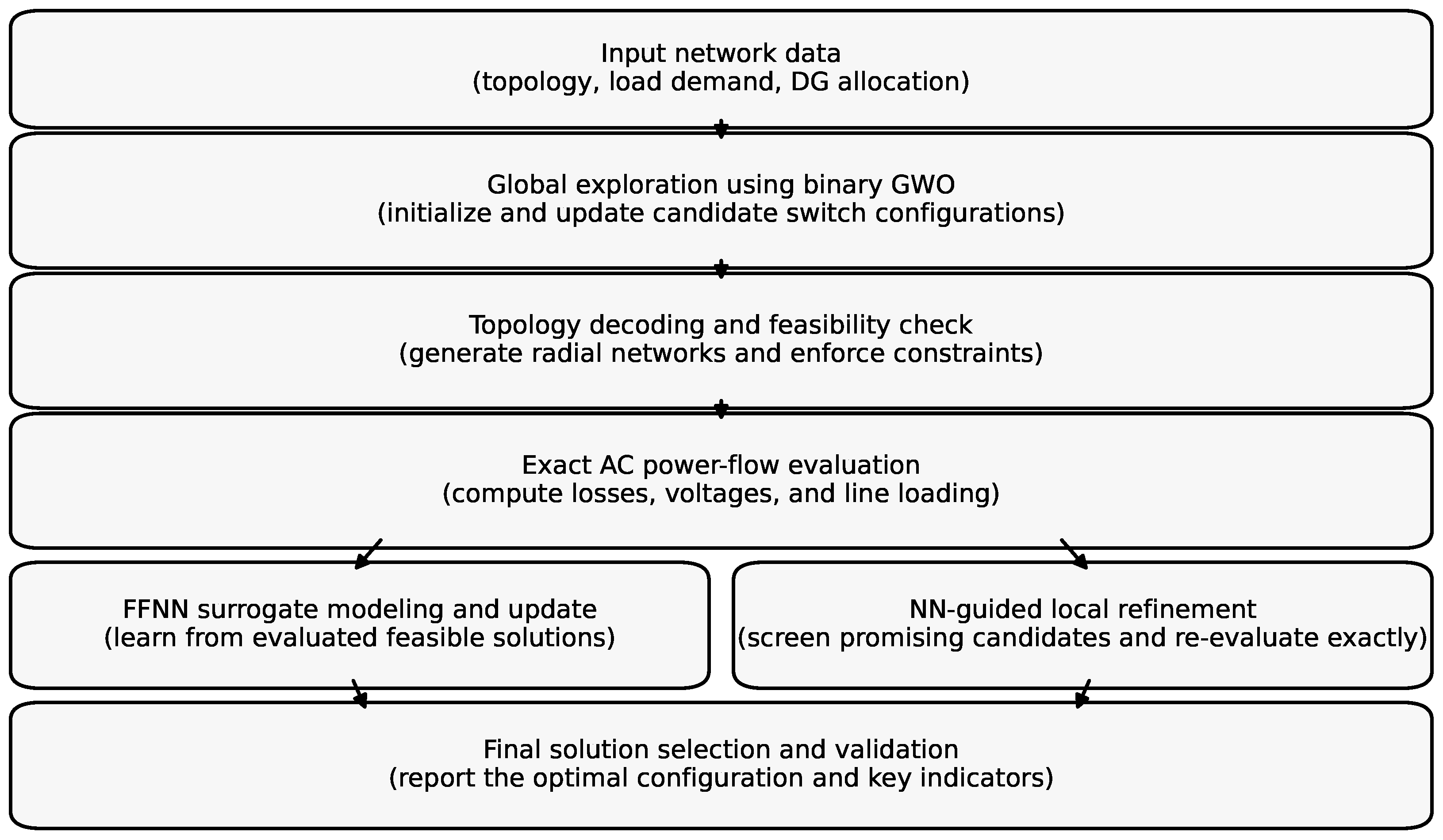
The proposed hybrid method combines the global search capability of the Gray Wolf Optimizer with the fast evaluation of a neural network surrogate model. Figure 1 presents the full workflow, and Algorithms 1–6 provide a detailed description of each algorithmic component.

3.1. Gray Wolf Optimizer in a Binary Decision Space

GWO models the leadership hierarchy and hunting mechanism of gray wolves. Candidate solutions are represented as position vectors, and the three best solutions are denoted as α , β , and  δ . The position update uses coefficient vectors that depend on random components and a convergence factor that decreases linearly from two to zero [2,3,21]. To address discrete switch variables, a binary adaptation is applied by discretizing the updated continuous position values through a thresholding operator, as summarized in Algorithm 3.

3.2. Neural Network Surrogate Model

An FFNN surrogate model is used to approximate the loss function without running a full AC power flow for each evaluated candidate, thereby reducing computational cost. The FFNN is trained using evaluated configurations and their computed losses and uses decreasing hidden layer sizes [64, 32, 16] with batch normalization [22], ReLU activation, dropout regularization [23], and the Adam optimizer [24]. In the implementation used in this work, the network was trained for 100 epochs with a dropout rate of 0.2 and a ReduceLROnPlateau scheduler (factor of 0.5, patience of 10). Because the studied 33-bus benchmark had only five reconfiguration tie switches, a moderate metaheuristic budget (20 wolves, 50 iterations, and 10 independent runs, as summarized in Figure 1 was adopted to balance search diversity and computational expense. The decreasing hidden-layer structure was selected as a compact progressive compression of the binary switch vector for scalar loss prediction. These settings should be interpreted as practical implementation choices rather than the result of an exhaustive sensitivity study. The use of a neural surrogate for fast screening is consistent with recent efforts to employ surrogate models in computationally demanding energy system applications [6,7]. The surrogate supports NN-guided screening of neighbor solutions in the local refinement step.
Figure 1. Workflow of the proposed hybrid GWO–NN method.
Sustainability 18 04516 g001

3.3. Hybrid Coordination and Local Refinement

The hybrid strategy runs the bGWO first to explore the search space and build an evaluation dataset. Then, the FFNN is trained on the accumulated valid evaluations, and local refinement is performed in neighborhoods around the best candidate, using the FFNN for fast screening and full power flow only for the most promising neighbors. This synergy aims to improve solution quality while reducing the number of expensive AC evaluations. In this implementation, the primary role of the NN-guided stage is to accelerate local refinement; while surrogate screening may indirectly help the search avoid unpromising neighbors, the present study does not claim or quantify a separate local optima escape mechanism beyond the exploratory capability of the bGWO.
Because the FFNN is used only as a screening layer, and the retained candidates are re-evaluated with the exact AC model before acceptance, surrogate prediction errors do not directly define the final objective value. Their main effect is instead indirect; if the surrogate misranks neighboring candidates, then the local search stage may spend evaluations on less promising moves or miss a better nearby solution, thereby increasing the risk of suboptimal local refinement. For this reason, the present results should be interpreted as conditioned by the quality of the surrogate ranking, while the exact AC re-evaluation step acts as a safeguard against accepting a falsely favorable solution solely on the basis of NN predictions.
The following figure summarizes the proposed hybrid optimization workflow and the main processing stages.
Algorithm 1 coordinates the complete procedure in sequential phases. It first establishes a baseline by evaluating the network without and with distributed generation to quantify the initial loss reduction. It then performs multiple independent runs of the hybrid optimizer to collect solutions for subsequent statistical analysis. Next, it selects the global best solution using robustness metrics (including the coefficient of variation and convergence rate). Finally, it applies the selected switch configuration and verifies technical feasibility and operating limits before computing the performance indicators and exporting results.
Algorithm 1 Overall workflow of the proposed hybrid GWO–NN method.
Require: Network data (buses, lines, impedances), switch set (sectional and tie switches), load data, DG data, voltage and thermal limits, and algorithm parameters.
Ensure: Best feasible switching configuration and corresponding performance indicators.
1:
Evaluate the base case (no DG, original topology) using AC power flow; store indicators.
2:
Evaluate the DG case (DG injected, original topology) using AC power flow; store indicators.
3:
for  r = 1 to R independent runs do
4:
      Call the hybrid optimizer (Algorithm 2) and store the best solution of run r.
5:
end for
6:
Select the best overall solution primarily by the minimum penalized objective value; use robustness metrics (e.g., coefficient of variation of the best feasible objective values across runs) only as secondary tie-breakers when multiple runs achieve comparable minima.
7:
Validate the selected configuration using full AC power flow and constraint checks (Algorithm 6).
8:
Output the final configuration, line statuses, and performance indicators.
Algorithm 2 integrates the Gray Wolf Optimizer and a feedforward neural network in three stages. First, the GWO is executed to obtain the α β δ hierarchy together with a history of evaluated configurations. Second, the neural network is trained using the valid evaluations, employing a decreasing layer architecture with batch normalization, ReLU activation, dropout, and the Adam optimizer. Third, a local refinement is performed by generating bit-flip neighbors around the best candidate, screening them using fast NN predictions, and running full AC power flow only for the most promising configurations.
Algorithm 2 Hybrid GWO–NN optimizer with NN-guided local refinement.
Require: Decision encoding (binary tie-switch vector), mapping to maintain radiality, and objective evaluation function.
Ensure: Best feasible configuration found in one run.
1:
Run the binary Gray Wolf Optimizer (Algorithm 3) to obtain leaders ( α , β , δ ) and an evaluation history D .
2:
Train a feedforward NN surrogate on valid samples from D (Algorithm 4).
3:
Initialize best solution x α .
4:
for  k = 1 to K local refinement iterations do
5:
      Generate neighbor candidates of x using bit-flip moves.
6:
      Predict losses of candidates using the NN surrogate; keep a small subset of the most promising candidates.
7:
      Evaluate the retained candidates using full power flow (Algorithm 5).
8:
      Update x if a better feasible candidate is found.
9:
end for
10:
return  x .
Algorithm 3 adapts the Gray Wolf Optimizer to binary decision variables that represent the open amd closed status of tie-switches. The pack is initialized using Bernoulli sampling, and the α β δ leaders are identified based on objective values computed by the AC evaluation routine. Then, the iterative update computes three guided movements toward the leaders, modulated by random coefficients and a linearly decreasing convergence parameter. The resulting position is averaged and discretized by rounding to enforce the binary domain. The leadership hierarchy is updated whenever a better feasible configuration is discovered.
Algorithm 3 Binary Gray Wolf Optimizer (bGWO) for switch configuration search.
Require: Population size N, maximum iterations T, and objective evaluator.
Ensure: Best solution α and evaluation history D .
1:
Initialize N wolves as binary vectors using Bernoulli sampling; include the base configuration as a candidate.
2:
Evaluate each wolf with Algorithm 5; identify α , β , and  δ (best three).
3:
for  t = 1 to T do
4:
      Update convergence parameter a linearly from 2 to 0.
5:
      for each wolf i do
6:
            Compute continuous update vectors toward α , β , and  δ using GWO coefficients.
7:
            Average the three update vectors to obtain a real-valued position.
8:
            Discretize to binary using a rounding or threshold operator (e.g., x i , j I [ x i , j > 0.5 ] ).
9:
            Evaluate the updated wolf using Algorithm 5; update α , β , δ if improved.
10:
      end for
11:
end for
12:
return  α and D .
Algorithm 4 trains a multilayer perceptron surrogate to approximate system losses and thus avoid running a full AC power flow for every candidate during local search. The dataset is standardized using z-score normalization and organized into mini-batches. Hidden layers apply an affine transformation followed by batch normalization, ReLU activation, and dropout. The model parameters are optimized with Adam, and a learning rate scheduler reduces the step size when the mean-squared error stagnates. The normalization parameters are stored so that future predictions can be properly denormalized.
Algorithm 4 Feedforward neural network (FFNN) surrogate training.
Require: Dataset D = { ( x ( n ) , y ( n ) ) } of evaluated configurations and their losses, network architecture (e.g., [64, 32, 16]), learning rate, and epochs.
Ensure: Trained NN model and normalization parameters.
1:
Normalize inputs using z-score (store mean and standard deviation).
2:
Train a multilayer perceptron using ReLU activations, batch normalization, and dropout.
3:
Minimize mean-squared error using Adam optimizer; apply a learning rate scheduler when validation loss stagnates.
4:
Store model weights and normalization parameters for later inference.
5:
return trained NN model.
Algorithm 5 evaluates a candidate switch configuration by constructing a radial topology through the tie-switch to complementary sectional switch mapping, keeping a fixed number of active branches. It then solves the AC power flow using the Newton–Raphson method, where the net nodal demand is obtained by subtracting distributed generation injections from local loads. If convergence is not achieved, then a penalty value is returned. Although backward and forward sweep methods are commonly used in radial distribution feeders, the Newton–Raphson solver was adopted here because it is available in the implemented toolchain and has consistently performed in the tested benchmark cases. Non-convergent power flow cases, if encountered, are treated as infeasible during the evaluation process. From the converged solution, the total losses are computed as I 2 R summed over all active lines, and operational constraints are checked; any violation triggers a penalized objective value.
Algorithm 5 Objective evaluation: radial mapping, AC power flow, losses, and penalties.
Require: Binary tie-switch vector x , base network data, DG injections, and constraint limits.
Ensure: Objective value f ( x ) and feasibility flag.
1:
Build a candidate radial topology by applying the tie and sectional complementary mapping.
2:
Solve AC power flow using Newton–Raphson; compute net nodal demand as load minus DG injection.
3:
if power flow does not converge then
4:
    return large penalty value and infeasible flag.
5:
end if
6:
Compute active losses on active lines and aggregate total active losses.
7:
Check operating constraints (Algorithm 6).
8:
if any constraint is violated then
9:
    return penalized objective value and infeasible flag.
10:
else
11:
    return total active losses and feasible flag.
12:
end if
Algorithm 6 verifies feasibility by enforcing three key operating constraints. It checks that all bus voltage magnitudes remain within the adopted limits, evaluates thermal loading by computing the apparent power on each active line and comparing it to the corresponding capacity, and confirms radiality, as ensured by the complementary opening mechanism used in the topology mapping. This feasibility filter is critical in DNR because it prevents the search from accepting looped or partially energized topologies and allows infeasible candidates to be discarded immediately rather than propagated through subsequent iterations. The routine returns a single boolean flag so that infeasible configurations can be removed consistently.
Algorithm 6 Operational constraint verification.
Require: Bus voltages, line flows, and a radial topology.
Ensure: Boolean feasibility.
1:
Verify that all bus voltage magnitudes satisfy V min | V k | V max for all buses (in this work, V min = 0.85 p.u. and V max = 1.05 p.u.).
2:
Compute apparent power flow on each active line and verify thermal limits (loading 100 % ).
3:
Verify radiality (no loops and all buses energized), consistent with the complementary opening mechanism.
4:
return the logical conjunction of the three checks.

4. Benchmark Systems: IEEE 33-Bus and IEEE 69-Bus Distribution Networks

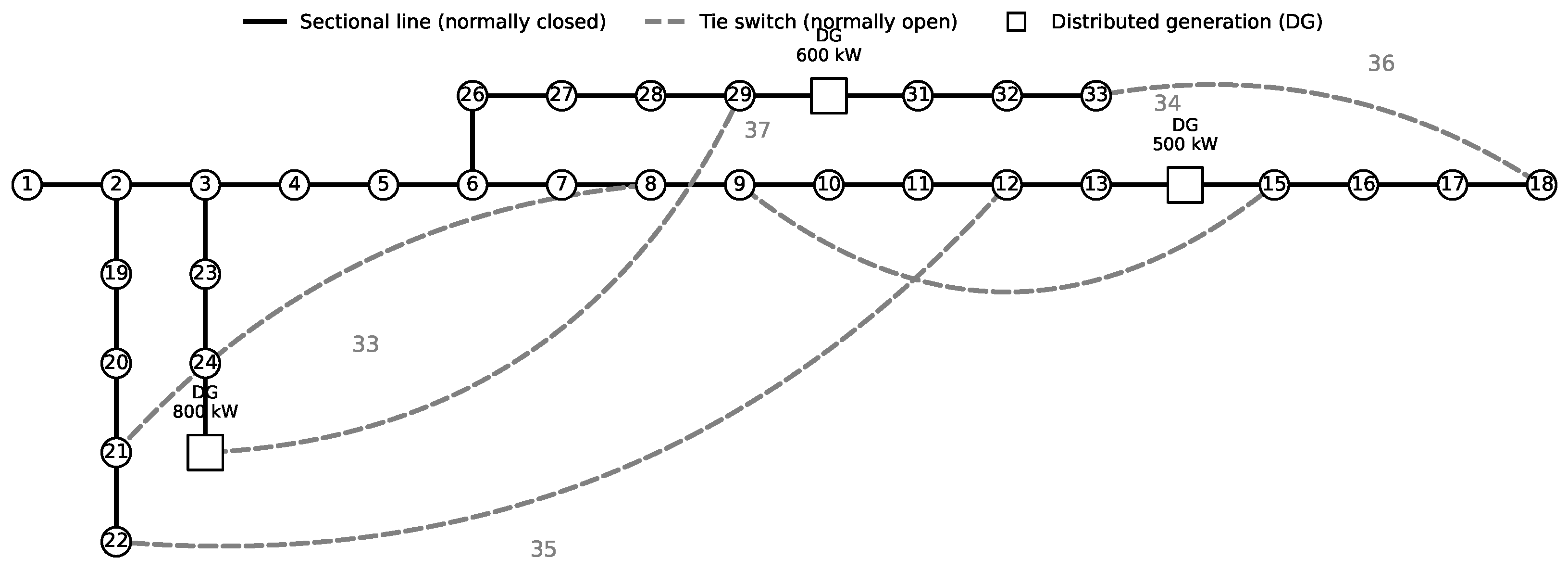
The proposed method was evaluated on the IEEE 33-bus and IEEE 69-bus radial distribution test systems. In both feeders, three operating conditions were analyzed: (1) the base case without DG, (2) the case with DG in the original topology, and (3) the DG + GWO–NN reconfiguration case. The IEEE 33-bus system (Figure 2) [25] comprised 33 buses, 32 normally closed sectional switches, and 5 normally open tie-switches, enabling reconfiguration while preserving radial operation. The total load was 3.715 MW and 2.300 MVAr, and the feeder operated at 12.66 kV. DG units were installed at buses 14, 25, and 30, with nominal active power ratings of 500 kW, 800 kW, and 600 kW, respectively. This DG placement and sizing was treated as a fixed study scenario for benchmarking the reconfiguration method; that is, DG allocation was not optimized in the present work. In the IEEE 33-bus implementation, the binary tie-switch decision vector was ordered as [ s 33 , s 34 , s 35 , s 36 , s 37 ] , where 1 denotes a closed tie-switch and 0 denotes an open tie-switch.
The IEEE 69-bus feeder is included in the manuscript as a second benchmark network with a larger size and longer radial structure. Its results were not treated as a peripheral appendix; rather, they were integrated into the surrogate learning, voltage profile, voltage deviation, bus loss, line loss, line loading, and total loss comparisons reported in Section 5. Therefore, the revised manuscript presents both feeders as part of the benchmark evidence used to assess the proposed GWO–NN workflow.
The following figure illustrates the IEEE 33-bus distribution test feeder used as one of the benchmark systems, including sectionalizing, tie-switches, and the DG placement buses.

5. Results and Discussion

Three scenarios were evaluated in each benchmark: (1) base system without DG, (2) system with DG in the original topology, and (3) system with DG and the topology optimized by the hybrid GWO–NN method. Table 1 summarizes the detailed numerical indicators for the IEEE 33-bus feeder, whereas Figure 3, Figure 4, Figure 5, Figure 6, Figure 7, Figure 8 and Figure 9 compare the behavior of the IEEE 33-bus and IEEE 69-bus systems. The indicators were extracted from converged AC power flow solutions for the evaluated configurations.
As shown in Table 1, the IEEE 33-bus case exhibited consistent improvements in losses, minimum voltage magnitude, voltage deviation range, and maximum line loading when DG and reconfiguration were combined. Table 2 summarizes the benchmark-level numerical evidence reported in the manuscript for both the IEEE 33-bus and IEEE 69-bus feeders.

5.1. NN Surrogate Training Behavior

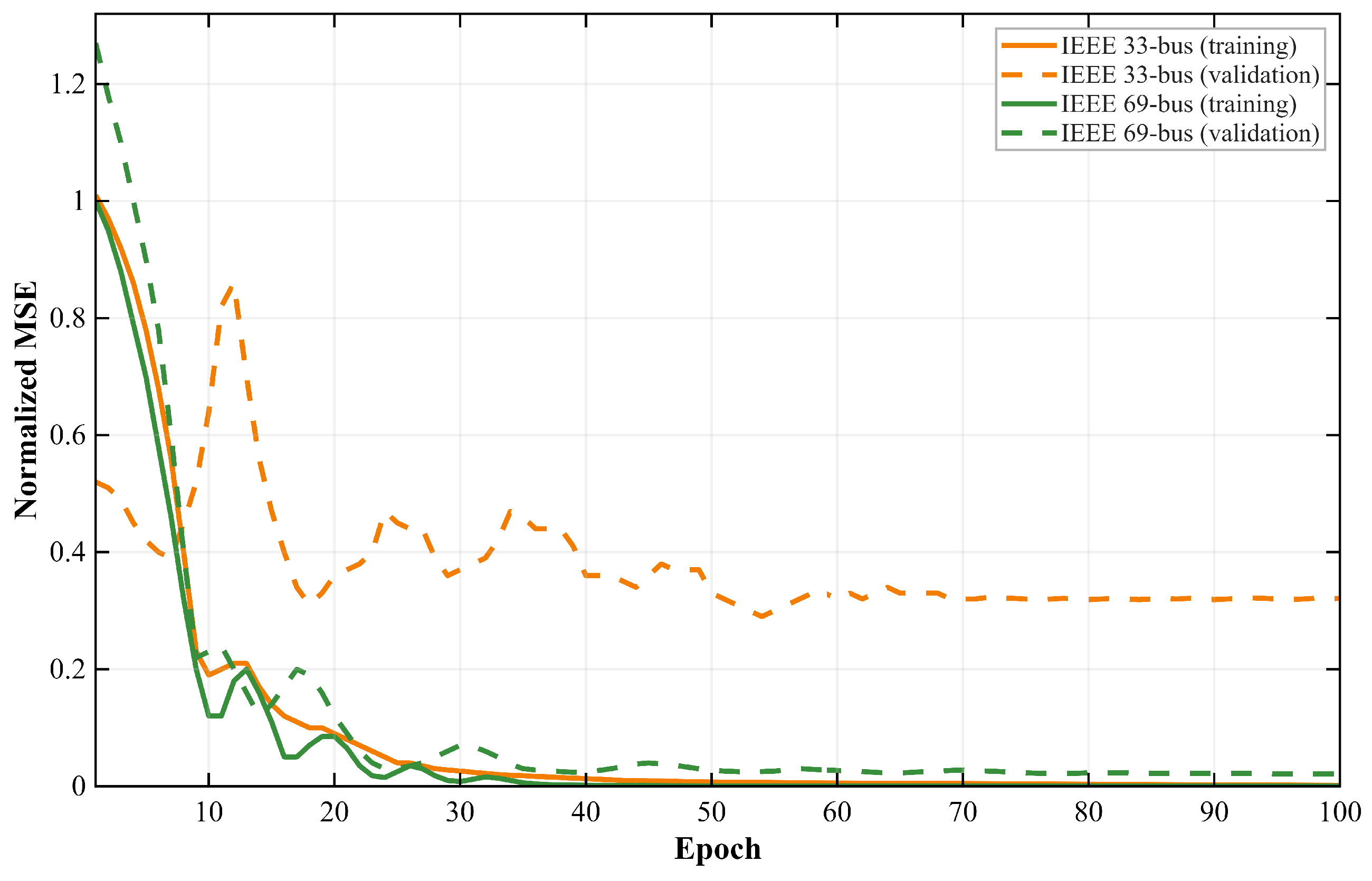
Although the validation trajectories were not strictly monotonic, their overall behavior was consistent with the corresponding training curves, supporting the use of the FFNN as a screening model during the local refinement stage. Because both the input configurations and target losses were standardized during training, the reported values are expressed in normalized units and should therefore be interpreted as relative convergence indicators rather than as direct physical error measures. Overall, the comparison shows that the surrogate’s predictive behavior was feeder-dependent and varied with the network topology and structure of the evaluated search space while remaining suitable for surrogate-assisted refinement in both benchmark systems.
Figure 3 summarizes the FFNN learning behavior for the IEEE 33-bus and IEEE 69-bus test systems over 100 epochs using both training and validation loss. In both feeders, the normalized mean-squared error decreased sharply during the initial epochs and then gradually stabilized, indicating that the surrogate learned an increasingly accurate approximation of the mapping between switch configurations and active power losses. However, the convergence patterns differed across the two benchmarks. For the IEEE 33-bus case, the training curve decayed more slowly and stabilized at comparatively higher error levels, while the validation curve showed more pronounced oscillations, suggesting that the loss landscape of this feeder was harder for the surrogate to approximate consistently under the adopted dataset and model settings. By contrast, the IEEE 69-bus case exhibited a steeper initial reduction in both training and validation loss and converged to lower normalized error values, indicating a more stable fitting process for the evaluated samples.
Figure 3. Training and validation loss evolution of the FFNN surrogate over 100 epochs for the IEEE 33-bus and IEEE 69-bus test systems.
Sustainability 18 04516 g003
Table 3 reports a complementary hold-out validation for the IEEE 33-bus benchmark in physical units, while Table 4 summarizes the surrogate validation evidence currently included in the manuscript and the items that remain outside the present scope. Using the feasible configurations evaluated by the current Python 3.14.4 implementation, the surrogate achieved a mean absolute error (MAE) of 11.35 kW, a root mean square error (RMSE) of 12.86 kW, and a Spearman rank correlation of 1.00 on the validation subset. Moreover, the candidate with the best predicted loss also matched the best exact-ranked candidate within the evaluated validation set. These results support the interpretation of the FFNN as a ranking-oriented screening model for local refinement, although they do not yet replace a broader sensitivity study across multiple random splits and benchmark feeders.
In optimization terms, the most relevant consequence of surrogate error is not that an infeasible or numerically inaccurate solution is finally accepted, because shortlisted candidates are always rechecked through exact AC power flow, but rather that an imprecise ranking may bias which neighbors are explored during local refinement. Therefore, lower surrogate accuracy can reduce the efficiency of the search and may lead the refinement stage to converge to a locally suboptimal solution, even when the final reported solution remains AC-validated.

5.2. Optimal Configuration and Resulting Topology

For the detailed IEEE 33-bus case, the hybrid GWO–NN method identified the binary tie-switch configuration [ 0 ,   1 ,   1 ,   0 ,   1 ] as the optimal solution, yielding a total active power loss of 87.083 kW. This configuration corresponded to closing tie-switches 34, 35, and 37 while keeping tie-switches 33 and 36 open. Under the complementary mapping used to maintain radiality, sectional lines 9, 12, and 28 were opened, yielding a feasible radial topology. Tie-switch 34 connected bus 9 to bus 15, consistent with a redistribution of power flows toward the mid-feeder area, where the DG was installed. Tie-switch 37 connected bus 25 with bus 29, creating a shorter path between the main feeder and the region of higher DG injection, which is consistent with the observed reduction in upstream line currents and losses. In the final implementation, the best run converged in 67.87 s and required 1023 exact fitness evaluations on a workstation running Windows 11 Home 25H2 with an Intel Core Ultra 7 265 processor at 2.40 GHz and 64 GB of RAM. Table 5 reports the full operating status of all lines in the obtained configuration, including the end buses, active and reactive losses, and line loading.

5.3. Computational Performance and Literature Benchmark

Because the retained runtime logs reported in this manuscript correspond explicitly to the IEEE 33-bus benchmark, the wall-clock behavior is presented numerically for that feeder. This does not imply that the IEEE 69-bus case is secondary in the manuscript; rather, it reflects the level of benchmark logging currently preserved for direct runtime tabulation. For the IEEE 33-bus case studied in this article, the final GWO–NN configuration [ 0 ,   1 ,   1 ,   0 ,   1 ] was obtained in 67.87 s with 1023 exact fitness evaluations. This count is particularly relevant because the FFNN-guided local screening avoids performing a full AC evaluation for every neighboring candidate, and thus the reported runtime corresponds to the exact validation workload that remained after surrogate filtering.
To place this result in context, Table 6 compiles the representative execution times reported by other optimizers in the literature for IEEE 33-bus reconfiguration studies. The comparison must be interpreted cautiously because stopping criteria, objective functions, DG assumptions, coding details, and hardware platforms differ across publications. Therefore, Table 6 is intended as a practical reference benchmark rather than as a strict apples-to-apples ranking. Even with this caveat, the proposed GWO–NN runtime lies in the same order of magnitude as several recent metaheuristic reports, remaining clearly below older GA-based implementations and below one PSO-based report, while still preserving exact AC feasibility checks during the final acceptance step [26,27].
In practical terms, these results suggest that the proposed hybridization is computationally competitive for an AC-validated DNR workflow with DG while providing a transparent evaluation count.
Table 7 reports an exploratory same-code comparison between a GWO-only run and the full GWO + FFNN workflow for the IEEE 33-bus benchmark. In the tested run, both approaches reached the same best feasible solution, namely the switch configuration [0, 1, 1, 0, 1], with total active losses of 87.083 kW. Under this single-run comparison, the surrogate-assisted version did not improve the final objective value and did not reduce the exact AC evaluation count. Therefore, these results should be interpreted only as a preliminary ablation check rather than as a definitive assessment of the surrogate contribution. A statistically grounded comparison across multiple random seeds remains necessary before drawing stronger conclusions about computational benefits or robustness.
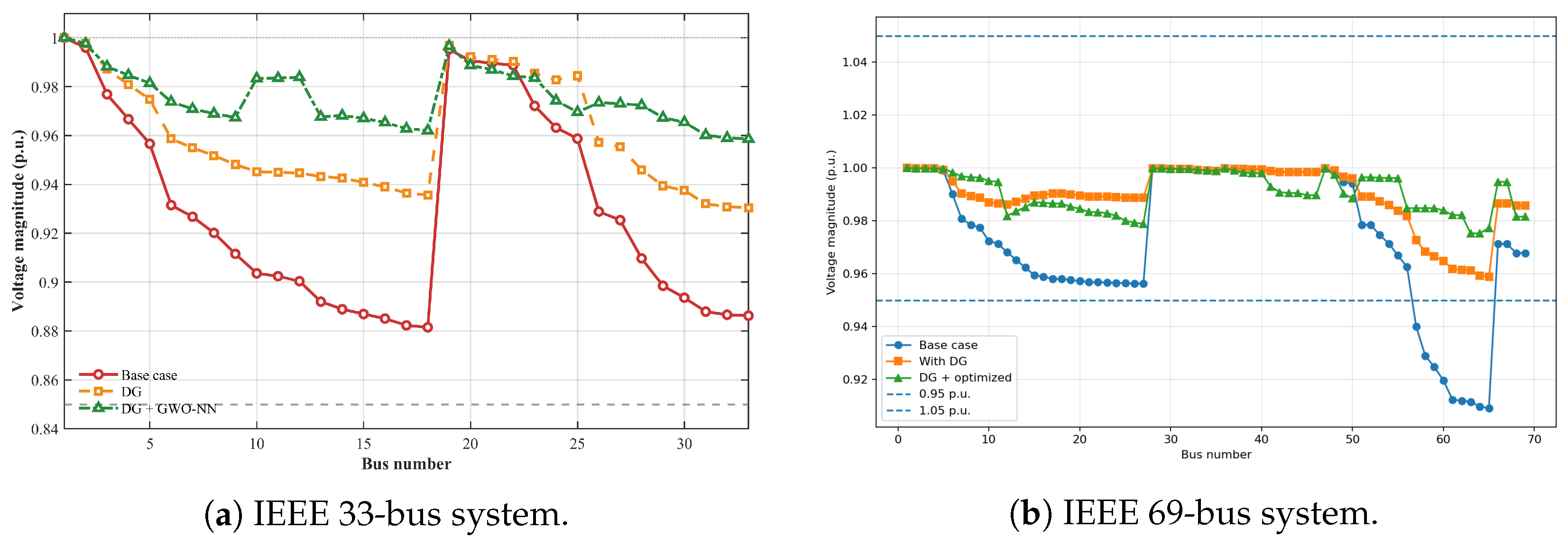
For the IEEE 33-bus system, the base case showed a pronounced voltage drop, with a minimum value of 0.8829 p.u. near bus 18. When DG was connected in the original topology, the minimum voltage increased to 0.9363 p.u., and the overall profile became noticeably flatter. After network reconfiguration with the proposed hybrid method, the minimum voltage further increased to 0.9587 p.u., confirming that the optimized topology improved voltage regulation while preserving acceptable operating conditions. The IEEE 69-bus system followed the same overall behavior, but with a longer feeder and a more spatially extended low-voltage region in the base case. In that feeder, DG integration also mitigated the downstream voltage drop, and the optimized configuration yielded the smoothest voltage trajectory, demonstrating that the proposed method remained effective in larger, more complex networks.
Figure 4 summarizes the bus voltage magnitude profiles for both feeders under the base, DG, and optimized DG + GWO–NN scenarios. In both test feeders, the base case exhibited the largest voltage drop along the feeder, especially toward the remote buses, whereas DG integration improved the overall voltage profile by reducing the depth of the voltage sag. The optimized DG + GWO–NN configuration provided the best voltage regulation in both systems, yielding a flatter profile and maintaining bus voltages closer to the nominal value.
Figure 4. Voltage profile comparison for the base case, DG case, and optimized DG + GWO–NN case in the IEEE 33-bus and IEEE 69-bus test systems.
Sustainability 18 04516 g004

5.4. Percentage Voltage Deviations

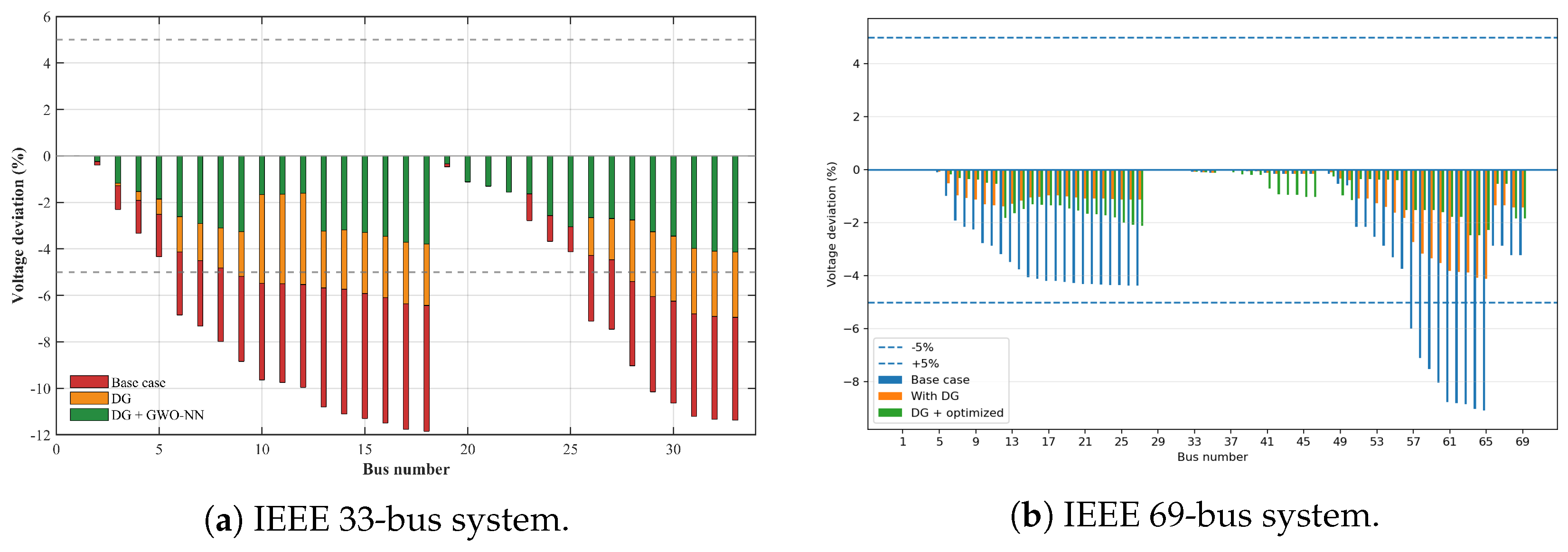
For the IEEE 33-bus system, the base case presented a deviation range from approximately 11.71 % to 0 % , indicating poor regulation near the feeder end. When DG was added without reconfiguration, the minimum deviation improved to approximately 6.37 % . After applying the proposed reconfiguration method, the deviation range was further narrowed from approximately 4.13 % to 0 % , placing the optimized case within the commonly adopted ± 5 % practical voltage regulation band. The IEEE 69-bus system exhibited the same qualitative improvement, although the deviations were distributed across a larger number of downstream buses due to its longer radial structure. In that case, DG noticeably mitigated the most severe negative deviations, and the optimized configuration produced the most favorable profile by reducing both the depth and spatial extent of the low-voltage region.
Figure 5 summarizes the percentage voltage deviation with respect to the nominal value for both feeders under the three evaluated scenarios. In both feeders, the base case exhibited the largest negative voltage deviations, particularly toward the remote buses, reflecting the weak voltage regulation of the original radial topology under the given loading conditions. The integration of DG reduced the magnitude of these deviations by providing local active power support, while the optimized DG + GWO–NN configuration further compressed the deviation range and shifted the voltage profile closer to the nominal value.
Figure 5. Percentage voltage deviation per bus for the base case, DG case, and optimized DG + GWO–NN case in the IEEE 33-bus and IEEE 69-bus test systems.
Sustainability 18 04516 g005

5.5. Loss Distribution by Bus

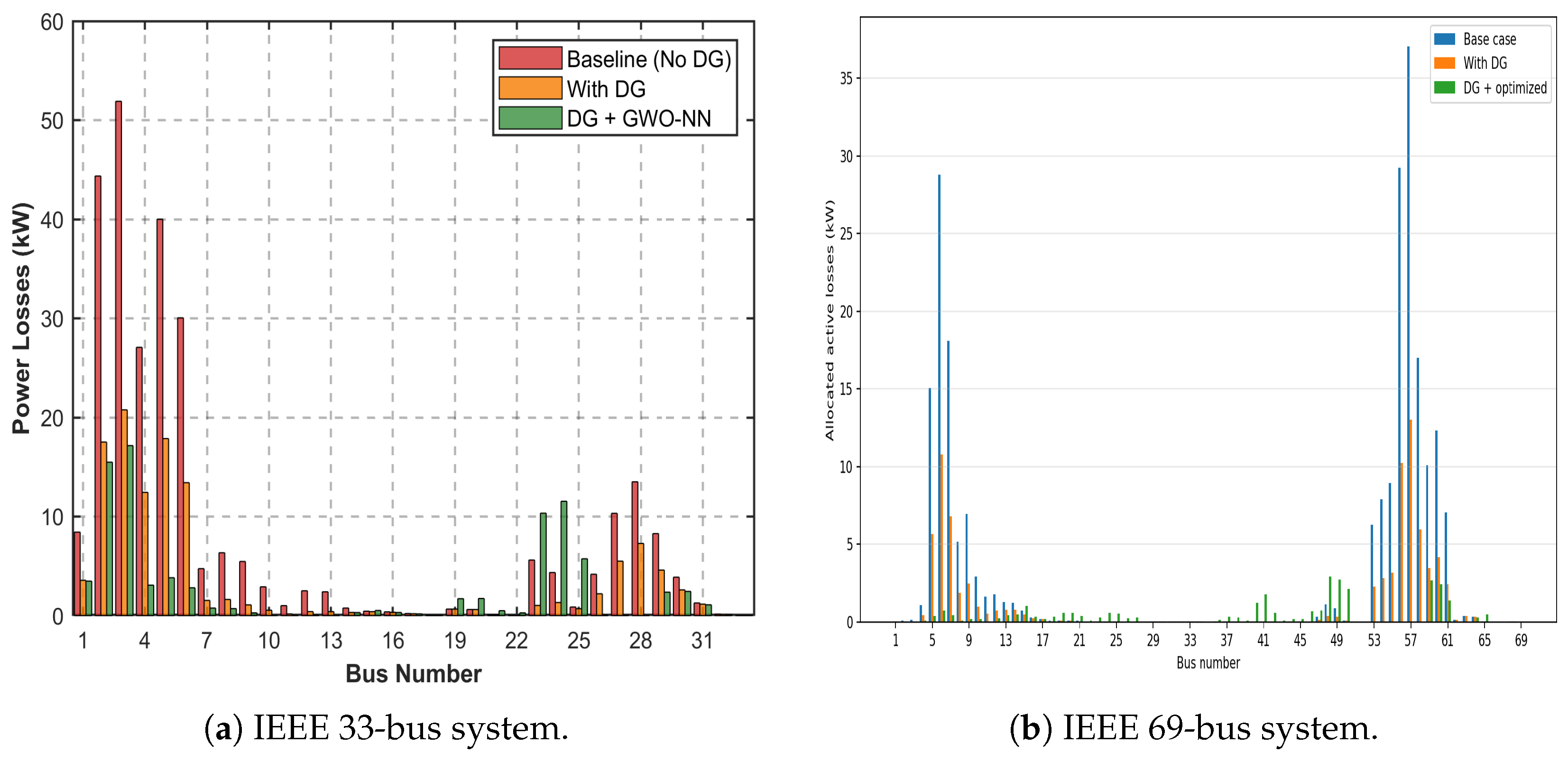
For the IEEE 33-bus system, the base case concentrated the largest allocated losses in the upstream portion of the feeder, with the most pronounced peak around bus 3 and additional peaks around buses 2, 5, and 6. With DG connected in the original topology, these upstream concentrations dropped substantially. After reconfiguration, the dominant upstream peaks were further reduced, although some localized loss concentrations appeared around buses 23–25 because the new radial topology redistributed branch currents. The overall pattern was therefore not simply lower at every bus; rather, it was more spatially redistributed, with the feeder-wide total losses decreasing. The IEEE 69-bus system exhibited the same general effect but with a more complex spatial pattern due to the larger feeder size. In that case, the base scenario also showed concentrated losses at a limited number of critical buses, whereas DG and the optimized topology progressively reduced the dominant peaks and smoothed the overall allocation of losses across the network.
Figure 6 summarizes the allocation of active power losses by bus for both feeders under the three evaluated scenarios. In both feeders, the base case concentrated the largest losses in a limited number of buses located along the main feeder and in downstream sections, reflecting the higher current flow and the cumulative effect of line losses in the original radial topology. The integration of DG reduced both the magnitude and concentration of these losses by supplying part of the local demand, while the optimized DG + GWO–NN configuration further redistributed the losses and lowered the maximum allocated value at the most critical buses.
Figure 6. Allocated active power losses per bus for the base case, DG case, and optimized DG + GWO–NN case in the IEEE 33-bus and IEEE 69-bus test systems.
Sustainability 18 04516 g006

5.6. Line Losses and Activated Tie-Switches

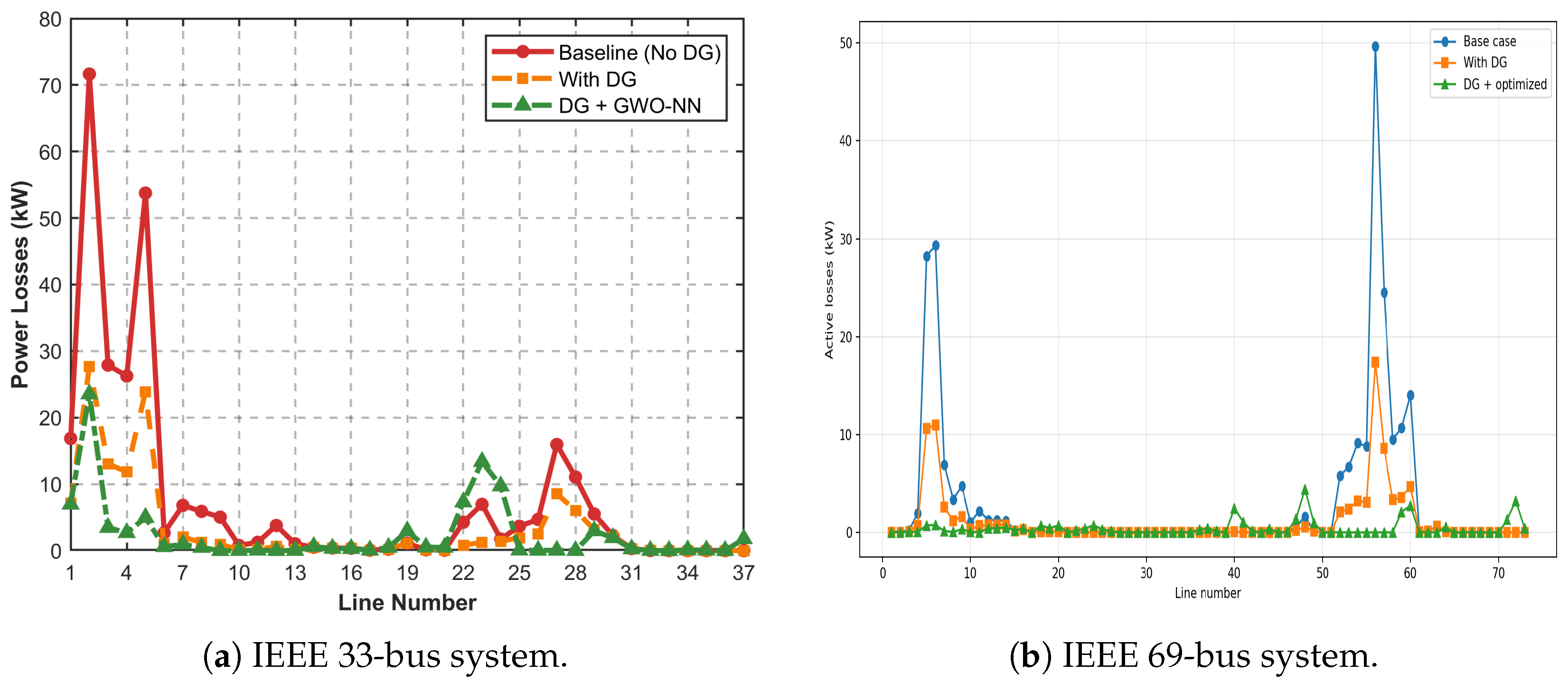
For the IEEE 33-bus system, the base case showed the largest line loss concentrations in the first few branches, especially around lines 2 and 5, with secondary peaks toward the end of the feeder. When DG was connected without reconfiguration, these upstream peaks decreased substantially. After applying the proposed hybrid reconfiguration, the dominant upstream losses were further reduced, and part of the loss burden shifted to a narrower set of branches around lines 22–24, consistent with the new power-routing pattern. The activated tie lines themselves introduced only small additional losses compared with the savings achieved in the previously critical sections. The IEEE 69-bus system exhibited the same trend, although the distribution was more spatially dispersed due to the larger feeder sizes and more complex topology. In that feeder, DG reduced the most severe line loss peaks, and the optimized configuration further smoothed the profile by relieving the most critical branches and redistributing the losses more evenly across the network.
Figure 7 summarizes the active power losses computed per line for both feeders under the three evaluated scenarios. In both feeders, the base case exhibited the largest loss concentrations in a few critical lines located near the beginning of the feeder and in heavily loaded downstream sections. The integration of DG significantly reduced these peaks by decreasing current flow through the most stressed branches, while the optimized DG + GWO–NN configuration further redistributed the line losses and lowered the most severe concentrations, yielding an overall more balanced loss profile.
Figure 7. Active power losses per line for the base case, DG case, and optimized DG + GWO–NN case in the IEEE 33-bus and IEEE 69-bus test systems.
Sustainability 18 04516 g007

5.7. Line Loading

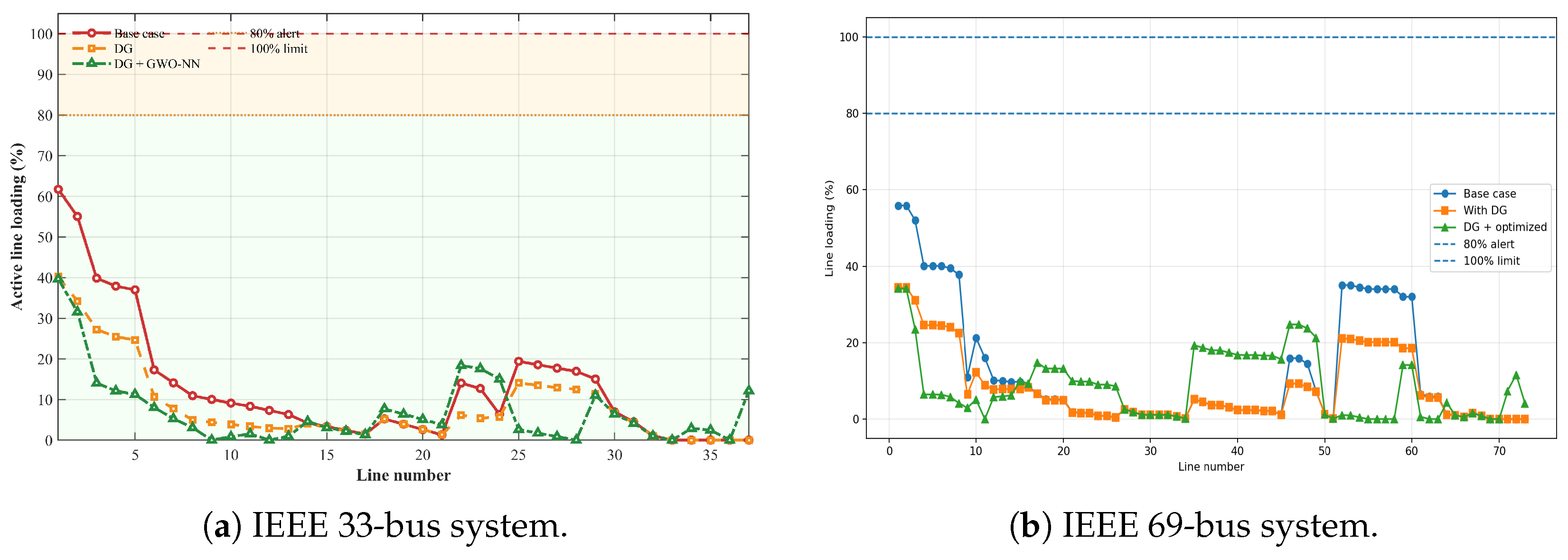
For the IEEE 33-bus system, the base case reached a maximum line loading of 61.72% on line 1, indicating that the feeder head carried the largest current burden in the original topology. When DG was connected without reconfiguration, the maximum loading decreased to 40.17% on the same line, reflecting a significant decentralization of power flow. After applying the proposed GWO–NN reconfiguration, the maximum loading remained at a similarly reduced level of 39.67%, while the activated tie lines operated at relatively low loading levels, confirming that the new topology improved current sharing without creating additional congestion. The IEEE 69-bus system exhibited the same qualitative improvement, although the loading pattern was more spatially distributed due to the larger feeder sizes and more complex network structure. In that feeder, the DG case reduced the most pronounced loading peaks, and the optimized configuration further redistributed current flow while keeping all lines well below the 80% alert threshold and the 100% operating limit.
Figure 8 summarizes the active line-loading profiles of both feeders under the base, DG, and optimized DG + GWO–NN scenarios. In both feeders, the base case exhibited the highest loading levels in the upstream branches, where the cumulative demand current was concentrated. The integration of DG reduced these loading levels by supplying part of the load locally, thereby relieving the most stressed sections. The optimized DG + GWO–NN configuration further redistributed the power flow and smoothed the loading pattern without introducing new highly stressed lines.
Figure 8. Active line loading for the base case, DG case, and optimized DG + GWO–NN case in the IEEE 33-bus and IEEE 69-bus test systems.
Sustainability 18 04516 g008

5.8. Total Active Power Losses

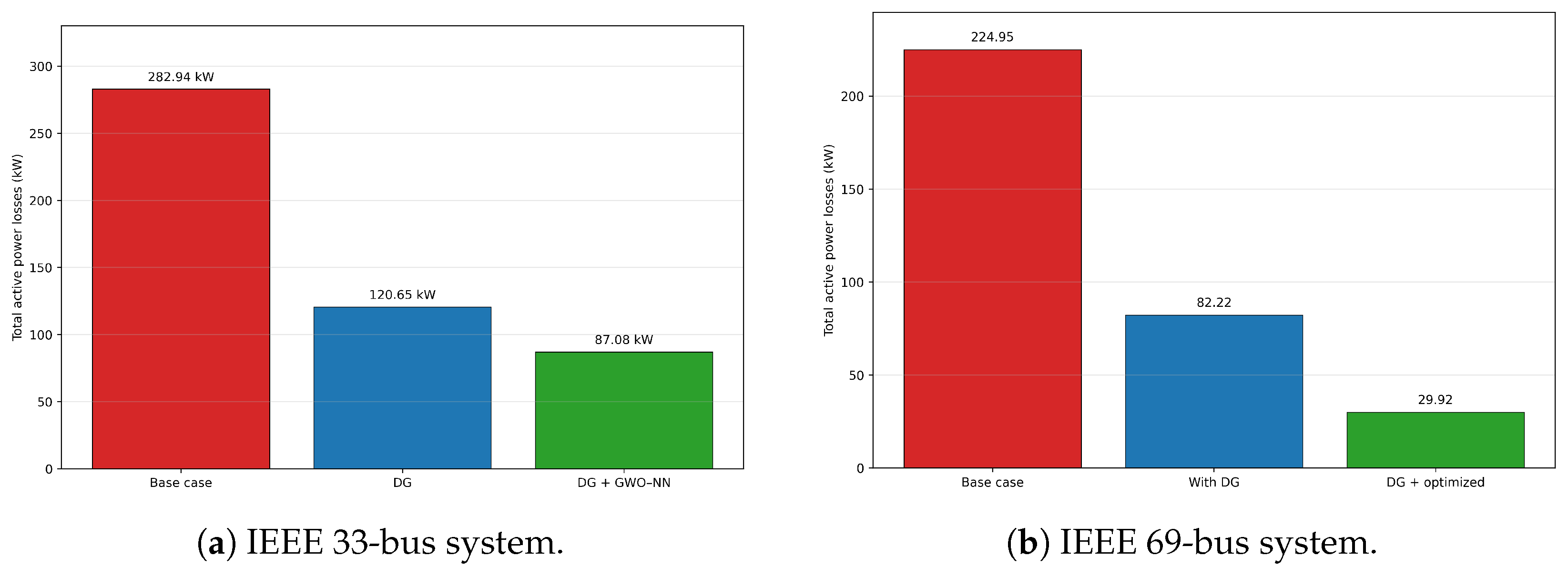
For the IEEE 33-bus system, the total active power losses decreased from 282.94 kW in the base case to 120.65 kW when DG was connected, corresponding to a reduction of 57.4%. After applying the proposed GWO–NN reconfiguration, the losses were further reduced to 87.08 kW, representing an additional 27.8% reduction compared with the DG case and a total reduction of 69.2% relative to the original configuration. The IEEE 69-bus system showed the same overall pattern, with total active power losses decreasing from 224.95 kW in the base case to 82.22 kW with DG and then to 29.92 kW after network reconfiguration. These results confirm that the proposed hybrid strategy remained effective not only for the IEEE 33-bus benchmark but also for a larger, more complex feeder, where the combined action of DG placement and topology reconfiguration yielded a marked improvement in overall efficiency.
Figure 9 summarizes the total active power losses obtained for both feeders under the three evaluated operating conditions. In both test feeders, the base case yielded the highest losses, as all demand was supplied from the substation via the original radial topology. The integration of DG substantially reduced the total losses by supplying part of the demand locally and lowering the current magnitudes in the most heavily loaded sections. The optimized DG + GWO–NN configuration yielded an additional reduction, confirming that network reconfiguration complemented DG integration by further improving power flow distribution.
Figure 9. Total active power losses for the base case, DG case, and optimized DG + GWO–NN case in the IEEE 33-bus and IEEE 69-bus test systems.
Sustainability 18 04516 g009

5.9. Scope and Practical Limitations

The present study focuses on electrical-performance indicators, namely losses, voltage regulation, and line loading. It includes benchmark results for both the IEEE 33-bus and IEEE 69-bus feeders, but it still does not provide a broad multi-feeder validation campaign beyond those two systems. Three elements remain especially relevant for stronger practical claims: (1) a same-code, same-hardware wall clock comparison against a conventional GWO baseline across repeated runs, (2) an explicit economic assessment of switching costs, breaker wear, and maintenance implications, and (3) a broader quantitative validation of the surrogate model, including multi-split sensitivity, rank-based metrics across feeders, and systematic ablation statistics. These omissions do not invalidate the reported benchmark results, but they do limit the strength of any generalization beyond the feeders and DG scenarios considered here.
Table 8 clarifies the level of detail currently documented in the manuscript for each benchmark feeder. Both the IEEE 33-bus and IEEE 69-bus systems are now part of the reported benchmark evidence, although the IEEE 33-bus case still retains the most extensive line-by-line operating table and explicit runtime logging within the current paper.

6. Conclusions

The manuscript presented benchmark results for the IEEE 33-bus and IEEE 69-bus distribution feeders under the same three operating scenarios: the base case, the DG case, and the DG + GWO–NN reconfiguration case. In the IEEE 33-bus benchmark, DG alone reduced losses from 282.94 kW to 120.65 kW, and the optimized reconfiguration further reduced them to 87.08 kW while increasing the minimum voltage magnitude to 0.9587 p.u. In the IEEE 69-bus benchmark, the total active losses decreased from 224.95 kW to 82.22 kW with DG and to 29.92 kW after reconfiguration, together with visibly improved voltage profiles and line-loading patterns.
Overall, the proposed workflow combines global exploration via the binary GWO with fast surrogate-assisted screening by an FFNN, followed by exact AC validation of the accepted candidates. The benchmark results indicate that this coordination can reduce losses and improve operating profiles in feeders of different sizes. The revised manuscript also included a complementary quantitative FFNN validation for the IEEE 33-bus case and an exploratory same-code ablation comparing GWO-only and GWO + FFNN screening. Even so, broader multi-run ablation statistics, additional quantitative surrogate metrics for the IEEE 69-bus case, and validation on further feeder topologies remain necessary before claiming broad generality at the journal level.
In particular, because the surrogate influences the ranking of candidates during local refinement, its accuracy can affect the efficiency of the search and the risk of suboptimal convergence, even though the final accepted candidates are always checked with the exact AC model.

7. Future Work

One relevant extension is to incorporate uncertainty in renewable generation and demand. The current formulation optimizes a single deterministic operating point. A stochastic or scenario-based extension could evaluate each candidate topology under multiple DG and load scenarios and minimize expected losses (or another risk-aware objective), capturing variability and supporting robust operation [19,28].
Another important pathway is the coordinated treatment of new flexible loads, particularly electric vehicle charging, whose spatial and temporal variability can strongly modify feeder operating conditions [29,30,31]. As discussed by Amann et al. [31], managed charging can also serve as a flexibility asset rather than only a source of grid stress, making it an attractive context for future multi-period DNR studies. The proposed GWO–NN structure could therefore be extended toward receding-horizon operation in the presence of EV charging clusters and renewable intermittency. A further methodological extension is the use of reinforcement learning-based decision layers for adaptive topology control under time-varying conditions, while preserving the exact AC validation and radiality checks used in the present work [32].
From a practical planning perspective, a future version of the framework should also incorporate an economic layer that explicitly balances loss reduction against switching operation costs and potential equipment wear. In addition, the relaxed voltage band adopted here (0.85–1.05 p.u.) is acceptable for benchmark-oriented algorithmic studies, but future utility-oriented validations should tighten these limits to the operational standards of the target distribution operator. Finally, broader external validation on feeders beyond the IEEE 33-bus and IEEE 69-bus benchmarks, including alternative DG placements and loading conditions, remains necessary before claiming broad applicability in journal form.


Author Contributions

Conceptualization, B.C.; methodology, B.C.; software, B.C.; validation, M.R. and B.C.; formal analysis, B.C.; investigation, B.C.; resources, B.C.; data curation, M.R. and E.G.; writing—original draft preparation, B.C. and M.R.; writing—review and editing, M.R., A.A.T. and E.G.; visualization, B.C.; supervision, M.R., A.A.T. and E.G.; project administration, M.R., A.A.T. and E.G.; funding acquisition, M.R., A.A.T. and E.G. All authors have read and agreed to the published version of the manuscript.

Funding

This research was funded by Universidad Politécnica Salesiana, grant number 5000.

Institutional Review Board Statement

Not applicable.

Informed Consent Statement

Not applicable.

Data Availability Statement

The original contributions presented in this study are included in the article. Further inquiries can be directed to the corresponding author.

Acknowledgments

The authors acknowledge the use of the IEEE 33-bus and IEEE 69-bus test systems as benchmark networks for this manuscript.

Conflicts of Interest

The authors declare no conflicts of interest.

Abbreviations

The following abbreviations are used in this manuscript:
ACAlternating current
DGDistributed generation
DNRDistribution network reconfiguration
FFNNFeedforward Neural Network
GWOGray Wolf Optimizer
MINLPMixed-integer nonlinear programming
NNNeural network

References

  1. Behbahani, M.R.; Jalilian, A.; Bahmanyar, A.; Ernst, D. Comprehensive Review on Static and Dynamic Distribution Network Reconfiguration Methodologies. IEEE Access 2024, 12, 9510–9525. [Google Scholar] [CrossRef]
  2. Souifi, H.; Hadj Abdallah, H. Grey Wolf Optimizer for Optimal Distribution Network Reconfiguration. In Proceedings of the 2022 IEEE Electrical Power and Energy Conference (EPEC), Virtual, 5–7 December 2022; pp. 405–411. [Google Scholar] [CrossRef]
  3. Pujari, H.K.; Rudramoorthy, M. Grey wolf optimisation algorithm for solving distribution network reconfiguration considering distributed generators simultaneously. Int. J. Sustain. Energy 2022, 41, 2121–2149. [Google Scholar] [CrossRef]
  4. Su, Y.; Zhu, Q.; Tian, Y.; Dai, R.; Lv, Z.; Zhang, M. Distribution Network Reconfiguration Based on Hybrid Particle Swarm Optimization and Grey Wolf Optimization. In Proceedings of the 2023 IEEE 7th Conference on Energy Internet and Energy System Integration (EI2), Hangzhou, China, 15–18 December 2023; pp. 718–723. [Google Scholar] [CrossRef]
  5. Tu, B.; Wang, F.; Huo, Y.; Wang, X. A hybrid algorithm of grey wolf optimizer and harris hawks optimization for solving global optimization problems with improved convergence performance. Sci. Rep. 2023, 13, 22909. [Google Scholar] [CrossRef]
  6. Zhang, Q.; Zhang, J.; Liang, L.; Li, Z.; Zhang, T. A deep learning based surrogate model for estimating the flux and power distribution solved by diffusion equation. EPJ Web Conf. 2021, 247, 03013. [Google Scholar] [CrossRef]
  7. Balduin, S.; Westermann, T.; Puiutta, E. Evaluating different machine learning techniques as surrogate for low voltage grids. Energy Inform. 2020, 3, 24. [Google Scholar] [CrossRef]
  8. Florez, H.A.R.; López, G.P.; Jaramillo-Duque, Á.; López-Lezama, J.M.; Muñoz-Galeano, N. A Mathematical Modeling Approach for Power Flow and State Estimation Analysis in Electric Power Systems through AMPL. Electronics 2022, 11, 3566. [Google Scholar] [CrossRef]
  9. Xu, J.; Zhang, H.; Wang, S. An Extended Model Approach to Study the Power Flow Analysis of Complex Power Systems. Processes 2025, 13, 2607. [Google Scholar] [CrossRef]
  10. Li, Y.; Ma, X.; Liang, C.; Li, Y.; Cai, Z.; Jiang, T. Continuous Line Loss Calculation Method for Distribution Network Considering Collected Data of Different Densities. Energies 2022, 15, 5171. [Google Scholar] [CrossRef]
  11. Okon, T.; Wilkosz, K. Propagation of Voltage Deviations in a Power System. Electronics 2021, 10, 949. [Google Scholar] [CrossRef]
  12. Mokred, S.; Wang, Y. Comparative Analysis of Voltage Stability in Radial Power Distribution Networks Under Critical Loading Conditions and Diverse Load Models. Electricity 2025, 6, 64. [Google Scholar] [CrossRef]
  13. Malengret, M.; Gaunt, C.T. Active Currents, Power Factor, and Apparent Power for Practical Power Delivery Systems. IEEE Access 2020, 8, 133095–133113. [Google Scholar] [CrossRef]
  14. Neto, A.B.; Barbosa, M.B.; Mota, L.M.; Lavorato, M.; de Carvalho, M.F.H. Optimal Power Flow Technique for Distribution System Considering Distributed Energy Resources (DER). Energies 2022, 15, 8507. [Google Scholar] [CrossRef]
  15. Montoya, O.D.; Gil-González, W.; Hernández, J.C.; Giral-Ramírez, D.A.; Medina-Quesada, A. A Mixed-Integer Nonlinear Programming Model for Optimal Reconfiguration of DC Distribution Feeders. Energies 2020, 13, 4440. [Google Scholar] [CrossRef]
  16. Stojanović, B.; Rajić, T.; Šošić, D. Distribution network reconfiguration and reactive power compensation using a hybrid Simulated Annealing–Minimum spanning tree algorithm. Int. J. Electr. Power Energy Syst. 2023, 147, 108829. [Google Scholar] [CrossRef]
  17. Hu, Z.; Zhu, H.; Deng, C. Distribution network reconfiguration optimization method based on undirected-graph isolation group detection and the whale optimization algorithm. AIMS Energy 2024, 12, 484–504. [Google Scholar] [CrossRef]
  18. Cortes, P.; Tabares, A.; Franco, F.; Rodríguez, A.X.; Álvarez-Martínez, D. Integrating and Comparing Radiality Constraints for Optimized Distribution System Reconfiguration. arXiv 2024, arXiv:2411.11596. [Google Scholar] [CrossRef]
  19. Pham, N.V.; Nguyen, T.H.T. Multi-period power flow analysis in distribution systems with distributed generation using the nonlinear programming model. J. Mil. Sci. Technol. 2025, 104, 49–58. [Google Scholar] [CrossRef]
  20. Sun, Y.; Yang, C.; Cui, H.; Wu, M.; Shao, J.; Zhao, B.; He, K. Optimal Power Flow in Distribution Network: A Review on Problem Formulation and Optimization Methods. Energies 2023, 16, 5974. [Google Scholar] [CrossRef]
  21. Zhang, J.; Dai, Y.; Shi, Q. An improved grey wolf optimization algorithm based on scale-free network topology. Heliyon 2024, 10, e35958. [Google Scholar] [CrossRef]
  22. Ioffe, S.; Szegedy, C. Batch Normalization: Accelerating Deep Network Training by Reducing Internal Covariate Shift. arXiv 2015, arXiv:1502.03167. [Google Scholar] [CrossRef]
  23. Salehin, I.; Kang, D.-K. A Review on Dropout Regularization Approaches for Deep Neural Networks within the Scholarly Domain. Electronics 2023, 12, 3106. [Google Scholar] [CrossRef]
  24. Reyad, M.; Sarhan, A.M.; Arafa, M. A modified Adam algorithm for deep neural network optimization. Neural Comput. Appl. 2023, 35, 17095–17112. [Google Scholar] [CrossRef]
  25. Baran, M.E.; Wu, F.F. Network reconfiguration in distribution systems for loss reduction and load balancing. IEEE Trans. Power Deliv. 1989, 4, 1401–1407. [Google Scholar] [CrossRef]
  26. Kahouli, O.; Alsaif, H.; Bouteraa, Y.; Ali, N.B.; Chaabene, M. Power System Reconfiguration in Distribution Network for Improving Reliability Using Genetic Algorithm and Particle Swarm Optimization. Appl. Sci. 2021, 11, 3092. [Google Scholar] [CrossRef]
  27. Akmayeva, D.; Uzun, U.E.; Pamuk, N. Reconfiguration of Distribution Power Systems Using Heuristic Optimization Algorithms. Turk. J. Electr. Power Energy Syst. 2024, 4, 135–141. [Google Scholar] [CrossRef]
  28. Duan, F.; Wang, T.; Wu, B.; Xu, Z.; Zhang, L.; Sun, H. A new multi-objective-stochastic framework for reconfiguration and wind energy resource allocation in distribution network incorporating improved dandelion optimizer and uncertainty. Sci. Rep. 2024, 14, 20857. [Google Scholar] [CrossRef] [PubMed]
  29. Huzaifa, M.; Hussain, A.; Haider, W.; Kazmi, S.A.A.; Ahmad, U.; Rehman, H.U. Optimal Planning Approaches under Various Seasonal Variations across an Active Distribution Grid Encapsulating Large-Scale Electrical Vehicle Fleets and Renewable Generation. Sustainability 2023, 15, 7499. [Google Scholar] [CrossRef]
  30. Nguyen, T.L.; Nguyen, Q.A. A Multi-Objective PSO-GWO Approach for Smart Grid Reconfiguration with Renewable Energy and Electric Vehicles. Energies 2025, 18, 2020. [Google Scholar] [CrossRef]
  31. Amann, G.; Büttner, S.; Marinopoulos, A.; Vitiello, S.; Andreadou, N.; Kotsakis, E.; Fulli, G.; Masera, M. E-Mobility Deployment and Impact on Grids: Impact of Electric Vehicle and Charging Infrastructure on European Transmission and Distribution Grids: Innovation Needs; Publications Office of the European Union: Luxembourg, 2022. [Google Scholar] [CrossRef]
  32. Terven, J. Deep Reinforcement Learning: A Chronological Overview and Methods. AI 2025, 6, 46. [Google Scholar] [CrossRef]
Figure 2. One-line diagram of the IEEE 33-bus test system used as one of the benchmark feeders in the manuscript. Sectional lines are normally closed, and tie switches are normally open (dashed). DG units are located at buses 14, 25, and 30.
Sustainability 18 04516 g002
Table 1. Key performance indicators for the IEEE 33-bus feeder under the three evaluated scenarios.
IndicatorBase (No DG)With DGDG + GWO–NN
Total active power losses (kW)282.94120.6587.08
Minimum voltage magnitude (p.u.)0.88290.93630.9587
Voltage deviation range (%)[−11.71, 0.00][−6.37, 0.00][−4.13, 0.00]
Maximum line loading (%)61.7240.1739.67
Table 2. Comparative benchmark results for the IEEE 33-bus and IEEE 69-bus feeders under the three evaluated scenarios.
MetricIEEE 33-BusIEEE 69-Bus
Base-case active losses (kW)282.94224.95
Active losses with DG (kW)120.6582.22
Active losses after DG + GWO–NN (kW)87.0829.92
Reduction with DG vs. base (%)57.463.5
Additional reduction with GWO–NN vs. DG (%)27.863.6
Total reduction vs. base (%)69.286.7
Minimum voltage after optimization (p.u.)0.9587Improved; see Figure 4
Maximum line loading after optimization (%)39.67Improved; see Figure 8
Table 3. Complementary quantitative validation of the FFNN surrogate for the IEEE 33-bus benchmark.
MetricIEEE 33-Bus
MAE (kW)11.35
RMSE (kW)12.86
Spearman rank correlation1.00
Best predicted rank vs. exact rank1/4
Best exact rank vs. predicted rank1/4
Validation protocolHold-out split over feasible configurations
Table 4. Current status of surrogate model validation evidence in the revised study.
Evidence ItemStatus
FFNN training-loss curveReported in manuscript
FFNN validation-loss curveReported in manuscript
MAE (kW)Available for IEEE 33-bus
RMSE (kW)Available for IEEE 33-bus
Spearman rank correlationAvailable for IEEE 33-bus
Sensitivity analysis across random splitsNot yet reported in manuscript
Same-code GWO-only vs. GWO + FFNN ablationExploratory single-run result available
Multi-run ablation with statisticsNot yet reported
IEEE 69-bus quantitative FFNN metricsPending reproducible benchmark execution
Table 5. Complete line operating status for the optimized configuration.
LineFromToTypeStatusLosses (kW)Losses (kVAr)Loading (%)
112SectionalClosed6.9653.55139.7
223SectionalClosed23.5511.9931.5
334SectionalClosed3.4641.76414
445SectionalClosed2.6891.3712.1
556SectionalClosed4.9724.29211.3
667SectionalClosed0.5791.9148.03
778SectionalClosed0.950.3145.27
889SectionalClosed0.4670.3363.07
9910SectionalOpen000
101011SectionalClosed0.0070.0020.84
111112SectionalClosed0.0430.0141.55
121213SectionalOpen000
131314SectionalClosed0.0230.030.94
141415SectionalClosed0.6020.5364.61
151516SectionalClosed0.3360.2453.06
161617SectionalClosed0.30.4012.2
171718SectionalClosed0.0630.051.34
18219SectionalClosed0.4670.4457.7
191920SectionalClosed2.962.6676.4
202021SectionalClosed0.510.5965.1
212122SectionalClosed0.4880.6453.79
22323SectionalClosed7.3054.99218.4
232324SectionalClosed13.3810.5617.6
242425SectionalClosed9.717.59815
25626SectionalClosed0.0660.0342.6
262627SectionalClosed0.0410.0211.73
272728SectionalClosed0.0370.0330.85
282829SectionalOpen000
292930SectionalClosed2.9711.51311
303031SectionalClosed1.9291.9076.42
313132SectionalClosed0.2580.3014.16
323233SectionalClosed0.0160.0250.99
33821TieOpen000
34915TieClosed0.0990.0992.88
351222TieClosed0.0740.0742.48
361833TieOpen000
372529TieClosed1.7711.77112.2
Table 6. Indicative runtime benchmark against selected optimizers reported for IEEE 33-bus reconfiguration studies.
MethodReported Time (s)System/CaseNotes
Proposed GWO–NN67.87IEEE 33-bus with DGThis work; Intel Core Ultra 7 265, 64 GB RAM, 1023 exact evaluations
GWO39.2064IEEE 33-bus nominal-load reconfigurationReported by Akmayeva et al.; faster than the PSO and MVO implementations in the same study [27]
MVO51.2126IEEE 33-bus nominal-load reconfigurationSame benchmark and implementation environment as the previous row [27]
PSO60.2252IEEE 33-bus nominal-load reconfigurationSame benchmark and implementation environment as the previous row [27]
PSO120.25IEEE 33-bus loss-minimization reconfigurationReported by Kahouli et al. for a MATLAB implementation; the original reference does not specify the software version [26]
GA328.63IEEE 33-bus loss-minimization reconfigurationReported by Kahouli et al.; the same study also reports PSO = 120.25 s [26]
Table 7. Exploratory ablation comparison between GWO only and GWO + FFNN screening for the IEEE 33-bus benchmark.
MetricGWO OnlyGWO + FFNN Screening
Best loss (kW)87.08387.083
Runtime (s)25.6867.87
Exact AC evaluations10201023
Best configuration[0, 1, 1, 0, 1][0, 1, 1, 0, 1]
Table 8. Documentation and reproducibility level of the IEEE 33-bus and IEEE 69-bus benchmarks within the manuscript.
Item Documented in ManuscriptIEEE 33-BusIEEE 69-Bus
Benchmark descriptionYesYes
Base, DG, and optimized losses reportedYesYes
Voltage profile discussionYesYes
Voltage deviation discussionYesYes
Bus loss distribution discussionYesYes
Line loss discussionYesYes
Line loading discussionYesYes
Total loss comparison discussionYesYes
Optimized topology table reportedYesNo
Runtime explicitly reportedYesNo
Exact AC evaluation count explicitly reportedYesNo
Complete study specification reportedYesPartial
Disclaimer/Publisher’s Note: The statements, opinions and data contained in all publications are solely those of the individual author(s) and contributor(s) and not of MDPI and/or the editor(s). MDPI and/or the editor(s) disclaim responsibility for any injury to people or property resulting from any ideas, methods, instructions or products referred to in the content.