Article

Multiscale Dynamics of Drought Propagation in a Complex Basin

by
Jinshi Shao
1,
Xiaojun She
1,*,
Yihua Zhang
2,
Meng Liu
1 and
Li Shuai
1
1
Chongqing Jinfo Mountain Karst Ecosystem National Observation and Research Station, School of Geographical Sciences, Southwest University, Chongqing 400715, China
2
Department of Earth and Space Sciences, Southern University of Science and Technology, Shenzhen 518055, China
*
Author to whom correspondence should be addressed.
Sustainability 2026, 18(9), 4368; https://doi.org/10.3390/su18094368
Submission received: 23 March 2026 / Revised: 21 April 2026 / Accepted: 23 April 2026 / Published: 28 April 2026

Abstract

Analyzing the propagation dynamics from meteorological drought (MD) to hydrological drought (HD) is essential for sustainable water resource management, particularly under climate change. This study analyzed the multidimensional propagation characteristics and their driving factors from MD to HD in the Jialing River Basin from 1993 to 2020. The temporal characteristics of drought propagation were analyzed using monthly and daily drought indices, with a focus on variations in initiation lag times across seasons and drought grades. The attenuation and amplification effects during drought propagation were quantified using event propagation ratios, while examining the differential propagation patterns across different drought grades. Additionally, the Geographical Detector Model was employed to identify the main drivers of spatial heterogeneity in hydrological drought response rates. The main findings are as follows: (1) at the daily scale, the initiation stage had the shortest lag, while peak and termination stages showed longer lags. Seasonal and drought grade variations were observed in the initiation lag, with shorter lags in summer and autumn. (2) Drought propagation from MD to HD resulted in an attenuation of maximum intensity, while duration and severity were amplified. (3) Spatial heterogeneity in HD response rate was mainly influenced by evaporative conditions, vegetation cover, and topography.

1. Introduction

Drought propagation describes the transmission of drought anomalies through the hydrological cycle, commonly originating from meteorological drought (MD) and potentially evolving into hydrological drought (HD) or other drought types [1,2,3]. As a lagged response to MD, HD often features longer duration and more pronounced cumulative impacts [2,4,5]. Understanding the propagation process from MD to HD is important for enhancing drought monitoring capabilities and supporting sustainable water resource management [6,7]. However, the paucity or discontinuity of observed runoff records in many basins poses a major challenge to quantitative investigations of drought propagation [6,8].
Existing research has characterized drought propagation through metrics such as response timescale, propagation lag, and response rate. The response timescale is defined as the accumulation period of MD that exhibits the strongest correlation with HD [8,9,10]. However, correlation analysis primarily captures linear dependence and may overlook nonlinear relationships [11], which are likely to emerge during drought propagation owing to the modulating effects of runoff generation, storage, and release processes [12,13]. To capture time-varying and scale-dependent associations, many studies have employed cross-wavelet transform (XWT) and wavelet coherence (WTC) to examine common power, coherence, and phase relationships in the time-frequency domain [8,14,15]. Yet these methods are generally applied to continuous drought index series [8,16], making it difficult to accurately examine propagation lags when wet, normal, and dry conditions are analyzed together [10]. To address this limitation, an event-based framework has been adopted to investigate drought propagation, confining analysis to drought periods [10,17]. Event-based methods also support the assessment of changes in drought frequency and characteristic metrics, allowing the identification of attenuation or amplification during propagation [18,19,20]. Nevertheless, many studies rely on drought indices constructed at monthly or coarser timescales, which generally identify the month of drought initiation or termination rather than the exact dates. This coarse temporal resolution limits accurate analysis of drought propagation at event stages [21]. Daily drought indices have recently been developed to improve event identification and lag estimation [22]. Moreover, metrics such as hydrological drought response rate and transformation rate have been proposed to better characterize the responsiveness and transition between MD and HD events [23,24,25]. Furthermore, understanding the drivers of spatial heterogeneity in drought propagation is equally essential [26,27,28].
In recent decades, the topographically complex Jialing River Basin (JRB) has experienced increasing hydrological drought pressure [25,29,30]. Although the JRB has received growing research attention, a systematic analysis of drought propagation from MD to HD remains insufficient. Previous studies in the JRB and the broader Yangtze River Basin have identified response timescales using correlation analysis and phase relationships using XWT/WTC [12,31,32]. Investigations based on drought events have noted potential attenuation or amplification effects of drought characteristics during propagation [4,18,31]. However, daily-scale propagation characteristics and their underlying drivers remain poorly understood in the JRB [25,33,34].
Accordingly, this study focuses on the JRB and performs a multidimensional analysis to investigate the temporal characteristics, attenuation or amplification effects, and driving factors of drought propagation from MD to HD. The specific objectives are to (1) characterize the spatiotemporal patterns of drought propagation from MD to HD at both monthly and daily scales; (2) quantify the attenuation and amplification effects during drought propagation and analyze the propagation patterns of drought events across different drought grades; and (3) identify the main drivers of the spatial heterogeneity in hydrological drought response rate. Such a multi-scale analytical perspective is important for improving the understanding and management of complex environmental processes [35]. These findings are expected to enhance the comprehension of drought propagation processes and their underlying mechanisms, while offering scientific support for basin-scale drought prevention, mitigation, and the sustainable administration of water resources under the scenario of climate change.

2. Materials and Methods

2.1. Study Area

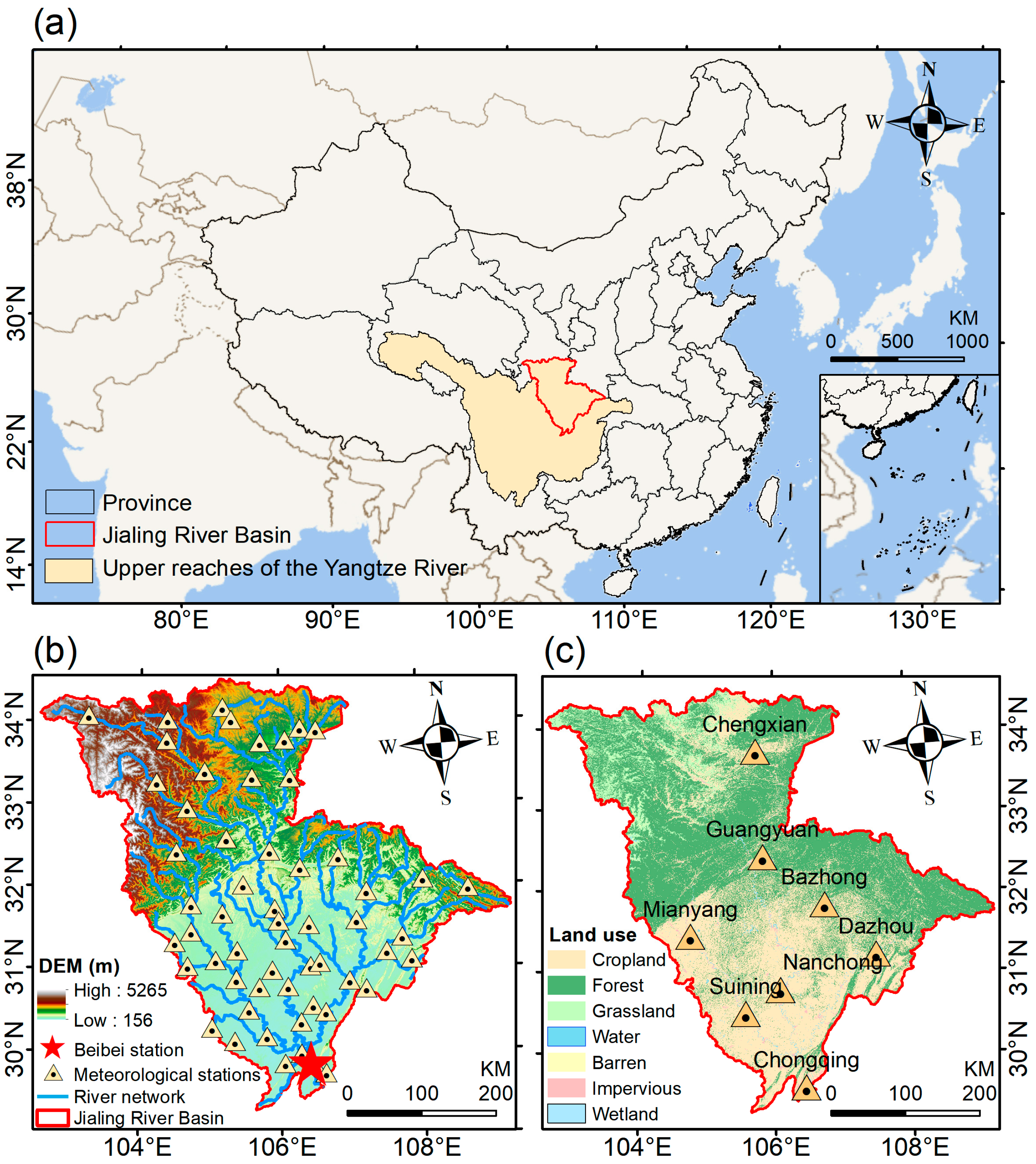
As a major left-bank tributary of the Upper Yangtze River (Figure 1a), the Jialing River extends for about 1120 km along its main stem and contributes nearly 17.5% of the total runoff in the Yangtze River Basin [9,36]. The JRB exhibits a pronounced topographic gradient, decreasing from the northwest to the southeast, with elevations ranging from 156 to 5265 m (Figure 1b). The JRB has complex and heterogeneous topography, characterized by high mountains and plateaus in the northwest, low-to-medium mountains in the northeast, basins and hills in the central part, while valleys and parallel ridges are distributed in the southeast [37,38]. Under the combined effects of the monsoon climate and topography, precipitation exhibits pronounced seasonality, with more than 70% of the annual total occurring from May to September [22,39]. Precipitation also exhibits a distinct spatial gradient, decreasing from southeast to northwest [40]. The JRB is primarily covered by forest, grassland, and cropland (Figure 1c). The upper basin is dominated by forest and grassland and has relatively high vegetation cover, whereas cropland is more extensive in the middle and lower basins [37].

2.2. Data Source

2.2.1. Geospatial Data

Shuttle Radar Topography Mission (SRTM) DEM data with a 90 m spatial resolution were obtained from the Geospatial Data Cloud (https://www.gscloud.cn/). Land use data were acquired from the 2020 China Land Cover Dataset (CLCD) [41], which has a 30 m spatial resolution and is accessible at https://zenodo.org/records/4417810 (accessed on 30 May 2025). Soil property data were extracted from the Harmonized World Soil Database (HWSD) [42], with a spatial resolution of 1 km (https://www.fao.org/soils-portal/data-hub/soil-maps-and-databases/harmonized-world-soil-database-v20/en/, accessed on 30 May 2025). Annual Normalized Difference Vegetation Index (NDVI) data for 2000–2020 and annual evapotranspiration data for 2011–2020 were sourced from the Resource and Environmental Science Data Platform [43], both at 1 km spatial resolution (https://www.resdc.cn, accessed on 30 May 2025).

2.2.2. Meteorological Data

Daily meteorological observations spanning 1990–2020 were acquired from the China Meteorological Administration, sourced from 57 stations distributed across the JRB. The obtained dataset included daily maximum and minimum temperatures, precipitation, relative humidity, wind speed, and sunshine hours. Based on station latitude, sunshine duration, and the day of the year, solar radiation was estimated following previous studies [44,45]. Missing meteorological records were supplemented using the weather generator embedded within the Soil and Water Assessment Tool Plus (SWAT+) model, which is parameterized for each station using long-term monthly statistics.

2.2.3. Hydrological Data

This study selected the Beibei Hydrological Station, which is the basin outlet control station [39,46]. Daily and monthly observed runoff observations for 2007–2020 at this station were provided by the Changjiang Water Resources Commission of the Ministry of Water Resources.

2.3. Methods

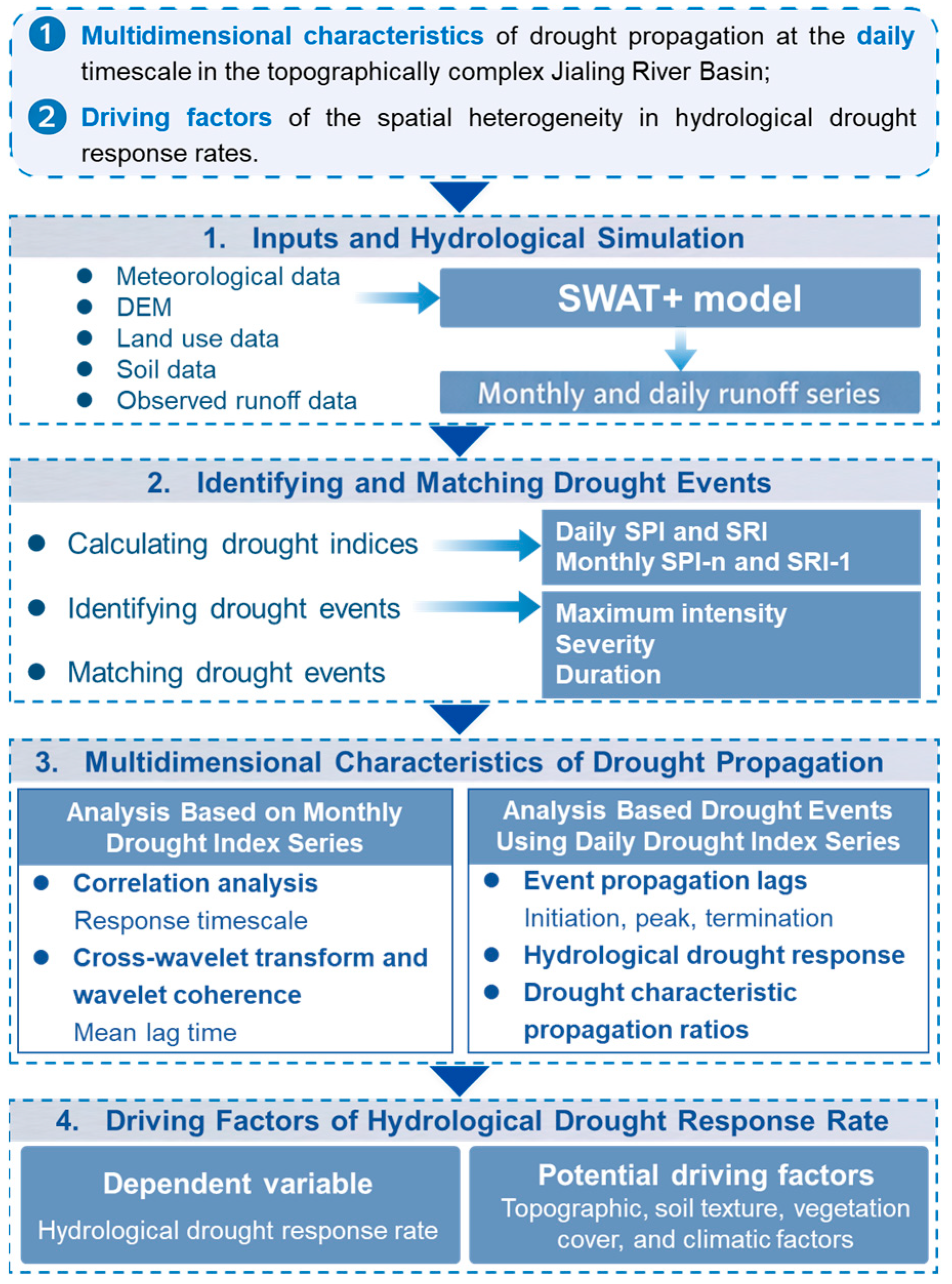
The analytical framework developed for this research is presented in Figure 2.

2.3.1. Hydrological Simulation Based on the SWAT+ Model

SWAT+ has been widely employed in ecohydrological research for simulating hydrological and energy dynamics at the watershed scale [47,48]. In this study, the 2024 version of SWAT+ was adopted, which features a modular framework wherein each hydrological component is modeled as an independent submodule [49,50]. The preliminary construction of the SWAT+ model was completed using QSWAT+ 2.3.7 within the QGIS 3.34.2 platform. Parameter sensitivity analysis, model calibration and validation were performed via SWAT+ Toolbox 1.0.3. The input data for SWAT+ modeling are presented in Figure 2. The DEM served as the foundational topographic input, which underpinned river network derivation, slope and aspect extraction, and subbasin delineation. The positions of subbasin outlets were matched to the spatial distribution of meteorological and hydrological stations, leading to the division of the JRB into 39 subbasins. Hydrological Response Units (HRUs) were delineated by integrating land use, soil type and slope gradient data. The model was run for the period 1990 to 2020, with 1990–1992 set as the warm-up phase to mitigate the impacts of initial state uncertainty. Observed runoff data were used to conduct parameter sensitivity analysis, model calibration as well as validation, with the calibration period set as 2007–2015 and the validation period as 2016–2020. The performance of runoff simulations was assessed using four statistical metrics: the coefficient of determination (R2), Nash–Sutcliffe efficiency (NSE), Kling–Gupta efficiency (KGE), and percent bias (PBIAS) [51]. Model performance was deemed acceptable when the simulation results met the criteria of R2 > 0.6, NSE > 0.5, and PBIAS within the range of ±25% [52,53,54].

2.3.2. Identification and Matching Drought Events

1. Calculating Drought Indices at Monthly and Daily Timescales
Meteorological and hydrological drought regimes were quantified using the Standardized Precipitation Index (SPI) and Standardized Runoff Index (SRI), respectively. SPI was computed based on accumulated precipitation series, while SRI was calculated from accumulated runoff. For daily SRI calculations, daily runoff was initially aggregated over the target accumulation timescale. As an illustration, the accumulated runoff at the 30-day timescale was derived following the approach documented in previous studies [21,22,55]:
X i , j k = l = 31 k + j 30 Q i 1 , l + l = 1 j Q i , l ,     j <   k l = j k + 1 j Q i , l ,     j k ,
where X i , j k denotes the accumulated runoff on day j of year i at the timescale k (days), and Q i , l is the daily runoff on day l of year i. The gamma distribution was subsequently adopted to fit the accumulated runoff series, and the corresponding cumulative probabilities were transformed into a standard normal distribution to obtain the daily SRI. The daily SPI was computed using an analogous procedure. Given that accumulated precipitation may equal zero over short accumulation windows, the piecewise probability method developed by Wang et al. [21] was implemented.
To support drought propagation investigations (Figure 2), monthly SPI series across accumulation timescales from 1 to 20 months (denoted as SPI-n, n = 1–20) and monthly SRI at a 1-month timescale (SRI-1) were also developed. Compared with daily indices, monthly drought indicators are more competent in characterizing the cumulative impacts and temporal lag features during drought propagation [56]. Since runoff integrates part of the catchment memory effect, SRI-1 was utilized to represent monthly hydrological drought conditions [10,56,57]. The interrelation between SPI-n and SRI-1 was further explored to identify the response timescale of HD to MD.
2. Identifying Drought Events and Extracting Event Characteristics
Run theory, a widely adopted method for drought event identification and characteristic extraction, is applicable to various drought indices [58]. Three thresholds were established according to the SPI-based classification criteria specified in the Grades of Meteorological Drought (GB/T 20481-2017; Table 1): a = −0.5, b = −1, and c = −1.5 [15,27,28]. Threshold b, corresponding to moderate drought, was employed to delineate the initiation and termination of drought events. Threshold a, representing slight drought, was utilized to determine whether adjacent events should be merged. Threshold c corresponds to severe drought and was applied to exclude short-duration events.
Drought event identification and characteristic extraction were conducted through a three-step procedure: (1) a drought event was identified when the drought index persisted below threshold b for over 30 consecutive days; (2) short-duration events were excluded if the drought index never fell below threshold c. Adjacent drought events were merged when the interval between them was ≤30 days and the drought index stayed below threshold a during this interval; (3) duration, severity, and maximum intensity were calculated. Severity was defined as the absolute value of the cumulative drought index over the event period, and maximum intensity was the absolute value of the lowest drought index recorded during the drought episode.
3. Matching Drought Events
MD and HD events were matched to facilitate the analysis of drought propagation at the event scale. Each HD event served as the reference, and MD events occurring between 30 days prior to the initiation of a HD event and the end of that HD event were identified as its matched events [59,60,61]. The matching results were categorized into three types: independent events, one-to-one matching, and many-to-one matching. Specifically, one-to-one matching describes a scenario where a single MD event corresponds to a single HD event. In contrast, many-to-one matching refers to a situation where multiple MD events are associated with the same HD event.

2.3.3. Multi-Dimensional Analysis of Drought Propagation Characteristics

1. Analyzing Response Timescale and Lag Time Based on Monthly Drought Indices
To identify the response timescale of HD to MD, Pearson and Spearman rank correlation coefficients were computed between SPI-n (with n ranging from 1 to 20) and SRI-1. The SPI accumulation timescale that matched the highest correlation coefficient was designated as the response timescale [8,10]. Additionally, this study investigated the correlations between SRI-1 and lagged SPI-n across lag periods of 1 to 12 months [16,22].
XWT and WTC were further employed to estimate the mean lag time from the average phase difference within significant or highly coherent regions [12,16,62]. XWT was used to analyze the relationship between two time series X ( t ) and Y ( t ) in time-frequency domains. The continuous wavelet transforms of these time series are denoted by W X ( s ,   τ ) and W Y ( s ,   τ ) , respectively:
W X Y ( s , τ ) = W X ( s , τ ) W Y * ( s , τ ) ,
where s represents the scale, and τ represents the time shift.
WTC was employed to explore the interrelation among two time series across various scales and temporal periods:
R 2 s , τ = S s 1 W X Y ( s ,   τ ) 2 S s 1 W X ( s ,   τ ) 2   S s 1 W Y ( s ,   τ ) 2 ,
where S represents the smoothing operator. X ( t ) and Y ( t ) were SPI and SRI, respectively.
2. Analyzing Lag Times of Drought Events Propagation Based on Daily Drought Indices
Propagation lag times across different drought stages were quantified based on matched MD and HD events, while independent HD events were excluded from the analysis. The time differences between MD and HD events at the initiation, peak, and termination stages were defined as the initiation lag time (∆S), peak lag time (∆P), and termination lag time (∆E), respectively [63,64]. For many-to-one matching scenarios, ∆S was referenced to the initiation of the earliest matched MD event, ∆P was based on the peak of the matched MD event with the maximum peak intensity, and ∆E was referenced to the termination of the latest matched MD event [65].
3. Quantifying Hydrological Drought Response Rate and Drought Characteristic Propagation Ratios Based on Daily Drought Indices
Existing research has demonstrated that certain HD events arise without a prior MD signal, and not all MD events can propagate into HD events [18,24]. Accordingly, the HD response rate was employed to quantify the responsiveness of HD to MD, which was defined as follows:
R = N M H N H ,
where N M H refers the number of HD events propagated from MD events, while N H denotes the total count of HD events. Specifically, R quantitatively reflects the ratio of HD events initiated by preceding MD events, and its value spans from 0 to 1. A higher R signifies a more pronounced responsiveness of HD to MD, while a lower R means fewer HD events are induced by MD events.
Drought characteristic propagation ratios were further introduced to quantify changes in drought event characteristics during propagation. Ratios were calculated for maximum intensity, severity, and duration. Each ratio was computed as the geometric mean of the decile-based ratios of HD event characteristics to those of their corresponding matched MD events [66,67]. Detailed calculations followed Apurv et al. [68]. For many-to-one matching cases, duration and severity of the matched MD events were summed to correspond to the single HD event, while the maximum intensity was selected as the highest value among all matched MD events [60].

2.3.4. Driving Factors of the Hydrological Drought Response Rate

The Geographical Detector Model (GDM) is a spatial statistical method grounded in the theory of geographical spatial stratified heterogeneity. It is primarily used to identify spatial heterogeneity and to quantify the explanatory power of potential driving factors under complex environmental conditions. It was used to quantify the contribution of potential driving factors to the spatial heterogeneity in hydrological response rate [69,70]. The HD response rate was treated as the dependent variable, whereas thirteen potential driving factors were chosen as the explanatory variables. These explanatory variables were categorized into four groups: topographic, soil texture, vegetation cover, and climatic factors. Topographic factors included elevation (DEM) and slope (SLOPE). Soil texture factors included clay (CLAY), sand (SAND), and silt (SILT) contents. Vegetation cover was characterized by NDVI. Climatic factors included precipitation (P), seasonal precipitation index (Ps), wind speed (WIND), sunshine duration (SSD), temperature (T), evapotranspiration (ET), and relative humidity (RH). Since the GDM requires categorical inputs, we first normalized all continuous variables using min–max normalization to reduce the impact of diverse units and value scopes. We then discretized the normalized variables into 10 classes using the empirical cumulative distribution function (ECDF) [69].
Precipitation in the JRB is characterized by strong seasonality [33,58], and existing research has demonstrated that precipitation seasonality affects drought propagation [67,68]. Accordingly, the seasonal precipitation index (Ps) was introduced to characterize the intra-annual distribution of precipitation, which was calculated as follows [66]:
P s = D P ¯ P ¯ m a x ,
D = m = 1 12 P m P ¯ log 2 12 P m P ¯ ,
where P ¯ is the mean annual precipitation; P ¯ m a x is the maximum P ¯ among all subbasins; and P m is the mean precipitation of month m averaged over all available years.

3. Results

3.1. SWAT+ Model Performance Evaluation

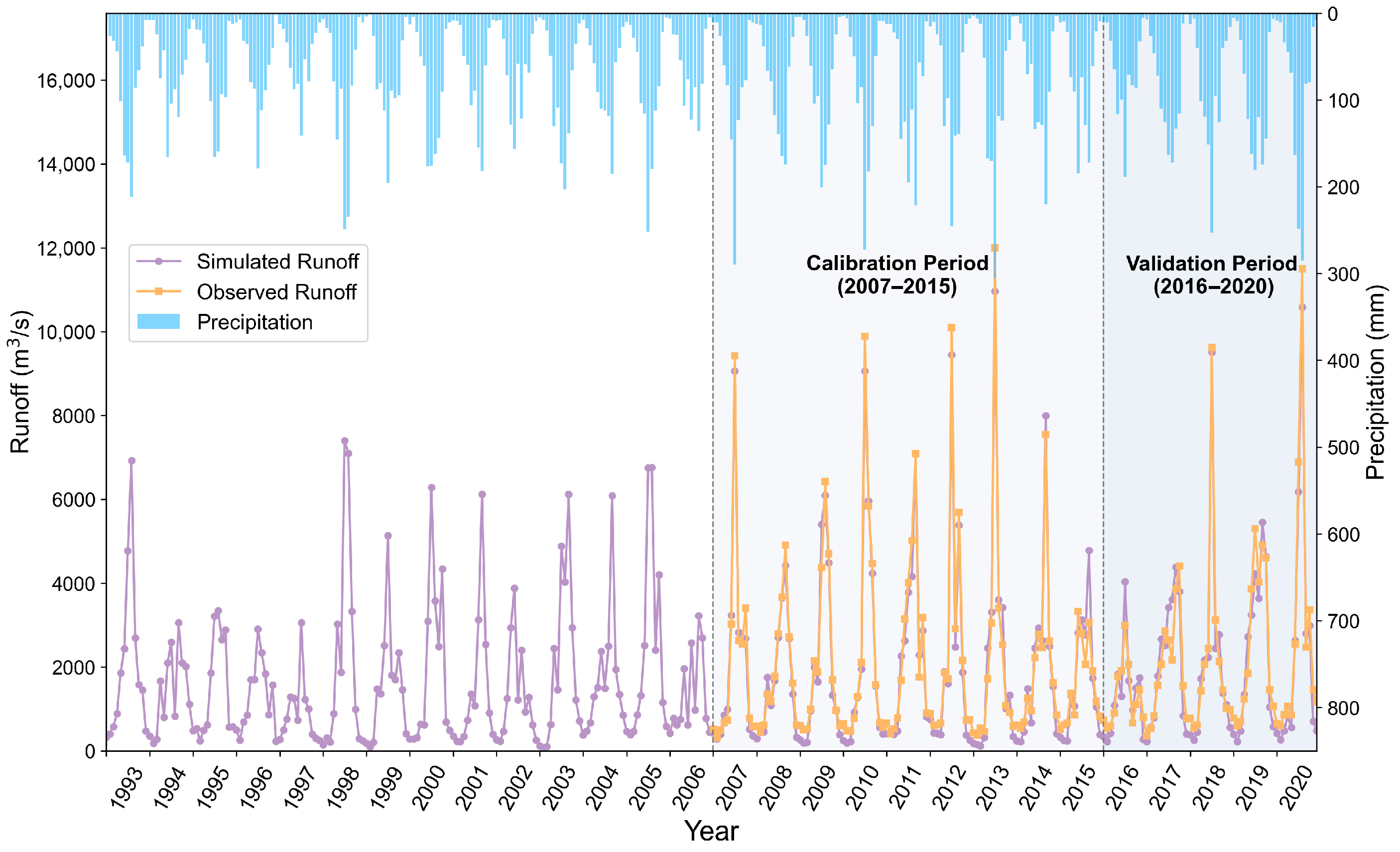
Figure 3 and Table 2 illustrate the performance of the SWAT+ model in simulating monthly runoff at the Beibei Hydrological Station within the JRB. During both the calibration and validation periods, R2, NSE, and KGE all surpassed 0.900. Additionally, the PBIAS values suggest that the SWAT+ model slightly underestimated runoff during certain low-flow and peak-flow periods.
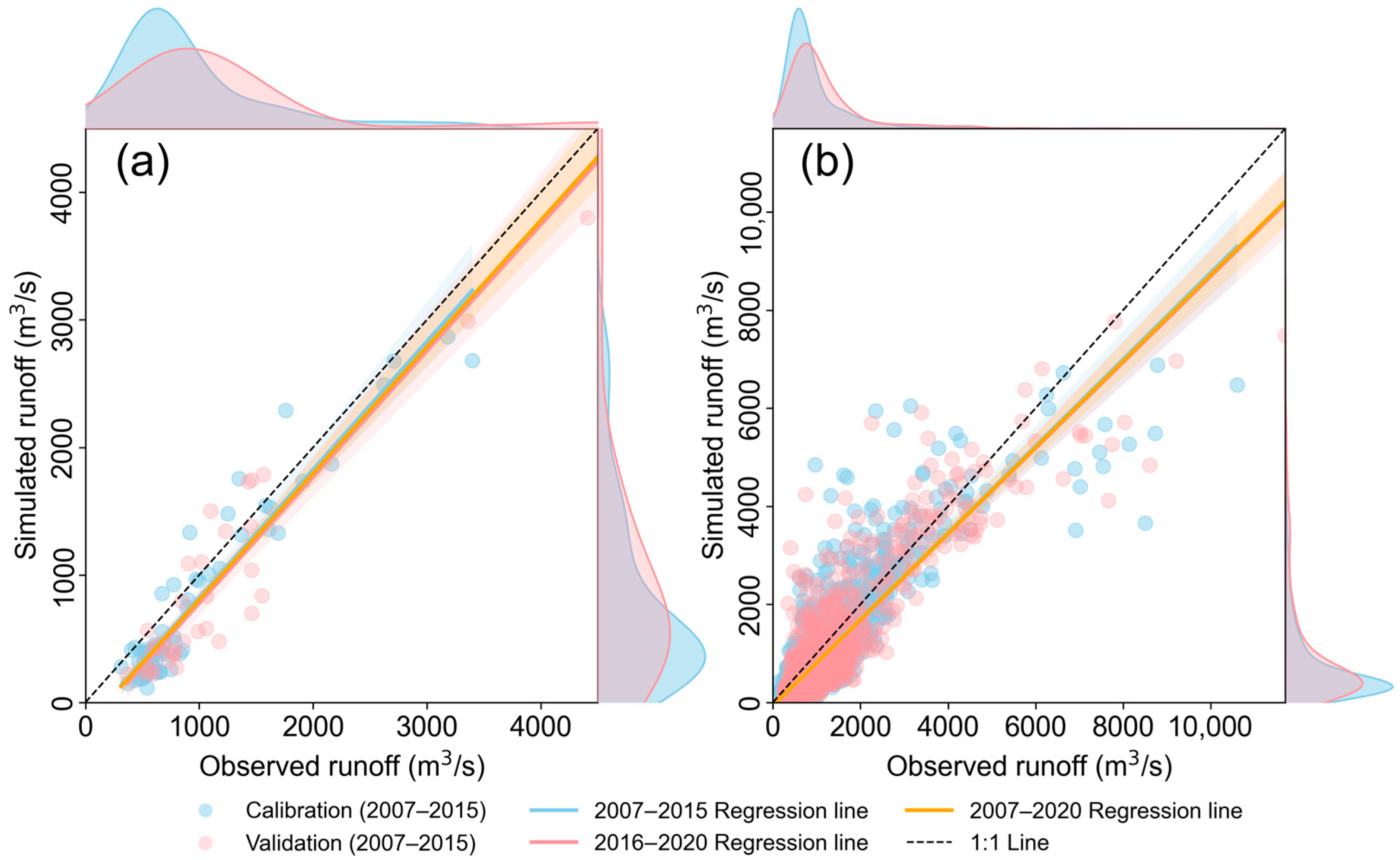
Previous research showed that precipitation in the JRB displays significant intra-annual variability, with the rainy season spanning from May to September [71]. Accordingly, the dry season was evaluated separately. Simulated and observed runoff during the dry season (January–April and October–December) from 2007 to 2020 was compared at both monthly and daily scales. At both temporal scales, simulated and observed runoff clustered around the 1:1 line (Figure 4). At the monthly scale, R2 was about 0.910 in both calibration and validation, while NSE was close to 0.850 (Table 2). Daily performance was inferior to that at the monthly scale, but it still met the acceptable criteria. At both scales, the PBIAS was about −18.500%. The regression line was located below and to the right of the 1:1 line, indicating an overall underestimation of runoff during the dry season.

3.2. Response Timescale and Mean Lag Time Based on Monthly Drought Indices

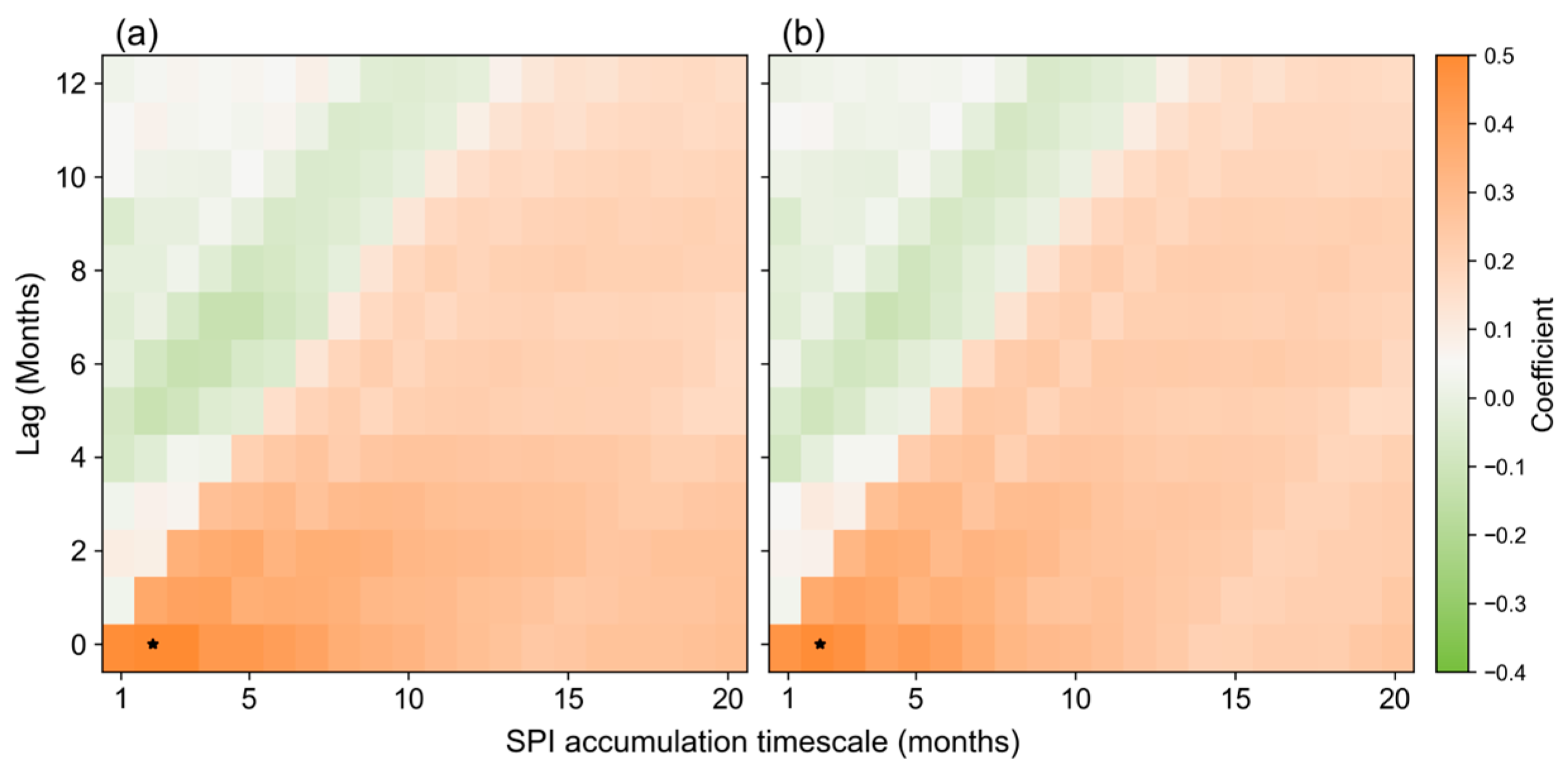
Both Pearson and Spearman rank correlation coefficients reached their peak values at an SPI accumulation timescale of n = 2 and a lag of 0 months (Pearson r = 0.50; Spearman ρ = 0.49; Figure 5). This finding suggests that HD in the JRB responds to MD with an optimal timescale of 2 months [4,29,72]. At a lag of 0 months, relatively high correlations between SPI and SRI-1 were primarily observed across SPI accumulation timescales of 1–8 months. Nevertheless, correlation coefficients within this range only fluctuated between 0.40 and 0.50. This limited variation indicates that correlation analysis alone is insufficient to clearly characterize drought propagation [16,73]. Therefore, the relationship between SPI-2 and SRI-1 was further investigated in the time-frequency domain using XWT and WTC [16,62].
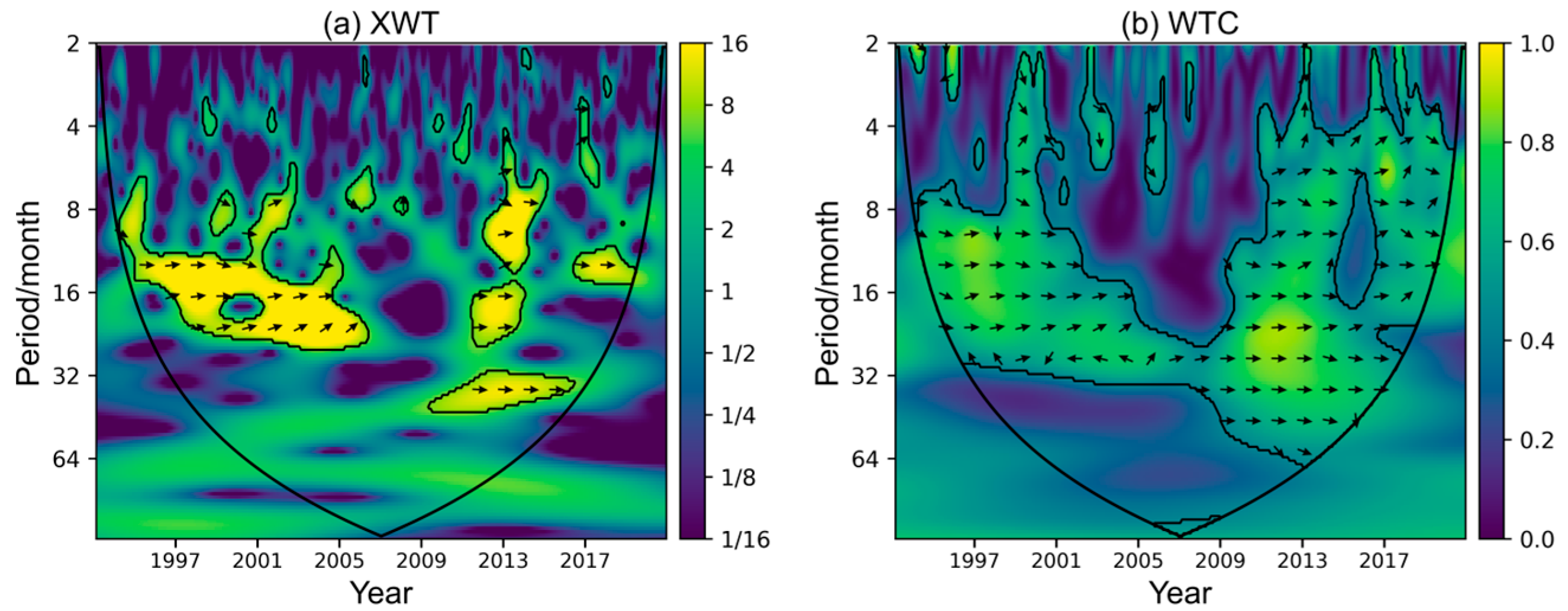
The results of XWT and WTC analyses are presented in Figure 6. The cone of influence (COI) is delineated by a thin solid black curve, within which the impact of edge effects is confined [74]. The phase relationship between SPI-2 and SRI-1 is reflected by the directions of arrows. The XWT results revealed significant common power between SPI-2 and SRI-1 at periods of 12–26 months during 1997–2005. Within this region, most arrows pointed to the right with a slight upward bias, indicating that SPI-2 and SRI-1 were generally in phase, with SRI-1 exhibiting a slight lag behind SPI-2. Phase differences were averaged across the significant common-power region within the COI, and the estimated mean lag time from MD to HD in the JRB was 0.83 months, which is consistent with previous research [12].

3.3. Lag Times of Drought Events Based on Daily Drought Indices

3.3.1. Event Propagation Lag Times at the Initiation, Peak, and Termination Stages

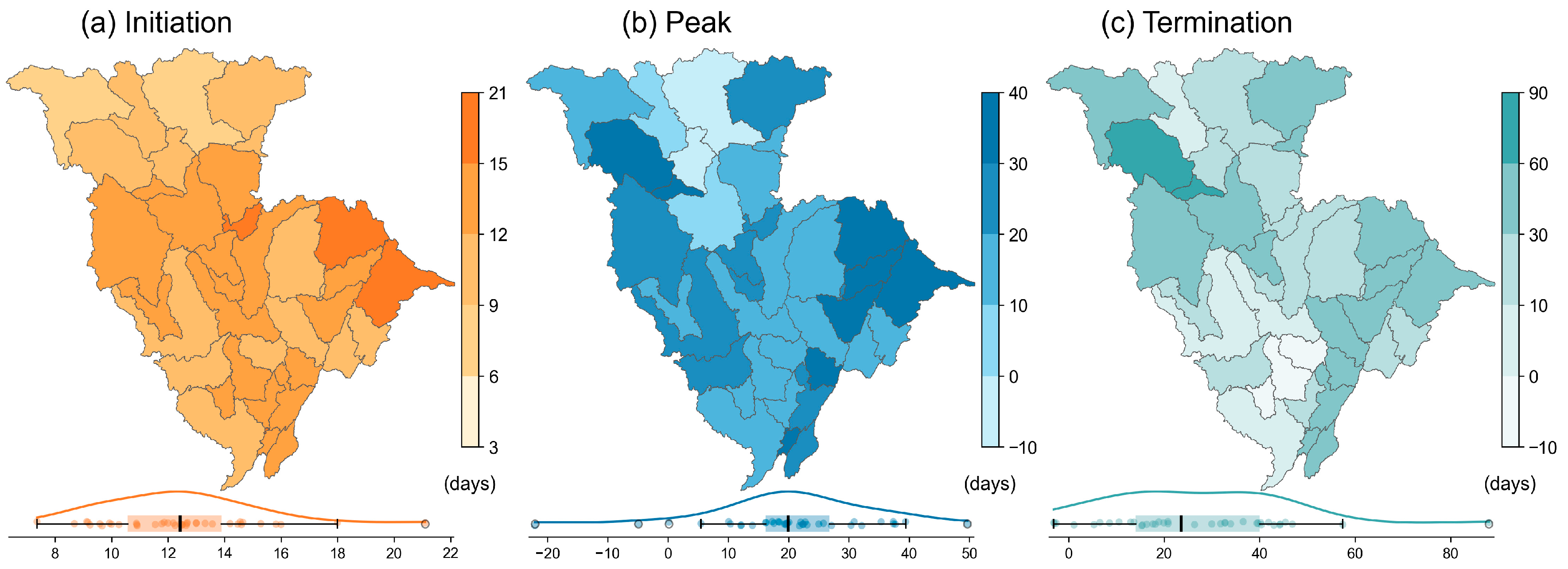
For the initiation lag time (∆S), the median value was 12 days (Figure 7a). Approximately 82% of the subbasins had ∆S values ranging from 9 to 15 days. The median peak lag time (∆P) was 20 days, with most values ranging from 16 to 28 days. The median termination lag time (∆E) was 23 days, and most ∆E values were between 15 and 40 days, with ∆E being longer than ∆P. This finding indicates that HD events usually recover slower than MD events. Overall, the lag pattern was characterized by a short initiation lag, a longer peak lag, and the longest termination lag, which illustrates distinct differences among the three event stages.
Across the JRB, drought propagation lag times displayed significant spatial heterogeneity, with the spatial pattern differing across distinct event stages (Figure 7). The initiation lag time exhibited limited spatial variation, whereas the peak and termination lag times showed much stronger spatial variation. Subbasins in the central JRB had relatively longer ∆S values, mostly between 12 and 15 days, while ∆S ranged from 6 to 12 days in most other subbasins (Figure 7a). The spatial heterogeneity of ∆P was significantly stronger (Figure 7b). Eastern subbasins had the longest ∆P values, generally exceeding 30 days. In the western JRB, ∆P mostly ranged from 20 to 30 days, while in the central basin, most ∆P values ranged from 10 to 20 days. A few northern subbasins showed negative ∆P values, suggesting that the peaks of HD events occurred earlier than those of corresponding MD events. The spatial pattern of ∆E was analogous to that of ∆P (Figure 7c), with high- and low-value areas largely overlapping. Longer ∆E values were concentrated in the eastern and northwestern JRB, while shorter ∆E values were mainly observed in the central basin. Overall, the spatial distribution of drought propagation lag times across the JRB was relatively uniform at the initiation stage but became more differentiated at the peak and termination stages. This pattern indicates that spatial differences in the initial hydrological response to MD were limited, whereas more distinct regional divergence emerged in the subsequent stages of drought propagation.

3.3.2. Variations in the Initiation Lag Time Across Seasons and Drought Grades

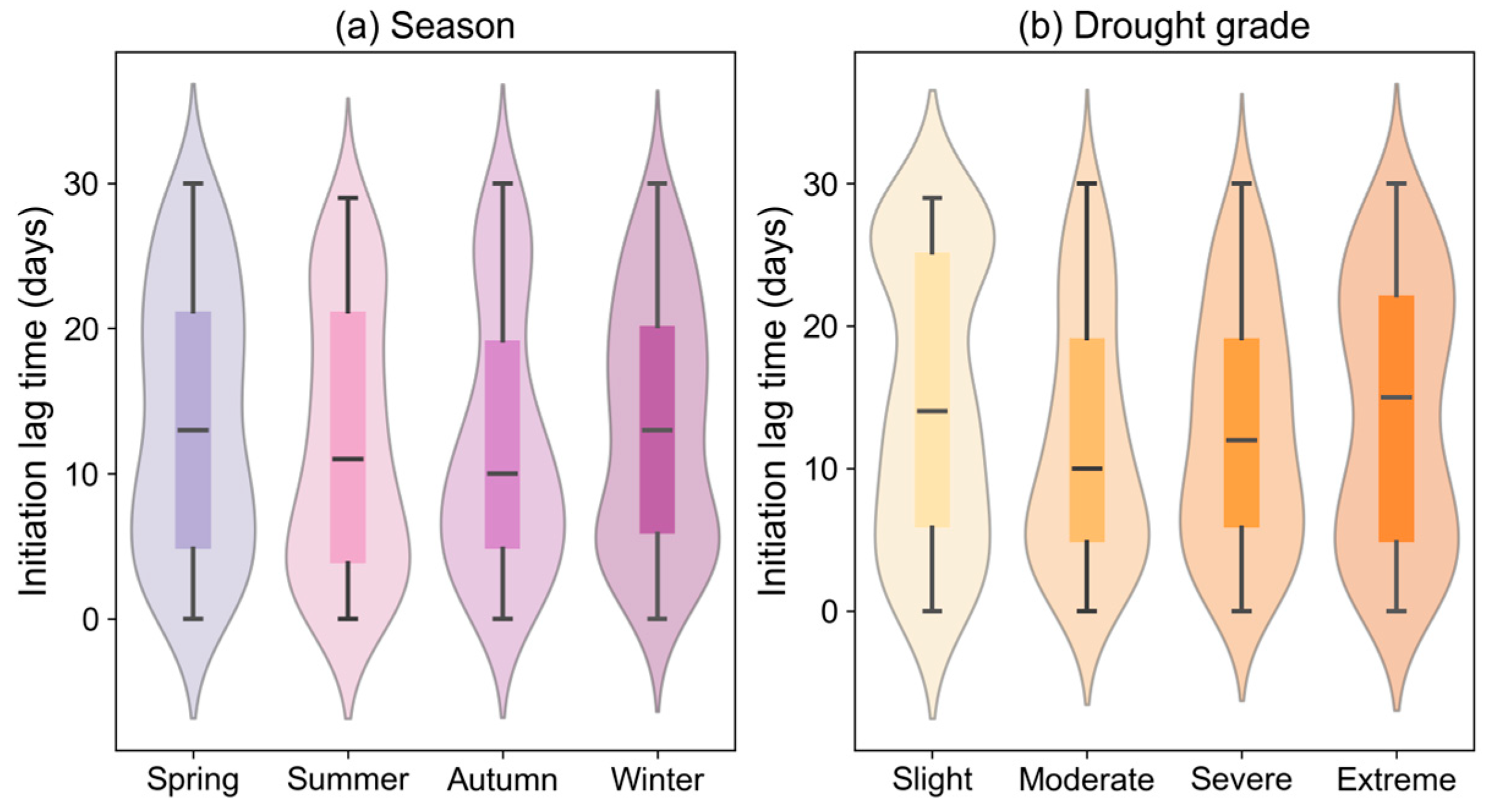
The initiation lag time (∆S) was generally shorter during summer and autumn, whereas it was longer in spring and winter (Figure 8a). Such a seasonal characteristic aligns with results reported in prior research focusing on monthly-scale drought indices in the JRB [31]. In summer and autumn, the shorter ∆S values may be attributed to increased precipitation and higher temperatures. These factors may accelerate the hydrological cycle, leading to a more rapid runoff response to precipitation.
Regarding drought grades, ∆S exhibited a complex nonlinear relationship with increasing drought grade (Figure 8b). The median ∆S values for slight, moderate, severe, and extreme HD events were 14, 10, 12, and 15 days, respectively. Slight and extreme drought events had longer ∆S values, whereas moderate drought events had the shortest ∆S values.

3.4. Amplification and Attenuation Effects of Drought Propagation

3.4.1. Spatial Patterns of Drought Characteristics During Drought Propagation

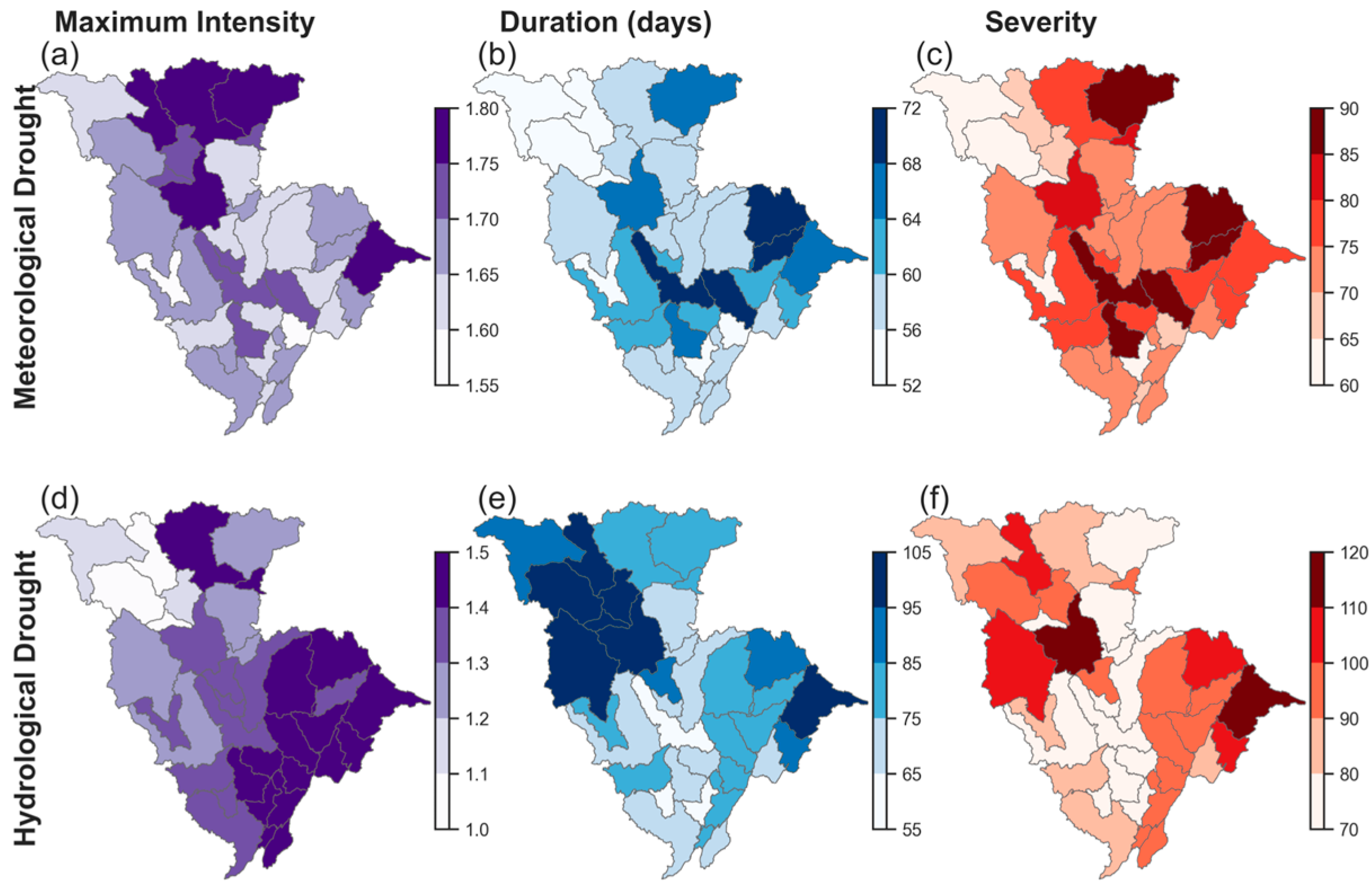
Figure 9 illustrates the spatial patterns of matched MD and HD events across the JRB. For MD events, the maximum intensity ranged from 1.55 to 1.80 (Figure 9a). High maximum intensity values (>1.75) were concentrated in the northern JRB, whereas lower values were in the southeast. The duration of these MD events ranged between 52 and 72 days (Figure 9b). The longest durations were detected within the central and eastern regions of the JRB, whereas the shortest durations were in the northwest. Drought severity ranged from 60 to 90 (Figure 9c), exhibiting a spatial distribution pattern analogous to that of duration.
For HD events propagated from MD events, their spatial distribution differed significantly. The maximum intensity of HD events ranged from 1.0 to 1.5, which was lower than that of MD events (Figure 9d). High values of maximum intensity were concentrated in the southeastern JRB, exhibiting an overall increasing gradient from northwest to southeast. The durations of HD events ranged from 55 days to 105 days, which were longer than those of MD events in most subbasins (Figure 9e). The longest durations occurred in the northwest and southeast, whereas the shortest were in the southwest. Severity ranged from 70 to 120, which was higher than that of MD events (Figure 9f). High severity values were primarily concentrated in the northwest and southeast, with lower values in the southwest.
Overall, the duration and severity of HD events were higher than those of MD events, while their maximum intensity was generally lower. The spatial distribution of drought characteristics changed during propagation. High values of maximum intensity for MD events were concentrated in the northern JRB, whereas those for HD events were in the southeast. The areas with the lowest MD duration and severity were in the northwestern JRB, while the highest values for HD duration and severity were in the northwest.

3.4.2. Spatial Patterns of Hydrological Response Rate and Characteristic Propagation Ratios

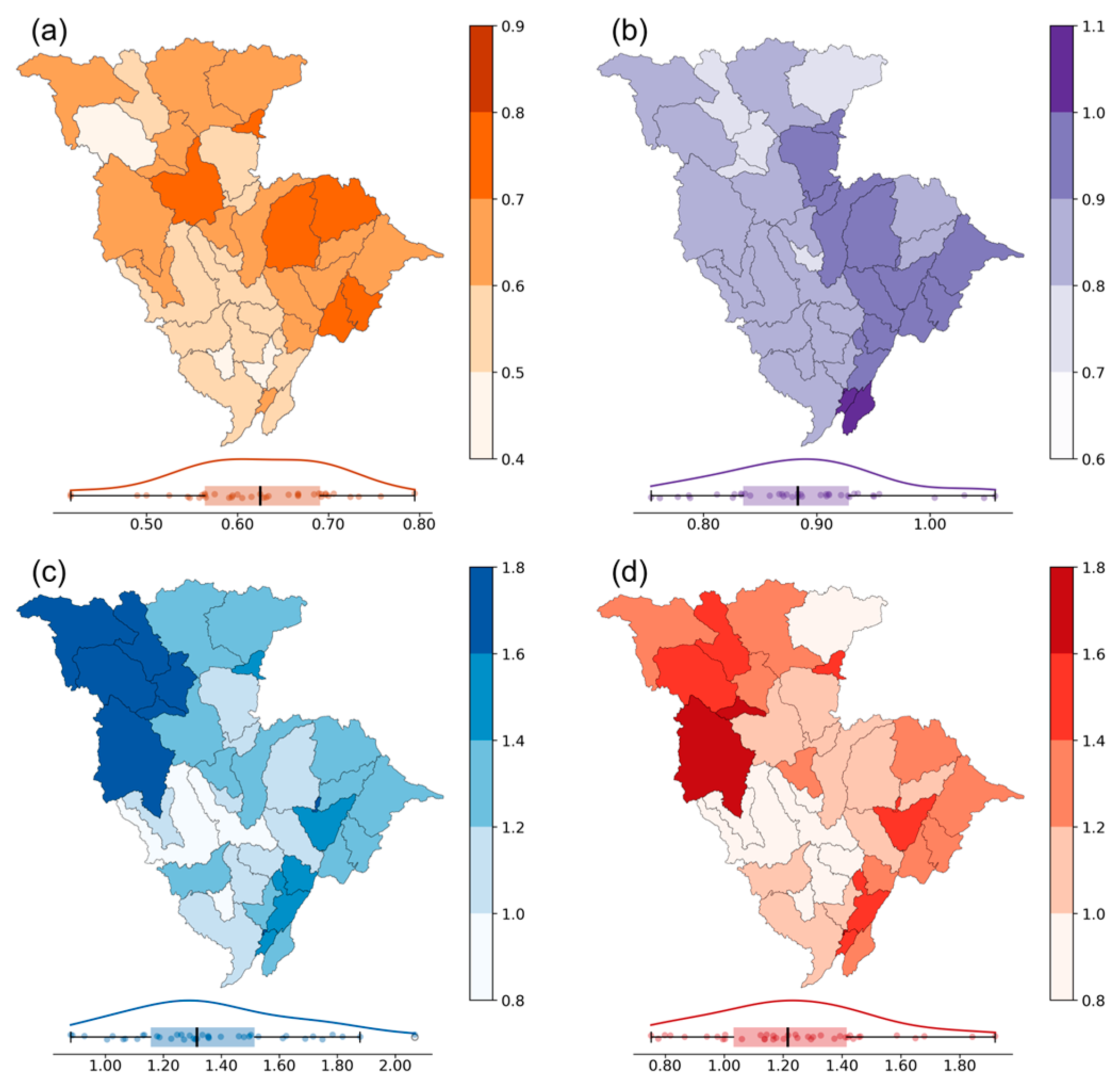
The median HD response rate was 0.62 (Figure 10a), indicating a moderate hydrological response to MD across the JRB. Drought characteristics changed significantly during propagation. The median maximum intensity propagation ratio (MIPR) was 0.88 (Figure 10b), with only four subbasins (10.26%) having MIPR values greater than 1. This result suggests overall attenuation of maximum intensity during drought propagation from MD to HD. In contrast, both the duration propagation ratio (DPR; Figure 10c) and the severity propagation ratio (SPR; Figure 10d) were generally greater than 1. The median DPR and SPR were 1.32 and 1.22, respectively. A total of 92.31% of subbasins (36 subbasins) had DPR values greater than 1, and 79.49% of subbasins (31 subbasins) had SPR values greater than 1. These results indicate that HD events persisted longer and had greater severity than their corresponding MD events.
Both the HD response rate and drought characteristic propagation ratios showed pronounced spatial heterogeneity across the JRB (Figure 10). The HD response rate was lower in the southwestern JRB, with most values ranging from 0.50 to 0.60 (Figure 10a). In most other subbasins, HD response rates exceeded 0.60. Most subbasins had MIPR < 1, indicating attenuation of maximum intensity during propagation (Figure 10b). Only a few subbasins near the basin outlet had MIPR > 1, suggesting local amplification of maximum intensity. The remaining subbasins had a clear MIPR spatial gradient, showing lower magnitudes in the western region and higher magnitudes in the eastern region. DPR and SPR showed similar spatial patterns (Figure 10c,d). Both indices were low in the southwestern JRB and high in the northwest. In the northwest, DPR exceeded 1.60 and SPR exceeded 1.40, indicating stronger amplification of drought duration and severity. Conversely, subbasins with both ratios below 1 were concentrated in the southwest, suggesting that HD events in this region were generally shorter and less severe than the corresponding MD events. Overall, low HD response rates were concentrated in the southwest, while maximum intensity was amplified only near the basin outlet. Duration and severity were amplified mainly in the northwestern subbasins.

3.4.3. Propagation Patterns Across Different Drought Grades

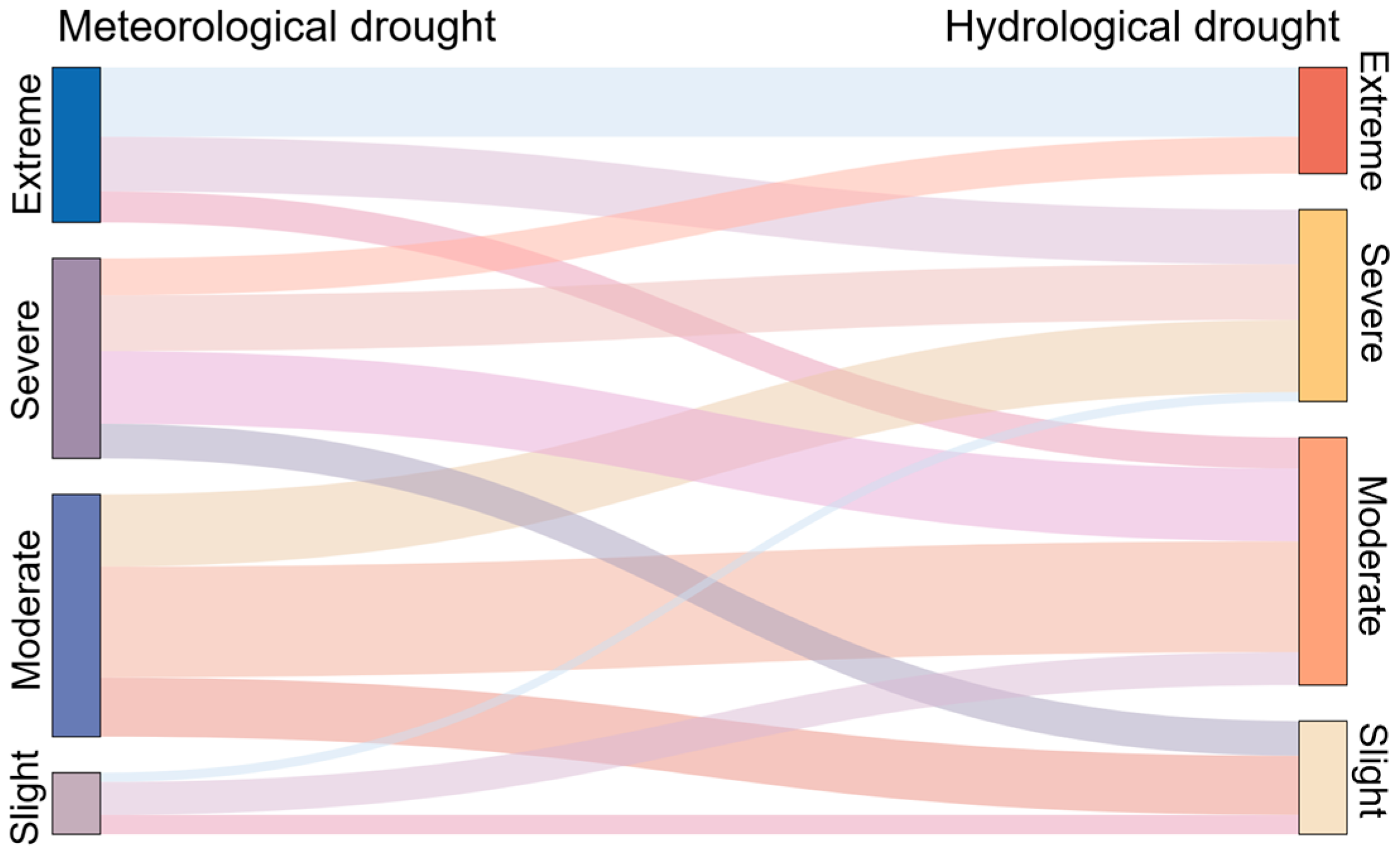
The propagation from MD events to HD events exhibited a complex evolution across different drought grades (Figure 11). Slight MD events primarily triggered more severe HD events, with 68.6% leading to higher-grade HD events. Moderate and extreme MD events mostly induced HD events of the same grade: 45.8% of moderate MD events triggered moderate HD events, and 44.7% of extreme MD events triggered extreme HD events. Severe MD events exhibited a more complex propagation pattern, affecting all HD grades. Among severe MD events, 36.4% triggered moderate HD events, 27.9% triggered severe HD events, 18.5% triggered extreme HD events, and 17.3% triggered slight HD events. Extreme HD events were primarily caused by extreme and severe MD events, accounting for 65.2% and 34.8%, respectively. The interactions involving severe drought events were the most complex, with severe MD events capable of triggering HD events across all grades, while severe HD events were triggered by MD events of any drought grade. These findings suggest that propagation across different drought grades increases uncertainty of HD events and complicates hydrological response dynamics.

3.5. Driving Factors of the Spatial Heterogeneity in Hydrological Drought Response Rate

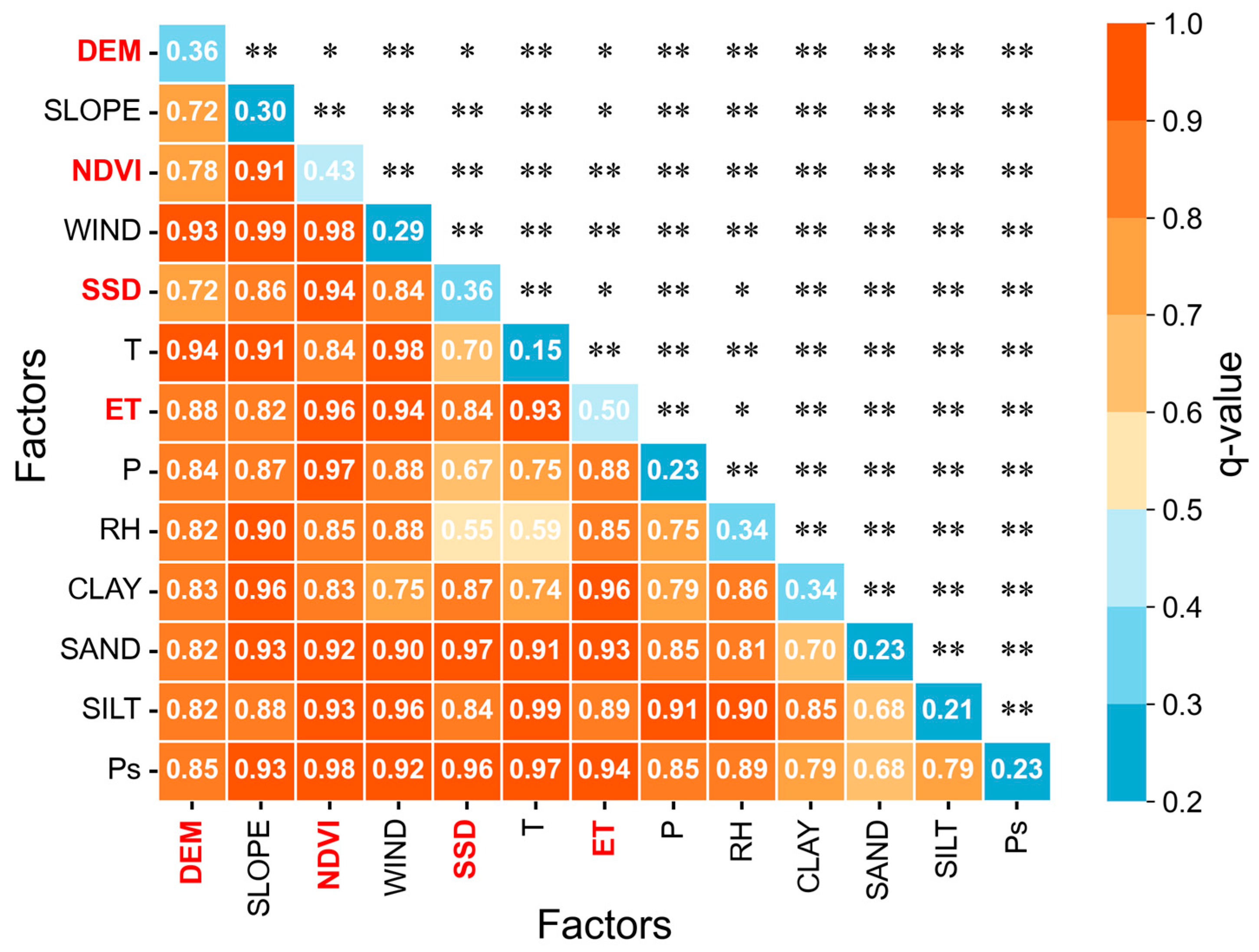
In Figure 12, the diagonal q-values indicate the degree of explanatory power that single factors have on the spatial heterogeneity of the hydrological response rate. Factor detection showed that evapotranspiration had the highest q-value (0.50), indicating the strongest explanatory power among the potential factors. NDVI ranked second (q = 0.43), suggesting that vegetation conditions were also important. DEM and SSD both had q-values of 0.36. In contrast, precipitation, precipitation seasonality, temperature, and soil texture had relatively low explanatory power when considered individually.
The interaction detector showed that the explanatory power of each two-factor interaction exceeded that of either factor alone. All pairwise interactions showed either bivariate enhancement (*) or nonlinear enhancement (**), with nonlinear enhancement accounting for 91.03% of all interactions. This pattern suggests that the effects of interacting factors were predominantly nonlinear rather than additive. Although temperature had the lowest q-value in the single-factor analysis (q = 0.15), its interactions with soil texture factors increased the q-value to more than 0.74. Interactions involving evapotranspiration also produced q-values above 0.82, further underscoring its strong interaction effects.
Comparison of factor classes between high- and low-response subbasins showed a clear contrast. Low-response subbasins in the southwestern JRB were associated with lower classes of evapotranspiration, NDVI, SSD, DEM, and slope, but higher classes of precipitation and relative humidity. By contrast, high-response subbasins were associated with higher classes of evapotranspiration, NDVI, SSD, DEM, and slope, but lower classes of precipitation and relative humidity. These results suggest that spatial variation in response rate across the JRB could not be explained by precipitation alone [75]. Instead, the variation was associated with combined differences in evaporative conditions, vegetation cover, and topography.

4. Discussion

Robust hydrological evaluation is a prerequisite for drought propagation analysis, particularly in regions with scarce observed runoff data where long-term HD indices must be derived from model simulations [76]. In this study, the SWAT+ model showed acceptable performance in runoff reproduction at both monthly and daily timescales at the Beibei Hydrological Station. These results align with previous research that has verified the applicability of the SWAT model across the JRB [54,77,78]. However, because calibration and validation were mainly conducted at the basin outlet, uncertainty remains when extending the analysis to multiple subbasins. Single-station calibration cannot fully represent the spatial heterogeneity of hydrological processes across the basin, and parameters optimized for the outlet may not fully capture local runoff characteristics at the subbasin scale [79]. Additionally, precipitation in the JRB exhibits pronounced intra-annual variability, making model performance during the dry season crucial for reliable drought analysis [29,33]. Simulation results showed that while SWAT+ captured the general dynamics of dry-season runoff, it tended to underestimate low-flow conditions. This bias might be partly associated with the omission of land use change and reservoir regulation from the model construction due to data limitations [80,81]. Such uncertainty is especially relevant for this study because biases in low runoff simulations may affect the identification of threshold-based drought events, as well as estimates of event-scale lag times and propagation ratios. The identification of drought events in this research was carried out using standardized drought indices, the three-threshold run theory method, and event-matching rules, and their reliability is supported by the generally acceptable performance of the SWAT+ model. However, independent validation at individual events was not feasible in this study, owing to the limited availability of subbasin-scale runoff observations and detailed historical drought records in the JRB. This limitation also affects the attribution analysis based on GDM. Because the explanatory variables partly rely on model-related inputs and outputs, uncertainty in hydrological simulation may influence the quantified explanatory power of the driving factors. For example, vegetation cover was identified as one of the dominant factors controlling the spatial heterogeneity of hydrological drought response rates in the JRB, whereas vegetation dynamics are strongly regulated by land use change. If land use dynamics are not explicitly incorporated into the hydrological model, the dynamic underlying surface conditions of the basin may not be fully represented. This may not only introduce bias into low-flow simulations, but also add uncertainty to the attribution analysis of drought propagation. Nevertheless, the results suggest that a validated process-based model can still provide a practical basis for drought propagation analysis in data-scarce basins. Future studies should integrate land use dynamics, reservoir operations, and anthropogenic water abstraction to better characterize human impacts on drought processes [82,83].
In this study, results indicated that evaporative demand, vegetation cover, and topographic factors are the primary controls on hydrological drought responses within the JRB. High evaporative demand may intensify soil water loss and reduce runoff generation and recharge, thereby affecting the transformation of precipitation deficits into runoff deficits [28]. Vegetation cover may further modulate this process through transpiration and canopy interception [37]. Topography plays a key role in governing runoff generation and catchment storage, thereby influencing both the rate and timing of drought propagation [34]. These factors also help explain the contrasting attenuation and amplification effects observed during drought propagation. The attenuation of maximum intensity suggests that MD signals may be partly buffered by catchment storage and delayed runoff response, thereby weakening the maximum intensity of HD. In contrast, the amplification of drought duration and severity indicates that once drought signals propagate into the hydrological system, storage depletion, flow recession, and delayed hydrological recovery may prolong runoff deficits and increase cumulative drought impacts. However, static basin attributes alone are insufficient to fully explain the propagation from MD to HD. Dynamic antecedent conditions, including antecedent soil moisture status and groundwater storage, may also exert considerable influence [8]. High antecedent soil moisture may enhance the basin buffering capacity and delay the initiation of HD, whereas low antecedent soil moisture may reduce buffering capacity and accelerate the development of runoff deficits. Similarly, groundwater storage can sustain baseflow during dry periods, thereby regulating the timing and intensity of drought propagation [10,67,84]. These dynamic factors may alter catchment storage and release processes, influencing whether and when MD develops into HD. Therefore, their omission introduces additional uncertainty into attribution analysis and should be addressed in future research. Furthermore, drought analysis is inevitably influenced by methodological choices, including the selection of drought indices, threshold classification criteria, and the rules used for drought event identification and matching. Such differences may lead to discrepancies in drought propagation characteristics and driving mechanisms, and future studies should compare multiple indices to further analyze the influence on drought propagation.

5. Conclusions

This study investigated the drought propagation from MD to HD in the JRB through multiscale temporal and spatial analysis. The main findings are as follows:
(1) The propagation from MD to HD in the JRB exhibited an overall short lag, although lag times varied across different stages. At the monthly scale, the optimal response timescale was 2 months, with a mean lag time of approximately 0.83 months. At the daily scale, the initiation stage had the shortest lag time, while the peak and termination stages had longer lag times. The initiation lag time varied significantly across seasons and drought grades. It was shorter in summer and autumn, and longer in spring and winter. Initiation lag times were longer for slight and extreme droughts compared to moderate droughts.
(2) Drought propagation from MD to HD resulted in an attenuation of maximum intensity, while duration and severity were amplified. Spatially, maximum intensity generally decreased across most of the JRB, with localized amplification near the basin outlet. Amplification of duration and severity was most pronounced in the northwestern JRB. The drought propagation process also displayed complex patterns across different drought grades. Slight MD events typically triggered more severe HD events, whereas extreme MD events primarily resulted in extreme HD events. Severe MD events showed the most complex pathways, leading to HD events of varying drought grades.
(3) Spatial heterogeneity of the HD response rate was dominated by evaporative conditions, vegetation cover, and topographic factors. Among the single factors, evapotranspiration had the strongest explanatory power. In addition, pairwise interactions consistently showed greater explanatory power than single factors.

Author Contributions

Conceptualization, J.S.; methodology, J.S. and X.S.; validation, J.S.; formal analysis, J.S. and X.S.; investigation, J.S.; data curation, J.S.; writing—original draft preparation, J.S.; writing—review and editing, J.S., X.S., Y.Z., M.L. and L.S.; visualization, J.S., X.S., Y.Z., M.L. and L.S.; supervision, X.S.; project administration, X.S.; funding acquisition, J.S., X.S., Y.Z. and L.S. All authors have read and agreed to the published version of the manuscript.

Funding

This research was funded by the Postgraduate Research Innovation Project from Southwest University, China under Grant SWUS25096.

Institutional Review Board Statement

Not applicable.

Informed Consent Statement

Not applicable.

Data Availability Statement

Data are contained within the article. The data presented in this study can be requested from the authors.

Conflicts of Interest

The authors declare no conflicts of interest.

Abbreviations

The following abbreviations are used in this manuscript:
SPIStandardized Precipitation Index
SRIStandardized Runoff Index
MDMeteorological Drought
HDHydrological Drought
XWTcross-wavelet transform
WTCwavelet coherence
COIcone of influence
JRBJialing River Basin
GDMGeographical Detector Model
NDVINormalized Difference Vegetation Index
SWAT+Soil and Water Assessment Tool Plus
NSENash-Sutcliffe efficiency
R2Coefficient of Determination
KGEKling-Gupta Efficiency
PBIASpercent bias
Psseasonal precipitation index
∆Slag time at drought initiation
∆Plag time at drought peak
∆Elag time at drought termination
MIPRmaximum intensity propagation ratio
DPRduration propagation ratio
SPRseverity propagation ratio

References

  1. Raposo, V.d.M.B.; Costa, V.A.F.; Rodrigues, A.F. A review of recent developments on drought characterization, propagation, and influential factors. Sci. Total Environ. 2023, 898, 165550. [Google Scholar] [CrossRef] [PubMed]
  2. Wu, J.; Chen, X.; Yao, H.; Zhang, D. Multi-timescale assessment of propagation thresholds from meteorological to hydrological drought. Sci. Total Environ. 2021, 765, 144232. [Google Scholar] [CrossRef] [PubMed]
  3. Zhang, Q.; Miao, C.; Guo, X.; Gou, J.; Su, T. Human activities impact the propagation from meteorological to hydrological drought in the Yellow River Basin, China. J. Hydrol. 2023, 623, 129752. [Google Scholar] [CrossRef]
  4. Zhang, X.; She, D.; Xia, J.; Zhang, L.; Deng, C.; Liu, Z. The changing characteristics of propagation time from meteorological drought to hydrological drought in the Yangtze River basin, China. Atmos. Res. 2023, 290, 106774. [Google Scholar] [CrossRef]
  5. Yu, J.; Zou, L.; Xia, J.; Dou, M.; Liu, H.; Zuo, L. Future changes in hydrological drought across the Yangtze River Basin: Identification, spatial–temporal characteristics, and concurrent probability. J. Hydrol. 2023, 625, 130057. [Google Scholar] [CrossRef]
  6. Lin, Q.; Wu, Z.; Zhang, Y.; Peng, T.; Chang, W.; Guo, J. Propagation from meteorological to hydrological drought and its application to drought prediction in the Xijiang River basin, South China. J. Hydrol. 2023, 617, 128889. [Google Scholar] [CrossRef]
  7. Li, L.; Shao, Z.; Liu, W.; Liu, Y.; Zhao, S.; Wei, Y.; Zhang, J.; Wang, X.; Hou, H. Channel Microenvironment-Controlled Pillared MOF as Efficient Triboelectric Nanogenerator Material for Self-Powered Degradation of Organic Pollutants. Energy Environ. Mater. 2026, e70280. [Google Scholar] [CrossRef]
  8. Li, Q.; He, P.; He, Y.; Han, X.; Zeng, T.; Lu, G.; Wang, H. Investigation to the relation between meteorological drought and hydrological drought in the upper Shaying River Basin using wavelet analysis. Atmos. Res. 2020, 234, 104743. [Google Scholar] [CrossRef]
  9. Wang, H.; Wang, Z.; Bai, Y.; Wang, W. Propagation characteristics of meteorological drought to hydrological drought considering nonlinear correlations—A case study of the Hanjiang River Basin, China. Ecol. Inform. 2024, 80, 102512. [Google Scholar] [CrossRef]
  10. Baez-Villanueva, O.M.; Zambrano-Bigiarini, M.; Miralles, D.G.; Beck, H.E.; Siegmund, J.F.; Alvarez-Garreton, C.; Verbist, K.; Garreaud, R.; Boisier, J.P.; Galleguillos, M. On the timescale of drought indices for monitoring streamflow drought considering catchment hydrological regimes. Hydrol. Earth Syst. Sci. 2024, 28, 1415–1439. [Google Scholar] [CrossRef]
  11. Wei, Y.; Zhu, L.; Chen, Y.; Cao, X.; Yu, H. Spatiotemporal Variations in Drought and Vegetation Response in Inner Mongolia from 1982 to 2019. Remote Sens. 2022, 14, 3803. [Google Scholar] [CrossRef]
  12. Li, R.; Chen, N.; Zhang, X.; Zeng, L.; Wang, X.; Tang, S.; Li, D.; Niyogi, D. Quantitative analysis of agricultural drought propagation process in the Yangtze River Basin by using cross wavelet analysis and spatial autocorrelation. Agric. For. Meteorol. 2020, 280, 107809. [Google Scholar] [CrossRef]
  13. Gudmundsson, L.; Brunner, M.I.; Döll, P.; Fluet-Chouinard, E.; Frolova, N.; Gosling, S.N.; Hirabayashi, Y.; Kireeva, M.B.; Liu, X.; Müller Schmied, H.; et al. Past and future change in global river flows. Nat. Rev. Earth Environ. 2026, 7, 7–23. [Google Scholar] [CrossRef]
  14. Huang, S.; Li, P.; Huang, Q.; Leng, G.; Hou, B.; Ma, L. The propagation from meteorological to hydrological drought and its potential influence factors. J. Hydrol. 2017, 547, 184–195. [Google Scholar] [CrossRef]
  15. Ma, Y.; Ren, J.; Kang, S.; Niu, J.; Tong, L. Spatial-temporal dynamics of meteorological and agricultural drought in Northwest China: Propagation, drivers and prediction. J. Hydrol. 2025, 650, 132492. [Google Scholar] [CrossRef]
  16. Aon, S.; Nandi, S.; Sen, S.; Biswas, S. GRACE based groundwater drought evaluation of Ganga Basin and analysis of drought propagation using wavelet based quantitative approach. Sci. Total Environ. 2024, 951, 175666. [Google Scholar] [CrossRef]
  17. Wu, J.; Chen, X.; Yao, H.; Liu, Z.; Zhang, D. Hydrological Drought Instantaneous Propagation Speed Based on the Variable Motion Relationship of Speed-Time Process. Water Resour. Res. 2018, 54, 9549–9565. [Google Scholar] [CrossRef]
  18. Hu, R.; Yuan, S.; Jin, J.; Zhu, L.; Liu, Y. Long-term changes in the drought propagation characteristics in the Yangtze River Basin. J. Hydrol. Reg. Stud. 2026, 63, 103014. [Google Scholar] [CrossRef]
  19. Zhang, X.; Hao, Z.; Singh, V.P.; Zhang, Y.; Feng, S.; Xu, Y.; Hao, F. Drought propagation under global warming: Characteristics, approaches, processes, and controlling factors. Sci. Total Environ. 2022, 838, 156021. [Google Scholar] [CrossRef]
  20. Zhang, S.; Liu, J.; Li, C.; Yu, F.; Jing, L.; Wang, Y. Identification of the large-area and long-duration drought and its evolutionary characteristics in Nenjiang River basin. J. Hydrol. 2023, 626, 130218. [Google Scholar] [CrossRef]
  21. Wang, Q.; Zhang, R.; Qi, J.; Zeng, J.; Wu, J.; Shui, W.; Wu, X.; Li, J. An improved daily standardized precipitation index dataset for mainland China from 1961 to 2018. Sci. Data 2022, 9, 124. [Google Scholar] [CrossRef] [PubMed]
  22. Jeong, M.-S.; Park, S.-Y.; Kim, Y.-J.; Yoon, H.-C.; Lee, J.-H. Identification of propagation characteristics from meteorological drought to hydrological drought using daily drought indices and lagged correlations analysis. J. Hydrol. Reg. Stud. 2024, 55, 101939. [Google Scholar] [CrossRef]
  23. Sattar, M.N.; Lee, J.-Y.; Shin, J.-Y.; Kim, T.-W. Probabilistic Characteristics of Drought Propagation from Meteorological to Hydrological Drought in South Korea. Water Resour. Manag. 2019, 33, 2439–2452. [Google Scholar] [CrossRef]
  24. Guo, Y.; Huang, S.; Huang, Q.; Leng, G.; Fang, W.; Wang, L.; Wang, H. Propagation thresholds of meteorological drought for triggering hydrological drought at various levels. Sci. Total Environ. 2020, 712, 136502. [Google Scholar] [CrossRef]
  25. Li, Y.; Deng, Q.; Chang, J.; Huang, Y.; Zhang, H.; Fan, J.; Wu, H. Nonlinear propagation of meteorological to hydrological drought: Contrasting dynamics in humid and semi-arid regions. J. Hydrol. 2025, 657, 133012. [Google Scholar] [CrossRef]
  26. Gan, B.; Liu, M.; Cui, H.; Chen, X.; Chen, Y.; Gao, L.; Deng, H. Spatiotemporal patterns and propagation of meteorological and hydrological drought in a humid basin of Southeast China. Sci. Rep. 2025, 15, 31720. [Google Scholar] [CrossRef]
  27. Han, Z.; Huang, S.; Huang, Q.; Leng, G.; Wang, H.; Bai, Q.; Zhao, J.; Ma, L.; Wang, L.; Du, M. Propagation dynamics from meteorological to groundwater drought and their possible influence factors. J. Hydrol. 2019, 578, 124102. [Google Scholar] [CrossRef]
  28. Zou, R.; Wang, X.; Yin, Y.; Ma, X.; Yang, X.; Huang, P.; Ullah, I. Comparing spatio-temporal propagation patterns of hydrological and meteorological droughts: Insights from SWAT modelling in the poyang lake basin. CATENA 2024, 243, 108183. [Google Scholar] [CrossRef]
  29. Zeng, X.; Zhao, N.; Sun, H.; Ye, L.; Zhai, J. Changes and relationships of climatic and hydrological droughts in the Jialing River Basin, China. PLoS ONE 2015, 10, e0141648. [Google Scholar] [CrossRef] [PubMed]
  30. Xu, J.; Ji, G.; Zhang, Y. Analysis on the characteristics of drought-flood abrupt alternation in the Jialing River Basin from1982 to 2020 based on SRI. J. Henan Norm. Univ. (Nat. Sci. Ed.) 2025, 53, 42–49. [Google Scholar]
  31. Du, H.; Zeng, S.; Wei, X.; Liu, H.; Xia, J. Study on propagation characteristics from meteorological drought to hydrological drought in the Jialing River Basin. Water Resour. Prot. 2025, 41, 134–143. [Google Scholar]
  32. Shuai, L.; Ling, Z.; Cun-Jie, Z.; Chan, X.; Qiang, Z.; Wen-Ting, G. Spatio-temporal variations and propagation from meteorological to hydrological drought in the upper Yangtze River basin over last 120 years. Adv. Clim. Change Res. 2023, 19, 263. [Google Scholar]
  33. Wan, H. Projection of Future Climate Change and Its Influence on Surface Runoff of the Upper Yangtze River Basin, China. Atmosphere 2023, 14, 1576. [Google Scholar] [CrossRef]
  34. Chen, J.; Fan, Y.; Zhang, Y.; Peng, J.; Zhang, J.; Cao, C. Comprehensive propagation characteristics between paired meteorological and hydrological drought events: Insights from various underlying surfaces. Atmos. Res. 2024, 299, 107193. [Google Scholar] [CrossRef]
  35. Lu, B.; Wang, W.; Jordan, N.; Wright, D.; Bechle, A.; Zoet, L.; Wu, C. A multi-scale assessment for managing coastal geomorphic changes in southwestern Lake Michigan. J. Environ. Manag. 2025, 395, 127878. [Google Scholar] [CrossRef]
  36. Zhang, S.; Li, W.; An, W.; Hou, J.; Hou, X.; Tang, C.; Gan, Z. Temporal and spatial evolutionary trends of regional extreme precipitation under different emission scenarios: Case study of the Jialing River Basin, China. J. Hydrol. 2023, 617, 129156. [Google Scholar] [CrossRef]
  37. Hou, X.; Zhang, S.; Ruan, Q.; Tang, C. Synergetic impact of climate and vegetation cover on runoff, sediment, and nitrogen and phosphorus losses in the Jialing River Basin, China. J. Clean. Prod. 2022, 361, 132141. [Google Scholar] [CrossRef]
  38. Zhang, J.; Zhang, M.; Song, Y.; Lai, Y. Hydrological simulation of the Jialing River Basin using the MIKE SHE model in changing climate. J. Water Clim. Change 2021, 12, 2495–2514. [Google Scholar] [CrossRef]
  39. Guo, W.; Wang, G.; Ma, Y.; Hong, F.; Huang, L.; Yang, H.; Jiao, X.; He, N.; Wang, H. Evaluation of hydrological regime alteration and ecological flow processes in the changing environment of the Jialing River, China. J. Water Clim. Change 2024, 15, 978–997. [Google Scholar] [CrossRef]
  40. Yang, S.; Li, L.; Zhu, R.; Luo, C.; Lu, X.; Sun, M.; Xu, B. Assessing land-use changes and carbon storage: A case study of the Jialing River Basin, China. Sci. Rep. 2024, 14, 15984. [Google Scholar] [CrossRef] [PubMed]
  41. Yang, J.; Huang, X. 30 m annual land cover and its dynamics in China from 1990 to 2019 (Version 1.0.0). Earth Syst. Sci. Data 2021, 2021, 1–29. [Google Scholar]
  42. Fischer, G.; Nachtergaele, F.; Prieler, S.; Van Velthuizen, H.; Verelst, L.; Wiberg, D. Global Agro-Ecological Zones Assessment for Agriculture (GAEZ 2008); IIASA: Luxembourg; Austria FAO: Rome, Italy, 2008; p. 10. [Google Scholar]
  43. Xu, X. Spatial Distribution Dataset of Annual Vegetation Index (NDVI) in China. 2018. Available online: https://www.resdc.cn/DOI/doi.aspx?DOIid=49 (accessed on 30 May 2025).
  44. Tong, C.; Zhang, W.; Tang, Y.; Wang, H. Estimation of Daily Solar Radiation in China. Chin. J. Agrometeorol. 2005, 26, 165. [Google Scholar]
  45. Tso, T.-K.; Wang, Y.-X.; Chen, C.-X. Characteristics of the Distribution of Total Radiation in China. Acta Meteorol. Sin. 2013, 33, 78–96. [Google Scholar]
  46. Shao, Y.; He, Y.; Mu, X.; Zhao, G.; Gao, P.; Sun, W. Contributions of climate change and human activities to runoff and sediment discharge reductions in the Jialing River, a main tributary of the upper Yangtze River, China. Theor. Appl. Climatol. 2021, 145, 1437–1450. [Google Scholar] [CrossRef]
  47. Aloui, S.; Mazzoni, A.; Elomri, A.; Aouissi, J.; Boufekane, A.; Zghibi, A. A review of Soil and Water Assessment Tool (SWAT) studies of Mediterranean catchments: Applications, feasibility, and future directions. J. Environ. Manag. 2023, 326, 116799. [Google Scholar] [CrossRef] [PubMed]
  48. Cecconello, S.T.; Bressiani, D.; Nunes, M.C.M.; Timm, L.C. Analysis of SWAT+ model performance: A comparative study using different software and algorithms. Environ. Model. Softw. 2025, 188, 106425. [Google Scholar] [CrossRef]
  49. Cao, C.; Ying, M. Assessing Water Resource Vulnerability in an Agricultural Basin for Climate Change Adaptation. Water Resour. Manag. 2024, 39, 179–205. [Google Scholar] [CrossRef]
  50. Sánchez-Gómez, A.; Bieger, K.; Schürz, C.; Rodríguez-Castellanos, J.M.; Molina-Navarro, E. Multi-spatial and multi-criteria calibration to guarantee a robust SWAT+ hydrological model in a large and heterogeneous catchment. CATENA 2025, 261, 109508. [Google Scholar] [CrossRef]
  51. Castellanos-Osorio, G.; López-Ballesteros, A.; Pérez-Sánchez, J.; Senent-Aparicio, J. Disaggregated monthly SWAT+ model versus daily SWAT+ model for estimating environmental flows in Peninsular Spain. J. Hydrol. 2023, 623, 129837. [Google Scholar] [CrossRef]
  52. Moriasi, D.N.; Arnold, J.G.; Van Liew, M.W.; Bingner, R.L.; Harmel, R.D.; Veith, T.L. Model evaluation guidelines for systematic quantification of accuracy in watershed simulations. Trans. ASABE 2007, 50, 885–900. [Google Scholar] [CrossRef]
  53. Moriasi, D.N.; Gitau, M.W.; Pai, N.; Daggupati, P. Hydrologic and water quality models: Performance measures and evaluation criteria. Trans. ASABE 2015, 58, 1763–1785. [Google Scholar] [CrossRef]
  54. Wu, M.; Ni, F.; Deng, Y.; Yue, Z.; Jiang, N.; Kang, W.; Xiang, J. Projections of Runoff and Hydrological Drought in the Jialing River Basin Based on CMIP6. Resour. Environ. Yangtze Basin 2024, 33, 1004–1017. [Google Scholar]
  55. Wang, Q.; Zeng, J.; Qi, J.; Zhang, X.; Zeng, Y.; Shui, W.; Xu, Z.; Zhang, R.; Wu, X.; Cong, J. A multi-scale daily SPEI dataset for drought characterization at observation stations over mainland China from 1961 to 2018. Earth Syst. Sci. Data 2021, 13, 331–341. [Google Scholar] [CrossRef]
  56. Sutanto, S.J.; Van Lanen, H.A.J. Catchment memory explains hydrological drought forecast performance. Sci. Rep. 2022, 12, 2689. [Google Scholar] [CrossRef]
  57. Tijdeman, E.; Stahl, K.; Tallaksen, L.M. Drought Characteristics Derived Based on the Standardized Streamflow Index: A Large Sample Comparison for Parametric and Nonparametric Methods. Water Resour. Res. 2020, 56, e2019WR026315. [Google Scholar] [CrossRef]
  58. Chen, Y.; Zhang, Y.; Tian, J.; Tang, Z.; Wang, L.; Yang, X. Understanding the Propagation of Meteorological Drought to Groundwater Drought: A Case Study of the North China Plain. Water 2024, 16, 501. [Google Scholar] [CrossRef]
  59. Chen, H.; Meng, F.; Sa, C.; Luo, M.; Bao, Y.; Liu, T. A three-dimensional perspective on how land use/cover change reshapes drought propagation under climate change? J. Hydrol. Reg. Stud. 2025, 60, 102478. [Google Scholar] [CrossRef]
  60. Xu, Z.; Jiang, B.; Guo, X.; Wu, Z.; Fan, S. Initial soil moisture conditions dominate variation in event-scale propagation time from meteorological to agricultural drought. Agric. Water Manag. 2026, 325, 110128. [Google Scholar] [CrossRef]
  61. Yang, Y.; Li, Z.; Yang, J.; Liao, L.; Liang, L.; Wei, C.; He, M.; Mo, C.; Li, X.; Sun, G. Characteristics, prediction model and driving mechanism of multidimensional daily scale propagation from meteorological to agricultural drought in Guangxi, China. J. Hydrol. 2025, 663, 134233. [Google Scholar] [CrossRef]
  62. Luo, X.; Luo, X.; Ji, X.; Ming, W.; Wang, L.; Xiao, X.; Xu, J.; Liu, Y.; Li, Y. Meteorological and hydrological droughts in the Lancang-Mekong River Basin: Spatiotemporal patterns and propagation. Atmos. Res. 2023, 293, 106913. [Google Scholar] [CrossRef]
  63. Bevacqua, A.G.; Chaffe, P.L.B.; Chagas, V.B.P.; AghaKouchak, A. Spatial and temporal patterns of propagation from meteorological to hydrological droughts in Brazil. J. Hydrol. 2021, 603, 126902. [Google Scholar] [CrossRef]
  64. Das, S.; Das, J.; Umamahesh, N.V. Investigating the propagation of droughts under the influence of large-scale climate indices in India. J. Hydrol. 2022, 610, 127900. [Google Scholar] [CrossRef]
  65. Zeleke, E.B.; Chawanda, C.J.; Melesse, A.M. Using a standardized event-based tool for drought analysis: Application to propagation predictability patterns. Environ. Model. Softw. 2026, 195, 106745. [Google Scholar]
  66. Xiong, H.; Han, J.; Yang, Y. Propagation From Meteorological to Hydrological Drought: Characteristics and Influencing Factors. Water Resour. Res. 2025, 61, e2024WR037765. [Google Scholar] [CrossRef]
  67. Apurv, T.; Cai, X. Drought Propagation in Contiguous U.S. Watersheds: A Process-Based Understanding of the Role of Climate and Watershed Properties. Water Resour. Res. 2020, 56, e2020WR027755. [Google Scholar] [CrossRef]
  68. Apurv, T.; Sivapalan, M.; Cai, X. Understanding the Role of Climate Characteristics in Drought Propagation. Water Resour. Res. 2017, 53, 9304–9329. [Google Scholar] [CrossRef]
  69. Jin, H.; Zhang, K.; Zhang, P.; Liu, G.; Liu, M.; Chen, X.; Willems, P. Spatiotemporal evolution of drought status and its driving factors attribution in China. Sci. Total Environ. 2025, 958, 178131. [Google Scholar] [CrossRef] [PubMed]
  70. Mei, L.; Aru, H.; Tong, S.; Wang, Y.; Guo, E.; Zhang, T.; Yin, S.; Bao, Y. Study on the propagation processes and driving mechanisms of meteorological, hydrological, and agricultural droughts on the Mongolian Plateau. J. Hydrol. 2025, 660, 133511. [Google Scholar] [CrossRef]
  71. Wang, Y.-B.; Junaid, M.; Deng, J.-Y.; Tang, Q.-P.; Luo, L.; Xie, Z.-Y.; Pei, D.-S. Effects of land-use patterns on seasonal water quality at multiple spatial scales in the Jialing River, Chongqing, China. CATENA 2024, 234, 107646. [Google Scholar] [CrossRef]
  72. Um, M.-J.; Kim, Y.; Jung, K.; Lee, M.; An, H.; Min, I.; Kwak, J.; Park, D. Evaluation of drought propagations with multiple indices in the Yangtze River basin. J. Environ. Manag. 2022, 317, 115494. [Google Scholar] [CrossRef]
  73. Aon, S.; Biswas, S. Bivariate Assessment of Hydrological Drought of a Semi-Arid Basin and Investigation of Drought Propagation Using a Novel Cross Wavelet Transform Based Technique. Water Resour. Manag. 2024, 38, 2977–3005. [Google Scholar] [CrossRef]
  74. Hou, H.; Lu, D.; Zhou, D.; Bai, J.; Guo, F.; Chen, C.; Wang, J.; Cheng, Y.; Bao, Z.; Li, H. The response of meteorological drought to extreme climate in the water-receiving area of the Tao river diversion project in China. Sci. Rep. 2025, 15, 42077. [Google Scholar] [CrossRef]
  75. Ho, S.; Tian, L.; Disse, M.; Tuo, Y. A new approach to quantify propagation time from meteorological to hydrological drought. J. Hydrol. 2021, 603, 127056. [Google Scholar] [CrossRef]
  76. Van Loon, A.F.J.W.I.R.W. Hydrological drought explained. Wiley Interdiscip. Rev. Water 2015, 2, 359–392. [Google Scholar] [CrossRef]
  77. Shi, W.; He, Y.; Shao, Y. Effects of Climate Change and Human Activities on Runoff in the Upper Reach of Jialing River, China. Remote Sens. 2024, 16, 2481. [Google Scholar] [CrossRef]
  78. Wu, M.; Ni, F.; Deng, Y.; Jiang, N.; Zhu, M.; Ren, H.; Yue, Z.; Wang, Y. Examining future spatiotemporal changes in blue and green water using an enhanced SWAT model: A Jialing River basin case study. Ecol. Indic. 2025, 170, 112941. [Google Scholar] [CrossRef]
  79. Anand, V.; Singh, S.K.; Oinam, B. Parameterization and calibration of the SWAT hydrological model using SUFI-2 and GLUE algorithms in Bay of Plenty, New Zealand. J. Water Clim. Change 2025, 16, 2444–2461. [Google Scholar] [CrossRef]
  80. Wang, X.; Tu, X.; Peng, T.; Singh, V.P.; Zhou, Z.; Lin, K. Analysis of drought propagation from meteorological to hydrological drought under the impact of a super-large reservoir. J. Hydrol. Reg. Stud. 2025, 62, 102801. [Google Scholar] [CrossRef]
  81. Ganguli, P.; Singh, B.; Reddy, N.N.; Raut, A.; Mishra, D.; Das, B.S. Climate-catchment-soil control on hydrological droughts in peninsular India. Sci. Rep. 2022, 12, 8014. [Google Scholar] [CrossRef]
  82. Wang, W.; Lu, B.; Wu, C.H. Cost-effective drone monitoring and evaluating toolkits for stream habitat health: Development and application. Environ. Monit. Assess. 2025, 198, 10. [Google Scholar] [CrossRef]
  83. Liu, B.; Liu, F.; Song, F. Coupling sPCA-Based Statistical Modeling With Deep Residual Networks Considering Thermal Effect for Deformation Forecasting in High Dams. Struct. Control Health Monit. 2025, 2025, 6688960. [Google Scholar] [CrossRef]
  84. Wang, Z.; Chang, J.; Wang, Y.; Yang, Y.; Guo, Y.; Yang, G.; He, B. Temporal and spatial propagation characteristics of meteorological drought to hydrological drought and influencing factors. Atmos. Res. 2024, 299, 107212. [Google Scholar] [CrossRef]
Figure 1. Overview map of the Jialing River Basin (JRB): (a) location of the JRB in China; (b) spatial distribution of elevation; (c) spatial distribution of land use.
Sustainability 18 04368 g001
Figure 2. Framework of the study.
Sustainability 18 04368 g002
Figure 3. Monthly observed and simulated runoff at the Beibei Hydrological Station, along with basin-scale precipitation in the JRB.
Sustainability 18 04368 g003
Figure 4. Scatter plots with marginal density distributions for observed versus simulated runoff during the dry season at the Beibei Hydrological Station: (a) monthly runoff; (b) daily runoff.
Sustainability 18 04368 g004
Figure 5. Correlation coefficients between SRI-1 and SPI-n (n = 1–20) at lag periods of 0–12 months: (a) Pearson correlation coefficient; (b) Spearman rank correlation coefficient. Asterisks (*) mark the position of the highest correlation coefficient within each panel.
Sustainability 18 04368 g005
Figure 6. Cross-wavelet transform (XWT) and wavelet coherence (WTC) between SPI-2 and SRI-1 in the JRB: (a) XWT; (b) WTC. Arrows indicate the phase relationship between SPI-2 and SRI-1, where → represents in-phase, ← represents anti-phase, ↑ indicates SRI-1 lags SPI-2, and ↓ indicates SRI-1 leads SPI-2.
Sustainability 18 04368 g006
Figure 7. Spatial distribution of lag times in drought propagation from meteorological drought to hydrological drought across the JRB: (a) initiation lag time; (b) peak lag time; (c) termination lag time.
Sustainability 18 04368 g007
Figure 8. Seasonal and drought grade variations in initiation lag time for hydrological drought events: (a) season; (b) drought grade.
Sustainability 18 04368 g008
Figure 9. Spatial distribution of matched meteorological and hydrological drought events in the JRB. Row 1 represents matched meteorological drought events, with (a) maximum intensity, (b) duration (days), and (c) severity. Row 2 represents matched hydrological drought events, with (d) maximum intensity, (e) duration (days), and (f) severity.
Sustainability 18 04368 g009
Figure 10. Spatial patterns of hydrological drought response rate and characteristic propagation ratios in the JRB: (a) drought response rate; (b) propagation ratio of maximum intensity; (c) propagation ratio of duration; (d) propagation ratio of severity. The lower insets show the distributions (boxplots and jittered points) and corresponding density curves for each metric.
Sustainability 18 04368 g010
Figure 11. Propagation patterns between meteorological drought events and their triggered hydrological drought events across different drought grades. The colored rectangular blocks on the left represent grades of meteorological drought, and those on the right represent grades of hydrological drought. The colors of the connecting flows correspond to the propagation paths of drought events between different grades.
Sustainability 18 04368 g011
Figure 12. Q-values of factor interactions affecting the hydrological drought response rate to meteorological drought in the JRB. The diagonal q-values represent the explanatory power of individual driving factors, with the top four highlighted in red. Asterisks (* and **) denote bivariate enhancement and nonlinear enhancement, respectively.
Sustainability 18 04368 g012
Table 1. Classification Criteria for Drought Indices.
Drought GradeSPI\SRI
Slight−1 < SPI\SRI ≤ −0.5
Moderate−1.5 < SPI\SRI ≤ −1
Severe−2 < SPI\SRI ≤ −1.5
ExtremeSPI\SRI ≤ −2
Table 2. Performance evaluation of the Soil and Water Assessment Tool Plus (SWAT+) model for runoff simulation during the calibration period (2007–2015), validation period (2016–2020), and dry season.
ScalePeriodNSER2PBIASKGE
Monthly2007–2015Entire series0.9700.972−4.698%0.950
Dry season0.8270.907−18.525%0.801
2016–2020Entire series0.9420.946−5.348%0.940
Dry season0.8520.913−18.511%0.806
2007–2020Entire series0.9610.963−4.932%0.947
Dry season0.8450.911−18.519%0.805
Daily2007–2015Entire series0.7500.752−4.684%0.761
Dry season0.6570.729−18.521%0.794
2016–2020Entire series0.7610.763−5.656%0.815
Dry season0.6930.752−18.472%0.772
2007–2020Entire series0.7540.755−5.035%0.801
Dry season0.6800.742−18.501%0.768
Disclaimer/Publisher’s Note: The statements, opinions and data contained in all publications are solely those of the individual author(s) and contributor(s) and not of MDPI and/or the editor(s). MDPI and/or the editor(s) disclaim responsibility for any injury to people or property resulting from any ideas, methods, instructions or products referred to in the content.