Article

Performative Placetelling as a Tool for Sustainable Cultural Tourism: Evidence from the DisAbitanti Project (Southern Italy)


1
Department of Human and Social Sciences, Università del Salento, 73100 Lecce, Italy
2
Department of Literary, Linguistic, and Philosophical Studies, Università Telematica Pegaso, 80143 Naples, Italy
3
Department of Law Studies, Università del Salento, 73047 Monteroni di Lecce, Italy
*
Author to whom correspondence should be addressed.
Sustainability 2026, 18(9), 4365; https://doi.org/10.3390/su18094365
Submission received: 18 March 2026 / Revised: 19 April 2026 / Accepted: 23 April 2026 / Published: 28 April 2026

Abstract

This paper examines DisAbitanti, a participatory cultural initiative developed in Corigliano d’Otranto (Grecìa Salentina, Southern Italy) to explore how performative and community-based practices may contribute to sustainable and proximity tourism in small heritage towns. The study adopts an exploratory qualitative case study design, combining participatory action research and artistic research, drawing on participant observation, reflective field diaries, semi-structured interviews with local actors and participants, and analysis of project materials and relevant local planning documents. The analysis identifies a set of emerging patterns suggesting that the reactivation of abandoned or underused spaces through site-specific performances and collective storytelling is associated with forms of resident participation, reconfiguration of resident–visitor roles, and off-season cultural activation. These dynamics contribute to strengthening local identity and social cohesion, while highlighting the role of cultural practice in place-based governance processes. The analysis indicates that performative interventions can act as catalysts for the emergence of informal governance dynamics within the case study, connecting local associations, artists, residents, and cultural organizers. This claim is supported by empirically observed indications, including the number and diversity of actors involved and the emergence of new collaborative interactions. While the findings are not intended to be generalizable, they provide analytical insight into how performative practices may enable forms of place-based coordination around heritage use and spatial activation, linking heritage experience to habitability and spatial equity. The paper concludes that DisAbitanti offers a context-sensitive approach for translating sustainability principles—consistent with the UN 2030 Agenda—into situated tourism governance practices, with potential relevance for other small inner peripheral towns facing seasonality and spatial marginalization.

1. Introduction

Sustainable tourism represents one of the main challenges and opportunities outlined in the United Nations 2030 Agenda for Sustainable Development, as it requires the integration of economic, social, cultural, and environmental dimensions of development [1]. Within this framework, tourism is increasingly understood not only as an economic sector but also as a socio-cultural practice capable of influencing territorial development, community well-being, and environmental stewardship.
In recent years, cultural and proximity tourism have emerged as alternative paradigms to mass tourism, capable of fostering territorial resilience, social inclusion, and community empowerment. The literature highlights how proximity tourism redefines the traditional relationship between mobility and distance by emphasizing relational, experiential, and ethical dimensions of travel [2,3,4]. This shift encourages residents and visitors to rediscover nearby places, activating new forms of everyday exploration and participation.
Tourism can therefore be interpreted as a relational phenomenon that activates systemic processes involving narratives, spaces, and imaginaries [5]. In this perspective, local communities play a central role in shaping visitor experiences and territorial narratives. Similarly, the valorization of small historical centers in Mediterranean regions must be grounded in local identity, participatory governance, and endogenous resources rather than in exogenous market logics [6].
However, the tourism development of many Mediterranean territories still faces structural challenges. One of the most critical issues is the strong seasonality of tourism flows, largely concentrated in summer coastal destinations. This concentration reinforces economic dependence on seaside attractions while weakening local knowledge of cultural heritage, particularly among younger generations [7]. As a result, many inland territories and small historical centers remain marginal within dominant tourism circuits.
These dynamics intersect with broader territorial processes that European spatial studies increasingly describe through the concept of inner peripheries. Unlike traditional notions of geographic peripherality, inner peripheries refer to territories characterized by functional disconnection from economic networks, decision-making processes, and essential services. Such areas often experience demographic decline, aging populations, and limited opportunities for economic diversification, generating self-reinforcing cycles of marginalization [8].
Addressing these disparities has become a central objective of European Cohesion Policy, which seeks to reduce spatial inequalities and promote balanced territorial development across regions [9]. Within this policy framework, culture and cultural heritage are increasingly recognized as strategic resources capable of supporting place-based development, strengthening social capital, and enhancing territorial resilience [10].
The growing policy relevance of cultural heritage reflects a broader transformation in the understanding of heritage itself. Traditionally, heritage policies focused on the conservation of exceptional monuments and sites. Early international frameworks such as the UNESCO World Heritage Convention (1972) privileged monumental and aesthetic values associated with sites of outstanding universal value [11]. Over time, however, the concept of heritage has expanded significantly.
The UNESCO Convention for the Safeguarding of the Intangible Cultural Heritage (2003) marked a turning point by recognizing practices, knowledge, skills, and cultural expressions as living heritage transmitted and recreated by communities [12]. This shift moved the focus from objects to social processes, emphasizing the active role of communities in the production and transmission of cultural meaning.
A similar evolution can be observed in European cultural governance. The Council of Europe Framework Convention on the Value of Cultural Heritage for Society (Faro Convention, 2005) introduced the concept of heritage communities, defined as groups of people who value specific aspects of cultural heritage and wish to sustain and transmit them to future generations [13]. In this perspective, heritage is not merely a set of protected assets, but a collective resource shaped through participation, social practices, and shared responsibility.
These conceptual developments have progressively influenced European territorial strategies. Cultural heritage is increasingly integrated into broader frameworks of sustainable development, social cohesion, and territorial regeneration. This trend has become particularly visible in post-pandemic recovery policies promoted through the NextGenerationEU program and the Recovery and Resilience Facility, which encourage member States to incorporate culture and heritage within strategies for sustainable and inclusive territorial development [14].
Within this policy and theoretical context, proximity tourism emerges as a strategic lever for transforming peripheral and transitional spaces that have traditionally lacked autonomous development perspectives. Proximity tourism generally refers to travel occurring close to the visitor’s place of residence, involving short-distance mobility within the same region and often characterized by short stays or day trips [15]. These destinations frequently include places already known or emotionally meaningful to visitors, suggesting a strong identity-based relationship between people and places.
Among the main benefits attributed to this form of tourism is its capacity to encourage the rediscovery and valorization of cultural and natural heritage close to home, strengthening people’s connections with their territorial context. In this sense, proximity tourism can foster knowledge, care, and preservation of local heritage while promoting deseasonalization and community-based economic development [16,17].
Nevertheless, heritage-based development strategies are not free from criticism. Scholars have pointed out that the rhetoric of heritage villages may commodify territories, transforming them into aestheticized spaces detached from the everyday lives of their inhabitants. In such contexts, towns risk becoming museum-like environments or symbolic commodities in which houses gain economic value while collective memory and everyday life lose significance [18]. Reclaiming sustainability therefore requires reorienting tourism toward habitability, livability, and the right to dwell, starting from the communities that inhabit these places [19,20].
Within this debate, creative and community-based tourism has emerged as a promising approach capable of reconciling cultural heritage, local participation, and sustainable development. Small towns should not simply replicate cultural models developed for large cities but rather develop strategies rooted in endogenous resources, local capacities, and bottom-up processes [21]. Studies on creative tourism highlight the active role of visitors in co-creating cultural experiences through intangible heritage practices such as arts, rituals, crafts, and storytelling [22]. Memory also plays a central role in these processes. The relationship between memory and place contributes to the construction of collective identities and territorial narratives. As highlighted in the literature, memories persist through their spatial anchoring, linking recollections, material environments, and social practices [23]. Through sensorial and performative experiences, places become spaces of shared memory and collective meaning-making [24,25]. Artistic and narrative practices can therefore expand the representational spectrum of territories and diversify tourism experiences. Literary and artistic landscapes, for instance, have been shown to mitigate overtourism while fostering new territorial imaginaries and cultural itineraries [26].
Building on these theoretical and policy perspectives, this paper investigates DisAbitanti (Dis-inhabitants), a cultural and participatory project carried out in Corigliano d’Otranto (Grecìa Salentina, Apulia, province of Lecce, Italy), as an innovative model of proximity and sustainable tourism in small heritage towns. The project integrates artistic practices, site-specific performances, and collective storytelling to reactivate abandoned spaces and stimulate new forms of community participation.
Grounded in community-based and place-driven development, DisAbitanti reconnects cultural heritage, artistic practices, and local governance processes, contributing to seasonal desaturation, social inclusion, and the valorization of intangible heritage. By activating collaborative networks among residents, artists, cultural organizations, and local associations, the initiative illustrates how cultural projects can generate informal governance networks and new forms of place-based decision-making.
Despite the growing literature on sustainable tourism, creative tourism, and heritage-led development, important gaps remain in understanding how participatory cultural initiatives concretely contribute to territorial regeneration in small towns and inner peripheral areas. Existing studies have widely explored the role of cultural heritage in tourism development and regional attractiveness [27,28,29,30], as well as the potential of creative tourism and place-based cultural practices to foster community engagement and local identity [31,32,33]. However, significantly fewer studies have examined how artistic and performative practices actively catalyze participatory governance processes and informal collaboration networks at the local scale, and empirical evidence documenting these dynamics –particularly in small and marginal urban contexts—remains limited. Addressing this gap, this article investigates how performative place-based practices function as catalysts for community-driven tourism governance.
Moreover, although European policy frameworks increasingly emphasize the role of culture and heritage within cohesion policy and sustainable territorial development strategies [34,35,36], empirical research exploring how these principles translate into concrete community-based initiatives remains limited. Within this context, the DisAbitanti project represents a particularly relevant case study: by combining participatory artistic practices, site-specific performance, and territorial storytelling, the initiative experiments with new ways of valorizing minor and everyday heritage spaces. Rather than focusing on iconic monuments, the project activates domestic spaces, abandoned houses, and neighborhood memories as narrative resources. In doing so, it contributes to diversifying local tourism experiences, fostering forms of proximity tourism rooted in everyday landscapes, and strengthening the relationship between cultural heritage and community participation. To address these gaps, this study analyzes the cultural project DisAbitanti as a case study of participatory cultural regeneration in a small Mediterranean town. To clarify the key concepts guiding this study, the following definitions are adopted.
Proximity tourism is understood as a form of travel occurring within short geographical distances, characterized not only by spatial proximity but also by relational and experiential dimensions, including familiarity, emotional attachment, and engagement with everyday environments [2,3,4,15].
Placetelling® is a registered trademark of the Centro Universitario Europeo per i Beni Culturali (CUEBC), developed as a framework for heritage interpretation and territorial development (see Section 2). It can be defined as a narrative-based methodological approach that supports territorial interpretation and heritage valorization through the co-construction of place-based stories involving local communities. It operates as a performative and interpretive practice that links storytelling, spatial experience, and community participation [37,38,39,40,41].
This study introduces the concept of performative Placetelling® to describe a narrative approach in which site-specific performances, participatory storytelling, and spatial exploration interact to reinterpret everyday heritage spaces. The concept builds upon Placetelling®; within this framework, performative Placetelling® extends the original approach by emphasizing the role of embodied and site-specific practices as tools for territorial interpretation. Performative actions are thus understood not only as cultural events but as situated processes capable of activating relationships between communities, places, and narratives, contributing to the diversification of tourism experiences and the strengthening of community engagement in small heritage towns [5,40]. In this perspective, the “performative” dimension represents a crucial shift from representational to embodied practices: place is not only narrated but enacted, experienced, and collectively re-produced through situated actions, bodily presence, and relational dynamics.
This paper aims to investigate how performative and participatory cultural practices can contribute to the development of sustainable and proximity tourism in small heritage towns. Specifically, it analyzes the DisAbitanti Project as an empirical case to explore how artistic practices activate community participation, reshape heritage interpretation, and foster new forms of place-based governance. The research addresses the following questions: how can artistic and performative practices contribute to the activation of proximity tourism and sustainable cultural experiences in small towns? In what ways can community-based cultural initiatives strengthen local identity, memory, and heritage valorization in territories affected by marginalization and depopulation? Can participatory artistic interventions foster informal governance networks and new forms of place-based collaboration among local actors?
Building on the theoretical and policy perspectives discussed above, this study adopts a conceptual framework that connects cultural heritage, proximity tourism, and participatory cultural practices within a place-based development perspective. In this framework, artistic and performative interventions are interpreted as catalysts capable of activating new relationships between communities, places, and visitors.
Cultural heritage is therefore understood not only as a resource for tourism development but also as a dynamic process through which communities reinterpret and transmit shared meanings. Proximity tourism provides opportunities for rediscovering nearby territories, strengthening emotional connections between people and places, and promoting more sustainable mobility patterns.
Within this framework, community-based cultural initiatives—such as participatory performances, storytelling practices, and collaborative artistic production—foster cultural participation, activate underused spaces, strengthen collective memory, and generate informal governance networks. The case of DisAbitanti illustrates how artistic practices can support territorial regeneration by linking heritage activation, community participation, and local governance processes, contributing to sustainable tourism strategies in small heritage towns and inner peripheral territories.

2. Materials and Methods

2.1. The “Stage” of the DisAbitanti Project: Corigliano d’Otranto

The project DisAbitanti—Paesaggio teatrale con case (Dis-Inhabitants—A Theatrical Landscape with Houses) was launched in 2024 in the municipality of Corigliano d’Otranto (Apulia, province of Lecce, Italy) as a pilot initiative experimenting with forms of cultural activation of place. This section introduces the territorial context of the study and provides the geographical, demographic, and tourism-related characteristics of the case study area.
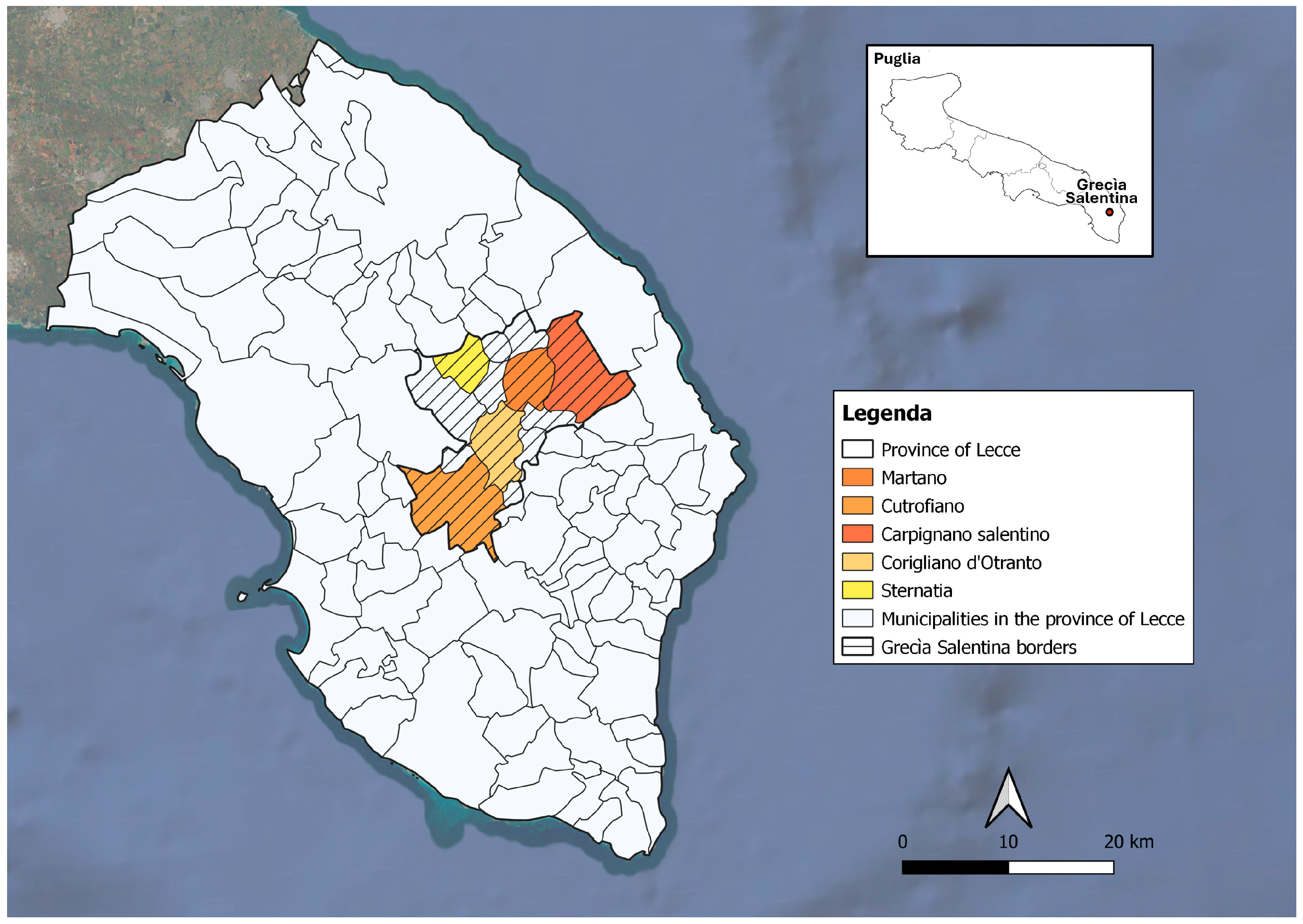
Corigliano d’Otranto, a small historic village located in the central part of the Salento peninsula, in the province of Lecce, within the historical and cultural area known as Grecìa Salentina. This area is characterized by the historical presence of the Griko linguistic minority and by a widespread heritage of cultural traditions, social practices, and local knowledge that contribute to the definition of a distinctive territorial identity (Figure 1).
The analysis of demographic data highlights trends that reflect the dynamics affecting many small towns in Southern Italy. After a phase of moderate growth during the early 2000s, the resident population began to experience a gradual decline: in 2001, the population stood at 5649 inhabitants, reaching a peak of 5910 inhabitants in 2011. In subsequent years, a decreasing trend was observed, bringing the population to 5558 residents in 2024, with an overall loss of more than 350 inhabitants compared with the 2011 peak. This trend is primarily driven by a negative natural balance, with the number of deaths consistently exceeding the number of births. In recent years, the natural balance has reached particularly significant values, such as in 2022, when a difference of 62 units between births and deaths was recorded. Migration flows also show considerable fluctuations, but are insufficient to offset demographic decline. Alongside population decrease, transformations in household structure are also observable: the average number of members per household declined from 2.85 in 2003 to 2.24 in 2024, indicating progressive fragmentation of family units and an aging resident population.
From a tourism perspective, the Salento region displays a strong polarization of visitor flows along coastal areas, with seaside destinations such as Otranto and Gallipoli concentrating the majority of tourist presence. In this context, inland towns tend to play a complementary role, intercepting a more limited share of tourism flows. However, tourism represents only one dimension of local development. Other sectors, such as agriculture, local services, and small-scale manufacturing activities, continue to play a significant role in shaping the socio-economic structure of inland municipalities in the region.
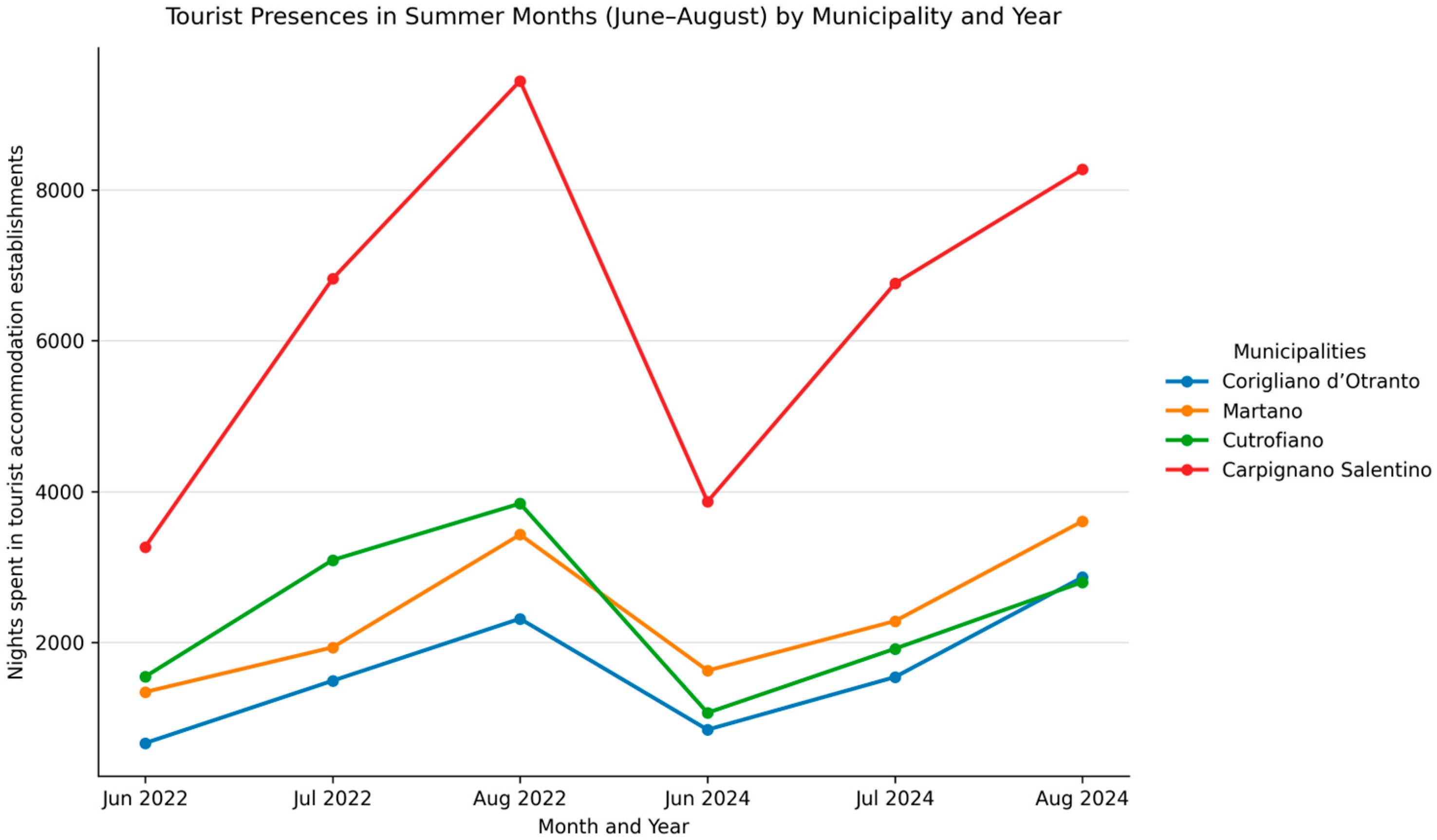
A comparative analysis of tourist presences (2022–2024), measured as nights spent in tourist accommodation establishments, in the municipalities of Martano, Cutrofiano, Carpignano Salentino, Sternatia, and Corigliano d’Otranto, reveals a marked heterogeneity in the distribution of tourism flows, combined with pronounced seasonal concentration. Figure 2 presents the distribution of tourist presence (measured as nights spent in tourist accommodation establishments) during the summer months (June–August) for selected municipalities, comparing data from 2022 and 2024 derived from ISTAT (Italian National Institute of Statistics).
The use of monthly data allows for a more precise interpretation of seasonal dynamics and relative differences across municipalities. The graph highlights a clear concentration of tourism flows in July and August across all municipalities. However, significant differences emerge in the magnitude of these flows.
Overall, the comparison reveals the existence of a territorial hierarchy in tourism dynamics, where differences are not only quantitative but also reflect distinct forms of territorial positioning within the broader Salento tourism system. This dynamic confirms the role of inland municipalities as satellite destinations within the coastal tourism system, where local attractiveness is often subordinated to proximity to major seaside destinations. Carpignano Salentino stands out for significantly higher values of tourist presence compared with other towns in Grecìa Salentina, with summer peaks that clearly exceed those of neighboring municipalities. This result is consistent with its tourism positioning: Carpignano is branded as a municipality with a maritime vocation, an element that—despite the absence of a direct coastal location—indicates a strong functional connection with the seaside tourism circuit and summer demand, helping explain the greater intensity of flow.
At an intermediate level are Martano and Cutrofiano, which show substantial summer presences but lower levels than Carpignano. In this case, it is noteworthy that neither municipality is associated with any specific tourism vocation category. The absence of a clear identity marker suggests a more generic tourism profile linked to proximity dynamics and a service/accommodation role in relation to the broader flows of the Salento territory, without a recognizable specialization in territorial communication.
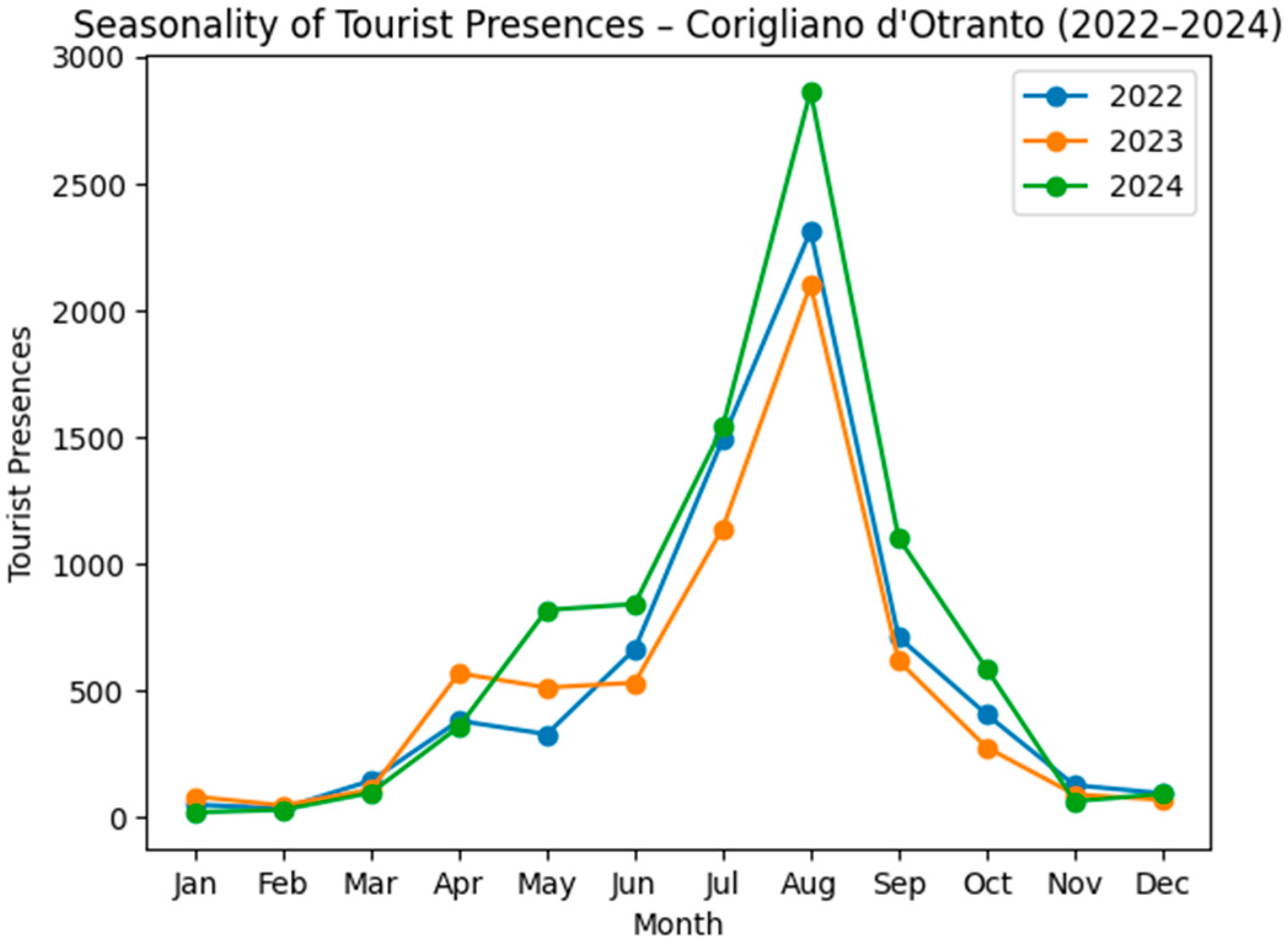
Corigliano d’Otranto occupies an intermediate position, with quantitatively limited but relatively stable flows across the three-year period and with pronounced seasonality, indicating its connection to the seaside summer tourism system. However, Corigliano presents a crucial specificity: its tourism brand defines it as a municipality with a cultural, historical, artistic, and landscape vocation. This characterization distinguishes it from the other municipalities considered, as it orients the destination toward an identity focused on the enhancement of cultural and landscape heritage. The analysis of the monthly distribution of tourist presence between 2022 and 2024 shows a strong concentration of flows during the summer months, with peaks between July and August, confirming the dependence of inland centers on the coastal tourism system of Salento. However, the increase in presence during shoulder seasons in Corigliano d’Otranto—visible in Figure 3—suggests potential for tourism de-seasonalization. While this trend cannot be attributed to a single cultural initiative, it indicates a broader context in which cultural activities and heritage-based practices may contribute to off-season territorial activation (given the temporal scope of the data, this analysis does not aim to establish causal relationships between specific cultural initiatives and observed tourism trends, but rather to interpret these dynamics within their broader territorial and temporal context).
Overall, the intersection between tourism mobility data and territorial branding provides a useful analytical framework for discussion. Grecìa Salentina appears characterized by an internal hierarchy in which some municipalities (such as Carpignano) are more strongly integrated into the seaside tourism system, while others (Martano and Cutrofiano) display less defined tourism profiles. Corigliano, although intercepting limited flows, possesses a more recognizable symbolic positioning that appears potentially more coherent with strategies aimed at tourism de-seasonalization. In this perspective, the case of Corigliano d’Otranto is particularly significant for investigating how cultural and performative practices may contribute to translating a “cultural” territorial brand into more structured forms of experiential and proximity tourism oriented toward territorial sustainability.
The intersection between tourism dynamics and demographic transformations raises several structural challenges for small inland towns in Salento. The strong seasonality of tourism limits the possibility of developing stable local economies linked to the enhancement of cultural heritage. At the same time, ongoing depopulation and population aging risk producing a gradual loss of heritage knowledge and local memory. In the absence of sustainable territorial valorization strategies, these processes could lead to the progressive museumification of historic centers, transforming them into spaces primarily dedicated to seasonal tourist consumption and depriving them of the everyday vitality of local communities. Taken together, these dynamics highlight several structural challenges affecting small inland towns in Salento. First, the strong seasonality of tourism concentrates economic activity in a limited period of the year and reinforces the dependence of inland municipalities on coastal destinations. Second, ongoing demographic decline and population aging reduce the number of permanent residents able to sustain everyday social life in historic centers. Third, the gradual disappearance of traditional practices and local knowledge risks weakening the transmission of intangible cultural heritage. Finally, in the absence of sustainable territorial strategies, historic centers risk undergoing processes of museumification, where houses and urban spaces are preserved as aesthetic environments for tourism consumption rather than as places of everyday life.
The case of Corigliano d’Otranto is therefore particularly relevant for analyzing alternative territorial valorization strategies based on cultural and performative practices. In recent years, several artistic and cultural initiatives have contributed to reactivating local heritage through forms of territorial storytelling, site-specific performance, and participatory practices involving local communities. These experiences make it possible to valorize not only major monuments—such as Castello de’ Monti, selected as a regional cultural attractor and the focus of long-term tourism projects including the initiative known as “Castello Volante” project—but also a constellation of “minor heritage” elements composed of local stories, memories, traditions, and everyday spaces.
Through these practices, cultural heritage is not merely preserved or exhibited but activated and reinterpreted within public space, contributing to the development of forms of proximity tourism oriented toward the quality of experience, community participation, and territorial sustainability. Within this perspective, the case of Corigliano d’Otranto represents a significant case study for examining how cultural practices can contribute to the construction of more sustainable tourism models capable of connecting heritage valorization with the well-being of local communities.

2.2. The DisAbitanti Project: A Phased Process

The DisAbitanti project aims to explore the relationship between inhabited space, collective memory, and contemporary artistic practices. The project was conceived with four main objectives. First, to reactivate abandoned or underused spaces of the historic centers through participatory artistic practices. Second, to collect and reinterpret local memories and oral histories connected to these spaces. Third, to foster community participation in the construction of territorial narratives through participatory dramaturgy. Finally, the project aimed to experiment with narrative-based cultural experiences capable of diversifying local tourism practices and promoting forms of proximity tourism rooted in everyday heritage. The project represents an experimental field of collaboration between academic research—particularly narrative geographies developed through the Placetelling® methodology—and performative narrative practices such as social theater and participatory dramaturgy.
The initiative is promoted by Magma APS with the support of APS Essenza, partners of the project Trame Libere, within the framework of the regional program called Luoghi Comuni (Apulia Region program), aimed at enhancing public and community spaces through cultural and creative initiatives. It was implemented by Associazione Culturale ALIBI—Artisti LIBeri Indipendenti, an organization active in the field of performing arts and theater production. From a governance perspective, the DisAbitanti project can be interpreted as generating an informal and relational network of collaboration between residents, cultural practitioners, and local actors. However, the sustainability of such networks over time remains uncertain. Their continuity often depends on the presence of key facilitators and on the intensity of community engagement, which may be difficult to maintain beyond the duration of the project.
Rather than remaining purely interpretive, these governance implications suggest the potential for further operationalization through the integration of relational analytics and smart governance frameworks. While not implemented in the present study, such an approach could bridge qualitative cultural activation with quantitative decision-support mechanisms, enabling a more systematic understanding of participation patterns, stakeholder interaction, and collaborative dynamics in small-scale contexts. For instance, future research could explore the use of network-based indicators such as stakeholder cohesion, clustering, and the diffusion of knowledge across local actors.
In parallel, the translation of these practices into policy frameworks could be further developed by connecting them with emerging approaches to smart governance and small-context digital models. In this perspective, narrative-based cultural activation could be complemented by lightweight data-driven tools, supporting local administrations in monitoring participation, spatial use, and cultural engagement over time. This integration would outline a pragmatic roadmap in which performative and narrative practices are not only culturally meaningful but also operationally relevant for evidence-based governance in small towns and inner peripheral areas.
The project operates through a collaborative model involving cultural associations, artists, researchers, and local actors, combining public support (the above-mentioned Luoghi Comuni program) with civil society initiatives. This configuration enables flexible decision-making and the integration of artistic experimentation with local knowledge.
The project DisAbitanti can be interpreted as a research–creation experience, in which artistic production and territorial investigation develop in an integrated manner. The performative process thus becomes a temporary form of “inhabiting” space, capable of reactivating marginalized places and redefining their meaning within the collective life of the community. The project unfolded between September and December 2024 and was structured in progressive phases culminating in a distributed theatrical performance across the historic center of the town. Abandoned or unused buildings were incorporated into the spatial and narrative framework of the performance, being reinterpreted as spaces for geographical inquiry and artistic creation. The project aimed to reconnect these locations—often perceived as invisible backdrops or marginal spaces of everyday life—to the milieu, reframing it as a narrative device capable of activating new relationships between memory, space, and community. In this sense, such places become active sites of creative expression and collective memory reconstruction, critically engaging with issues such as depopulation, social impoverishment, and the multiple forms of contemporary tourism extractivism.
The methodology is structured into five operational phases. In the initial desk-based phase (September 2024), a mapping of abandoned private properties and unused public spaces within the village was conducted in order to identify the sites that would become active s-objects of the participatory theatrical creation. At the same time, a public call for participation engaged both property owners and participants: property owners contributed by granting temporary access to private spaces, while participants in the workshops were invited to explore these locations and reconstruct, through interviews and narrative and dramaturgical writing, possible stories and memories connected to them.
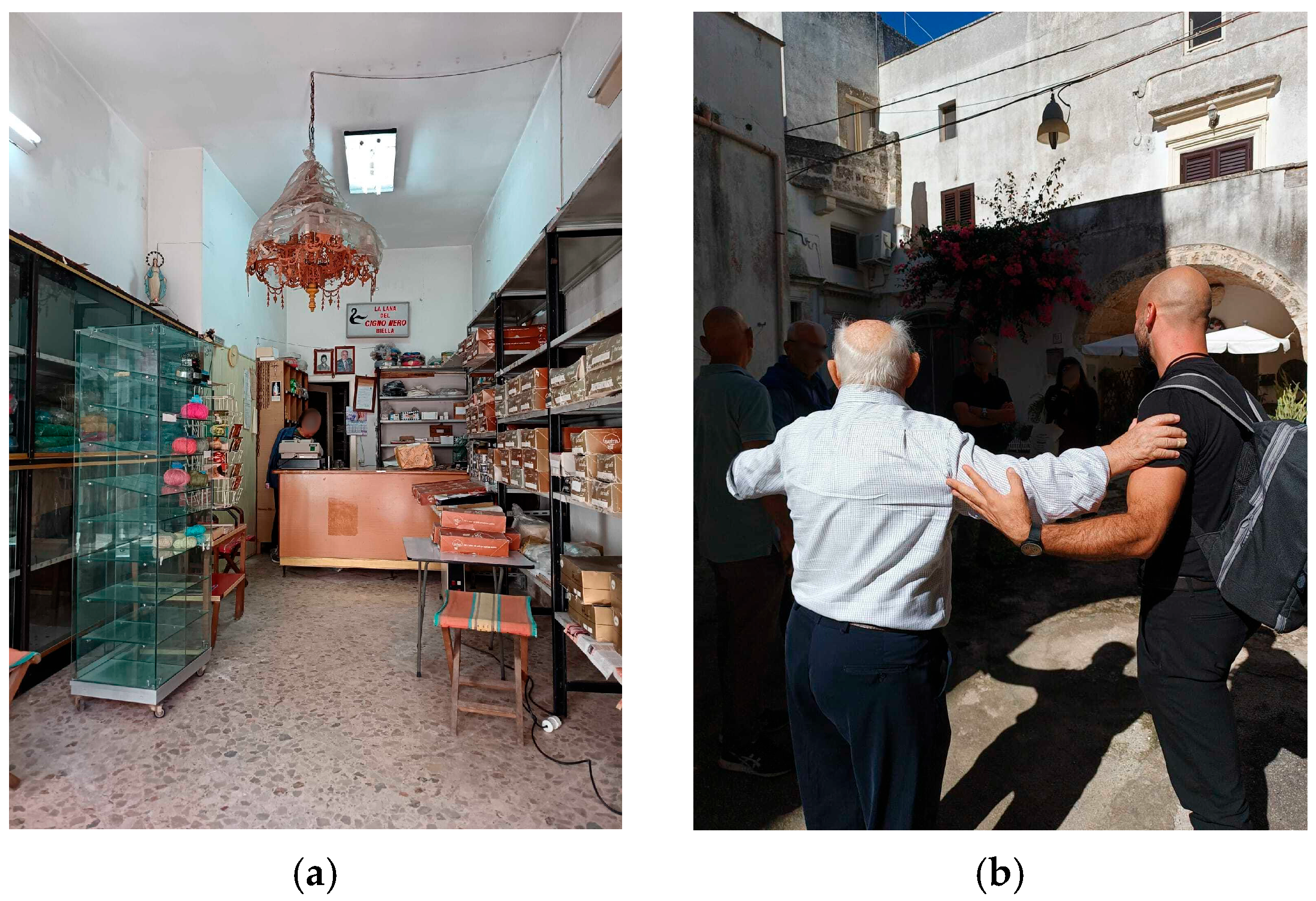
The second phase (October 2024), which provided access to the field, consisted of the collection of oral testimonies through which local memories, life histories, and emotional geographies connected to the selected spaces were reconstructed. The qualitative data collected resulted from semi-structured interviews, amounting to a total of approximately eight hours of audio recordings. These interviews were conducted directly by project participants, supported by researchers and theater practitioners, who facilitated and guided the process. Through the snowball sampling method, fifteen key informants were subsequently identified and interviewed in situ (Figure 4). The use of snowball sampling entails potential limitations, particularly the risk of recruiting participants within closely connected social networks and the resulting lack of diversity in perspectives. To address these issues, the sampling process was guided by the intention to include a heterogeneous range of participants in terms of age, gender, and social roles within the community. Particular attention was given to incorporating both older residents, as key holders of local memory, and younger participants, as well as individuals with varying degrees of engagement in community life. While the sample is not statistically representative, it reflects a deliberate effort to ensure diversity and to capture multiple situated perspectives consistent with the qualitative and participatory design of the research. Within this process, residents played a crucial role not only as informants but also as active contributors to the construction of the narrative material. Their memories, experiences, and everyday knowledge formed the basis of the dramaturgical texts developed during the workshops, positioning local inhabitants as co-creators of the territorial storytelling process.
The third phase (from 13 October to 10 November) consisted of a place-based storytelling laboratory with dramaturgical aims, spanning ten hours of workshop sessions. Starting from a qualitative analysis of the corpus of testimonies collected in the field, a reasoned selection of recurring themes emerging from the data was developed. These themes became the narrative core of the territorial storytelling process. This phase enabled the creation of a participatory dramaturgy rooted in local places and everyday experiences, grounded in the testimonial corpus gathered during fieldwork.
The fourth phase (from 17 November to 22 December), spanning ten hours of workshop sessions in total, was devoted to a site-specific theater workshop in which the selected spaces became natural scenographies for performative actions. In this context, performance did not merely use the site as a scenic backdrop but treated it as a generative element of the performed narrative.
The final phase involved the dissemination of results through a public event held on 26 December 2024. The event was an itinerant route across the historic center of the village, structured as a narrative and performative path linking places of interest, local stories, personal memories, and performative practices.
The participatory process involved 10 workshop participants, 15 interviewees, and approximately 120 spectators attending the final performative event. In addition to the qualitative materials, basic descriptive information was used to contextualize participation patterns across the different phases of the project. This included the distribution of participants between workshops (10 participants involved in the dramaturgical and performative laboratories), interviews (15 local informants contributing oral testimonies), and the final public event (120 spectators attending the performative route in three rounds of events). It also included the typology of actors involved, namely residents (primarily engaged as interviewees and memory contributors), performers and workshop participants (involved in dramaturgical co-creation and performance), cultural associations and local organizers (supporting project design and implementation), researchers (facilitating data collection and analysis), and property owners (granting temporary access to private spaces). Consideration was also given to the different roles these actors assumed within the participatory process, ranging from testimony collection and narrative co-construction to artistic interpretation, organizational support, and audience participation. While these elements do not constitute a formal quantitative or social network analysis, they provide empirically grounded indications of participant distribution, actor diversity, and the relational configuration activated through the project. While the study adopts a qualitative and interpretive design, future applications of this framework could benefit from the integration of complementary quantitative and network-based indicators to further support the analysis of participation patterns and relational dynamics.
The qualitative analysis focused on a corpus of dramaturgical texts produced during the workshops and performed during the final event. These materials were analyzed through an inductive thematic analysis aimed at identifying recurring narrative motifs connecting memory, spatial transformation, and everyday practices. The analysis combined three sources of evidence: field observation during the performative event, textual analysis of dramaturgical fragments, and examination of the digital StoryMap interface. This triangulation enabled the interpretation of the narrative strategies through which the project constructs a hybrid storytelling model integrating performance, space, and digital mediation.
The coding process followed an iterative and partly participatory procedure. An initial thematic structuring emerged during the workshops, where participants were actively involved in selecting, discussing, and organizing recurring narrative themes from the collected testimonies. This co-interpretive phase contributed to identifying shared meanings and locally grounded narrative categories.
Building on this preliminary thematic work, the analytical coding was subsequently refined and systematized by the lead researcher through repeated readings of the empirical materials. The dramaturgical fragments were systematically coded in order to identify recurring narrative patterns related to the representation of place, memory, and spatial transformation.
Given the exploratory and practice-based nature of the study, the analysis did not rely on formal statistical measures of intercoder agreement. Instead, analytical consistency was supported through iterative validation within the research team and through the comparison between workshop-generated themes and researcher-led coding. Discrepancies or ambiguities in thematic interpretation were addressed through iterative reflection and alignment between the emergent categories and the empirical material.
Throughout the analytical process, reflexive memos were used to document interpretive decisions, emerging themes, and potential biases related to the researcher’s positionality and involvement in the project. This reflexive approach contributed to ensuring transparency and analytical coherence across the different sources of qualitative data.
The coding process led to the identification of three main thematic clusters that structure the results presented in the following section. While the study is grounded in a context-specific case, the methodological approach—combining participatory thematic co-construction and researcher-led analysis—offers a potentially transferable framework for investigating similar processes of place-based cultural activation in other territorial contexts.
From a methodological perspective, DisAbitanti is grounded in an interdisciplinary approach combining cultural geography, participatory dramaturgy, and Placetelling® practices. Placetelling®, developed within the School of Placetelling® established in 2016 by the Department of Human and Social Sciences of the University of Salento, in collaboration with the Centro Universitario Europeo per i Beni Culturali (CUEBC) and the Società Geografica Italiana (SGI), and directed by Fabio Pollice, can be understood as a narrative-performative methodology aimed at supporting processes of territorial interpretation and heritage activation through situated micro-stories and community-based storytelling [17,37,38,39,40,41]. Within this framework, narrative practices function as maieutic devices that foster community awareness and contribute to endogenous and place-based development processes [37]. This perspective aligns with the principles of the Council of Europe, which conceptualizes cultural heritage as a dynamic and participatory resource shaped through the interaction between communities, places, and shared meanings [17]. Accordingly, Placetelling® conceives storytelling not only as a representational tool but as a performative practice capable of activating processes of territorialization and patrimonialization by engaging local communities in the co-construction of place narratives [40,41].
From a theoretical perspective, the approach aligns with the tradition of environmental theater and spatially oriented performative practices, which overcome the conventional separation between stage and audience and promote greater permeability between scenic and urban space. At the same time, the project draws on concepts from humanistic geography, particularly the notion of topophilia [42,43]—understood as the affective bond between individuals and places—as well as broader reflections on the relationships between space, memory, and territorial identity. Through this approach, participatory arts—especially theater—become a tool of territorial inquiry and cultural mediation capable of making key concepts of geographical research accessible to wider audiences. Performative and narrative actions thus enable the emergence of otherwise invisible dimensions of urban space, including everyday memories, neighborhood relations, and the material and immaterial traces left by previous generations.
To analyze the DisAbitanti project, a combined analytical framework was adopted, integrating three complementary dimensions: (1) observation of the live performative event, (2) textual analysis of the dramaturgical materials produced for the performances, and (3) examination of the digital StoryMap, which extends the narrative experience into a geolocated online environment associated with specific locations in the historic center.
The performative dimension was analyzed through direct observation, focusing on the spatial organization of the narrative path and the interaction between performers, participants, and urban spaces. The dramaturgical texts were examined as primary narrative sources through qualitative thematic analysis, aimed at identifying recurring narrative motifs across the corpus. Finally, the StoryMap was analyzed as a digital narrative interface, investigating how the performative dramaturgy is translated into a cartographic structure accessible to online audiences.

3. Results

The analysis of the DisAbitanti project reveals a multi-layered narrative structure in which performative experience, dramaturgical texts, and digital spatial representation interact to produce a hybrid form of territorial storytelling. Rather than operating as separate components, these dimensions function as an integrated narrative system through which places are re-signified as carriers of memory, absence, and transformation.
The performative dimension of the project reveals a site-specific narrative walk in which participants encounter a sequence of urban locations associated with stories of abandonment, transformation, and everyday life. Within this context, dramaturgical fragments are activated through the presence of performers, functioning as narrative triggers that connect the material environment with past forms of inhabitation and lived experience. The territory thus emerges as an active narrative agent, co-producing meaning through the interaction between space, text, and embodied participation.
The analysis of the dramaturgical texts reveals their role as primary narrative sources within the project’s storytelling model. Rather than functioning as conventional theatrical scripts, these texts construct a fragmented narrative structure grounded in the interplay between memory, spatial references, and performative activation. Three recurring narrative motifs emerge across the dramaturgical corpus: (1) memory of everyday life, (2) absence and abandonment, and (3) transformation of the urban landscape.
The digital StoryMap (available at: https://uploads.knightlab.com/storymapjs/202349b20334ae1e188571ecfba60e32/disabitanti/index.html, accessed on 17 March 2026) further reveals how the performative narrative is reconfigured into a geolocated and asynchronous narrative environment. Rather than simply documenting the live event, the digital interface reorganizes the dramaturgical materials into a cartographic structure that preserves the spatial logic of the performative path while enabling individual exploration. In this way, the digital layer extends the narrative experience beyond the temporal boundaries of the live performance, transforming it into a persistent and accessible storytelling system.

3.1. Narrative Methodology of the DisAbitanti Path

The analysis of the DisAbitanti project reveals a narrative methodology based on the interaction between performative storytelling and digital spatial representation. Rather than presenting the territory through descriptive information or historical explanation, the project constructs a narrative system in which places become catalysts for stories, memories, and imaginative reconstruction.
During the live event, the narrative experience unfolds through the physical movement of participants across a sequence of urban locations. Each site functions as a narrative station where a dramaturgical fragment is activated. These fragments do not present a continuous storyline but operate as autonomous narrative units connected through the spatial progression of the walk. The dramaturgy of the event, therefore, emerges from the relationship between the text, the performer, and the specific place in which the fragment is delivered.
The dramaturgical texts play a crucial role in shaping this experience. Typically short and evocative, they rely on concrete material details such as walls, houses, courtyards, doors, and everyday objects to evoke the traces of past lives. Rather than reconstructing historical events in a documentary manner, the texts suggest fragments of lived experience and moments of everyday life that once animated the spaces now perceived as abandoned or marginal.
The fragmentary structure of the dramaturgy corresponds to a specific dramaturgical logic, in which each text introduces a minimal narrative situation anchored in a particular location. Fragments often begin with a reference to physical space, continue with an evocation of human presence or memory, and conclude with an open-ended reflection or narrative suspension. This structure encourages participants to imagine the lives that once unfolded within the spaces encountered during the walk. Within the performative context, the territory itself becomes an active narrative agent. The meaning of each dramaturgical fragment is inseparable from the spatial context in which it is performed. Architectural remains, urban voids, and traces of past uses interact with the spoken text, creating a layered narrative experience in which the environment contributes directly to the storytelling process.
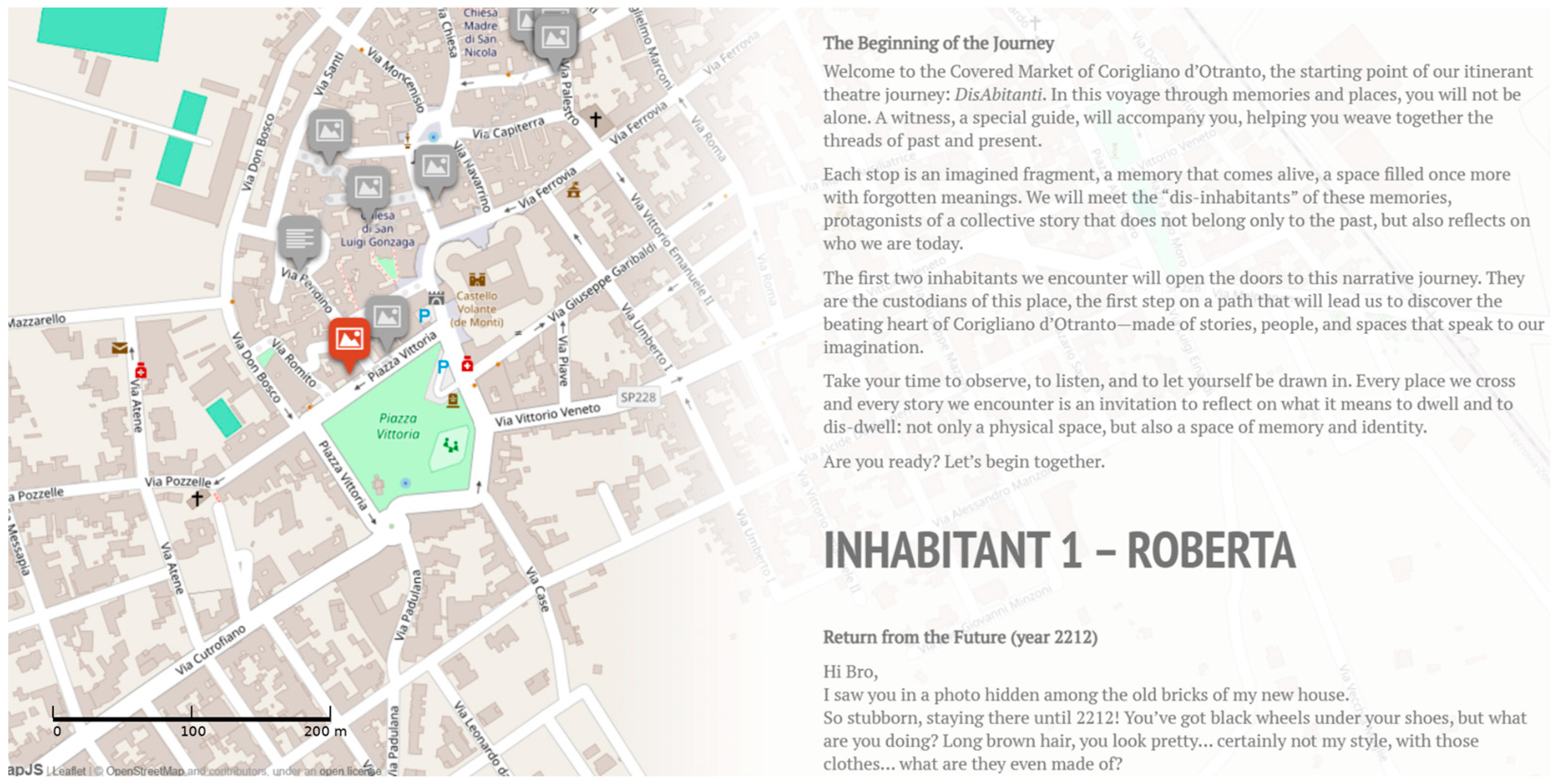
When the project is translated into the StoryMap environment, this performative narrative structure is reorganized rather than simply documented. The digital map reproduces the spatial sequence of the walk by associating each location with a corresponding narrative fragment. The result—as illustrated in Figure 5—is a digital path that mirrors the dramaturgical structure of the live event while transforming the experience into a navigable narrative cartography.
The texts included in the StoryMap retain the brevity and evocative quality of the original dramaturgical fragments. However, their function shifts slightly within the digital environment. During the live performance, the fragments are embedded in a shared embodied experience that includes the presence of performers, the collective movement of participants, and the sensory perception of the environment. While the performative event unfolds in real time as a collective journey through the city, the digital path can be explored individually and asynchronously. In the digital version, the embodied and collective dimension of the live event is replaced by an individual and asynchronous mode of exploration. Nevertheless, the spatial sequencing preserved by the map maintains the dramaturgical logic of the original experience. In this way, the digital platform does not replace the performative event but extends its narrative life: the StoryMap becomes a medium through which the dramaturgical fragments continue to activate stories connected to specific places, even in the absence of the live event.

3.2. Use of Dramaturgical Texts as Primary Narrative Sources

Within the analytical framework of this study, the dramaturgical texts created for the DisAbitanti performative path are treated as primary narrative sources. In order to analyze their contribution to the territorial storytelling model, the dramaturgical materials were examined through a thematic categorization that identifies recurring narrative motifs across the different fragments. This thematic grouping makes it possible to understand how individual texts contribute to the construction of a broader narrative landscape.
Three main thematic clusters emerge from the analysis: Memory of everyday life; Absence and abandonment; Transformation of the urban landscape.
  • Memory of everyday life
The first thematic cluster emerging from the dramaturgical corpus concerns the reconstruction of everyday domestic life that once animated the houses and streets encountered during the performative walk. The dramaturgical fragments evoke intimate domestic scenes, family relations, and neighborhood practices that structured social life within the historic center. Rather than focusing on exceptional events, these narratives reconstruct the ordinary rhythms of domestic life through sensory memories, routine gestures, and shared spatial practices.
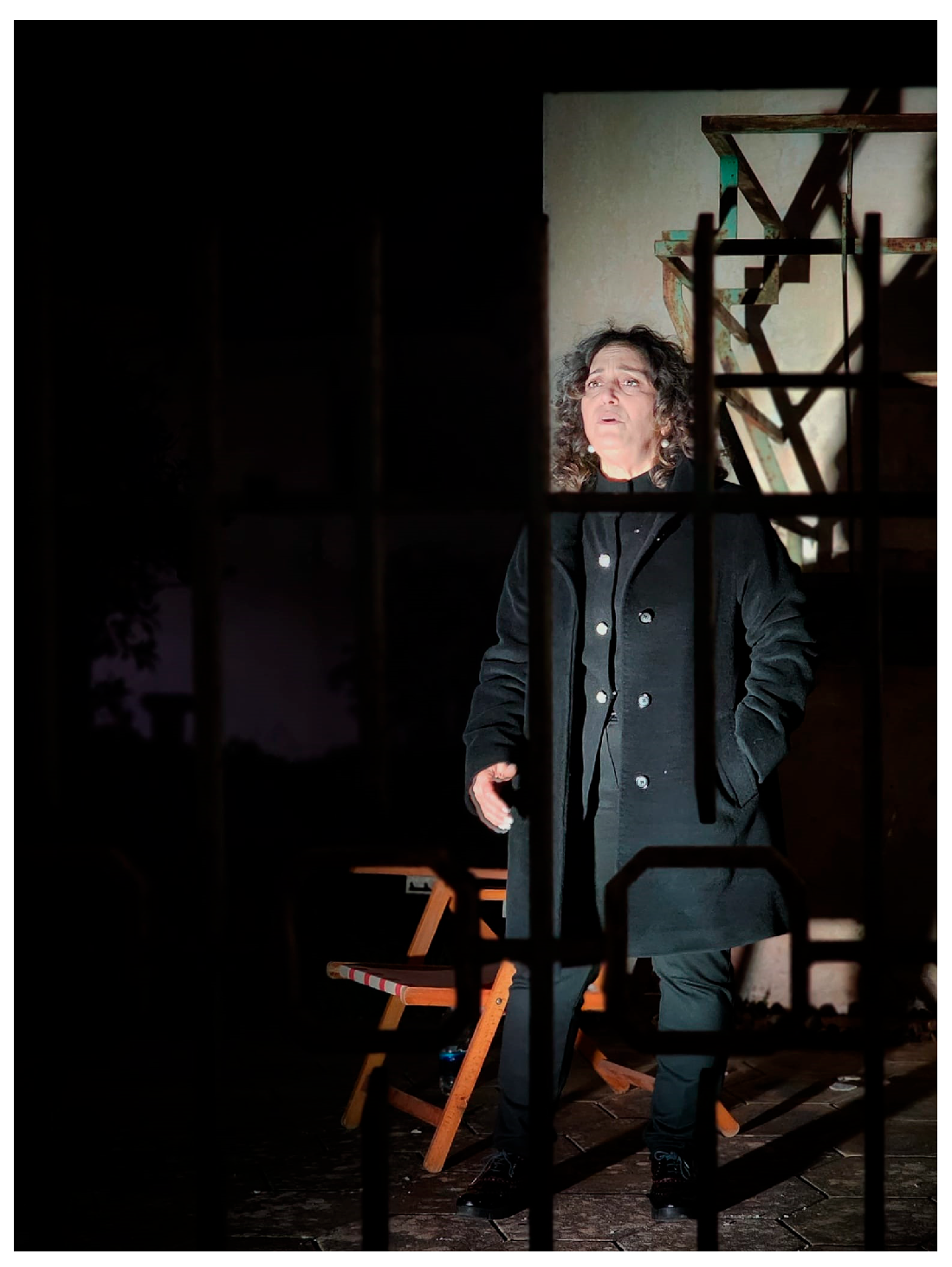
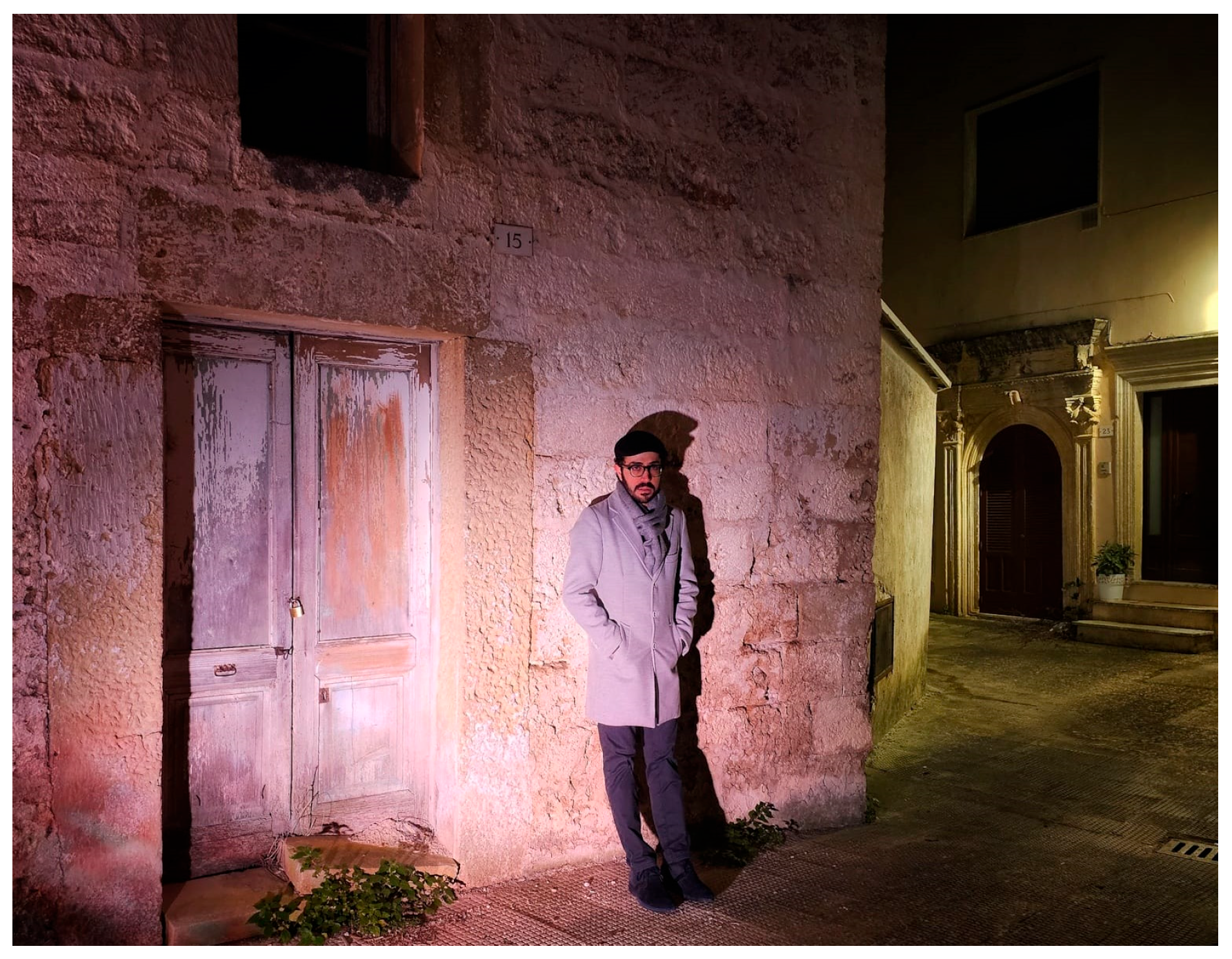
For analytical purposes, the dramaturgical fragments are referenced using the numbering assigned during the thematic coding of the corpus. Inhabitant n. 3’s monologue (Figure 6), for instance, recalls childhood memories associated with food preparation in the family kitchen:
“In the small pot there was oil, cinnamon, and orange peel freshly picked from the garden, back when those trees were young—much younger than they are now.
Every year, before Christmas, my mother would prepare to make sweets for the holidays. She wore an apron that covered her from neck to toe, like a knight putting on armor before going into battle. (…) My sister and I would gather around the table and watch her as she prepared the little volcano of flour into which she poured the hot oil, flowing out like lava, before kneading the dough. We waited eagerly for the moment when she would step away for a second, so we could steal a bit of that sweet dough and eat it.
To our childish eyes, the kitchen was like the gingerbread house from fairy tales.
Meanwhile, our mother would sing a song that was often heard: ‘There was a very pretty little house, without a roof, without a kitchen…’.
Looking back now, that song seemed to speak about this very place”.
Through references to smell, taste, and cooking practices, the fragment reactivates the sensory atmosphere of domestic space. The kitchen becomes a site of embodied memory where everyday practices acquire symbolic meaning. Such sensory references resonate with geographical perspectives that emphasize the role of embodied experience in shaping place attachment, highlighting how emotional bonds between individuals and their environments emerge through lived experience and routine interaction with place [42,43]. Other dramaturgical fragments similarly reconstruct everyday life through references to domestic objects, routines, and intimate spatial relations. In inhabitant n. 9’s monologue (Figure 7), Pina’s voice reflects on a life shaped by domestic labor and everyday practices:
“I lived beneath the tolling of the church bells for sixty years, embraced by Lecce stone and warmed by the sunlight reflected from the rosettes. I built this house with effort, when effort was measured in sweat and the rumbling of an empty stomach. I furnished these walls with memories and stitched every tablecloth, every sheet, every piece of linen in order to weave my place and make it a home”.
Here, the act of sewing and arranging household objects becomes a metaphor for the gradual construction of belonging. The house emerges as a space where identity is produced through repeated gestures and everyday labor. In this sense, domestic practices contribute to transforming the dwelling into what humanistic geography describes as a lived place, a space infused with meanings generated through everyday interaction between people and their environment [44].
The narratives also reveal the relational dimension of domestic life within the village context. Memories of cooking frequently extend beyond the private household to include forms of neighborhood exchange and informal sociality. In the same dramaturgical fragment, the inhabitant n. 3 recalls how food preparation was embedded within a wider network of social relations:
“What I mean is that among neighbors there was a custom: a sort of communal kitchen had emerged. Whenever something special was prepared, a portion of it would be taken to another family. Sometimes this task fell to me. I would take the uncovered dish, covered only with a white cloth, and walk proudly along the street, just as I had done on the day of my First Communion, when I crossed the nave toward the altar.
One of our neighbors used to cook pignata—a traditional slow-cooked pot of legumes –every Monday. She always prepared an extra portion for us. On Sunday evening she would come by to ask how much we wanted. Then, cupping her hands together, she would measure the portions of legumes that she would leave to soak.
The following morning she would wake up early to light the fireplace, because that was how legumes were cooked: in the pignata, next to the burning wood whose flames made the ‘sibille’ dance”.
This description highlights the social circulation of food as a form of everyday reciprocity that reinforced neighborhood cohesion. Such practices illustrate how domestic spaces extend beyond the boundaries of the house, becoming part of a broader relational landscape structured by proximity, familiarity, and shared routines. In geographical terms, these practices can be interpreted as forms of vernacular spatiality, through which social relations materialize within everyday environments and contribute to the production of place meanings [43].
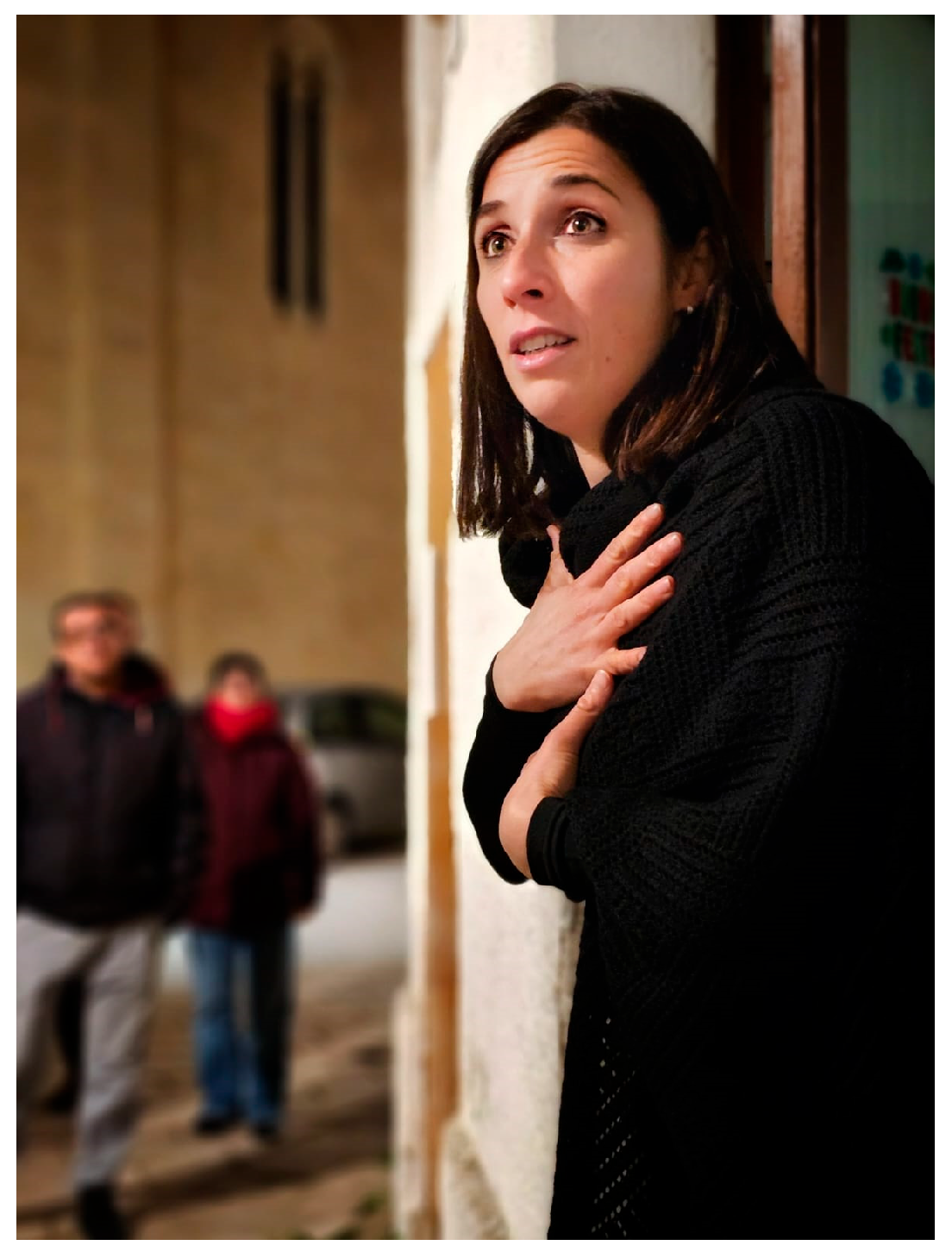
The dramaturgical corpus also includes memories associated with childhood play and informal learning experiences within the rural environment. A fragment of inhabitant n. 8’s monologue (Figure 8) recounts the relationship between a child and an elderly relative during visits to a countryside house:
“After a while she would come out of the house with a piece of bread in her hand. It was days old, but she knew how to turn it into magic. First, she would take me to see the fish in the large stone basin. She threw in a few crumbs and they came swimming toward us: ‘look, they’re coming to greet you,’ she would say, and I believed her.
Then came the other magic: she sprinkled sugar on the bread after lightly wetting it with water. A crispy crust formed and melted in your mouth”.
Through this scene, the narrative reconstructs a micro-landscape of rural everyday life in which food, childhood play, and family relations intersect. The description of simple gestures—sharing bread, observing animals, running through fields—anchors memory within the material and sensory environment of the countryside.
From an analytical perspective, these narrative strategies illustrate how everyday practices contribute to the construction of place-based memory. Cultural geography has long emphasized that places acquire meaning through the accumulation of lived experiences rather than through monumental or exceptional events. In this sense, the dramaturgical fragments resonate with the concept of topophilia, understood as the affective bond between individuals and places generated through everyday interaction with the environment [45].
At the same time, the fragments reflect what scholars of memory geography describe as the spatial anchoring of memory, whereby personal recollections become inseparable from the environments in which they occurred [23,24]. In the dramaturgical texts, memories of childhood, family, and neighborhood life are inseparable from specific architectural elements—kitchens, courtyards, gardens, and village streets. These spaces function as mnemonic devices that reactivate narratives of past social life.
By foregrounding such micro-histories, dramaturgy constructs an alternative heritage narrative centered on everyday experience rather than monumental history. The houses encountered during the performative walk are thus reframed as repositories of lived experience and emotional memory. Through the activation of domestic memories, the performative path invites participants to reinterpret abandoned buildings not simply as signs of decline but as archives of ordinary life embedded within the material fabric of the village.
In this perspective, the dramaturgical reconstruction of everyday life contributes to a micro-scale interpretation of heritage that aligns with recent geographical approaches emphasizing the importance of vernacular landscapes and lived heritage in shaping territorial identity and collective memory [29,30].
2.
Absence and abandonment
A second thematic cluster addresses the experience of absence and abandonment. In these dramaturgical fragments, the narrative focus shifts from past presence to the traces left behind after inhabitants have departed. Rather than representing abandonment merely as a condition of material deterioration, the texts explore how absence becomes perceptible through the emotional, spatial, and mnemonic layers embedded within domestic environments.
A recurring symbolic element across several monologues is the threshold of the house, particularly doors and entrances, which function as narrative metaphors separating interior life from the silence of the exterior environment. One fragment of inhabitant n. 5’s monologue evokes the memory of a house defined by a door that has remained closed for years:
“Is the door closed?
Yes, the door of this house has always been closed. That was her obsession: the door had to be properly shut, always. She feared that something might slip inside—an animal, a cat, a mouse, a gecko, a worm, even an ant. Life had to stay outside that door, outside that house”.
The threshold of the house often functions as a symbolic boundary between private suffering and the outside world. In inhabitant n. 5’s monologue (Figure 9), the narrator describes the house as a place where painful memories remained trapped behind a closed door:
“Yes, the door of this house has always been closed. That was her obsession: that the door should always be properly shut. Why? Because she was afraid that the sounds of animals might escape through that door. Yes, exactly—the sounds of animals.
Her brother would bark at her when he could not find clean water in the basin:
‘Mena! Bring the water! Did you fill it or not? Did you fill it or not?’
He barked at her, growling like a dog, when he returned from the countryside in the evening and, found that there was not enough water in the basin, she was supposed to fill with buckets carried from the fountain in the square”.
In this passage, the house becomes a container of unresolved abusive experiences. The closed door operates as a symbolic boundary that protects private suffering while simultaneously isolating the dwelling from the social life of the village. The threshold thus acquires a strong narrative function, mediating the relationship between intimacy and collective space.
From a geographical perspective, such narrative devices illustrate how architectural elements can act as material anchors of memory, allowing personal histories to remain embedded within the built environment even after inhabitants have left. As argued in studies on the relationship between memory and place, built environments often function as repositories of lived experiences that persist through spatial traces and material forms [21,22].
Other dramaturgical fragments reinforce this interpretation by portraying houses as spaces shaped by emotional withdrawal and solitude. In inhabitant n. 9’s monologue, the narrator reflects on a life spent within the protective boundaries of the domestic interior:
“Here I learned to recognize for myself the care and attention I deserved, without expecting them from others. I came to understand that sometimes closing the door behind you is a little like fastening the buttons of your coat: it shelters you from the coldness of people, from their unwanted glances, their unsolicited words, and their inquisitive silences”.
Here, the house functions as a defensive space, offering protection from the perceived hostility of the social environment. The act of closing the door becomes a spatial metaphor for emotional withdrawal, transforming the domestic interior into a refuge from external judgment and social pressure.
This narrative representation resonates with humanistic geographical interpretations of dwelling, which emphasize the intimate relationship between individuals and the environments they inhabit. According to this perspective, houses are not merely functional shelters but spaces through which individuals negotiate their relationship with the world, constructing personal identities and emotional geographies [43,44].
The dramaturgical texts also evoke abandonment as a temporal condition that emerges gradually through the accumulation of silence and absence. In another fragment, the narrator describes the moment of leaving a house after a lifetime of inhabitation:
“Watching this house empty out is like seeing the closing credits of a noisy film roll by—except that here they pass without music”.
Through the metaphor of cinematic credits, the narrative frames abandonment as the closing sequence of a long narrative cycle. The house appears as a biographical space whose meaning derives from the memories and events that unfolded within it.
From this perspective, abandonment is not portrayed solely as a process of physical decay but as a temporal transition between different phases of habitation. Even when emptied of inhabitants, houses continue to retain traces of the lives that once animated them.
Scholars in cultural geography have highlighted how abandoned spaces can function as sites where the presence of the past remains perceptible through material remnants and spatial atmospheres. In this sense, absence itself becomes a meaningful dimension of place, revealing layers of social transformation and historical change embedded within everyday landscapes [45,46].
The dramaturgical narratives thus transform architectural elements—doors, windows, courtyards, and thresholds—into interpretive devices through which audiences are invited to reflect on broader processes affecting small towns and inner peripheral territories. The closed door, the empty room, or the silent courtyard become spatial metaphors for demographic decline, migration, and the gradual transformation of local communities.
At the same time, by narrating abandonment through personal memories rather than statistical data, dramaturgy rehumanizes processes that are often described in abstract demographic or economic terms. Through these intimate narratives, abandoned houses are reinterpreted as biographical landscapes, where individual stories intersect with wider territorial transformations.
This narrative approach contributes to reframing abandonment not simply as a sign of decline but as a condition through which new interpretations of place may emerge. By revealing the emotional and mnemonic layers embedded within domestic architecture, the performative path invites participants to reconsider abandoned houses as meaningful elements within the cultural landscape of the village.
3.
Transformation of the urban landscape
A third thematic group concerns the transformation of the urban landscape and the evolving relationship between communities and places. These fragments explore how spaces change over time, sometimes losing their original functions while acquiring new meanings within the collective imagination.
In these texts, the narrative perspective often expands beyond individual houses or streets to consider the broader historical and social dynamics shaping the territory. References to migration, economic change, or shifts in local practices appear implicitly through the stories suggested by the fragments.
This thematic dimension situates the DisAbitanti project within a wider reflection on the changing cultural landscape of contemporary urban and peri-urban environments, where tourism development increasingly interacts with processes of spatial reconfiguration and heritage reinterpretation [47,48,49,50]. By connecting personal memories with spatial transformations, dramaturgy constructs a narrative framework that links individual stories with collective processes. In some cases, these changes are explicitly connected to processes of touristification affecting the historic center. Several dramaturgical fragments also reveal how the transformation of the village landscape is connected to the growing presence of tourism. While many narratives evoke memories of everyday domestic life, some passages explicitly describe the conversion of traditional houses into short-term holiday accommodation [47,48,49]. In inhabitant monologue n. 5, the narrator reflects on the radical transformation of a house that once represented a place of family life and neighborhood relations:
“Now, every time I pass by, memories come back, as if certain phrases were still echoing in a place that is now unrecognizable. That place of joy no longer exists: the outer walls remain, but the old house has been completely altered, its substance and soul erased. The three anonymous two-room flats into which they have been divided by those who bought it are now without a story, because no story is needed by those who only use them for a few days, as a base between a day at the sea and an evening out in bars and restaurants”.
In this passage, the transformation of the house is not only architectural but also social and symbolic. The dwelling, once embedded in the everyday life of the community, becomes a temporary infrastructure serving short-term visitors. Although the physical structure of the building remains partially recognizable, its social function and narrative identity appear fundamentally altered.
This transformation reflects a broader process through which domestic spaces in a historic center are increasingly integrated into tourism economies, often through the conversion of residential buildings into short-term accommodation and temporary visitor infrastructure [47,49]. Houses that previously functioned as long-term places of dwelling are reconfigured as transient spaces of consumption, used intermittently by visitors rather than continuously inhabited by local residents. Such dynamics resonate with geographical interpretations of touristification, whereby residential environments are transformed from lived spaces into commodified landscapes oriented toward tourism consumption [47,48,49]. From this perspective, the dramaturgical narrative reveals a tension between memory and contemporary spatial dynamics. The narrator’s recollection preserves the house as a place of lived experience, while the present landscape reflects its incorporation into a seasonal tourism system. This contrast illustrates how processes of touristification can reshape not only the physical structures of buildings but also their cultural meaning and narrative identity within the local landscape.
The thematic organization of the dramaturgical materials reveals how the project constructs its narrative architecture through the interplay between memory, absence, and transformation. These three thematic strands operate simultaneously within the performative experience and in the digital StoryMap translation.
In the performative context, the thematic fragments are distributed across the spatial path, allowing participants to encounter different narrative perspectives as they move through the territory. In the digital environment, the same fragments are reorganized within the cartographic interface, preserving their thematic resonance while enabling asynchronous exploration.
This thematic structure contributes to the creation of a narrative landscape in which individual places become entry points into broader reflections on the life cycle of inhabited spaces. Through the integration of dramaturgy, spatial exploration, and digital mapping, the Disabitanti project demonstrates how performative storytelling can activate new forms of cultural interpretation of the territory.

3.3. Territorial Storytelling Model Emerging from the Project

The combined analysis of the performative event, the dramaturgical texts, and the StoryMap translation reveals a distinctive model of territorial storytelling that differs from traditional forms of heritage communication.
Conventional heritage interpretation typically emphasizes historical information, architectural description, and chronological explanation. In contrast, the DisAbitanti project constructs a narrative landscape in which places function primarily as nodes of memory and storytelling. The focus shifts from explaining the historical significance of locations to activating imaginative engagement with their traces and transformations.
In the performative dimension of the project, this storytelling model manifests itself through a dramaturgy of the territory. The urban environment is transformed into a distributed stage where each location represents a scene within a broader narrative composition. The traces of former inhabitants, suggested through the dramaturgical texts, function as absent characters whose stories resonate through the spaces encountered during the walk.
The participants in the event occupy a position comparable to that of spectators moving through a theatrical environment. Their journey across the city creates a sequence of encounters with places and stories that gradually construct a layered understanding of the territory. The narrative, therefore, emerges from the interaction between the dramaturgical text, the spatial context, and the interpretive engagement of participants.
The digital StoryMap preserves this dramaturgical logic while translating it into a cartographic interface. Each geolocated point on the map represents a narrative node connected to a fragment of the dramaturgy. The map itself becomes a narrative structure that organizes the relationship between places and stories. Through this structure, the digital platform transforms the ephemeral experience of the performative walk into a persistent narrative landscape accessible beyond the temporal boundaries of the original event.
This configuration gives rise to a hybrid form of performative Placetelling® extended through digital mapping rooted in performative practice. The narrative does not originate exclusively in the digital medium but emerges from the interaction between three elements: the physical territory, the performative activation of stories in situ, and the digital reconfiguration of these materials within a cartographic interface.
Through this process, spaces characterized by abandonment or marginality are reframed as repositories of lived experience and cultural memory. The storytelling model encourages audiences to interpret the territory not only as a physical environment but also as a landscape of traces shaped by past forms of life. By activating memories embedded in everyday places, the project contributes to a more reflective engagement with the cultural and social transformations of the urban environment.
The DisAbitanti project, therefore, demonstrates how performative storytelling and digital mapping can be combined to construct new forms of narrative heritage interpretation. By integrating dramaturgy, spatial exploration, and digital mediation, the project produces a storytelling model capable of transforming the perception of ordinary or neglected places into meaningful cultural experiences.

4. Discussion

The results presented in this study highlight how dramaturgical narratives can function as interpretive tools for understanding the relationship between memory, place, and spatial transformation in small historic settlements. In this perspective, the DisAbitanti experience can also be interpreted through the lens of proximity tourism [2,3,4,15]. In this context, proximity should not be understood exclusively as geographical distance. Rather, it involves relational dimensions such as familiarity, emotional attachment, and the rediscovery of everyday environments [2,3]. By encouraging participants to explore spaces embedded in the daily life of the village, the performative path fosters forms of tourism based on return, recognition, and emotional connection with place.
The first thematic cluster emphasizes the role of everyday practices in shaping place attachment. These narratives align with humanistic geographical perspectives that interpret places not simply as physical settings but as environments infused with meaning through lived experience [42,45]. Through sensory memories and descriptions of domestic practices, the monologues reconstruct the intimate spatial relationships that connected inhabitants to their homes and neighborhoods. In this sense, the dramaturgical narratives contribute to revealing the micro-scale processes through which place identity is formed and maintained over time.
The second thematic cluster focuses on absence and abandonment, highlighting how domestic spaces continue to retain traces of past lives even after they are no longer inhabited. These representations resonate with studies in memory geography that emphasize how material environments can function as mnemonic anchors linking individual recollections to specific places [23,24]. Rather than portraying abandonment solely as a process of decay, the dramaturgical narratives reveal the emotional and symbolic layers that persist within empty or underused houses.
At the same time, the analysis also highlights how these domestic spaces are increasingly affected by broader socio-economic transformations. In particular, the third thematic cluster shows how some houses have undergone significant functional changes due to the expansion of tourism, illustrating how domestic spaces embedded in the everyday life of the village are gradually incorporated into seasonal tourism systems. From a geographical perspective, this process reflects wider dynamics of touristification that affect many small historic settlements in Mediterranean regions [47,48,49].
Touristification does not necessarily involve large-scale physical transformations but often operates through subtle changes in the social use of space [47,48]. Houses that once served as long-term residences may be subdivided and repurposed as temporary accommodations for visitors. As a result, the social rhythms of the village gradually shift from permanent habitation toward seasonal or intermittent occupation. Such transformations can alter the relationship between residents and the built environment, potentially weakening the narrative continuity that connects places to the lived experiences of local communities [49,50].
Within this context, the DisAbitanti project offers an alternative perspective on the relationship between heritage, tourism, and local identity. Rather than focusing exclusively on monumental heritage sites, the project directs attention to the everyday domestic landscape as a repository of cultural meaning. Through the use of participatory dramaturgy and site-specific performance, abandoned or overlooked houses are reactivated as narrative spaces in which stories of everyday life can be shared and reinterpreted. This process transforms ordinary buildings into narrative nodes within a broader landscape of memory. Rather than reiterating these effects, it is more relevant to interpret how such practices operate as mechanisms of redistribution within the tourism system. In many Mediterranean villages, tourism tends to concentrate around a limited number of iconic sites, while residential environments are gradually transformed into temporary accommodation or seasonal spaces. This process can generate forms of spatial homogenization and weaken the relationship between local communities and their built environment. From a tourism perspective, performative Placetelling® contributes to diversifying visitor experiences by shifting attention from iconic monuments to everyday heritage spaces embedded in local life. This redistribution of attention across the urban fabric can mitigate the concentration of tourist practices around a limited number of attractions, encouraging slower and more exploratory forms of cultural tourism [16,21,32]. In small historic towns, such narrative-based experiences may therefore contribute to reducing spatial pressures associated with tourism while strengthening the relationship between visitors and local communities. For local administrations and cultural organizations, initiatives such as DisAbitanti suggest that small-scale performative projects can function as low-cost cultural infrastructures capable of activating minor heritage sites. They also generate new tourism narratives rooted in local communities: through participatory dramaturgy and site-specific storytelling, the project activates a network of minor places, transforming them into narrative nodes within the urban fabric; in doing so, the experience expands the interpretive geography of the village beyond its most recognizable landmarks; this narrative approach encourages visitors to engage with places through stories, memories, and everyday practices rather than through standardized forms of consumption. As a result, the tourist experience becomes slower, more reflective, and more closely connected to the lived environment of the community. At the same time, the involvement of local participants in the creation of the dramaturgical narratives strengthens the role of residents as active interpreters of their own territory.
From this perspective, performative Placetelling® can be understood as an innovative tool for cultural tourism development in small settlements [37,38,39]. From the perspective of sustainable tourism, the experience also reveals several interconnected dimensions of sustainability. From a social perspective, the project strengthens community participation by actively involving residents in the collection of memories, the creation of narratives, and the performative interpretation of local spaces [13]. This participatory process contributes to reinforcing social cohesion and collective ownership of heritage. From a cultural perspective, the initiative supports the transmission and reinterpretation of intangible heritage [12]. Oral histories, domestic practices, and everyday memories are transformed into narrative materials that reconnect the community with its cultural identity. From a spatial perspective, the project promotes the temporary reuse of abandoned or underused buildings, activating dispersed locations across the historic center and encouraging a distributed cultural experience that reduces pressure on iconic landmarks. Finally, from an economic perspective, small-scale cultural initiatives such as DisAbitanti may contribute to generating localized economic effects, although these impacts require further systematic assessment in future research [17]. Preliminary qualitative observations suggest that the project may support micro-scale economic activation, for instance by increasing attendance at local cultural events and potentially benefiting small local businesses during the period of implementation.
In terms of temporal sustainability, the project also indicates a potential contribution to mitigating tourism seasonality. By activating narrative experiences outside peak summer periods and redistributing visitor attention toward everyday spaces, such initiatives may encourage forms of off-season cultural tourism. However, a more robust evaluation of these effects would require longitudinal data on visitor flows and local economic indicators. While regional tourism dynamics are shaped by complex spatial interactions, including spillovers and competitive effects between destinations, the contribution of this study is situated at the micro-scale of local cultural practice. As such, the DisAbitanti project should not be interpreted as influencing regional tourism patterns, but as revealing how small-scale performative interventions may contribute to localized processes of activation within a broader territorial system. In this sense, the DisAbitanti project suggests how narrative-based cultural initiatives can contribute to more sustainable forms of tourism by promoting a deeper understanding of place and by supporting the cultural vitality of communities living in historic villages.
From a governance perspective, the DisAbitanti project can be interpreted as generating an informal and relational network of collaboration between residents, cultural practitioners, and local actors. However, the sustainability of such networks over time remains uncertain. Their continuity often depends on the presence of key facilitators and on the intensity of community engagement, which may be difficult to maintain beyond the duration of the project.
In this sense, the scalability of the approach presents significant challenges. While the methodology can be adapted to other contexts, its effectiveness is closely linked to place-specific social relations, cultural resources, and the willingness of residents to participate. Replication, therefore, requires careful contextual adaptation rather than simple transferability.
Furthermore, the project highlights potential tensions between bottom-up cultural initiatives and formal governance structures. Coordination with local administrative bodies, integration into existing cultural policies, and the availability of long-term institutional support represent critical factors influencing the durability and impact of such initiatives.
From a methodological perspective, the project also demonstrates how performative storytelling can function as a form of territorial research [5,40]. The dramaturgical fragments do not merely illustrate personal memories but actively produce new interpretations of the local landscape by situating narratives within the physical spaces to which they refer. In doing so, the project aligns with recent approaches in cultural geography that emphasize the role of narrative and performative practices in shaping the perception and interpretation of place.
At the same time, the integration of the performative path with a digital StoryMap allows the narrative experience to extend beyond the temporal limits of the theatrical event. The digital interface spatially organizes the dramaturgical fragments within a cartographic framework, enabling users to explore the narrative geography of the village even after the live performance has ended. This hybrid configuration—combining performance, storytelling, and digital mapping—creates a multi-layered narrative infrastructure through which the cultural landscape of the village can be interpreted. Within the broader field of immersive heritage and performative practices, recent approaches have increasingly explored the use of advanced digital technologies, including virtual, augmented, and mixed reality environments, to enhance visitor engagement and narrative immersion. Compared to these resource-intensive models, the DisAbitanti project adopts a low-tech, community-anchored approach based on performative storytelling and in situ participation. This distinction highlights a set of trade-offs: while mixed reality heritage performance can offer highly immersive and visually enhanced experiences, it often requires significant technological infrastructure, specialized expertise, and financial investment, potentially limiting its applicability in small or resource-constrained contexts. In contrast, the approach developed in this study prioritizes accessibility, direct embodied engagement, and the active involvement of local communities, enabling a more inclusive and place-sensitive form of cultural activation. From this perspective, performative Placetelling® can be understood as a transferable and adaptable methodology particularly suited to small towns and inner peripheral areas, where low-cost, participatory, and context-specific interventions may offer more sustainable pathways for heritage interpretation and tourism development.
The use of the StoryMap platform can also be situated within a broader ecosystem of mobile and digital storytelling tools designed to deliver place-based narrative experiences, including applications such as Narralive and other location-triggered storytelling systems. Within this landscape, the DisAbitanti project adopts a story-centric and place-based approach in which digital mapping functions as an extension of the performative experience rather than as a standalone medium.
This positioning highlights several key dimensions. First, the authoring process is strongly participatory, as narrative contents are co-produced through workshops, interviews, and collective dramaturgy, rather than being designed exclusively by experts. Second, the digital interface enhances audience agency by allowing users to navigate the narrative path asynchronously and selectively, engaging with places and stories according to individual trajectories.
At the same time, the use of digital storytelling tools raises questions regarding the long-term sustainability and maintenance of such narrative infrastructures. Unlike institutional digital platforms, community-based projects may face challenges related to updating content, technical maintenance, and continuity over time. These aspects suggest the need for further research into governance models and support mechanisms capable of ensuring the durability and evolution of digitally mediated storytelling practices in small-scale contexts.
This perspective also resonates with ethnographic and anthropological approaches to situated storytelling and performative traditions developed across diverse cultural contexts. Such studies emphasize the embodied, polyvocal, and culturally embedded nature of narrative practices, in which meaning emerges through the interaction between multiple voices, lived experiences, and performative expression [43,51,52].
In this sense, the DisAbitanti project reflects similar dynamics by foregrounding narrative plurality, embodied participation, and the active role of communities in shaping heritage interpretation. Rather than presenting heritage as a fixed and authoritative discourse, the project constructs a situated and participatory narrative landscape rooted in everyday practices and local memory, where different perspectives coexist and contribute to the co-production of meaning.
From the perspective of sustainable tourism, the performative Placetelling® approach suggests alternative ways of engaging visitors with local heritage. Rather than promoting standardized tourist experiences centered on iconic attractions, narrative-based practices such as Placetelling® encourage slower and more reflective forms of engagement with place [16,21]. By foregrounding everyday memories and local stories, these practices can contribute to strengthening the relationship between visitors, residents, and the cultural landscape.
Through this approach, theater becomes a tool not only for artistic expression but also for territorial interpretation, allowing communities to rediscover and reinterpret the spatial narratives embedded in their everyday surroundings.
Ultimately, the findings of this study suggest that performative storytelling can play a significant role in mediating the relationship between heritage, memory, and contemporary spatial transformations. By activating narratives connected to everyday domestic spaces, projects such as DisAbitanti contribute to revealing the cultural significance of ordinary landscapes that might otherwise remain invisible within conventional heritage discourse. In doing so, they offer valuable insights into how small historic settlements can reinterpret their cultural identity while navigating the complex dynamics of demographic change and tourism development.

5. Conclusions

This study explored how dramaturgical and geographical narratives developed within the DisAbitanti project can contribute to interpreting the relationship between memory, place, and spatial transformation in small historic settlements. By analyzing the dramaturgical corpus produced through participatory workshops and site-specific performance, the research demonstrated how everyday domestic spaces can function as narrative landscapes where personal memories intersect with broader territorial processes.
The analysis highlighted three main dynamics shaping the narrative representation of the village: the reconstruction of everyday domestic life, the persistence of memory within abandoned or underused houses, and the transformation of domestic spaces within contemporary tourism systems. Through these narratives, ordinary architectural elements—kitchens, courtyards, gardens, and streets—emerge as repositories of lived experience that connect individual biographies with the spatial history of the settlement.
From a methodological perspective, the study suggests that performative storytelling can operate as a form of territorial research capable of revealing hidden layers of meaning embedded in everyday landscapes [5,40]. By situating dramaturgical narratives directly within the spaces to which they refer, the performative path encourages participants to reinterpret familiar environments through the memories associated with them.
At the same time, the integration of site-specific performance with digital cartography through the StoryMap platform demonstrates how ephemeral cultural practices can generate lasting narrative infrastructures for interpreting place. The DisAbitanti project illustrates how participatory arts and narrative geography can contribute to developing more reflective and place-sensitive forms of cultural tourism. In this sense, the DisAbitanti project also illustrates how small-scale cultural initiatives based on participatory storytelling and performative practices can contribute to developing proximity-based tourism models that reconnect heritage, everyday life, and community participation [37,38,39].
Future research could adopt comparative approaches to examine how performative Placetelling® methodologies can be adapted and implemented across different socio-cultural contexts. Such studies may investigate the challenges, enabling conditions, and adaptive strategies involved in transferring this approach to other small settlements experiencing demographic decline and tourism-driven transformations. In particular, future research could explore how context-specific factors—such as local governance structures, community engagement practices, and cultural resources—influence the effectiveness and sustainability of these interventions.
In addition, the analytical framework developed in this study could be further strengthened through the integration of light-touch quantitative and relational measures alongside the qualitative approach. These may include attendance data and basic participant profiles, pre- and post-event surveys exploring dimensions such as place attachment, sense of belonging, and civic efficacy, as well as simple social network mapping of the actors involved across the project timeline. Where data availability allows, longitudinal observation of off-season cultural events and visitation patterns could support the assessment of potential medium-term territorial effects. Rather than replacing the interpretive depth of qualitative inquiry, such integrations would complement it by enhancing the capacity to trace participation patterns, relational dynamics, and the evolving forms of place-based coordination activated through performative practices.

Author Contributions

Conceptualization, A.R., S.N., G.D. and F.B.; methodology, G.D. and F.B.; formal analysis, G.D.; investigation, G.D.; writing—original draft preparation, A.R., S.N., G.D. and F.B.; writing—review and editing, A.R., F.B. and G.D.; visualization, G.D.; supervision, A.R.; project administration, A.R. Section 1, F.B. Section 2.1, G.D. Section 2.2 and Section 3, S.N. Section 4, A.R., S.N., G.D. and F.B. Section 5. All authors have read and agreed to the published version of the manuscript.

Funding

This research received no external funding.

Institutional Review Board Statement

Ethical review and approval were waived for this study by Institution Committee due to the CNR Charter of Principles for Research in the Social Sciences and Humanities (Carta dei principi per la ricerca nelle scienze sociali e umane), the European Commission guidance Ethics in Social Science and Humanities (5 July 2021) and Regulation (EU) 2016/679 (GDPR) with regard to the processing of personal data and participant information.

Informed Consent Statement

Informed consent was obtained from all subjects involved in the study prior to interviews, workshops, and observation activities. Written informed consent has been obtained from the participants to publish identifiable images in this paper.

Data Availability Statement

The data presented in this study are available on request from the corresponding author due to privacy and ethical restrictions.

Acknowledgments

The authors would like to thank the residents and participants involved in the DisAbitanti project for sharing their memories, time, and experiences. The authors also acknowledge the support of the Municipality of Corigliano d’Otranto, Magma APS, Essenza APS, and A.LIB.I. Association, Luoghi Comuni program in the organization of the workshops and performative events.

Conflicts of Interest

The authors declare no conflicts of interest.

References

  1. World Tourism Organization (UNWTO). Tourism and the Sustainable Development Goals–Journey to 2030; UNWTO: Madrid, Spain, 2018. [Google Scholar] [CrossRef]
  2. Larsen, G.R.; Guiver, J.W. Understanding tourists’ perceptions of distance: A key to reducing the environmental impacts of tourism mobility. J. Sustain. Tour. 2013, 15, 968–981. [Google Scholar] [CrossRef]
  3. Rantala, O.; Salmela, T.; Valtonen, A.; Höckert, E. Envisioning tourism and proximity after the Anthropocene. Sustainability 2020, 12, 3948. [Google Scholar] [CrossRef]
  4. Jeuring, J.; Haartsen, T. The challenge of proximity: The (un)attractiveness of near-home tourism destinations. Tour. Geogr. 2017, 19, 118–141. [Google Scholar] [CrossRef]
  5. Bozzato, S. Turismo e Narrazione Territoriale; FrancoAngeli: Milano, Italy, 2021. [Google Scholar]
  6. Pollice, F. Valorizzazione dei centri storici e turismo sostenibile nel bacino del Mediterraneo. Boll. Soc. Geogr. Ital. 2018, 1, 41–56. [Google Scholar] [CrossRef]
  7. Pollice, F.; Rinella, A.; Epifani, F.; Miggiano, P. Placetelling as a Strategic Tool for Promoting Niche Tourism in the Islands: The Case of Cape Verde. Sustainability 2020, 12, 4333. [Google Scholar] [CrossRef]
  8. ESPON. Inner Peripheries: National Territories Facing Challenges of Access to Basic Services; ESPON EGTC: Luxembourg, 2017. [Google Scholar]
  9. European Commission. Cohesion Policy 2021–2027: Building a Smarter, Greener and More Inclusive Europe; European Commission: Brussels, Belgium, 2021. [Google Scholar]
  10. Barca, F.; McCann, P.; Rodríguez-Pose, A. The case for regional development intervention: Place-based versus place-neutral approaches. J. Reg. Sci. 2012, 52, 134–152. [Google Scholar] [CrossRef]
  11. UNESCO. Convention Concerning the Protection of the World Cultural and Natural Heritage; UNESCO: Paris, France, 1972. [Google Scholar]
  12. UNESCO. Convention for the Safeguarding of the Intangible Cultural Heritage; UNESCO: Paris, France, 2003. [Google Scholar]
  13. Council of Europe. Framework Convention on the Value of Cultural Heritage for Society (Faro Convention); Council of Europe: Faro, Portugal, 2005. [Google Scholar]
  14. European Commission. NextGenerationEU: Europe’s Recovery Plan; European Commission: Brussels, Belgium, 2020. [Google Scholar]
  15. Salmela, T.; Nevala, H.; Nousiainen, M.; Rantala, O. Proximity tourism: A thematic literature review. Matkailututkimus 2021, 17, 46–63. [Google Scholar] [CrossRef]
  16. Fletcher, R.; Murray Mas, I.; Blanco-Romero, A.; Blázquez-Salom, M. Tourism and degrowth: An emerging agenda for research and praxis. J. Sustain. Tour. 2019, 27, 1745–1763. [Google Scholar] [CrossRef]
  17. Romagosa, F. The COVID-19 crisis: Opportunities for sustainable and proximity tourism. Tour. Geogr. 2020, 22, 690–694. [Google Scholar] [CrossRef]
  18. Barbera, F.; Cersosimo, D.; De Rossi, A. Contro i Borghi. Il Belpaese che Dimentica i Paesi; Donzelli: Roma, Italy, 2022. [Google Scholar]
  19. Lefebvre, H. Writings on Cities; Blackwell: Oxford, UK, 1996. [Google Scholar]
  20. Harvey, D. The right to the city. New Left Rev. 2008, 53, 23–40. [Google Scholar] [CrossRef]
  21. Richards, G. Creative tourism: Opportunities for smaller places? Tour. Manag. Stud. 2019, 15, 7–10. [Google Scholar] [CrossRef]
  22. Coribello, I. Analysis of the tourist potential of Salento (Italy) as a creative tourism destination. Tour. Herit. J. 2021, 3, 119–135. [Google Scholar] [CrossRef]
  23. Hoelscher, S.; Alderman, D.H. Memory and place: Geographies of a critical relationship. Soc. Cult. Geogr. 2004, 5, 347–355. [Google Scholar] [CrossRef]
  24. Jones, O.; Garde-Hansen, J. Geography and Memory: Explorations in Identity, Place and Becoming; Palgrave Macmillan: London, UK, 2012. [Google Scholar]
  25. Rodríguez-Castro, L.; Barry, K.; Bhattacharya, D.; Pini, B.; Boyd, C.; Ben, D.; Bayes, C.; Berger, B.N.; Narayan, P.; Lobo, M.; et al. Editorial introduction: Geography and collective memories through art. Aust. Geogr. 2022, 54, 13–31. [Google Scholar] [CrossRef]
  26. Arcos-Pumarola, J.; Osácar Marzal, E.; Llonch-Molina, N. Literary urban landscape in a sustainable tourism context. Hum. Geogr. 2018, 12, 175–189. [Google Scholar] [CrossRef]
  27. Garrod, B.; Fyall, A. Managing heritage tourism. Ann. Tour. Res. 2000, 27, 682–708. [Google Scholar] [CrossRef]
  28. Timothy, D.J.; Boyd, S.W. Heritage Tourism; Prentice Hall: Harlow, UK, 2003. [Google Scholar]
  29. Smith, L. Uses of Heritage; Routledge: London, UK, 2006. [Google Scholar]
  30. Graham, B.; Ashworth, G.J.; Tunbridge, J.E. A Geography of Heritage: Power, Culture and Economy; Arnold: London, UK, 2000. [Google Scholar]
  31. Richards, G.; Raymond, C. Creative tourism. ATLAS News 2000, 23, 16–20. [Google Scholar]
  32. Duxbury, N.; Richards, G. Towards a research agenda for creative tourism: Developments, diversity, and dynamics. In A Research Agenda for Creative Tourism; Duxbury, N., Ed.; Edward Elgar Publishing: Cheltenham, UK, 2019; pp. 1–14. [Google Scholar] [CrossRef]
  33. Binkhorst, E.; den Dekker, T. Agenda for co-creation tourism experience research. J. Hosp. Mark. Manag. 2009, 18, 311–327. [Google Scholar] [CrossRef]
  34. European Commission. Towards an Integrated Approach to Cultural Heritage for Europe; (COM(2014) 477 Final); European Commission: Brussels, Belgium, 2014. [Google Scholar]
  35. European Commission. Work Plan for Culture 2019–2022; European Commission: Brussels, Belgium, 2018. [Google Scholar]
  36. Sciacchitano, E. Documenti dell’Unione Europea/European Union documents. Cap. Cult. 2020, 11, 465–551. [Google Scholar] [CrossRef]
  37. Pollice, F. Placetelling® per lo sviluppo di una coscienza dei luoghi e dei loro patrimoni. Territ. Cult. 2017, 30, 106–111. [Google Scholar]
  38. Epifani, F.; Damiano, P. Rappresentazioni narrative e costruzioni identitarie: La narrazione come pratica territorializzante. Geotema 2022, 68, 14–21. [Google Scholar]
  39. Pollice, F. Placetelling: Per un approccio geografico applicativo alla narrazione dei luoghi. Geotema 2022, 68, 5–13. [Google Scholar]
  40. Miggiano, P. Il Mondo in Forma di Racconto: Il Metodo Narrativo Nella Ricerca Geografica; FrancoAngeli: Milano, Italy, 2025. [Google Scholar]
  41. Rinella, A.; D’Aversa, G. Tra Santi, Streghe e Folletti: Work in Progress Degli Studenti Unisalento per la Valorizzazione dei Sistemi Territoriali Locali; Placetelling. Collana di Studi Geografici sui Luoghi e Sulle Loro Rappresentazioni, 6; Università del Salento: Lecce, Italy, 2025. [Google Scholar]
  42. Tuan, Y.-F. Space and Place: The Perspective of Experience; University of Minnesota Press: Minneapolis, MN, USA, 1977. [Google Scholar]
  43. Ingold, T. The Perception of the Environment: Essays on Livelihood, Dwelling and Skill; Routledge: London, UK, 2000. [Google Scholar]
  44. Relph, E. Place and Placelessness; Pion: London, UK, 1976. [Google Scholar]
  45. Tuan, Y.-F. Topophilia: A Study of Environmental Perception, Attitudes and Values; Columbia University Press: New York, NY, USA, 1974. [Google Scholar]
  46. Edensor, T. Industrial Ruins: Space, Aesthetics and Materiality; Berg: Oxford, UK, 2005. [Google Scholar]
  47. Milano, C.; Cheer, J.; Novelli, M. Overtourism: Excesses, Discontents and Measures; CABI: Wallingford, UK, 2019. [Google Scholar]
  48. Gravari-Barbas, M.; Guinand, S. (Eds.) Tourism and Gentrification in Contemporary Metropolises: International Perspectives; Routledge: London, UK, 2017. [Google Scholar] [CrossRef]
  49. Cocola-Gant, A. Tourism gentrification. In Handbook of Gentrification Studies; Lees, L., Phillips, M., Eds.; Edward Elgar Publishing: Cheltenham, UK, 2018; pp. 281–293. [Google Scholar] [CrossRef]
  50. Ashworth, G.J.; Page, S.J. Urban tourism research: Recent progress and current paradoxes. Tour. Manag. 2011, 32, 1–15. [Google Scholar] [CrossRef]
  51. Turner, V. From Ritual to Theatre: The Human Seriousness of Play; PAJ Publications: New York, NY, USA, 1982. [Google Scholar]
  52. Conquergood, D. Rethinking ethnography: Towards a critical cultural politics. Commun. Monogr. 1991, 58, 179–194. [Google Scholar] [CrossRef]
Figure 1. Map of the municipalities of Grecìa Salentina.
Sustainability 18 04365 g001
Figure 2. Tourist presence (nights spent in tourist accommodation establishments) in the summer months (June–August) in selected municipalities of Grecìa Salentina, comparing 2022 and 2024. Source: Authors’ elaboration based on ISTAT, “Nights spent in tourist accommodation establishments by municipality—monthly data (2022–2024)”, https://esploradati.istat.it/databrowser/#/it/dw/categories/IT1,Z0700SER,1.0/SER_TOURISM/SER_TOURISM_RELATED_FILES, accessed on 17 March 2026.
Sustainability 18 04365 g002
Figure 3. Seasonality of tourist presence in Corigliano d’Otranto (2022–2024). Source: Authors’ elaboration based on ISTAT, “Nights spent in tourist accommodation establishments by municipality—monthly data (2022–2024)”, https://esploradati.istat.it/databrowser/#/it/dw/categories/IT1,Z0700SER,1.0/SER_TOURISM/SER_TOURISM_RELATED_FILES, accessed on 17 March 2026.
Sustainability 18 04365 g003
Figure 4. Interviewing residents in the old family shop (a) and in the traditional courtyard (b).
Sustainability 18 04365 g004
Figure 5. DisAbitanti project StoryMap. Source: original visualization generated through Knight Lab StoryMapJS. Base map: OpenStreetMap (via Leaflet/StoryMapJS). Approximate scale based on capture zoom level.
Sustainability 18 04365 g005
Figure 6. Inhabitant n. 3, Dora Paulì, during the performance.
Sustainability 18 04365 g006
Figure 7. Inhabitant n. 9, Manuela Bello, during the performance.
Sustainability 18 04365 g007
Figure 8. Inhabitant n. 8, Leonardo Mercuri, during the performance.
Sustainability 18 04365 g008
Figure 9. Inhabitant n. 5, Stefano De Paola, during the performance.
Sustainability 18 04365 g009
Disclaimer/Publisher’s Note: The statements, opinions and data contained in all publications are solely those of the individual author(s) and contributor(s) and not of MDPI and/or the editor(s). MDPI and/or the editor(s) disclaim responsibility for any injury to people or property resulting from any ideas, methods, instructions or products referred to in the content.