Digital Transformation and Sustainability in Perishable Product Logistics: Emerging Themes and Future Directions in the Industry 5.0 Context Through a Systematic Literature Review


Abstract
1. Introduction
1.1. Relevant Existing Review Papers and the Contribution of the Present Paper
1.2. Paper Organization
2. Theoretical Background
2.1. Sustainable Perishable Logistics
2.2. Transition from I4.0 to I5.0
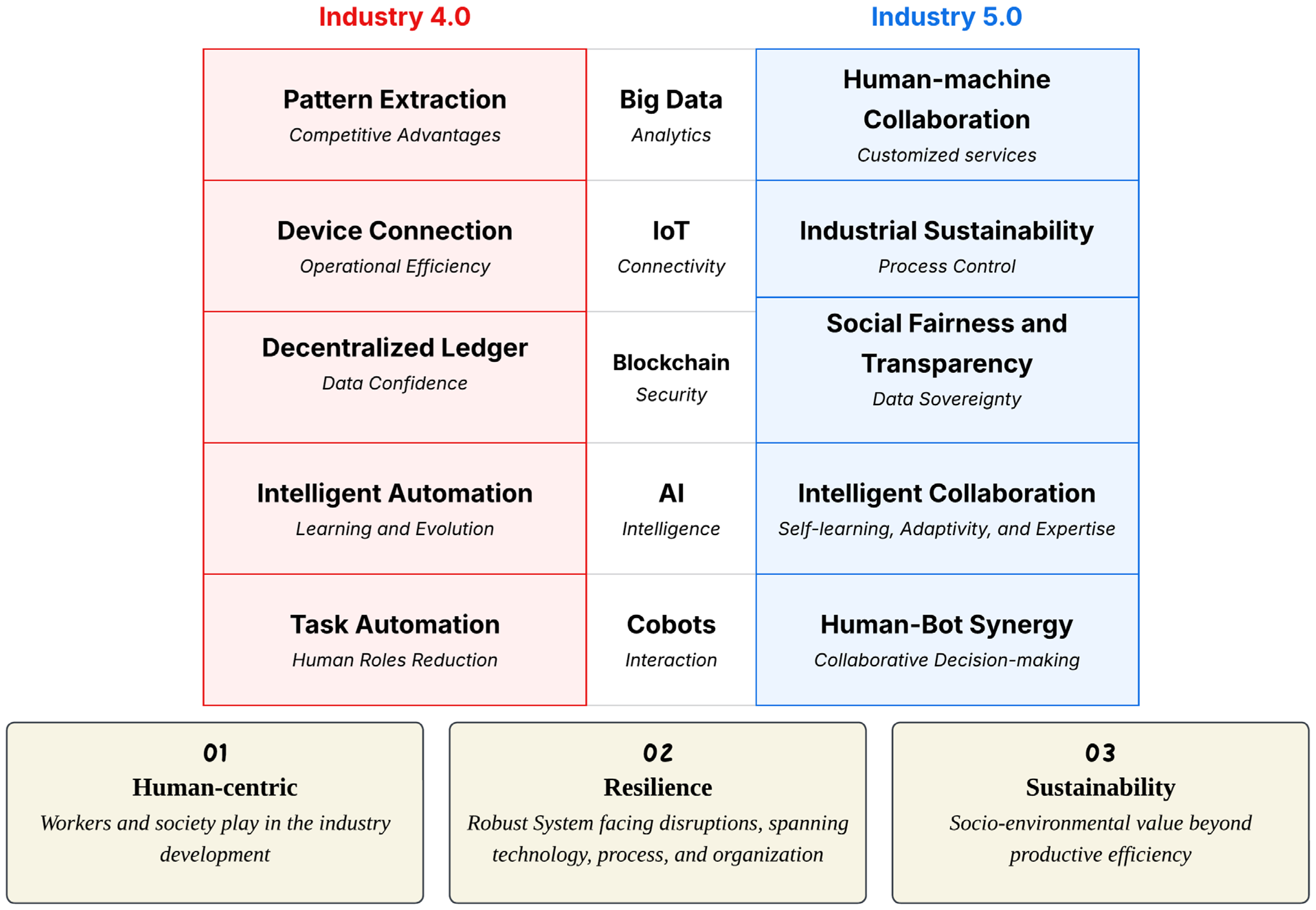
- Big data [51,52]: Under I4.0, big data is deployed to extract patterns from large-scale datasets, identifying hidden patterns and correlations within data to generate competitive advantages for organizations [53,54]. Under I5.0, big data is a strong tool leveraging real-world information in enhancing human–machine collaboration, enabling data-driven processes, and supporting the development of personalized products and services.
- IoT: Connecting devices globally is the core value of IoT. In the I4.0 framework, it enhances the intelligence of both physical and virtual entities [55], leveraging seamless data exchange and real-time communication, and further improves operational efficiency [56]. As highlighted by Singh et al. [57], in the era of I5.0, the connectivity is reframed with IoT and sensor networks for industrial sustainability, rather than the general enhancement of efficiency.
- Blockchain: It has evolved significantly with a broad expansion of purpose. Originally adopted in I4.0 as a decentralized, secure ledger system for its advantages of transparency and immutability in transactions [58,59], blockchain is repositioned in I5.0 as a technology to promote social fairness and personal data security (data sovereignty). It can incentivize data sharing among users and stakeholders, enhancing user experience and enabling personalized services across supply chain management, healthcare, and digital identity applications.
- AI: In I4.0, AI focuses on training data-driven models to replicate human-level intelligence with minimal human input [44,60]. In I5.0, Leng et al. [61] identify three transformative modes, collaborative intelligence, self-learning intelligence, and crowd intelligence, which shift AI from model optimization toward multi-dimensional human–machine interaction, enabling adaptive and self-improving systems.
- Collaborative robotics: This technology reflects a direct transition from automation toward human–machine synergy. Under I4.0, autonomous robots reduce human intervention in productive tasks, lowering costs and minimizing human errors [62,63]. In I5.0, collaborative robots (cobots) shift from replacing human roles toward human–machine synergy: equipped with trained intelligence, they jointly support decision-making and identify patterns beyond unaided human perception [64].
3. Research Questions and Methodology
- R.Q.1: What characterizes the scholarly landscape regarding perishable goods logistics within the context of I5.0 and sustainability? Specifically, which nations, organizations, researchers, and journals represent the most significant contributors?
- R.Q.2: What are the dominant and recurring research patterns currently shaping this specific field of study?
- R.Q.3: What are the emerging research themes in perishable product logistics toward sustainability and I5.0 integration?
- R.Q.4: What are the future research perspectives on sustainability practices and I5.0 technologies for transforming perishable product logistics?
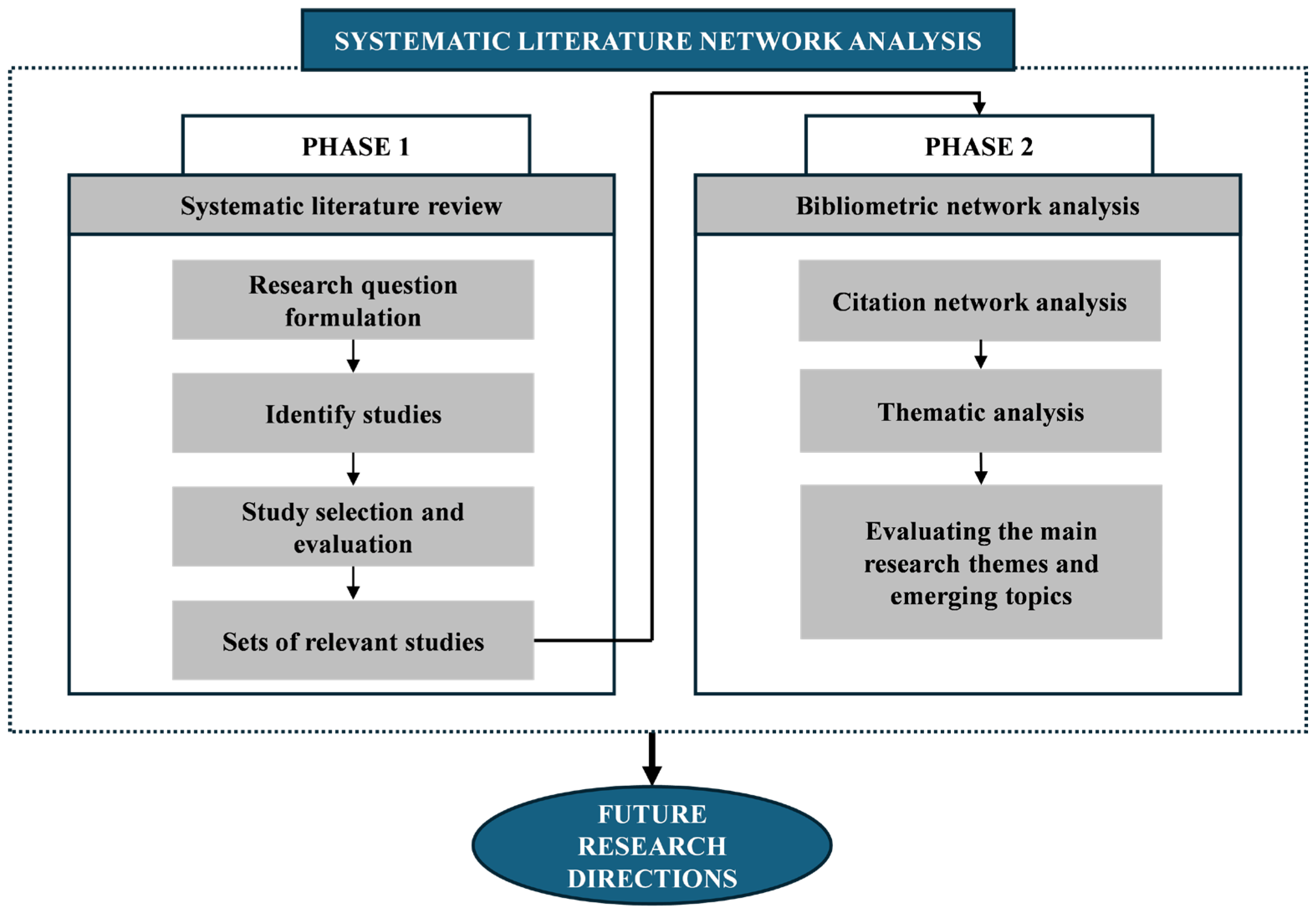
3.1. First Phase: Systematic Literature Review
3.1.1. Identification of Literature Related to the Study
- (a)
- Database selection
- (b)
- Identification of keywords
- (c)
- Search strategy
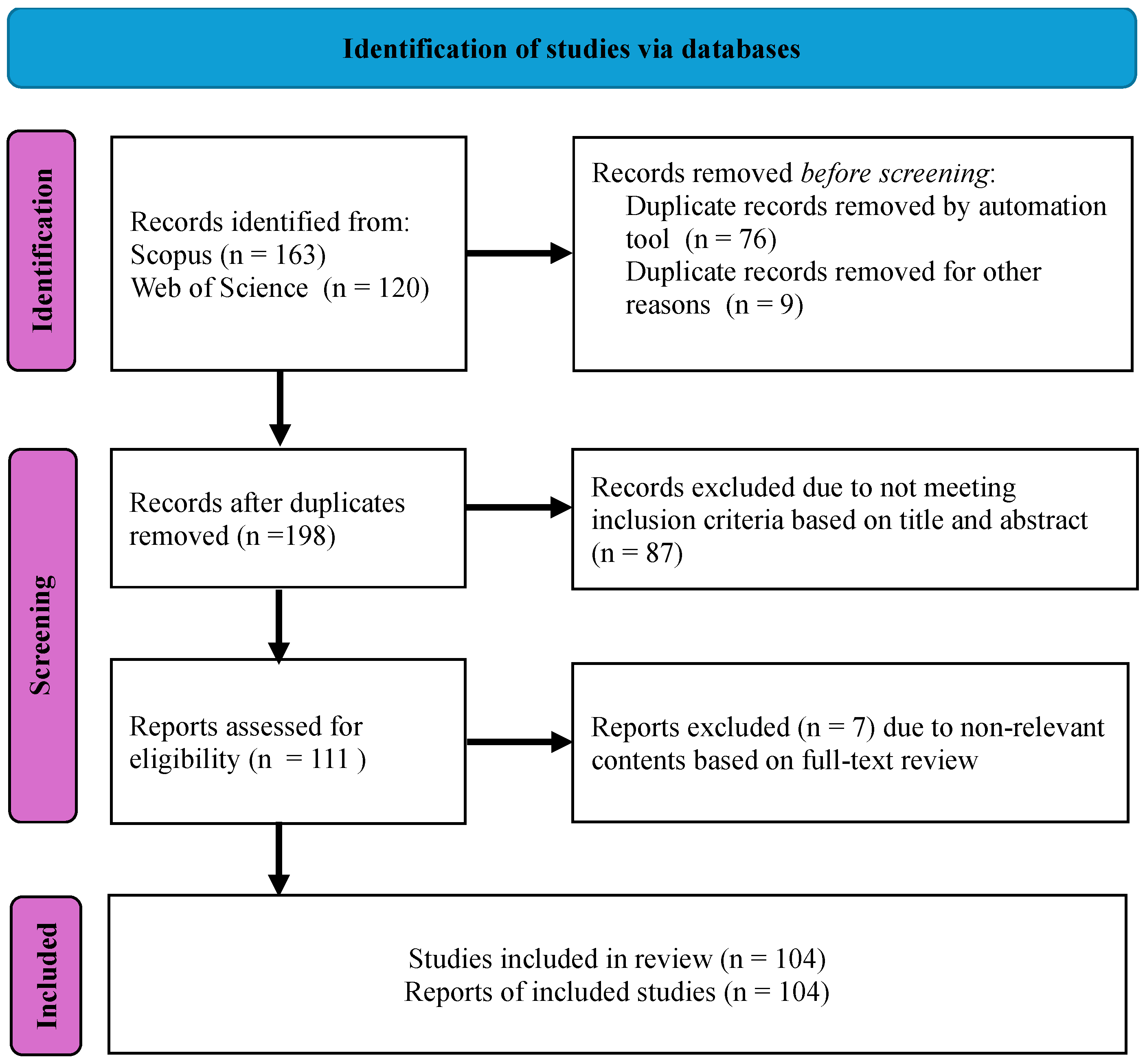
3.1.2. Screening of the Articles
- (a)
- Initial search and refinement
- (b)
- Inclusion and exclusion criteria
- Inclusion: Peer-reviewed English articles (full-text) published from January 2021 to July 2025, specifically focusing on I5.0 technology or sustainability in perishable product logistics.
- Exclusion: Other types of publication (non-peer-reviewed articles, books, book chapters, conference papers), non-English works, and any research not directly related to the specified domain.
3.1.3. Inclusions of Final Papers to Review
3.2. Second Phase: Bibliometric Network Analysis
4. Discussion
4.1. Answer to R.Q.1
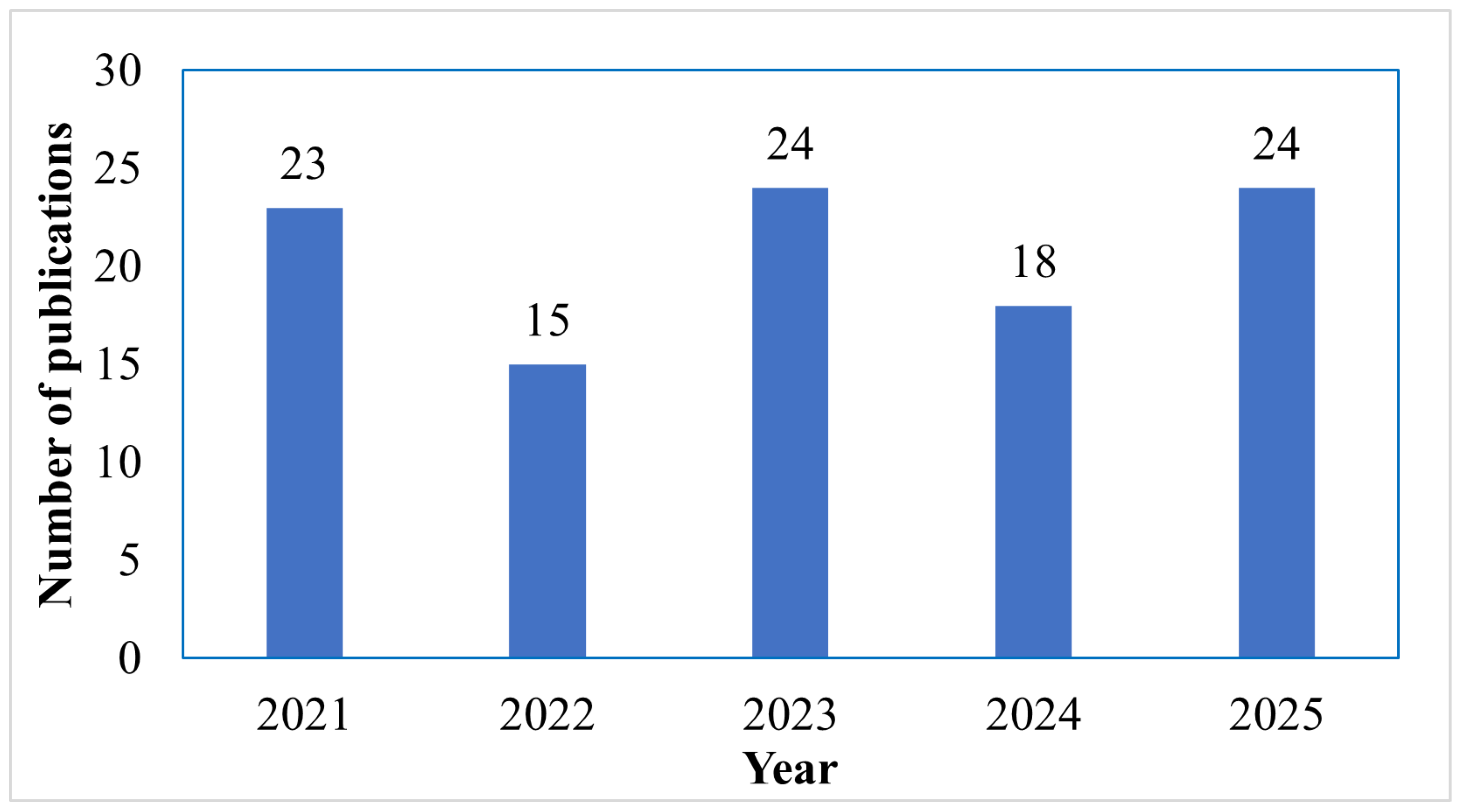
4.1.1. Yearly Publication Progress
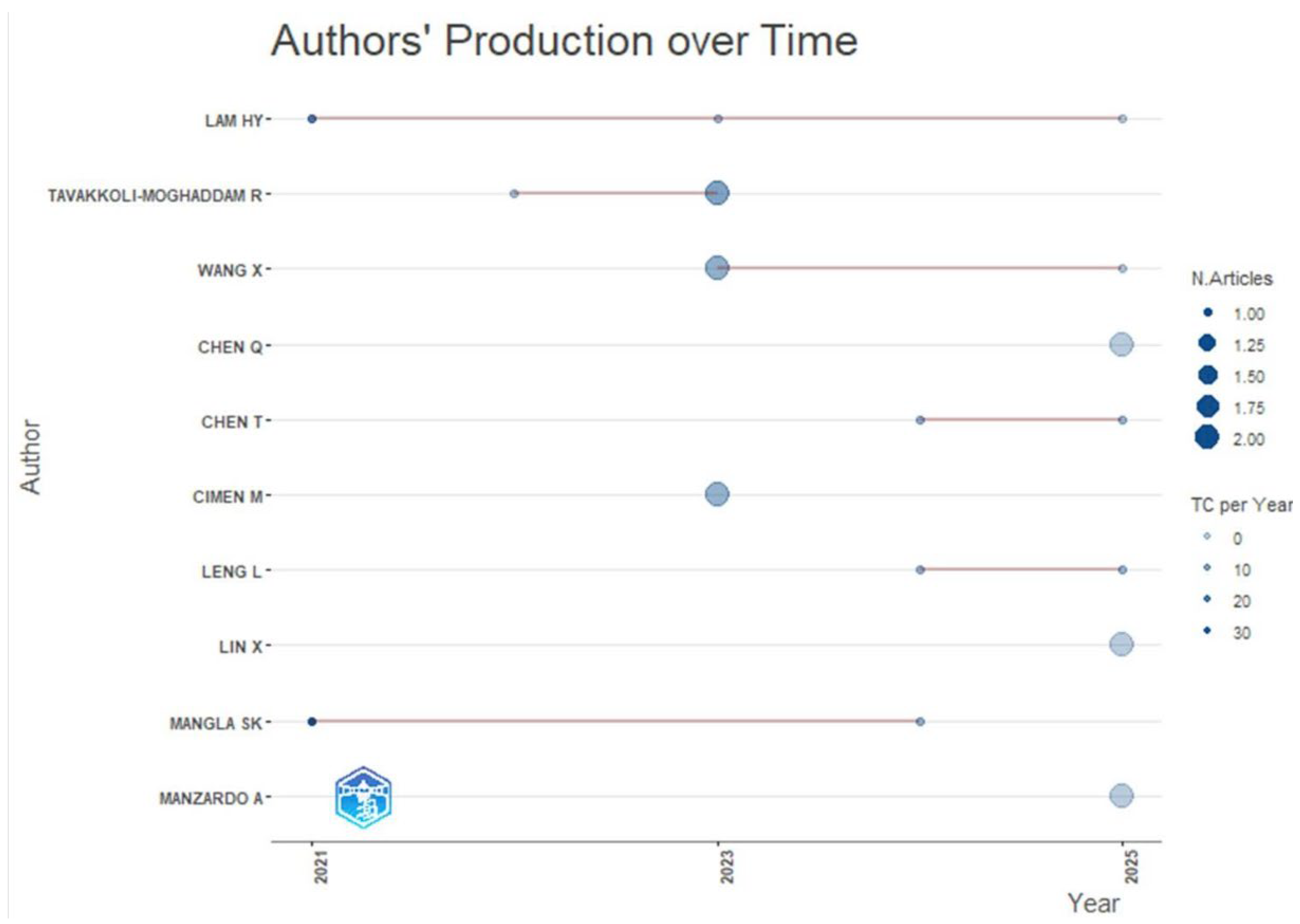
4.1.2. Top Productive Authors
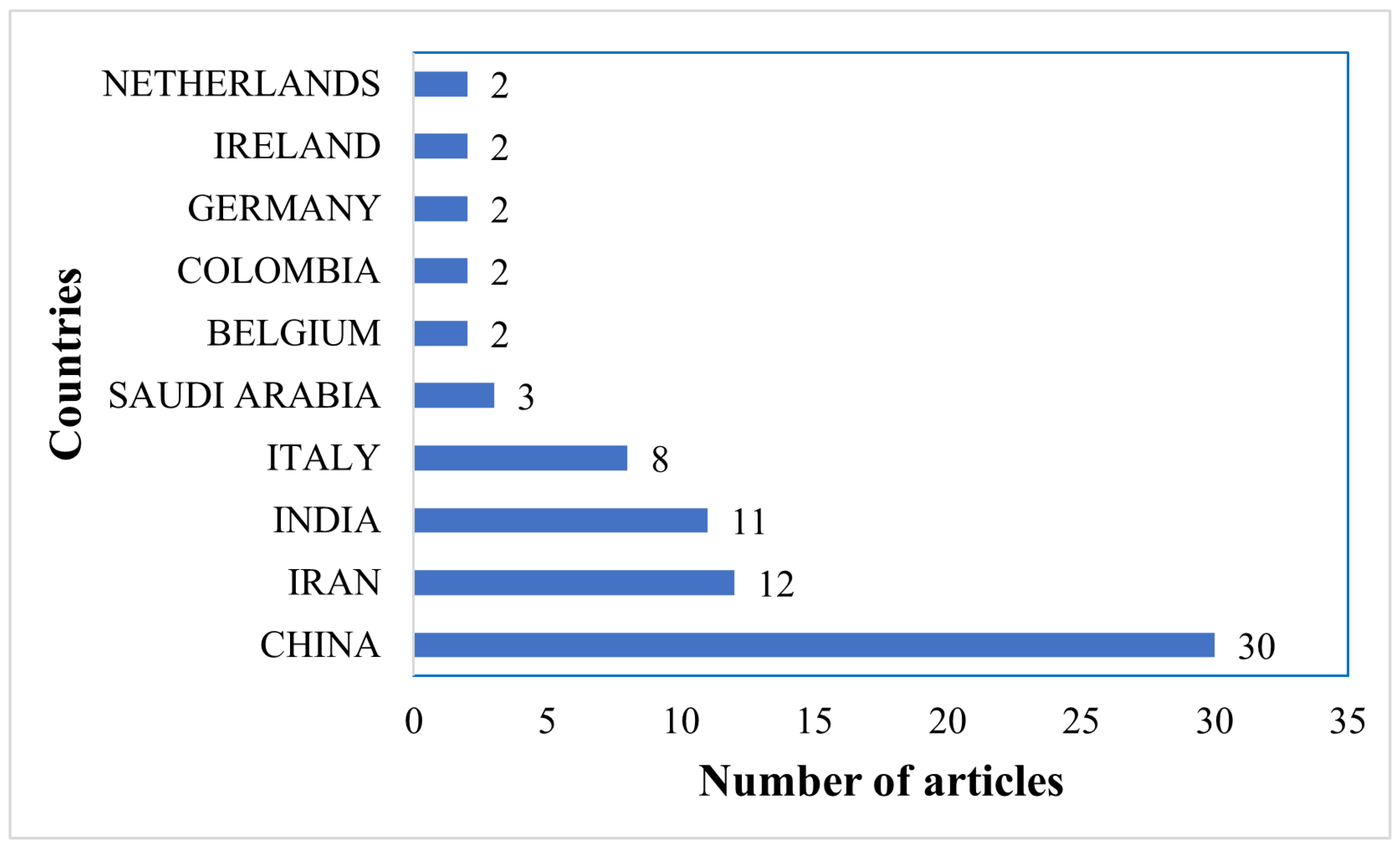
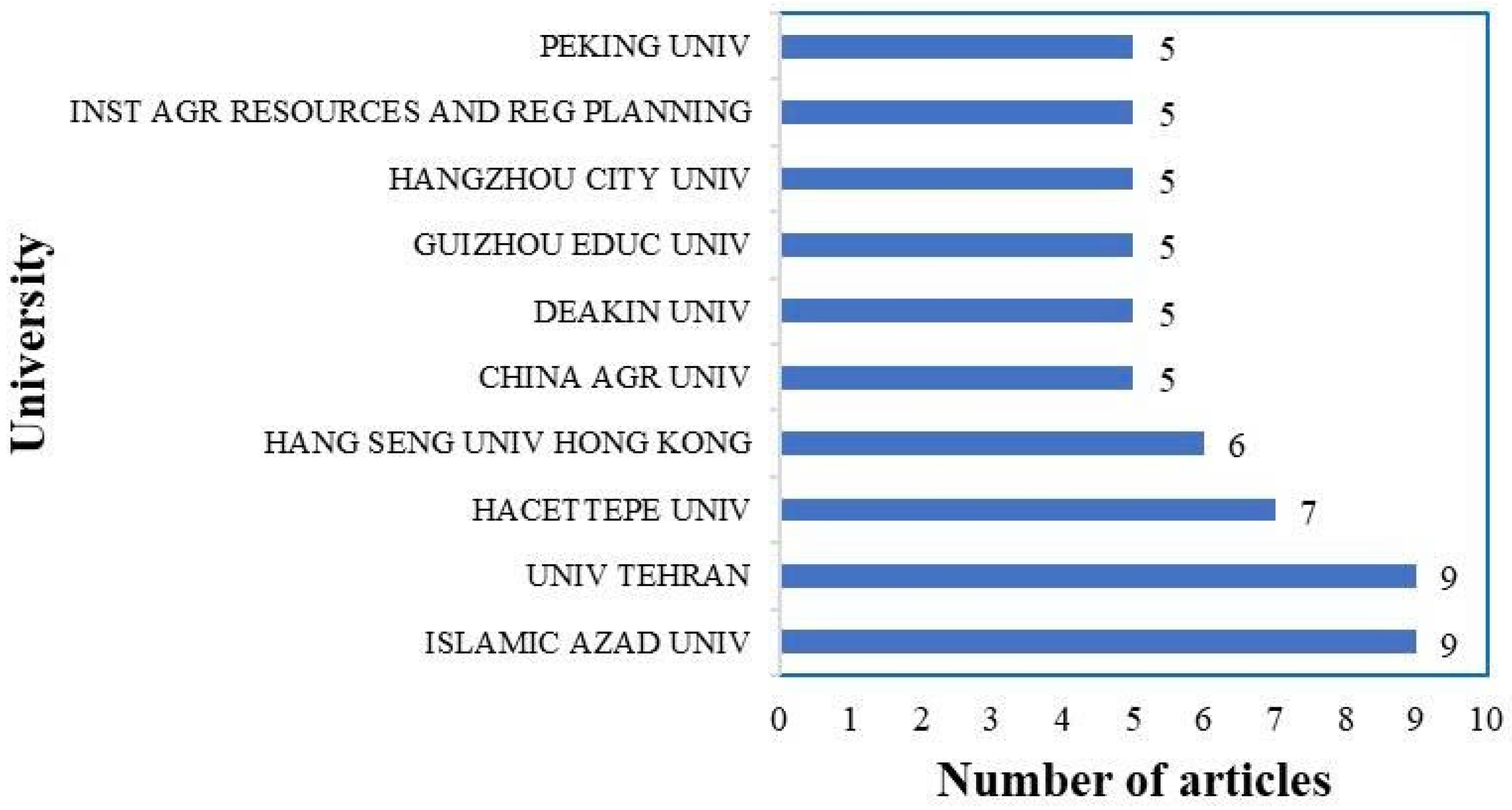
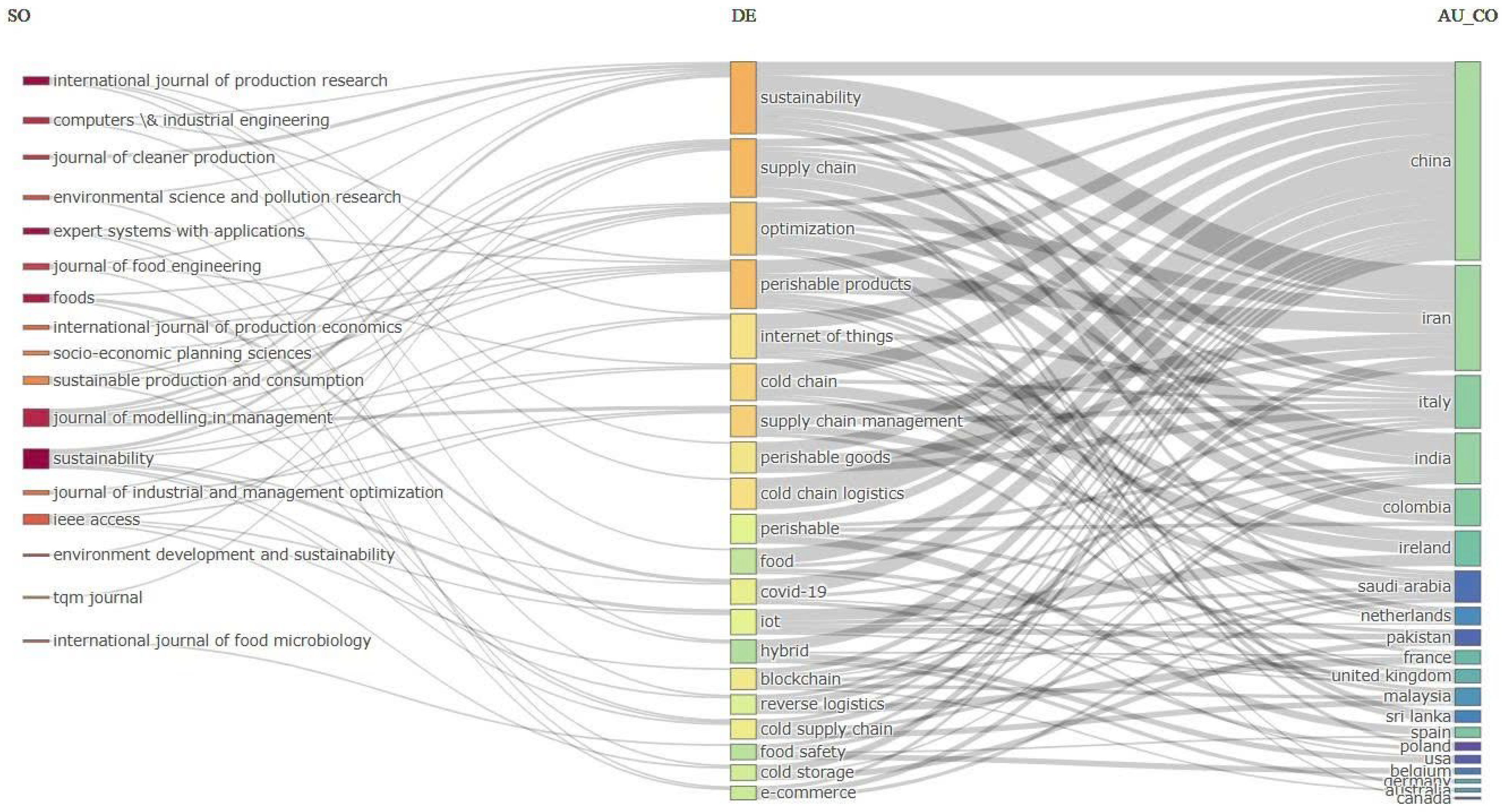
4.1.3. Most Productive Countries and Institutions
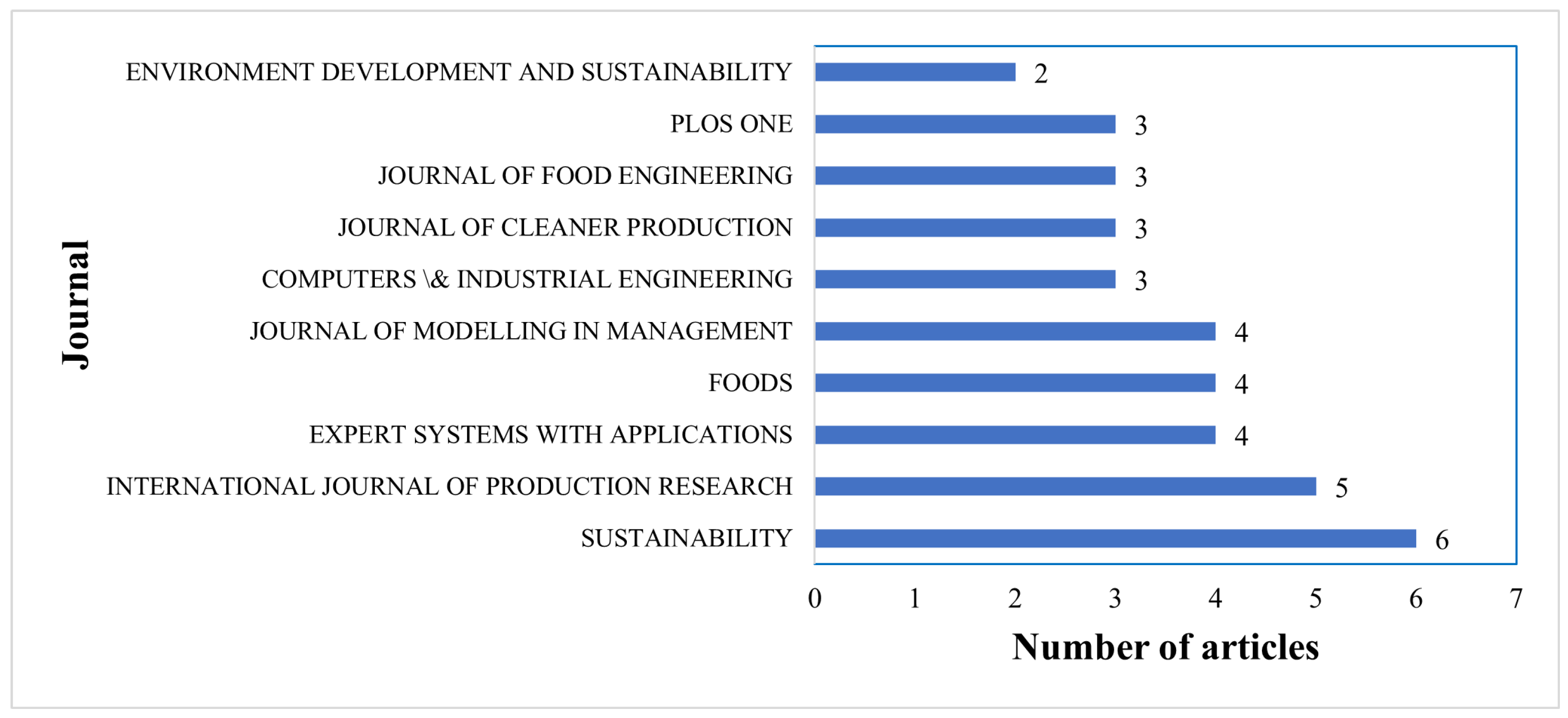
4.1.4. Citation Patterns of Top Journals
4.2. Answer to R.Q.2
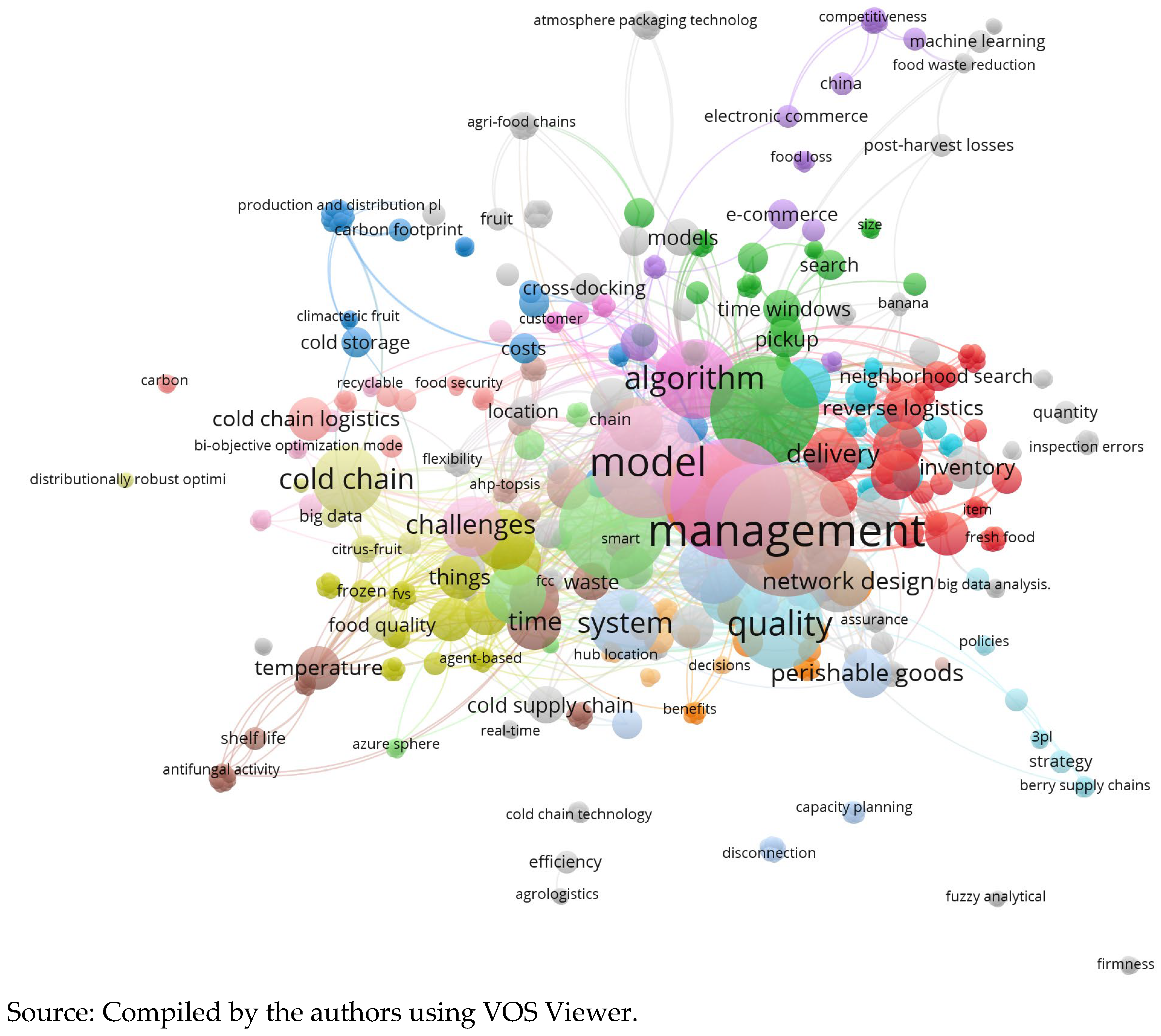
4.2.1. Semantic Network Analysis: Keywords’ Co-Occurrence
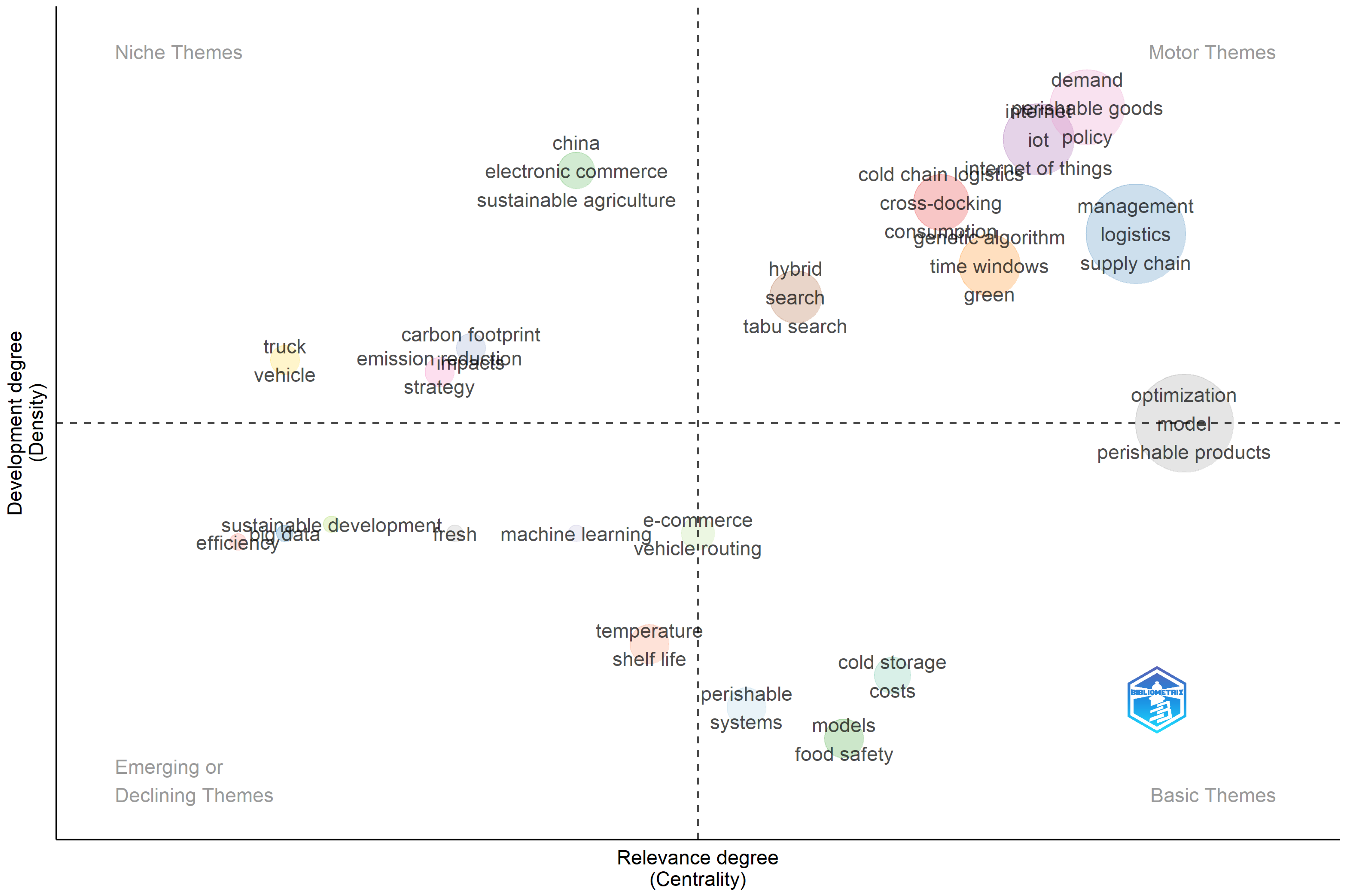
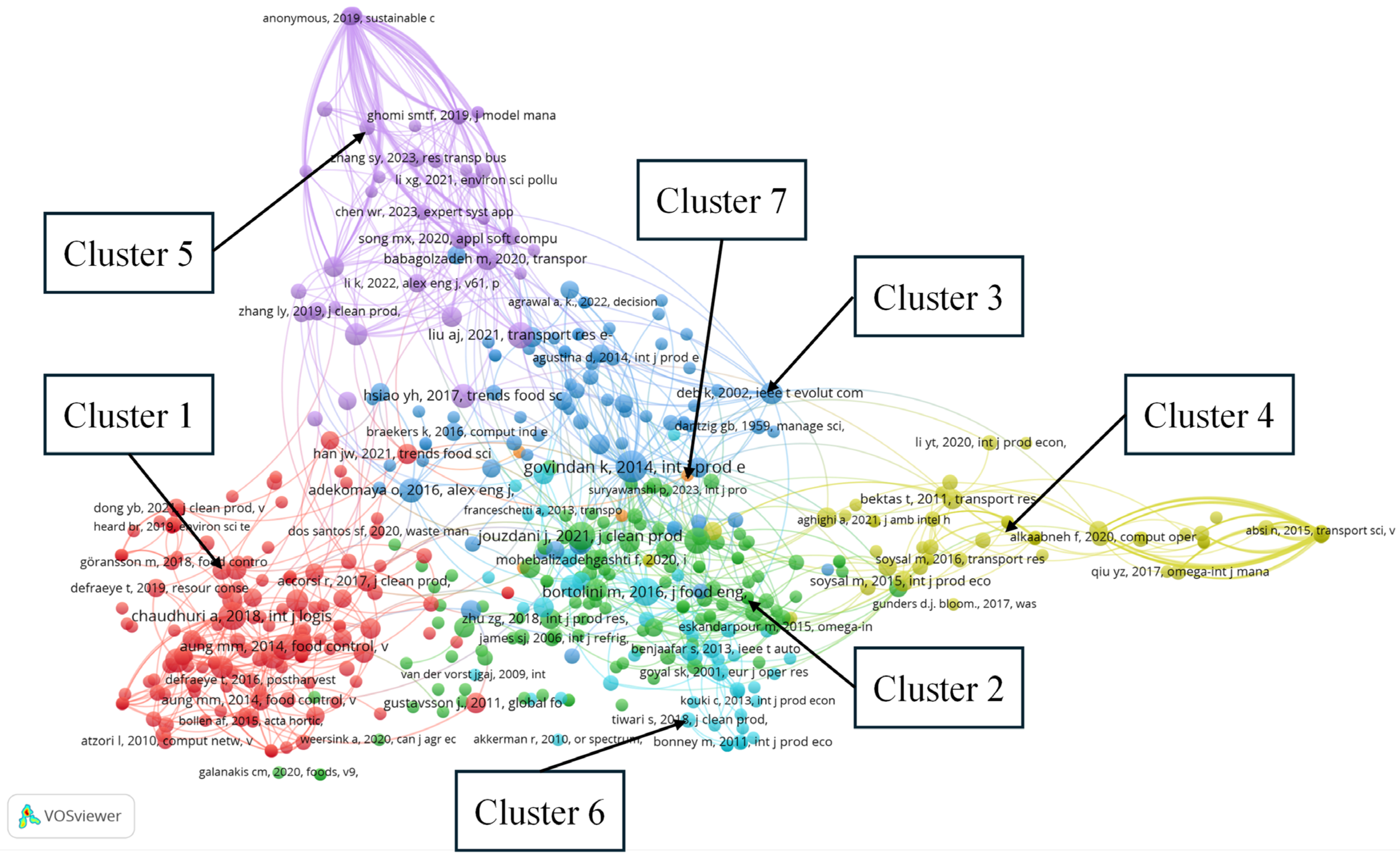
4.2.2. Citation Network Analysis: Research Themes
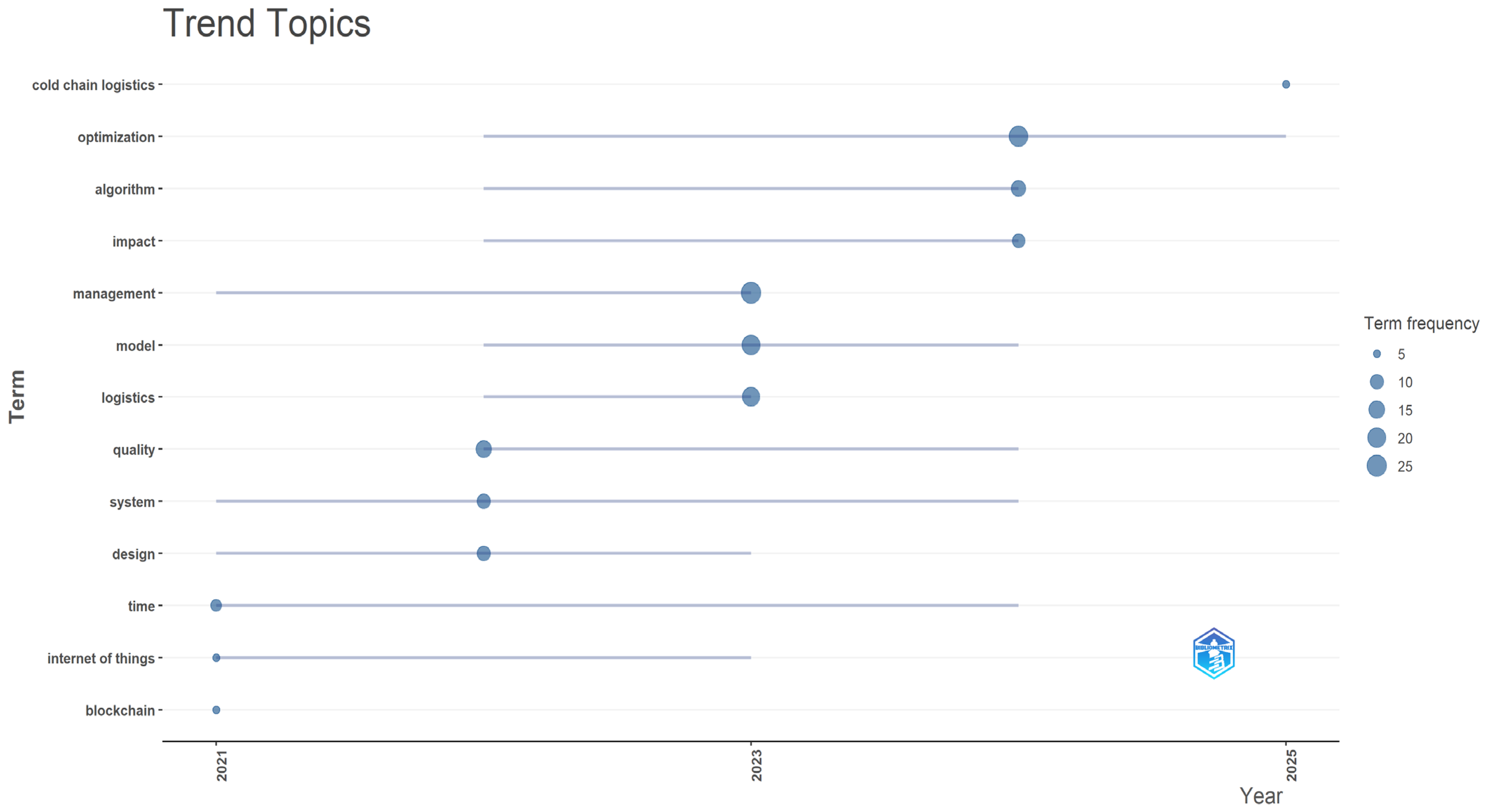
4.2.3. Citation Network Analysis: Trending Topics
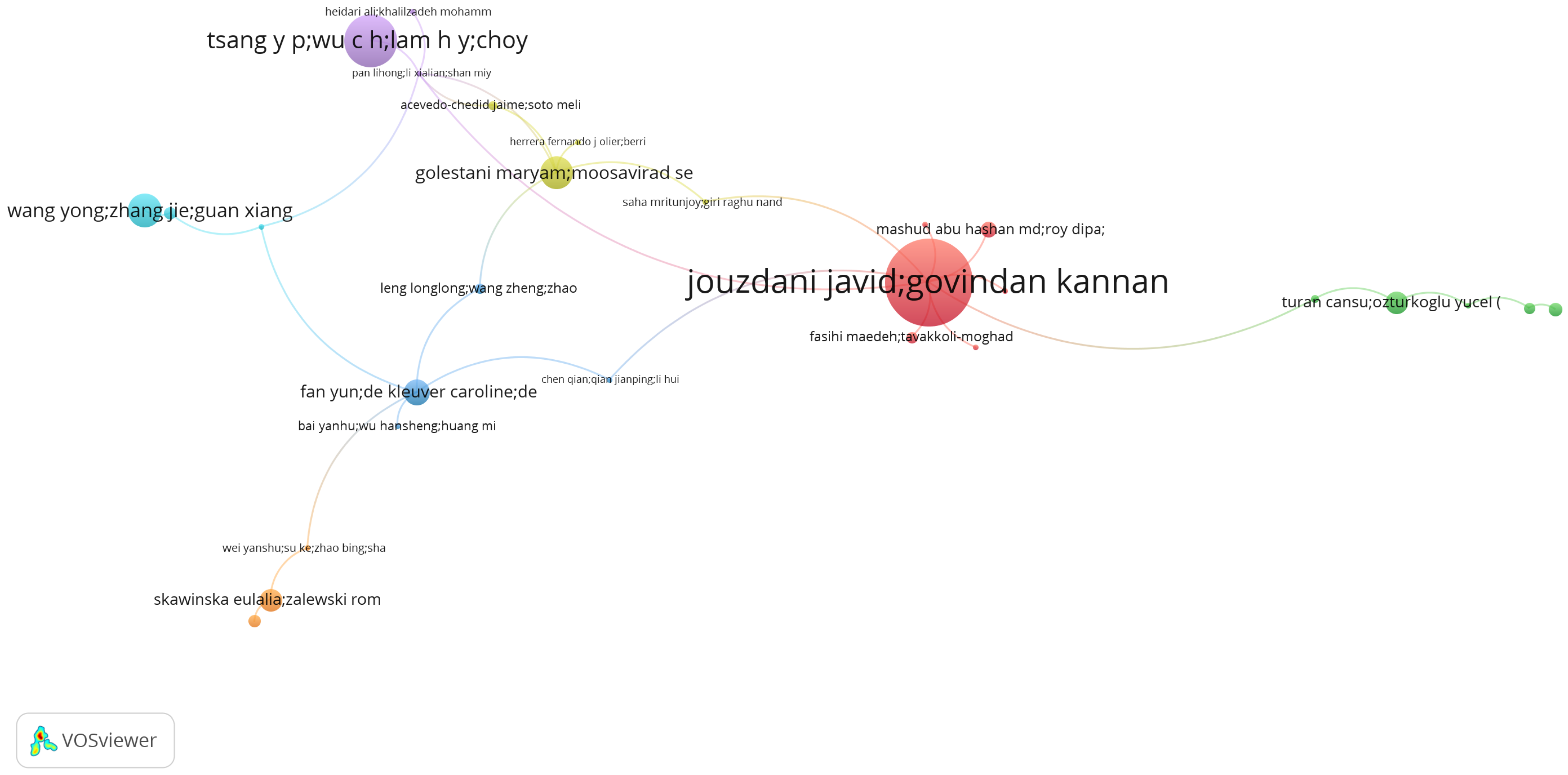
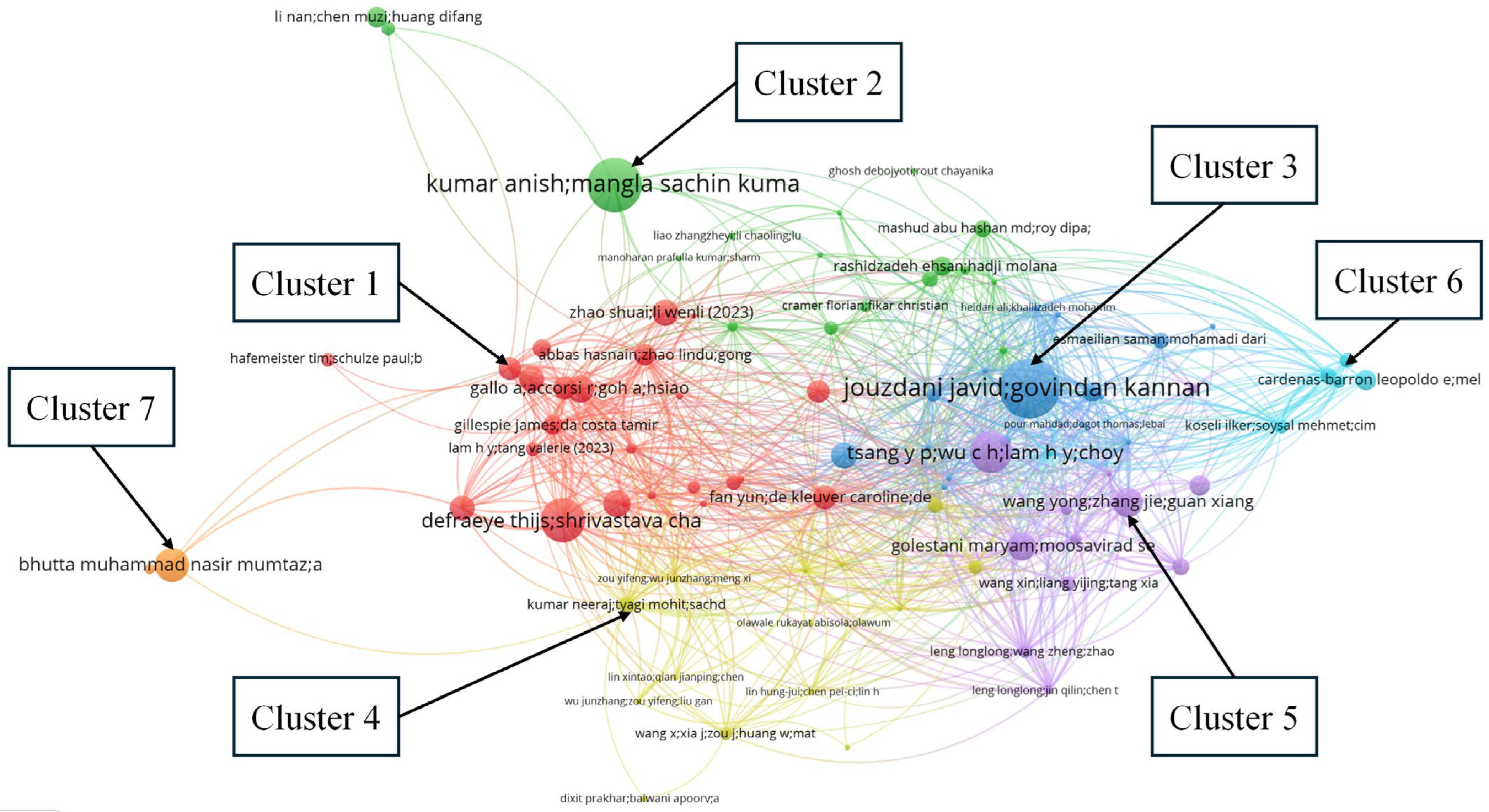
4.2.4. Citation and Co-Citation Analysis
4.3. Answer to R.Q.3
4.3.1. Cluster 1: Perishable Product Quality and Safety
4.3.2. Cluster 2: Sustainability-Oriented Management
4.3.3. Cluster 3: Resilient Supply Chains and Logistics Under Uncertainty
4.3.4. Cluster 4: Transformation Toward I5.0-Assisted Monitoring
4.3.5. Cluster 5: Sustainability-Targeted Optimization Frameworks
4.3.6. Cluster 6: Sustainable Routing Problems for Perishable Product Logistics
4.3.7. Cluster 7: Technological and Security Barriers
4.4. Answer to R.Q.4
4.4.1. Critical Appraisal of I5.0 Alignment
4.4.2. Research Directions
5. Conclusions
Summary of Research Questions
Supplementary Materials
Author Contributions
Funding
Institutional Review Board Statement
Informed Consent Statement
Data Availability Statement
Acknowledgments
Conflicts of Interest
Appendix A. List of 104 Included Studies

| No. | Authors | Year | Title | Ref. |
|---|---|---|---|---|
| 1 | Chen Q et al. | 2025 | Dynamic Multi-Objective Time-Temperature Management For Climacteric Fruit Cold Storage Considering Ripeness Windows And Energy Consumption | [89] |
| 2 | Majidi A et al. | 2022 | Sustainable Pricing-Production-Workforce-Routing Problem For Perishable Products By Considering Demand Uncertainty; A Case Study From The Dairy Industry | [100] |
| 3 | Dhanda A et al. | 2024 | Impact Of Carbon Emission Policy On Fresh Food Supply Chain Model For Deteriorating Imperfect Quality Items | [82] |
| 4 | Abbasi S et al. | 2023 | Designing The Location-Routing Problem For A Cold Supply Chain Considering The COVID-19 Disaster | [97] |
| 5 | Jahdi S et al. | 2024 | An Irp Model To Improve The Sustainability Of Cold Food Supply Chains Under Stochastic Demand | [98] |
| 6 | Wang Y et al. | 2021 | Collaborative Multiple Centers Fresh Logistics Distribution Network Optimization With Resource Sharing And Temperature Control Constraints | [73] |
| 7 | Fan Y et al. | 2021 | Trading Off Cost, Emission, And Quality In Cold Chain Design: A Simulation Approach | [76] |
| 8 | Gillespie J et al. | 2023 | Real-Time Anomaly Detection In Cold Chain Transportation Using IoT Technology | [77] |
| 9 | Kumar A et al. | 2021 | Mitigate Risks In Perishable Food Supply Chains: Learning From COVID-19 | [84] |
| 10 | Defraeye T et al. | 2021 | Digital Twins Are Coming: Will We Need Them In Supply Chains Of Fresh Horticultural Produce? | [79] |
| 11 | Bhutta Mnm et al. | 2021 | Secure Identification, Traceability And Real-Time Tracking Of Agricultural Food Supply During Transportation Using Internet Of Things | [101] |
| 12 | Skawinska E et al. | 2022 | Economic Impact Of Temperature Control During Food Transportation-A COVID-19 Perspective | [78] |
| 13 | Abbas H et al. | 2023 | The Perishable Products Case To Achieve Sustainable Food Quality And Safety Goals Implementing On-Field Sustainable Supply Chain Model | [75] |
| 14 | Kumar N et al. | 2022 | Depiction Of Possible Solutions To Improve The Cold Supply Chain Performance System | [90] |
| 15 | Sabbagh P | 2021 | An Uncertain Model For Analysis The Barriers To Implement Blockchain In Supply Chain Management And Logistics For Perishable Goods | [102] |
| 16 | Jouzdani J et al. | 2021 | On The Sustainable Perishable Food Supply Chain Network Design: A Dairy Products Case To Achieve Sustainable Development Goals | [71] |
| 17 | Golestani M et al. | 2021 | A Multi-Objective Green Hub Location Problem With Multi Item-Multi Temperature Joint Distribution For Perishable Products In Cold Supply Chain | [96] |
| 18 | Navazi F et al. | 2023 | A Sustainable Closed-Loop Location-Routing-Inventory Problem For Perishable Products | [88] |
| 19 | Fasihi M et al. | 2023 | Designing A Sustainable Fish Closed-Loop Supply Chain Network Under Uncertainty | [85] |
| 20 | Koseli I et al. | 2023 | Optimizing Food Logistics Through A Stochastic Inventory Routing Problem Under Energy, Waste And Workforce Concerns | [99] |
| 21 | Leng L et al. | 2024 | Formulation And Heuristic Method For Urban Cold-Chain Logistics Systems With Path Flexibility—The Case Of China | [94] |
| 22 | Pilati F et al. | 2024 | Environmentally Sustainable Inventory Control For Perishable Products: A Bi-Objective Reorder-Level Policy | [81] |
| 23 | Leng L et al. | 2025 | Energy-Conserving Cold Chain With Ambient Temperature, Path Flexibility, And Hybrid Fleet: Formulation And Heuristic Approach | [95] |
| 24 | Jarumaneeroj P et al. | 2025 | Eco-Friendly Long-Haul Perishable Product Transportation With Multi-Compartment Vehicles | [92] |
| 25 | Zhu Q et al. | 2024 | On The Value Of Smart Contract And Blockchain In Designing Fresh Product Supply Chains | [83] |
| 26 | Shaharudin Ms et al. | 2024 | Cold Supply Chain Of Leafy Green Vegetables: A Social Network Analysis Approach | [80] |
| 27 | Heidari A et al. | 2025 | Accelerating Benders Decomposition For Sustainable Food Closed-Loop Supply Chain Network Under Uncertainty: A Case Study | [86] |
| 28 | Pan L et al. | 2025 | Designing A Sustainable Supply Chain Network For Perishable Products Integrating Internet Of Things And Mixed Fleets | [87] |
| 29 | Lam Hy et al. | 2025 | Transforming Cold Chain Logistics: A Reversible Vehicle Routing Approach For Sustainable And Efficient Delivery Of Perishable Goods | [93] |
| 30 | Zou Y et al. | 2025 | Digital Twin Integration For Dynamic Quality Loss Control In Fruit Supply Chains | [91] |
| No. | Authors | Year | Title | Ref. |
|---|---|---|---|---|
| 1 | Jia Y | 2025 | Big Data-Driven Collaborative Optimization Model For Cold Chain Multimodal Transport Resources | [23] |
| 2 | Lin X et al. | 2025 | Potential Decarbonization For Balancing Local And Non-Local Perishable Food Supply In Megacities | [104] |
| 3 | Ouyang S et al. | 2025 | Spatial Distribution Patterns And Sustainable Development Drivers Of China’s National Famous, Special, Excellent, And New Agricultural Products | [105] |
| 4 | Pan F et al. | 2021 | Deterioration Rate Variation Risk For Sustainable Cross-Docking Service Operations | [22] |
| 5 | Wang X et al. | 2023 | Pathways Toward Precise Monitoring And Low-Carbon Sustainability In Fruit Cold Chain Logistics: A Solution Enabled By Flexible Temperature Sensing | [106] |
| 6 | Fernando Wm et al. | 2024 | An Integrated Vehicle Routing Model To Optimize Agricultural Products Distribution In Retail Chains | [107] |
| 7 | Lin Hj et al. | 2025 | Quantifying Carbon Emissions In Cold Chain Transport: A Real-World Data-Driven Approach | [108] |
| 8 | Mashud Ahm et al. | 2022 | An Optimum Balance Among The Reduction In Ordering Cost, Product Deterioration And Carbon Emissions: A Sustainable Green Warehouse | [109] |
| 9 | Chekoubi Z et al. | 2022 | The Integrated Production-Inventory-Routing Problem With Reverse Logistics And Remanufacturing: A Two-Phase Decomposition Heuristic | [110] |
| 10 | Saha M et al. | 2024 | Freshness-Keeping Effort Vs. Sustainability: An Efficient Approach For Perishable Supply Chain System | [111] |
| 11 | Herrera Fjo et al. | 2025 | Allocation Of Strategic Positions For Storage Of Meat Products Requiring Cold Chain | [112] |
| 12 | Falari Sr et al. | 2024 | Smart Multi-Commodity Location-Routing Model For Perishable Goods With An Emphasis On Big Data Under Uncertainty And Congestion | [113] |
| 13 | Zagurskiy Om et al. | 2021 | Food Supply Transport And Logistics System Organizations | [114] |
| 14 | Rendon-Benavides R et al. | 2023 | In-Transit Interventions Using Real-Time Data In Australian Berry Supply Chains | [115] |
| 15 | Leylaparast P et al. | 2025 | Integration Of Pricing, Sustainability And 3Pl Delivery Time According To Freshness Date In A Dual-Channel Fruit Supply Chain: A Game Theoretic Approach | [116] |
| 16 | Wang X et al. | 2023 | A Multi-Compartment Electric Vehicle Routing Problem With Time Windows And Temperature And Humidity Settings For Perishable Product Delivery | [117] |
| 17 | Cramer F et al. | 2024 | Investigating Crowd Logistics Platform Operations For Local Food Distribution | [118] |
| 18 | Yang C et al. | 2023 | Edge-Cloud Blockchain And Ioe-Enabled Quality Management Platform For Perishable Supply Chain Logistics | [119] |
| 19 | Afreen H et al. | 2021 | An Iot-Based Real-Time Intelligent Monitoring And Notification System Of Cold Storage | [120] |
| 20 | Sergi I et al. | 2021 | A Smart And Secure Logistics System Based On IoT And Cloud Technologies | [121] |
| 21 | Cilenti C et al. | 2024 | Utilizing Phase Change Materials For Sun-Powered Refrigerators: Experimental Validation In Outdoor Environments | [122] |
| 22 | Hardiansyah Ba et al. | 2024 | Monitoring And Controlling System For Mango Logistics Based On Machine Learning | [123] |
| 23 | Gallo A et al. | 2021 | A Traceability-Support System To Control Safety And Sustainability Indicators In Food Distribution | [124] |
| 24 | Zhao S et al. | 2023 | Blockchain-Based Traceability System Adoption Decision In The Dual-Channel Perishable Goods Market Under Different Pricing Policies | [125] |
| 25 | Tagarakis Ac et al. | 2021 | Bridging The Gaps In Traceability Systems For Fresh Produce Supply Chains: Overview And Development Of An Integrated IoT-Based System | [126] |
| 26 | Turan C et al. | 2022 | A Conceptual Framework Model For An Effective Cold Food Chain Management In Sustainability Environment | [127] |
| 27 | Li N et al. | 2023 | How Do Logistics Disruptions Affect Rural Households? Evidence From COVID-19 In China | [128] |
| 28 | Huang J et al. | 2024 | Green Supply Chain Management: A Renewable Energy Planning And Dynamic Inventory Operations For Perishable Products | [129] |
| 29 | Esmaeilian S et al. | 2023 | A Multi-Objective Model For Sustainable Closed-Loop Supply Chain Of Perishable Products Under Two Carbon Emission Regulations | [130] |
| 30 | Mejjaouli S | 2022 | Internet Of Things Based Decision Support System For Green Logistics | [131] |
| 31 | Chandrasiri C et al. | 2022 | Mitigating Environmental Impact Of Perishable Food Supply Chain By A Novel Configuration: Simulating Banana Supply Chain In Sri Lanka | [132] |
| 32 | Filina-Dawidowicz L et al. | 2022 | Contemporary Problems And Challenges Of Sustainable Distribution Of Perishable Cargoes: Case Study Of Polish Cold Port Stores | [133] |
| 33 | Bai Y et al. | 2023 | How To Build A Cold Chain Supply Chain System For Fresh Agricultural Products Through Blockchain Technology-A Study Of Tripartite Evolutionary Game Theory Based On Prospect Theory | [134] |
| 34 | Liao Z et al. | 2024 | The Improvement Strategy Of Fresh Produce Supply Chain Resilience Based On Extenics | [135] |
| 35 | Zuo X et al. | 2022 | Route Optimization Of Agricultural Product Distribution Based On Agricultural IoT And Neural Network From The Perspective Of Fabric Blockchain | [136] |
| 36 | Wei Y et al. | 2025 | Nonlinear Robust Distribution Planning Model For Perishable Products Based On Sustainable Development | [137] |
| 37 | Bauer M et al. | 2023 | Relationship Between The State Of The Country’s Logistics And Perishable Goods’ Output: Dairy Industry | [138] |
| 38 | Manoharan Pk et al. | 2025 | Enhancing Perishable Materials’ Supply Chain Management Using Fuzzy Entropy Model | [139] |
| 39 | Arolkar Nm et al. | 2024 | Automated Tenderness Assessment Of Okra Using Robotic Non-Destructive Sensing | [140] |
| 40 | Wozniak Me et al. | 2021 | Blockchain In Supermarkets: Mitigating The Problem Of Organic Waste Generation | [141] |
| 41 | Oguz S et al. | 2025 | Listeria Monocytogenes Growth Under Well-Controlled CO2, Ph, And Temperature Conditions Through A Novel Gas-Controlling System | [142] |
| 42 | Rossi T et al. | 2021 | A New Logistics Model For Increasing Economic Sustainability Of Perishable Food Supply Chains Through Intermodal Transportation | [143] |
| 43 | Suryawanshi P et al. | 2021 | Sustainable And Resilience Planning For The Supply Chain Of Online Hyperlocal Grocery Services | [144] |
| 44 | Rashidzadeh E et al. | 2021 | Assessing The Sustainability Of Using Drone Technology For Last-Mile Delivery In A Blood Supply Chain | [145] |
| 45 | Soysal M et al. | 2023 | Managing Returnable Transport Items In A Vendor Managed Inventory System | [146] |
| 46 | Perez-mesa Jc et al. | 2021 | Addressing The Location Problem Of A Perishables Redistribution Center In The Middle Of Europe | [147] |
| 47 | Shahrabi F et al. | 2022 | Modelling And Solving The Bi-Objective Production-Transportation Problem With Time Windows And Social Sustainability | [148] |
| 48 | Assari M et al. | 2023 | Incorporating Product Decay During Transportation And Storage Into A Sustainable Model | [149] |
| 49 | Samasti M et al. | 2025 | Optimizing Harvest Planning In Perishable Agricultural Production: A Data-Driven Approach Leveraging Weather Conditions And Clustering Analysis | [150] |
| 50 | Pour M et al. | 2025 | Determinants Of Site Selection For The Warehouses Of Food Logistic Providers | [151] |
| 51 | Shafiee Motlaq-Kashani A et al. | 2025 | A Sustainable And Resilient Humanitarian Relief Chain Network Design For Distributing Assembled Relief Items Dynamically Considering Perishability, Under Disruption | [152] |
| 52 | Shakuri M et al. | 2024 | A Risk-Averse Sustainable Perishable Food Supply Chain Considering Production And Delivery Times With Real-World Application | [153] |
| 53 | Vera-Garcia F et al. | 2022 | Modelling And Real-Data Validation Of A Logistic Centre Using Trnsys®: Influences Of The Envelope, Infiltrations And Stored Goods | [154] |
| 54 | Khan Wu et al. | 2022 | Cyber Secure Framework For Smart Containers Based On Novel Hybrid Dtls Protocol | [155] |
| 55 | Jafari Sm et al. | 2021 | Improving The Storage Stability Of Tomato Paste By The Addition Of Encapsulated Olive Leaf Phenolics And Experimental Growth Modeling Of A. flavus | [156] |
| 56 | Hafemeister T et al. | 2022 | Boar Semen Shipping For Artificial Insemination: Current Status And Analysis Of Transport Conditions With A Major Focus On Vibration Emissions | [157] |
| 57 | Tsang Yp et al. | 2021 | Integrating Internet Of Things And Multi-Temperature Delivery Planning For Perishable Food E-Commerce Logistics: A Model And Application | [72] |
| 58 | Tiwari Kv et al. | 2023 | An Optimization Model For Vehicle Routing Problem In Last-Mile Delivery | [158] |
| 59 | Cardenas-Barron Le et al. | 2021 | A Fast And Effective Mip-Based Heuristic For A Selective And Periodic Inventory Routing Problem In Reverse Logistics | [159] |
| 60 | Chen T et al. | 2024 | Sustainable Collaborative Strategy In Pharmaceutical Refrigerated Logistics Routing Problem | [160] |
| 61 | Pu M et al. | 2021 | Overstocked Agricultural Produce And Emergency Supply System In The COVID-19 Pandemic: Responses From China | [161] |
| 62 | Zahran S | 2024 | Optimizing Supply Chain Management Of Fresh E-Commerce Agri-Consumer Products Using Energy-Efficient Vehicle Routing | [162] |
| 63 | Acevedo-Chedid J et al. | 2023 | An Optimization Model For Routing-Location Of Vehicles With Time Windows And Cross-Docking Structures In A Sustainable Supply Chain Of Perishable Foods | [163] |
| 64 | Bhatnagar A et al. | 2022 | Demand-Supply Planning And Sustainability Aspect For Agro-Based Perishables In Cold-Chain | [164] |
| 65 | Kaptan M et al. | 2023 | Fuzzy Bayesian Network Analysis Of The Factors Causing Food Losses In Reefer Containers | [165] |
| 66 | Dixit P et al. | 2023 | A Novel Shape-Stabilized Phase Change Material With Tunable Thermal Conductivity For Cold Chain Applications | [166] |
| 67 | Deonarine S et al. | 2023 | Oil Extraction And Natural Drying Kinetics Of The Pulp And Seeds Of Commercially Important Oleaginous Fruit From The Rainforests Of Guyana | [167] |
| 68 | Anwar K et al. | 2025 | Inbound Logistics Optimization For Fresh Oranges With Waste Management | [168] |
| 69 | Ghosh D et al. | 2025 | Integrating Imperfect Production, Screening Errors, Item Deterioration, Rising Transportation Costs, And Carbon Emissions For Sustainable Optimization | [169] |
| 70 | Zhang W et al. | 2025 | Blockchain Technology Adoption Strategies For The Shipping Costs Bearer In The Fresh Product Supply Chain | [170] |
| 71 | Roa Ap et al. | 2023 | Robust Design Of A Logistics System Using Fepia Procedure And Analysis Of Trade-Offs Between CO2 Emissions And Net Present Value | [171] |
| 72 | Wu J et al. | 2025 | Reducing Food Loss And Associated Greenhouse Gas Emissions Using A Dynamic Shelf Life Approach | [172] |
| 73 | Olawale Ra et al. | 2025 | Sustainable Farming With Machine Learning Solutions For Minimizing Food Waste | [20] |
| 74 | Lam Hy et al. | 2023 | Digital Transformation For Cold Chain Management In Freight Forwarding Industry | [173] |
References
- Koberg, E.; Longoni, A. A systematic review of sustainable supply chain management in global supply chains. J. Clean. Prod. 2019, 207, 1084–1098. [Google Scholar] [CrossRef]
- Shaabani, H. A literature review of the perishable inventory routing problem. Asian J. Shipp. Logist. 2022, 38, 143–161. [Google Scholar] [CrossRef]
- Kumar, A.; Mangla, S.K.; Kumar, P.; Karamperidis, S. Challenges in perishable food supply chains for sustainability management: A developing economy perspective. Bus. Strategy Environ. 2020, 29, 1809–1831. [Google Scholar] [CrossRef]
- Weerabahu, S.K.; Samaranayake, P.; Dasanayaka, S.S.; Wickramasinghe, C.N. Challenges of agri-food supply in city region food systems: An emerging economy perspective. J. Agribus. Dev. Emerg. Econ. 2022, 12, 161–182. [Google Scholar] [CrossRef]
- Singh, R.K.; Kumar, R.; Kumar, P. Strategic issues in pharmaceutical supply chains: A review. Int. J. Pharm. Healthc. Mark. 2016, 10, 234–257. [Google Scholar] [CrossRef]
- Beliën, J.; Forcé, H. Supply chain management of blood products: A literature review. Eur. J. Oper. Res. 2012, 217, 1–16. [Google Scholar] [CrossRef]
- Gatto, A.; Chepeliev, M. Global food loss and waste estimates show increasing nutritional and environmental pressures. Nat. Food 2024, 5, 136–147. [Google Scholar] [CrossRef]
- Fami, H.S.; Aramyan, L.H.; Sijtsema, S.J.; Alambaigi, A. Determinants of household food waste behavior in Tehran city: A structural model. Resour. Conserv. Recycl. 2019, 143, 154–166. [Google Scholar] [CrossRef]
- Ivanović, N.; Vučinić, A.; Marinković, V.; Krajnović, D.; Ćurčić, M. Towards sustainable food waste management in Serbia: A review of challenges, gaps, and future perspectives. Sustainability 2025, 17, 2961. [Google Scholar] [CrossRef]
- Boerma, T.; AbouZahr, C.L.; Ho, J. World Health Statistics 2009; World health organization (WHO): Geneva, Switzerland, 2009. [Google Scholar]
- Chen, Y.; Zhang, X.; Ji, J.; Zhang, C. Cold chain transportation energy conservation and emission reduction based on phase change materials under dual-carbon background: A review. J. Energy Storage 2024, 86, 111258. [Google Scholar] [CrossRef]
- Colglazier, W. Sustainable development agenda: 2030. Science 2015, 349, 1048–1050. [Google Scholar] [CrossRef] [PubMed]
- Khan, Z.H.; Khalid, A.; Iqbal, J. Towards realizing robotic potential in future intelligent food manufacturing systems. Innov. Food Sci. Emerg. Technol. 2018, 48, 11–24. [Google Scholar] [CrossRef]
- Konfo, T.R.C.; Djouhou, F.M.C.; Hounhouigan, M.H.; Dahouenon-Ahoussi, E.; Avlessi, F.; Sohounhloue, C.K.D. Recent advances in the use of digital technologies in agri-food processing: A short review. Appl. Food Res. 2023, 3, 100329. [Google Scholar] [CrossRef]
- Haji, M.; Kerbache, L.; Muhammad, M.; Al-Ansari, T. Roles of technology in improving perishable food supply chains. Logistics 2020, 4, 33. [Google Scholar] [CrossRef]
- Caiado, R.G.G.; Machado, E.; Santos, R.S.; Thomé, A.M.T.; Scavarda, L.F. Sustainable I4. 0 integration and transition to I5. 0 in traditional and digital technological organisations. Technol. Forecast. Soc. Change 2024, 207, 123582. [Google Scholar] [CrossRef]
- Karmaker, C.L.; Bari, A.M.; Anam, M.Z.; Ahmed, T.; Ali, S.M.; de Jesus Pacheco, D.A.; Moktadir, M.A. Industry 5.0 challenges for post-pandemic supply chain sustainability in an emerging economy. Int. J. Prod. Econ. 2023, 258, 108806. [Google Scholar] [CrossRef]
- Enang, E.; Bashiri, M.; Jarvis, D. Exploring the transition from techno centric industry 4.0 towards value centric industry 5.0: A systematic literature review. Int. J. Prod. Res. 2023, 61, 7866–7902. [Google Scholar] [CrossRef]
- European Commission. Industry 5.0: Towards More Sustainable, Resilient and Human-Centric Industry; European Commission: Brussels, Belgium, 2021. [Google Scholar]
- Olawale, R.A.; Olawumi, M.A.; Oladapo, B.I. Sustainable farming with machine learning solutions for minimizing food waste. J. Stored Prod. Res. 2025, 112, 102611. [Google Scholar] [CrossRef]
- Jamil, M.A.; Mustofa, R.; Hossain, N.U.I.; Rahman, S.A.; Chowdhury, S. A structural equation modeling framework for exploring the industry 5.0 and sustainable supply chain determinants. Supply Chain Anal. 2024, 6, 100060. [Google Scholar] [CrossRef]
- Pan, F.; Zhou, W.; Fan, T.; Li, S.; Zhang, C. Deterioration rate variation risk for sustainable cross-docking service operations. Int. J. Prod. Econ. 2021, 232, 107932. [Google Scholar] [CrossRef]
- Jia, Y. Big Data-Driven Collaborative Optimization Model for Cold Chain Multimodal Transport Resources. J. Logist. Inform. Serv. Sci. 2025, 12, 95–105. [Google Scholar]
- Ivanov, D. The Industry 5.0 framework: Viability-based integration of the resilience, sustainability, and human-centricity perspectives. Int. J. Prod. Res. 2023, 61, 1683–1695. [Google Scholar] [CrossRef]
- Tort, Ö.Ö.; Vayvay, Ö.; Çobanoğlu, E. A systematic review of sustainable fresh fruit and vegetable supply chains. Sustainability 2022, 14, 1573. [Google Scholar] [CrossRef]
- Zhang, B.; Mohammad, J. Sustainability of perishable food cold chain logistics: A systematic literature review. SAGE Open. 2024, 14, 21582440241280455. [Google Scholar]
- Khalid, R.U.; Jajja, M.S.S.; Ahsan, M.B. Supply chain sustainability and risk management in food cold chains—A literature review. Mod. Supply Chain Res. Appl. 2024, 6, 193–221. [Google Scholar] [CrossRef]
- Shetty, L.; Srivastava, S.; Dwivedi, A.; Pamucar, D.; Patil, A. Shaping sustainable paths for perishable food supply chains-contemporary insights and future prospects. Environ. Dev. Sustain. 2024, 28, 3107–3140. [Google Scholar] [CrossRef]
- de Castro Moura Duarte, A.L.; Picanço Rodrigues, V.; Bonome Message Costa, L. The sustainability challenges of fresh food supply chains: An integrative framework. Environ. Dev. Sustain. 2024, 27, 27505–27529. [Google Scholar] [CrossRef]
- Rejeb, A.; Rejeb, K.; Abdollahi, A.; Zailani, S.; Iranmanesh, M.; Ghobakhloo, M. Digitalization in food supply chains: A bibliometric review and key-route main path analysis. Sustainability 2021, 14, 83. [Google Scholar] [CrossRef]
- Yadav, V.S.; Singh, A.R.; Raut, R.D.; Mangla, S.K.; Luthra, S.; Kumar, A. Exploring the application of Industry 4.0 technologies in the agricultural food supply chain: A systematic literature review. Comput. Ind. Eng. 2022, 169, 108304. [Google Scholar] [CrossRef]
- Remondino, M.; Zanin, A. Logistics and agri-food: Digitization to increase competitive advantage and sustainability. Literature review and the case of Italy. Sustainability 2022, 14, 787. [Google Scholar] [CrossRef]
- Zhao, G.; Chen, X.; Jones, P.; Liu, S.; Lopez, C.; Leoni, L.; Dennehy, D. Understanding the drivers of industry 4.0 technologies to enhance supply chain sustainability: Insights from the agri-food industry. Inf. Syst. Front. 2024, 27, 1619–1649. [Google Scholar] [CrossRef]
- Ertz, M.; Centobelli, P.; Cerchione, R. Shaping the future of cold chain 4.0 through the lenses of digital transition and sustainability. IEEE Trans. Eng. Manag. 2022, 71, 2812–2828. [Google Scholar] [CrossRef]
- Singh, K.A.; Patra, F.; Ghosh, T.; Mahnot, N.K.; Dutta, H.; Duary, R.K. Advancing food systems with industry 5.0: A systematic review of smart technologies, sustainability, and resource optimization. Sustain. Futures 2025, 9, 100694. [Google Scholar] [CrossRef]
- Math, R.; Mukherjee, S.; Panigrahi, R.R.; Shrivastava, A.K. A Bibliometric Analysis of Industry 5.0 and Healthcare Supply Chain Research: Emerging Opportunities and Future Challenges. Supply Chain Anal. 2025, 10, 100125. [Google Scholar] [CrossRef]
- Tavakkoli-Moghaddam, R.; Ghahremani-Nahr, J.; Parviznejad, P.S.; Nozari, H.; Najafi, E. Application of internet of things in the food supply chain: A literature review. J. Appl. Res. Ind. Eng. 2022, 9, 475–492. [Google Scholar]
- Winkelhaus, S.; Grosse, E.H. Logistics 4.0: A systematic review towards a new logistics system. Int. J. Prod. Res. 2020, 58, 18–43. [Google Scholar] [CrossRef]
- Cavinato, J. The Traffic Service Corporation; The Traffic Service Corporation: Washington, DC, USA, 1982. [Google Scholar]
- Brundtland. The Brundtland Report: ‘Our Common Future’. 1987. Available online: http://www.un-documents.net/our-common-future.pdf (accessed on 20 September 2025).
- Robert, K.W.; Parris, T.M.; Leiserowitz, A.A. What is sustainable development? Goals, indicators, values, and practice. Environ. Sci. Policy Sustain. Dev. 2005, 47, 8–21. [Google Scholar] [CrossRef]
- Sun, X.; Yu, H.; Solvang, W.D.; Wang, Y.; Wang, K. The application of Industry 4.0 technologies in sustainable logistics: A systematic literature review (2012–2020) to explore future research opportunities. Environ. Sci. Pollut. Res. 2022, 29, 9560–9591. [Google Scholar] [CrossRef]
- Rojko, A. Industry 4.0 concept: Background and overview. Int. J. Interact. Mob. Technol. 2017, 11, 77–90. [Google Scholar] [CrossRef]
- Rijwani, T.; Kumari, S.; Srinivas, R.; Abhishek, K.; Iyer, G.; Vara, H.; Dubey, S.; Revathi, V.; Gupta, M. Industry 5.0: A review of emerging trends and transformative technologies in the next industrial revolution. Int. J. Interact. Des. Manuf. 2025, 19, 667–679. [Google Scholar] [CrossRef]
- Marcon, É.; Soliman, M.; Gerstlberger, W.; Frank, A.G. Sociotechnical factors and Industry 4.0: An integrative perspective for the adoption of smart manufacturing technologies. J. Manuf. Technol. Manag. 2022, 33, 259–286. [Google Scholar] [CrossRef]
- Saniuk, S.; Grabowska, S.; Gajdzik, B. Social expectations and market changes in the context of developing the Industry 4.0 concept. Sustainability 2020, 12, 1362. [Google Scholar] [CrossRef]
- Breque, M.; De Nul, L.; Petridis, A. Industry 5.0: Towards a Sustainable, Human-Centric and Resilient European Industry, R&I Paper Series. European Commission. 2021. Available online: https://research-and-innovation.ec.europa.eu/knowledge-publications-tools-and-data/publications/all-publications/industry-50-towards-sustainable-human-centric-and-resilient-european-industry_en (accessed on 14 December 2025).
- Ghobakhloo, M.; Iranmanesh, M.; Tseng, M.-L.; Grybauskas, A.; Stefanini, A.; Amran, A. Behind the definition of Industry 5.0: A systematic review of technologies, principles, components, and values. J. Ind. Prod. Eng. 2023, 40, 432–447. [Google Scholar] [CrossRef]
- Zafar, M.H.; Langås, E.F.; Sanfilippo, F. Exploring the synergies between collaborative robotics, digital twins, augmentation, and industry 5.0 for smart manufacturing: A state-of-the-art review. Robot. Comput.-Integr. Manuf. 2024, 89, 102769. [Google Scholar] [CrossRef]
- Marica, M.C.; Bizon, N.; Bostan, I.; Enescu, M.C. A brief review of industry 5.0: Key technologies, applications, and future perspectives. In 2024 16th International Conference on Electronics, Computers and Artificial Intelligence (ECAI); IEEE: Piscataway, NJ, USA, 2024. [Google Scholar]
- Diebold, F.X. On the Origin(s) and Development of the Term ‘Big Data’; University of Pennsylvania: Philadelphia, PA, USA, 2012. [Google Scholar]
- Das, T.K.; Kumar, P.M. Big data analytics: A framework for unstructured data analysis. Int. J. Eng. Sci. Technol. 2013, 5, 153. [Google Scholar]
- Scruggs, S.B.; Watson, K.; Su, A.I.; Hermjakob, H.; Yates, J.R., III; Lindsey, M.L.; Ping, P. Harnessing the heart of big data. Circ. Res. 2015, 116, 1115–1119. [Google Scholar] [CrossRef]
- Sagiroglu, S.; Sinanc, D. Big data: A review. In 2013 International Conference on Collaboration Technologies and Systems (CTS); IEEE: Piscataway, NJ, USA, 2013; pp. 42–47. [Google Scholar]
- Rinat, K.; Thakur, G.; Gupta, M.; Madhuri, T.N.P.; Bansal, S. Comparative analysis of big data computing in Industry 4.0 and Industry 5.0: An experimental study. BIO Web Conf. 2024, 86, 01068. [Google Scholar] [CrossRef]
- Idrissi, Z.K.; Lachgar, M.; Hrimech, H. Blockchain, IoT and AI in logistics and transportation: A systematic review. Transp. Econ. Manag. 2024, 2, 275–285. [Google Scholar] [CrossRef]
- Singh, A.K.; Sharma, A.; kumar Singh, P.; Kesarwani, S.; Singh, A.P. Internet of Things and Sensor Networks in Industry 5.0: Connecting devices and machines. In Emerging Technologies in Digital Manufacturing and Smart Factories; IGI Global Scientific Publishing: Hershey, PA, USA, 2024; pp. 67–78. [Google Scholar]
- Crosby, M.; Pattanayak, P.; Verma, S.; Kalyanaraman, V. Blockchain technology: Beyond bitcoin. Appl. Innov. 2016, 2, 71. [Google Scholar]
- Seebacher, S.; Schüritz, R. Blockchain technology as an enabler of service systems: A structured literature review. In International Conference on Exploring Services Science; Springer: Cham, Switzerland, 2017. [Google Scholar]
- Pesapane, F.; Codari, M.; Sardanelli, F. Artificial intelligence in medical imaging: Threat or opportunity? Radiologists again at the forefront of innovation in medicine. Eur. Radiol. Exp. 2018, 2, 35. [Google Scholar] [CrossRef]
- Leng, J.; Zhu, X.; Huang, Z.; Li, X.; Zheng, P.; Zhou, X.; Mourtzis, D.; Wang, B.; Qi, Q.; Shao, H.; et al. Unlocking the power of industrial artificial intelligence towards Industry 5.0: Insights, pathways, and challenges. J. Manuf. Syst. 2024, 73, 349–363. [Google Scholar] [CrossRef]
- Parsons, S. Autonomous Robots: From Biological Inspiration to Implementation and Control by George A. Bekey, MIT Press, 560 pp., $55.00, ISBN 0-262-02578-7. Knowl. Eng. Rev. 2005, 20, 197–198. [Google Scholar] [CrossRef]
- Sahan, A.M.; Kathiravan, S.; Lokesh, M.; Raffik, R. Role of cobots over industrial robots in industry 5.0: A review. In 2023 2nd International Conference on Advancements in Electrical, Electronics, Communication, Computing and Automation (ICAECA); IEEE: Piscataway, NJ, USA, 2023. [Google Scholar]
- Panagou, S.; Neumann, W.P.; Fruggiero, F. A scoping review of human robot interaction research towards Industry 5.0 human-centric workplaces. Int. J. Prod. Res. 2024, 62, 974–990. [Google Scholar] [CrossRef]
- Colicchia, C.; Strozzi, F. Supply chain risk management: A new methodology for a systematic literature review. Supply Chain Manag. Int. J. 2012, 17, 403–418. [Google Scholar] [CrossRef]
- Moher, D.; Liberati, A.; Tetzlaff, J.; Altman, D.G. Preferred reporting items for systematic reviews and meta-analyses: The PRISMA statement. BMJ 2009, 339, e1000097. [Google Scholar] [CrossRef]
- Delecroix, B.; Epstein, R. Co-word analysis for the non-scientific information example of Reuters Business Briefings. Data Sci. J. 2004, 3, 80–87. [Google Scholar] [CrossRef]
- Donthu, N.; Kumar, S.; Sureka, R.; Joshi, R. Research constituents and citation analysis of the Journal of Business and Industrial Marketing (1986–2019). J. Bus. Ind. Mark. 2021, 36, 1435–1451. [Google Scholar] [CrossRef]
- Boyack, K.W.; Klavans, R. Co-citation analysis, bibliographic coupling, and direct citation: Which citation approach represents the research front most accurately? J. Am. Soc. Inf. Sci. Technol. 2010, 61, 2389–2404. [Google Scholar] [CrossRef]
- White, H.D.; McCain, K.W. Visualizing a discipline: An author co-citation analysis of information science, 1972–1995. J. Am. Soc. Inf. Sci. 1998, 49, 327–355. [Google Scholar]
- Jouzdani, J.; Govindan, K. On the sustainable perishable food supply chain network design: A dairy products case to achieve sustainable development goals. J. Clean. Prod. 2021, 278, 123060. [Google Scholar] [CrossRef]
- Tsang, Y.P.; Wu, C.-H.; Lam, H.Y.; Choy, K.L.; Ho, G.T. Integrating Internet of Things and multi-temperature delivery planning for perishable food E-commerce logistics: A model and application. Int. J. Prod. Res. 2021, 59, 1534–1556. [Google Scholar] [CrossRef]
- Wang, Y.; Zhang, J.; Guan, X.; Xu, M.; Wang, Z.; Wang, H. Collaborative multiple centers fresh logistics distribution network optimization with resource sharing and temperature control constraints. Expert Syst. Appl. 2021, 165, 113838. [Google Scholar] [CrossRef]
- Liu, X.; Zhang, J.; Guo, C. Full-text citation analysis: A new method to enhance scholarly networks. J. Am. Soc. Inf. Sci. Technol. 2013, 64, 1852–1863. [Google Scholar] [CrossRef]
- Abbas, H.; Zhao, L.; Gong, X.; Faiz, N. The perishable products case to achieve sustainable food quality and safety goals implementing on-field sustainable supply chain model. Socio-Econ. Plan. Sci. 2023, 87, 101562. [Google Scholar] [CrossRef]
- Fan, Y.; de Kleuver, C.; de Leeuw, S.; Behdani, B. Trading off cost, emission, and quality in cold chain design: A simulation approach. Comput. Ind. Eng. 2021, 158, 107442. [Google Scholar] [CrossRef]
- Gillespie, J.; da Costa, T.P.; Cama-Moncunill, X.; Cadden, T.; Condell, J.; Cowderoy, T.; Ramsey, E.; Murphy, F.; Kull, M.; Gallagher, R. Real-time anomaly detection in cold chain transportation using IoT technology. Sustainability 2023, 15, 2255. [Google Scholar] [CrossRef]
- Skawińska, E.; Zalewski, R.I. Economic impact of temperature control during food transportation—A COVID-19 perspective. Foods 2022, 11, 467. [Google Scholar] [CrossRef]
- Defraeye, T.; Shrivastava, C.; Berry, T.; Verboven, P.; Onwude, D.; Schudel, S.; Bühlmann, A.; Cronje, P.; Rossi, R.M. Digital twins are coming: Will we need them in supply chains of fresh horticultural produce? Trends Food Sci. Technol. 2021, 109, 245–258. [Google Scholar] [CrossRef]
- Shaharudin, M.S.; Fernando, Y. Cold supply chain of leafy green vegetables: A social network analysis approach. J. Sci. Technol. Policy Manag. 2024, 15, 794–817. [Google Scholar] [CrossRef]
- Pilati, F.; Giacomelli, M.; Brunelli, M. Environmentally sustainable inventory control for perishable products: A bi-objective reorder-level policy. Int. J. Prod. Econ. 2024, 274, 109309. [Google Scholar] [CrossRef]
- Dhanda, A.; Mittal, M.; Chawla, S.; Prasad, J. Impact of Carbon Emission Policy on Fresh Food Supply Chain Model for Deteriorating Imperfect Quality Items. Int. J. Math. Eng. Manag. Sci. 2024, 9, 516. [Google Scholar] [CrossRef]
- Zhu, Q.; Sun, Y.; Mangla, S.K.; Arisian, S.; Song, M. On the value of smart contract and blockchain in designing fresh product supply chains. IEEE Trans. Eng. Manag. 2023, 71, 10557–10570. [Google Scholar] [CrossRef]
- Kumar, A.; Mangla, S.K.; Kumar, P.; Song, M. Mitigate risks in perishable food supply chains: Learning from COVID-19. Technol. Forecast. Soc. Change 2021, 166, 120643. [Google Scholar] [CrossRef]
- Fasihi, M.; Tavakkoli-Moghaddam, R.; Hajiaghaei-Keshteli, M.; Najafi, S.E. Designing a sustainable fish closed-loop supply chain network under uncertainty. Environ. Sci. Pollut. Res. 2023, 30, 90050–90087. [Google Scholar] [CrossRef]
- Heidari, A.; Khalilzadeh, M.; Pamucar, D.; Ecer, F. Accelerating Benders Decomposition for sustainable food closed-loop supply chain network under uncertainty: A case study. Kybernetes, 2025; ahead of print. [CrossRef]
- Pan, L.; Li, X.; Shan, M. Designing a Sustainable Supply Chain Network for Perishable Products Integrating Internet of Things and Mixed Fleets. J. Theor. Appl. Electron. Commer. Res. 2025, 20, 137. [Google Scholar] [CrossRef]
- Navazi, F.; Sazvar, Z.; Tavakkoli-Moghaddam, R. A sustainable closed-loop location-routing-inventory problem for perishable products. Sci. Iran. 2023, 30, 757–783. [Google Scholar] [CrossRef]
- Chen, Q.; Qian, J.; Li, H.; Lin, X.; Li, J.; Liu, Z.; Zhao, Z. Dynamic multi-objective time-temperature management for climacteric fruit cold storage considering ripeness windows and energy consumption. J. Food Eng. 2025, 387, 112350. [Google Scholar] [CrossRef]
- Kumar, N.; Tyagi, M.; Sachdeva, A. Depiction of possible solutions to improve the cold supply chain performance system. J. Adv. Manag. Res. 2022, 19, 106–138. [Google Scholar] [CrossRef]
- Zou, Y.; Wu, J.; Meng, X.; Wang, X.; Manzardo, A. Digital twin integration for dynamic quality loss control in fruit supply chains. J. Food Eng. 2025, 397, 112577. [Google Scholar] [CrossRef]
- Jarumaneeroj, P.; Krairiksh, S.; Dusadeerungsikul, P.O.; Li, D.; Iris, Ç. Eco-friendly long-haul perishable product transportation with multi-compartment vehicles. Comput. Ind. Eng. 2025, 202, 110934. [Google Scholar] [CrossRef]
- Lam, H.Y.; Ho, G.; Mo, D.Y.; Wong, L. Transforming cold chain logistics: A reversible vehicle routing approach for sustainable and efficient delivery of perishable goods. Enterp. Inf. Syst. 2025, 19, 2492737. [Google Scholar] [CrossRef]
- Leng, L.; Wang, Z.; Zhao, Y.; Zuo, Q. Formulation and heuristic method for urban cold-chain logistics systems with path flexibility–The case of China. Expert Syst. Appl. 2024, 244, 122926. [Google Scholar] [CrossRef]
- Leng, L.; Jin, Q.; Chen, T.; Wan, A.; Wang, Z. Energy-conserving cold chain with ambient temperature, path flexibility, and hybrid fleet: Formulation and heuristic approach. Int. J. Prod. Res. 2025, 63, 26–50. [Google Scholar] [CrossRef]
- Golestani, M.; Moosavirad, S.H.; Asadi, Y.; Biglari, S. A multi-objective green hub location problem with multi item-multi temperature joint distribution for perishable products in cold supply chain. Sustain. Prod. Consum. 2021, 27, 1183–1194. [Google Scholar] [CrossRef]
- Abbasi, S.; Moosivand, M.; Vlachos, I.; Talooni, M. Designing the location–routing problem for a cold supply chain considering the COVID-19 disaster. Sustainability 2023, 15, 15490. [Google Scholar] [CrossRef]
- Jahdi, S.; Gulecyuz, S.; O’Reilly, S.; O’Sullivan, B.; Tarim, S.A. An IRP model to improve the sustainability of cold food supply chains under stochastic demand. J. Clean. Prod. 2024, 462, 142615. [Google Scholar] [CrossRef]
- Köseli, İ.; Soysal, M.; Çimen, M.; Sel, Ç. Optimizing food logistics through a stochastic inventory routing problem under energy, waste and workforce concerns. J. Clean. Prod. 2023, 389, 136094. [Google Scholar] [CrossRef]
- Majidi, A.; Farghadani-Chaharsooghi, P.; Mirzapour Al-e-Hashem, S.M.J. Sustainable pricing-production-workforce-routing problem for perishable products by considering demand uncertainty; a case study from the dairy industry. Transp. J. 2022, 61, 60–102. [Google Scholar] [CrossRef]
- Bhutta, M.N.M.; Ahmad, M. Secure identification, traceability and real-time tracking of agricultural food supply during transportation using internet of things. IEEE Access 2021, 9, 65660–65675. [Google Scholar] [CrossRef]
- Sabbagh, P. An uncertain model for analysis the barriers to implement blockchain in supply chain management and logistics for perishable goods. Int. J. Comput. Intell. Syst. 2021, 14, 1292–1302. [Google Scholar] [CrossRef]
- Page, M.J.; McKenzie, J.E.; Bossuyt, P.M.; Boutron, I.; Hoffmann, T.C.; Mulrow, C.D.; Shamseer, L.; Tetzlaff, J.M.; Akl, E.A.; Brennan, S.E.; et al. The PRISMA 2020 statement: An updated guideline for reporting systematic reviews. BMJ 2021, 372, n71. [Google Scholar] [CrossRef] [PubMed]
- Lin, X.; Qian, J.; Chen, J.; Yu, Q.; You, L.; Chen, Q.; Li, J.; Xiao, P.; Jiang, J. Potential decarbonization for balancing local and non-local perishable food supply in megacities. Resour. Environ. Sustain. 2025, 20, 100206. [Google Scholar] [CrossRef]
- Ouyang, S.; Wen, J. Spatial Distribution Patterns and Sustainable Development Drivers of China’s National Famous, Special, Excellent, and New Agricultural Products. Agriculture 2025, 15, 1430. [Google Scholar] [CrossRef]
- Wang, X.; Xia, J.; Zou, J.; Huang, W.; Matetic, M.; Bakarić, M.; Zhang, X. Pathways toward precise monitoring and low-carbon sustainability in fruit cold chain logistics. Mater. Today Sustain. 2023, 24, 100592. [Google Scholar] [CrossRef]
- Fernando, W.M.; Thibbotuwawa, A.; Perera, H.N.; Nielsen, P.; Kilic, D.K. An integrated vehicle routing model to optimize agricultural products distribution in retail chains. Clean. Logist. Supply Chain 2024, 10, 100137. [Google Scholar] [CrossRef]
- Lin, H.J.; Chen, P.C.; Lin, H.P.; Hsieh, I.Y.L. Quantifying carbon emissions in cold chain transport: A real-world data-driven approach. Transp. Res. Part D Transp. Environ. 2025, 142, 104679. [Google Scholar] [CrossRef]
- Mashud, A.H.M.; Roy, D.; Chakrabortty, R.K.; Tseng, M.L.; Pervin, M. An optimum balance among the reduction in ordering cost, product deterioration and carbon emissions: A sustainable green warehouse. Environ. Sci. Pollut. Res. 2022, 29, 78029–78051. [Google Scholar] [CrossRef]
- Chekoubi, Z.; Trabelsi, W.; Sauer, N.; Majdouline, I. The Integrated Production-Inventory-Routing Problem with Reverse Logistics and Remanufacturing: A Two-Phase Decomposition Heuristic. Sustainability 2022, 14, 13563. [Google Scholar] [CrossRef]
- Saha, M.; Giri, R.N. Freshness-keeping effort vs. sustainability: An efficient approach for perishable supply chain system. Int. J. Syst. Sci. Oper. Logist. 2024, 11, 2297835. [Google Scholar] [CrossRef]
- Herrera, F.J.O.; Berrio, C.A.P.; Herrera-Vidal, G.; Adarme, W.; Linfati, R.; Gatica, G.; Coronado-Hernández, J.R. Allocation of Strategic Positions for Storage of Meat Products Requiring Cold Chain. Foods 2025, 14, 1010. [Google Scholar] [CrossRef]
- Falari, S.R.; Fathi, K.; Afshar Kazemi, A. Smart multi-commodity location-routing model for perishable materials with emphasis on big data under uncertainty and congestion. Iran J. Manag Stud. 2023; Online First. [CrossRef]
- Zagurskiy, O.; Zhurakovska, T. Food supply transport and logistics system organizations. Mach. Energetics 2021, 12, 53–59. [Google Scholar] [CrossRef]
- Rendon-Benavides, R.; Perez-Franco, R.; Elphick-Darling, R.; Plà-Aragonés, L.M.; Aleu, F.G.; Verduzco-Garza, T.; Rodriguez-Parral, A.V. In-transit interventions using real-time data in Australian berry supply chains. TQM J. 2022, 35, 759–777. [Google Scholar] [CrossRef]
- Leylaparast, P.; Gholamian, M.R.; Noroozi, M. Integration of pricing, sustainability and 3PL delivery time according to freshness date in a dual-channel fruit supply chain. J. Ind. Manag. Optim. 2025, 21, 504–523. [Google Scholar] [CrossRef]
- Wang, X.; Liang, Y.; Tang, X.; Jiang, X. A multi-compartment electric vehicle routing problem with time windows and temperature and humidity settings for perishable product delivery. Expert Syst. Appl. 2023, 233, 120974. [Google Scholar] [CrossRef]
- Cramer, F.; Fikar, C. Investigating crowd logistics platform operations for local food distribution. Int. J. Retail. Distrib. Manag. 2023, 52, 836–855. [Google Scholar] [CrossRef]
- Yang, C.; Lan, S.; Zhao, Z.; Zhang, M.; Wu, W.; Huang, G.Q. Edge-Cloud Blockchain and IoE-Enabled Quality Management Platform for Perishable Supply Chain Logistics. IEEE Internet Things J. 2022, 10, 3264–3275. [Google Scholar] [CrossRef]
- Afreen, H.; Bajwa, I.S. An IoT-Based Real-Time Intelligent Monitoring and Notification System of Cold Storage. IEEE Access 2021, 9, 38236–38253. [Google Scholar] [CrossRef]
- Sergi, I.; Montanaro, T.; Benvenuto, F.L.; Patrono, L. A Smart and Secure Logistics System Based on IoT and Cloud Technologies. Sensors 2021, 21, 2231. [Google Scholar] [CrossRef] [PubMed]
- Cilenti, C.; Petruzziello, F.; Grilletto, A.; Aprea, C.; Maiorino, A. Utilizing Phase Change Materials for Sun-Powered Refrigerators: Experimental Validation in Outdoor Environments. . Ann. De Chim. Sci. Des Matériaux 2024, 48, 595–602. [Google Scholar] [CrossRef]
- Hardyansyah, B.; Sukoco, H.; Wijaya, S.H. Monitoring and Controlling System for Mango Logistics Based on Machine Learning. J. RESTI 2024, 8, 150–159. [Google Scholar] [CrossRef]
- Gallo, A.; Accorsi, R.; Goh, A.; Hsiao, H.; Manzini, R. A traceability-support system to control safety and sustainability indicators in food distribution. Food Control. 2021, 124, 107866. [Google Scholar] [CrossRef]
- Zhao, S.; Li, W. Blockchain-based traceability system adoption decision in the dual-channel perishable goods market under different pricing policies. Int. J. Prod. Res. 2023, 61, 4548–4574. [Google Scholar] [CrossRef]
- Tagarakis, A.C.; Benos, L.; Kateris, D.; Tsotsolas, N.; Bochtis, D. Bridging the Gaps in Traceability Systems for Fresh Produce Supply Chains: Overview and Development of an Integrated IoT-Based System. Appl. Sci. 2021, 11, 7596. [Google Scholar] [CrossRef]
- Turan, C.; Ozturkoglu, Y. A conceptual framework model for an effective cold food chain management in sustainability environment. J. Model. Manag. 2021, 17, 1262–1279. [Google Scholar] [CrossRef]
- Li, N.; Chen, M.; Huang, D. How Do Logistics Disruptions Affect Rural Households? Evidence from COVID-19 in China. Sustainability 2022, 15, 465. [Google Scholar] [CrossRef]
- Huang, J.; Xie, D.; Qiu, Y.; Wang, J.; Song, J. Green supply chain management: A renewable energy planning and dynamic inventory operations for perishable products. Int. J. Prod. Res. 2023, 62, 8924–8951. [Google Scholar] [CrossRef]
- Esmaeilian, S.; Mohamadi, D.; Esmaelian, M.; Ebrahimpour, M. A multi-objective model for sustainable closed-loop supply chain of perishable products under two carbon emission regulations. J. Model. Manag. 2021, 18, 285–317. [Google Scholar] [CrossRef]
- Mejjaouli, S. Internet of Things based Decision Support System for Green Logistics. Sustainability 2022, 14, 14756. [Google Scholar] [CrossRef]
- Chandrasiri, C.; Dharmapriya, S.; Jayawardana, J.; Kulatunga, A.K.; Weerasinghe, A.N.; Aluwihare, C.P.; Hettiarachchi, D. Mitigating Environmental Impact of Perishable Food Supply Chain by a Novel Configuration: Simulating Banana Supply Chain in Sri Lanka. Sustainability 2022, 14, 12060. [Google Scholar] [CrossRef]
- Filina-Dawidowicz, L.; Wiktorowska-Jasik, A. Contemporary problems and challenges of sustainable distribution of perishable cargoes: Case study of Polish cold port stores. Environ. Dev. Sustain. 2021, 24, 4434–4450. [Google Scholar] [CrossRef]
- Bai, Y.; Wu, H.; Huang, M.; Luo, J.; Yang, Z. How to build a cold chain supply chain system for fresh agricultural products through blockchain technology. PLoS ONE 2023, 18, e0294520. [Google Scholar] [CrossRef] [PubMed]
- Liao, Z.; Li, C.; Lu, L.; Luo, X. The improvement strategy of fresh produce supply chain resilience based on extenics. PLoS ONE 2024, 19, e0309008. [Google Scholar] [CrossRef]
- Zuo, X.; Cui, Z.; Lin, H.; Wang, D. Route Optimization of Agricultural Product Distribution Based on Agricultural Iot and Neural Network from the Perspective of Fabric Blockchain. Wirel. Commun. Mob. Comput. 2022, 2022, 5106215. [Google Scholar] [CrossRef]
- Wei, Y.; Su, K.; Zhao, B.; Shang, T. Nonlinear robust distribution planning model for perishable products based on sustainable development. Optimization 2023, 74, 843–869. [Google Scholar] [CrossRef]
- Bauer, M.; Mukhametov, A.; Trifonov, P. Relationship between the state of the country’s logistics and perishable goods’ output: Dairy industry. TQM J. 2022, 35, 1799–1814. [Google Scholar] [CrossRef]
- Manoharan, P.K.; Sharma, V.; Tiwari, S.K. Enhancing Perishable Materials’ Supply Chain Management Using Fuzzy Entropy Model. J. Adv. Manuf. Syst. 2025, 25, 795–824. [Google Scholar] [CrossRef]
- Arolkar, N.M.; Ortiz, C.; Dapurkar, N.; Blanes, C.; Gonzalez-Planells, P. Automated Tenderness Assessment of Okra Using Robotic Non-Destructive Sensing. Horticulturae 2024, 10, 930. [Google Scholar] [CrossRef]
- Wozniak, M.E.; Valdes-Gonzalez, H.; Reyes-Bozo, L. Blockchain in Supermarkets: Mitigating the Problem of Organic Waste Generation. JOIV Int. J. Inform. Vis. 2021, 5, 481–487. [Google Scholar] [CrossRef]
- Oguz, S.; Turrisi, V.; Kuuliala, L.; Somrani, M.; Devlieghere, F. Listeria monocytogenes growth under well-controlled CO2, pH, and temperature conditions through a novel gas-controlling system. Int. J. Food Microbiol. 2025, 441, 111343. [Google Scholar] [CrossRef]
- Rossi, T.; Pozzi, R.; Pirovano, G.; Cigolini, R.; Pero, M. A new logistics model for increasing economic sustainability of perishable food supply chains through intermodal transportation. Int. J. Logist. Res. Appl. 2020, 24, 346–363. [Google Scholar] [CrossRef]
- Suryawanshi, P.; Dutta, P. Sustainable and resilience planning for the supply chain of online hyperlocal grocery services. Sustain. Prod. Consum. 2021, 28, 496–518. [Google Scholar] [CrossRef]
- Rashidzadeh, E.; Hadji Molana, S.M.; Soltani, R.; Hafezalkotob, A. Assessing the sustainability of using drone technology for last-mile delivery in a blood supply chain. J. Model. Manag. 2021, 16, 1376–1402. [Google Scholar] [CrossRef]
- Soysal, M.; Koc, C.; Cimen, M.; Ibis, M. Managing returnable transport items in a vendor managed inventory system. Socio-Econ. Plan. Sci. 2022, 86, 101504. [Google Scholar] [CrossRef]
- Perez-Mesa, J.C.; Serrano-Arcos, M.M.; Jimenez-Guerrero, J.F.; Sanchez-Fernandez, R. Addressing the Location Problem of a Perishables Redistribution Center in the Middle of Europe. Foods 2021, 10, 1091. [Google Scholar] [CrossRef] [PubMed]
- Shahrabi, F.; Tavakkoli-Moghaddam, R.; Triki, C.; Pahlevani, M.; Rahimi, Y. Modelling and solving the bi-objective production-transportation problem with time windows and social sustainability. IMA J. Manag. Math. 2021, 33, 637–662. [Google Scholar] [CrossRef]
- Assari, M.; Eruguz, A.S.; Dullaert, W.; Heijungs, R. Incorporating product decay during transportation and storage into a sustainable inventory model. Comput. Ind. Eng. 2023, 185, 109653. [Google Scholar] [CrossRef]
- Samasti, M.; Kucukdeniz, T. Optimizing Harvest Planning in Perishable Agricultural Production: A Data-Driven Approach Leveraging Weather Conditions and Clustering Analysis. Food Energy Secur. 2025, 14, e70107. [Google Scholar] [CrossRef]
- Pour, M.; Dogot, T.; Lebailly, P.; Lopez-Carr, D.; Azadi, H. Determinants of site selection for the warehouses of food logistic providers. Environ. Dev. Sustain. 2025, 1–15. [Google Scholar] [CrossRef]
- Shafiee Motlaq-Kashani, A.; Rabbani, M.; Aghsami, A. A sustainable and resilient humanitarian relief chain network design for distributing assembled relief items dynamically considering perishability, under disruption. J. Model. Manag. 2025, 20, 1446–1476. [Google Scholar] [CrossRef]
- Shakuri, M.; Barzinpour, F. A risk-averse sustainable perishable food supply chain considering production and delivery times with real-world application. PLoS ONE 2024, 19, e0308332. [Google Scholar] [CrossRef]
- Vera-Garcia, F.; Rubio-Rubio, J.J.; Lopez-Belchi, A.; Hontoria, E. Modelling and real-data validation of a logistic centre using TRNSYS: Influences of the envelope, infiltrations and stored goods. Energy Build. 2022, 275, 112474. [Google Scholar] [CrossRef]
- Ullah Khan, W.; Nawaz Khan Marwat, S.; Ahmed, S. Cyber Secure Framework for Smart Containers Based on Novel Hybrid DTLS Protocol. Comput. Syst. Sci. Eng. 2022, 43, 1297–1313. [Google Scholar] [CrossRef]
- Jafari, S.M.; Ghanbari, V.; Dehnad, D.; Ganje, M. Improving the storage stability of tomato paste by the addition of encapsulated olive leaf phenolics and experimental growth modeling of A. flavus. Int. J. Food Microbiol. 2021, 338, 109018. [Google Scholar] [CrossRef]
- Hafemeister, T.; Schulze, P.; Bortfeldt, R.; Simmet, C.; Jung, M.; Fuchs-Kittowski, F.; Schulze, M. Boar Semen Shipping for Artificial Insemination: Current Status and Analysis of Transport Conditions with a Major Focus on Vibration Emissions. Animals 2022, 12, 1331. [Google Scholar] [CrossRef] [PubMed]
- Tiwari, K.V.; Sharma, S.K. An optimization model for vehicle routing problem in last-mile delivery. Expert Syst. Appl. 2023, 222, 119789. [Google Scholar] [CrossRef]
- Cardenas-Barron, L.E.; Melo, R.A. A fast and effective MIP-based heuristic for a selective and periodic inventory routing problem in reverse logistics. Omega 2021, 103, 102394. [Google Scholar] [CrossRef]
- Chen, T.; Chu, F.; Zhang, J.; Sun, J. Sustainable collaborative strategy in pharmaceutical refrigerated logistics routing problem. Int. J. Prod. Res. 2023, 62, 5036–5060. [Google Scholar] [CrossRef]
- Pu, M.; Chen, X.; Zhong, Y. Overstocked Agricultural Produce and Emergency Supply System in the COVID-19 Pandemic: Responses from China. Foods 2021, 10, 3027. [Google Scholar] [CrossRef]
- Zahran, S. Optimizing Supply Chain Management of Fresh E-Commerce Agri-Consumer Products Using Energy-Efficient Vehicle Routing. IEEE Trans. Consum. Electron. 2024, 70, 1685–1693. [Google Scholar] [CrossRef]
- Acevedo-Chedid, J.; Soto, M.C.; Ospina-Mateus, H.; Salas-Navarro, K.; Sana, S.S. An optimization model for routing-location of vehicles with time windows and cross-docking structures in a sustainable supply chain of perishable foods. Oper. Manag. Res. 2023, 16, 1742–1765. [Google Scholar] [CrossRef]
- Bhatnagar, A.; Shankar, R.; Vrat, P. Demand-supply planning and sustainability aspect for agro-based perishables in cold-chain. Int. J. Ind. Syst. Eng. 2022, 40, 79. [Google Scholar] [CrossRef]
- Kaptan, M.; Bayazit, O. Fuzzy Bayesian network analysis of the factors causing food losses in reefer containers. J. Food Process. Eng. 2023, 46, e14358. [Google Scholar] [CrossRef]
- Dixit, P.; Balwani, A.; Ambardar, T.; Reddy, V.J.; Maiti, T.K.; Pandey, A.K.; Dasari, A.; Chattopadhyay, S.P. A novel shape-stabilized phase change material with tunable thermal conductivity for cold chain applications. RSC Sustain. 2023, 1, 2305–2318. [Google Scholar] [CrossRef]
- Deonarine, S.; Soodoo, N.; Bouzidi, L.; Narine, S.S. Oil Extraction and Natural Drying Kinetics of the Pulp and Seeds of Commercially Important Oleaginous Fruit from the Rainforests of Guyana. Processes 2023, 11, 3292. [Google Scholar] [CrossRef]
- Anwar, K.; Turkay, M. Inbound logistics optimization for fresh oranges with waste management. J. Food Eng. 2024, 391, 112411. [Google Scholar] [CrossRef]
- Ghosh, D.; Rout, C.; Goswami, A. Integrating imperfect production, screening errors, item deterioration, rising transportation costs, and carbon emissions for sustainable optimization. J. Ind. Manag. Optim. 2025, 21, 2052–2073. [Google Scholar] [CrossRef]
- Zhang, W.; Wu, L.; Ji, L. Blockchain technology adoption strategies for the shipping costs bearer in the fresh product supply chain. Front. Sustain. Food Syst. 2025, 9, 1550985. [Google Scholar] [CrossRef]
- Roa, A.P.; Escobar, J.W.; Montoya, M.P. Robust design of a logistics system using FePIA procedure and analysis of trade-offs between CO2 emissions and net present value. Heliyon 2023, 9, e18444. [Google Scholar] [CrossRef]
- Wu, J.; Zou, Y.; Liu, G.; Xue, L.; Shi, Z.; Fedele, A.; Manzardo, A. Reducing Food Loss and Associated Greenhouse Gas Emissions Using a Dynamic Shelf Life Approach. Environ. Sci. Technol. 2025, 59, 13742–137533. [Google Scholar] [CrossRef] [PubMed]
- Lam, H.; Tang, V. Digital transformation for cold chain management in freight forwarding industry. Int. J. Eng. Bus. Manag. 2023, 15, 18479790231160857. [Google Scholar] [CrossRef]


| Authors | Aims | No. of. Papers | Time Period | Review Type | Notes |
|---|---|---|---|---|---|
| Tort et al. [25] | To review existing studies on fresh fruit and vegetable supply chains. | 118 | 2000–2020 | SLR | Mainly focused on fresh fruit and vegetables |
| Zhang and Mohammad [26] | To assess the literature on perishable food cold chain logistics, emphasizing decision-making tools for sustainability and the role of smart technologies. | 80 (only WoS) | 2010–2023 | SLR | Only focused on cold foods with limited attention on the application of technologies |
| Khalid et al. [27] | To review and assess the existing literature on food cold chains in relation to risk management and supply chain sustainability principles. | 155 | 2000–2023 | LR | Focused on food cold chain management |
| Shetty et al. [28] | To review the emerging research trends of sustainability research within perishable food supply chains. | 389 | 2009–2023 | SLR | Limited to the perishable food supply chain, with a brief review of some applications of IoT and blockchain |
| de Castro Moura Duarte et al. [29] | To review and identify the key factors affecting the sustainability of fresh food supply chains. | 39 | 2007–2022 | SLR | Limited to fresh food supply chains |
| Haji et al. [15] | To review how technologies are implemented across different food supply chain stages and assess their effectiveness. | 137 | 2000–2020 | LR | Focus on I4.0 technologies |
| Rejeb et al. [30] | To review existing digital transformation initiatives in food supply chains, including blockchain, artificial intelligence, big data, social media, and geographic information systems. | 2140 | 1975–2021 | BR | Limited to the scope of I4.0 technologies with a specified focus on food supply chains |
| Yadav et al. [31] | To review the current applications of I4.0 technologies for research into the agricultural food supply chain and to identify current challenges and future research agendas in this area. | 146 | 2010–2020 | SLR | Only focused on I4.0 and limited to the scope of the agricultural food supply chain |
| Remondino and Zanin [32] | To examine the current challenges in the logistics of agri-foods and to present a case study in Italy to demonstrate the importance of digitalization in the logistics of agri-food. | Not provided | Not provided | LR, CS | Limited to the consideration of I4.0 technologies in the supply chains within the agri-food sector |
| Zhao et al. [33] | To identify and understand the drivers of I4.0 deployment unique to the agriculture food supply chain’s sustainability. | 56 | Not provided | SLR | Focused on the I4.0 technologies applied in the supply chain of agri-food. |
| Ertz et al. [34] | To investigate the effects of digital and sustainable technologies on the cold chain sector within the framework of cold chain 4.0. | 618 | 1991–2020 | BR, N | Considered the cold chain |
| Singh et al. [35] | To investigate the relationship between I5.0 and sustainability, with particular emphasis on computational advancements, resource utilization, and environmentally responsible practices in the food industry. | 168 | All years are covered in the database | SLR | Considering the food industry beyond the supply chain context |
| Math et al. [36] | To review the published papers on healthcare supply chain management and emerging technologies. | 142 | 2018–2024 | BR | Limited to the healthcare supply chain, with consideration of a few technologies such as AI, IoT, and robotics |
| Tavakkoli-Moghaddam et al. [37] | To examine the role of IoT in the food supply chain and assess its advantages and drawbacks. | 93 | 2014–2021 | LR | Scoped to the food supply chain, with consideration of only IoT technology |
| This study | To provide the most up-to-date review of the state of the art in sustainability-oriented logistics for perishable products within the specific context of I5.0-driven technological transformation. | 104 | 2021–2025 | SLR | Novel contributions include: (1) Considering perishable products in a broad sense, rather than being limited to specific product categories. (2) Placing stronger emphasis on a wide range of I5.0 technologies. |
| No. | Search Strings |
|---|---|
| 1 | “Logistics” AND (“Perishable products” OR “Perish*”) AND (“Sustainab*”) |
| 2 | “Logistics” AND (“Perishable products” OR “Perish*”) AND (“Technology”) |
| 3 | “Logistics” AND (“Perishable products” OR “Perish*”) AND (“Industry 5.0”) |
| 4 | “Logistics” AND (“Perishable products” OR “Perish*”) AND (“Artificial Intelligence” OR “Big Data” OR “Robotics” OR “IoT” OR “Blockchain”) |
| Source | NP | h_Index | g_Index | m_Index | TC | PY_Start |
|---|---|---|---|---|---|---|
| Sustainability | 6 | 6 | 6 | 1.5 | 99 | 2022 |
| Expert Systems with Applications | 4 | 4 | 4 | 0.8 | 94 | 2021 |
| International Journal of Production Research | 5 | 4 | 5 | 0.8 | 161 | 2021 |
| Foods | 4 | 3 | 4 | 0.6 | 46 | 2021 |
| Journal of Modelling in Management | 4 | 3 | 4 | 0.6 | 62 | 2021 |
| Computers & Industrial Engineering | 3 | 2 | 3 | 0.4 | 37 | 2021 |
| Environmental Science and Pollution Research | 2 | 2 | 2 | 0.5 | 26 | 2022 |
| IEEE Access | 2 | 2 | 2 | 0.4 | 97 | 2021 |
| International Journal of Production Economics | 2 | 2 | 2 | 0.4 | 22 | 2021 |
| Journal of Cleaner Production | 3 | 2 | 3 | 0.4 | 206 | 2021 |
| Keyword | Cluster | Betweenness Centrality | Closeness Centrality | Occurrences | Total Link Strength |
|---|---|---|---|---|---|
| Management | Management | 1763.6 | 0.00225 | 25 | 304 |
| Optimization | Optimization | 1252.3 | 0.00200 | 22 | 281 |
| Logistics | Management | 1314.9 | 0.00228 | 19 | 247 |
| Model | Optimization | 1999.1 | 0.00206 | 20 | 242 |
| Perishable products | Optimization | 2111.2 | 0.00228 | 19 | 221 |
| Sustainability | Optimization | 1843.5 | 0.00210 | 17 | 213 |
| Supply chain | Management | 2068.0 | 0.00234 | 17 | 174 |
| Quality | Management | 1175.3 | 0.00223 | 14 | 144 |
| Algorithm | Optimization | 752.1 | 0.00199 | 12 | 137 |
| Design | Management | 591.2 | 0.00213 | 10 | 129 |
| Cold chain | Management | 1038.4 | 0.00220 | 10 | 125 |
| Quadrant | Cluster | Clustering Coefficients | Callon Centrality | Callon Density |
|---|---|---|---|---|
| Motor | Management | 0.1566426 | 17.61 | 70.10 |
| Motor | Optimization | 0.1665161 | 17.62 | 58.54 |
| Motor | Demand | 0.3707665 | 5.72 | 91.59 |
| Motor | IoT | 0.6282051 | 4.43 | 88.58 |
| Niche | Carbon footprint | 0.8105263 | 0.25 | 62.50 |
| Niche | Emission reduction | 0.6000000 | 0.25 | 62.50 |
| Basic | Models | 0.3247863 | 1.07 | 33.33 |
| Emerging | Big data | 1.0000000 | 0.00 | 50.00 |
| Emerging | Machine learning | - | 0.50 | 50.00 |
| Emerging | Sustainable development | 0.4967742 | 0.00 | 50.00 |
| Cluster Articles | Link | Total Link Strength |
|---|---|---|
| Cluster 1: Perishable product quality and safety | ||
| Abbas et al. [75] | 37 | 79 |
| Fan et al. [76] | 45 | 78 |
| Gillespie et al. [77] | 36 | 75 |
| Skawińska and Zalewski [78] | 27 | 59 |
| Defraeye et al. [79] | 22 | 45 |
| Cluster 2: Sustainability-oriented management | ||
| Shaharudin and Fernando [80] | 32 | 47 |
| Pilati et al. [81] | 31 | 45 |
| Dhanda et al. [82] | 16 | 23 |
| Zhu et al. [83] | 19 | 23 |
| Kumar et al. [84] | 13 | 13 |
| Cluster 3: Resilient supply chains and logistics under uncertainty | ||
| Fasihi et al. [85] | 44 | 102 |
| Jouzdani and Govindan [71] | 40 | 86 |
| Heidari et al. [86] | 37 | 66 |
| Pan et al. [87] | 36 | 65 |
| Navazi et al. [88] | 32 | 64 |
| Cluster 4: Transformation toward I5.0-assisted monitoring | ||
| Chen et al. [89] | 38 | 83 |
| Kumar et al. [90] | 36 | 66 |
| Zou et al. [91] | 31 | 56 |
| Jarumaneeroj et al. [92] | 30 | 50 |
| Lam et al. [93] | 27 | 41 |
| Cluster 5: Sustainability-targeted optimization frameworks | ||
| Leng et al. [94] | 34 | 100 |
| Leng et al. [95] | 25 | 85 |
| Golestani et al. [96] | 39 | 71 |
| Wang et al. [73] | 29 | 57 |
| Abbasi et al. [97] | 23 | 47 |
| Cluster 6: Sustainable routing problems for perishable product logistics | ||
| Jahdi et al. [98] | 44 | 92 |
| Köseli et al. [99] | 24 | 52 |
| Majidi et al. [100] | 23 | 51 |
| Cluster 7: Technological and security barriers | ||
| Bhutta and Ahmad [101] | 5 | 7 |
| Sabbagh [102] | 1 | 1 |
| Cluster | Future Research Directions | Category |
|---|---|---|
| 1 | Real-time sensing and intelligent quality control frameworks for perishable products | Practical implementation |
| I5.0 technologies for perishable food safety management and supply chains | Methodological innovation | |
| 2 | Emerging technologies for sustainable perishable supply chains and logistics | Methodological innovation |
| Readiness of perishable logistics and supply chain against pandemics and disruptions | Theoretical development | |
| 3 | Exploration of technology-supported systems for operationalizing sustainability and resilience in real-world perishable logistics | Theoretical development |
| Resilient and flexible network design under uncertainty and potential disruptions | Practical implementation | |
| 4 | AI-enabled digital twins to enhance predictive quality control and sustainability | Methodological innovation |
| Human–machine collaboration in the operation of perishable supply chains and logistics | Theoretical development | |
| Integration of I5.0 technologies for intelligent and autonomous perishable product supply chains and logistics | Methodological innovation | |
| 5 | Trade-offs between economic, environmental, and social objectives in perishable supply chain and logistics design | Theoretical development |
| Holistic design frameworks with economic, environmental, and social sustainability constraints | Practical implementation | |
| 6 | AI-driven routing, IoT-enabled monitoring, and decision support for energy-efficient transportation | Methodological innovation |
| Green vehicle routing problems for perishable products | Theoretical development | |
| 7 | Solutions to overcome security barriers to implementing I5.0 technologies in perishable product logistics | Methodological innovation |
| Smart human–machine systems for secure, traceable, and efficient perishable supply chains | Practical implementation | |
| Enhancing information and financial security in digitalized logistics and supply chain environments | Theoretical development |
Disclaimer/Publisher’s Note: The statements, opinions and data contained in all publications are solely those of the individual author(s) and contributor(s) and not of MDPI and/or the editor(s). MDPI and/or the editor(s) disclaim responsibility for any injury to people or property resulting from any ideas, methods, instructions or products referred to in the content. |
© 2026 by the authors. Licensee MDPI, Basel, Switzerland. This article is an open access article distributed under the terms and conditions of the Creative Commons Attribution (CC BY) license.
Share and Cite
Ngan, N.T.M.; Xie, H.; Bruni, M.E. Digital Transformation and Sustainability in Perishable Product Logistics: Emerging Themes and Future Directions in the Industry 5.0 Context Through a Systematic Literature Review. Sustainability 2026, 18, 4366. https://doi.org/10.3390/su18094366
Ngan NTM, Xie H, Bruni ME. Digital Transformation and Sustainability in Perishable Product Logistics: Emerging Themes and Future Directions in the Industry 5.0 Context Through a Systematic Literature Review. Sustainability. 2026; 18(9):4366. https://doi.org/10.3390/su18094366
Chicago/Turabian StyleNgan, Nguyen Thi Mong, Haoqi Xie, and Maria Elena Bruni. 2026. "Digital Transformation and Sustainability in Perishable Product Logistics: Emerging Themes and Future Directions in the Industry 5.0 Context Through a Systematic Literature Review" Sustainability 18, no. 9: 4366. https://doi.org/10.3390/su18094366
APA StyleNgan, N. T. M., Xie, H., & Bruni, M. E. (2026). Digital Transformation and Sustainability in Perishable Product Logistics: Emerging Themes and Future Directions in the Industry 5.0 Context Through a Systematic Literature Review. Sustainability, 18(9), 4366. https://doi.org/10.3390/su18094366