From Assessment to Action: A Decision-Support Methodology for Digital Government Transformation


Abstract
1. Introduction
2. Strategic Approaches in Digital Government
2.1. Digital Government Strategy
2.2. Government Strategic Evaluation
2.3. Government Strategic Planning
2.4. Research Gap in Digital Government Assessment and Planning
3. Digital Government Strategic Assessment
3.1. Digital Government Environment Dimensions
- Human: Refers to the emphasis on the human factor in the implementation of digital technologies within government systems, focusing on the impact on individuals and their role in the adoption and use of these technologies. It targets three main objectives: (i) to improve the society digital readiness level [35]; (ii) to incorporate cultural considerations into the deployment of digital services [36]; and (iii) to enable a digitally savvy and innovative public sector workforce [37];
- Organizational: focuses on enhancing governmental processes to improve productivity, reduce costs, and meet citizens’ expectations for personalized public services. It emphasizes modernizing public administrations while targeting [38,39]: (i) to simplify and harmonize administrative procedures; (ii) define clearly internal roles and responsibilities; and (iii) empower public Institutions with Autonomous IT Acquisition Policies;
- Governance: Refers to a government’s capacity to establish clear decision-making arrangements, assign roles and responsibilities, ensure accountability, and foster collaboration among stakeholders to achieve defined strategic objectives. It aims to: (i) establish a Clear Governance Structure [40]; (ii) enhance collaboration among Stakeholders [41]; and (iii) Strengthen the political leadership [42];
- Legal: focuses on developing and ensuring the consistency of laws and decrees to align with real needs, enabling the provision of online public services that are legal, secure, and compliant. The pillars necessary for this dimension are [43,44]: (i) ensure citizen protection; (ii) establish a legal Framework for Coverage; (iii) enhance IT Regulation Quality; and (iv) strengthen intellectual Property protection;
- Technical: encompasses the technical requirements tied to the IT maturity of public entities, particularly their capacity to utilize foundational and emerging technologies effectively. Its goals are to: (i) address the persistence of a heavy information systems legacy [45]; (ii) improve infrastructure Access sharing capacities; (iii) support converged networks and services support; and (iv) embrace disruptive IT adoption (SMAC, IA);
- Financial: pertains to the budgets needed to acquire or develop digital government systems and the administration’s ability to ensure long-term sustainability. It focuses on four key objectives [46,47,48]: (i) Manage digital Government initiatives funding; (ii) enhance Investment Promotion; (iii) Establish awards schemes; (iv) Manage financial aspects of Public Procurement.
3.2. Digital Government Key Pillars
3.3. Proposed Methodological Approach for Digital Government Assessment
- SOs and SSOs Identification, based on needs identified following the environment assessment. An SO can respond to the administration and/or the customer needs. Each SO is broken down into several SSOs that represent measurable steps necessary for achieving the overall SO;
- Dimensions and Key pillars setting, Definition of the six dimensions along with their corresponding factors, followed by the selection of key pillars based on IT trends and recommendations;
- KP importance Evaluation with Weights Fixation, consisting in defining how much a KP contributes to reach a specific SO. These weights can be identified based on quantitative analytical research of specialized and proven reports and best practices in the Government digital transformation domain, and calculated according to the importance of each KP and the benefits that are derived from its use;
- Environment Readiness Level Evaluation, achieved through the study of the digital environment based on the six key dimensions (governance, technical, legal, organizational, human and financial). Each dimension is broken down into key factors, whose readiness level indicates each factor capacity to support the KPs implementation. The readiness levels are defined in Appendix A.
- Maturity Levels Identification, describing the maturity of the environment in achieving SSO, providing valuable insight into the progress of digital transformation in government. Its calculation, shown in (Equation (3)) is based on both the KP weight and the environment Readiness Level Evaluation [31].
3.4. Evaluation of KP Importance and Weight Assignment
4. Digital Government Planning Strategy (DGPS) and the Global Conceptual Model
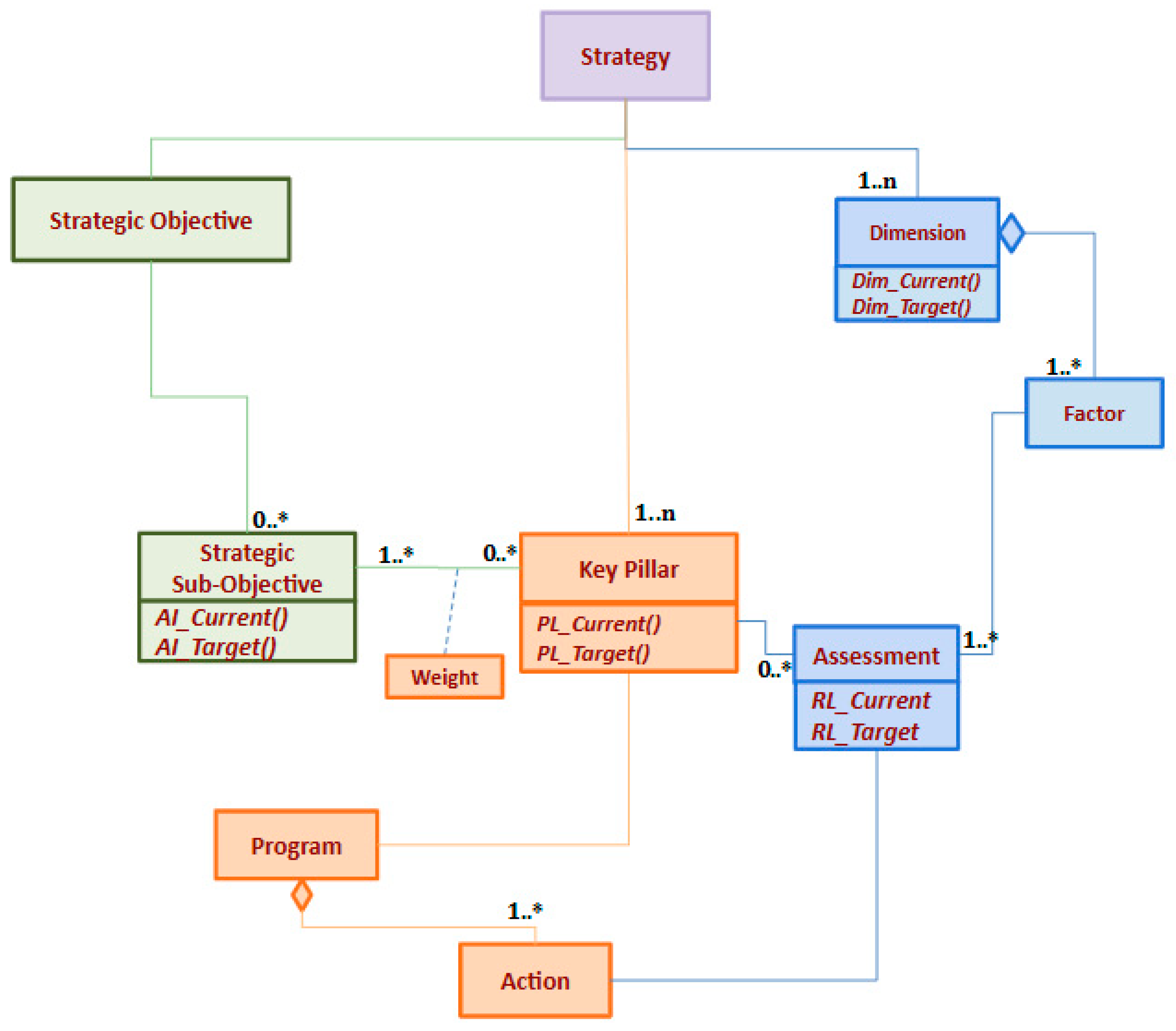
4.1. Conceptual Structure of DGSA and DGPS
- RL_Current represents the current readiness level, determined through an assessment of the existing institutional environment;
- RL_Target represents the desired readiness level that the government aims to achieve. Within the DGPS component, RL_Target is determined by increasing the current readiness level (RL_Current) by +1 (Improve), +2 (Reinforce), or +3 (Strengthen).
- PL_Current reflects the current preparedness level and is calculated based on RL_Current;
- PL_Target reflects the targeted preparedness level and is calculated based on RL_Target.
- AI_Current represents the current achievement indicator, computed from PL_Current and RL_Current;
- AI_Target represents the intended achievement indicator, derived from PL_Target and RL_Target.
4.2. Digital Government Planning Strategy (DGPS)
- Improve (+1): Actions designated to ‘improve’ are focused on making incremental enhancements that address immediate inefficiencies or shortcomings. These are typically quick wins that slightly boost the readiness level, making the environment more conducive to technological adoption without extensive overhauls;
- Reinforce (+2): The ‘reinforce’ actions go a step further by building on the existing strengths or addressing deeper issues that require more substantial changes. These actions are designed to make more significant modifications that fortify the readiness of the factors, ensuring that they are more robust and capable of supporting digital initiatives;
- Strengthen (+3): At the highest level, ‘strengthen’ actions are transformative, aiming to solidify and expand the capabilities of the factors extensively. This category involves strategic, long-term initiatives that fundamentally enhance the overall structure, functionality, and resilience of the digital government framework.
4.3. Digital Platform for DGSA and DGPS Components
5. DGSA and DGPS Applied to Government as a Platform Strategic Objective in Indonesia
5.1. DGSA Applied to Government as a Platform Strategic Objective in Indonesia
5.1.1. Government as a Platform as DGSA Strategic Objective
5.1.2. KP Importance Evaluation with Weights Fixation
5.1.3. Indonesia Environment Readiness and Maturity Level Identification Using DGSA
5.1.4. Government as a Platform SSOs Maturity Levels Identification in Indonesia
5.2. DGPS Applied to Government as a Platform in Indonesia
6. Discussion
7. Conclusions
Author Contributions
Funding
Institutional Review Board Statement
Informed Consent Statement
Data Availability Statement
Conflicts of Interest
Abbreviations
| AI | Achievement indicator |
| DGPS | Digital Government Planning Strategy |
| DGSA | Digital Government Strategic Assessment |
| IT | Information Technology |
| KP | Key Pillars |
| ND_DGE | Number of Digital Government Environment dimension |
| NFk | Number of Factors composing the dimension k |
| OECD | Organisation for Economic Co-operation and Development |
| PL | Preparedness Level |
| RL | Readiness Level |
| SMAC | Social–Mobile–Analytics–Cloud |
| SO | Strategic objectives |
| SSO | sub-strategic objectives |
Appendix A

| Readiness Level | Signification |
|---|---|
| 1 | Government is aware of the considered factor importance vis-à-vis a specific KP |
| 2 | Government starts implementing dedicated actions to reinforce the factor role to set up the KP |
| 3 | Government starts developing dedicated and planned actions to reinforce the factor role to set up the KP |
| 4 | Dedicated strategic action plans and policies are regularly measured |
| 5 | Dedicated strategic plans are regularly updated and continually improved to respond to changes. |
References
- Bryson, J.M.; Bert, G. Strategic Planning for Public and Nonprofit Organizations: A Guide to Strengthening and Sustaining Organizational Achievement, 6th ed.; Wiley: Hoboken, NJ, USA, 2024; ISBN 978-1-394-27403-1. [Google Scholar]
- Wolf, C.; Floyd, S.W. Strategic Planning Research: Toward a Theory-Driven Agenda. J. Manag. 2017, 43, 1754–1788. [Google Scholar] [CrossRef]
- Johnsen, Å. Strategic management thinking and practice in the public sector: A strategic planning for all seasons? Financ. Account. Manag. 2015, 31, 243–268. [Google Scholar] [CrossRef]
- Vial, G. Understanding digital transformation: A review and a research agenda. J. Strateg. Inf. Syst. 2019, 28, 118–144. [Google Scholar] [CrossRef]
- Verhoef, P.C.; Broekhuizen, T.; Bart, Y.; Bhattacharya, A.; Dong, J.Q.; Fabian, N.; Haenlein, M. Digital transformation: A multidisciplinary reflection and research agenda. J. Bus. Res. 2021, 122, 889–901. [Google Scholar] [CrossRef]
- Mergel, I.; Edelmann, N.; Haug, N. Defining digital transformation: Results from expert interviews. Gov. Inf. Q. 2019, 36, 101385. [Google Scholar] [CrossRef]
- OECD. Recommendation of the Council on Digital Government Strategies. Available online: http://www.oecd.org/gov/digitalgovernment/ (accessed on 21 March 2019).
- Antunes, A.L.; Cardoso, E.; Barateiro, J. The Balanced Scorecard Ontology: A Semantic Approach to Enhance Strategy Management. IEEE Eng. Manag. Rev. 2024, 53, 121–140. [Google Scholar] [CrossRef]
- Ma, K.; Bai, L.; Sun, Y.; Pan, T.; Shi, V.; Zhang, Y. Selection of New Projects Considering the Synergistic Relationships in a Project Portfolio. Buildings 2022, 12, 1460. [Google Scholar] [CrossRef]
- Crompvoets, J.; Vancauwenberghe, G.; Ho, S.; Masser, I.; Timo De Vries, W. Governance of national spatial data infrastructures in Europe. Int. J. Spat. Data Infrastruct. Res. 2018, 13, 253–285. [Google Scholar] [CrossRef]
- Yuhang, D.; Rui, H. Research on the public sector’s strategic management process based on dynamic capabilities. Int. J. Sci. Res. Arch. 2023, 10, 469–477. [Google Scholar] [CrossRef]
- Abdi, I.Y. The Effect of Strategic Planning on the Performance of SMEs in Hargeisa. Master’s Thesis, Gollis University, Hargeisa, Somaliland, 2023. [Google Scholar]
- Askim, J.; Døving, E.; Johnsen, Å. Evaluation in Norway: A 25-Year Assessment. Scand. J. Public Adm. 2021, 25, 109–131. [Google Scholar] [CrossRef]
- Zhou, M.; Cao, S.; Wang, R.; Wang, Y. Research on performance Evaluation method to promote sustainable development of opening government affairs. E3S Web Conf. 2021, 251, 02097. [Google Scholar] [CrossRef]
- Bourgeois, I.; Maltais, S. Translating evaluation policy into practice in government organizations. Am. J. Eval. 2022, 44, 353–373. [Google Scholar] [CrossRef]
- Ye, X.; Su, X.; Yao, Z.; Dong, L.; Lin, Q.; Yu, S. How do citizens view digital government services? Study on digital government service quality based on citizen feedback. Mathematics 2023, 11, 3122. [Google Scholar] [CrossRef]
- Mukamurenzi, S. E-Government Service Evaluation in Rwanda: A Design Perspective; Orebro University: Orebro, Sweden, 2019; ISBN 978-91-7529-311-0. [Google Scholar]
- Adjei-Bamfo, P.; Domfeh, K.A.; Bawole, J.N.; Ahenkan, A.; Maloreh-Nyamekye, T.; Adjei-Bamfo, S.; Darkwah, S.A. An e-government framework for assessing readiness for public sector e-procurement in a lower-middle income country. Inf. Technol. Dev. 2020, 26, 742–761. [Google Scholar] [CrossRef]
- Cybersecurity & Infrastructure Security Agency. Cyber Security Evaluation Tool (CSET). Available online: https://www.cisa.gov/ (accessed on 10 December 2025).
- Ivanova, M.; Kulkaev, G.; Tanina, A. Improving the UN methodology of the E-Government Development Index. In Digital Transformation on Manufacturing, Infrastructure & Service; Lecture Notes in Networks and Systems; Springer Nature: Cham, Switzerland, 2023; pp. 111–129. [Google Scholar] [CrossRef]
- European Commission. eGovernment Benchmark 2023. Available online: https://digital-strategy.ec.europa.eu/library/egovernment-benchmark-2023 (accessed on 10 December 2025).
- United Nations Department of Economic and Social Affairs. United Nations e-Government Survey 2022: The Future of Digital Government; United Nations: New York City, NY, USA, 2022; ISBN 978-92-1-123213-4. [Google Scholar]
- World Bank. GovTech Maturity Index 2025: Tracking Public Sector Digital Transformation Worldwide; World Bank: Washington, DC, USA, 2025. [Google Scholar]
- George, B.; Walker, R.M.; Monster, J. Does strategic planning improve organizational performance? A meta-analysis. Public Adm. Rev. 2019, 79, 810–819. [Google Scholar] [CrossRef]
- Attard-Frost, B.; Brandusescu, A.; Lyons, K. The governance of artificial intelligence in Canada: Findings and opportunities from a review of 84 AI governance initiatives. Gov. Inf. Q. 2024, 41, 101929. [Google Scholar] [CrossRef]
- Echendu, A.J. Adapting the Singapore Model to Nigeria’s Urban Management. Possibilities and Challenges. J. ERSA Powered WU 2022, 9, 115–133. [Google Scholar] [CrossRef]
- Korachi, Z.; Bounabat, B. Towards a Platform for Defining and Evaluating Digital Strategies for Building Smart Cities. In Proceedings of the 3rd International Conference on Smart Grid and Smart Cities, Berkeley, CA, USA, 25–28 June 2019; ICSGSC 2019; IEEE: Piscataway, NJ, USA, 2019; pp. 32–40. [Google Scholar] [CrossRef]
- Korachi, Z.; Bounabat, B. Towards a Frame of Reference for Smart City Strategy Development and Governance. J. Comput. Sci. 2020, 16, 1451–1464. [Google Scholar] [CrossRef]
- Raja, M.; Kymre, I.G.; Bjerkan, J.; Galvin, K.T.; Uhrenfeldt, L. National digital strategies and innovative eHealth policies concerning older adults’ dignity: A document analysis in three Scandinavian countries. BMC Health Serv. Res. 2023, 23, 848. [Google Scholar] [CrossRef]
- Janowski, T. Digital government evolution: From transformation to contextualization. Gov. Inf. Q. 2015, 32, 221–236. [Google Scholar] [CrossRef]
- Valdés, G.; Solar, M.; Astudillo, H.; Iribarren, M.; Concha, G.; Visconti, M. Conception, development and implementation of an e-Government maturity model in public agencies. Gov. Inf. Q. 2011, 28, 176–187. [Google Scholar] [CrossRef]
- Malodia, S.; Dhir, A.; Mishra, M.; Bhatti, Z.A. Future of e-Government: An integrated conceptual framework. Technol. Forecast. Soc. Change 2021, 173, 121102. [Google Scholar] [CrossRef]
- Darusalam, D.; Janssen, M.; Said, J.; Sanusi, Z.; Omar, N. An evaluation framework for the impact of digitalization on the quality of governance: Evidence from Indonesia. Int. J. Public Adm. Digit. Age 2023, 10, 1–21. [Google Scholar] [CrossRef]
- Zhu, B.; Zhong, R.; Wei, C. Measuring digital government service performance: Evidence from China. China Econ. Rev. 2024, 83, 102105. [Google Scholar] [CrossRef]
- Pašalić, I.N.; Ćukušić, M. Understanding e-participation adoption: Exploring technological, organizational, and environmental factors. Technol. Forecast. Soc. Change 2024, 207, 123633. [Google Scholar] [CrossRef]
- Kumar, S.; Baishya, K.; Sadarangani, P.H.; Samalia, H.V. Cultural Influence on e-Government Development. Electron. J. Inf. Syst. Eval. 2020, 23, 17–33. [Google Scholar] [CrossRef]
- Budai, B.B.; Csuhai, S.; Tózsa, I. Digital Competence Development in Public Administration Higher Education. Sustainability 2023, 15, 12462. [Google Scholar] [CrossRef]
- Trondal, J. The organizational dimension of global governance. In Governing the Contemporary Administrative State; European Administrative Governance; Palgrave Macmillan: Cham, Switzerland, 2023; pp. 295–325. [Google Scholar] [CrossRef]
- Radojičić, Z.V.; Vučetić, D. The European Principles of Public Administration Services Delivery from the Perspective of Digitalization and Simplification: Normative Framework and Practise in the Republic of Serbia. ECLIC 2023, 7, 219–242. [Google Scholar] [CrossRef]
- European Commission. Non-Paper on the IT Governance of the CEF Building Block Digital Service Infrastructures (DSIs); Directorate-General for Communications Networks, Content and Technology: Brussels, Belgium, 2018. [Google Scholar]
- Gasco-Hernandez, M.; Gil-Garcia, J.R.; Luna-Reyes, L.F. Unpacking the role of technology, leadership, governance and collaborative capacities in inter-agency collaborations. Gov. Inf. Q. 2022, 39, 101710. [Google Scholar] [CrossRef]
- Torfing, J.; Ansell, C. Strengthening political leadership and policy innovation through the expansion of collaborative forms of governance. In Political Innovations; Routledge: London, UK, 2020; pp. 37–54. [Google Scholar] [CrossRef]
- Wu, Y. Protecting personal data in e-government: A cross-country study. Gov. Inf. Q. 2014, 31, 150–159. [Google Scholar] [CrossRef]
- Simes, R.; O’Mahony, J.; Hillard, R.; Dong, R.; Harper, I.; Farrall, F.; Thiru Moorthy, S. Digital Government Transformation; Deloitte Access Economics Pty Ltd.: Sydney, Australia, 2015. [Google Scholar]
- Khabouze, R. Modernization of Legacy Information Technology Systems–ProQuest. 2022. Available online: https://www.proquest.com/openview/0f713e11f96546e4d285288438e6fb81/1?pq-origsite=gscholar&cbl=18750&diss=y (accessed on 15 March 2026).
- OECD. Recommendation of the Council on OECD Legal Instruments Digital Government Strategies. 2014. Available online: https://legalinstruments.oecd.org/en/instruments/OECD-LEGAL-0406 (accessed on 10 March 2026).
- Schedler, K. Business model innovation and the financial dimension of strategy in the public sector. In Handbook on Strategic Public Management; Edward Elgar Publishing: Cheltenham, UK, 2023; pp. 211–226. [Google Scholar] [CrossRef]
- Deblander, N. Glocal Sourcing: How to Combine Global and Local Sourcing? A Case Study Within FMCG Industry. Master’s Thesis, Louvain School of Management, Ottignies-Louvain-la-Neuve, Belgium, 2023. [Google Scholar]
- Hujran, O.; Al-Debei, M.M.; Al-Adwan, A.S.; Alarabiat, A.; Altarawneh, N. Examining the antecedents and outcomes of smart government usage: An integrated model. Gov. Inf. Q. 2023, 40, 101783. [Google Scholar] [CrossRef]
- Campmas, A.; Iacob, N.; Simonelli, F. How Can Interoperability Stimulate the Use of Digital Public Services? An Analysis of National Interoperability Frameworks and e-Government in the European Union. Data Policy 2022, 4, e19. [Google Scholar] [CrossRef]
- Robles-Carrillo, M. Digital identity: An approach to its nature, concept, and functionalities. Int. J. Law Inf. Technol. 2024, 32, eaae019. [Google Scholar] [CrossRef]
- Almufarreh, A.; Arshad, M. Promising Emerging technologies for teaching and learning: Recent developments and future challenges. Sustainability 2023, 15, 6917. [Google Scholar] [CrossRef]
- Dhudasia, M.B.; Grundmeier, R.W.; Mukhopadhyay, S. Essentials of data management: An overview. Pediatr. Res. 2023, 93, 2–3. [Google Scholar] [CrossRef]
- Reddick, C.G.; Turner, M. Channel choice and public service delivery in Canada: Comparing e-government to traditional service delivery. Gov. Inf. Q. 2012, 29, 1–11. [Google Scholar] [CrossRef]
- Kurti, S.; Kina, K. Citizen Satisfaction’s Determinants with the Integrated Public Services Quality Provided by One-Stop-Shop. A Case from a Western Balkan Country. Public Policy Adm. 2024, 23, 369–381. [Google Scholar] [CrossRef]
- Aristovnik, A.; Ravšelj, D.; Murko, E. Decoding the Digital Landscape: An Empirically Validated Model for Assessing Digitalisation across Public Administration Levels. Adm. Sci. 2024, 14, 41. [Google Scholar] [CrossRef]
- Gong, Y.; Yang, X. Understanding Strategies for Digital Government Transformation: A strategic action fields perspective. Int. J. Inf. Manag. 2024, 76, 102766. [Google Scholar] [CrossRef]
- Gil-Garcia, J.R. Enacting Electronic Government Success: An Integrative Study of Government-Wide Websites, Organizational Capabilities, and Institutions; Springer: Berlin/Heidelberg, Germany, 2012. [Google Scholar]
- OECD. Digital Government Index: 2019 Results; OECD Public Governance Policy Papers, No. 03; OECD Publishing: Paris, France, 2020. [Google Scholar] [CrossRef]
- World Bank. Digital Economy for Africa (DE4A) Initiative; World Bank: Washington, DC, USA, 2020. [Google Scholar]
- Halim, S.; Bounabat, B. A conceptual framework for assessment of digital Government strategy environment. Application to digital Government development in Africa. In E-Society and Mobile Learning 2023, Lisbon, Portugal, 11–13 March 2023; Curran Associates, Inc.: Red Hook, NY, USA, 2023; ISBN 978-989-8704-47-4. [Google Scholar]
- Halim, S.; Bounabat, B. Strategic digital environment assessment vis-à-vis a regional strategic digital government framework. application to OECD digital government policy framework in Estonia. In E-Society and Mobile Learning 2023, Lisbon, Portugal, 11–13 March 2023; Curran Associates, Inc.: Red Hook, NY, USA, 2024; ISBN 978-989-8704-55-9. [Google Scholar]
- Kolesnik, E.; Pavlova, L.; Rybalova, T. Effectiveness evaluation of implementation of target programs for municipal education: Improvement of approaches. Public Policy Adm. 2018, 17, 568–585. [Google Scholar] [CrossRef]
- Styrin, E.; Mossberger, K.; Zhulin, A. Government as a Platform: Intergovernmental Participation for Public Services in the Russian Federation. Gov. Inf. Q. 2022, 39, 101627. [Google Scholar] [CrossRef]
- Scupola, A.; Mergel, I. Co-Production in Digital Transformation of Public Administration and Public Value Creation: The Case of Denmark. Gov. Inf. Q. 2022, 39, 101650. [Google Scholar] [CrossRef]
- Schmitz, A.; Wimmer, M.A. Framework for interoperable service architecture development. Gov. Inf. Q. 2023, 40, 101869. [Google Scholar] [CrossRef]
- Wouters, S.; Janssen, M.; Lember, V.; Crompvoets, J. Strategies to advance the dream of integrated digital public service delivery in inter-organizational collaboration networks. Gov. Inf. Q. 2023, 40, 101779. [Google Scholar] [CrossRef]
- Janssen, M.; Brous, P.; Estevez, E.; Barbosa, L.S.; Janowski, T. Data governance: Organizing data for trustworthy artificial intelligence. Gov. Inf. Q. 2020, 37, 101493. [Google Scholar] [CrossRef]
- Kemppainen, L.; Kemppainen, T.; Kouvonen, A.; Shin, Y.; Lilja, E.; Vehko, T.; Kuusio, K. Electronic identification (e-ID) as a socio-technical system moderating migrants’ access to essential public services: The case of Finland. Gov. Inf. Q. 2023, 40, 101839. [Google Scholar] [CrossRef]
- Scholta, H.; Mertens, W.; Kowalkiewicz, M.; Becker, J. From one-stop shop to no-stop shop: An e-government stage model. Gov. Inf. Q. 2019, 36, 11–26. [Google Scholar] [CrossRef]
- Janowski, T.; Estevez, E.; Baguma, R. Platform governance for sustainable development: Reshaping citizen-administration relationships in the digital age. Gov. Inf. Q. 2018, 35, S1–S16. [Google Scholar] [CrossRef]
- de Sousa, W.G.; de Melo, E.R.P.; Bermejo, P.H.D.S.; Farias, R.A.S.; Gomes, A.O. How and where is artificial intelligence in the public sector going? A literature review and research agenda. Gov. Inf. Q. 2019, 36, 101392. [Google Scholar] [CrossRef]
- Ramadhan, A.; Suhendra, A.; Yohanitas, W.A. One Data Indonesia: A retrospective analysis of data interoperability in declaring regional planning and development. KnE Soc. Sci. 2025, 10, 152–171. [Google Scholar] [CrossRef]
- Rusmini, R.; Deliarnoor, N.A.; Yuningsih, N.Y.; Sagita, N.I. Rethinking e-government failure: A readiness-based assessment of Indonesia’s digitalization efforts. Cogent Soc. Sci. 2025, 11, 2559867. [Google Scholar] [CrossRef]
- Sabani, A.; Thai, V.; Hossain, M.A. Factors affecting citizen adoption of e-government in developing countries: An exploratory case study from Indonesia. J. Glob. Inf. Manag. 2023, 31, 1–23. [Google Scholar] [CrossRef]
- Kartiasih, F.; Nachrowi, N.D.; Wisana, I.D.G.K.; Handayani, D. Inequalities of Indonesia’s regional digital development and its association with socioeconomic characteristics: A spatial and multivariate analysis. Inf. Technol. Dev. 2023, 29, 299–328. [Google Scholar] [CrossRef]
- Malik, A.; Novelia, A.; Mukri, M.; Baharuddin, S.A. The Influence of Digital Economic Growth and Productive Work Force Toward Human Development Index in Indonesia Viewed from a Maqashid Sharia Perspective. Int. J. Islam. Econ. 2024, 6, 188–201. [Google Scholar] [CrossRef]

| Maturity Level | AI (SSO) | Significance: The Environment Necessary to Achieve the SSO Is |
|---|---|---|
| 0—Initial | [0,1[ | limited, and its development process is unpredictable |
| 1—Developing | [1,2[ | implemented by dedicated projects, and its development process is frequently reactive |
| 2—Defined | [2,3[ | implemented through planned projects, and its development process is more proactive |
| 3—Managed | [3,4[ | implemented by proactive and regularly measured strategic action plans and policies |
| 4—Integrated | [4,5[ | implemented by dedicated measured and continually improved |
| Strategic Objective | Strategic Sub-Objective | Definition |
|---|---|---|
| Government as a platform | Shared infrastructure | The development of common digital assets and reusable components that support standardized and scalable service delivery across government. |
| Cross-agency service integration | The ability of public institutions to connect systems, exchange data, and integrate workflows across organizational boundaries. | |
| Collaborative government | The involvement of citizens, businesses, civil society, and other stakeholders in the design, delivery, and improvement of digital public services |
| Strategic Objective | Strategic Sub-Objective | Interoperability | Digital Identity | Emerging Technologies | Data Management | Multi-Channel Digital Services | One-Stop-Shop Portals |
|---|---|---|---|---|---|---|---|
| Government as a platform | Shared infrastructure | 0.247 | 0.213 | 0.114 | 0.131 | 0.152 | 0.143 |
| Cross-agency service integration | 0.315 | 0.182 | 0.106 | 0.205 | 0.074 | 0.118 | |
| Collaborative government | 0.127 | 0.124 | 0.133 | 0.136 | 0.242 | 0.238 |
| Environment Dimension | Factors | Interoperability | Digital Identity | Emerging Technologies | Data Management | Multi-Channel Digital Services | One-Stop-Shop Portals |
|---|---|---|---|---|---|---|---|
| Organizational | Institutional autonomy in IT acquisition | 3 | 3 | 3 | 3 | 3 | 3 |
| Role and responsibility clarity | 3 | 3 | 3 | 4 | 3 | 3 | |
| Administrative simplification | 3 | 3 | 3 | 3 | 4 | 4 | |
| Organizational Value | 3 | 3 | 3 | 3.33 | 3.33 | 3.33 | |
| Human | Innovation-oriented workforce | 3 | 3 | 4 | 3 | 3 | 3 |
| Cultural alignment and acceptance | 3 | 3 | 3 | 3 | 3 | 3 | |
| Citizen digital readiness | 3 | 3 | 3 | 3 | 4 | 4 | |
| Human Value | 3 | 3 | 3.33 | 3 | 3.33 | 3.33 | |
| Financial | Funding for digital government initiatives | 4 | 4 | 3 | 4 | 4 | 4 |
| Investment promotion capacity | 3 | 3 | 4 | 3 | 3 | 3 | |
| Incentive and award schemes | 3 | 3 | 3 | 3 | 3 | 3 | |
| Public procurement financial management | 3 | 3 | 3 | 3 | 3 | 3 | |
| Financial Value | 3.25 | 3.25 | 3.25 | 3.25 | 3.25 | 3.25 | |
| Governance | Governance structure clarity | 4 | 4 | 3 | 4 | 4 | 4 |
| Stakeholder collaboration | 4 | 3 | 3 | 4 | 4 | 4 | |
| Accountability and coordination mechanisms | 3 | 3 | 3 | 4 | 3 | 3 | |
| Governance Value | 3.67 | 3.33 | 3 | 4 | 3.67 | 3.67 | |
| Technical | Legacy systems management | 3 | 3 | 3 | 3 | 3 | 3 |
| Infrastructure sharing capacity | 4 | 3 | 3 | 4 | 4 | 4 | |
| Converged networks and services | 3 | 3 | 3 | 4 | 4 | 4 | |
| Adoption of disruptive technologies | 3 | 3 | 4 | 3 | 3 | 3 | |
| Technical Value | 3.25 | 3 | 3.25 | 3.5 | 3.5 | 3.5 | |
| Legal | Citizen protection and rights | 3 | 3 | 3 | 3 | 4 | 3 |
| Coverage and adequacy of the legal framework | 4 | 4 | 3 | 4 | 4 | 4 | |
| Quality of IT regulation | 3 | 3 | 3 | 3 | 3 | 3 | |
| Intellectual property protection | 3 | 3 | 4 | 3 | 3 | 3 | |
| Legal Value | 3.25 | 3.25 | 3.25 | 3.25 | 3.5 | 3.25 | |
| PL_Current (KP) | 3.24 | 3.14 | 3.18 | 3.39 | 3.43 | 3.39 | |
| Strategic Objective | Strategic Sub-Objective | AI_Current | Maturity Level |
|---|---|---|---|
| Government as a platform | Shared infrastructure | 3.28 | 3—Managed |
| Cross-agency service integration | 3.28 | 3—Managed | |
| Collaborative government | 3.32 | 3—Managed |
| Environment Dimension | Action | Interoperability | Digital Identity | Emerging Technologies | Data Management | Multi-Channel Digital Services | One-Stop-Shop Portals |
|---|---|---|---|---|---|---|---|
| Organizational | Reinforce Institutional autonomy in IT acquisition | 5 | 5 | 5 | 5 | 5 | 5 |
| Improve Role and responsibility clarity | 4 | 4 | 4 | 5 | 4 | 4 | |
| Improve Administrative simplification | 4 | 4 | 4 | 4 | 5 | 5 | |
| Organizational Target Value | 4.33 | 4.33 | 4.33 | 4.67 | 4.67 | 4.67 | |
| Human | Improve Innovation-oriented workforce | 4 | 4 | 5 | 4 | 4 | 4 |
| Reinforce Cultural alignment and acceptance | 5 | 5 | 5 | 5 | 5 | 5 | |
| Improve Citizen digital readiness | 4 | 4 | 4 | 4 | 5 | 5 | |
| Human Target Value | 4.33 | 4.33 | 4.67 | 4.33 | 4.67 | 4.67 | |
| Financial | Improve Funding for digital government initiatives | 5 | 5 | 4 | 5 | 5 | 5 |
| Improve Investment promotion capacity | 4 | 4 | 5 | 4 | 4 | 4 | |
| Reinforce Incentive and award schemes | 5 | 5 | 5 | 5 | 5 | 5 | |
| Reinforce Public procurement financial management | 5 | 5 | 5 | 5 | 5 | 5 | |
| Financial Target Value | 4.75 | 4.75 | 4.75 | 4.75 | 4.75 | 4.75 | |
| Technical | Reinforce Legacy systems management | 5 | 5 | 5 | 5 | 5 | 5 |
| Improve Infrastructure sharing capacity | 5 | 4 | 4 | 5 | 5 | 5 | |
| Improve Converged networks and services | 4 | 4 | 4 | 5 | 5 | 5 | |
| Improve Adoption of disruptive technologies | 4 | 4 | 5 | 4 | 4 | 4 | |
| Technical Target Value | 4.5 | 4.25 | 4.5 | 4.75 | 4.75 | 4.75 | |
| Governance | Governance Value | 3.67 | 3.33 | 3 | 4 | 3.67 | 3.67 |
| Legal | Legal Value | 3.25 | 3.25 | 3.25 | 3.25 | 3.5 | 3.25 |
| PL_Target (KP) | 4.14 | 4.14 | 4.14 | 4.14 | 4.14 | 4.14 | |
| Strategic Objective | Strategic Sub-Objective | AI_Target | Maturity Level |
|---|---|---|---|
| Government as a platform | Shared infrastructure | 4.18 | 4—Integrated |
| Cross-agency service integration | 4.18 | 4—Integrated | |
| Collaborative government | 4.22 | 4—Integrated |
Disclaimer/Publisher’s Note: The statements, opinions and data contained in all publications are solely those of the individual author(s) and contributor(s) and not of MDPI and/or the editor(s). MDPI and/or the editor(s) disclaim responsibility for any injury to people or property resulting from any ideas, methods, instructions or products referred to in the content. |
© 2026 by the authors. Licensee MDPI, Basel, Switzerland. This article is an open access article distributed under the terms and conditions of the Creative Commons Attribution (CC BY) license.
Share and Cite
Halim, S.; Bounabat, B. From Assessment to Action: A Decision-Support Methodology for Digital Government Transformation. Sustainability 2026, 18, 4362. https://doi.org/10.3390/su18094362
Halim S, Bounabat B. From Assessment to Action: A Decision-Support Methodology for Digital Government Transformation. Sustainability. 2026; 18(9):4362. https://doi.org/10.3390/su18094362
Chicago/Turabian StyleHalim, Sara, and Bouchaib Bounabat. 2026. "From Assessment to Action: A Decision-Support Methodology for Digital Government Transformation" Sustainability 18, no. 9: 4362. https://doi.org/10.3390/su18094362
APA StyleHalim, S., & Bounabat, B. (2026). From Assessment to Action: A Decision-Support Methodology for Digital Government Transformation. Sustainability, 18(9), 4362. https://doi.org/10.3390/su18094362