1. Introduction
In recent years, increasing attention to integrated urban water management has underscored the critical role of WWTPs as the final safeguard for the quality of urban receiving waters [
1]. In China, most municipal WWTPs are designed and operated to meet the Class A discharge limits specified in the Discharge Standard of Pollutants for Municipal Wastewater Treatment Plants (GB 18918-2002) [
2].
To further improve water quality in the Yellow River Basin and meet surface water pollution control objectives, Shaanxi Province formulated and implemented the Comprehensive Wastewater Discharge Standard for the Yellow River Basin in Shaanxi Province (DB 61/224-2018) [
3,
4]. This local standard requires municipal WWTPs with a design capacity exceeding 2000 m
3/d to meet the Class IV surface water quality standards at their discharge outlets. However, most existing WWTPs were constructed years ago under less stringent design criteria and are increasingly unable to comply with the tightened effluent limits and rising hydraulic loading demands. Consequently, extensive process retrofitting and compliance upgrading have become essential to ensure stable long-term operation under the updated regulatory framework [
5].
Due to repeated upgrades and retrofits, many existing WWTPs have complex internal piping and face significant space constraints [
6]. In this context, meeting the quasi-Class IV surface water discharge standards requires performance optimization of biological treatment units [
7]. This involves a comprehensive reassessment of the existing process layout, optimization of external carbon dosing strategies, and prudent selection of sludge retention time (SRT) to maintain the metabolic activity of nitrifying bacteria [
8], denitrifiers [
9], and polyphosphate-accumulating organisms (PAOs) [
10], thereby enhancing simultaneous nitrogen and phosphorus removal.
At the same time, increasing the effective concentration of suspended activated sludge and optimizing the spatial distribution of functional microorganisms within bioreactors are key strategies for process intensification. Technologies such as moving-bed biofilm reactors (MBBR) [
11,
12] and membrane bioreactors (MBR) [
13] enable substantial increases in biomass concentration while creating a more favorable habitat for functional microbes, without increasing the reactor footprint. These advantages have rendered them widely adopted in capacity expansion and advanced treatment retrofits of WWTPs.
The structure and function of microbial communities are fundamental to the operational stability and treatment performance of wastewater systems, and their importance becomes even more evident under adverse conditions such as low temperatures. As autotrophic microorganisms, nitrifying bacteria grow slowly and are highly sensitive to temperature; low temperatures can markedly inhibit nitrification activity and thereby impair ammonia removal. Denitrifying bacteria are mainly heterotrophic and use organic carbon as an electron donor, and their denitrification efficiency depends not only on temperature but also strongly on the carbon-to-nitrogen (C/N) ratio of the influent and the bioreactor environment. Polyphosphate-accumulating organisms (PAOs) remove phosphorus through the pathway of anaerobic phosphorus release followed by aerobic/anoxic phosphorus uptake, and they are highly sensitive to key operational parameters, including dissolved oxygen (DO), sludge retention time (SRT), and the configuration and control of anaerobic and aerobic zones. Therefore, optimizing microbial community structure and enhancing the abundance and activity of core functional groups, including nitrifiers, denitrifiers, and PAOs, are important strategies for improving process resilience under low-temperature conditions and enhancing nitrogen and phosphorus removal in wastewater treatment plants.
To address effluent non-compliance at a municipal WWTP in Henan Province, Qiao retrofitted the plant by adding an anaerobic tank and upgrading the original oxidation ditch to an A
2/O + MBBR + O
3 configuration [
14]. After the reconstruction, all effluent quality indicators met the quasi-Class IV surface water standard. In another case, a WWTP in Anhui Province initially adopted an anaerobic + Orbal oxidation ditch process; Liu et al. upgraded the system to an “A
2/O–MBBR + secondary clarifier + filtration” process, achieving stable compliance with local discharge standards [
9]. Furthermore, Chen and co-workers retrofitted a WWTP in Ningbo using an A
2/O process coupled with MBR, supplemented by a high-efficiency clarifier and a denitrifying deep-bed filter. Their results verified that both treatment trains consistently satisfied the quasi-Class IV surface water standard [
10].
Collectively, these studies have shown that both MBBR and MBR technologies can substantially increase the mixed liquor suspended solids (MLSS) concentration in biological reactors, reduce sludge loading, enhance nitrogen and phosphorus removal, and improve the shock-load resistance of activated sludge systems. However, compared with MBR, MBBR-based processes typically require additional advanced treatment units, such as ozonation and post-denitrification filtration, to meet the quasi-Class IV surface water standards, thereby necessitating the construction of more treatment facilities.
This study presents the upgrading of a municipal WWTP in northern China. The existing treatment train was systematically assessed for its operational performance, and the corresponding pollutant loading rates were quantified. The proposed upgrade strategy centers on three core measures: increasing the effective volume of the biological reactors, raising MLSS concentrations, and reconfiguring the biological treatment units into optimized staged compartments. Furthermore, this study investigates the theoretical pollutant removal efficiencies of the retrofitted process under varying temperature conditions, as well as the succession patterns of microbial communities and the full-scale operational performance after reconstruction. The findings aim to provide a theoretical basis and practical design guidance for similar WWTP upgrading projects in Northwest China.
To address the research gap and clarify the innovative contributions, it is emphasized that previous studies have mostly focused on the separate application of MBBR or MBR for WWTP upgrading, and few have investigated the combined strategy of oxidation ditch volume expansion via wall height raising and MBR integration—especially for WWTPs in northern China characterized by long-term low-temperature conditions, severe land constraints and stringent discharge standards. Meanwhile, the microbial response mechanism and low-temperature adaptation characteristics of this combined retrofit strategy have not been fully revealed. This study fills this gap by proposing a land-saving retrofit solution, revealing the core improvement mechanisms, and providing practical engineering parameters for cold-region WWTPs.
Despite the wide application of MBBR and MBR technologies in WWTP upgrading, existing studies have critical research gaps and limitations for WWTPs in northern China under the dual constraints of long-term low temperatures and severe land scarcity: (1) most studies focus on the separate application of MBBR or MBR, and few investigate the combined retrofit strategy of oxidation ditch volume expansion via wall height raising and MBR integration—a land-saving modification method that fully utilizes existing facilities without new land acquisition; (2) MBBR-based upgrading processes typically require additional advanced treatment units (e.g., ozonation, denitrification filtration) to meet quasi-Class IV surface water standards, which increases construction investment and process complexity, while the synergistic effect of oxidation ditch HRT extension and MBR solid-liquid separation on low-temperature pollutant removal has not been systematically explored; (3) the microbial response mechanism (e.g., functional bacteria enrichment, low-temperature adaptation) and engineering parameter system of the above combined strategy for northern cold-region WWTPs with carbon source limitation (BOD5/TN = 3.0~4.0) remain unrevealed.
This study presents the sustainable upgrading of a municipal WWTP in northern China under the dual constraints of low winter temperature and limited land availability. Unlike conventional expansion-oriented upgrading strategies, the proposed retrofit combines oxidation ditch wall-height raising and MBR integration to improve effluent quality without constructing new large-scale biological treatment units. The study evaluates the hydraulic and sludge-loading changes, low-temperature pollutant removal capacity, microbial community succession, and full-scale operational performance after reconstruction. By linking WWTP effluent improvement with the water quality protection needs of the Yellow River Basin, this study provides a practical engineering reference for sustainable wastewater infrastructure upgrading in cold and land-constrained regions.
2. Materials and Methods
2.1. Overview of the WWTP
The WWTP has a design capacity of 50,000 m3/d, and its effluent consistently complies with the Class A discharge limits specified in the Discharge Standard of Pollutants for Municipal Wastewater Treatment Plants (GB 18918-2002). The plant adopts an oxidation ditch process, followed by secondary clarification, filtration, and final disinfection.
The biological treatment unit has a total effective volume of 37,280 m3, consisting of 23,278 m3 for the aerobic zone, 11,194 m3 for the anoxic zone, and 2808 m3 for the anaerobic zone, with an average MLSS concentration of approximately 4000 mg/L.
2.2. Analysis of Project Operational Performance and Identified Issues
The influent wastewater was characterized by an imbalanced nutrient composition. The average BOD5/COD ratio was 0.54, indicating a high fraction of biodegradable organic matter and favorable overall biodegradability. However, the average BOD5/TN ratio was 3.68, slightly lower than the widely accepted optimal value of 4. For conventional biological nitrogen and phosphorus removal processes (e.g., A2/O and oxidation ditch systems), a BOD5/TN ratio above 4 is typically required to supply sufficient organic carbon for efficient denitrification. This indicates that the denitrification process in this WWTP was likely constrained by insufficient organic carbon.
Liu et al. [
9] reported a negative correlation between the SS/BOD
5 ratio and denitrification rate; specifically, an elevated SS/BOD
5 ratio reduces denitrification kinetics in biological treatment systems. An SS/BOD
5 ratio of approximately 1.2 is considered favorable for achieving efficient and stable denitrification. In contrast, the influent of this WWTP had an average SS/BOD
5 ratio of 1.44, with values exceeding 1.5 for about 40% of the operating year. Such conditions further suppress the denitrification rate and restrict the efficient utilization of the already limited carbon source by denitrifying bacteria in the anoxic zone, ultimately deteriorating the overall nitrogen removal performance of the system.
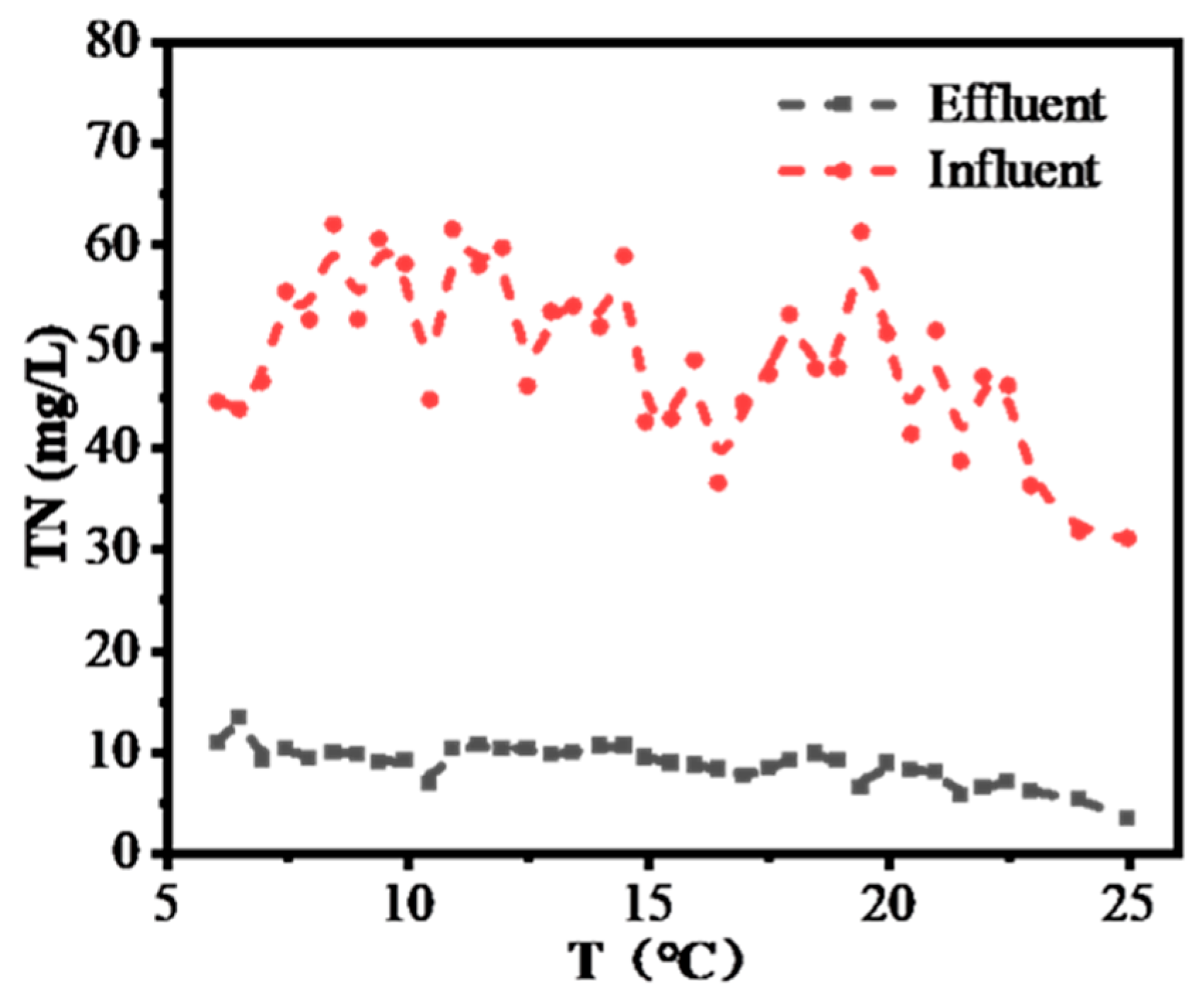
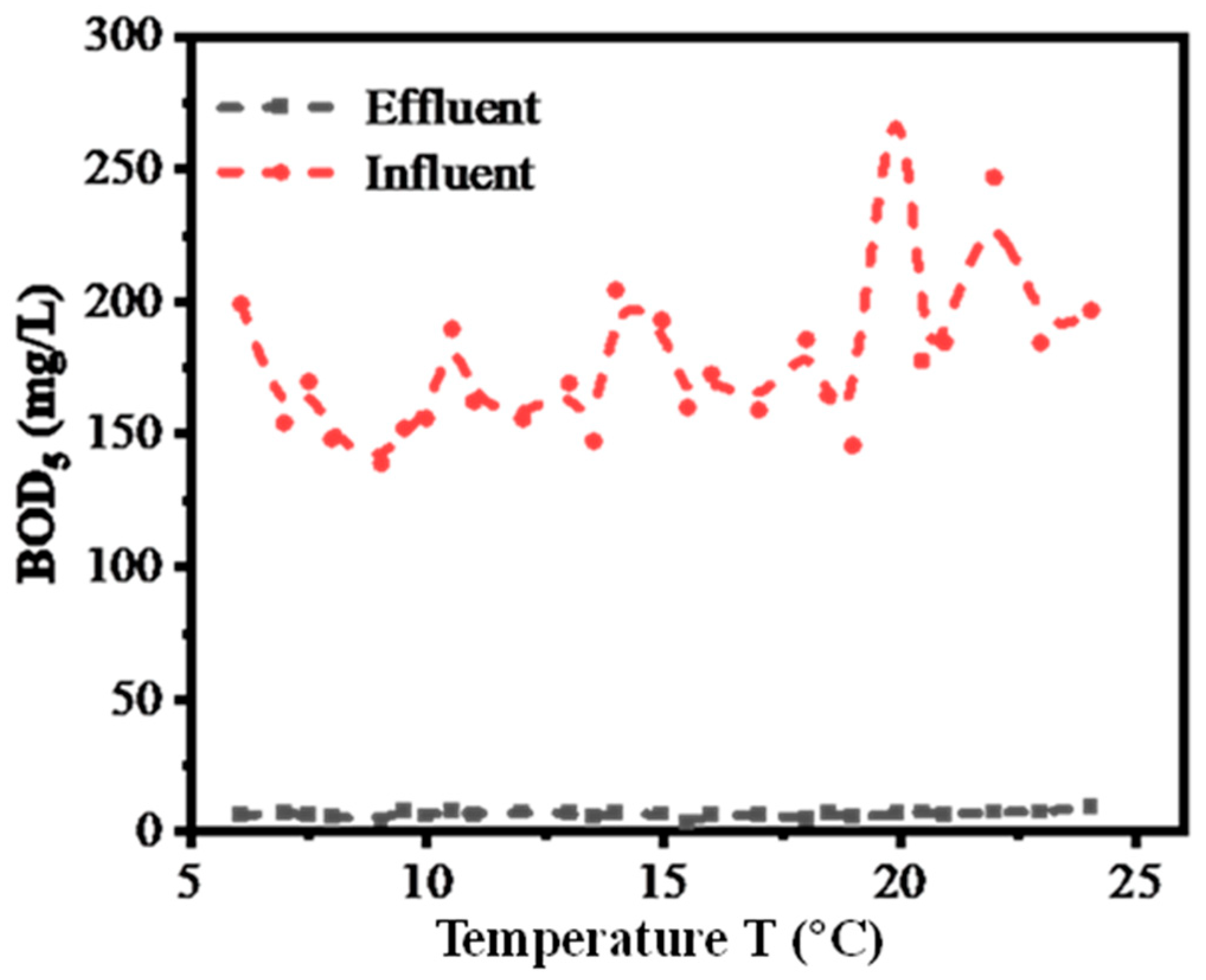
The influent temperature of the WWTP varied between 6.0 and 25.0 °C, with an annual average of 15.4 °C. Monthly influent temperatures are statistically summarized in
Table 1. As shown in
Table 1, the monthly average temperature dropped below 15.0 °C from January to April and November to December, indicating that the plant operated under low-temperature conditions for roughly half the year. These conditions markedly inhibited microbial activity and the associated nitrification and denitrification processes, leading to weakened shock-load resistance and greater fluctuation in effluent quality. Furthermore, the average influent temperature in January and February fell below 10 °C, causing a drastic reduction in the nitrification capacity of the activated sludge system. To maintain stable effluent quality during these periods, the plant had to reduce the influent flow rate to prolong the HRT and mitigate sludge loading.
The design representativeness of influent quality in the original scheme was significantly inadequate. Investigations revealed that the guarantee rates for COD and SS were only approximately 70%, while the rate for TP was roughly 60%. For NH4+-N, the guarantee rate was a mere 31.45%. These results demonstrate that the influent quality assumed in the original design cannot meet the operational requirements of the existing WWTP.
2.3. Design Water Volume and Influent and Effluent Water Quality
Operational performance analysis of the WWTP showed that the original treatment system exhibited poor resistance to hydraulic and organic shock loads, leading to substantial fluctuations in effluent quality. Accordingly, the design capacity for the upgrade project was set at 50,000 m3/d, consistent with the existing treatment capacity.
For the design of influent and effluent quality criteria, a frequency analysis was performed using one-year actual influent quality data. The design influent quality for the upgrade project was determined based on a 90% confidence level. The effluent was required to meet the Class A requirements specified in the Integrated Wastewater Discharge Standard for the Yellow River Basin in Shaanxi Province (DB 61/224-2018). The key design parameters and corresponding discharge limits are summarized in
Table 2.
2.4. Performance Assessment of the Original Process
The pollutant removal efficiencies of the original system were determined using Equations (1)–(6). All variables are clearly defined with standard international units, and the key computational assumptions are listed below. Detailed derivations and validations of these equations are provided in the
Supplementary Materials.
The parameters in the equations are defined as follows:
Vn: Effective volume of anaerobic zone m3
Q: Design flow rate of biological reactor m3/d
X: Average MLSS concentration in biological reactor mg/L
Nk: Influent TKN concentration of biological reactor mg/L
Nte: Effluent TN concentration of biological reactor mg/L
ΔXV: Microbial mass discharged from biological system kg/d
Kde: Denitrification rate constant d−1
T: Influent wastewater temperature °C
Yt: Total sludge production yield coefficient Dimensionless
y: Ratio of MLVSS to MLSS Dimensionless
SO: Influent BOD5 concentration of biological reactor mg/L
Se: Effluent BOD5 concentration of biological reactor mg/L
VO: Effective volume of aerobic zone m3
θco: Design sludge age of aerobic zone d
F: Safety factor Dimensionless
μ: Specific growth rate of nitrifying bacteria d−1
Na: Influent NH4+-N concentration of biological reactor mg/L
Kn: Half-saturation constant for nitrification mg/L
As listed in
Table 2, the design influent concentrations of BOD
5 and TN were 210 mg/L and 60 mg/L, respectively. To meet the effluent discharge limits, the biological treatment units were required to reduce BOD
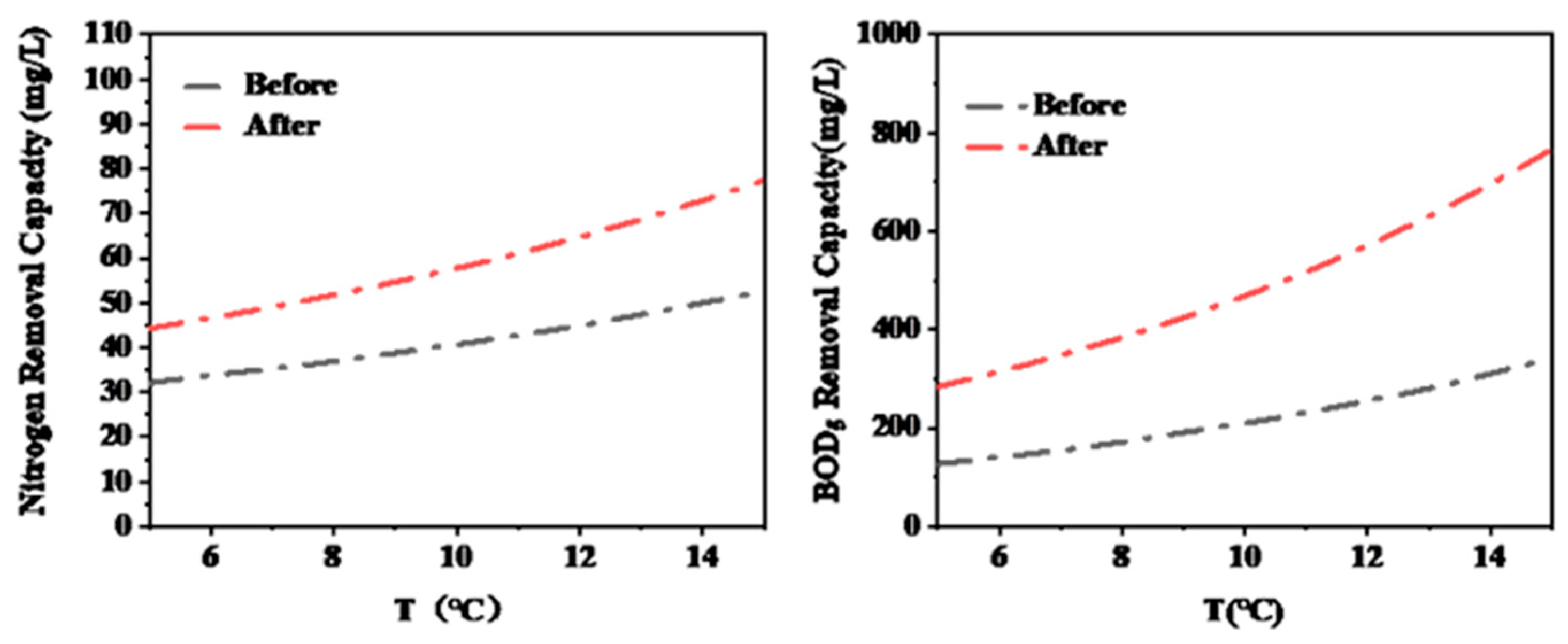
5 to below 20 mg/L and TN to below 15 mg/L. This translated to required minimum removal capacities of 190 mg/L for BOD
5 and 45 mg/L for TN.
Based on Equations (1)–(3), performance evaluation of the original process revealed that the denitrification capacity decreased significantly when the influent temperature dropped below 12 °C, owing to the reduction in the denitrification rate constant Kde. At an influent temperature of 5 °C, the theoretical TN removal capacity was merely 32.9 mg/L, which was inadequate to reach the target removal efficiency of 75%. Moreover, the denitrification sludge loading reached 0.050 kg/(kg·d), making it difficult for the upstream biological treatment system to tolerate large fluctuations in wastewater temperature and influent water quality parameters.
2.5. Transformation Technical Scheme
Based on the performance evaluation of the original system, the primary limiting factor was identified as excessive sludge loading. To address this issue, this study proposed a process retrofit scheme involving increasing the effective working volume of the bioreactor and elevating the MLSS concentration, thereby effectively reducing both the volumetric loading and sludge mass loading. Furthermore, the biological reactor was rezoned to further optimize the treatment performance.
Increasing the bioreactor volume is essential for improving wastewater treatment performance, especially under low-temperature conditions that inhibit microbial activity and nitrogen removal efficiency. Under these conditions, extending the HRT and lowering sludge loading are effective strategies to boost the treatment capacity of the bioreactor. However, the existing WWTP was operating at its design capacity, with no spare effective volume available in the current tanks. Furthermore, site land constraints prevented the construction of new bioreactors within the plant boundary. Therefore, this study proposed an innovative retrofit strategy that involved raising the wall height of the existing bioreactors to increase the effective water depth. This modification increased the effective working volume and prolonged the HRT, thereby enhancing the overall treatment efficiency.
The original biological treatment system comprised an anaerobic tank followed by an oxidation ditch. The anaerobic tank measured 28.0 m (L) × 21.0 m (W) × 5.5 m (H), with an effective water depth of 5.2 m and an effective volume of 2808 m3, corresponding to a HRT of 1.35 h. The oxidation ditch contained four identical channels, each sized at 60.0 m (L) × 40.0 m (W) × 5.15 m (H), with an effective water depth of 4.3 m and a freeboard of 0.85 m. Each channel had an effective volume of 9320 m3, bringing the total effective volume of the oxidation ditch to 34,470 m3 and yielding an HRT of 16.55 h.
In this study, the wall height of the existing oxidation ditch was raised by 0.5 m, increasing the effective water depth to 4.8 m. This modification brought the total effective volume of the oxidation ditch to 38,480 m3 and prolonged the HRT to 18.47 h. After this volume expansion, the denitrification sludge loading decreased to 0.045 kg/(kg·d), and the BOD5 sludge loading was reduced to 0.058 kg/(kg·d).
To further increase the sludge concentration, it should be noted that while expanding the bioreactor volume can prolong the HRT, its effect on sludge loading reduction is limited. Therefore, this study focused on substantially reducing the sludge loading in the first-stage bioreactor by effectively increasing the MLSS concentration.
In routine WWTP operations, mixed liquor suspended solids (MLSS) is typically increased by adjusting the return activated sludge (RAS) ratio. Monthly operational reports from the plant showed that the sludge volume index (SVI) in the oxidation ditch was approximately 140 mL/g, with the sludge concentration in the secondary clarifier at around 7100 mg/L. Given the operating conditions—including an influent BOD5 of 210 mg/L, an effluent BOD5 of 6 mg/L, and a design flow rate of 50,000 m3/d—the MLSS in the biological tank needed to exceed 7000 mg/L to meet a BOD5 sludge loading of 0.035 kg/(kg·d). This target MLSS concentration was significantly affected by the concentration of waste activated sludge. The analysis indicated that merely increasing the RAS ratio was insufficient to raise the MLSS in the biological tank to the required level.
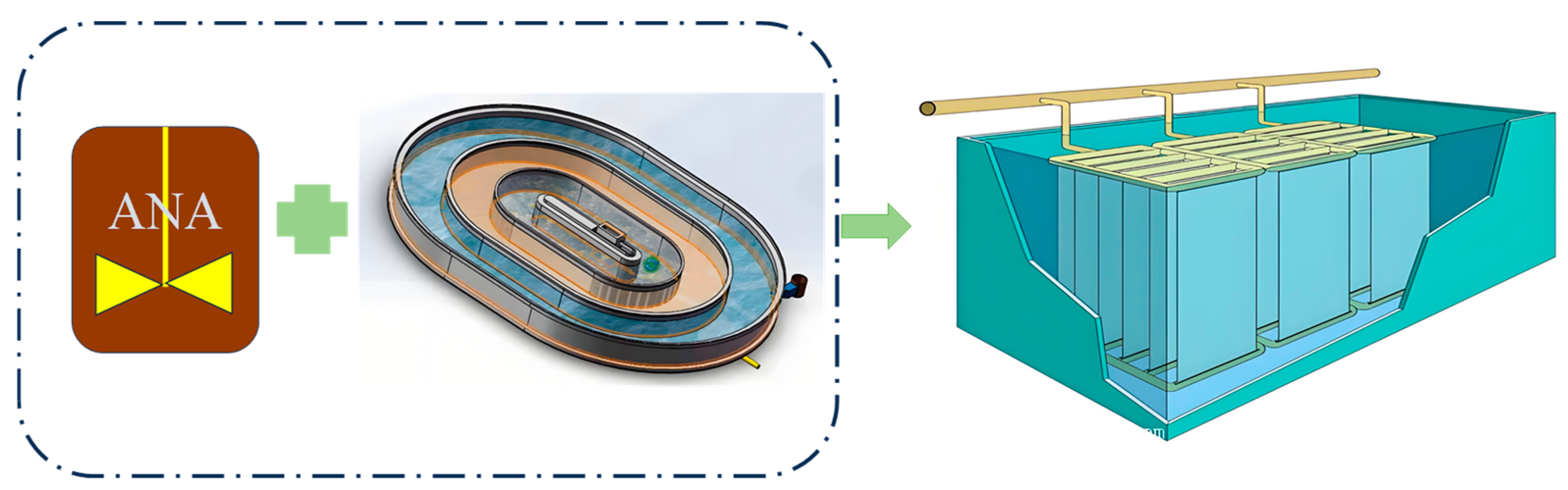
Given the limited land availability, this study proposed installing membrane modules downstream of the biological tank to construct a MBR system. The membrane units enable high-efficiency solid-liquid separation, which not only increases the MLSS concentration in the biological tank but also significantly improves the overall treatment performance, ensuring stable effluent quality that meets the regulatory discharge standards. The total design flow rate of the membrane tanks and associated facilities was set at 50,000 m
3/d, with each membrane tank designed to handle 12,500 m
3/d. Each membrane tank has a volume of 836.45 m
3, with an effective water depth of 3.8 m and a HRT of 1.6 h. The designed MLSS concentration in the membrane tank was 10,000 mg/L, and the internal recirculation ratios were set as follows: 400% from the membrane tank to the aerobic zone, 300% from the aerobic zone to the anoxic zone, and 100% from the anoxic zone to the anaerobic zone. The MLSS concentrations in the aerobic, anoxic, and anaerobic zones were 8000 mg/L, 6000 mg/L, and 3000 mg/L, respectively, resulting in an average sludge concentration of approximately 7050 mg/L in the biological reactors (as shown in
Figure 1).
2.6. Analytical and Characterization Methods
Sludge samples were collected from the anaerobic, anoxic, and aerobic zones of the oxidation ditch in October 2023 (pre-retrofit, 6+ months of stable operation) and April 2024 (post-retrofit, 6-month stable operation meeting three criteria: effluent compliant with DB 61/224-2018 Class A; bioreactor MLSS stabilized at 7050 ± 50 mg/L; denitrification and BOD5 sludge loadings at 0.030–0.033 kg/(kg·d)). Triplicate 100-mL samples were taken per zone at each time point (9 samples total), stored in sterile centrifuge tubes at −80 °C within 2 h, and freeze-dried before DNA extraction.
Microbial DNA was extracted using the E.Z.N.A.
® Soil DNA Kit (Omega Bio-tek, Norcross, GA, USA). The 16S rRNA V3–V4 region was amplified with primers 338F/806R on an ABI GeneAmp
® 9700 cycler (Applied Biosystems, Foster City, CA, USA) (95 °C for 3 min; 27 cycles of 95 °C 30 s, 55 °C 30 s, 72 °C 45 s; 72 °C 10 min). Purified PCR products were sequenced on the Illumina MiSeq PE300 platform [
15].
Raw reads were filtered (Trimmomatic v0.39), merged (FLASH v1.2.11), and dechimerized (UCHIME v4.2). OTUs were clustered at 97% similarity by UPARSE v7.1 [
16]. Taxonomy was assigned via RDP Classifier v2.2 against the SILVA 16S rRNA database (v138, 70% threshold). Alpha diversity was calculated with Mothur v1.30.2, and one-way ANOVA (SPSS 26.0,
p < 0.05) was used for statistical comparison [
17].
4. Discussion
4.1. Core Mechanism of Microbial Community Optimization Driven by Process Retrofit
First, the reduction in sludge loading creates a favorable growth environment for functional microorganisms. The extension of HRT and the increase in MLSS concentration jointly reduce the denitrification and BOD
5 sludge loading of the system by 59.7% and 50%, respectively. This alleviates the substrate competition between fast-growing heterotrophic bacteria and slow-growing nitrifying and denitrifying bacteria, providing sufficient nutrients and reaction time for the growth of core functional bacteria, and laying a foundation for their enrichment [
18].
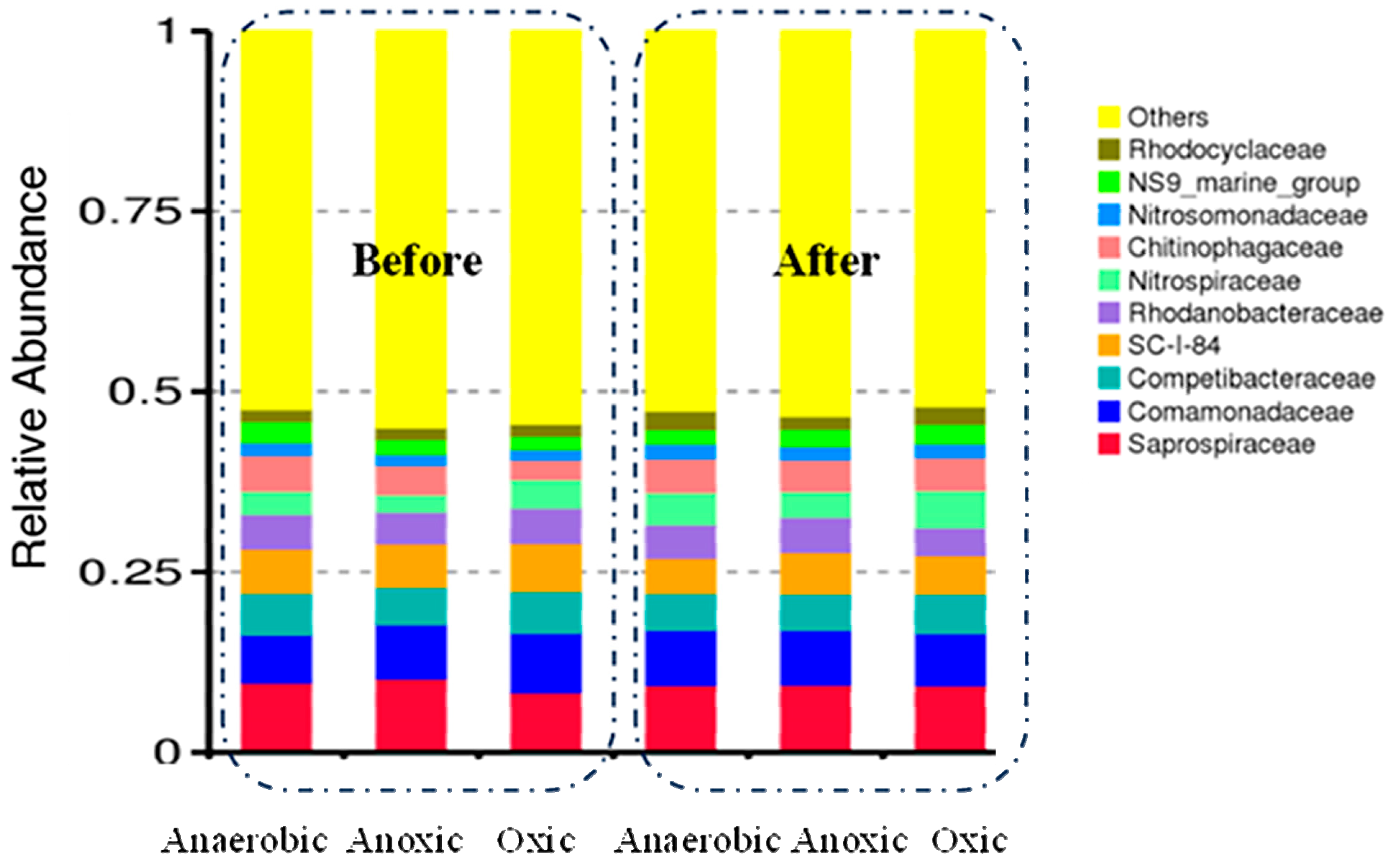
Second, the membrane retention effect of MBR significantly increases the absolute abundance of slow-growing functional bacteria. The MBR membrane module achieves complete solid-liquid separation, which can completely retain slow-growing nitrifying and denitrifying bacteria in the reactor, avoiding their loss with effluent or excess sludge. This is the key reason for the significant increase in the relative abundance of
Nitrospiraceae,
Nitrosomonadaceae and
Rhodocyclaceae, and also solves the problem of functional bacteria loss caused by short sludge age in traditional activated sludge processes [
19].
In addition, the significant increase in microbial community diversity after the retrofit enhances the functional redundancy of the system. The increase in Shannon-Wiener, Simpson, ACE and Chao1 indices indicates that the community structure is more stable, which can provide stronger resilience to cope with low-temperature shock and influent quality fluctuation, and reduce the operational risk of the system.
4.2. Mechanism of Low-Temperature Pollutant Removal Performance Improvement by Microbial Community Remodeling
The remodeling of the microbial community structure after the retrofit provides a core microbiological basis for the stable operation of the system under low-temperature conditions, which is mainly reflected in three aspects [
20].
First, the enrichment of nitrifying bacteria enhances the low-temperature nitrification stability of the system.
Nitrospiraceae, as the dominant NOB group (accounting for 69.8% of the nitrifying guild), includes comammox Nitrospira with excellent low-temperature adaptability [
21]. This type of bacteria can maintain high nitrite oxidation activity even at 6.5 °C, effectively overcoming the low-temperature “nitrification break” problem of the original process, which is the fundamental reason for the NH
4+-N removal rate remaining above 99% under low-temperature conditions.
Second, the enrichment of Rhodocyclaceae improves the low-temperature denitrification efficiency and carbon source utilization capacity of the system. As the core denitrifying functional group, Rhodocyclaceae has four key adaptive advantages: (1) strong facultative anaerobic metabolic capacity, which can adapt to the alternating anoxic-aerobic environment of the oxidation ditch and maintain high denitrification activity under anoxic and hypoxic conditions; (2) broad substrate spectrum, which can efficiently utilize various organic carbon sources in wastewater, including low-molecular-weight organics produced by hydrolysis of complex carbohydrates; (3) high utilization efficiency of scarce carbon sources under high MLSS conditions, which has a core competitive advantage over other denitrifying bacteria under the condition of BOD5/TN = 3.68 in this study; (4) robust cell wall structure and excellent flocculation performance, which can resist the hydraulic shear stress in the MBR system and adapt to the high MLSS environment. With the extension of anoxic HRT to 18.47 h, this group can fully complete nitrate reduction, avoiding incomplete TN removal under low-temperature conditions.
Third, the increase in community functional redundancy enhances the anti-disturbance ability of the system under adverse conditions. The improved microbial diversity ensures that when facing low-temperature shock or influent quality fluctuation, different functional groups can complement each other to maintain the overall pollutant removal performance of the system, which is an important guarantee for the stable compliance of effluent quality under complex operating conditions.
4.3. Comparison and Innovation of This Retrofit Strategy with Existing WWTP Upgrading Technologies
Existing studies have confirmed the effectiveness of MBBR and MBR in WWTP upgrading, but this study offers several innovations for WWTPs in northern China, where long-term low temperatures, severe land constraints, and stringent discharge standards are major challenges [
22].
Compared with the mainstream MBBR-based upgrading process, the combined strategy proposed in this study has significant advantages. MBBR-based processes usually need to add additional advanced treatment units such as ozonation and denitrification deep-bed filter to meet the quasi-Class IV surface water standard, which not only increases the land occupation and construction investment, but also improves the complexity of process operation and management. In contrast, the strategy of “oxidation ditch wall height raising + MBR integration” in this study fully utilizes the existing facilities, does not need new land acquisition, and can achieve stable compliance with strict discharge standards only by optimizing the existing biological treatment unit and adding MBR, which perfectly solves the core problem of land scarcity in existing WWTPs.
In terms of theoretical research, this study fills the research gap in the field of cold-region WWTP upgrading. Most previous studies focused on the separate application of MBBR or MBR, and few investigated the synergistic effect of oxidation ditch volume expansion and MBR integration on low-temperature pollutant removal. This study systematically reveals the microbial response mechanism of this combined strategy, clarifies the quantitative relationship between functional bacteria enrichment and low-temperature pollutant removal capacity, and establishes a set of practical engineering parameters (HRT = 19.82 h, average MLSS = 7050 mg/L, reasonable internal recirculation ratio), which provides direct theoretical support and design guidance for similar projects.
4.4. Application Scope and Limitations of the Retrofit Strategy
This combined retrofit strategy of “oxidation ditch wall raising + MBR integration” has clear applicable conditions, and is most suitable for WWTPs with the following characteristics: (1) the original process is an oxidation ditch process with a freeboard of more than 0.5 m, which can realize volume expansion by raising the wall height without new land acquisition; (2) the plant faces strict land constraints and cannot build new large-scale treatment units; (3) the plant is located in northern China with long-term low-temperature conditions in winter, and the core operational problem is low-temperature nitrification and denitrification failure; (4) the influent BOD5/TN ratio is 3.0–4.0, with moderate carbon source limitation.
This study has several limitations. First, the long-term operational stability of the MBR system, especially the membrane fouling control strategy under high-MLSS and low-temperature conditions, has not been fully evaluated. Second, the optimization of the carbon-source dosing scheme under extremely low-temperature conditions requires further research to reduce operating costs. Third, this study mainly focuses on the removal of conventional pollutants such as TN and BOD
5, and the removal of trace emerging pollutants in the upgraded system still needs to be explored [
23].
4.5. Engineering Application Value and Prospect of the Study
The results of this study have important engineering application value for WWTP upgrading in northern and northwest China. At present, a large number of WWTPs in the Yellow River Basin are facing the dual pressure of strict discharge standards and low-temperature operational bottlenecks, and most of them have the problem of limited land for reconstruction [
24]. The land-saving retrofit strategy proposed in this study can achieve stable effluent compliance under low-temperature conditions without new land acquisition, which provides a replicable technical solution for similar projects [
25,
26].
In terms of theoretical research, this study reveals the core improvement mechanism of the combined strategy of HRT extension and MBR integration, and complements the quantitative evaluation system for low-temperature operation of WWTPs. Future research can be carried out in the following aspects: (1) develop targeted membrane pollution control technology for MBR system under low-temperature and high MLSS conditions to extend membrane service life and reduce operation cost; (2) optimize the functional bacteria directional enrichment strategy to further improve the pollutant removal efficiency under extreme low-temperature conditions; (3) explore the removal effect and mechanism of the upgraded system on emerging pollutants, to meet the higher water quality management requirements in the future.
4.6. Biological Monitoring for WWTP Operation and Process Evaluation
Conventional WWTP operation is mainly evaluated using physicochemical indicators such as COD, TN, NH
4+-N, and TP. Although these parameters are essential for assessing treatment efficiency and regulatory compliance, they do not directly reflect the integrated biological toxicity of wastewater or the potential ecological effects of effluent discharge [
27]. For WWTPs in northern regions, where long-term low-temperature operation, influent fluctuations, and process retrofitting may affect biological stability, toxicity-based biological monitoring could provide useful
supplementary information in addition to routine physicochemical assessment [
28].
Among the available bioassays, the Microtox test system, which is based on the inhibition of bioluminescence in Vibrio fischeri, has been widely used as a rapid and sensitive tool for wastewater toxicity screening [
29]. Previous studies have shown that Microtox can complement conventional monitoring by helping detect toxicity fluctuations and by providing an additional perspective on treatment performance and operational risk. In this respect, biological monitoring may be particularly relevant for upgraded biological treatment systems, in which changes in sludge structure and functional microbial populations may alter system responses to toxic disturbances.
In the present study, the retrofit strategy combined oxidation ditch volume expansion and MBR integration, which significantly increased MLSS concentration and reshaped the microbial community structure. These changes improved low-temperature pollutant removal performance, but they also indicate that future operational assessment could benefit from complementing routine water quality monitoring with biological toxicity evaluation. Such an approach may help better characterize the resilience of the remodeled sludge system under complex influent conditions, especially during winter operation.
It should also be noted that this study focused on conventional pollutant removal, sludge loading, and microbial community succession, while toxicity-based biological monitoring was not included. Therefore, the relationship between wastewater toxicity, microbial community dynamics, and process stability could not be evaluated directly. Future work may incorporate Microtox or other bioassays as supplementary monitoring tools and further explore their applicability in cold-region WWTPs after process upgrading.