Rebus-Based Instruction as a Sustainable Pedagogical Approach for Citizenship and Cultural Sustainability: Enhancing Gifted Students’ Learning of Mesopotamian and Anatolian Civilizations

Abstract
1. Introduction
2. Materials and Methods
2.1. Research Design
2.2. Study Group
2.3. Data Collection Tools
2.3.1. Quantitative Data Collection Tool
2.3.2. Qualitative Data Collection Tool
2.3.3. Didactic Proposal of the Rebus-Based Instruction
2.3.4. Data Collection and Analysis
3. Results
3.1. Results of the Quantitative Data
3.2. Results of Qualitative Data
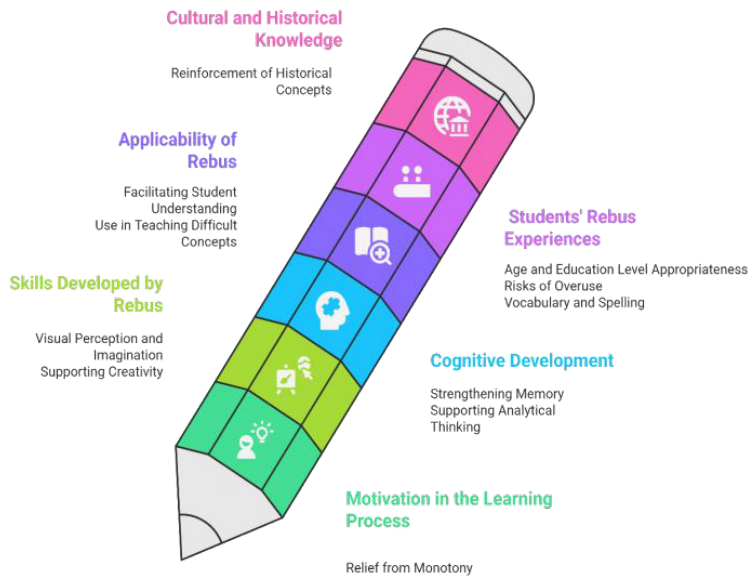
- Theme 1: “Motivation in the Learning Process”
- Sub-theme 1.1: “Relief from Monotony”
- Theme 2: “Skills Developed by Rebus”
- Sub-theme 2.1: “Visual Perception and Imagination”
- Sub-theme 2.2: “Supporting Creativity”
- Theme 3: “Cognitive Development”
- Sub-theme 3.1: “Strengthening Memory”
- Sub-theme 3.2: “Supporting Analytical Thinking”
- Theme 4: “Applicability of Rebus”
- Sub-theme 4.1: “Facilitating Student Understanding”
- Sub-theme 4.2: “Use in Teaching Difficult Concepts”
- Theme 5: “Students’ Rebus Experiences”
- Sub-theme 5.1: “Age and Education Level Appropriateness”
- Sub-theme 5.2: “Risks of Overuse”
- Sub-theme 5.3: “Vocabulary and Spelling”
- Theme 6: “Cultural and Historical Knowledge”
- Sub-theme 6.1: “Reinforcement of Historical Concepts”
4. Discussion
5. Conclusions
Author Contributions
Funding
Institutional Review Board Statement
Informed Consent Statement
Data Availability Statement
Conflicts of Interest
Abbreviations
| ESD | Education for Sustainable Development |
| UNESCO | United Nations Educational, Scientific and Cultural Organization |
| BILSEM | Science and Art Center (Bilim ve Sanat Merkezi) |
| SDG | Sustainable Development Goals |
Appendix A. English Version of the Achievement Test Items
- What is the writing system invented by the Sumerians, one of the Mesopotamian civilizations?
- 2.
- What invention, which contributed to the common heritage, is associated with the Lydians in Anatolia?
- 3.
- What is the name of the laws enacted by Hammurabi in Mesopotamia, known as the first written laws in history?
- 4.
- How did the Hittites, one of the Anatolian civilizations, contribute to historiography?
- 5.
- Why did Mesopotamian civilizations generally develop around rivers?
- 6.
- In which field did the Urartians, one of the Anatolian civilizations, contribute to the common heritage?
- 7.
- For which scientific achievements are the Babylonians, one of the Mesopotamian civilizations, known?
- 8.
- One of the best-known contributions of the Anatolian civilizations to the common heritage is the agricultural methods used by the Phrygians. Which of the following is one of these methods?
- 9.
- Which civilization established the first known city-states in Mesopotamia?
- 10.
- In which branch of art were the Phrygians, one of the Anatolian civilizations, famous?
Appendix B. English Version of the Semi-Structured Interview Protocol
- How would you describe your learning experience during the rebus-based instruction process?
- How did the rebus activities affect your interest and motivation during the lesson?
- In what ways did the rebus-based activities make the lesson different from your usual social studies lessons?
- Do you think learning through rebus activities made the topics easier to understand? Why or why not?
- How did the visual and symbolic elements used in the rebus activities affect your learning process?
- Do you think the rebus-based activities helped you remember the contributions of Mesopotamian and Anatolian civilizations more easily? Please explain.
- Which parts of the rebus-based instruction did you find most enjoyable or useful?
- Were there any parts of the rebus-based instruction that you found difficult or confusing? Please explain.
- Do you think rebus-based activities improved your thinking skills, such as interpretation, creativity, or analytical thinking? Why or why not?
- Would you like rebus-based activities to be used in future social studies lessons? Why or why not?
- ➢
- Can you explain that in more detail?
- ➢
- Can you give an example?
- ➢
- How did that make you feel?
- ➢
- Why do you think that happened?
- ➢
- Which activity do you remember most clearly?
Appendix C. Illustrative Pre-Test and Post-Test Open-Ended Responses Regarding the Identification of Anatolian and Mesopotamian Civilizations
| N | Groups | Pre-Test | Post-Test |
| 11 | Experimental Group | None | Hittites, Urartians, Sumerians, Phrygians, Lydians, Assyrians, Babylonians, Ionians |
| None | Sumerians, Hittites, Urartians, Phrygians, Lydians, Assyrians, Babylonians, Ionians | ||
| Babylonians, Sumerians, Hittites, Urartians | Hittites, Urartians, Phrygians, Lydians, Assyrians, Babylonians, Ionians | ||
| None | Phrygians, Hittites, Urartians, Sumerians, Lydians, Assyrians, Babylonians | ||
| I do not know | Hittites, Urartians, Ionians, Sumerians | ||
| I do not know | Hittites, Urartians, Phrygians, Lydians, Assyrians, Babylonians, Ionians, Sumerians | ||
| Rome | Hittites, Urartians, Phrygians, Lydians, Sumerians, Assyrians, Babylonians, Ionians | ||
| Seljuk, Byzantine, Ottoman, Roman | Babylonians, Ionians, Lydians, Sumerians | ||
| Asian Hun State | Hittites, Urartians, Phrygians, Lydians, Assyrians, Sumerians, Babylonians, Ionians | ||
| Sunerians, Libyans, Hittites, Uraltians, Babirlonians, Phrygians | There are, Sumerians, Hittites, Urartians, Phrygians, Lydians, Assyrians, Babylonians, Ionians | ||
| None, I do not know | Sumerians, Hittites, Assyrians | ||
| 7 | Control Group | None | Sumerians, Lydians, Babylonians, Ionians |
| I know Sumerian, Akkadian, Babylonian, Lydian, Urartu, Phrygian, Hittite | Sumerians, Hittites, Lydians, Ionians | ||
| None | Sumerians, Hittites, Urartians, Phrygians, Lydians | ||
| Anatolia: Lydian Mesopotamia: Hammurabi | Sumerians, Urartians, Phrygians, Lydians, Babylonians, Ionians | ||
| I do not know | Sumerians, Hittites, Urartians, Phrygians, Lydians, Babylonians | ||
| None | Sumerians, Hittites, Phrygians, Urartians | ||
| None | Sumerians, Hittites, Lydians, Ionians | ||
| None | Sumerians, Hittites, Babylonians, Ionians |
References
- Britannica. Rebus. In Encyclopaedia Britannica 2025; Encyclopædia Britannica, Inc.: Chicago, IL, USA, 2025; Available online: https://www.britannica.com/topic/rebus-writing-principle (accessed on 1 December 2025).
- Clark, R.C.; Mayer, R.E. E-Learning and the Science of Instruction, 4th ed.; Wiley: Hoboken, NJ, USA, 2016. [Google Scholar]
- Mayer, R.E. Multimedia Learning, 2nd ed.; Cambridge University Press: Cambridge, UK, 2009. [Google Scholar] [CrossRef]
- Paivio, A. Mental Representations: A Dual Coding Approach; Oxford University Press: Oxford, UK, 1986. [Google Scholar]
- Akdoğan, D.S. Rebus as a material in vocabulary teaching. In Proceedings of the 7th National Language Education Symposium, Eskişehir, Türkiye, 19–21 October 2023. [Google Scholar]
- Anderson, L.W.; Krathwohl, D.R. (Eds.) A taxonomy for Learning, Teaching, and Assessing: A Revision of Bloom’s Taxonomy of Educational Objectives; Longman: New York, NY, USA, 2001. [Google Scholar]
- Sweller, J.; Ayres, P.; Kalyuga, S. Cognitive Load Theory; Springer: New York, NY, USA, 2011. [Google Scholar]
- Moreno, R.; Mayer, R.E. Interactive multimodal learning environments. Educ. Psychol. Rev. 2007, 19, 309–326. [Google Scholar] [CrossRef]
- Dörnyei, Z. The Psychology of the Language Learner; Routledge: London, UK, 2005. [Google Scholar]
- Zimmerman, B.J. Becoming a Self-Regulated Learner. Theory Pract. 2002, 41, 64–70. [Google Scholar] [CrossRef] [PubMed]
- Gardner, H. Intelligence Reframed: Multiple Intelligences for the 21st Century; Basic Books: New York, NY, USA, 1999. [Google Scholar]
- Sternberg, R.J. Thinking Styles; Cambridge University Press: Cambridge, UK, 1999. [Google Scholar]
- Gültekin, F. Informal logic and fallacies in the field of history. Turk. Hist. Educ. J. 2021, 10, 43–56. [Google Scholar] [CrossRef]
- Demirel, M.; Arı, G. Effect of rebus on vocabulary development. Educ. Theory Pract. 2020, 16, 40–55. [Google Scholar]
- Sak, U. Üstün Zekâlılar: Özellikleri, Tanılanmaları, Eğitimleri; Vize Yayıncılık: Ankara, Türkiye, 2011. [Google Scholar]
- Renzulli, J.S. Reexamining the role of gifted education and talent development for the 21st century: A four-part theoretical approach. Gift. Child Q. 2012, 56, 150–159. [Google Scholar] [CrossRef]
- Pfeiffer, S.I. Essentials of Gifted Assessment; Wiley: Hoboken, NJ, USA, 2015. [Google Scholar]
- Tomlinson, C.A. The Differentiated Classroom: Responding to the Needs of All Learners, 2nd ed.; ASCD: Alexandria, VA, USA, 2014. [Google Scholar]
- VanTassel-Baska, J.; Stambaugh, T. Challenges and possibilities for serving gifted learners in the regular classroom. Theory Pract. 2005, 44, 211–217. [Google Scholar] [CrossRef]
- Akar, H.; Yıldız, D. Concept teaching through visual symbols: The rebus example. Educ. Sci. Theory Pract. 2020, 20, 1201–1218. [Google Scholar]
- Özçelik, M.; Keskin, H.K. Effect of rebus on concept teaching. Elem. Educ. Online 2018, 17, 875–888. [Google Scholar]
- Alkan, A.; Mertol, H.; Mertol, G. Use of rebus as differentiation in ICT courses for gifted students. Eurasian Int. Res. J. 2020, 8, 1–11. [Google Scholar]
- VanTassel-Baska, J.; Stambaugh, T. Comprehensive Curriculum for Gifted Learners, 3rd ed.; Allyn & Bacon: Boston, MA, USA, 2006. [Google Scholar]
- Renzulli, J.S. The Enrichment Triad Model. In Systems and Models for Developing Programs for the Gifted and Talented, 2nd ed.; Sternberg, R.J., Davidson, J.E., Eds.; Creative Learning Press: Mansfield Center, CT, USA, 2005; pp. 246–279. [Google Scholar]
- Sternberg, R.J.; Grigorenko, E.L. The theory of successful intelligence as a basis for gifted education. Gift. Child Q. 2002, 46, 265–277. [Google Scholar] [CrossRef]
- Tomlinson, C.A. How to Differentiate Instruction in Mixed-Ability Classrooms; Association for Supervision and Curriculum Development (ASCD): Alexandria, VA, USA, 2001. [Google Scholar]
- Silver, H.F.; Strong, R.W.; Perini, M.J. So Each May Learn: Integrating Learning Styles and Multiple Intelligences; Association for Supervision and Curriculum Development: Alexandria, VA, USA, 2000. [Google Scholar]
- Mayer, R.E. Cambridge Handbook of Multimedia Learning; Cambridge University Press: Cambridge, UK, 2005. [Google Scholar]
- Sadoski, M.; Paivio, A. Imagery and Text: A Dual Coding Theory of Reading and Writing; Lawrence Erlbaum Associates: Mahwah, NJ, USA, 2001. [Google Scholar]
- Bransford, J.D.; Brown, A.L.; Cocking, R.R. How People Learn: Brain, Mind, Experience, and School; National Academy Press: Washington, DC, USA, 2000. [Google Scholar]
- Schraw, G.; Moshman, D. Metacognitive theories. Educ. Psychol. Rev. 1995, 7, 351–371. [Google Scholar] [CrossRef]
- Vygotsky, L.S. Mind in Society; Harvard University Press: Cambridge, MA, USA, 1978. [Google Scholar]
- Beck, I.L.; McKeown, M.G.; Kucan, L. Bringing Words to Life: Robust Vocabulary Instruction, 2nd ed.; Guilford Press: New York, NY, USA, 2013. [Google Scholar]
- Nation, I.S.P. Learning Vocabulary in Another Language; Cambridge University Press: Cambridge, UK, 2001. [Google Scholar]
- Keskin, Y.; Sezgin, E. Creative drama and rebus in social studies education. Natl. Educ. J. 2017, 46, 135–157. [Google Scholar]
- Kurnaz, A.; Doğan, Y. Teaching history with creative activities. J. Hist. Educ. 2020, 6, 55–74. [Google Scholar]
- Gardner, H. Frames of Mind: The Theory of Multiple Intelligences; Basic Books: New York, NY, USA, 1983. [Google Scholar]
- Karakaş, B.; Sarı, M. Effect of multiple intelligences-based instruction. Qual. Res. Educ. 2021, 9, 145–172. [Google Scholar]
- Renzulli, J.S. Enrichment triad model. Gift. Child Q. 1977, 21, 227–233. [Google Scholar] [CrossRef]
- Reis, S.M.; Renzulli, J.S. Schoolwide Enrichment Model; Prufrock Press: Waco, TX, USA, 2010. [Google Scholar]
- Fosnot, C.T. Constructivism: Theory, Perspectives, and Practice, 2nd ed.; Teachers College Press: New York, NY, USA, 2013. [Google Scholar]
- Sterling, S. Sustainable Education; Schumacher Society: Totnes, UK, 2004. [Google Scholar]
- UNESCO. Education for Sustainable Development: A Roadmap; UNESCO Publishing: Paris, France, 2020. [Google Scholar]
- Wals, A.E.J. Education for Sustainability; Wageningen University: Wageningen, The Netherlands, 2015. [Google Scholar]
- Paivio, A. Dual coding theory. Can. J. Psychol. 1991, 45, 255–287. [Google Scholar] [CrossRef]
- Bruner, J.S. The act of discovery. Harv. Educ. Rev. 1961, 31, 21–32. [Google Scholar]
- Soini, K.; Dessein, J. Culture–sustainability relation. Sustainability 2016, 8, 167. [Google Scholar] [CrossRef]
- Sternberg, R.J.; Davidson, J.E. Conceptions of Giftedness, 2nd ed.; Cambridge University Press: Cambridge, UK, 2005. [Google Scholar]
- Büyüköztürk, Ş.; Kılıç Çakmak, E.; Akgün, Ö.E.; Karadeniz, Ş.; Demirel, F. Scientific Research Methods in Education, 30th ed.; Pegem Akademi: Ankara, Türkiye, 2021. [Google Scholar]
- Creswell, J.W. Research Design: Qualitative, Quantitative, and Mixed Methods Approaches, 4th ed.; SAGE Publications: Thousand Oaks, CA, USA, 2014. [Google Scholar]
- Gardner, H. Multiple Intelligences: The Theory in Practice; Basic Books: New York, NY, USA, 1993. [Google Scholar]
- Mayer, R.E. Cognitive theory of multimedia learning. In Cambridge Handbook of Multimedia Learning, 2nd ed.; Cambridge University Press: Cambridge, UK, 2014; pp. 43–71. [Google Scholar] [CrossRef]
- Yeşilbursa, C.C.; Işıksal, B. Rebus Use in Social Studies Education. Int. Soc. Sci. Stud. J. 2022, 8, 4203–4218. [Google Scholar]
- Seyhan, A.; Delibalta, T.İ. Ortaokul öğrencilerinin mekânsal düşünme becerilerinin geliştirilmesinde okul dışı öğrenmenin kullanılması. Dokuz Eylül Üniv. Buca Eğit. Fak. Derg. 2024, 60, 896–912. [Google Scholar] [CrossRef]
- Benek, İ. The Effect of Kahoot-Supported Rebus Application on Gifted Students’ Cognitive Structures and Views on Astronomy. Int. J. New Trends Educ. Their Implic. 2024, 15, 63–78. [Google Scholar]
- Yurteri, E.; Mertol, H. Rebus in Geography Education. Kırşehir Univ. J. 2018, 2, 46–57. [Google Scholar]
- Doğan, A.; Avcıoğlu, A. Use of rebus as differentiation in primary mathematics teaching. Int. J. Textb. Educ. Mater. 2024, 7, 156–187. [Google Scholar]
- Kuruoğlu, F. Effect of Rebus on Critical Thinking Skills. Master’s Thesis, Çanakkale Onsekiz Mart University, Çanakkale, Türkiye, 2023. [Google Scholar]
- Söylemez, Y.; Söylemez, N.; Yıldırım, Z.A.; Yıldırım, İ.; Güneş, E.; Çavdar, R.; Okul, F.S. Resfebe ile değerlerimi öğreniyorum. Int. J. Educ. Sci. 2022, 2, 64–75. [Google Scholar] [CrossRef]
- Tilbury, D. Education for Sustainable Development; UNESCO Publishing: Paris, France, 2011. [Google Scholar]
- Leal Filho, W.; Manolas, E.; Pace, P. The future we want: Key issues on sustainable development in higher education after Rio and the UN decade of education for sustainable development. Int. J. Sustain. High. Educ. 2015, 16, 112–129. [Google Scholar] [CrossRef]
- Ministry of National Education. Differentiated Education. Available online: https://tymm.meb.gov.tr (accessed on 18 February 2026).


| Groups | Gender | N | (%) |
|---|---|---|---|
| Control Group | Male | 4 | 22.2 |
| Female | 3 | 16.7 | |
| Total | 7 | 38.9 | |
| Experimental Group | Male | 4 | 22.2 |
| Female | 7 | 38.9 | |
| Total | 11 | 61.1 |
| Learning Outcome/Content Domain | Item Number(s) | Focus of the Item |
|---|---|---|
| Identifying the Sumerians’ contribution to writing | 1 | Knowledge of the invention of cuneiform writing |
| Recognizing the Lydians’ contribution to economy and trade | 2 | Knowledge of the use of money |
| Identifying the legal contribution of Mesopotamian civilizations | 3 | Knowledge of the Code of Hammurabi |
| Recognizing the Hittites’ contribution to historiography | 4 | Knowledge of historical writing and tablets |
| Explaining the role of rivers in the development of Mesopotamian civilizations | 5 | Geography and settlement awareness |
| Identifying the Urartians’ contribution to common heritage | 6 | Knowledge of irrigation systems/infrastructure |
| Recognizing the Babylonians’ contribution to science | 7 | Knowledge of geometry and calendar |
| Identifying the Phrygians’ contribution to agriculture | 8 | Knowledge of plow-based agricultural practices |
| Recognizing the founders of the first city-states in Mesopotamia | 9 | Knowledge of Sumerian political organization |
| Identifying the Phrygians’ contribution to art | 10 | Knowledge of weaving as a cultural contribution |
| N | Groups | Tests | X |
|---|---|---|---|
| 11 | Experimental Group | Pre-test | 43.64 |
| Post-test | 68.18 | ||
| 7 | Control Group | Pre-test | 42.86 |
| Post-test | 60 |
| Comparison | Test | N | Test Statistic | p |
|---|---|---|---|---|
| Experimental Group Pre-test vs. Post-test | Wilcoxon Signed-Rank Test | 11 | Z = −4.50 | <0.05 |
| Experimental Group Post-test vs. Control Group Post-test | Mann–Whitney U Test | 18 | U = 68.00 | <0.05 |
Disclaimer/Publisher’s Note: The statements, opinions and data contained in all publications are solely those of the individual author(s) and contributor(s) and not of MDPI and/or the editor(s). MDPI and/or the editor(s) disclaim responsibility for any injury to people or property resulting from any ideas, methods, instructions or products referred to in the content. |
© 2026 by the authors. Licensee MDPI, Basel, Switzerland. This article is an open access article distributed under the terms and conditions of the Creative Commons Attribution (CC BY) license.
Share and Cite
Turan Korkutata, B.; İçen, M. Rebus-Based Instruction as a Sustainable Pedagogical Approach for Citizenship and Cultural Sustainability: Enhancing Gifted Students’ Learning of Mesopotamian and Anatolian Civilizations. Sustainability 2026, 18, 4220. https://doi.org/10.3390/su18094220
Turan Korkutata B, İçen M. Rebus-Based Instruction as a Sustainable Pedagogical Approach for Citizenship and Cultural Sustainability: Enhancing Gifted Students’ Learning of Mesopotamian and Anatolian Civilizations. Sustainability. 2026; 18(9):4220. https://doi.org/10.3390/su18094220
Chicago/Turabian StyleTuran Korkutata, Beyza, and Mustafa İçen. 2026. "Rebus-Based Instruction as a Sustainable Pedagogical Approach for Citizenship and Cultural Sustainability: Enhancing Gifted Students’ Learning of Mesopotamian and Anatolian Civilizations" Sustainability 18, no. 9: 4220. https://doi.org/10.3390/su18094220
APA StyleTuran Korkutata, B., & İçen, M. (2026). Rebus-Based Instruction as a Sustainable Pedagogical Approach for Citizenship and Cultural Sustainability: Enhancing Gifted Students’ Learning of Mesopotamian and Anatolian Civilizations. Sustainability, 18(9), 4220. https://doi.org/10.3390/su18094220