Article

Sustainable Lignocellulosic Biosorbent Derived from Asplenium scolopendrium Leaves for the Adsorptive Removal of Methylene Blue from Aqueous Solutions


1
Faculty of Chemical Engineering, Biotechnologies and Environmental Protection, Politehnica University Timisoara, V. Parvan Bd. No. 6, 300223 Timisoara, Romania
2
Coriolan Dragulescu Institute of Chemistry, Romanian Academy, Mihai Viteazu Bd. No. 24, 300223 Timisoara, Romania
3
National Institute of Research and Development for Electrochemistry and Condensed Matter (INCEMC), Dr. A. Paunescu Podeanu St., No. 144, 300569 Timisoara, Romania
*
Author to whom correspondence should be addressed.
Sustainability 2026, 18(8), 4145; https://doi.org/10.3390/su18084145
Submission received: 27 March 2026 / Revised: 17 April 2026 / Accepted: 20 April 2026 / Published: 21 April 2026
(This article belongs to the Special Issue Sustainable Research Progress on Treatment of Wastewater)

Abstract

This research evaluates the feasibility of using a lignocellulosic biosorbent prepared from mature leaves of Asplenium scolopendrium (produced through simple mechanical processing of the leaves, without applying any chemical modification or heat treatment) for the removal of methylene blue from water. Before and after adsorption the material was characterized using SEM technique and color analysis. Subsequently, the adsorption behavior was analyzed by examining equilibrium, kinetic, and thermodynamic aspects of the process. The equilibrium data were best represented by the Sips isotherm model, while the adsorption rate followed the Avrami model. Thermodynamic evaluation indicated that the retention of the dye occurs predominantly through a physical adsorption mechanism, while a minor contribution from chemisorption may be present, slightly enhancing the overall dye uptake. Process optimization was performed using the Taguchi experimental design, which also allowed the identification of the most significant operational variable. In addition, analysis of variance (ANOVA) was applied to quantify the contribution of each factor affecting dye removal efficiency. Among the investigated variables, time showed the strongest influence (72.65%), whereas temperature had a negligible effect (1.33%). The maximum adsorption capacity reached 174.1 mg/g, surpassing the performance of several comparable biosorbents reported in the literature. Overall, the findings demonstrate that Asplenium scolopendrium (hart’s-tongue fern) leaves represent an inexpensive, sustainable, and efficient material for eliminating methylene blue from aqueous solutions.

1. Introduction

The rapid acceleration of global industrialization and continuous population growth have significantly increased the release of hazardous substances into natural ecosystems. Among these, synthetic organic dyes represent a major environmental concern due to their extensive use in industries such as textiles, paper, printing, and pharmaceuticals, and their direct discharge into water bodies via industrial effluents. In particular, the textile, paper, and plastic industries release large volumes of colored wastewater, contributing to severe aquatic contamination. These dyes typically contain complex aromatic structures that confer high chemical stability and resistance to natural biodegradation, resulting in persistent pollution characterized by reduced light penetration, oxygen depletion, and disruption of aquatic photosynthesis. Within this context, methylene blue (MB), a widely used cationic dye, is of particular concern due to its persistence and toxicity, being associated with adverse human health effects such as increased heart rate, vomiting, and tissue necrosis, as well as ecological damage in aquatic systems by inhibiting light transmission [1,2,3,4,5,6].
To mitigate the impact of dye-contaminated wastewater, several treatment technologies have been developed, including membrane filtration, advanced oxidation processes, and electrochemical methods. However, their large-scale application is often constrained by high operational costs, energy demands, and the generation of secondary waste. Among these approaches, adsorption has emerged as one of the most efficient and practical techniques due to its simplicity, high removal efficiency, and ability to eliminate pollutants even at low concentrations without generating harmful by-products [4,5,7,8,9,10]. Activated carbon is widely recognized as the gold standard adsorbent; nevertheless, its high cost and limited regenerability significantly restrict its industrial use. Consequently, increasing attention has been directed toward low-cost and sustainable alternatives derived from lignocellulosic biomass, which offer favorable surface chemistry and abundant functional groups such as hydroxyl, carboxyl, and amino groups that act as active binding sites for dye molecules [11,12,13,14].
Against this backdrop, hart’s-tongue fern (Asplenium scolopendrium) leaves have attracted attention as a potential natural biosorbent for dye removal. This perennial evergreen species is widely distributed across Europe, North America, East Asia, and North Africa, and typically grows in humid, shaded environments either on soil or as an epiphyte on decaying tree bark. Its leaves, reaching up to 70 cm in length and 12 cm in width, are rich in lignocellulosic components and contain functional groups that enhance adsorption performance. Beyond its structural suitability, the species has also been traditionally used in herbal medicine for treating pulmonary and biliary disorders, and is known for diuretic, astringent, and antitumor properties [15,16,17].
According to the literature data, as well as our experience, the adsorption capacities of materials obtained from plant leaves differ greatly. In addition, the same adsorbent material exhibits completely different adsorption capacities for different dyes, even if these dyes are in the same class, in our case in the class of cationic adsorbents. In this context, the main purpose of this article was to test hart’s-tongue fern (Asplenium scolopendrium) leaf powder as a sustainable adsorbent material for the removal of methylene blue—one of the most widely used dyes in the textile industry—from water. The existing scientific literature does not present studies or analyses examining the effectiveness of this adsorbent material for the removal of methylene blue from aqueous solutions. Therefore, this research provides an opportunity to investigate this novel method and evaluate its viability as an effective approach for dye removal. By modeling kinetic and equilibrium data and using statistical optimization through the Taguchi method, this study aimed to provide an efficient and cost-effective solution for dye removal from water. This integrated approach ensures that the removal of synthetic pollutants remains consistent with the principles of the circular economy and environmental protection.

2. Materials and Methods

The adsorbent was prepared from the mature leaves of hart’s-tongue fern, sourced from StefMar (Râmnicu Vâlcea, Romania). The preparation method, which excluded any chemical or thermal processing steps, has been thoroughly detailed in an earlier publication [16] and assumes that the dried leaves were pulverized with an electric grinder, then the obtained powder was rinsed with distilled water to remove color and turbidity, and finally the wet material was dried in a laboratory oven at 105 °C for 24 h. According to the same study [16], the point of zero charge (pHPZC) of the material was determined to be 7.4, using the solid addition method. Spectral peaks corresponding to functional groups in cellulose, hemicellulose and lignin that can interact with methylene blue dye were identified in the FTIR spectrum. Key features include O–H and N–H stretching (hydroxyl and amine groups), C–H and CH2 vibrations (aliphatic structures), aromatic C=C bonds and carbonyl (C=O) and carboxyl groups, as well as aromatic and C–O structures linked to lignin [16].
Scanning electron microscopy and color measurements were carried out both prior to and following methylene blue adsorption. Surface morphology was examined using an FEI Inspect S microscope (FEI, Eindhoven, The Netherlands), while color analysis was conducted with a Cary-Varian 300 Bio UV–Vis colorimeter (Varian Inc., Mulgrave, Australia).
A batch experimental system was employed to evaluate the influence of different parameters on dye removal performance during adsorption. All tests were carried out in triplicate under constant agitation conditions. Reagents of analytical purity supplied by Merck were used in all experiments. The solution pH was adjusted using 0.1 N HCl or NaOH, and sodium chloride served as the background electrolyte to assess the effect of ionic strength. Methylene blue concentrations were quantified at 664 nm using a Specord 200 PLUS UV–Vis spectrophotometer (Analytik Jena, Jena, Germany).
Kinetic and equilibrium experiments were conducted at pH = 6 using an adsorbent dosage of 2 g/L, at a temperature of 29 K and zero ionic strength (0 mol/L). The contact time and the initial dye concentration were varied for the kinetic and equilibrium analyses, respectively.
The influence of the pH solution on dye removal efficiency was studied at an initial dye concentration of 100 (mg/L), adsorbent dose of 2 (g/L), contact time of 20 min, temperature of 297 K, ionic strength of 0 (mol/L), and pH ranges 2–10. The influence of the adsorbent dose on dye removal efficiency was determined at pH = 6, initial dye concentration of 100 (mg/L), contact time of 20 min, temperature of 297 K, ionic strength of 0 (mol/L), adsorbent dose range 1–5 (g/L). The influence of the temperature on dye removal efficiency was determined at pH = 6, adsorbent dose of 2 (g/L), initial dye concentration of 100 (mg/L), contact time of 20 min, ionic strength of 0 (mol/L), temperature range 275–308 K. The influence of ionic strength on dye removal efficiency was determined at pH = 6, initial dye concentration of 100 (mg/L), contact time of 20 min, adsorbent dose of 2 (g/L), temperature of 293 K, ionic strength range 0–0.2 (mol/L).
The calculation equations for the percentage of methylene blue removal (R%) and the equilibrium adsorption capacity (qe) are presented in the Supplementary Information, Table S1.
To interpret the experimental adsorption results and gain insight into interaction mechanisms, surface characteristics, and adsorbent affinity, various equilibrium isotherm and kinetic models were evaluated. The nonlinear expressions of the isotherm models [18,19] and kinetic models [20,21] applied for data analysis are summarized in the Supplementary Information, Tables S2 and S3.
The selection of the most appropriate isotherm and kinetic models was based on statistical evaluation using the coefficient of determination (R2), sum of squared errors (SSE), chi-square (χ2) and average relative error (ARE). Model suitability was assessed by maximizing R2 and while minimizing SSE, χ2 and ARE [19]. The corresponding equations used to compute these error indicators are provided in the Supplementary Information, Table S4.
The Taguchi methodology was applied to identify optimal conditions and improve dye removal performance by systematically optimizing the main parameters affecting the adsorption process. An L25 orthogonal array incorporating six factors at five levels was designed, and experimental results were evaluated using signal-to-noise (S/N) ratio analysis. Subsequently, analysis of variance (ANOVA) based on a general linear model was performed to quantify the contribution of each controllable factor to the overall removal efficiency. All statistical analyses and calculations were conducted using Minitab 19 software (version 19.1.1, Minitab LLC, State College, PA, USA).
The main adsorption mechanism was inferred from thermodynamic parameters calculated using the equations listed in Table S5 of the Supplementary Materials [20].
Desorption experiments were performed in a batch setup by employing three eluents—distilled water, 0.1 (mol/dm) HCl, and 0.1 (mol/dm) NaOH—while maintaining continuous agitation for two hours. Following this procedure, the desorption efficiency was determined based on the formula provided in Table S6 of the Supplementary Materials.

3. Results and Discussion

3.1. SEM and Color Analysis

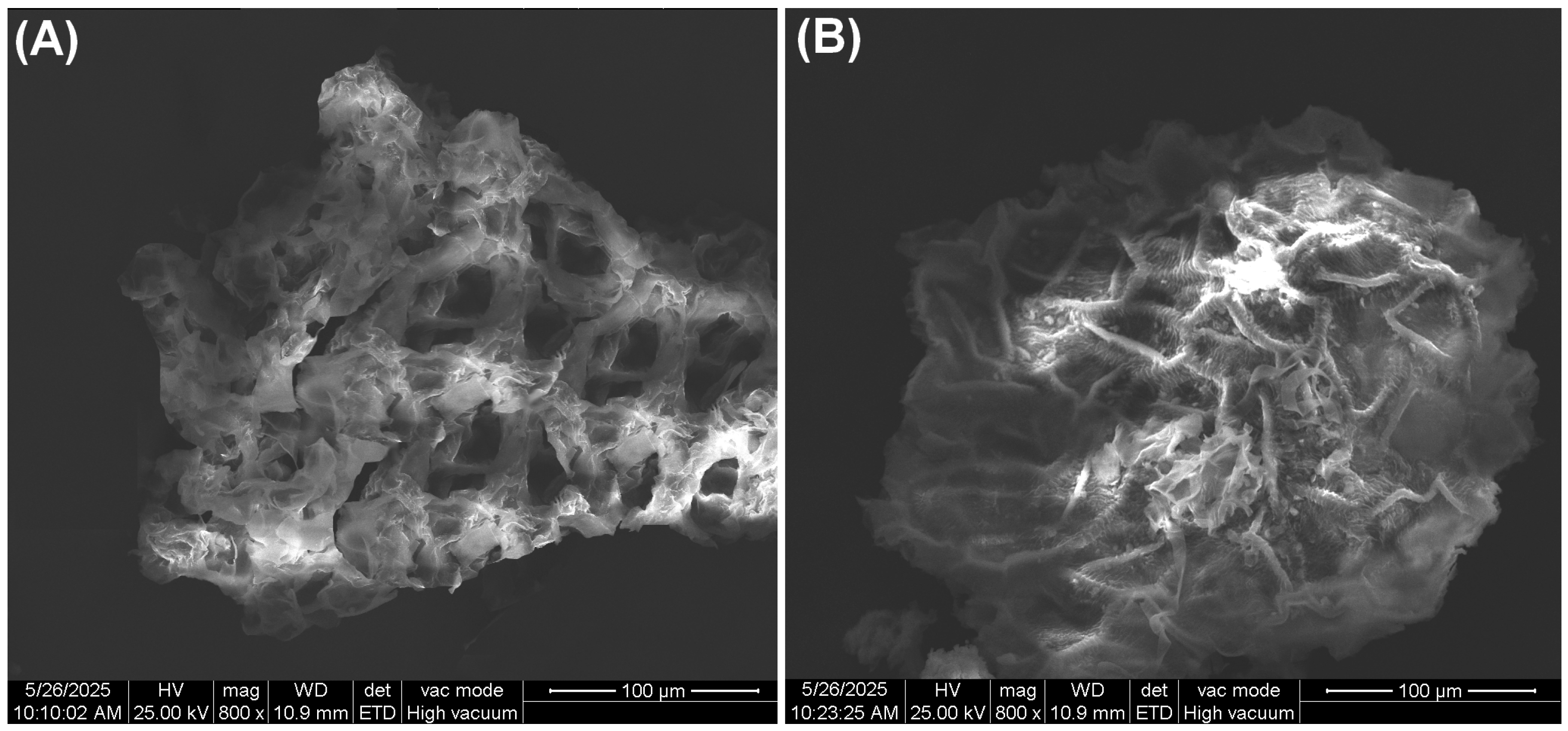
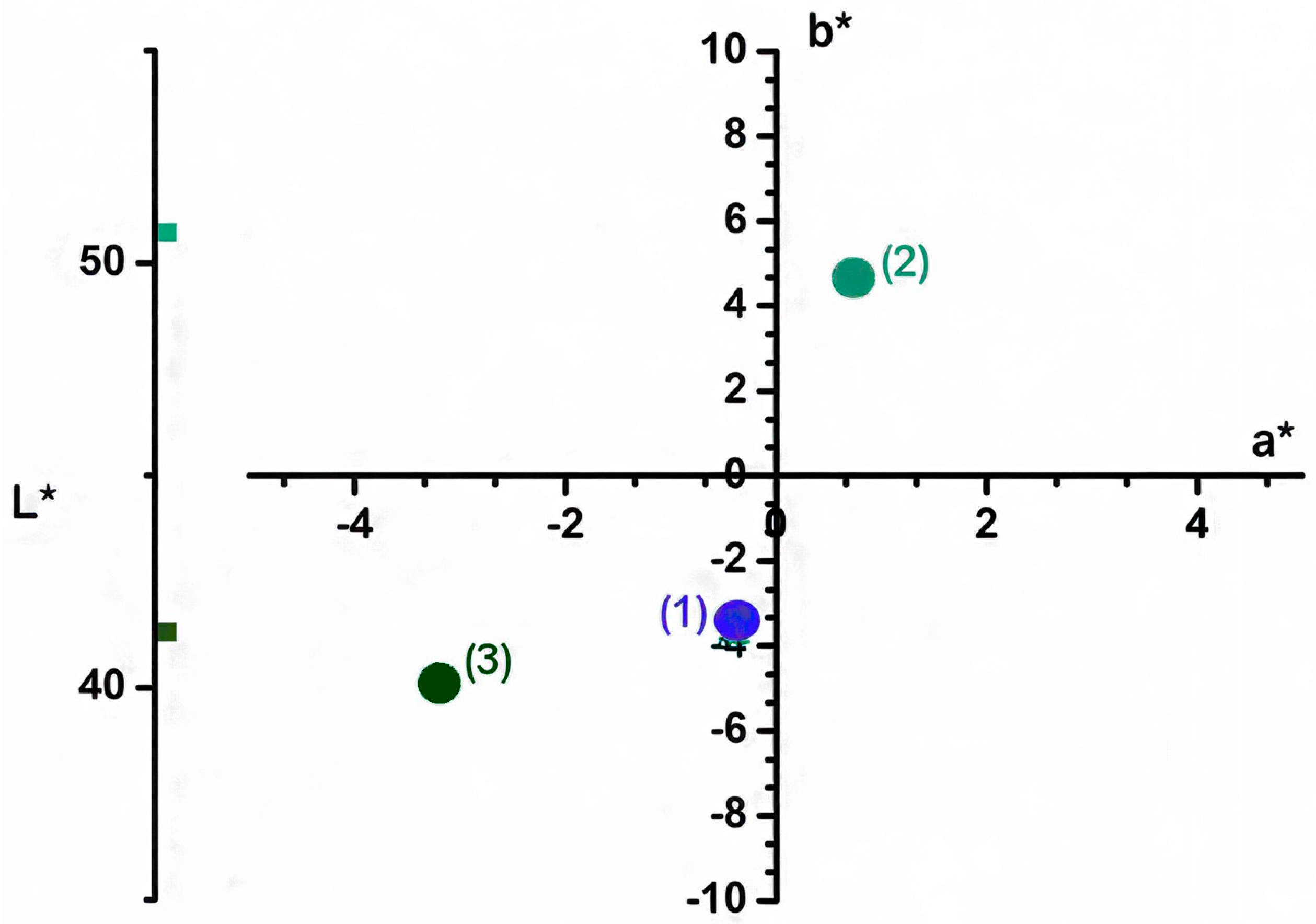
SEM imaging of the adsorbent, conducted before and after the adsorption process, confirm the attachment of methylene blue molecules onto the material surface. Prior to adsorption, SEM micrographs (Figure 1A) show a highly porous morphology characterized by cavities and voids of diverse dimensions and shapes. Following dye uptake, the surface becomes smoother and more uniform (Figure 1B), indicating that the pores were occupied by methylene blue. These observations are corroborated by color measurements in the CIELab* color space (Figure 2). The initial adsorbent is represented by the color coordinate labeled (2), whereas after adsorption the absorbent color coordinate labeled (3) lies within the same color region as the methylene blue dye, color coordinate labeled (1), confirming dye retention on the adsorbent.

3.2. Adsorption Equilibrium Isotherms

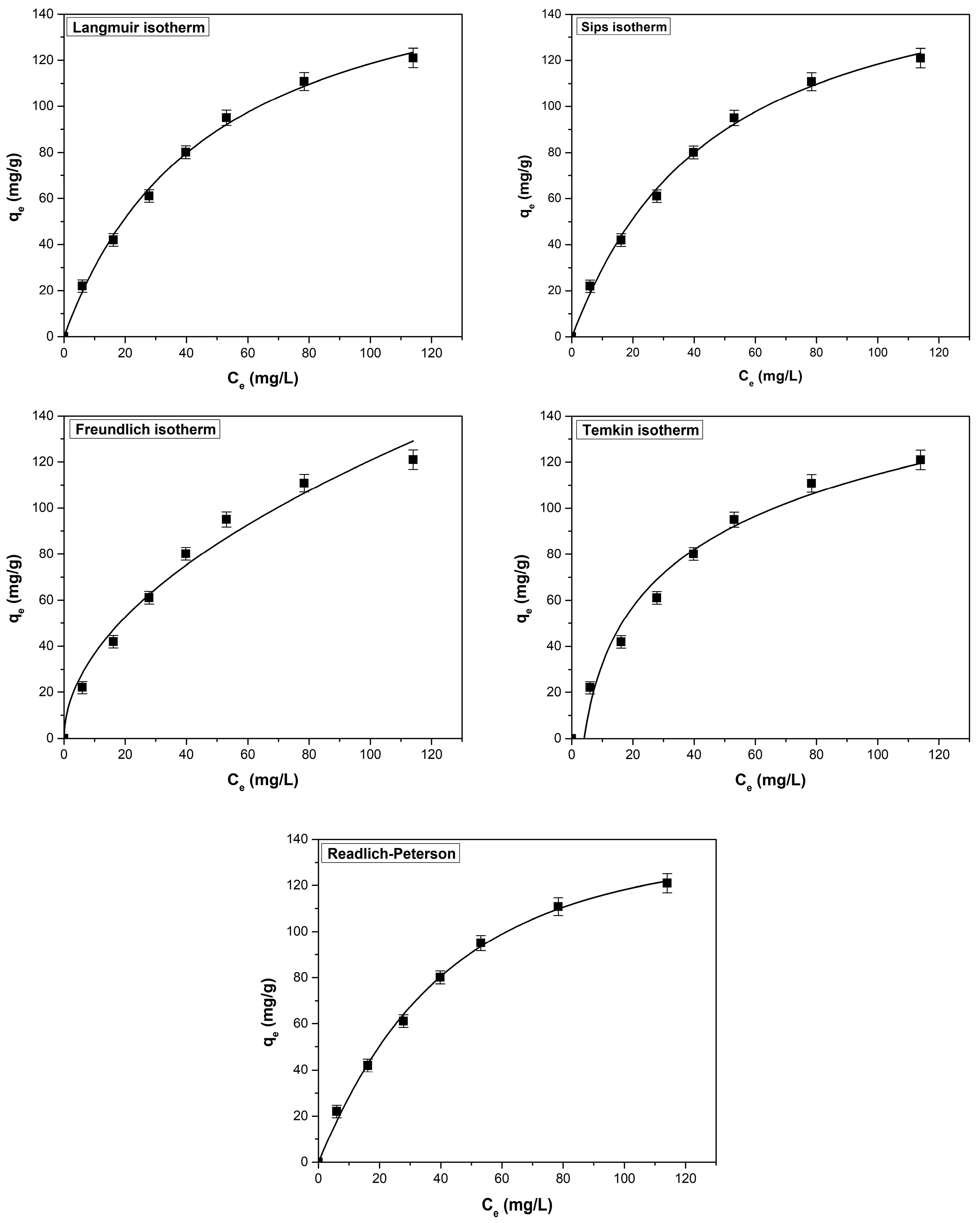
The adsorption equilibrium was investigated by fitting the experimental data to several widely used isotherm models—namely, Langmuir, Freundlich, Temkin, Redlich–Peterson, and Sips. Equilibrium isotherms describe the relationship between the solute concentration in the liquid phase and the amount adsorbed onto the surface of the adsorbent. The fitted isotherm curves, together with their corresponding model constants and error analysis parameters, are presented in Figure 3 and Table 1.
The modeling of adsorption isotherms revealed that the experimental data are most adequately described by the Sips model, closely followed by the Langmuir model. The high values of the coefficient of determination (R2 = 0.9975 for Sips and 0.9968 for Langmuir), together with the low error parameters (χ2, SSE, and ARE), indicate an excellent fit of these models to the experimental data. The maximum adsorption capacity determined by the Langmuir model (qmax = 175.64 mg/g) is very close to that estimated by the Sips model (Qsat = 174.1 mg/g), confirming the consistency of the results.
Notably, the Sips model exhibited the lowest error values (χ2 = 0.77, SSE = 32.2, and ARE = 4.36%), suggesting its superior ability to describe the adsorption behavior over the entire concentration range investigated. The Sips model integrates the fundamental assumptions of both Langmuir and Freundlich isotherms, making it particularly suitable for adsorption systems involving heterogeneous surfaces [19].
Similarly, the Redlich–Peterson model (R2 = 0.9970, β = 1.18) supports intermediate adsorption behavior, providing a satisfactory description of the system, albeit with slightly higher deviations. In contrast, the Freundlich and Temkin models exhibited significantly poorer statistical indicators (higher χ2, SSE, and ARE values), indicating a limited ability to accurately represent the adsorption process.
Although the Freundlich model suggests favorable adsorption behavior (1/n = 0.51), it shows a lower fit quality (R2 = 0.9818), whereas the Temkin model exhibits the weakest correlation with the experimental data, indicating that a linear decrease in adsorption energy with surface coverage does not adequately describe the adsorption mechanism.
These findings are consistent with previously reported studies, in which the Sips isotherm was identified as the most appropriate model for describing methylene blue adsorption onto various similar biosorbents: Tussilago farfara Leaves [5], Prunus cerasus leaves [22], Vaccinium myrtillus L. leaves [12], and Rubus idaeus leaves [23].
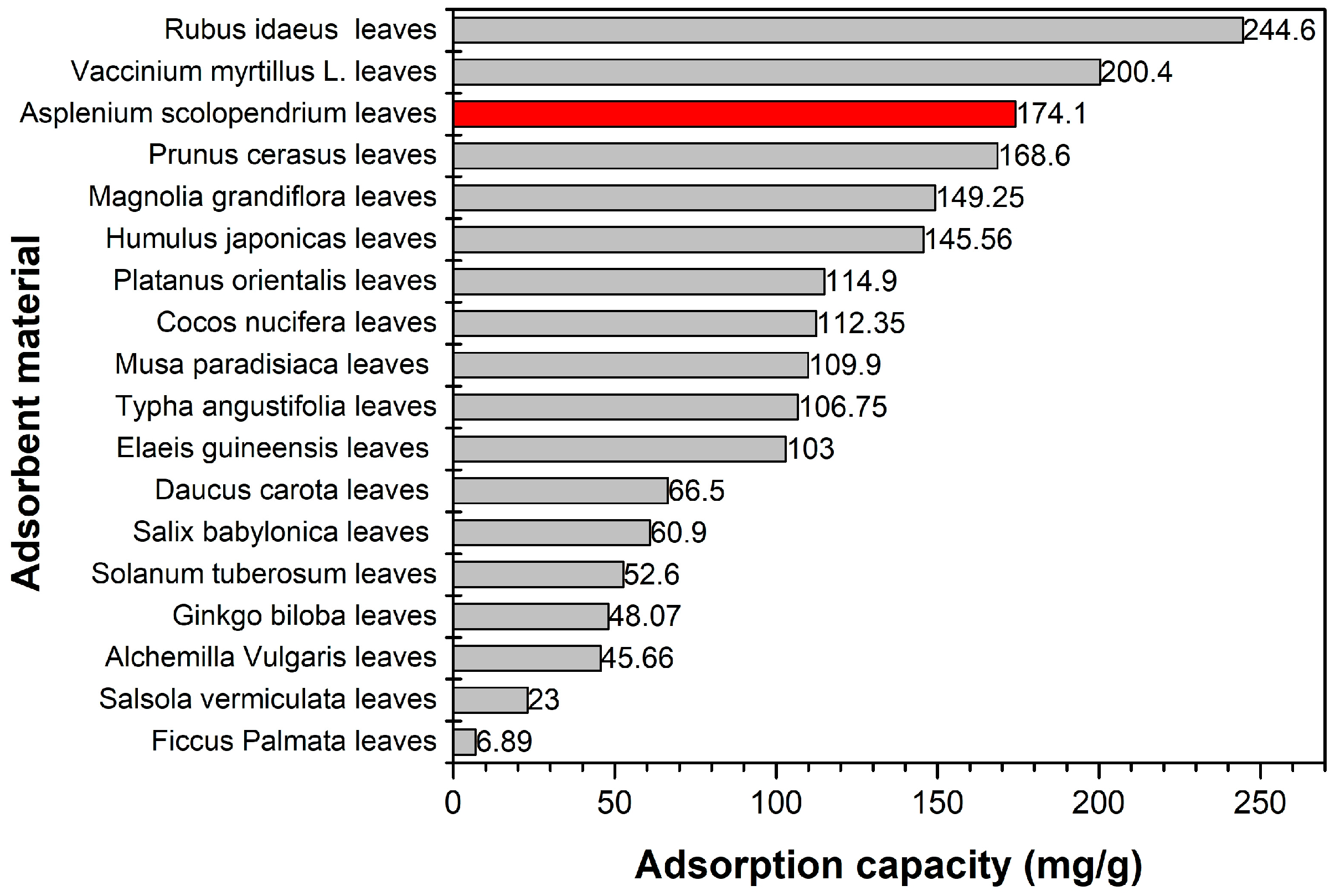
Figure 4 presents a comparative analysis of the adsorption capacities of different plant leaf materials used for methylene blue, in articles in the scientific literature [12,22,23,24,25,26,27,28,29,30,31,32,33,34,35,36,37]. The adsorption capacity of the adsorbent material used in this study, has been inserted in red in Figure 4, to highlight its position compared to the other materials used by other researchers in their studies. The data indicates that the adsorbent derived from Asplenium scolopendrium leaves achieves a higher capacity than several equivalent materials documented in the existing scientific literature.

3.3. Adsorption Kinetic Models

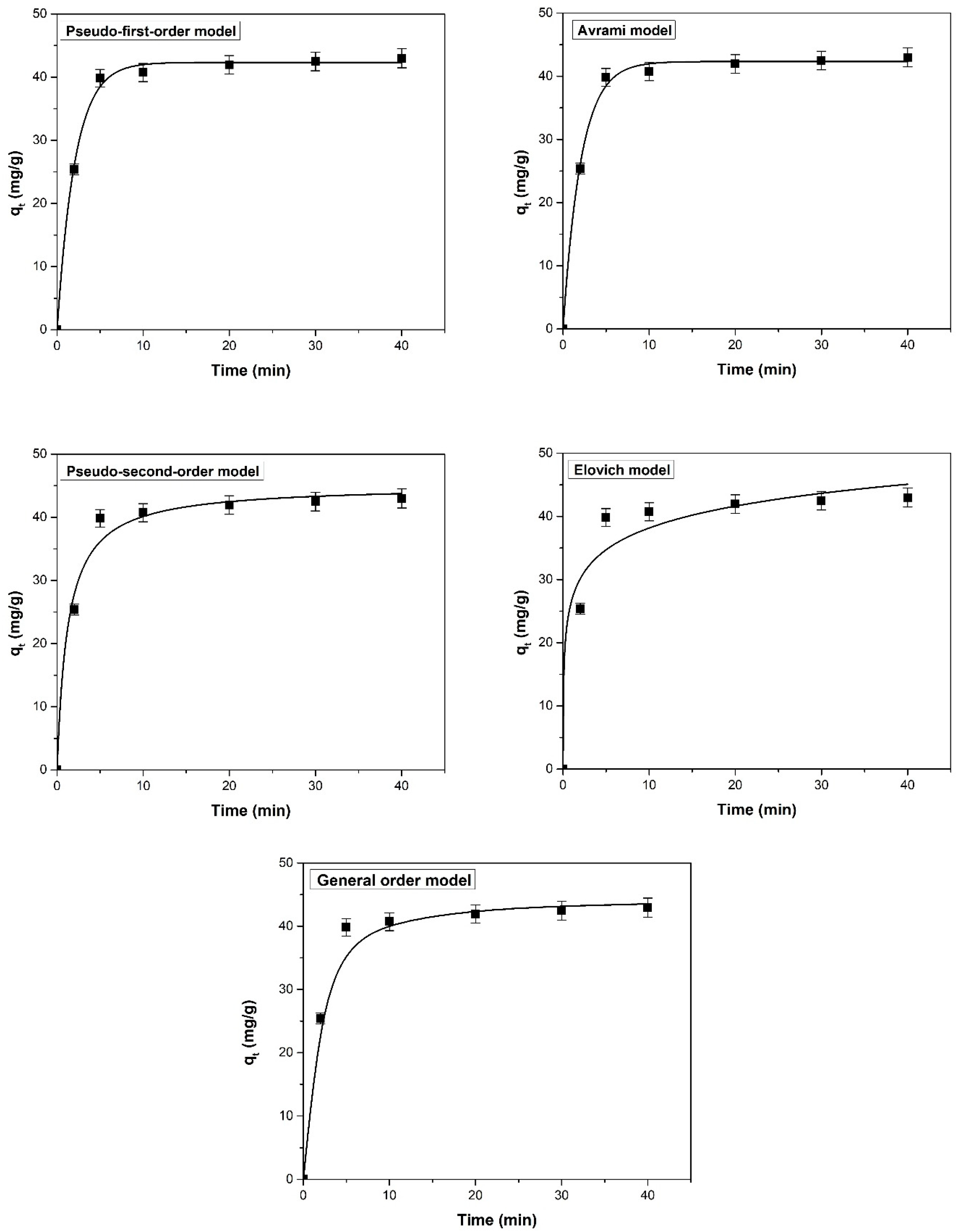
Figure 5 shows how contact time influences the adsorption capacity of the adsorbent derived from hart’s-tongue fern leaves. The adsorption capacity rises with time and reaches a steady state after approximately 20 min. At the beginning of the process, adsorption occurs quickly; however, the rate gradually decreases as time progresses until equilibrium is achieved. This behavior is explained by the abundance of available active sites at the initial stage, which are gradually occupied. As these sites become saturated with methylene blue molecules, the adsorbent surface approaches full coverage, indicating that equilibrium has been reached.
The literature reports comparable equilibrium times for various similar adsorbent materials employed in methylene blue dye adsorption: 20 min for coltsfoot leaves [5], papaya leaves [38] and Humulus japonicas leaves [25], 24 min for potato leaves [33] and 30 min for Daucus carota leaves [31].
Five kinetic models were evaluated to interpret the experimental data, and the corresponding fitted curves are presented in Figure 5. The model parameters, together with their associated error functions, are summarized in Table 2. Among the tested models, the Avrami kinetic model provided the best fit to the experimental data, as indicated by the highest coefficient of determination and the lowest error values (R2 = 0.9970, χ2 = 0.11, SSE = 4.45, ARE = 1.57%). This suggests that the adsorption process does not follow a simple integer-order kinetic mechanism, but rather involves a more complex behavior, likely associated with multiple adsorption pathways or a heterogeneous distribution of active sites. Previous studies have also reported that the Avrami kinetic model effectively represents the adsorption behavior of methylene blue on adsorbent materials based on plant, including Nigella sativa seeds waste [39] and Mimosa Pigra Plant biochar [40].
The superior performance of the Avrami model can be attributed to its ability to account for the progressive occupation of active sites in systems characterized by complex cellular structures and heterogeneous porosity. Unlike classical kinetic models, it reflects the evolution of the adsorption rate as dye molecules diffuse into the biomass and rearrange on irregular surfaces [20,39].
The Avrami rate constant, kAV = 0.83 (1/min) indicates a high transfer rate of dye molecules from the solution to the biomass surface in the initial stages of the process. This value, corroborated by the exponent nAV = 0.57, suggests a high initial affinity of the plant adsorbent for the dye, the process being subsequently controlled by the diffusion resistance in the porous structure of the material.
The pseudo-second-order model also shows a good agreement with the experimental data (R2 = 0.9859, ARE = 4.22%), and the calculated equilibrium adsorption capacity (qe,calc = 45.09 mg/g) is close to the experimental value. This may indicate the involvement of chemisorption. However, its lower performance compared to the Avrami model suggests that a uniform second-order mechanism is insufficient to fully describe the system.
Although the pseudo-first-order model yields a relatively high coefficient of determination (R2 = 0.9924), the higher ARE value (16.86%) and the discrepancy between calculated and experimental adsorption capacities indicate that this model does not adequately represent the adsorption kinetics.
The Elovich model exhibits the weakest performance (ARE = 20.75%), suggesting that a mechanism based on an exponential increase in activation energy with surface coverage is not dominant in this system.
The general-order kinetic model also provides a good fit (R2 = 0.9926, ARE = 2.41%), further supporting the conclusion that the adsorption process does not strictly follow integer-order kinetics. The kinetic exponent (n = 1.23) indicates intermediate behavior. Overall, the adsorption kinetics appear to be governed by a combination of mechanisms, including surface interactions and mass transfer effects.

3.4. The Effects of pH, Ionic Strength, and Adsorbent Dosage on Dye Removal Efficiency

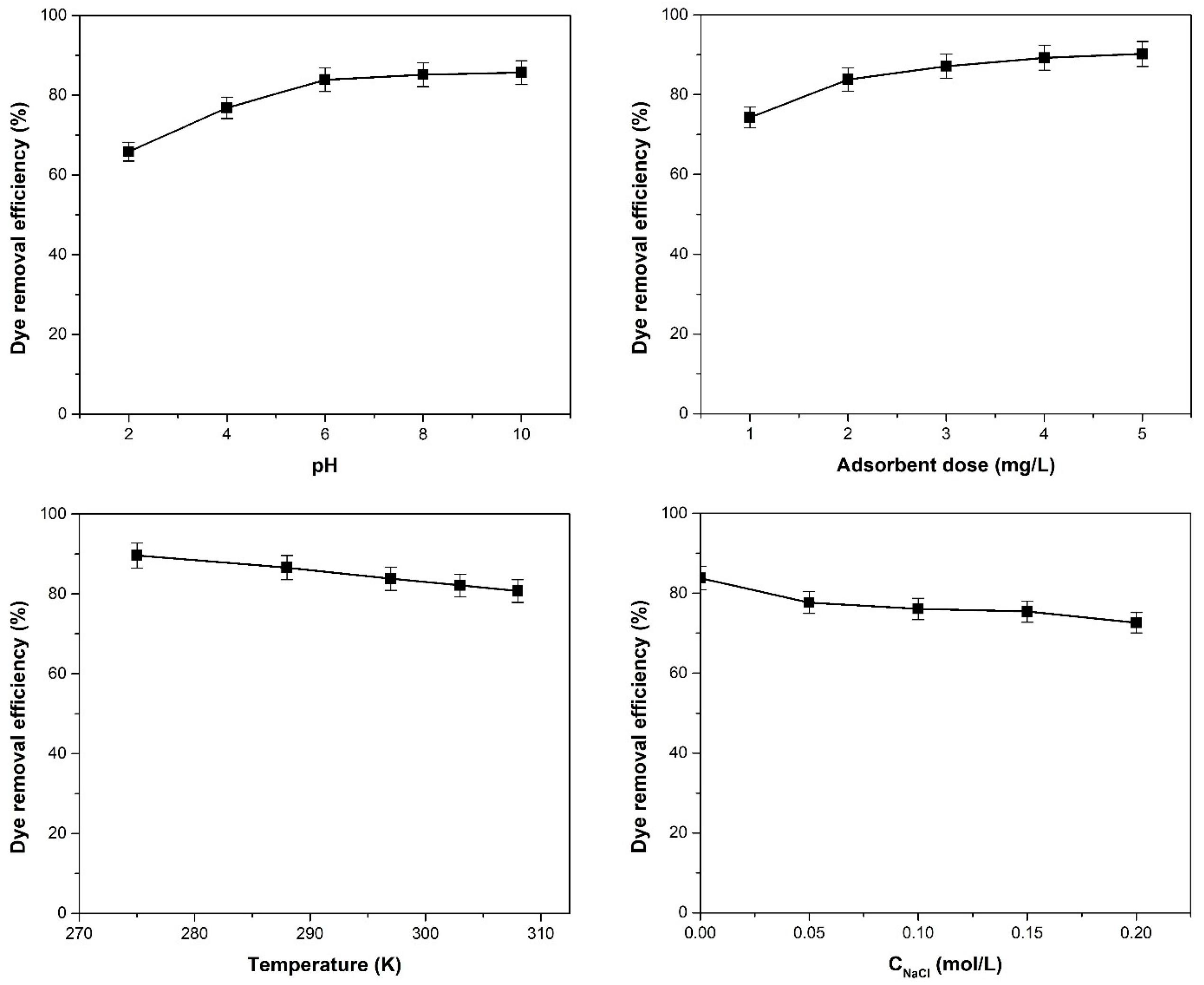
The effects of pH, ionic strength, and adsorbent dosage on adsorption performance are presented in Figure 6. Adsorption was enhanced at pH values above the point of zero charge (pHPZC = 7.04), where the adsorbent surface becomes negatively charged, favoring electrostatic attraction with the cationic methylene blue dye. In contrast, under acidic conditions, the positively charged surface hinders dye uptake due to electrostatic repulsion. Although dye removal efficiency shows a slight increase between pH 6 and 10, the relatively small variation suggests that mechanisms other than electrostatic interactions also contribute to the adsorption process [5,41]. As an alternative mechanism, it is possible that π–π stacking interactions, together with hydrophobic forces, become factors supporting the adsorption capacity and affinity of the system. Due to its planar and conjugated aromatic structure, methylene blue exhibits a high predisposition for π–π interactions with surfaces rich in aromatic domains, such as carbon-based materials (e.g., biomass). In such systems, the π electrons of the aromatic nucleus of the dye interact with the π electron clouds of the adsorbent, leading to the stabilization of the adsorbed complex [42,43].
An increase in ionic strength negatively affected dye removal efficiency, as sodium ions compete with dye cations for available active sites on the adsorbent surface [33,41].
Increasing the adsorbent dose led to an increase in dye removal efficiency, as well as higher amounts of adsorbent by providing a greater available surface area and increasing the number of active binding sites [12,44]. At higher doses of adsorbent, the positive effect is less pronounced, because there is the possibility of worsening the stirring conditions.
A decrease in dye adsorption efficiency can be observed with increasing temperature which suggests that the adsorption process is exothermic. With increasing temperature, the attractive interactions between the dye molecules and the adsorption sites on the adsorbent surface, as well as the interactions among adjacent adsorbed species, are weakened, resulting in a decrease in adsorption efficiency [45,46].

3.5. Thermodynamic Parameters Analysis

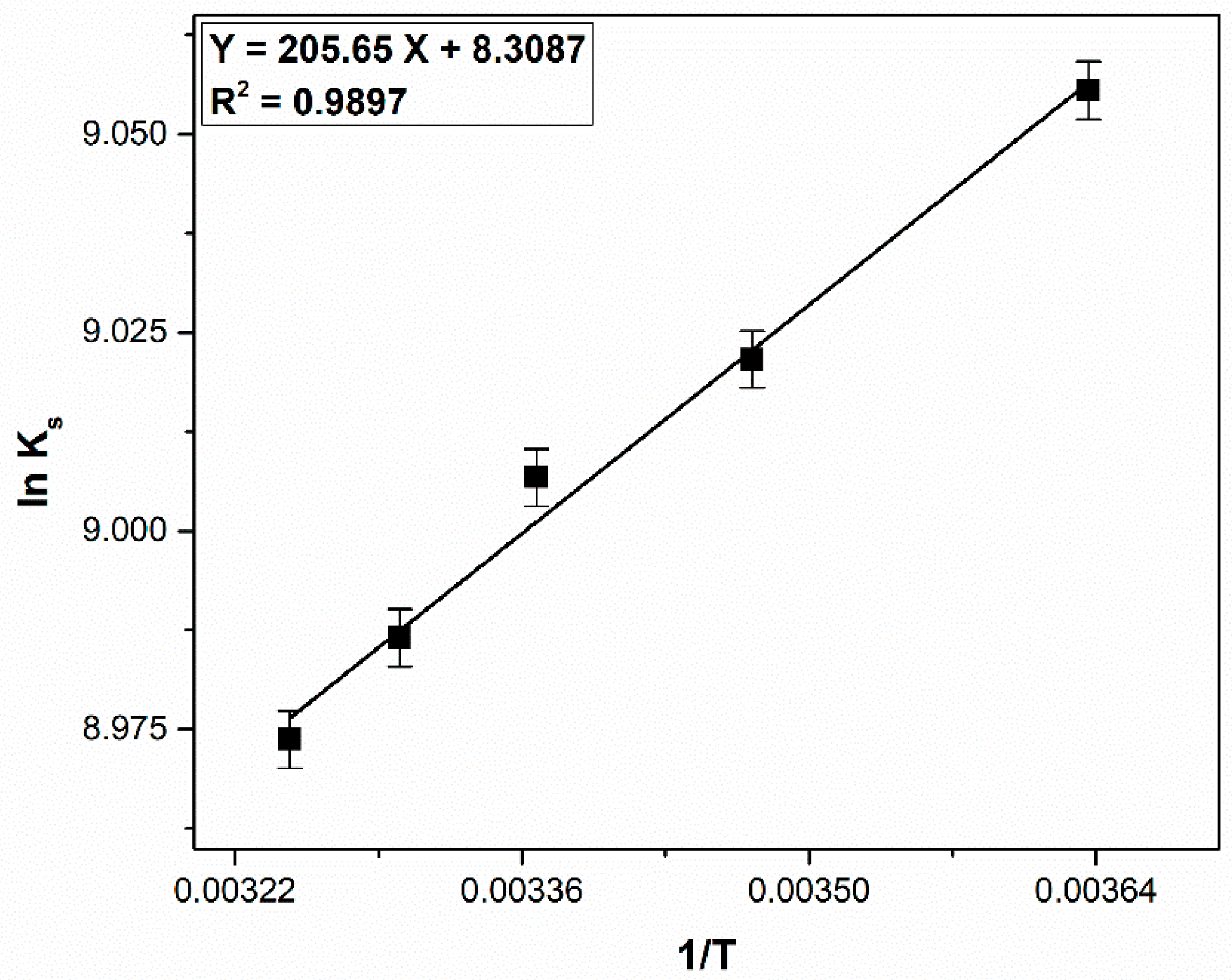
Thermodynamic parameters were evaluated from experimental data obtained at several temperatures (275–308 K), using the Van’t Hoff approach from the linear plots of ln Kₗ versus 1/T (Figure 7). The calculated values of standard Gibbs free energy change (ΔG°), standard enthalpy change (ΔH°), and standard entropy change (ΔS°) are presented in Table 3.
The negative ΔG° values confirm that the adsorption process is spontaneous and thermodynamically favorable. Standard enthalpy change (ΔH°) exhibits a negative value indicating that the process can proceed through exothermic pathways. Furthermore, the positive ΔS° values observed suggest an increase in randomness at the solid–liquid interface during adsorption, reflecting the enhanced disorder at the boundary layer.
Various studies have reported comparable results regarding the adsorption of methylene blue on different materials. For example, research on the leaves of Tussilago farfara [5], Daucus carota [31], Prunus cerasus [22], Typha angustifolia (L.) [29] and Solanum tuberosum [33].
The adsorption mechanism is primarily governed by physisorption, as evidenced by the low ΔH° values (below 20 kJ/mol), which are characteristic of processes driven by weak intermolecular forces such as van der Waals interactions. In addition, the standard Gibbs free energy change (ΔG°) falls within the range of −80 to −20 (kJ/mol), with values closer to −20 (KJ/mol). This distribution indicates that physical adsorption predominates, while a minor contribution from chemisorption may be present, slightly enhancing the overall dye uptake [23,34].

3.6. Taguchi Optimization

The optimal conditions for parameters influencing dye removal from water by adsorption were identified using the Taguchi method. This technique is suitable because it minimizes the effects of noise factors on the process. It is widely used for process optimization since it allows the analysis of several variables with a small number of experiments, improving efficiency without additional costs. An important advantage of the Taguchi method is its ability to optimize multiple parameters at the same time while obtaining detailed information from limited experimental runs [47,48,49].
The optimal parameters for dye removal through adsorption were determined using a Taguchi orthogonal array (L25). Six factors, each examined at five different levels, were analyzed to assess their influence on dye removal efficiency (Table 4). The Taguchi method was applied to transform the experimental results into a signal-to-noise (S/N) ratio, which was subsequently evaluated to assess the reliability of the experiment and the validity of the obtained results. In this approach, the term “signal” represents the desired value (mean), while “noise” corresponds to the undesirable variation (standard deviation) of the output response [47,48,49]. Since maximizing adsorption efficiency was the main objective in evaluating the experimental results, the “larger-the-better” criterion was selected for the analysis of the signal-to-noise ratio within the Taguchi method.
The experimental data for methylene blue removal efficiency, along with the corresponding S/N ratios for each experimental run, are presented in Table 5.
Table 6 displays the outcomes of the Taguchi analysis derived from the S/N ratios, highlighting the order of influence of the studied factors. Among the controllable parameters, time showed the most significant effect on the adsorption process, whereas temperature had the smallest impact. According to the literature data, contact time had the greatest influence, while temperature had the least effect in the adsorption of methylene blue on the adsorbent material obtained from raspberry (Rubus idaeus) leaves [23].
By correlating data presented in Table 4 and Table 6, the optimal conditions for adsorption were established as: pH = 10, contact time = 40 min, adsorbent dosage = 4 g/L, initial dye concentration = 200 mg/L, temperature = 275 K, and ionic strength = 0 mol/L.
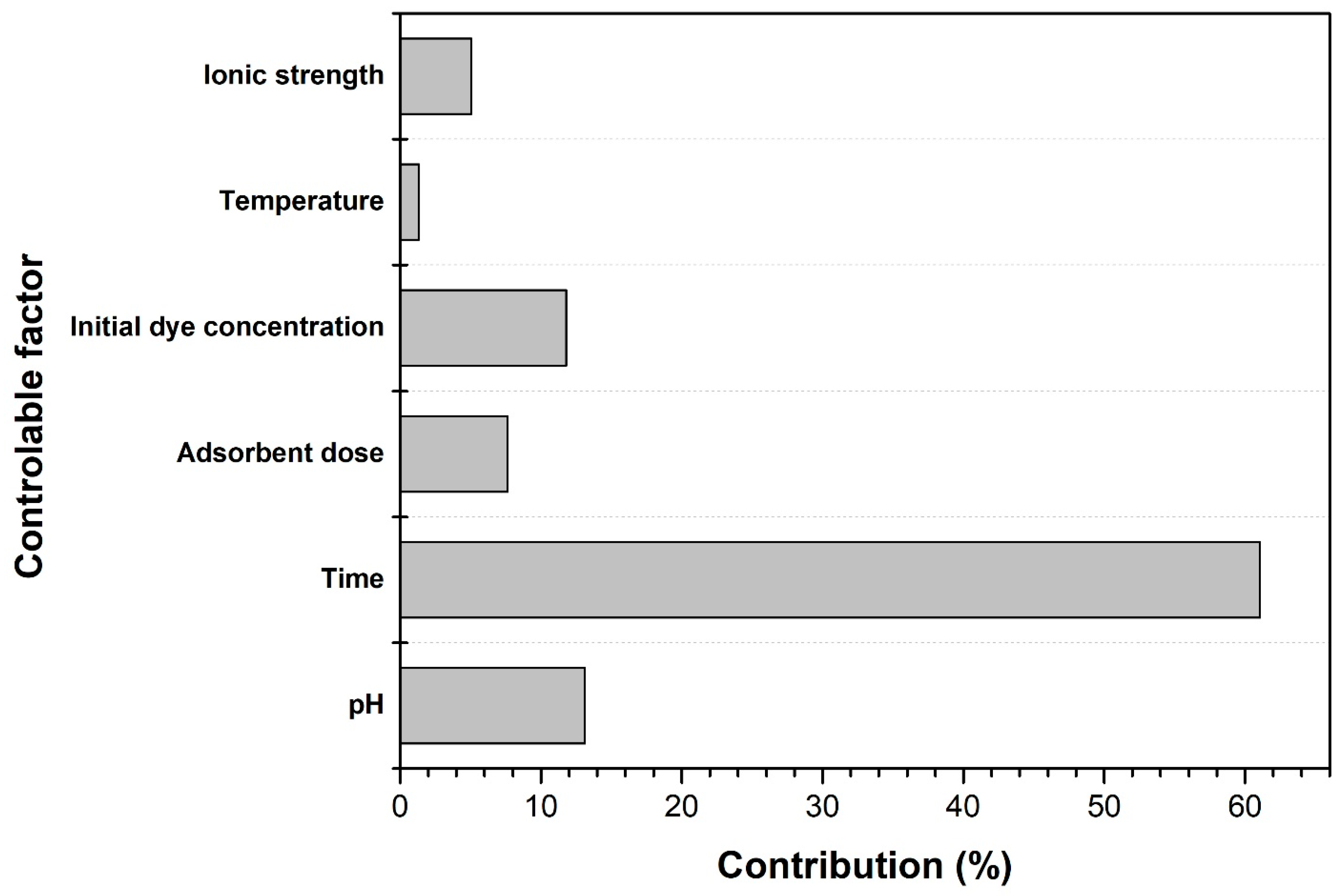
The findings from the ANOVA analysis support the conclusions obtained using the Taguchi method. They confirm the same ranking of the controllable factors according to their influence on the process and additionally quantify the percentage contribution of each factor (Figure 8). ANOVA results indicate that time has the greatest effect on the process (72.65%), whereas the temperature exhibits the least influence (1.33%).

3.7. Desorption Study

Although attempts were made to recover methylene blue dye from the adsorbent material using various desorbing agents, the results indicated low efficiency, making its reuse impractical. The obtained desorption efficiencies were 16.76% for distilled water, 67.34% for HCl, and 35.41% for NaOH, confirming that regeneration of the adsorbent is not feasible. Nevertheless, this drawback is mitigated by the low cost and wide availability of hart’s-tongue fern leaves. Furthermore, the adsorbent material can be utilized through incineration to generate energy, providing a simple and effective reuse option.
In addition, the material can be applied in the production of ceramic or glass foams, where it acts as a foaming agent. This behavior is due to the release of large amounts of gases during combustion, which promotes the formation of a porous structure and makes it a suitable precursor for such materials [12,23].

4. Conclusions

This study presents an investigation of a low-cost lignocellulosic adsorbent developed from natural plant sources for the removal of methylene blue from aqueous solutions. The adsorbent material was obtained from Asplenium scolopendrium (hart’s-tongue fern) through simple preparation routes that deliberately avoided chemical reagents and thermal treatments, emphasizing sustainability and low processing costs. SEM and color analyses, revealed noticeable changes in surface morphology and coloration after adsorption, providing clear evidence of dye retention on the adsorbent surfaces. Equilibrium modeling demonstrated that the Sips isotherm best described the adsorption process, while kinetic data were most accurately fitted by the Avrami model. Rapid adsorption was observed, with equilibrium reached within approximately 20 min. The adsorption performance was influenced by operational parameters such as pH, contact time, adsorbent dose, temperature and ionic strength. Thermodynamic parameters indicated that the adsorption processes are spontaneous and predominantly governed by physical interactions, with minor chemical contributions. Process optimization using the Taguchi method, supported by ANOVA, confirmed the significant influence of time (72.65%), while temperature had a negligible contribution (1.33%). In terms of performance, the hart’s-tongue fern-based adsorbent exhibited a higher maximum adsorption capacity (174.1 mg/g) for methylene blue, surpassing many similar biosorbents reported in the literature. Overall, these findings highlight that Asplenium scolopendrium leaves are abundant, eco-friendly, and highly effective resources for the removal of methylene from water, offering promising potential for practical wastewater treatment applications, consistent with the principles of the circular economy and sustainability.

Supplementary Materials

The following supporting information can be downloaded at: https://www.mdpi.com/article/10.3390/su18084145/s1, Table S1: The calculation equations for dye removal percentage and adsorption capacity at equilibrium; Table S2: The non-linear equations of the adsorption isotherms used to assess the process; Table S3: The non-linear equations of the kinetic models used to assess the process; Table S4: The calculation equations for error parameters R2, χ2, SSE and ARE. title; Table S5: The calculation equations of thermodynamic parameters. Table S6: The calculation equation of the desorption efficiency.

Author Contributions

Conceptualization, G.M. and M.E.R.-G.; methodology, G.M., M.D. and C.T.; software, G.M., C.V. and C.T.; validation, G.M., M.D. and C.T.; formal analysis, G.M. and S.P.; investigation, G.M., M.E.R.-G., S.P., M.D. and S.B.; resources, G.M. and M.D.; data curation, G.M. and C.V.; writing—original draft preparation, G.M., C.V., M.E.R.-G., C.T. and S.B.; writing—review and editing, G.M., M.E.R.-G., M.D. and S.P.; visualization, G.M. and C.V.; supervision, G.M. and M.E.R.-G. All authors have read and agreed to the published version of the manuscript.

Funding

This research received no external funding.

Institutional Review Board Statement

Not applicable.

Informed Consent Statement

Not applicable.

Data Availability Statement

All the experimental data obtained are presented, in the form of a table and/or figure, in the article, or Supplementary Materials.

Conflicts of Interest

The authors declare no conflicts of interest.

References

  1. Al-Tohamy, R.; Ali, S.S.; Li, F.; Okasha, K.M.; Mahmoud, Y.A.-G.; Elsamahy, T.; Jiao, H.; Fu, Y.; Sun, J. A critical review on the treatment of dye-containing wastewater: Ecotoxicological and health concerns of textile dyes and possible remediation approaches for environmental safety. Ecotoxicol. Environ. Saf. 2022, 231, 113160. [Google Scholar] [CrossRef]
  2. Akhtar, N.; Syakir Ishak, M.I.; Bhawani, S.A.; Umar, K. Various Natural and Anthropogenic Factors Responsible forWater Quality Degradation: A Review. Water 2021, 13, 2660. [Google Scholar] [CrossRef]
  3. Khan, I.; Saeed, K.; Zekker, I.; Zhang, B.; Hendi, A.H.; Ahmad, A.; Ahmad, S.; Zada, N.; Ahmad, H.; Shah, L.A.; et al. Review on methylene blue: Its properties, uses, toxicity and photodegradation. Water 2022, 14, 242. [Google Scholar] [CrossRef]
  4. Mosoarca, G.; Popa, S.; Vancea, C.; Dan, M.; Boran, S. Modelling and Optimization of Methylene Blue Adsorption Process on Leonurus cardiaca L. Biomass Powder. Processes 2023, 11, 3385. [Google Scholar] [CrossRef]
  5. Mosoarca, G.; Vancea, C.; Popa, S.; Radulescu-Grad, M.E.; Dan, M.; Tanasie, C.; Boran, S. Adsorption of Methylene Blue onto Environmentally Friendly Lignocellulosic Material Obtained from Mature Coltsfoot (Tussilago farfara) Leaves. Polymers 2025, 17, 1549. [Google Scholar] [CrossRef]
  6. Su, X.; Wang, X.; Ge, Z.; Bao, Z.; Lin, L.; Chen, Y.; Dai, W.; Sun, Y.; Yuan, H.; Yang, W.; et al. KOH-activated biochar and chitosan composites for efficient adsorption of industrial dye pollutants. Chem. Eng. J. 2024, 486, 150387. [Google Scholar] [CrossRef]
  7. Kathing, C.; Saini, G. A review of various treatment methods for the removal of dyes from textile effluent. Recent Prog. Mater. 2022, 4, 21. [Google Scholar] [CrossRef]
  8. Sahu, D.; Pervez, S.; Karbhal, I.; Tamrakar, A.; Mishra, A.; Verma, S.R.; Deb, M.K.; Ghosh, K.K.; Pervez, Y.F.; Shrivas, K.; et al. Applications of different adsorbent materials for the removal of organic and inorganic contaminants from water and wastewater—A review. Desalin. Water Treat. 2024, 317, 100253. [Google Scholar] [CrossRef]
  9. Iwuozor, K.O.; Ighalo, J.O.; Ogunfowora, L.A.; Adeniyi, A.G.; Igwegbe, C.A. An empirical literature analysis of adsorbent performance for methylene blue uptake from aqueous media. J. Environ. Chem. Eng. 2021, 9, 105658. [Google Scholar] [CrossRef]
  10. Shakoor, S.; Nasar, A. Removal of methylene blue dye from artificially contaminated water using citrus limetta peel waste as a very low cost adsorbent. J. Taiwan Inst. Chem. Eng. 2016, 66, 154–163. [Google Scholar] [CrossRef]
  11. Ungureanu, E.L.; Mocanu, A.L.; Stroe, C.A.; Panciu, C.M.; Berca, L.; Sionel, R.M.; Mustatea, G. Agricultural Byproducts Used as Low-Cost Adsorbents for Removal of Potentially Toxic Elements from Wastewater: A Comprehensive Review. Sustainability 2023, 15, 5999. [Google Scholar] [CrossRef]
  12. Mosoarca, G.; Vancea, C.; Popa, S.; Dan, M.; Boran, S. The Use of Bilberry Leaves (Vaccinium myrtillus L.) as an Efficient Adsorbent for Cationic Dye Removal from Aqueous Solutions. Polymers 2022, 14, 978. [Google Scholar] [CrossRef]
  13. Bulgariu, L.; Escudero, L.B.; Bello, O.S.; Iqbal, M.; Nisar, J.; Adegoke, K.A.; Alakhras, F.; Kornaros, M.; Anastopoulos, I. The utilization of leaf-based adsorbents for dyes removal: A review. J. Mol. Liq. 2019, 276, 728–747. [Google Scholar] [CrossRef]
  14. Yadav, M.; Singh, N.; Annu; Khan, S.A.; Raorane, C.J.; Shin, D.K. Recent Advances in Utilizing Lignocellulosic Biomass Materials as Adsorbents for Textile Dye Removal: A Comprehensive Review. Polymers 2024, 16, 2417. [Google Scholar] [CrossRef]
  15. Yekefallah, M.; Raofie, F. Preparation of stable nanosuspensions from Asplenium colopendrium leaves via rapid expansion of supercritical solution into aqueous solutions (RESSAS). J. Drug Deliv. Sci. Technol. 2021, 64, 102566. [Google Scholar] [CrossRef]
  16. Mosoarca, G.; Vancea, C.; Popa, S.; Dan, M.; Boran, S. Utilizing Novel Lignocellulosic Material from Hart’s-Tongue Fern (Asplenium scolopendrium) Leaves for Crystal Violet Adsorption: Characterization, Application, and Optimization. Polymers 2023, 15, 3923. [Google Scholar] [CrossRef]
  17. Bremer, P.; Eelke Jongejans, E. Frost and Forest Stand Effects on the Population Dynamics of Asplenium scolopendrium. Popul. Ecol. 2009, 52, 211–222. [Google Scholar] [CrossRef]
  18. Al-Ghouti, M.A.; Da’ana, D.A. Guidelines for the use and interpretation of adsorption isotherm models: A review. J. Hazard. Mater. 2020, 393, 122383. [Google Scholar] [CrossRef] [PubMed]
  19. Piccin, J.S.; Cadaval, T.R.S.; de Pinto, L.A.A.; Dotto, G.L. Adsorption isotherms in liquid phase: Experimental, modeling, and interpretations. In Adsorption Processes for Water Treatment and Purification; Bonilla-Petriciolet, A., Mendoza-Castillo, D., Reynel-Avila, H., Eds.; Springer: Cham, Switzerland, 2017; pp. 19–51. [Google Scholar]
  20. Dotto, G.L.; Salau, N.P.G.; Piccin, J.S.; Cadaval, T.R.S.; de Pinto, L.A.A. Adsorption kinetics in liquid phase: Modeling for discontinuous and continuous systems. In Adsorption Processes for Water Treatment and Purification; Bonilla-Petriciolet, A., Mendoza-Castillo, D., Reynel-Avila, H., Eds.; Springer: Cham, Switzerland, 2017; pp. 53–76. [Google Scholar]
  21. Wanga, J.; Guo, X. Adsorption kinetic models: Physical meanings, applications, and solving methods. J. Hazard. Mater. 2020, 390, 122156. [Google Scholar] [CrossRef] [PubMed]
  22. Mosoarca, G.; Vancea, C.; Popa, S.; Dan, M.; Boran, S. A Novel High-Efficiency Natural Biosorbent Material Obtained from Sour Cherry (Prunus cerasus) Leaf Biomass for Cationic Dyes Adsorption. Materials 2023, 16, 4252. [Google Scholar] [CrossRef]
  23. Mosoarca, G.; Popa, S.; Vancea, C.; Dan, M.; Boran, S. Removal of Methylene Blue from Aqueous Solutions Using a New Natural Lignocellulosic Adsorbent—Raspberry (Rubus idaeus) Leaves Powder. Polymers 2022, 14, 1966. [Google Scholar] [CrossRef]
  24. Guo, D.; Li, Y.; Cui, B.; Hu, M.; Luo, S.; Ji, B.; Liu, Y. Natural adsorption of methylene blue by waste fallen leaves of Magnoliaceae and its repeated thermal regeneration for reuse. J. Clean. Prod. 2020, 267, 121903. [Google Scholar] [CrossRef]
  25. Huang, Z.G.; Wang, T.; Yi, H.Y.; Li, X.B. Study on the adsorption of methylene blue from dye wastewater by Humulus japonicas leaves. In E3S Web of Conferences; EDP Sciences: Ulis, France, 2021; Volume 236, p. 03028. [Google Scholar]
  26. Peydayesh, M.; Rahbar-Kelishami, A. Adsorption of methylene blue onto Platanus orientalis leaf powder: Kinetic, equilibrium and thermodynamic studies. J. Ind. Eng. Chem. 2015, 21, 1014–1019. [Google Scholar] [CrossRef]
  27. Jawad, A.H.; Rashid, R.A.; Mahmuod, R.M.A.; Ishak, M.A.M.; Kasim, N.N.; Ismail, K. Adsorption of methylene blue onto coconut (Cocos nucifera) leaf: Optimization, isotherm and kinetic studies. Desalin. Water Treat. 2015, 57, 8839–8853. [Google Scholar] [CrossRef]
  28. Krishni, R.R.; Foo, K.Y.; Hameed, B.H. Adsorptive removal of methylene blue using the natural adsorbent-banana leaves. Desalin. Water Treat. 2014, 52, 6104–6112. [Google Scholar] [CrossRef]
  29. Boumaza, S.; Yenounne, A.; Hachi, W.; Kaouah, F.; Bouhamidi, Y.; Trari, M. Application of Typha angustifolia (L.) Dead leaves waste as biomaterial for the removal of cationic dye from aqueous solution. Int. J. Environ. Res. 2018, 12, 561–573. [Google Scholar] [CrossRef]
  30. Setiabudi, H.D.; Jusoh, R.; Suhaimi, S.F.R.M.; Masrur, S.F. Adsorption of methylene blue onto oil palm (Elaeis guineensis) leaves: Process optimization, isotherm, kinetics and thermodynamic studies. J. Taiwan Inst. Chem. Eng. 2016, 63, 363–370. [Google Scholar] [CrossRef]
  31. Kushwaha, A.K.; Gupta, N.; Chattopadhyaya, M.C. Removal of cationic methylene blue and malachite green dyes from aqueous solution by waste materials of Daucus carota. J. Saudi Chem. Soc. 2014, 18, 200–207. [Google Scholar] [CrossRef]
  32. Khodabandehloo, A.; Rahbar-Kelishami, A.; Shayesteh, H. Methylene blue removal using Salix babylonica (Weeping willow) leaves powder as a low-cost biosorbent in batch mode: Kinetic, equilibrium, and thermodynamic studies. J. Mol. Liq. 2017, 244, 540–548. [Google Scholar] [CrossRef]
  33. Gupta, N.; Kushwaha, A.K.; Chattopadhyaya, M.C. Application of potato (Solanum tuberosum) plant wastes for the removal of methylene blue and malachite green dye from aqueous solution. Arab. J. Chem. 2016, 9, S707–S716. [Google Scholar] [CrossRef]
  34. Singh, R.; Singh, T.S.; Odiyo, J.O.; Smith, J.A.; Edokpayi, J.N. Evaluation of methylene blue sorption onto low-cost biosorbents: Equilibrium, kinetics, and thermodynamics. J. Chem. 2020, 2020, 8318049. [Google Scholar] [CrossRef]
  35. Reçber, Z. Adsorption of methylene blue onto spent Alchemilla vulgaris leaves: Characterization, isotherms, kinetic and thermodynamic studies. Int. J. Environ. Sci. Technol. 2022, 19, 4803–4814. [Google Scholar] [CrossRef]
  36. Bestani, B.; Benderdouche, N.; Benstaali, B.; Belhakem, M.; Addou, A. Methylene blue and iodine adsorption onto an activated desert plant. Bioresour. Technol. 2008, 99, 8441–8444. [Google Scholar] [CrossRef]
  37. Fiaz, R.; Hafeez, M.; Mahmood, R. Ficcus palmata leaves as a low-cost biosorbent for methylene blue: Thermodynamic and kinetic studies. Water Environ. Res. 2019, 91, 689–699. [Google Scholar] [CrossRef]
  38. Mukhlish, M.Z.B.; Khan, M.R.; Bhoumick, M.C.; Paul, S. Leaf powder: Novel adsorbent for removal of methylene blue from aqueous solution. Water Air Soil Pollut. 2012, 223, 4949–4958. [Google Scholar] [CrossRef]
  39. Sid, D.; Salem, Y.; Baitiche, M.; Djerboua, F.; Boukhalfa, N.; Boutahala, M. Removal of methylene blue dye from water with low cost Nigella sativa seeds waste: Kinetic, isotherm, and statistical modeling. Desalin. Water Treat. 2020, 197, 358–367. [Google Scholar] [CrossRef]
  40. Xuan Cuong, N. Study on Adsorption of Methylene Blue from Aqueous Solution by Biochar Derived from Mimosa Pigra Plant. VNU J. Sci. Earth Environ. Sci. 2021, 37, 43–54. [Google Scholar] [CrossRef]
  41. Han, X.; Wang, W.; Ma, X. Adsorption characteristics of methylene blue onto low cost biomass material lotus leaf. Chem. Eng. J. 2011, 171, 1–8. [Google Scholar] [CrossRef]
  42. Crini, G. Non-conventional low-cost adsorbents for dye removal: A review. Bioresour. Technol. 2006, 97, 1061–1085. [Google Scholar] [CrossRef] [PubMed]
  43. Gupta, V.K. Suhas Application of low-cost adsorbents for dye removal—A review. J. Environ. Manag. 2009, 90, 2313–2342. [Google Scholar] [CrossRef]
  44. Alghamdi, W.M.; El Mannoubi, I. Investigation of seeds and peels of Citrullus colocynthis as efficient natural adsorbent for Methylene blue dye. Processes 2021, 9, 1279. [Google Scholar] [CrossRef]
  45. Amrhar, O.; Berisha, A.; El Gana, L.; Nassali, H.; Elyoubi, M.S. Removal of methylene blue dye by adsorption onto Natural Muscovite Clay: Experimental, theoretical and computational investigation. Int. J. Environ. Anal. Chem. 2023, 103, 2419–2444. [Google Scholar] [CrossRef]
  46. Yagub, M.T.; Sen, T.K.; Afroze, S.; Ang, H.M. Dye and its removal from aqueous solution by adsorption: A review. Adv. Colloid Interface Sci. 2014, 209, 172–184. [Google Scholar] [CrossRef] [PubMed]
  47. Fernandez-Lopez, J.A.; Angosto, J.M.; Roca, M.J.; Doval Minarro, M. Taguchi design-based enhancement of heavy metals bioremoval by agroindustrial waste biomass from artichoke. Sci. Total Environ. 2019, 653, 55–63. [Google Scholar] [CrossRef] [PubMed]
  48. Razmi, B.; Ghasemi-Fasaei, R. Investigation of Taguchi optimization, equilibrium isotherms, and kinetic modeling for phosphorus adsorption onto natural zeolite of clinoptilolite type. Adsorpt. Sci. Technol. 2018, 36, 1470–1483. [Google Scholar] [CrossRef]
  49. Zolgharnein, J.; Rastgordani, M. Optimization of simultaneous removal of binary mixture of indigo carmine and methyl orange dyes by cobalt hydroxide nano-particles through Taguchi method. J. Mol. Liq. 2018, 262, 405–414. [Google Scholar] [CrossRef]
Figure 1. SEM analysis of adsorbent material surface: (A)—before adsorption, (B)—after adsorption.
Sustainability 18 04145 g001
Figure 2. Color analysis the CIELab* color space: (1)—(MB) methylene blue, (2)—adsorbent material before adsorption, and (3)—adsorbent material after adsorption.
Sustainability 18 04145 g002
Figure 3. Curve fitting for Langmuir, Freundlich, Temkin, Redlich–Peterson and Sips isotherms, used for processing experimental data.
Sustainability 18 04145 g003
Figure 4. A comparative analysis of the adsorption capacities of various plant-leaf-based materials for methylene blue.
Sustainability 18 04145 g004
Figure 5. Curve fitting for pseudo-first order, pseudo-second order, Avrami, Elovich and general order kinetic models, used for processing experimental data.
Sustainability 18 04145 g005
Figure 6. The effects of pH, ionic strength, and adsorbent dosage on adsorption performance.
Sustainability 18 04145 g006
Figure 7. The linear plots of ln Kₗ versus 1/T.
Sustainability 18 04145 g007
Figure 8. Percentage contribution of controllable factors on the adsorption process determined by ANOVA.
Sustainability 18 04145 g008
Table 1. The isotherm used for processing experimental data, together with their corresponding model constants and error analysis parameters.
Equilibrium IsothermParametersValue
LangmuirKL (L/mg)0.020 ± 0.004
qmax (mg/g)175.64 ± 18.24
R20.9968
χ20.80
SSE40.79
ARE (%)4.47
FreundlichKf (mg/g)(L/mg)1/n11.22 ± 2.14
1/n0.51 ± 0.09
R20.9818
χ23.70
SSE240
ARE (%)8.75
TemkinKT (L/mg)0.25 ± 0.07
b (kJ/g)68.98 ± 10.4
R20.9804
χ26.64
SSE251
ARE (%)13.26
SipsQsat (mg/g)174.1 ± 14.93
KS (L/mg)0.021 ± 0.003
n1.01
R20.9975
χ20.77
SSE32.2
ARE (%)4.36
Redlich–PetersonKRP (L/g)3.12 ± 0.62
aRP (L/mg)0.006 ± 0.001
βRP1.18 ± 0.11
R20.9970
χ21.36
SSE41.7
ARE (%)5.15
Table 2. The kinetic models used for processing experimental data, together with their corresponding model constants and error analysis parameters.
Kinetic ModelParametersValues
Pseudo-first orderk1 (1/min)0.57 ± 0.11
qe,calc (mg/g)42.09 ± 4.52
R20.9924
χ20.43
SSE13.19
ARE (%)16.86
Pseudo-second orderk2 (1/min)0.017 ± 0.004
qe,calc (g/mg·min)45.09 ± 4.42
R20.9859
χ20.63
SSE21.44
ARE (%)4.22
Elovicha (g/mg)0.19 ± 0.04
b (mg/g·min)1029 ± 214
R20.9598
χ21.94
SSE61.09
ARE (%)20.75
General orderkn (1/min) (g/mg)1/n7.98 ± 1.87
qn (mg/g)44.50 ± 3.42
n1.23 ± 0.34
R20.9926
χ20.31
SSE11.13
ARE (%)2.41
AvramikAV (1/min)0.83 ± 0.17
qAV (mg/g)42.32 ± 3.75
nAV0.57 ± 0.16
R20.9970
χ20.11
SSE4.45
ARE (%)1.57
Table 3. The calculated values of thermodynamic parameter.
ΔG (KJ/mol)ΔH (KJ/mol)ΔS (J/molK)
275 K288 K297 K303 K308 K
−20.7−21.6−22.2−22.6−23.1−0.028.3
Table 4. The six parameters and their levels used to study the effect on dye removal efficiency.
FactorLevel 1Level 2Level 3Level 4Level 5
pH246810
Time (min)210203040
Adsorbent dose (g/L)12345
Initial dye concentration (mg/L)50100150250350
Temperature (K)275288297303308
Ionic strength (mol/L)00.050.10.150.2
Table 5. The experimental data for methylene blue removal efficiency, along with the corresponding S/N ratios for each experimental run.
pHTime (min)Adsorbent Dose (g/L)Initial Dye Concentration (mg/L)Temperature
(K)
Ionic Strength
(mol/L)
Dye Removal Efficiency
(%)
S/N
Ratio
22150275044.3633.13
21021002880.0568.1336.79
22031502970.167.1936.41
23042503030.1565.4636.45
24053503080.254.2234.84
4221503030.242.932.44
4103250308078.1337.81
42043502750.0572.637.33
4305502880.191.8839.16
44011002970.1559.9235.63
6233502880.1544.1432.69
6104502970.287.8638.75
6205100303098.539.78
63011503080.0572.6937.36
64022502750.187.2638.73
8241003080.153.6834.77
81051502750.1576.2737.75
82012502880.270.6437.04
8302350297077.2137.66
8403503030.0596.2739.61
10252502970.0554.3434.51
101013503030.158.7335.51
10202503080.1586.8338.83
103031002750.293.1339.31
10404150288098.8739.93
Table 6. Response table for signal to noise ratios (options “Larger is better”).
LevelpHTimeAdsorbent
Dose
Initial Dye
Concentration
TemperatureIonic
Strength
135.5333.5135.7437.9037.2537.67
236.4837.3336.8937.2637.1337.13
337.4637.8837.1736.7836.6036.92
437.3737.9937.4536.9136.7636.27
537.6237.7537.2135.6136.7336.48
Delta2.104.481.712.290.661.39
Rank314265
Disclaimer/Publisher’s Note: The statements, opinions and data contained in all publications are solely those of the individual author(s) and contributor(s) and not of MDPI and/or the editor(s). MDPI and/or the editor(s) disclaim responsibility for any injury to people or property resulting from any ideas, methods, instructions or products referred to in the content.