1. Introduction
Tourism is increasingly shaped by climate and sustainability expectations, and large hospitality firms—hotels, resorts, integrated leisure operators, and related service providers—are pivotal for turning sustainable tourism aspirations into operational reality. Hospitality facilities consume substantial energy and water, generate waste, and contribute to greenhouse gas emissions through building operations, purchased utilities, and supply chains. At the same time, hospitality brands are highly visible to guests, destination communities, investors, and regulators. This visibility amplifies both reputational risk and the potential for firms to demonstrate environmental citizenship—credible, accountable actions that reduce environmental impacts and support destination sustainability [
1,
2,
3,
4].
Corporate governance is a key internal mechanism through which firms can translate sustainability intent into measurable environmental performance. Boards of directors influence strategic priorities, oversee risk management, shape disclosure and accountability, and can embed sustainability into executive incentives and organizational routines [
5,
6,
7,
8]. Despite a growing ESG and corporate governance literature, the governance–environment linkage in hospitality remains underdeveloped relative to broader multi-industry research, and existing findings are not yet well aligned around sector-specific measures, institutional conditions, or valuation consequences [
9,
10,
11,
12,
13,
14].
Several gaps motivate the present study. First, much prior evidence comes from broad cross-industry settings, making it difficult to determine whether the same governance mechanisms operate similarly in hospitality, where asset intensity, guest visibility, and destination dependence are unusually high. Second, environmental performance is frequently proxied through aggregate ESG or disclosure measures, which can blur the distinction between reported commitment and realized operational outcomes. Third, prior studies do not consistently examine whether board-level sustainability governance is associated not only with environmental performance but also with market valuation within a single hospitality-focused framework.
Accordingly, this study addresses two research questions. RQ1: Which board-level governance mechanisms are associated with environmental performance in large global hospitality firms? RQ2: Is environmental performance associated with firm value after accounting for governance attributes and firm characteristics? We address these questions using a ten-year panel of large listed hospitality firms for which comparable governance, environmental, and financial data are available.
Our contribution is deliberately bounded rather than revolutionary. We do not claim to uncover an entirely new governance–performance relationship. Rather, we contribute in three sector-specific ways. First, we provide hospitality-specific evidence in a literature still dominated by multi-industry studies. Second, we examine a governance-to-environment-to-value sequence using a standardized, though disclosure-based, environmental measure and a market-based valuation proxy. Third, we document a transparent public-source data collection and coding protocol that can support replication, sample expansion, lagged analyses, and the future incorporation of direct operational environmental indicators.
The remainder of the article proceeds as follows.
Section 2 critically reviews prior literature and develops the hypotheses.
Section 3 describes the sample, measures, and empirical strategy.
Section 4 reports the empirical results.
Section 5 discusses implications, limitations, and future research.
Section 6 concludes.
2. Literature Review, Research Gap, and Hypotheses Development
Boards are expected to balance shareholder interests with broader stakeholder expectations, particularly where environmental impacts are material and visible. Stakeholder theory argues that firms gain legitimacy and resources by addressing the needs of salient stakeholders, including customers, employees, regulators, local communities, and investors [
2,
15,
16]. Agency theory emphasizes monitoring and control to reduce managerial opportunism [
17,
18], while the resource-based view and the natural-resource-based view suggest that superior environmental capabilities can be sources of competitive advantage through efficiency, innovation, and risk reduction [
3,
19]. Together, these perspectives imply that board structures and processes can shape environmental performance and, ultimately, firm value.
At the same time, the literature leaves several issues unresolved. First, many governance–ESG studies rely on broad cross-sector samples, so the portability of their findings to hospitality remains uncertain. Second, governance mechanisms are not always measured in comparable ways: studies differ in how they operationalize independence, diversity, committees, and CEO power, and few observe whether a formally disclosed governance structure is substantively active. Third, environmental performance is often proxied by aggregate ESG or disclosure scores, which can conflate communication quality, management systems, and realized environmental outcomes. Fourth, endogeneity remains difficult to address because governance structures, sustainability practices, and valuation may be jointly determined. These limitations motivate a cautiously framed, hospitality-specific analysis.
In hospitality, environmental performance is not only an operational issue but also a strategic one: energy and water intensity, waste generation, and supply-chain impacts are increasingly scrutinized by guests, online intermediaries, destination authorities, and institutional investors. Environmental citizenship therefore requires both measurable reductions in environmental footprints and credible governance that signals accountability and reduces the risk of symbolic “green” claims. Yet prior findings are not fully uniform. Independent directors may improve monitoring, but their effect can depend on information quality and ESG expertise; gender diversity may broaden perspectives, but effects may vary with critical mass and institutional context; sustainability committees may signal either substantive oversight or formal compliance; and CEO duality can either weaken monitoring or speed strategic execution. Accordingly, the hypotheses below are developed as directional expectations that remain sensitive to context, measurement, and design.
2.1. Board Independence and Environmental Performance
Independent directors are generally viewed as more effective monitors of management and as better positioned to represent a wider set of stakeholder interests, although prior findings are not uniform across jurisdictions and outcome measures. In environmentally sensitive and reputationally exposed industries such as hospitality, independent boards may be more willing to require robust environmental targets, demand credible disclosure, and oversee the implementation of resource-efficiency initiatives. Empirical evidence links independent boards to stronger environmental disclosure and performance, particularly when boards are supported by dedicated environmental governance structures [
8,
20,
21]. Accordingly, we hypothesize:
Board independence can strengthen environmental performance through several complementary pathways. First, independent directors can increase the credibility of board monitoring by questioning managerial narratives, pressing for verifiable environmental targets, and reducing the likelihood that sustainability reporting becomes primarily symbolic. Second, independent directors can promote the use of formal controls—environmental KPIs, external assurance, and board-level dashboards—that make environmental risks and opportunities visible in routine governance processes. Third, independence can support more disciplined capital allocation toward efficiency upgrades (e.g., retrofits, energy management systems) and toward environmental innovations that reduce long-run operating costs.
In the hospitality context, the monitoring role of independent directors is especially salient because environmental issues are tightly coupled with brand reputation and destination relationships. Hotels depend on community goodwill, regulatory permits, and destination attractiveness. Independent directors can help ensure that environmental risks—such as water scarcity, waste management failures, or climate-related disruptions—are treated as enterprise risks rather than as peripheral CSR topics. By elevating these issues to the board agenda, independence can facilitate earlier interventions and reduce the probability of high-visibility environmental incidents.
Nevertheless, independence is not a complete substitute for environmental competence. Independent directors may lack deep firm-specific or technical knowledge of hospitality operations, and overly “outsider” boards can struggle to evaluate complex sustainability investments. This highlights the importance of combining independence with relevant expertise and effective information systems, suggesting that board independence is most likely to be beneficial when paired with high-quality environmental reporting and a clear sustainability strategy [
7,
22,
23,
24].
Hypothesis 1 (H1).
Board independence is positively associated with environmental performance in global hospitality firms.
2.2. Board Gender Diversity and Environmental Performance
Gender-diverse boards may improve decision quality through broader perspectives, stronger stakeholder orientation, and greater attention to ethics and long-term value, although simple percentage measures can obscure whether diversity is substantively influential or merely symbolic [
25,
26,
27,
28]. Prior research finds that female board representation can be associated with improved CSR and environmental outcomes and greater transparency [
21,
25,
26,
27,
28,
29,
30]. In hospitality and tourism—where service quality, reputational capital, and stakeholder relationships are central—these governance benefits may be particularly salient. Therefore, we hypothesize:
Gender diversity may shape environmental performance through cognitive and relational mechanisms. Cognitive diversity can broaden the set of alternatives considered and reduce groupthink, improving the board’s capacity to evaluate trade-offs between short-term costs and long-term sustainability returns. Relationally, women directors are frequently associated with stronger stakeholder orientation and more persistent attention to ethical and social issues, which can translate into greater attention to environmental citizenship in highly visible service sectors [
31,
32,
33,
34].
A growing stream of research suggests that the impact of gender diversity may depend on “critical mass”—the extent to which diverse directors are sufficiently represented to influence deliberation rather than serving as tokens. This is relevant for hospitality firms whose boards may include international members and operate across jurisdictions with different diversity norms. In such settings, gender diversity can contribute to more robust debate on environmental risks and disclosure quality, but the magnitude of the effect may vary by cultural context and by the board’s overall inclusiveness.
Importantly, board gender diversity may be particularly consequential in hospitality because service delivery and brand trust are co-produced with employees and guests. Boards that are more attentive to stakeholder relationships may be more likely to support operational practices that reduce environmental impacts without eroding service quality—for example, circular procurement, waste prevention programs, and investments in renewable energy where feasible. These arguments align with empirical studies showing positive links between gender diversity and environmental or ESG performance in hospitality and related sectors [
12,
35,
36,
37].
Hypothesis 2 (H2).
Board gender diversity is positively associated with environmental performance in global hospitality firms.
2.3. Board Sustainability Committees and Environmental Performance
Board-level sustainability or environmental committees can institutionalize oversight by allocating time, expertise, and agenda focus to environmental strategy, reporting, and risk management. However, the existence of a committee does not by itself guarantee meaningful involvement, so any association observed with a committee dummy should be interpreted as evidence on formal governance structure rather than on committee quality [
38]. Such committees can improve governance by monitoring environmental key performance indicators, reviewing climate and resource risks, and ensuring that management actions are aligned with stated sustainability commitments [
39,
40]. Evidence suggests that environmental or sustainability committees can support stronger environmental strategy and outcomes [
21,
41]. We therefore hypothesize:
Sustainability committees can operate as a governance “infrastructure” that reduces attention constraints at the board level. By dedicating formal time and responsibility to sustainability oversight, committees can translate broad ESG aspirations into specific monitoring routines: reviewing environmental metrics, assessing climate transition and physical risks, overseeing environmental disclosures, and monitoring progress against public targets.
Committee effectiveness, however, is likely to vary with design features. Committees with independent membership, clear charters, and access to relevant expertise (e.g., environmental management, energy systems, sustainable finance) can better evaluate environmental investments and challenge management assumptions. Regular committee meetings and formal reporting lines to the full board can also help embed environmental oversight into strategic planning and enterprise risk management.
For hospitality firms, committee structures can help connect corporate-level sustainability goals to property-level execution. Because hotels operate as portfolios of assets with heterogeneous local conditions, environmental performance requires coordinated standards and credible monitoring across properties. A board sustainability committee can request standardized environmental data, monitor compliance with internal environmental policies, and ensure that sustainability initiatives are resourced and not treated as discretionary add-ons [
21,
41].
Hypothesis 3 (H3).
The presence of a board sustainability committee is positively associated with environmental performance in global hospitality firms.
2.4. CEO Duality and Environmental Performance
When the CEO also serves as board chair, monitoring intensity may weaken due to concentrated authority and reduced board independence [
42]. While stewardship theory argues that unified leadership can improve strategic clarity, agency theory predicts that CEO duality can reduce accountability and increase the risk that symbolic sustainability actions substitute for substantive performance improvements [
8,
18,
43]. In hospitality—where sustainability claims are visible to guests and destinations—weak oversight may be particularly costly [
44,
45]. Accordingly, we hypothesize:
CEO duality concentrates decision authority and can alter how sustainability priorities are evaluated and enforced. From an agency perspective, duality may reduce the board’s willingness to challenge management, increasing the risk that environmental initiatives remain superficial or are adopted primarily for reputational purposes. From a stewardship perspective, unified leadership could, in principle, accelerate sustainability initiatives by reducing coordination costs and enabling rapid strategic execution [
46].
In hospitality, the stewardship argument may be most plausible where the firm faces acute environmental disruptions (e.g., extreme weather, water stress) requiring fast operational adaptation. Yet the reputational exposure of hospitality brands also raises the cost of weak oversight: if sustainability claims are not matched by performance, firms may face accusations of greenwashing and erosion of stakeholder trust. Thus, on balance, we expect the monitoring costs of CEO duality to dominate in the context of environmental performance.
More broadly, CEO duality should be interpreted as one element of power concentration. Future hospitality governance research could extend this framework by examining other sources of power—such as controlling owners, cross-holdings, or dual-class shares—that may shape how boards prioritize environmental citizenship. For the present study, our focus remains on CEO duality as a central and observable governance feature [
8,
18].
Hypothesis 4 (H4).
CEO duality is negatively associated with environmental performance in global hospitality firms.
2.5. Environmental Performance and Firm Value
Environmental performance can influence firm value through multiple channels: reduced operating costs from energy and water efficiency, lower regulatory and litigation risk, improved access to capital, stronger brand and reputational capital, and enhanced stakeholder relationships [
47,
48,
49]. Meta-analytic evidence suggests that ESG performance is often positively related to financial performance [
50], though magnitude and mechanisms can vary by industry and by the valuation proxy used. In hospitality, where physical assets and destination relationships are central, credible environmental performance may be especially value-relevant [
12,
51,
52,
53,
54,
55,
56]. We thus hypothesize:
The value relevance of environmental performance in hospitality can be understood through both cash-flow and risk channels. Operationally, energy and water efficiency can reduce utility expenses, while waste reduction and circular procurement can lower input costs and exposure to volatile commodity prices. Risk-wise, stronger environmental performance can mitigate regulatory, litigation, and disruption risks (e.g., climate-related property damage or supply interruptions), potentially reducing the cost of capital.
Environmental performance can also create intangible value through brand trust and destination partnerships. Hotels often rely on destination attractiveness and social license to operate; credible environmental citizenship can strengthen relationships with local authorities, communities, and tourism organizations. In addition, as investors increasingly integrate ESG signals into valuation and portfolio allocation decisions, environmental performance may influence market-based measures like Tobin’s Q through investor expectations and perceived resilience.
Yet the strength of the environmental performance–value relationship may differ across firms and contexts. For example, value effects may be larger where customers are more sustainability sensitive, where regulatory pressures are higher, or where the firm has sufficient managerial capacity and slack resources to implement environmental upgrades [
57]. Consistent with prior evidence in the ESG-performance literature and hospitality research, we expect a positive average association between environmental performance and firm value [
12,
50,
53,
54].
Hypothesis 5 (H5).
Environmental performance is positively associated with firm value (Tobin’s Q) in global hospitality firms.
2.6. Recent Evidence and Emerging Research Directions in Hospitality ESG Governance
Recent research—particularly in
Sustainability—highlights that hospitality and tourism firms face distinct sustainability governance challenges: highly visible environmental externalities, large fixed-asset portfolios, and strong dependence on destination ecosystems and community legitimacy. A comprehensive review of sustainable corporate governance in hospitality and tourism underscores the growing emphasis on board-level mechanisms that translate ESG ambition into operational practice, while also noting persistent measurement and comparability challenges [
58].
Within this emerging stream, recent cross-national evidence on global hospitality firms suggests that stronger governance may be associated with better environmental performance [
59]. At the same time, the literature remains thin on cumulative hospitality-specific testing, on transparent replication protocols, and on studies that connect governance, environmental performance, and firm value within the same bounded design. This motivates a replication-oriented and carefully delimited contribution rather than a claim of wholesale theoretical novelty.
Measurement developments are also important. Recent work proposes sector-tailored ESG evaluation guidelines for tourism, with explicit attention to hotel-specific practices (e.g., energy, water, waste, and destination stewardship), highlighting that credible evaluation requires indicators that capture both management systems and outcomes [
60]. This is especially relevant because disclosure-based composite scores remain useful for comparability but may not fully reflect underlying operational performance.
Empirical studies across sectors similarly emphasize that governance characteristics shape sustainability performance and disclosure. For example, research finds that corporate governance arrangements are associated with environmental performance outcomes in advanced market contexts [
61], while cross-country evidence suggests that board gender diversity and broader institutional conditions jointly influence sustainability performance [
62]. Other recent studies show that board characteristics can affect the fulfillment of ESG responsibilities and that governance effects may operate through informational and financing channels, such as reduced constraints and improved access to green investment [
63]. These findings further suggest that country context and regulatory conditions are plausible moderators that future hospitality studies should examine directly.
Finally, emerging tourism finance research increasingly links ESG performance to enterprise value, while also documenting potential mechanisms. Studies of tourism companies find that ESG performance can enhance firm value directly and indirectly through channels such as media attention and green innovation [
64], with complementary evidence pointing to broader value effects of ESG performance in the tourism sector [
65]. In addition, sustainability committee structures have been shown to strengthen environmental disclosure processes in other asset-intensive sectors, suggesting design features that may generalize to hospitality boards [
66]. Parallel work on sustainability communication in hospitality emphasizes the reputational and value consequences of transparency and the risks of misalignment between narrative claims and operational reality [
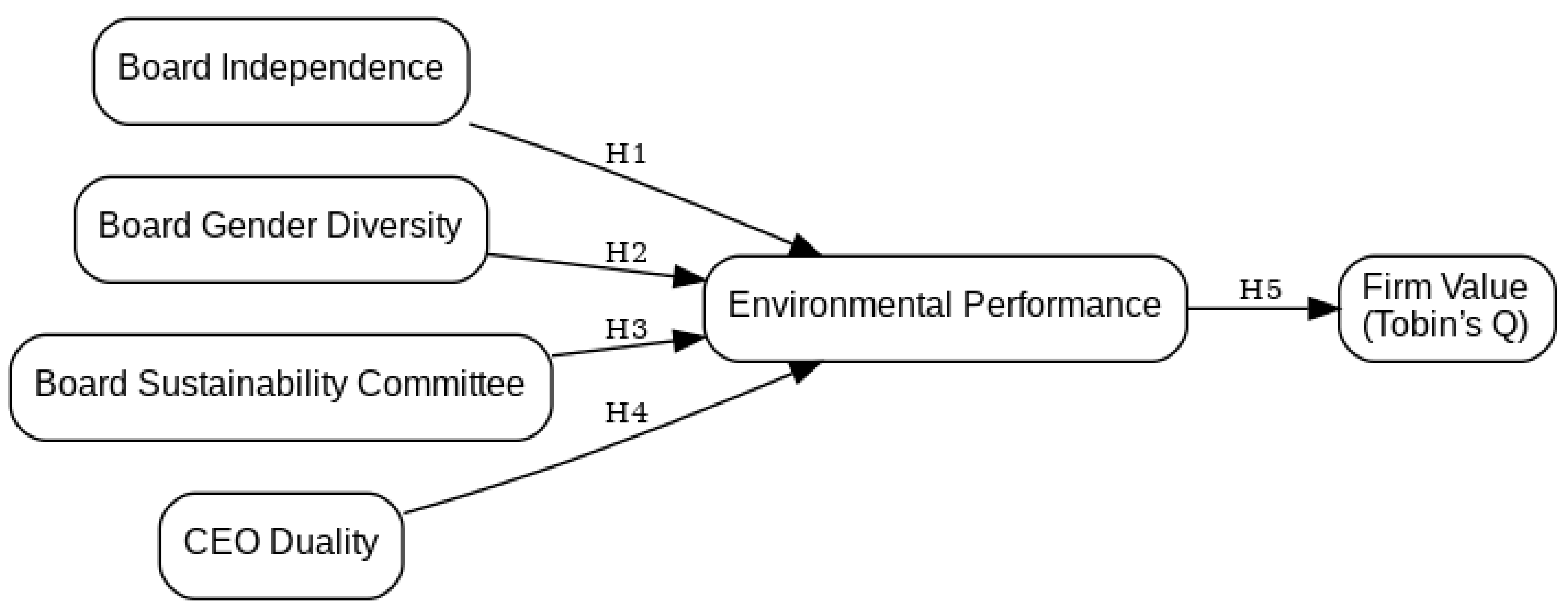
67]. Taken together, these studies underscore both the timeliness of examining board sustainability governance and the need to interpret governance–environment–value associations with attention to measurement limits and contextual variation (
Figure 1).
3. Materials and Methods
3.1. Sample and Study Context
The empirical analysis focuses on 10 large publicly traded hospitality firms that are global industry leaders and operate across major tourism markets: Marriott International, Hilton Worldwide Holdings, Oriental Land, Las Vegas Sands, InterContinental Hotels Group (IHG), Galaxy Entertainment Group, Hyatt Hotels, Accor, The Indian Hotels Company, and Huazhu Group. The panel covers fiscal years 2013–2022 (100 firm-year observations). The firms represent hotels, resorts, integrated leisure and gaming operators, and theme-park-oriented hospitality, providing variation in business models while remaining within the broader hospitality and tourism ecosystem. Focusing on large listed firms supports consistent availability of ESG disclosure and financial reporting and allows a like-for-like panel across a ten-year period.
This sampling decision creates an analytically focused but narrow frame of inference. The study is designed to speak most directly to large, publicly traded global hospitality firms with comparable disclosure systems, not to the hospitality industry as a whole. Small and medium-sized enterprises, private operators, and many emerging-market firms are not captured, so external validity should be interpreted cautiously.
To align the study with emerging sustainable tourism practices, we interpret environmental performance as an operationalized indicator of environmental citizenship—observable actions and reported outcomes that reduce environmental impacts and can be assessed by stakeholders such as guests, investors, and destination communities (
Table 1).
3.2. Data Sources
Environmental performance and board governance variables were obtained from Refinitiv ESG (LSEG Data & Analytics), which standardizes ESG indicators based on publicly available corporate disclosures and applies a transparent methodology to construct pillar-level scores. The use of a single vendor improves cross-firm comparability, but it also means that the environmental measure is partly disclosure based and may capture reporting quality and management systems in addition to realized operational outcomes. Financial statement data and market-based variables used to construct Tobin’s Q were obtained from Refinitiv/Datastream-type sources commonly used in prior governance–performance research.
In line with open-science expectations and to facilitate replication and extension,
Section 3.6 outlines a public-source data collection protocol that can be used to extend the panel beyond 2022, expand the sample beyond the initial 10 firms, incorporate direct environmental indicators where available, and document assurance and reporting-context variables.
3.3. Measures
Environmental performance (EnvPerf) is measured using the Refinitiv Environmental Pillar Score (0–100), where higher values reflect stronger environmental performance based on disclosed policies, resource use, emissions, innovation, and related indicators. The score is appropriate for cross-firm comparability, but it should not be interpreted as a pure physical-impact measure: higher values may reflect better reporting systems and environmental management, not only realized reductions in emissions, energy use, water withdrawal, or waste.
Firm value is measured using Tobin’s Q, a market-based valuation proxy. Following established practice, Tobin’s Q is computed as the market value of equity plus the book value of debt divided by total assets. Although widely used, Tobin’s Q is only one lens on value relevance, and future studies should also consider alternative valuation proxies such as market-to-book ratios or enterprise-value-based measures.
Governance variables include: board independence (percentage of independent directors); board gender diversity (percentage of women directors); sustainability committee (dummy variable equal to 1 if a board-level sustainability/environment/CSR committee is present); CEO duality (dummy equal to 1 if the CEO also serves as board chair); and board size (number of directors). The sustainability committee variable captures the formal existence of board-level oversight, not committee expertise, meeting frequency, independence, or substantive involvement.
Control variables include firm size (natural logarithm of total assets) and profitability (return on assets, ROA).
3.4. Empirical Models
The analysis uses panel regressions with year effects and, where appropriate, firm fixed effects to control for time-invariant heterogeneity across firms. Because the research questions concern conditional associations rather than definitive causal effects, the reported coefficients are interpreted as within-sample associations. The baseline specifications are:
Equation (1) Tobin’s Q:
where Q is Tobin’s Q, MVE is market value of equity, BVD is book value of total debt, and TA is total assets.
To test H1–H4, environmental performance is modeled as a function of governance mechanisms and controls:
Equation (2) Environmental performance model:
To test H5, firm value is modeled as a function of environmental performance and controls. We report a baseline model with governance variables only and an extended model including EnvPerf:
Equation (3) Firm value model:
3.5. Estimation Approach, Endogeneity, and Diagnostic Considerations
Given the panel structure, we estimate within-firm (fixed effects) models for environmental performance and for firm value, including year fixed effects to account for common shocks (e.g., macroeconomic conditions and sector-wide ESG reporting trends). This approach reduces bias from time-invariant unobserved heterogeneity, but it does not fully resolve simultaneity, reverse causality, or omitted time-varying confounders. Better governed firms may also differ in unobserved strategic, cultural, or market characteristics that affect both sustainability practices and valuation. Accordingly, the empirical design supports associative rather than strict causal inference, and causal language is avoided in the interpretation of results. Standard errors are interpreted cautiously given the small number of firms, and the specifications remain deliberately parsimonious to preserve degrees of freedom. Correlation diagnostics are used to assess multicollinearity among governance variables. Expanded panels should examine lagged governance terms, alternative valuation proxies, institutional controls, and quasi-experimental designs where credible shocks or staggered governance changes are observable.
3.6. Protocol for Extending the Panel Beyond 2022 and Expanding the Sample Using Public Sources
The baseline dataset used in this study covers fiscal years 2013–2022 for 10 global hospitality firms. Because sustainability governance and environmental disclosure evolve rapidly in tourism-facing sectors, the dataset is designed to be extensible in two dimensions: (i) temporal extension beyond 2022 (adding subsequent fiscal years), and (ii) cross-sectional expansion to additional listed hospitality and tourism operators. The protocol below provides a replicable approach to sample expansion, variable coding, annual updates using public sources, and future robustness extensions.
- (1)
Define the extension scope and firm identifiers. Specify the new coverage (e.g., 2023 onward) and the types of firms to include (hotels, resorts, casinos/integrated resorts, cruise lines, theme-park and leisure operators). A practical starting point is to screen firms using standard classifications (e.g., GICS 25,301,020 Hotels, Resorts & Cruise Lines; GICS 25,301,010 Casinos & Gaming) and to apply inclusion rules such as: publicly listed status, at least three consecutive years of filings, and availability of sustainability reporting. For each firm, record stable identifiers (legal name, ticker, exchange, ISIN/CIK where available), fiscal year-end, reporting currency, and headquarters region.
- (2)
Collect and code governance variables annually. For each fiscal year, download the most authoritative governance disclosure available: U.S.-listed firms—SEC EDGAR filings (DEF 14A, 10-K, 20-F); non-U.S. firms—stock exchange filings and annual reports from investor relations portals. Code (a) Board Size as the number of directors; (b) Board Independence as independent directors divided by total directors using the issuer’s independence classification; (c) Board Gender Diversity as female directors divided by total directors based on director biographies; (d) CEO Duality as 1 if the CEO/Managing Director is also board chair, 0 otherwise; (e) Sustainability/ESG Committee as 1 if a board committee charter or mandate explicitly includes sustainability/CSR/ESG/environment/climate oversight, 0 otherwise. To enhance relevance for sustainable tourism governance, researchers can add variables disclosed in governance and remuneration reports, such as ESG-linked executive pay (dummy or weight), board ESG expertise (count or share of directors with climate/sustainability experience), committee meeting frequency, charter specificity, independence of committee members, and external assurance of sustainability reporting (dummy).
- (3)
Update environmental performance using public metrics (and vendor scores where available). For comparability with prior ESG research, a vendor score such as the Refinitiv Environmental Pillar Score can be used when access is available. For a fully public-source approach, extract direct environmental metrics from sustainability reports and ESG data books, including Scope 1 and Scope 2 emissions (and Scope 3 where disclosed), energy consumption, renewable electricity share, water withdrawal, waste generation, and waste diversion/recycling rates. Compute intensity measures (e.g., emissions per revenue; energy per revenue; water per revenue) or per-activity proxies where available (e.g., per occupied room-night), and standardize units and boundary definitions (e.g., GHG Protocol scopes, location- vs. market-based electricity). Where firms disclose CDP climate or water responses, sustainability-reporting standards (e.g., GRI, SASB/ISSB mapping), or external assurance statements, record these as complementary indicators of disclosure quality, comparability, and reporting credibility.
- (4)
Update financial variables and compute Tobin’s Q consistently. Obtain total assets, book value of debt, and net income from audited financial statements; obtain year-end share price and shares outstanding from stock exchange data and widely used public market-data portals. Compute Tobin’s Q using Equation (1). Compute ROA as net income divided by total assets and firm size as the natural log of total assets. For multi-currency firms, convert monetary inputs to a common currency (e.g., USD) using a documented year-end exchange rate source (e.g., IMF, central bank, or Federal Reserve series) or compute Tobin’s Q in local currency consistently because both numerator and denominator are currency-homogeneous.
- (5)
Quality assurance and reproducibility. Maintain a codebook describing each variable, year-alignment rules (fiscal year vs. calendar year), and decision rules for ambiguous disclosures (e.g., committee name changes). For hand-coded governance variables, use double-coding by independent researchers and report an inter-coder agreement metric; resolve discrepancies with documented adjudication. Archive all source documents (PDFs/URLs) with retrieval dates, and maintain versioned datasets and scripts (e.g., R/Stata/Python) so that each annual update can be reproduced.
- (6)
Annual update cycle and model re-estimation. For each new fiscal year added beyond 2022, update governance variables from that year’s filings, update environmental metrics from the corresponding sustainability report cycle, and update financials using the same fiscal-year convention. Re-estimate the fixed-effects models with year effects and clustered standard errors, and assess coefficient stability over time. Researchers extending the panel can also test lag structures (e.g., governance at t − 1 predicting environmental performance at t), alternative environmental measures, alternative valuation proxies (e.g., market-to-book or enterprise-value-based measures), jurisdictional reporting standards, national regulatory variables, and—where credible exogenous shocks exist—quasi-experimental designs.
Table 2 provides a non-exhaustive list of public repositories that support replication, annual updating beyond 2022, and sample expansion.
4. Results
4.1. Descriptive Statistics and Correlations
Table 3 reports descriptive statistics for the main variables. On average, the sample firms exhibit moderate-to-strong environmental pillar scores and Tobin’s Q values above one, consistent with the sample’s focus on large, brand-intensive hospitality leaders. Boards are predominantly independent, while gender diversity varies substantially across firms and time. Slightly more than half of the firm-year observations indicate the presence of a board sustainability committee, and CEO duality is observed in a substantial minority of cases. Because the sample contains only 10 firms, these descriptive patterns are best understood as characteristics of a bounded set of global listed hospitality leaders rather than as industry-wide benchmarks.
Table 4 presents the correlation matrix. Board gender diversity and the presence of a sustainability committee are positively correlated with environmental performance, while CEO duality is negatively correlated. Correlations among governance variables are below thresholds commonly associated with severe multicollinearity.
4.2. Governance Mechanisms and Environmental Performance
Table 5 reports the fixed-effects regression of environmental performance on governance mechanisms and controls. Consistent with H1 and H2, board independence and board gender diversity are positively associated with environmental performance. Supporting H3, the presence of a sustainability committee is strongly and positively related to environmental performance. In line with H4, CEO duality is negatively associated with environmental performance. Board size is positively related, suggesting that larger boards may provide greater access to expertise and stakeholder perspectives relevant for environmental oversight in hospitality.
Overall, the model explains a substantial share of within-firm variation in environmental performance. At the same time, the coefficients should be interpreted as within-sample associations rather than as definitive causal effects, especially given the limited number of firms and the possibility of remaining endogeneity.
4.3. Environmental Performance and Firm Value
Table 6 examines firm value (Tobin’s Q). Model 1 estimates Tobin’s Q as a function of governance variables and controls; board independence is positively related to firm value while CEO duality and board size are negatively related [
68]. Model 2 adds environmental performance and finds a positive association between environmental performance and Tobin’s Q, supporting H5. Notably, the coefficient on board independence declines in magnitude and becomes statistically insignificant once environmental performance is included. This pattern is suggestive of a possible pathway through which governance may matter for valuation, although no formal mediation test is performed and the evidence should be interpreted cautiously.
5. Discussion
The results indicate that board sustainability governance is meaningfully associated with environmental performance in the global hospitality sector. The positive role of board independence is consistent with monitoring and stakeholder-alignment arguments: independent directors can push for credible targets, improved disclosure quality, and accountability for resource-intensive operations. The positive association between board gender diversity and environmental performance aligns with evidence that diverse boards can enhance ethical sensitivity, stakeholder orientation, and long-term decision-making. In an industry where guest perceptions, destination relationships, and human capital are critical, these governance attributes can support the operationalization of environmental citizenship.
The strong positive association of sustainability committees with environmental performance suggests that formal governance structures that allocate dedicated attention to ESG issues may matter. Sustainability committees can translate broad sustainability narratives into governance routines by overseeing environmental key performance indicators, evaluating climate and resource risks, and ensuring that environmental commitments are reflected in capital allocation and operational practices. However, because the committee measure captures existence rather than intensity or expertise, the finding should be read as evidence on formal oversight architecture rather than on committee quality.
The negative association between CEO duality and environmental performance suggests that concentrated leadership structures may weaken board oversight of environmental issues. This is important for sustainable tourism because hospitality firms face both operational risks (e.g., energy price volatility and climate-related disruptions) and legitimacy risks when sustainability claims are not supported by performance.
Finally, environmental performance appears value-relevant within the sample: firms with stronger environmental pillar scores exhibit higher Tobin’s Q. This result is consistent with the argument that environmental performance can support shareholder value through efficiency, risk reduction, and enhanced legitimacy. At the same time, the disclosure-based measure and small sample mean that the findings should not be interpreted as proof of a causal chain from governance reform to firm value. For sustainable tourism stakeholders, the implication is more modest: governance practices that strengthen environmental oversight may align environmental citizenship and firm value in large listed hospitality firms.
5.1. Interpreting the Governance–Environmental Performance Links
Board independence (H1) shows a positive association with environmental performance, which is consistent with the view that independent directors enhance monitoring and reduce information asymmetry around sustainability strategy and outcomes. In practice, independence can matter because environmental performance is often characterized by complex measurement, uneven data quality across properties, and managerial discretion in setting targets and reporting progress. Where environmental information is complex or potentially contested, independent directors can request external benchmarking, seek third-party assurance, and demand that environmental initiatives are tied to measurable operational indicators rather than to narrative commitments alone.
For global hospitality firms, independence may be particularly valuable because operations span multiple jurisdictions and heterogeneous environmental risks. Independent directors can encourage management to adopt minimum global standards while still allowing property-level flexibility—an approach that can reduce risk and improve comparability across the portfolio. This also provides a governance foundation for aligning corporate sustainability objectives with destination sustainability priorities, which often involve water stewardship, waste infrastructure, and community expectations.
Board gender diversity (H2) is also positively associated with environmental performance. Beyond ethics-oriented explanations, this pattern is compatible with theories of cognitive diversity, risk sensitivity, and stakeholder engagement. Recent cross-country evidence suggests that the impact of gender diversity on sustainability performance can vary with national institutional conditions and broader governance environments [
62]. For hospitality firms operating across different regions, this implies that diversity may be most influential when board processes are inclusive and when sustainability governance roles are clearly defined.
The presence of a sustainability committee (H3) is among the strongest predictors of environmental performance in the sample. This finding supports the idea that dedicated structures help overcome attention constraints at the board level by establishing recurring oversight routines and a focal point for sustainability expertise. Recent work also suggests that sustainability committees can improve the quality and extent of sustainability disclosures, and that committee design can mediate the relationship between board structure and environmental reporting outcomes [
66]. In hospitality, where sustainability is operationally embedded (e.g., in facilities management, procurement, and guest experience), committees can serve as the governance interface that translates strategy into measurable performance expectations.
CEO duality (H4) exhibits a negative association with environmental performance, highlighting the risks of power concentration for sustainability oversight. Even when unified leadership can improve strategic coherence, the environmental domain requires sustained monitoring, credible disclosure, and independent challenge—especially when firms face reputational exposure and stakeholder scrutiny. For hospitality brands, where sustainability claims can directly affect customer trust and destination relations, weaker oversight can be costly if performance lags behind public commitments.
5.2. Environmental Performance and Firm Value
Environmental performance (H5) is positively related to firm value (Tobin’s Q), indicating that the market may reward firms that demonstrate stronger environmental outcomes or stronger environmental management capabilities. The relationship is plausibly driven by both operational cash-flow effects (efficiency and resource savings) and risk effects (lower exposure to regulatory, disruption, and reputational risks). Importantly, because environmental pillar scores can reflect both outcomes and management systems, the observed value effect may also capture investor confidence in governance quality, reporting discipline, and transparency—not only underlying physical environmental improvement.
Recent tourism-focused studies reinforce the idea that ESG and environmental performance can be value relevant. Evidence from tourism companies suggests that ESG performance can enhance enterprise value through mechanisms such as media attention and green innovation [
64], while other research also documents positive ESG–value relationships in tourism settings [
65]. These mechanisms are consistent with hospitality realities: consumer-facing firms benefit when sustainability actions are visible, credible, and connected to innovation and service quality.
The value implications also highlight a disclosure-performance tension. Sustainability communication can create or destroy value depending on whether narrative claims are aligned with operational reality. Recent hospitality research on sustainability communication emphasizes that transparency and the credibility of green claims shape how corporate sustainability is interpreted by stakeholders, with potential consequences for corporate value construction [
67]. Accordingly, boards should treat disclosure as an accountability mechanism rather than as a branding exercise, ensuring that reporting is supported by auditable data and clear governance responsibility.
5.3. Practical Implications for Boards and Hospitality Executives
The results suggest several actionable governance practices for large listed hospitality firms seeking to strengthen environmental performance while protecting or enhancing firm value, subject to the study’s sample and measurement limitations:
- (1)
Strengthen independent oversight of sustainability. Boards can review whether independence is sufficient to provide effective challenge on sustainability strategy and to oversee environmental risk. Where independence is limited, firms can consider appointing additional independent directors with relevant experience (e.g., environmental management, sustainable finance, or destination stewardship).
- (2)
Build diversity with influence, not symbolism. Boards should ensure that gender diversity is accompanied by inclusive board processes and meaningful committee assignments, so that diverse perspectives can shape environmental oversight and strategic decision-making.
- (3)
Formalize sustainability committee mandates and information flows. If a sustainability committee exists, its charter should specify responsibilities (metrics oversight, climate/resource risk review, disclosure review, and monitoring of target progress), reporting lines to the full board, and coordination with audit and risk committees. Where no committee exists, boards can evaluate whether sustainability oversight is sufficiently resourced and institutionalized.
- (4)
Separate CEO and chair roles where feasible. Given the negative association between CEO duality and environmental performance, boards may consider separating the roles or appointing a strong independent lead director with explicit responsibility for sustainability oversight.
- (5)
Invest in measurement systems and assurance. Environmental performance improvements and credible reporting require robust data systems across properties. Boards can request periodic internal audits of environmental data and consider external assurance for key metrics to strengthen credibility with investors and destination stakeholders.
5.4. Policy and Destination Governance Implications
At the policy level, the findings suggest that board sustainability governance can complement public-sector efforts toward sustainable tourism, particularly in relation to large listed hospitality firms. Destination authorities and tourism organizations increasingly expect hospitality firms to contribute to local sustainability objectives (e.g., water stewardship, waste systems, and emissions reduction). Governance mechanisms—particularly independent oversight and sustainability committees—can provide a credible internal structure for aligning firm behavior with destination priorities.
Regulators and industry bodies can support this alignment by encouraging standardized, comparable environmental reporting, clearer assurance practices, and guidance on board-level oversight. Sector-specific ESG measurement efforts in tourism, including recent proposals for hotel-focused ESG evaluation guidelines, indicate that improved metrics can enhance accountability and make board oversight more effective [
61]. Policies that improve transparency and comparability may therefore strengthen incentives for substantive performance improvements rather than symbolic disclosure, although the governance pathways relevant to SMEs may differ from those observed in large listed firms.
5.5. Limitations and Future Research
This study has several important limitations that motivate cautious interpretation. First, the sample covers only 10 large publicly traded hospitality firms (100 firm-year observations). This supports a focused analysis of information-rich global leaders but limits statistical power, external validity, and generalizability to privately held firms, SMEs, and firms operating primarily in emerging markets or under distinct ownership structures. The findings should therefore be interpreted as evidence for a bounded segment of the industry rather than for hospitality as a whole.
Second, the Refinitiv Environmental Pillar Score is a useful standardized measure, but it is partly disclosure based and may not fully capture underlying operational environmental outcomes. Higher scores can reflect stronger reporting systems and stated policies in addition to realized improvements in emissions, energy, water, or waste performance. Future research should therefore triangulate score-based measures with direct indicators, reporting standards, and external assurance information to better distinguish reporting quality from actual environmental performance.
Third, the governance variables remain relatively coarse. In particular, the sustainability committee variable captures formal existence rather than committee quality, independence, meeting intensity, or ESG expertise. More granular governance data could help distinguish symbolic compliance from substantive board engagement.
Fourth, while firm and year fixed effects reduce some omitted-variable concerns, the relationships remain correlational. Governance structures, environmental performance, and valuation may be jointly determined, and delayed effects are plausible. Future studies should therefore examine lagged specifications, alternative valuation proxies, institutional and regulatory controls, and quasi-experimental designs where credible shocks or staggered governance changes are available. Additional extensions could also connect firm-level environmental performance to destination-level sustainability outcomes, incorporate Scope 3 and supply-chain governance, and examine whether board ESG competence or country context moderates the observed associations.
6. Conclusions
This study provides bounded hospitality-specific evidence linking board governance mechanisms to environmental performance and firm value in a global hospitality setting. Using panel data for 10 major listed hospitality firms from 2013–2022, we find that board independence, board gender diversity, and board-level sustainability committees are positively associated with environmental performance, while CEO duality is negatively associated. Environmental performance is positively associated with firm value (Tobin’s Q), suggesting that credible environmental citizenship may be economically meaningful in large listed hospitality firms.
Practical implications follow for boards and destination stakeholders. Hospitality firms may strengthen sustainability governance by increasing independent oversight, improving board diversity, formalizing sustainability committee mandates, and separating CEO and chair roles where feasible. For investors and regulators, the results reinforce the relevance of governance structures in assessing the credibility of sustainability strategies, while also underscoring the need for more comparable direct environmental metrics.
The study’s limits are equally important. The sample is small, the environmental measure is partly disclosure based, and the design does not identify strict causal effects. Future research should extend the panel beyond 2022, expand coverage to additional hospitality and tourism firms, and incorporate additional governance mechanisms (e.g., ESG-linked executive compensation, board ESG expertise, ownership structure), institutional moderators, and direct environmental performance measures (e.g., emissions, energy, and water intensities). These extensions can deepen understanding of how emerging corporate governance practices support sustainable tourism transitions.




 ,
,