Article

The Efficiency of Satellite Products to Assess Climate Change Impacts on Runoff and Water Availability in a Semi-Arid Basin


1
Data Science for Sustainable Earth Laboratory (Data 4 Sustainable Earth), Faculty of Sciences and Technology, Sultan Moulay Slimane University, Beni Mellal 23000, Morocco
2
International Water Research Institute (IWRI), Mohammed VI Polytechnic University, Ben Guerir 43150, Morocco
3
Geomatics, Georesources and Environment Laboratory, Faculty of Sciences and Technology, Sultan Moulay Slimane University, Beni Mellal 23000, Morocco
*
Author to whom correspondence should be addressed.
Sustainability 2026, 18(8), 4089; https://doi.org/10.3390/su18084089
Submission received: 11 February 2026 / Revised: 3 April 2026 / Accepted: 5 April 2026 / Published: 20 April 2026

Abstract

Climate change poses an escalating threat to global water resources, with semi-arid regions such as Morocco being particularly vulnerable due to high climatic variability and limited adaptive capacity. In these regions, including the Tassaoute watershed in central Morocco, data scarcity and uncertainties related to data availability and quality frequently hinder robust assessments of climate change impacts. Recent advances in data science and remote sensing offer promising alternatives to overcome these limitations. This study investigates the potential of the PERSIANN-CDR satellite-derived precipitation product for assessing climate change impacts on water resources. The capability of PERSIANN-CDR to reproduce observed precipitation patterns and associated hydrological responses is evaluated through a comparative analysis using observed precipitation data. Results indicate that PERSIANN-CDR generally underestimates peak precipitation events and total rainfall amounts compared to in situ observations. Runoff is simulated using two hydrological models: GR2M (Génie Rural 2 parameters Mensuel) and the Thornthwaite water balance method, both driven by observed meteorological data and PERSIANN-CDR precipitation. The future water availability was assessed using 5 climate models, under two scenarios: RCP4.5 and RCP8.5 for the periods 2030–2060 and 2061–2090. Results show a marked temperature increase of 2–3 °C across all models, accompanied by a general decline in precipitation ranging from −30% to −60% under RCP4.5 and −20% to −80% under RCP8.5. These climatic changes translate into substantial reductions in runoff, with stronger decreases projected under the high-emission scenario and during the dry season. Monthly analyses reveal pronounced seasonal contrasts, highlighting the increased sensitivity of low-flow periods to climate forcing. Overall, runoff is projected to decrease by 50–90%, with model and data-source differences highlighting the importance of multi-model and satellite-derived approaches in data-sparse regions. These results emphasize the utility of satellite precipitation datasets in guiding climate-adaptive water management strategies.

1. Introduction

The accelerating accumulation of greenhouse gases—driven by fossil fuel combustion and land-use changes—is fundamentally altering global climatic systems [1,2]. These shifts exert profound impacts on ecosystems and human societies, particularly through the disruption of the hydrological cycle. Changes in precipitation patterns, accelerated glacial melt, and a higher frequency of extreme events—such as prolonged droughts and flash floods—directly threaten freshwater availability [3,4]. While droughts diminish primary water supplies, extreme flooding can compromise water quality and limit the efficiency of groundwater recharge [5,6]. According to the IPCC (2023) [7], climate change poses a major threat to global water resources. Recent studies project a strong rise in water scarcity, with up to 0.5–3.1 billion people potentially affected by 2050 [8]. Significant reductions in freshwater availability are expected in regions such as the Mediterranean Basin, southern Africa, and Australia [9,10]. Rainfall patterns are also likely to shift, with humid regions receiving more precipitation while dry regions become increasingly arid [11]. Rising temperatures will intensify evaporation and amplify drought risk [12]. In mountain regions, glacier and snowmelt decline will reduce runoff and threaten downstream water supplies [7]. Additionally, sea-level rise is projected to increase the salinization of coastal aquifers and degrade freshwater quality [7,13]. In this regard, Morocco is also considered as one of the most vulnerable countries to climate change due to the recurring cycles of severe droughts and floods [14]. The country’s natural water resources are estimated at approximately 22 billion m3, equivalent to 606 m3 per person annually. This figure is expected to drop below 560 m3 per person by 2030 due to population growth [15]. The Surface water resources in an average year are estimated at 18 billion m3, while the sustainably exploitable groundwater resources amount to about 4 billion m3 annually, representing 20% of Morocco’s total natural water resources [16,17]. In the upper Tassaoute watershed, agriculture is a dominant water user, and anthropogenic water withdrawals for irrigation were estimated to represent about 14% of the annual mean flow, highlighting the significant pressure of agricultural demand on limited water resources [18]. In recent decades, Morocco has witnessed a noticeable decline in annual rainfall, particularly in spring, along with an increase in temperatures of about 1 °C across the entire country [19]. Experts predict that by 2050, temperatures will rise by 1 to 1.4 °C in winter and by 2 °C in summer, while rainfall is expected to decrease by 10% to 20% [20,21,22]. Various research studies have studied the impact of climate change on water resources, both at the international and national levels, exploring various aspects. Woznicki et al. [23] examined the effect of climate change on irrigation demand, highlighting its potential impact on agricultural production. They emphasize the need for watershed managers and agricultural producers to understand regional impacts for effective water resources management. Murumkar et al. [24] analyzed spatial trends and patterns of temperature, precipitation, and potential evapotranspiration (PET) in the semi-arid Logone River Basin, sub-Saharan Africa. Krysanova et al. [25] investigated the link between the performance of hydrological models and the credibility of climate projections, highlighting the importance of using reliable models to improve the quality of water indicators in the context of climate change adaptation. In France, Etchevers et al. [26] studied the impact of climate change on the hydrology of the Rhone watershed, using three models to analyze different components: atmospheric parameters, snow cover, and energy and water balances. In Morocco, Marchane et al. [1] assessed the impacts of climate change on runoff in the Rheraya watershed (High Atlas) using two hydrological models combined with regional climate scenarios. Similarly, El Khalki et al. [27] studied the availability of water resources in the Oued El Abid watershed (Central High Atlas) to help managers anticipate the effects of climate change. Finally, Elaloui et al. [28] assessed soil vulnerability to water erosion in the upstream Tassaoute watershed using satellite data and geographic information systems to identify the most sensitive areas.
However, most of these studies face challenges related to data scarcity, which remains a critical limitation in many semi-arid regions, where long-term and high-resolution observations are often missing. Ground-based hydrometeorological observations are often insufficient to monitor the complex systems of the watersheds: rain gauges are costly to maintain, unevenly distributed, and fail to capture the spatial variability of precipitation across the watershed. To overcome this challenge, satellite-derived precipitation products have proven useful to compensate for missing observations, although their accuracy can be limited in mountainous regions with complex topography [29].
Several studies have assessed the performance of satellite-derived precipitation products over Morocco and other semi-arid regions. For instance, Ouatiki et al. [30] evaluated the TRMM 3B42 V7 product over the Oum Er-Rbia Basin and showed that, while satellite precipitation estimates may exhibit limitations at the daily scale, their performance improves substantially at monthly and annual time scales, making them suitable for water resources and hydrological applications in data-scarce basins. More recent studies have expanded this evaluation framework by comparing multiple precipitation products. In this context, El Khalki et al. [31] emphasized that the reliability of satellite precipitation datasets is strongly basin-dependent and recommended testing several products before hydrological application. By analyzing nine Moroccan basins, they demonstrated that PERSIANN-CDR consistently outperformed other products such as GPM IMERG and CHIRPS in terms of runoff simulation, highlighting its robustness for hydrological modeling. Based on these findings, PERSIANN-CDR was selected in the present study as the most appropriate precipitation dataset for the upper Tassaoute watershed. In addition to their use as inputs for hydrological models, satellite-derived data have also been increasingly explored for the direct estimation of river discharge, particularly in ungauged or poorly gauged basins [32]. However, such approaches remain associated with significant uncertainties related to data resolution, retrieval errors, and the complexity of hydrological processes, especially in semi-arid and mountainous environments [33].
This study investigates the impact of climate change on water resources in the Tassaoute watershed, Morocco. The general objective is to assess whether the integration of satellite-derived precipitation data (PERSIANN-CDR) with conceptual hydrological models can effectively evaluate hydrological responses in a mountainous watershed with limited ground observations. Specifically, the study aims to (i) evaluate the performance of PERSIANN-CDR precipitation data in runoff simulation, (ii) analyze the sensitivity and hydrological behavior of two hydrological models, GR2M [34] and Thornthwaite [35], and (iii) quantify potential future changes in water resources using EURO-CORDEX climate projections under RCP 4.5 and RCP 8.5 scenarios up to 2090. The study is based on the hypotheses that satellite-derived precipitation products can provide reliable rainfall inputs for hydrological modeling in data-scarce mountain watersheds, that hydrological models with different conceptual structures may show varying sensitivities to climatic inputs, and that projected climate change will significantly influence future runoff and water availability in the watershed.
This paper first presents the study area and the datasets used, including observed and satellite-derived precipitation. It then describes the methodology, detailing the hydrological models, calibration approaches, and climate scenarios considered. The results and discussion focus on runoff based on both observed data and PERSIANN-CDR, as well as future projections. Finally, the paper concludes with recommendations for sustainable water management in the Tassaoute watershed.

2. Materials and Methods

2.1. Study Area

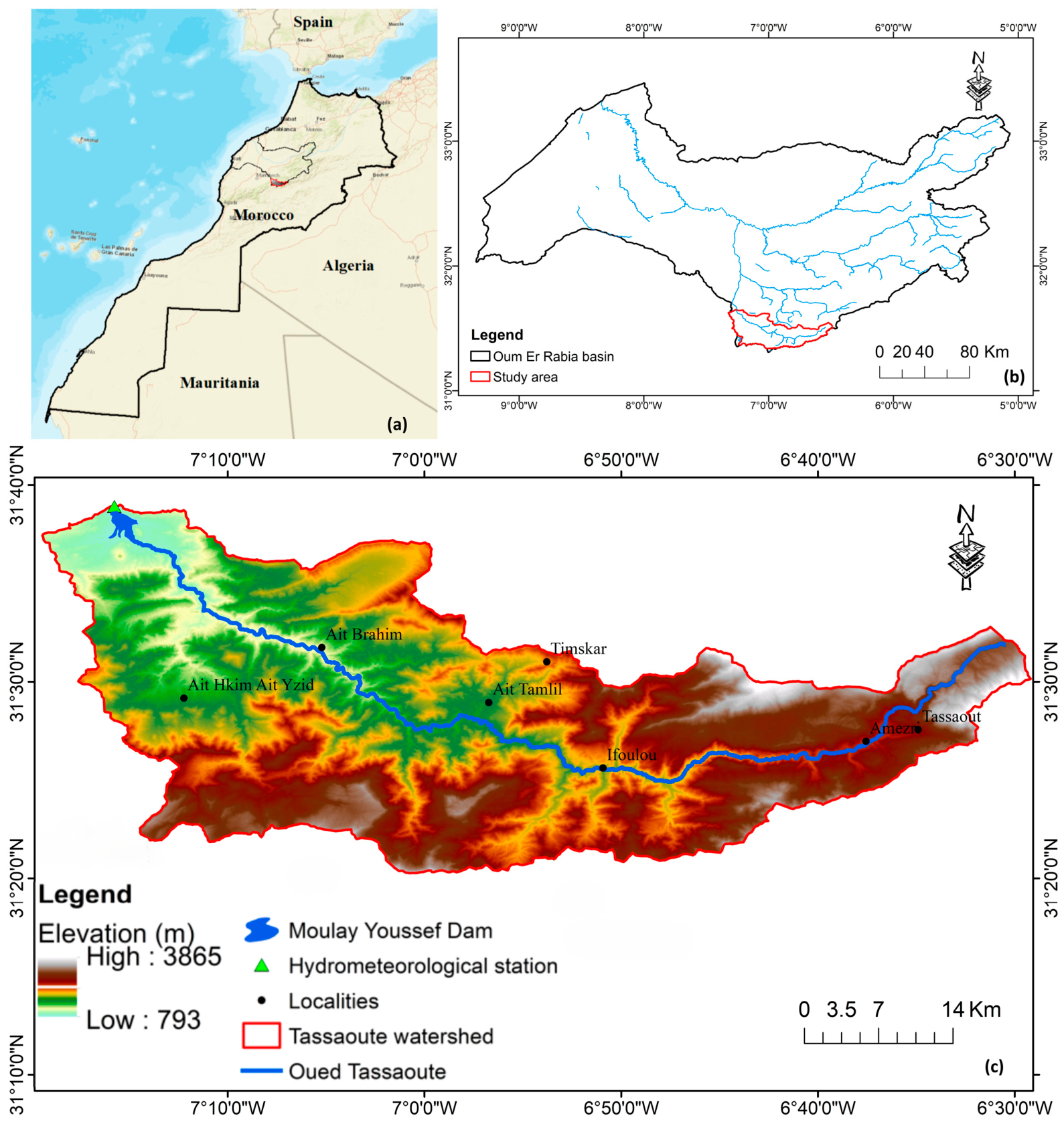
The study area covers the Tassaoute watershed, which is located upstream of the Moulay Youssef dam. The upstream Tassaoute watershed is located in the Demnate Atlas, which is a northern sub-Atlas region in the eastern part of the Haouz plain, approximately 70 km east of Marrakech, also It encompasses the entire impluvium of the Moulay Youssef dam, including the Ait Adel reservoir and the Timin’Outline dam (compensation dam) (Figure 1). The geographical area covers approximately 1418.35 km2, extending between latitudes 31°33′56″ and 31°64′47″ North and longitudes 6°48′40″ and 7°33′40″ [36]. It has the shape of an elongated quadrilateral which runs from the High Atlas Mountains to the Haouz plain, oriented East–West, and located 35 km from the city of Demnate and approximately 90 km from the city of Marrakech.
Tassaoute, a region rich in streams and rivers, is home to a watershed of capital importance. Among its waterways, Oued Tassaoute stands out as a major river. It has its source in the Atlas Mountains and crosses the provinces of Azilal, Beni Mellal and L’Haouz. Furthermore, the Tassaoute watershed also plays an essential role in agricultural irrigation. Many irrigation systems use the river’s waters to support the region’s thriving agriculture. However, water resources management constitutes a major challenge in this watershed, given the vital importance of water for agriculture, drinking water supply and environmental preservation. In-depth hydrological studies and appropriate management measures are therefore necessary to ensure sustainable use of water resources in this valuable watershed. The Moulay Youssef Dam, located on Oued Tassaoute, plays a key role in water resources management in the watershed. It has a storage capacity of approximately 200 million m3 and supports the irrigation of about 30,000 hectares of agricultural land, mainly olive groves in the El Attaouia area and surrounding regions. The reservoir is primarily supplied by rainfall and runoff from the Oued Tassaoute catchment, which extends for approximately 106 km [28].
Geologically, the upstream Tassaoute watershed is located in the western part of the Central High Atlas, also known as the Demnate Atlas. The watershed is characterized by a combination of metamorphic and sedimentary formations predating the Permian period, as well as extensive Jurassic formations that dominate the regional structure. These geological units influence the watershed’s geomorphology and hydrological processes, particularly runoff generation and water storage capacity [28,37].
The climate of the Tassaoute watershed oscillates between semi-arid and Mediterranean and is characterized by annual precipitation generally varying between 300 mm and 800 mm. Rainfall is heavier in winter, while summer months are drier. Precipitation and snowmelt in the Atlas Mountains exert a significant influence on the river. Due to these natural phenomena, significant floods occur during the rainy season, leading to the risk of flooding in low-lying areas of the watershed [38].

2.2. Dataset

2.2.1. Observed Data

Hydrological modeling requires input data from hydro-climatic stations in the study region. In our case, the Moulay Youssef dam station was used, which provides a set of information including precipitation, runoff, temperatures, and inflows from the dam over a 30-year period.
The analysis of temporal variability in the upstream Tassaoute watershed reveals distinct patterns in precipitation, runoff, and temperature (Table S1). Annual precipitation showed a mean value of 403 mm with a maximum amount of 703 mm in a wet year (1995/1996) and a minimum of 220 mm in dry years. Years such as 1992/1993, 2007/2008, and 2019/2020 were notably dry, reflecting interannual variability that may suggest shifts toward drier periods [39]. Monthly data show higher rainfall in January and March, with a marked drop in July. Runoff follows a similar seasonal trend, increasing in March and April and decreasing in summer, with peak flows also observed in 1995/1996 and 2014/2015. However, there is often a time lag between rainfall and runoff due to snowmelt and karst contributions [40], particularly in spring. It should be noted that snowmelt is not explicitly included in this study, as the modeling relies solely on data from the dam station located in the watershed’s outlet, where no snow measurement stations are available. The correlation between monthly precipitation and runoff (r = 0.61) indicates a moderate positive relationship. Temperature variations are strongly influenced by altitude, with noticeable drops above 2244 m, explaining snow accumulation and delayed melt contributing to spring runoff.

2.2.2. Satellite Rainfall Products

To evaluate the reliability of satellite-derived precipitation, the PERSIANN-CDR dataset was also employed. PERSIANN-CDR is a long-term, satellite-derived precipitation record generated using artificial neural networks, providing daily global estimates at a spatial resolution of approximately 0.25° × 0.25° (~25 km) and covering several decades [41]. In this study, PERSIANN-CDR data are used to compare with observed precipitation from the dam station, allowing assessment of its accuracy and suitability for hydrological applications in the Tassaoute watershed. The data was downloaded from the site: https://chrsdata.eng.uci.edu (accessed on 13 January 2026).

2.3. EURO-CORDEX Initiative Climate Models

Future climate projections used in this study were obtained from the EURO-CORDEX initiative, which provides high-resolution regional climate simulations for Europe and the Mediterranean region. Regional climate models (RCMs) dynamically downscale outputs from global climate models (GCMs) to provide more detailed climate information at regional scales [27,42,43,44].
Five climate models with a spatial resolution of 0.11° were selected: CNRM, EC-EARTH, IPSL, MPI, and HadGEM [45,46]. Each model includes several simulations: EVAL (evaluation run using ERA-Interim reanalysis as boundary conditions for 1970–2005), HIST (historical simulation based on GCM forcing for 1950–2005), and two future climate scenarios, RCP4.5 and RCP8.5, covering the period 2006–2100. RCP4.5 represents a moderate emission scenario, while RCP8.5 corresponds to a high-emission scenario.
In this study, climate projections were analyzed for two future periods (2030–2060 and 2061–2090) under both RCP4.5 and RCP8.5 scenarios.

2.4. Hydrological Models

2.4.1. GR2M

The GR2M (Rural Engineering with 2 monthly parameters) model, developed by Mouelhi in 2003 [47], is a conceptual hydrological model that simulates discharge data using meteorological inputs (rainfall and potential evapotranspiration). It operates on a monthly time step and is designed to estimate runoff based on only two parameters.
The first parameter, X1, represents the maximum capacity of the production store (in mm), which corresponds to the soil moisture reservoir.
The second parameter, X2, is a transfer function that controls the routing of water from the surface to the groundwater (Figure 2).

2.4.2. Thornthwaite

The Thornthwaite model is a monthly water balance model designed to estimate different components of the hydrological cycle, such as rainfall, runoff, and potential evapotranspiration (ETP). Developed by the US Geological Survey, it requires basic input data like precipitation, temperature, and latitude.
Key parameters in the model include the type of precipitation (rain or snow), snow and rain temperatures, and the soil’s water retention capacity, which is typically set at 150 mm. This retention capacity helps determine how much excess water contributes to direct runoff once the soil is saturated. Additionally, the model uses the average monthly temperature and latitude to estimate ETP and considers the duration of sunshine, which influences the water demand.

2.4.3. Calibration and Validation Method

To evaluate the quality of hydrological simulations, the KGE criterion is used (Kling–Gupta Efficiency) [48]. This indicator, used in the field of hydrology, combines three main components: correlation (C), bias error (B) and variability error (E) [49,50]. The general formula for calculating KGE is as follows:
K G E = 1 s q r t ( ( C 1 ) 2 + ( B 1 ) 2 + ( E 1 ) 2 )
The value of the KGE criterion varies from −∞ to 1, where a value closer to 1 indicates better performance of the hydrological forecast model. Here is a general interpretation of KGE values:
  • KGE > 0.6: very good
  • 0.4 < KGE ≤ 0.6: good
  • 0.2 < KGE ≤ 0.4: acceptable
  • KGE ≤ 0.2: bad
Regarding bias, it represents the difference between the simulated and observed values, normalized by the latter. A bias close to 0 indicates a good match between the simulated and observed values. The higher the absolute bias, the greater the discrepancy between the simulated and observed values. Mathematically, it is expressed by the following equation:
B I A S = | ( ( Q s Q ) ) / Q |
where
  • Qs: The simulated or estimated values (in our case: the runoff simulated by a model).
  • Q: The observed or actual values (in our case: the observed runoff).

3. Results and Discussion

3.1. Comparison Between Observed Precipitation and PERSIANN-CDR

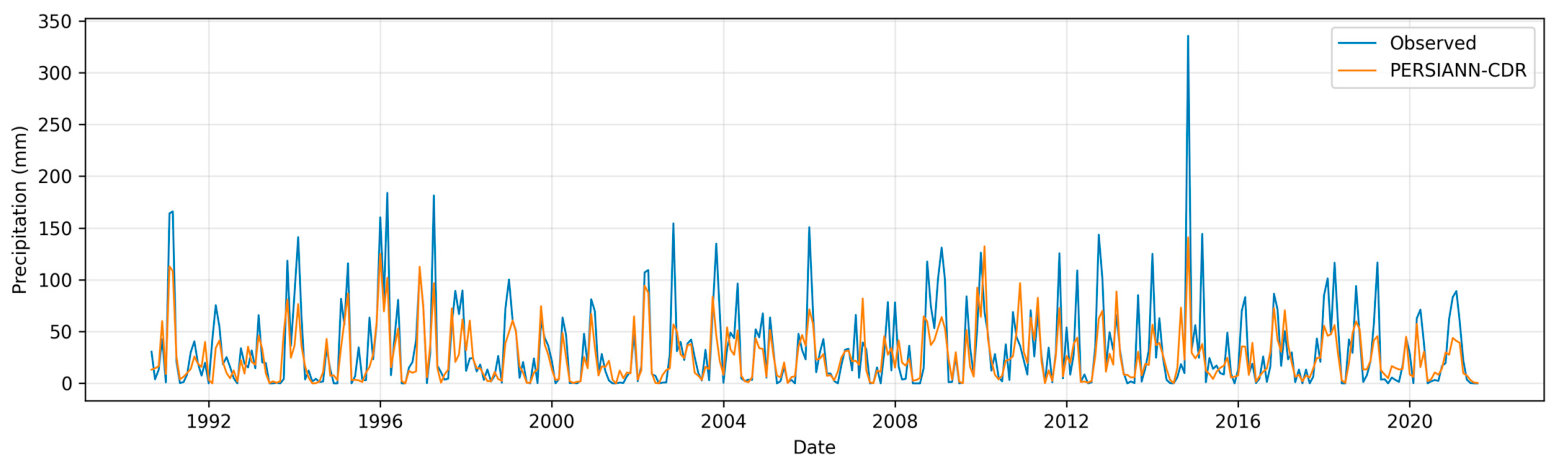
To assess the reliability of satellite-derived precipitation in the Tassaoute watershed, a comparison was conducted between observed monthly rainfall and PERSIANN-CDR estimates for the period 1990–2021. Overall, PERSIANN-CDR captures the temporal pattern of rainfall relatively well, as indicated by the strong correlation coefficient (R = 0.80). However, performance statistics show moderate agreement, with NASH = 0.42 and KGE = 0.37, suggesting that although the timing of rainfall events is well reproduced, the magnitudes are not always accurately represented. This indicates that while PERSIANN-CDR effectively captures the temporal variability of precipitation, its ability to reproduce observed quantities remains limited. Such behavior is consistent with the findings of El Khalki et al. [31], who reported that the efficiency of hydrological simulations does not depend solely on the accuracy of satellite precipitation estimates, as each basin exhibits a unique response to precipitation inputs. The positive bias (0.21) indicates that PERSIANN-CDR slightly underestimates precipitation compared to observations (Figure 3).
Descriptive statistics further highlight these differences. Observed rainfall shows a higher mean (33.62 mm) and a much larger maximum value (335.5 mm) compared to PERSIANN-CDR (26.24 mm and 140.9 mm, respectively), indicating that extreme events are significantly underestimated by the satellite product. The standard deviation is also lower for PERSIANN-CDR (19.68 mm) compared to observed data (30.16 mm), reflecting a smoothing effect typical of satellite-derived precipitation. In contrast, the median values (19.55 mm for observations and 17.41 mm for PERSIANN-CDR) show better agreement for moderate rainfall events. Overall, the results show that while PERSIANN-CDR effectively captures rainfall variability, it tends to underestimate peak events and total rainfall amounts. Therefore, it is useful as a complementary dataset for temporal analysis but requires caution in applications sensitive to extreme rainfall.

3.2. Application of Hydrological Models

3.2.1. GR2M Application

  • Modeling Using Observed Data
To apply the GR2M model to the upstream sub-watershed of the Tassaoute, two sets of data were used: potential evapotranspiration and observed precipitation, provided by the ABHOER (Oum Er Rbia River Basin Agency), covering the period from September 1990 to August 2020.
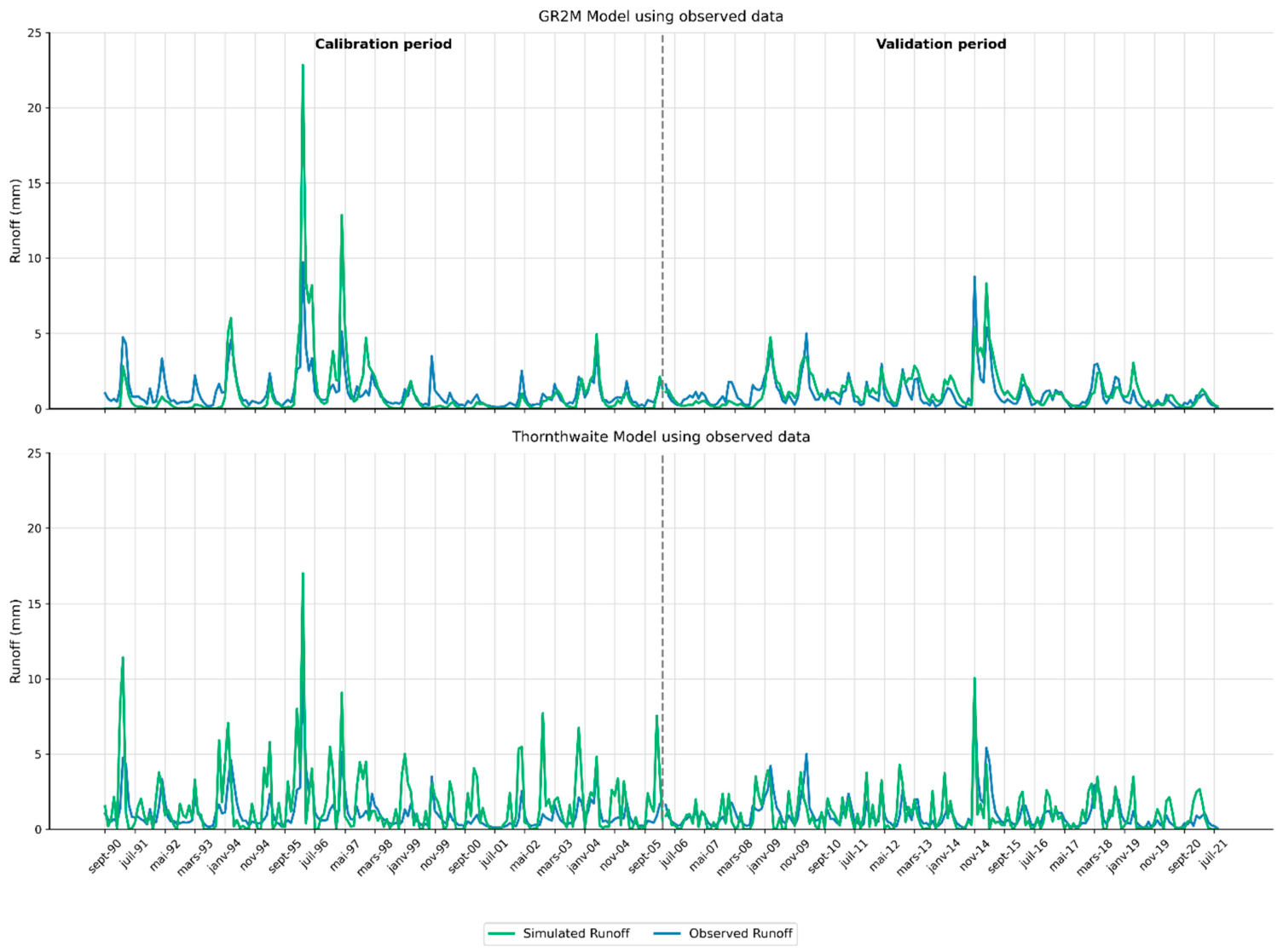
The results of the GR2M model application are presented in the graph (see Figure 4). For this, two scenarios were used: firstly, half of the data series was used for calibration and the other half for validation, and then the roles were reversed. Secondly, the model was calibrated using the first two-thirds of the data series and validated using the remaining third, and vice versa.
More specifically, the calibration and validation periods for the GR2M model are as follows: in first, calibration from 1990 to 2005 and validation from 2005 to 2021 and then: calibration from 1990 to 2011 and validation from 2011 to 2021, and vice versa.
According to the results in Table 1, calibrating the model parameters over different periods yielded good results in terms of the KGE criterion. The highest KGE values were obtained for the more recent periods (2005–2021 and 2011–2021), indicating better agreement between the model’s predictions and the observed data. KGE values for the earlier periods (1990–2005 and 1990–2011) were slightly lower but still acceptable. This may be due to climate variability during those years. The KGE validation value provides an indication of the model’s accuracy in reproducing runoff outside the calibration period. Based on the values provided (Table 1), it can be noted that the periods 1990–2005 and 1990–2011 had KGE values of 0.476 and 0.438, respectively. This indicates that the model was able to simulate runoff for different periods using the same parameters. The same is true for the other combination, although a higher KGE was achieved for the 2005–2021 period compared to 2011–2021. This can be explained by the fact that the first period represents half of the series, while the second represents only one third.
Considering the calibration and validation results obtained for the studied watershed, we can conclude that the GR2M model performs well, with KGE values around 0.6 for calibration and 0.5 for validation. These values indicate good accuracy and a satisfactory match between the model’s predictions and the observed data. Figure 4 clearly illustrates this conclusion, showing that the overestimation observed during high-flow periods returns to normal after validation.
  • Modeling Using PERSIANN-CDR Data
In this part, hydrological modeling was performed using PERSIANN-CDR precipitation as the primary input. The GR2M model was recalibrated and validated over the same periods (1990–2005, 2005–2021, 1990–2011, and 2011–2021). The GR2M parameters showed greater variability when using PERSIANN-CDR data. Parameter X1 ranged from 1.2 to 603, while X2 remained stable (0.86–0.89). Calibration KGE values ranged from 0.38 to 0.55, and validation values ranged from 0.44 to 0.61. These results show that the GR2M model maintains good performance even when driven by satellite precipitation, with validation values comparable to or even higher than those obtained with observed precipitation.

3.2.2. Thornthwaite Application

The application of the Thornthwaite model was carried out using two input datasets: observed precipitation and observed temperatures. Default parameters, previously tested on various watersheds by the model developer, were used. The analysis of the results shows that, despite a high correlation coefficient (0.84), the KGE obtained was similar to that of the GR2M model (see Table 2). The same methodology was applied as for the GR2M model: using half or two-thirds of the data for calibration and the remainder for validation and vice versa. It was observed that the simulated runoff was significantly overestimated during high-flow periods, while they were nearly equivalent to observed flows during low-flow periods (see Figure 4).
Calibration of the Thornthwaite model parameters for the upstream watershed of the Tassaoute led to very good KGE values, especially for the period 2011–2021 (see Table 2). This suggests that the model is capable of accurately representing hydrological conditions and runoff variability in this watershed. Moreover, the validation results of the calibrated parameters, with KGE values around 0.61 and 0.54, are considered good. This indicates that the model can generalize its predictions to periods outside the calibration range, thus increasing confidence in its ability to provide reliable results. In summary, the positive results obtained with the Thornthwaite model in the upstream watershed are promising and demonstrate the model’s efficiency in representing hydrological processes. As shown in Figure 4, the simulated runoff during the validation period is nearly equal to the observed runoff. The model, therefore, performs well after validation.
The performance of the Thornthwaite and GR2M models was evaluated using bias and RMSE metrics. During the calibration period, the Thornthwaite model exhibited a bias of 2.59 and an RMSE of 11.22, whereas the GR2M model showed significantly lower values with a bias of 0.1038 and an RMSE of 1.48. In the validation period, the Thornthwaite model’s bias and RMSE improved to 0.04 and 0.97, respectively. Similarly, the GR2M model demonstrated a bias of 0.12 and a lower RMSE of 0.67 during validation. These results indicate that the GR2M model provides a more accurate simulation of runoff, with lower systematic and overall errors in both calibration and validation phases compared to the Thornthwaite model.
  • Thornthwaite application using PERSIANN-CDR data
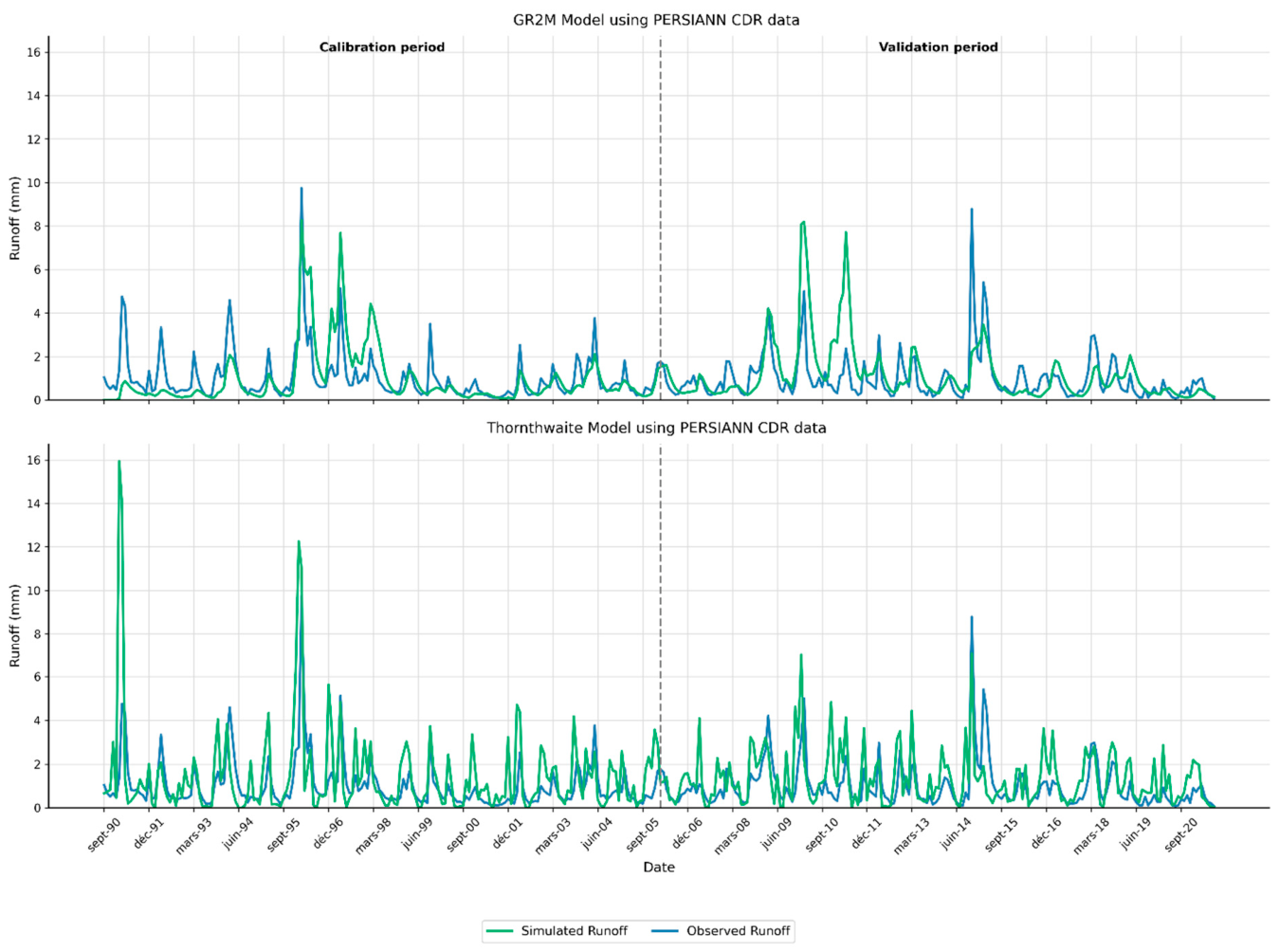
The Thornthwaite model also performed well with PERSIANN-CDR data. Calibration KGE values were highly consistent across all periods (0.54–0.56), and validation KGE values were remarkably high, ranging from 0.80 to 0.81, demonstrating excellent predictive ability. Parameter values (Rf, DRf, SMSC, TempRain) remained stable across calibration–validation splits, and snowmelt parameters remained null as expected for the study region. Descriptive statistics show that Thornthwaite simulations based on PERSIANN-CDR inputs produce higher runoff means and greater variability (mean = 1.61; max = 44) compared to GR2M (mean = 1.07; max = 8.27). Correlation coefficients indicate GR2M slightly outperforms Thornthwaite (0.60 vs. 0.54) in aligning with observed flows.
Overall, both hydrological models performed satisfactorily using PERSIANN-CDR precipitation, with Thornthwaite showing very strong validation results and GR2M providing stable and coherent simulations (Figure 5).

3.3. Climate Projections and Impact on Water Resources

In this section, we assess the impact of climate change on water resources in the upstream Tassaoute watershed using a hydrological modeling approach driven by climate projections [51]. The watershed is highly important for local agriculture and water management, making it critical to evaluate potential changes in runoff and water availability.
The methodology involves three main steps [52]: (i) simulation of future climate conditions using regional climate models based on EURO-CORDEX projections, (ii) generation of climate scenarios by adjusting observed hydro-climatic data according to model outputs, and (iii) conversion of these climate projections into runoff using the hydrological model previously calibrated and validated. This approach allows for a systematic assessment of potential climate impacts on water resources in a data-scarce mountainous watershed.

3.3.1. Regional Climate Simulation

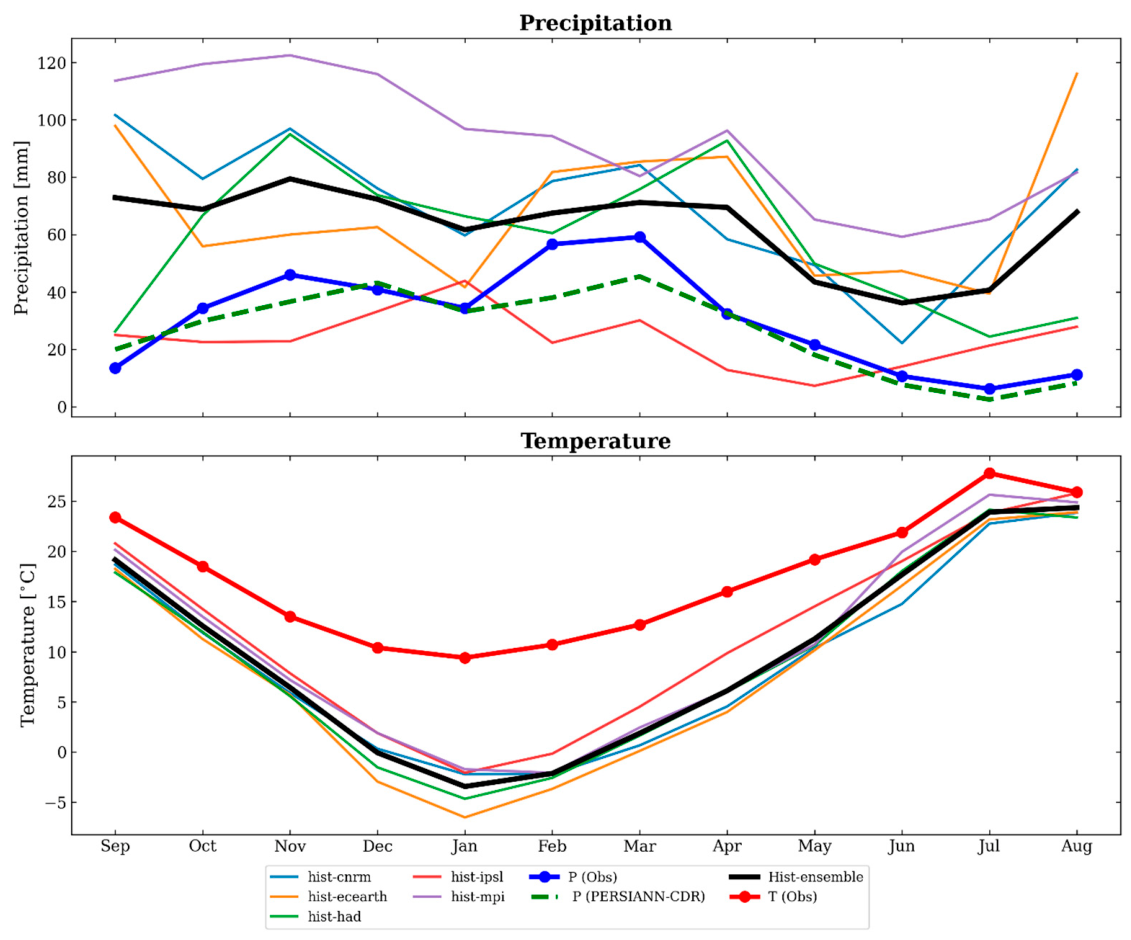
The comparison of RCMs simulations for the historical period (1990–2021) with observed data and PERSIANN-CDR products indicates that the ensemble of regional climate models generally reproduces the seasonal variability of temperature and precipitation in the upper Tassaoute watershed (Figure 6). Temperature simulations show strong agreement with observations, highlighting the robustness of RCMs in representing thermal conditions in semi-arid mountainous regions. In contrast, precipitation simulations exhibit larger discrepancies, particularly during peak rainfall periods, with a maximum overestimation of about 120 mm by the Max Planck Institute (MPI) model and a maximum underestimation of 13 mm by the Institute Pierre-Simon Laplace (IPSL) model. These differences are consistent with the well-known difficulty of climate models in accurately capturing localized convective rainfall and complex topographic effects.
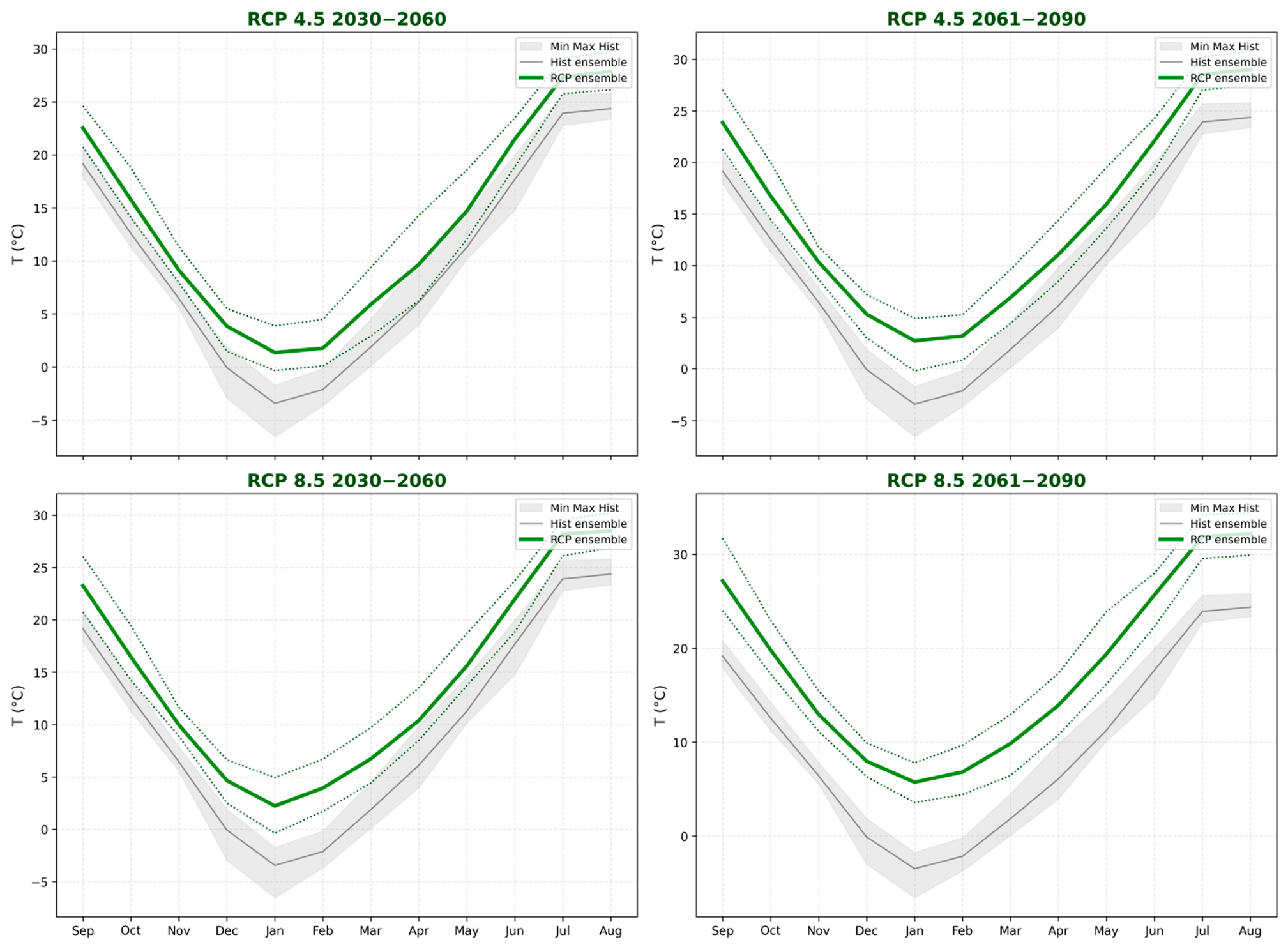
Future projections indicate a clear shift toward a warmer and more arid climate regime. Temperature projections consistently show an increase relative to the historical baseline across all scenarios. For example, historical mean temperatures in January are approximately −3 °C, whereas late-century projections (2061–2090) under the RCP 8.5 scenario indicate values approaching 3 °C, corresponding to a substantial warming of about 6 °C for this month. Summer conditions are also expected to intensify, with July temperatures rising from a historical average of around 24 °C to nearly 30 °C under the long-term RCP 8.5 scenario (Figure 7).
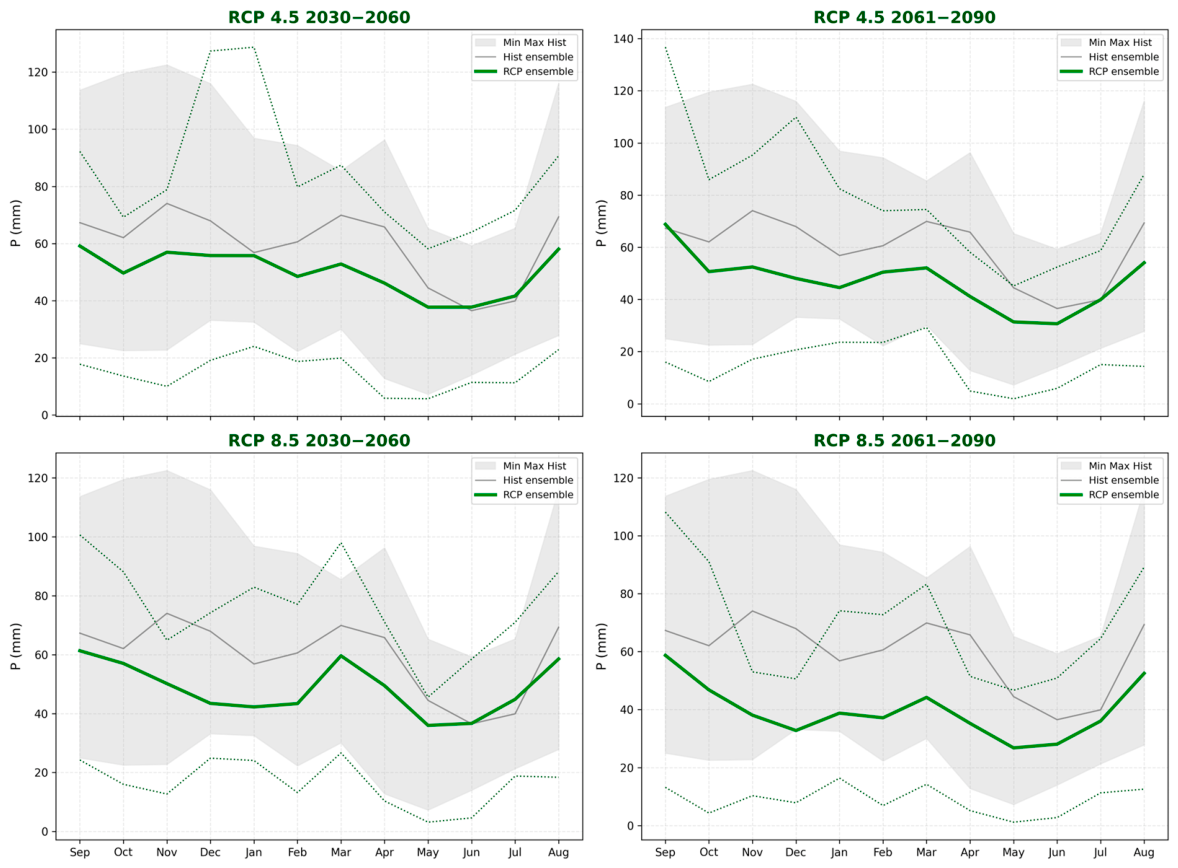
In parallel with this pronounced warming, precipitation projections reveal a marked decline accompanied by increased inter-model variability. The ensemble mean precipitation is frequently lower than the historical ensemble mean, indicating a reduction in total water inputs to the watershed. This decline is particularly evident during the spring and summer months (May–August), when monthly precipitation—historically averaging close to 50 mm—is projected to decrease to approximately 25–30 mm under the late-century RCP 8.5 scenario (Figure 8).
The combined effect of rising temperatures (on the order of 4–7 °C) and sustained decreases in precipitation is expected to generate a highly evaporative climate. This intensification of thermal stress, together with reduced moisture availability, provides a coherent explanation for the severe runoff reductions simulated by the hydrological models, highlighting the strong sensitivity of surface water resources to future climatic changes.

3.3.2. The Impact of Changes in Climate Projections

In order to assess the potential impacts of climate change on the hydrological regime of the upstream Tassaoute watershed, climate projection datasets for precipitation and evapotranspiration were incorporated into the GR2M rainfall–runoff model, which previously demonstrated robust performance during calibration and validation. Model skill over the historical (hist) and evaluation (eval) periods was verified using the Kling–Gupta Efficiency (KGE) metric without recalibration, yielding values on the order of 0.55, thereby confirming the adequacy of the model for scenario-based simulations. The runoff projections derived from observed precipitation indicate a marked decline in future flows across both RCP4.5 and RCP8.5 scenarios, with the most substantial reductions occurring during the February–April period and under the high-emission RCP8.5 scenario in the far-future horizon (2061–2090). This trend suggests an increasing risk of water scarcity and reduced hydrological productivity in the watershed.
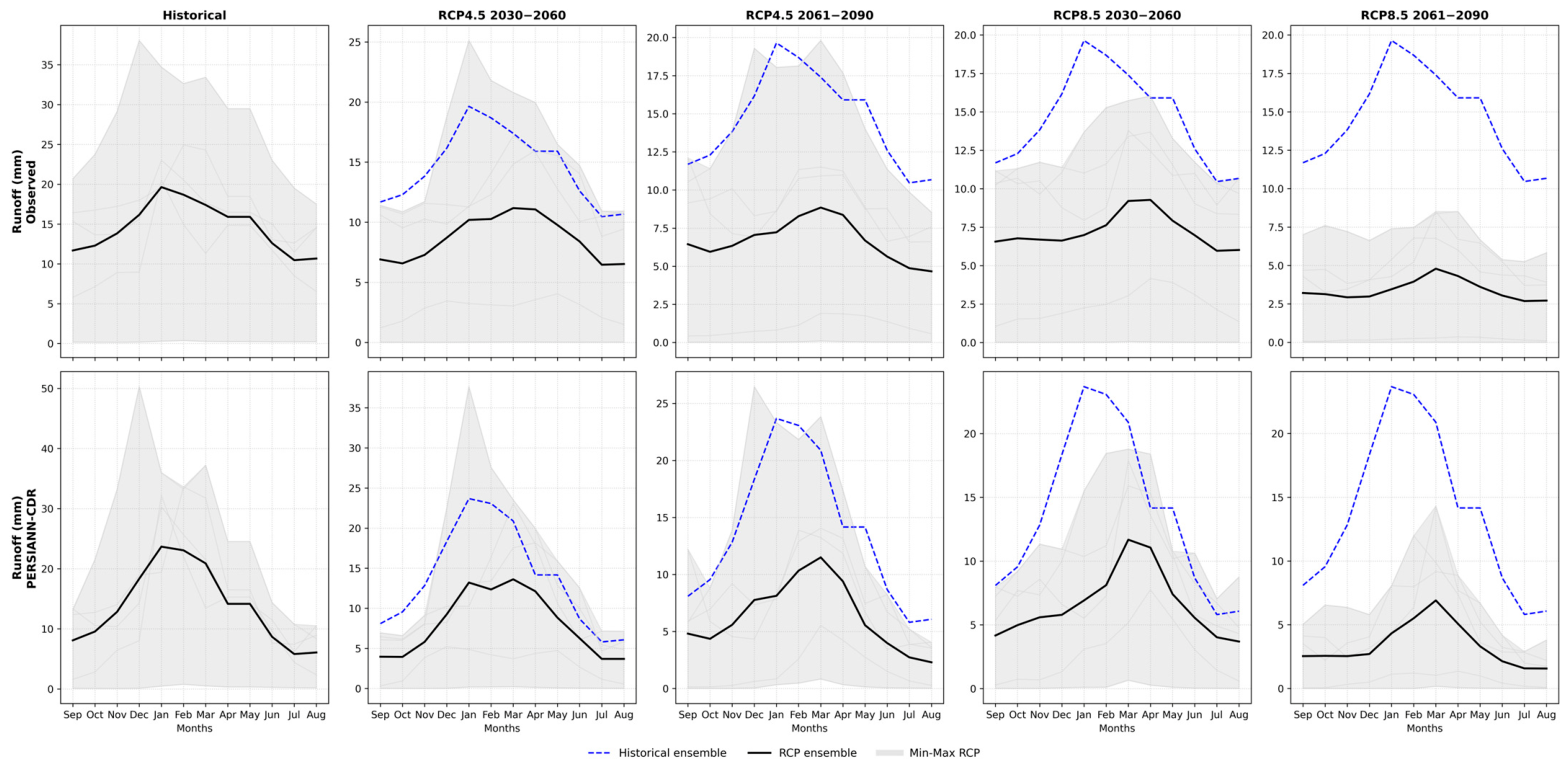
In Figure 9, GR2M model simulations indicate a significant and progressive decline in monthly runoff across all future climate scenarios compared to the historical ensemble. Under the intermediate RCP 4.5 scenario, peak runoff during the main high-flow season (January–March) decreases from historical values of approximately 15–20 mm to 10–12 mm by the 2061–2090 period. This reduction becomes markedly more pronounced under the RCP 8.5 scenario, where the long-term ensemble mean (2061–2090) shows runoff values remaining below 5 mm for most months, reflecting an almost complete disappearance of the historical seasonal peak. Simulations forced with PERSIANN-CDR precipitation, while exhibiting higher absolute runoff magnitudes in the historical period (with peaks reaching ~35 mm), display a consistent relative response to climate change. Under RCP 8.5, projected peak runoff declines by more than 50% by the end of the century, confirming the robustness of the decreasing trend regardless of the precipitation dataset used.
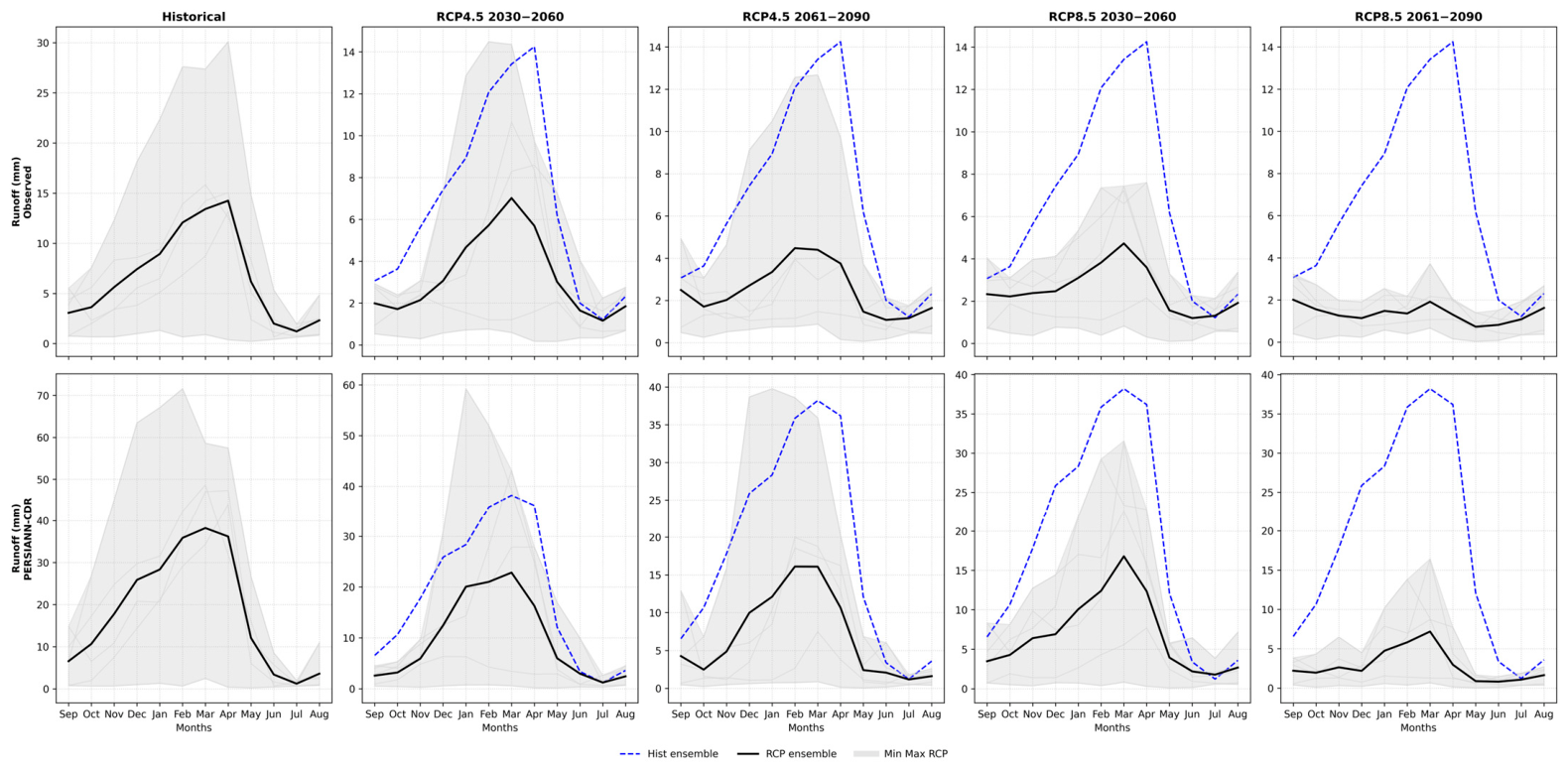
In Figure 10, the Thornthwaite water balance model projects an even more severe reduction in runoff, particularly during the key recharge months. For the historical period (1990–2021), the ensemble mean reaches peak values of approximately 14–15 mm in March–April. However, under RCP 8.5 for 2061–2090, the seasonal runoff peak nearly vanishes, with simulated values dropping below 2 mm. Notably, the entire Min–Max model envelope rarely exceeds 4 mm during months that were historically the wettest, highlighting an extreme contraction of runoff generation. A similar pattern emerges in the PERSIANN-CDR-driven simulations, where historical peaks of ~38 mm decline sharply to around 7 mm by the late-century period under RCP 8.5. This pronounced sensitivity suggests that the Thornthwaite model responds strongly to rising temperatures and altered precipitation regimes, amplifying the projected impacts of climate change on surface water availability in the watershed.
Even under the same period and emission scenario, the five climate models show significant variability, with some models overestimating and others underestimating precipitation and runoff. This variability reflects structural differences among RCMs and reinforces the importance of ensemble-based analyses. Although PERSIANN-CDR underestimates precipitation during the historical period, runoff simulations using both hydrological models tend to be overestimated. This behavior is mainly attributed to model calibration, where parameters were adjusted to compensate for lower precipitation inputs, resulting in amplified runoff responses in future projections.
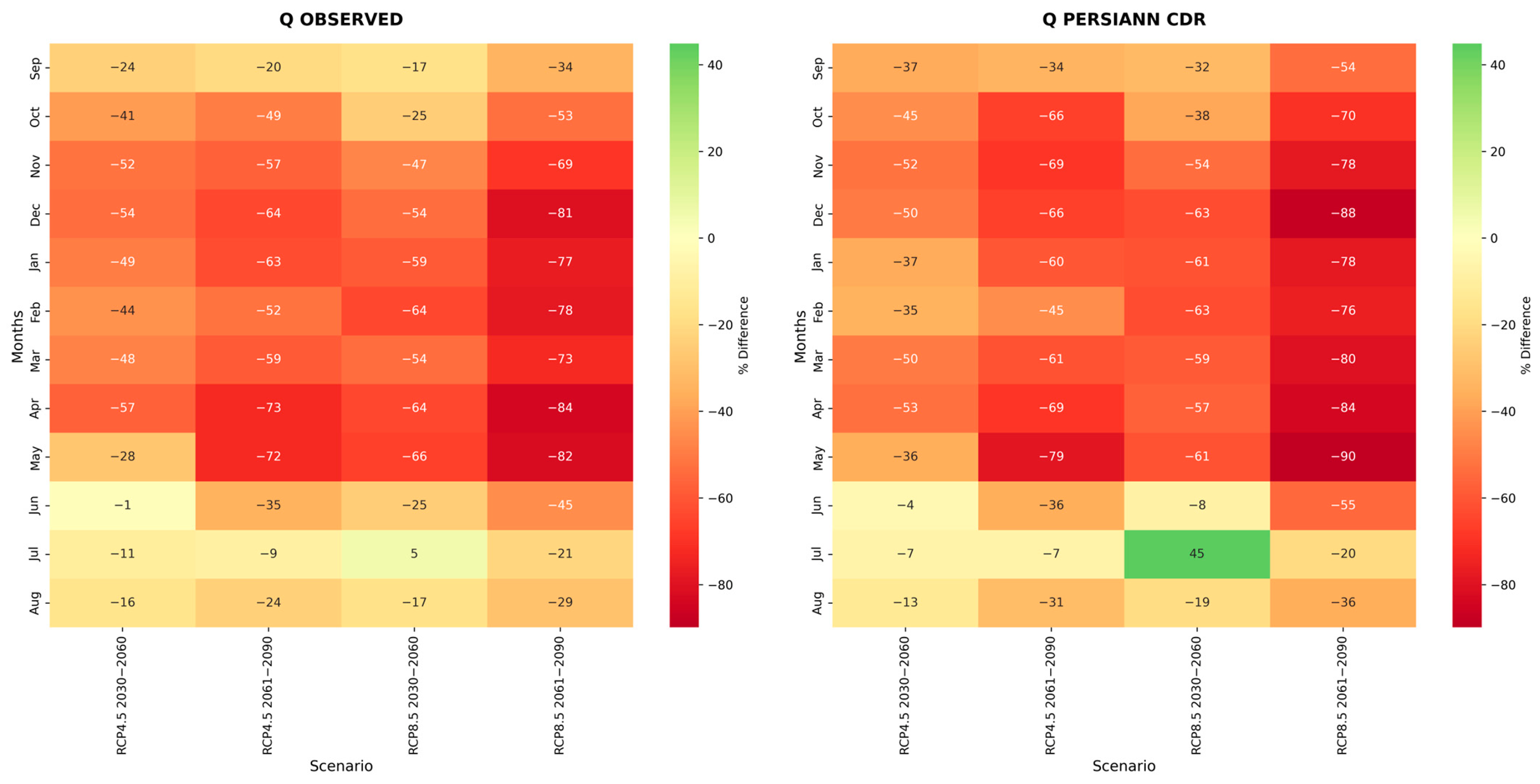
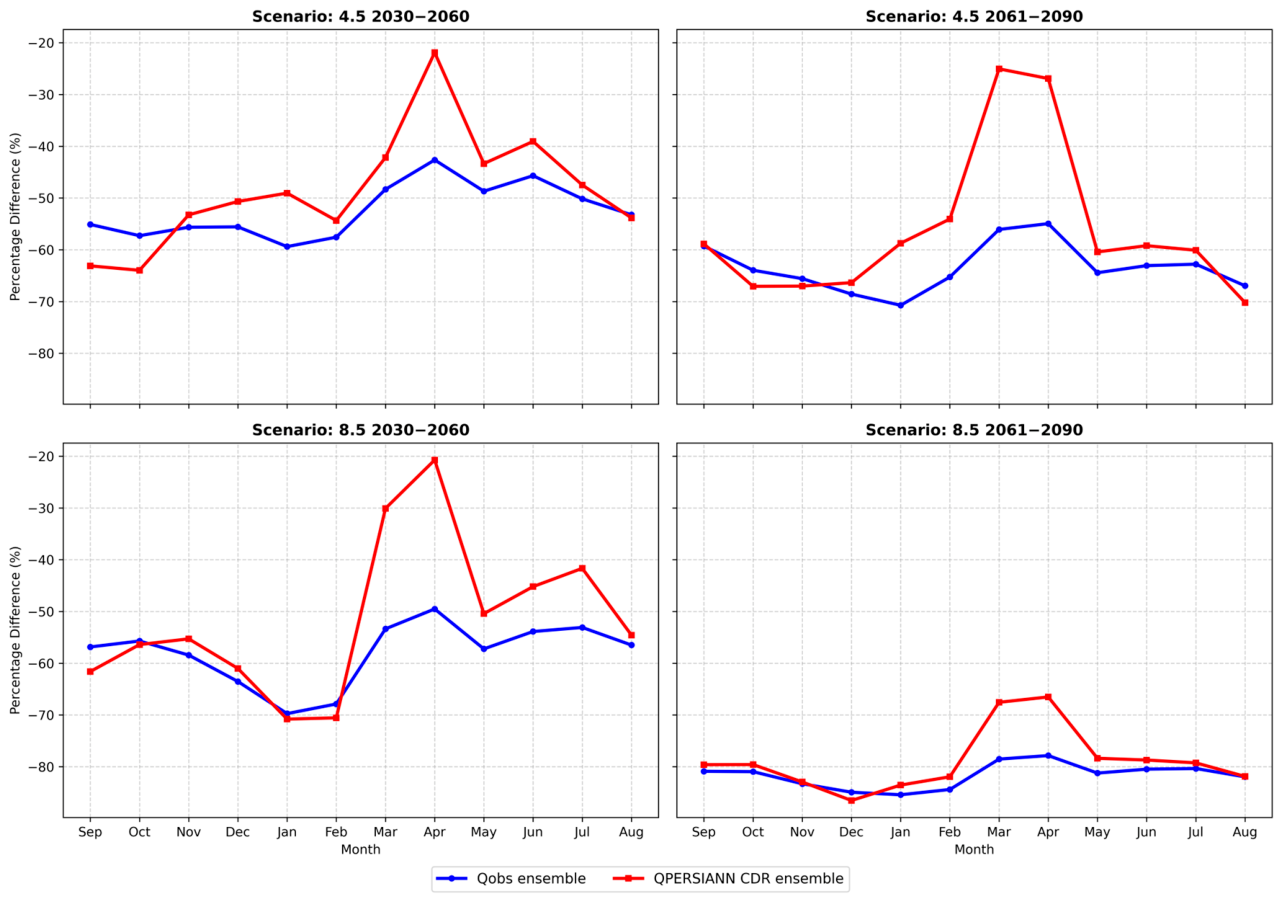
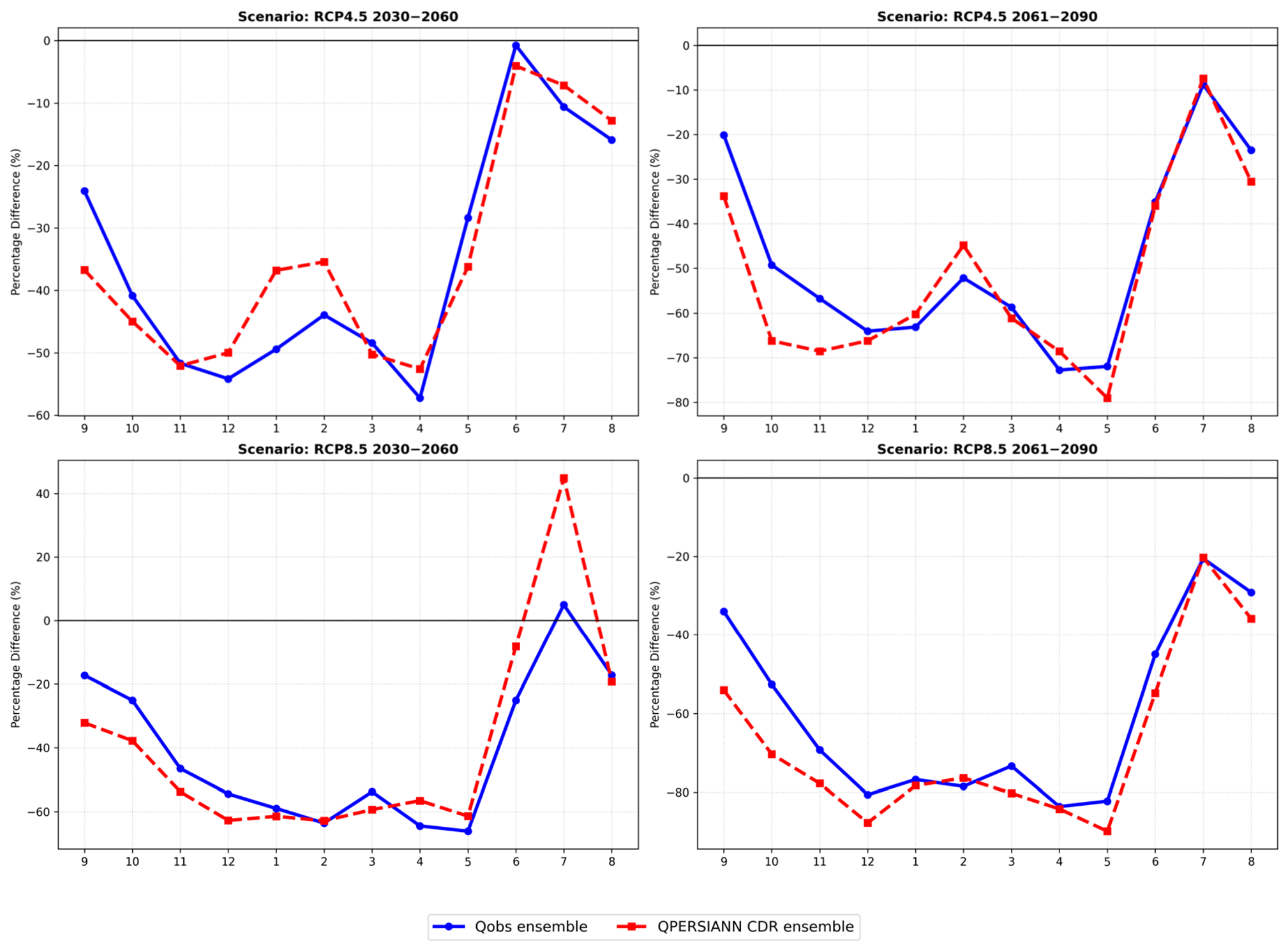
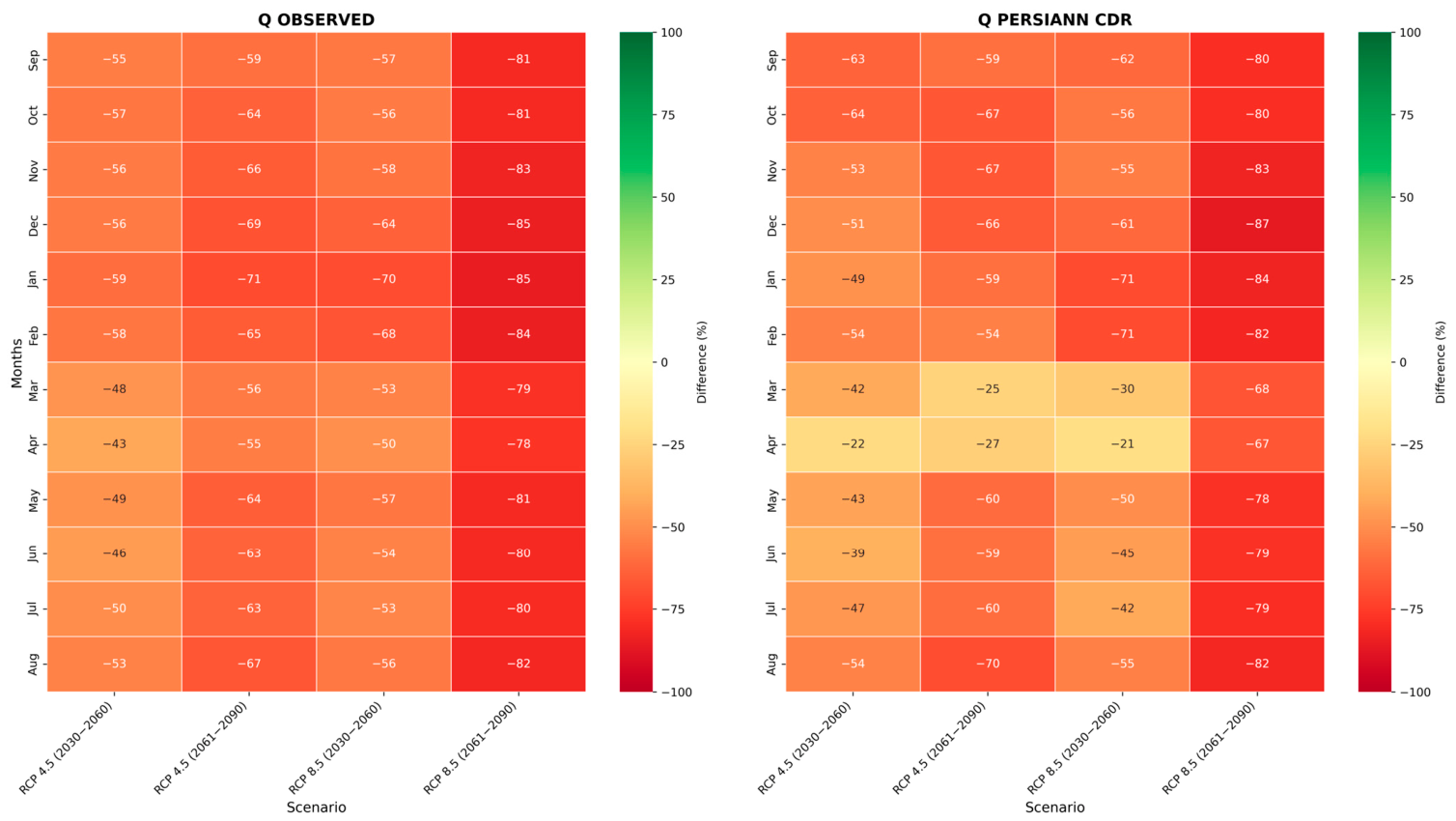
The analysis of the projected monthly percentage change in runoff relative to the historical baseline (1990–2021) reveals a severe and progressive hydrological decline across all future scenarios, with a notable divergence in behavior between simulations driven by observed data and those using the PERSIANN-CDR satellite product. While the historical ensemble represents a period of relatively stable water availability, the transition to the RCP 4.5 and RCP 8.5 scenarios marks a significant shift toward extreme aridity. Under the RCP 8.5 late-century period (2061–2090), both the GR2M and Thornthwaite models project a near-total collapse of runoff, with ensemble average deficits frequently exceeding −80% compared to the historical benchmark. A critical finding in this discussion is the higher volatility introduced by the PERSIANN-CDR data; while simulations based on observed rainfall follow a more constrained and consistent drying trend, the PERSIANN-CDR-driven models exhibit much wider uncertainty ranges and more pronounced seasonal anomalies. For example, in the Thornthwaite model for the RCP 8.5 2030–2060 period, the PERSIANN-CDR data generates a sharp, localized runoff peak of +45% in July, an outlier that is absent in the observed-driven simulations and likely reflects the satellite product’s tendency to overestimate specific precipitation events. Furthermore, the model-specific deviations highlight that while the GR2M model shows a more uniform decrease across the year, the Thornthwaite model is more sensitive to these data input differences, showing sharper contrasts between the historical stability and the erratic fluctuations of future satellite-projected rainfall. Ultimately, the transition from historical norms to future RCP pathways suggests a future where water scarcity becomes the dominant state, but the magnitude and timing of this scarcity remain more uncertain when relying on PERSIANN-CDR data compared to ground-based observations (Figure 11, Figure 12, Figure 13 and Figure 14).
The results obtained in this study are consistent with a growing body of literature evaluating satellite-based precipitation products in semi-arid and Mediterranean regions. The performance of PERSIANN-CDR in reproducing rainfall dynamics (R = 0.80; NASH = 0.42; KGE = 0.37) falls within the range reported in previous studies. For instance, Ashouri et al.’s [53] PERSIANN-CDR dataset development reported correlation coefficients generally between 0.6 and 0.85 at monthly scales, with reduced skill in capturing high-intensity precipitation. Similarly, Beck et al.’s [54] global precipitation evaluation showed that satellite products tend to underestimate extremes and exhibit lower Nash–Sutcliffe efficiencies (often <0.5) in arid and mountainous regions. These findings directly support our results, where PERSIANN-CDR captures rainfall timing well but underestimates magnitudes and extremes, leading to moderate hydrological performance. The comparative behavior of the hydrological models further confirms conclusions reported in the literature regarding model sensitivity to precipitation uncertainty. The relatively stable performance of the GR2M model (KGE ≈ 0.38–0.61) is consistent with studies highlighting the robustness of low-parameter conceptual models under uncertain inputs. In contrast, the strong response of the Thornthwaite water balance model—reflected in exaggerated peak flows (max = 44 compared to 8.27 for GR2M)—agrees with previous findings that simple water balance approaches tend to amplify precipitation variability. Similar behavior has been documented in comparative hydrological studies such as Oudin et al.’s [55] conceptual hydrological model evaluation, where simpler models showed higher sensitivity to input fluctuations, especially in semi-arid climates. Our results therefore reinforce the conclusion that model structure plays a critical role in controlling the propagation of precipitation uncertainty into runoff simulations.
A major source of uncertainty in this study is the absence of an explicit snowmelt module, despite the known importance of snow processes in the High Atlas Mountains. Snow accumulation and subsequent melting contribute significantly to spring runoff in Moroccan basins, as demonstrated in studies such as Boudhar et al.’s [56] work on snowmelt in the High Atlas, which showed that snowmelt can account for a large proportion of seasonal discharge. By neglecting this process, the models used in this study may misrepresent the physical origin of spring flows, effectively attributing part of the snowmelt-driven runoff to rainfall inputs. This simplification introduces biases in both the timing and magnitude of simulated discharge, particularly during the winter–spring transition. The relatively good calibration performance suggests that this missing process may be partially compensated through parameter adjustment; however, such compensation reduces the physical realism of the model and limits its reliability under changing climate conditions. Similar limitations have been emphasized in mountain hydrology studies, where the inclusion of snow modules significantly improves simulation accuracy. This limitation is further exacerbated by the absence of temperature observations at high altitudes, while most snowmelt modules rely primarily on temperature-based approaches. As a result, the representation of snow processes introduces additional uncertainty in the model simulations. In addition, uncertainties arise from the integration of datasets with different spatial and temporal resolutions. Ground observations provide point-scale accuracy, whereas PERSIANN-CDR offers spatially continuous estimates at coarser resolution, and climate model outputs introduce further scaling differences. Previous studies, including Beck et al.’s [54] global precipitation evaluation, have shown that such scale mismatches can lead to systematic biases in hydrological simulations, particularly in heterogeneous basins. In our case, these discrepancies likely contribute to differences between observed and simulated runoff, especially when satellite data are used without correction.
Moreover, the use of conceptual models introduces structural uncertainties related to simplified process representation and parameter assumptions. For example, parameters such as soil water retention capacity are treated as uniform, despite known spatial variability in soil and land cover properties. This limitation has been widely discussed in hydrological modeling literature, where simplified parameterization can lead to errors in runoff generation, particularly under extreme conditions. Our results reflect this limitation, as differences between GR2M and Thornthwaite outputs highlight how model structure and assumptions influence simulation outcomes. Despite these uncertainties, the projected hydroclimatic trends of increasing temperature and decreasing precipitation are consistent with regional climate change studies in Morocco and the Mediterranean basin. Studies such as Driouech et al.’s [57] climate change Morocco report a significant decline in precipitation (up to 20–30% by the end of the century) and a marked increase in temperature, leading to reduced water availability. Our findings align with these projections, showing decreasing runoff and increased hydrological stress, particularly during dry seasons.
Compared to previous studies, the main contribution of this work lies in explicitly linking satellite precipitation uncertainty, hydrological model structure, and climate change impacts within a single framework. While many studies evaluate precipitation datasets or hydrological models separately, this study demonstrates how input data uncertainty propagates differently depending on the model used. This integrated perspective is particularly important for ungauged or poorly gauged basins, where satellite data are often the only available source of information. Our results confirm that PERSIANN-CDR can be reliably used for seasonal and long-term assessments after bias correction, but caution is required when analyzing extreme events or snow-influenced hydrological regimes.

4. Conclusions

This study highlights the projected impacts of climate change on water resources in the Upper Tassaoute watershed in Morocco. The main conclusions can be summarized as follows:
  • Future climate projections indicate a consistent intensification of the regional warming trend, accompanied by a general decline in precipitation (P) ensembles for both the 2030–2060 and 2061–2090 periods relative to the 1990–2021 historical baseline (Figure S1).
  • Simulations using both the GR2M and Thornthwaite hydrological models project a significant and near-universal reduction in monthly runoff (Q) across all future scenarios.
  • Under the high-emission RCP 8.5 pathway (2061–2090), ensemble average runoff deficits frequently exceed −80%. Specifically, individual climatic drivers such as HAD and IPSL project a near-total hydrological collapse, with monthly runoff reductions approaching −100%.
  • Runoff simulations driven by the PERSIANN-CDR satellite product exhibit higher intra-annual volatility and wider uncertainty ranges compared to those based on ground observations. This is evidenced by localized anomalies, such as a projected +45% runoff peak in July under the RCP 8.5 2030–2060 scenario within the Thornthwaite model.
  • Despite the inherent biases and occasional overestimation of specific precipitation events, PERSIANN-CDR proved to be an indispensable tool for characterizing the hydrological future of data-sparse regions. It provides a vital long-term record that enables the quantification of climate risk where ground-based monitoring is absent.
  • Comparative analysis reveals that while the GR2M model follows a more uniform downward trajectory, the Thornthwaite model is more sensitive to seasonal fluctuations and specific data input types, underscoring the necessity of multi-model ensembles in climate impact assessments.
Given these projected changes, the study emphasizes the urgent need for adaptive water management strategies aimed at improving water use efficiency, enhancing monitoring infrastructure, and strengthening integrated watershed governance. Future research should also evaluate land-use change effects and integrate multiple hydrological models to better represent uncertainty. In addition, a comprehensive sensitivity analysis was not conducted in the present study and could be considered in future work to further assess model robustness and parameter uncertainty.

Supplementary Materials

The following supporting information can be downloaded at: https://www.mdpi.com/article/10.3390/su18084089/s1, Figure S1: Ombrothermic diagrams for the Tassaoute watershed across multiple climate scenarios (RCP 4.5 and RCP 8.5) and future time horizons (2030–2060 and 2061–2090); Table S1: Main characteristics of the hydrometric station in the upper Tassaoute watershed.

Author Contributions

Conceptualization, S.E., E.M.E.K. and A.E.; methodology, S.E. and E.M.E.K.; software, S.E.; validation, S.E. and E.M.E.K.; formal analysis, S.E. and E.M.E.K.; investigation, S.E. and E.M.E.K.; resources, S.E. and E.M.E.K.; data curation, S.E.; writing—original draft preparation, S.E.; writing—review and editing, S.E., E.M.E.K., O.N.-T., M.I., A.E., J.E.A., S.K. and M.N.; visualization, S.E.; supervision, E.M.E.K. and A.E.; project administration, A.E.; funding acquisition, E.M.E.K. All authors have read and agreed to the published version of the manuscript.

Funding

This research received no external funding.

Institutional Review Board Statement

Not applicable.

Informed Consent Statement

Not applicable.

Data Availability Statement

The raw data supporting the conclusions of this article will be made available by the Corresponding author, without undue reservation.

Acknowledgments

The authors would like to thank the Moroccan Ministry of Higher Education, Scientific Research and Innovation, the OCP Foundation, Mohammed VI Polytechnic University (UM6P), and the National Center for Scientific and Technical Research (CNRST) for supporting this work through the APRD research program. The authors also sincerely acknowledge the support of the PRIMA Resilink project for their valuable contributions to this research and BIODIVERSA+ PRESINMED Project under contract number 3 for the contributions. During the preparation of this manuscript, the authors used GPT-4 (OpenAI) for English language editing, including grammar and sentence structure improvements to enhance clarity. The authors reviewed and edited the generated content and take full responsibility for the final version of the manuscript.

Conflicts of Interest

The authors declare no conflicts of interest.

References

  1. Marchane, A.; Tramblay, Y.; Hanich, L.; Ruelland, D.; Jarlan, L. Climate Change Impacts on Surface Water Resources in the Rheraya Catchment (High Atlas, Morocco). Hydrol. Sci. J. 2017, 62, 979–995. [Google Scholar] [CrossRef]
  2. Pérez-Cutillas, P.; Salhi, A. Long-Term Hydroclimatic Projections and Climate Change Scenarios at Regional Scale in Morocco. J. Environ. Manag. 2024, 371, 123254. [Google Scholar] [CrossRef]
  3. García-Ruiz, J.M.; Lana-Renault, N. Hydrological and Erosive Consequences of Farmland Abandonment in Europe, with Special Reference to the Mediterranean Region—A Review. Agric. Ecosyst. Environ. 2011, 140, 317–338. [Google Scholar] [CrossRef]
  4. Richter, B.D.; Bartak, D.; Caldwell, P.; Davis, K.F.; Debaere, P.; Hoekstra, A.Y.; Li, T.; Marston, L.; McManamay, R.; Mekonnen, M.M.; et al. Water Scarcity and Fish Imperilment Driven by Beef Production. Nat. Sustain. 2020, 3, 319–328. [Google Scholar] [CrossRef]
  5. Dao, P.U.; Heuzard, A.G.; Le, T.X.H.; Zhao, J.; Yin, R.; Shang, C.; Fan, C. The Impacts of Climate Change on Groundwater Quality: A Review. Sci. Total Environ. 2024, 912, 169241. [Google Scholar] [CrossRef] [PubMed]
  6. Geris, J.; Comte, J.-C.; Franchi, F.; Petros, A.K.; Tirivarombo, S.; Selepeng, A.T.; Villholth, K.G. Surface Water-Groundwater Interactions and Local Land Use Control Water Quality Impacts of Extreme Rainfall and Flooding in a Vulnerable Semi-Arid Region of Sub-Saharan Africa. J. Hydrol. 2022, 609, 127834. [Google Scholar] [CrossRef]
  7. AR6 Synthesis Report: Climate Change 2023. Available online: https://www.ipcc.ch/report/ar6/syr/ (accessed on 21 January 2026).
  8. Gosling, S.N.; Arnell, N.W. A Global Assessment of the Impact of Climate Change on Water Scarcity. Clim. Change 2016, 134, 371–385. [Google Scholar] [CrossRef]
  9. Hagemann, S.; Chen, C.; Clark, D.B.; Folwell, S.; Gosling, S.N.; Haddeland, I.; Hanasaki, N.; Heinke, J.; Ludwig, F.; Voss, F.; et al. Climate Change Impact on Available Water Resources Obtained Using Multiple Global Climate and Hydrology Models. Earth Syst. Dyn. 2013, 4, 129–144. [Google Scholar] [CrossRef]
  10. Kusangaya, S.; Warburton, M.L.; Archer van Garderen, E.; Jewitt, G.P.W. Impacts of Climate Change on Water Resources in Southern Africa: A Review. Phys. Chem. Earth Parts ABC 2014, 67–69, 47–54. [Google Scholar] [CrossRef]
  11. Schewe, J.; Heinke, J.; Gerten, D.; Haddeland, I.; Arnell, N.W.; Clark, D.B.; Dankers, R.; Eisner, S.; Fekete, B.M.; Colón-González, F.J.; et al. Multimodel Assessment of Water Scarcity under Climate Change. Proc. Natl. Acad. Sci. USA 2014, 111, 3245–3250. [Google Scholar] [CrossRef]
  12. Secci, D.; Tanda, M.G.; D’Oria, M.; Todaro, V.; Fagandini, C. Impacts of Climate Change on Groundwater Droughts by Means of Standardized Indices and Regional Climate Models. J. Hydrol. 2021, 603, 127154. [Google Scholar] [CrossRef]
  13. Liu, Z.; Ying, J.; He, C.; Guan, D.; Pan, X.; Dai, Y.; Gong, B.; He, K.; Lv, C.; Wang, X.; et al. Scarcity and Quality Risks for Future Global Urban Water Supply. Landsc. Ecol. 2024, 39, 10. [Google Scholar] [CrossRef]
  14. Results and Performance of the World Bank Group 2022. Available online: https://ieg.worldbankgroup.org/evaluations/results-and-performance-world-bank-group-2022 (accessed on 21 January 2026).
  15. Mohamed, M. Water Sector in Morocco: Situation and Perspectives. J. Water Resour. Ocean Sci. 2013, 2, 108–114. [Google Scholar] [CrossRef]
  16. Hssaisoune, M.; Bouchaou, L.; Sifeddine, A.; Bouimetarhan, I.; Chehbouni, A. Moroccan Groundwater Resources and Evolution with Global Climate Changes. Geosciences 2020, 10, 81. [Google Scholar] [CrossRef]
  17. Ministère de L’équipement et de L’eau. Available online: https://www.equipement.gov.ma/Pages/Accueil.aspx (accessed on 4 April 2026).
  18. Elfoul, M.; Ghachi, M.E. Impact des Actions Anthropiques sur le Bilan Hydrologique dans le Bassin Versant de la Tassaout (Amont du Barrage Moulay Youssef): Modele Hydrologique Orchy II (1986–2010). J. Water Environ. Sci. 2018, 2, 297–304. [Google Scholar]
  19. Mahdaoui, K.; Chafiq, T.; Asmlal, L.; Tahiri, M. Assessing Hydrological Response to Future Climate Change in the Bouregreg Watershed, Morocco. Sci. Afr. 2024, 23, e02046. [Google Scholar] [CrossRef]
  20. Arjdal, K.; Driouech, F.; Vignon, É.; Chéruy, F.; Manzanas, R.; Drobinski, P.; Chehbouni, A.; Idelkadi, A. Future of Land Surface Water Availability over the Mediterranean Basin and North Africa: Analysis and Synthesis from the CMIP6 Exercise. Atmos. Sci. Lett. 2023, 24, e1180. [Google Scholar] [CrossRef]
  21. Meliho, M.; Khattabi, A.; Braun, M.; Orlando, C.A. Future Climate Change Projections in the Agroecological, Bioclimatic, Biogeographical and Altitudinal Vegetation Zones of Morocco. Afr. J. Ecol. 2023, 61, 794–814. [Google Scholar] [CrossRef]
  22. Rezaei, A.; Karami, K.; Tilmes, S.; Moore, J.C. Future Water Storage Changes over the Mediterranean, Middle East, and North Africa in Response to Global Warming and Stratospheric Aerosol Intervention. Earth Syst. Dyn. 2024, 15, 91–108. [Google Scholar] [CrossRef]
  23. Woznicki, S.A.; Nejadhashemi, A.P.; Parsinejad, M. Climate Change and Irrigation Demand: Uncertainty and Adaptation. J. Hydrol. Reg. Stud. 2015, 3, 247–264. [Google Scholar] [CrossRef]
  24. Murumkar, A.; Durand, M.; Fernández, A.; Moritz, M.; Mark, B.; Phang, S.C.; Laborde, S.; Scholte, P.; Shastry, A.; Hamilton, I. Trends and Spatial Patterns of 20th Century Temperature, Rainfall and PET in the Semi-Arid Logone River Basin, Sub-Saharan Africa. J. Arid Environ. 2020, 178, 104168. [Google Scholar] [CrossRef]
  25. Krysanova, V.; Donnelly, C.; Gelfan, A.; Gerten, D.; Arheimer, B.; Hattermann, F.; Kundzewicz, Z.W. How the Performance of Hydrological Models Relates to Credibility of Projections under Climate Change. Hydrol. Sci. J. 2018, 63, 696–720. [Google Scholar] [CrossRef]
  26. Etchevers, P.; Golaz, C.; Habets, F.; Noilhan, J. Impact of a Climate Change on the Rhone River Catchment Hydrology. J. Geophys. Res. Atmos. 2002, 107, ACL-6-1–ACL-6-18. [Google Scholar] [CrossRef]
  27. El Khalki, E.M.; Tramblay, Y.; Hanich, L.; Marchane, A.; Boudhar, A.; Hakkani, B. Climate Change Impacts on Surface Water Resources in the Oued El Abid Basin, Morocco. Hydrol. Sci. J. 2021, 66, 2132–2145. [Google Scholar] [CrossRef]
  28. Elaloui, A.; El Khalki, E.M.; Namous, M.; Ziadi, K.; Eloudi, H.; Faouzi, E.; Bou-Imajjane, L.; Karroum, M.; Tramblay, Y.; Boudhar, A.; et al. Soil Erosion under Future Climate Change Scenarios in a Semi-Arid Region. Water 2022, 15, 146. [Google Scholar] [CrossRef]
  29. Saouabe, T.; Naceur, K.A.; El Khalki, E.M.; Hadri, A.; Saidi, M.E. GPM-IMERG Product: A New Way to Assess the Climate Change Impact on Water Resources in a Moroccan Semi-Arid Basin. J. Water Clim. Change 2022, 13, 2559–2576. [Google Scholar] [CrossRef]
  30. Ouatiki, H.; Boudhar, A.; Tramblay, Y.; Jarlan, L.; Benabdelouhab, T.; Hanich, L.; El Meslouhi, M.; Chehbouni, A. Evaluation of TRMM 3B42 V7 Rainfall Product over the Oum Er Rbia Watershed in Morocco. Climate 2017, 5, 1. [Google Scholar] [CrossRef]
  31. El Khalki, E.M.; Tramblay, Y.; Saidi, M.E.; Marchane, A.; Chehbouni, A. Hydrological Assessment of Different Satellite Precipitation Products in Semi-Arid Basins in Morocco. Front. Water 2023, 5, 1243251. [Google Scholar] [CrossRef]
  32. Tourian, M.J.; Schwatke, C.; Sneeuw, N. River Discharge Estimation at Daily Resolution from Satellite Altimetry over an Entire River Basin. J. Hydrol. 2017, 546, 230–247. [Google Scholar] [CrossRef]
  33. Tarpanelli, A.; Brocca, L.; Lacava, T.; Melone, F.; Moramarco, T.; Faruolo, M.; Pergola, N.; Tramutoli, V. Toward the Estimation of River Discharge Variations Using MODIS Data in Ungauged Basins. Remote Sens. Environ. 2013, 136, 47–55. [Google Scholar] [CrossRef]
  34. Mouelhi, S.; Michel, C.; Perrin, C.; Andréassian, V. Stepwise Development of a Two-Parameter Monthly Water Balance Model. J. Hydrol. 2006, 318, 200–214. [Google Scholar] [CrossRef]
  35. US Geological Survey Browse the USGS Publications Warehouse. Available online: https://pubs.usgs.gov/browse/report/USGS%20Numbered%20Series/Fact%20Sheet/2007/ (accessed on 16 November 2025).
  36. Elaloui, A.; Marrakchi, C.; Fekri, A.; Maimouni, S.; Aradi, M. MISE EN PLACE D’UN MODÈLE QUALITATIF POUR LA CARTOGRAPHIE DES ZONES À RISQUE D’ÉROSION HYDRIQUE DANS LA CHAÎNE ATLASIQUE: CAS DU BASSIN VERSANT DE LA TESSAOUTE AMONT. (HAUT ATLAS CENTRAL, MAROC). Eur. Sci. J. 2015, 11, 106–121. [Google Scholar]
  37. Ziadi, K.; Barakat, A.; Aloui, A.E.; Ouayah, M.; Namous, M. Modelling and Mapping of Soil Erosion Risk Based on GIS and PAP/RAC Guidelines in the Watershed of Tassaoute (Central High Atlas, Morocco). Bull. Geogr. Phys. Geogr. Ser. 2023, 24, 65–83. [Google Scholar] [CrossRef]
  38. Elaloui, A.; Marrakchi, C.; Fekri, A.; Maimouni, S.; Aradi, M. USLE-Based Assessment of Soil Erosion by Water in the Watershed Upstream Tessaoute (Central High Atlas, Morocco). Model. Earth Syst. Environ. 2017, 3, 873–885. [Google Scholar] [CrossRef]
  39. Vicente-Serrano, S.M.; Tramblay, Y.; Reig, F.; González-Hidalgo, J.C.; Beguería, S.; Brunetti, M.; Kalin, K.C.; Patalen, L.; Kržič, A.; Lionello, P.; et al. High Temporal Variability Not Trend Dominates Mediterranean Precipitation. Nature 2025, 639, 658–666. [Google Scholar] [CrossRef] [PubMed]
  40. Wang, F.; Chen, H.; Lian, J.; Fu, Z.; Nie, Y. Hydrological Response of Karst Stream to Precipitation Variation Recognized through the Quantitative Separation of Runoff Components. Sci. Total Environ. 2020, 748, 142483. [Google Scholar] [CrossRef]
  41. Rachdane, M.; El Khalki, E.M.; Saidi, M.E.; Nehmadou, M.; Ahbari, A.; Tramblay, Y. Comparison of High-Resolution Satellite Precipitation Products in Sub-Saharan Morocco. Water 2022, 14, 3336. [Google Scholar] [CrossRef]
  42. Lespinas, F.; Ludwig, W.; Heussner, S. Hydrological and Climatic Uncertainties Associated with Modeling the Impact of Climate Change on Water Resources of Small Mediterranean Coastal Rivers. J. Hydrol. 2014, 511, 403–422. [Google Scholar] [CrossRef]
  43. Milano, M.; Ruelland, D.; Fernandez, S.; Dezetter, A.; Fabre, J.; Servat, E.; Fritsch, J.-M.; Ardoin-Bardin, S.; Thivet, G.; Um, A.; et al. Current State of Mediterranean Water Resources and Future Trends under Climatic and Anthropogenic Changes. Hydrol. Sci. J. 2013, 58, 498–518. [Google Scholar] [CrossRef]
  44. Sanchez-Gomez, E.; Somot, S.; Mariotti, A. Future Changes in the Mediterranean Water Budget Projected by an Ensemble of Regional Climate Models. Geophys. Res. Lett. 2009, 36, L21401. [Google Scholar] [CrossRef]
  45. Sinan, M.; Belhouji, A. Impact of the Climate Change on the Climate and the Water Resources of Morocco on Horizons 2020, 2050 and 2080 and Measures of Adaptation. Houille Blanche 2016, 102, 32–39. [Google Scholar] [CrossRef]
  46. Dee, D.P.; Uppala, S.M.; Simmons, A.J.; Berrisford, P.; Poli, P.; Kobayashi, S.; Andrae, U.; Balmaseda, M.A.; Balsamo, G.; Bauer, P.; et al. The ERA-Interim Reanalysis: Configuration and Performance of the Data Assimilation System. Q. J. R. Meteorol. Soc. 2011, 137, 553–597. [Google Scholar] [CrossRef]
  47. Mouelhi, S. Vers Une Chaîne Cohérente de Modèles Pluie-Débit Aux Pas de Temps Pluriannue, Annuel, Mensuel et Journalier. Ph.D. Thesis, ENGREF Paris, Paris, France, 2003. [Google Scholar]
  48. Kling, H.; Gupta, H. On the Development of Regionalization Relationships for Lumped Watershed Models: The Impact of Ignoring Sub-Basin Scale Variability. J. Hydrol. 2009, 373, 337–351. [Google Scholar] [CrossRef]
  49. Arsenault, R.; Brissette, F.; Martel, J.-L. The Hazards of Split-Sample Validation in Hydrological Model Calibration. J. Hydrol. 2018, 566, 346–362. [Google Scholar] [CrossRef]
  50. Coron, L. Les Modèles Hydrologiques Conceptuels Sont-Ils Robustes Face à Un Climat En Évolution? Diagnostic Sur Un Échantillon de Bassins Versants Français et Australiens. Ph.D. Thesis, AgroParisTech, Paris, France, 2013. [Google Scholar]
  51. Tramblay, Y.; Jarlan, L.; Hanich, L.; Somot, S. Future Scenarios of Surface Water Resources Availability in North African Dams. Water Resour. Manag. 2018, 32, 1291–1306. [Google Scholar] [CrossRef]
  52. Tramblay, Y.; Ruelland, D.; Somot, S.; Bouaicha, R.; Servat, E. High-Resolution Med-CORDEX Regional Climate Model Simulations for Hydrological Impact Studies: A First Evaluation of the ALADIN-Climate Model in Morocco. Hydrol. Earth Syst. Sci. 2013, 17, 3721–3739. [Google Scholar] [CrossRef]
  53. Ashouri, H.; Hsu, K.-L.; Sorooshian, S.; Braithwaite, D.K.; Knapp, K.R.; Cecil, L.D.; Nelson, B.R.; Prat, O.P. PERSIANN-CDR: Daily Precipitation Climate Data Record from Multisatellite Observations for Hydrological and Climate Studies. Bull. Am. Meteorol. Soc. 2015, 96, 69–83. [Google Scholar] [CrossRef]
  54. Beck, H.E.; Vergopolan, N.; Pan, M.; Levizzani, V.; Van Dijk, A.I.J.M.; Weedon, G.P.; Brocca, L.; Pappenberger, F.; Huffman, G.J.; Wood, E.F. Global-Scale Evaluation of 22 Precipitation Datasets Using Gauge Observations and Hydrological Modeling. Hydrol. Earth Syst. Sci. 2017, 21, 6201–6217. [Google Scholar] [CrossRef]
  55. Oudin, L.; Hervieu, F.; Michel, C.; Perrin, C.; Andréassian, V.; Anctil, F.; Loumagne, C. Which Potential Evapotranspiration Input for a Lumped Rainfall–Runoff Model?: Part 2—Towards a Simple and Efficient Potential Evapotranspiration Model for Rainfall–Runoff Modelling. J. Hydrol. 2005, 303, 290–306. [Google Scholar] [CrossRef]
  56. Boudhar, A.; Hanich, L.; Boulet, G.; Duchemin, B.; Berjamy, B.; Chehbouni, A. Evaluation of the Snowmelt Runoff Model in the Moroccan High Atlas Mountains Using Two Snow-Cover Estimates. Hydrol. Sci. J. 2009, 54, 1094–1113. [Google Scholar] [CrossRef]
  57. Driouech, F.; Déqué, M.; Sánchez Gómez, E. Weather Regimes—Moroccan Precipitation Link in a Regional Climate Change Simulation. Glob. Planet. Change 2010, 72, 1–10. [Google Scholar] [CrossRef]
Figure 1. The geographical location of study area; (a) Map of Morocco, (b) Oum Er-Rbia basin, and (c) map of the study area.
Sustainability 18 04089 g001
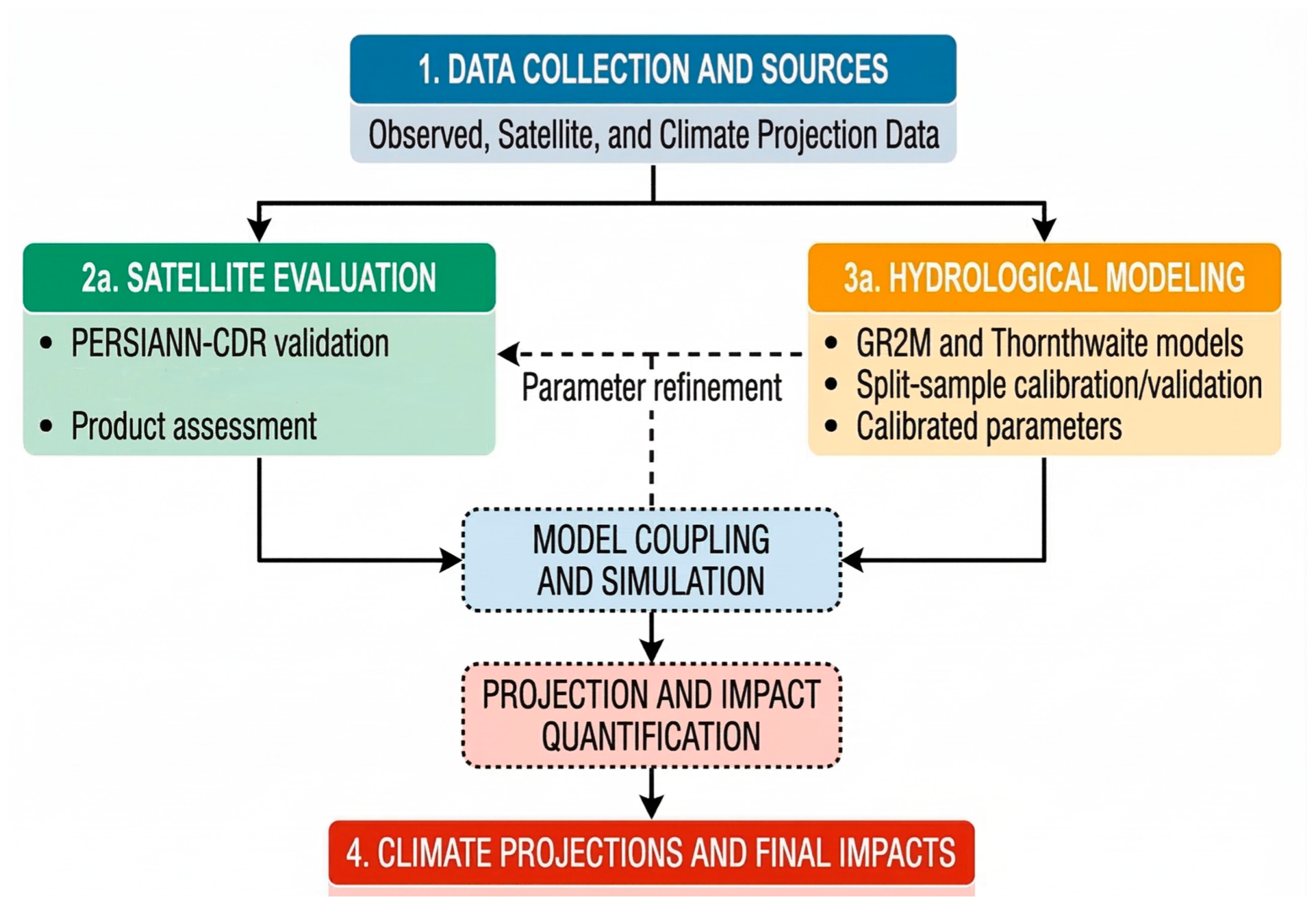
Figure 2. Methodological Flowchart of the Study.
Sustainability 18 04089 g002
Figure 3. Comparison of observed and PERSIANN-CDR precipitation from 1990 to 2021.
Sustainability 18 04089 g003
Figure 4. Simulation of monthly average runoff of the Tassaoute upstream watershed using observed data [1990–2020].
Sustainability 18 04089 g004
Figure 5. Simulation of monthly average runoff of the Tassaoute upstream watershed using PERSIANN-CDR data [1990–2020].
Sustainability 18 04089 g005
Figure 6. Observed and RCMs simulation of precipitation and temperature during the period 1990–2021. hist-CNRM: CNRM-CERFACS model hist-EC-EARTH: European Community Earth model hist-IPSL: Institute Pierre Simon Laplace model hist-MPI: Max Planck Institute model hist-HAD: HadGEM2-ES model P (Obs): observed precipitation, T (Obs): observed temperature. P (PERSIANN-CDR): PERSIANN-CDR precipitation input. Hist-ensemble: ensemble mean of the historical simulations.
Sustainability 18 04089 g006
Figure 7. Projected temperature for the future periods (2030–2060 and 2061–2090) for the ensemble of climatic models.
Sustainability 18 04089 g007
Figure 8. Projected precipitation for the future periods (2030–2060 and 2061–2090) for the ensemble of climatic models.
Sustainability 18 04089 g008
Figure 9. Comparison of projected runoff across five climatic models for RCP4.5 and RCP8.5 scenarios, simulated with the GR2M model using observed and PERSIANN-CDR precipitation data.
Sustainability 18 04089 g009
Figure 10. Comparison of projected runoff across five climatic models for RCP4.5 and RCP8.5 scenarios, simulated with the Thornthwaite model using observed and PERSIANN-CDR precipitation data.
Sustainability 18 04089 g010
Figure 11. Monthly percentage change in runoff for future scenarios relative to the historical baseline based on GR2M model, Qobs refers to discharge simulated using parameter set using observed precipitation.
Sustainability 18 04089 g011
Figure 12. Monthly percentage change in runoff for future scenarios relative to the historical baseline based on Thornthwaite model, Qobs refers to discharge simulated using parameter set using observed precipitation.
Sustainability 18 04089 g012
Figure 13. Monthly percentage change in runoff for future scenarios relative to the historical baseline based on GR2M model.
Sustainability 18 04089 g013
Figure 14. Monthly percentage change in runoff for future scenarios relative to the historical baseline based on Thornthwaite model.
Sustainability 18 04089 g014
Table 1. Result of calibration and validation of the parameters of the GR2M model at the upstream Tassaoute watershed.
ParameterPeriod (1990–2005)Period (2005–2021)Period (1990–2011)Period (2011–2021)
GR2M Model Using Observed Data
X132.7232.68
X20.67210.65340.66970.6847
KGE calibration0.52320.72400.56180.6907
KGE validation0.47680.50180.43820.4619
GR2M Model Using PERSIANN-CDR Data
X11.21.541.43603
X20.890.860.870.87
KGE calibration0.400.470.550.38
KGE validation0.600.520.440.61
X1 and X2 are parameters of the GR2M hydrological model, where X1 represents the production store capacity (mm) and X2 represents the groundwater exchange coefficient. KGE refers to the Kling–Gupta Efficiency.
Table 2. Results of calibration and validation of the Thornthwaite model in the upstream Tassaoute watershed. Rf: runoff factor; DRf: direct runoff factor; SMSC: soil moisture storage capacity (mm); TempRain: rainfall temperature threshold (°C); TempSnow: snow temperature threshold (°C); MaxMelt: maximum snowmelt rate (mm); KGE_calibration: Kling–Gupta Efficiency for calibration; KGE_validation: Kling–Gupta Efficiency for validation.
Period (1990–2005)Period (2005–2021)Period (1990–2011)Period (2011–2021)
THORNTHWHAITE Model Using Observed Data
Rf0.220.130.220.12
DRf0.030.030.030.03
SMSC1011.32657.401008.57659.24
TempRain1.903.941.914.02
TempSnow----
MaxMelt0000
KGE_calibration0.590.620.560.69
KGE_validation0.610.590.670.54
THORNTHWHAITE Model Using PERSIANN CDR Data
Rf0.480.570.470.58
DRf0.030.030.030.03
SMSC264.66293.7264.41218.54
TempRain1.903.941.914.02
TempSnow----
MaxMelt0000
KGE_calibration0.560.540.540.55
KGE_validation0.810.800.810.80
Disclaimer/Publisher’s Note: The statements, opinions and data contained in all publications are solely those of the individual author(s) and contributor(s) and not of MDPI and/or the editor(s). MDPI and/or the editor(s) disclaim responsibility for any injury to people or property resulting from any ideas, methods, instructions or products referred to in the content.