Article

Framework for Integrated Energy Market Trading Strategy Considering User Comfort and Energy Substitution Based on Stackelberg Game: A Case Study in China

1
School of Electrical Engineering, Yanshan University, Qinhuangdao 066004, China
2
Key Laboratory of Power Electronics for Energy Conservation and Drive Control of Hebei Province, Yanshan University, Qinhuangdao 066004, China
*
Author to whom correspondence should be addressed.
Sustainability 2026, 18(8), 4042; https://doi.org/10.3390/su18084042
Submission received: 3 March 2026 / Revised: 3 April 2026 / Accepted: 13 April 2026 / Published: 18 April 2026
(This article belongs to the Section Energy Sustainability)

Abstract

As the integrated energy market evolves toward a multi-stakeholder coexistence model, balancing economic efficiency, user well-being, and system-level sustainability among interacting stakeholders has become a key challenge, particularly in the rapidly developing regional integrated energy markets in China. Thus, to satisfy user comfort and energy substitution requirements while achieving cost-effective electricity and heating supply, this study proposes a Stackelberg game-based market trading framework involving an integrated energy producer (IEP), an integrated energy operator (IEO), and a load aggregator (LA). First, the integrated energy market framework and transaction modes are established, and the profit models of IEP and IEO are formulated. Considering users’ energy substitution behavior, user comfort is quantified to explicitly reflect user welfare in market decision making, and a consumer surplus model is developed for LA participating in market transactions. Second, a Stackelberg game framework is constructed to coordinate the strategies of all participants by incorporating source–load energy flows, and the equilibrium solution is proven to be unique and solvable using quadratic programming. Finally, a case study based on historical data from Hebei Province, China, is conducted to validate the proposed strategy. The results demonstrate that the proposed method effectively coordinates the interests of all stakeholders, enhances demand response capability without reducing user comfort, and improves economic benefits for both supply and demand sides in regional integrated energy markets.

1. Introduction

Driven by the global low-carbon transition, modern energy systems are undergoing profound structural changes, which has significantly increased coordination complexity. Therefore, the traditional single-energy operation paradigm is no longer sufficient to ensure efficiency, reliability, and economy. Thus, the integrated energy market has emerged as a key evolutionary framework [1], enabling coordinated interconnection among electricity, gas, heating, and cooling networks to facilitate multi-carrier energy conversion and cascading utilization [2].
To address increasingly complex multi-energy coupling requirements, DR exploits the interaction potential between supply and demand sides [3], empowering end users to actively participate in sustainable energy management in accordance with operation requirements [4]. To fully exploit flexibility potential, Li et al. introduced cloud service-DR [5], Ma et al. coordinated conventional flexible loads and electric vehicle DR through dynamic pricing mechanisms [6], and Xiao et al. established a coupled model linking time-varying carbon emission factors with response willingness across multiple energy sources [7]. Furthermore, the optimization of multi-energy load shifting strategies has gained attention to reduce energy costs while absorbing surplus renewable generation [8]. Duan et al. proposed a complementary multi-energy strategy combined with horizontal time-shift DR to improve system energy efficiency [9]. Li et al. reduced operating costs by shifting dual peak loads of electricity, heating, and cooling [10]. However, in the coordinated optimization of electricity and heat supply, most of the energy conversion appears on the source side, and the demand side more often considers the independent optimization of power and heating, and less frequently considers the impact of energy conversion on the demand side on the source and load side under the market mechanism.
Beyond improving flexibility through multi-energy coordination, demand-side decisions are not purely economic but are increasingly influenced by user-side considerations. As users pursue economic efficiency while placing increasing emphasis on comfort, their energy consumption decisions increasingly involve a trade-off between these two factors. Consequently, research on optimizing user energy behavior has shifted its focus toward user comfort. Traditional models constrain heat or temperature within predefined comfort ranges for optimization [11], but they fail to adequately capture distinctions between different comfort levels. Zhang et al. analyzed the impact of multi-period heat load balancing on the operational economics of integrated energy planning with respect to human comfort [12]. Li et al. examined the relationship among uncertainty, heat inertia, and user comfort, equating comfort to energy storage capacity to reduce costs and pollution in day-ahead scheduling. Nevertheless, thermal comfort is not explicitly quantified in cost terms in these studies. Quantifying comfort costs could further capture marginal variations in comfort, support socially sustainable DR strategies, clarify the relationship between comfort and energy consumption, and enable more resilient optimal solutions.
The diversity of market participants often results in heterogeneous objectives and potential conflicts of interest [13], making the design of rational market transaction mechanisms essential [14]. Game theory provides an effective framework for coordinating such interactions [15], within which Stackelberg game has been widely applied to promote the development of the energy market [16]. Analytical frameworks commonly emphasize operator–user interactions targeting cost and profit optimization [17]. Considering microgrids as leaders and energy consumers as followers, Lia et al. proposed an energy-sharing management strategy [18], while Cheng et al. addressed diverse distributed energy demands through real-time pricing mechanisms [19]. Tan et al. applied a Stackelberg game model to electricity spot and peak-shaving markets to elucidate the strategic interactions between power generators and power trading centers [20]. However, current research provides relatively limited coverage of source–grid–load coordinated optimization that accounts for the participation of energy producers. To comprehensively account for interests of renewable energy suppliers, building prosumers, and electric vehicle aggregators, Zhang et al. proposed a centralized optimization model incorporating multiple stakeholder objectives [21]. Zhao et al. further constructed a single-leader multiple-follower distributed cooperative optimal dispatch model to enhance energy coupling [22].
In summary, to enable rational pricing design, coordinated source–load interaction, and mutually beneficial outcomes, the following questions still require urgent attention:
RQ1: How can user comfort be quantitatively integrated into demand response (DR)?
RQ2: How can a reasonable energy substitution strategy be established on the user side?
RQ3: How to coordinate the interactions among the integrated energy operator (IEO), integrated energy producer (IEP), and load aggregator (LA) while ensuring stable and economically efficient pricing strategies?
To address the issues, this paper proposes a user-side energy substitution strategy, whereby users determine their heat utilization patterns based on electricity and heat price signals released by IEO. Meanwhile, based on thermal comfort theory, the perception of temperature deviations is quantified as a comfort cost and incorporated into the objective function of LA. Subsequently, a Stackelberg game framework is established, with IEO as the leader and IEP and LA as followers, to resolve conflicts of interest among the parties.
The remainder of this paper is organized as follows. Section 2 presents the integrated energy market architecture and trading mechanism. Section 3 formulates the mathematical models of the market participants. Section 4 develops the Stackelberg game model and proves the existence and uniqueness of the Nash equilibrium. Section 5 presents the case study of Hebei Province, China, characterized by high heating demand and strong multi-energy coupling. These analyses demonstrate the economic performance, user comfort improvement, and robustness of the proposed strategy in integrated energy markets. Section 6 concludes the paper.

2. Integrated Energy Market Architecture and Trading Mechanism

2.1. Integrated Energy Market Architecture

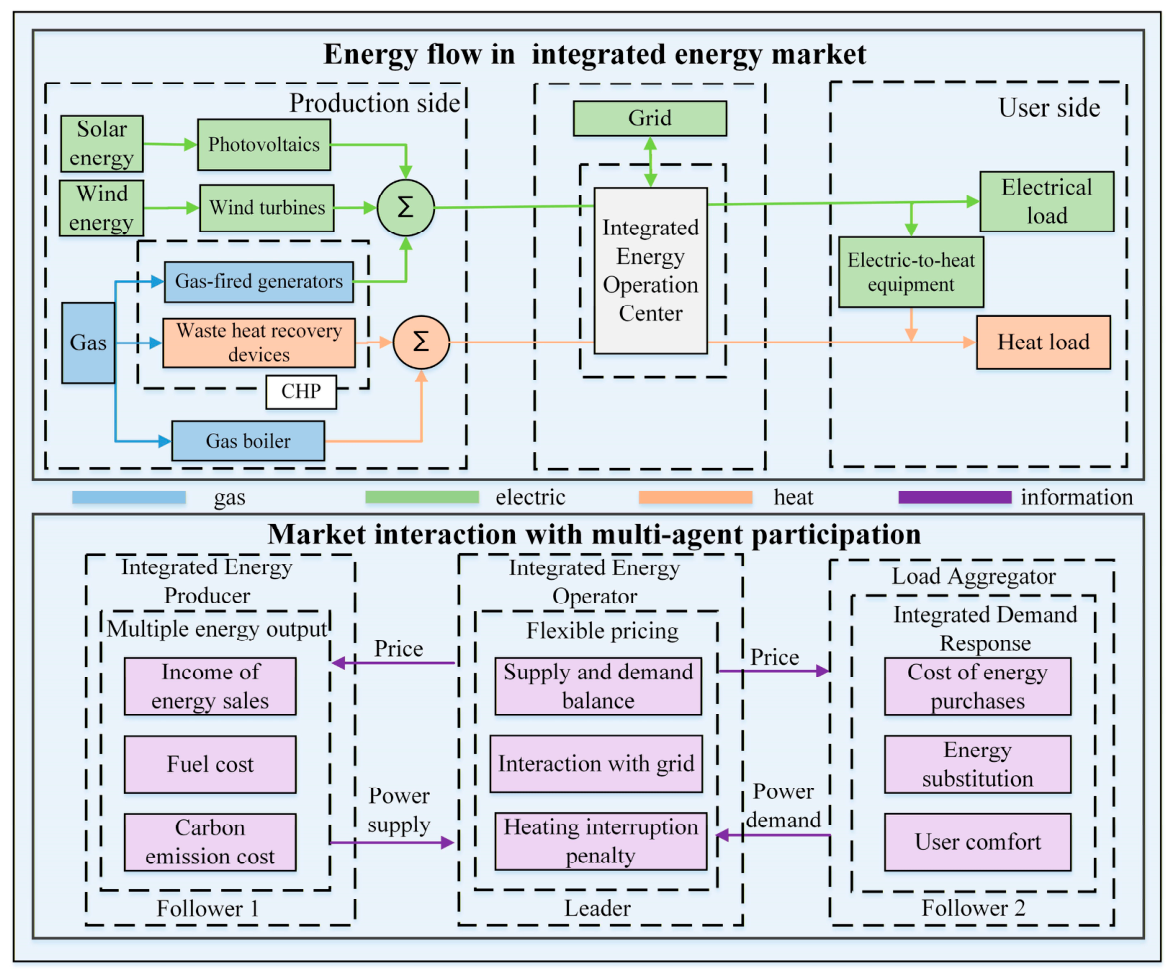
Based on traditional electric energy trading, heat energy trading is additionally incorporated by the system to satisfy users’ multi-energy requirements. The architecture of the market is shown in Figure 1, which is interpreted from physical energy operation layer and market interaction layer.
The upper layer describes the physical architecture and energy flow relationships of integrated energy system (IES). IEP mainly consists of renewable energy generating units, combined heat and power (CHP) units equipped with gas-fired generators and waste heat recovery devices, as well as gas boilers. During electricity generation, waste heat is recovered to achieve cascade utilization, thereby improving overall energy efficiency. The gas boiler supplements heat production when CHP operation is constrained, effectively mitigating the operational rigidity caused by thermoelectric coupling. IEO is positioned at the center of the system and acts as the operational hub connecting the production side, the external power grid, and the user side. Considering the significant losses in long-distance heat transmission, thermal energy is mainly supplied by local units within the region. IEO coordinates multi-energy flows, interacts with the external grid when necessary to maintain system balance, and ensures reliable energy delivery. The user side includes electrical loads and electric-to-heat equipment serving heat loads, which forms a coupled electricity–heat demand structure.
The lower layer illustrates the market interaction mechanism under a leader–follower framework. IEO serves as the market leader and determines day-ahead electricity and heat prices based on prevailing supply–demand conditions. By purchasing energy from IEP and selling it to users, IEO earns revenue through the price spread, while bearing the risks associated with price volatility and supply–demand imbalances. In addition, IEO is responsible for system reliability and assumes penalty costs arising from heating interruptions. IEP acts as a follower and seeks to maximize its profit by considering energy sales revenue, fuel cost, and carbon emission cost. Due to the relatively small individual load levels and the dispersed distribution of flexible users, a load aggregator (LA) is introduced as another follower, which aggregates users with integrated demand response capabilities, enabling coordinated scheduling, energy substitution, and collective participation in market transactions, while balancing economy and user comfort.
The integration of these two layers forms a unified framework in which physical energy flows and economic decision-making processes are mutually embedded, providing the structural basis for modeling the integrated energy market operation and multi-agent game behavior.

2.2. Integrated Energy Market Trading Mechanism with Energy Substitution Strategy

Based on the Stackelberg game-theoretic framework for integrated energy markets [19,20], the integrated energy trading process is logically structured into two sequential stages: pricing and quantity determination.
Stage 1 (the upper level): IEO, as an energy intermediary, determines the price of purchasing energy from producers and selling energy to users based on supply–demand conditions and market information, with the goal of maximizing its own income.
Stage 2 (the lower level): IEP determines the optimal electricity and heat outputs given the energy purchase prices set by IEO, with the objective of maximizing its profit. Meanwhile, users respond to the energy selling prices by determining their energy consumption strategies, aiming to maximize consumer surplus. Consequently, the optimal decisions of the lower level are fed back to the upper level, thereby influencing the determination of the upper-level pricing decisions.
Market interactions are characterized by inherent interest conflicts between IEO and both the supply and demand sides. The increase in one party’s income implies a corresponding decrease in the income of the other parties. The sequential decision-making process in each iteration conforms to a leader–follower hierarchical dynamic game. Therefore, the Stackelberg game framework is suitable for optimizing the objectives of the participants.
IEO, the leader of the game, prioritizes pricing strategies based on the load demand. Given the price signals set by IEO, IEP determines its optimal output, while users adjust their energy consumption accordingly. The leader and followers iteratively update their decisions with the objective of maximizing their respective benefits.
Under DR mechanisms, the pursuit of economic energy consumption induces the shifting or curtailment of electrical and heat loads, accompanied by changes in user comfort levels. As users increasingly balance cost efficiency with comfort requirements, energy substitution strategies exhibit advantages. Accordingly, a user-side energy substitution strategy is proposed within IES. Users optimize their electricity and heat consumption in response to price signals issued by IEO. Energy conversion equipment is installed, allowing heat demand to be met either by directly purchasing heat energy from IEO or by converting purchased electricity into heat energy. The heat energy utilization mode is determined by the relative prices of electricity and heat energy and the users’ heat demand requirements. On the energy production side, the waste heat produced by CHP units can be considered as a heat source indirectly derived from electricity for heating purposes.

3. Model of the Integrated Energy Market

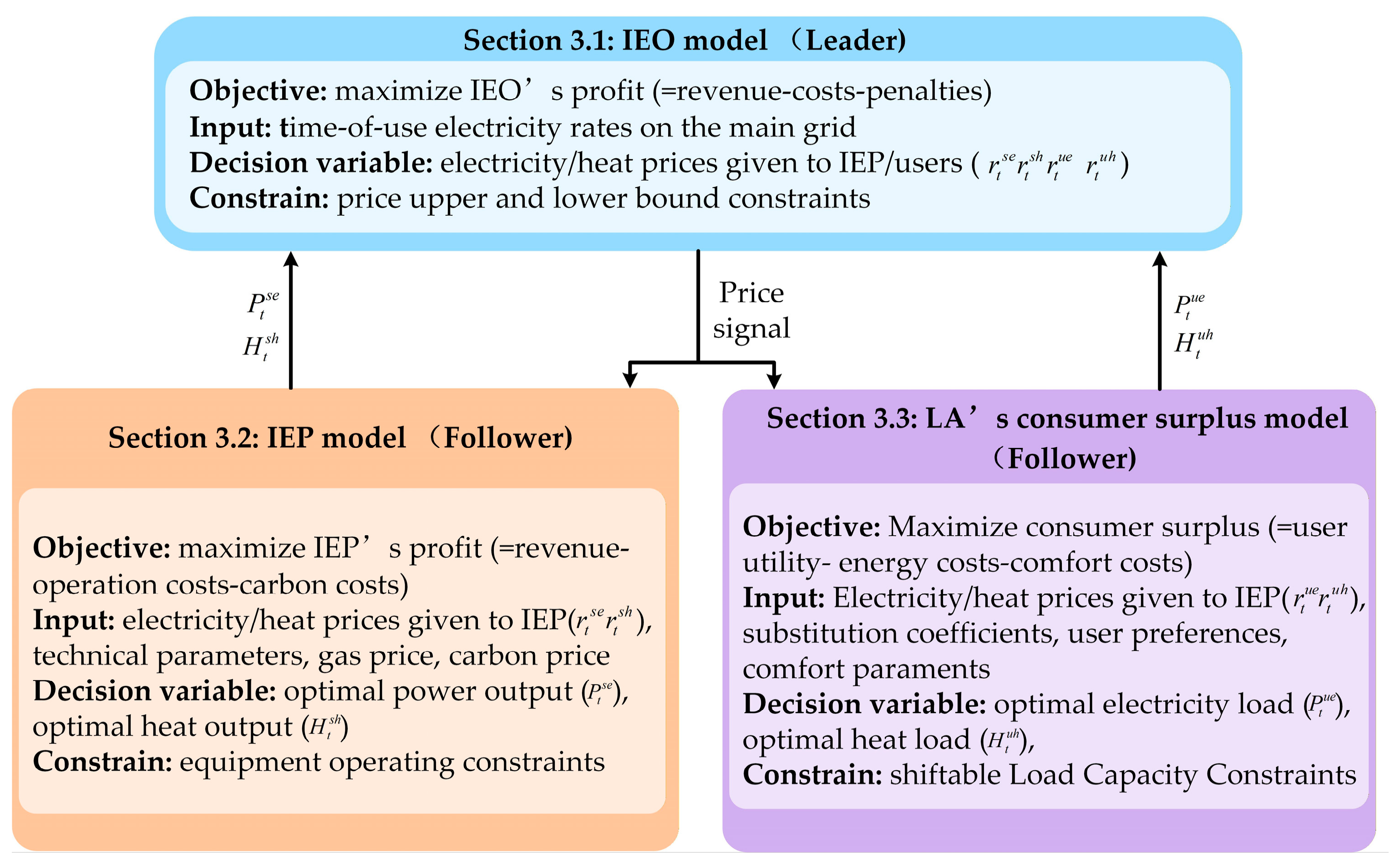
The participants interact within a hierarchical Stackelberg game framework where physical energy flows and economic decision making are mutually embedded. IEO serves as the market leader, formulating energy purchase and retail pricing strategies to maximize its revenue while maintaining system balance. The IEP and LA act as followers who react to these pricing signals. Specifically, IEP determines the optimal multi-energy production schedule in response to the purchase prices, balancing operational constraints with fuel and carbon trading costs. Concurrently, LA regulates user demand in response to the retail prices, dynamically utilizing energy substitution to maximize consumer surplus while weighing energy costs against quantified user comfort. Ultimately, the followers’ optimal generation and consumption strategies are continuously fed back to the leader, iteratively shaping IEO’s subsequent pricing decisions until a cohesive market equilibrium is achieved. To visually illustrate the coordination among the sub-models, Figure 2 presents the schematic structure of the mathematical models.

3.1. IEO Benefit Model

IEO serves as an intermediary between the wholesale and retail markets, determining the purchase and selling prices of electricity and heat based on supply and demand conditions. Following established microeconomic profit-maximization principles in integrated energy markets [23,24], IEO’s objective is to maximize its operational profit. The model is based on subtracting the energy procurement costs C t b u y , grid interaction costs C t g r i d , and heating interruption penalties I t h from the total energy sales revenue C t s e l l . The objective function is expressed as
max F ier = t = 1 T ( C t s e l l C t b u y C t g r i d I t h ) Δ t
where T refers to the 24 h of a day.
C t s e l l = P t u e r t u e + H t u h r t u h
C t b u y = P t s e r t s e + H t s h r t s h
C t g r i d = max ( P t u e P t s e , 0 ) r t g s + min ( P t u e P t s e , 0 ) r t g b
I t h = max ( H t u h H t s h , 0 ) H h
To prevent IEO from monopolizing the market and to ensure the participation willingness of both IEP and users, the formulated prices must be bounded. Specifically, IEO’s purchasing prices must remain within the range of grid tariffs to maintain competitiveness, and the retail prices are constrained by upper and lower limits enforced by market regulators to protect consumer surplus.
r t g b < r t s e < r t g s r t g b < r t u e < r t g s
r t h , min < r t s h < r t h , max r t h , min < r t u h < r t h , max
r t e , min < r t u e < r t e , max
r t h , min < r t s h < r t h , max

3.2. IEP Benefit Model

IEP determines its optimal electricity and heat output based on the prices published by the IEO. Consistent with typical multi-carrier energy production models [25], IEP’s objective function is formulated by subtracting operational expenses, specifically fuel costs and carbon emission trading costs, from the revenue generated through energy sales to IEO. The objective function to maximize its profit is derived as
max F c h p = t = 1 T ( P t se r t s e + H t s h r t s h C t c o 2 C t c h p ) Δ t

3.2.1. Fuel Costs of IEP

According to the operating conditions of production capacity equipment, a quadratic function is employed to model the relationship between output power and fuel costs [25]:
c t c h p = α 1 c h p P t c h p 2 + α 2 c h p P t c h p + α 3 c h p + β 1 G B H t G B 2 + β 2 G B H t G B + β 3 G B
The fuel costs of wind power, photovoltaic generation, and waste heat recovery devices are assumed to be zero.
Through waste heat recovery equipment, the waste heat generated during CHP unit operation can be reutilized for heating, thereby improving overall energy utilization efficiency. The relationship between waste heat recovery and output power can be expressed as
H t c h p = P t c h p 1 η c h p η L η c h p ,   d e n o t e d   a s   H t c h p = P t c h p η k
The total heat output on the production side follows:
H t s h = H t c h p + H t G B
The total electricity output on the production side follows:
P t s e = P t W T + P t P V + P t c h p
Generally, renewable energy generation exhibits randomness and volatility. In this study, the objective is to maximize the utilization of wind and photovoltaic power. To focus on the market interaction mechanism, uncertainties are not explicitly modeled, and the outputs of wind and photovoltaic power are forecast based on historical data.
In addition, the output of the gas-fired generators and gas boilers is required to satisfy equipment ramping constraints and power amplitude constraints:
P t + 1 c h p P t c h p < Δ P c h p
H t + 1 G B H t G B < Δ H G B
0 P t c h p P t c h p , max
0 H t G B H t G B , max

3.2.2. Carbon Trade Costs of IEP

To reduce carbon emissions and fully realize the economic and environmental benefits of IES, carbon trading costs are incorporated to internalize environmental externalities and support emission mitigation. When the actual carbon emission of the IEP is greater than the allocated carbon emission credit, the excess part needs to be purchased from the carbon trading market; otherwise, the remaining credit can be sold for profit.
The primary carbon emission sources in IES include gas boilers and CHP units. Wind power and photovoltaic generation are assumed to have zero carbon emissions.
The carbon trading cost is as follows:
C t c o 2 = t = 1 T r c o 2 ( E h E h 0 ) Δ t
  E h 0 = E c h p 0 + E G B 0
CHP unit generates electricity and supplies additional heat energy, converting a portion of its electricity output into heat supply. Its carbon emission quotas are allocated based on the total equivalent heat generation [26]:
E c h p 0 = t = 1 T k c 0 ( H t c h p + φ P t c h p )
Gas boilers provide heat energy, and their carbon emission quota is proportional to the amount of heat supplied:
E G B 0 = t = 1 T k h 0 ( H t G B )
where φ is the conversion factor for converting waste heat recovery into power generation.

3.3. Consumer Surplus Model Considering DR

The coordinated and complementary integrated DR among different energy sources greatly increases the flexibility of resource mobilization. Exploiting the flexible adjustment potential of demand-side resources through DR can reduce the operating pressure of the system and improve economic interests.
The user side optimizes shiftable electric loads and purchased heat loads in response to price signals provided by the IEO. Equipped with energy conversion devices, such as air-conditioning units, it converts electricity to satisfy heat demand. The selection of heat consumption modes is primarily determined by the relative prices of electricity and heat. The objective function is to maximize consumer surplus, defined as the difference between user comfort and energy consumption costs:
max F user = t = 1 T ( f t e + f t h C t s e l l )
where f t e is the users’ electrical comfort cost, f t h is the users’ thermal comfort cost, and C s e l l t is the cost of energy purchased from IEO.

3.3.1. Electricity Comfort of Users

The purchased electrical load of the users comprises two components: electricity converted to heat and direct electric load.
P t u e = P t c + P t l
P t l = P t f l + P t s l
where P t c is the total power after conversion from electricity to heat. P t l is the direct electricity load. P t f l is the fixed electric load. P t s l represents a shiftable electric load that can be flexibly scheduled by users according to electricity prices. It is required to satisfy the following constraints:
0 P t s l P t l , max P t l , max = 0.3 P t l
where P t l , max is the upper limit of the shiftable load in the period t , which is limited to 0.3 times the total electrical load [27].
The cost of electrical comfort is expressed as a quadratic function, representing the satisfaction of users when consuming electricity:
f t e = α e 2 p t u e 2 + β e p t u e
where α e and β e are the preference coefficients for electric energy consumption, which can reflect the users’ demand preference for electric energy and affect the size of demand. The higher the value, the more reluctant users are to reduce the load.

3.3.2. Thermal Comfort of Users

To explicitly incorporate users’ thermal comfort into the optimization framework, this study adopts the widely used predicted mean vote-predicted percentage dissatisfied (PMV-PPD) model and transforms heat dissatisfaction into a tractable cost representation. The parameters related to human behavior and indoor environment are fixed to the typical values reported in the literature, allowing indoor air temperature to be treated as the primary decision-related variable.
The users’ heat load comprises the heat purchased directly from IEO and the heat obtained by converting purchased electricity via energy conversion devices. Given the hourly scheduling resolution considered in this study, indoor temperature variations can be reasonably approximated by quasi-steady behavior within each time interval. Room temperature is assumed to change and stabilize rapidly when the heat load is applied for indoor heating, which does not affect the analysis of the main problem. The expression of heat energy used by users is
H t u h = H t l P t c η c
Considering the influence of environmental factors and human factors, Wang et al. proposed the PMV-PPD index system of thermal comfort [28]. The PMV index is used to predict the heat sensation of the body in different environments; the PPD index indicates the percentage of people dissatisfied with the heat environment. The coefficients present in Equation (29) are standard empirical constants derived from Fanger’s classic thermal comfort experiments, which have been widely established and standardized in the evaluation of indoor environments [26].
P M V = ( 0.303 exp ( 0.036 M ) + 0.028 ) × { M W 3.05 × 10 3 [ 5733 6.99 ( M W ) P a ] 0.42 [ ( M W ) 58.15 ] 0.0014 M ( 34 t a ) 3.96 × 10 8 f c [ ( t c + 273 ) 4 ( t r + 273 ) 4 ] 1.7 × 10 5 M ( 5867 P a ) f c h c ( t c t a ) }
The relationship between PPD and PMV follows:
P P D ( t a ) = 100 95 exp [ ( 0.03353 P M V 4 ( t a ) + 0.2179 P M V 2 ( t a ) ) ]
Therefore, the dissatisfaction cost of users is established:
C ( t a ) = σ h P P D ( t a )
Since the PMV index is influenced by multiple factors and its calculation is complex, the analysis focuses on the relationship between air temperature t a and PMV; therefore, only indoor temperature is considered as a variable, and all other factors are assumed to be constant. According to the parameters given [29], the relationship between PMV and indoor temperature T i n , t is obtained, as shown in Table 1. Equation (31) is obtained through quadratic fitting using MATLAB R2022a, and the heat discomfort cost is obtained:
f t h = σ h ( θ 1 T i n , t 2 + θ 2 T i n , t + θ 3 )
It should be noted that the quadratic form in Equation (32) is not intended to represent a physical law, but rather a numerical approximation of heat dissatisfaction derived from the PMV-PPD relationship, which facilitates analytical tractability and ensures smoothness in the subsequent optimization.
In order to be consistent with the electrical comfort, the heat discomfort cost function is transformed into the thermal comfort cost form:
f t h = σ h [ λ ( θ 1 T i n , t 2 + θ 2 T i n , t + θ 3 ) ]
The relationship between indoor temperature and heat load [30] is as follows:
H t l = S μ ( T i n , t T o u t , t ) + C S Δ t ( T i n , t T i n , t 1 )
where S is the heating area; μ is the indoor heat loss under the unit temperature difference in unit heating area; C is the heat capacity per unit heating area; T i n , t and T o u t , t are the indoor and outdoor temperature in t period.
According to Equation (34), the temperature can be converted into the heat load required by users, which is recorded as T i n , t = k 1 H t l + k 2 , so the users’ thermal comfort is quantified as
f t h = σ h { λ [ θ 1 ( k 1 H t l + k 2 ) 2 θ 2 ( k 1 H t l + k 2 ) + θ 3 ) ] }
where θ 1 , θ 2 , θ 3 are 1.7509, −87.416, 1069.1, respectively. The residual modulus is 0.075649. The error of fitting results is within the acceptable range. λ is a reasonable constant and is taken as 30 according to the fitted function image.

4. The Multi-Agent Game of Regional IES Market Transactions

4.1. Stackelberg Game Model

The Stackelberg game is a classical leader–follower dynamic non-cooperative game in which the leader moves first by announcing its strategy, and the followers subsequently optimize their responses after observing the leader’s decision. The equilibrium of the game is obtained through backward induction and is characterized by the leader anticipating the optimal reaction functions of the followers. Compared with simultaneous move Nash games, the Stackelberg framework explicitly captures sequential decision making and strategic dominance, making it particularly suitable for markets with pricing power asymmetry and hierarchical structures, especially in demand response management [15], electricity pricing [17], and multi-energy coordination [20]. Given that IEO in this study determines purchase and retail prices prior to production and consumption decisions, the market exhibits a natural leader–follower hierarchy.
IEO is the leader of the game, and IEP and the LA are the followers to establish a Stackelberg game with one leader and two followers, which can be expressed as G = { N ; φ i e o ; { φ c h p , φ u } ; F i e o ; { F c h p , F u } } .
  • Participants include IEO (leader), IEP (follower 1), and LA (follower 2), which are expressed as N = { i e o , c h p , u } ;
  • Strategy set: The leader’s strategy comprises the prices for purchasing electricity and heat from the IEP and for selling electricity and heat to users, which can be expressed as φ i e o = { r t s e , r t s h , r t u e , r t u h } . The strategy of follower 1 is the electrical power output of the CHP and the heat power output of the gas boiler, which can be expressed as φ c h p = { P t s e , H t G B } ; The strategy of follower 2 is LA’s shiftable electric load and purchased heat load, which can be expressed as φ u = { P t s l , H t u h } ;
  • For each participant, revenue serves as the objective function, as given by Equations (1), (11) and (23).

4.2. Proof of Game Equilibrium

Theorem: When the Stackelberg game model satisfies the following conditions, there is a unique Nash equilibrium [31]:
  • The strategy set of leader and followers is a non-empty compact convex set.
  • When the leader’s strategy is given, all followers have a unique optimal solution.
  • When the follower’s strategy is given, the leader has a unique optimal solution.
Proof: Based on the proposed strategy, it is demonstrated that the aforementioned game equilibrium satisfies three conditions, ensuring its existence and uniqueness (the cost coefficients are all positive numbers)
The revenue functions of the leader, follower 1, and follower 2 are given by Equations (1), (11) and (23), respectively, and are subject to the constraints in Equations (6)–(9), (15)–(18) and (24). This ensures that the strategy set of each participant is non-empty, compact, and convex.
  • The first-order partial derivatives of the leader’s objective function (Equation (1)) with respect to and are computed as
F i e o P t s e = ( r t s e + η k r t s h 2 α 1 c h p ( P t s e P t w t P t p v ) α 2 c h p r t c o 2 φ ( k c k c 0 )
F i e o H t G B = r t s h 2 β 1 G B H t G B β 2 G B r t c o 2 ( k h k h 0 )
Set the first-order partial derivative equal to zero to obtain the extreme point:
P t s e = r s e + η k r s h α 2 c h p r t c o 2 2 α 1 c h p + P w t + P p v
H t G B = r s h β 2 G B r t c o 2 2 β 1 G B
The second-order partial derivatives of the leader’s revenue function with respect to P t s e and H t G B are derived, and the corresponding Hessian matrix is formed as
H 1 = 2 α 1 c h p 0 0 2 β 1 G B
The matrix is negative definite, and the objective function has a maximum point. Therefore, when the leader gives prices, there is a unique optimal solution for follower 1.
2.
The first-order partial derivatives of the user objective function (Equation (23)) with respect to P t s l and H t u h are computed as
F u P t s l = β e α e ( P t s l + P t f l + P t c ) r t u e
F u H t u h = σ h [ 2 θ 1 k 1 2 ( H t u h + P t C η C ) + 2 θ 1 k 1 k 2 + θ 2 k 1 ] r t u h
Set the first-order partial derivative equal to zero to obtain the extreme point:
P t s l = β e r t u e α e P t f l P t c
H t u h = ( 1 2 θ 1 k 1 2 σ h r t u h + P t C η C + k 2 k 1 + θ 2 2 θ 1 k 1 )
The second-order partial derivatives of the user revenue function with respect to P t s l and H t u h are derived, and the corresponding Hessian matrix is formed as
H 2 = α e 0 0 2 σ n θ 1 k 1 2
The matrix is negative definite, and the objective function has a maximum point. Therefore, when the leader gives prices, there is a unique optimal solution for follower 2.
3.
The uniqueness of the leader’s optimal solution can be demonstrated when the followers’ strategies are fixed. For illustration, one representative case is considered, while other cases are analogous. In this case, the leader needs to purchase electricity from the grid and faces insufficient heat supply, and the extreme points of the followers’ strategies are substituted into the leader’s objective function. The first-order partial derivatives of the leader’s objective function (Equation (11)) with respect to r t s e , r t s h , r t u e , and r t u h are computed as
F i e o r t u e = β e 2 r t u e α e + r g s α e
F i e o r t u h = H h 2 r t u h 2 θ 1 k 1 2 σ h + P t C η C k 2 k 1 θ 2 2 θ 1 k 1
F i e o r t s e = α 1 c h p + r c o 2 + r g s + η k H h 2 α 1 c h p r t s e + η k r t s h α 1 c h p P t w t P t p v
F i e o r t s h = η k α 2 c h p + η k r c o 2 + η k r t g s + η k 2 H h 2 α 1 c h p + H h + β 2 G B 2 r t s h + r c o 2 2 β 1 G B η k r t s e + η k 2 r t s h α 1 c h p
The second-order partial derivatives of the leader’s revenue function with respect to r t s e , r t s h , r t u e , and r t u h are derived, and the corresponding Hessian matrix is formed as
H 3 = 2 α e 0 0 0 0 1 θ 1 k 1 2 σ h 0 0 0 0 1 α 1 c h p η k α 1 c h p 0 0 η k α 1 c h p η k 2 α 1 c h p + 1 β 1 G B
The matrix is negative definite, and the objective function has a maximum point. Therefore, when the follower determines the strategy, the leader has a unique optimal solution. In summary, the Stackelberg game model proposed in this paper has a unique Nash equilibrium.

4.3. Solution of Stackelberg Game Model

The intelligent algorithms are prone to falling into local optimal solutions based on simple biological group behavior; therefore, consistency with the Nash equilibrium solution cannot be guaranteed. In the original problem, some cost functions are quadratic, and therefore a quadratic programming algorithm is employed. The algorithm is theoretically well-established, computationally efficient, and exhibits fast convergence, making it well-suited for the present problem.
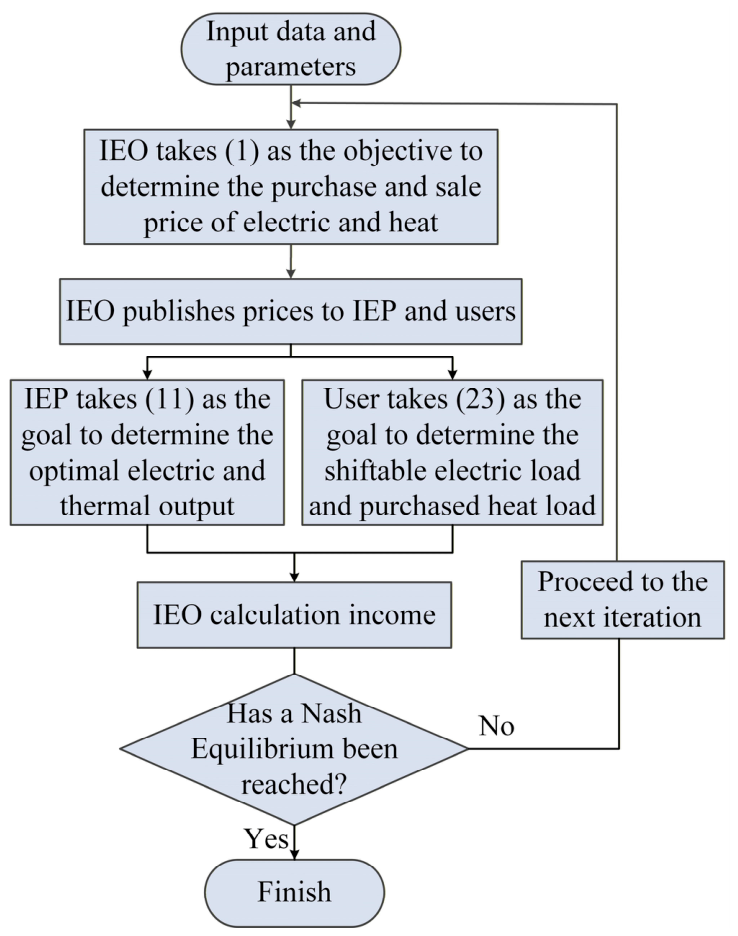
As the leader of the game, IEO determines the purchase and sale price of electricity and heat, and issues price signals to the lower layers. The IEP and LA, as followers, bring the price given by IEO into their own models to optimize the output and use of electricity and heat. Then, they upload their power information to the upper layer. The game participants aim to maximize their own benefits, and iterate for many times until the game Nash equilibrium solution is obtained. If ( φ i e o , φ c h p , φ u ) represents the Stackelberg game equilibrium, it must satisfy the following conditions:
F i e o ( φ i e o , φ c h p , φ u ) F i e o ( φ i e o , φ c h p , φ u ) F c h p ( φ i e o , φ c h p , φ u ) F c h p ( φ i e o , φ c h p , φ u ) F u ( φ i e o , φ c h p , φ u ) F u ( φ i e o , φ c h p , φ u )
At each iteration, IEO updates electricity and heat prices, while IEP and LA solve their optimization problems with quadratic objective functions and linear constraints. Due to the negative definiteness of the Hessian matrices and the convex feasible sets, each subproblem admits a unique global optimum. The iterative process terminates when no participant can further improve its objective value through unilateral strategy adjustment, which corresponds to the equilibrium condition defined in Equation (39). The solution flow chart is as follows (Figure 3):

5. Case Study

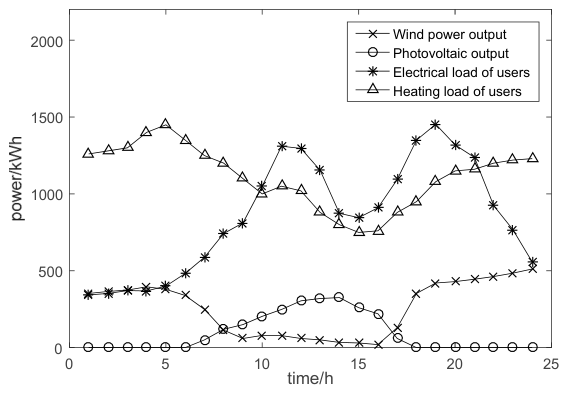
To ensure the credibility and reflect typical diurnal variations, a typical winter day derived from historical data scenarios in Hebei Province is selected as a case study, reflecting peak heating demand and typical electricity–heat coupling characteristics that highlight the interaction between supply, demand, and energy substitution. Hebei Province is characterized by multi-carrier energy flows, high CHP penetration, strong heating demand, and active integrated energy market development, making it a representative scenario for validating the proposed Stackelberg game-based integrated energy trading strategy. Although Hebei Province was selected as the representative case study for this research, the methodology and findings can be applied to most cities in northern China and other regions with similar heating requirements. This research analyzes the Stackelberg game optimization strategy and the operational transaction process of electricity and heat energy within regional IES, providing practical insights for integrated energy market design, the operational management of regional IES, and the formulation of effective pricing and demand response mechanisms. Summer trading patterns are similar to those in winter, differing solely in the energy conversion process. The curves of renewable energy output, electrical and heat loads on a typical winter day are shown in Figure 4. The tests are coded in MATLAB using the YALMIP toolbox and solved by GUROBI on a personal computer with a 13th Gen Intel(R) Core (TM) i9-13900H CPU @ 2600 Mhz and 32 GB memory.
The main parameters are detailed in the Table A1 of Appendix A [26,27,28,29,31,32].

5.1. Game Iterative Optimization

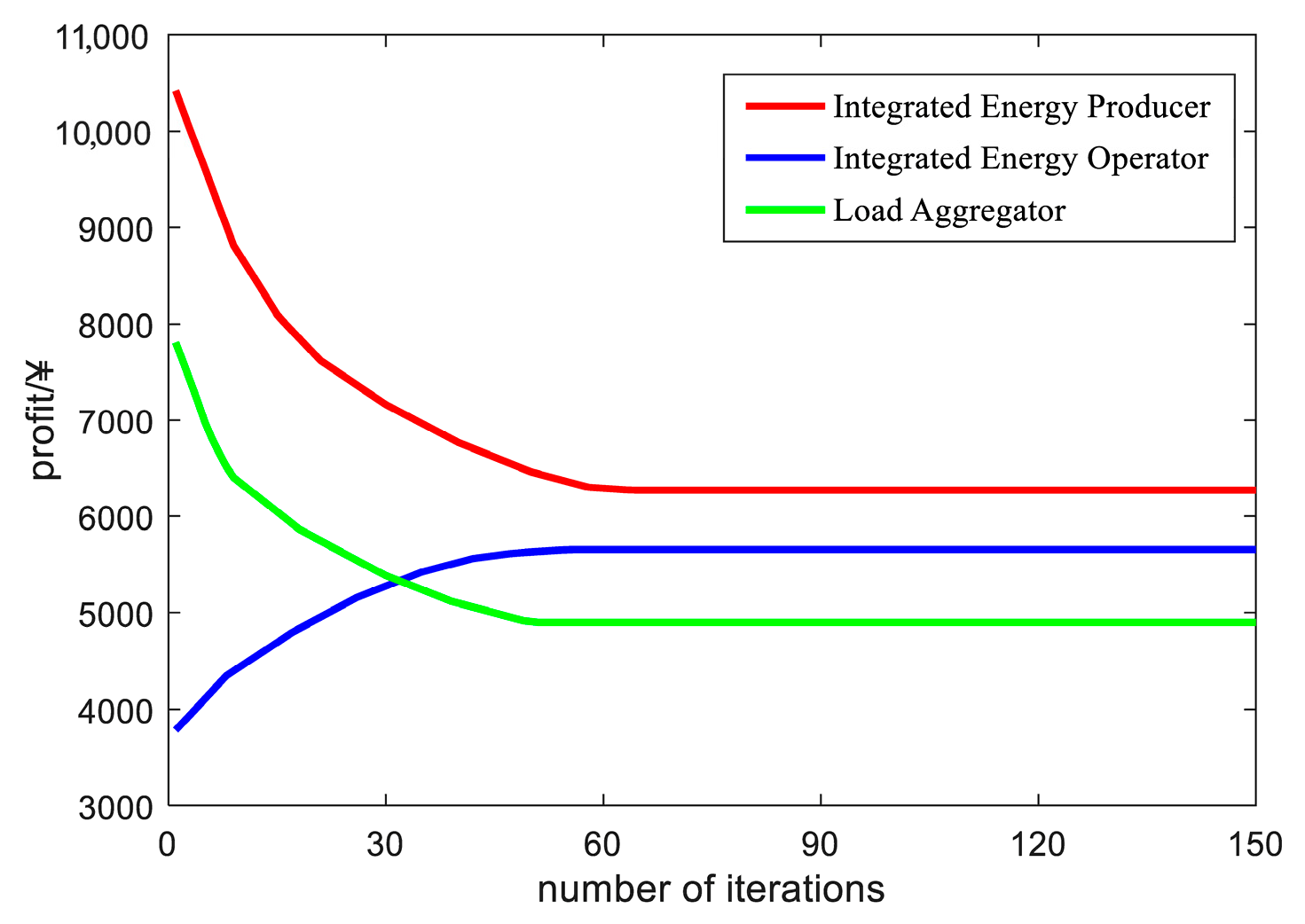
The iterative process of total income optimization of the three market participants is shown in Figure 5. The objective values change rapidly in the initial stage and gradually converge to stable levels after approximately 60 iterations, indicating a stable interaction process among IEO, IEP, and LA. As the leader in the Stackelberg game, the IEO updates its pricing strategies based on the responses of the followers, and its profit gradually increases during the iterative process, reflecting its leadership role in market transactions. Upon convergence, no participant can improve its objective through unilateral deviation, providing numerical support for the analytically established existence and uniqueness of the Nash equilibrium in Section 4.2. At the equilibrium point, the final profits of the IEO, IEP, and LA are ¥5658, ¥6274, and ¥4899, respectively.

5.2. IEO Optimization Results

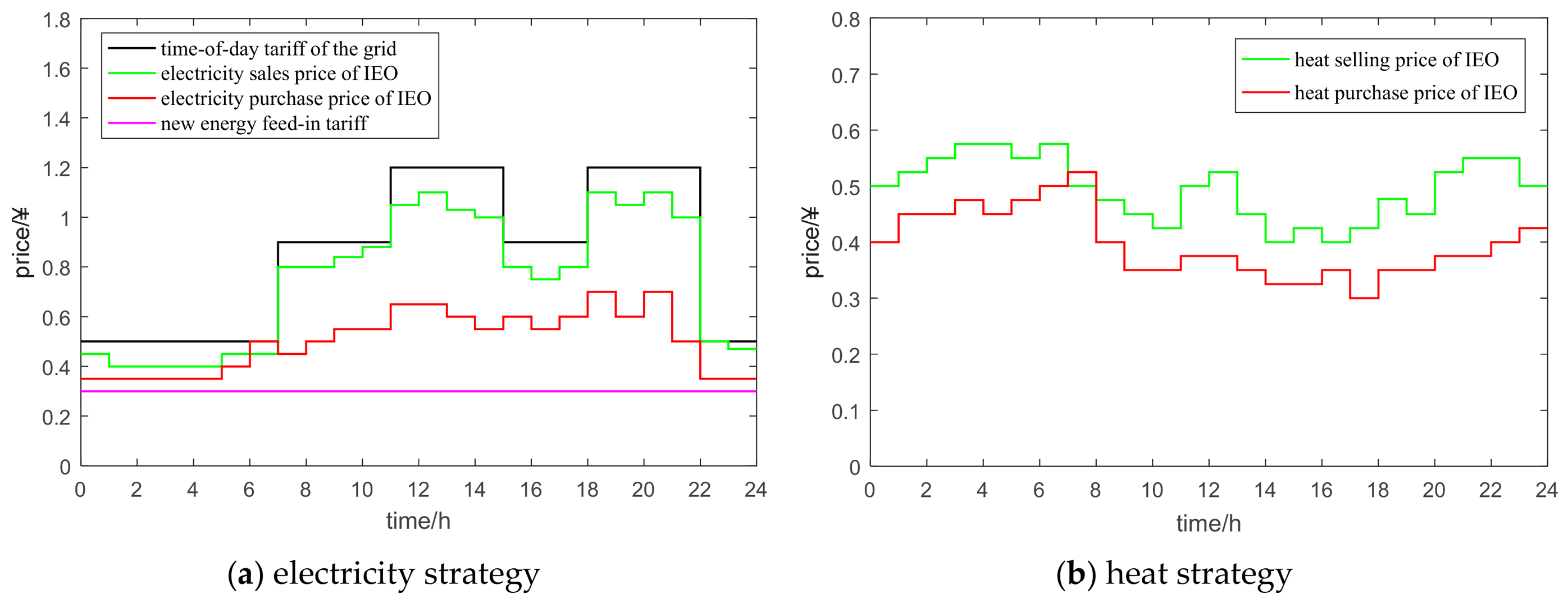
The price strategy of the leader IEO is shown in Figure 6. Under the proposed market mechanism, the electricity selling prices are generally lower than the grid time-of-use tariffs and higher than renewable feed-in tariffs, enabling effective coordination between producers and users while maintaining incentives for both sides. The electricity purchase prices remain relatively stable, while the selling prices closely follow the variation in user demand, with higher values observed during peak load periods. Consequently, larger price spreads appear during 11:00–15:00 and 18:00–23:00, indicating that the electricity trading revenue of IEO is mainly accumulated during these intervals. Similar characteristics can be observed for heat energy pricing.
It is also noted that in certain off-peak periods (e.g., 6:00–7:00 for electricity and 7:00–8:00 for heat), the selling prices of IEO are temporarily lower than the corresponding purchase prices. This pricing inversion results from the intertemporal profit-maximization strategy of IEO, in which short-term price concessions are adopted to maintain supply–demand balance and avoid heating interruption penalties. These temporary losses are compensated by higher margins in other periods, reflecting the role of IEO in absorbing price fluctuation risks as an intermediary between the source and load sides.

5.3. LA Optimization Results

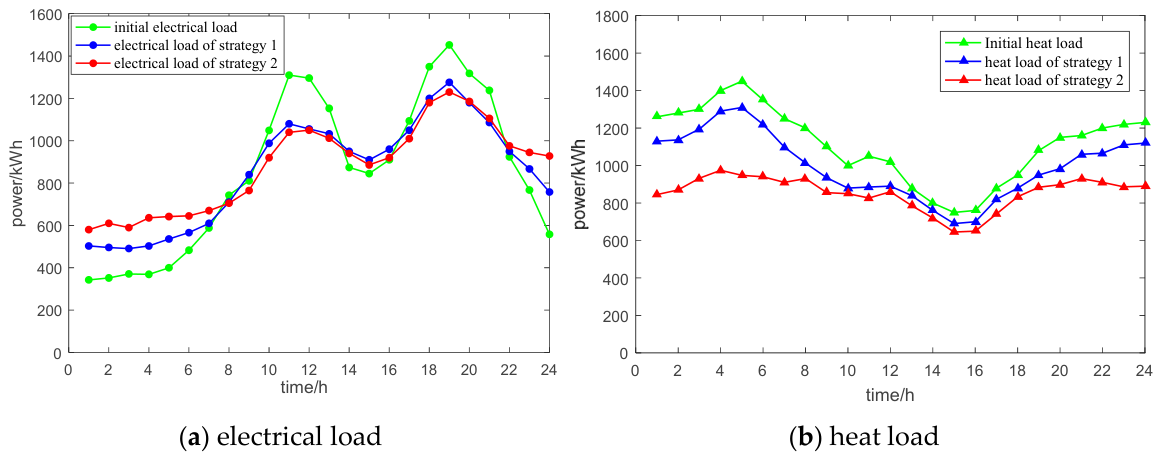
To evaluate the impact of user demand response and energy substitution behavior, a comparative case study is conducted under two different strategies. The load curve before and after users’ DR is shown in Figure 7. Table 2 shows the corresponding cost and consumer surplus comparison before and after optimization.
Strategy 1: Do not consider the users’ energy substitution behavior.
Strategy 2: Consider the users’ energy substitution behavior.
Under strategy 1, driven by time-of-use pricing, users shift part of their electricity consumption away from peak price periods to reduce power consumption costs. Consequently, the original load peaks during 11:00–13:00 and 19:00–22:00 are reduced and partially transferred to the periods of 00:00–08:00 and 15:00–17:00. The peak load is shifted to fill the valley, and the load curve is optimized. Electric comfort is reduced by 2.00%. The adjustment amount of heat energy response is limited. Excessive reduction will affect the users’ heat demand and thermal comfort. The overall heat energy has some reduction but no significant reduction, but the thermal comfort has still dropped significantly, down by 17.32%. The energy purchase cost is reduced by 13.57%. Consumer surplus increases by 4.29%.
According to Figure 7a,b, strategy 2 achieves more pronounced peak shaving and valley filling effects than strategy 1. This improvement arises from the consideration of user energy substitution behavior. Specifically, part of the electric load is shifted to periods with lower electricity prices, thereby increasing power consumption during valley hours. In addition, users exhibit higher heating demand at night, when heat prices are relatively high. Under such conditions, electricity-to-heat conversion equipment is utilized for nighttime heating by taking advantage of low electricity prices, which further increases electricity demand during valley periods. As a result, users gain greater flexibility in accessing heat energy, leading to a reduction in direct heat purchases during nighttime hours. These changes in energy consumption behavior smooth the heat load profile, alleviate heating pressure on the system, and promote coordinated optimization between electricity and heat. Meanwhile, thermal comfort decreases by 4.74%, energy purchase costs are reduced by 17.86%, and consumer surplus increases by 24.25%. Although a small reduction in energy comfort is observed, the significant decrease in energy purchase costs and the increase in consumer surplus indicate that strategy 2 achieves a balance between economy and user comfort under sustainable pricing signals.

5.4. IEP Optimization Results

A comparison is conducted between the initial load profile and the load profile obtained after the final optimization of the production side.
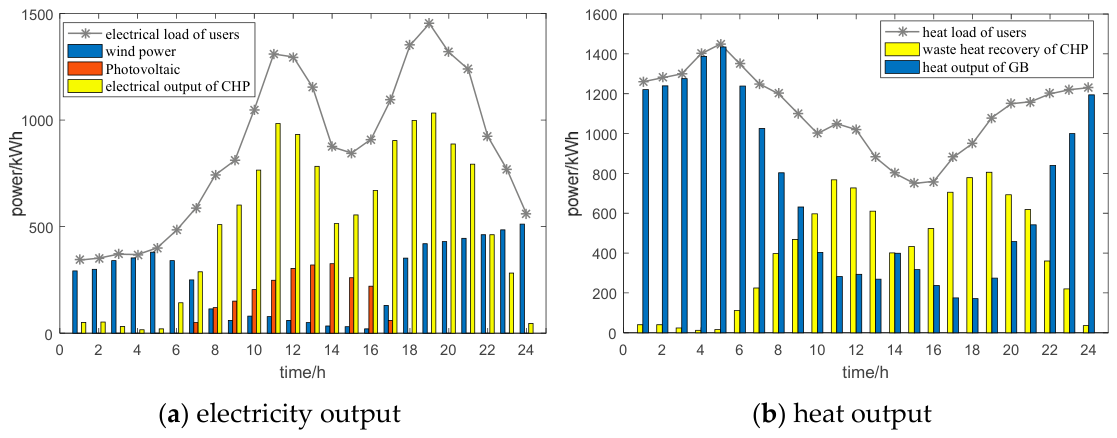
The output before optimization is shown in Figure 8, and the output after optimization is shown in Figure 9. Before optimization, the power generation of CHP unit is concentrated at 8:00–22:00 and fluctuates greatly. Waste heat recovery is directly coupled with the power generation of the CHP unit and is aligned with the heat demand of users. To prevent heating interruptions or supply shortages, gas boiler operates in coordination with the CHP unit to ensure that the system heat demand is fully satisfied. Consequently, the heat output of the gas boiler is relatively high during nighttime periods and low during daytime hours, exhibiting significant fluctuations.
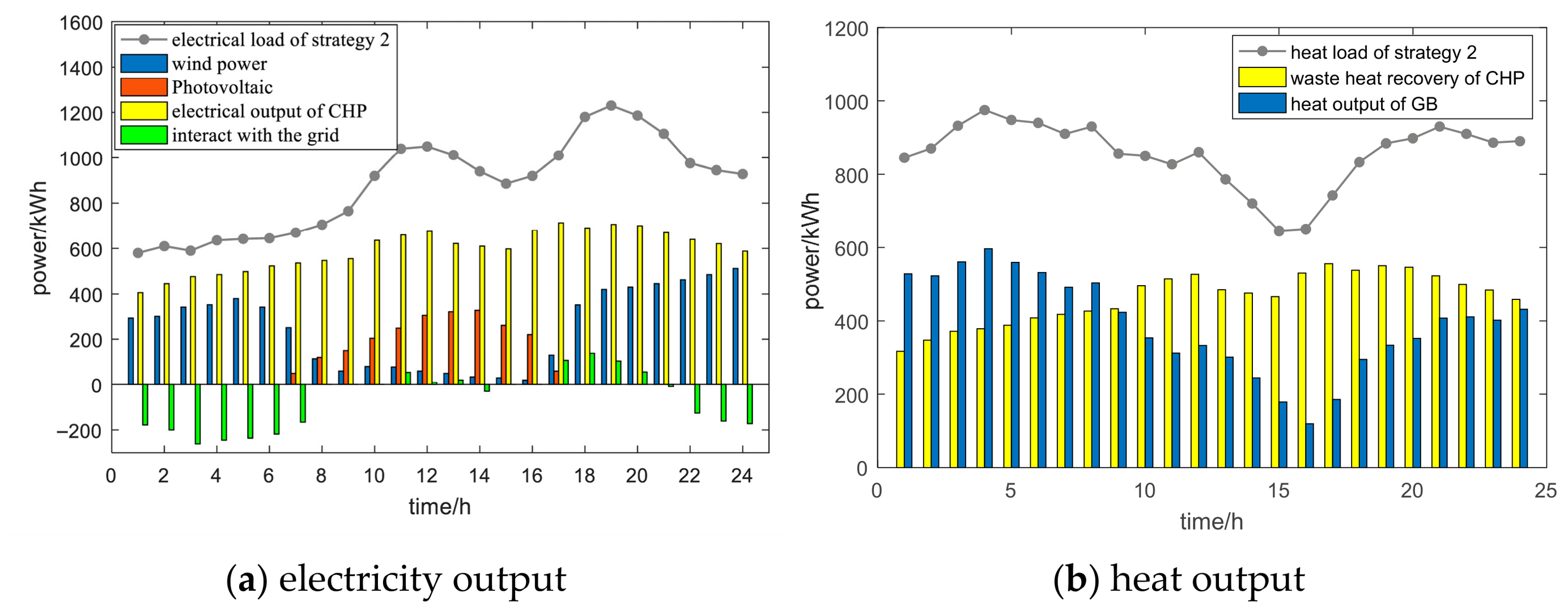
After the proposed strategy is adopted, the load-side energy demand changes, and IEO guides the output of the IEP through price signals. During the periods of 00:00–07:00 and 22:00–24:00, IEP increases power generation beyond local demand to enhance profitability, and IEO sells the surplus electricity to the grid, thereby maintaining supply–demand balance while generating additional revenue. In contrast, during peak load periods of 11:00–13:00 and 17:00–20:00, electricity is purchased from the grid to satisfy load demand.
After the optimization, the output of the unit becomes significantly more stable, the fluctuation is reduced, and the energy supply pressure is reduced. The profit before optimization is ¥5862, and it increases to ¥6274 after optimization.

5.5. Sensitivity Analysis

To assess the robustness of the proposed Stackelberg game model of integrated energy market, a sensitivity analysis is performed by varying key parameters, specifically the user comfort coefficient and the power-to-heat conversion efficiency, while keeping all other model structures and assumptions unchanged.
The total system profit is defined as the sum of the objective values of the IEO, IEP, and LA. Although the Stackelberg game framework does not explicitly optimize the total system profit, this metric is reported to evaluate the overall economic performance of the integrated energy market under different parameter settings.

5.5.1. Sensitivity Analysis of Comfort Coefficient

The electrical comfort coefficient is incorporated into the objective function of LA through quadratic comfort cost terms. To facilitate analysis, a comfort coefficient ratio is introduced to describe the ratio of the current comfort coefficient to the benchmark value:
f t e = σ c f t e
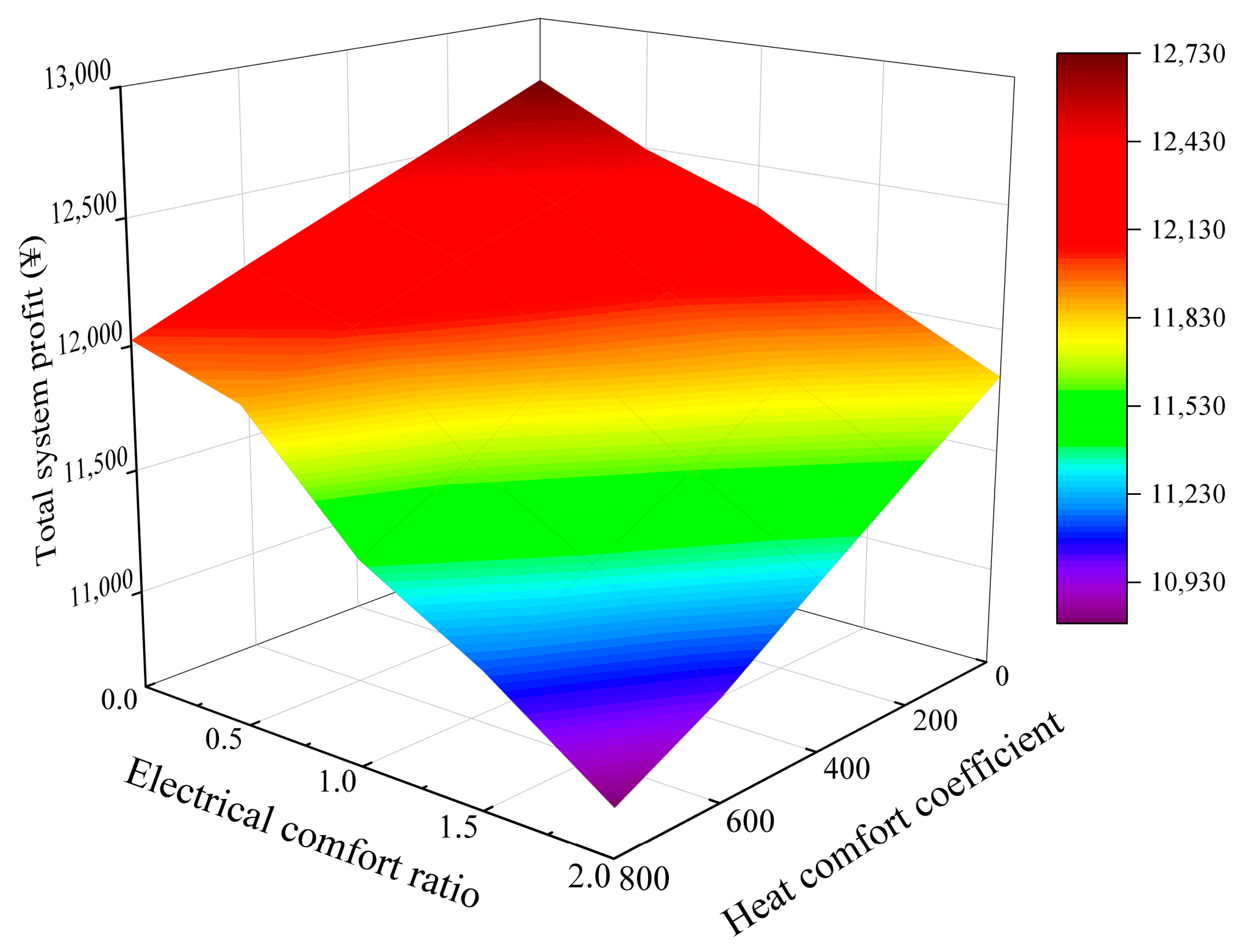
Figure 10 depicts the total system profit under varying electrical and thermal comfort coefficients. The system’s profit declines as either coefficient increases, indicating that stricter comfort preferences reduce users’ willingness to adjust consumption behavior. The profit is more sensitive to electrical comfort, highlighting the dominant role of electrical flexibility, whereas thermal comfort mainly constrains the depth of power-to-heat substitution without substantially altering system coordination. The maximum system profit is achieved at lower comfort coefficients, reflecting the inherent trade-off between economic efficiency and user comfort. As comfort requirements become more stringent, the marginal benefits of demand-side flexibility decrease, resulting in a gradual decline in overall system profitability. Overall, the sensitivity analysis demonstrates the applicability of the model under diverse user preferences, aligning with policy initiatives that promote active demand-side participation.

5.5.2. Sensitivity Analysis of Conversion Efficiency

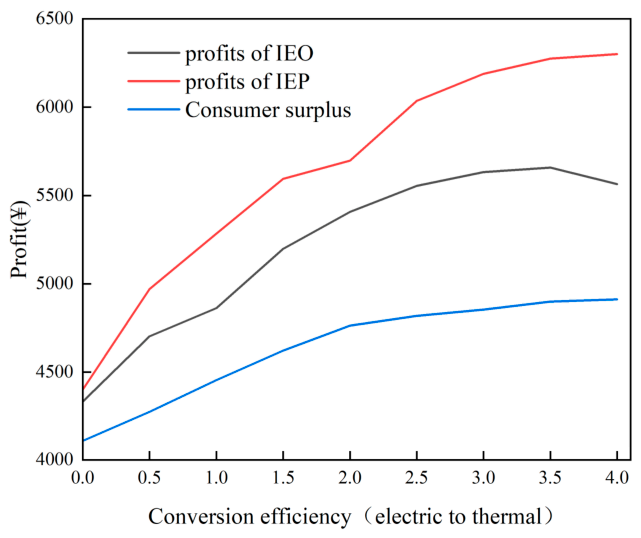
Figure 11 illustrates the impacts of power-to-heat conversion efficiency on market outcomes. As efficiency increases, the profits of the IEO, IEP, and LA generally rise. IEO’s profit increases up to a threshold (around η c = 3.5) and then slightly declines, reflecting diminishing marginal returns due to intensified competition and the redistribution of efficiency gains. In contrast, the IEP’s profit increases monotonically across the entire efficiency range, underscoring the persistent economic advantage of electricity-based heat supply. Meanwhile, consumer surplus grows more moderately, suggesting that efficiency improvements only partially translate into user welfare gains due to demand elasticity and comfort constraints. Overall, the results reveal the existence of an economically efficient range for power-to-heat conversion efficiency rather than unlimited efficiency-driven benefits.

6. Discussion

6.1. Comparative Analysis and Mechanism Discussion

To highlight the contribution of the study, the proposed framework is compared with recent reference in two core dimensions: DR strategy and user welfare coordination.
Firstly, regarding DR strategy, the proposed model achieves a methodological transition from single-dimensional time-shifting to dual-dimensional source–load coordination. Compared to recent studies, for instance, Yan et al. developed a Stackelberg game incorporating user psychology, but the framework lacks a systematic representation for cross-energy substitution [33]. Similarly, although Meng et al. explore multi-agent interactions with flexible loads, the DR strategies predominantly rely on load curtailment or temporal shifting [34]. Furthermore, Li et al. investigate energy coupling within decentralized game models, yet the focus remains on production-side coupling units rather than user side [35]. In contrast, this study forms a robust coordination strategy whose equilibrium is proven to be unique and stable via convex quadratic programming. Consequently, the proposed DR strategy amplifies the effectiveness of price signals, allowing IEO to simultaneously optimize temporal load shifting and multi-energy demand allocation, thereby enhancing both economic and operational sustainability.
Secondly, regarding user welfare coordination, this study transcends the binary feasibility limitations inherent in conventional approaches, but many studies treat user comfort as a hard physical boundary. For instance, Shi et al. [36] utilize fixed indoor temperature bands as absolute constraints. Furthermore, even when adopting dynamic thermal comfort metrics, such as in Lv et al. [37], strict upper and lower PMV bounds are still enforced as rigid interval. While computationally straightforward, these methodologies fail to capture marginal comfort variations. In contrast, by innovatively quantifying subjective user comfort into an explicit, continuous economic cost term, the proposed model activates a highly dynamic market response. This paradigm shift ensures the demand side remains highly responsive to price incentives without violating acceptable comfort tolerances. Furthermore, the analytical findings explicitly map the trade-off boundaries of this mechanism: heightened comfort requirements inherently diminish load flexibility and system profit, and while higher efficiency improves outcomes, its economic benefits remain strictly bounded.
In summary, the results reveal the underlying mechanism of the multi-stakeholder game in the integrated energy market. The proposed Stackelberg game framework effectively quantifies the fundamental trade-off between economic efficiency and user comfort. When IEO raises retail energy prices during peak hours, LA responds not merely by curtailing demand, but by leveraging cross-carrier energy substitution. By converting the subjective human thermal sensation into an explicit economic cost, the model allows users to dynamically balance their energy bills against their comfort requirements, rather than being forced to endure unacceptable indoor environments for the sake of economy.

6.2. Limitations and Future Work

With the advancement of market-oriented energy reforms, interactions among market participants have become increasingly prominent. This study focuses on revealing the structural coupling mechanisms among electricity, heat, and user-side decision making under a deterministic setting. To maintain analytical clarity, renewable generation outputs are represented by given profiles and evaluated through sensitivity analysis. However, the integrated energy system in practical operation faces high uncertainties due to the stochastic volatility of renewable energy. The future work will incorporate stochastic programming or distributed robust optimization into the Stackelberg game framework to address renewable energy uncertainties.

7. Conclusions

In conclusion, to address the conflicting objectives of operational economy and user welfare in the integrated energy market, this study proposes a novel trading and pricing strategy based on a Stackelberg game framework. By innovatively embedding the PMV thermal comfort index and cross-carrier energy substitution into the demand response mechanism, the model transcends the limitations of traditional rigid load-shifting models. The main conclusions are as follows:
  • Theoretical and methodological contribution: The proposed model transforms subjective human thermal sensation into a quantifiable economic metric. This methodological shift enables a dynamic and flexible trade-off between energy expenditure and thermal satisfaction. By unlocking the potential of bidirectional electro-thermal substitution, LA can adaptively switch energy carriers in response to price signals. This mechanism broadens the traditional boundaries of DR, providing a more human-centric flexibility resource that smooths the load profile without enforcing unacceptable indoor environments;
  • Practical and application significance: The formulated hierarchical game provides IEO with an efficient, decentralized, and non-invasive pricing tool. Instead of requiring direct, centralized control over end user appliances, which inherently raises privacy and communication hurdles. IEO can efficiently guide source–load coordination and alleviate peak–valley differences purely through optimized wholesale and retail price signals. This structural design not only safeguards the independent decision-making authority and privacy of market participants but also promotes the robust, low-carbon, and economically viable operation of regional integrated energy systems.

Author Contributions

Conceptualization, L.Y., B.P. and D.Z.; methodology, L.Y., B.P. and D.Z.; software, L.Y. and B.P.; validation, L.Y.; writing—original draft preparation, L.Y. and B.P.; writing—review and editing, D.Z. and Y.Z.; supervision, L.Y.; and funding acquisition, L.Y. All authors have read and agreed to the published version of the manuscript.

Funding

This research was funded by the Natural Science Foundation of Hebei Province, E2019203514 and the Natural Science Foundation of China, 61573302.

Institutional Review Board Statement

Not applicable.

Informed Consent Statement

Not applicable.

Data Availability Statement

The data presented in this study are available on request from the corresponding author due to the confidential and sensitive nature of the laboratory project data, the data cannot be proactively provided.

Conflicts of Interest

The authors declare no conflicts of interest.

Abbreviations

IESintegrated energy system
DRdemand response
IEOintegrated energy operator
IEPintegrated energy producer
LAload aggregator
CHPCombined heat and power
Constant
Ttotal number of time periods
Δ t length of time (h)
r t g b ,   r t g s electricity sale and purchase prices for interacting with the grid (¥)
H h penalty factor for heating interruption
r t h , min ,   r t h , max minimum/maximum price of heat energy (¥)
α 1 c h p ,   α 2 c h p ,   α 3 c h p cost coefficient of gas-fired generators of CHP
β 1 G B ,   β 2 G B ,   β 3 G B cost coefficient of gas-fired generators of gas boiler
η L energy loss rate of the waste heat recovery equipment
η c h p energy conversion efficiency of natural gas in the gas-fired generators of the CHP
P t c h p , max maximum output of the gas-fired generators (kW)
H t G B , max maximum output of gas boiler (kW)
M energy metabolic rate of human body
W mechanical power made by human body
S penalty coefficient for heating interruption per unit area
P a partial pressure of water vapor in the air around the human body (kPa)
η c heat conversion efficiency of electric-to-thermal equipment
f c l ratio of clothing area covered by human body to bare area
h c surface heat transfer coefficient
t a air temperature around the human body (K)
  t r indoor average radiation temperature (K)
t c l outer surface temperature of clothing (K)
σ h constant coefficient of dissatisfaction percentage—dissatisfaction cost
θ 1 ,   θ 2 ,   θ 3 the curve fitting coefficients
E h 0 initial carbon emission allocation
E c h p 0 ,   E G B 0 initial carbon emission allocation of CHP/gas boiler
k c ,   k h actual unit carbon emissions of CHP and gas boiler (t/GJ)
k c 0 ,   k h 0 carbon emission quota per unit of heat supply for CHP/gas boiler(t/GJ)
r t c o 2 carbon trading market price (¥/t)
Variables
C t s e l l income from selling energy to users in the period t (¥)
C t b u y cost of purchasing energy from manufacturers (¥)
C t g r i d cost of interaction with the grid (¥)
P t u e ,   H t u h electricity/thermal power of users in the period t (kW)
P t s e ,   H t s h electricity/heat output power of IEP in the period t (kW)
E h actual carbon emission of the system
I t h penalty fee for heating interruption (¥)
r t s e ,   r t s h electricity/heat prices given to IEP in the period t (¥)
r t u e ,   r t u h electricity/heat prices given to users in the period t (¥)
C t c o 2 carbon transaction cost of the system (¥)
C t c h p fuel cost of producing electric and heat energy (¥)
P t c h p output electric power of CHP in the period t (kW)
H t G B output heat power of gas boiler in the period t (kW)
P W T t ,   P P V t output power of wind and photovoltaic in the period t (kW)
H t u h heat load purchased by users (kW)
H t l the total heat load (kW)
Units
hhour
¥Chinese yuan
kWkilowatt
KKelvin temperature
kPakilopascal
m2square meter
GJGigajoule
tton

Appendix A

Table A1. Parameter table.
ParameterValueParameterValueParameterValue
η c 3 η G B 0.9 λ 30
h c 4.7 η c h p 0.45 S 1000
I c 0.0775 η L 0.2 H h 2.5
M 70 α 1 c h p 0.02 r g b 0.3
W 0 α 2 c h p 1.5 k c 0.06 t/GJ
P a 2000 α 3 c h p 0 k h 0.065 t/GJ
t r 29.7 β 1 G B 0.01 r t c o 2 ¥70/t
t c l 32 β 2 G B 0.9 k c 0 0.05 t/GJ
f c l 1.15 β 3 G B 0 k h 0 0.05 t/GJ
σ h 400 α e 12 β e 0.008
φ 6 MJ/(kW/h) μ 1.037 × 10⁴ J/(m2·°C) C 1.63 × 10⁵ J/(m2·°C)
r g s : valley (23:00–9:00 the next day): ¥0.7, peak (10–22:00): ¥1.1 flat: ¥0.9.

References

  1. Chang, P.; Zhu, Q.; Li, C. Bi-Level Configuration and Operational Collaborative Optimization Model of Elec-tricity-Hydrogen Integrated Energy System in Integrated Energy Market. Electr. Power Syst. Res. 2025, 249, 112092. [Google Scholar] [CrossRef]
  2. Qi, X.; Khattak, B.N.; Alam, A.; Liu, W. Optimizing Market Driven Usage Modulation in Regional Integrated Energy Systems for Sustainable Energy Efficiency and Peak Load Balancing. Sustain. Energy Grids Netw. 2025, 44, 101938. [Google Scholar] [CrossRef]
  3. Liu, X.; Zhang, W.; Chi, Z.; Jiang, T.; Ji, Y. Optimal Energy Scheduling for Multi-Energy Network Based on Incentive Integrated Demand Response. Sustain. Energy Grids Netw. 2025, 44, 101986. [Google Scholar] [CrossRef]
  4. Zeng, B.; Zhou, Y.; Xu, X.; Cai, D. Bi-Level Planning Approach for Incorporating the Demand-Side Flexibility of Cloud Data Centers under Electricity-Carbon Markets. Appl. Energy 2024, 357, 122406. [Google Scholar] [CrossRef]
  5. Li, Y. Safe-AutoSAC: AutoML-Enhanced Safe Deep Reinforcement Learning for Integrated Energy System Scheduling with Multi-Channel Informer Forecasting and Electric Vehicle Demand Response. Appl. Energy 2025, 399, 126468. [Google Scholar] [CrossRef]
  6. Ma, S.; Liu, H.; Wang, N.; Huang, L.; Su, J.; Zhao, T. Incentive-Based Integrated Demand Response with Multi-Energy Time-Varying Carbon Emission Factors. Appl. Energy 2024, 359, 122763. [Google Scholar] [CrossRef]
  7. Xiao, D.; Deng, W.; Liu, B.; Huang, W.; Zhu, Z. Game-Theoretic Energy Scheduling for Community Multi-Energy System with Electric Vehicle Aggregator Leveraging Quantum Swarm Intelligence. Int. J. Electr. Power Energy Syst. 2025, 172, 111200. [Google Scholar] [CrossRef]
  8. Li, X.; Wang, H. Integrated Energy System Model with Multi-Time Scale Optimal Dispatch Method Based on a Demand Response Mechanism. J. Clean. Prod. 2024, 445, 141321. [Google Scholar] [CrossRef]
  9. Duan, J.; Tian, Q.; Liu, F.; Xia, Y.; Gao, Q. Optimal Scheduling Strategy with Integrated Demand Response Based on Stepped Incentive Mechanism for Integrated Electricity-Gas Energy System. Energy 2024, 313, 133689. [Google Scholar] [CrossRef]
  10. Li, T.; Li, Y.; Han, X.; Fan, X. The Transaction Solution in Coupled Energy-Frequency Market Mechanism Considering Multi-Agent Integrated Energy Production Unit. Sustain. Energy Technol. Assess. 2025, 78, 104347. [Google Scholar] [CrossRef]
  11. Yang, X.; Chen, Z.; Huang, X.; Li, R.; Xu, S.; Yang, C. Robust Capacity Optimization Methods for Integrated Energy Systems Considering Demand Response and Thermal Comfort. Energy 2021, 221, 119727. [Google Scholar] [CrossRef]
  12. Zhang, J.; Kong, X.; Shen, J.; Sun, L. Day-Ahead Optimal Scheduling of a Standalone Solar-Wind-Gas Based Integrated Energy System with and without Considering Thermal Inertia and User Comfort. J. Energy Storage 2023, 57, 106187. [Google Scholar] [CrossRef]
  13. Yao, W.; Wang, C.; Yang, M.; Wang, K.; Dong, X.; Zhang, Z. A Tri-Layer Decision-Making Framework for IES Considering the Interaction of Integrated Demand Response and Multi-Energy Market Clearing. Appl. Energy 2023, 342, 121196. [Google Scholar] [CrossRef]
  14. Cheng, L.; Yu, F.; Huang, P.; Liu, G.; Zhang, M.; Sun, R. Game-Theoretic Evolution in Renewable Energy Systems: Advancing Sustainable Energy Management and Decision Optimization in Decentralized Power Markets. Renew. Sustain. Energy Rev. 2025, 217, 115776. [Google Scholar] [CrossRef]
  15. Ren, X.; Wang, J.; Yang, S.; Zhao, Q.; Jia, Y.; Ou, K.; Hu, G.; Yan, J. A Novel Multi-Objective Stackelberg Game Model for Multi-Energy Dynamic Pricing and Flexible Scheduling in Distributed Multi-Energy System. Energy 2025, 325, 136206. [Google Scholar] [CrossRef]
  16. Zhao, Y.; Gao, H.; Li, H.; Zhang, H.; Lao, K.W. Stackelberg Game Based Optimal Multi-Energy Management for Commercial Building Operators. In 2021 4th International Conference on Energy, Electrical and Power Engineering (CEEPE), Chongqing, China, 23–25 April 2021; IEEE: Piscataway, NJ, USA, 2021; pp. 1200–1204. [Google Scholar] [CrossRef]
  17. Erol, Ö.; Başaran Filik, Ü. A Stackelberg Game-Based Dynamic Pricing and Robust Optimization Strategy for Microgrid Operations. Int. J. Electr. Power Energy Syst. 2024, 155, 109574. [Google Scholar] [CrossRef]
  18. Li, B.; Zhao, R.; Lu, J.; Xin, K.; Huang, J.; Lin, G.; Chen, J.; Pang, X. Energy Management Method for Microgrids Based on Improved Stackelberg Game Real-Time Pricing Model. Energy Rep. 2023, 9, 1247–1257. [Google Scholar] [CrossRef]
  19. Cheng, L.; Wang, K.; Peng, P.; Zou, T.; Huang, P.; Zhang, M. Multi-Agent Stackelberg Game for Joint Optimization of Electricity Spot and Deep Peak Regulation Markets: Strategies and Implications for System Flexibility. Int. J. Electr. Power Energy Syst. 2025, 171, 111041. [Google Scholar] [CrossRef]
  20. Tan, J.; Li, Y.; Zhang, X. Operation of a commercial district integrated energy system considering dynamic integrated demand response: A Stackelberg game approach. Energy 2023, 274, 126888. [Google Scholar] [CrossRef]
  21. Zhang, Y.; Li, L.; Liu, Z.; Wu, Y. Research on Operation Optimization of Energy Storage Power Station and Integrated Energy Microgrid Alliance Based on Stackelberg Game. Energy Eng. 2024, 121, 1209–1221. [Google Scholar] [CrossRef]
  22. Zhao, N.; Gu, W. Low-Carbon Planning and Optimization of the Integrated Energy System Considering Lifetime Carbon Emissions. J. Build. Eng. 2024, 82, 108178. [Google Scholar] [CrossRef]
  23. Liu, X. Strategy Research on Variable Load Carbon Price and Demand Response of Integrated Energy System Based on Stackelberg Game and Cooperative Game. Energy 2025, 328, 136579. [Google Scholar] [CrossRef]
  24. Li, Z.; Qiu, Y.; Liu, H.; Zhou, X.; Ju, L.; Li, Z.; Yu, C.; Shi, W.; Zhuang, W.; Zhou, S. Enhancing Regional Integrated Energy Systems Through Seasonal Hydrogen Storage: Insights from a Stackelberg Game Model. Processes 2025, 13, 3533. [Google Scholar] [CrossRef]
  25. Wang, Y.; Liu, Z.; Wang, J.; Du, B.; Qin, Y.; Liu, X.; Liu, L. A Stackelberg Game-Based Approach to Transaction Optimization for Distributed Integrated Energy System. Energy 2023, 283, 128475. [Google Scholar] [CrossRef]
  26. Fanger, P.O. Thermal Comfort: Analysis and Applications in Environment Engineering; McGraw-Hill: New York, NY, USA, 1972. [Google Scholar]
  27. Pakbin, H.; Karimi, A.; Hassanzadeh, M.N. An Optimized Demand Response Framework for Enhancing Power System Reliability under Wind Power and EV-Induced Uncertainty. Sci. Rep. 2025, 15, 21636. [Google Scholar] [CrossRef] [PubMed]
  28. Wang, J.; Jiang, Y.; Tang, C.Y.; Song, L. Analysis of Predicted Mean Vote-Based Model Predictive Control for Residential HVAC Systems. Build. Environ. 2023, 229, 109952. [Google Scholar] [CrossRef]
  29. Aluisio, B.; Dicorato, M.; Forte, G.; Litrico, G.; Trovato, M. Integration of Heat Production and Thermal Comfort Models in Microgrid Operation Planning. Sustain. Energy Grids Netw. 2018, 16, 37–54. [Google Scholar] [CrossRef]
  30. Yan, S.; Wang, W.; Li, X.; Lv, H.; Fan, T.; Aikepaer, S. Stochastic Optimal Scheduling Strategy of Cross-Regional Carbon Emissions Trading and Green Certificate Trading Market Based on Stackelberg Game. Renew. Energy 2023, 219, 119268. [Google Scholar] [CrossRef]
  31. Wang, T.; Wang, J.; Zhao, Y. Multi-Objective Residential Load Dispatch Based on Comprehensive Demand Response Potential and Multi-Dimensional User Comfort. Electr. Power Syst. Res. 2023, 220, 109331. [Google Scholar] [CrossRef]
  32. Calise, F.; Cappiello, F.L.; Cimmino, L.; Vicidomini, M. Dynamic Analysis of the Heat Theft Issue for Residential Buildings. Energy Build. 2023, 282, 112790. [Google Scholar] [CrossRef]
  33. Yan, H.; Hou, H.; Deng, M.; Si, L.; Wang, X.; Hu, E.; Zhou, R. Stackelberg Game Theory Based Model to Guide Users’ Energy Use Behavior, with the Consideration of Flexible Resources and Consumer Psychology, for an Integrated Energy System. Energy 2024, 288, 129806. [Google Scholar] [CrossRef]
  34. Meng, Q.; Jin, X.; Luo, F.; Wang, Z.; Hussain, S. Distributionally Robust Scheduling for Benefit Allocation in Regional Integrated Energy System with Multiple Stakeholders. J. Mod. Power Syst. Clean Energy 2024, 12, 1631–1642. [Google Scholar] [CrossRef]
  35. Li, J.; Yang, B.; Zhou, Y.; Yan, B.; Li, H.; Gao, D.; Jiang, L. Stackelberg Game-Based Optimal Coordination for Low Carbon Park with Hydrogen Blending System. Renew. Energy 2026, 256, 124118. [Google Scholar] [CrossRef]
  36. Lv, R.; Wu, E.; Lan, L.; Fu, C.; Guo, M.; Chen, F.; Wang, M.; Zou, J. Research on Virtual Energy Storage Scheduling Strategy for Air Conditioning Based on Adaptive Thermal Comfort Model. Energies 2024, 17, 2670. [Google Scholar] [CrossRef]
  37. Shi, X.; Wang, X.; Ji, Y.; Liu, Z.; Han, W. Distributionally Robust Demand Response for Heterogeneous Buildings with Rooftop Renewables under Cold Climates. Buildings 2024, 14, 1530. [Google Scholar] [CrossRef]
Figure 1. Integrated energy market architecture and interaction diagram (source: own elaboration).
Sustainability 18 04042 g001
Figure 2. Schematic structure of the integrated energy market models (source: own elaboration).
Sustainability 18 04042 g002
Figure 3. Flow chart of game solving.
Sustainability 18 04042 g003
Figure 4. Initial data.
Sustainability 18 04042 g004
Figure 5. Iterative optimization diagram.
Sustainability 18 04042 g005
Figure 6. The price strategy of the leader IEO.
Sustainability 18 04042 g006
Figure 7. LA optimization comparison.
Sustainability 18 04042 g007
Figure 8. The output before optimization.
Sustainability 18 04042 g008
Figure 9. The output after optimization.
Sustainability 18 04042 g009
Figure 10. Sensitivity to electrical and thermal comfort coefficient.
Sustainability 18 04042 g010
Figure 11. Sensitivity to conversion efficiency.
Sustainability 18 04042 g011
Table 1. Relationship between PMV and human heat sensation [27].
PMVHeat SensationPPD (%)
3hot100
2warm75
1slightly warm25
0neutral5
−1slightly cool25
−2cool75
−3cold100
Table 2. Comparison before and after DR.
Electric Comfort
Cost (¥)
Thermal Comfort
Cost (¥)
Cost of Purchasing
Energy (¥)
Consumer
Surplus (¥)
Before11,068934716,4723943
Strategy 110,647772814,2634112
Strategy 29525890413,5304899
Disclaimer/Publisher’s Note: The statements, opinions and data contained in all publications are solely those of the individual author(s) and contributor(s) and not of MDPI and/or the editor(s). MDPI and/or the editor(s) disclaim responsibility for any injury to people or property resulting from any ideas, methods, instructions or products referred to in the content.