From Smart Green Ports to Blue Economy: A Review of Sustainable Maritime Infrastructure and Policy

 ,
, 
Abstract
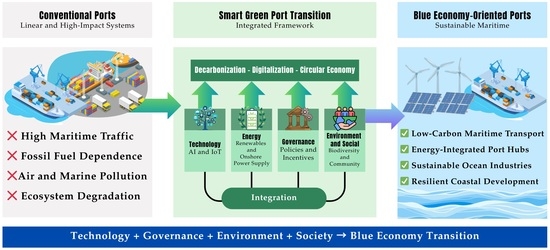
1. Introduction

| Reference (Year) | Focus Area | Key Contribution | Limitation | Gap Addressed in This Study |
|---|---|---|---|---|
| Walker (2016) [9] | Environmental certification programs for ports and maritime transport |
|
| Moving from performance-based environmental certification toward a fully integrated conceptual framework that combines digitalization, governance mechanisms, energy transition, and socio-ecological considerations. |
| Bergqvist & Monios (2019) [7] | Green port concept, environmental sustainability in ports, governance, and operational practices |
|
| Developing an integrated framework that simultaneously links technological innovation, governance mechanisms, environmental sustainability, and social dimensions within a unified transition pathway toward blue economy-oriented port systems |
| Alamoush et al. (2020) [12] | Technical and operational measures for reducing emissions and improving energy efficiency in ports |
|
| Advances the literature by integrating technical measures with governance frameworks, digital transformation, socio-environmental considerations, and blue economy linkages. |
| Liu et al. (2025) [10] | Green innovation in ports |
|
| Advances the literature by extending beyond green innovation toward an integrated smart green port–blue economy nexus, incorporating governance mechanisms, digital transformation, socio-ecological systems, and cross-sectoral maritime linkages |
| Alamoush & Ismail (2025) [14] | Port generation development models and integration of energy transition for decarbonization |
|
| Advances the literature by extending beyond energy transition to incorporate governance frameworks, digital transformation, environmental management, and socio-ecological integration within a blue economy perspective |
| Kurniawan et al. (2026) [11] | Integration of wastewater treatment technologies and governmental policies for marine pollution mitigation within the blue economy |
|
| Advances the literature by extending the analysis toward port-centric transformations, integrating smart technologies, energy transition, governance mechanisms, and socio-ecological considerations. |
| Castro et al. (2026) [13] | Role of Artificial Intelligence (AI) in enabling sustainability, resilience, and system-level transformation in port ecosystems |
|
| Extends beyond a technology-centric and AI-focused perspective by integrating technological, governance, environmental, and socio-economic dimensions within a unified framework of smart green ports transitioning toward blue economy-oriented systems |
| This study | Integrated transition from smart green ports to blue economy-oriented sustainable maritime systems, incorporating technological, governance, environmental, and socio-economic dimensions |
|
| This study addresses the lack of integrated analytical frameworks in existing literature by systematically linking technological innovation, governance mechanisms, environmental management, and socio-economic dimensions within a single transition pathway. It advances current knowledge by explicitly connecting smart green port development to blue economy principles, providing a holistic and policy-relevant understanding of sustainable maritime ecosystems. |
- (RQ1)
- How has the concept of green ports evolved toward integrated blue economy-oriented port systems?
- (RQ2)
- What are the key technological pathways, such as renewable energy integration, alternative fuels, and digitalization, that enable sustainable maritime infrastructure in ports?
- (RQ3)
- How do policy frameworks and governance mechanisms influence the implementation of green and smart port strategies across different regions?
- (RQ4)
- What environmental and social dimensions, including marine pollution mitigation, biodiversity conservation, and community engagement, are addressed in sustainable port development?
- (RQ5)
- What are the major challenges and barriers to achieving low-carbon and resilient port systems, and how can these be addressed through integrated strategies?
- (RQ6)
- How do green port initiatives contribute to broader blue economy objectives, including sustainable ocean resource management and coastal development?
2. Methodology
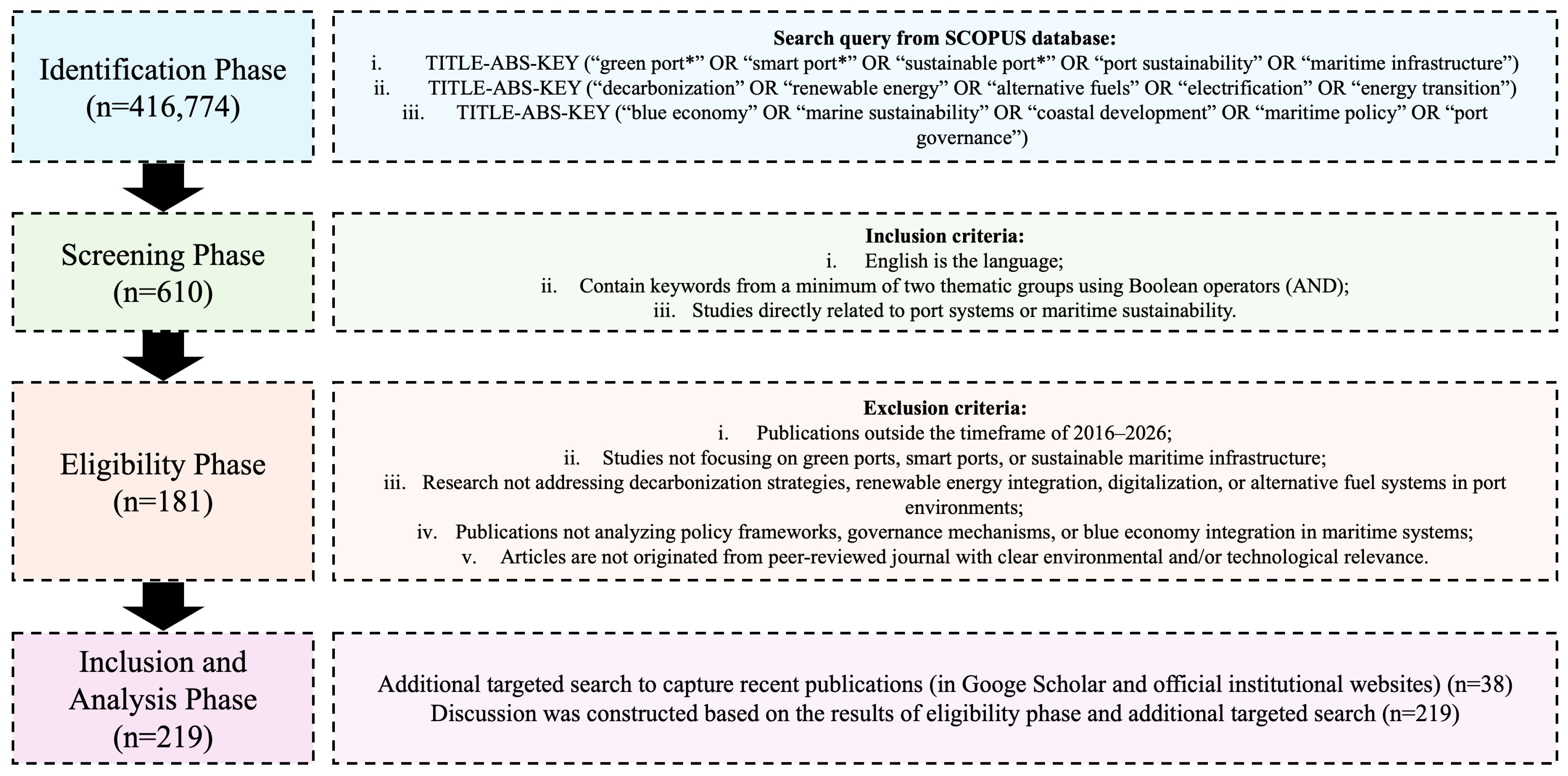
2.1. Literature Search Strategy
- (i)
- TITLE-ABS-KEY (“green port*” OR “smart port*” OR “sustainable port*” OR “port sustainability” OR “maritime infrastructure”);
- (ii)
- TITLE-ABS-KEY (“decarbonization” OR “renewable energy” OR “alternative fuels” OR “electrification” OR “energy transition”);
- (iii)
- TITLE-ABS-KEY (“blue economy” OR “marine sustainability” OR “coastal development” OR “maritime policy” OR “port governance”).
2.2. Screening and Selection of Studies
- (i)
- English language.
- (ii)
- Keywords from a minimum of two thematic groups using Boolean operators (AND).
- (iii)
- Studies directly related to port systems or maritime sustainability.
- (i)
- Publications outside the timeframe of 2016–2026.
- (ii)
- Studies that do not focus on green ports, smart ports, or sustainable maritime infrastructure.
- (iii)
- Research that does not address decarbonization strategies, renewable energy integration, digitalization, or alternative fuel systems in port environments.
- (iv)
- Publications that do not analyze policy frameworks, governance mechanisms, or blue economy integration in maritime systems.
- (v)
- Articles that do not originate from a peer-reviewed journal with clear environmental and/or technological relevance.
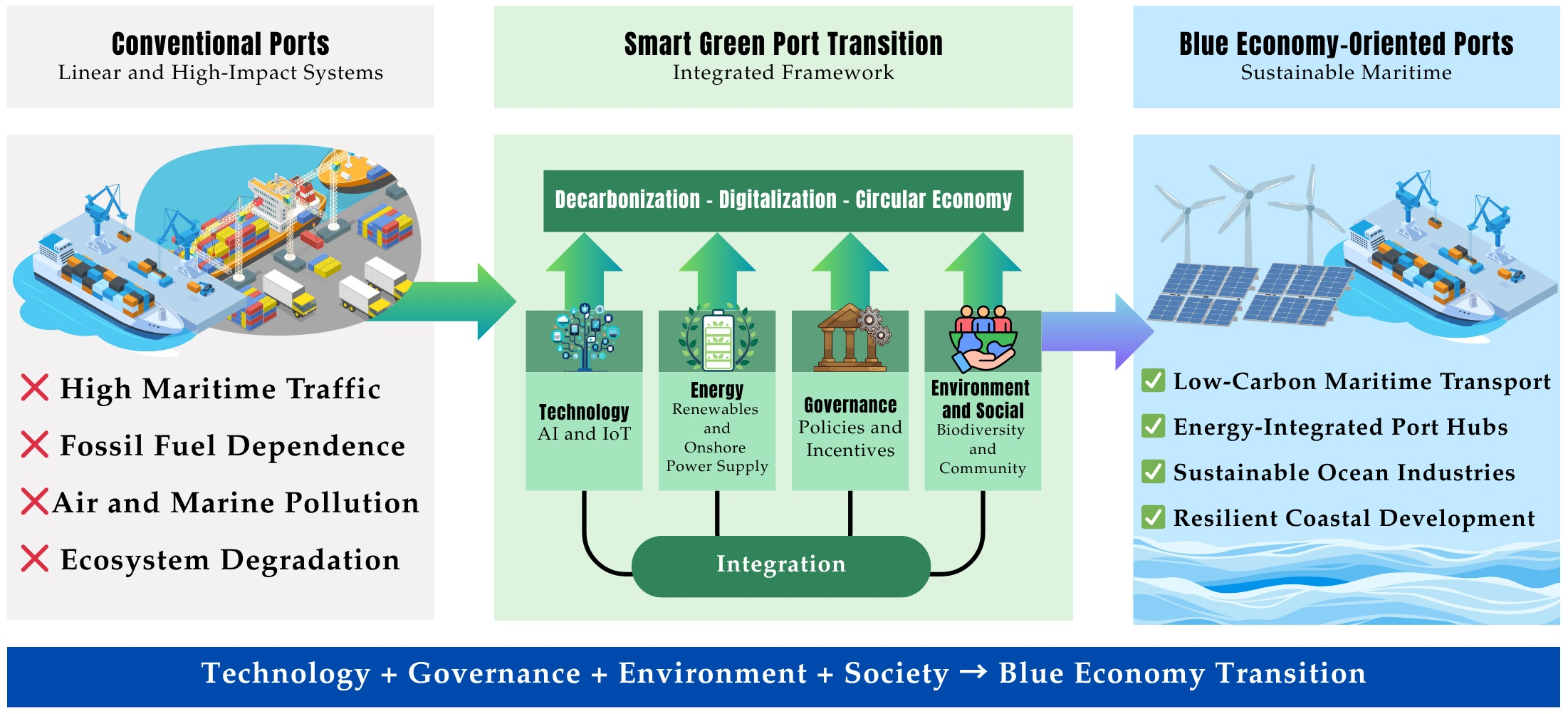
3. Conceptual Framework
3.1. Evolution of the Green Port Concept
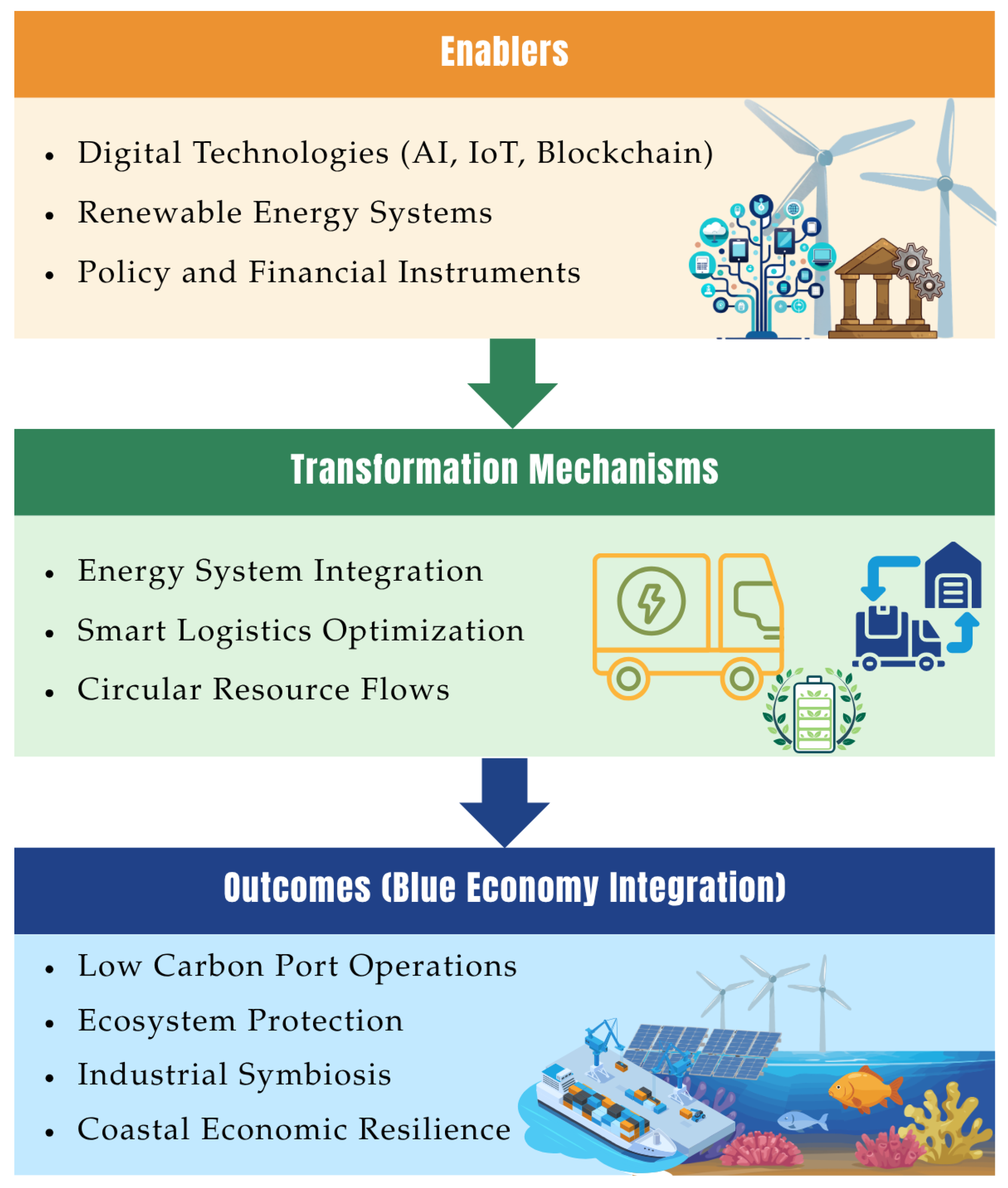
3.2. Green Ports as Enablers of the Blue Economy
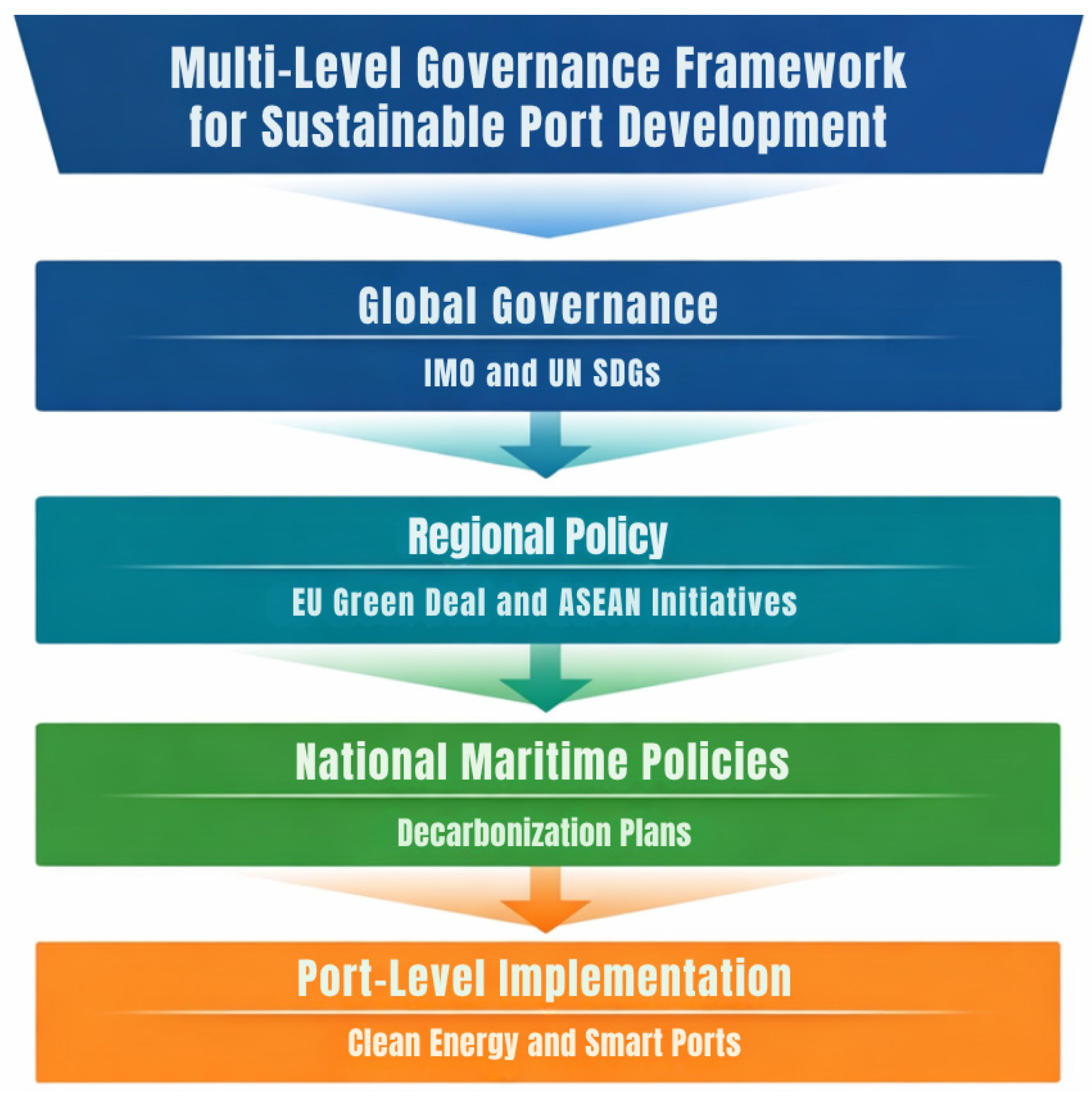
3.3. Smart Port Systems and Multi-Level Governance
4. Sustainable Maritime Infrastructure
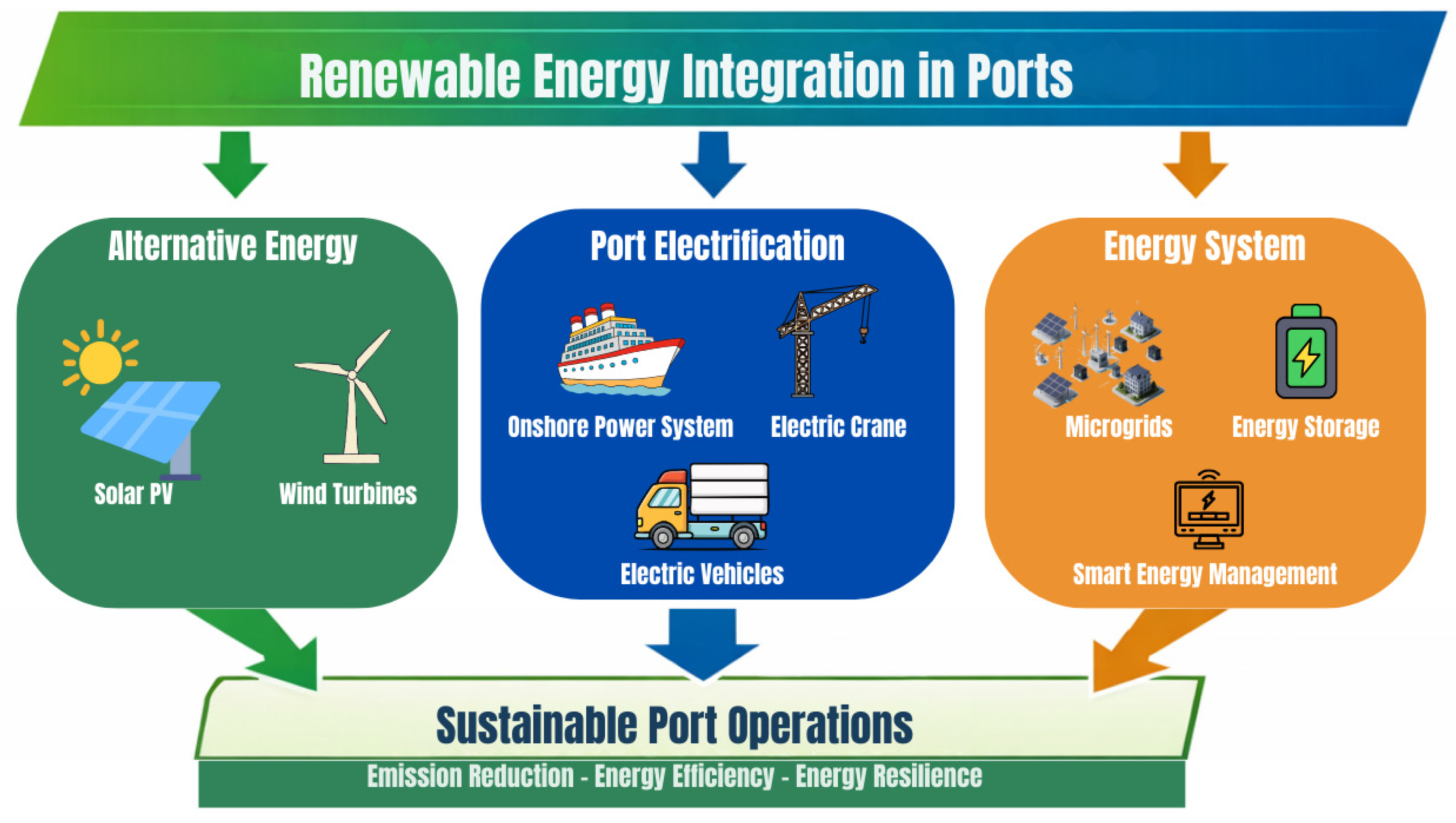
4.1. Renewable Energy Integration
| Renewable Energy Source | Advantages | Energy Potential | Development Challenges | Typical Applications | Ports of Implementation |
|---|---|---|---|---|---|
| Floating Solar Photovoltaic (PV) [85,86,87,88] | Efficient use of water surface, reduced land use, improved panel efficiency due to cooling effect | Very high potential in calm port basins, docks, and sheltered coastal waters | Mooring system design, corrosion, wave and tidal stability, higher initial cost | Floating solar arrays on port basins, hybrid PV–battery systems for port microgrids, power supply for cold storage and reefer containers, charging of electric port equipment | Port of Avilés (Northern Spain), Port of Amsterdam in Netherlands, Port of Barrow in Cumbria, Port de Sète in France, Port of Constanta in Romania |
| Solar Photovoltaic (PV) [89,90,91] | Clean, abundant, low operating cost, easy integration | High potential in tropical and coastal regions with strong solar irradiance | Intermittency, space limitations, efficiency reduction due to salt corrosion | Rooftop solar on terminals and warehouses, port lighting, administrative buildings, auxiliary power | Port of Los Angeles (USA), Port of Long Beach (USA), Port of Valencia in Spain, Ports of Tenerife in Spain, Port of Barcelona in Spain, Port of Rotterdam in Netherlands, Port of North Sea (Belgium and The Netherlands), Port of Solomon Islands, Ports of Fiji, Port of Colombo in Sri Lanka, Port of Marseille in France, Port of Helsinki in Finland, Port of Antwerp in Belgium, Port of Batangas in Philippines, Ports of Associated British (UK), Ports of Auckland in New Zealand, Ports of Stockholm in Sweden, Port of Hamburg in Germany, Singapore’s Jurong Port, Port of Genoa in Italy |
| Tidal Energy [3,92] | Highly predictable, stable output, long-term reliability | Significant potential in narrow straits and areas with strong tidal currents | High capital cost, limited suitable locations, environmental impact concerns | Power supply for remote ports, navigation aids, port microgrids | Ports of Gladstone in Australia |
| Wave Energy [93,94,95] | Large and untapped energy resources, suitable for open seas | Promising for ports exposed to strong wave conditions | Technology is still developing, maintenance challenges, harsh marine environment | Supplementary power for port facilities, offshore port structures | Port of Los Angeles (USA), Port of Tanger-Med (Morocco), Port of Pecém in Ceará, Brazil |
| Wind Energy [3,84,96] | High energy yield, mature technology, suitable for coastal areas | Strong potential in offshore and coastal ports with consistent wind patterns | Visual impact, noise concerns, high initial investment, grid integration | Onshore/offshore wind turbines supplying port electricity, hybrid renewable systems | Port of Gothenburg in Sweden, Port of Rotterdam in Netherlands, Ports of Associated British (UK), Ports of Tenerife in Spain, Port of Helsinki in Finland, Port of Genoa in Italy, The Port of Tianjin in China |
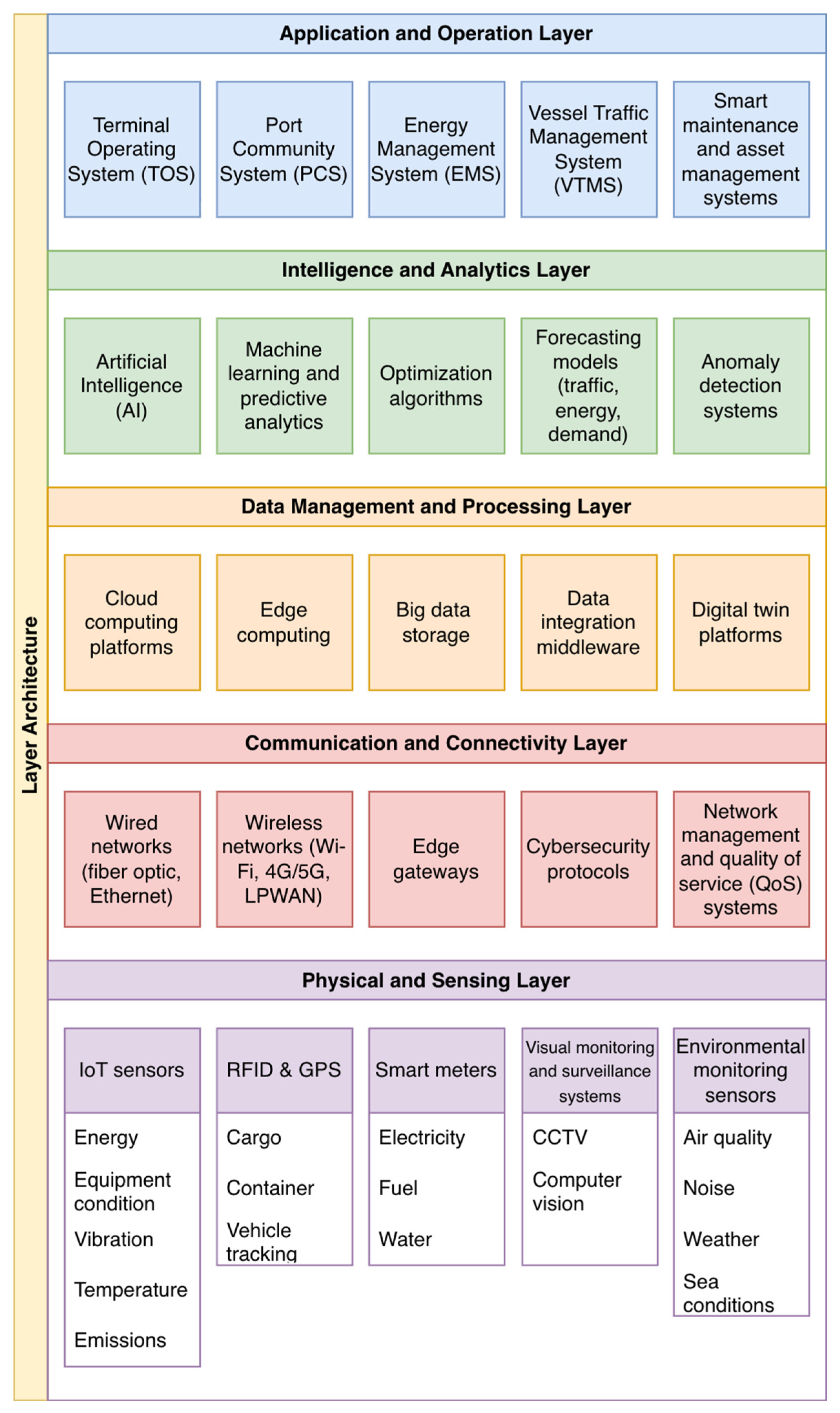
4.2. Smart Port Technologies
4.3. Green Logistics and Supply Chain Optimization
4.4. Infrastructure for Alternative Fuels
5. Environmental and Social Dimensions
5.1. Marine Pollution and Emission Reduction Strategies
5.2. Biodiversity and Ecosystem Protection in Port Regions
5.3. Community Engagement and Social Responsibility
6. Policy and Regulatory Landscape
6.1. International Policy Frameworks
6.2. Regional and National Policy Initiatives
6.3. Economic Incentives and Governance Mechanisms
7. Case Studies of Green Port Initiatives
7.1. Green Port Initiatives in Developed Regions
7.2. Green Port Initiatives in Developing Regions
7.3. Lessons Learned and Best Practices
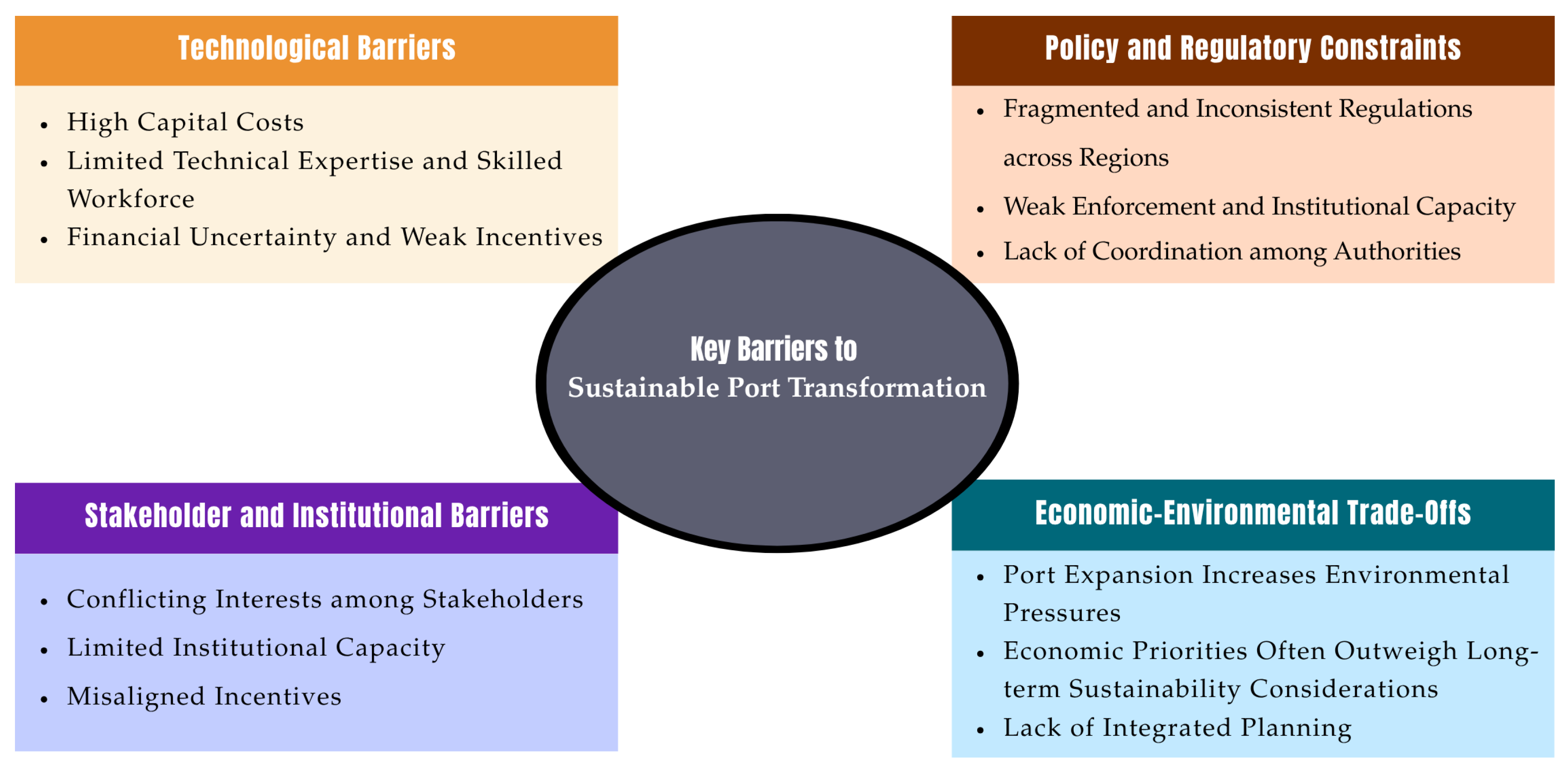
8. Challenges and Barriers
8.1. Technological Gaps and Investment Constraints
8.2. Policy and Regulatory Inconsistencies
8.3. Stakeholder Resistance and Institutional Capacity Limitations
8.4. Trade-Offs Between Economic Growth and Sustainability
9. Opportunities and Future Directions
9.1. Emerging Digital and Energy Technologies
9.2. Circular Economy in Port Ecosystems
9.3. Integration of Ports into Blue Economy Clusters
9.4. Pathways Toward Net-Zero Ports
10. Limitations of the Study
11. Conclusions
Author Contributions
Funding
Institutional Review Board Statement
Informed Consent Statement
Data Availability Statement
Acknowledgments
Conflicts of Interest
References
- Wan, C.; Zhao, Y.; Zhang, D.; Yip, T.L. Identifying Important Ports in Maritime Container Shipping Networks along the Maritime Silk Road. Ocean Coast. Manag. 2021, 211, 105738. [Google Scholar] [CrossRef]
- Damman, S.; Steen, M. A Socio-Technical Perspective on the Scope for Ports to Enable Energy Transition. Transp. Res. Part D Transp. Environ. 2021, 91, 102691. [Google Scholar] [CrossRef]
- Zhang, Q.; Hu, X.; Li, Z.; Zhou, Y.; Qi, X. Port’s Industry Ecosystem Construction: Empirical Evidence from China. Transp. Policy 2025, 163, 42–60. [Google Scholar] [CrossRef]
- Guo, F.; Feng, L.; Sun, W.; Lu, Q. Sea Trade and Growth: A Comprehensive Analysis of Zanzibar’s Impact on Mombasa’s People and Environment. Reg. Stud. Mar. Sci. 2026, 96, 104876. [Google Scholar] [CrossRef]
- Imron, M.F.; Ananta, A.R.; Ramadhani, I.S.; Kurniawan, S.B.; Abdullah, S.R.S. Potential of Lemna Minor for Removal of Methylene Blue in Aqueous Solution: Kinetics, Adsorption Mechanism, and Degradation Pathway. Environ. Technol. Innov. 2021, 24, 101921. [Google Scholar] [CrossRef]
- Permatasari, A.A.A.P.; Rosiana, I.W.; Wiradana, P.A.; Lestari, M.D.; Widiastuti, N.K.; Kurniawan, S.B.; Widhiantara, I.G. Extraction and Characterization of Sodium Alginate from Three Brown Algae Collected from Sanur Coastal Waters, Bali as Biopolymer Agent. Biodiversitas 2022, 23, 1655–1663. [Google Scholar] [CrossRef]
- Bergqvist, R.; Monios, J. Green Ports in Theory and Practice. In Green Ports; Elsevier: Oxford, UK, 2019; pp. 1–17. [Google Scholar]
- Hua, C.; Chen, J.; Wan, Z.; Xu, L.; Bai, Y.; Zheng, T.; Fei, Y. Evaluation and Governance of Green Development Practice of Port: A Sea Port Case of China. J. Clean. Prod. 2020, 249, 119434. [Google Scholar] [CrossRef]
- Walker, T.R. Green Marine: An Environmental Program to Establish Sustainability in Marine Transportation. Mar. Pollut. Bull. 2016, 105, 199–207. [Google Scholar] [CrossRef] [PubMed]
- Liu, Y.; Chao, Y.; Xie, S.; Wang, G.; Wang, L.; Xue, C. Green Innovation in Ports: Drivers, Domains, and Challenges. Front. Mar. Sci. 2025, 12, 1664611. [Google Scholar] [CrossRef]
- Kurniawan, S.B.; Roziqin, A.; Ahmad, A.; Ahmad, M.M.; Alfanda, B.D.; Pambudi, D.S.A.; Said, N.S.M.; Abdul, P.M.; Imron, M.F. Tackling Marine Pollution in the Blue Economy: Synergies between Wastewater Treatment Technologies and Governmental Policies. Mar. Pollut. Bull. 2026, 222, 118627. [Google Scholar] [CrossRef]
- Alamoush, A.S.; Ballini, F.; Ölçer, A.I. Ports’ Technical and Operational Measures to Reduce Greenhouse Gas Emission and Improve Energy Efficiency: A Review. Mar. Pollut. Bull. 2020, 160, 111508. [Google Scholar] [CrossRef]
- Castro, M.; Sabino, M.R.; Cabrita, M.d.R.; Mendes, A.; Pinho, T. From Smart Ports to Sustainable Port Ecosystems: The Transformative Role of Artificial Intelligence. Systems 2026, 14, 187. [Google Scholar] [CrossRef]
- Alamoush, A.S.; Ismail, A.M. Review of Port Generations Development Models: Addressing the Energy Transition Gap. Next Sustain. 2025, 6, 100186. [Google Scholar] [CrossRef]
- Elhussieny, M. Smart Green Ports: A Sustainable Solution for the Maritime Industry in a Changing Climate. Multidiscip. Adapt. Clim. 2025, 2, 1. [Google Scholar] [CrossRef]
- Li, K.X.; Li, M.; Zhu, Y.; Yuen, K.F.; Tong, H.; Zhou, H. Smart Port: A Bibliometric Review and Future Research Directions. Transp. Res. Part E Logist. Transp. Rev. 2023, 174, 103098. [Google Scholar] [CrossRef]
- Nie, J.; Shen, J.; Chen, Y. The Effect of New Quality Productivity on Port Sustainability: Evidence from China. J. Sea Res. 2025, 204, 102575. [Google Scholar] [CrossRef]
- Le, S.T.; Nguyen, T.H. The Development of Green Ports in Emerging Nations: A Case Study of Vietnam. Sustainability 2023, 15, 13502. [Google Scholar] [CrossRef]
- Winkel, R.; Weddige, U.; Johnsen, D.; Hoen, V.; Papaefthimiou, S. Shore Side Electricity in Europe: Potential and Environmental Benefits. Energy Policy 2016, 88, 584–593. [Google Scholar] [CrossRef]
- Hossain, T.; Adams, M.; Walker, T.R. Role of Sustainability in Global Seaports. Ocean Coast. Manag. 2021, 202, 105435. [Google Scholar] [CrossRef]
- Kurniawan, S.B.; Ahmad, A.; Imron, M.F.; Abdullah, S.R.S.; Othman, A.R.; Hasan, H.A. Achieving a Biocircular Economy in the Aquaculture Sector Through Waste Valorization. Toxics 2025, 13, 131. [Google Scholar] [CrossRef]
- Uusikartano, J.; Saha, P.; Aarikka-Stenroos, L. The Industrial Symbiosis Process as an Interplay of Public and Private Agency: Comparing Two Cases. J. Clean. Prod. 2022, 344, 130996. [Google Scholar] [CrossRef]
- Abu Hasan, H.; Muhamad, M.H.; Budi Kurniawan, S.; Buhari, J.; Husain Abuzeyad, O. Managing Bisphenol A Contamination: Advances in Removal Technologies and Future Prospects. Water 2023, 15, 3573. [Google Scholar] [CrossRef]
- de Souza, R.G.; Quelhas, O.L.G. Model Proposal for Diagnosis and Integration of Industry 4.0 Concepts in Production Engineering Courses. Sustainability 2020, 12, 3471. [Google Scholar] [CrossRef]
- Roy, M.; Akbar, D. The Blue Nexus Unveiled: Interlinking Marine Pollution, Circular Economy, and the Blue Economy in Ocean Sustainability. Mar. Pollut. Bull. 2026, 223, 119028. [Google Scholar] [CrossRef] [PubMed]
- Karuppiah, K.; Garza-Reyes, J.A.; Virmani, N. Pathways to a Sustainable Blue Economy: Exploring Its Barriers in an Emerging Economy. Bus. Strateg. Environ. 2025, 34, 6095–6110. [Google Scholar] [CrossRef]
- Attanasio, G.; Battistella, C.; Chizzolini, E. How Do Seaports Use Foresight to Face Environmental Sustainability Disruptions? Transp. Res. Interdiscip. Perspect. 2024, 25, 101095. [Google Scholar] [CrossRef]
- Gourvenec, S.; Dbouk, W.; Sturt, F.; Teagle, D.A.H. Pathways to a Blue Economy. Curr. Opin. Environ. Sustain. 2025, 77, 101570. [Google Scholar] [CrossRef]
- Kurniawan, S.B.; Abdullah, S.R.S.; Imron, M.F.; Ismail, N.‘I. Current State of Marine Plastic Pollution and Its Technology for More Eminent Evidence: A Review. J. Clean. Prod. 2021, 278, 123537. [Google Scholar] [CrossRef]
- Kurniawan, S.B.; Ahmad, A.; Rahim, N.F.M.; Said, N.S.M.; Alnawajha, M.M.; Imron, M.F.; Abdullah, S.R.S.; Othman, A.R.; Ismail, I.; Hasan, H.A. Aquaculture in Malaysia: Water-Related Environmental Challenges and Opportunities for Cleaner Production. Environ. Technol. Innov. 2021, 24, 101913. [Google Scholar] [CrossRef]
- Kurniawan, S.B.; Pambudi, D.S.A.; Ahmad, M.M.; Alfanda, B.D.; Imron, M.F.; Abdullah, S.R.S. Ecological Impacts of Ballast Water Loading and Discharge: Insight into the Toxicity and Accumulation of Disinfection by-Products. Heliyon 2022, 8, e09107. [Google Scholar] [CrossRef]
- Kurniawan, S.B.; Imron, M.F.; Roziqin, A.; Pambudi, D.S.A.; Alfanda, B.D.; Ahmad, M.M.; Khoirunnisa, F.; Mahmudah, R.A.; Barakwan, R.A.; Jusoh, H.H.W.; et al. Cases of Oil Spills in the Indonesian Coastal Area: Ecological Impacts, Health Risk Assessment, and Mitigation Strategies. Reg. Stud. Mar. Sci. 2024, 79, 103835. [Google Scholar] [CrossRef]
- Wang, L.; Li, Y. Estimation Methods and Reduction Strategies of Port Carbon Emissions—What Literatures Say? Mar. Pollut. Bull. 2023, 195, 115451. [Google Scholar] [CrossRef]
- Klinger, D.H.; Maria Eikeset, A.; Davíðsdóttir, B.; Winter, A.M.; Watson, J.R. The Mechanics of Blue Growth: Management of Oceanic Natural Resource Use with Multiple, Interacting Sectors. Mar. Policy 2018, 87, 356–362. [Google Scholar] [CrossRef]
- Rotter, A.; Giannakourou, A.; Argente García, J.E.; Quero, G.M.; Auregan, C.; Triantaphyllidis, G.; Venetsanopoulou, A.; De Carolis, R.; Efstratiou, C.; Aboal, M.; et al. Identification of Marine Biotechnology Value Chains with High Potential in the Northern Mediterranean Region. Mar. Drugs 2023, 21, 416. [Google Scholar] [CrossRef] [PubMed]
- Buonomano, A.; Giuzio, G.F.; Maka, R.; Palombo, A.; Russo, G. Empowering Sea Ports with Renewable Energy under the Enabling Framework of the Energy Communities. Energy Convers. Manag. 2024, 314, 118693. [Google Scholar] [CrossRef]
- González-Cancelas, N.; Guil López, J.J.; Vaca-Cabrero, J.; Camarero-Orive, A. Toward Smart and Sustainable Port Operations: A Blue Ocean Strategy Approach for the Spanish Port System. J. Mar. Sci. Eng. 2025, 13, 872. [Google Scholar] [CrossRef]
- Jaganathan, J.S.; Abdullah, S.R.S.; Sanusi, S.N.A.; Ramli, N.N.; Alias, J.; Subramaniam, S.V.; Daud, N.M.; Buslima, F.A.; Said, N.S.M.; Buhari, J.; et al. Machine Learning and Explainable Artificial Intelligence in Coagulation–Flocculation: A Contemporary Review. J. Environ. Chem. Eng. 2025, 13, 119664. [Google Scholar] [CrossRef]
- Healy, S.; Wissner, N. Raising Ambition Levels at the IMO for 2050. In An Overview of the Key Issues at Stake at MEPC 80; European Parliamentary Research Service: Brussels, Belgium, 2023; Volume 80. [Google Scholar]
- Monios, J.; Wilmsmeier, G. Maritime Governance after COVID-19: How Responses to Market Developments and Environmental Challenges Lead towards Degrowth. Marit. Econ. Logist. 2022, 24, 699–722. [Google Scholar] [CrossRef]
- UNIDO. Blue Ports: Gateways to Sustainable Industrial and Inclusive Development; UNIDO: Vienna, Austria, 2025.
- Diniz, N.V.; Cunha, D.R.; de Santana Porte, M.; Oliveira, C.B.M.; de Freitas Fernandes, F. A Bibliometric Analysis of Sustainable Development Goals in the Maritime Industry and Port Sector. Reg. Stud. Mar. Sci. 2024, 69, 103319. [Google Scholar] [CrossRef]
- Virto, L.R.; Dumez, H.; Romero, C.; Bailly, D. How Can Ports Act to Reduce Underwater Noise from Shipping? Identifying Effective Management Frameworks. Mar. Pollut. Bull. 2022, 174, 113136. [Google Scholar] [CrossRef]
- George, A.; Kamath, A.C.; Somarajan, J. Green Ports and Sustainable Logistics Operations. Int. J. Sci. Res. Sci. Technol. 2025, 12, 204–216. [Google Scholar]
- UNIDO. The Blue Agenda in Indonesia to Accelerate Sustainable Ocean Development. Available online: https://www.unido.org/news/blue-agenda-indonesia-accelerate-sustainable-ocean-development (accessed on 6 March 2026).
- Bennett, N.J.; Blythe, J.; White, C.S.; Campero, C. Blue Growth and Blue Justice: Ten Risks and Solutions for the Ocean Economy. Mar. Policy 2021, 125, 104387. [Google Scholar] [CrossRef]
- van Geet, M.T.; Lenferink, S.; Arts, J.; Leendertse, W. Understanding the Ongoing Struggle for Land Use and Transport Integration: Institutional Incongruence in the Dutch National Planning Process. Transp. Policy 2019, 73, 84–100. [Google Scholar] [CrossRef]
- Alamoush, A.S.; Ölçer, A.I.; Ballini, F. Ports’ Role in Shipping Decarbonisation: A Common Port Incentive Scheme for Shipping Greenhouse Gas Emissions Reduction. Clean. Logist. Supply Chain 2022, 3, 100021. [Google Scholar] [CrossRef]
- Densberger, N.L.; Bachkar, K. Towards Accelerating the Adoption of Zero Emissions Cargo Handling Technologies in California Ports: Lessons Learned from the Case of the Ports of Los Angeles and Long Beach. J. Clean. Prod. 2022, 347, 131255. [Google Scholar] [CrossRef]
- Nguyen, H.P.; Nguyen, P.Q.P.; Nguyen, T.P. Green Port Strategies in Developed Coastal Countries as Useful Lessons for the Path of Sustainable Development: A Case Study in Vietnam. Int. J. Renew. Energy Dev. 2022, 11, 950–962. [Google Scholar] [CrossRef]
- Ducruet, C.; Notteboom, T.; Slack, B. Port Migration Patterns in the Global Port System since the 1950s. In Port Systems in Global Competition; Routledge: London, UK, 2023; pp. 122–146. [Google Scholar]
- Urban, F.; Nurdiawati, A.; Harahap, F.; Morozovska, K. Decarbonizing Maritime Shipping and Aviation: Disruption, Regime Resistance and Breaking through Carbon Lock-in and Path Dependency in Hard-to-Abate Transport Sectors. Environ. Innov. Soc. Transitions 2024, 52, 100854. [Google Scholar] [CrossRef]
- Entsalo, H.; Kalimo, H.; Kautto, P.; Turunen, T. Analysing Regulatory Instruments in Sustainability Transitions: A Combined ‘Intervention Points’ and ‘Roles of Law’ Approach to the European Union’s Ecodesign Framework. Sustain. Prod. Consum. 2023, 42, 125–137. [Google Scholar] [CrossRef]
- Kurt, I.; Aymelek, M. Operational Adaptation of Ports with Maritime Autonomous Surface Ships. Transp. Policy 2024, 145, 1–10. [Google Scholar] [CrossRef]
- Qin, Y.; Lu, B. The Impact of Internal and External Network Collaboration on Port Node Resilience. Reliab. Eng. Syst. Saf. 2026, 266, 111624. [Google Scholar] [CrossRef]
- Micallef, A.; Apap, M.; Licari, J.; Spiteri Staines, C.; Xiao, Z. Renewable Energy Systems in Offshore Platforms for Sustainable Maritime Operations. Ocean Eng. 2025, 319, 120209. [Google Scholar] [CrossRef]
- Sardar, A.; Islam, R.; Anantharaman, M.; Garaniya, V. Advancements and Obstacles in Improving the Energy Efficiency of Maritime Vessels: A Systematic Review. Mar. Pollut. Bull. 2025, 214, 117688. [Google Scholar] [CrossRef]
- Halpe, P.; Adams, M.; Walker, T.R. Challenges and Opportunities for Ports in Achieving Net-Zero Emissions in Maritime Transport. Transp. Res. Interdiscip. Perspect. 2025, 30, 101379. [Google Scholar] [CrossRef]
- Moros-Daza, A.; Moros-Marcillo, A.; Pacheco-Bustos, C.A. Greening Seaports: Evaluating Impacts and Policies for Renewable Energy Systems. Renew. Sustain. Energy Rev. 2025, 213, 115475. [Google Scholar] [CrossRef]
- Li, K.; Gharehgozli, A.; Lee, J.-Y.Y. Smart Technologies and Port Operations: Optimal Adoption Strategy with Network Externality Consideration. Comput. Ind. Eng. 2023, 184, 109557. [Google Scholar] [CrossRef]
- Zhang, W.; Wang, J.; Qin, G.; Kuntal, S.; Gong, F.; Yan, R. Review of the State-of-the-Art of Alternative Marine Fuels: A Viable Approach to Zero-Carbon Shipping. Clean. Logist. Supply Chain 2025, 16, 100232. [Google Scholar] [CrossRef]
- Alamoush, A.S.; Ölçer, A.I.; Ballini, F. Port Greenhouse Gas Emission Reduction: Port and Public Authorities’ Implementation Schemes. Res. Transp. Bus. Manag. 2022, 43, 100708. [Google Scholar] [CrossRef]
- Li, L.; Zhong, M.; Ma, X.; Zhao, H.; Safdar, M.; Chuwang, D.D.; Zhang, Z. Optimal Planning of Renewable Energy Infrastructure for Ports under Multiple Design Scenarios Considering System Constraints and Growing Transport Demand. J. Clean. Prod. 2024, 477, 143827. [Google Scholar] [CrossRef]
- Parhamfar, M.; Sadeghkhani, I.; Adeli, A.M. Towards the Application of Renewable Energy Technologies in Green Ports: Technical and Economic Perspectives. IET Renew. Power Gener. 2023, 17, 3120–3132. [Google Scholar] [CrossRef]
- Raihan, A. Synergistic Integration of Digital Twins and Artificial Intelligence for Sustainable Energy and Environmental Systems: A Comprehensive Review. Sustain. Cities Soc. Adv. 2026, 2, 100024. [Google Scholar] [CrossRef]
- Elkafas, A.G.; Seddiek, I.S. Application of Renewable Energy Systems in Seaports towards Sustainability and Decarbonization: Energy, Environmental and Economic Assessment. Renew. Energy 2024, 228, 120690. [Google Scholar] [CrossRef]
- Hasnat, M. Al Technological Innovation in Renewable Energy for Green Ports Aimed at Promoting Sustainable Development and Effective Environmental Management. Environ. Innov. Manag. 2025, 1, 2530001. [Google Scholar] [CrossRef]
- Issa, M.; Rizk, P.; Boulon, L.; Rezkallah, M.; Rizk, R.; Ilinca, A. Smart, Connected, and Sustainable: The Transformation of Maritime Ports Through Electrification, IoT, 5G, and Green Energy. Sustainability 2025, 17, 7568. [Google Scholar] [CrossRef]
- Gutierrez-Romero, J.E.; Esteve-Pérez, J.; Zamora, B. Implementing Onshore Power Supply from Renewable Energy Sources for Requirements of Ships at Berth. Appl. Energy 2019, 255, 113883. [Google Scholar] [CrossRef]
- Abu Bakar, N.N.; Bazmohammadi, N.; Vasquez, J.C.; Guerrero, J.M. Electrification of Onshore Power Systems in Maritime Transportation towards Decarbonization of Ports: A Review of the Cold Ironing Technology. Renew. Sustain. Energy Rev. 2023, 178, 113243. [Google Scholar] [CrossRef]
- Karimi, S.; Zadeh, M.; Suul, J.A. Shore Charging for Plug-In Battery-Powered Ships: Power System Architecture, Infrastructure, and Control. IEEE Electrif. Mag. 2020, 8, 47–61. [Google Scholar] [CrossRef]
- Saeedi, S.; Aghamohammadloo, H.; Haakana, J.; Lassila, J. Future Energy Management of Port Microgrids Considering Dual Fuel Engines and On-Shore Power Supply. Energy Convers. Manag. 2026, 352, 121053. [Google Scholar] [CrossRef]
- Arun, M.; Samal, S.; Barik, D.; Chandran, S.S.R.; Tudu, K.; Praveenkumar, S. Integration of Energy Storage Systems and Grid Modernization for Reliable Urban Power Management toward Future Energy Sustainability. J. Energy Storage 2025, 114, 115830. [Google Scholar] [CrossRef]
- Sifakis, N.; Konidakis, S.; Tsoutsos, T. Hybrid Renewable Energy System Optimum Design and Smart Dispatch for Nearly Zero Energy Ports. J. Clean. Prod. 2021, 310, 127397. [Google Scholar] [CrossRef]
- Odoi-Yorke, F.; Owusu, J.J.; Atepor, L. Composite Decision-Making Algorithms for Optimisation of Hybrid Renewable Energy Systems: Port of Takoradi as a Case Study. Energy Rep. 2022, 8, 2131–2150. [Google Scholar] [CrossRef]
- Buonomano, A.; Del Papa, G.; Giuzio, G.F.; Palombo, A.; Russo, G. Future Pathways for Decarbonization and Energy Efficiency of Ports: Modelling and Optimization as Sustainable Energy Hubs. J. Clean. Prod. 2023, 420, 138389. [Google Scholar] [CrossRef]
- Chen, S.; Zeng, Q.; Li, Y. Integrated Operations Planning in Highly Electrified Container Terminals Considering Time-of-Use Tariffs. Transp. Res. Part E Logist. Transp. Rev. 2023, 171, 103034. [Google Scholar] [CrossRef]
- Carrillo-Galvez, A.; Carmo, F.D.; Soares, T.; Mourão, Z.; Ponomarev, I.; Araújo, J.; Bandeira, E. Electricity Demand Forecasting in Green Ports: Modelling and Future Research Directions. Transp. Policy 2025, 171, 1012–1024. [Google Scholar] [CrossRef]
- Alwaeli, M.F.; Galvani, S.; Talavat, V. Addressing Power Quality Challenges in Hybrid Renewable Energy Systems through STATCOM Devices and Advanced Gray Wolf Optimization Technique. Results Eng. 2025, 25, 104405. [Google Scholar] [CrossRef]
- Kalaiselvan, P.; Devi, N.C.; Deepti, M.; Devi, A.A.; Akamad, K.; Dheeran, P.; Debbarma, S.; Vadivel, D.; Rajesh, D. Solid-State Fermentation—A Sustainable Future Technology in Aquafeeds? Front. Mar. Sci. 2025, 12, 1669719. [Google Scholar] [CrossRef]
- Zhang, Z.; Song, C.; Zhang, J.; Chen, Z.; Liu, M.; Aziz, F.; Kurniawan, T.A.; Yap, P.-S. Digitalization and Innovation in Green Ports: A Review of Current Issues, Contributions and the Way Forward in Promoting Sustainable Ports and Maritime Logistics. Sci. Total Environ. 2024, 912, 169075. [Google Scholar] [CrossRef] [PubMed]
- Hu, W.; Shi, J.; Pang, C.; Chen, J.; Wan, Z.; Wang, Z. Assessment and Optimization of Shipping Network Resilience in the Maritime Silk Road Regions. J. Transp. Geogr. 2026, 130, 104454. [Google Scholar] [CrossRef]
- Gabrielii, C.; Gammelsæter, M.; Mehammer, E.B.; Damman, S.; Kauko, H.; Rydså, L. Energy Systems Integration and Sector Coupling in Future Ports: A Qualitative Study of Norwegian Ports. Appl. Energy 2025, 380, 125003. [Google Scholar] [CrossRef]
- Montuori, L.; Alcázar-Ortega, M.; Díaz-Bello, D.; Vargas-Salgado, C. Towards the Decarbonization of the Maritime Industry: Design of a Novel Methodology for the Sustainable Strategy Assessment. Sustain. Energy Technol. Assess. 2025, 83, 104632. [Google Scholar] [CrossRef]
- Forester, E.; Levin, M.O.; Thorne, J.H.; Armstrong, A.; Pasquale, G.; Vincenza Di Blasi, M.L.; Scott, T.A.; Hernandez, R.R. Siting Considerations for Floating Solar Photovoltaic Energy: A Systematic Review. Renew. Sustain. Energy Rev. 2025, 211, 115360. [Google Scholar] [CrossRef]
- Goswami, A.; Sadhu, P.K. Degradation Analysis and the Impacts on Feasibility Study of Floating Solar Photovoltaic Systems. Sustain. Energy Grids Netw. 2021, 26, 100425. [Google Scholar] [CrossRef]
- Koondhar, M.A.; Albasha, L.; Mahariq, I.; Graba, B.B.; Touti, E. Reviewing Floating Photovoltaic (FPV) Technology for Solar Energy Generation. Energy Strateg. Rev. 2024, 54, 101449. [Google Scholar] [CrossRef]
- Micheli, L.; Talavera, D.L. Economic Feasibility of Floating Photovoltaic Power Plants: Profitability and Competitiveness. Renew. Energy 2023, 211, 607–616. [Google Scholar] [CrossRef]
- Heinrichs, H.U.; Weinand, J.M.; Kebrich, S.; Gómez Trillos, J.C.; Chen, S.; Hoffmann, M.; Tsani, T.; Chen, R.; Hu, W.; Schmidt, J.; et al. Large-Scale Resource Assessments for Solar Photovoltaics: A Review of Potential Definitions, Methodologies and Future Research Needs. Renew. Energy 2026, 261, 125080. [Google Scholar] [CrossRef]
- Kasaeian, A.; Zarkhah, N.; Akhond Dezfouli, P.; Samankan, S.; Yan, W.M. A Review of the Applications of Solar Photovoltaic in Marine Vessels and Ships. Appl. Energy 2025, 396, 126178. [Google Scholar] [CrossRef]
- Quansah, A.D.; Boakye, P.; Mensah, L.D.; Quansah, D.A. Systematic Literature Review on the Potential of Using Solar Photovoltaic to Power Sea Water Desalination on Offshore Petroleum Facilities. Energy Rep. 2024, 12, 3843–3860. [Google Scholar] [CrossRef]
- Khare, V.; Bhuiyan, M.A. Tidal Energy-Path towards Sustainable Energy: A Technical Review. Clean. Energy Syst. 2022, 3, 100041. [Google Scholar] [CrossRef]
- Babarit, A. Ocean Wave Energy Conversion: Resource, Technologies and Performance; Elsevier: Oxford, UK, 2017; pp. 1–262. [Google Scholar]
- Giorgi, G. How to Generate Electricity from Waves-Principles of Wave Energy Converters. In Encyclopedia of Renewable Energy, Sustainability and the Environment; Elsevier: Amsterdam, The Netherlands, 2024; Volume 3, pp. 17–26. ISBN 9780323939416. [Google Scholar]
- Huang, L.; Yang, J.; Hu, M. Wave Prediction and Predictive Control Approach for Efficiency Optimization in Wave Energy Conversion Systems: A Review. Electr. Power Syst. Res. 2026, 254, 112613. [Google Scholar] [CrossRef]
- Torrielli, A.; Giusti, A. Seismic Response of Towers of Offshore Wind Turbines on Sliding Foundations at the Port Quayside. Renew. Energy 2026, 256, 123887. [Google Scholar] [CrossRef]
- Tsvetkova, A.; Wahlström, I.; Edelman, K.; Franzén, R.; Chen Zhou, Y.; Hellström, M. Smart Port City: Digital Interfaces for Enhancing RoPax Port and City Co-Existence. Cities 2025, 161, 105936. [Google Scholar] [CrossRef]
- Belmoukari, B.; Audy, J.F.; Forget, P. Smart Port: A Systematic Literature Review. Eur. Transp. Res. Rev. 2023, 15, 4. [Google Scholar] [CrossRef]
- Behdani, B. Port 4.0: A Conceptual Model for Smart Port Digitalization. Transp. Res. Procedia 2023, 74, 346–353. [Google Scholar] [CrossRef]
- Karaś, A. Smart Port as a Key to the Future Development of Modern Ports. TransNav 2020, 14, 27–31. [Google Scholar] [CrossRef]
- Li, K.; Wang, L.; Gharehgozli, A.; Joo, S.J.; Lee, J.Y. Optimal Quality Design of Smart Technologies for Port Digitalization: A Game Theoretical Approach under Digitalization Synergy. Transp. Res. Part E Logist. Transp. Rev. 2025, 204, 104459. [Google Scholar] [CrossRef]
- Kosek, W.; Chamier-Gliszczynski, N.; Królikowski, T. Smart Ports in Poland: The Digital Transformation of Maritime Logistics on the Example of the Ports of Gdańsk, Gdynia, and Szczecin-Swinoujście. Procedia Comput. Sci. 2025, 270, 5318–5328. [Google Scholar] [CrossRef]
- Leng, S.; Wang, Y.; Zhou, Y.; Feng, X.; Lee, P.T.W.; Bai, R. The Growing Role of Artificial Intelligence in Smart Container Ports: Its Application and Future Research Directions. J. Int. Logist. Trade 2026, 1–35. [Google Scholar] [CrossRef]
- Rajabi, A.; Khodadad Saryazdi, A.; Belfkih, A.; Duvallet, C. Towards Smart Port: An Application of AIS Data. In Proceedings of the 20th International Conference on High Performance Computing and Communications, 16th International Conference on Smart City and 4th International Conference on Data Science and Systems, Exeter, UK, 28–30 June 2018. [Google Scholar]
- Teixeira, P.; Lopes, R.B.; Teixeira, L. The Integration of Artificial Intelligence in Seaports’ Smart Gate Processes: Evidence Based on a Systematic Literature Review. Results Eng. 2026, 29, 108919. [Google Scholar] [CrossRef]
- Chen, H.; Wen, Y.; Huang, Y.; Xiao, C.; Sui, Z. Edge Computing Enabling Internet of Ships: A Survey on Architectures, Emerging Applications, and Challenges. IEEE Internet Things J. 2025, 12, 1509–1528. [Google Scholar] [CrossRef]
- Sanchez-Gonzalez, P.L.; Díaz-Gutiérrez, D.; Leo, T.J.; Núñez-Rivas, L.R. Toward Digitalization of Maritime Transport? Sensors 2019, 19, 926. [Google Scholar] [CrossRef]
- El Mekkaoui, S.; Benabbou, L.; Berrado, A. Machine Learning Models for Efficient Port Terminal Operations: Case of Vessels’ Arrival Times Prediction. IFAC-PapersOnLine 2022, 55, 3172–3177. [Google Scholar] [CrossRef]
- Idrissi, A.E.; Haidine, A.; Aqqal, A.; Dahbi, A. Deployment Strategies of Mobile Networks for Internet-of-Things in Smart Maritime Ports. In Proceedings of the 11th International Symposium on Signal, Image, Video and Communications, ISIVC 2022—Conference Proceedings, El Jadida, Morocco, 18–20 May 2022. [Google Scholar]
- Paulauskas, V.; Filina-dawidowicz, L.; Paulauskas, D. Ports Digitalization Level Evaluation. Sensors 2021, 21, 6134. [Google Scholar] [CrossRef] [PubMed]
- Zhu, J.; Ma, F. Scheduling of Twin Automatic Stacking Cranes and Automated Guided Vehicle Considering Buffer Mode on Automated Container Terminal. Comput. Ind. Eng. 2024, 193, 110271. [Google Scholar] [CrossRef]
- Xing, Z.; Liu, H.; Wang, T.; Chew, E.P.; Lee, L.H.; Tan, K.C. Integrated Automated Guided Vehicle Dispatching and Equipment Scheduling with Speed Optimization. Transp. Res. Part E Logist. Transp. Rev. 2023, 169, 102993. [Google Scholar] [CrossRef]
- Hervás-Peralta, M.; Poveda-Reyes, S.; Molero, G.D.; Santarremigia, F.E.; Pastor-Ferrando, J.-P. Improving the Performance of Dry and Maritime Ports by Increasing Knowledge about the Most Relevant Functionalities of the Terminal Operating System (TOS). Sustainability 2019, 11, 1648. [Google Scholar] [CrossRef]
- Gao, Y.; Chang, D.; Chen, C.H.; Xu, Z. Design of Digital Twin Applications in Automated Storage Yard Scheduling. Adv. Eng. Inform. 2022, 51, 101477. [Google Scholar] [CrossRef]
- Caldeirinha, V.; Felício, J.A.; Salvador, A.S.; Nabais, J.; Pinho, T. The Impact of Port Community Systems (PCS) Characteristics on Performance. Res. Transp. Econ. 2020, 80, 100818. [Google Scholar] [CrossRef]
- Pandiyan, P.; Saravanan, S.; Usha, K.; Kannadasan, R.; Alsharif, M.H.; Kim, M.-K. Technological Advancements toward Smart Energy Management in Smart Cities. Energy Rep. 2023, 10, 648–677. [Google Scholar] [CrossRef]
- Allwyn, R.G.; Al-Hinai, A.; Margaret, V. A Comprehensive Review on Energy Management Strategy of Microgrids. Energy Rep. 2023, 9, 5565–5591. [Google Scholar] [CrossRef]
- Ge, P.; Tang, D.; Yuan, Y.; Guerrero, J.M.; Zio, E. A Hierarchical Multi-Objective Co-Optimization Framework for Sizing and Energy Management of Coupled Hydrogen-Electricity Energy Storage Systems at Ports. Appl. Energy 2025, 384, 125451. [Google Scholar] [CrossRef]
- Chen, R.; Zhang, J.; Wang, H. Autonomous Fleet Management System in Smart Ports: Practical Design and Analytical Considerations. Multimodal Transp. 2025, 4, 100211. [Google Scholar] [CrossRef]
- Lu, H.; Wang, S. A Study on Multi-ASC Scheduling Method of Automated Container Terminals Based on Graph Theory. Comput. Ind. Eng. 2019, 129, 404–416. [Google Scholar] [CrossRef]
- Davarzani, H.; Fahimnia, B.; Bell, M.; Sarkis, J. Greening Ports and Maritime Logistics: A Review. Transp. Res. Part D Transp. Environ. 2016, 48, 473–487. [Google Scholar] [CrossRef]
- Nham, N.T.H.; Ha, L.T. Green Logistics and Ocean Health: Global Empirical Evidence. Sustain. Futur. 2025, 10, 101525. [Google Scholar] [CrossRef]
- Twrdy, E.; Zanne, M. Improvement of the Sustainability of Ports Logistics by the Development of Innovative Green Infrastructure Solutions. Transp. Res. Procedia 2020, 45, 539–546. [Google Scholar] [CrossRef]
- Ferraro, S.; Leoni, L.; Cantini, A.; Di Pasquale, V.; De Carlo, F. The Green Logistics Maturity Model for Evaluating Sustainable Logistics Practices. J. Clean. Prod. 2026, 544, 147671. [Google Scholar] [CrossRef]
- Port of Rotterdam. The Port of Rotterdam Authority Presents Nature Vision: On Our Way towards a Nature-Inclusive Port. Available online: https://www.portofrotterdam.com/en/news-and-press-releases/port-rotterdam-authority-presents-nature-vision-our-way-towards-nature (accessed on 6 March 2026).
- Guo, T.; Liu, P.; Wang, C.; Xie, J.; Du, J.; Lim, M.K. Toward Sustainable Port-Hinterland Transportation: A Holistic Approach to Design Modal Shift Policy Mixes. Transp. Res. Part A Policy Pract. 2023, 174, 103746. [Google Scholar] [CrossRef]
- Gao, L.; Zhan, M. Route Optimization of Multimodal Transport Considering Regional Differences under Carbon Tax Policy. Sustainability 2025, 17, 5743. [Google Scholar] [CrossRef]
- Br Barus, M.D.; Asyrafy, H.; Nababan, E.; Mawengkang, H. Routing and Scheduling Optimization Model of Sea Transportation. IOP Conf. Ser. Mater. Sci. Eng. 2018, 300, 12011. [Google Scholar] [CrossRef]
- Fan, Y.; Behdani, B.; Bloemhof-Ruwaard, J.; Zuidwijk, R. Flow Consolidation in Hinterland Container Transport: An Analysis for Perishable and Dry Cargo. Transp. Res. Part E Logist. Transp. Rev. 2019, 130, 128–160. [Google Scholar] [CrossRef]
- Rekabi, S.; Sazvar, Z.; Tavakkoli-Moghaddam, R.; Dolgui, A. Developing a Green Multi-Modal Dry Port-Seaport Logistics Network Enhanced by the Internet of Things and Machine Learning. Comput. Ind. Eng. 2025, 207, 111270. [Google Scholar] [CrossRef]
- Chen, J.; Chen, H.; Shi, J.; Shi, M.; Xu, J.; Jiang, H.; Xiang, Y.; Liu, Y.; Chen, H. AIS Data-Driven Assessment of Shore Side Electricity’s Emission Reduction Potential in China. Transp. Policy 2025, 167, 130–144. [Google Scholar] [CrossRef]
- Khan, M.I.; Yasmeen, T.; Khan, M.; Hadi, N.U.; Asif, M.; Farooq, M.; Al-Ghamdi, S.G. Integrating Industry 4.0 for Enhanced Sustainability: Pathways and Prospects. Sustain. Prod. Consum. 2025, 54, 149–189. [Google Scholar] [CrossRef]
- Abusalih, A.; Liu, Z. A Cost and Emission Optimization Framework for Strategic Intermodal Freight Transportation Infrastructure Development. Oper. Res. Perspect. 2025, 15, 100369. [Google Scholar] [CrossRef]
- Cocuzza, E.; Ignaccolo, M.; Marinacci, C.; Ricci, S.; Twrdy, E.; Zanne, M. Sustainable Strategies for Ports and Maritime Logistics: A Methodological Approach to Green Transition. Sustainability 2025, 17, 5739. [Google Scholar] [CrossRef]
- Jafarian, A.; Dolati Neghabadi, P.; Asgari, N.; Zanjirani Farahani, R. A Sustainable Maritime Supply Chain Framework: An Overview for Academics and Practitioners. Transp. Res. Part A Policy Pract. 2026, 205, 104863. [Google Scholar] [CrossRef]
- Vukić, L.; Lai, K. Acute Port Congestion and Emissions Exceedances as an Impact of COVID-19 Outcome: The Case of San Pedro Bay Ports. J. Shipp. Trade 2022, 7, 25. [Google Scholar] [CrossRef]
- Babaei, R.; Ting, D.S.-K.; Carriveau, R. Assessing the Feasibility of Electrifying Container Ships for Sustainable Maritime Transport. Next Res. 2026, 4, 101249. [Google Scholar] [CrossRef]
- Guo, Y.; Yan, R.; Qi, J.; Liu, Y.; Wang, S.; Zhen, L. LNG Bunkering Infrastructure Planning at Port. Multimodal Transp. 2024, 3, 100134. [Google Scholar] [CrossRef]
- Foretich, A.; Zaimes, G.G.; Hawkins, T.R.; Newes, E. Challenges and Opportunities for Alternative Fuels in the Maritime Sector. Marit. Transp. Res. 2021, 2, 100033. [Google Scholar] [CrossRef]
- Saafi, M.A.; Traver, M.; Hamad, E. Towards Maritime Transport Decarbonization: Comparison of Onboard Carbon Capture and Storage to Low Carbon Alternative Fuels. Transp. Res. Interdiscip. Perspect. 2025, 32, 101494. [Google Scholar] [CrossRef]
- Marroni, G.; Casson Moreno, V.; Ovidi, F.; Chiavistelli, T.; Landucci, G. A Methodology for Risk Assessment of LNG Carriers Accessing Vulnerable Port Areas. Ocean Eng. 2023, 273, 114019. [Google Scholar] [CrossRef]
- Süner, M.; Sarıca, A. Future Emissions Assessment of Mersin International Port (MIP) with Hydrogen Fuel and the Other Alternative Fuels. Int. J. Hydrog. Energy 2026, 215, 153727. [Google Scholar] [CrossRef]
- Taroual, K.; Nachtane, M.; Adeli, K.; Boulzehar, A.; Saifaoui, D.; Faik, A. Marine Renewable Energy for Hydrogen Production: Advancing towards a Sustainable Future through Technological, Economic, and Environmental Frontiers–A Review. Renew. Sustain. Energy Rev. 2026, 226, 116304. [Google Scholar] [CrossRef]
- Semchukova, V.; Topolski, K.; Abdin, Z. Hydrogen Technology for Maritime Applications: A Review of Challenges, Opportunities, and Lessons from the Port Authority of New York and New Jersey. Renew. Sustain. Energy Rev. 2025, 216, 115641. [Google Scholar] [CrossRef]
- Williamsson, J.; Costa, N.; Santén, V.; Rogerson, S. Barriers and Drivers to the Implementation of Onshore Power Supply—A Literature Review. Sustainability 2022, 14, 6072. [Google Scholar] [CrossRef]
- Uzun, D.; Okumus, D.; Canbulat, O.; Anil Gunbeyaz, S.; Karamperidis, S.; Hudson, D.; Turan, O.; Allan, R. Port Energy Demand Model for Implementing Onshore Power Supply and Alternative Fuels. Transp. Res. Part D Transp. Environ. 2024, 136, 104432. [Google Scholar] [CrossRef]
- Zadeh, M.; Ghimire, P. Ship Electrification. In Marine Propulsion for Decarbonization; Elsevier: Amsterdam, The Netherlands, 2026; pp. 283–303. ISBN 9780443241086. [Google Scholar]
- Livaniou, S.; Papadopoulos, G.A. Liquefied Natural Gas (LNG) as a Transitional Choice Replacing Marine Conventional Fuels (Heavy Fuel Oil/Marine Diesel Oil), towards the Era of Decarbonisation. Sustainability 2022, 14, 16364. [Google Scholar] [CrossRef]
- Al Dhahri, H.; Hussain, M.; Ghani, M.A.A.; Inayat, A.; Al-Muhtaseb, A.H.; Al-Haj, L.; Jamil, F. Green Hydrogen Production via Electrolysis: Materials Innovation, System Integration, and Global Deployment Pathways. Renew. Sustain. Energy Rev. 2026, 229, 116617. [Google Scholar] [CrossRef]
- Valera-Medina, A.; Xiao, H.; Owen-Jones, M.; David, W.I.F.; Bowen, P.J. Ammonia for Power. Prog. Energy Combust. Sci. 2018, 69, 63–102. [Google Scholar] [CrossRef]
- Moraes, T.S.; Borges, L.E.P.; Farrauto, R.; Noronha, F.B. Steam Reforming of Ethanol on Rh/SiCeO2 Washcoated Monolith Catalyst: Stable Catalyst Performance. Int. J. Hydrog. Energy 2018, 43, 115–126. [Google Scholar] [CrossRef]
- Sun, C.; Cheng, L.; Zhu, S.; Han, F.; Chu, Z. Multi-Criteria User Equilibrium Model Considering Travel Time, Travel Time Reliability and Distance. Transp. Res. Part D Transp. Environ. 2019, 66, 3–12. [Google Scholar] [CrossRef]
- Fadaie, S.; Thornley, P.; Souppez, J.-B. A Systematic Review of Technologies, Measures, and CO2 Emission Reduction Potential for Maritime Transport Decarbonisation. Adv. Appl. Energy 2025, 20, 100255. [Google Scholar] [CrossRef]
- Barone, G.; Buonomano, A.; Del Papa, G.; Giuzio, G.F.; Maka, R.; Palombo, A.; Russo, G. Steering Shipping towards Energy Sustainability: Alternative Fuels in Decarbonization Policies. Energy 2025, 331, 136827. [Google Scholar] [CrossRef]
- Zanobetti, F.; Bernardi, A.; Pio, G.; Freire Ordóñez, D.; Danaci, D.; Chachuat, B.; Cozzani, V.; Shah, N. Quantitative Sustainability Assessment of E-Fuels for Maritime Transport. Sustain. Energy Fuels 2025, 9, 6506–6521. [Google Scholar] [CrossRef]
- Vakili, S.; Insel, M.; Singh, S.; Ölçer, A. Decarbonizing Domestic and Short-Sea Shipping: A Systematic Review and Transdisciplinary Pathway for Emerging Maritime Regions. Sustainability 2025, 17, 7294. [Google Scholar] [CrossRef]
- Rogosic, M.; Stanivuk, T.; Lucaci, D. A Study on the Application of Shore-Side Power as a Method to Reduce the Emissions of Greenhouse Gases by Cruise Ships. J. Mar. Sci. Eng. 2025, 13, 453. [Google Scholar] [CrossRef]
- Yang, Y.; Meng, X.; Chen, Q.; Xue, Q.; Wang, L.; Sun, J.; Guo, W.; Tao, H.; Yang, L.; Chen, F. Characteristics of Volatile Organic Compounds under Different Operating Conditions in a Petrochemical Industrial Zone and Their Effects on Ozone Formation. Environ. Pollut. 2024, 363, 125254. [Google Scholar] [CrossRef]
- Prabhakaran, N.; Gupta, G.V.M.; Kumar, B.S.K. A Critical Review on Ocean Acidification Driven by Disinfection By-Products Discharge from Ships’ Ballast Water Management Systems: Impacts on Carbon Chemistry. Mar. Pollut. Bull. 2025, 217, 118029. [Google Scholar] [CrossRef]
- Jang, P.G.; Cha, H.G.; Jang, M.C.; Hyun, B.; Choi, T.S.; Kang, Y.; Shin, K. Characteristic and Relative Environmental Risk of Disinfection by Products Associated with Simple Glucose or Naturally Occurring Algal Organic Matter as Tested in Ballast Water Treatment System. J. Mar. Sci. Eng. 2022, 10, 1928. [Google Scholar] [CrossRef]
- Cowie, R.H.; Bouchet, P.; Fontaine, B. The Sixth Mass Extinction: Fact, Fiction or Speculation? Biol. Rev. 2022, 97, 640–663. [Google Scholar] [CrossRef]
- DiPetto, G.R.; Bilkovic, D.M.; Sloey, T.M.; Yando, E.S.; Walters, E.L. Future-Oriented Coastal Protection: The Utility of Living Shorelines under Changing Climatic Conditions. Nat.-Based Solut. 2025, 8, 100285. [Google Scholar] [CrossRef]
- Acciaro, M. Managing Biodiversity in the Port Sector: Experiences from Three World Ports. In Transport Transitions: Advancing Sustainable and Inclusive Mobility; Springer: Cham, Switzerland, 2025; pp. 127–133. [Google Scholar]
- Buabeng, D.F.; Yankson, E.; Mensah, P. Economic and Environmental Impacts of Coastal Land Reclamation on the Blue Economy. In Handbook of Sustainable Blue Economy; Springer Nature: Cham, Switzerland, 2025; pp. 1–24. [Google Scholar]
- Guo, X.; Song, S.; Chen, L.; Zhang, C.; Ye, S.; Ding, Y.; Gou, R.; Huang, X.; Lv, S.; Saintilan, N.; et al. Ecological Connectivity between Mangroves and Seagrasses Increases Sediment Blue Carbon Storage. Estuar. Coast. Shelf. Sci. 2025, 318, 109231. [Google Scholar] [CrossRef]
- Bigham, K.T.; Rowden, A.A.; Leduc, D.; Bowden, D.A. Review and Syntheses: Impacts of Turbidity Flows on Deep-Sea Benthic Communities. Biogeosciences 2021, 18, 1893–1908. [Google Scholar] [CrossRef]
- Benhadji, N.; Kurniawan, S.B.; Imron, M.F. Review of Mayflies (Insecta Ephemeroptera) as a Bioindicator of Heavy Metals and Microplastics in Freshwater. Sci. Total Environ. 2025, 958, 178057. [Google Scholar] [CrossRef] [PubMed]
- Rojano-Doñate, L.; Lamoni, L.; Tougaard, J.; Findlay, C.R. Effect of Vessel Noise on Marine Mammals and Measures to Reduce Impact. In The Effects of Noise on Aquatic Life; Springer International Publishing: Cham, Switzerland, 2024; pp. 1755–1771. [Google Scholar]
- El-Dairi, R.; Outinen, O.; Kankaanpää, H. Anthropogenic Underwater Noise: A Review on Physiological and Molecular Responses of Marine Biota. Mar. Pollut. Bull. 2024, 199, 115978. [Google Scholar] [CrossRef]
- Costello, K.E.; Lynch, S.A.; McAllen, R.; O’Riordan, R.M.; Culloty, S.C. Assessing the Potential for Invasive Species Introductions and Secondary Spread Using Vessel Movements in Maritime Ports. Mar. Pollut. Bull. 2022, 177, 113496. [Google Scholar] [CrossRef] [PubMed]
- Sepehri, A.; Kirichek, A.; van den Heuvel, M.; van Koningsveld, M. Smart, Sustainable, and Circular Port Maintenance: A Comprehensive Framework and Multi-Stakeholder Approach. J. Environ. Manage. 2024, 370, 122625. [Google Scholar] [CrossRef]
- Grêt-Regamey, A.; Saunders, J.; Edwards, P.; Richards, D.; Alemu, J.I.; Bhatia, N.; Carrasco, R.; Drillet, Z.; Fung, T.K.; Gaw, Y.F.L.; et al. The Pluralistic Natural Capital Values of a Tropical City. Ecosyst. Serv. 2025, 76, 101774. [Google Scholar] [CrossRef]
- Casoli, D.; Visentin, M.; Tuan, A.; Cappiello, G. The Power of a Stewardship Mind: Reorienting Organizations around the Duty to Care to Better Address Grand Challenges. Int. J. Manag. Rev. 2025, 1–23. [Google Scholar] [CrossRef]
- Thomsen, J.K.; Måren, I.E.; Cusens, J. Applying the Ecosystem Services Framework in UNESCO’s World Network of Biosphere Reserves: Lessons Learned and Ways Forward. Curr. Opin. Environ. Sustain. 2025, 75, 101539. [Google Scholar] [CrossRef]
- Mugoni, E.; Kanyepe, J.; Tukuta, M. Sustainable Supply Chain Management Practices (SSCMPS) and Environmental Performance: A Systematic Review. Sustain. Technol. Entrep. 2024, 3, 100050. [Google Scholar] [CrossRef]
- PortBris Marine Ecology. Port of Brisbane. Available online: https://www.portbris.com.au/sustainability/planet/environment/marine-ecology (accessed on 6 March 2026).
- Port of Vancouver ECHO. Vancouver Fraser Port Authority. Available online: https://www.portvancouver.com/environment/healthy-ecosystem/echo (accessed on 6 March 2026).
- Aguilera, M.A.; Araya, A.; Rojas, A.; Ortiz, L.; Strain, E.M.A. Designing Urban Ports for Improved Coastal Ecosystem Services: Lessons Learnt for Enhancing Biodiversity and Reducing Social-Ecological Conflicts. Reg. Stud. Mar. Sci. 2023, 60, 102886. [Google Scholar] [CrossRef]
- Techera, E.J. The Intersection of Marine and Coastal Conservation and Nature-Based Solutions to Climate Change: Governance Insights from Indian Ocean Small Island States. Ocean Coast. Manag. 2023, 239, 106579. [Google Scholar] [CrossRef]
- Alamoush, A.S.; Ballini, F.; Ölçer, A.I. Management of Stakeholders Engaged in Port Energy Transition. Energy Policy 2024, 188, 114074. [Google Scholar] [CrossRef]
- UNDESA. UNDESA-Report on MSMEs and the Sustainable Development Goals 2 Micro-, Small and Medium-Sized Enterprises (MSMEs) and Their Role in Achieving the Sustainable Development Goals UNDESA-Report on MSMEs and the Sustainable Development Goals. Available online: https://www.local2030.org/library/767/Mircro-Small-and-Medium-sized-Enterprises-and-their-role-in-achieving-the-Sustainable-Development-Goals.pdf (accessed on 6 March 2026).
- Ducruet, C.; Polo Martin, B.; Sene, M.A.; Lo Prete, M.; Sun, L.; Itoh, H.; Pigné, Y. Ports and Their Influence on Local Air Pollution and Public Health: A Global Analysis. Sci. Total Environ. 2024, 915, 170099. [Google Scholar] [CrossRef]
- Karakasnaki, M.; Pantouvakis, A.; Vlachos, I. Maritime Social Sustainability: Conceptualization and Scale Development. Transp. Res. Part D Transp. Environ. 2023, 121, 103804. [Google Scholar] [CrossRef]
- Moeremans, B.; Dooms, M. An Exploration of Social License to Operate (SLTO) Measurement in the Port Industry: The Case of North America. Sustainability 2021, 13, 2543. [Google Scholar] [CrossRef]
- Guruge, T.P.S.R.; Kuruppu, I.V. Economically Synchronized Protection of Coastal and Marine Ecosystems Using an Action Impact Matrix: Advancing a Sustainable Blue Economy in South Asia. In Handbook of Sustainable Blue Economy; Springer Nature: Cham, Switzerland, 2025; pp. 1–26. [Google Scholar] [CrossRef]
- IMO 2023 IMO Strategy on Reduction of GHG Emissions from Ships. Ocean Yearb. Online 2025, 39, 836–854. [CrossRef]
- United Nations. Transforming Our World: The 2030 Agenda for Sustainable Development; United Nations Department of Economic and Social Affairs: New York, NY, USA, 2023.
- Torkayesh, A.E.; Venghaus, S. Decoding the Transport Policy Maze towards Climate Neutrality: Cross-Sectoral Policy Landscapes. Renew. Sustain. Energy Rev. 2024, 206, 114865. [Google Scholar] [CrossRef]
- Directorate-General for Communication of European Commission. The European Green Deal-European Commission. Available online: https://commission.europa.eu/strategy-and-policy/priorities-2019-2024/european-green-deal_en (accessed on 6 March 2026).
- Directorate-General for Mobility and Transport. Commission Unveils EU Ports Strategy to Strengthen Competitiveness, Security and Sustainability of European Ports-Mobility and Transport. Available online: https://transport.ec.europa.eu/news-events/news/commission-unveils-eu-ports-strategy-strengthen-competitiveness-security-and-sustainability-european-2026-03-04_en (accessed on 6 March 2026).
- Socquet-Clerc, K.; Khoo Su-Yen, S.; Edwards, S.; Kembara, G.; Salleh, A.; Tristan Tarriela, J. Maritime Security Sector Governance and Reform in Southeast Asia Thematic SSG Brief; Geneva Centre for Security Sector Governance: Geneva, Switzerland, 2023.
- Shayan, N.F.; Mohabbati-Kalejahi, N. Inland Port Sustainability: Systematic Review Uncovering Terminologies, Topics, Methodologies, and Geographical Scopes. Res. Transp. Bus. Manag. 2026, 64, 101512. [Google Scholar] [CrossRef]
- United Nations, Department of Economic and Social Affairs. THE 17 GOALS. Sustainable Development. Available online: https://sdgs.un.org/goals (accessed on 6 March 2026).
- EU Decarbonising Maritime Transport–FuelEU Maritime. Mobility and Transport. Available online: https://transport.ec.europa.eu/transport-modes/maritime/decarbonising-maritime-transport-fueleu-maritime_en (accessed on 6 March 2026).
- Wikborg Rein. EU Emissions Trading System Applies for Shipping as from 1 January 2024. Available online: https://www.wr.no/en/news/eu-emissions-trading-system-applies-for-shipping-as-from-1-january-2024 (accessed on 6 March 2026).
- ASEAN. ASEAN Maritime Outlook First Edition Catalogue-in-Publication Data; ASEAN Secretariat: Jakarta, Indonesia, 2023.
- Department for Transport. UK Maritime Decarbonisation Strategy; Department for Transport: London, UK, 2025.
- Ahmad, F.; Boumaiza, A.; Sanfilippo, A.; Al-Fagih, L. A Comprehensive Review on Green Finance and Its Impact on Net Zero Energy Transition: From the Perspective of Renewable Energy Development. Energy Strateg. Rev. 2025, 62, 101948. [Google Scholar] [CrossRef]
- Hu, W.; He, X. The Role of Fiscal Policies in Supporting a Transition to a Low-Carbon Economy: Evidence from the Chinese Shipping Industry. Transp. Res. Part A Policy Pract. 2024, 179, 103940. [Google Scholar] [CrossRef]
- Ren, F.; Huang, Y.; Xia, Z.; Xu, X.; Li, X.; Chi, J.; Li, J.; Wang, Y.; Song, J. Do Public-Private Partnerships (PPPs) Promote the Sustainable Development of Infrastructure (SDI)? Evidence from China. Eng. Constr. Archit. Manag. 2025, 32, 7587–7621. [Google Scholar] [CrossRef]
- MPA Home. Maritime & Port Authority of Singapore (MPA). Available online: https://www.mpa.gov.sg/home (accessed on 6 March 2026).
- The Port of Los Angeles. The Port of Los Angeles: America’s Port®. Port of Los Angeles. Available online: https://portoflosangeles.org/ (accessed on 6 March 2026).
- The Port of Long Beach. Environmental and Operational Report; Port of Long Beach: Long Beach, CA, USA, 2026; p. 16.
- Ministry of Transport Malaysia. Available online: https://www.mot.gov.my/en (accessed on 6 March 2026).
- Kementerian Perhubungan Inaportnet. Available online: https://inaportnet.dephub.go.id/ (accessed on 6 March 2026).
- Tenenbaum, B.; Greacen, C.; Shrestha, A.; Knuckles, J. Five Government Approaches to Promote Solar Hybrid Mini Grids in Africa: Which Works When—And Why? The World Bank: Washington, DC, USA, 2025. [CrossRef]
- D’Amico, G.; Szopik-Depczyńska, K.; Dembińska, I.; Ioppolo, G. Smart and Sustainable Logistics of Port Cities: A Framework for Comprehending Enabling Factors, Domains and Goals. Sustain. Cities Soc. 2021, 69, 102801. [Google Scholar] [CrossRef]
- Hassanali, K. Examining Institutional Arrangements toward Coordinated Regional Ocean Governance and Blue Economy Policy Development in the Caribbean Community (CARICOM). Coast. Manag. 2022, 50, 385–407. [Google Scholar] [CrossRef]
- Clemente, D.; Cabral, T.; Rosa-Santos, P.; Taveira-Pinto, F. Blue Seaports: The Smart, Sustainable and Electrified Ports of the Future. Smart Cities 2023, 6, 1560–1588. [Google Scholar] [CrossRef]
- Notteboom, T.E.; Yap, W.Y. Port Competitiveness and Sustainability: Challenges and Opportunities. Marit. Policy Manag. 2019, 46, 611–629. [Google Scholar]
- de Langen, P.W. The Strategy of the Port Development Company; a Framework Based on the Business Ecosystems Perspective and an Application to the Case of Port of Rotterdam. Marit. Transp. Res. 2023, 4, 100089. [Google Scholar] [CrossRef]
- Sooprayen, K.; Van de Kaa, G.; Pruyn, J.F.J. Factors for Innovation Adoption by Ports: A Systematic Literature Review. J. Ocean Eng. Mar. Energy 2024, 10, 953–962. [Google Scholar] [CrossRef]
- Yu, T.; Li, H.; Zhou, T.; Zhao, N.; Yang, Z. Evaluation and Strategy Development of Port-Industry-City Integration: A China’s Case. Res. Transp. Bus. Manag. 2025, 60, 101375. [Google Scholar] [CrossRef]
- Arabnejad, M.H.; Thies, F.; Yao, H.D.; Ringsberg, J.W. Zero-Emission Propulsion System Featuring, Flettner Rotors, Batteries and Fuel Cells, for a Merchant Ship. Ocean Eng. 2024, 310, 118618. [Google Scholar] [CrossRef]
- Ruini, A.; Sporchia, F.; Niccolucci, V.; Pulselli, F.M.; Bastianoni, S. Rethinking Environmental Benefit Allocation in Industrial Symbiosis. Sci. Total Environ. 2025, 992, 179932. [Google Scholar] [CrossRef] [PubMed]
- Zhang, L.; Wang, J.; Fu, G.; Zhang, Z. Simultaneous Electricity Generation and Nitrogen and Carbon Removal in Single-Chamber Microbial Fuel Cell for High-Salinity Wastewater Treatment. J. Clean. Prod. 2020, 369, 123203. [Google Scholar] [CrossRef]
- Miranda, F.; Rosa-Santos, P.; Taveira-Pinto, F.; Guan, D.; Fazeres-Ferradosa, T. Aquaculture and Offshore Wind: A Review of Co-Location Design Challenges. Ocean Eng. 2025, 318, 120161. [Google Scholar] [CrossRef]
- Port of Rotterdam. The Hydrogen System Is Taking Shape. Port of Rotterdam. Available online: https://www.portofrotterdam.com/en/news-and-press-releases/hydrogen-system-taking-shape (accessed on 6 March 2026).
- Okumus, D.; Andrews, E.; Gunbeyaz, S.A. Developing Circularity Metrics for the Maritime Industry: A Stakeholder Focused Study. Ocean Eng. 2024, 312, 119158. [Google Scholar] [CrossRef]




| Framework Layer and Related RQ | Component | Key Elements | Interconnections |
|---|---|---|---|
| Drivers (RQ1 & RQ6) | External pressures shaping port transition | Climate change & decarbonization pressure, digital transformation, policy & regulatory push, market demand for green shipping | Drive the need for technological adoption, policy development, and sustainability integration |
| Enabling system: Technological & energy (RQ2) | Infrastructure transformation | Renewable energy systems (solar, wind, microgrids), alternative fuels (liquefied natural gas, hydrogen, electrification), smart technologies (artificial intelligence, internet of things, automation) | Supports low-carbon operations, energy efficiency, and digital optimization across port systems |
| Enabling system: Governance & policy (RQ3) | Institutional and regulatory framework | International (International Maritime Organization, Sustainable Development Goals), regional (EU, ASEAN), national strategies; Incentives (carbon pricing, public–private partnerships) | Enables implementation of technologies and aligns stakeholders toward sustainability goals |
| Enabling system: Environmental & social (RQ4) | Sustainability integration | Emission reduction, marine pollution control, biodiversity protection, community engagement, corporate social responsibility | Ensures ecological protection and social acceptance of port development |
| Cross-cutting barriers (RQ5) | System constraints | Financial limitations, technological gaps, regulatory fragmentation, institutional capacity, stakeholder resistance | Influence effectiveness of all enabling systems and slow transition processes |
| Outcome: Blue economy (RQ6) | Integrated impacts | Low-carbon maritime transport, ecosystem protection, sustainable coastal development, industrial symbiosis, ocean-based economic activities | Result from interaction of all components and represent the transition toward blue economy systems |
| Country | Key Policy/Initiative | Focus Area | Difference with Conventional Port | Impact on Blue Economy | Reference |
|---|---|---|---|---|---|
| Australia | Singapore–Australia Green and Digital Shipping Corridor | Green Corridors, Ammonia Pilot | Transforming port functionalities into clean energy export centers, shifting away from a reliance on mining commodity exports | Large-scale trade decarbonization and hydrogen export. | [42] |
| Canada | Green Marine Certification (Port of Vancouver) | Habitat Restoration, Noise Reduction | Regulatory requirements for underwater noise reduction to ensure marine mammal conservation. | Balancing trade growth with the protection of marine mammals. | [43] |
| China | 14th Five-Year Plan for Green Transportation | Smart Ports, Onshore Power (OPS) | Mandatory shore power requirements for vessels at berth. | Reducing coastal pollution to support sustainable fisheries. | [20] |
| Germany | National Strategy for Green Shipping (Port of Hamburg) | Alternative Fuels, Digital Monitoring | Integration of Smart Port systems to optimize vessel routing for fuel efficiency. | Strategic leadership in European sustainable logistics. | [44] |
| Indonesia | National Blue Agenda Actions Partnership (NBAAP) | Maritime Digitalization, Waste Reception | Prioritizing port reception facilities for waste management and the digital integration of logistics through the Inaportnet system. | Circular economy in archipelagic logistics and marine conservation. | [45] |
| Netherlands | Rotterdam Port Authority Carbon Neutral 2050 | CCS (Carbon Capture), Hydrogen Hub | The transition from fossil fuels to CCS infrastructure. | Decarbonizing maritime industry while maintaining economic lead. | [46] |
| Norway | Green Shipping Programme | Battery-Electric Ferries, Hydrogen Technology | Focusing on the full electrification of ferry fleets and the integration of renewable energy at berthing facilities. | Protection of fjords (Natural Capital) for blue tourism. | [47] |
| Singapore | Maritime Singapore Green Initiative (MSGI) | Green Bunkering (LNG), ESI Incentives | Fiscal incentives for vessels adopting low-emission fuels, such as LNG and biofuels, within port jurisdictions. | Sustainable shipping hub and marine ecosystem protection. | [48] |
| USA | Clean Air Action Plan (CAAP)-Port of LA/Long Beach | Zero-Emission Equipment, Truck Regulation | Zero-emission standards for port trucks and cargo handling equipment. | Improving air quality for coastal communities and tourism. | [49] |
| Vietnam | National Green Port Strategy 2030–2045 | Legal Infrastructure Corridors | Compulsory ‘Eco-Port’ certification standards for greenfield terminal projects in ecologically sensitive coastal zones | Efficiency and environmental resilience in developing economies. | [50] |
| Fuel/Technology | Emission Reduction Potential | Maturity | Infrastructure Requirements | Advantages | Key Challenges | Applications | References |
|---|---|---|---|---|---|---|---|
| Liquefied Natural Gas (LNG) | Moderate CO2 reduction (20–25%); major reduction in SOx and particulate matter | High | LNG bunkering terminals, cryogenic storage tanks, pipelines | Mature technology, high energy density, existing bunkering infrastructure | Methane slip, still fossil-based | Container ships, tankers, bulk carriers | [148] |
| Hydrogen | Near-zero emissions when produced via renewable electrolysis | Emerging | Hydrogen production plants, high-pressure storage, fuel cells, bunkering infrastructure | Zero-carbon fuel potential, versatile applications | Storage complexity, high cost, safety concerns | Fuel-cell vessels, port equipment | [149] |
| Battery-Electric Systems/Electrification (OPS) | Zero emissions at berth or short-range operations | Moderate | Shore power systems, charging stations, upgraded port grid | Immediate emission reduction, high energy efficiency | Limited range, infrastructure costs | Ferries, port equipment, short-sea shipping | [70] |
| Ammonia (NH3) | Potentially zero CO2 emissions | Emerging | Ammonia production plants, cryogenic or pressurized storage, bunkering systems | Carbon-free fuel, relatively high energy density, global ammonia trade network | Toxicity, NOx formation, safety management | Deep-sea vessels (future designs) | [150,151] |
| Methanol (CH3OH) | Lower CO2 emissions; near-carbon-neutral if produced from renewable sources | Emerging to moderate | Methanol bunkering infrastructure, storage tanks, modified engines | Liquid at ambient conditions, easier storage and handling | Lower energy density, production pathway dependence | Container ships, tankers | [152] |
| Port | Key Biodiversity Initiative | Ecosystem Focus | Outcomes | Reference |
|---|---|---|---|---|
| Port of Brisbane | Seagrass restoration | Coastal seagrass ecosystem | Increased seagrass coverage | [176] |
| Port of Rotterdam | Nature Vision program | Delta ecosystems | Habitat connectivity | [125] |
| Port of Vancouver | ECHO program | Marine mammals | Reduced underwater noise | [177] |
| Policy Level | Policy Framework | Key Objectives | Implications for Ports | Reference |
|---|---|---|---|---|
| Global | IMO Strategy on Reduction in GHG Emissions from Ships | Achieve net-zero greenhouse gas emissions from international shipping around 2050; reduce carbon intensity of marine fuels | Adoption of low-carbon fuels, energy-efficiency technologies, and port infrastructure supporting clean shipping | [186] |
| Global | UN Sustainable Development Goals (SDGs) | Promote sustainable infrastructure, climate action, and marine ecosystem protection | Encourage ports to adopt environmentally responsible operations and support sustainable ocean governance | [193] |
| Regional (EU) | European Green Deal | Achieve climate neutrality by 2050 and decarbonize the transport sector | Electrification of ports, renewable energy integration, and low-carbon maritime logistics systems | [189] |
| Regional (EU) | Fit for 55 Package & FuelEU Maritime | Reduce greenhouse gas emissions by at least 55% by 2030 and promote low-carbon maritime fuels | Deployment of alternative fuels, shore power, and emission monitoring in ports and shipping | [194] |
| Regional | EU Emissions Trading System (ETS) for Shipping | Introduce carbon pricing for maritime emissions to incentivize decarbonization | Financial incentives for ports and shipping companies to reduce emissions and invest in green technologies | [195] |
| Regional (ASEAN) | ASEAN Maritime Transport Cooperation & Green Shipping Initiatives | Enhance sustainable maritime connectivity and regional logistics integration | Promotion of smart ports, green shipping corridors, and sustainable port infrastructure in Southeast Asia | [196] |
| National | National Maritime Decarbonization Strategies (e.g., Singapore, Netherlands, Japan) | Integrate sustainability into national maritime development policies | Implementation of smart port technologies, alternative fuel infrastructure, and renewable energy systems | [197] |
| Port | Country | Key Green Initiatives | Technologies/Policies | Reference |
|---|---|---|---|---|
| Port of Rotterdam | The Netherlands | Hydrogen hub, CCS (Porthos), renewable energy integration | Smart port systems, circular industry clusters | [125] |
| Port of Singapore | Singapore | Maritime Singapore Green Initiative | LNG bunkering, digital port systems | [201] |
| Port of Los Angeles | USA | Clean Air Action Plan (CAAP) | Electrification, zero-emission trucks, shore power | [202] |
| Port of Long Beach | USA | Clean Air Action Plan | Zero-emission cargo handling equipment | [203] |
| Malaysian Ports | Malaysia | Green port guidelines | Energy efficiency, waste management | [204] |
| Indonesian Ports | Indonesia | Inaportnet digitalization | Waste reception facilities, smart logistics | [205] |
| African Ports | Various | Renewable energy and efficiency programs | Solar power, port modernization | [206] |
| Opportunity Area | Emerging Solutions | Potential Benefits |
|---|---|---|
| Digitalization | AI-based logistics optimization, blockchain documentation systems [103,207] | Improved efficiency and transparency |
| Renewable energy systems | Hybrid solar–wind–tidal energy systems [64,67,214] | Reduced carbon footprint |
| Circular economy | Industrial symbiosis, waste heat recovery, material recycling [154,215,216] | Resource efficiency |
| Blue economy clusters | Offshore wind hubs, aquaculture logistics platforms [217] | Regional economic diversification |
| Net-zero infrastructure | Hydrogen bunkering, electrified port equipment [77,218] | Decarbonized maritime transport |
Disclaimer/Publisher’s Note: The statements, opinions and data contained in all publications are solely those of the individual author(s) and contributor(s) and not of MDPI and/or the editor(s). MDPI and/or the editor(s) disclaim responsibility for any injury to people or property resulting from any ideas, methods, instructions or products referred to in the content. |
© 2026 by the authors. Licensee MDPI, Basel, Switzerland. This article is an open access article distributed under the terms and conditions of the Creative Commons Attribution (CC BY) license.
Share and Cite
Kurniawan, S.B.; Ahmad, M.M.; Pambudi, D.S.A.; Alfanda, B.D.; Imron, M.F. From Smart Green Ports to Blue Economy: A Review of Sustainable Maritime Infrastructure and Policy. Sustainability 2026, 18, 4038. https://doi.org/10.3390/su18084038
Kurniawan SB, Ahmad MM, Pambudi DSA, Alfanda BD, Imron MF. From Smart Green Ports to Blue Economy: A Review of Sustainable Maritime Infrastructure and Policy. Sustainability. 2026; 18(8):4038. https://doi.org/10.3390/su18084038
Chicago/Turabian StyleKurniawan, Setyo Budi, Mahasin Maulana Ahmad, Dwi Sasmita Aji Pambudi, Benedicta Dian Alfanda, and Muhammad Fauzul Imron. 2026. "From Smart Green Ports to Blue Economy: A Review of Sustainable Maritime Infrastructure and Policy" Sustainability 18, no. 8: 4038. https://doi.org/10.3390/su18084038
APA StyleKurniawan, S. B., Ahmad, M. M., Pambudi, D. S. A., Alfanda, B. D., & Imron, M. F. (2026). From Smart Green Ports to Blue Economy: A Review of Sustainable Maritime Infrastructure and Policy. Sustainability, 18(8), 4038. https://doi.org/10.3390/su18084038