Article

Optimization of Antimicrobial Functionalization of Bacterial Cellulose Using Winery By-Products and Carboxymethyl Cellulose as Linker


by
Maria Karpeli
1,
Danai Ioanna Koukoumaki
2,
Dimitris Sarris
2,
Konstantinos Gkatzionis
3,
Efstathios Giaouris
4,
Kosmas Ellinas
5 and
Eleni Naziri
1,*
1
Department of Food Science and Nutrition, School of the Environment, University of the Aegean, 81400 Myrina, Lemnos, Greece
2
Laboratory of Physico-Chemical and Biotechnological Valorization of Food Byproducts, Department of Food Science and Nutrition, School of Environment, University of the Aegean, 81400 Myrina, Lemnos, Greece
3
Laboratory of Consumer and Sensory Perception of Foods and Beverages, Department of Food Science and Nutrition, School of the Environment, University of the Aegean, 81400 Myrina, Lemnos, Greece
4
Laboratory of Food Microbiology and Hygiene, Department of Food Science and Nutrition, School of the Environment, University of the Aegean, 81400 Myrina, Lemnos, Greece
5
Laboratory of Advanced Functional Materials and Nanotechnology, Department of Food Science and Nutrition, School of the Environment, University of the Aegean, 81400 Myrina, Lemnos, Greece
*
Author to whom correspondence should be addressed.
Sustainability 2026, 18(8), 4040; https://doi.org/10.3390/su18084040
Submission received: 12 March 2026 / Revised: 10 April 2026 / Accepted: 13 April 2026 / Published: 18 April 2026

Abstract

The growing need for sustainable strategies to reduce agro-industrial waste has stimulated interest in valorizing winery by-products as sources of high-value bioactive compounds. Wine lees, rich in phenolic compounds with well-documented antimicrobial activity, remain largely underutilized in the development of functional materials. In most cases, incorporation of bioactive agents relies on physical adsorption, which often results in weak adhesion and limited durability. In this study, phenolic extracts derived from wine lees and grape seed extract were incorporated into bacterial cellulose (BC) to develop bioactive materials with antimicrobial and antioxidant functionality. Two strategies were investigated: (i) direct immersion of BC in phenolic extracts and (ii) incorporation of extracts in BC membranes pre-modified with carboxymethyl cellulose (CMC) to enhance phenolic affinity and retention. The resulting materials were characterized for total phenolic content, antioxidant activity, and antimicrobial performance against bacterial strains (Escherichia coli, Salmonella Typhimurium, and Staphylococcus aureus). CMC-pretreated membranes significantly enhanced phenolic incorporation and antimicrobial performance, achieving a 99.9% reduction in E. coli after 24 h, while S. Typhimurium and S. aureus counts were below the detection limit (LOD < 1.0 log10 CFU/mL). These findings demonstrate the potential of wine lees as a sustainable source of bioactive compounds for the development of antimicrobial cellulose-based materials, supporting circular bioeconomy strategies and their potential application in food packaging.

1. Introduction

The wine industry reflects an important sector of the global economy. According to the International Organization of Vine and Wine (OIV), the global wine production for 2024 reached about 225 mL [1]. However, this substantial level of wine production entails the generation of significant quantities of by-products, including grape pomace, seeds, stems, wine lees, and wastewater, with high organic load, in a short period of time. Specifically, the processing of 1000 kg of grapes yields approximately 750 L of wine but also generates around 1650 L of wastewater and about 200 kg of solid residues, highlighting the significant material flows associated with vinification. The management of these residues represents an environmental and economic challenge for wineries, while their valorization offers opportunities for the recovery of value-added compounds within integrated biorefinery approaches [2]. In this context, recent studies have demonstrated the feasibility of upgrading conventional wineries into circular biorefinery systems, where multiple waste streams are re-integrated into value chains, improving resource efficiency and overall process sustainability [3].
One of the major by-products of the winemaking process is wine lees. They constitute approximately 14–25% of total winemaking by-products and account for 2–6% of overall wine production, depending on grape variety and vinification process [4]. Wine lees are defined as the solid sediment accumulated at the bottom of vessels after fermentation, during storage, or after other authorized processes. They are commonly classified as “heavy” or “light” based on particle size and the racking process. They are primarily composed of dead yeast cells, grape-derived residues, organic acids including tartaric acid, as well as ethanol, water, and other inorganic compounds [5,6].
For decades, wine lees have been utilized by wineries during wine aging, contributing to reduced astringency and bitterness while enhancing mouth-feeling, wine body, and color stability [7,8]. Beyond enological applications, wine lees have been investigated for the recovery of ethanol and tartaric acid [9,10,11], as well as for their potential use in biofuel and fertilizer production, with composting also reported as a management strategy [12,13,14,15]. However, wine lees are characterized by high organic load, reflected in elevated chemical and biological oxygen demand (COD and BOD), rendering their disposal environmentally challenging and potentially harmful [16]. Despite these limitations, wine lees are increasingly recognized as a rich source of valuable bioactive compounds, particularly polyphenols, including phenolic acids, stilbenes, flavonols, anthocyanins, catechin derivatives and proanthocyanidins, which are widely recognized for their antioxidant and antimicrobial properties [17,18,19,20]. Consequently, in recent years, growing research interest has focused on both the extraction of phenolic compounds from wine lees using alternative methods and their direct incorporation into various food applications. Typical examples of food applications are cookies and cereal bars enriched with polyphenols [21,22], muffins [23], bread [24], dairy products, such as ice cream and yogurt [25,26], meat products [27,28], as well as tomato sauce [29], highlighting the potential of wine lees as functional food ingredients.
Beyond their use in food matrices, there is a quest for new antimicrobial surfaces and coatings [30]. To this end, the antimicrobial functionality of phenolic-rich extracts derived from wine lees has recently attracted attention for applications in bio-based materials [5,31,32]. The incorporation of such extracts into polymeric systems enables the development of antimicrobial materials capable of contributing to food safety and shelf-life extension, simultaneously reducing the use of other substances commonly used as antimicrobial compounds, which can exhibit adverse side effects (i.e., metals) [33].
In parallel, the scientific community is increasingly focused on replacing non-biodegradable, petroleum-based plastic materials used in food packaging with sustainable, environmentally friendly, and biodegradable biopolymers. Bacterial Cellulose (BC) has emerged as a particularly attractive alternative [34]. It is synthesized as a primary metabolic product by several bacterial species, with the most efficient producers belonging to the genus Komagataeibacter [35]. Importantly, increasing research efforts have demonstrated that BC can be efficiently produced using low-cost industrial by-products, such as brewers’ spent grain (BSG) and brewers’ spent yeast (BSY), as alternative fermentation substrates, contributing to both process sustainability and circular bioeconomy strategies [36]. Additionally, owing to its unique physicochemical and mechanical properties, such as high crystallinity, remarkable tensile strength, high water-holding capacity, and the nanoscale fibrillar network, BC is considered a highly promising biopolymer. These properties enable its application in a wide range of industrial sectors, including biomedical, such as wound dressing [37], as well as in the food sector, where it is considered “generally recognized as safe” (GRAS) and explored as a food additive and packaging material [38,39,40]. Its structural characteristics also render it highly attractive for advanced nanotechnology applications [41].
While phenolic extracts from wine lees have been extensively studied in food matrices, their integration into solid bio-based materials represents a logical extension of their antimicrobial functionality. In this context, BC provides a stable, food-compatible structure that enables the transformation of soluble bioactive extracts into functional solid materials. The use of carboxymethyl cellulose (CMC), a derivative of cellulose, as a secondary biopolymeric component can further support the interaction and retention of phenolic compounds within the BC network, enhancing their distribution and improving the functional performance of the resulting materials [42,43]. Additionally, marked differences in phenolic composition have been reported between red and white wines [44], with anthocyanins constituting a major fraction of phenolic compounds in red wines [45]. This compositional characteristic positions red wine-derived by-products as particularly attractive sources of antioxidant compounds. Based on this, a commercial grape seed extract (GSE), rich in proanthocyanidins, was selected as a comparative extract to represent a phenolic profile distinct from that of red wine lees [4,17,46].
Within this framework, the present study aims to explore the functional integration of phenolic-rich extracts derived from wine lees into BC, towards the development of a bioactive cellulose-based material with antimicrobial functionality. Wine lees are exploited as a sustainable source of natural bioactive compounds, while BSY is utilized as a low-cost substrate for BC biosynthesis, enabling the combined valorization of by-products from two major agro-industrial sectors. This integrated approach supports circular bioeconomy principles and enables the development of sustainable, biodegradable, and active materials with potential applications in food packaging and related bioactive systems.

2. Materials and Methods

2.1. Materials

Brewer’s Spent Yeast was provided by Macedonian Thrace Brewery (Komotini, Greece). The BSY was autolyzed following the protocol of Tanguler and Erten [47]: the undiluted BSY was stirred at 600 rpm for 24 h at 50 °C and then heated to 80 °C for 1 h. After heating, the mixture was centrifuged (7.690 rcf, 4 °C, 10 min) and the resulting supernatant was stored at −20 °C until further use. The free amino nitrogen (FAN) content of BSY hydrolysates was quantified via the ninhydrin colorimetric method [48].
Red wine lees were provided by a local Lemnos Island winery (Chatzigeorgiou Winery, Myrina, Lemnos, Greece), which cultivates one of the oldest vine varieties, Limnio or Kalampaki [49]. Upon delivery to the laboratory, the lees sediments were separated by centrifugation of the samples (7.690 rcf, 4 °C, 10 min). The supernatant was decanted, and the solid fraction was freeze-dried for 24 h (−30 °C, 000.1 Pa) (Biobase, BK-FD10P, Jinan, China) and stored in airtight containers until further use.

2.2. Chemicals, Growth Media, and Reagents

Ethanol (99.8% denaturated with IPA), Folin–Ciocalteu Reagent, Sodium carbonate anhydrous (Na2CO3) and Citric acid anhydrous were bought from PanReac Applichem (Darmstadt, Germany), Dimethyl Sulfoxide (DMSO) and Sodium Chloride (NaCl) from Penta (Radiova, Praha), Tryptic Soy Agar (TSA) and Tryptic Soy Broth (TSB) from Condalab (Madrid, Spain), Carboxymethyl Cellulose (CMC) from TCI chemicals (Toshima, Tokyo, Japan), Pure Grape Seed Extract (GSE) (proanthocyanidins, 95%) from Hansen Supplements (Warszawa, Poland), Gallic acid monohydrate from Glentham life sciences (Corsham, UK) and 2,2-diphenyl-1-picrylhydrazyl (DPPH free radical) from Sigma-Aldrich (St. Louis, MO, USA).

2.3. Bacterial Strains

To produce BC, Komagataeibacter rhaeticus UNIWA AAK2 was used, which was kindly provided by the Department of Wine, Vine, and Beverage Sciences (School of Food Science, University of West Attica, Athens, Greece). The antimicrobial activity of extracts and BC films was evaluated against both Gram- and Gram+ bacterial strains of clinical interest from the microbial culture collection of Laboratory of Food Microbiology and Hygiene (LFMH) of the Department of Food Science and Nutrition (Lemnos, Greece), including Escherichia coli ATCC_8739 (DFSN_B76), Salmonella enterica serovar Typhimurium ATCC_14028 (DFSN_B81) and Staphylococcus aureus ATCC_25923 (DFSN_B82).

2.4. Preparation and Characterization of Red Wine Lees Phenolic Extract

2.4.1. Extraction of Phenolic Compounds from Red Wine Lees

Phenolic compounds were extracted from freeze-dried red wine lees according to a previously reported method [28] with minor modifications. Briefly, freeze-dried wine lees were mixed with an ethanol/water solution (80/20, v/v) at a solid-to-solvent ratio of 1:10 (w/v). The mixtures were subjected to ultrasonic-assisted extraction using a sonication bath (Elmasonic P 70 H, Singen, Germany) for 30 min, at 40 °C and 40 kHz. After the extraction, the samples were centrifuged at 7.690 rcf for 10 min, and the supernatant was collected. Ethanol was subsequently removed by evaporation, and the remaining aqueous phase was freeze-dried (−30 °C, 0.001 Pa, 24 h) to eliminate residual water. The dried extracts were then redissolved in dimethyl sulfoxide (DMSO) to ensure the solubilization of both polar and non-polar molecules. All extractions were performed in triplicate. The procedure showed good reproducibility, with a coefficient of variation (CV) equal to 9.5%, while the extraction yield was 8.4% (w/w, dry basis) of total extract. The extracts were stored at 4 °C until further use.

2.4.2. Determination of Total Phenolic Content (TPC)

The total phenolic content (TPC) of the extract was determined using the Folin–Ciocalteu colorimetric assay. Briefly, 5 mL of distilled water was mixed with 0.2 mL of the extract and 0.5 mL of Folin–Ciocalteu reagent and left for 3 min under dark conditions, after which 1 mL of Na2CO3 was added. Distilled water was then incorporated to adjust the final volume to 10 mL. After vigorous vortexing, the samples were left for 30 min in the dark at room temperature, then measured spectrophotometrically at 750 nm. The standard curve was prepared with gallic acid, and the results were expressed as mg gallic acid equivalents (GAE) per g. For GSE, samples were appropriately diluted with DMSO prior to analysis to ensure absorbance values within the linear range of the calibration curve (R2 = 0.946).

2.4.3. Antioxidant Activity of Extracts

The antioxidant activity of the extracts was evaluated using the DPPH (2,2-diphenyl-1-picrylhydrazyl) method. In brief, 40 μL of the extract was added to 1.96 mL of DPPH free radical solution freshly prepared in methanol (10−4 M). The reaction mixture was then shaken vigorously for 10 s in a Vortex apparatus (OHAUS, Parsippany, NJ, USA), and the samples were incubated in the dark, at room temperature, for 30 min. The absorbance of the samples was measured spectrophotometrically at 515 nm against a blank solution (without radicals). The radical scavenging activity (RSA) of each sample was determined according to the following equation:
R S A   ( % )   =   ( A T 0 A sample A T 0 )   ×   100
where AT0 is the absorbance of the control sample at 515 nm and Asample is the absorbance of the sample at the same wavelength.

2.5. Production of Bacterial Cellulose

The K. rhaeticus strain was maintained on Hestrin-Schramm (HS) agar plates (20 g/L glucose, 5 g/L yeast extract, 5 g/L peptone, 2.27 g/L NaH2PO4, 1.15 g/L citric acid, and 20 g/L agar) at 4 ± 2 °C and sub-cultured before each experimental use. Culture medium consisted of 20 g/L glucose, as a carbon source, and ~350 mg/L FAN of pre-treated BSY. pH value was maintained at 5.0–5.5 prior to sterilization (121 °C, 20 min). The media were inoculated with 10% (v/v) of a 48 h exponential-phase pre-culture grown in HS medium. Fermentations were conducted under fully aerobic conditions by incubating the flasks in an orbital shaker (Labwit ZWY-105 211C, Burwood, VIC, Australia) at 180 ± 5 rpm for 48 h, followed by incubation at 30 °C under static conditions for 10–12 days. Bacterial cellulose (BC) was recovered by harvesting the membranes and washing them with deionized water. To remove residual bacterial cells, the BC membranes were immersed in 1 M NaOH at 80 °C for approximately 80 min. Subsequently, the membranes were rinsed with deionized water until the pH was neutral, then dried at 40 °C to constant weight.

2.6. Preparation of Antimicrobial Films

Two different approaches were employed for the incorporation of wine lees extract (WLE) and GSE: (i) Direct immersion into BC, and (ii) Incorporation into BC membranes pre-modified with CMC.

2.6.1. Direct Immersion into BC

Bacterial Cellulose membranes were cut into square samples (2 × 2 cm) and placed in a small beaker containing 1.0 mL of either WLE or GSE, sufficient to fully immerse the membranes. The containers were sealed to prevent solvent evaporation, and the samples were maintained at room temperature under mild agitation for 24 h. Afterwards, the BC membranes were removed from the extracts and air-dried at room temperature until constant weight.

2.6.2. Incorporation into BC Membranes Pre-Modified with CMC

For the second incorporation strategy, CMC was used as a binder to promote stronger interactions between the BC matrix and the bioactive extracts. BC films were prepared according to Isopencu et al. [50], with minor modifications. Briefly, a wet BC membrane was dispersed in 100 mL of distilled water containing 0.2% (w/v) CMC and 0.06% (w/v) citric acid (CA), used as a crosslinking agent. The mixture was stirred at 40 °C for 1 h to ensure adequate dispersion and component interaction. Following homogenization, the corresponding extract (WLE or GSE) was added to the mixture, and stirring was continued for an additional 1 h. The resulting suspension was then transferred to 250 mL Erlenmeyer flasks and left overnight on an orbital shaker at 40 °C and 150 rpm. After incubation, the BC films were thoroughly washed with distilled water to remove unbound extract and residual reagents. The films were subsequently placed on non-adhesive paper and dried in an air oven at 40 °C for 4 h under moderate air circulation. Control samples were prepared following the same procedure, without the addition of extracts. The detailed composition and the respective abbreviations of the investigated BC samples are summarized in Table 1.

2.7. Physico-Chemical Determination of BC Films

2.7.1. Film Thickness

The thickness of BC films was measured with high accuracy using a digital micrometer (IP65, Mitutoyo Corp, Japan) with a precision of 0.001 mm. For each sample, at least three measurements were taken at different points of the same BC film.

2.7.2. Color Analysis

The portable colorimeter Lovibond SV 100 was used to assess the color of BC films. The CIE values were recorded in L* (lightness), a* (red/green), and b* (yellow/blue). For each BC film, at least 5 independent measurements were taken.

2.7.3. Light Absorption and Film Opacity

The light absorption of BC films was characterized using white-light spectroscopy. The experimental setup consisted of an Ossila Spectrometer (G2001A1), Ossila Broadband White Light Source (370–850 nm), and Ossila Spectroscopy Transmission Holder (Ossila Ltd., UK) that were connected through optical fibers, while the Ossila spectroscopy software (G2001A1, Ossila Ltd., UK) was used to obtain the measurements. BC films (3 × 3 cm) were placed in the holder, and at least two independent measurements were conducted at room temperature under dark conditions, with a 30 ms integration time and an average of 50 spectra to minimize background noise. A blank substrate was used to acquire the reference spectrum.
Film opacity was determined through the absorption of each sample at 600 nm and was calculated by the following equation, according to Koukoumaki et al. [51]:
O p a c i t y = A 600 x
where A600 is the absorbance at 600 nm and x is the film thickness (mm)

2.7.4. Scanning Electron Microscopy

The characterization of the morphology induced on the surfaces was completed using scanning electron microscopy (SEM) with two instruments (i) a JEOL JSM-7401F FEG at 2 kV beam voltage, Source: Cold field emission electron gun (Tungsten single crystal emitter), Beam Voltage: 0.1 to 30 kV, Resolution: 1.0 nm (15 kV), 1.5 nm (1 kV), Detectors: Three Electron Detectors + Camera: Upper secondary electron in-lens (SEI), Lower secondary electron (LEI), Retractable backscattered electron detector (RBEI) & IR camera, Stage: Eucentric goniometer stage. Computer controlled 3-axis: X-Y: 70 × 50 mm, rotation R: 360° and manual handling of Z-axis: 1.5 up to 25 mm and tilt up to +70°, Other Capabilities: Magnification up to ×1,000,000, Vacuum down to 10−8 Pa, Sample Size: From 10 mm × 10 mm to 10 cm × 10 cm, wafers with diameter 3″ or 4″, Maximum Sample Height: 10 mm and (ii) FEI Quanta Inspect SEM with a Thermionic gun W, Beam Voltage 0.2–30 kV, Resolution 3.5 nm@30 kV, Detectors E-T, BS, LFD (low vacuum), EDX (light elements down to B), CCD IR inspection camera, motorized Stage x,y (±50 mm), z (25 mm), rotation (360 continuous), tilt (−10 to +80°) and Low vacuum mode (up to 0.70 Torr). A Pt platinum sputtering step was done prior to SEM observation for 30 s to deposit a thin (a few nanometers), conductive coating on BC substrates. This layer prevents charging effects.

2.7.5. Fourier Transform Infrared Spectroscopy

Fourier transform infrared spectroscopy (FTIR) was used to analyze the chemical compositions of the BC surfaces and the applied coatings (PerkinElmer Spectrum 100 spectrometer, PerkinElmer Inc., MA, USA). Spectra were recorded using a Universal Attenuated Total Reflectance (UATR) accessory with Diamond and Germanium crystals. Spectral range: 7800–370 cm−1 with a best resolution of 0.5 cm−1. A special press is used to bring samples into good contact with the single reflection elements.

2.8. Antimicrobial Activity of Extracts and Bacterial Cellulose Films

2.8.1. Antimicrobial Activity of Extracts

The antimicrobial activity of WLE and GSE was evaluated using two complementary methods: (i) the agar well diffusion assay and (ii) a direct contact (inoculation) assay.
For the agar well diffusion assay, Petri dishes containing TSA were inoculated with 0,1 mL of approximately 1 × 10⁸ CFU/mL of the corresponding bacterial strain, under aseptic conditions. Wells with a diameter of approximately 6 mm were aseptically formed in the agar and filled with 70 μL of the tested extract. The plates were incubated at 37 °C for 24 h. For each bacterial strain, both extracts, the solvent control (DMSO) and a negative control (only the inoculum), were tested on the same Petri dish. Following incubation, the diameter of the inhibition zones was measured in millimeters using a digital optical microscope (Dino-Lite AM8917MZTL, Taiwan) with DinoCapture 2.0 software.
For the direct contact assay, a cellular suspension of 1 × 10⁸ CFU/mL was prepared for each bacterial strain. Briefly, bacterial strains were activated and grew from glycerol stock cultures stored at −80°C, through two consecutive subcultures. Briefly, one cryobead of each strain was inoculated into 10 mL of TSB and incubated at 37 °C for 24 h. Subsequently, 100 μL of that subculture was transferred to 10 mL of fresh TSB and incubated under the same conditions. Following activation, bacterial suspensions with an optical density at 600 nm (OD600) of approximately 0.1, corresponding to 1 × 10⁸ CFU/mL, were used. Serial decimal dilutions of the bacterial suspension for each strain (OD600 0.1) were then prepared in 0.15 M NaCl solution to achieve a final inoculation concentration of 105 CFU/mL. An aliquot of 0.5 mL of that bacterial inoculum was then added to 1 mL of each extract and vortexed briefly. The samples were incubated at 37 °C for 24 h. Subsequently, 0.1 mL of each sample was plated onto TSA without further dilution using the spread-plate method. The plates were incubated at 37 °C for an additional 24 h, after which the developed colonies were counted and expressed as CFU/mL.

2.8.2. Antimicrobial Activity of BC Films

The antimicrobial activity of BC films was evaluated according to ISO 22196 [52]. The BC films were cut into 2 × 2 cm squares and placed in a 6-well tissue plate (CytoOne, Hamburg, Germany). Each well was inoculated with 2 mL of the diluted bacterial suspension, prepared as mentioned above in 2.8.1. Then, the samples were incubated for 24 h and 48 h at 37 °C under static conditions. After each incubation period, an aliquot of 0.1 mL from each well was collected and spread onto TSA plates. The plates were incubated at 37 °C for 24 h, after which the resulting colonies were counted and expressed as CFU/mL. The antimicrobial activity of the BC films was evaluated based on the reduction in viable bacterial counts relative to the control. Similar methodology has also been used in the literature [53].

2.9. Statistical Analysis

Differences between mean values were assessed using one-way ANOVA, followed by the Games–Howell post hoc test at a significance level of α = 0.05 (p < 0.05). Statistical analyses were performed using jamovi software (version 2.6.44).

3. Results and Discussion

3.1. TPC and Antioxidant Activity of Extracts

Significant differences were observed in the TPC of WLE and GSE. Specifically, WLE exhibited a TPC of 11.27 ± 1.08 mg GAE/g dried extract, corresponding to a functionalization solution of 1.39 ± 0.08 mg GAE/mL, whereas the corresponding values for GSE were 28.83 ± 3.93 mg GAE/g dried extract and 3.60 ± 0.49 mg GAE/mL, respectively. When expressed on a raw material basis, the TPC of wine lees reached 12.27 ± 0.16 mg GAE/g dry wine lees, a value comparable to those reported in the literature, depending on grape variety and vinification conditions [5,54].
Concentrations used for film functionalization were selected based on practical formulation considerations, including solubility of the extracts in the solvent system and their subsequent dispersion within the BC matrix. In particular, higher concentrations led to limited solubility and non-uniform distribution, while excessive amounts resulted in aggregation phenomena and local saturation of the matrix. Therefore, the applied extract concentrations were selected to ensure homogeneous incorporation and stable film formation under realistic processing conditions rather than achieving an equimolar antioxidant benchmarking. When compared with literature data, differences in TPC values were expected due to variations in extraction design and expression basis. For example, Athanasiou et al. [31] reported TPC values of 5.95 mg GAE/mL for wine lees extracts obtained under optimized UAE conditions (1:5 solid-to-solvent ratio, 50% ethanol). In contrast, the present study employed an 80% ethanol system and a 1:10 solid-to-solvent ratio, followed by solvent removal and reconstitution prior to analysis. These methodological differences may significantly influence phenolic recovery and apparent concentration values. It should be noted that the extraction protocol was designed for laboratory-scale proof-of-concept. Industrial applications would require optimized and scalable extraction strategies (e.g., solvent recovery, continuous or greener extraction techniques).
Regarding antioxidant activity, both extracts displayed a pronounced effect, with significant differences between them. The higher RSA observed for WLE (91.5 ± 0.1%) compared to GSE (68.4 ± 7.4%) indicates greater radical-quenching efficiency. The inverse relationship observed between TPC and RSA indicates that radical-scavenging capacity is not solely determined by TPC. While GSE exhibited higher phenolic equivalents in the functionalization solution, WLE showed superior DPPH scavenging efficiency, suggesting that qualitative differences in phenolic composition play a decisive role. The radical-scavenging efficiency of phenolic compounds is strongly governed by their molecular structure, particularly the number and position of hydroxyl groups, degree of conjugation, and electron-donating capacity, which determine redox behavior and influence electron-transfer mechanisms in DPPH-based assays [55,56]. Thus, the higher antioxidant efficiency of WLE compared to GSE may be partly attributed to qualitative differences in phenolic composition. Anthocyanins, which constitute a major fraction of phenolic compounds in red wines, have been widely reported to exhibit strong radical scavenging activity [57,58]. Studies on anthocyanin-rich extracts have demonstrated that these compounds can significantly contribute to antioxidant performance, depending on their molecular structure and reaction kinetics [59]. In contrast, commercial grape seed extracts are predominantly enriched in proanthocyanidins, whose antioxidant behavior depends on their degree of polymerization [60]. Although radical scavenging activity may increase with polymer size up to a critical point, further polymerization can result in reduced apparent DPPH activity, indicating that higher molecular weight proanthocyanidins do not necessarily exhibit stronger radical scavenging efficiency [60]. Therefore, differences in phenolic class distribution rather than total phenolic equivalents alone may explain the lower DPPH scavenging activity observed for GSE compared to WLE.
Overall, these results demonstrate that WLE constitutes a highly effective antioxidant system despite having lower phenolic equivalents than GSE, underscoring the importance of phenolic composition rather than total phenolic content alone. From a sustainability perspective, the high radical scavenging efficiency of a minimally processed winery by-product extract highlights the functional potential of agro-industrial residues as competitive natural antioxidant systems, supporting circular bioeconomy strategies.

3.2. Characterization of BC Films

3.2.1. Optical Properties

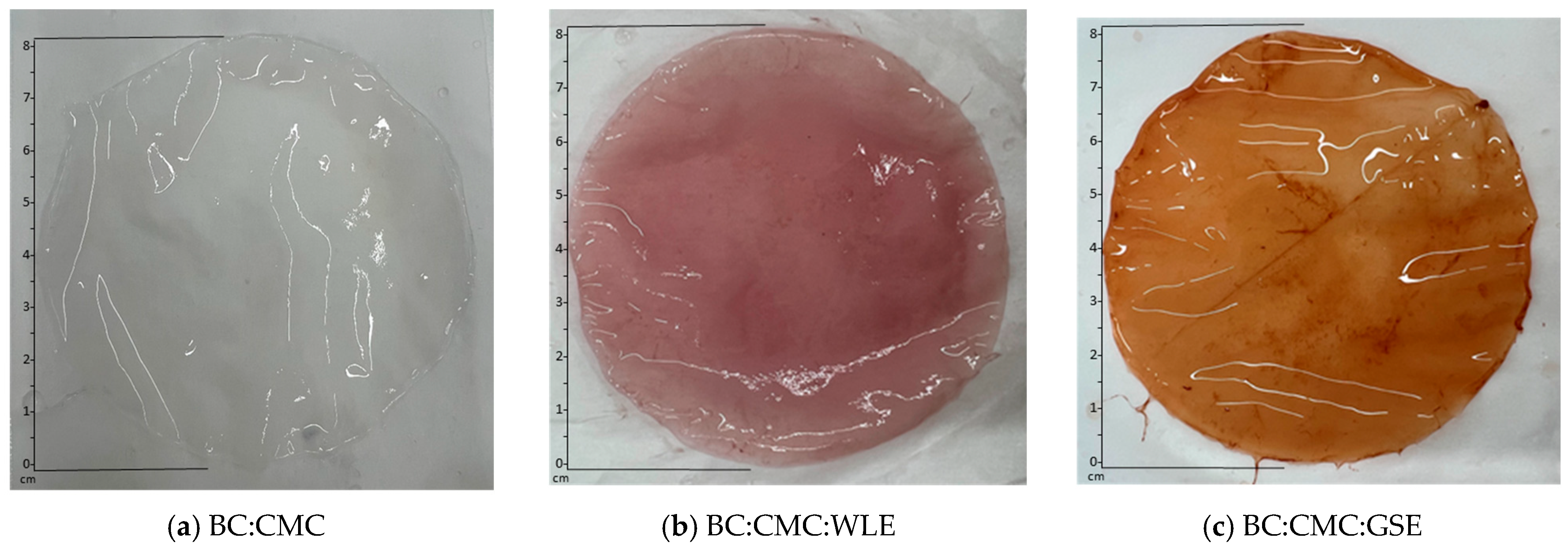
The optical performance of BC films is a critical parameter for their application in sustainable packaging, as it directly influences transparency, appearance, and consumer perception. Table 2 summarizes the color coordinates (L*, a*, b*), thickness, and opacity values of all prepared samples. Specifically, the chromatic properties of BC films were significantly influenced by both matrix composition and incorporation strategy. The BC film exhibited the highest lightness (L* = 90.25 ± 0.52), along with near-zero a* (−0.38 ± 0.84) and low b* values (4.43 ± 0.48), confirming its high transparency and optical neutrality. The modification with CMC resulted in a noticeable decrease in lightness (L* = 82.95 ± 3.59) and a shift toward positive a* (3.52 ± 1.67) and higher b* values (11.71 ± 2.48), indicating increased redness and yellowness. This behaviour may be associated with increased solid content and structural heterogeneity introduced by CMC, which can enhance light scattering within the composite network. Incorporation of phenolic extracts without CMC (BC:WLE and BC:GSE) induced moderate chromatic modifications compared to BC. Lightness values decreased to approximately 83–85, indicating a slight reduction in transparency. The a* values remained close to zero and comparable to those of the control BC. In contrast, b* values increased substantially relative to BC (from 4.43 to approximately 10–11), indicating a moderate shift toward yellowish tones. This shift is consistent with the presence of phenolic chromophores that absorb in the blue region of the visible spectrum, resulting in increased yellowness [61]. Notably, these b* values were comparable to those observed for BC:CMC, suggesting that immersion alone primarily affected yellowness without leading to pronounced pigmentation. A markedly different behavior was observed when phenolic extracts were incorporated in the presence of CMC. Both BC:CMC:WLE and BC:CMC:GSE exhibited pronounced decreases in lightness and significant increases in both a* and b* parameters. The most substantial chromatic modification was observed for BC:CMC:GSE (L* = 63.38 ± 2.42; a* = 15.44 ± 2.05; b* = 29.3 ± 3.67), indicating intensified pigmentation and increased optical density. These findings demonstrate that CMC-assisted incorporation enhanced phenolic retention and promoted stronger matrix–pigment interactions, thereby amplifying color development. Moreover, in Figure 1, the samples of BC pre-modified with CMC and incorporated with the phenolic extracts (WLE and GSE) are presented.
Film thickness is a critical structural parameter, as it directly affects mechanical stability, optical behavior, and mass transfer properties of biopolymer-based packaging materials [62]. The BC film exhibited a thickness of 0.022 ± 0.001 mm, whereas all functionalized films showed increased thickness. The most pronounced increase was observed for BC:CMC:GSE (0.030 ± 0.001 mm), corresponding to a 34.3% increase relative to the control. The increase in thickness following CMC incorporation and extract addition is consistent with previous reports demonstrating that film thickness increases with higher solid content and additive concentration [63]. Studies on CMC and composite films have shown that incorporating antioxidant compounds or lignin derivatives results in measurable thickness increase due to the contribution of additional solids and modification of the polymer network structure [64,65]. Such increases have been attributed to enhanced interactions between additives and the polymer matrix, including hydrogen bonding and other intermolecular forces, which can alter film organization and packing density. In the present system, the more pronounced thickening observed in CMC-containing films suggested that CMC facilitated stronger interactions between BC matrix and phenolic compounds, promoting improved integration of extract components within the composite matrix rather than mere surface deposition. Such structural modifications are expected to influence not only film thickness but also the mechanical response of the material, particularly under varying environmental conditions. Particularly, environmental moisture plays a critical role in the mechanical behavior of cellulosic materials, as water molecules act as a plasticizer, reducing intermolecular interactions and decreasing stiffness. Conversely, structural organization and intermolecular interactions, particularly hydrogen bonding, enhance the stiffness and durability of cellulose-based systems. These effects are particularly relevant in BC-based materials, where matrix structuring and additive incorporation may influence their mechanical stability under varying environmental conditions [66,67]. In the present study, the enhanced structuration induced by CMC and phenolic incorporation may contribute to the observed increase in film thickness and overall structural integrity and may also affect their response to environmental moisture.
Optical performance is a critical functional parameter for films intended for food packaging applications, as it determines their ability to protect food products from photo-oxidative degradation, pigment discoloration, and nutrient loss [68]. Therefore, while high transparency is desirable for consumer visibility, increased opacity can be technologically advantageous for light-sensitive products [69,70,71]. The literature reports that highly transparent packaging materials typically exhibit relatively low opacity values, whereas increased opacity is associated with enhanced light-barrier performance. In the present study, pure BC exhibited the lowest opacity (9.68 ± 2.83), confirming its inherently high optical clarity and homogeneous film structure. Modification with CMC and phenolic extracts significantly altered the optical behavior. As shown in Table 2, all modified films exhibited greater opacity than BC. This trend is consistent with previous findings on CMC-based films, where incorporation of essential oils or other functional compounds increased opacity due to enhanced matrix heterogeneity and formation of dispersed domains within the polymer network [72]. Similarly, adding reinforcing phases to BC systems can modify light transmission by altering the film’s microstructure and interactions within the matrix [73]. Consistent with the previously presented color analysis, the increase in opacity was accompanied by a progressive decrease in L* values. BC exhibited the highest lightness (L* = 90.25 ± 0.52), whereas extract-containing composites showed significantly lower L* values, with BC:CMC:GSE reaching 63.38 ± 2.42. This inverse relationship indicates that the darker appearance of the composite films is associated with enhanced light reduction within the matrix. Phenolic compounds present in the extracts are characterized by conjugated aromatic structures that absorb radiation in the UV–visible region and have been reported to protect chromophore systems against photo-induced degradation [74]. Their incorporation, therefore, contributed not only to bioactivity but also to increased intrinsic light absorption in the films. In parallel, the introduction of additional solid phases may increase structural heterogeneity, thereby further promoting light-scattering effects. Overall, the elevated opacity values observed for the composite films indicate enhanced light-barrier functionality compared to neat BC. Such behavior may be advantageous for the packaging of light-sensitive food systems, including lipid-rich or pigment-containing products.

3.2.2. Light Absorption

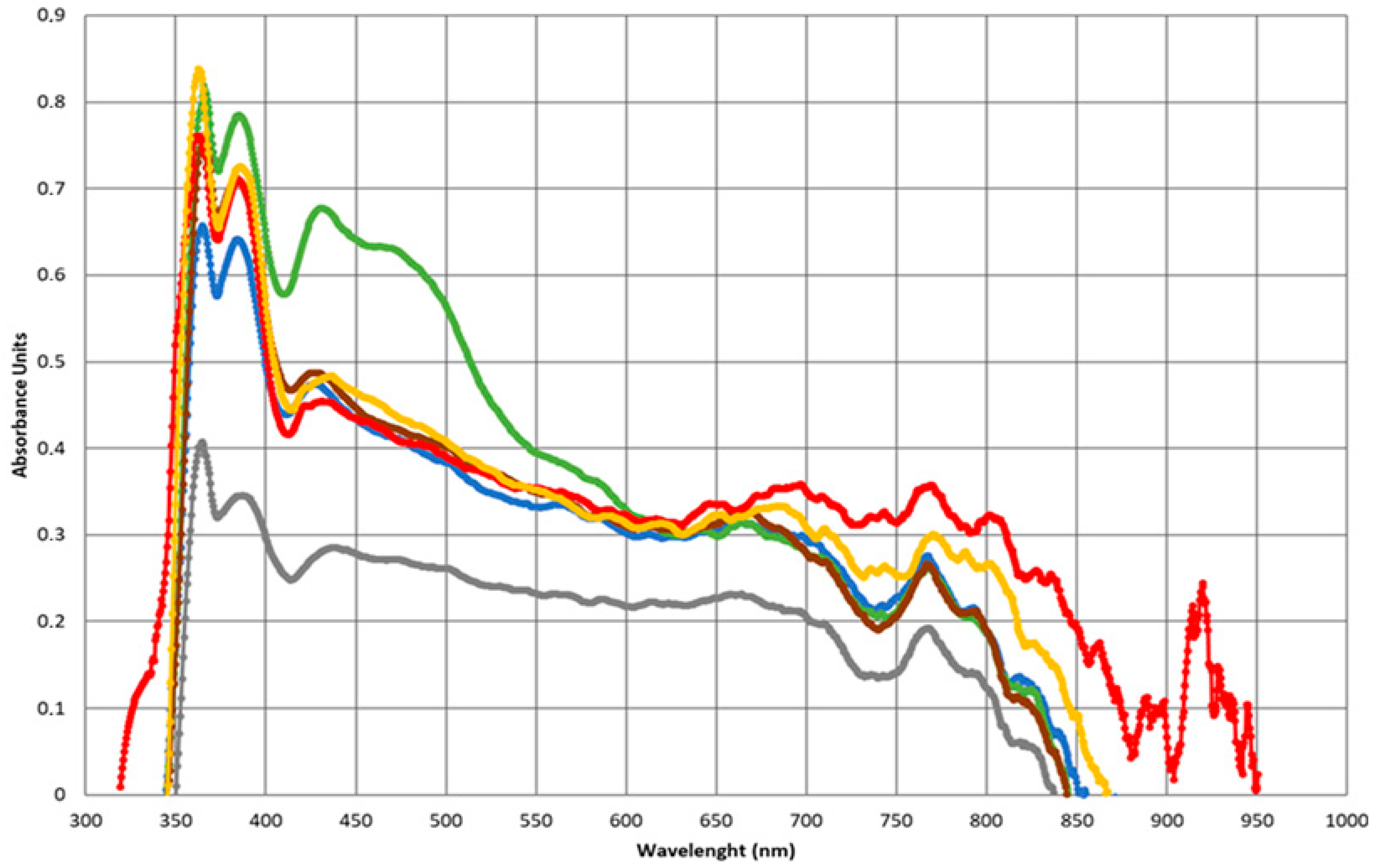
The UV-Vis absorption spectra of the BC films are presented in Figure 2. All samples exhibited a pronounced UV absorption band, with maxima centered at 350–370 nm. The BC film exhibited the lowest absorbance across the entire spectrum, confirming its high transparency and limited intrinsic chromophore content. The CMC-modified samples showed slightly higher absorbance, likely due to increased solid content. However, the most pronounced increase in light absorption was observed in extract-containing films. Among the formulations, BC:CMC:GSE exhibited the highest absorbance intensity in the UV region, followed by BC:CMC:WLE and BC:WLE. The enhanced absorption in these samples reflects the higher phenolic content and the presence of chromophore groups that absorb UV radiation. The strong absorbance peak around 360 nm is consistent with the characteristic absorption of polyphenols and flavonoids, which are known to contribute to UV-blocking functionality [75].
In the visible region (400–800 nm), extract-containing films maintained higher absorbance levels compared to BC and BC:CMC samples, explaining the observed reduction in L* values and increased opacity. The gradual decline in absorbance toward longer wavelengths indicates partial, rather than complete, blocking of visible light, suggesting a balance between transparency and protective functionality. These findings complement the opacity results, confirming that the increased opacity of composite films arises not only from enhanced light scattering due to microstructural heterogeneity, but also from intrinsic light absorption by phenolic compounds. Therefore, the developed films demonstrated combined UV-absorbing and light-diffusing behavior, reinforcing their suitability as functional light-protective packaging materials.

3.2.3. Surface Morphology Characterization

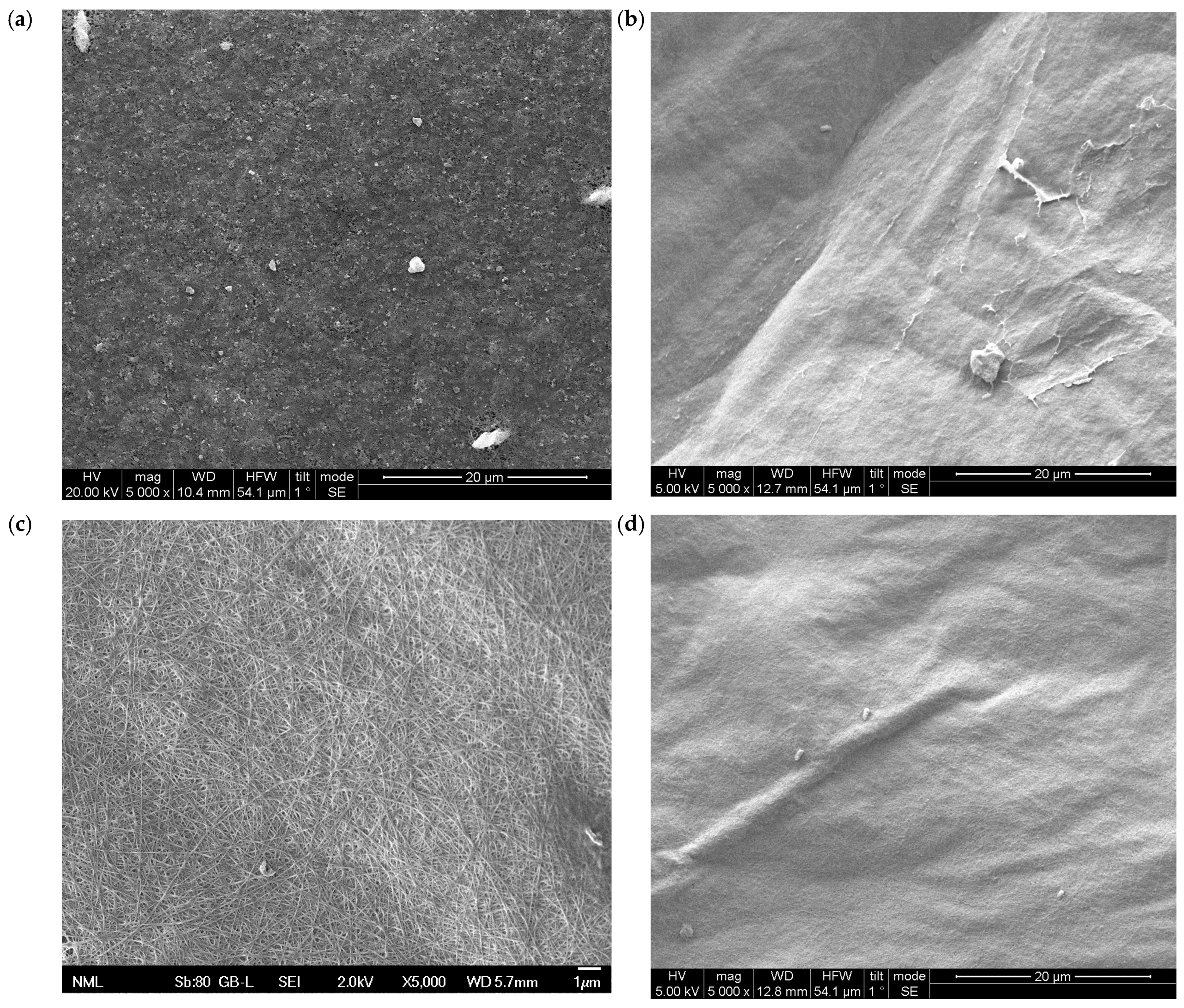
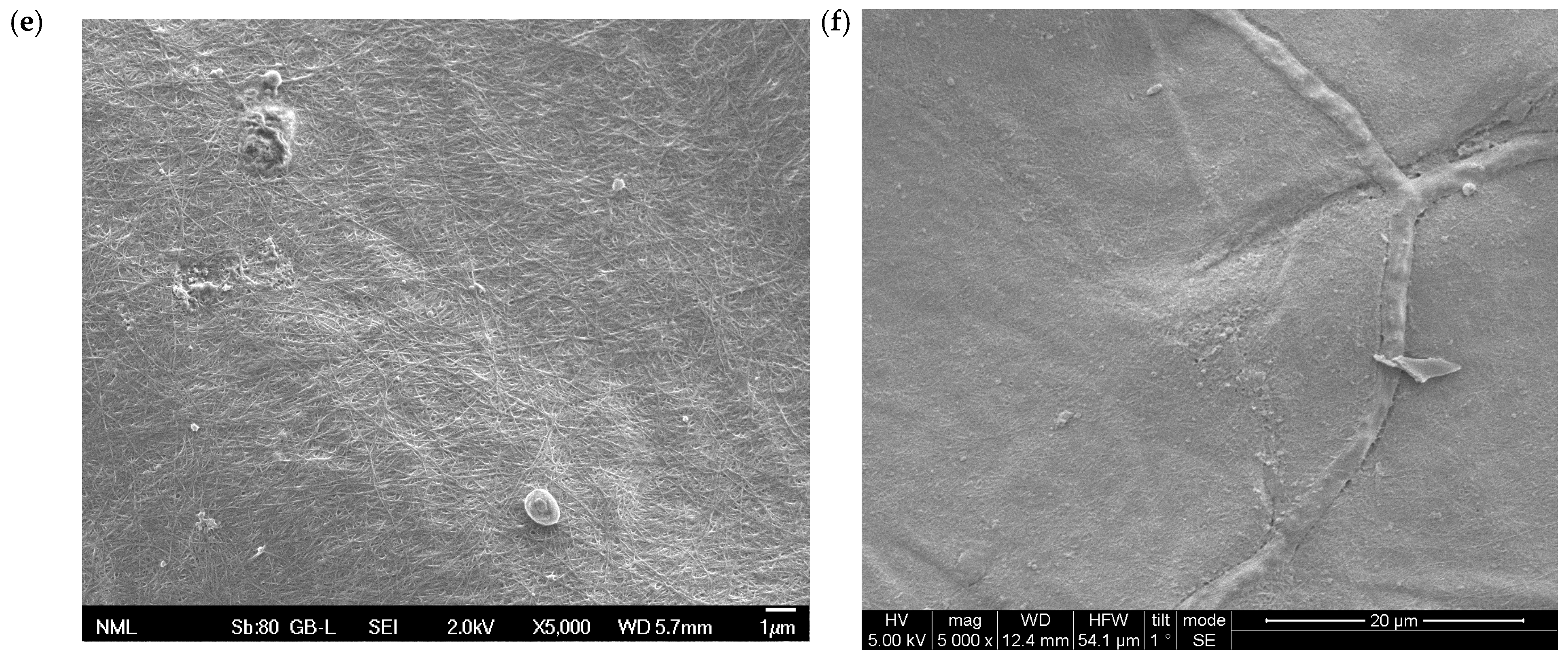
BC membranes synthesized under static culture conditions are characterized by an exceptional structural network and superior physicochemical properties. Specifically, they exhibit high crystallinity, a high degree of polymerization, and significant porosity, features that affect their overall performance [76]. Figure 3 presents SEM micrographs of BC films and modified ones. As observed in Figure 3a, the neat BC exhibited a highly textured and granular surface. This morphology was consistent with previous reports describing BC as a three-dimensional interconnected nanofiber network with open porosity [77,78]. The incorporation of CMC (Figure 3b) resulted in partial coverage of the nanofibrils and reduced surface porosity, leading to a smoother and more uniform surface. A similar surface densification has been reported in the literature in BC:CMC:CA films [50]. This structural densification could be correlated with the film thickness increase as mentioned above (i.e., Section 3.2.1). The surface of BC modified with WLE (Figure 3c) preserved the original BC pore structure, indicating that the extract treatment did not drastically alter the nanofibrillar framework. However, the fibrils appeared slightly more defined and contrasted, suggesting surface adsorption of phenolic constituents rather than bulk structural disruption. A comparable morphology was observed in the BC:GSE sample (Figure 3e), where the porous network and fiber-induced roughness remained evident. In contrast, BC:CMC:WLE (Figure 3d) and BC:CMC:GSE (Figure 3f) exhibited a more compact and continuous surface morphology with visible folds and wrinkle-like features. The reduction in visible pores suggests that CMC formed a coating layer over the BC network, while the extracts were incorporated within the composite structure. The observed smoothing effect was consistent with the structural modification induced solely by CMC addition.

3.2.4. BC Surface Chemistry Characterization

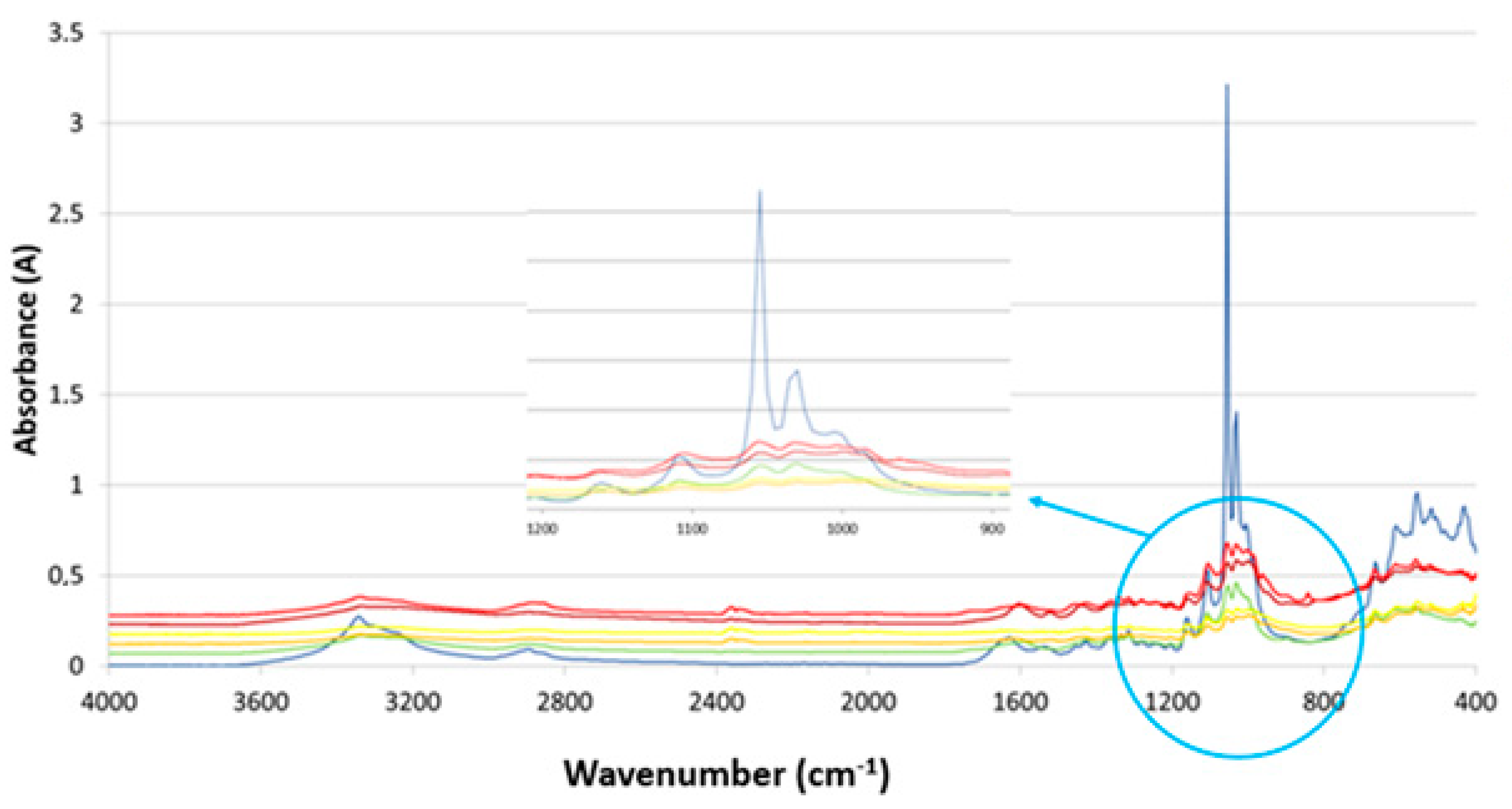
FTIR analysis was employed to examine the chemical composition of BC and BC- modified films, aiming to identify potential interactions arising from the different approaches (Figure 4). Specifically, the FTIR spectra of all BC-based films exhibited highly similar profiles, indicating that the fundamental chemical structure of BC was preserved following functionalization. Characteristic cellulose absorption bands were observed in all samples [79,80], including the broad O–H stretching band at 3300–3400 cm−1 associated with extensive intermolecular hydrogen bonding, C–H stretching vibrations around ~2900 cm−1, the band at ~1640 cm−1 attributed to absorbed or bound water (H–O–H bending), and the characteristic cellulose vibrations at ~1420 cm−1 (CH2 bending), ~1160 cm−1 (C–O–C stretching), and ~1050–1030 cm−1 (C–O stretching).
The FTIR spectra of BC and BC–CMC films were highly similar, indicating that the incorporation of CMC did not alter the chemical structure of BC. Minor intensity variations, particularly in the O–H stretching region, are attributed to enhanced hydrogen bonding between BC and CMC chains. The increased absorbance observed in the ~1600–1650 cm−1 region is associated with the presence of carboxylate groups (−COO) of CMC, in agreement with literature reports for BC–CMC systems [50]. The absence of new absorption bands, particularly in the ~1730–1740 cm−1 region, further confirms that CMC incorporation occurred without covalent bonding or ester formation. Additionally, subtle intensity variations in the 1200–900 cm−1 region are attributed to overlapping C–O–C and C–O stretching vibrations [79].
The incorporation of GSE or WLE resulted in subtle but systematic modifications of the FTIR profiles of BC-based films, depending on the presence of CMC. For BC films functionalized with extracts alone, the FTIR spectra remained highly similar to that of BC, with no new absorption bands detected, indicating that incorporation of GSE or WLE did not alter the chemical structure of the cellulose matrix. Minor changes in band shape and relative contributions were observed, mainly as slight broadening in the O–H stretching region (3200–3400 cm−1), which is consistent with overlapping contributions from hydroxyl-rich phenolic constituents and/or changes in bound water content [81]. These limited spectral differences are consistent with a relatively low effective interaction or exposure of the extracts within the BC matrix, which may explain the comparatively modest antimicrobial activity observed later in the absence of CMC.
In contrast, the incorporation of GSE or WLE into the BC–CMC matrix led to more discernible variations in band profiles, particularly in the O–H stretching region (3200–3400 cm−1) and, to a lesser extent, within the 1500–1650 cm−1 and fingerprint (~1050–900 cm−1) regions [53,79]. In the latter, BC–CMC films further modified with GSE or WLE exhibited noticeable changes in band profile and the appearance of shoulder features compared to BC–CMC alone, reflecting overlapping contributions from cellulose, CMC, and extract components rather than the formation of new chemical bonds. Importantly, no new absorption bands were observed in any of the spectra, supporting that extract incorporation occurred predominantly through non-covalent interactions and physical association within the BC network, without chemical modification of the cellulose backbone, in agreement with previous reports on phenolic–cellulose interactions [82]. Similar FTIR spectral variations upon incorporation of wine lees or phenolic-rich extracts into biopolymer matrices have been previously reported, mainly reflected as changes in relative band intensities and spectral profiles, without the appearance of new absorption bands [32,83].
Overall, FTIR analysis confirms that none of the applied functionalization strategies induced substantial chemical modification of the bacterial cellulose backbone, while supporting the presence of CMC-mediated interactions and consistent with the incorporation of phenolic extracts. These interaction patterns are consistent with the morphological densification observed in SEM analysis and may contribute to the modified optical and light-attenuation properties detected in UV–Vis and opacity measurements.

3.3. Antimicrobial Activity of Extracts

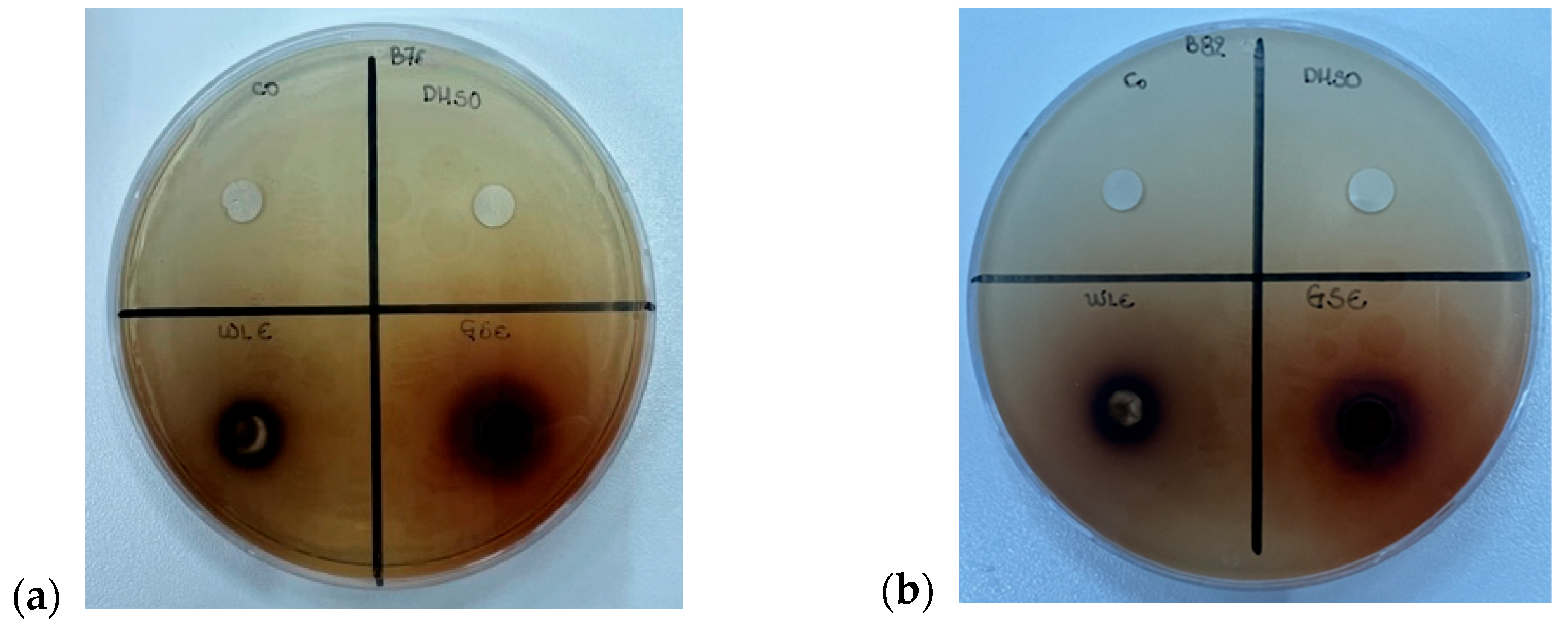
The antimicrobial activity of WLE and GSE was evaluated using both the agar well diffusion method and direct inoculation assay. Figure 5 presents the agar plates for the diffusion assay performed against E. coli (Gram-negative) and S. aureus (Gram-positive), selected as model pathogens for each bacterial classification. Each plate contained wells filled with WLE, GSE, or DMSO (as the reference sample), as well as control wells without extract (C0) to allow direct comparison among treatments.
Both extracts exhibited a dark brown color, and clear inhibition zones (i.e., transparent regions indicating absence of bacterial growth) were observed around the wells containing the extracts. In contrast, no inhibition zone was detected around the DMSO or control wells, confirming the absence of antimicrobial activity from the solvent. The visual inspection of the agar plates revealed well-defined inhibition zones with clear boundaries, facilitating reliable measurements of inhibition zone diameters. The zones appeared consistent in shape and intensity between the plates, indicating the good reproducibility of the assay.
The quantitative results of the agar well diffusion assay are summarized in Table 3. As shown, GSE exhibited higher inhibitory activity compared to WLE against both tested microorganisms, with inhibition zones of 3.58 mm ± 0.19 for E. coli and 3.60 mm ± 0.24 for S. aureus. The comparatively lower inhibition diameters observed for WLE may be associated with differences in phenolic composition and concentration between the two extracts. As reported previously, GSE contained substantially higher TPC than WLE, which may contribute to enhanced antimicrobial performance. In both cases, inhibition zones were slightly larger against S. aureus than against E. coli. This difference can be attributed to structural variations between Gram-positive and Gram-negative bacteria. The outer membrane of Gram-negative bacteria, composed of lipopolysaccharides, acts as an additional permeability barrier that limits the penetration of hydrophobic phenolic compounds, thereby increasing resistance. In contrast, Gram-positive bacteria lack this outer membrane, allowing phenolic compounds to interact more readily with the phospholipid bilayer, thereby increasing membrane permeability, leading to leakage of intracellular constituents and disruption of enzymatic systems [84]. Similar trends have been reported in BC-based antimicrobial systems, where inhibition zones were more pronounced against S. aureus than E. coli [78].
To further assess the antimicrobial efficacy of extracts, direct inoculation assays were performed. The viable cell counts (log10 CFU/mL) after 24 h of incubation are presented in Table 3. DMSO was again used as the reference control to evaluate any solvent-related effects. Complete inactivation of both microorganisms was observed after 24 h of exposure to WLE and GSE, with no detectable viable cells observed. These findings are consistent with previous reports demonstrating strong antimicrobial effects of wine lees extracts [5] and phenolic-rich bioactive systems incorporated into polymer matrices [85]. In contrast, the DMSO control showed no substantial reduction in viable counts, with bacterial populations remaining around 3.9 log10 CFU/mL, confirming that the antimicrobial activity originated from the phenolic extracts.
Taken together, the agar diffusion and direct contact results demonstrate that both extracts exhibit strong antimicrobial activity against Gram-positive and Gram-negative bacteria. The higher antimicrobial efficacy observed for GSE compared to WLE is consistent with its significantly higher TPC, suggesting that phenolic concentration plays a central role in determining antimicrobial performance. Phenolic compounds are known to interact with bacterial cell membranes, increase permeability, and disrupt essential cellular functions, which may explain the observed inhibition patterns [86].

3.4. Antimicrobial Activity of BC-Based Composite Films

Following confirmation of the antimicrobial activity of both extracts in solution, their incorporation into BC films was investigated to provide a new, robust functionalization route using agro-industrial by-products. Two functionalization strategies were tested and evaluated, (i) direct immersion into extract solutions and (ii) incorporation into BC pre-modified with CMC, enabling improved retention of extracts within the BC network. Since DMSO exhibited no inhibitory activity, BC and BC-CMC films were used as reference control samples.
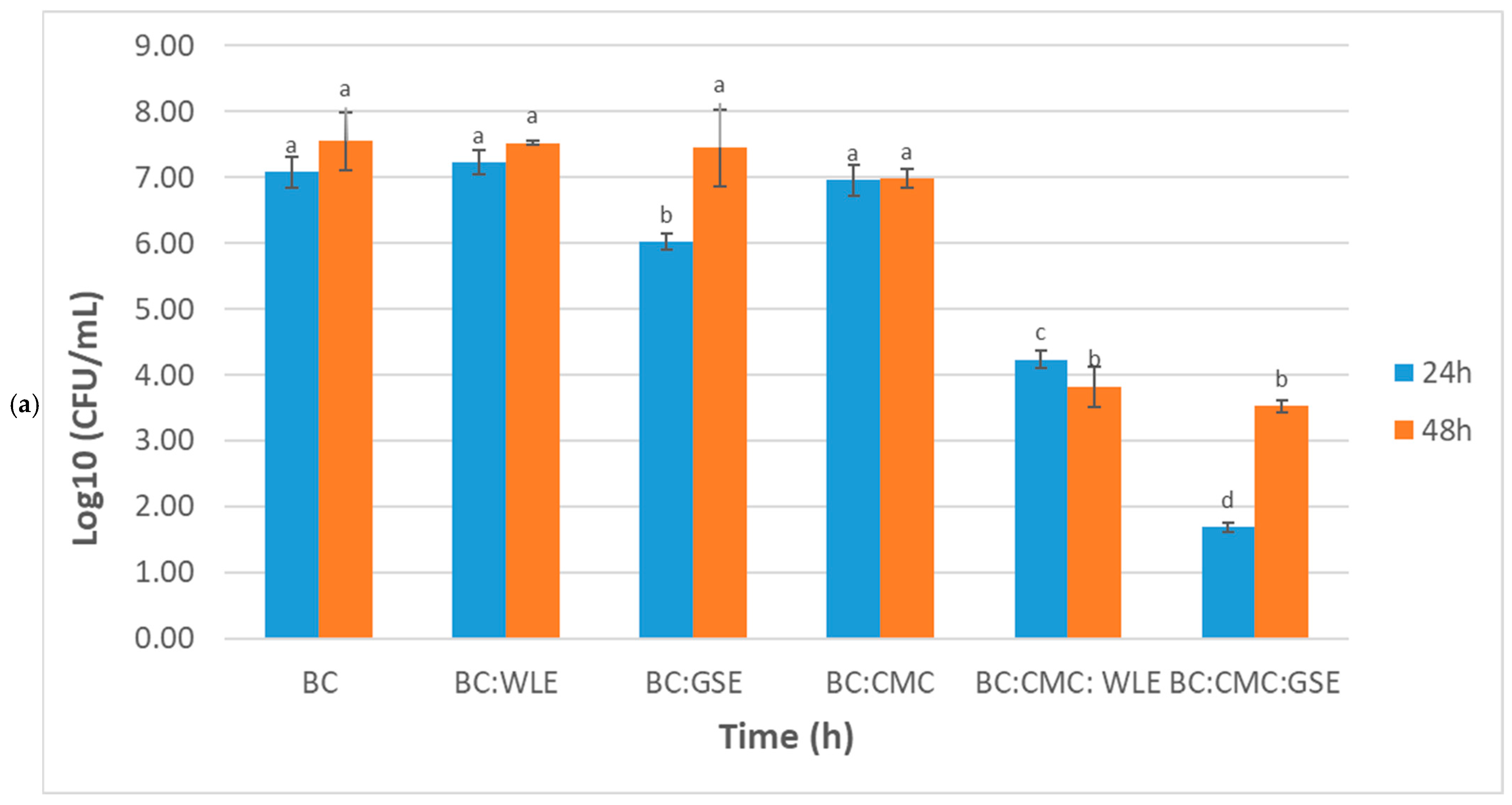
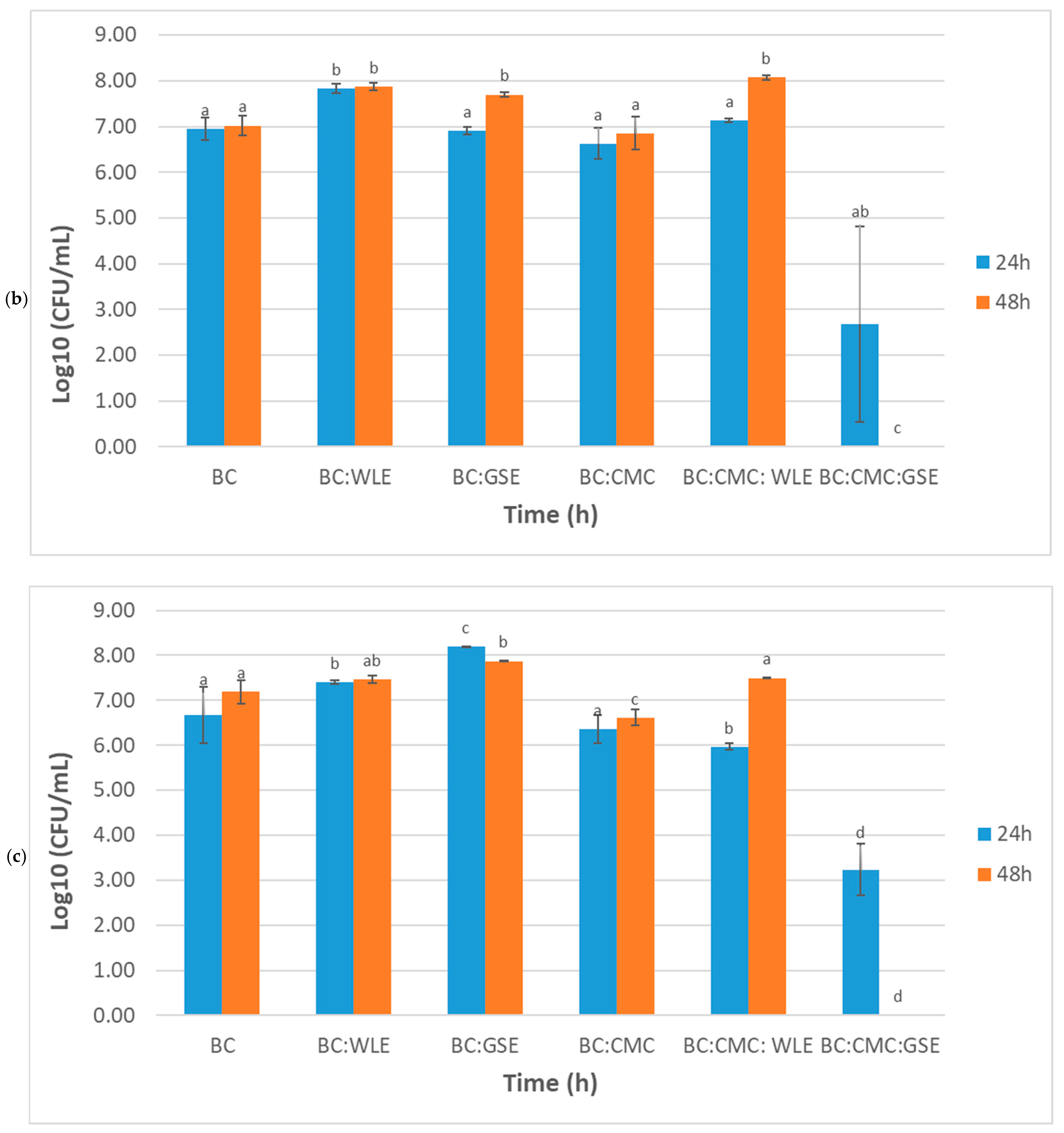
Figure 6 presents the antimicrobial performance of the films prepared via the two aforementioned functionalization strategies. Considering E. coli (Figure 6a), samples prepared by immersion (BC:WLE and BC:GSE) exhibited limited antimicrobial activity. Specifically, a statistically significant reduction of 1 log10 CFU/mL was observed only for the BC:GSE at 24 h. This behavior is consistent with limited extract retention and/or rapid diffusion of phenolic compounds from the film surface into the surrounding medium. In contrast, films prepared using CMC as a binder demonstrated significantly enhanced antimicrobial activity. BC:CMC:GSE achieved a reduction of 5.3 log10 CFU/mL (99.9% reduction relative to the initial microbial load) after 24 h, whereas BC:CMC:WLE showed a lower reduction of 2.7 log10 CFU/mL. After 48 h, both samples maintained substantial inhibition (reduction of ~3 log10 CFU/mL). The improved performance of binder-containing systems indicates that CMC facilitated more stable incorporation and controlled availability of phenolic compounds within the BC matrix. Although release kinetics were not directly evaluated, this interpretation is indirectly supported by SEM and FTIR findings. SEM analysis showed that BC films largely retained their native porous structure, whereas BC–CMC films exhibited a denser morphology. In parallel, FTIR analysis indicated stronger intermolecular interactions in BC–CMC–extract systems, suggesting improved extract retention compared to immersion-treated films. Similar improvements in antimicrobial efficacy have been reported following the incorporation of phenolic compounds into CMC matrices. For instance, CMC films containing resveratrol and eugenol exhibited enhanced antimicrobial activity compared to neat CMC, with Gram-positive bacteria being more susceptible [84]. This supports the role of CMC as an effective carrier matrix that stabilizes and gradually releases bioactive phenolic compounds.
For S. Typhimurium, a noticeable reduction of almost 4 log10 CFU/mL in bacterial population was observed only for the BC:CMC:GSE at 24 h and complete inhibition after 48 h. This reduction was statistically significant compared to the respective control and immersion-treated samples (p < 0.05). In contrast, immersion-treated films showed either negligible reduction or slight bacterial growth. The superior efficacy of BC:CMC:GSE may be attributed to the higher phenolic content of GSE combined with improved extract retention within the CMC-modified matrix. A similar pattern was observed for S. aureus. Immersion-treated films failed to suppress bacterial growth, whereas BC:CMC:GSE resulted in a 3.2 log10 CFU/mL reduction at 24 h and complete inhibition after 48 h (LOD < 1.0 log10 CFU/mL). These differences were also statistically significant (p < 0.05). BC:CMC:WLE showed only a transient reduction. These findings confirm that effective antimicrobial performance depends strongly on the integration strategy rather than solely on extract potency. The pronounced activity of BC:CMC:GSE against both S. Typhimurium and S. aureus is consistent with previous reports demonstrating strong bacteriostatic and bactericidal effects of grape pomace polyphenolic extracts against foodborne pathogens [87]. However, in contrast to several CMC-based systems, where activity was primarily observed against Gram-positive strains [84,88], the present study achieved substantial inhibition against Gram-negative bacteria as well, indicating improved bioactivity within the BC–CMC composite matrix.
The markedly enhanced antimicrobial activity of CMC-containing films correlates with the structural and spectroscopic findings discussed previously. SEM analysis revealed a more compact, continuous surface morphology in BC–CMC–extract systems, suggesting improved entrapment and distribution of phenolic compounds. FTIR analysis further indicated stronger hydrogen-bonding interactions within BC–CMC–extract matrices, supporting non-covalent stabilization of phenolics. These interaction patterns are likely to reduce rapid extract leaching and promote sustained antimicrobial action. In contrast, immersion-treated films preserved the native porous BC structure, which may facilitate rapid diffusion and depletion of active compounds, explaining the limited long-term antimicrobial effect. Comparable findings have been described for CMC-based active films incorporating plant extracts, in which matrix–bioactive interactions influenced antimicrobial efficiency [88]. The improved performance observed in the present BC–CMC–GSE system may therefore be attributed to enhanced phenolic stabilization and distribution within the composite network, rather than solely to extract potency. Furthermore, the consistently superior performance of GSE-based systems aligns with its significantly higher TPC compared to WLE, reinforcing the role of phenolic concentration in determining antimicrobial efficacy. These differences were statistically significant among samples within each incubation time (p < 0.05), further supporting the observed trends. Overall, the results demonstrate that antimicrobial efficacy is governed not only by the intrinsic bioactivity of the extracts but also by the incorporation protocol and the CMC-assisted functionalization strategy, which significantly enhanced both extract retention, improving their antimicrobial performance.

4. Conclusions

This study demonstrated the successful development of bioactive BC-based composite films functionalized with phenolic-rich extracts derived from winery by-products. The effectiveness of the extracts when incorporated into BC films was enhanced by CMC pre-modification. In particular, the BC:CMC:GSE system achieved up to 99.9% reduction in E. coli and complete inhibition of S. Typhimurium and S. aureus after 48 h. Spectroscopic (FTIR) and morphological (SEM) analyses confirmed that extract incorporation occurred primarily through non-covalent interactions without altering the cellulose backbone. These structural modifications were consistent with reduced lightness (L*) and increased opacity in extract-containing films. From a sustainability perspective, the valorization of red wine lees as a source of functional phenolic compounds, combined with the use of brewer’s spent yeast for BC production, demonstrates an integrated circular bioeconomy approach. The developed BC–CMC–extract composites exhibited combined antimicrobial and light-protective functionality, supporting their potential application as active bio-based packaging materials for light-sensitive and perishable food systems. Overall, this work provides a pathway for developing bio-based antimicrobial compounds from agro-industrial by-products as alternatives to conventional materials (e.g., metals). In addition, a controlled bioactive integration strategy is demonstrated for their incorporation into cellulose-based materials, supporting the development of sustainable packaging solutions. Future research should address the optimization of extract release kinetics, process scalability, and validation of these materials under real food packaging conditions.

Author Contributions

Conceptualization, M.K., K.E. and E.N.; methodology, M.K. and D.I.K.; software, M.K. and D.I.K.; validation, E.G., K.E. and E.N.; formal analysis, M.K.; investigation, M.K. and D.I.K.; resources, K.E., D.S. and E.G.; data curation, M.K., K.E. and E.N.; writing—original draft preparation, M.K.; writing—review and editing, D.S., K.G., E.G., K.E. and E.N.; visualization, M.K., K.E. and E.N.; supervision E.N.; project administration, K.E.; funding acquisition, K.E. All authors have read and agreed to the published version of the manuscript.

Funding

This research work is supported by the project entitled “Next generation green functional surfaces” [EXRCISE-Grant Number 16743] funded by the Hellenic Foundation for Research and Innovation (H.F.R.I) under the “Basic Research Financing (Horizontal support for all Sciences), National Recovery and Resilience Plan Greece 2.0”.

Institutional Review Board Statement

Not applicable.

Informed Consent Statement

Not applicable.

Data Availability Statement

The original contributions presented in the study are included in the article. Further inquiries can be directed to the corresponding author.

Acknowledgments

The authors want to acknowledge the Institute of Nanoscience and Nanotechnology (INN) of NCSR Demokritos for the support in SEM imaging and Ioannis Karatasios and Vasiliki Kontogianni, Ceramics and Composite Materials research group at INN, for providing access and facilitating FTIR analysis.

Conflicts of Interest

The authors declare no conflicts of interest.

References

  1. State of The World Vine and Wine Sector in 2024. Available online: https://www.oiv.int/sites/default/files/documents/OIV-State_of_the_World_Vine-and-Wine-Sector-in-2024.pdf (accessed on 16 February 2026).
  2. Rodrigues, R.P.; Gando-Ferreira, L.M.; Quina, M.J. Increasing Value of Winery Residues through Integrated Biorefinery Processes: A Review. Molecules 2022, 27, 4709. [Google Scholar] [CrossRef] [PubMed]
  3. Ncube, A.; Fiorentino, G.; Colella, M.; Ulgiati, S. Upgrading wineries to biorefineries within a Circular Economy perspe tive: An Italian case study. Sci. Total Environ. 2021, 775, 145809. [Google Scholar] [CrossRef]
  4. Ye, Z.; Qin, Y.; Harrison, R.; Hider, R.; Bekhit, A.E.-D.A. Characterization of Bioactive Compounds in Lees from New Zealand Wines with Different Vinification Backgrounds. Antioxidants 2022, 11, 2335. [Google Scholar] [CrossRef]
  5. Athanasiou, P.E.; Patila, M.; Fotiadou, R.; Chatzikonstantinou, A.V.; Stamatis, H. Valorization of Wine Lees: Assessment of Antioxidant, Antimicrobial and Enzyme Inhibitory Activity of Wine Lees Extract and Incorporation in Chitosan Films. Waste Biomass Valor. 2024, 15, 5657–5672. [Google Scholar] [CrossRef]
  6. Chetrariu, A.; Dabija, A.; Caisin, L.; Agapii, V.; Avrămia, I. Sustainable Valorization of Wine Lees: From Waste to Value-Added Products. Appl. Sci. 2025, 15, 3648. [Google Scholar] [CrossRef]
  7. De Iseppi, A.; Rocca, G.; Marangon, M.; Corich, V.; Arrigoni, G.; Porcellato, D.; Curioni, A. Characterization and Identification of Yeast Peptides Released during Model Wine Fermentation and Lees Contact. J. Agric. Food Chem. 2024, 72, 24749–24761. [Google Scholar] [CrossRef]
  8. Pérez-Serradilla, J.A.; De Castro, M.D.L. Role of lees in wine production: A review. Food Chem. 2008, 111, 447–456. [Google Scholar] [CrossRef] [PubMed]
  9. Naziri, E.; Nenadis, N.; Mantzouridou, F.T.; Tsimidou, M.Z. Valorization of the major agrifood industrial by-products and waste from Central Macedonia (Greece) for the recovery of compounds for food applications. Food Res. Int. 2014, 65, 350–358. [Google Scholar] [CrossRef]
  10. Dimou, C.; Kopsahelis, N.; Papadaki, A.; Papanikolaou, S.; Kookos, I.K.; Mandala, I.; Koutinas, A.A. Wine lees valorization: Biorefinery development including production of a generic fermentation feedstock employed for poly(3-hydroxybutyrate) synthesis. Food Res. Int. 2015, 73, 81–87. [Google Scholar] [CrossRef]
  11. Kontogiannopoulos, K.N.; Patsios, S.I.; Karabelas, A.J. Tartaric acid recovery from winery lees using cation exchange resin: Optimization by Response Surface Methodology. Sep. Purif. Technol. 2016, 165, 32–41. [Google Scholar] [CrossRef]
  12. Romero, E.; Salido, A.; Cifuentes, C.; Fernández, J.-D.; Nogales, R. Effect of vermicomposting process on pesticide sorption capability using agro-industrial wastes. Int. J. Environ. Anal. Chem. 2006, 86, 289–297. [Google Scholar] [CrossRef]
  13. Ahmad, B.; Yadav, V.; Yadav, A.; Rahman, M.U.; Yuan, W.Z.; Li, Z.; Wang, X. Integrated biorefinery approach to valorize winery waste: A review from waste to energy perspectives. Sci. Total Environ. 2020, 719, 137315. [Google Scholar] [CrossRef]
  14. De Andrade Bulos, R.B.; Da Gama Paz, F.; Machado, C.G.; Tavares, P.P.L.G.; De Souza, C.O.; Umsza-Guez, M.A. Scientific and technological research on the use of wine lees. Food Prod. Process. Nutr. 2023, 5, 25. [Google Scholar] [CrossRef]
  15. Álvaro, A.G.; Palomar, C.R.; Hermosilla, D.; Gascó, A.; Muñoz, R.; de Godos, I. Improving the Anaerobic Digestion Process of Wine Lees by the Addition of Microparticles. Water 2023, 16, 101. [Google Scholar] [CrossRef]
  16. Moldes, A.B.; Vázquez, M.; Domínguez, J.M.; Díaz-Fierros, F.; Barral, M.T. Negative effect of discharging vinification lees on soils. Bioresour. Technol. 2008, 99, 5991–5996. [Google Scholar] [CrossRef]
  17. Costa-Pérez, A.; Medina, S.; Sánchez-Bravo, P.; Domínguez-Perles, R.; García-Viguera, C. The (Poly)phenolic Profile of Separate Winery By-Products Reveals Potential Antioxidant Synergies. Molecules 2023, 28, 2081. [Google Scholar] [CrossRef] [PubMed]
  18. Garcia, L.; Poulain, B.; Douliez, A.; Naud, E.; Valls-Fonayet, J.; Nioi, C. White wine lees as a source of antioxidants: Insights into their chemical profile. Food Chem. 2025, 494, 146118. [Google Scholar] [CrossRef]
  19. De Luca, M.; Restuccia, D.; Spizzirri, U.G.; Crupi, P.; Ioele, G.; Gorelli, B.; Clodoveo, M.L.; Saponara, S.; Aiello, F. Wine Lees as Source of Antioxidant Molecules: Green Extraction Procedure and Biological Activity. Antioxidants 2023, 12, 622. [Google Scholar] [CrossRef]
  20. Silva, A.; Silva, V.; Igrejas, G.; Gaivão, I.; Aires, A.; Klibi, N.; Enes Dapkevicius, M.D.L.; Valentão, P.; Falco, V.; Poeta, P. Valorization of Winemaking By-Products as a Novel Source of Antibacterial Properties: New Strategies to Fight Antibiotic Resistance. Molecules 2021, 26, 2331. [Google Scholar] [CrossRef] [PubMed]
  21. Caponio, G.R.; Miolla, R.; Vacca, M.; Difonzo, G.; De Angelis, M. Wine lees as functional ingredient to produce biscuits fortified with polyphenols and dietary fibre. LWT 2024, 198, 115943. [Google Scholar] [CrossRef]
  22. Borges, M.S.; Biz, A.P.; Bertolo, A.P.; Bagatini, L.; Rigo, E.; Cavalheiro, D. Enriched cereal bars with wine fermentation biomass. J. Sci. Food Agric. 2021, 101, 542–547. [Google Scholar] [CrossRef] [PubMed]
  23. Bianchi, F.; Cervini, M.; Giuberti, G.; Simonato, B. The Potential of Wine Lees as a Fat Substitute for Muffin Formulations. Foods 2023, 12, 2584. [Google Scholar] [CrossRef] [PubMed]
  24. Martín-Garcia, A.; Riu-Aumatell, M.; López-Tamames, E. By-Product Revalorization: Cava Lees Can Improve the Fermentation Process and Change the Volatile Profile of Bread. Foods 2022, 11, 1361. [Google Scholar] [CrossRef] [PubMed]
  25. Sharma, A.K.; Aglawe, M.K. Addition of Processed Fine Wine Lees of Cabernet Sauvignon to Improve Nutraceutical Properties of Yoghurt. Proc. Natl. Acad. Sci. India Sect. B: Biol. Sci. 2022, 92, 141–147. [Google Scholar] [CrossRef]
  26. Sharma, A.K.; Kumar, R.; Azad, Z.R.A.A.; Adsule, P.G. Use of fine wine lees for value addition in ice cream. J. Food Sci. Technol. 2015, 52, 592–596. [Google Scholar] [CrossRef]
  27. Alarcón, M.; López-Viñas, M.; Pérez-Coello, M.S.; Díaz-Maroto, M.C.; Alañón, M.E.; Soriano, A. Effect of Wine Lees as Alternative Antioxidants on Physicochemical and Sensorial Composition of Deer Burgers Stored during Chilled Storage. Antioxidants 2020, 9, 687. [Google Scholar] [CrossRef]
  28. Hernández-Macias, S.; Ferrer-Bustins, N.; Comas-Basté, O.; Jofré, A.; Latorre-Moratalla, M.; Bover-Cid, S.; Vidal-Carou, M.D.C. Revalorization of Cava Lees to Improve the Safety of Fermented Sausages. Foods 2021, 10, 1916. [Google Scholar] [CrossRef]
  29. Rivas, M.Á.; Casquete, R.; Benito, M.J.; Martín, A.; Dorado, T.; De Guía Córdoba, M. Enhancing tomato sauce quality by replacing sugar with wine lees dietary fiber. LWT 2024, 214, 117159. [Google Scholar] [CrossRef]
  30. Butler, J.; Handy, R.D.; Upton, M.; Besinis, A. Review of Antimicrobial Nanocoatings in Medicine and Dentistry: Mechanisms of Action, Biocompatibility Performance, Safety, and Benefits Compared to Antibiotics. ACS Nano 2023, 17, 7064–7092. [Google Scholar] [CrossRef]
  31. Athanasiou, P.E.; Patila, M.; Fotiadou, R.; Giotopoulou, I.; Barkoula, N.-M.; Voutsas, E.; Stamatis, H. pH-Responsive Chitosan Films Enriched with NADES-Extracted Wine Lees Anthocyanins for In Situ Food Monitoring. Gels 2025, 11, 676. [Google Scholar] [CrossRef]
  32. Athanasiou, P.E.; Gkountela, C.I.; Patila, M.; Fotiadou, R.; Chatzikonstantinou, A.V.; Vouyiouka, S.N.; Stamatis, H. Laccase-Mediated Oxidation of Phenolic Compounds from Wine Lees Extract towards the Synthesis of Polymers with Potential Applications in Food Packaging. Biomolecules 2024, 14, 323. [Google Scholar] [CrossRef]
  33. Kefallinou, D.; Ellinas, K.; Speliotis, T.; Stamatakis, K.; Gogolides, E.; Tserepi, A. Optimization of Antibacterial Properties of “Hybrid” Metal-Sputtered Superhydrophobic Surfaces. Coatings 2019, 10, 25. [Google Scholar] [CrossRef]
  34. Ntovolou, I.; Farkatsi, D.; Ellinas, K. The Quest Towards Superhydrophobic Cellulose and Bacterial Cellulose Membranes and Their Perspective Applications. Micro 2025, 5, 37. [Google Scholar] [CrossRef]
  35. Campano, C.; Balea, A.; Blanco, A.; Negro, C. Enhancement of the fermentation process and properties of bacterial cellulose: A review. Cellulose 2016, 23, 57–91. [Google Scholar] [CrossRef]
  36. Tsouko, E.; Pilafidis, S.; Dimopoulou, M.; Kourmentza, K.; Sarris, D. Bioconversion of underutilized brewing by-products into bacterial cellulose by a newly isolated Komagataeibacter rhaeticus strain: A preliminary evaluation of the bioprocess environmental impact. Bioresour. Technol. 2023, 387, 129667. [Google Scholar] [CrossRef]
  37. Carvalho, T.; Guedes, G.; Sousa, F.L.; Freire, C.S.R.; Santos, H.A. Latest Advances on Bacterial Cellulose-Based Materials for Wound Healing, Delivery Systems, and Tissue Engineering. Biotechnol. J. 2019, 14, 1900059. [Google Scholar] [CrossRef]
  38. Ullah, H.; Santos, H.A.; Khan, T. Applications of bacterial cellulose in food, cosmetics and drug delivery. Cellulose 2016, 23, 2291–2314. [Google Scholar] [CrossRef]
  39. Dourado, F.; Leal, M.; Martins, D.; Fontão, A.; Rodrigues, A.; Gama, F. Celluloses as Food Ingredients/Additives: Is There a Room for BNC? In Bacterial Nanocellulose; Elsevier: Amsterdam, The Netherlands, 2016. [Google Scholar] [CrossRef]
  40. Shi, Z.; Zhang, Y.; Phillips, G.O.; Yang, G. Utilization of bacterial cellulose in food. Food Hydrocoll. 2014, 35, 539–545. [Google Scholar] [CrossRef]
  41. Mokhena, T.C.; John, M.J. Cellulose nanomaterials: New generation materials for solving global issues. Cellulose 2020, 27, 1149–1194. [Google Scholar] [CrossRef]
  42. He, Y.; Li, H.; Fei, X.; Peng, L. Carboxymethyl cellulose/cellulose nanocrystals immobilized silver nanoparticles as an effective coating to improve barrier and antibacterial properties of paper for food packaging applications. Carbohydr. Polym. 2021, 252, 117156. [Google Scholar] [CrossRef] [PubMed]
  43. Khalil, R.K.S.; Sharaby, M.R.; Abdelrahim, D.S.; ElLeithy, A.E. A novel multifunctional carboxymethyl cellulose packaging film with encapsulated lemon oil for quality enhancement of cherry tomato and baby spinach leaves. Food Packag. Shelf Life 2024, 42, 101267. [Google Scholar] [CrossRef]
  44. Stratil, P.; Kubáň, V.; Fojtová, J. Comparison of the phenolic content and total antioxidant activity in wines as determined by spectrophotometric methods. Czech J. Food Sci. 2008, 26, 242–253. [Google Scholar] [CrossRef]
  45. Gupta, M.; Dey, S.; Marbaniang, D.; Pal, P.; Ray, S.; Mazumder, B. Grape seed extract: Having a potential health benefits. J. Food Sci. Technol. 2020, 57, 1205–1215. [Google Scholar] [CrossRef]
  46. Umsza-Guez, M.A.; Vázquez-Espinosa, M.; Chinchilla, N.; Aliaño-González, M.J.; Oliveira de Souza, C.; Ayena, K.; Fernández Barbero, G.; Palma, M.; Carrera, C. Enhancing Anthocyanin Extraction from Wine Lees: A Comprehensive Ultrasound-Assisted Optimization Study. Antioxidants 2023, 12, 2074. [Google Scholar] [CrossRef] [PubMed]
  47. Tanguler, H.; Erten, H. Utilisation of spent brewer’s yeast for yeast extract production by autolysis: The effect of temperature. Food Bioprod. Process. 2008, 86, 317–321. [Google Scholar] [CrossRef]
  48. Lie, S. The EBC-ninhydrin method for determination of free alpha amino nitrogen. J. Inst. Brew. 1973, 79, 37–41. [Google Scholar] [CrossRef]
  49. Thomas, K.; Thanopoulos, R.; Knüpffer, H.; Bebeli, P.J. Plant genetic resources of Lemnos (Greece), an isolated island in the Northern Aegean Sea, with emphasis on landraces. Genet. Resour. Crop Evol. 2011, 59, 1417–1440. [Google Scholar] [CrossRef]
  50. Isopencu, G.; Deleanu, I.; Busuioc, C.; Oprea, O.; Surdu, V.-A.; Bacalum, M.; Stoica, R.; Stoica-Guzun, A. Bacterial Cellulose—Carboxymethylcellulose Composite Loaded with Turmeric Extract for Antimicrobial Wound Dressing Applications. IJMS 2023, 24, 1719. [Google Scholar] [CrossRef] [PubMed]
  51. Koukoumaki, D.I.; Papanikolaou, S.; Ioannou, Z.; Gkatzionis, K.; Sarris, D. The Development of Novel Edible Films from Single-Cell Protein Produced by the Biotechnological Valorization of Cheese Whey. Appl. Microbiol. 2024, 4, 1030–1041. [Google Scholar] [CrossRef]
  52. ISO 22196; Measurement of antibacterial activity on plastics and other non-porous surfaces. International Organization for Standardization: Geneva, Switzerland, 2011.
  53. Dimitrakellis, P.; Ellinas, K.; Kaprou, G.D.; Mastellos, D.C.; Tserepi, A.; Gogolides, E. Bactericidal Action of Smooth and Plasma Micro-Nanotextured Polymeric Surfaces with Varying Wettability, Enhanced by Incorporation of a Biocidal Agent. Macromol. Mater. Eng. 2021, 306, 2000694. [Google Scholar] [CrossRef]
  54. Zhijing, Y.; Shavandi, A.; Harrison, R.; Bekhit, A.E.-D.A. Characterization of Phenolic Compounds in Wine Lees. Antioxidants 2018, 7, 48. [Google Scholar] [CrossRef]
  55. Platzer, M.; Kiese, S.; Tybussek, T.; Herfellner, T.; Schneider, F.; Schweiggert-Weisz, U.; Eisner, P. Radical Scavenging Mechanisms of Phenolic Compounds: A Quantitative Structure-Property Relationship (QSPR) Study. Front. Nutr. 2022, 9, 882458. [Google Scholar] [CrossRef]
  56. Ali, H.M.; Almagribi, W.; Al-Rashidi, M.N. Antiradical and reductant activities of anthocyanidins and anthocyanins, structure–activity relationship and synthesis. Food Chem. 2016, 194, 1275–1282. [Google Scholar] [CrossRef]
  57. Duarte, C.N.; Taofiq, O.; Dias, M.I.; Heleno, S.A.; Santos-Buelga, C.; Barros, L.; Amaral, J.S. Chemical Characterization and Bioactive Properties of Wine Lees and Diatomaceous Earth towards the Valorization of Underexploited Residues as Potential Cosmeceuticals. Cosmetics 2023, 10, 58. [Google Scholar] [CrossRef]
  58. Labarbe, B.; Cheynier, V.; Brossaud, F.; Souquet, J.-M.; Moutounet, M. Quantitative Fractionation of Grape Proanthocyanidins According to Their Degree of Polymerization. J. Agric. Food Chem. 1999, 47, 2719–2723. [Google Scholar] [CrossRef] [PubMed]
  59. Ichikawa, H.; Ichiyanagi, T.; Xu, B.; Yoshii, Y.; Nakajima, M.; Konishi, T. Antioxidant Activity of Anthocyanin Extract from Purple Black Rice. J. Med. Food 2001, 4, 211–218. [Google Scholar] [CrossRef] [PubMed]
  60. Zhou, H.-C.; Tam, N.F.; Lin, Y.-M.; Ding, Z.-H.; Chai, W.-M.; Wei, S.-D. Relationships between Degree of Polymerization and Antioxidant Activities: A Study on Proanthocyanidins from the Leaves of a Medicinal Mangrove Plant Ceriops tagal. PLoS ONE 2014, 9, e107606. [Google Scholar] [CrossRef] [PubMed]
  61. Aleixandre, J.; du Toit, W. The Role of UV-Visible Spectroscopy for Phenolic Compounds Quantification in Winemaking. In Frontiers and New Trends in the Science of Fermented Food and Beverages; IntechOpen: London, UK, 2018. [Google Scholar] [CrossRef]
  62. Atta, O.M.; Manan, S.; Ul-Islam, M.; Ahmed, A.A.Q.; Ullah, M.W.; Yang, G. Development and characterization of plant oil-incorporated carboxymethyl cellulose/bacterial cellulose/glycerol-based antimicrobial edible films for food packaging applications. Adv. Compos. Hybrid Mater. 2022, 5, 973–990. [Google Scholar] [CrossRef]
  63. Marcuello, C.; Foulon, L.; Chabbert, B.; Aguié-Béghin, V.; Molinari, M. Atomic force microscopy reveals how relative humidity impacts the Young’s modulus of lignocellulosic polymers and their adhesion with cellulose nanocrystals at the nanoscale. Int. J. Biol. Macromol. 2020, 147, 1064–1075. [Google Scholar] [CrossRef]
  64. Akhtar, H.M.S.; Zhao, Y.; Li, L.; Shi, Q. Novel active composite films based on carboxymethyl cellulose and sodium alginate incorporated with phycocyanin: Physico-chemical, microstructural and antioxidant properties. Food Hydrocoll. 2024, 147, 109440. [Google Scholar] [CrossRef]
  65. Haqiqi, M.T.; Bankeeree, W.; Lotrakul, P.; Pattananuwat, P.; Punnapayak, H.; Ramadhan, R.; Kobayashi, T.; Amirta, R.; Prasongsuk, S. Antioxidant and UV-Blocking Properties of a Carboxymethyl Cellulose–Lignin Composite Film Produced from Oil Palm Empty Fruit Bunch. ACS Omega 2021, 6, 9653–9666. [Google Scholar] [CrossRef]
  66. Dayal, M.S.; Catchmark, J.M. Mechanical and structural property analysis of bacterial cellulose composites. Carbohydr. Polym. 2016, 144, 447–453. [Google Scholar] [CrossRef]
  67. Cazón, P.; Puertas, G.; Vázquez, M. Characterization of multilayer bacterial cellulose-chitosan films loaded with grape bagasse antioxidant extract: Insights into spectral and water properties, microstructure, and antioxidant activity. Int. J. Biol. Macromol. 2024, 268, 131774. [Google Scholar] [CrossRef] [PubMed]
  68. Yildirim-Yalcin, M.; Tornuk, F.; Toker, O.S. Recent advances in the improvement of carboxymethyl cellulose-based edible films. Trends Food Sci. Technol. 2022, 129, 179–193. [Google Scholar] [CrossRef]
  69. Kwon, S.; Orsuwan, A.; Bumbudsanpharoke, N.; Yoon, C.; Choi, J.; Ko, S. A Short Review of Light Barrier Materials for Food and Beverage Packaging. Korean J. Packag. Sci. Technol. 2018, 24, 141–148. [Google Scholar] [CrossRef]
  70. Sarkhel, S.; Kaur, S.; Das, R.; Sharma, A.; Kheto, A.; Saha, D.; Kumar, Y. Antimicrobial active packaging with biopolymers and natural extracts: Sustainable solutions and technological challenges. Sustain. Food Technol. 2025, 4, 1225–1261. [Google Scholar] [CrossRef]
  71. Da Costa, D.S.; Dos Santos, L.N.; Ferreira, N.R.; Takeuchi, K.P.; Lopes, A.S. Properties of films and coatings added of tocopherol for food packaging: Tool-based review for systematic reviews and bibliometric analysis. BFJ 2024, 126, 226–268. [Google Scholar] [CrossRef]
  72. Simsek, M.; Eke, B.; Demir, H. Characterization of carboxymethyl cellulose-based antimicrobial films incorporated with plant essential oils. Int. J. Biol. Macromol. 2020, 163, 2172–2179. [Google Scholar] [CrossRef]
  73. Papadaki, A.; Manikas, A.C.; Papazoglou, E.; Kachrimanidou, V.; Lappa, I.; Galiotis, C.; Mandala, I.; Kopsahelis, N. Whey protein films reinforced with bacterial cellulose nanowhiskers: Improving edible film properties via a circular economy approach. Food Chem. 2022, 385, 132604. [Google Scholar] [CrossRef] [PubMed]
  74. Cuvelier, M.-E.; Berset, C. Phenolic compounds and plant extracts protect paprika against UV-induced discoloration. Int. J. Food Sci. Technol. 2005, 40, 67–73. [Google Scholar] [CrossRef]
  75. Philippidis, A.; Poulakis, E.; Kontzedaki, R.; Orfanakis, E.; Symianaki, A.; Zoumi, A.; Velegrakis, M. Application of Ultraviolet-Visible Absorption Spectroscopy with Machine Learning Techniques for the Classification of Cretan Wines. Foods 2020, 10, 9. [Google Scholar] [CrossRef]
  76. Wang, J.; Tavakoli, J.; Tang, Y. Bacterial cellulose production, properties and applications with different culture methods—A review. Carbohydr. Polym. 2019, 219, 63–76. [Google Scholar] [CrossRef]
  77. Huang, Y.-C.; Khumsupan, D.; Lin, S.-P.; Santoso, S.P.; Hsu, H.-Y.; Cheng, K.-C. Production of bacterial cellulose (BC)/nisin composite with enhanced antibacterial and mechanical properties through co-cultivation of Komagataeibacter xylinum and Lactococcus lactis subsp. lactis. Int. J. Biol. Macromol. 2024, 258, 128977. [Google Scholar] [CrossRef]
  78. Bodea, I.M.; Cătunescu, G.M.; Pop, C.R.; Fiț, N.I.; David, A.P.; Dudescu, M.C.; Stănilă, A.; Rotar, A.M.; Beteg, F.I. Antimicrobial Properties of Bacterial Cellulose Films Enriched with Bioactive Herbal Extracts Obtained by Microwave-Assisted Extraction. Polymers 2022, 14, 1435. [Google Scholar] [CrossRef]
  79. Babac, C.; Kutsal, T.; Pişkin, E. Production and Characterization of Biodegradable Bacterial Cellulose Membranes. Int. J. Nat. Eng. Sci. 2009, 3, 19–22. [Google Scholar]
  80. Ghozali, M.; Meliana, Y.; Chalid, M. Synthesis and characterization of bacterial cellulose by Acetobacter xylinum using liquid tapioca waste. Mater. Today Proc. 2021, 44, 2131–2134. [Google Scholar] [CrossRef]
  81. Tagkouli, D.; Tsiaka, T.; Kritsi, E.; Soković, M.; Sinanoglou, V.J.; Lantzouraki, D.Z.; Zoumpoulakis, P. Towards the Optimization of Microwave-Assisted Extraction and the Assessment of Chemical Profile, Antioxidant and Antimicrobial Activity of Wine Lees Extracts. Molecules 2022, 27, 2189. [Google Scholar] [CrossRef] [PubMed]
  82. Fernandes, I.D.A.A.; Maciel, G.M.; Ribeiro, V.R.; Rossetto, R.; Pedro, A.C.; Haminiuk, C.W.I. The role of bacterial cellulose loaded with plant phenolics in prevention of UV-induced skin damage. Carbohydr. Polym. Technol. Appl. 2021, 2, 100122. [Google Scholar] [CrossRef]
  83. Gumus, T.; Kaynarca, G.B.; Kamer, D.D.A. Optimization of an edible film formulation by incorporating carrageenan and red wine lees into fish gelatin film matrix. Int. J. Biol. Macromol. 2024, 258, 128854. [Google Scholar] [CrossRef]
  84. Aminzare, M.; Moniri, R.; Hassanzad Azar, H.; Mehrasbi, M.R. Evaluation of antioxidant and antibacterial interactions between resveratrol and eugenol in carboxymethyl cellulose biodegradable film. Food Sci. Nutr. 2022, 10, 155–168. [Google Scholar] [CrossRef]
  85. Shao, Z.; Lan, W.; Xie, J. A konjac glucomannan/ gelatin film integrated with rosemary essential oil and ginger essential oil-loaded bacterial cellulose: Preparation, characterization, and application in sea bass (Lateolabrax maculatus) packaging. Food Chem. 2025, 478, 143604. [Google Scholar] [CrossRef] [PubMed]
  86. Gyawali, R.; Ibrahim, S.A. Ibrahim, Natural products as antimicrobial agents. Food Control. 2014, 46, 412–429. [Google Scholar] [CrossRef]
  87. Sateriale, D.; Forgione, G.; Di Rosario, M.; Pagliuca, C.; Colicchio, R.; Salvatore, P.; Paolucci, M.; Pagliarulo, C. Vine-Winery Byproducts as Precious Resource of Natural Antimicrobials: In Vitro Antibacterial and Antibiofilm Activity of Grape Pomace Extracts against Foodborne Pathogens. Microorganisms 2024, 12, 437. [Google Scholar] [CrossRef] [PubMed]
  88. Baniasadi, H.; Fathi, Z.; Lizundia, E.; Cruz, C.D.; Abidnejad, R.; Fazeli, M.; Tammela, P.; Kontturi, E.; Lipponen, J.; Niskanen, J. Development and characterization of pomegranate peel extract-infused carboxymethyl cellulose composite films for functional, sustainable food packaging. Food Hydrocoll. 2025, 158, 110525. [Google Scholar] [CrossRef]
Figure 1. Representative images of CMC-modified BC films incorporated with phenolic extracts: (a) BC:CMC, (b) BC:CMC:WLE, and (c) BC:CMC:GSE.
Sustainability 18 04040 g001
Figure 2. White Light Spectroscopy measurement in UV–Vis absorbance spectra (300–1000 nm) of BC and modified BC films: BC (), BC:CMC (), BC:WLE (), BC:GSE (), BC:CMC:WLE (), and BC:CMC:GSE (). Extract-containing films exhibit increased absorbance in the UV region (≈320–380 nm) and enhanced light attenuation across the visible range compared to neat BC.
Sustainability 18 04040 g002
Figure 3. SEM micrographs (5000× magnification) showing the surface morphology of (a) BC (working distance: 10.4 mm, SE mode, 20 KV), (b) BC:CMC (working distance: 12.7 mm, SE mode, 5 KV), (c) BC:WLE (working distance: 5.7 mm, GB-L mode, 2 KV), (d) BC:CMC-WLE (working distance: 12.8 mm, SE mode, 5 KV), (e) BC:GSE (working distance: 5.7 mm, GB-L mode, 2 KV), and (f) BC:CMC:GSE (working distance: 12.4 mm, SE mode, 5 KV) films. Neat BC exhibits a porous nanofibrillar network, while the incorporation of CMC and phenolic extracts progressively modifies surface compactness and pore visibility.
Sustainability 18 04040 g003aSustainability 18 04040 g003b
Figure 4. FTIR absorbance spectra (4000–400 cm−1) of bacterial cellulose (BC) and BC-based films functionalized with wine lees extract (WLE) and grape seed extract (GSE), with and without CMC pre-modification: BC (), BC-CMC (), BC-WLE (), BC-GSE (), BC-CMC-WLE (), BC-CMC-GSE (). Variations in band intensity and profile, particularly in the 1200–900 cm−1 region, indicate modifications in intermolecular interactions and surface composition.
Sustainability 18 04040 g004
Figure 5. Agar well diffusion assay against (a) E. coli and (b) S. aureus. Wells contained wine lees extract (WLE), grape seed extract (GSE), DMSO (negative control), and control wells without extract. Clear inhibition zones surrounding extract-containing wells indicate antimicrobial activity.
Sustainability 18 04040 g005
Figure 6. Antimicrobial activity of BC-based films evaluated by direct contact assay after 24 h and 48 h of incubation against (a) E. coli, (b) S. Typhimurium, and (c) S. aureus. Results are expressed as log10 CFU/mL (mean ± SD). Different letters indicate statistically significant differences among samples within each time point (Games–Howell post hoc test, p < 0.05). No viable cells were detected for BC:CMC:GSE against S. Typhimurium and S. aureus after 48 h (LOD < 1.0 log10 CFU/mL).
Sustainability 18 04040 g006aSustainability 18 04040 g006b
Table 1. Full names and corresponding abbreviations for BC samples.
Full Name of SampleAbbreviation
Bacterial CelluloseBC
Bacterial Cellulose pre-modified with CMCBC:CMC
Bacterial Cellulose immersed in WLEBC:WLE
Bacterial Cellulose immersed in GSEBC:GSE
Bacterial Cellulose pre-modified with CMC and incorporation of WLEBC:CMC:WLE
Bacterial Cellulose pre-modified with CMC and incorporation of GSEBC:CMC:GSE
Table 2. Color parameters (L*, a*, b*), thickness, and opacity values of BC-based films*.
SamplesL*a*b*Thickness (mm)Film Opacity
BC90.25 ± 0.52−0.38 ± 0.844.43 ± 0.480.022 ± 0.0019.68 ± 2.83
BC:CMC82.95 ± 3.593.52 ± 1.6711.71 ± 2.480.028 ± 0.00310.84 ± 1.36
BC:WLE83.35 ± 1.080.05 ± 0.8510.60 ± 2.280.025 ± 0.00112.59 ± 0.08
BC:GSE85.08 ± 0.30−0.50 ± 0.4911.20 ± 0.330.027 ± 0.00111.87 ± 0.22
BC:CMC:WLE79.25 ± 1.167.72 ± 1.0217.22 ± 1.260.024 ± 0.00113.21 ± 0.49
BC:CMC:GSE63.38 ± 2.4215.44 ± 2.0529.30 ± 3.670.030 ± 0.00110.72 ± 1.41
* Values are expressed as mean ± standard deviation. Measurements were performed in triplicate (n = 3) or quintuplicate (n = 5), depending on the parameter analyzed (please check Section 2).
Table 3. Inhibition zone diameters (mm) determined by agar well diffusion and viable cell counts (log10 CFU/mL) from direct contact assays for GSE and WLE against Escherichia coli and Staphylococcus aureus. DMSO was used as the negative control.
Type of ExtractAgar Well DiffusionDirect Contact Assay
E. coliS. aureusE. coliS. aureus
(mm) *log10 (CFU/mL) *
Grape Seed Extract3.58 ± 0.193.60 ± 0.24N.D.N.D.
Red Wine Lees1.99 ± 0.022.22 ± 0.02N.D.N.D.
DMSON.I.A.N.I.A.3.97 ± 0.013.91 ± 0.02
* Mean values of three independent samples, N.I.A.: No Inhibitory Activity, N.D.: LOD < 1.0 log10 CFU/mL.
Disclaimer/Publisher’s Note: The statements, opinions and data contained in all publications are solely those of the individual author(s) and contributor(s) and not of MDPI and/or the editor(s). MDPI and/or the editor(s) disclaim responsibility for any injury to people or property resulting from any ideas, methods, instructions or products referred to in the content.