3.2. Synchronic Impacts of Regeneration Modes on Heritage Values and Community Vitality
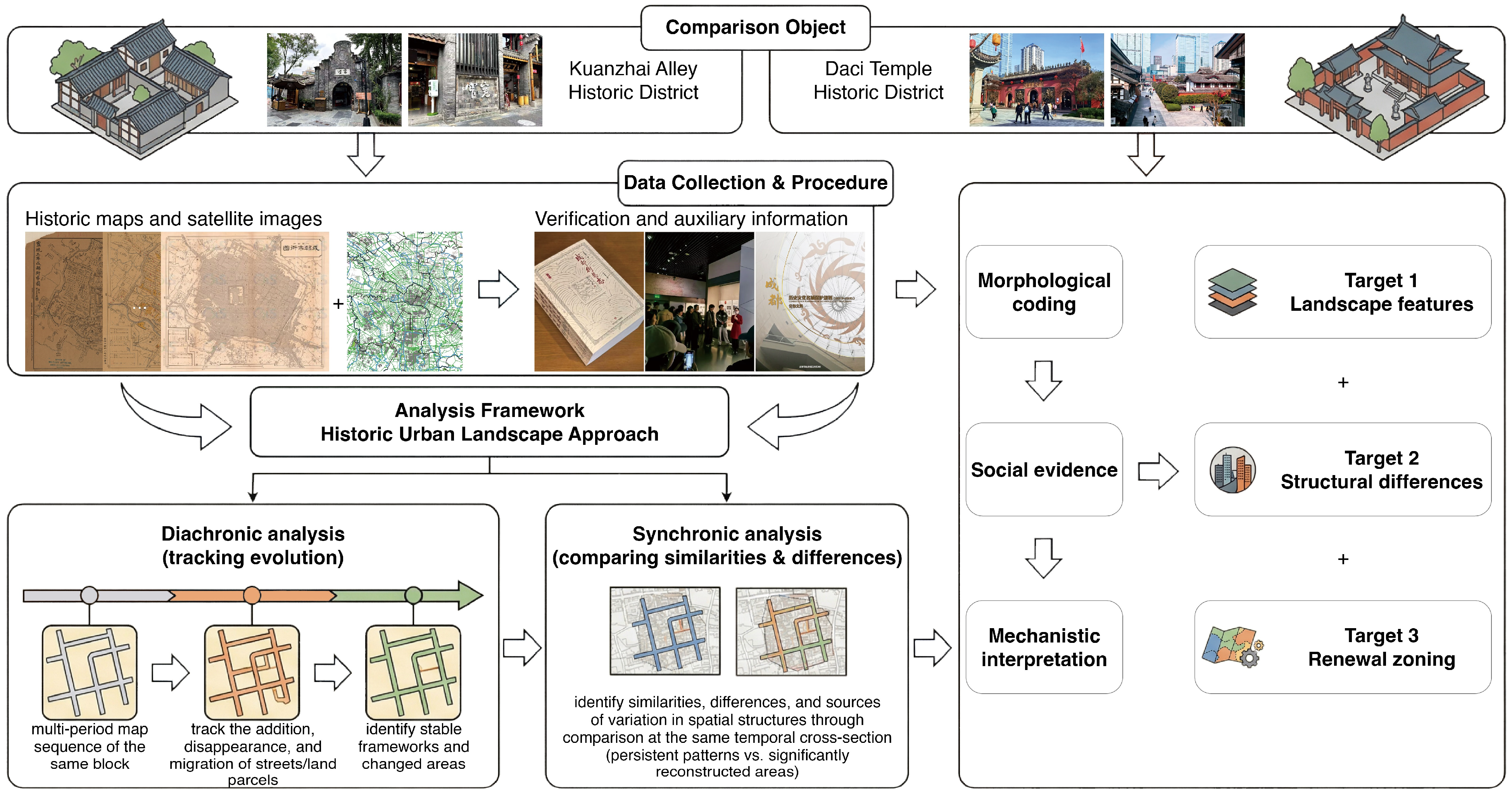
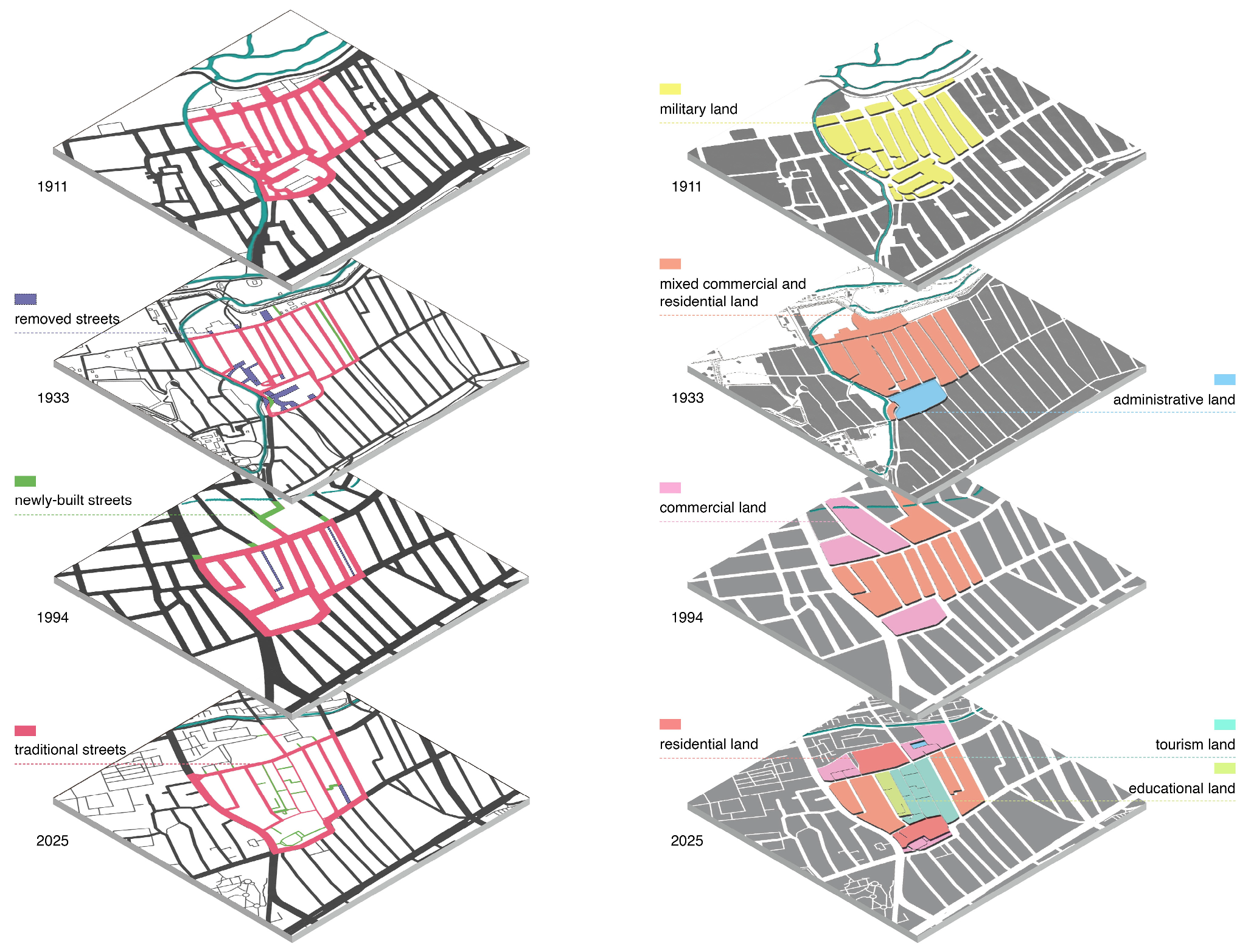
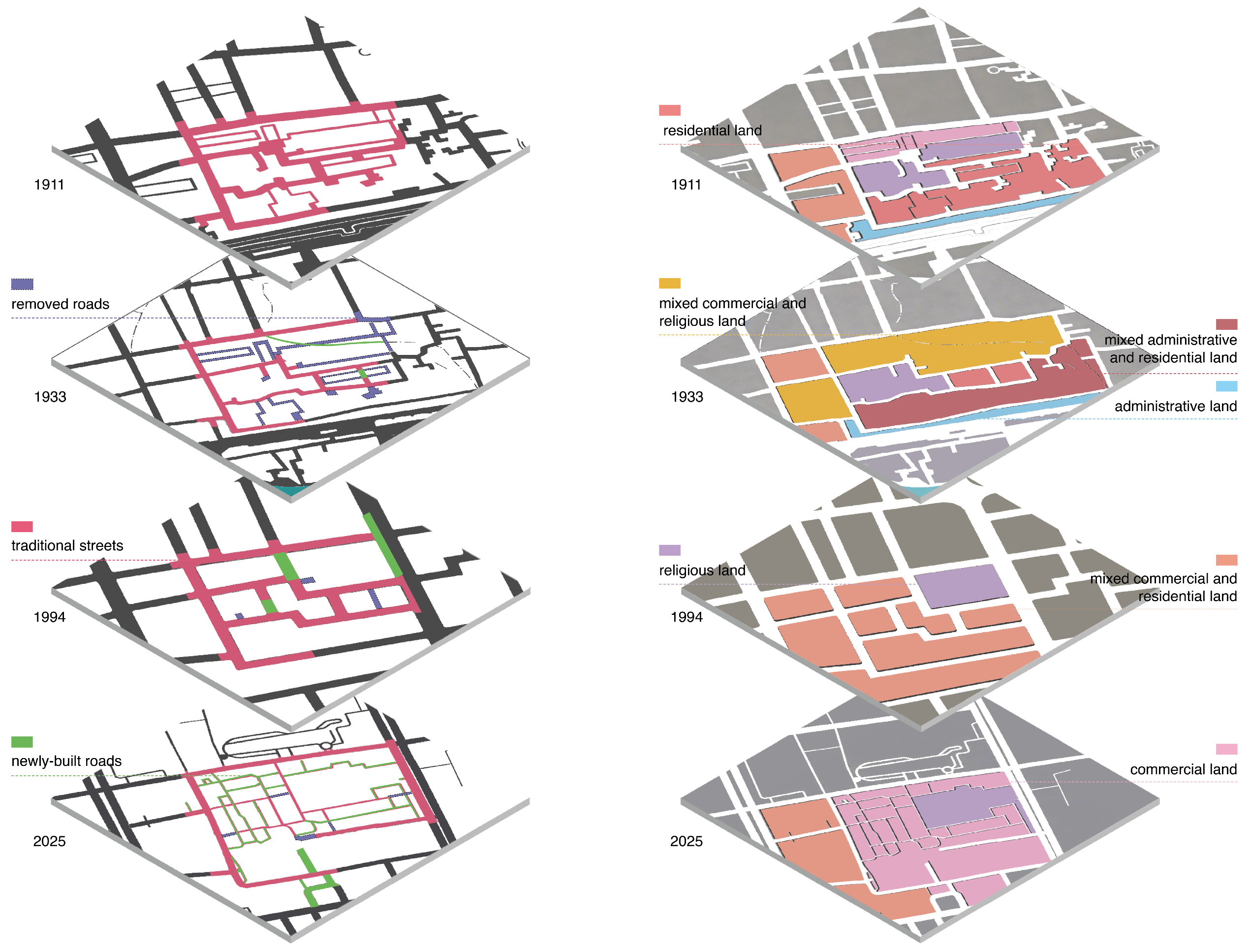
HUL calls for addressing the coupled relations among spatial form, social structure, and governance decision-making under dynamic urban development. Accordingly, comparing the two historic districts should not be limited to a diachronic narrative of change; it also requires juxtaposition at the same time points to trace where divergent mechanisms originate. Building on this logic, this section conducts a synchronic comparison using two benchmark years—1994 and 2025—as the main thread. These correspond, respectively, to baseline community conditions before renewal interventions and to post-renewal operational conditions after implementation. The morphological and socio-economic contexts of 1911 and 1933 are used as references to clarify differences in starting conditions and the path dependence of the two regeneration trajectories.
3.2.1. Key Time Point of 1994
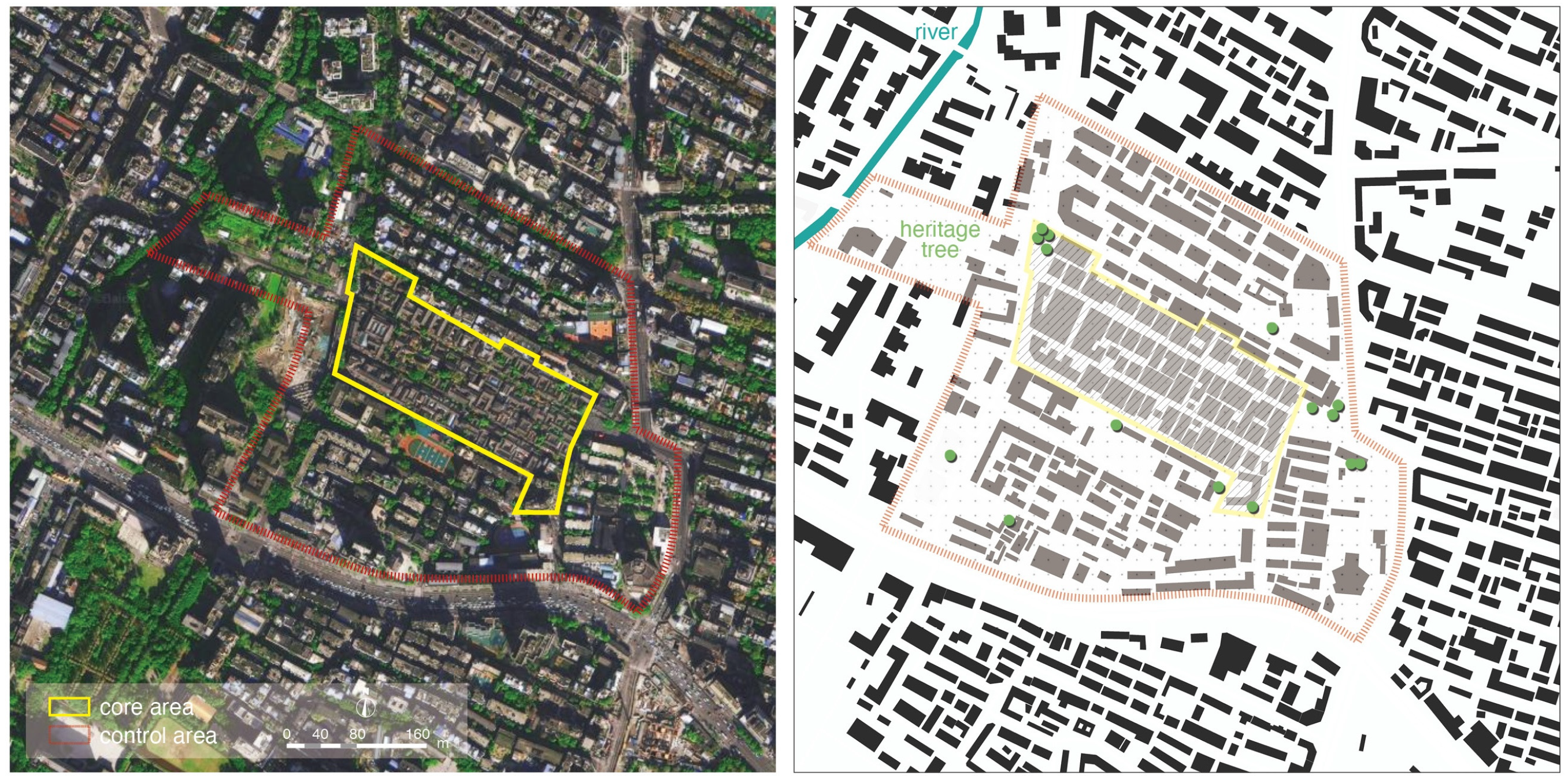
In 1994, Kuanzhai Alley exhibited a typical high-intensity, everyday-life-oriented residential community condition. The street-and-alley backbone remained stable, while secondary alleys and courtyard accessibility jointly supported a fine-grained network of daily activities. Spatial organization, therefore, leaned toward a highly inhabitable, fine-grained structure rather than a consolidated layout optimized for operations. This configuration was reinforced by the population scale and occupational structure at the time: The resident population was high and largely composed of local households, and the commercial mix was dominated by everyday services, such as groceries, repair shops, and teahouses. Both the user groups and temporal rhythms of use primarily served internal community needs.
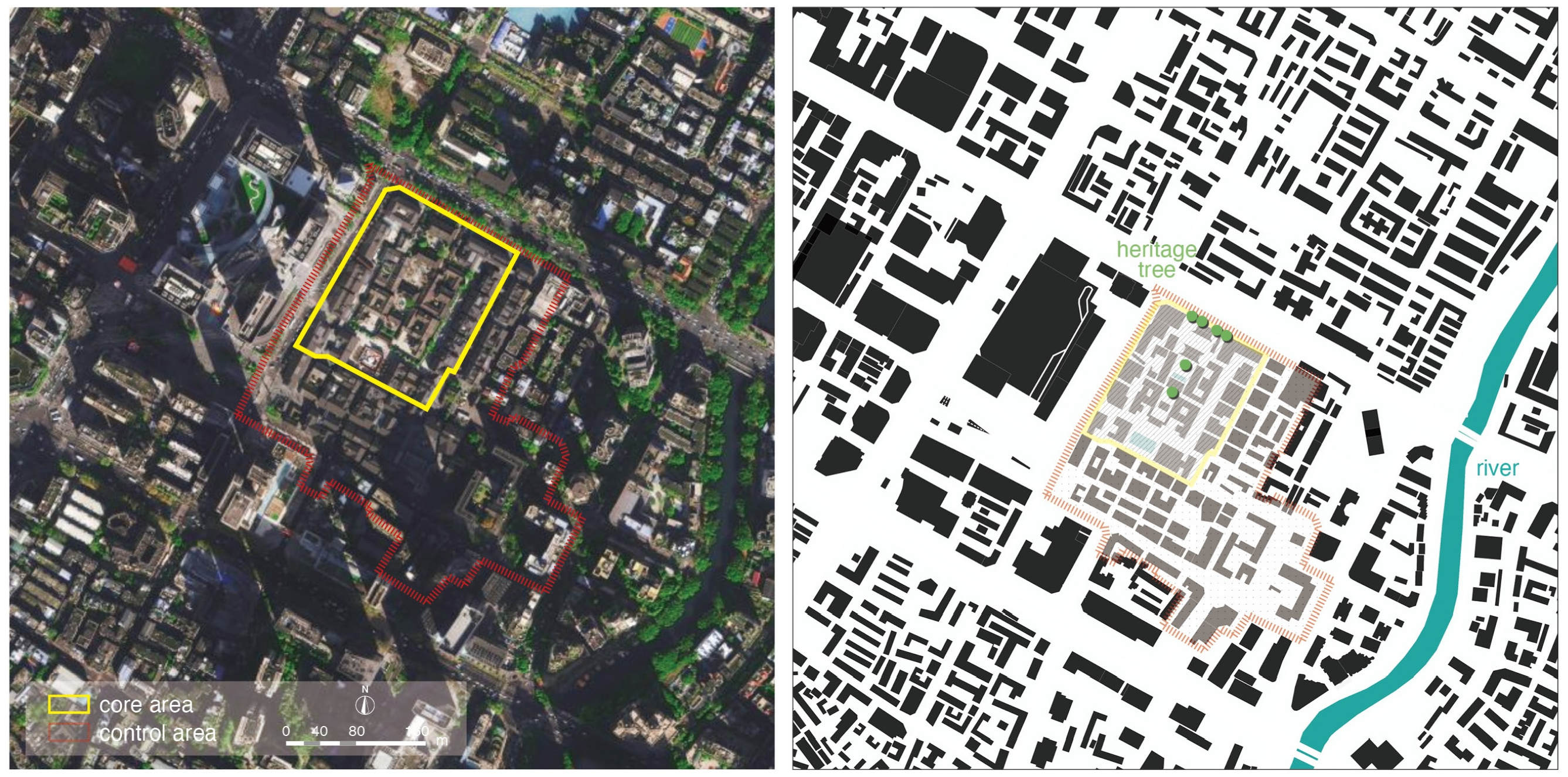
Over the same period, the Daci Temple historic district displayed a combined pattern of built-stock decline and weakened connectivity. Compared with earlier periods, the street-and-alley hierarchy and accessibility structure contracted markedly; public spaces and street frontages became less active. Together with declining residential capacity, the area approached a low-intensity, weak-growth form of everyday stability. Commerce remained centered on daily services—small eateries, barbers, hardware shops, and stalls—yet, under reduced scale and connectivity, these uses functioned more as compensatory maintenance for a declining community and generated limited appeal at the city-wide level. This cross-case contrast suggests that, prior to renewal interventions, the two districts occupied distinct baselines: a high-residential-intensity–high-everyday-density community condition versus a low-capacity–weakly connected decline condition. These structural baselines helped shape the subsequent divergence in regeneration choices.
More specifically, the divergence between the two renewal paths was rooted not only in different structural conditions but also in different inherited functional roles and social backgrounds. Kuanzhai Alley entered the renewal period as a courtyard-based, everyday-life-oriented residential quarter, in which local households, fine-grained alleys, and small-scale service commerce jointly sustained an internally oriented community structure. By contrast, the Daci Temple historic district historically functioned less as a purely residential enclave than as a religious-commercial node, where temple-related activities, marketplace exchange, and city-oriented movement were more closely intertwined. This difference is important for interpreting later regeneration choices: In Kuanzhai Alley, renewal could proceed by conserving the visible street-and-alley framework while reorganizing internal operational units and everyday-use structures; for the Daci Temple historic district, renewal was more readily driven toward redevelopment-led re-centralization, in which the visibility of cultural anchors and the attraction of commercial capital became the dominant organizing logic.
3.2.2. Key Time Point of 2025
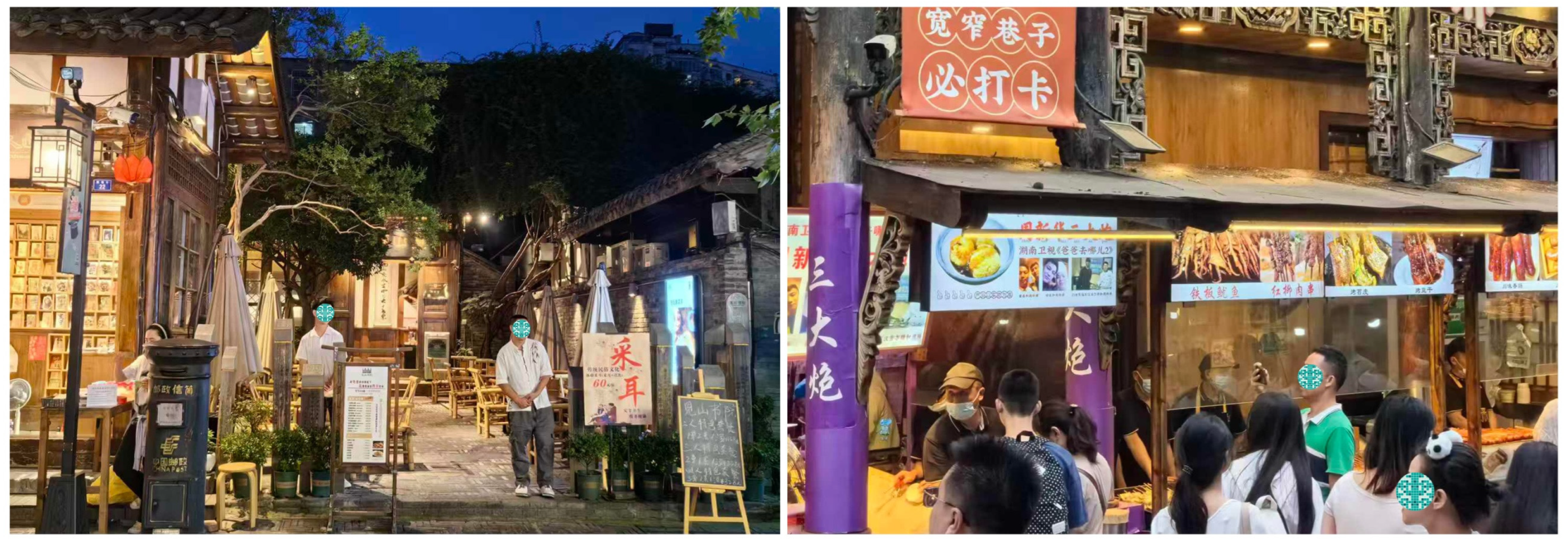
In 2025, Kuanzhai Alley reflects a highly staged, tourism-consumption-oriented regeneration outcome. The street-and-alley backbone and townscape appearance were largely retained, yet internal operational units were systematically consolidated. The inhabitable fine-grainedness embedded in courtyard and plot boundaries was continually compressed, shifting the area from a permeable everyday-life network toward a more controllable spatial arrangement geared to commercial operations. In parallel, the population structure underwent an abrupt, discontinuous shift: The permanent on-site resident population declined sharply, and the remaining resident base consisted mainly of business operation managers rather than indigenous households; the district therefore shifted from a resident-based community to a cultural-commercial arena driven largely by external consumption. The number of establishments and the intensity of commercial uses increased substantially and clustered, producing visible external vitality indicators, such as high pedestrian volumes and the night-time economy (
Figure 7). The social costs, however, are equally apparent. The outward displacement of residential functions significantly weakens continuity of community life, pointing to typical risks of renewal-induced gentrification and social-structural replacement. This population shift was driven not simply by demographic fluctuation but by the combined effects of tourism-oriented functional substitution, the consolidation of operational units, and the compression of inhabitable fine-grained courtyard and plot structures. As a result, community vitality became increasingly detached from stable residence and everyday mutual support and more dependent on externally generated consumption flows and short-duration use rhythms.
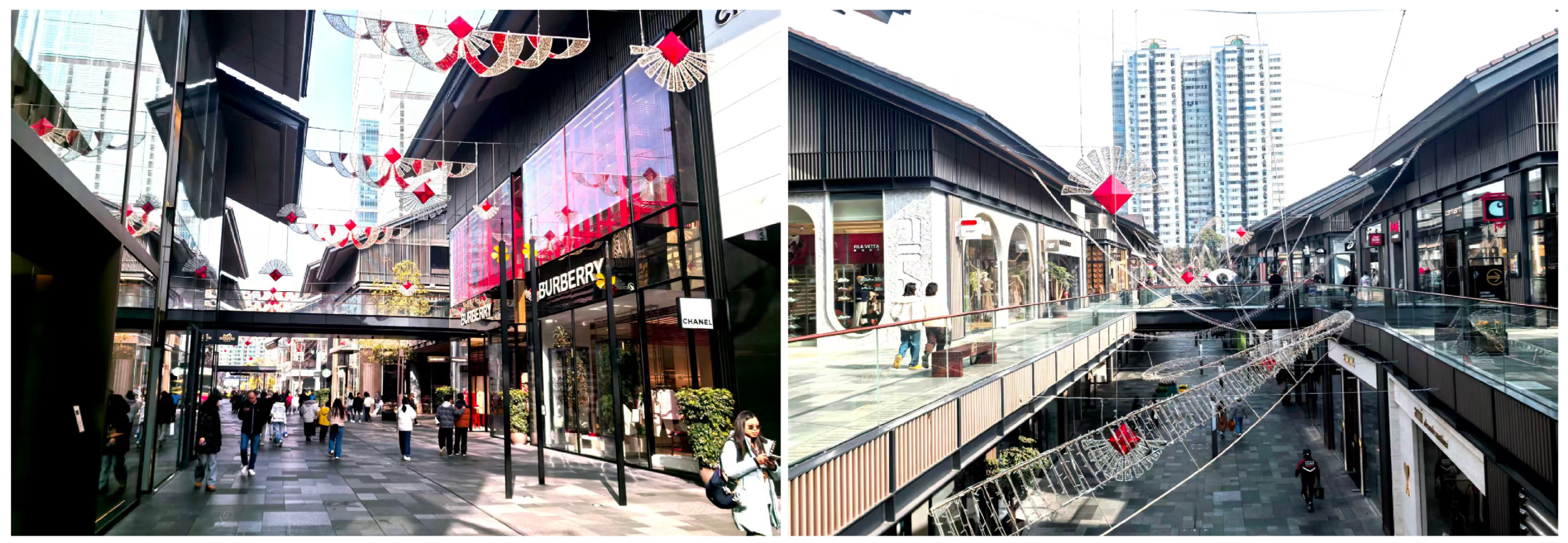
In 2025, the Daci Temple district reasserts centrality through redevelopment. An open, mixed-use commercial complex and a concentration of upscale uses strengthen landmark visibility and capital attraction (
Figure 8). Despite these phenomena, the resident population has fallen sharply, and vitality is generated mainly through frequent external consumption and short stays rather than through the everyday reproduction of a stable residential community. Here, resident decline was associated with redevelopment-led reorganization of the street–plot system, the replacement of low-intensity local services by upscale clustering, and the resulting reduction in conditions for ordinary long-term habitation. The social consequence is that the district’s vitality becomes more visible in commercial terms yet weaker in the sense of community structure, because routine neighborhood interaction, resident-based service demand, and locally embedded everyday practices are no longer reproduced at the same intensity.
Meanwhile, the juxtaposition of religious–cultural anchors with upscale consumption settings makes experiences of authenticity and place-based practices more likely to be overshadowed by curated narratives, increasing the district’s dependence on a single market logic. This comparison shows that growth in external vitality does not necessarily translate into stronger community vitality. Change management must therefore assess both visible spatial outcomes and the less visible costs to social continuity; otherwise, even when street spaces are repaired or rebuilt, a paradox can emerge—tangible renewal without everyday vitality.
Figure 8.
Commercial status of the Daci Temple historic district. Source: taken by the author.
Figure 8.
Commercial status of the Daci Temple historic district. Source: taken by the author.
3.2.3. Background Comparison of 1911 and 1933
The two districts’ divergent regeneration starting points are not determined by policy choices alone; they are also closely tied to their initial functional attributes and to the heritage narratives that can be (re)interpreted and mobilized from those attributes. In 1911, Kuanzhai Alley had almost no fixed commercial presence; only by 1933 did a limited number of distinctive establishments gradually emerge in a shop-front, dwelling-behind configuration, providing services beyond the immediate neighborhood. This indicates that its underlying historical orientation was primarily residential and community-based. Consequently, the later shift toward tourism consumption required highly interventionist spatial consolidation and symbolic production to achieve functional substitution, making disruptions to everyday continuity and resident withdrawal more likely. By contrast, the Daci Temple district already hosted multiple businesses in 1911, which—together with temple-fair activities—formed a city-facing setting for trade and services. By 1933, commercial activity further expanded and exhibited a coexistence of traditional commerce and modern services. This implies that its historical value could be more readily folded into a commercial–cultural landmark narrative; regeneration, therefore, tended to amplify centrality through capitalization and upmarketization, with the primary risks shifting toward the consumption-led rewriting of religious–cultural context and the displacement of place-based practices.
3.3. Synergistic Pathways of Holistic Conservation and Organic Renewal Under the HUL Concept and Renewal Zoning
Synergy between holistic conservation and organic renewal should not depend on uniform, one-size-fits-all controls at a single regulatory intensity. Instead, zoning should differentiate both types of value-bearing elements and the sources of vitality mechanisms, enabling conservation priorities, renewal approaches, and operational constraints to be tailored to local conditions [
47]. Evidence from Kuanzhai Alley suggests that persistence of the street-and-alley backbone does not automatically sustain everyday-life structures; internal-unit consolidation and resident withdrawal constitute the dominant risks. Zoning should therefore prioritize safeguarding fine-grained spatial structure, strengthening public-realm provision, and reinstating everyday use. Evidence from the Daci Temple district indicates that structure-level reconfiguration has created new consumption settings, yet the value narrative depends more critically on maintaining heritage anchors and a system for contextual interpretation. Zoning should thus emphasize the recognizability and experiential accessibility of religious–cultural nodes, while paying attention to the displacement effects of upscale clustering on the public realm and place-based practices. Building on these differences, this study proposes a shared set of zoning-type prototypes for spatial representation while differentiating their spatial targeting and governance tools in application.
It should be noted that the renewal zoning proposed here is conceived as change-management-oriented prototypes that organize governance priorities and key constraints, rather than being directly equivalent to statutory regulatory zoning under detailed control plans. Zoning allocation follows a minimal rule set linking evidence, mechanisms, and prototypes: First, boundaries are preferentially delineated along cross-temporally stable street-and-alley backbones, major plot boundaries, or clearly identifiable frontage/interface breaks to ensure legibility and auditability; second, heritage anchors and their associated spatial sequences are prioritized within heritage core and high-sensitivity zones, with frontage intervention and functional substitution treated as key objects of constraint; third, areas retaining traces of everyday life and offering conditions for strengthening the public realm are assigned to townscape-continuity and everyday-life repair zones, using everyday services and public space as the principal governance levers; fourth, primary streets and gateway nodes with concentrated commercial intensity and continuous frontages are classified as commercial–cultural frontage regulation zones, constrained through rules on commercial composition, public-realm boundaries, and visitor-flow organization; fifth, corridors that transmit peripheral development pressure and key areas of traffic organization are included in coordinated control and buffer–transition zones, where impacts on the core are mitigated through the integration of the active-mobility system, traffic capacity, and surrounding development intensity. Parameterizing thresholds and refining statutory boundaries require further calibration in relation to property rights, implementing actors, and the planning regulatory system. Here, the researcher only provides the auditable prototype logic and schematic spatial representation (
Table 9).
The translation from diagnosis to zoning did not rely on morphological evidence alone. The zoning assignment was based on a joint reading of the spatial level at which change occurred and the socio-economic direction of that change. Morphology identified whether change mainly affected the street skeleton, plot/courtyard structure, frontage interface, connectivity, or anchor-context relations, whereas socio-economic evidence indicated whether the associated social outcome was resident stability, resident withdrawal, everyday-service persistence, externally oriented commercial clustering, or rising exclusion pressure. Where the street skeleton remained legible but resident population declined sharply and the commercial mix shifted toward tourism- and experience-oriented clustering, the area was treated not simply as preserved but as requiring townscape-continuity/everyday-life repair and frontage regulation. Where anchor integrity remained important but contextual accessibility and use inclusiveness were weakened by upscale concentration, the priority shifted toward heritage-core protection and coordinated buffer control. In this sense, morphology identifies where and how change is occurring, while socio-economic evidence indicates whether that change sustains or erodes community functions, publicness, and locally embedded practices; zoning decisions are made only through their combined interpretation.
Differential emphasis is required when applying the four zoning types to the two districts. These differences are jointly shaped by which morphological levels have been affected by change and how the structure of vitality has been transformed. For Kuanzhai Alley, the persistence of the street-and-alley backbone provides a relatively clear conservation baseline. Yet the consolidation of internal operational units and the withdrawal of residents create a risk of façade-level retention alongside the erosion of everyday life. Accordingly, the heritage core and high-sensitivity zone should treat courtyard-scale structure and the continuity of street frontages as primary targets for control, preventing further plot consolidation from eroding fine-grained spatial structure and the diversity of spatial settings. The townscape-continuity and everyday-life repair zone should explicitly prioritize reinstating residential/everyday functions and strengthening the public realm, building an everyday-use structure that complements the cultural-tourism economy. The commercial–cultural frontage regulation zone should curb homogenization and excessive appropriation by diversifying the commercial mix and safeguarding public space. The coordinated control and buffer–transition zone should focus on visitor management and the active-mobility network such that pressure on the core can be spatially redistributed and moderated.
For the Daci Temple historic district, renewal has already reached the level of restructuring street-and-alley networks and plot organization. Governance priorities should therefore shift from celebrating post-reconfiguration functional prosperity toward rebuilding heritage legibility and safeguarding contextual integrity. The heritage core and high-sensitivity zone should use religious–cultural nodes and their associated spaces as anchors, prioritizing narrative continuity and experiential accessibility and preventing commercial frontage interventions from obscuring the sacral character of key places. The townscape-continuity and everyday-life repair zone should provide more inclusive everyday services and public activity spaces, mitigating potential social exclusion and temporal homogenization produced by upscale clustering. The commercial–cultural frontage regulation zone should explicitly manage the displacement effects of upscale uses on place-based practices and the public realm, reducing the district’s dependence on a single market logic for value realization. The coordinated control and buffer–transition zone should integrate commercial spillover management, traffic capacity, and landscape-corridor continuity, thereby stabilizing the environmental context of cultural nodes.
To render the zoning strategy assessable, this study further specifies monitoring indicator domains for each zone, operationalizing the HUL closed loop of change management. For Kuanzhai Alley, monitoring should prioritize indicators that capture the reinstatement of everyday life, including the intensity of plot consolidation, the proportion of public space, the extent of resident population recovery, and the diversity of the commercial mix. For the Daci Temple district, monitoring should focus on accessibility to heritage anchors, the sustained use of traditional activity spaces, the inclusiveness of the use structure, and—at the control-zone level—changes in traffic capacity and surrounding development intensity. By coupling zoning with indicators, holistic conservation moves beyond boundary delineation, and organic renewal is no longer reduced to project delivery. Instead, both can be coordinated through a unified evidence framework, supporting a more robust governance pathway that sustains the city’s cultural roots while responding to contemporary development needs.
To facilitate practical implementation, the proposed renewal-zoning prototypes can be embedded into an iterative district-level governance workflow rather than treated as standalone academic maps. In practice, the workflow may proceed in five linked steps. First, planning and heritage authorities delineate provisional zoning units on the basis of the morphological-evidence diagnosis and the dominant regeneration risks identified in each area. Second, these prototypes are translated into implementable control tools, such as conservation-plan annotations, urban design guidance, frontage-management rules, and project-review checklists. Third, proposed interventions are assessed zone by zone according to the corresponding objectives, key constraints, and preferred directions of change such that demolition, plot amalgamation, functional substitution, interface redesign, and traffic organization are no longer reviewed in an undifferentiated manner. Fourth, the indicator domains proposed in this study can be incorporated into periodic monitoring to assess whether actual changes remain consistent with zone objectives. Fifth, where monitoring reveals sustained deviation, the intensity of control, permitted uses, or public-space requirements can be adjusted through a feedback mechanism. In this sense, the zoning proposed here is not a substitute for statutory planning but a decision-support layer that helps align heritage conservation, urban renewal, and tourism management within existing governance procedures.
In terms of implementation, the proposed monitoring indicators should be embedded into the statutory planning system in a differentiated rather than uniform manner. Indicators with relatively clear spatial and regulatory implications—such as plot-consolidation intensity, public-space proportion, frontage continuity, traffic capacity, and surrounding development intensity—can be translated into control items or review parameters within conservation plans, detailed regulatory plans, urban design guidance, and project approval checklists. By contrast, indicators that primarily capture social and cultural outcomes—such as resident recovery, commercial-mix diversity, accessibility to heritage anchors, inclusiveness of use structure, and continuity of traditional activity spaces—are better treated as district-level monitoring and evaluation indicators, to be reviewed periodically rather than imposed as fixed statutory quotas. In this way, the monitoring framework proposed here does not seek to replace the existing statutory indicator system; instead, it supplements it by linking binding spatial controls with adaptive performance monitoring, thereby making heritage-sensitive renewal both more assessable and more adjustable over time.
In practical terms, these zoning priorities should be translated into project-review criteria. For Kuanzhai Alley, stricter review should be applied to excessive courtyard amalgamation, frontage homogenization, and the erosion of resident-serving functions. For the Daci Temple district, the review should prioritize the protection of anchor–sequence–context relations; the continuity of traditional activity spaces; and the control of frontage intervention, traffic pressure, and surrounding development intensity. Thus, the zoning types are operationalized through district-specific combinations of control priorities, review criteria, and monitoring focuses.