Article

Port Green Investment Based on Non-Cooperative–Cooperative Biform Game

1
School of Business, Beijing Technology and Business University, Beijing 100048, China
2
College of Business Administration, Capital University of Economics and Business, Beijing 100070, China
*
Author to whom correspondence should be addressed.
Sustainability 2026, 18(8), 4036; https://doi.org/10.3390/su18084036
Submission received: 22 March 2026 / Revised: 15 April 2026 / Accepted: 16 April 2026 / Published: 18 April 2026

Abstract

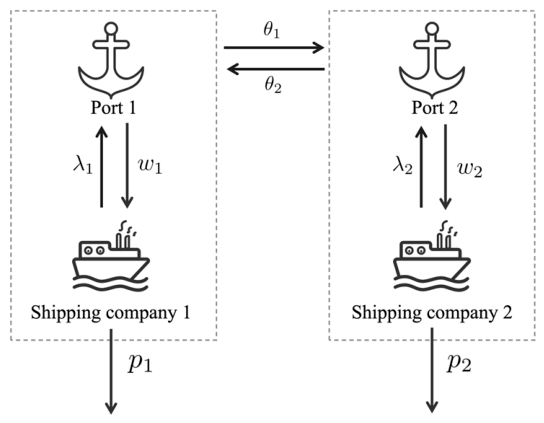
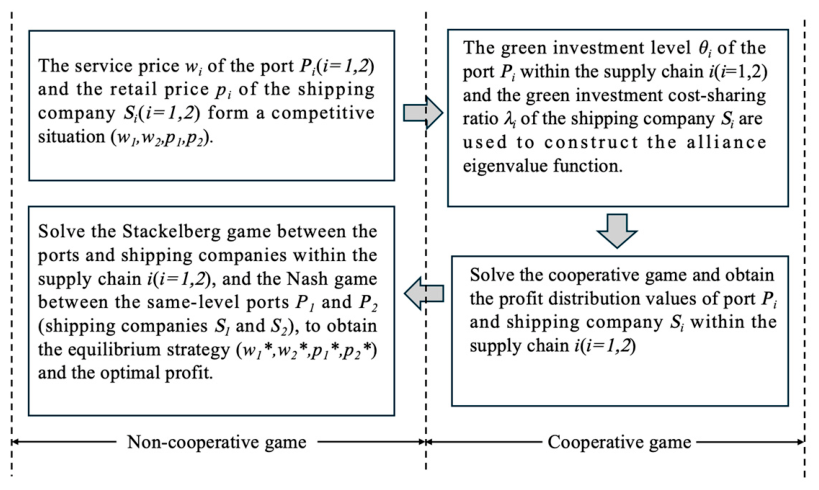
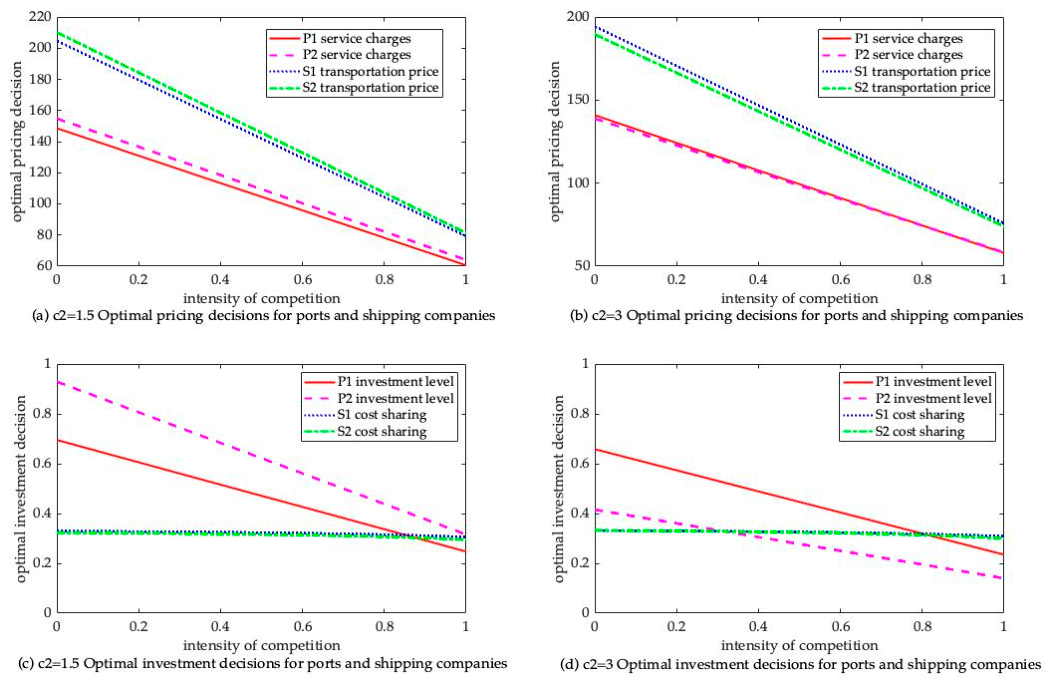
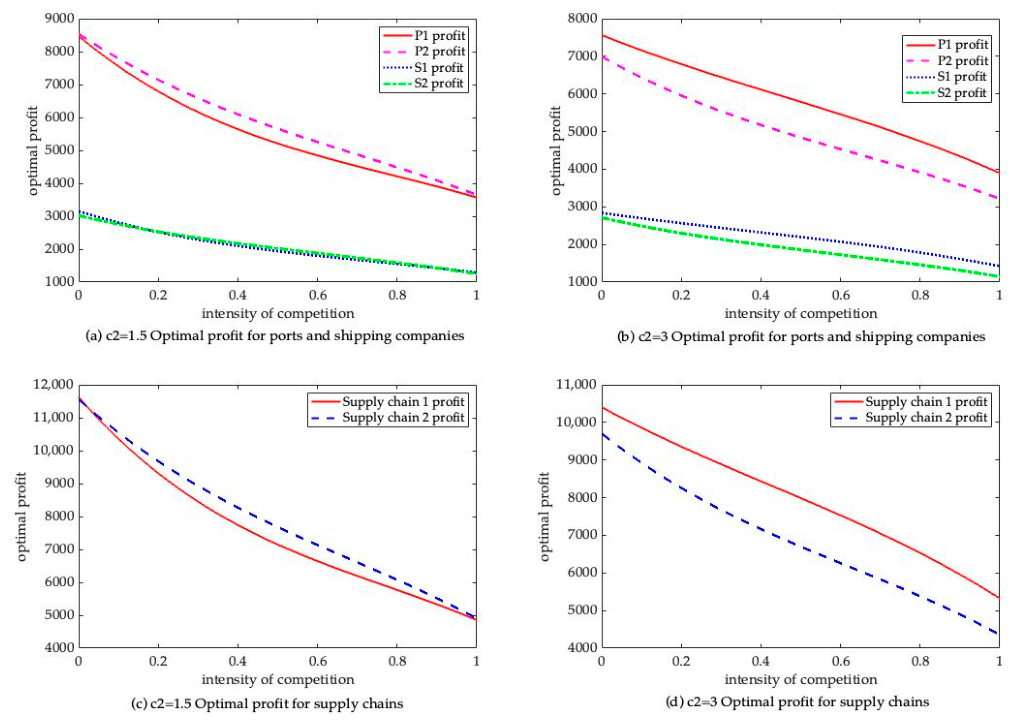
Carbon emission regulations and customers’ green preferences require ports and shipping companies to develop green services, but green investments entail significant costs. Vertical alliance cooperation between ports and shipping companies through sharing costs can address this issue. Most studies use non-cooperative game to analyze the competitive relationship between ports and shipping companies. Although such research can capture price competition, they struggle to address the distribution of cooperative benefits within an alliance. They also fail to simultaneously reflect the coexistence of competition and cooperation. So, we constructed a non-cooperative–cooperative biform game to analyze green investment under vertical alliance. In the non-cooperative stage, the model captures vertical price competition between ports and shipping companies, as well as horizontal competition among supply chains. In the cooperative stage, the Shapley value is used to allocate the coalition profits from green investment cooperation. The results indicate that alliance cooperation can promote the green development of shipping. Moderate green competition can promote the green development of shipping. Route substitution competition will increase service prices and green investment level and reduce the cost-sharing ratio for shipping companies. Port congestion prompts ports to increase green investment level. These findings offer references for the green collaborative development of ports and shipping companies across different countries, thereby enriching the research framework for global sustainable development in shipping.
Keywords: port competition; vertical alliance; pricing strategy; green development port competition; vertical alliance; pricing strategy; green development