1. Introduction
The global shift toward environmentally regulated trade has fundamentally reshaped the governance of land-based commodities, transforming sustainability from a voluntary commitment into a prerequisite for market access. Over the past decade, the European Union has emerged as one of the most assertive actors in defining global environmental norms, culminating in the adoption of the EU Deforestation-Free Regulation (EUDR). Designed to prevent the entry of agricultural products associated with deforestation and forest degradation, the EUDR extends EU regulatory authority beyond its borders by requiring plot-level traceability, geolocation, and proof of legality in accordance with producer-country laws [
1,
2,
3]. Although presented as a response to global ecological crises, the regulation also carries significant socio-political implications for producing countries whose development trajectories remain closely tied to agricultural exports [
4]. In this sense, the EUDR is not merely an environmental instrument; it is also a governance device through which standards of legitimacy, accountability, and market inclusion are increasingly defined at the transnational level.
Indonesia’s palm oil sector lies at the center of this regulatory realignment. As the world’s largest palm oil producer, Indonesia depends heavily on the sector for export earnings, rural employment, and regional development, with millions of livelihoods directly or indirectly linked to palm oil production. At the same time, palm oil has become one of the most contested commodities in global environmental politics, frequently associated with deforestation, biodiversity loss, and land-use change [
5,
6,
7]. These controversies have elevated palm oil from an economic commodity into a site of geopolitical and normative contestation, where trade, sustainability, and sovereignty intersect. Disputes between the European Union and Indonesia over palm oil governance illustrate how environmental regulation has become intertwined with questions of legitimacy, power asymmetry, and national dignity [
8]. Accordingly, the EUDR should be understood not only as a technical trade requirement, but also as a regulatory intervention that reorders power relations across global commodity chains.
The governance expectations introduced by the EUDR intersect unevenly with Indonesia’s domestic institutional landscape. Requirements for traceability, legality verification, and deforestation-free production place substantial demands on regulatory systems characterized by fragmented authority, overlapping mandates, and uneven capacity across ministries and levels of government. Although Indonesia has developed national sustainability instruments such as the Indonesian Sustainable Palm Oil (ISPO) certification scheme, alignment between domestic governance arrangements and EUDR requirements remains partial. Previous studies on Indonesian palm oil governance suggest that sustainability policies are often articulated formally, yet their implementation remains uneven due to institutional fragmentation, limited resources, and competing development priorities [
9,
10]. This gap between policy ambition and implementation capacity is particularly consequential in sectors where compliance depends on the participation of dispersed and resource-constrained smallholders.
North Sumatra, particularly the districts of Serdang Bedagai and Simalungun, provides a critical empirical setting in which to examine these dynamics. As one of Indonesia’s oldest palm oil-producing regions, North Sumatra is characterized by deeply entrenched smallholder-dominated production systems, fragmented landholdings, semi-formal tenure arrangements, and dense networks of intermediaries. Fresh fruit bunches typically pass through layers of middlemen before reaching mills, embedding production within trust-based and relational market structures rather than transparent, vertically integrated supply chains. Such configurations are widely documented in smallholder-dominated commodity systems and play a central role in shaping governance outcomes [
11,
12,
13]. In these contexts, commodity circulation is governed not only by formal rules and official documentation, but also by social ties, practical convenience, and negotiated understandings of legitimacy.
For many smallholders in Serdang Bedagai and Simalungun, market access is mediated less by formal supply-chain visibility than by relationships with local traders who offer immediate cash payments, flexible pricing, and logistical convenience. In this setting, EUDR demands for polygon-based geolocation and documented legality collide with everyday realities in which land certificates are often absent, plot boundaries are socially recognized rather than administratively defined, and local bureaucracies face persistent capacity constraints. Similar tensions have been identified across sustainability certification and traceability initiatives, where global requirements frequently clash with informal tenure systems and limited smallholder capacity [
14,
15,
16]. Rather than entering a neutral administrative environment, the EUDR is thus filtered through livelihood systems in which legal formality, cadastral clarity, and traceability infrastructure cannot be taken for granted.
These conditions generate uncertainty and anxiety, particularly fears of exclusion from export-linked supply chains and concerns that long-standing livelihoods may be reclassified as illegal under new regulatory criteria. Such concerns reflect broader structural inequities embedded in global commodity chains, where compliance costs and risks are disproportionately shifted toward upstream actors with limited access to information, capital, and technology [
17,
18]. While deforestation-free regulations are framed as universal environmental safeguards, local actors often perceive them as externally imposed standards that insufficiently account for historical inequalities and institutional constraints in producing regions [
19,
20]. From this perspective, the EUDR is not experienced solely as an environmental measure, but as a potentially exclusionary regime of market discipline that may redistribute risks downward while leaving structural asymmetries intact.
Against this backdrop, the implementation of the EUDR in Indonesia’s palm oil sector exposes a fundamental tension between globally articulated environmental norms and the lived socio-economic realities of smallholder producers. While the European Union frames the EUDR as a universal instrument to curb deforestation through enhanced traceability and legality verification, the regulation enters governance contexts shaped by distinct institutional logics, agrarian histories, and livelihood structures [
1,
2]. In Serdang Bedagai and Simalungun, palm oil production is embedded in agrarian systems characterized by fragmented landholdings, semi-formal or informal tenure, reliance on intermediaries, and household-based labor arrangements. These conditions underpin a specific habitus through which smallholders interpret risk, authority, and obligation [
15,
21]. When the EUDR mandates polygon-level geolocation, documented legality, and transparent chains of custody, such requirements are not assessed solely on technical grounds. Instead, they are interpreted through the lens of livelihood precarity, historical experiences of bureaucratic exclusion, and economic practices that prioritize trust-based exchange and immediate cashflow [
14,
16]. As a result, the regulation is frequently perceived as burdensome, externally imposed, and disconnected from local realities.
This disjuncture raises a broader theoretical problem concerning environmental norm diffusion. Dominant models of global environmental governance often assume relatively linear norm cascades from international institutions to national and local actors. However, such models tend to underestimate the agency of local actors and the role of socio-cultural logics in shaping regulatory outcomes [
18,
22]. In practice, farmers, traders, cooperatives, and local officials do not passively absorb global norms; they actively reinterpret, negotiate, adapt, and at times resist them in ways that reflect local priorities and structural constraints, particularly in contexts characterized by informal tenure and intermediary-dominated value chains [
11,
12]. This suggests that the diffusion of global sustainability norms is neither automatic nor uniform, but contingent upon the interaction between transnational regulatory ambitions and locally embedded systems of meaning and practice.
A related dimension of the problem concerns policy decoupling, understood as the divergence between formal policy alignment and everyday implementation. In Indonesia, national and provincial authorities have articulated commitments to deforestation-free supply chains and strengthened sustainability instruments such as the ISPO scheme. Yet empirical studies consistently show limited progress in comprehensive smallholder registration, legality documentation, and interoperable traceability systems due to administrative bottlenecks, fragmented authority, and capacity constraints [
9,
10,
15]. Initiatives such as STDB registration and smallholder mapping are often implemented unevenly or symbolically, widening the gap between compliance-oriented discourse and lived practice. In such circumstances, formal alignment with global norms may coexist with limited substantive transformation on the ground, producing a governance landscape in which policy performance is measured more by symbolic conformity than by practical inclusion.
These dynamics are further complicated by the multi-level and polycentric nature of palm oil governance. Intermediaries remain central to smallholder market access in North Sumatra, operating through informal arrangements that fall outside the regulatory logic of the EUDR yet remain essential for livelihood security [
13]. Local governments, meanwhile, face uneven incentives and constrained capacity to translate global norms into locally viable practices [
9,
23]. This creates a core governance puzzle: if global environmental norms are formally adopted yet only partially enacted, should such outcomes be interpreted as implementation failures, compliance gaps, or as adaptive responses to structural constraints within multi-level governance systems [
24,
25]? Likewise, how do everyday practices of adaptation and resistance interact with institutional arrangements to produce persistent patterns of decoupling [
26,
27]? These questions are central to evaluating the fairness and legitimacy of imposing uniform regulatory standards across highly differentiated production systems [
19,
20].
The existing literature offers important insights into sustainability governance, traceability, and smallholder inclusion, yet several gaps remain. First, much of the discussion on the EUDR and deforestation-free supply chains has focused on compliance architecture, policy alignment, and trade implications, with less attention to how global norms are interpreted and contested in everyday agrarian settings. Second, studies of Indonesian palm oil governance have documented institutional fragmentation and uneven implementation, but have paid comparatively limited attention to how these governance problems are mediated by habitus and by the relational structures of intermediary-based supply chains. Third, while the concept of policy decoupling has been widely used to explain divergence between formal commitments and implementation outcomes, it has not been sufficiently connected to everyday resistance in smallholder-dominated commodity systems. Addressing these gaps is important because understanding how the EUDR interacts with local livelihood systems, institutional arrangements, and market structures is essential for assessing whether deforestation-free regulations can achieve environmental objectives without exacerbating social exclusion [
28,
29].
This study addresses that challenge by examining how global environmental norms embedded in the EUDR—particularly those associated with spatial traceability, legality verification, and due-diligence-based market access—are received, reinterpreted, negotiated, and resisted by local actors in smallholder-dominated palm oil landscapes in Serdang Bedagai and Simalungun, North Sumatra. In theoretical terms, the analysis is centered on two core lenses—everyday resistance and policy decoupling—to explain how EUDR-related pressures are negotiated across governance levels. Habitus serves as a supporting concept for interpreting how smallholders and other local actors perceive risk, obligation, and livelihood threat, while norm diffusion provides the broader governance context within which these responses emerge. Rather than treating resistance as simple non-compliance, the study conceptualizes it as an adaptive and relational process through which actors seek to preserve livelihood security, negotiate institutional demands, and buffer themselves against exclusionary regulatory pressures. This perspective helps explain why formal sustainability commitments often produce uneven implementation and why inclusive governance requires more than technical compliance mechanisms. Accordingly, this study is guided by the following research questions:
- (RQ1)
How does habitus shape smallholder perceptions of and responses to EUDR requirements in Serdang Bedagai and Simalungun?
- (RQ2)
How do discursive, practical, and institutional forms of everyday resistance emerge in smallholder-dominated palm oil supply chains in response to the EUDR?
- (RQ3)
How does policy decoupling manifest across governance levels and actor networks in the implementation of EUDR-related requirements in Indonesia’s palm oil sector?
- (RQ4)
How do these dynamics open or constrain pathways toward more inclusive and context-sensitive sustainability governance?
By addressing these questions, the article moves from the micro-level of perception and everyday practice to the meso- and macro-level dynamics of institutional interaction, governance fragmentation, and regulatory adaptation. More specifically, the study clarifies what the EUDR changes relative to earlier legality and sustainability frameworks such as ISPO and SVLK: it introduces a more spatially explicit and externally driven compliance logic through polygon-level geolocation, cut-off-date verification, and buyer-mediated due diligence. The novelty of the article therefore lies not in revisiting familiar governance constraints, but in showing how these long-standing conditions are reconfigured under the EUDR into more specific forms of selective disclosure, temporal reframing, cooperative buffering, and multi-level policy decoupling. The study thus contributes not only to debates on deforestation-free governance and palm oil sustainability, but also to broader discussions on how global environmental norms are translated, contested, and selectively enacted in the Global South.
The remainder of this article is structured as follows.
Section 2 describes the materials and methods employed in the study.
Section 3 presents the empirical findings.
Section 4 discusses the findings in relation to sustainability governance, smallholder inclusion, and policy design.
Section 5 concludes by highlighting the study’s principal contributions and offering directions for future research and policy.
2. Materials and Methods
This study employs a qualitative-dominant, multi-level research design to examine how the EUDR is interpreted, negotiated, and enacted across governance scales in Indonesia’s palm oil sector. A qualitative approach is appropriate for capturing how global environmental norms are experienced, contested, and translated in everyday practice, particularly in contexts characterized by informal institutions, heterogeneous actors, and uneven regulatory capacity [
21,
22].
2.1. Study Area
Empirical fieldwork was conducted in the regencies of Serdang Bedagai and Simalungun, North Sumatra Province, Indonesia. These sites were selected because of their long-established palm oil production systems and high concentration of independent smallholders. Both regencies represent typical smallholder-dominated value chains characterized by fragmented land tenure, reliance on intermediaries, and limited formal traceability, conditions widely documented in Indonesian palm oil regions [
11,
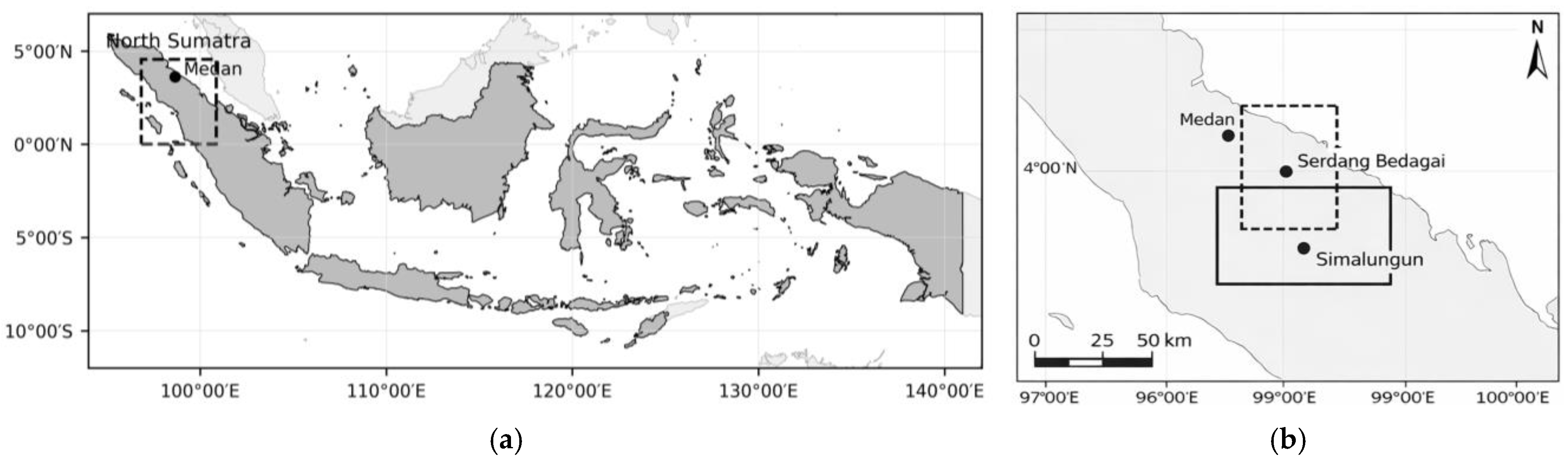
15]. Geographically, the study area is situated within North Sumatra Province, as illustrated in
Figure 1.
The approximate central coordinates of the two study regencies are 2°57′00″ N, 99°03′30″ E for Simalungun and 3°23′47.8″ N, 99°01′41.5″ E for Serdang Bedagai, calculated from the midpoint of their published administrative coordinate extents.
Figure 1 shows the location of North Sumatra within Indonesia and the location of the study regencies of Serdang Bedagai and Simalungun within the province. These regencies provide an appropriate setting for examining how global sustainability norms are interpreted and implemented within locally embedded agrarian and market structures, particularly in contexts where smallholder production, institutional fragmentation, and traceability constraints remain significant.
2.2. Analytical Framework
This study is analytically centered on everyday resistance and policy decoupling as the two principal lenses for interpreting how EUDR-related governance pressures are received, negotiated, and enacted in smallholder contexts. To situate these dynamics across governance scales and actor networks, the analysis further draws on Multi-Level Governance (MLG), Polycentric Governance, and the Environmental Rule of Law (EROL) as supporting perspectives. As shown in
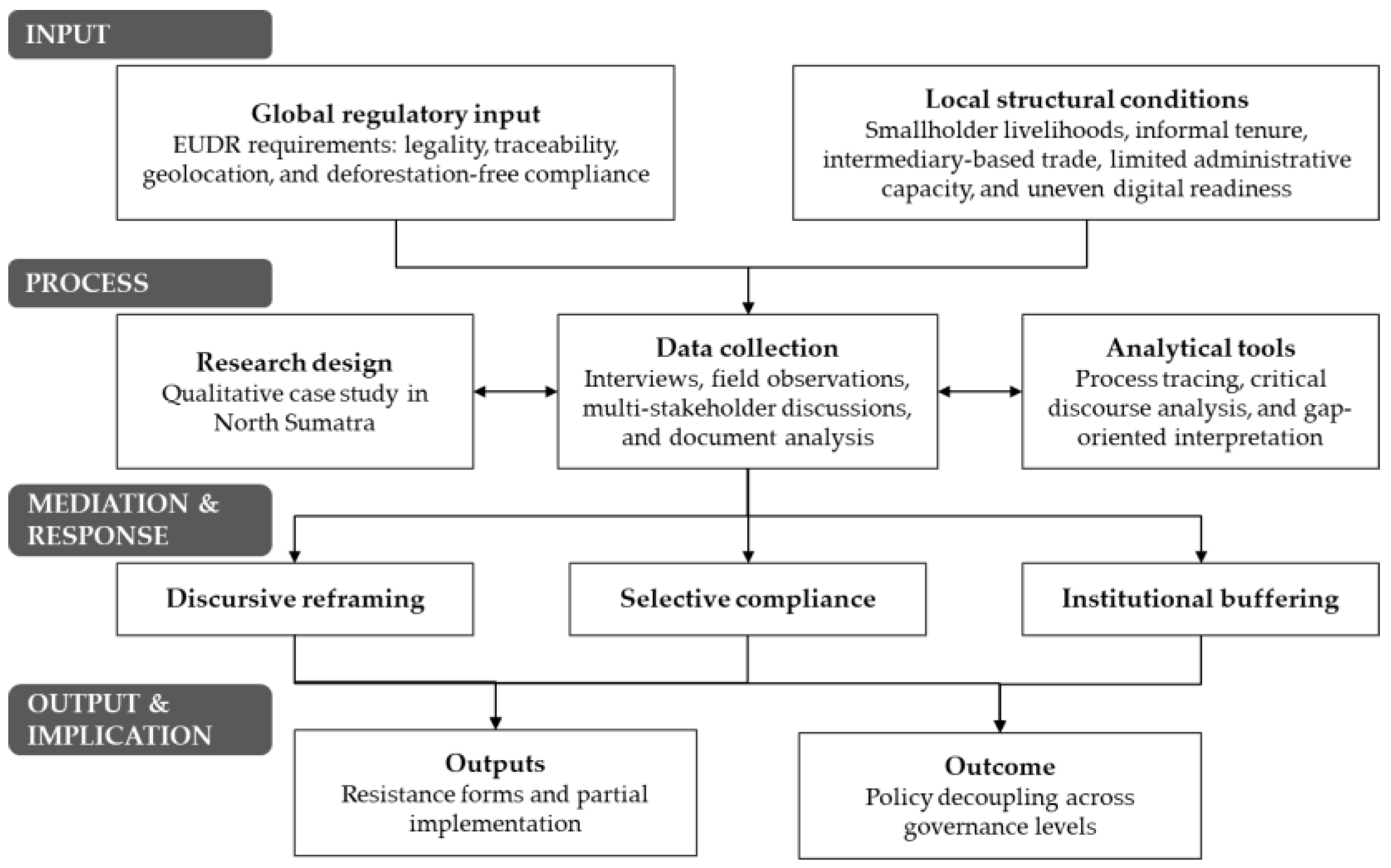
Figure 2, the framework traces the interaction between global regulatory inputs and local structural conditions, the mediating processes through which these are translated, and the resulting forms of response and policy decoupling.
MLG is used to analyze how authority and regulatory pressure move vertically across global, national, provincial, district, and local levels, thereby producing layered and often fragmented pathways of implementation [
23]. This perspective is particularly relevant for understanding how a transnational regulatory instrument such as the EUDR is translated into domestic and subnational governance settings that differ substantially in institutional capacity and administrative reach. From the perspective of the framework, MLG helps explain how regulatory expectations originating at the transnational level enter national and subnational governance processes, where they are reinterpreted and unevenly operationalized.
Polycentric Governance complements this perspective by recognizing that authority is distributed across multiple and overlapping centers, including mills, traders, cooperatives, certification bodies, and state agencies, none of which exercises full control over compliance outcomes [
30,
31]. In smallholder-dominated palm oil systems, governance is therefore shaped not only by state regulation, but also by market actors, intermediary networks, and localized coordination mechanisms that influence how sustainability requirements are interpreted and enacted in practice. This perspective is especially important for understanding the local structural conditions and mediating processes through which compliance is negotiated, adapted, or buffered in everyday governance.
The EROL perspective adds a normative dimension by assessing how fairness, procedural inclusion, and equity shape the perceived legitimacy of the EUDR in smallholder contexts [
29,
32]. This is important because the effectiveness of deforestation-free regulation depends not only on technical compliance, but also on whether the regulatory framework is regarded as legitimate, feasible, and socially just by those expected to comply with it. In this respect, EROL helps explain why global sustainability rules may generate different forms of response, including resistance, selective compliance, or institutional buffering, when they are perceived as insufficiently attentive to local realities.
Taken together, these supporting perspectives help situate the study’s core analysis of everyday resistance and policy decoupling within the institutional complexity and normative tensions that arise when global environmental standards encounter unequal local capacities, informal tenure systems, intermediary-based markets, and livelihood dependencies. This analytical configuration also provides an organizing structure for the research process, linking regulatory and structural inputs to field-based observation and analysis, and ultimately to the identification of mediating responses and policy outcomes.
2.3. Data Collection
Data collection was conducted between September and November 2025 and drew on four primary sources. First, in-depth semi-structured interviews were conducted with a purposively selected set of respondents representing key actor categories in palm oil governance and supply-chain practice. In total, the study involved 30 individual interview respondents and 2 group respondents. The individual respondents comprised 8 representatives from the Indonesian central government, 8 from local government, 2 intermediaries, 5 representatives from palm oil mills supplying export-oriented refineries, and 7 representatives from Indonesian non-governmental organizations (NGOs). In addition, the study included 1 farmer group respondent and 1 cooperative/KUD group respondent.
Respondents were selected based on their demonstrated relevance, experience, and institutional involvement in palm oil-related issues. To enhance the quality and credibility of the data, minimum experience thresholds were applied across actor groups. Government officials and national-level NGO respondents each had no less than eight years of experience in overseeing, regulating, or engaging with palm oil governance issues. Industry respondents, particularly those representing palm oil mills supplying export-oriented refineries, had at least ten years of professional experience in the sector. Intermediaries, cooperative/KUD leaders, and field-level NGO actors had a minimum of three years of direct involvement in palm oil-related activities. Farmer respondents were drawn from households with at least two generations of involvement in oil palm cultivation, in order to capture accumulated livelihood experience and intergenerational knowledge of the sector.
In this sense, the sample was designed not as a general survey of all stakeholder positions, but as a purposive qualitative selection of respondents with substantive knowledge of palm oil governance and practice. This approach is consistent with qualitative research that emphasizes information-rich cases, triangulation, and analytical depth rather than statistical representativeness. Hennink and Kaiser [
33], in their systematic review of empirical tests of saturation in qualitative research, found that studies using empirical qualitative data often reached saturation within 9–17 interviews, especially in studies with relatively homogeneous populations and more focused objectives. In addition, comparable interview-based studies in palm oil governance and sustainability have employed similarly scaled samples, including de Vos et al. [
34], who conducted interviews with 18 RSPO-certified independent smallholder groups and 9 certification facilitators in Indonesia, and Brizuela-Torres et al. [
35], who used 30 stakeholder interviews in Peru’s oil palm sector.
These interviews explored perceptions of EUDR requirements, experiences with legality and traceability initiatives, and everyday strategies of compliance, adaptation, and resistance. Particular attention was given to how respondents understood geolocation, legality verification, deforestation-related obligations, and market access risks, as well as how they assessed the practical feasibility and fairness of compliance in smallholder-dominated settings.
Second, direct field observations were undertaken to document production practices, trading arrangements, and interactions among farmers, intermediaries, cooperatives, and local institutional actors, thereby allowing triangulation between stated perceptions and observed behavior. Third, multi-stakeholder discussions at the district level generated insights into institutional coordination, capacity constraints, and implementation challenges across agencies, reflecting the fragmented governance environment typical of decentralized natural resource management [
9,
10]. Fourth, document analysis covered EU legal texts related to the EUDR, Indonesian regulatory instruments including ISPO and STDB guidelines, district-level implementation documents, and corporate sustainability disclosures. Indonesia’s experience with legality verification systems such as SVLK also served as an important domestic reference for understanding how legality-based governance instruments are implemented and contested in practice [
36].
2.4. Data Analysis
The analytical process proceeded in three interrelated stages. First, all qualitative materials from interviews, field observations, multi-stakeholder discussions, and documentary sources were organized by actor group, governance level, and type of source. Interview notes and transcripts were read repeatedly to identify recurring issues related to legality, traceability, deforestation-free production, market access, administrative capacity, and livelihood concerns. At this stage, process tracing was used to map how EUDR-related obligations travel across governance levels and to identify critical junctures at which norms are reinterpreted, delayed, or selectively implemented [
23]. This stage was used to trace how regulatory expectations were translated as they moved from transnational and national arenas into provincial, district, and local implementation settings, and to identify where implementation became fragmented, weakened, or only partially operationalized in practice.
Second, Critical Discourse Analysis (CDA) was applied to interview transcripts, group discussion notes, field notes, and policy documents to examine how actors framed sustainability, legality, and deforestation-free production, and how such narratives were used to legitimize, negotiate, or contest regulatory demands [
37]. The coding process combined CDA with thematic analysis and proceeded iteratively. Interview and discussion materials were first transcribed or consolidated into detailed field notes and then read repeatedly. Relevant passages were segmented into meaning units and coded to identify recurring terms, expressions, narrative framings, and issue clusters. These coded units were subsequently examined through three interrelated CDA dimensions: the textual dimension, focusing on key terms, recurring expressions, framing devices, and evaluative language; the discursive-practice dimension, focusing on how narratives were produced, circulated, and mediated across actors and institutions; and the broader socio-cultural dimension, focusing on how those narratives were embedded in livelihood realities, power relations, market structures, and governance conditions.
Within these dimensions, thematic analysis was used to identify recurrent patterns related to legality, deforestation, sustainability, traceability, dissemination practices, power relations, market pressure, state-centered discourse, and livelihood vulnerability. Codes were first applied at the level of meaning units, then compared across actor groups and source types, and finally refined into higher-order interpretive categories, including discursive reframing, practical adaptation or resistance, and institutional buffering. Thematic saturation was assessed progressively through repeated comparison across interviews, group discussions, field observations, and documentary materials, and was considered to have been reached when additional materials no longer generated substantially new themes, but instead confirmed, elaborated, or slightly refined the existing analytical categories. In this way, the combined CDA and thematic analysis allowed the study to move from detailed textual interpretation to broader explanation of how EUDR-related pressures were received, negotiated, and partially decoupled in practice.
Before the gap-oriented synthesis, the coded thematic results were summarized through quantification of theme recurrence across meaning units, actor categories, and source types in order to identify the most salient empirical gaps. Third, the coded findings were then synthesized through a gap-oriented analytical lens to identify forms of policy decoupling between formal alignment with the EUDR and everyday implementation practices. This step compared official regulatory expectations with observed local conditions, actor narratives, and actual implementation constraints. The purpose was to identify where commitments to legality, traceability, and deforestation-free governance remained symbolic, partial, or unevenly enacted in practice. The analysis therefore linked observed resistance, selective compliance, and implementation gaps to broader patterns of institutional decoupling documented in the sustainability governance literature [
9,
24].
Iterative triangulation was employed across interviews, field observations, stakeholder discussions, and documentary sources to enhance analytical transparency and ensure that interpretations were grounded in multiple forms of evidence. Themes were compared across respondent categories to assess consistency and variation, and documentary evidence was used to contextualize or verify claims emerging from the field. For clarity of presentation,
Section 3 is organized to reflect this analytical sequence:
Section 3.1 reports triangulated field-based indicative estimates and interpretive findings on smallholder perceptions;
Section 3.2 presents CDA-informed thematic findings on discursive, practical, and institutional resistance;
Section 3.3 presents governance-level patterns of policy decoupling derived from gap-oriented comparison between formal regulatory expectations and observed practice; and
Section 3.4 discusses emergent forms of negotiated adjustment identified through cross-actor comparison.
2.5. Rigor and Ethical Considerations
Analytical rigor was ensured through triangulation across interviews, field observations, stakeholder discussions, and documentary sources, as well as through iterative coding, cross-actor comparison, and ongoing assessment of thematic saturation. Coding consistency was maintained through repeated comparison of themes and meaning units, while preliminary interpretations were cross-checked with selected informants to strengthen contextual validity. Ethical considerations included informed consent, anonymization of respondents, and careful attention to the potential risks faced by participants when discussing issues related to regulatory compliance and market access.
3. Results
This section presents empirical findings on how the EUDR is encountered and enacted across smallholder-dominated palm oil systems in Serdang Bedagai and Simalungun districts. The results reveal persistent gaps between formal policy alignment and everyday implementation, manifested through lived tensions, routinized forms of resistance, and multi-level patterns of policy decoupling.
3.1. Lived Tensions: Smallholder Perceptions of EUDR
Drawing on triangulated evidence from semi-structured interviews, group discussions, field observations, and documentary review, this subsection examines how smallholders in Serdang Bedagai and Simalungun perceive and interpret EUDR-related requirements in relation to their everyday livelihood realities. Through cross-source comparison and the descriptive presentation of approximate field estimates, the analysis shows how legality, geolocation, land-history documentation, and market dependence are experienced as interrelated sources of tension in smallholder-dominated palm oil systems.
For smallholders in Serdang Bedagai and Simalungun, the EUDR is perceived primarily as a potential threat to livelihood security rather than as an environmental opportunity. Palm oil production constitutes a central source of household income, intergenerational continuity, and social identity. Accordingly, interpretations of EUDR requirements are shaped by long-standing practices of informal land tenure, reliance on intermediaries, and the constant need to maintain immediate cashflow.
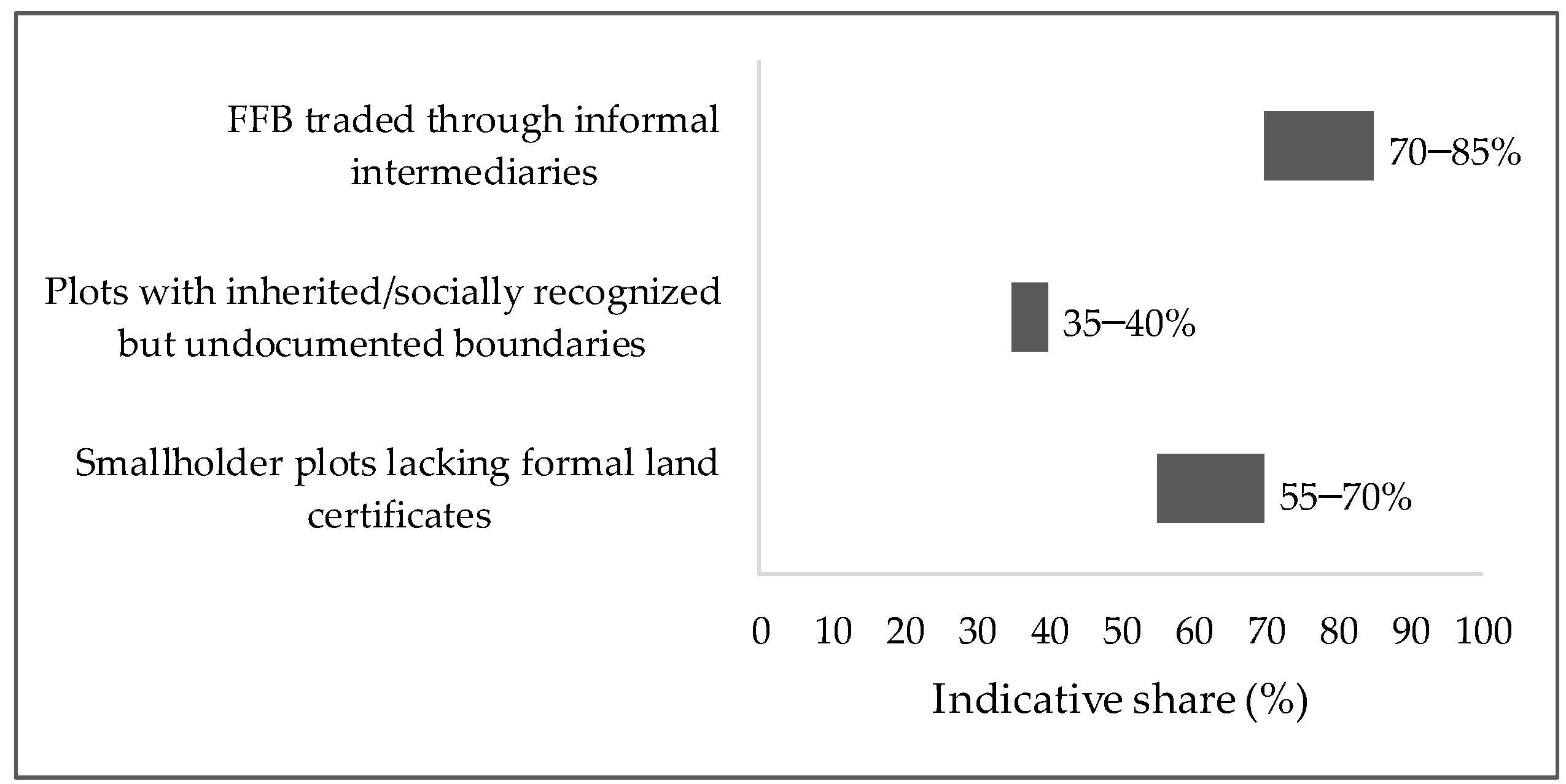
Recurring evidence across interviews, group discussions, field observations, and documentary review indicates widespread anxiety regarding legality and traceability requirements. The quantitative indicators presented in this subsection should therefore be understood as triangulated field-based indicative estimates derived from qualitative evidence rather than as results from a structured survey.
Figure 3 summarizes these approximate field estimates descriptively in order to illustrate the magnitude of the structural constraints most frequently identified across the field materials.
As summarized in
Figure 3, approximately 55–70% of smallholder plots were estimated to lack formal land certificates, while around 35–40% depended on inherited or socially recognized boundaries that were not administratively documented. In this context, polygon-based geolocation was widely perceived as both technically complex and socially unsettling, particularly where plot boundaries had historically been negotiated informally rather than established through formal survey procedures. More importantly, geolocation reshapes local practice by shifting compliance from general participation in legality or sustainability schemes to plot-specific spatial legibility. Land that has long been recognized through inheritance, neighborhood knowledge, or informal agreement must now be translated into fixed geospatial evidence that can be verified by actors outside the local setting. This requirement increases the practical importance of boundary clarification, documentation, and spatial disclosure, while also making some smallholders more cautious about revealing plot information that could expose unresolved tenure ambiguities.
The 31 December 2020 cut-off date introduces a related but distinct tension by requiring actors to make historical land use legible in ways that many smallholders cannot readily document. For producers whose land histories predate the regulation but were never formally recorded, the issue is not only whether land use changed, but whether such histories can be retrospectively proven in an administratively credible form. This helps explain why some respondents framed their plots as long-established and emphasized continuity of cultivation rather than recent change. These concerns are further reinforced by the structure of local marketing systems. Field estimates suggest that approximately 70–85% of fresh fruit bunches (FFB) continue to be traded through informal intermediaries that offer immediate payment, flexible pricing, and logistical access. As a result, EUDR requirements are often viewed as institutionally distant and externally imposed, especially by actors whose economic relations remain embedded in trust-based market arrangements rather than formalized supply-chain governance.
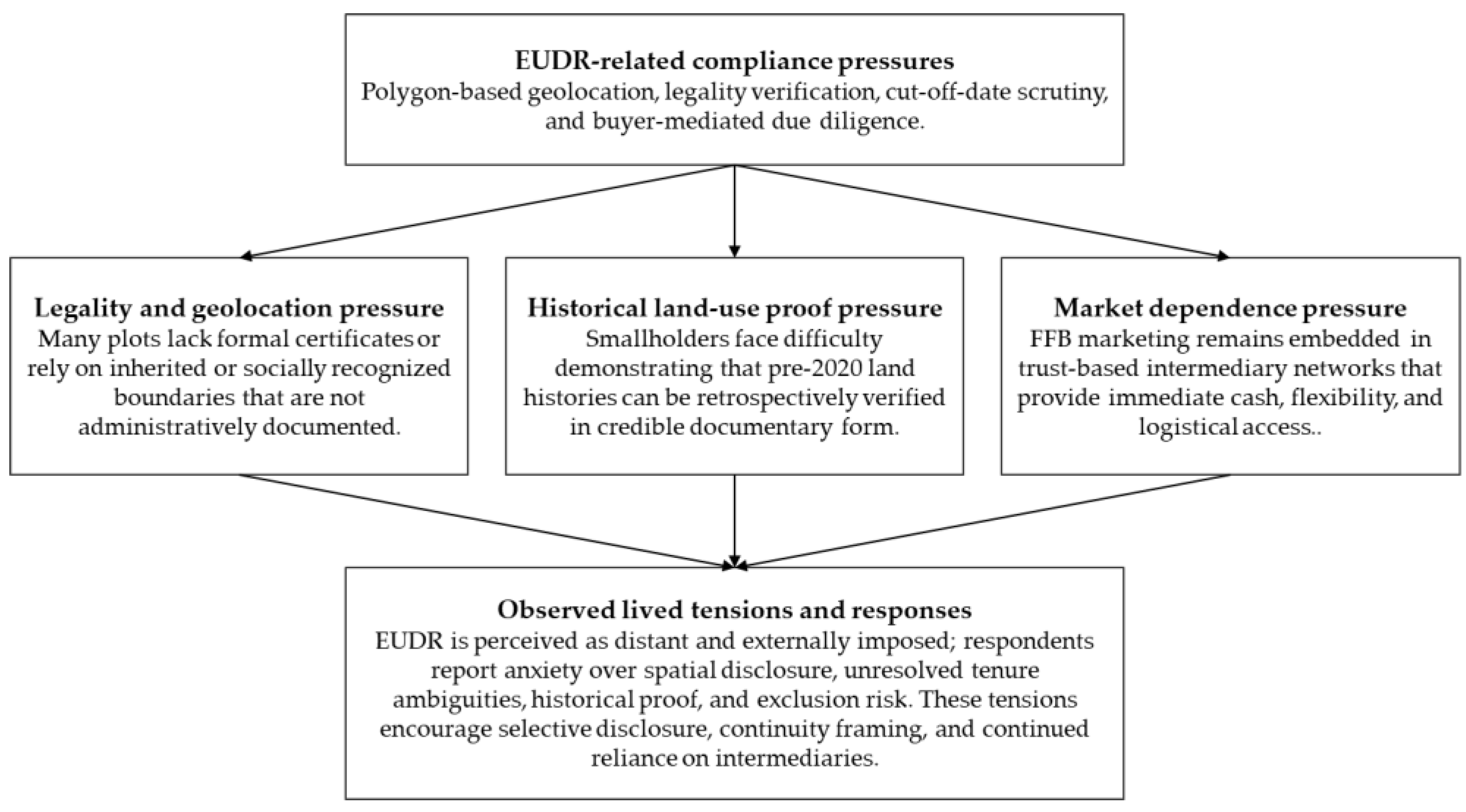
Taken together, these patterns indicate that smallholder perceptions of the EUDR are shaped by three interrelated pressure domains: legality and geolocation pressure, historical land-use proof pressure, and market dependence pressure.
Figure 4 synthesizes how these pressures translate EUDR requirements into lived tensions associated with spatial disclosure, unresolved tenure ambiguity, retrospective proof, and exclusion risk. In this setting, the regulation is encountered less as a neutral administrative instrument than as a governance demand filtered through livelihood insecurity, informal institutions, and intermediary-based market relations.
3.2. Local Resistance: Discursive, Practical, and Institutional
Drawing on CDA-informed thematic coding of interview transcripts, group discussion materials, field notes, and documentary sources, this subsection identifies recurrent patterns of local resistance to the EUDR across smallholder-based palm oil systems in Serdang Bedagai and Simalungun. Although resistance among local actors is widespread, it rarely takes the form of open opposition. Instead, it is expressed through routinized and adaptive practices that enable smallholders, cooperatives, and intermediaries to navigate regulatory pressure while preserving livelihood stability. Through iterative comparison of meaning units, actor narratives, and source types, these responses were analytically grouped into three interrelated forms: discursive, practical, and institutional resistance.
Discursive resistance is evident in the way the EUDR is framed as misaligned with local realities, historically insensitive, and inequitable in its distribution of compliance burdens. Smallholders often define sustainability in relation to income continuity, secure land access, and social reproduction rather than through abstract environmental indicators. From this perspective, the regulation is not rejected outright, but questioned for its limited recognition of the socio-economic conditions under which smallholders operate.
Practical resistance is reflected in the continued reliance on informal trading networks, delayed engagement with legality registration, and selective participation in digital traceability initiatives. These practices allow local actors to maintain market participation while minimizing the perceived risks associated with documentation requirements and spatial disclosure. Rather than constituting simple non-compliance, such responses represent pragmatic strategies for coping with regulatory demands that are seen as difficult to fulfill under existing conditions.
Institutional resistance operates through buffering mechanisms at the district level. Local agencies formally endorse sustainability objectives and promote registration initiatives, yet implementation remains partial due to limited staffing, budget constraints, and ambiguous mandates. This results in a pattern of symbolic compliance, in which sustainability requirements are acknowledged procedurally but only weakly enforced in practice.
Table 1 synthesizes the recurrent tensions and adaptive responses identified through the CDA-informed coding and thematic comparison stage. It shows how formal EUDR-related sustainability expectations encounter narrated and observed smallholder realities, and how these misalignments translate into selective disclosure, ritualized documentation, and continued reliance on informal mechanisms of legitimacy. Collectively, these coded patterns generate multiple forms of decoupling—normative, administrative, technological, temporal, and responsibility-based—without severing smallholders’ participation in palm oil markets.
Importantly, these responses are not reducible to generalized reluctance toward regulation. Rather, they are shaped by several EUDR-specific compliance features that operate through distinct mechanisms. First, polygon-based geolocation individualizes compliance by requiring socially recognized plots to be converted into externally verifiable geospatial units, thereby increasing the salience of boundary clarification, documentation, and selective spatial disclosure. Second, the 31 December 2020 cut-off date historicizes compliance by making past land use subject to retrospective verification, which generates tension in contexts where agrarian histories are locally known but poorly documented. Third, downstream buyers and mills increasingly interpret EUDR obligations through sourcing-risk management, which encourages the use of aggregated data, cooperative buffering, and selective filtering of suppliers rather than immediate transformation of the entire supply base. Together, these mechanisms generate more specific forms of adaptive response, including selective geospatial disclosure, temporal reframing of land status as long-established, and reliance on cooperative aggregation to buffer individual-level traceability exposure.
3.3. Policy Decoupling: Alignment Without Transformation
Drawing on the gap-oriented analytical stage described in
Section 2.4, this subsection examines how policy decoupling emerges when formal alignment with the EUDR is compared with observed implementation in North Sumatra. The analysis considers official commitments, institutional initiatives, actor narratives, and practical constraints in order to identify where legality, traceability, and deforestation-free governance are formally endorsed but only partially enacted in practice.
Beyond the smallholder level, the findings reveal cumulative patterns of policy decoupling across governance scales. At the national level, ministries articulate commitments to deforestation-free supply chains and seek to align domestic sustainability instruments with EUDR-related discourse. These commitments are echoed at the provincial level, while district agencies promote initiatives such as STDB registration and smallholder mapping.
Field evidence from North Sumatra, however, indicates limited operational readiness. STDB coverage remains below 30% in both districts, fewer than 20% of district plantation staff have received training in GIS or digital traceability systems, and inconsistencies in spatial data persist across agencies. At the same time, mills and smallholders do not interpret EUDR-related pressures in the same way. For smallholders, the regulation is experienced primarily as a livelihood and documentation risk, particularly where geolocation, legality verification, and historical land-use proof may expose insecure tenure or threaten continued market access. Mills, by contrast, tend to interpret the EUDR more as a sourcing-risk and market-access problem: the central concern is not only whether individual plots are fully traceable, but how to maintain throughput and buyer confidence under tightening due-diligence expectations. This difference helps explain why mills that have piloted traceability initiatives often continue to rely on aggregated data, cooperative mediation, and partial traceability arrangements, while intermediaries remain largely outside formal regulatory oversight.
Table 2 summarizes the governance-level patterns of decoupling identified through comparison between formal alignment claims and observed implementation constraints, actor practices, and institutional limitations across governance levels. It shows how EUDR-related norms become progressively decoupled as they move from global regulatory articulation to local implementation. Decoupling is therefore not confined to the local level; rather, it accumulates across governance layers, reflecting administrative constraints, fragmented authority, and differentiated incentives among actors. In this respect, policy decoupling emerges not only from capacity limitations, but also from the distinct ways in which actors interpret and operationalize EUDR-related obligations within their own institutional and market positions.
3.4. Emerging Co-Governance: Negotiation and Reframing of EUDR
Drawing on cross-actor comparison of cases in which adaptation, mediation, and negotiated adjustment were observed, this subsection examines emergent forms of proto–co-governance in response to the EUDR in North Sumatra. Although resistance and policy decoupling remain pervasive, the field evidence also indicates that some actors have begun to translate deforestation-free requirements into more locally workable arrangements.
Some mills have begun translating EUDR requirements into simplified operational practices, including hybrid analog–digital mapping systems and cooperative-mediated data aggregation. Cooperatives with prior experience in sustainability certification appear to show greater readiness to engage with traceability and legality requirements.
District governments have also increasingly advocated transitional legality pathways, recognition of informal tenure histories, and differentiated obligations for smallholders. Although these initiatives remain fragmented and largely experimental, they suggest the emergence of proto–co-governance arrangements through which global sustainability norms are incrementally adapted to local institutional and livelihood contexts.
These observed adjustments indicate that the local response to the EUDR is not exhausted by resistance and decoupling alone. Rather, the findings suggest the early formation of negotiated governance pathways in which mills, cooperatives, district governments, and smallholders begin to share the work of mediating compliance demands, buffering exclusion risks, and adapting global regulatory expectations to local realities.
Collectively, the findings identify five interrelated forms of decoupling—policy, practice, normative, temporal, and responsibility decoupling—that structure local responses to the EUDR. These patterns should not be understood as anomalous compliance failures; rather, they reflect predictable governance outcomes arising from the interaction between ambitious global regulation and smallholder-based production systems operating within fragmented institutional environments.
4. Discussion
This study shows that the encounter between the EUDR and Indonesia’s palm oil sector is not a linear process of compliance, but a negotiated governance outcome shaped by everyday resistance, policy decoupling, and institutional fragmentation. Rather than entering a governance landscape predisposed to uniform norm internalization, the EUDR interacts with smallholder-dominated production systems in which livelihood rationalities, informal institutions, and dispersed authority structures shape how sustainability requirements are interpreted and enacted. In interpretive terms, these findings are best understood through two core lenses—everyday resistance and policy decoupling—while habitus helps explain the livelihood-based dispositions through which regulatory pressures are perceived and negotiated. Understanding these dynamics therefore requires moving beyond linear models of norm diffusion toward a relational perspective grounded in everyday practice, institutional complexity, and multi-level governance [
18,
22].
The novelty of this study lies in showing that, unlike earlier legality and sustainability regimes, the EUDR does not merely reproduce familiar implementation gaps, but reconfigures them through spatially individualized traceability, retrospective land-use scrutiny, and buyer-mediated due-diligence pressures. In this setting, the findings reveal more specific forms of response, including selective disclosure, temporal reframing, and cooperative buffering. The effectiveness of deforestation-free regulation therefore depends not only on the formal strength of transnational standards, but also on how those standards are translated within local agrarian settings marked by unequal capacities, informal institutions, and historically embedded market relations.
More specifically, the findings suggest that the EUDR restructures local governance pressures through three linked mechanisms. Polygon-based geolocation individualizes compliance by requiring land claims and plot boundaries to become spatially fixed and externally verifiable. The 31 December 2020 cut-off date historicizes compliance by making past land use subject to retrospective scrutiny, thereby generating tension where agrarian histories are socially recognized but weakly documented. Mills, meanwhile, operationalize the regulation through a different interpretive logic from that of smallholders: whereas smallholders experience EUDR primarily as a threat of documentation-based exclusion, mills tend to treat it as a sourcing-risk and buyer-assurance challenge. This divergence helps explain why compliance often proceeds through selective disclosure, temporal reframing, aggregated traceability, and cooperative buffering rather than through uniform transformation across the supply chain.
Against this background, a first key insight concerns the character of everyday resistance. Consistent with Johansson and Vinthagen [
26] and Scott [
27], the forms of resistance observed in Serdang Bedagai and Simalungun do not take the shape of overt opposition or organized protest. Instead, resistance is enacted through routinized practices such as selective disclosure, delayed engagement, symbolic participation, and continued reliance on intermediaries, all of which allow local actors to manage regulatory pressure while preserving livelihood stability. These practices are embedded in a habitus shaped by informal tenure, trust-based trading relations, and the imperative of immediate cashflow [
15,
21]. In this context, resistance should not be interpreted as a rejection of environmental objectives per se. Rather, it reflects a pragmatic effort to navigate regulatory demands perceived as misaligned with local realities, especially where compliance threatens to increase uncertainty over land status, market access, and household income.
A second insight concerns policy decoupling as a structural governance outcome rather than an anomalous implementation failure. Drawing on organizational theory, the findings show how formal alignment with the EUDR is maintained to secure international legitimacy, while everyday practices remain only partially transformed [
24]. In Indonesia’s palm oil sector, decoupling is produced by the dispersion of authority across ministries, subnational governments, market actors, and informal intermediaries, conditions that resonate with Rhodes’ notion of the hollowing out of the state [
25,
30]. Under such circumstances, symbolic compliance and partial implementation become rational governance responses rather than simple policy failures [
9,
28]. The gap between formal commitment and practical enactment is therefore not incidental; it is generated by the institutional architecture through which transnational sustainability norms are introduced into fragmented domestic governance systems.
Crucially, everyday resistance and policy decoupling are mutually constitutive. Resistance practices actively generate the gap between formal policy commitments and practical implementation, while decoupling, in turn, normalizes resistance as a routine feature of governance. This interaction challenges binary distinctions between compliance and non-compliance and highlights sustainability governance outcomes as emergent products of everyday negotiation rather than mere deviations from ideal policy design [
15,
18]. From a power-sensitive perspective, these dynamics also reflect broader patterns of power redistribution and contestation commonly observed in sustainability transitions [
38]. What appears from a regulatory standpoint as non-alignment may, from the perspective of local actors, represent a calculated and socially embedded response to the uneven distribution of compliance burdens, risks, and benefits.
A third insight concerns the role of multi-level and polycentric governance in shaping EUDR implementation. The EUDR travels across governance scales without a single authority capable of enforcing uniform compliance. Mills, traders, cooperatives, certification bodies, and state agencies simultaneously shape compliance pathways, each interpreting EUDR requirements through distinct incentives, capacities, and risk calculations [
23,
31]. Intermediaries play a particularly important buffering role by mediating smallholder exposure to regulatory demands, while mills occupy ambivalent positions between global buyers and informal supply networks [
12,
13]. Compliance therefore emerges through negotiation across actor networks rather than through hierarchical command alone. This helps explain why implementation remains uneven even when national and provincial actors publicly endorse sustainability objectives: the operationalization of such objectives depends on actors whose interests, capabilities, and accountability structures are only partially aligned.
From an Environmental Rule of Law (EROL) perspective, the findings reveal significant justice deficits in the local reception of the EUDR. Uniform regulatory requirements impose disproportionate burdens on smallholders who lack formal land documentation, administrative support, and digital infrastructure, thereby raising concerns of distributive injustice [
19,
20]. The procedural exclusion of smallholders and local governments from norm formulation further weakens perceptions of legitimacy, while global definitions of deforestation and legality tend to override local tenure histories and customary practices [
29,
32]. Under such conditions, everyday resistance and policy decoupling emerge as predictable and rational responses to perceived regulatory misalignment. This finding is important because it shifts analytical attention from whether local actors are willing to comply toward whether the structure of regulation itself allows fair and feasible pathways for inclusion.
Importantly, the findings also point to emerging pathways toward negotiated adjustment and co-governance. Policy decoupling does not necessarily foreclose transformation; rather, it may create transitional space for negotiated solutions. Cooperatives with prior certification experience demonstrate greater readiness to engage with traceability and legality requirements, underscoring the mediating role of collective institutions [
14,
39]. Mills experimenting with hybrid traceability systems suggest that technical adaptation is possible when incentives are aligned, while district-level advocacy for transitional legality pathways illustrates how local feedback can reshape national and international engagement [
9,
29]. These developments indicate that deforestation-free governance is more likely to gain traction when compliance is translated into locally workable arrangements rather than imposed as a uniform administrative template.
The findings therefore support a more relational interpretation of deforestation-free governance. Rather than viewing EUDR implementation as a straightforward matter of transmitting norms from the global level to local actors, the evidence suggests that regulatory outcomes are co-produced through contestation, adaptation, and selective institutionalization. In this sense, everyday resistance reveals the blind spots of regulatory design, while policy decoupling exposes the limits of formal alignment as an indicator of substantive change. At the same time, the presence of cooperative-based mediation, district advocacy, and mill-level experimentation suggests that negotiated pathways remain possible. The challenge for sustainability governance is thus not simply to tighten compliance mechanisms, but to create institutional conditions under which global ambitions can be translated into credible, legitimate, and socially viable local practice.
The governance dynamics identified in this study should also be interpreted within clearly defined scope conditions. Empirically, the analysis is situated in smallholder-dominated palm oil systems characterized by fragmented land tenure, intermediary-based value chains, and decentralized governance arrangements. These structural features shape the specific forms of everyday resistance and policy decoupling observed in Serdang Bedagai and Simalungun and help explain why EUDR-related norms are selectively interpreted, adapted, and enacted in practice. In this sense, the findings are most directly applicable to governance settings in which livelihood precarity, informal institutions, and dispersed authority structure regulatory responses. They may therefore differ from contexts dominated by vertically integrated plantation estates, more formalized supply chains, or jurisdictions with stronger administrative capacity and digital infrastructure. Rather than claiming universal applicability across all palm oil production systems, the study illuminates how deforestation-free governance unfolds under conditions of institutional fragmentation and smallholder vulnerability, where compliance is negotiated through everyday practice rather than realized through uniform implementation [
21,
28].
At the same time, the patterns documented in North Sumatra resonate with broader empirical and theoretical insights from smallholder-based commodity systems across the Global South. Similar tensions between global sustainability norms and local livelihood realities have been observed in cocoa, coffee, timber, and other land-based sectors, where compliance demands intersect with informal tenure arrangements, intermediary-mediated markets, and uneven state capacity [
11,
12,
18]. This broader relevance suggests that, although the empirical findings are context-specific, the analytical lens developed in this study—linking everyday resistance and policy decoupling—offers wider value for understanding how deforestation-free regulations are negotiated within fragmented governance environments. Viewed in this way, the Indonesian case contributes not only to debates on palm oil governance, but also to a wider discussion of how global environmental norms are translated, contested, and selectively institutionalized in unequal agrarian settings.
Overall, the Indonesian case illustrates that global environmental norms achieve durability not through coercive enforcement alone, but through negotiated co-production. Everyday resistance reveals regulatory blind spots, policy decoupling creates adaptive space, and polycentric governance offers multiple pathways for aligning global ambitions with local realities. Recognizing these dynamics allows sustainability governance to move beyond symbolic compliance toward more inclusive, context-sensitive, and socially just forms of transformation in smallholder-dominated commodity systems [
18,
40].
5. Conclusions
This study examines how global environmental norms embedded in the EUDR are encountered and negotiated in smallholder-dominated palm oil systems in North Sumatra. Rather than revealing a purely technical compliance gap, the findings point to a deeper structural and normative misalignment between global deforestation-free ambitions and the socio-economic realities that shape everyday production, trade, and governance. In Serdang Bedagai and Simalungun, smallholders, intermediaries, mills, and local authorities do not engage with the EUDR as a neutral set of sustainability rules. Instead, they interpret and negotiate these requirements through practices embedded in habitus, informal institutions, and livelihood imperatives.
The findings show that the EUDR is widely perceived as distant and externally imposed, particularly because of its requirements for geolocation, legality verification, and traceability. This perception shapes how regulatory demands are interpreted and adapted in practice. In response, local actors employ routinized forms of everyday resistance, including selective disclosure, delayed engagement, and symbolic participation, which enable continued market access while minimizing perceived regulatory risk. These practices do not amount to outright rejection of sustainability objectives. Rather, they represent pragmatic adaptations to structural constraints and produce policy decoupling, whereby formal alignment with global norms coexists with limited substantive transformation on the ground.
Theoretically, this study contributes by showing that everyday resistance and policy decoupling are mutually constitutive under an EUDR-style governance regime, in which plot-level geolocation, cut-off-date verification, and buyer-driven due diligence convert long-standing structural constraints into more exclusion-sensitive and spatially explicit compliance pressures. Using everyday resistance and policy decoupling as its principal interpretive lenses, and drawing on habitus as a supporting concept, the analysis challenges linear models of norm diffusion by showing that governance outcomes are negotiated products of interaction between global regulatory ambition and local socio-institutional contexts. In this sense, the study demonstrates that the translation of global sustainability norms is mediated not only by institutional design, but also by local histories of authority, informality, and livelihood dependence.
Beyond documenting symbolic alignment and practical decoupling, this study suggests that the pathway forward is not immediate full compliance, but the gradual emergence of what this study terms proto–co-governance. In the North Sumatran cases, this takes the form of still-fragmented but observable negotiated arrangements in which mills, cooperatives, district governments, and smallholders begin to share the work of adapting global deforestation-free requirements to local realities. Such arrangements include cooperative-based data aggregation, hybrid analog–digital traceability practices, district advocacy for transitional legality pathways, and efforts to recognize informal tenure histories within more feasible compliance processes. The term proto is important here, because these arrangements are not yet stable, comprehensive, or fully institutionalized. However, they indicate that durable EUDR implementation is more likely to emerge through incremental, negotiated, and actor-shared governance than through top-down enforcement alone. In this sense, the study contributes not only by showing how resistance and policy decoupling occur, but also by identifying how they may open a transitional governance space through which more inclusive and context-sensitive deforestation-free regulation can gradually be built.
These findings carry important implications for policymakers, regulators, and supply-chain actors. For national and subnational governments, the results suggest that effective implementation of deforestation-free regulation requires more than formal policy alignment; it requires transitional legality pathways, improved administrative coordination, and recognition of informal tenure histories that shape smallholder participation. For mills, cooperatives, and downstream buyers, the findings underscore the importance of designing traceability and legality systems that are operationally feasible for smallholders, including simplified compliance mechanisms, cooperative-based aggregation, and phased adaptation strategies. More broadly, the study indicates that durable deforestation-free governance cannot be secured through top-down enforcement alone. Global environmental norms are stabilized, reshaped, and rendered governable through everyday practices of negotiation and adaptation. Recognizing these dynamics is essential not only for reducing symbolic compliance, but also for opening more inclusive, context-sensitive, and socially viable pathways toward sustainability governance.
Several limitations should be considered. First, the qualitative research design prioritizes depth of understanding over statistical generalization, aiming to capture meaning-making processes and everyday practices rather than aggregate prevalence. Second, the analysis focuses primarily on upstream actors and subnational governance institutions; future research could extend this framework to downstream buyers, financial actors, and enforcement intermediaries to better capture transnational accountability dynamics [
17,
41]. Third, the EUDR implementation landscape remains dynamic, and regulatory practices are likely to evolve as guidance is refined and market actors adjust. Longitudinal research will therefore be important for assessing whether current patterns of policy decoupling persist, diminish, or develop into more institutionalized forms of negotiated co-governance [
29].
6. Policy Implications
The findings yield several policy-relevant implications for the design and implementation of deforestation-free regulations. First, differentiated obligations and phased compliance pathways are essential to avoid excluding smallholders operating within informal or semi-formal tenure systems. Uniform regulatory requirements risk reproducing structural inequities unless they are accompanied by transitional legality mechanisms that acknowledge agrarian histories, uneven capacities, and the practical constraints faced by smallholders.
Second, traceability systems need to be inclusive by design. Cooperative-based aggregation, hybrid analog–digital mapping approaches, and flexible geolocation mechanisms provide more realistic entry points for smallholders than fully individualized, technology-intensive systems. Without such adaptation, traceability risks functioning less as a governance instrument than as a barrier to market participation. Third, legal and administrative empowerment at the subnational level is equally critical. District governments require sustained technical assistance, interoperable spatial data systems, and simplified administrative procedures to translate global norms into locally workable practices. Strengthening local governance capacity is therefore a necessary condition for meaningful implementation.
Fourth, producing countries such as Indonesia should approach engagement with deforestation-free regulations not only as a compliance challenge, but also as a strategic governance and diplomatic opportunity. Rather than framing the EUDR solely as an external constraint, governments can use it to advocate for equivalence frameworks and greater interoperability between domestic sustainability instruments and global due diligence regimes. Finally, global buyers and regulators need to recognize that policy decoupling signals regulatory misalignment rather than mere non-compliance. Addressing the underlying sources of everyday resistance can help inform more adaptive, equitable, and effective forms of sustainability governance. Aligning global environmental ambition with local livelihood realities is essential if deforestation-free supply chains are to advance both ecological integrity and social inclusion.
A comparative perspective further suggests that Indonesia’s policy response may benefit from lessons emerging in other palm-oil-producing countries. In Malaysia, the Malaysian Sustainable Palm Oil (MSPO) framework provides a national certification architecture covering the oil palm value chain, while recent system developments have placed greater emphasis on traceability and supply-chain reporting [
42,
43]. In Colombia, sectoral sustainability initiatives have more strongly emphasized zero-deforestation commitments, monitoring, and traceability mechanisms at both the mill and supply-base levels [
44]. These experiences indicate that national responses to global sustainability regulation are more likely to gain operational traction when traceability systems, certification frameworks, and producer support mechanisms are developed in an integrated manner. For Indonesia, however, such lessons need to be adapted carefully to local conditions, particularly the larger scale of independent smallholders, fragmented tenure histories, and uneven administrative capacity.




 ,
,