1. Introduction
Under accelerating global climate change and ongoing urbanization, ecological systems have become increasingly vulnerable, as evidenced by frequent extreme weather events, ecological degradation, resource scarcity, and environmental pollution [
1]. These ecological disturbances threaten regional environmental security and may propagate through urban systems, leading to economic instability, increased social vulnerability, and failures within critical infrastructure networks [
2]. Urban resilience (UR) has emerged as a crucial indicator of a city’s ability to withstand, absorb, adapt to, and recover from external shocks [
3], with the ultimate goal of enhancing a city’s adaptability and sustainable development in uncertain circumstances [
4]. However, the development of urban resilience is not a standalone process; its effectiveness is significantly constrained by the level of ecological risks (ER). Ecological risk refers to the instability in the structure and function of ecosystems, often caused by natural or human factors [
5], and its cumulative effects can weaken a city’s systems’ capacity to withstand disruptions, potentially leading to systemic issues [
6]. This is particularly evident in rapidly urbanizing areas, where land-use changes, reduced ecological space, and rising resource consumption lead to spatial aggregation of ecological risks, cross-scale transmission, and multifaceted interconnections [
7], as evidenced by studies in other urban agglomerations such as the Beijing–Tianjin–Hebei (BTH) region. The ecological risks associated with these processes are particularly pronounced and complex in densely populated urban areas [
5].
The Chengdu–Chongqing Urban Agglomeration (CCUA), located in the upper reaches of the Yangtze River, is one of the most rapidly urbanizing metropolitan regions in western China and represents a critical node within the national urban system. It simultaneously functions as a major economic growth pole and an ecologically sensitive transition zone between mountainous landscapes and dense urban settlements. Its complex mountainous terrain increases exposure to geological hazards, ecological degradation, and infrastructure vulnerability. In recent years, accelerated urban expansion under the “Chengdu–Chongqing Twin Cities Economic Circle” initiative has intensified land conversion, infrastructure construction, and population concentration. These processes have further fragmented ecological spaces, reduced habitat connectivity [
8], thereby increasing ecological pressure and strengthening the interaction between ecological risk and urban resilience.
Despite increasing attention to both urban resilience and ecological risk, existing studies often treat the two separately, with limited integration within a unified analytical framework. Empirical research that incorporates ecological risk as a core explanatory factor in urban resilience analysis remains scarce, and the underlying mechanisms linking risk and resilience dynamics—particularly at the urban agglomeration scale—are insufficiently explored. In summary, understanding the dynamic interrelationships and evolving patterns of ecological risks and urban resilience at specific spatial and temporal scales, as well as the underlying driving forces, is of paramount theoretical and practical significance for the high-quality development of this ecologically sensitive urban agglomeration. While the individual methods employed in this study have been widely applied in existing research, this study provides an incremental contribution by integrating them within a unified analytical framework that explicitly incorporates ecological risk as a core explanatory dimension of urban resilience. From an ecological risk perspective, this study examines the temporal–spatial evolution of urban resilience in the CCUA, explores the coupling and coordination mechanisms between the two subsystems, and identifies the structural drivers shaping resilience performance under ecological constraints. First, it integrates ecological risk into the analytical framework of urban resilience at the urban agglomeration scale. Second, it combines coupling coordination analysis with panel econometric modeling to jointly capture structural patterns and driving mechanisms. Third, it reveals the conditional and nonlinear effects of ecological risk through the moderating role of infrastructure development. The findings aim to inform resilience-oriented urban planning, infrastructure design, and risk-sensitive spatial governance strategies tailored to ecologically fragile urban agglomerations.
2. Literature Review
Resilience refers to the ability of systems, communities, or individuals to cope with disturbances, shocks, or pressures, adapt to them, and recover from them. It is a multidisciplinary concept that originated in the field of material science in physics. As research has advanced, it has been applied widely in various fields such as natural ecosystems [
9], society [
10], and economics [
11], as well as organizations [
12]. Urban resilience denotes a city’s capacity to respond to economic shocks, adapt to them, and recover from them. Recent empirical studies have further highlighted its broader socioeconomic implications. For instance, Liao et al. (2022) found that urban resilience significantly enhances residents’ subjective well-being through multiple channels, including increased income, improved health conditions, and strengthened social integration [
13]. The theory of urban resilience has evolved from focusing on disaster resistance to a more comprehensive systems-based approach that considers social-ecological-technical systems [
14]. Although there is extensive research on urban resilience, there is no yet universally accepted definition or universally applicable method for measuring it [
15]. In the academic framework of urban resilience assessment, there are mainly two evaluation frameworks: the economic-social-ecological framework and the Resilience-Adaptability-Restoration (RAR) framework. Both frameworks have their theoretical value and practical advantages; however, they differ in their analytical focus, with the economic–social–ecological framework emphasizing long-term structural capacity, while the RAR framework focuses on short-term system performance under shocks, leading to inconsistencies in capturing dynamic resilience processes. Economic–social–ecological framework, which emphasizes structural sustainability and long-term strategic resilience capacity. This framework is particularly suitable for aligning resilience evaluation with Sustainable Development Goals (SDGs) and long-term urban planning [
16]. However, its reliance on macro-level and often lagged socioeconomic indicators limits its ability to capture short-term adaptive responses to sudden disturbances [
17,
18]. The RAR framework, which conceptualizes resilience as a staged evolutionary process. Originating from disaster engineering research, it provides performance-based metrics to evaluate system behavior under shock scenarios. Bruneau et al. (2003) developed a seismic resilience framework that formalized quantitative resilience indicators [
19], while subsequent studies have applied similar models to disaster case analyses [
20]. Nevertheless, the RAR framework often simplifies ecological constraints and long-term environmental feedback mechanisms, limiting its applicability in ecologically vulnerable regions [
21,
22]. The current academic consensus suggests selecting different evaluation models based on the scenario. In areas with ecological vulnerabilities, the economic-social-ecological framework is more commonly used, while in regions with frequent disasters, the RAR framework is preferred. Various methods for assessing urban resilience, such as indicator evaluation [
23], systems dynamics models [
24], complex network analysis [
25], and GIS [
26], have been employed to reveal the multi-dimensional characteristics and driving mechanisms of urban resilience [
27].
Ecological risk research is a complex and multi-layered field. With the increasing severity of global environmental problems, ecological risk has become a key issue in environmental management and sustainable development [
28]. Ecological risk refers to the potential damage to ecosystem health and functioning caused by human activities or natural events, with its core focus on assessing ecosystem vulnerability under external pressures and proposing corresponding mitigation or alleviation measures [
29]. Early studies on ecological risk mainly concentrated on the dispersion of pollutants and their impacts on biodiversity, emphasizing the probabilistic nature and uncertainty of risk, and introducing spatial analysis and multi-level models to improve the prediction of ecological risks [
30]. In the field of pollution dispersion, numerous studies have employed the ecological risk assessment framework to evaluate the long-term effects of chemical pollutants in water, air, and soil on ecosystems [
31]. The ecological risk assessment framework proposed by the U.S. Environmental Protection Agency (EPA) aims to provide a systematic approach for assessing the potential impacts of environmental pollution on ecosystems [
32].
As ecological risk has attracted increasing attention from multiple disciplines, its research scope has gradually expanded. Three major ecological risk assessment models applied in environmental decision-making—food-web-based models, ecosystem-based models, and socio-ecological models—have been widely adopted. Among these, food-web networks and ecosystem-based approaches remain the primary focus of risk assessment at the community and ecosystem scales [
33]. In contrast, socio-ecological conditions constitute the main concern in risk assessment processes under legal and regulatory contexts. This approach facilitates interdisciplinary dialogue and supports the development of multi-objective paradigms for integrated risk assessment. The socio-ecological risk assessment framework, which incorporates the dual influences of social and ecological factors, has further evolved into a compound ecological risk assessment framework that integrates natural hazards with human activities and urbanization, thereby exploring ecosystem vulnerability and recovery capacity under compound stresses [
34].
With respect to the spatiotemporal dynamics of ecological risk, numerous studies have examined the evolution of ecological risks across different spatial scales, ecological regions, and temporal horizons, focusing on risk composition, risk calculation indicators, and spatial autocorrelation analysis of ecological risk [
35]. Accordingly, ecological risk research has expanded from single-factor risks, such as water resource risk and air pollution risk to integrated ecological risk index models [
36].
Although extensive research has separately examined urban resilience and ecological risk, studies integrating the two within a unified analytical framework remain limited. Existing research typically adopts one of two approaches: either measuring urban resilience independently without explicitly incorporating ecological risk as a structural constraint, or assessing ecological risk without examining its influence on resilience capacity. Some scholars have explored governance-oriented resilience frameworks under risk scenarios, emphasizing multi-dimensional optimization of risk response systems [
37]. Coupling coordination theory has also been introduced to examine structural interactions between subsystems. Spatial analytical tools such as Moran’s I, and geographically weighted regression have further enhanced the identification of spatial patterns between ecological risk and resilience. However, two critical gaps persist. First, empirical research integrating ecological risk as a core explanatory variable within an urban resilience framework at the urban agglomeration scale remains scarce. Second, most existing studies rely on descriptive or correlation-based approaches, with limited causal identification of the mechanisms linking ecological risk and resilience dynamics.
To address these gaps, this study integrates ecological risk assessment into a resilience analytical framework and combines coupling coordination analysis with panel econometric modeling. By doing so, it seeks to reveal both the structural interaction patterns and the underlying driving mechanisms of the risk–resilience nexus within the CCUA.
3. Materials and Methods
3.1. Study Area
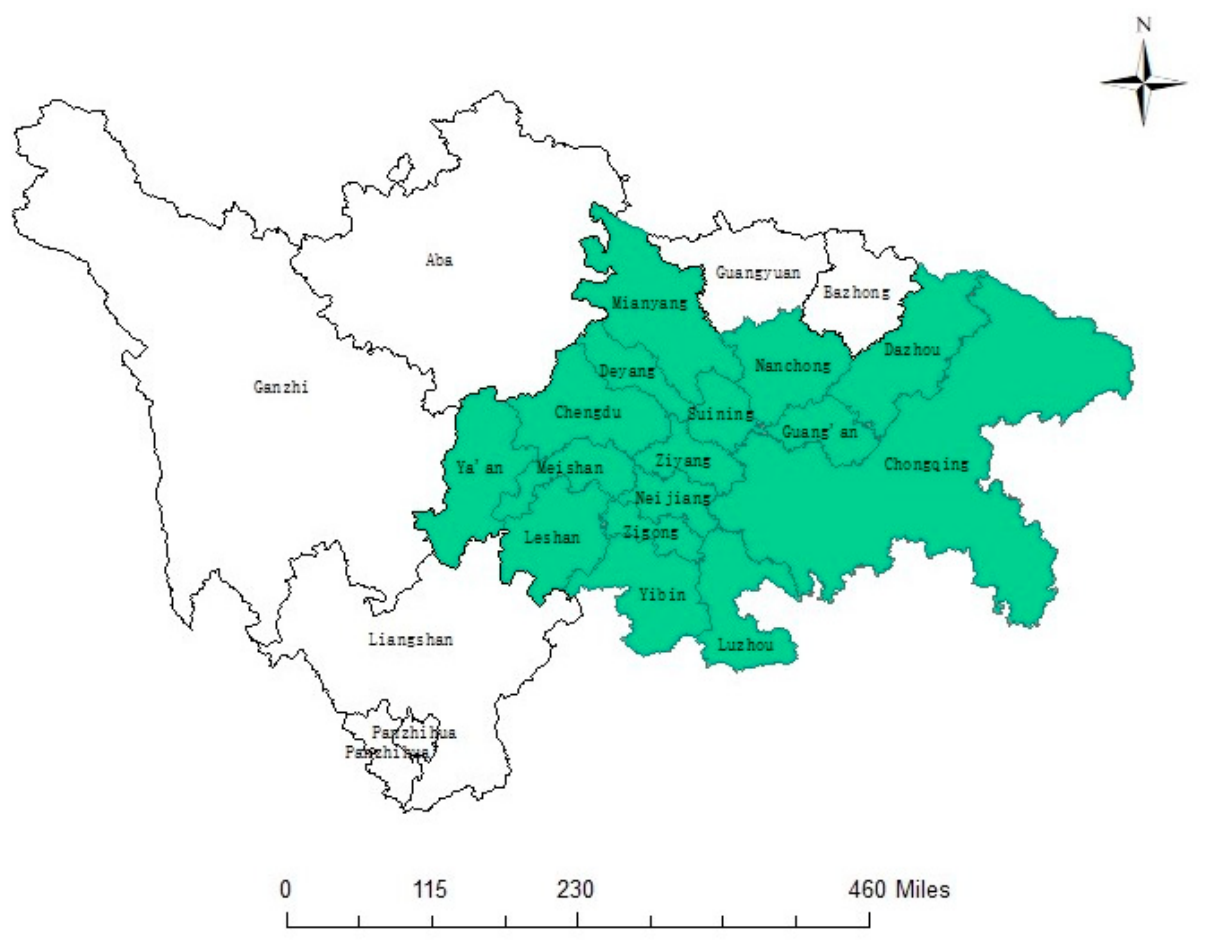
This study focuses on the CCUA in western China, whose geographical location is shown in
Figure 1. The CCUA consists of 16 prefecture-level cities located within Chongqing Municipality and Sichuan Province [
38]. As one of the most rapidly developing metropolitan regions in western China, the CCUA has experienced intensive urban expansion and infrastructure development in recent years, which have reshaped ecological conditions and urban system capacity. With a permanent population exceeding 98 million and a high level of urbanization, the CCUA represents one of the largest and most densely inhabited urban agglomerations in western China. Rapid economic growth has been accompanied by large-scale land conversion, transportation network expansion, and industrial restructuring, which have jointly influenced land-use configuration and infrastructure systems. Geographically, the CCUA spans latitudes from 27°39′ N to 33°03′ N and longitudes from 101°56′ E to 110°11′ E, covering a complex mountainous terrain intersected by major river systems. Situated in the upper reaches of the Yangtze River, the region forms a critical ecological barrier characterized by fragile mountainous ecosystems and dense urban settlements. The Yangtze River and its tributaries, including the Min and Jinsha Rivers, form a dense hydrological network that increases exposure to flooding, landslides, and ecological degradation, thereby elevating systemic risk within the built environment and shaping the regional risk–resilience interaction.
3.2. Data
The research data in this study mainly includes data on natural disasters, human activities, and socio-economics. The land use data is derived from the 30 m annual land cover raster data for China from 1990 to 2023 [
39]. The nighttime light data were derived from the corrected annual China-wide DMSP-OLS-like dataset for the period 1992–2024 [
40], while other data sources include the ‘Sichuan Province Statistical Yearbook’, ‘China Urban Statistical Yearbook’, ‘Sichuan Province Environmental Quality Bulletin’, and the national economic and social development statistical bulletins of various cities. For isolated missing observations, linear interpolation and trend-based extrapolation methods were applied to ensure temporal continuity and data consistency.
3.3. Methodology
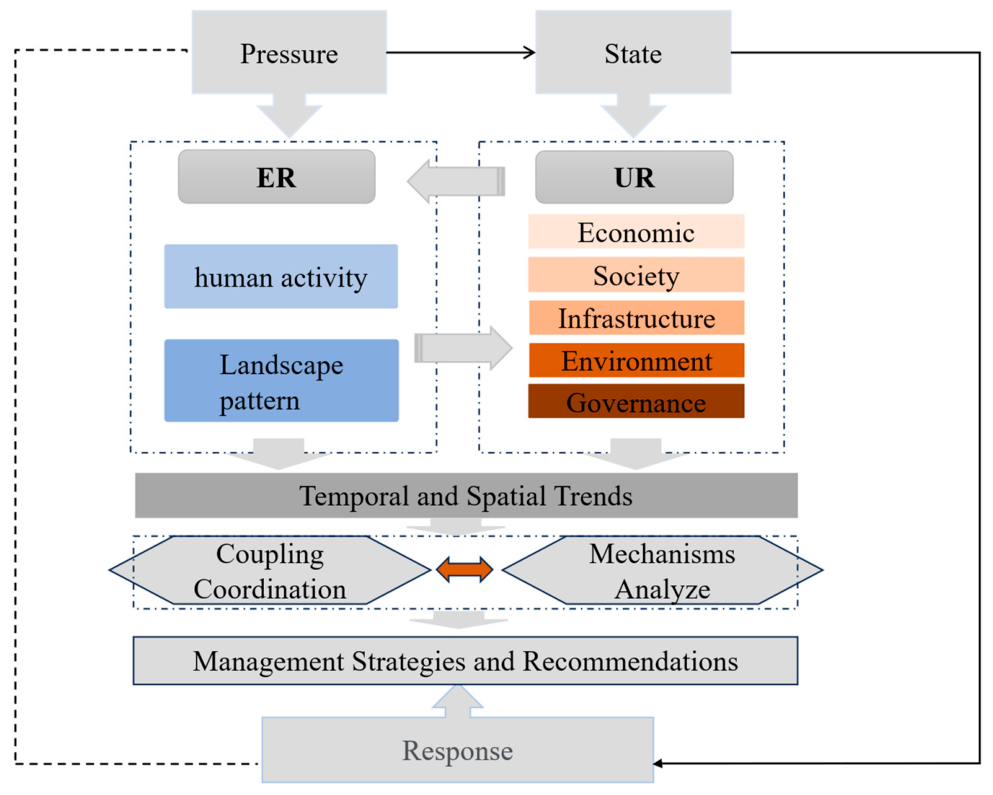
This study follows a structured four-stage analytical framework to systematically investigate the interactive dynamics between ecological risk and urban resilience in the CCUA. First, comprehensive evaluation index systems for ecological risk and urban resilience are constructed. The entropy weight–TOPSIS method is employed to objectively determine indicator weights and synthesize composite indices for 16 municipal-level cities from 2010 to 2023. This approach enables a systematic assessment of temporal evolution trends and spatial differentiation characteristics of ecological risk and urban resilience across the study area, which allows for consistent evaluation across panel data and reduces subjective interference in multi-year comparisons. Second, a coupling coordination degree model (CCDM) is applied to evaluate the degree of interaction and coordination between ecological risk and urban resilience, which is grounded in systems theory and widely used to capture the coordinated development between interrelated subsystems, enabling a direct characterization of the coupling relationship and its evolution between the two systems. Third, GIS-based spatial analysis is employed to visualize the spatial distribution of ecological risk and urban resilience. Fourth, to identify the driving mechanisms shaping urban resilience under ecological risk constraints, a panel econometric model is constructed to examine the net impact of ecological risk and structural factors on resilience performance. A two-way fixed effects model is employed to control for unobserved city-specific and time-specific heterogeneity. Core explanatory variables include ecological risk as the primary explanatory variable and structural control variables such as economic development level, industrial structure upgrading, urbanization level, infrastructure development, and environmental governance capacity. Robustness tests and specification diagnostics are conducted to ensure the reliability of the estimation results. The overall analytical framework of the study is illustrated in
Figure 2.
3.3.1. Entropy Weight–TOPSIS Method
The entropy weight method is applied to determine the objective weights of evaluation indicators. Let
represent the weight of the
j-th index, and
denote the information entropy of the
j-th index. denote the number of evaluation cities, and
k be a constant defined as
The formula is as follows:
The Technique for Order Preference by Similarity to Ideal Solution (TOPSIS) method is then employed to calculate composite index scores. A weighted normalized decision matrix is constructed using the entropy-derived weights. The positive ideal solution and negative ideal solution are defined as:
The Euclidean distance between each city and the positive and negative ideal solutions is calculated as:
The relative closeness coefficient, which represents the urban resilience score, is computed as:
3.3.2. Assessment of the Coupling Degree of Ecological Risk and Urban Resilience
To quantify the interaction between ER and UR, a coupling coordination degree model is employed to evaluate their systemic interdependence within the CCUA:
Here,
T represents the comprehensive coordination index, while
and
are the comprehensive level indices of the ER and UR systems, respectively. The values of
α and
β are both set to 0.5, indicating that the two systems have equal weight.
C represents the coupling degree, and
D denotes the coupling coordination degree. Following existing research [
41], the coupling coordination degree is divided into ten levels using a uniform distribution method, as shown in
Table 1.
3.3.3. Two-Way Fixed Effects Model
To identify the net effect of ecological risk on urban resilience, this study employs a two-way fixed effects model to control for unobserved city-specific heterogeneity and time-specific shocks. The baseline model is specified as follows:
where
represents urban resilience in city
in year
, and
denotes the ecological risk level.
is a vector of control variables that may systematically influence urban resilience, including economic development level, industrial structure upgrading, urbanization level, infrastructure development, and government environmental protection capacity [
42,
43,
44].
These control variables are incorporated to mitigate omitted variable bias and isolate the independent effect of ecological risk on resilience performance. City fixed effects capture time−invariant characteristics such as geographical endowments and historical development trajectories. Year fixed effects control for macroeconomic fluctuations and nationwide policy shocks affecting all cities simultaneously. Robust standard errors clustered at the city level are applied to account for heteroskedasticity and within-city serial correlation.
3.4. Assessment Index System
3.4.1. Urban Resilience Index System
This study establishes an urban resilience indicator system based on the economic-social-ecological framework and constructs a comprehensive evaluation framework with five dimensions: environment, economy, society, infrastructure, and governance, taking into account the multiple coupling relationships within the urban system. Drawing on established urban resilience assessment frameworks from both domestic and international studies [
42,
45,
46], 16 representative indicators were selected to capture structural resilience capacity across the five dimensions (see
Table 2). Specifically, the governance dimension reflects institutional capacity and public service provision that support risk response and adaptive management. Indicators such as the number of primary and secondary schools, the number of beds in health institutions, and the unemployment rate are used to proxy governance-related capacity in terms of human capital development, public health support, and social stability, which are critical for enhancing adaptive capacity and mitigating the impacts of ecological risks.
3.4.2. Ecological Risk Assessment
Based on established ecological risk identification frameworks, this study constructs a multi-source ecological risk assessment system (
Table 3), incorporating two primary dimensions: anthropogenic pressure and landscape pattern structure. Anthropogenic pressure is quantified using nighttime light intensity derived from remote sensing data and population density. Higher nighttime light intensity reflects stronger built environment activity concentration and greater anthropogenic disturbance, thereby increasing ecological risk exposure. Landscape pattern indicators are employed to capture ecological vulnerability arising from land-use configuration and spatial fragmentation within the urban–rural interface. Different land-use types exert heterogeneous ecological impacts due to variations in ecological service capacity, land cover stability, and disturbance sensitivity. A higher degree of land-use loss and ecological degradation corresponds to elevated ecological risk levels [
47,
48,
49].
The formula of land use loss degree is as follows:
where
is the area of the
k-th land use type within the study unit,
is the total area of the study unit, and
is the ecological risk weight for the
k-th land use type. The ecological risk weights for different land use types are based on existing research findings [
50,
51,
52] and are set as follows: cropland 0.32, forest land 0.12, grassland 0.16, built-up land 0.85, unused land 0.82, and water area 0.53. These values are derived from prior studies employing expert-based weighting approaches and are directly adopted in this study due to their consistency with the Chengdu–Chongqing regional context.
4. Results
4.1. Urban Resilience
4.1.1. Temporal Evolution of Urban Resilience
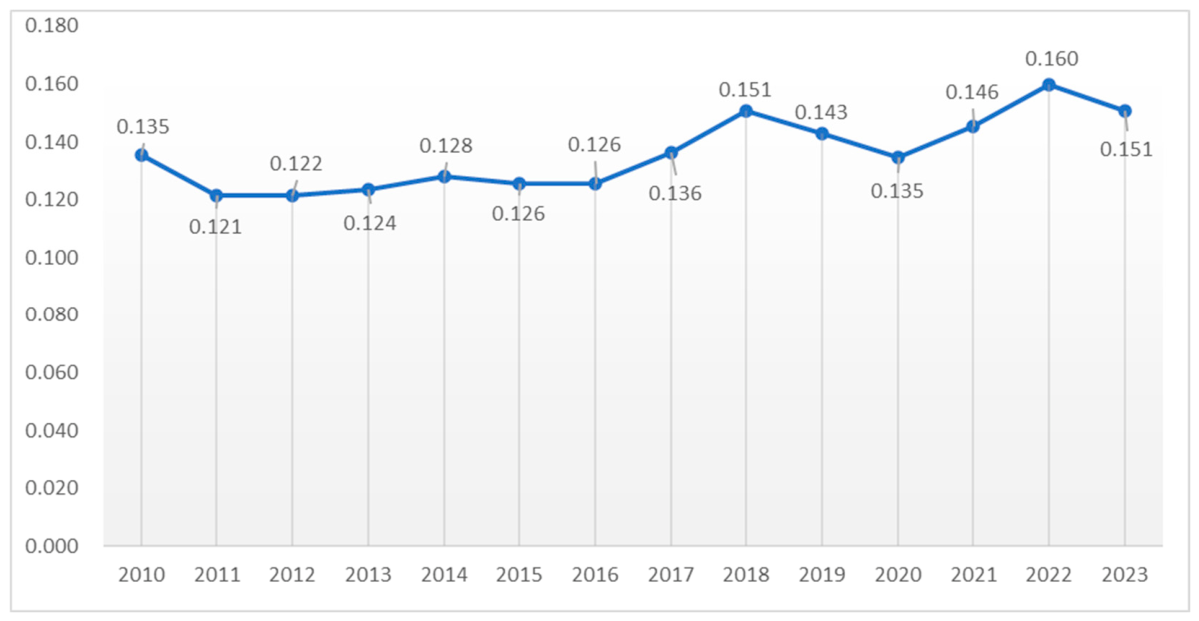
The results indicate that the average urban resilience level of the CCUA during 2010–2023 followed a two-stage trajectory characterized by an initial stabilization phase and subsequent structural enhancement, reflecting the dynamic adjustment of urban systems under changing ecological risk conditions. (see
Figure 3). During 2010–2016, resilience remained at a relatively low but stable level (mean = 0.126 ± 0.005), indicating limited adaptive capacity during the early stage of regional integration. The lowest value was recorded in 2011 (0.121), although interannual fluctuations during this period were modest, suggesting structural inertia within the resilience system. After 2017, resilience entered a phase of sustained improvement. By 2018, the resilience index increased to 0.151, indicating enhanced system robustness. A temporary decline occurred in 2020 (0.135), reflecting external shock impacts on regional system stability. Importantly, resilience did not revert to the early-stage baseline, indicating a structural shift toward higher adaptive capacity. Resilience rebounded in 2021 (0.146) and reached a peak in 2022 (0.160), suggesting strengthened systemic recovery capacity. The slight decline in 2023 (0.151) indicates that system stability remains dynamic and that long-term resilience consolidation requires further structural reinforcement.
4.1.2. Inter-Annual Evolution and Structural Transformation of Urban Resilience
From a temporal perspective, urban resilience exhibited phased adjustments with structural transition points around 2015 and 2020 (see
Table 4). During 2010–2014, inter-annual fluctuations remained within ±4%, indicating limited variation in adaptive capacity across cities during the early integration stage. Between 2015 and 2019, the coefficient of variation increased to 0.41, indicating intensified inter-city differentiation in resilience levels. This suggests that structural disparities among cities became more pronounced as the regional system evolved. During 2020–2023, resilience entered a recovery phase, with the majority of cities exhibiting positive growth trajectories. However, ecologically fragile cities showed relatively slower recovery rates, reflecting spatial heterogeneity in resilience consolidation.
4.1.3. Spatial Pattern Evolution of Urban Resilience
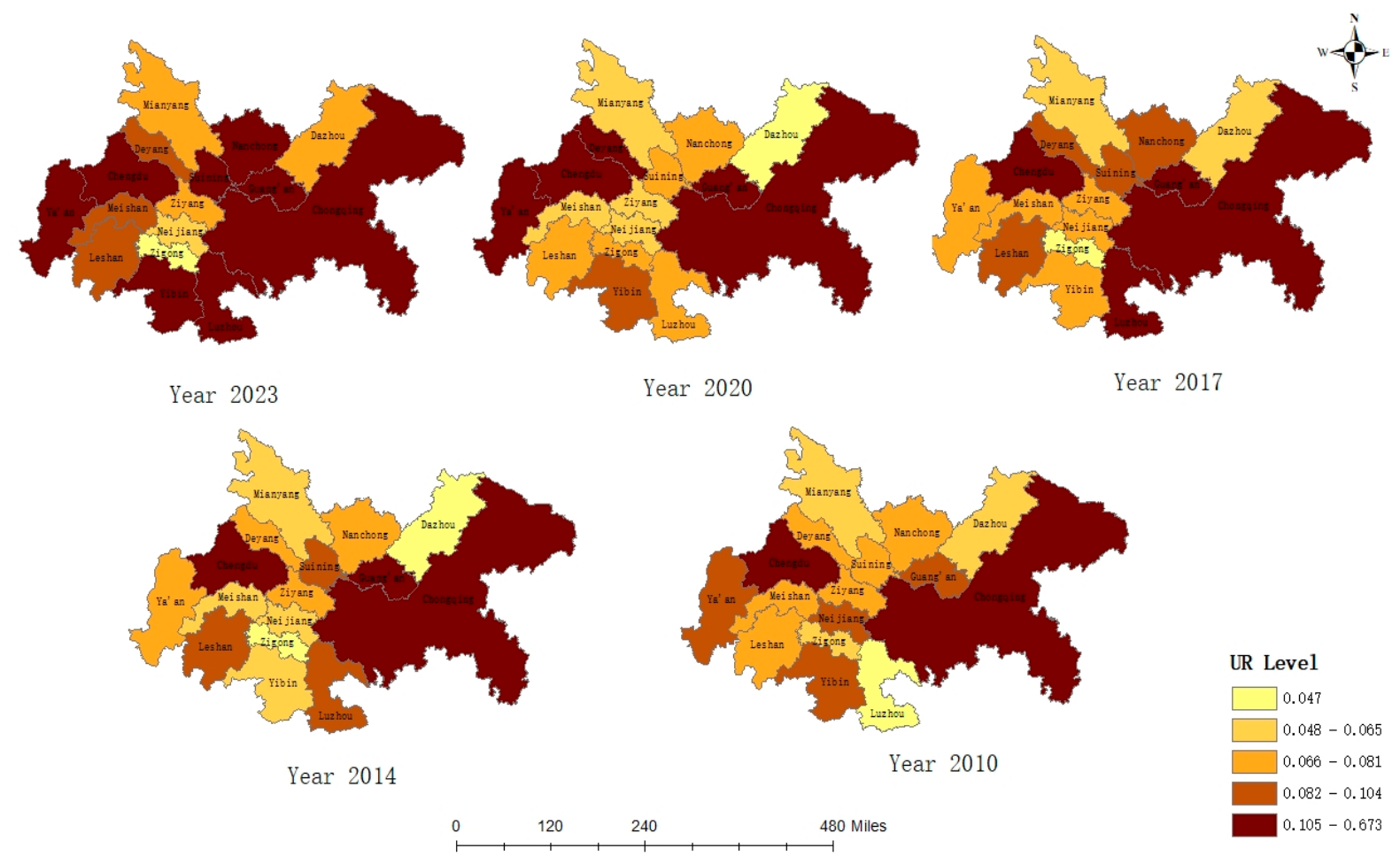
The spatial evolution of urban resilience in the CCUA exhibits pronounced gradient differentiation and progressive structural reconfiguration (see
Figure 4). The spatial pattern evolved from an initial unipolar concentration to a multi-axis and hierarchically differentiated configuration. Throughout the study period, a persistent core–periphery structure remained evident, with dominant resilience concentrated in central metropolitan areas and comparatively weaker performance in peripheral cities. Chongqing and Chengdu consistently functioned as dual-core resilience centers, maintaining significantly higher resilience levels than other cities. Both cities reached peak resilience levels in 2022, reinforcing a dual-core spatial radiation pattern. Despite their core status, the two cities exhibited differentiated evolutionary trajectories, indicating heterogeneous adaptive pathways within metropolitan systems. At the spatial structural level, a unipolar radiation pattern centered on Chongqing dominated during 2010–2016, with substantial resilience gaps between the core and surrounding cities. After 2017, the spatial configuration gradually transitioned toward an axis-based linkage structure. Three principal resilience corridors became increasingly evident: the Chengdu–Chongqing main axis, the riverine coordination belt, and the northeastern adjustment belt. Peripheral cities exhibited differentiated resilience patterns, including industrial transition-oriented recovery, ecological vulnerability-induced fluctuation, and rapid urbanization-driven instability.
4.2. Ecological Risk
4.2.1. Temporal Evolution of Ecological Risk
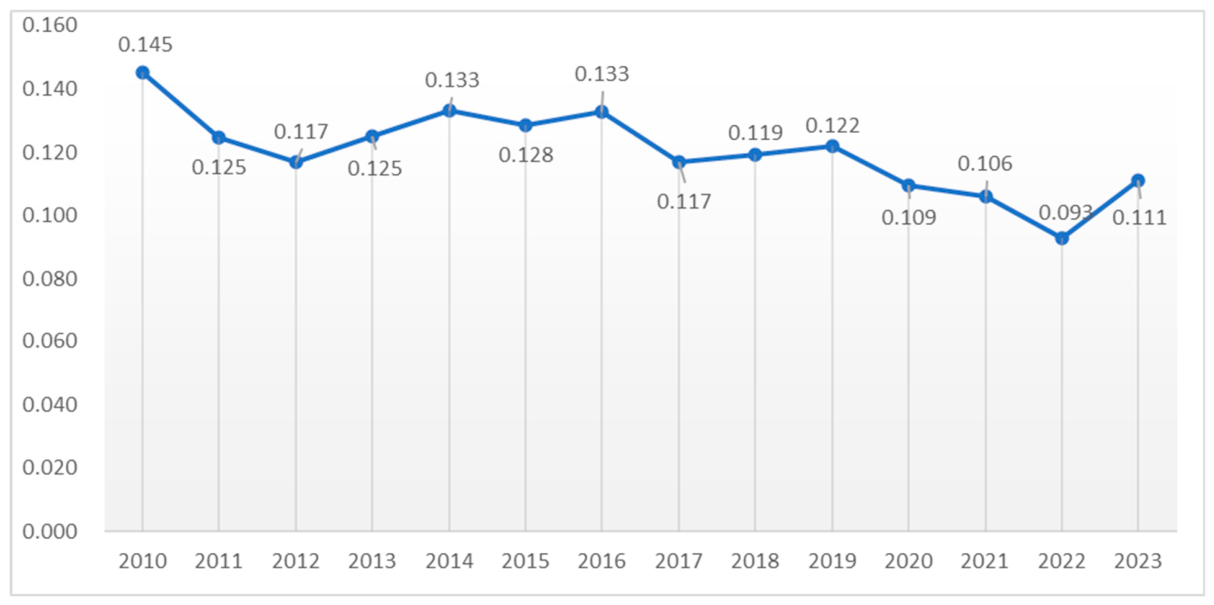
The results indicate that the annual average ecological risk in the CCUA followed a phased trajectory characterized by early fluctuation, subsequent decline, and slight rebound, providing the environmental context within which urban resilience evolves (see
Figure 5). Ecological risk was relatively high at the beginning of the observation period (0.145 in 2010). A noticeable decline occurred during 2011–2012, reaching 0.117 in 2012. Between 2013 and 2016, ecological risk experienced a period of moderate fluctuation, remaining within the range of 0.125–0.133. After 2017, ecological risk entered a general downward trend, with minor short-term rebounds during 2018–2019. From 2020 onward, ecological risk declined more markedly, reaching its lowest level in 2022 (0.093). A slight rebound was observed in 2023 (0.111); however, risk levels remained substantially lower than those observed during 2010–2016, indicating a sustained downward structural shift despite short-term variability.
4.2.2. Inter-Annual Evolution and Structural Transformation of Ecological Risk
From a temporal perspective, ecological risk evolution in the CCUA exhibits a distinct three-stage transformation process (see
Table 5), including an accumulation stage (2010–2016), a stabilization stage (2017–2019), and a decline stage (2020–2023). The period from 2010 to 2016 (accumulation stage) was characterized by accelerated risk accumulation, with a general upward trend across the region. During this stage, increasing nighttime light intensity and expansion of construction land coincided with rising ecological risk levels. Between 2017 and 2019 (stabilization stage), ecological risk entered a stabilization phase, with overall fluctuations narrowing and inter-city differences becoming relatively moderate. From 2020 to 2023 (decline stage), ecological risk declined more consistently across most cities, indicating a decoupling between development intensity and risk accumulation. Although short-term rebounds were observed in selected areas, risk levels remained substantially lower than those during the initial accumulation stage. Overall, the three-stage transformation highlights the nonlinear temporal dynamics of ecological risk evolution, characterized by initial accumulation, transitional stabilization, and subsequent structural decline.
4.2.3. Spatial Pattern Evolution of Ecological Risk
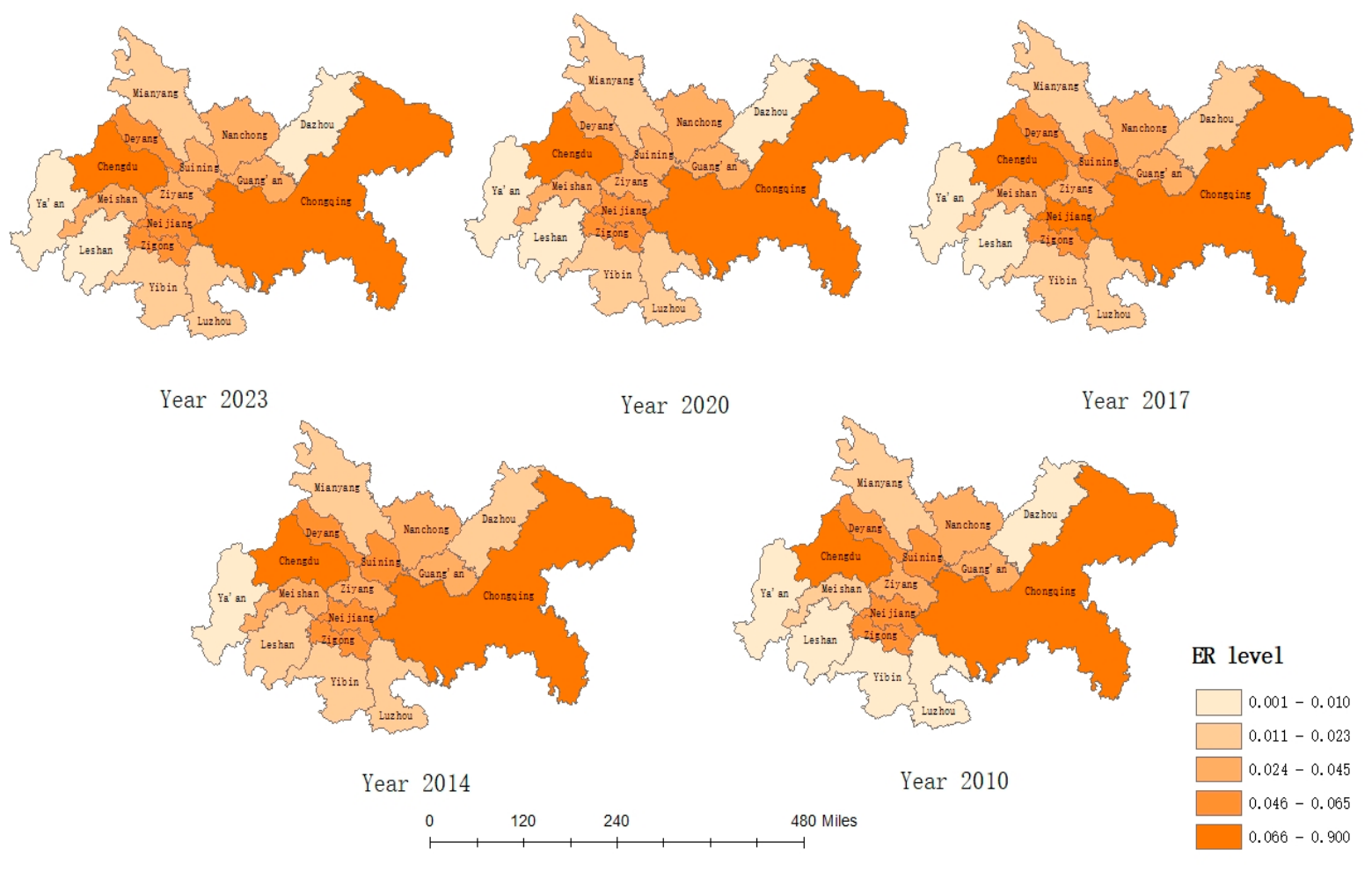
The spatial evolution of ecological risk in the CCUA exhibits a persistent gradient structure accompanied by progressive spatial reconfiguration (see
Figure 6). Overall, the pattern evolved toward a configuration characterized by core concentration and axial diffusion, indicating structural polarization under rapid urbanization. Throughout the study period, a pronounced core–periphery gradient remained evident. Chongqing and Chengdu consistently maintained higher ecological risk levels than other cities, functioning as dual-core risk centers. Their dominant status reflects concentrated demographic activities, intensive land-use development, and high nighttime light intensity within major metropolitan areas. Despite interannual fluctuations, risk levels in these core cities remained structurally elevated relative to peripheral regions. In terms of spatial diffusion, ecological risk demonstrated axis-oriented transmission effects. A corridor pattern gradually emerged along the primary development axis connecting Chengdu and Chongqing, while riverine cities exhibited relatively synchronized risk dynamics, suggesting spatial spillover through economic and land-use linkages. Meanwhile, several intermediate cities displayed transitional risk levels, forming buffer zones between core and low-risk peripheral areas. Peripheral and ecologically constrained cities generally maintained comparatively lower risk levels, reflecting differentiated development pathways and varying ecological carrying capacities. This spatial heterogeneity underscores the coexistence of risk concentration, diffusion, and localized mitigation across the region. Overall, the spatial restructuring of ecological risk indicates a transition from single-core dominance toward a more networked and multi-center configuration. The coexistence of concentration and diffusion patterns highlights the complex interaction between urban expansion, land-use intensity, and ecological vulnerability within the regional built environment system.
4.3. Coupling Coordination Between Urban Resilience and Ecological Risk
The spatial evolution of urban resilience in the CCUA exhibits pronounced gradient differentiation and progressive structural reconfiguration, which, when considered alongside ecological risk patterns, reflects the coupled dynamics between the two subsystems. The spatial pattern evolved from an initial unipolar concentration to a multi-axis and hierarchically differentiated configuration. Throughout the study period, a persistent core–periphery structure remained evident, with dominant resilience concentrated in central metropolitan areas and comparatively weaker performance in peripheral cities. Overall, the empirical results are interpreted within a unified analytical framework in which ecological risk represents an external constraint, while urban resilience reflects the adaptive capacity of the urban system, and their interaction forms the core research logic of this study. The evolution of the coupling coordination degree reflects the joint dynamics of ecological risk and urban resilience. Specifically, improvements in coordination are primarily driven by the combined effect of declining ecological risk and gradual enhancement of resilience capacity, rather than isolated changes in either subsystem. This indicates that the coordination level is highly dependent on the balance between the two systems, and mismatches between risk reduction and resilience improvement may result in states of high coupling but low coordination.
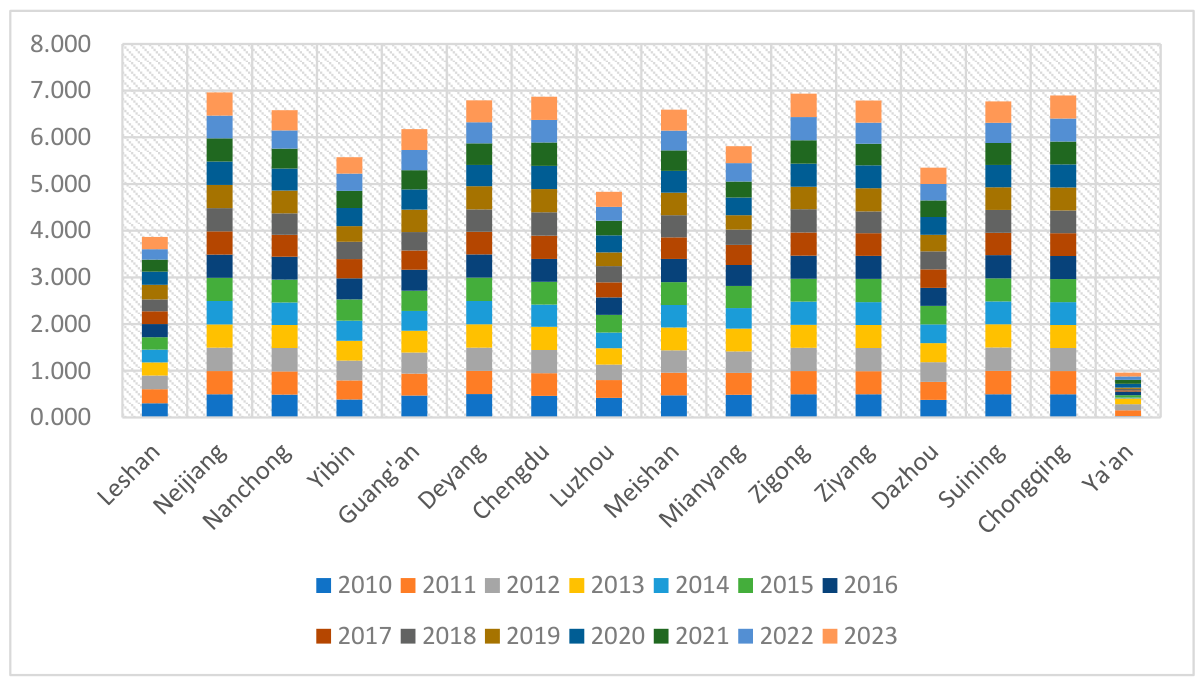
As illustrated in
Figure 7, the coupling coordination coefficient exhibits clear inter-city heterogeneity and stage-wise fluctuations over time. Chongqing and Chengdu consistently functioned as dual-core resilience centers, maintaining significantly higher resilience levels than other cities. Both cities reached peak resilience levels in 2022, reinforcing a dual-core spatial radiation pattern. Despite their core status, the two cities exhibited differentiated evolutionary trajectories, indicating heterogeneous adaptive pathways within metropolitan systems.
At the spatial structural level, a unipolar radiation pattern centered on Chongqing dominated during 2010–2016, with substantial resilience gaps between the core and surrounding cities. After 2017, the spatial configuration gradually transitioned toward an axis-based linkage structure. Three principal resilience corridors became increasingly evident: the Chengdu–Chongqing main axis, the riverine coordination belt, and the northeastern adjustment belt. Peripheral cities exhibited differentiated resilience patterns, including industrial transition-oriented recovery, ecological vulnerability-induced fluctuation, and rapid urbanization-driven instability. Detailed values of the coupling coordination degree for each city are reported in
Table 6.
4.4. Results of Two-Way Fixed Effects Model
4.4.1. Baseline Effect of Ecological Risk on Urban Resilience
Column (2) of
Table 7 reports the estimation results of the two-way fixed effects model. After controlling for city-specific and time-specific effects, ecological risk is significantly negatively associated with urban resilience, supporting the conceptual framework that ecological constraints shape the adaptive capacity of urban systems. Specifically, the coefficient of Risk is significantly negative at the 1% level (β = −0.0995,
p < 0.01), indicating that an increase in ecological risk substantially suppresses the development of urban resilience within the CCUA. This result suggests that ecological pressures, such as environmental degradation and resource constraints, may weaken the adaptive capacity and recovery potential of urban systems. Even after controlling for economic structure, technological level, infrastructure conditions, and governance factors, the constraining effect of ecological risk remains robust. The high intra-class correlation coefficient (ρ ≈ 0.98) further indicates that substantial heterogeneity exists across cities, justifying the adoption of the fixed effects specification.
4.4.2. Effects of Structural Control Variables
Among the control variables, infrastructure development (X4) demonstrates a consistently positive and statistically significant impact on urban resilience. In Column (2), the coefficient is significant at the 5% level, while in Column (3) it becomes significant at the 1% level. This result implies that improvements in transportation networks, public service provision, and urban connectivity contribute positively to strengthening systemic resilience, suggesting that their effects on urban resilience may be indirect, context-dependent, or subject to dynamic adjustment processes. By contrast, other structural variables—including economic development level (X1), industrial structure upgrading (X2), urbanization (X3), and environmental governance capacity (X5)—do not exhibit stable statistical significance across model specifications. Although their direct effects are limited in the baseline model, their inclusion improves model consistency and helps isolate the independent influence of ecological risk, thereby mitigating omitted variable bias. Specifically, the insignificant effect of economic development level (X1) may reflect its dual role, as economic growth can both enhance financial and technological capacity for resilience building and simultaneously increase environmental pressure, resulting in offsetting effects. Similarly, the impact of industrial structure upgrading (X2) may not be immediately observable, as structural transformation often involves time lags and transitional costs before yielding resilience benefits. In addition, regional heterogeneity within the urban agglomeration may further dilute the overall statistical significance of these variables.
4.4.3. Moderating Effect of Infrastructure Development
Column (3) of
Table 6 introduces the interaction term between ecological risk and infrastructure development to examine the moderating role of structural capacity in shaping the risk–resilience nexus. It should be noted that the positive coefficient of ecological risk in Column (3) reflects the conditional marginal interpretation under the interaction specification rather than a reversal of the baseline effect, as the impact of ecological risk depends on the level of infrastructure development. Specifically, when an interaction term is included, the coefficient of ecological risk represents its effect when the moderating variable equals zero, and the overall marginal effect should be interpreted as the sum of the main effect and the interaction term. The interaction coefficient (Risk × Infrastructure) is significantly negative at the 1% level (β = −0.0240,
p < 0.01), indicating that infrastructure development significantly moderates the impact of ecological risk on urban resilience. This result suggests that the effect of ecological risk is conditional upon the level of infrastructure development. In cities with relatively low infrastructure capacity, ecological risk may not immediately translate into resilience deterioration. However, as infrastructure levels increase, the marginal impact of ecological risk becomes more negative, implying that highly structured urban systems may exhibit stronger sensitivity to ecological pressures. One possible explanation is that advanced infrastructure systems enhance connectivity and spatial integration, thereby increasing systemic interdependence, which facilitates the rapid transmission of shocks across interconnected urban subsystems. While such integration improves efficiency under normal conditions, it may also amplify vulnerability when ecological disturbances occur as disruptions in one component (e.g., transportation, energy, or water systems) can propagate through highly connected networks and trigger cascading failures. In other words, infrastructure development simultaneously strengthens urban capacity and heightens exposure to risk transmission mechanisms, particularly in highly integrated systems where functional dependencies are strong. Therefore, infrastructure functions not only as a structural support for resilience enhancement but also as a channel through which ecological risk propagates within complex urban systems, reflecting its dual role in both enhancing adaptive capacity and increasing systemic vulnerability. This dual role highlights the importance of integrating resilience-oriented design principles into infrastructure planning to mitigate potential systemic fragility under escalating ecological pressures, such as reducing excessive interdependence and incorporating redundancy and modularity in critical infrastructure networks.
5. Discussion
This study systematically examined the spatiotemporal evolution of urban resilience and ecological risk in the CCUA and further explored the structural interaction between the two subsystems. The findings yield several theoretical and policy-relevant insights.
First, the temporal trajectories of urban resilience and ecological risk reveal an asynchronous yet structurally interdependent dynamic. While urban resilience underwent a prolonged foundational phase followed by gradual enhancement, ecological risk experienced a three-stage transformation characterized by accumulation, stabilization, and subsequent decline. This pattern supports prior arguments that resilience construction often lags behind risk accumulation due to institutional inertia and path dependency. However, this study extends existing literature by demonstrating that, at the urban agglomeration scale, resilience upgrading can coexist with persistent ecological pressure. Rather than a simple inverse relationship, the two systems form a structurally coupled but tension-laden configuration, reflecting the complexity of transitional regional development.
Second, the spatial analysis reveals a stable “dual-core dominance and peripheral differentiation” structure. Chongqing and Chengdu function simultaneously as resilience centers and ecological risk concentration areas [
44]. This duality aligns with the theory of agglomeration externalities, which suggests that resource concentration enhances governance capacity while simultaneously intensifying environmental stress. Importantly, the coupling results indicate that high resilience does not necessarily correspond to low ecological risk. Instead, it may signify stronger adaptive and buffering capacity under sustained ecological pressure. This challenges the conventional linear assumption that resilience and risk are inversely proportional and suggests that resilience should be interpreted as adaptive capacity under constraint rather than the absence of risk. Although this study identifies a clear dual-core spatial structure, spatial autocorrelation patterns are not explicitly examined. Given the strong inter-city linkages within the urban agglomeration, urban resilience may exhibit spatial clustering and spillover characteristics. Future research could incorporate spatial autocorrelation methods, such as Moran’s I or hotspot analysis, to further explore clustering patterns and spatial dependence across cities.
Third, the econometric evidence confirms that ecological risk significantly is negatively associated with resilience, even after controlling for structural and socioeconomic factors. This finding reinforces the proposition that ecological constraints constitute a structural boundary condition for sustainable urban transformation. More importantly, the moderating effect of infrastructure development reveals a nonlinear mechanism [
41]. Although infrastructure exerts a direct positive influence on resilience capacity, it simultaneously strengthens the marginal negative impact of ecological risk. This suggests that highly integrated infrastructure systems increase systemic interdependence, which may amplify vulnerability through cascading effects when ecological disturbances occur.
Such a dual effect is consistent with complex adaptive systems theory: higher levels of integration enhance operational efficiency under normal conditions but may elevate systemic fragility under stress. In rapidly urbanizing regions, infrastructure expansion therefore operates as both a resilience-enhancing mechanism and a potential risk transmission channel. This finding contributes to the growing literature on networked vulnerability and underscores the importance of embedding resilience-oriented design principles within infrastructure planning. It should be noted that the estimated effects may also be influenced by potential spatial spillover processes within the urban agglomeration. Given the high degree of economic and infrastructural interconnection in the CCUA, ecological risk or resilience conditions in one city may extend beyond administrative boundaries and affect neighboring cities through mechanisms such as environmental diffusion, industrial linkages, and infrastructure networks. As a result, the estimated coefficients may partly capture both local effects and unobserved spillover influences, which should be considered when interpreting the econometric results.
Compared with existing studies that typically focus on either resilience measurement or ecological risk assessment in isolation, this research advances the literature in three aspects. First, it integrates ecological risk as a central explanatory variable within a resilience analytical framework at the urban agglomeration scale. Second, it combines coupling coordination analysis with panel econometric modeling, enabling both structural pattern identification and causal inference. Third, it highlights the conditional and nonlinear characteristics of the risk–resilience nexus, particularly through the moderating role of infrastructure, thereby enriching the theoretical understanding of urban system dynamics under ecological constraints.
From a policy perspective, the results imply that resilience-oriented development strategies in ecologically sensitive urban agglomerations should move beyond growth-centric or infrastructure-driven paradigms. Core cities should prioritize ecological carrying capacity management and systemic risk buffering mechanisms, including the implementation of ecological zoning controls, limits on high-intensity land development, and the integration of green infrastructure to mitigate risk accumulation under high-density conditions. Peripheral cities should focus on structural transformation, ecological restoration, for example, by promoting low-impact land-use practices, strengthening ecosystem restoration programs (e.g., reforestation and watershed management), and adopting development strategies tailored to local resource endowments and ecological capacity. Furthermore, infrastructure planning should incorporate redundancy, modularity, and adaptive design, such as developing decentralized infrastructure networks, enhancing backup capacity in critical systems (e.g., transport and water supply), and integrating risk-monitoring and early warning systems to reduce cascading failures under ecological stress.
Nevertheless, several limitations warrant attention. First, due to data availability constraints, micro-level adaptive capacity indicators—such as household preparedness and emergency response efficiency—were not incorporated. Second, the ecological risk index relies on proxy variables (nighttime light intensity, population density, and land-use loss), which may not fully capture multidimensional ecological disturbance processes. Third, potential spatial spillover effects were not explicitly modeled in the econometric analysis. Future research could integrate spatial econometric approaches or dynamic panel models to explore inter-city transmission mechanisms and long-term resilience adjustment processes within urban networks.
6. Conclusions
This study examined the spatiotemporal evolution and interaction mechanisms between ecological risk and urban resilience in the CCUA over the period 2010–2023. By integrating the entropy weight–TOPSIS method, coupling coordination analysis, and a two-way fixed effects panel model, the research provides a systematic assessment of the structural dynamics and driving mechanisms underlying the regional risk–resilience system. Four main conclusions emerge.
First, urban resilience and ecological risk exhibit differentiated yet interdependent temporal trajectories. Urban resilience followed a stabilization–improvement path, whereas ecological risk underwent a three-stage evolution characterized by accumulation, stabilization, and decline. The results suggest that resilience enhancement occurs gradually and does not automatically eliminate embedded ecological pressures.
Second, the spatial pattern of the CCUA demonstrates persistent dual-core dominance, with Chengdu and Chongqing functioning simultaneously as resilience hubs and ecological risk concentration areas. This coexistence highlights the structural complexity of high-density urban systems, where development intensity and governance capacity evolve in parallel with ecological constraints.
Third, econometric results confirm that ecological risk exerts a statistically significant suppressing effect on urban resilience after controlling for structural and socioeconomic factors. Ecological constraints therefore represent a fundamental boundary condition for sustainable urban transformation within ecologically sensitive urban agglomerations.
Fourth, infrastructure development exhibits a dual and nonlinear effect. While it directly strengthens urban resilience capacity, it simultaneously intensifies the marginal negative impact of ecological risk through increased systemic connectivity. This finding underscores the necessity of balancing efficiency-oriented infrastructure expansion with resilience-oriented system design.
Theoretically, this study contributes to the literature by embedding ecological risk within an urban resilience analytical framework at the urban agglomeration scale and by integrating structural coupling analysis with causal econometric identification. Methodologically, it demonstrates the value of combining multi-index evaluation and panel modeling to uncover both pattern evolution and mechanism pathways. From a governance perspective, the findings suggest that resilience-oriented regional strategies should incorporate ecological carrying capacity constraints into development planning. Core cities need to strengthen ecological buffering and systemic redundancy, while peripheral cities should pursue differentiated green transformation pathways. Infrastructure systems should be designed with modularity, for instance by promoting decentralized layouts to reduce cascading vulnerabilities in highly interconnected urban networks.
Overall, this study provides empirical evidence and policy-relevant insights for advancing coordinated ecological governance and resilience enhancement in rapidly urbanizing and environmentally constrained urban agglomerations. However, potential endogeneity issues should be acknowledged. Although the two-way fixed effects model controls for time-invariant heterogeneity, it may not fully address reverse causality or omitted time-varying confounders. For instance, higher levels of urban resilience may, in turn, influence ecological risk through improved environmental governance and adaptive capacity. Future research could employ more rigorous identification strategies, such as instrumental variable approaches or dynamic panel models with lagged variables, to better establish causal relationships. In addition, spatial spillover effects are not explicitly modeled in the current analysis. The omission of spatial interaction terms may lead to biased or incomplete estimates of the risk–resilience relationship. Future research could incorporate spatial econometric models to better capture inter-city transmission mechanisms and regional interaction effects.
Author Contributions
Conceptualization, A.J. and Y.Z.; methodology, A.J.; software, H.Z.; resources, D.Y.; data curation, D.Y.; writing—original draft preparation, A.J.; writing—review and editing, D.X.; project administration, X.F. All authors have read and agreed to the published version of the manuscript.
Funding
This research is funded by Chengdu Water Ecological Civilization Construction Research Centre, grant number SST2025-10; Chengdu University of Information and Technology, grant number KYTZ 202232, KYZS202514, 376020, JYJG 2025079; Sichuan Environmental Sciences Academy Sci-tech Consulting Co., Ltd. (grant numbers 2025H0212).
Institutional Review Board Statement
Not applicable.
Informed Consent Statement
Not applicable.
Data Availability Statement
The original contributions presented in this study are included in the article. Further inquiries can be directed to the corresponding author.
Conflicts of Interest
Authors Hehuai Zhang, Dan Yu, Dan Xie and Xiaojuan Fu were employed by the Sichuan Environmental Sciences Academy Sci-Tech Consulting Co., Ltd. The remaining authors declare that the research was conducted in the absence of any commercial or financial relationships that could be construed as a potential conflict of interest. The authors declare that this study received funding from Sichuan Environmental Sciences Academy Sci-Tech Consulting Co., Ltd. The funder was not involved in the study design, collection, analysis, interpretation of data, the writing of this article or the decision to submit it for publication.
References
- Costanza, R.; De Groot, R.; Sutton, P.; Van der Ploeg, S.; Anderson, S.J.; Kubiszewski, I.; Farber, S.; Turner, R.K. Changes in the global value of ecosystem services. Glob. Environ. Change 2014, 26, 152–158. [Google Scholar] [CrossRef]
- Fang, L.; Wang, L.; Chen, W.; Sun, J.; Cao, Q.; Wang, S.; Wang, L. Identifying the impacts of natural and human factors on ecosystem service in the Yangtze and Yellow River Basins. J. Clean. Prod. 2021, 314, 127995. [Google Scholar] [CrossRef]
- Labaka, L.; Maraña, P.; Giménez, R.; Hernantes, J. Defining the roadmap towards city resilience. Technol. Forecast. Soc. Change 2019, 146, 281–296. [Google Scholar] [CrossRef]
- Ruggerio, C.A. Sustainability and sustainable development: A review of principles and definitions. Sci. Total Environ. 2021, 786, 147481. [Google Scholar] [CrossRef]
- Lin, Y.; Jin, Y.; Lin, M.; Wen, L.; Lai, Q.; Zhang, F.; Li, B. Exploring the spatial and temporal evolution of landscape ecological risks under tourism disturbance: A case study of the Min River Basin, China. Ecol. Indic. 2024, 166, 112412. [Google Scholar] [CrossRef]
- He, J.; Hu, S. Ecological efficiency and its determining factors in an urban agglomeration in China: The Chengdu–Chongqing Urban Agglomeration. Urban Clim. 2022, 41, 101071. [Google Scholar] [CrossRef]
- Pickett, S.T.; McGrath, B.; Cadenasso, M.L.; Felson, A.J. Ecological resilience and resilient cities. Build. Res. Inf. 2014, 42, 143–157. [Google Scholar] [CrossRef]
- Dang, Z.; Hu, B.; Gao, C.; Wen, S.; Ren, J.; Liang, Y. Construction and optimization of the ecological security pattern of Pinglu Canal Economic Zone based on the InVEST–circuit theory model. Land 2025, 14, 1103. [Google Scholar] [CrossRef]
- Holling, C.S. Resilience and stability of ecological systems. Annu. Rev. Ecol. Syst. 1973, 4, 1–23. [Google Scholar] [CrossRef]
- Walker, B.; Holling, C.S.; Carpenter, S.R.; Kinzig, A. Resilience, adaptability and transformability in social–ecological systems. Ecol. Soc. 2004, 9, 5. [Google Scholar] [CrossRef]
- Rose, A. Economic resilience to natural and man-made disasters: Multidisciplinary origins and contextual dimensions. Environ. Hazards 2007, 7, 383–398. [Google Scholar] [CrossRef]
- McManus, S.; Seville, E.; Vargo, J.; Brunsdon, D. Facilitated process for improving organizational resilience. Nat. Hazards Rev. 2008, 9, 81–90. [Google Scholar] [CrossRef]
- Liao, L.; Du, M.; Huang, J. The effect of urban resilience on residents’ subjective happiness: Evidence from China. Land 2022, 11, 1896. [Google Scholar] [CrossRef]
- Sharifi, A. Urban resilience assessment: Mapping knowledge structure and trends. Sustainability 2020, 12, 5918. [Google Scholar] [CrossRef]
- Ramirez Lopez, L.J.; Grijalba Castro, A.I. Sustainability and resilience in smart city planning: A review. Sustainability 2020, 13, 181. [Google Scholar] [CrossRef]
- Sharifi, A.; Yamagata, Y. Towards an integrated approach to urban resilience assessment. APN Sci. Bull. 2017, 7, 9–14. [Google Scholar] [CrossRef]
- Chen, Y.; Zhu, M.; Zhou, Q.; Qiao, Y. Research on spatiotemporal differentiation and influence mechanism of urban resilience in China based on MGWR model. Int. J. Environ. Res. Public Health 2021, 18, 1056. [Google Scholar] [CrossRef]
- Sharifi, A. A critical review of selected tools for assessing community resilience. Ecol. Indic. 2016, 69, 629–647. [Google Scholar] [CrossRef]
- Bruneau, M.; Chang, S.E.; Eguchi, R.T.; Lee, G.C.; O’Rourke, T.D.; Reinhorn, A.M.; Shinozuka, M.; Tierney, K.; Wallace, W.A.; Von Winterfeldt, D. A framework to quantitatively assess and enhance the seismic resilience of communities. Earthq. Spectra 2003, 19, 733–752. [Google Scholar] [CrossRef]
- Chen, C.; Xu, L.; Zhao, D.; Xu, T.; Lei, P. A new model for describing the urban resilience considering adaptability, resistance and recovery. Saf. Sci. 2020, 128, 104756. [Google Scholar] [CrossRef]
- Jordan, E.; Javernick-Will, A. Indicators of community recovery: Content analysis and Delphi approach. Nat. Hazards Rev. 2013, 14, 21–28. [Google Scholar] [CrossRef]
- Cutter, S.L.; Ash, K.D.; Emrich, C.T. The geographies of community disaster resilience. Glob. Environ. Change 2014, 29, 65–77. [Google Scholar] [CrossRef]
- Lu, H.; Zhang, C.; Jiao, L.; Wei, Y.; Zhang, Y. Analysis on the spatial–temporal evolution of urban agglomeration resilience: A case study in Chengdu–Chongqing Urban Agglomeration, China. Int. J. Disaster Risk Reduct. 2022, 79, 103167. [Google Scholar] [CrossRef]
- Rodriguez-Gonzalez, P.T.; Rico-Martinez, R.; Rico-Ramirez, V. Effect of feedback loops on the sustainability and resilience of human–ecosystems. Ecol. Modell. 2020, 426, 109018. [Google Scholar] [CrossRef]
- Sherrieb, K.; Norris, F.H.; Galea, S. Measuring capacities for community resilience. Soc. Indic. Res. 2010, 99, 227–247. [Google Scholar] [CrossRef]
- Mallick, S.K.; Das, P.; Maity, B.; Rudra, S.; Pramanik, M.; Pradhan, B.; Sahana, M. Understanding future urban growth, urban resilience and sustainable development of small cities using prediction–adaptation–resilience (PAR) approach. Sustain. Cities Soc. 2021, 74, 103196. [Google Scholar] [CrossRef]
- Datola, G.; Bottero, M.; De Angelis, E.; Romagnoli, F. Operationalising resilience: A methodological framework for assessing urban resilience through system dynamics model. Ecol. Modell. 2022, 465, 109851. [Google Scholar] [CrossRef]
- Gao, L.; Tao, F.; Liu, R.; Wang, Z.; Leng, H.; Zhou, T. Multi-scenario simulation and ecological risk analysis of land use based on the PLUS model: A case study of Nanjing. Sustain. Cities Soc. 2022, 85, 104055. [Google Scholar] [CrossRef]
- Adili, A.; Wu, B.; Chen, J.; Wu, N.; Ge, Y.; Abuduwaili, J. Assessment of landscape ecological risk and its driving factors for the Ebinur Lake Basin from 1985 to 2022. Land 2024, 13, 1572. [Google Scholar] [CrossRef]
- Pollino, C.A.; Woodberry, O.; Nicholson, A.; Korb, K.; Hart, B.T. Parameterisation and evaluation of a Bayesian network for use in an ecological risk assessment. Environ. Model. Softw. 2007, 22, 1140–1152. [Google Scholar] [CrossRef]
- Ferreira, S.L.; da Silva Junior, J.B.; dos Santos, I.F.; de Oliveira, O.M.; Cerda, V.; Queiroz, A.F. Use of pollution indices and ecological risk in the assessment of contamination from chemical elements in soils and sediments: Practical aspects. TrAC Trends Environ. Anal. Chem. 2022, 35, e00169. [Google Scholar] [CrossRef]
- Norton, S.B.; Rodier, D.J.; van der Schalie, W.H.; Wood, W.P.; Slimak, M.W.; Gentile, J.H. A framework for ecological risk assessment at the EPA. Environ. Toxicol. Chem. 1992, 11, 1663–1672. [Google Scholar] [CrossRef]
- Chen, S.; Chen, B.; Fath, B.D. Ecological risk assessment on the system scale: A review of state-of-the-art models and future perspectives. Ecol. Modell. 2013, 250, 25–33. [Google Scholar] [CrossRef]
- Petrosillo, I.; Zurlini, G.; Grato, E.; Zaccarelli, N. Indicating fragility of socio-ecological tourism-based systems. Ecol. Indic. 2006, 6, 104–113. [Google Scholar] [CrossRef]
- Xing, L.; Hu, M.; Wang, Y. Integrating ecosystem services value and uncertainty into regional ecological risk assessment: A case study of Hubei Province, Central China. Sci. Total Environ. 2020, 740, 140126. [Google Scholar] [CrossRef]
- Nie, Y.; Li, Y.; Li, X.; Zhang, L.; Chen, Z.; Yu, J. Ecological risk assessment in “Xiangyang–Shiyan–Suizhou–Shennongjia” based on risk probability and ecological loss model. Resour. Environ. Yangtze Basin 2024, 33, 870–881. [Google Scholar]
- Zhang, W.; Liu, G.; Ghisellini, P.; Yang, Z. Ecological risk and resilient regulation shifting from city to urban agglomeration: A review. Environ. Impact Assess. Rev. 2024, 105, 107386. [Google Scholar] [CrossRef]
- Ding, R.; Fu, J.; Zhang, Y.; Zhang, T.; Yin, J.; Du, Y.; Zhou, T.; Du, L. Research on the evolution of the economic spatial pattern of urban agglomeration and its influencing factors: Evidence from the Chengdu–Chongqing Urban Agglomeration of China. Sustainability 2022, 14, 10969. [Google Scholar] [CrossRef]
- Yang, J.; Huang, X. The 30 m annual land cover datasets and its dynamics in China from 1985 to 2023. Earth Syst. Sci. Data 2024, 13, 3907–3925. [Google Scholar] [CrossRef]
- Wu, Y.; Shi, K.; Chen, Z.; Liu, S.; Chang, Z. An Improved Time-Series DMSP-OLS-Like Data (1992–2024) in China by Integrating DMSP-OLS and SNPP-VIIRS; Dataset, V5; Harvard Dataverse: Cambridge, MA, USA, 2021. [Google Scholar] [CrossRef]
- Chen, M.; Zhang, Q.; Jiang, Y.; Wang, J.; Zhu, S. Evaluating the coupling coordination levels and critical obstacle indicators of urban infrastructure resilience: A case study in China. Buildings 2025, 15, 495. [Google Scholar] [CrossRef]
- Delgado-Ramos, G.C.; Guibrunet, L. Assessing the ecological dimension of urban resilience and sustainability. Int. J. Urban Sustain. Dev. 2017, 9, 151–169. [Google Scholar] [CrossRef]
- Huang, G.; Li, D.; Zhu, X.; Zhu, J. Influencing factors and their influencing mechanisms on urban resilience in China. Sustain. Cities Soc. 2021, 74, 103210. [Google Scholar] [CrossRef]
- Zhou, Y.; Chen, Y.; Li, Z.; Jiang, W. Ecological resilience assessment of an emerging urban agglomeration: A case study of Chengdu–Chongqing Economic Circle, China. Pol. J. Environ. Stud. 2022, 31, 2571–2584. [Google Scholar]
- Wang, B.; Han, S.; Ao, Y.; Liao, F. Evaluation and factor analysis for urban resilience: A case study of Chengdu–Chongqing Urban Agglomeration. Buildings 2022, 12, 962. [Google Scholar] [CrossRef]
- Lu, F.; Liu, Q.; Wang, P. Spatiotemporal characteristics of ecological resilience and its influencing factors in the Yellow River Basin of China. Sci. Rep. 2024, 14, 16988. [Google Scholar] [CrossRef]
- He, Y.; Liu, X.; Wu, D.; Li, S.; Zhou, P. Ecological risks and patterns associated with land use/cover changes along the Belt and Road Initiative routes. Land Degrad. Dev. 2025, 36, 2075–2094. [Google Scholar] [CrossRef]
- Wang, J.; Wang, J.; Zhang, J. Optimization of landscape ecological risk assessment method and ecological management zoning considering resilience. J. Environ. Manag. 2025, 376, 124586. [Google Scholar] [CrossRef]
- Qiu, J.; Ju, Z.; Wang, H.; Wu, J. The double-edged sword effects of land use optimization based on dual carbon goals: A perspective from landscape ecological risk. J. Environ. Manag. 2025, 380, 125044. [Google Scholar] [CrossRef]
- Zhu, R.; Gan, X.-Y.; Li, Z.-S. Spatio-temporal changes of ecological resilience and ecological risk and construction of ecological zones in Sichuan Province. Resour. Environ. Yangtze Basin 2024, 33, 175–188. [Google Scholar]
- Xu, Y.; Zhong, Y.X.; Feng, X.H.; Xu, L.T.; Zheng, L. Ecological risk pattern of Poyang Lake Basin based on land use. Acta Ecol. Sin. 2016, 36, 7850–7857. [Google Scholar] [CrossRef]
- Wang, S.; Zhang, Q.; Wang, Z.; Yu, L.; Xiang, S.; Gao, M. GIS-based ecological risk assessment and ecological zoning in the Three Gorges Reservoir Area. Acta Ecol. Sin. 2022, 42, 4654–4664. [Google Scholar] [CrossRef]
| Disclaimer/Publisher’s Note: The statements, opinions and data contained in all publications are solely those of the individual author(s) and contributor(s) and not of MDPI and/or the editor(s). MDPI and/or the editor(s) disclaim responsibility for any injury to people or property resulting from any ideas, methods, instructions or products referred to in the content. |