1. Introduction
Global climate change, characterized by extreme phenomena such as sea-level rise, droughts, and torrential rainfall [
1,
2], poses a significant global challenge. Carbon dioxide emissions are widely acknowledged as a primary driver of climate change [
3], thereby necessitating coordinated global action. China, as one of the largest contributors to global greenhouse gas emissions, has actively participated in international efforts to mitigate carbon emissions. Six years ago, China proposed the “Dual Carbon Goals” to address carbon emissions matters, with supply chain decarbonization identified as a critical pathway toward achieving these targets. A supply chain constitutes an interconnected network linking upstream and downstream firms, within which carbon emissions and energy consumption occur at multiple stages [
4], including raw material sourcing, energy use, and production processes [
5]. Emissions from production and supply chain activities account for over 42% of global carbon emissions, while indirect supply chain emissions are typically 5.5 times greater than direct emissions, reaching as high as 10.7 times in the retail sector [
6]. Effective supply chain management enhances resource allocation efficiency, improves operational performance, and reduces environmental burdens. Under increasingly stringent carbon regulatory frameworks, firms are required to strengthen supply chain management practices to ensure compliance. Accordingly, supply chain optimization has become an essential strategic approach for promoting carbon reduction and facilitating green transformation [
7].
Existing studies primarily focus on the determinants of carbon emissions from the perspective of aggregate emission levels, emphasizing both internal corporate characteristics [
1] and external political and economic environments [
8,
9]. However, relatively few studies employ carbon emission intensity (CEI), defined as carbon emissions per unit of output. Achieving the “Dual Carbon Goals” requires profound economic and social transformation, particularly in improving energy utilization efficiency and reducing corporate CEI [
10]. Prior research has analyzed the drivers and governance mechanisms of corporate CEI. Government intervention contributes substantially to the reduction in corporate CEI. Some studies argue that fiscal and tax incentives promote the adoption of clean technologies, thereby generating positive environmental externalities [
11]. Other studies find that increased government fiscal expenditure contributes to reductions in corporate CEI [
12]. Furthermore, favorable financing conditions, particularly green credit policies, encourage heavily polluting firms to engage in technological innovation and low-carbon transformation [
13]. Technological innovation is also identified as a key driver of corporate CEI reduction. Evidence shows that technological progress in China’s steel industry improved energy efficiency by 60% between 1994 and 2003 [
14], while digital inclusive finance has been shown to reduce urban CEI through innovation channels [
15]. However, existing studies exhibit several limitations. First, prior research predominantly focuses on macro-level factors and corporate governance mechanisms, with limited attention to the supply chain perspective. Second, much of the existing literature relies on qualitative analysis, with insufficient quantitative empirical evidence.
Supply chain digitalization (SCD) represents a critical management transformation in the digital economy. It is characterized by the use of technologies, including the IoT and artificial intelligence, to reconfigure the collaborative efficiency of supply chain components [
16,
17]. In practice, firms and their partners utilize digital technologies to restructure organizational workflows, coordination mechanisms, and value creation across both internal and external supply chain networks, including logistics, production, and information systems [
18]. Existing literature primarily emphasizes the economic benefits of SCD. Empirical evidence shows that digitalization improves supply chain efficiency [
19] and enhances operational stability [
20]. Evidence from Malaysian manufacturing firms shows that digitalization significantly improves supply chain processes [
13]. Other studies document that SCD enhances organizational resilience [
21] and strengthens competitive advantage [
22]. However, research on environmental impacts remains limited, with existing studies mainly focusing on corporate ESG performance [
23], green innovation [
24,
25], and carbon emissions [
26]. Recent studies have begun to explore how supply chains can reduce carbon emissions through digital solutions, including optimization algorithms [
27] and artificial intelligence technologies [
28]. Nevertheless, an integrated understanding of the impact of SCD on corporate CEI and its underlying mechanisms remains lacking. Furthermore, existing research primarily relies on dynamic capability theory or the resource-based view [
29], often employing difference-in-differences methods or survey-based approaches, resulting in limited empirical measurement and insufficient empirical evidence regarding the effects of SCD.
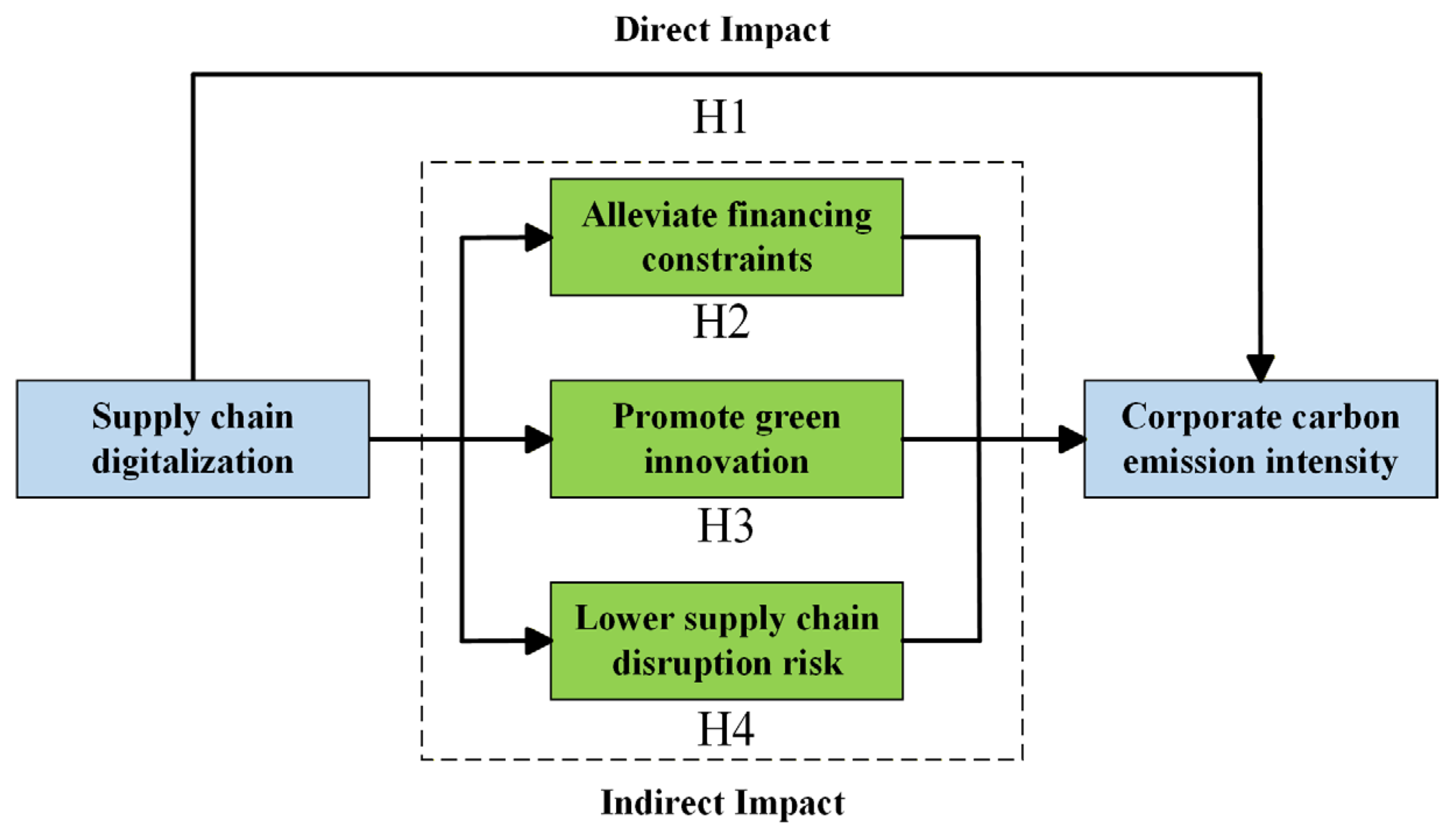
Therefore, using a panel dataset of A-share listed firms from the Shanghai and Shenzhen stock exchanges spanning 2013 to 2023, this study employs machine learning-based text analysis of corporate annual reports to measure SCD. The results indicate that SCD significantly reduces corporate CEI. This effect operates through three primary channels: alleviating financing constraints, promoting green innovation, and lowering supply chain disruption risk. Heterogeneity analysis further shows that the suppressive effect is more pronounced in non-state-owned enterprises, large-scale enterprises, non-high-tech industries, highly environmentally sensitive industries, and firms located in regions with more developed digital infrastructure.
This study makes several contributions. First, it proposes a novel analytical perspective by examining corporate CEI reduction at the firm level through the lens of SCD, thereby adding to the growing body of literature on the non-economic consequences of digitalization from the perspectives of Dynamic Capability Theory, the Resource-Based View, and Institutional Theory. Second, it develops a quantitative measurement framework for SCD using machine learning techniques implemented in Python 3.14.4, contributing to the advancement of empirical measurement and indicator construction in this field. Third, it identifies multiple mechanism pathways—including financing constraints, green innovation, and supply chain disruption risk—thereby enriching the understanding of how SCD affects corporate CEI. Finally, it investigates heterogeneity across firm-level, industry-level, and regional dimensions, thereby yielding a more comprehensive understanding of the conditional effects of SCD.
The rest of the study is organized below.
Section 2 outlines the theoretical framework and develops hypotheses.
Section 3 introduces the variable definitions and model specification.
Section 4 reports descriptive statistics, multicollinearity tests, baseline regression results, and robustness tests;
Section 5 introduces mechanism effects, heterogeneity analysis, and economic consequence analysis;
Section 6 summarizes conclusions, theoretical implications, practical implications, and limitations.
6. Conclusions and Discussion
6.1. Conclusions
Based on a panel sample of Chinese A-share listed firms from the Shanghai and Shenzhen stock exchanges during 2013–2023, this study employs machine learning techniques to conduct text analysis of corporate annual reports to measure SCD and empirically examine its impact on corporate CEI.
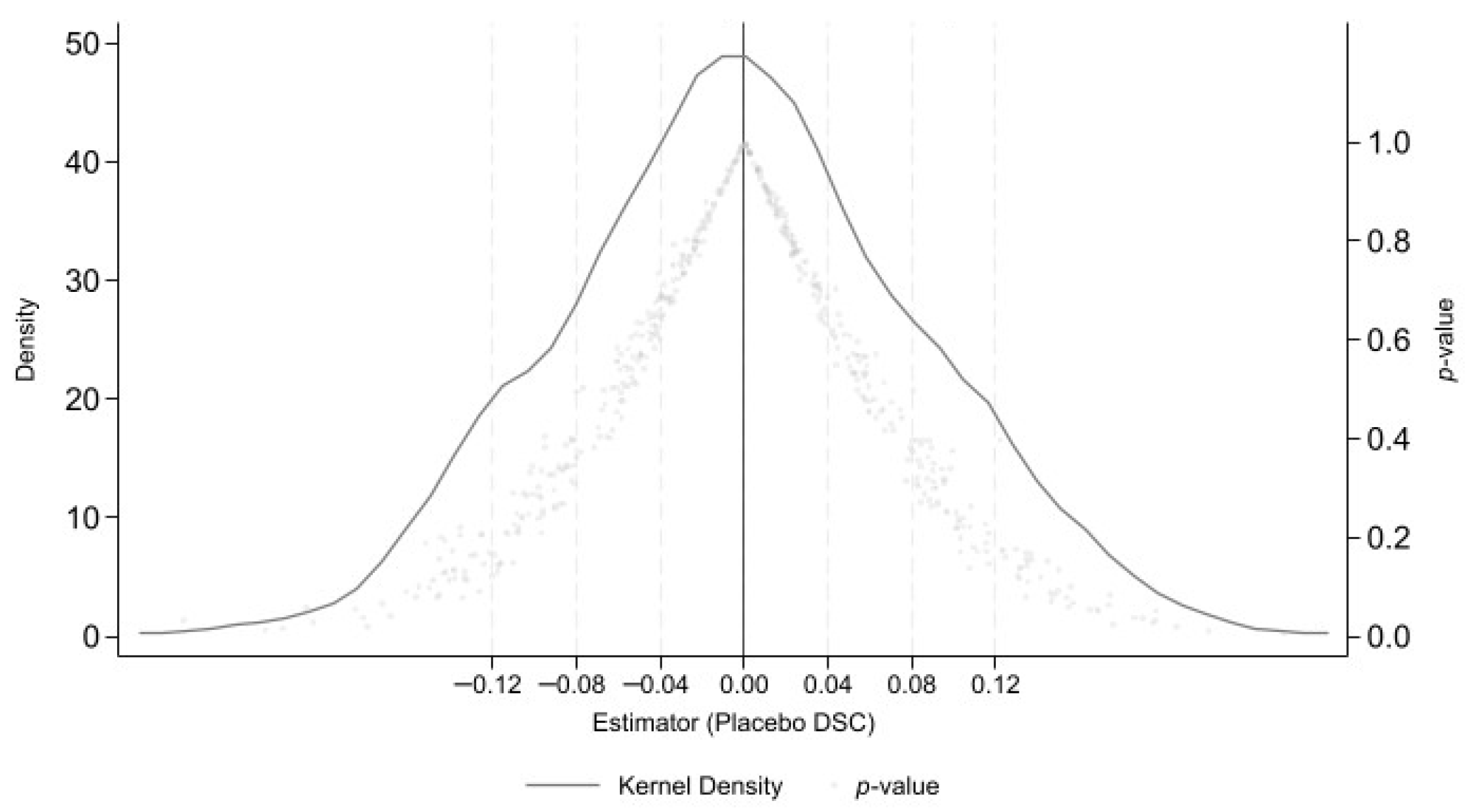
Several conclusions are drawn. First, SCD significantly reduces corporate CEI, and this finding remains robust after robustness checks, including alternative variable specifications and placebo tests. Second, this reduction is achieved by alleviating financing constraints, promoting green innovation, and reducing supply chain disruption risk. Third, the negative effect is more pronounced in non-state-owned enterprises, large firms, non-high-tech industries, environmentally sensitive industries, and firms located in regions with more developed digital infrastructure. Finally, SCD enhances firms’ sustainable development and economic performance, thereby supporting their long-term stable development.
6.2. Theoretical Implications
This study integrates Institutional Theory, the Resource-Based View, and Dynamic Capability Theory into a unified analytical framework to explain how SCD affects corporate CEI, thereby enriching the literature on SCD and carbon reduction. Specifically, Institutional Theory is employed to capture external regulatory and competitive pressures that incentivize firms to advance digital technologies; the Resource-Based View posits that digital resources and data constitute strategic assets that enhance supply chain efficiency and competitive advantage; and Dynamic Capability Theory further elucidates how firms transform accumulated resources into environmental and carbon performance through enhanced capabilities in sensing, decision-making, and resource reconfiguration. This integrated framework has been found to align with previous research that highlights the complementary roles of external institutions and internal capabilities in shaping environmental outcomes.
More importantly, this study extends our existing understanding by demonstrating that the effect of SCD on corporate CEI is not a simple direct effect but rather a multi-layered transmission mechanism encompassing financial optimization, innovation transformation, and risk mitigation. In particular, it is found that digital transformation, including SCD, influences environmental outcomes through the joint improvement of resource allocation efficiency and organizational adaptability, thereby contributing to carbon reduction. Furthermore, the financing channel indicates that digitalization reduces information asymmetry and improves capital allocation efficiency, implying that environmental benefits partly stem from financial optimization rather than solely from technological upgrading. In addition, the green innovation channel suggests that digital resources provide a foundation for innovation-driven carbon reduction, supporting the resource reconfiguration emphasized by the Resource-Based View and Dynamic Capability Theory. Finally, the supply chain risk channel suggests that digitalization improves firms’ disruption management capabilities, thereby stabilizing production processes and reducing resource waste, which introduces a risk governance perspective into the analysis of digitalization and environmental performance. Overall, these findings reposition SCD from a tool for operational efficiency to a comprehensive governance mechanism that facilitates carbon reduction.
Heterogeneity analysis provides deeper theoretical insights into the conditional effects of SCD. Specifically, the effect of SCD on corporate CEI is contingent upon the alignment among institutional pressure, resource endowment, and firms’ dynamic capabilities. In terms of Institutional Theory, it is observed that stronger effects occur in non-state-owned enterprises and environmentally sensitive industries, indicating that firms facing greater market competition, regulatory, or reputational pressures have stronger incentives to adopt digitalization for environmental improvement. In terms of the Resource-Based View, it is evident that large firms and those located in regions with more advanced digital infrastructure possess more abundant digital and financial resources, enabling more effective utilization of SCD. In terms of Dynamic Capability Theory, it is further suggested that firms characterized by strong flexibility and adaptability can be better positioned to translate digital technologies into efficiency gains and carbon reduction outcomes. Taken together, these results suggest that the environmental outcomes associated with digitalization vary depending on the synergy among external institutional conditions, internal resource bases, and firms’ resource reconfiguration capabilities, thereby reframing SCD as a context-dependent mechanism for sustainable development rather than a universally effective tool.
6.3. Practical Implications
The results indicate that SCD should no longer be regarded solely as a tool for efficiency enhancement or cost reduction, but rather as a governance mechanism capable of systematically reducing corporate CEI. Baseline regression results demonstrate that SCD significantly reduces corporate CEI, while mechanism analyses further suggest that this effect is not driven by a single channel but is jointly realized through multiple pathways. This result aligns with prior studies highlighting the multifaceted environmental effects of digital transformation.
At the firm level, this study extends the existing literature by suggesting that low-carbon transformation depends not only on digital technological advancement but also on the coordinated improvement of resource efficiency and operational stability. Firms are therefore encouraged to incorporate SCD into their low-carbon development strategies and promote digital upgrading across key stages, including procurement, production, and logistics. Specifically, the deployment of cloud computing and IoT technologies enables enhanced real-time monitoring and risk identification, thereby reducing disruption risk and limiting additional energy consumption caused by production volatility. Moreover, empirical evidence indicates that green innovation serves as a mediating mechanism, suggesting that firms should strengthen the role of green R&D within SCD implementation, facilitate the integration of digital technologies with operational processes and ultimately reduce corporate CEI.
At the government level, first, sustained efforts are needed to enhance digital infrastructure development, with greater investment in emerging infrastructure, including industrial internet systems and computing facilities, to provide robust support for SCD. Such improvements are expected to facilitate the diffusion of digital technologies in SCD and production scheduling, thereby creating the necessary conditions for carbon reduction. Second, in terms of financing constraints, a favorable financing environment plays a critical role in linking digitalization to low-carbon transformation. Governments should reduce firms’ financing costs through fiscal subsidies or green financial instruments, while inducing firms to increase investment in green R&D activities, thereby achieving emission reduction through technological progress. Third, heterogeneity analysis reveals that the effect of SCD on reducing corporate CEI varies significantly across regions, industries, and firms, highlighting the uneven effectiveness of digitalization policies. Therefore, policy design should adopt a more targeted approach, with greater support for firms in less-developed regions, small enterprises, and firms in highly polluting or low- and medium-technology industries, to alleviate resource and financing constraints and fully realize the environmental benefits of SCD.
6.4. Limitations
First, the sample is composed of A-share listed firms from the Shanghai and Shenzhen exchanges, with those in the financial and real estate sectors excluded. Given that research conclusions may be affected by firm-specific internal factors, the generalizability of the findings to a broader set of firms may be limited. The sample size can be expanded to include a more diverse set of firms, thereby increasing the external validity of the study.
Second, following prior studies, SCD is decomposed into multiple dimensions, and a quantitative indicator is constructed using text analysis and machine learning methods. Although this indicator captures the dynamic evolution of SCD, it primarily reflects managerial disclosure intensity and may not fully represent the actual depth of digital technology integration in physical supply chain processes. Firstly, substantial heterogeneity may exist across firms in terms of information disclosure. Some firms may strategically disclose digitalization-related information for reputation management purposes, whereas others may adopt more conservative disclosure practices, leading to an uneven distribution of measurement errors across the sample. Secondly, such measurement biases may also interfere with mechanism identification. For example, if firms strategically disclose information related to green innovation or financing constraints, the corresponding mechanism pathways may partially reflect disclosure tendencies rather than actual economic behavior. Thirdly, the findings are more applicable to publicly firms with high disclosure standards and stringent regulation, and their applicability may be limited in environments with lower information transparency. Future studies may incorporate firm-level indicators of digital investment—such as IT-related capital expenditures and digital patent outputs—to more accurately capture the environmental impacts of SCD.
Furthermore, the underlying channels through which SCD affects corporate CEI are analyzed. However, additional mechanisms may also exist. Future research could explore mechanisms related to upstream and downstream supply chain partners, as well as information asymmetry [
30].
Finally, while robustness tests account for the lagged effects of SCD, the sample period (2013–2023) includes major digital transformation policies and global economic shocks. Linear models may be insufficient to capture non-linear or threshold effects of carbon reduction across different stages of digitalization. Future research could employ panel threshold models to examine whether a threshold effect exists, whereby CEI initially increases before declining, thereby providing more precise guidance for firms and policymakers.