This is an early access version, the complete PDF, HTML, and XML versions will be available soon.
Article

Advancing Life Cycle Assessment of Pasture-Based Beef Systems: A High-Resolution Cradle-to-Grave Framework for Global Benchmarking


by
Rodolfo Bongiovanni
1,2,*,
Leticia Tuninetti
3,
Javier Echazarreta
3,
Ana Muzlera Klappenbach
3,
Javier Lozano
1,
Leonel Alisio
1 and
Mariano Avilés
1
1
Facultad de Ciencias Agropecuarias, Universidad Católica de Córdoba, Av. Armada Argentina 3555, Córdoba X5016DHK, Argentina
2
Instituto Nacional de Tecnología Agropecuaria, INTA, Ruta Nacional N° 9 Km. 636, Manfredi, Córdoba X5988, Argentina
3
Instituto Nacional de Tecnología Industrial, INTI, Av. Gral. Paz 5445, San Martín, Buenos Aires B1650, Argentina
*
Author to whom correspondence should be addressed.
Sustainability 2026, 18(8), 3930; https://doi.org/10.3390/su18083930
Submission received: 14 March 2026 / Revised: 1 April 2026 / Accepted: 9 April 2026 / Published: 15 April 2026

Abstract

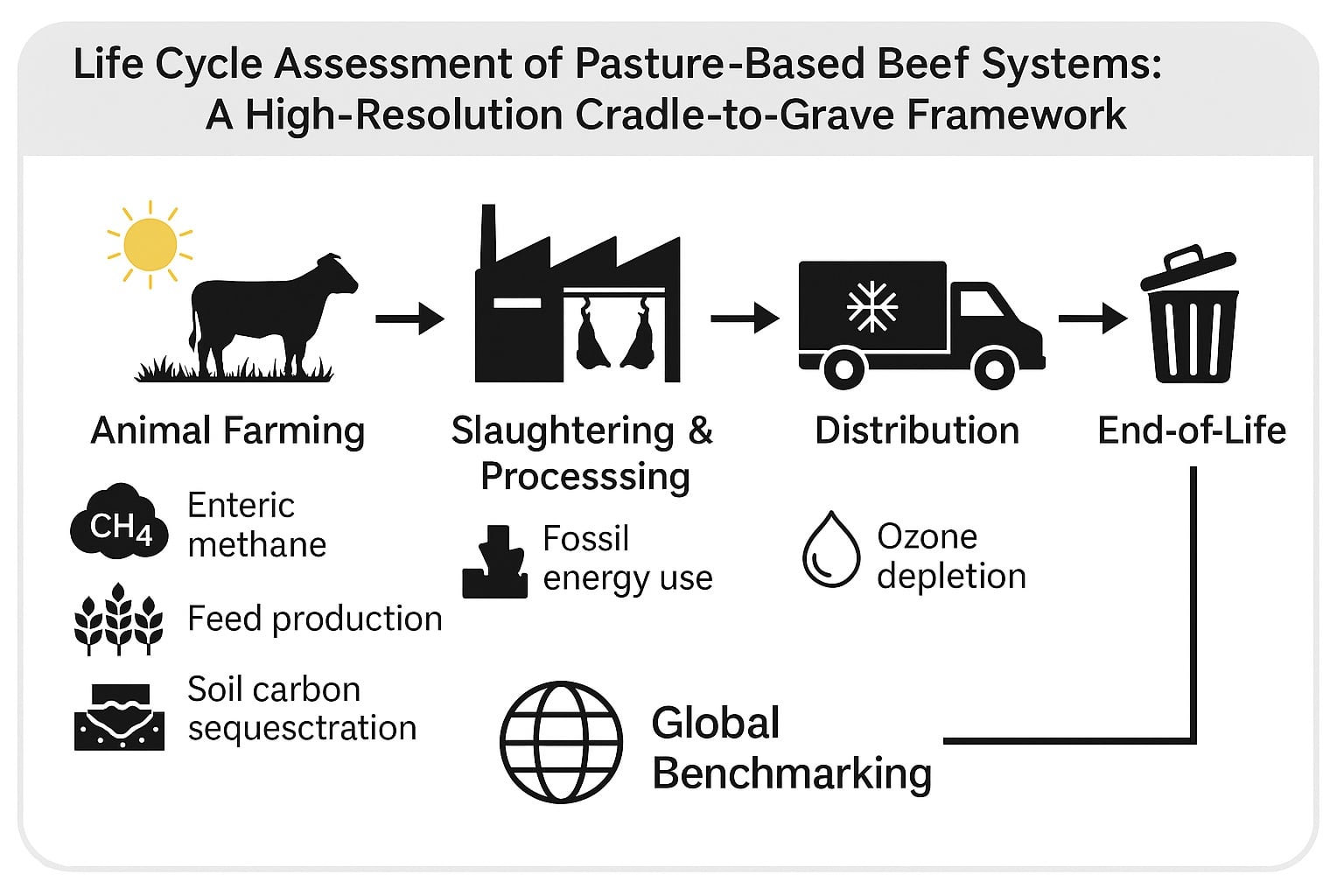
Beef production is widely recognized as a significant contributor to global greenhouse gas emissions, making robust and transparent environmental assessments essential for advancing sustainability within supply chains. This study applies a comprehensive cradle-to-grave Life Cycle Assessment (LCA) to evaluate the environmental performance of beef destined for export, following ISO 14040, ISO 14044 and ISO 14067 standards and the Product Category Rules for meat of mammals. Sixteen impact categories were quantified for 1 kg of vacuum-packed beef using detailed primary data from a pasture-based production system and a representative processing facility. The total climate change impact was 3.27 × 101 kg CO2eq, with enteric methane and feed production jointly responsible for over 70% of overall impacts. Slaughtering and distribution were associated mainly with fossil energy use and ozone depletion, while soil carbon sequestration partially compensated biogenic emissions. The results were consistent with international benchmarks, highlighting the environmental advantages of pasture-based systems, low fertilizer use, and stable land management. Key hotspots were identified in animal growth, feed efficiency, and manure management, with logistics also contributing notably. Overall, the study provides a high-resolution environmental baseline that can support Environmental Product Declarations and guide targeted mitigation strategies across beef supply chains. While the results are derived from a specific pasture-based production system, the study is positioned as a case-study-based application of a high-resolution LCA framework, illustrating how detailed inventories can support environmental benchmarking and hotspot identification without implying statistical representativeness of all beef production systems.
Keywords: greenhouse gas emissions; environmental product declaration; enteric methane; carbon sequestration; resource use efficiency greenhouse gas emissions; environmental product declaration; enteric methane; carbon sequestration; resource use efficiency
Graphical Abstract