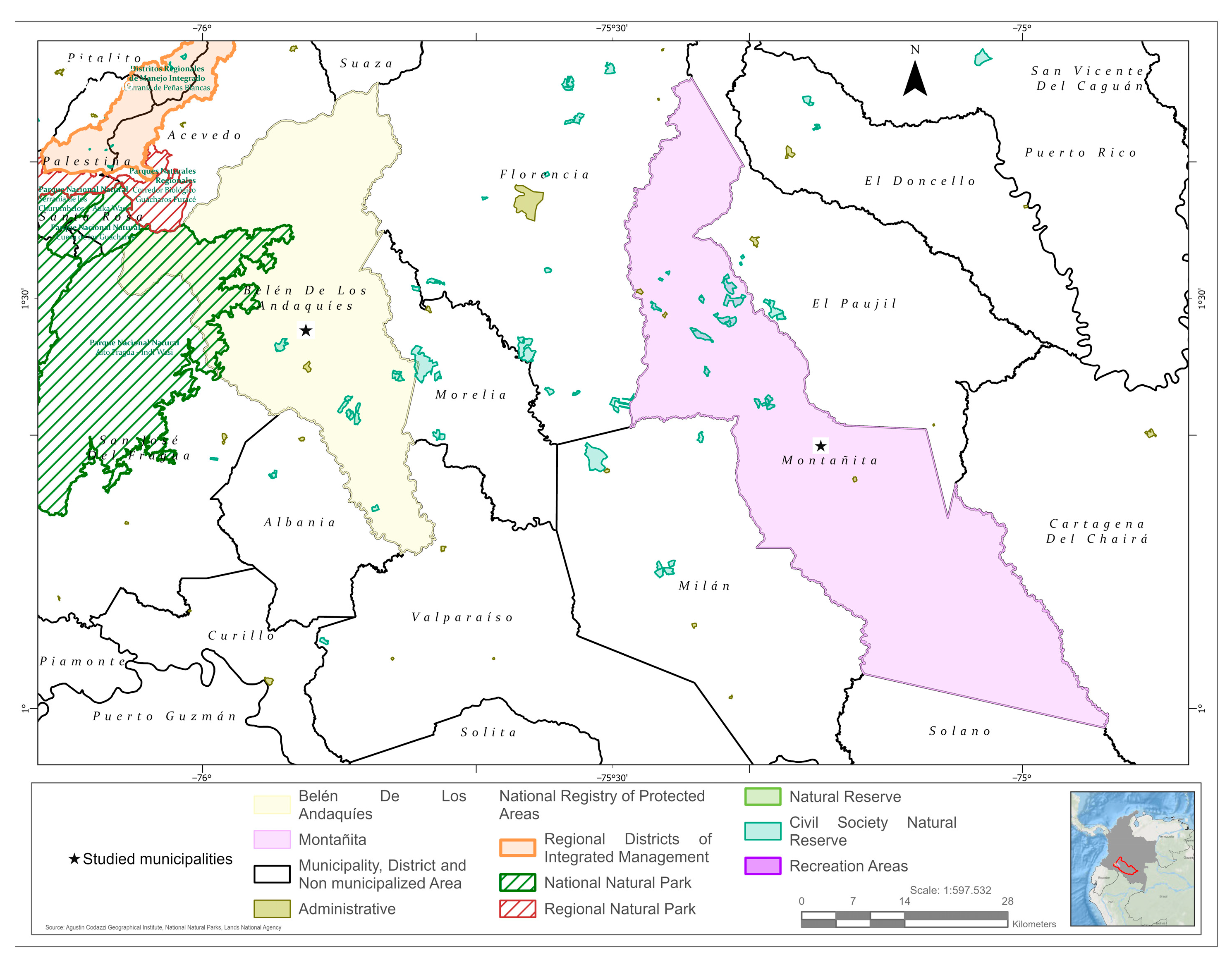
3.1. Characteristics of Dairy and Cacao Organizations
The comparison of the Organizational Capacity Index (OCI) for the two sectors shows better performance for cacao organizations compared to dairy organizations. On average, cacao producer organizations reached an index score of 8.60, with values concentrated between 6.66 and 10.45. ASPROABELÉN (10.45), COMUCAN (9.39), and AGROSOLIDARIA (9.15) stand out as the highest-scoring cacao-producing organizations. In contrast, dairy organizations presented an average index of 6.35 with greater dispersion, ranging from 2.37 to 8.90. Among these, while ASOAGROEMPT (8.90) and Lácteos La Arboleda (8.82) showed competitive performance, ASMUJSAN (2.37) exhibited marked lags. Overall, the data suggest that cacao organizations show more consistent performance and achieve higher levels of comprehensive performance, whereas the dairy network is more heterogeneous, with underperforming cases that condition its average (
Table 2).
See
Appendix A (
Table A1) and the Abbreviations for the full names of the organizations studied.
Important contrasts were also identified between cacao and dairy organizations across most of the organizational principles evaluated.
In strategic planning, cacao organizations demonstrated strengths in formulating their mission, vision, and organizational principles, as well as in conducting strategic diagnostics (SWOT analysis) for commercialization and in fostering cooperation among members, while dairy organizations showed greater dispersion and weaknesses in these aspects.
In terms of marketing, cocoa organizations performed better in accessing specialized markets (such as organic production), obtaining organic and sustainability certifications, and establishing commercial partnerships. In contrast, dairy production remains more closely linked to traditional and local markets, with limited access to information on sales and purchases.
Regarding the annual operating plans, cacao organizations reported more consistent budget management and greater cooperative efforts to implement their plans, whereas dairy organizations revealed limitations in execution and coordination. In terms of the annual budget, cacao demonstrated progress in planning and adapting the budget to members’ needs, as well as in teamwork for its management, compared to dairy organizations, which showed weaknesses in planning and budget execution practices.
The results for administrative and organizational management confirmed the cacao organizations’ advantage, which reported more frequent assemblies, clearer regulations, a diversity of committees, and inclusive gender and youth policies. Dairy organizations, by contrast, tend to be more informal, relying on specific leadership and with lower levels of formalization in manuals and statutes.
With regard to legal compliance, cacao organizations exhibited more consistent practices in tax declarations and payments, while dairy organizations displayed lags in tax formalization. For finance, cacao stood out for having more complete and transparent financial statements, and sharing accounting records with members, compared with dairy organizations, where basic accounting and limited use of financial tools prevailed.
For production, cacao excelled by incorporating technological innovation, sustainability practices, better post-harvest processes, and greater access to technical assistance. Cattle organizations, although associated with silvopastoral systems, showed a more conventional approach, lagging in productive infrastructure.
In the environmental dimension, cacao organizations integrated more sustainable management practices, reduced agrochemical use, implemented environmental management plans, and accessed organic certification. In contrast, dairy organizations faced greater limitations in certification and conservation planning.
Finally, for agroindustry and value addition, cacao demonstrated greater progress in cocoa bean handling practices and access to technological assistance, although with shortcomings in transformation activities. Dairy organizations remained at low levels of industrialization and were dependent on primary sales, except for Lácteos La Arboleda, which is engaged in cheese production and other dairy by-products.
The comparative analysis by organizational criteria allows for a deeper understanding of the differences observed between the two value chains. In the case of cacao, greater coherence and stability can be identified in areas such as finance, legal compliance, production, and strategic planning, suggesting more consolidated processes and more standardized organizational practices. In contrast, the dairy value chain displays a greater diversity of organizational situations, with uneven performance across several of the principles assessed.
This heterogeneity is particularly evident in areas such as marketing, annual operating plans, and agroindustry, where some organizations demonstrate significant progress while others continue to face structural limitations. Although both value chains show efforts to comply with legal requirements and strengthen financial management, cacao organizations tend to exhibit greater internal consistency, whereas dairy organizations still include lagging cases and more unstable organizational trajectories. Scores are particularly low for women’s dairy organizations.
These differences can be partly explained by the historical trajectory of each value chain. Cacao organizations have accumulated longer experience and have been the recipients of international cooperation funding and capacity-building projects, which have enabled them to consolidate learning processes, strengthen their internal structures, and establish more solid management mechanisms. In contrast, dairy organizations are more recent and remain in earlier stages of institutional consolidation, which influences their current levels of formalization, internal coordination, and organizational articulation.
Perceptions of the Role of Cooperation Across Organizational Principles
The interviews conducted with legal representatives provide insight into how cooperation is interpreted, valued, and experienced within organizations in each value chain. Rather than emerging uniformly across all organizational principles, cooperation takes on differentiated meanings depending on the level of institutional consolidation, historical trajectory, and predominant challenges within each sector.
In cacao organizations, cooperation is described as a structuring axis of organizational life. Representatives emphasize that strategic planning processes, the formulation of mission and vision, internal diagnostics, and the definition of collective goals largely depend on consolidated cooperative dynamics. Cooperation is associated with the capacity to hold regular assemblies, deliberate collectively, make joint decisions, and monitor agreements through formal mechanisms such as meeting minutes and committees. In this sense, cooperation is not perceived merely as an instrumental practice but as an organizing principle that strengthens internal cohesion and collective identity.
Furthermore, representatives from cacao organizations highlight that cooperation has been crucial for advancing administrative formalization and legal compliance processes. Tax management, financial reporting, and the sharing of accounting information with members are described as achievements made possible through a collective organizational culture that prioritizes shared responsibility and teamwork. Cooperation is also perceived as facilitating articulation with external actors—such as technical support institutions, specialized buyers, and certification bodies—thereby strengthening institutional capacity and expanding market opportunities.
In productive and environmental dimensions, cooperation is understood as enabling knowledge exchange, the adoption of sustainable practices, and access to technical assistance. However, representatives often note that progress in these areas has been gradual and contingent upon prior organizational consolidation. Consequently, in the cacao sector, cooperation is perceived as a transversal element that permeates multiple organizational dimensions, although its most visible expression lies in governance structures and strategic planning.
In contrast, in dairy organizations, cooperation is interpreted in a more focused and pragmatic manner. Representatives tend to associate it primarily with addressing immediate productive and financial challenges. Cooperation is described as essential for managing inputs, improving technical processes, accessing production-oriented assistance, and organizing annual budgets. In this sector, the meaning attributed to cooperation is strongly linked to operational efficiency and short-term economic sustainability.
While some leaders acknowledge the importance of strengthening strategic planning and organizational formalization, these aspects appear in the interviews as ongoing challenges rather than consolidated practices. Cooperation in these dimensions is perceived as intermittent or dependent on specific projects, rather than as a fully institutionalized and structural practice. Moreover, several representatives mention that organizational dynamics often rely on leadership figures, which can limit the broader institutionalization of transversal cooperative practices.
Regarding legal compliance and administrative management, perceptions within the dairy sector reflect efforts toward formalization but also acknowledge limitations in technical capacity and process systematization. Cooperation manifests in specific initiatives, yet it does not always translate into stable mechanisms of long-term institutional strengthening.
Taken together, the narratives reveal that cooperation fulfills different functions in each value chain. In cacao, it is conceived as a driver of cohesion, strategic planning, and institutional strengthening, producing a more integral and structural effect on organizational development. In the dairy sector, by contrast, cooperation is primarily oriented toward resolving productive and budgetary needs, reflecting a more operational and less transversal character.
These differences not only reflect distinct understandings of cooperation but also divergent organizational trajectories. While cacao organizations have built more institutionalized cooperative practices over time, dairy organizations remain in earlier stages of consolidation, where cooperation is still articulated around specific functional areas rather than functioning as an overarching organizing principle.
3.2. Social Networks: Actors and Cooperation in the Studied Value Chains
3.2.1. Cacao Value Chain in the Municipalities of Belén De Los Andaquíes and La Montañita
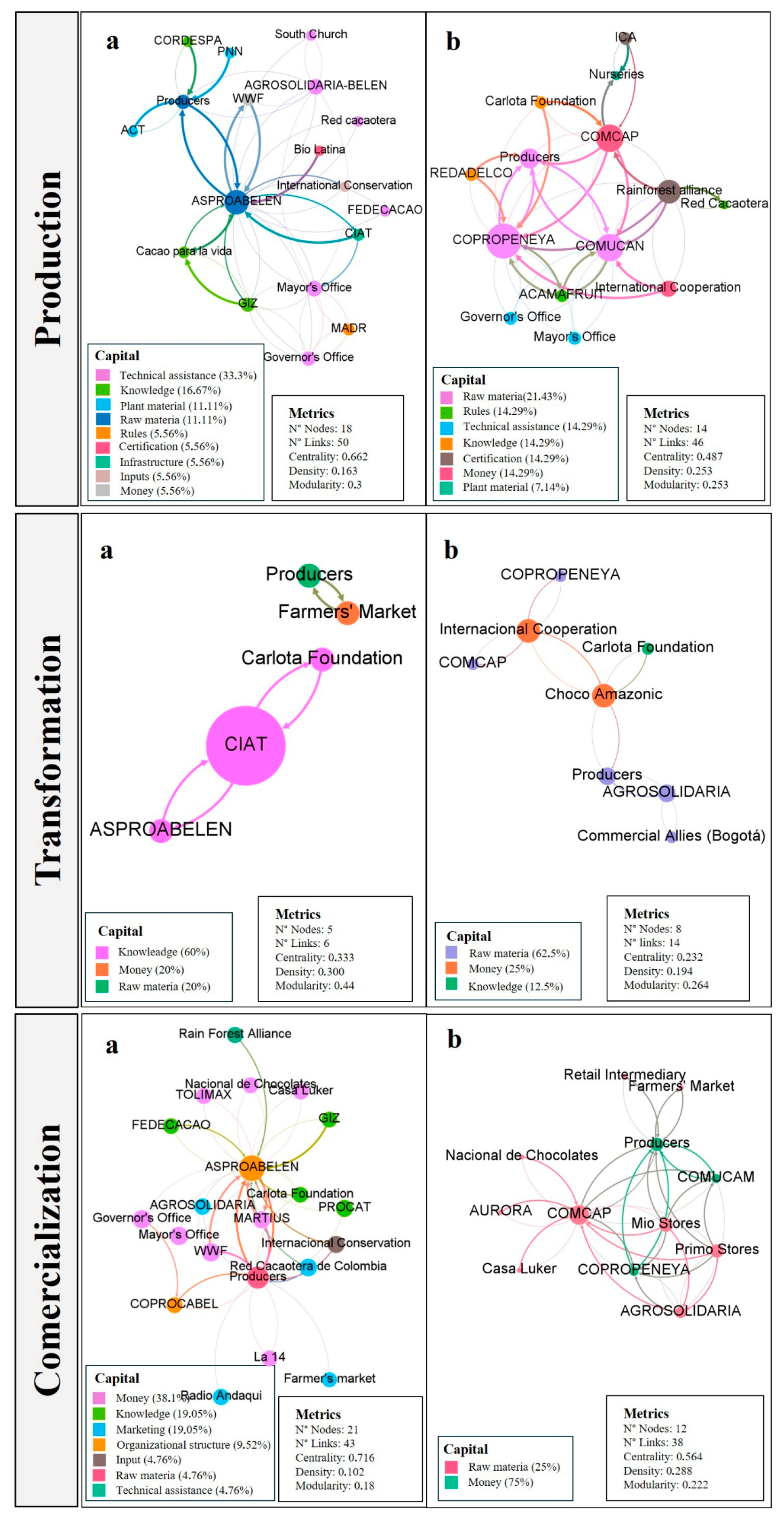
The structural analysis of the cacao value chain reveals marked differences between the two municipalities (
Figure 2). In Belén, cooperation networks are broader and concentrated around central actors, particularly ASPROABELÉN, while in La Montañita, networks are smaller but denser, with frequent connections among COMUCAM, COPROPENEYA, and COMCAP. For detailed network metrics, see
Appendix B.1. The cooperation networks are structured around the circulation of knowledge, technical assistance, financial resources, norms, marketing channels, and raw materials. These flows shape the interactions among actors and define the functional dynamics of the value chain. A detailed description of the network actors and the types of capital exchanged can be found in
Appendix B.2,
Appendix B.3 and
Appendix B.4.
The cacao value chain’s productive stage comprises three types of actors: input suppliers, cacao producers, and governmental and non-governmental development agencies. Input suppliers provide raw materials for cacao cultivation and cocoa bean processing. They can be classified into two groups: (1) suppliers of plant material (nurseries), fertilizers, and organic inputs; and (2) suppliers of tools and technologies for cultivation. Cacao producers in both municipalities are smallholder organic farmers (less than 3 ha per production system) who cultivate cacao under agroforestry systems.
In Belén, the productive network includes 50 actors and presents a centrality of 0.662, dominated by ASPROABELÉN, which coordinates flows of technical assistance, knowledge, and plant material, in collaboration with institutions such as the National Learning Service (SENA) and the Departmental Secretariat of Agriculture. The density (0.163) is moderate, and the modularity (0.3) indicates subgroups organized around input suppliers. In La Montañita, with 14 actors, the network is denser (0.253) but less centralized (0.487), mainly articulated by producers’ associations such as COMUCAM, COPROPENEYA, and COMCAP, with flows of raw materials, norms, and technical assistance distributed more horizontally.
Regarding the processing stage, this includes two types of actors: producer organizations and local entities promoting cacao processing. Producers and organizations trained in cacao processing produce chocolate bars and traditional drinking chocolate. Local promotion entities contribute knowledge related to cacao transformation, perform organoleptic profiling to assess the grain’s potential for chocolate production, and add value through local brands. In Belén, this stage comprises five actors and shows a density of 0.300 and a centrality of 0.333, concentrated in the ChocoAmazonic enterprise, which provides specialized knowledge, financial resources, and raw materials to local associations. In La Montañita, the network includes eight actors, with a lower density (0.194) and centrality (0.232), where COMCAP plays an intermediary role, although network fragmentation (modularity 0.264) limits the circulation of social capital typologies.
The commercialization stage comprises three types of actors: producer organizations, buyers of dry beans at local, national, or international levels, and governmental and non-governmental development agencies. In Belén, the commercialization network includes 21 actors and reaches the highest centrality (0.716), dominated by ASPROABELÉN, which channels financial resources, knowledge, and marketing in partnerships with certification agencies such as BioLatina and international organizations such as Rainforest Alliance. The density (0.102) is low, indicating less frequent relationships, while modularity (0.18) shows a network structured around external markets. In La Montañita, the network is composed of 12 nodes; it is denser (0.288) and less centralized (0.564), organized mainly by the Agricultural Marketing Cooperative of Caquetá (COMCAP), which channels financial resources and raw materials but with fewer commercial partners. In both municipalities, Nacional de Chocolates and Casa Luker are the main buyers of cacao beans and maintain direct relationships with producer organizations.
3.2.2. La Montañita Municipality’s Dairy Value Chain
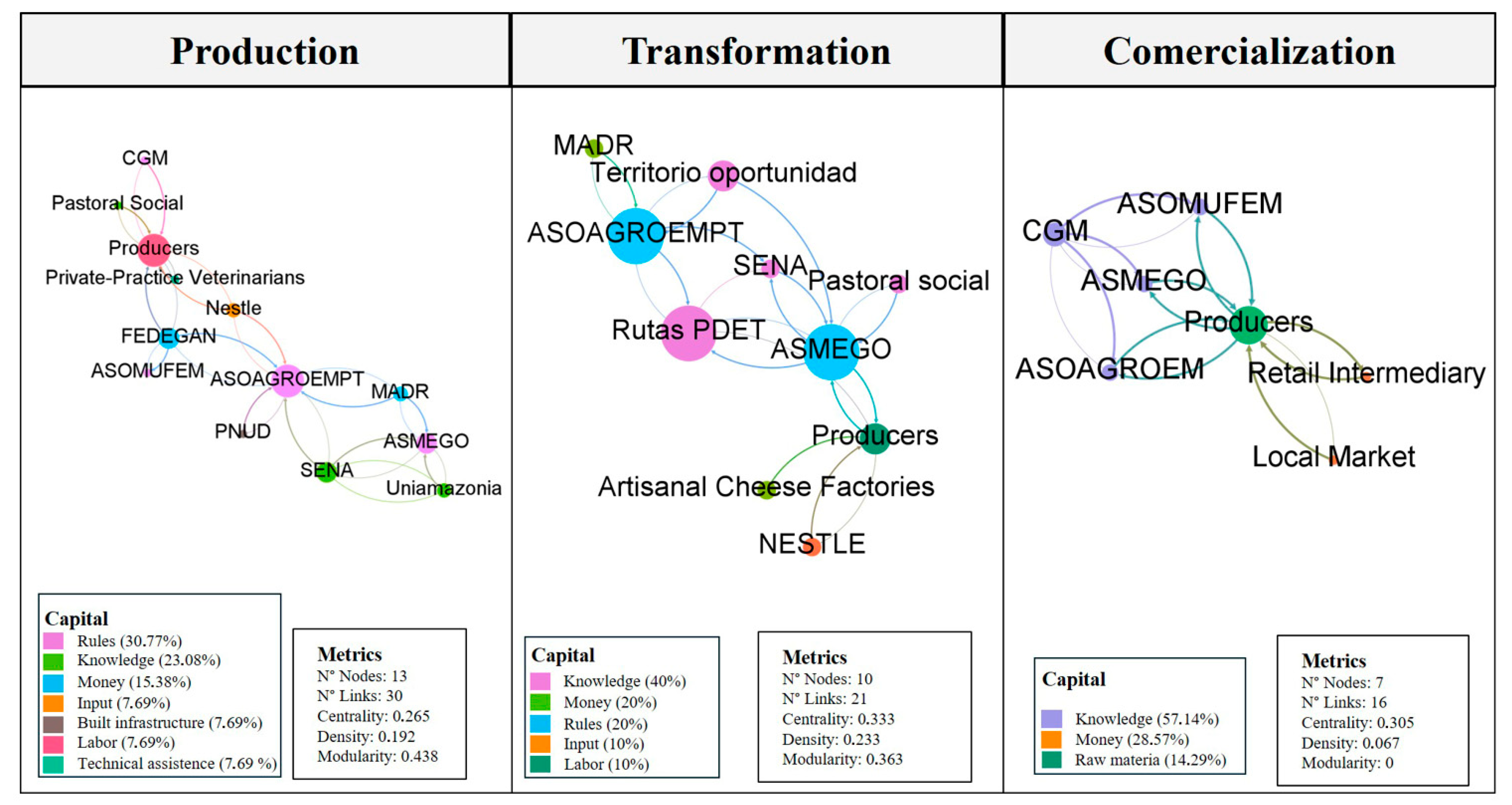
The structural analysis of La Montañita municipality’s dairy value chain shows that cooperation networks are configured heterogeneously across the productive, processing, and commercialization stages (
Figure 3). Overall, local producer associations, processing companies, and support institutions constitute the main interaction nodes where resource and service flows are concentrated. For detailed network metrics, see
Appendix C.1. The predominant social capital circulating in these networks is raw materials (cattle and milk), technical knowledge, financial resources, and environmental regulations, which sustain production and sanitary management as well as commercialization processes and sustainability initiatives. A detailed description of the actors participating in each stage and the social capital mobilized is presented in
Appendix C.2,
Appendix C.3 and
Appendix C.4. Cattle production in La Montañita is mainly oriented toward milk and dairy products, and for this reason, we focus on this specific agri-food value chain.
In the production stage, the network brings together 13 actors with moderate density (0.192) and low centralization (0.265). This reflects frequent interactions among women’s grassroots associations, such as ASMEGO, ASOMUFEN, and ASMUJSAN, along with input suppliers and technical assistance entities. The modularity (0.438) reveals the existence of specialized subgroups in which raw materials (cattle and forage) and technical knowledge in production management circulate. While this diversity of linkages favors specialization in production, the relationships between associations and suppliers should be stronger.
It is important to note that dairy associations have diversified over the past five years, including producer organizations composed mainly of women. Most of these organizations were created within the framework of the project “Building Rural Entrepreneurial Capacities, Trust, and Opportunity—El Campo Emprende”, promoted by the Colombian Ministry of Agriculture, which aimed to form associative groups in territories affected by internal armed conflict. These organizations are distributed throughout La Montañita municipality; however, those located in the mountainous areas receive less attention and support and have fewer strategic partners. The mountain associations are, in turn, situated in more fragile ecosystems, and some lack land tenure rights, which hinders their access to resources such as technical assistance and credit for implementing more sustainable production systems.
In addition to producers and their associations, the productive segment also includes input suppliers and governmental and non-governmental development organizations. The latter provide essential materials for dairy production, including veterinary supply stores and vendors of milking equipment, forage, feed supplements, water troughs, and other tools for pasture maintenance. Governmental and non-governmental development entities promote dairy production, invest in productive projects, and support local producers and organizations through technical assistance, genetic improvement, and marketing initiatives. However, their contribution remains limited in terms of organizational strengthening, a factor that is closely linked to the low levels of organizational development observed in the sector.
The processing stage focuses on actions to support milk processing and the production of cheese and other dairy by-products. It involves 10 actors, with the highest density in the dairy network (0.233) and greater centralization (0.333). Associations such as ASOAGROEMPT and local veterinary service companies concentrate on the linkages, mobilizing technical knowledge and financial resources aimed at animal care. The modularity (0.363) indicates the persistence of functional blocks in which suppliers and associations work closely together, although this concentration also generates the risk of excessive dependence on central actors.
The commercialization stage is the weakest. With seven actors, its density is very low (0.067), and modularity is nonexistent. Although centralization reaches a medium value (0.306), relationships are concentrated in a few buyers and processors, such as Lácteos La Arboleda, which acts as the central actor in channeling financial resources and raw materials (milk). The limited interconnection between associations and companies restricts marketing-channel diversification and reduces producers’ bargaining power, who remain highly dependent on a small number of buyers.
Relationships among actors in this stage are established exclusively for commercial purposes. There are no actors seeking to promote new commercial alliances outside the municipality or even the department to add value to milk or to promote production under silvopastoral systems that could directly contribute to ecosystem and biodiversity conservation. Vertical relationships predominate, and financial resources are the main capital flowing because of commercial transactions.
3.2.3. Typologies of Cooperation Networks in the Cacao and Dairy Value Chains
The comparative analysis of the cacao and dairy value chains shows that both are primarily structured around linking-type cooperation. In the processing and commercialization stages of cacao, as well as in all three stages of the dairy chain (production, processing, and commercialization), networks with low density and high centralization were identified, indicating that linkages between producer organizations and support actors are configured in a vertical and unidirectional manner. These interactions are mainly oriented toward the transfer of financial resources, technical assistance, and specialized knowledge, providing immediate benefits for accessing incentives and modernizing production. However, network metrics show that the concentration of relational power in a few external actors limits horizontality and generates dependency dynamics that restrict organizational autonomy and their capacity to influence intervention planning.
In the case of cacao, in addition to linking-type cooperation, bonding-type cooperation was clearly identified in the production stage and incipiently in the commercialization stage. This is reflected in the formation of cohesive and relatively closed groups among actors with similar levels of influence. This type of cooperation provides benefits in terms of trust, mutual support, and local coordination; however, its scope for redistributing benefits and engaging with more powerful actors remains limited.
In contrast, the dairy value chain is characterized by the predominance of linking-type cooperation across all stages, which translates into relationships with low diversity of horizontal ties and strong concentration in external support actors. This pattern presents significant challenges, as the high dependency on external incentives and technical assistance exposes associations to institutional fragility if such resources were to disappear. Nevertheless, a distinctive element compared to cacao is the role of actors such as Pastoral Social, which, in addition to providing technical and financial assistance, accompany families in social and psychological dimensions. This approach strengthens forms of cooperation oriented toward care, equity, and family resilience—dimensions that are often less visible in other productive chains.
Overall, the results indicate that while the cacao value chain exhibits a certain diversification in its forms of cooperation—combining both linking- and bonding-type dynamics—the dairy value chain retains a more homogeneous and vertically oriented structure, predominantly based on linking-type relationships. Notably, the absence of bridging-type cooperation suggests limited cross-fertilization and collective learning among organizations. A common challenge for both value chains lies in overcoming the vertical dynamics that sustain the subordination of local organizations to more powerful actors, thereby constraining the development of more horizontal and sustainable cooperation networks. Nonetheless, the external provision of financial, technical, and knowledge resources remains a crucial factor supporting the continuity of productive activities, economic stability, and—particularly in the dairy sector—the strengthening of social dimensions that foster community cohesion.




 ,
,