Recent Advances in the Use of Botanical Extracts from Jatropha Species for the Sustainable Control of Insect Pests: A Systematic Review and Meta-Analysis

 ,
,  ,
, 
 , ,
, ,  , , , , and
Abstract
1. Introduction
- (1)
- What is the insecticidal effect of the botanical extracts of Jatropha spp. on controlling insect pests?
- (2)
- What effect do the botanical extracts of Jatropha spp. have on the growth and development of larvae and pupae?
- (3)
- Which botanical extracts of Jatropha spp. are most effective at controlling insect pests?
- (4)
- Which insect pests are the botanical extracts of Jatropha spp. more effective against?
2. Materials and Methods
2.1. Protocol and Inclusion Criteria
2.2. Information Sources and Search Strategies
2.3. Study Selection Process, Information Collected, and Data Extraction
2.4. Risk of Bias Assessment
2.5. Statistical Analysis of the Bioactivity of Jatropha spp. Botanical Extracts
2.6. Secondary Analysis and Software
2.7. Use of Artificial Intelligence
3. Results
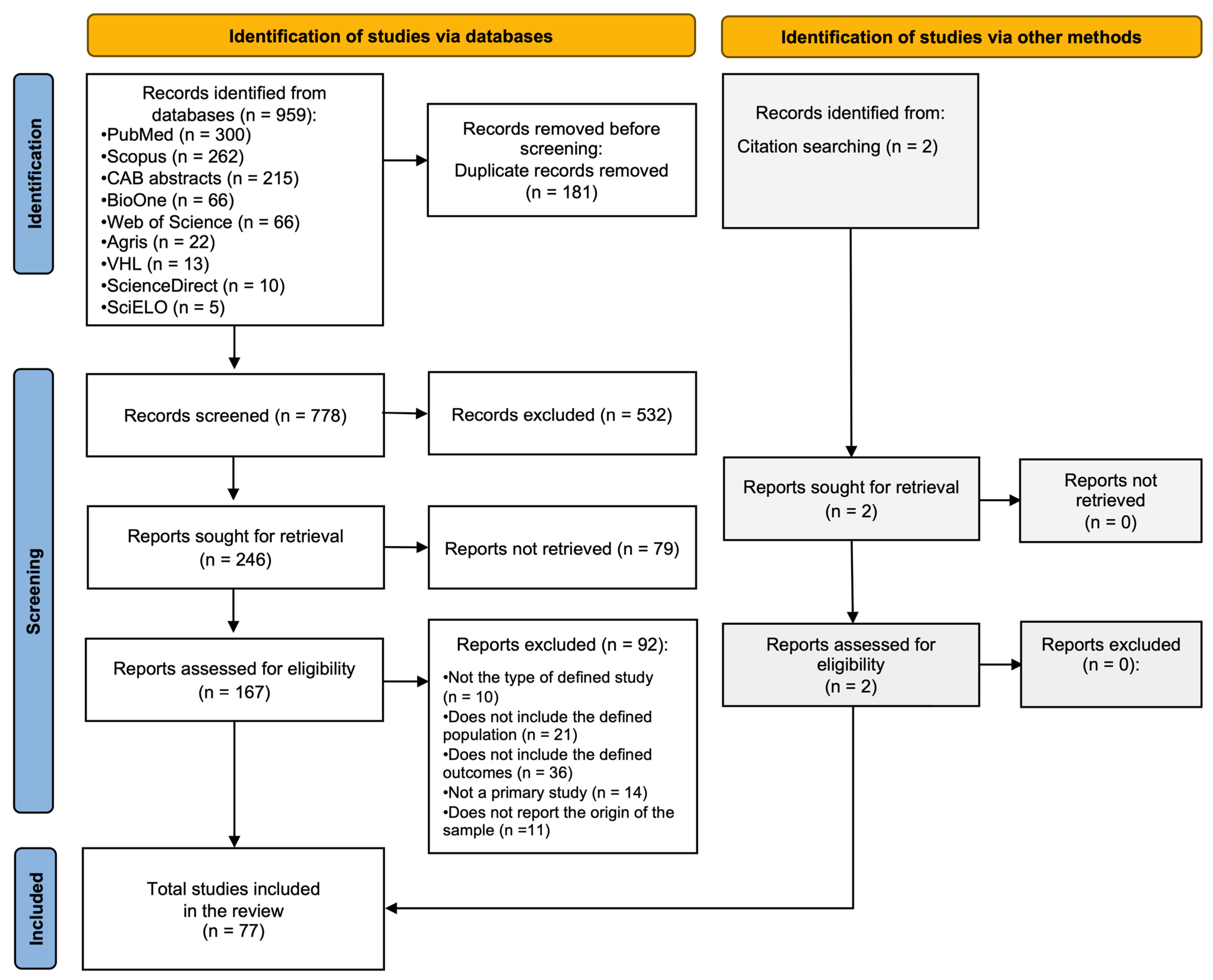
3.1. Selection of Studies
3.2. General Characteristics of the Studies
3.3. Risk of Bias of Individual Studies
3.4. Summary of Results of the 77 Individual Studies Included in the Systematic Review
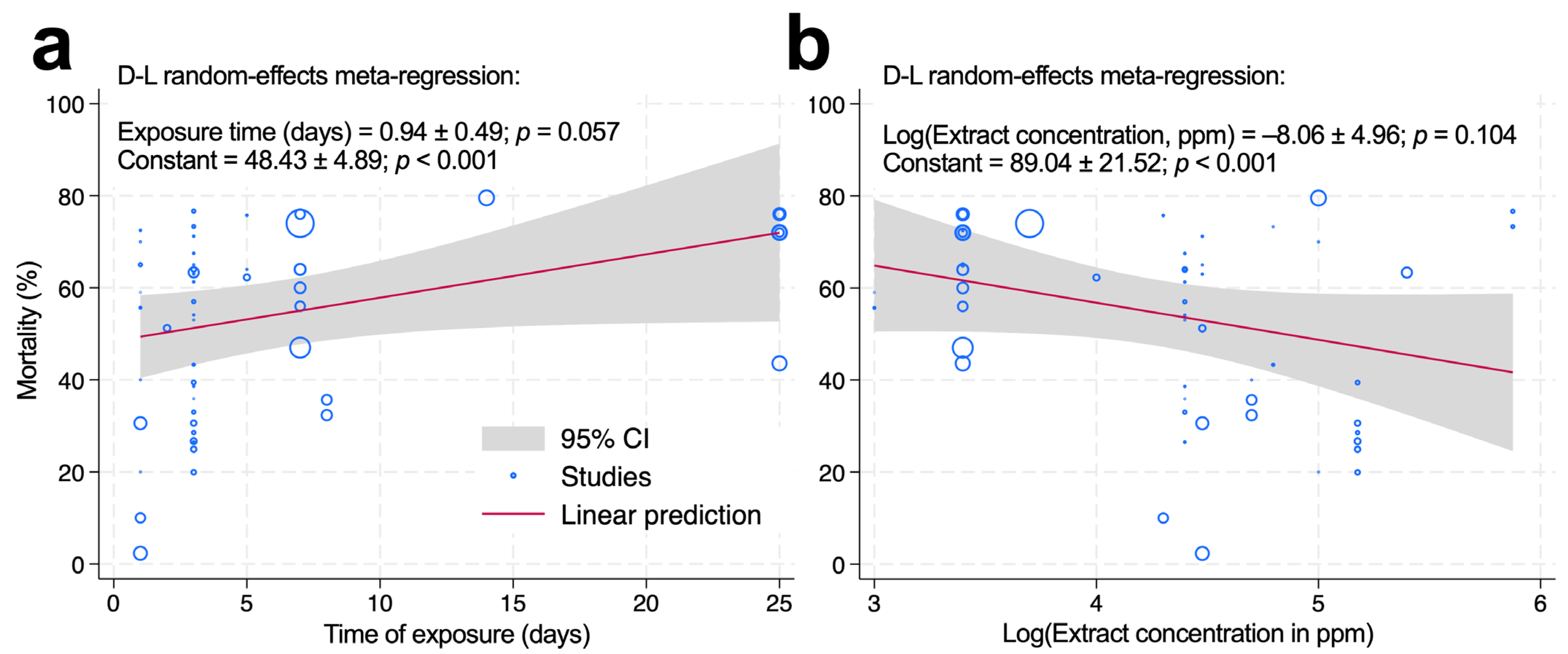
3.5. Meta-Analyses of the Mortality
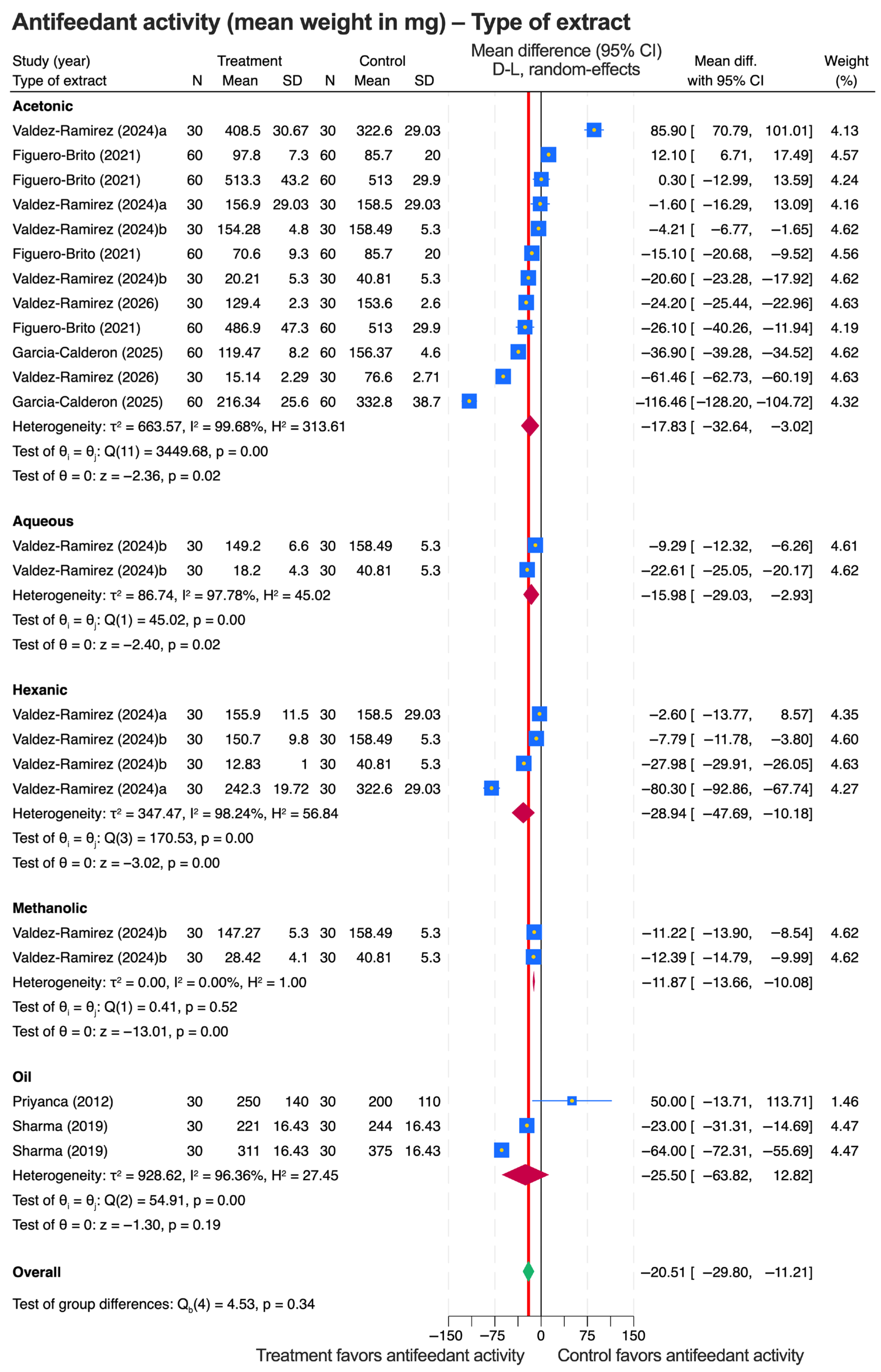
3.6. Meta-Analyses of the Antifeedant Activity
3.7. Meta-Analyses of Development Time
3.8. Meta-Analysis of the Oviposition Inhibition
3.9. Meta-Analyses of the Repellency Activity
4. Discussion
5. Conclusions
6. Limitations
7. Perspectives
Supplementary Materials
Author Contributions
Funding
Institutional Review Board Statement
Informed Consent Statement
Data Availability Statement
Acknowledgments
Conflicts of Interest
Appendix A
| A—Jatropha curcas | |||
| Study | Species/Botanical Extract | Methods | Bioactivity |
| Valdez-Ramirez et al. [21] | Hexane and acetone extracts of J. curcas seeds | From 0 to 5000 ppm against S. frugiperda in a feeding bioassay | 5000 ppm caused 100% larval mortality |
| Valdez-Ramirez et al. [25] | Acetonic extract of J. curcas seeds | 100 to 2500 ppm administered via an ingestion bioassay on S. frugiperda | A concentration of 2500 ppm resulted in 86.67% larval mortality and a delay in larval development by 4–10 days |
| Adabie-Gomez, et al. [29] | Aqueous extract and seed powders of J. curcas. | Concentrations (0, 1, 5, 10, and 20% (w/v)) of the extract and powder were evaluated in ingestion bioassays on stored grain pests S. zeamais and C. maculatus. Mortality rate, repellency, and emergence of offspring were assessed. | The 20% (w/v) J. curcas extract exhibited insecticidal activity, repelling 68.15% of C. maculatus and 58% of S. zeamais. |
| Asmanizar, et al. [30] | Aqueous extract of J. curcas seeds. | Two concentrations (0.5% and 0.25% (v/v)) of the extract were evaluated via a contact bioassay on N. viridula. The mortality rate was assessed. | The aqueous extracts of J. curcas seeds at concentrations of 0.5% and 0.25% (v/v) exhibited a mortality rate of 80–100% on N. viridula. |
| Babarinde, et al. [31] | Aqueous extract of J. curcas seeds. | The extract was evaluated at fumigation concentrations (50, 100, 150, and 200 µL/L) and contact concentrations (0.30, 0.60, 0.90, 1.20, and 1.50 µL/cm2) against S. zeamais. Mortality percentage was assessed. | The extract obtained from roasted J. curcas seeds at 200 µL/L in air for 24 h caused 84.68% mortality. Meanwhile, contact toxicity at 1.50 µL/cm2 for 3 h caused 47.52% mortality on S. zeamais. |
| Botti, et al. [32] | Aqueous extract of J. curcas seeds. | Seven concentrations (0, 0.5, 1.0, 1.5, 2.0, 2.5, and 3.0% (v/v)) of the extract were evaluated in ingestion applications on B. brassicae. Mortality rates were assessed. | J. curcas seed oil, at a concentration of 3.0% (v/v), showed mortality rates of 40% and 60% within 24 and 48 h, respectively, in B. brassicae. |
| Diabaté, et al. [33] | Aqueous extract of J. curcas seeds. | The extract was evaluated at two concentrations (50 and 80 g/L) through ingestion applications on B. tabaci and H. armigera. The reduction in the population of these insect pests was determined. | The aqueous extract of J. curcas seeds at 80 g/L reduced the number of B. tabaci insects by 0.21 in the rural plot, 0.13 in the random plot, and 2.26 in the experimental plot. Furthermore, a reduction in the number of H. armigera larvae of 0.03 was observed. |
| Holtz, et al. [34] | Aqueous extract of J. curcas seeds. | The extract was evaluated at seven concentrations (0.0, 0.5, 1.0, 1.5, 2.0, 2.5, and 3.0% (w/v)) via an ingestion bioassay on M. persicae. Mortality percentage was determined. | The application of the nut oil at 2.5% (v/v) resulted in mortality rates of 61% and 71% in M. persicae at 48 and 72 h, respectively. |
| Oliveira, et al. [35] | Aqueous extract of J. curcas seeds. | The extract was evaluated at a concentration of 3% (v/v) via contact applications on D. saccharalis. Mortality rate and anti-oviposition effects were assessed. | The 3% (v/v) J. curcas seed extract resulted in only 60% hatching, and an increase in the embryonic period of 7.09 days was observed in D. saccharalis. |
| Onunkun [36] | Aqueous extract of J. curcas seeds. | The extract was evaluated at a concentration of 10% (w/v) via contact application on P. uniforma and P. sjostedti. Egg hatching was assessed. | A 10% (w/v) extract of J. curcas seeds reduced populations by 64% in P. uniforma and P. sjostedti. |
| Orozco-Santos, et al. [37] | Aqueous extract of J. curcas seeds. | Two concentrations (4% and 1% (v/v)) of the extract were evaluated in an ingestion bioassay on D. citri nymphs. The reduction in the number of insects was assessed. | The 4% (v/v) J. curcas seed extract reduced the number of D. citri nymphs by 76.3% and 92.5% at 2 and 6 days, respectively. |
| Pant, et al. [38] | Aqueous extract of J. curcas seeds. | The extract was evaluated at five concentrations (300, 600, 900, 1200, and 1500 ppm) in contact applications on T. castaneum. The mortality rate was determined. | The eucalyptus oil nanoemulsion containing filtrate of aqueous extracts of karanja and jatropha at 300 and 1500 ppm yielded mortality rates of 88 to 100% within 24 h on T. castaneum. |
| Pérez and Iannacone [39] | Aqueous extract of J. curcas seeds. | The extract was evaluated along with nine plant species at 3% (w/v) in contact applications on R. palmarum. Mortality and repellency rates were assessed. | The 3% (w/v) aqueous extract of J. curcas seeds exhibited insecticidal activity, showing 100% repellency against R. palmarum. |
| Silva, et al. [40] | Aqueous extract of J. curcas seeds. | Two concentrations (5% and 10% (w/v)) of the extract were evaluated in contact applications on S. zeamais, R. dominica, T. castaneum, and O. surimanensis. Mortality rates were assessed. | The 10% (w/v) aqueous extract of J. curcas seeds caused mortality rates of 75%, 100%, 60%, and 90% in S. zeamais, R. dominica, T. castaneum, and O. surimanensis, respectively. |
| Uddin and Abdulazeez [41] | Aqueous extract of J. curcas seeds. | Three concentrations (1.5, 2.0, and 2.5% (w/v)) of the extract were evaluated via an ingestion bioassay on C. maculatus. The reduction in insect numbers, anti-oviposition activity, and emergence of offspring were assessed. | The 2.5% (w/v) aqueous extract of J. curcas seeds over a 10-day period increased mortality by 2.25 and decreased adult emergence by 0.75. Meanwhile, the 2.5% (w/v) powder decreased oviposition by 2.50 on C. maculatus. |
| Ugwu [42] | Aqueous and ethanolic extracts of J. curcas seeds. | The extract was evaluated at two concentrations (75% and 100% (w/v)) in contact and residual applications on P. fusca. The reduction in the number of insects was assessed. | Ethanolic extracts of J. curcas seeds at 75% (w/v) had a residual effect of 3.33 after 40 min, and at 100% (w/v), an effect of 4.33 after 20 min, as well as a contact effect of 1.67 after 80 min on P. fusca. |
| Ukpai, et al. [43] | Aqueous extract of J. curcas seeds. | Four concentrations (2.5, 5.0, 7.5, and 10.0 (w/v)) of the extract were evaluated via dietary intake in S. zeamais. The reduction in the number of insects was determined. | Treatment with 10% (w/v) J. curcas seed powder resulted in a mortality rate of 2.75 on S. zeamais. |
| Adebowale and Adedire [44] | Petroleum ether extract of J. curcas seeds. | Five concentrations (0, 0.5, 1.0, 1.5, and 2% (v/v)) of the extract were administered orally to C. maculatus to determine anti-oviposition activity and larval emergence. | The J. curcas seed extract inhibited adult emergence at all concentrations (0%), and reduced oviposition by 6.67 eggs compared to the control (21.67) in C. maculatus. |
| Khani, et al. [45] | Petroleum ether extract of J. curcas seeds. | Five concentrations (2, 4, 6, 8, and 10% (µL/mL)) of the extract were evaluated in ingestion and contact bioassays (4, 8, 12, 16, and 20 (µL/mL)) on C. cephalonica larvae and eggs. Assessing mortality rate, anti-feeding activity, hatchability, and emergence of offspring. | The petroleum ether extract of J. curcas seeds at 12 and 20 µL/mL caused mortality rates of 66.5% and 98%. At a concentration of 6 µL/g, it exhibited 48.08% anti-feeding activity, and at 2 µL/mL, it resulted in a 58% hatchability rate in C. cephalonica. |
| Kona, et al. [46] | Petroleum ether extract of J. curcas seeds. | The extract was evaluated in contact bioassays (1000, 500, 250, 125, and 62.5 mg/L) and ingestion bioassays (8000, 6000, 4000, and 2000 mg/L) on T. absoluta. Mortality rates and egg hatchability were assessed. | A concentration of 125 mg/L of petroleum ether extract from J. curcas seeds resulted in 25% mortality of eggs. Larval mortality of 85–100% was observed at 4000 and 8000 mg/L by the fourth day in T. absoluta. |
| Mousa, et al. [47] | Petroleum ether extract from J. curcas seeds. | The extract was evaluated via ingestion bioassays (1, 2, 3, 4, and 5% (w/v)) and contact bioassays (2, 4, 6, 8, and 10 µL/g) on S. oryzae. Mortality, repellency, and anti-feeding activity were determined. | The petroleum ether extract from J. curcas seeds at 10 µL/g showed a mortality rate of 66%. At 5% (w/v), it repelled 69.6% of S. oryzae. |
| Ugwu [48] | Petroleum ether extract from J. curcas seeds. | A concentration (10 mL/L (v/v)) of the extract was evaluated in ingestion bioassays on M. sjostedi thrips and M. vitrata larvae. Population reduction was assessed. | The J. curcas seed extract at 10 mL/L (v/v) reduced the population of M. sjostedti by 52.07% and M. vitrata by 59.12%. |
| Asmanizar, et al. [49] | Acetone extract of J. curcas seeds. | The extract was evaluated at immersion concentrations (0.5, 1, 2.5, 5, 10, and 20% (v/v)), surface concentrations (0.025, 0.05, 0.1, 0.2, and 0.4% (v/w)), and seedling concentrations (0.05, 0.1, 0.2, 0.4, and 0.8% (v/v)) via oral administration to S. zeamais. The percentage of mortality and seedling emergence was determined. | The 20% (v/v) J. curcas seed extract showed 90% mortality, and at 0.4% (v/p), mortality was 100%. Meanwhile, seedling emergence at 0.8% (v/v) was reduced by 45.80 compared to the control (90.20) on S. zeamais. |
| García-Calderón, et al. [50] | Acetone extract of J. curcas seeds | Concentrations of 1000, 2300, and 5000 ppm of acetone extract via ingestion bioassay on Spodoptera frugiperda | Results showed that 5000 ppm caused a larval mortality rate of 73%. |
| Valdez-Ramírez, et al. [51] | Acetonic extract of J. curcas seeds | Concentrations ranging from 0 to 2500 ppm were administered against S. frugiperda. | The highest concentration resulted in a 51.5% reduction in the percentage of damage to corn plants |
| Baideng, et al. [52] | Methanolic extract of J. curcas seeds. | Six concentrations (10,000, 20,000, 30,000, 40,000, 50,000, and 60,000 ppm) of the extract were evaluated via an ingestion bioassay on C. binotalis larvae. The mortality percentage was assessed. | The methanolic extract of J. curcas seeds at 50,000 ppm caused the highest larval mortality (90%) over 96 h in C. binotalis. |
| Alharbi and Alanazi [53] | J. curcas seed oil | The ethanolic extract (10, 20, 30, 40, and 50%, v/v) in contact and ingestion bioassays on Rhynchophorus ferrugineus | Reporting that the highest dose resulted in 100% mortality 24 h post-treatment |
| Bashir and El-Shafie [54] | Hexane extract of J. curcas seeds. | The extract was evaluated in contact (5, 10, 15, and 20% (v/v)) and ingestion (10% (v/v)) bioassays against S. gregaria nymphs. The assessment included determining mortality rates, anti-feeding activity, egg hatchability, and developmental effects. | J. curcas seed oil caused mortality ranging from 22.4% to 59.2% after seven days of application. The 10% (v/v) concentration delayed the development time from the fifth to the sixth nymphal stage by 5 days, as well as reduced the egg hatching rate by 0.10%. Meanwhile, the 5% (v/v) concentration caused a 50% anti-feeding effect on S. gregaria. |
| Bashir and El-Shafie [55] | Hexane extract of J. curcas seeds. | Two concentrations (5% and 10% (v/v) of the extract) were evaluated in contact and feeding bioassays on S. gregaria nymphs. The evaluation included mortality rate, anti-feeding activity, and egg hatchability. | J. curcas seed oil at 5% (v/v) produced an anti-feeding effect of 78.92% after the sixth day. Meanwhile, at a concentration of 10%, it showed a nymphal mortality rate of 43.39% and reduced female fecundity by 42.2% in S. gregaria. |
| Figueroa-Brito, et al. [56] | Aqueous extract of J. curcas seeds. | The extract was evaluated at two concentrations (1% and 5% (v/v)) via an ingestion bioassay on C. decolora larvae. The study assessed mortality rates, effects on development, and emergence of offspring. | The aqueous extract of J. curcas seeds at 5000 ppm reduced the larval viability of C. decolora by 46%. |
| Figueroa-Brito, et al. [57] | Acetone extract of J. curcas seeds. | The extract was evaluated under laboratory conditions (250, 500, 1000, 1500, and 2000 ppm) and greenhouse conditions (250, 500, and 1000 ppm) in an ingestion bioassay on C. decolora larvae. Assessing mortality rates and deformities in adult insects, anti-feeding activity, and effects on development. | Acetone extracts of J. curcas almond nut at 500 ppm caused 60% of the insects to be deformed, as well as a cumulative mortality rate of 50%. At 200 ppm, this treatment inhibited larval weight by 53% at 21 days. At 1000 ppm, it provided greater control of damage to cabbage plants by 28% at 18 days against C. decolora. |
| Valdez-Ramírez, et al. [58] | Hexane, acetone, methanol, and aqueous extracts of J. curcas seeds | Concentrations of 100, 500, 1000, 2500, and 5000 ppm were evaluated in an ingestion bioassay on S. frugiperda larvae. | The acetone extract of the Ahuhuetzingo genotype at 5000 ppm caused 100% larval mortality. |
| Acda [59] | J. curcas seed oil. | The oil was evaluated at five concentrations (0.2, 5.0, 10, and 20% (w/w)) against C. vastator via an ingestion bioassay. Mortality rates and anti-feeding activity were assessed. | The oil exhibited insecticidal activity (20% (w/w)), resulting in a mortality increase of 93.50% against C. vastator. |
| Agboka, et al. [60] | J. curcas seed oil. | The seed oil was evaluated at five concentrations (0, 2.5, 5, 10, and 100% (v/v)) via contact application on larvae and adults of M. nigrivenella. The survival rate and the effect on egg hatching were assessed. | J. curcas seed oil at 5% (v/v) increased the oviposition deterrence index by 100%. It also reduced the number of M. nigrivenella larvae in the field by 49.2%. |
| Alonso and Santos [61] | J. curcas seed oil. | The seed oil was evaluated in ingestion (5, 10, and 30 mg/mL) and contact (0.02, 0.1, and 0.2 mg/mL) bioassays on A. sexdens. The survival rate was determined. | J. curcas seed oil at doses of 5, 10, and 30 mg/mL was toxic by ingestion, reducing the survival rate to less than 25% in A. sexdens. |
| Verma, et al. [62] | Phorbol esters from J. curcas seed oil. | Five concentrations (0.5, 0.25, 0.05, 0.025, and 0.005 g/mL) of phorbol esters were evaluated in contact applications on O. obesus, with mortality rates determined. | Phorbol esters from J. curcas seed oil at a concentration of 0.5 g/mL caused 100% mortality in O. obesus twelve hours after application. |
| Priyanka and Srivastava [63] | J. curcas seed oil. | The oil was evaluated at two concentrations (1% and 2% (v/v)) in contact and ingestion bioassays on S. litura larvae. Mortality rates and anti-feeding activity were assessed. | J. curcas seed oil at 2% (v/v) showed a larval mortality rate of 73.33% on S. litura. |
| Sabbour and Abd-El-Raheem [64] | J. curcas seed oil. | The oil was evaluated at three concentrations (0.5, 2, and 3% (v/w)) through ingestion and contact bioassays on C. maculatus and C. chinensis. Mortality rates and anti-oviposition activity were assessed. | J. curcas seed oil at 0.5, 2, and 3% (v/v) caused cumulative mortality of 66.9% and 73.1% in C. maculatus and C. chinensis, respectively, seven days after application. |
| Bessike, et al. [65] | J. curcas seed oil. | The oil (1000 mL) was combined with (1, 2, 4, 8, and 16 mg/L) of extracts from other botanical species and evaluated via topical application on M. bellicosus. Mortality rates were determined. | J. curcas seed oil (1000 mL) combined with O. basilicum extract at 16 mg/L resulted in 93.3% mortality after 90 min of application on M. bellicosus. |
| Devappa, et al. [66] | Phorbol esters from J. curcas seed oil. | The phorbol esters were evaluated in contact bioassays (0.0313, 0.0625, 0.125, 0.25, 0.5, 1, and 20 mg/mL) and ingestion bioassays (0.0625, 0.125, and 0.25 mg/mL) on S. frugiperda larvae. Mortality percentage and anti-feeding activity were assessed. | Forbol esters reduced food intake by 33%, relative growth by 42%, and feed conversion efficiency by 38% at a concentration of 0.25 mg/mL. The greatest reductions—39% and 45% in relative consumption rate—were observed at 0.625 and 0.125 mg/mL, respectively, with larval mortality reaching 80% at 20 mg/mL in S. frugiperda. |
| Holtz, et al. [67] | J. curcas seed oil. | Six concentrations (0.5, 1.0, 1.5, 2.0, 2.5, and 3.0% (v/v)) of the extract were applied in an ingestion bioassay on B. brassicae. Mortality percentage was evaluated. | J. curcas seed oil at 3% (v/v) exhibited insecticidal activity 48 and 72 h after application, with mortality rates of 58.90% and 76.94% against B. brassicae. |
| Katoune, et al. [68] | J. curcas seed oil. | The seed oil was evaluated at four concentrations (2.5, 5, 7.5, and 10% (v/v)) in ingestion applications against M. sjostedti, C. tomentosicollis, and A. craccivora. Population reduction was assessed. | J. curcas seed oil at a concentration of 7.5% (v/v) exhibited insecticidal activity against M. sjostedti, C. tomentosicollis, and A. craccivora, resulting in a higher seed yield in the field of 1000 kg/ha. |
| Prabowo [69] | J. curcas seed oil. | Four concentrations (5, 10, 20, and 40 mL/L) of oil were evaluated using an ingestion bioassay on H. armigera larvae. Larval survival rate, anti-feeding activity, egg hatchability, and anti-oviposition activity were assessed. | The percentage inhibition of prepupae and pupae weight in J. curcas wangi variety oil at 40 (ml/L) was 57.41% and 65.38%, and the percentage inhibition of eggs was 96.70% and 98.42% in J. curcas NutIP2A variety oil at 40 (ml/L) against H. armigera. |
| Ratnadass, et al. [70] | J. curcas seed oil. | The oil was evaluated in contact (0.35, 1.22, 3.5, and 12.25 g/mL) and ingestion (0.035, 0.35, and 3.5 g/mL) bioassays on H. armigera eggs and larvae. Evaluating anti-feeding activity and egg hatchability. | The phorbol esters of J. curcas seed oil at 0.35 g/mL exhibited insecticidal activity by reducing the hatching rate by 68.7%. Meanwhile, at 3.5 g/mL, it reduced pupal weight by 220 mg compared to the control of 341.5 mg in H. armigera. |
| Sharma, et al. [71] | oil and J. curcas seed phorbol esters. | The phorbol esters were evaluated at three concentrations (1.25, 2.5, and 6.25% (v/v)) in contact applications on O. obesus. The mortality percentage was evaluated. | J. curcas seed cake oil in cold water at 6.25% (v/v) showed a mortality rate of 83.3%. In hot water, mortality was 50% within 72 h after application to O. obesus. |
| Sharma and Gaur [72] | J. curcas seed oil. | The oil was evaluated at concentrations of 2.5%, 5.0%, and 10% (v/v) via ingestion by larvae of S. litura and S. obliqua. The study assessed mortality rates, as well as anti-feeding activity, emergence of offspring, and effects on development. | J. curcas seed oil at 10% (v/v) exhibited insecticidal activity by increasing the larval period by 13.33 and 28.33 days. Mortality rates were 56.66% and 53.33%, respectively, for S. litura and S. obliqua larvae. |
| Andargae, et al. [73] | Powder from the leaves and seeds of J. curcas. | Seed powders from seven botanical species treatments were evaluated at 4% (w/w) in an ingestion bioassay on C. maculatus. The mortality rate and hatching rate of offspring were determined. | The 5% (w/w) leaf and seed powder of J. curcas showed a higher mortality rate of 87.6% and 97.8% for adult insects on the seventh day. The seed powder also significantly reduced the emergence of offspring to 1.4 compared to the control of 38.4 for C. maculatus. |
| Ifeanyieze, et al. [74] | J. curcas seed powders. | Three concentrations (15, 20, and 25% (w/w)) of the powder were evaluated via ingestion and applications on C. maculatus. Mortality rate, repellency, and emergence of offspring were assessed. | J. curcas seed powder at 20% (w/w) exhibited insecticidal activity with a repellency rate of 53.3% and n insecticidal activity with a mortality rate of 60%, and no offspring were produced in C. maculatus. |
| Araya and Getu [75] | J. curcas seed powders. | The seed powder was evaluated at three concentrations (5, 10, and 15% (w/w)) via an ingestion bioassay on Z. subfasciatus, assessing mortality rates and offspring emergence. | A mortality rate of over 90% was observed in adult Z. subfasciatus on seeds treated with J. curcas powder at 5% and 10% (w/w) during the 96 h following application, and the number of emerging offspring was reduced to 2.33 and 2, respectively, compared to the control’s 31.33. |
| Bayih, et al. [76] | J. curcas seed powders. | Fifteen treatments of botanical species at 1% and 2% (w/w) powder concentrations were evaluated in ingestion bioassays on Z. subfasciatus. The mortality rate and offspring emergence rate were determined. | J. curcas seed powder at 2% (w/w) caused a mortality rate of 74.17%, and when combined with C. ambrosioides powder, it caused a mortality rate of 89.5% 96 h after application and completely inhibited the emergence of offspring in Z. subfasciatus. |
| Ohazurike, et al. [77] | Powder and petroleum ether extract from J. curcas seeds. | The powder was evaluated at concentrations (0.1, 0.2, 0.3, and 0.4 g) in ingestion applications on S. zeamais. Mortality and anti-oviposition rates were determined. | J. curcas seed powder at 0.3 and 0.4 g caused mortality in 10 insects compared to the control, which caused no deaths in S. zeamais. |
| Addisu, et al. [78] | Aqueous extract of J. curcas leaves and seeds. | The extract was evaluated at four concentrations (10, 20, 30, and 35% (w/v)) via contact application on Macrotermes ssp., assessing mortality and repellency rates. | The J. curcas seed extract caused 100% mortality in Macrotermes ssp. at concentrations of 20 to 35% (w/v) over a 72-h period. |
| Adlin-Pricilla Vasanthi, et al. [79] | Aqueous extract of J. curcas leaves and seeds. | The extracts obtained from both parts of the plant were evaluated at a concentration of 10% (w/v) via an ingestion bioassay on O. wallonensis. Mortality rates and anti-feeding activity were assessed. | The 10% (w/v) aqueous extracts of J. curcas leaves and seeds caused mortality rates of 88.67% and 86.66%, respectively, 48 h after application and exhibited anti-feeding activity of 0.25 g compared to the control of 1.75 g on O. wallonensis. |
| Opuba, et al. [80] | Aqueous leaf extract of J. curcas. | Three concentrations (1.0, 2.0, and 3.0% (w/v)) of the extract were evaluated in an ingestion bioassay on C. maculatus. Determining population reduction. | The aqueous extract of J. curcas leaves at a concentration of 1.0% (w/v) showed a mortality rate of 94% and 98% after a period of 120 h. It also reduced the oviposition rate by 81.04% in C. maculatus. |
| Silva, et al. [81] | Aqueous extract of J. curcas leaves. | The extract was evaluated at a concentration of 10% (w/v) in an ingestion bioassay using C. capitata larvae. The mortality rate was determined. | The 10% (w/v) aqueous extract of J. curcas leaves caused a mortality rate of 95.6% in C. capitata. |
| Ohoueu, et al. [82] | Aqueous extract of J. curcas leaves and bark. | Three concentrations (100, 200, and 400 mg/mL) of the leaf and bark extract were evaluated via oral administration to H. hampie. Mortality rates were assessed. | Concentrations (400, 200, and 100 mg/mL) of aqueous leaf extract and the 400 mg/mL concentration of J. curcas bark caused 50% mortality in H. hampie. |
| Arti [83] | Aqueous extract of J. curcas leaves. | The extract of five botanical species was evaluated at a concentration of 2% (w/v) in an ingestion bioassay on S. obliqua larvae. Mortality percentage was assessed. | The phytochemical efficacy of J. curcas did not show significant insecticidal activity, with a mortality rate of 10.10% after 72 h of application on S. obliqua. |
| Amoabeng, et al. [84] | Aqueous extract of J. curcas leaves. | The extract was evaluated at a concentration of 3% (w/v) in an ingestion bioassay on P. xylostella larvae and B. brassicae aphids, assessing population and colony reduction. | The aqueous extract of J. curcas leaves, at a concentration of 3% (w/v), resulted in 66% mortality of P. xylostella larvae and reduced infestation by B. brassicae (0 = no colonies). |
| Chudasama, et al. [85] | Aqueous extract of J. curcas leaves. | Twenty extract treatments were evaluated at concentrations of 3% and 5% (w/v) in ingestion tests on C. maculatus. Evaluating anti-oviposition activity and emergence of offspring. | The 5% (w/v) aqueous leaf extract of J. curcas showed a 64.16% reduction in oviposition and a 62.05% reduction in adult emergence in C. maculatus. |
| Holtz, et al. [86] | Aqueous extract of J. curcas leaves. | The extract was evaluated at three concentrations (1.0, 2.0, and 3.0% (w/v)) in an ingestion bioassay on M. persicae. The mortality rate was assessed. | The extract of dried J. curcas leaves at 1.0, 2.0, and 3.0% (w/v) showed mortality rates of 96%, 86%, and 90%, respectively, compared to extracts from younger leaves on M. persicae. |
| Jide-Ojo and Ojo [87] | Aqueous extract of J. curcas leaves. | The extract was evaluated at concentrations of insectostatic activity (5 and 100% (w/v)) and insecticidal activity (5, 10, 50, and 100% (w/v)) in ingestion bioassays on S. zeamais. Mortality rate, anti-feeding activity, anti-oviposition activity, and hatching of offspring were determined. | The aqueous leaf extract of J. curcas inhibited oviposition at 5% and 100% (w/v) by 26.62% and 76.49%, respectively. The same trend was observed in offspring production, with suppression of 10.88% and 77.69% in S. zeamais. |
| Jide-Ojo, et al. [88] | Aqueous extract of J. curcas leaves and seeds. | The extract was evaluated at five concentrations (0, 5, 10, 50, and 100 ppm) through topical applications on S. zeamais, assessing mortality rates and anti-oviposition effects. | J. curcas seed oil at 100 ppm inhibited oviposition by 90%, reduced adult emergence by 92.3%, and caused 90% mortality in S. zeamais. |
| Ribeiro, et al. [89] | Methanolic extract of J. curcas leaves. | The extract of green and dry leaves was evaluated at a concentration of 1000 mg/kg in an ingestion bioassay on S. frugiperda larvae. The mortality rate and effects on development were assessed. | EMB accessions of fresh and dried J. curcas leaves at (1000 mg/kg) showed larval mortality of 60% and 56.67% in S. frugiperda. |
| Idowu and Alabi [90] | Ethyl acetate and methanol extract of J. curcas leaves | Concentrations ranging from 25 to 100% (v/v) in contact and ingestion bioassays against S. frugiperda | The highest concentration resulted in 100% contact toxicity 96 h after treatment, while ingestion of the extracts caused 100% larval mortality |
| Sharma [91] | Acetone extract of J. curcas leaves. | Six concentrations (0.00, 0.625, 1.25, 2.50, 5.00, and 10.00 (v/v)) of the extract were evaluated in an ingestion bioassay on S. obliqua larvae. The percentage of mortality and anti-feeding activity were determined. | The acetone extract of J. curcas leaves at 5.00 (v/v) showed a mortality rate of 33.33%. Meanwhile, at 1.25 (v/v), pupation decreased by 26.66% in S. obliqua. |
| Rehman, et al. [92] | Methanolic, chloroformic, and n-hexane extracts of J. curcas leaves. | The extract was evaluated at three concentrations (5, 10, and 15% (v/v)) via ingestion bioassays on T. castaneum and R. dominica. The mortality rate was determined. | A methanolic extract of J. curcas leaves at a concentration of 15% (v/v) caused 37.32% mortality in T. castaneum 72 h after application. It also caused 49.17% mortality in R. dominica. |
| Rehman, et al. [93] | Methanolic, chloroformic, petroleum ether, and n-hexane extracts of J. curcas leaves. | The different extracts were evaluated at concentrations of 5, 10, and 15% (w/v) via contact applications on T. castaneum to determine the repellency percentage. | The 15% (w/v) methanolic extract of J. curcas leaves exhibited insecticidal activity with a repellency of 63.36% after 24 h on T. castaneum. |
| Guerra-Árevalo, et al. [94] | Aqueous stem extract of J. curcas. | Four concentrations (10, 20, 30, and 40% (v/v) of the extract) were evaluated in ingestion tests on H. grandella larvae. Mortality and survival rates, as well as anti-feeding activity, were assessed. | J. curcas resin at a concentration of 40% (w/v) caused a mortality rate of 67% and larval activity <30% in H. grandella. |
| Holtz, et al. [95] | Aqueous extracts of J. curcas leaves, stems, and seeds. | Seven concentrations (0.0, 0.5, 1.0, 1.5, 2.0, 2.5, and 3.0% (w/v)) of the extract were evaluated in contact and ingestion bioassays on P. citri nymphs. Mortality rates were assessed. | Aqueous extracts from different parts of J. curcas and seed oil at concentrations of 1.5, 2.0, and 3.0% (w/v) showed a mortality rate of 91.6% against P. citri. |
| Mwine, et al. [96] | Aqueous extract of J. curcas stems. | The extract was evaluated at concentrations of 50% and 25% (v/v) in an ingestion bioassay on P. xylostella and B. brassicae. Evaluating the reduction in the number of insect pests. | J. curcas latex at 50% (v/v) showed a reduction in B. brassicae infestation levels of 6.91 points after the fourth week. Meanwhile, this same treatment resulted in an 11% reduction in the number of P. xylostella larvae. |
| B—Jatropha gossypifolia | |||
| Number/Study | Species/Botanical Extract | Methods | Bioactivity |
| Bullangpoti, et al. [97] | Ethyl acetate extract of J. gossypifolia leaves. | Nine concentrations (1000, 2000, 3000, 4000, 5000, 6000, 7000, 8000, and 9000 ppm) of the extract were evaluated in an ingestion bioassay on S. exigua larvae. Mortality percentage was determined. | The ethyl acetate extract and the resin from J. gossypifolia leaves showed a median larval mortality (LC50) of 1809 and 3215 ppm, respectively, on S. exigua. |
| Bullangpoti, et al. [98] | Ethanolic extract of J. gossypifolia leaves. | The extract was evaluated in ingestion (400, 1200, 4000, 12,000, and 40,000 mg/L) and contact (4 mg/L) bioassays on S. frugiperda larvae. Mortality percentage was assessed. | The ethanolic extract of J. gossypifolia leaves at 40,000 (mg/L) caused 100% mortality within 31 days after application. It also accelerated pupation to 7 days at eth e concentrations above 12,000 (mg/L) on S. frugiperda. |
| Hina and Meera [99] | Aqueous, crude, suspension, ethanolic, and diethyl ether extracts of J. gossypifolia leaves. | Five formulations of extracts from three plant species were evaluated at concentrations of 1, 5, 10, and 25% (w/v) in ingestion treatments on C. chinensis. The anti-oviposition activity was assessed. | The 25% (w/v) diethyl ether extract of J. gossypifolia leaves significantly reduced the pest insect’s oviposition to 4.10 compared to the control’s 13.33 on C. chinensis. |
| Jilani, et al. [100] | Aqueous extract of J. gossypifolia leaves. | Three concentrations (400, 800, and 1200 ppm) of the extract were evaluated in an ingestion bioassay on T. castaneum. Egg hatching and anti-oviposition were assessed. | The aqueous leaf extract of J. gossypifolia at 800 ppm exhibited insecticidal activity, with a 63% lower oviposition rate compared to the control (88.56%) in T. castaneum. |
| Valencia J, et al. [101] | Leaf powder | Six concentrations (0.01, 0.1, 1, 10, 50, and 100 mg/mL) were evaluated in an ingestion bioassay on larvae of B. fusca, O. nubilalis, and S. nonagrioides, and the mortality rate was determined | The concentration of 100 mg/mL caused 100% mortality in B. fusca and O. nubilalis 24 h after application |
| C—Jatropha dopharica | |||
| Study | Species/Botanical Extract | Methods | Bioactivity |
| Al-Lawati, et al. [102] | Methanolic and ethanol extracts from leaves | Eight treatments of extracts obtained from different plant species were evaluated at a concentration of 1% (v/v) in a contact bioassay on C. chinensis. Mortality and repellency rates were assessed. | The 1% (v/v) ethanol extract of J. dhofarica leaves caused 70% mortality 48 h after application on C. chinensis |
| Al-Lawati, et al. [103] | Methanolic and ethanolic leaf extracts | Eight treatments of extracts obtained from different plant species were evaluated at a concentration of 2% (v/v) in an ingestion bioassay on C. chinensis. Mortality rate, repellency, anti-oviposition activity, and hatching of offspring were evaluated. | The 2% (v/v) methanolic leaf extract of J. dhofarica caused 80% mortality six days after application on C. chinensis. |
Appendix B
Appendix B.1. Jatropha curcas (70 Studies)
- 1.
- J. curcas—Seed extract (32 studies)
- Aqueous extract
- Petroleum ether
- Acetonic extract
- Methanolic, ethanolic, or hexanic extract
- Mixture of extracts
- 2.
- J. curcas—Seed oil (14 studies)
- 3.
- J. curcas—Seed powder (5 studies)
- 4.
- J. curcas—Leaf extract (16 studies)
- Aqueous extract
- Methanolic or acetonic extract
- Mixture of extracts
- 5.
- J. curcas—Stem (3 studies)
Appendix B.2. Jatropha gossypifolia (5 Studies)
- 1.
- J. gossypifolia—Leaf extract (4 studies)
- 2.
- J. gossypifolia—Leaf powder (1 study)
Appendix B.3. Jatropha dopharica (2 Studies)
- 1.
- J. dopharica—Leaf extract (2 studies)
References
- Saddam, B.; Idrees, M.A.; Kumar, P.; Mahamood, M. Biopesticides: Uses and importance in insect pest control: A review. Int. J. Trop. Insect Sci. 2024, 44, 1013–1020. [Google Scholar] [CrossRef]
- Botías, C.; Sánchez-Bayo, F. Papel de los plaguicidas en la pérdida de polinizadores. Ecosistemas 2018, 27, 34–41. [Google Scholar] [CrossRef]
- Akhter, W.; Shah, F.M.; Yang, M.; Freed, S.; Razaq, M.; Mkindi, A.G.; Akram, H.; Ali, A.; Mahmood, K.; Hanif, M. Botanical biopesticides have an influence on tomato quality through pest control and are cost-effective for farmers in developing countries. PLoS ONE 2023, 18, e0294775. [Google Scholar] [CrossRef]
- Ngegba, P.M.; Cui, G.; Khalid, M.Z.; Zhong, G. Use of botanical pesticides in agriculture as an alternative to synthetic pesticides. Agriculture 2022, 12, 600. [Google Scholar] [CrossRef]
- Dalavayi Haritha, M.; Bala, S.; Choudhury, D. Eco-friendly plant based on botanical pesticides. Plant Arch. 2021, 21, 2197–2204. [Google Scholar] [CrossRef]
- Stankovic, S.; Kostić, M.; Kostić, I.; Krnjajić, S. Practical approaches to pest control: The use of natural compounds. In Pests, Weeds and Diseases in Agricultural Crop and Animal Husbandry Production; Kontogiannatos, D., Kourti, A., Ferreira-Mendes, K., Eds.; IntechOpen: London, UK, 2021; pp. 1–18. [Google Scholar]
- Basheer, S.A.; Ali, S.H.; Mohammed, A.N. Jatropha Green Petroleum Tree (Article Review). In Proceedings of the IOP Conference Series: Earth and Environmental Science, 4th International Agricultural Conference, Mosul, Iraq, 10–11 January 2023; p. 012109. [Google Scholar]
- Valdez-Ramirez, A.; Flores-Macias, A.; Figueroa-Brito, R.; Torre-Hernandez, M.E.d.l.; Ramos-Lopez, M.A.; Beltran-Ontiveros, S.A.; Becerril-Camacho, D.M.; Diaz, D. A Systematic Review of the Bioactivity of Jatropha curcas L. (Euphorbiaceae) Extracts in the Control of Insect Pests. Sustainability 2023, 15, 11637. [Google Scholar] [CrossRef]
- Phowichit, S.; Buatippawan, S.; Bullangpoti, V. Insecticidal activity of Jatropha gossypifolia L. (Euphorbiaceae) and Cleome viscosa L. (Capparidacae) on Spodoptera litura (Lepidoptera: Noctuidae). Toxicity and carboxylesterase and glutathione-S-transferase activities studies. Commun. Agric. Appl. Biol. Sci. 2008, 73, 611–619. [Google Scholar]
- Sampson, B.; Tabanca, N.; Werle, C.; Stringer, S.; Wedge, D.; Moraes, R. Insecticidal activity of Jatropha extracts against the azalea lace bug, Stephanitis pyrioides (Hemiptera: Tingidae). J. Econ. Entomol. 2023, 116, 192–201. [Google Scholar] [CrossRef]
- Moher, D.; Shamseer, L.; Clarke, M.; Ghersi, D.; Liberati, A.; Petticrew, M.; Shekelle, P.; Stewart, L.A.; PRISMA-P Group. Preferred reporting items for systematic review and meta-analysis protocols (PRISMA-P) 2015 statement. Syst. Rev. 2015, 4, 1. [Google Scholar] [CrossRef]
- Chandler, J.; Cumpston, M.; Li, T.; Page, M.J.; Welch, V. Cochrane Handbook for Systematic Reviews of Interventions; Wiley: Hoboken, NJ, USA, 2019; Volume 4, p. 14651858. [Google Scholar]
- Page, M.J.; McKenzie, J.E.; Bossuyt, P.M.; Boutron, I.; Hoffmann, T.C.; Mulrow, C.D.; Shamseer, L.; Tetzlaff, J.M.; Akl, E.A.; Brennan, S.E.; et al. The PRISMA 2020 statement: An updated guideline for reporting systematic reviews. BMJ 2021, 372, n71. [Google Scholar] [CrossRef]
- Stata, Release 18; Stata Meta-analysis Reference Manual. Statistical Software; StataCorp: College Station, TX, USA, 2023.
- Hernandez-Carreño, P.E.; Velazquez-Valdez, D.Z.; Delgado-Suarez, E.J.; Ortiz-Navarrete, V.F.; Ballesteros-Nova, N.E.; Puente-Cruz, A.L.; Gallardo-Vera, F.; Beltran-Ontiveros, S.A.; Mora-Palazuelos, C.E.; Gutierrez-Arzapalo, P.Y.; et al. Prevalence, serovars, and antimicrobial resistance of nontyphoidal Salmonella in the swine production chain of the Americas: A systematic review and meta-analysis. Heliyon 2025, 11, e44263. [Google Scholar] [CrossRef]
- Borenstein, M. Research Note: In a meta-analysis, the I2 index does not tell us how much the effect size varies across studies. J. Physiother. 2020, 66, 135–139. [Google Scholar] [CrossRef]
- Sterne, J.A.; Sutton, A.J.; Ioannidis, J.P.; Terrin, N.; Jones, D.R.; Lau, J.; Carpenter, J.; Rücker, G.; Harbord, R.M.; Schmid, C.H. Recommendations for examining and interpreting funnel plot asymmetry in meta-analyses of randomised controlled trials. BMJ 2011, 343, d4002. [Google Scholar] [CrossRef]
- Nourou, K.N.A.; Alain, H.; Bertrand, M.S.; Patrice, N.D.J. Evaluation of the Insecticidal Potential of Jatropha curcas Seed Extracts on Pests of Okra in the Field. East Afr. Sch. J. Agric. Life Sci. 2022, 5, 157–166. [Google Scholar] [CrossRef]
- Nikkhah, M.; Hashemi, M.; Najafi, M.B.H.; Farhoosh, R. Synergistic effects of some essential oils against fungal spoilage on pear fruit. Int. J. Food Microbiol. 2017, 257, 285–294. [Google Scholar] [CrossRef]
- Ferdous, Z.; Datta, A.; Anwar, M. Synthetic pheromone lure and apical clipping affects productivity and profitability of eggplant and cucumber. Int. J. Veg. Sci. 2018, 24, 180–192. [Google Scholar] [CrossRef]
- Valdez-Ramírez, A.; Flores-Macías, A.; Ramos-López, M.Á.; Castañeda-Espinoza, J.D.; Rodríguez-González, F.; Herrera-Figueroa, L.E.; Figueroa-Brito, R. Effect of Extracts and Compounds of Jatropha curcas L. Seeds Against the Fall Armyworm Spodoptera frugiperda. Southwest. Entomol. 2024, 49, 120–132. [Google Scholar] [CrossRef]
- Ren, Y.; Shi, J.; Mu, Y.; Tao, K.; Jin, H.; Hou, T. AW1 neuronal cell cytotoxicity: The mode of action of insecticidal fatty acids. J. Agric. Food Chem. 2019, 67, 12129–12136. [Google Scholar] [CrossRef] [PubMed]
- Moran, J.H.; Mon, T.; Hendrickson, T.L.; Mitchell, L.A.; Grant, D.F. Defining mechanisms of toxicity for linoleic acid monoepoxides and diols in Sf-21 cells. Chem. Res. Toxicol. 2001, 14, 431–437. [Google Scholar] [CrossRef]
- Mtasa, T.; Katsaruware-Chapoto, R.D.; Mvumi, C. Botanical Extracts of Jatropha (Jatropha curcas L.) and Cherry Pie (Lantana camara L.) for Red Bollworm (Diparopsis castanea Hamps.) Control: A Laboratory Study. Afr. Mediterr. Agric. J.-Al Awamia 2025, 63–72. [Google Scholar] [CrossRef]
- Valdez-Ramírez, A.; de la Torre-Hernández, M.E.; Figueroa-Brito, R.; Flores-Macías, A.; Nuñez-Valdez, M.E.; Ramos-López, M.A.; de León, E.R.; Hernández-Carreño, P.E.; Gutierrez-Grijalva, E.P.; Lizarraga-Verdugo, E.; et al. Individual and synergistic effects of the Acetonic extract of Jatropha curcas L. (Euphorbiaceae) seeds and the enzymatic extract of Serratia marcescens Strain 81 on Spodoptera frugiperda (JE Smith). J. Appl. Entomol. 2026, 150, 1–12. [Google Scholar] [CrossRef]
- Moshobane, M.C.; Mudereri, B.T.; Mukundamago, M.; Chitata, T. Predicting future distribution patterns of Jatropha gossypiifolia L. in South Africa in response to climate change. S. Afr. J. Bot. 2022, 146, 417–425. [Google Scholar] [CrossRef]
- Sisodiya, D.; Shrivastava, P. Repellent and antifeedant activities of Euphorbia thymifolia (Linn.) and Manilkara hexandra (Roxb.) against Rhyzopertha dominica (Fab.). Int. J. Res. Anal. Rev. 2018, 5, 257–260. [Google Scholar]
- Ramos-López, M.; Pérez, S.; Rodríguez-Hernández, G.; Guevara-Fefer, P.; Zavala-Sanchez, M.A. Activity of Ricinus communis (Euphorbiaceae) against Spodoptera frugiperda (Lepidoptera: Noctuidae). Afr. J. Biotechnol. 2010, 9, 1359–1365. [Google Scholar] [CrossRef]
- Adabie-Gomez, D.A.; Monford, K.G.; Agyir-Yawson, A.; Owusu-Biney, A.; Osae, M. Evaluation of four local plant species for insecticidal activity against Sitophilus zeamais Motsch. (Coleoptera: Curculionidae) and Callosobruchus maculatus (F) (Coleoptera: Bruchidae). Ghana J. Agric. Sci. 2006, 39, 147–154. [Google Scholar] [CrossRef]
- Asmanizar, A.; Aldywaridha, A.; Sumantri, E.; Ratna Mauli, L.; Siregar, D.; Maimunah, F. Evaluation of potential plant crude extracts against green stink bug Nezara viridula Linn. (Hemiptera: Pentatomidae). Serangga 2019, 24, 15–24. [Google Scholar]
- Babarinde, G.O.; Babarinde, S.A.; Ojediran, T.K.; Odewole, A.F.; Odetunde, D.A.; Bamido, T.S. Chemical composition and toxicity of Jatropha curcas seed oil against Sitophilus zeamais Motschulsky as affected by pre-extraction treatment of seeds. Biocatal. Agric. Biotechnol. 2019, 21, 101333. [Google Scholar] [CrossRef]
- Botti, J.M.C.; Holtz, A.M.; Paulo, H.H.; Franzin, M.L.; Pratissoli, D.; Pires, A.A. Alternative control of Brevicoryne brassicae (Hemiptera: Aphididae) with extracts of different species of plants. Rev. Bras. Ciências Agrárias 2015, 10, 178–183. [Google Scholar] [CrossRef][Green Version]
- Diabaté, D.; Gnago, J.A.; Koffi, K.; Tano, Y. The effect of pesticides and aqueous extracts of Azadirachta indica (A. Juss) and Jatropha curcas L. on Bemisia tabaci (Gennadius) (Homoptera: Aleyrididae) and Helicoverpa armigera (Hübner)(Lepidoptera: Noctuidae) found on tomato plants in Côte d’Ivoire. J. Appl. Biosci. 2014, 80, 7132–7143. [Google Scholar] [CrossRef]
- Holtz, A.M.; Marinho-Prado, J.S.; Cofler, T.P.; Piffer, A.B.M.; Gomes, M.d.S.; Borghi Neto, V. Insecticidal potential of physic nut fruits of different stages of maturation on Myzus persicae (Hemiptera: Aphididae). Idesia 2021, 39, 93–99. [Google Scholar] [CrossRef]
- Oliveira, H.N.; Santana, A.G.; Antigo, M.R. Insecticide activity of physic nut (Jatropha curcas L.) oil and neem (Azadirachta indica a. Juss.) oil on eggs of Diatraea saccharalis (Fabr.) (Lepidoptera: Crambidae). Arq. Do Inst. Biológico 2013, 80, 229–232. [Google Scholar] [CrossRef]
- Onunkun, O. Evaluation of aqueous extracts of five plants in the control of flea beetles on okra (Abelmoschus esculentus (L.) Moench). J. Biopestic. 2012, 5, 62–67. [Google Scholar] [CrossRef]
- Orozco-Santos, M.; Robles-González, M.; Hernández-Fuentes, L.M.; Velázquez-Monreal, J.J.; Bermudez-Guzmán, M.d.J.; Manzanilla-Ramírez, M.; Manzo-Sánchez, G.; Nieto-Ángel, D. Use of oils and plant extracts to control Diaphorina citri kuwayama 1 on Mexican lime in the dry tropic of Mexico. Southwest. Entomol. 2016, 41, 1051–1066. [Google Scholar] [CrossRef]
- Pant, M.; Dubey, S.; Patanjali, P.K.; Naik, S.N.; Sharma, S. Insecticidal activity of eucalyptus oil nanoemulsion with karanja and Jatropha aqueous filtrates. Int. Biodeterior. Biodegrad. 2014, 91, 119–127. [Google Scholar] [CrossRef]
- Perez, D.; Iannacone, J. Effectiveness of botanical extracts from ten plants on mortality and larval repellency of Rhynchophorus palmarum L., an insect pest of the Peach palm Bactris gasipaes Kunth in Amazonian Peru. Agric. Técnica 2006, 66, 21–30. [Google Scholar]
- Silva, G.N.; Faroni, L.R.A.; Sousa, A.H.; Freitas, R.S. Bioactivity of Jatropha curcas L. to insect pests of stored products. J. Stored Prod. Res. 2012, 48, 111–113. [Google Scholar] [CrossRef]
- Uddin, R.O., II; Abdulazeez, R.W. Comparative efficacy of neem (Azadirachta indica), false sesame (Ceratotheca sesamoides) Endl. and the physic nut (Jatropha curcas) in the protection of stored cowpea (Vigna unguiculata) L. walp against the seed beetle Callosobruchus maculatus (F.). Ethiop. J. Environ. Stud. Manag. 2013, 6, 827–834. [Google Scholar] [CrossRef]
- Ugwu, J.A. Prospects of botanical pesticides in management of Iroko gall bug, Phytolyma fusca (Hemiptera, Psylloidea) under laboratory and field conditions. J. Basic Appl. Zool. 2021, 82, 24. [Google Scholar] [CrossRef]
- Ukpai, O.M.; Ibediungha, B.N.; Ehisianya, C.N. Potential of seed dusts of Jatropha curcas L., Thevetia peruviana (Pers.), and Piper guineense schumach. against the maize weevil, Sitophilus zeamais (motschulsky, 1855) (Coleoptera: Curculionidae) in storage of corn grain. Pol. J. Entomol. 2017, 86, 237–250. [Google Scholar] [CrossRef]
- Adebowale, K.O.; Adedire, C.O. Chemical composition and insecticidal properties of the underutilized Jatropha curcas seed oil. Afr. J. Biotechnol. 2006, 5, 901–906. [Google Scholar]
- Khani, M.; Awang, R.M.; Omar, D.; Rahmani, M. Toxicity, antifeedant, egg hatchability and adult emergence effect of Piper nigrum L. and Jatropha curcas L. extracts against rice moth, Corcyra cephalonica (Stainton). J. Med. Plants Res. 2013, 7, 1255–1262. [Google Scholar]
- Kona, N.E.M.; Taha, A.K.; Mahmoud, M.E.E. Effects of botanical extracts of Neem (Azadirachta indica) and Jatropha (Jatropha curcas) on eggs and larvae of tomato leaf miner, Tuta absoluta (Meyrick) (Lepidoptera: Gelechiidae). Persian Gulf Crop Prot. 2014, 3, 41–46. [Google Scholar]
- Mousa, K.; Rita-Muhamad, A.; Dzolkhifli, O.; Mawardi, R.; Rezazadeh, S. Tropical medicinal plant extracts against rice weevil, Sitophilus oryzae L. J. Med. Plants Res. 2011, 5, 259–265. [Google Scholar]
- Ugwu, J.A. Insecticidal activity of some botanical extracts against legume flower thrips and legume pod borer on cowpea Vigna unguiculata L. walp. J. Basic Appl. Zool. 2020, 81, 13. [Google Scholar] [CrossRef]
- Asmanizar; Djamin, A.; Idris, A.B. Evaluation of Jatropha curcas and Annona muricata Seed Crude Extracts Against Sitophilus zeamais Infesting Stored Rice. J. Entomol. 2012, 9, 13–22. [Google Scholar] [CrossRef]
- García-Calderón, N.D.; Barranco-Florido, J.E.; Flores-Macías, A.; Ramos-López, M.Á.; Valdez-Ramírez, A.; Figueroa-Brito, R. Activity of an acetonic extract of Jatropha curcas seeds and metabolites of Beauveria bassiana on Spodoptera frugiperda. Southwest. Entomol. 2025, 50, 9–20. [Google Scholar] [CrossRef]
- Valdez-Ramírez, A.; De La Torre-hernandez, M.E.; Flores-Macías, A.; Ramírez-Zamora, J.; García-Calderón, N.D.; Nuñez-Valdez, M.E.; Figueroa-Brito, R. Synergistic efficacy of extract of Jatropha curcas seeds and enzyme extract of Serratia marcescens against Spodoptera frugiperda under greenhouse conditions. Sci. Rep. 2025, 15, 38212. [Google Scholar] [CrossRef]
- Baideng, E.L.; Pelealu, J.J.; Assa, B.H.; Lengkey, H.A.W. Efficacy of Jatropha curcas L. seed extract on mortality of cabbage crop larvae (Crocidolomia binotalis zeller: Lepidoptera: Pyralidae). J. Appl. Life Sci. Environ. 2020, 53, 307–313. [Google Scholar] [CrossRef]
- Alharbi, A.; Alanazi, A. Studying the effectiveness of Jatropha curcas L. Extract as a repellent, antifeedant, and toxic substance against red palm weevil (Rhynchophorus ferrugineus) adult insects in Saudi Arabia. J. King Saud Univ.-Sci. 2024, 36, 103322. [Google Scholar] [CrossRef]
- Bashir, E.; El-Shafie, H. Insecticidal and Antifeedant Efficacy of Jatropha oil extract against the Desert Locust, Schistocerca gregaria (Forskal) (Orthoptera: Acrididae). Agric. Biol. J. N. Am. 2013, 4, 260–267. [Google Scholar] [CrossRef]
- Bashir, E.M.; El-Shafie, H.A.F. Toxicity, antifeedant and growth regulating potential of three plant extracts against the desert locust Schistocerca gregaria Forskal (Orthoptera: Acrididae). Am. J. Exp. Agric. 2014, 4, 959–970. [Google Scholar] [CrossRef]
- Figueroa-Brito, R.; Miranda, E.H.; Gómez, V.R.C. Biological Activity of Trichilia americana (Meliaceae) on Copitarsia decolora Guenée (Lepidoptera: Noctuidae). J. Entomol. Sci. 2019, 54, 131–149. [Google Scholar] [CrossRef]
- Figueroa-Brito, R.; Tabarez-Parra, A.S.; Avilés-Montes, D.; Rivas-González, J.M.; Ramos-López, M.Á.; Sotelo-Leyva, C.; Salinas-Sánchez, D.O. Chemical Composition of Jatropha curcas Seed Extracts and Its Bioactivity Against Copitarsia decolora under Laboratory and Greenhouse Conditions. Southwest. Entomol. 2021, 46, 103–114. [Google Scholar] [CrossRef]
- Valdez-Ramírez, A.; Ramos-Lopèz, M.Á.; Flores-Macías, A.; Vargas-Cardoso, O.R.; Castañeda-Espinoza, J.D.; Figueroa-Brito, R. Bioactivity of seed extracts from different genotypes of Jatropha curcas (Euphorbiaceae) against Spodoptera frugiperda (Lepidoptera: Noctuidae). Fla. Entomol. 2024, 107, 20240045. [Google Scholar] [CrossRef]
- Acda, M.N. Toxicity, tunneling and feeding behavior of the termite, Coptotermes vastator, in sand treated with oil of the physic nut, Jatropha curcas. J. Insect Sci. 2009, 9, 64. [Google Scholar] [CrossRef]
- Agboka, K.; Mawufe, A.K.; Tamò, M.; Vidal, S. Effects of plant extracts and oil emulsions on the maize cob borer Mussidia nigrivenella (Lepidoptera: Pyralidae) in laboratory and field experiments. Int. J. Trop. Insect Sci. 2009, 29, 185–194. [Google Scholar] [CrossRef]
- Alonso, E.C.; Santos, D.Y. Ricinus communis and Jatropha curcas (Euphorbiaceae) seed oil toxicity against Atta sexdens rubropilosa (Hymenoptera: Formicidae). J. Econ. Entomol. 2013, 106, 742–746. [Google Scholar] [CrossRef]
- Verma, M.; Pradhan, S.; Sharma, S.; Naik, S.N.; Prasad, R. Efficacy of karanjin and phorbol ester fraction against termites (Odontotermes obesus). Int. Biodeterior. Biodegrad. 2011, 65, 877–882. [Google Scholar] [CrossRef]
- Priyanka, B.; Srivastava, R.P. Larvicidal and growth regulatory activities of some essential oils against Asian army worm, Spodoptera litura (Fab.). J. Biopestic. 2012, 5, 186–190. [Google Scholar] [CrossRef]
- Sabbour, M.M.; Abd-El-Raheem, M.A. Repellent effects of Jatropha curcas, canola and Jojoba seed oil, against Callosobruchus maculates (F.) and Callosobruchus chinensis (L.). J. Appl. Sci. Res. 2013, 9, 4678–4682. [Google Scholar]
- Bessike, J.G.; Ndiwe, B.; Fongnzossie, E.F.; Pizzi, A.; Mfomo, J.; Biwole, A.; Tounkam, M.; Biwôlé, J.J.; Bitondo, D.; Kekeunou, S.; et al. Evaluation of the potentials of Jatropha curcas seed oil and in combination with leaf extracts of Cymbopogon citratus, Ocimum basilicum, and Eucalyptus globulus as wood preservatives against Macrotermes bellicosus termites. Ind. Crops Prod. 2023, 195, 116205. [Google Scholar] [CrossRef]
- Devappa, R.K.; Angulo-Escalante, M.A.; Makkar, H.P.S.; Becker, K. Potential of using phorbol esters as an insecticide against Spodoptera frugiperda. Ind. Crops Prod. 2012, 38, 50–53. [Google Scholar] [CrossRef]
- Holtz, A.M.; Stinguel, P.; Ataide, J.O.; Aguiar, R.L.; Neto, V.B.; Fienni, N.D. Potential of storage of the Jatropha oil for the management of the cabbage aphis. Acta Biológica Parana. 2022, 51, 1–7. [Google Scholar] [CrossRef]
- Katoune, H.I.; Lafia, D.M.; Salha, H.; Doumma, A.; Drame, A.Y.; Pasternak, D.; Ratnadass, A. Physic nut (Jatropha curcas) oil as a protectant against field insect pests of cowpea in Sudano-Sahelian cropping systems. J. SAT Agric. Res. 2011, 9, 1–6. [Google Scholar]
- Prabowo, H. Sublethal effect of physic nut wangi variety oil (Jatropha curcas L.) on Helicoverpa armigera Hubner. J. Phys. Conf. Ser. 2019, 1175, 012010. [Google Scholar] [CrossRef]
- Ratnadass, A.; Togola, M.; Cissé, B.; Vassal, J.M. Potential of sorghum and physic nut (Jatropha curcas) for management of plant bugs (Hemiptera: Miridae) and cotton bollworm (Helicoverpa armigera) on cotton in an assisted trap-cropping strategy. J. SAT Agric. Res. 2009, 7, 1–7. [Google Scholar]
- Sharma, S.; Verma, M.; Prasad, R.; Yadav, D. Efficacy of non-edible oil seedcakes against termite (Odontotermes obesus). J. Sci. Ind. Res. 2011, 70, 1037–1041. [Google Scholar]
- Sharma, P.; Gaur, N. Detrimental effect and GC-MS analysis of some plant oils against polyphagous pests Spodoptera litura and Spilarctia obliqua. Legume Res. 2019, 42, 392–398. [Google Scholar] [CrossRef]
- Andargae, Y.; Tagele, S.; Girsil, T.; Woldemariam, S.S. Evaluation of different botanical for the management of cowpea bruchid (Callosobruchus maculatus) in north-eastern Ethiopia. Arch. Phytopathol. Plant Prot. 2013, 46, 1331–1337. [Google Scholar] [CrossRef]
- Ifeanyieze, F.O.; Ameh, H.I.; Ejiofor, T.E.; Ikehi, M.E.; Onu, F.M. Seed powder extract of physic nut (Jatropha curcas) as a biopesticide for weevils (Callosobruchus maculatus) in stored cowpea (Vigna unguiculata). Afr. J. Sci. Technol. Innov. Dev. 2021, 14, 1864–1869. [Google Scholar] [CrossRef]
- Araya, G.; Getu, E. Evaluation of botanical plants powders against Zabrotes subfasciatus (Boheman) (Coleoptera: Bruchidae) in stored haricot beans under laboratory condition. Afr. J. Agric. Res. 2009, 4, 1073–1079. [Google Scholar]
- Bayih, T.; Tamiru, A.; Egigu, M.C. Bioefficacy of Unitary and Binary Botanical Combinations Against Mexican Bean Weevil, Zabrotes subfasciatus (Coleoptera: Chrysomelidae). Int. J. Trop. Insect Sci. 2018, 38, 205–215. [Google Scholar] [CrossRef]
- Ohazurike, N.C.; Omuh, M.O.; Emeribe, E.O. The use of seed extracts of the physic nut (Jatropha curcas L.) in the control of maize weevil (Sitophilus zeamaise M.) in stored maize grains (Zea mays L.). Glob. J. Agric. Sci. 2003, 2, 86–88. [Google Scholar] [CrossRef]
- Addisu, S.; Mohamed, D.; Waktole, S. Efficacy of botanical extracts against termites, Macrotermes spp., (Isoptera: Termitidae) under laboratory conditions. Int. J. Agric. Res. 2014, 9, 60–73. [Google Scholar] [CrossRef]
- Adlin-Pricilla Vasanthi, E.; Jeyarajan Nelson, S.; Muthukrishnan, N.; Ramanathan, A.; Uma, D. Antitermitic effect of invasive plants on subterranean termite, Odontotermes wallonensis Wasmann. (Termitidae: Isoptera). J. Entomol. Res. 2016, 40, 207–212. [Google Scholar] [CrossRef]
- Opuba, S.K.; Adetimehin, A.D.; Iloba, B.N.; Uyi, O.O. Insecticidal and anti-ovipositional activities of the leaf powder of Jatropha curcas (L.) (Euphorbiaceae) against Callosobruchus maculatus (F.) (Coleoptera: Chrysomelidae). Anim. Res. Int. 2018, 15, 2971–2978. [Google Scholar]
- Silva, H.D.; Souza, M.; Giustolin, T.A.; Alvarenga, C.D.; Fonseca, E.D.; Damasceno, A.S. Bioactivity of aqueous extracts of plants to the fruit fly larvae, Ceratitis capitata (Wied.). Arq. Do Inst. Biológico 2015, 82, 1–4. [Google Scholar] [CrossRef]
- Ohoueu, E.J.B.; Bouet, A.; Amoa, A.J.; Beugre, D.I.; Sery, D.J.M.; Legnate, H.; Wandan, E.N. Effect of aqueous extracts of Azadirachta indica A. Juss, Jatropha curcas L. and Moringa oleifera Lam. on coffee berry borer (Hypothenemus hampei F.; Coleoptera: Scolytidae) in laboratory. Int. J. Biol. Chem. Sci. 2023, 16, 2289–2301. [Google Scholar]
- Arti, K. Exploration of certain indigenous phyto-chemicals against bihar hairy caterpillar, Spilarctia obliqua Walk. J. Exp. Zool. 2016, 19, 421–423. [Google Scholar]
- Amoabeng, B.W.; Gurr, G.M.; Gitau, C.W.; Nicol, H.I.; Munyakazi, L.; Stevenson, P.C. Tri-trophic insecticidal effects of African plants against cabbage pests. PLoS ONE 2013, 8, e78651. [Google Scholar] [CrossRef]
- Chudasama, J.A.; Sagarka, N.B.; Satyakumari, S. Deterrent effect of plant extracts against Callosobruchus maculatus on stored cowpea in Saurashtra (Gujarat, India). J. Appl. Nat. Sci. 2015, 7, 187–191. [Google Scholar] [CrossRef][Green Version]
- Holtz, A.M.; Stinguel, P.; Ataíde, J.O.; Aguiar, R.L.; Piffer, A.B.M.; Magnago, A. Management of Myzus persicae with leaves of Jatropha curcas and Ricinus communis in different vegetative stages. Rev. Ciências Agroveterinárias 2022, 21, 308–314. [Google Scholar] [CrossRef]
- Jide-Ojo, C.C.; Ojo, O.O. Evaluation of the biological effects of leaf extracts of Jatropha curcas against Sitophilus zeamais (Coleoptera: Curculionidae). Electron. J. Environ. Agric. Food Chem. 2011, 10, 2166–2172. [Google Scholar]
- Jide-Ojo, C.C.; Gungula, D.T.; Ojo, O.O. Extracts of Jatropha curcas L. exhibit significant insecticidal and grain protectant effects against maize weevil, Sitophilus zeamais (Coleoptera: Curculionidae). J. Stored Prod. Postharvest Res. 2013, 4, 44–50. [Google Scholar] [CrossRef]
- Ribeiro, S.S.; Silva, T.B.d.; Moraes, V.R.d.S.; Nogueira, P.C.d.L.; Costa, E.V.; Bernardo, A.R.; Matos, A.P.; Fernandes, J.B.; Silva, M.F.d.G.F.d.; Pessoa, Â.M.d.S.; et al. Chemical constituents of methanolic extracts of Jatropha curcas L and effects on Spodoptera frugiperda (J. E. Smith) (Lepidoptera: Noctuidae). Química Nova 2012, 35, 2218–2221. [Google Scholar] [CrossRef]
- Idowu, O.; Alabi, O. Contact toxicity and feeding deterrent activity of Dennettia tripetala Bak. and Jatropha curcas L. leaf extracts against Spodoptera frugiperda JE Smith. J. Basic Appl. Zool. 2024, 85, 59. [Google Scholar] [CrossRef]
- Sharma, K.K. Effect of leaf extract of Jatropha curcas on growth and development of Bihar hairy caterpillar, Spilarctia obliqua, Walker. Int. J. Plant Prot. 2012, 5, 183–184. [Google Scholar]
- Rehman, H.U.; Hasan, M.U.; Qurban, A.; Muhammad, Y.; Shahzad, S.; Saima, M.; Shakir, H.U.; Alvi, A.M.; Ahmed, H.M. Potential of three indigenous plants extracts for the control of Tribolium castaneum (Herbst) and Rhyzopertha dominica (Fab.). Pak. Entomol. 2018, 40, 31–37. [Google Scholar]
- Rehman, H.-u.; Mirza, S.; Hasan, M.; Ali, Q.; Shakir, H.A.; Yasir, M. Repellent Potential of Three Medicinal Plant Extracts against Tribolium castaneum (Coleoptera: Tenebrionidae). Punjab Univ. J. Zool. 2018, 33, 121–126. [Google Scholar] [CrossRef]
- Guerra-Árevalo, H.; Pérez, E.B.; Vásquez, A.L.; Cerna, A.; Doria, M.S.; Arévalo, L.; Lopes, J.L.; Guerra, W.F.; Moreira, S.T.; Abanto-Rodríguez, C. Control de larvas de Hypsipyla grandella Zéller utilizando resina de Jatropha curcas L. Acta Agronómica 2018, 67, 446–454. [Google Scholar] [CrossRef]
- Holtz, A.M.; Franzin, M.L.; Paulo, H.H.; Botti, J.M.C.; Marchiori, J.P.; Pacheco, É.G. Controle alternativo de Planococcus citri (Risso, 1813) com extratos aquosos de pinhão-manso. Arq. Instuto Biológico 2016, 83, e1002014. [Google Scholar] [CrossRef][Green Version]
- Mwine, J.; Ssekyewa, C.; Kalanzi, K.; Damme, P. Evaluation of selected pesticidal plant extracts against major cabbage insect pests in the field. J. Med. Plants Res. 2013, 7, 1580–1586. [Google Scholar]
- Bullangpoti, V.; Khumrungsee, N.; Pluempanupat, W.; Kainoh, Y.; Saguanpong, U. Toxicity of ethyl acetate extract and ricinine from Jatropha gossypifolia senescent leaves against Spodoptera exigua Hübner (Lepidoptera: Noctuidae). J. Pestic. Sci. 2011, 36, 260–263. [Google Scholar] [CrossRef]
- Bullangpoti, V.; Wajnberg, E.; Audant, P.; Feyereisen, R. Antifeedant activity of Jatropha gossypifolia and Melia azedarach senescent leaf extracts on Spodoptera frugiperda (Lepidoptera: Noctuidae) and their potential use as synergists. Pest Manag. Sci. 2012, 68, 1255–1264. [Google Scholar] [CrossRef] [PubMed]
- Hina, K.; Meera, S. Euphorbiaceae plant extracts as ovipositional deterrent against Callosobruchus chinensis Linn. (Coleoptera: Bruchidae). J. Biopestic. 2016, 9, 80–90. [Google Scholar] [CrossRef]
- Jilani, S.N.K.; Islam, W.; Kamsh, M. Potential of pyrethroid insecticides and plant extracts on fecundity and egg viability of Tribolium castaneum (Herbst). J. Bio-Sci. 2011, 19, 95–97. [Google Scholar] [CrossRef]
- Valencia-Jiménez, A.; Frérot, B.; Guénego, H.; Múnera, D.F.; Grossi de Sá, M.F.; Calatayud, P.A. Effect of Jatropha gossypiifolia leaf extracts on three Lepidoptera species. Rev. Colomb. Entomol. 2006, 32, 45–48. [Google Scholar] [CrossRef]
- Al-Lawati, H.T.; Azam, K.M.; Deadman, M.L. Insecticidal and repellent properties of subtropical plant extracts against pulse beetle, Callosobruchus chinensis. Agric. Sci. 2002, 7, 37–45. [Google Scholar]
- Al-Lawati, H.T.; Azam, K.M.; Deadman, M.L. Potential of Omani flora as source of natural products for control of pulse beetle, Callosobruchus chinensis. Agric. Sci. 2002, 7, 59–63. [Google Scholar]



| Acronym | Definition |
|---|---|
| Population | We included studies that reported the effect of Jatropha spp. botanical extracts on insect pests of any taxonomic order affecting crops and vegetable products of agriculture and economic interest. Such crops may include one of several categories, including food crops (wheat, corn, rice, tomatoes, lettuce, legumes, potatoes), fruit crops (oranges, lemons, berries, mangoes, melons), fodder crops (barley, oats, sorghum, sugar beets, hay), timber crops, stored grain products, and oil crops |
| Intervention | We considered studies that reported feeding or contact bioassays of at least one botanical extract obtained from the from fresh or dried vegetative parts of Jatropha spp., including leaves, stems, roots, bark, seeds, and fruits. We considered the following four treatment categories:
|
| Comparator | The selected studies should include at least one of the following categories as comparison groups:
|
| Outcome | The studies should report any of the following outcomes, without prioritization:
|
| Studies | We included primary studies with experimental design that reported feeding or contact bioassays under laboratory, greenhouse, or experimental plot conditions. The studies should be published in English, Spanish, or Portuguese as full text in peer-reviewed journals. No temporal or regional restrictions were applied, and unpublished studies (gray literature) were not considered |
| Jatropha spp. | Main Crop Affected | Mean Difference (95% CI) * | z (p Value) ** | Q (p Value) *** | I2 (%) | |
|---|---|---|---|---|---|---|
| Insect Species | ||||||
| Jatropha curcas | ||||||
| Coptotermes vastator | Timber trees | 79.54 (78.06 to 81.01) | 105.89 (<0.001) | - | - | |
| Zabrotes subfasciatus | Stored grains | 67.41 (54.55 to 80.27) | 10.28 (<0.001) | 3.68 (=0.055) | 72.84 | |
| Spodoptera frugiperda | Corn | 66.48 (60.88 to 72.09) | 23.25 (<0.001) | 2944.54 (<0.001) | 99.39 | |
| Nezara viridula | Soybean | 66.36 (60.09 to 72.63) | 20.76 (<0.001) | 0.82 (=0.366) | 0.00 | |
| Myzus persicae | Cabbage | 58.09 (45.62 to 70.56) | 9.13 (<0.001) | 61.15 (<0.001) | 91.82 | |
| Odontotermes obesus | Wheat, rice | 58.06 (41.82 to 74.29) | 7.01 (<0.001) | 17.99 (<0.001) | 88.88 | |
| Brevicoryne brassicae | Cabbage | 53.70 (39.00 to 68.40) | 7.16 (<0.001) | 154.16 (<0.001) | 97.41 | |
| Planococcus citri | Coffee | 40.93 (29.50 to 52.36) | 7.02 (<0.001) | 8.33 (=0.080) | 51.98 | |
| Spodoptera litura | Cabbage, asparagus | 35.66 (33.43 to 37.88) | 31.40 (<0.001) | - | - | |
| Rhyzopertha dominica | Stored grains | 29.22 (17.41 to 41.03) | 4.85 (<0.001) | 25.75 (<0.001) | 92.23 | |
| Tribolium castaneum | Stored grains | 27.38 (24.19 to 30.57) | 16.82 (<0.001) | 3.91 (=0.142) | 48.86 | |
| Spilarctia obliqua | Sessame, mustard | 21.16 (−0.72 to 43.05) | 1.89 (=0.058) | 191.96 (<0.001) | 99.48 | |
| Sesamia nonagrioides | Sorghum | 20.00 (−6.55 to 46.55) | 1.48 (=0.140) | - | - | |
| Rhynchophorus palmarum | Palm fruit | 2.30 (0.61 to 3.98) | 2.67 (<0.001) | - | - | |
| Jatropha gossypifolia | ||||||
| Busseola fusca | Corn | 70.63 (12.85 to 128.40) | 2.40 (=0.017) | 26.05 (<0.001) | 96.16 | |
| Ostrinia nubilalis | Corn | 70.00 (48.79 to 91.20) | 6.47 (<0.001) | - | - | |
| Insect Species | Stage of Development | Mean Difference (95% CI) * | z (p Value) ** | Q (p Value) *** | I2 (%) |
|---|---|---|---|---|---|
| Copitarsia decolora | Larval | 5.54 (4.56 to 6.51) | 11.12 (<0.001) | 2.86 (=0.091) | 65.00 |
| Schistocerca gregaria | Nymphal | 4.97 (3.82 to 6.12) | 8.45 (<0.001) | 0.64 (=0.425) | 0.00 |
| Spilarctia obliqua | Larval | 0.89 (−1.78 to 3.58) | 0.66 (=0.511) | – | – |
| Pupal | 2.67 (0.91 to 4.42) | 2.99 (<0.003) | – | – | |
| Spodoptera frugiperda | Larval | 3.94 (−0.11 to 7.99) | 1.91 (=0.057) | 7766.24 (<0.0001) | 99.86 |
| Pupal | 2.57 (1.10 to 4.04) | 3.43 (<0.001) | 358.82 (<0.001) | 97.49 | |
| Spodoptera litura | Larval | 1.50 (−0.28 to 3.28) | 1.65 (=0.099) | – | – |
| Pupal | 1.00 (−1.09 to 3.09) | 0.94 (=0.350) | – | – |
Disclaimer/Publisher’s Note: The statements, opinions and data contained in all publications are solely those of the individual author(s) and contributor(s) and not of MDPI and/or the editor(s). MDPI and/or the editor(s) disclaim responsibility for any injury to people or property resulting from any ideas, methods, instructions or products referred to in the content. |
© 2026 by the authors. Licensee MDPI, Basel, Switzerland. This article is an open access article distributed under the terms and conditions of the Creative Commons Attribution (CC BY) license.
Share and Cite
Valdez-Ramírez, A.; de la Torre-Hernández, M.E.; Flores-Macías, A.; Figueroa-Brito, R.; Ramírez-Zamora, J.; Castañeda-Espinosa, J.D.; Ramos-Lopez, M.A.; Arce-Bojórquez, B.; Montoya-Moreno, M.; Gutiérrez-Castro, K.P.; et al. Recent Advances in the Use of Botanical Extracts from Jatropha Species for the Sustainable Control of Insect Pests: A Systematic Review and Meta-Analysis. Sustainability 2026, 18, 3870. https://doi.org/10.3390/su18083870
Valdez-Ramírez A, de la Torre-Hernández ME, Flores-Macías A, Figueroa-Brito R, Ramírez-Zamora J, Castañeda-Espinosa JD, Ramos-Lopez MA, Arce-Bojórquez B, Montoya-Moreno M, Gutiérrez-Castro KP, et al. Recent Advances in the Use of Botanical Extracts from Jatropha Species for the Sustainable Control of Insect Pests: A Systematic Review and Meta-Analysis. Sustainability. 2026; 18(8):3870. https://doi.org/10.3390/su18083870
Chicago/Turabian StyleValdez-Ramírez, Armando, María E. de la Torre-Hernández, Antonio Flores-Macías, Rodolfo Figueroa-Brito, Juan Ramírez-Zamora, Joel D. Castañeda-Espinosa, Miguel A. Ramos-Lopez, Brisceyda Arce-Bojórquez, Marisol Montoya-Moreno, Karla P. Gutiérrez-Castro, and et al. 2026. "Recent Advances in the Use of Botanical Extracts from Jatropha Species for the Sustainable Control of Insect Pests: A Systematic Review and Meta-Analysis" Sustainability 18, no. 8: 3870. https://doi.org/10.3390/su18083870
APA StyleValdez-Ramírez, A., de la Torre-Hernández, M. E., Flores-Macías, A., Figueroa-Brito, R., Ramírez-Zamora, J., Castañeda-Espinosa, J. D., Ramos-Lopez, M. A., Arce-Bojórquez, B., Montoya-Moreno, M., Gutiérrez-Castro, K. P., Moreno-Zazueta, J. N., Madueña-Ángulo, S. E., Beltran-Ontiveros, S. A., & Diaz, D. (2026). Recent Advances in the Use of Botanical Extracts from Jatropha Species for the Sustainable Control of Insect Pests: A Systematic Review and Meta-Analysis. Sustainability, 18(8), 3870. https://doi.org/10.3390/su18083870