Article

Sustainable Water Management in Dryland Agriculture: Experimental and Numerical Study

1
Department of Civil and Environmental Engineering, South Dakota School of Mines and Technology, Rapid City, SD 57701, USA
2
Department of Land, Air and Water Resources, University of California, Davis, CA 95616, USA
3
Department of Agronomy, Horticulture, and Plant Science, South Dakota State University, Brookings, SD 57007, USA
*
Author to whom correspondence should be addressed.
Sustainability 2026, 18(8), 3868; https://doi.org/10.3390/su18083868
Submission received: 2 March 2026 / Revised: 31 March 2026 / Accepted: 9 April 2026 / Published: 14 April 2026

Abstract

Dryland farming systems in South Dakota face rainfall variability and rising water demand, which can reduce crop productivity and threaten long-term soil health. We combined field experiments across three dryland sites in South Dakota (Roscoe, Selby, Fort Pierre) with continuous soil moisture monitoring (0–15, 15–30, 30–45 cm) and HYDRUS-1D modeling to evaluate cover crops and soil amendments (biochar, manure) on water retention. During the active cover crop growth period, plots with cover crops consistently exhibited lower soil water content than plots without cover crops, likely due to increased transpiration. Plots with no cover crop (NCC) retained more water than cover crop (CC) plots (Roscoe: 26.27% vs. 24.16% at 0–15 cm). During the primary crop growing season, biochar consistently increased soil moisture (θ) compared with manure and unamended plots. Following a 43-day dry spell (1 July–13 August 2024), soil moisture declined by approximately 0.096 m3 m−3 in the biochar plots, compared with 0.125 m3 m−3 under manure and 0.216 m3 m−3 in the unamended control, exhibiting differences in water retention capacity among treatments. HYDRUS inverse modeling reproduced observed soil moisture dynamics (R2 ~ 0.91) and demonstrated higher water content under biochar. Scenario analysis using representative wet (2008) and dry (2012) years showed the cover crop + biochar combination maintained the highest average water content. Results support integrating biochar with cover cropping to buffer drought and improve soil water availability in dryland farming.

1. Introduction

Rainfed farming systems in South Dakota span a dryland climatic gradient, ranging from semi-arid conditions in the central and western regions to dry sub-humid conditions in the east. Crop production in these systems depends on capturing, storing, and efficiently using in-season rainfall. These systems experience limited and variable precipitation (~350–550 mm annually), short growing seasons, and large temperature fluctuations. High evaporative demand often exceeds rainfall, leading to periodic soil moisture deficits [1,2,3]. Drylands are commonly classified as arid, semi-arid, or dry sub-humid, with a process-based dryness index defined by the precipitation to potential evapotranspiration ratio (P/PET): dry sub-humid (0.50–0.65), semi-arid (0.20–0.50), arid (0.05–0.20), and hyper-arid (<0.05), directly linking water supply to atmospheric demand [4,5,6]. Globally, drylands cover ~45% of Earth’s surface [7], store nearly one quarter of soil organic carbon [8], and strongly influence atmospheric CO2 variability [9,10]. Projections of a ~10% expansion of drylands by 2100 [8] suggest increasing water stress for rainfed agroecosystems in the Northern Great Plains, underscoring the need to align soil and water management strategies with climatic constraints.
Dryland systems in South Dakota and other regions are socio-ecologically significant but fragile. They supply biomass for food, fiber, and energy and support a large share of the global population. These systems also contribute substantially to global net primary productivity and influence terrestrial CO2 sink variability and long-term trends [11]. However, climatic constraints and harmful human activities often yield soils with low nutrient availability, shallow depth, reduced soil organic carbon (SOC), and salinity-induced deterioration of physical properties that hinder root water and nutrient uptake [12,13]. Water is the dominant yield-limiting factor: rainfall frequently fails to meet combined evaporative and transpiration losses, its distribution is uneven, and storm events amplify surface runoff and erosion risks [14,15,16]. The severity of crop water stress depends on rainfall timing, soil water-holding capacity, crop water requirements, antecedent soil moisture, and root uptake characteristics [17,18]. Water-conservation strategies that improve rainfall use efficiency are central to reducing water stress, mitigating erosion, and enhancing productivity [19,20].
Misconceptions persist that higher annual rainfall guarantees adequate water availability; however, total precipitation alone does not determine water sufficiency. In regions that receive significant annual rainfall, extended dry periods and high temperatures can still drive substantial evapotranspiration, leading to seasonal soil moisture deficits and net water limitations for crop production [21]. Rainfall unpredictability and frequent droughts reduce biomass production and constrain water availability, particularly in rainfed agricultural systems [22]. Improving water use efficiency (WUE), biomass produced per unit of water used [23], provides a central pathway for sustaining productivity under water-limited conditions [24]. WUE reflects the intrinsic link between carbon assimilation and water loss, as plants must transpire water to acquire CO2 for photosynthesis [25]. Because this balance controls biomass production under water-limited conditions, WUE has been assessed from site to continental scales, consistently linking productivity to soil properties that govern water infiltration, storage, and release in the root zone [26,27].
To enhance WUE in dryland agriculture, organic and nature-based soil management practices can improve infiltration, water-holding capacity, soil structure, and microbial functioning [28]. Cover crops, often legumes or grasses, are used to protect and improve soil, reduce raindrop impact and evaporation, conserve moisture, and function as surface mulch or green manure [29,30,31,32]. They mitigate erosion, reduce dust emissions, suppress weeds via competition, and increase organic matter and nutrient availability, including nitrogen through fixation and retention, contributing to climate mitigation via CO2 capture and reduced N2O emissions [33,34,35,36,37,38,39]. Combined with conservation tillage, cover crops improve soil quality and yields, and long-term use can enhance pore size distribution and water conduction/retention, although effects on soil water vary by year, region, climate, and soil type. In drylands, careful termination is critical to avoid competition with cash crops for limited water and nutrients [40,41,42].
Biochar is an environmentally friendly carbonaceous material produced via pyrolysis. It can increase soil water-holding capacity, enhance nutrient uptake, and promote beneficial microbial activity. It also acts as a carbon sink [43,44,45,46]. Its porous structure and surface functional groups underpin sorption and mineralization processes that support sustainable production [47,48]. Previous studies show biochar can reduce irrigation losses and mitigate drought stress, with yield benefits reported for crops such as tomato. Several of the studies used biochar from woody feedstocks (e.g., pine/spruce), pyrolysis temperatures ~550–600 °C, and field application rates around 1% or ~28 t ha−1, with observed long-term agronomic and economic gains [49,50,51]. Modifications, such as nZVI-enhanced biochar, increase surface area and reactive sites that strengthen interactions with soil moisture [52]. Biochar (≤50 mesh; BN biochar) used in this study was obtained from Biochar Now, LLC (Loveland, CO, USA) and produced from pinewood via slow pyrolysis (>600 °C) under oxygen-limited conditions, resulting in a stable, carbon-rich material [53]. The biochar had a BET surface area of 76.21 m2 g−1 and exhibited a porous structure with macropores. Elemental analysis indicated a predominantly carbon-rich composition with low iron content (~1.44% by weight). FTIR and Raman analyses confirmed the presence of oxygen-containing functional groups and graphitic structures [54,55]. Uncertainties remain about nutrient-loss reduction mechanisms in drylands and the minimum moisture thresholds required for positive plant responses [56]. Organic manure contributes macronutrients (N, P, K) and micronutrients (Mg, Ca, S, Mn), improves soil fertility and nutrient use efficiency, and can increase soil water retention to make better use of in-season rainfall [57,58,59]. As part of organic farming systems, manure helps maintain nutrient status, food safety, and soil health while raising yields through better use of available moisture; cattle manure is particularly effective for improving soil quality, SOM, available N, and microbial activity linked to SOC dynamics and nutrient cycling [33,60]
Seasonal soil moisture dynamics in dryland systems are governed by soil texture, structure, topography, and management, which regulate water distribution and persistence in the root zone [61,62]. Plant-available water is defined by key hydraulic thresholds, saturation, field capacity, available water capacity, and permanent wilting point. Soil amendments modify these thresholds by altering pore geometry and organic matter. Biochar increases meso- and microporosity, enhancing retention near field capacity and stabilizing water under drying, while manure improves aggregate stability and macropore connectivity, promoting infiltration and reducing drainage losses. Unamended soils often have lower available water capacity due to compaction and poor pore continuity. At field capacity, macropores drain while finer pores retain capillary water; as soils dry, increasing matric potential restricts root extraction and induces physiological stress [63,64,65,66,67]. Organic amendments mitigate this by reducing bulk density and increasing pore volume, extending plant-available water. However, excessive retention in poorly drained soils may reduce aeration, causing oxygen depletion and limiting root and microbial activity under transient saturation [62,64,65,66,68,69].
In water-limited environments, these changes have critical ecological implications. Amendments regulate infiltration, evaporation, and transpiration, influencing the frequency and severity of plant water stress [70,71]. Improved soil structure through biochar or manure sustains favorable moisture, aeration, photosynthesis, and nutrient cycling [72,73]. Although water at the permanent wilting point is unavailable to plants, increasing field capacity and available-water range delays wilting and enhances drought resilience [74,75]. Because over 80% of global croplands are rainfed, maximizing infiltration and minimizing evaporation through amendments and residue management are essential for stable yields in semi-arid regions such as South Dakota [76,77,78], whereas irrigated systems maintain moisture through supplemental inputs [20,68,79,80].
Root-zone soil moisture governs how rainfall is partitioned among infiltration, runoff, root-zone storage, and deep percolation. It thereby controls evapotranspiration, plant water availability, and crop productivity in dryland systems [81,82]. In rainfed regions such as South Dakota, where crop performance depends on capturing and retaining in-season precipitation, accurately quantifying soil moisture within the active root zone was essential for this study to compare the effects of cover crops, biochar, and manure on water retention and redistribution. Although hydrologic and climate modeling across scales is widely recognized as important [83], soil moisture monitoring remains limited due to high spatiotemporal variability and constraints associated with conventional in situ and remote-sensing methods, including spatial resolution, sampling frequency, and measurement uncertainty [84,85]. Therefore, continuous root-zone soil moisture monitoring in this study provided a basis for evaluating amendment performance and for calibrating and validating the HYDRUS-1D model, and such monitoring data are also essential for other hydrologic models because internal validation using soil moisture states is critical, as accurate surface flux simulations do not guarantee correct representation of sub-surface processes [86,87,88,89,90].
The vadose zone, where rainfall is stored, redistributed, and extracted by plant roots, governs soil–water dynamics and therefore requires soil-physics-based monitoring and modeling to accurately assess amendment effects in dryland systems [91]. In this study, evaluating how biochar, manure, and cover crops modify root-zone moisture required a physically based framework capable of simulating variably saturated flow under field conditions. Numerical modeling with the HYDRUS family enables simulation of water flow, solute transport, heat transfer, and CO2 dynamics, while pedotransfer functions such as Rosetta Lite v1.1 provide initial hydraulic parameter estimates from measured soil texture [92,93]. HYDRUS-1D and HYDRUS-2D/3D support steady and transient simulations as well as inverse modeling and have been widely tested in one-step and multi-step outflow, evaporation, horizontal and upward infiltration, and centrifuge experiments [94,95,96,97,98,99,100,101]. Since the 1980s, inverse methods combined with transient observations have become increasingly common in HYDRUS applications for refining soil hydraulic parameters [93,102,103]. These capabilities make HYDRUS particularly well suited for this study to quantify how soil amendments alter vadose-zone hydraulic properties and root-zone moisture dynamics under dryland agricultural management.
Despite growing interest in soil amendments and conservation practices, important knowledge gaps remain in understanding their field-scale impacts on root-zone water dynamics in dryland agriculture. In particular, it is not fully understood whether amendments such as biochar and organic manure can measurably increase soil water content, particularly during extended dry spells, and thereby buffer crops against drought stress under variable climatic conditions. The seasonal effects of cover crops on soil moisture patterns also require further investigation, as active growth may reduce soil water through transpiration, while post-termination residue may enhance moisture conservation. Accordingly, this study addresses the following research objectives: (1) evaluate whether soil amendments, especially biochar, are more effective than cover crop residue in conserving soil moisture during prolonged dry periods between rainfall events; (2) to quantify how cover crops influence seasonal soil moisture dynamics; and (3) to assess whether integrating continuous multi-depth field monitoring with HYDRUS inverse modeling enhances understanding and prediction of amendment-driven changes in vadose-zone soil moisture dynamics. By combining field experimentation with process-based modeling, this research aims to strengthen the empirical and numerical foundation for improving water management in dryland farming systems.
The study provides practical value for producers and researchers in South Dakota and other rainfed agricultural regions. By quantifying how biochar, manure, and cover crops influence seasonal soil moisture and drought resilience, the findings offer evidence-based guidance for improving water use efficiency under variable precipitation. The integration of field measurements with calibrated modeling tools also supports the development of predictive frameworks that can inform site-specific management decisions, optimize amendment selection, and enhance long-term soil health. More broadly, the results contribute to advancing adaptive water-management strategies for semi-arid and dry sub-humid systems facing increasing climatic variability.

2. Materials and Methods

2.1. Study Area Description

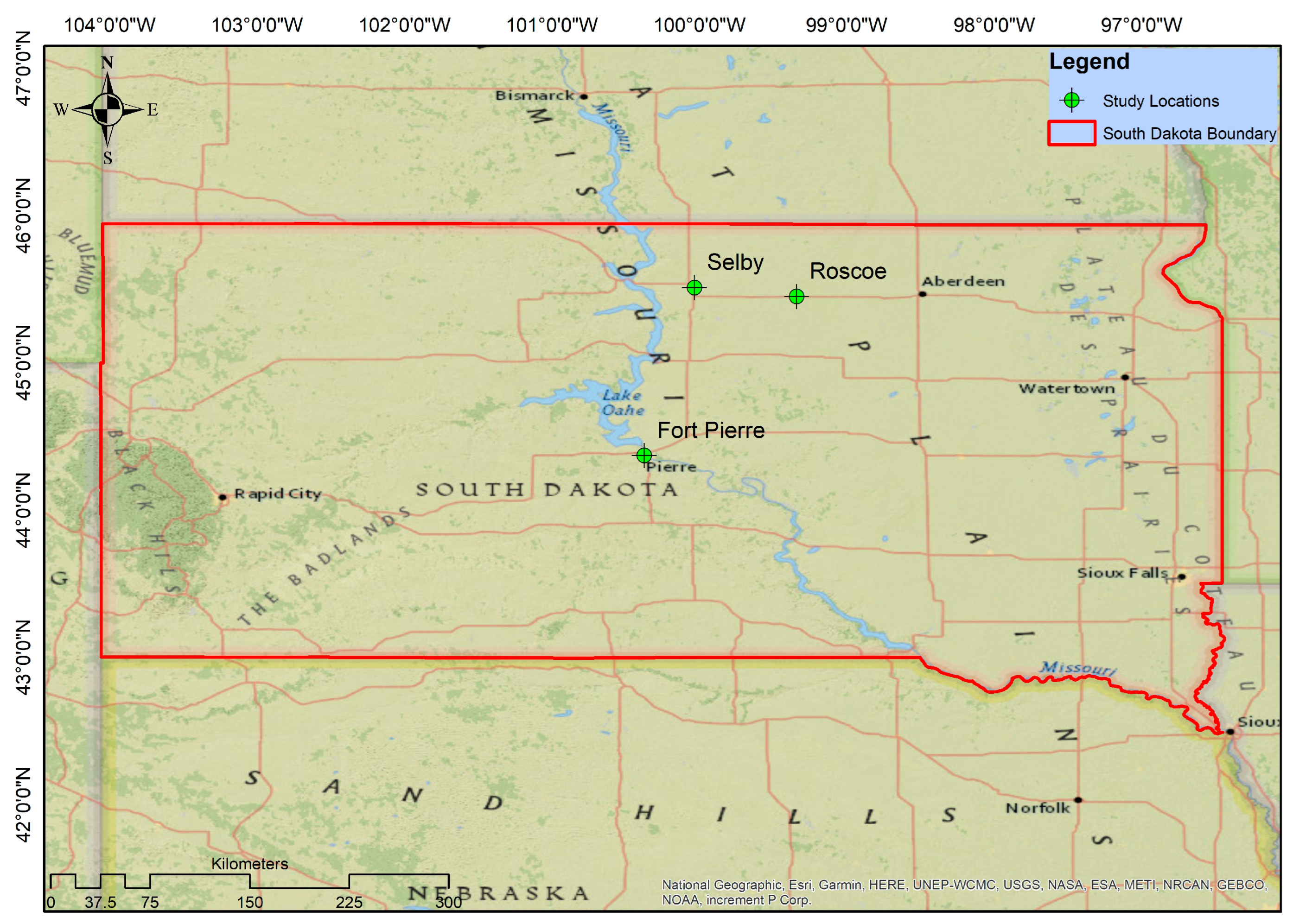
The study was conducted at three dryland field sites (Roscoe, Selby, and Fort Pierre) located in central and eastern South Dakota, representing semi-arid to dry-sub-humid climatic conditions and providing variability in soils, precipitation, and landscape characteristics necessary for evaluating soil-management impacts on moisture retention (Figure 1). These sites exhibit distinct climatic patterns: Fort Pierre receives ~43.94 cm of annual precipitation, Roscoe about 53.70 cm, and Selby approximately 46.46 cm, with all locations experiencing warm summers (85–90 °F in July) and cold winters (temperatures below 15 °F in January), resulting in freeze–thaw cycles that influence soil structure and moisture dynamics. The sites differ in soil types: clay loam in Roscoe, silt loam in Selby, and clay-rich soil in Fort Pierre, each with distinct drainage, water-holding capacity, and root-growth constraints that shape treatment responses under dryland farming conditions. Variations in topography further affect water flow and retention across the locations, reinforcing the value of these sites for assessing moisture-related outcomes of soil amendments and cover crops.
The three locations (Fort Pierre, Selby, and Roscoe) represent dryland farming systems in South Dakota, where crop production relies entirely on natural precipitation rather than irrigation. Commonly grown crops in these areas include drought-resistant varieties such as sorghum, oats, and winter rye, which are well-adapted to the region’s semi-arid conditions. Table 1 provides an overview of the cropping practices at each site during the experimental period. In Fort Pierre, a cover crop mix of rye and clover was planted on 11 August 2022 and terminated by frost on 15 October 2022. A cash crop of sorghum was then planted on 23 May 2023 and harvested on 10 October 2023. The following year, Hayden oats were planted on 22 April 2024 and harvested on 30 July 2024. In Selby, a diverse cover crop mixture, including sorghum Sudan, German hay millet, rye, turnip, radish, yellow blossom clover, and peas, was planted from 11 June 2024 to 30 July 2024. Unlike the other sites, no cash crops were planted during the study period in Selby. In Roscoe, a cover crop mix of millet, Sudan grass, sunflower, cowpeas, and soybeans was planted on 9 June 2023 and terminated by frost on 15 October 2023. A cash crop of soybeans was subsequently planted on 6 June 2024 and harvested on 8 October 2024.
These sites and crop rotations represent common farming practices in the region, making them ideal for studying how cover crops and soil treatments improve moisture retention. This research helps us understand their impact on soil water in dryland farming.

2.2. Data Collection

Daily precipitation, temperature, wind speed, humidity, and solar radiation were obtained from nearby SDSU Mesonet stations: Hayes (Fort Pierre), Bowdle (Roscoe), and Lowry (Selby). A Python 3.12 script was used to automate the extraction of multi-year datasets and ensure consistent formatting for model input. These climate data supported reference evapotranspiration (ETo) and potential evapotranspiration (PET) calculations. Soil moisture was measured using two complementary methods: (1) Continuous Monitoring: HOBO profile sensors were installed at Roscoe and Selby, recording hourly volumetric water content at 0–15 cm, 15–30 cm, and 30–45 cm depths. Sensors were positioned at plot centers to avoid edge effects, and data were accessed via the HoboLink platform. Winter months were excluded due to frozen soil interference. (2) Manual Sampling: Monthly gravimetric samples were collected at all sites (Roscoe, Selby, Fort Pierre) during the main crop season at 0–10 cm, 10–20 cm, and 20–30 cm depths. Samples were oven-dried to determine moisture content and used to validate sensor data. Soil profile descriptions were obtained from the USDA Web Soil Survey to characterize baseline soil conditions at each site. To support HYDRUS-1D modeling, soil texture at Roscoe was analyzed using the hydrometer method, providing sand, silt, and clay fractions for each depth layer. These data were used to generate initial hydraulic parameters in the Rosetta Lite module before subsequent refinement through inverse modeling. Soil moisture measurements were obtained using a combination of sensor-based monitoring and manual sampling. HOBO soil moisture sensors have an accuracy of about ±3%, which can improve to ±1–2% with soil-specific calibration. Calibration was done by comparing with the gravimetric oven-drying method. HYDRUS-1D further provided an independent evaluation of system behavior and consistency between observed and simulated data. Sensor-based soil moisture measurements were not collected during winter due to frozen soil conditions, as the sensors do not function reliably under freezing. Therefore, analysis and modeling were limited to the active growing season. Initial model conditions were based on early-season measurements and observed soil moisture dynamics primarily reflect precipitation-driven patterns during this period. While winter conditions may influence initial moisture levels, they are unlikely to significantly affect seasonal trends.

2.3. Experimental Design

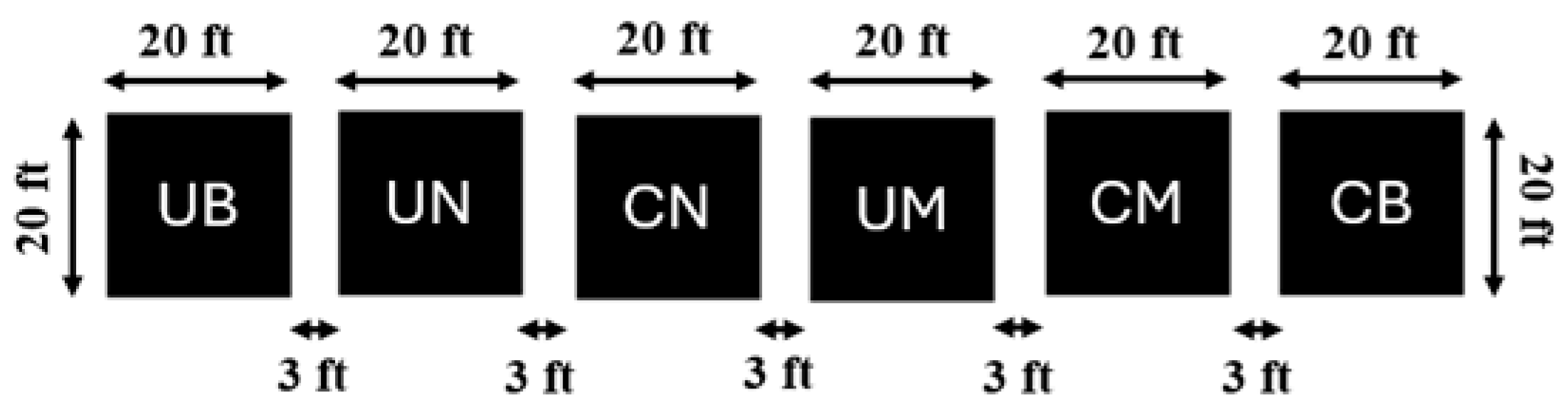
A replicated field experiment consisting of six treatments was established at Fort Pierre, Selby, and Roscoe to evaluate the effects of soil amendments and cover crops on soil moisture retention. At each site, treatments were arranged in a grid configuration, with individual plots measuring 20 × 20 ft and separated by 3 ft buffer zones to minimize lateral movement of water, nutrients, and amendments while allowing field access (Figure 2). This design reduced edge effects and treatment interference, ensuring comparable environmental conditions across plots and improving experimental control. The same six treatments with 4 replications were implemented consistently across all sites to enable direct comparisons under varying soil types and climatic conditions: no cover crop + biochar (UB), no cover crop + no amendment (UN, control), cover crop + no amendment (CN), no cover crop + organic manure (UM), cover crop + organic manure (CM), and cover crop + biochar (CB). Replication within each site enhanced statistical reliability and facilitated evaluation of treatment and site interactions.
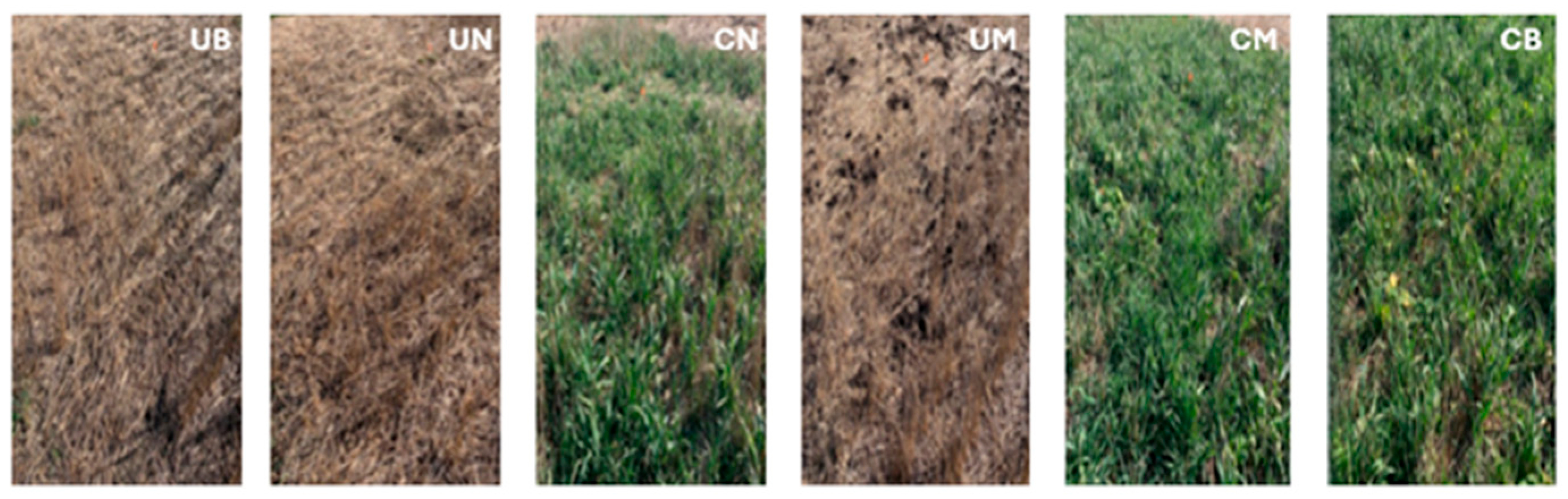
All soil amendments were applied before planting the cover crops. The cover crop treatments included a mix of millet, Sudan grass, and legumes, chosen for their potential to improve soil structure and boost organic matter. Soil amendments involved biochar made from wood chips and organic manure from nearby farms, reflecting practical, sustainable soil management approaches. Biochar was uniformly spread on the soil surface at a rate of 1.29 tons/acre across all sites. Organic manure application rates varied by location: Fort Pierre: 13 tons/acre, Selby: 17 tons/acre, and Roscoe: 18 tons/acre. The incorporation of these treatments aimed to enhance soil moisture retention and improve overall soil health. Figure 3 provides visual documentation of the six experimental plots, illustrating differences in cover crop presence and soil amendment applications.

2.4. Soil Moisture Sensor Installation

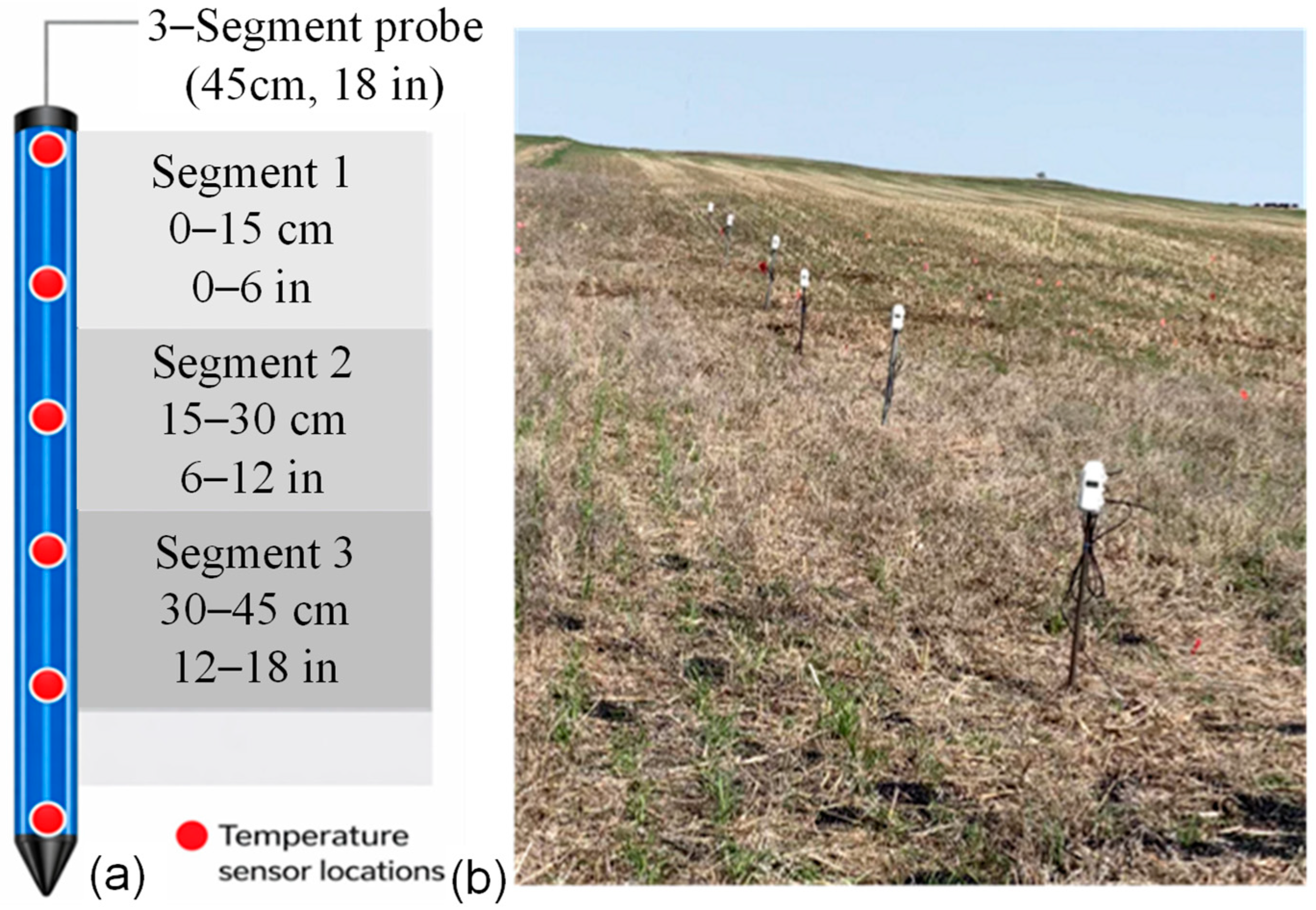
Soil moisture sensors were installed at Roscoe on 24 May 2023 and at Selby on 28 July 2023 to enable continuous monitoring, while manual soil moisture sampling was conducted at all three sites (Roscoe, Selby, and Fort Pierre) during the primary crop growing periods. HOBO profile sensors were installed in each plot at Roscoe and Selby to measure volumetric soil moisture content at three depths: 0–15 cm, 15–30 cm, and 30–45 cm. These depths were selected to encompass the effective root zone and capture moisture dynamics throughout the soil profile. Sensors were positioned at the center of each plot to minimize edge effects and ensure representative measurements (Figure 4). The sensors continuously recorded soil moisture, providing real-time data to assess treatment effects on soil water retention.

2.5. Numerical Modeling

2.5.1. HYDRUS-1D Model Setup

The HYDRUS-1D software (Version 2.05) was used to simulate soil water dynamics in experimental plots under different treatments at the Roscoe site. HYDRUS-1D is a finite element model that numerically solves the Richards equation, which describes variably saturated water flow in soils governing infiltration, redistribution, and drainage processes, making it essential for predicting water movement under different soil treatments and environmental conditions. The model incorporates soil hydraulic properties, including water retention and hydraulic conductivity functions, to provide a physically based representation of water flow within the soil profile. It is expressed mathematically as:
θ   ( h ) t = x K   ( h ) h z + 1 s ( h )
where θ is volumetric water content [L3 L−3], h is pressure head [L], K(h) is unsaturated hydraulic conductivity [LT−1], and S (h) represents root water uptake [L3L−3T−1].

2.5.2. Soil Hydraulic Model

The van Genuchten–Mualem single-porosity model was used in HYDRUS to describe soil water movement. It assumes the soil is uniform and does not account for hysteresis, making soil water behavior more manageable for computations. This empirical model is expressed as follows:
θ ( φ ) = θ r + θ r θ s [ 1 + ( α φ ) n ] m
In this equation, the soil water potential φ is represented in kilopascals (KPa). θr and θs are the residual and saturated volumetric water contents, respectively, quantified in cm3 cm−3. The parameter α is inversely related to the air-entry potential, while n is an empirical value connected to pore-size distribution, and the parameter m is a dimensionless fitting value defined as m = 1 − (1/n). α, n, and m are closely tied to the specific characteristics of the soil’s water retention curve.

2.5.3. Initial and Boundary Conditions

The HYDRUS-1D model was developed for the Roscoe site for the main crop growing period. To account for variations in soil moisture dynamics, simulations were conducted separately for each treatment. The initial soil moisture content, measured at the start of the experiment in each treatment plot, was used to define the initial conditions. Since rainfall was the only water source, the soil surface was driven by atmospheric boundary conditions, including daily precipitation and losses through evapotranspiration (PET). Thus, the upper boundary was defined as an atmospheric boundary condition. Although field sensors measured moisture up to 45 cm, the model domain was extended to 125 cm to capture full water movement and drainage beyond the root zone. A free drainage condition was applied at the lower boundary to allow excess water to flow out naturally. This approach was chosen since the groundwater table was too deep to influence soil moisture.

2.5.4. Inverse Modeling in HYDRUS-1D

Inverse modeling is a parameter estimation technique used to determine soil hydraulic properties by fitting simulated model outputs to observed field data. In HYDRUS-1D, this approach was utilized to estimate key soil hydraulic parameters, including residual water content (θr), saturated water content (θs), shape parameters (α and n), and saturated hydraulic conductivity (Ks). These parameters are critical for accurately describing soil water retention θ(h) and hydraulic conductivity K(h). The HYDRUS-1D model applied the Levenberg–Marquardt algorithm to fine-tune soil moisture simulations, reducing differences from actual measurements. Parameters were adjusted gradually to achieve the best fit. The Rosetta program was used to obtain initial estimates based on soil texture data from lab tests. These values served as a baseline for further adjustments. Calibration was performed using continuous soil moisture sensor data. An iterative inverse modeling procedure was applied to systematically adjust key parameters, minimizing discrepancies between simulated and observed values and thereby improving model accuracy and predictive reliability. Performance evaluation was carried out using the coefficient of determination (R2) and root mean squared error (RMSE) to assess the agreement between simulated and measured soil moisture data across different treatments (discussed later).

3. Results and Discussion

3.1. Climatic Parameters

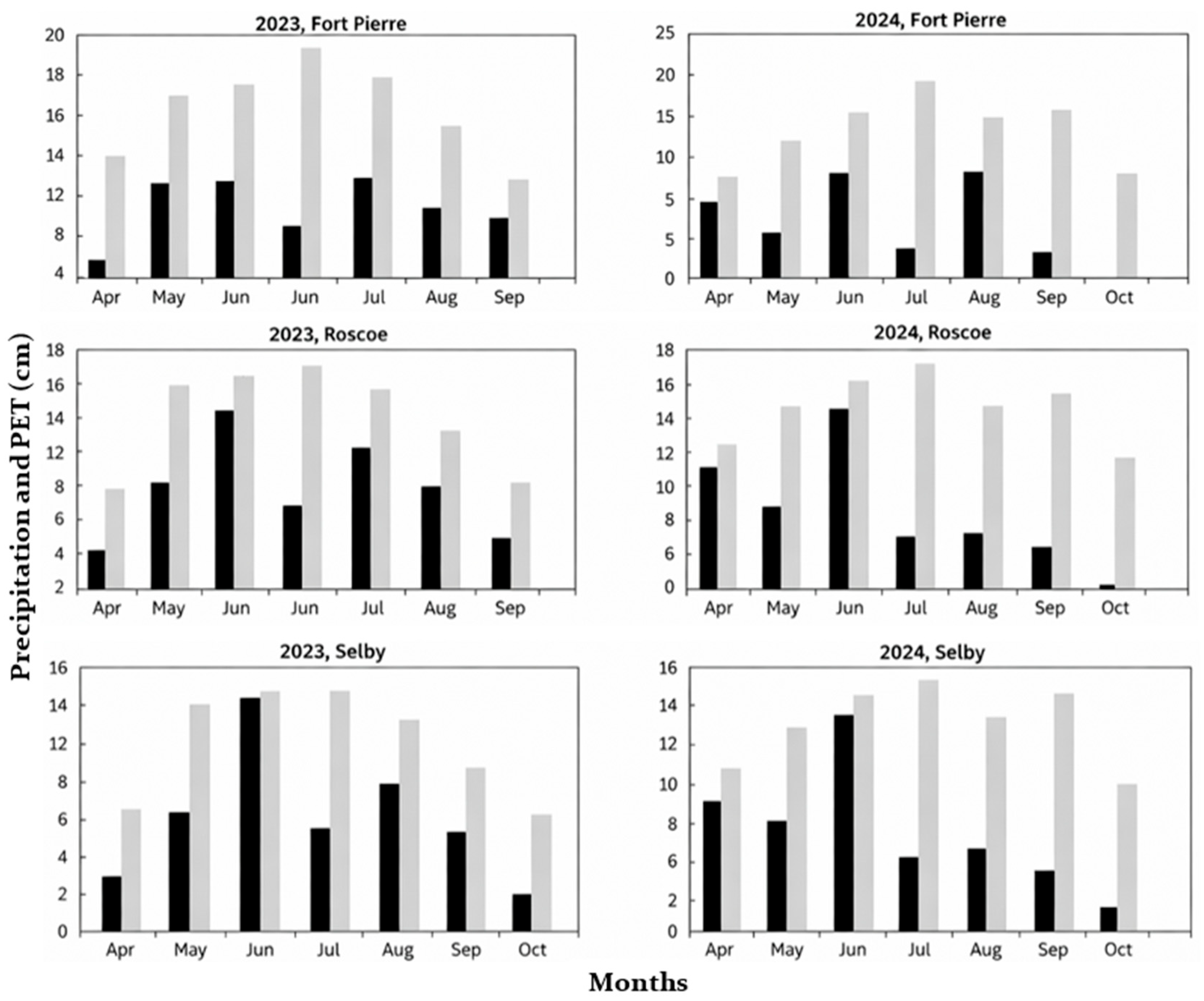
From Figure 5, the climatic analysis for 2023 and 2024 across Roscoe, Fort Pierre, and Selby reveals significant variations in precipitation and potential evapotranspiration (PET) trends. Roscoe received the most rainfall in 2023, totaling 48.55 cm, but it decreased to 36.63 cm in 2024, while Fort Pierre consistently had lower rainfall (35.73 cm in 2023 and 36.50 cm in 2024). Selby, for 2024, recorded 44.14 cm of precipitation, closely aligning with Roscoe. The highest rainfall occurred in June for all sites, with values reaching 13.05 cm in Roscoe (2023) and 13.26 cm in 2024, highlighting this period as a critical moisture-replenishing phase. However, PET exceeded precipitation throughout the growing season, with Fort Pierre recording the highest PET at 95.66 cm in 2023 and 105.05 cm in 2024, suggesting a higher evaporative demand. Roscoe and Selby had lower PET values (83.69 cm and 80.21 cm in 2023 and 91.41 and 99.67 cm in 2024). Fort Pierre showed a bigger gap between precipitation and PET, making it more vulnerable to drought and in need of better water conservation. From 2023 to 2024, PET increased slightly (4–5%) across all sites, likely due to warmer temperatures and higher evaporation. Overall, Fort Pierre had the driest conditions, while Roscoe and Selby retained more moisture.

3.2. Measured Soil Moisture Content

3.2.1. Effects of Soil Amendments on Moisture Retention During the Treatment Period

Multiple soil management alternatives/treatments were applied to the experimental plots at Roscoe, Selby, and Fort Pierre. The treatments, including soil amendments, were applied prior to main crop planting, with implementation timing varying by site and year. Mixed-species cover crops were grown in plots where the cover crop (CC) treatment was implemented. After termination, the biomass was retained on the soil surface as residue to simulate conservation practices and enhance soil organic matter inputs. Soil moisture was monitored using both manual sampling and HOBO profile sensors. Manual measurements were conducted at all three sites using the standard gravimetric oven-drying method, whereas continuous in situ soil moisture data were collected only at the Roscoe site using HOBO sensors. For analysis, treatments were categorized in two ways: (1) based on cover cropping, cover crop plots (CB, CM, CN) and no cover crop plots (UB, UM, UN) and (2) based on soil amendment type, biochar treatments (CB, UB), organic manure treatments (CM, UM), and no amendment treatments (CN, UN).
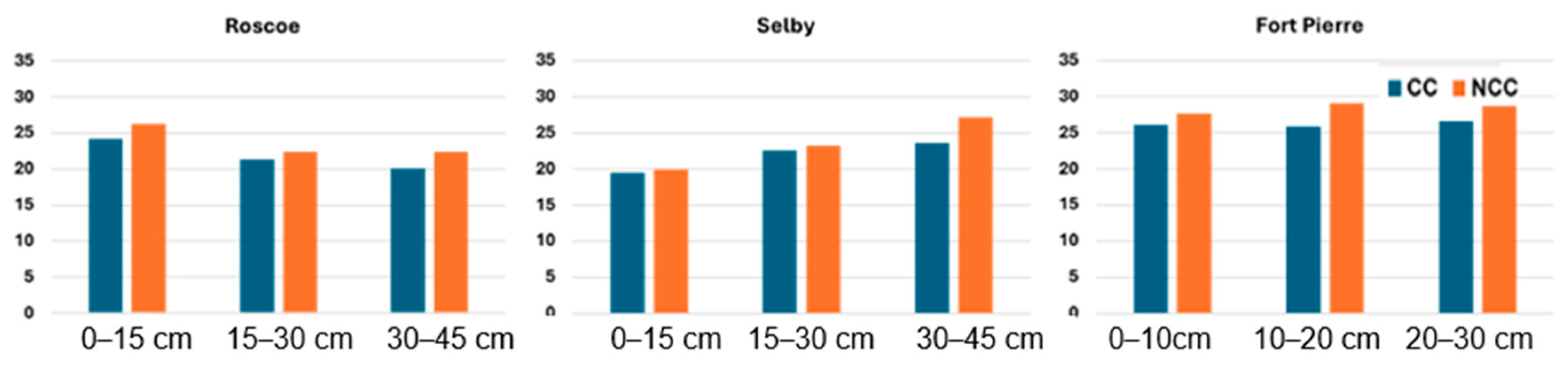
Average soil moisture values were calculated for each treatment group across multiple depths during the cover crop growing period, up to biomass termination. Analysis of the manually collected data revealed a consistent trend across all three sites: plots without cover crops (NCC) retained higher soil moisture than plots with cover crops (CC). This pattern was observed at all measured depths, as shown in Figure 6. The lower soil moisture in CC plots is likely attributable to increased water uptake and transpiration by the actively growing cover crops.
At Roscoe, average soil moisture in CC plots was 24.16% (0–15 cm), 21.37% (15–30 cm), and 20.09% (30–45 cm), whereas NCC plots recorded 26.27%, 22.39%, and 22.34%, respectively. Selby showed a similar pattern, with CC plots measuring 19.53%, 22.51%, and 23.62%, compared with 19.98%, 23.15%, and 27.17% in NCC plots at the same depths. At Fort Pierre, CC plots recorded 26.04%, 25.89%, and 26.58% at 0–10 cm, 10–20 cm, and 20–30 cm, respectively, while NCC plots had higher values of 27.61%, 29.11%, and 28.68%.
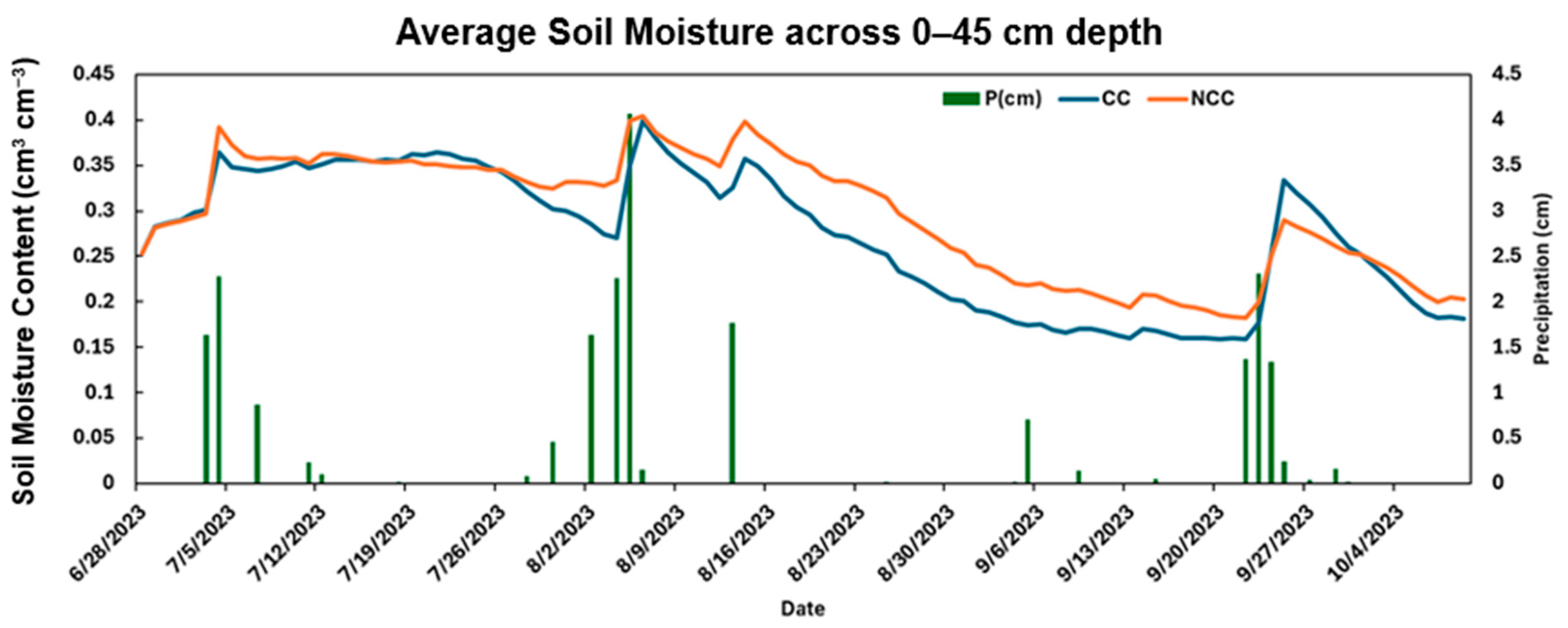
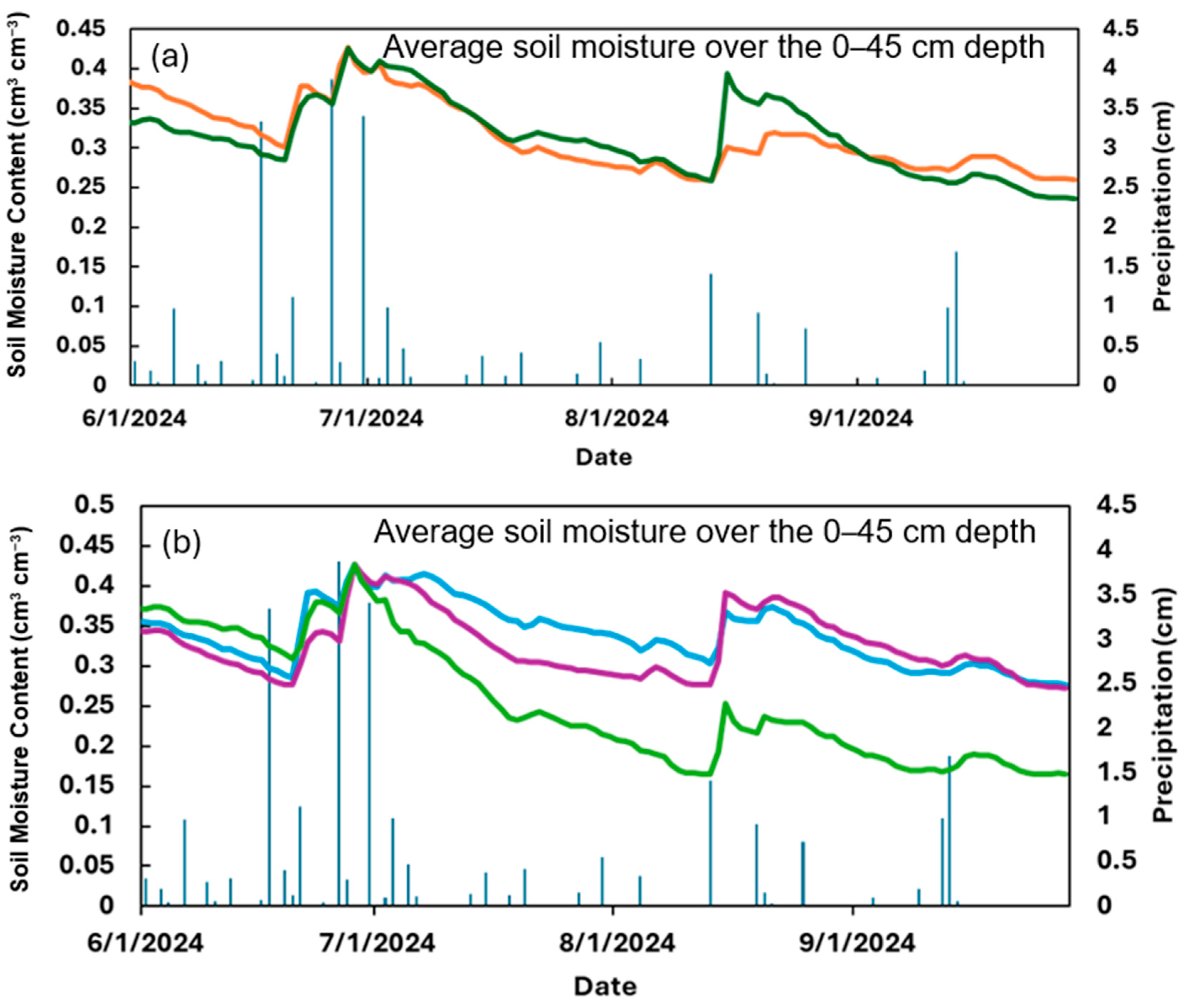
Recent studies support these findings, indicating that crop type can explain a substantial portion of soil moisture variability. Scholz et al. [104] reported that different crops account for 17% of soil moisture variance across fields, highlighting the broader plant-driven influence on soil water dynamics. A more relevant study by Zhang et al. [105] found that late-terminated cover crops reduced soil water by 7% and caused a 61% yield loss under dryland conditions, confirming that actively growing cover crop biomass can impose significant short-term moisture depletion. Continuous soil moisture data from sensors at the Roscoe site supported these findings. As shown in Figure 7, soil moisture in both CC and NCC plots increased after rainfall. However, the rate at which water was lost from the soil was faster in CC plots, attributable to evapotranspiration effects in CC plots. In contrast, NCC plots held moisture for longer periods.
In addition to assessing the effect of cover cropping, soil moisture data were analyzed to evaluate the effect of amendments. Treatments included biochar (CB, UB), organic manure (CM, UM), and no amendments (CN, UN). During the cover crop growing period, no significant differences in average soil moisture content were observed between amended and non-amended categories. This indicates that, within this period, any potential improvements in soil water retention from biochar or organic manure were not detectable. The stronger water uptake by actively growing cover crops likely masked possible amendment-related effects on soil moisture retention. Although cover crops provide well-documented soil health benefits, they can increase water use during active growth, leading to short-term reductions in soil moisture. However, incorporation of cover crop residues may improve soil structure and potentially enhance water-holding capacity over time, though this effect may vary depending on factors such as soil type and climate.

3.2.2. Effects of Soil Amendments on Moisture Retention During the Main Crop Growing Period

Soil amendments such as biochar and organic manure are widely recognized for their potential to improve soil water retention by enhancing soil structure, porosity, and organic matter content. Further investigation was conducted during the main crop growing period to evaluate whether (1) the water uptake by cover crops during the preceding cover crop period extended into the main crop season and (2) whether this carryover effect depended on soil type. Data from Roscoe and Fort Pierre were analyzed using both manual oven-drying and continuous HOBO profile sensors.
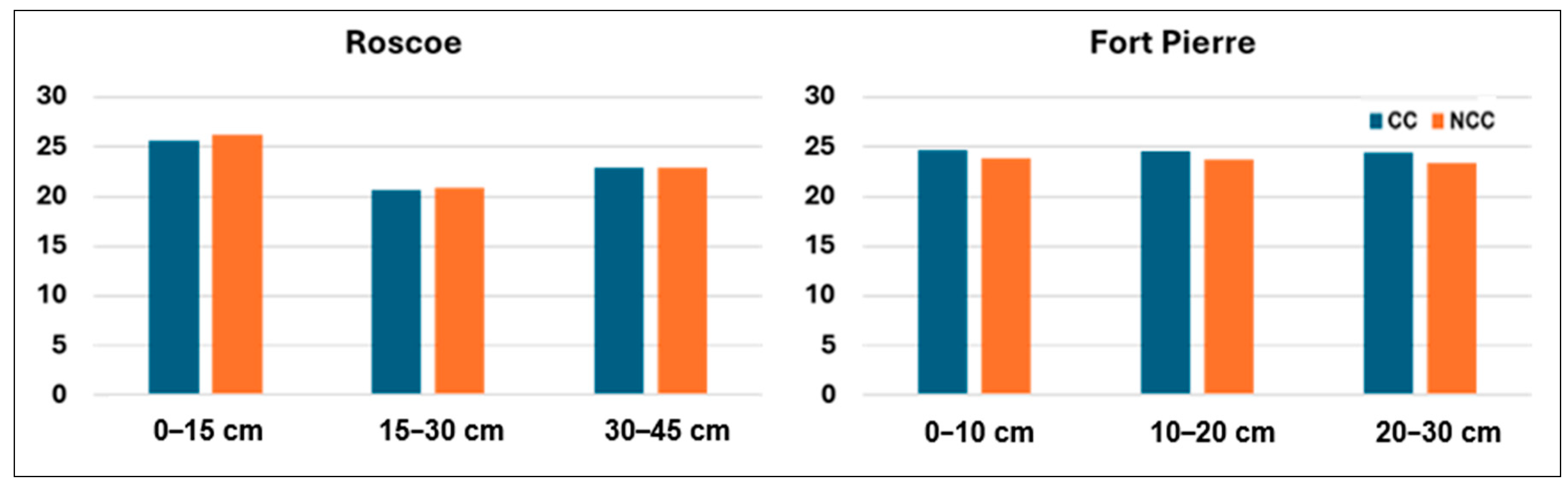
At the Roscoe site, plots with cover crop residue (CC) had average soil moisture contents of 25.57%, 20.65%, and 22.89% at depths of 0–15 cm, 15–30 cm, and 30–45 cm, respectively. In comparison, the no cover crop (NCC) plots had slightly higher values of 26.19%, 20.88%, and 22.90% at the same depths (Figure 8). This suggests that the water depletion caused by active cover crop growth in the prior season may have extended into the main crop period at Roscoe. The relatively greater impact at this site may be attributed to its loam and clay loam soils, which have lower water-holding capacity compared to heavier clay soils.
In contrast, at Fort Pierre, characterized by clay-rich soils, the CC plots retained higher moisture (24.64%, 24.61%, and 24.42%) than the NCC plots (23.86%, 23.77%, and 23.38%) at the corresponding depths. This indicates that the residual effects of cover cropping interacted differently with soil texture and that the clayey soils at Fort Pierre may have buffered the short-term water depletion effects observed at Roscoe. Overall, these results suggest that the carryover impact of cover crop water uptake into the main crop season is site-specific and influenced by soil type, with more pronounced effects in soils with relatively lower water-holding capacity. The comparison between CC and NCC plots across both sites is presented in Figure 9.
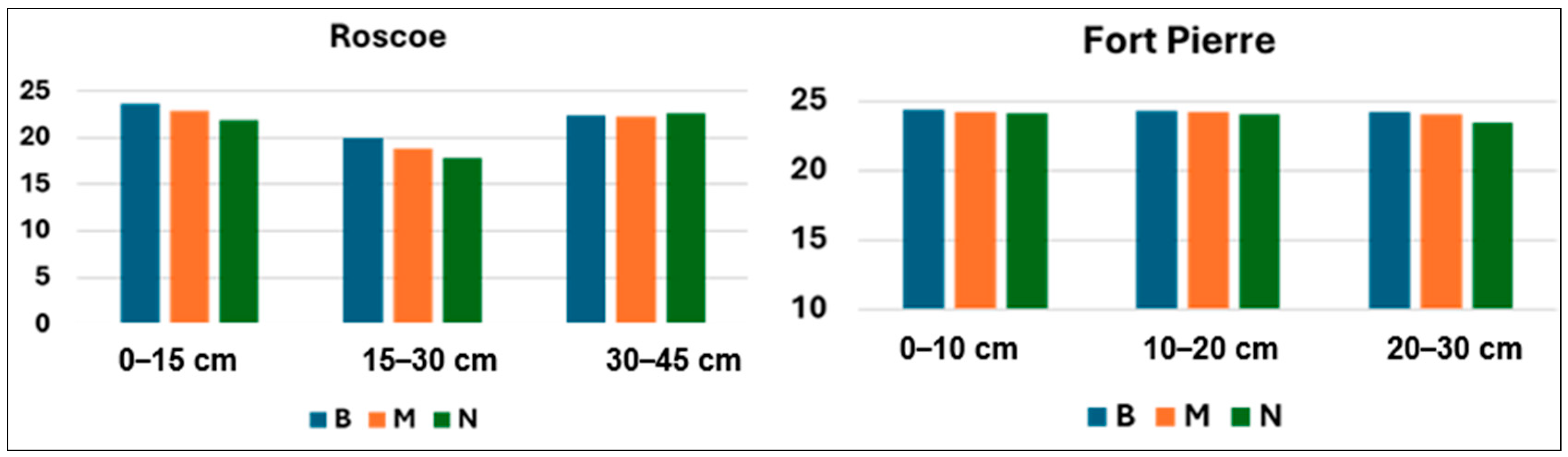
To evaluate the impact of soil amendments, the treatment plots were grouped into three categories: biochar (B: CB, UB), organic manure (M: CM, UM), and no amendment (N: CN, UN). At Roscoe, biochar-treated plots retained the highest average moisture content across depths, with values of 23.68%, 19.93%, and 22.35% at 0–15 cm, 15–30 cm, and 30–45 cm, respectively. Manure-treated plots followed with 22.84%, 18.83%, and 22.20%, while no amendment plots showed moisture levels of 21.81%, 17.85%, and 22.59%. At Fort Pierre, a similar pattern was observed, although the differences among treatments were less pronounced, likely due to the site’s clay-rich soils and inherently higher water-holding capacity. Biochar plots had average soil moisture values of 24.39%, 24.33%, and 24.24%, followed by manure plots with 24.25%, 24.21%, and 24.03% and no amendment plots with 24.11%, 24.04%, and 23.44% at the corresponding depths. These results, presented in Figure 10, indicate that biochar consistently enhanced soil moisture retention across both sites, particularly in the upper and middle soil layers. The findings are consistent with Thao et al. [106], who demonstrated that biochar significantly improves water retention in coarse-textured soils due to its large surface area and sorptive capacity, especially under drying conditions. Furthermore, multiple recent reviews [107,108] report that biochar enhances water-holding capacity, soil aggregation, and microbial activity—mechanisms that align with the increased moisture observed in biochar-treated plots in this study.
Continuous soil moisture data from the Roscoe site, collected using in situ sensors, provided detailed insight into soil moisture dynamics during the main crop growing season. As shown in Figure 10, both CC and NCC plots exhibited increases in moisture following rainfall events. During extended dry periods after rainfall, however, differences in moisture retention between CC and NCC plots were minimal, indicating that cover crop residue had only a limited influence on soil moisture at Roscoe during the main crop season. In contrast, biochar-treated plots consistently retained more moisture, particularly after rainfall events, suggesting that biochar enhances water retention and reduces the rate of moisture loss compared to manure-treated and unamended plots. These sensor-based observations are consistent with the manual measurements and further highlight the positive role of biochar in maintaining higher soil moisture levels during the crop growing period. Overall, soil moisture measurements from both manual sampling and continuous monitoring indicate that soil amendments, especially biochar, positively influence moisture retention during the main crop growing season. The effect of cover crop residue varied by site, with minimal impact at Roscoe and a modest increase in moisture retention at Fort Pierre, consistent with differences in soil texture and inherent water-holding capacity. In contrast, soil amendments such as biochar and manure generally performed better than the no amendment treatments at both sites, demonstrating improved water retention. These findings suggest that, in dryland farming systems, biochar may serve as a valuable amendment for enhancing water availability during critical crop growth stages. The manure effects observed at mid-soil depths are also consistent with reports that organic inputs promote soil aggregation and water storage [109].

3.2.3. Effects of Soil Amendments on Moisture Retention After an Extended Dry Period

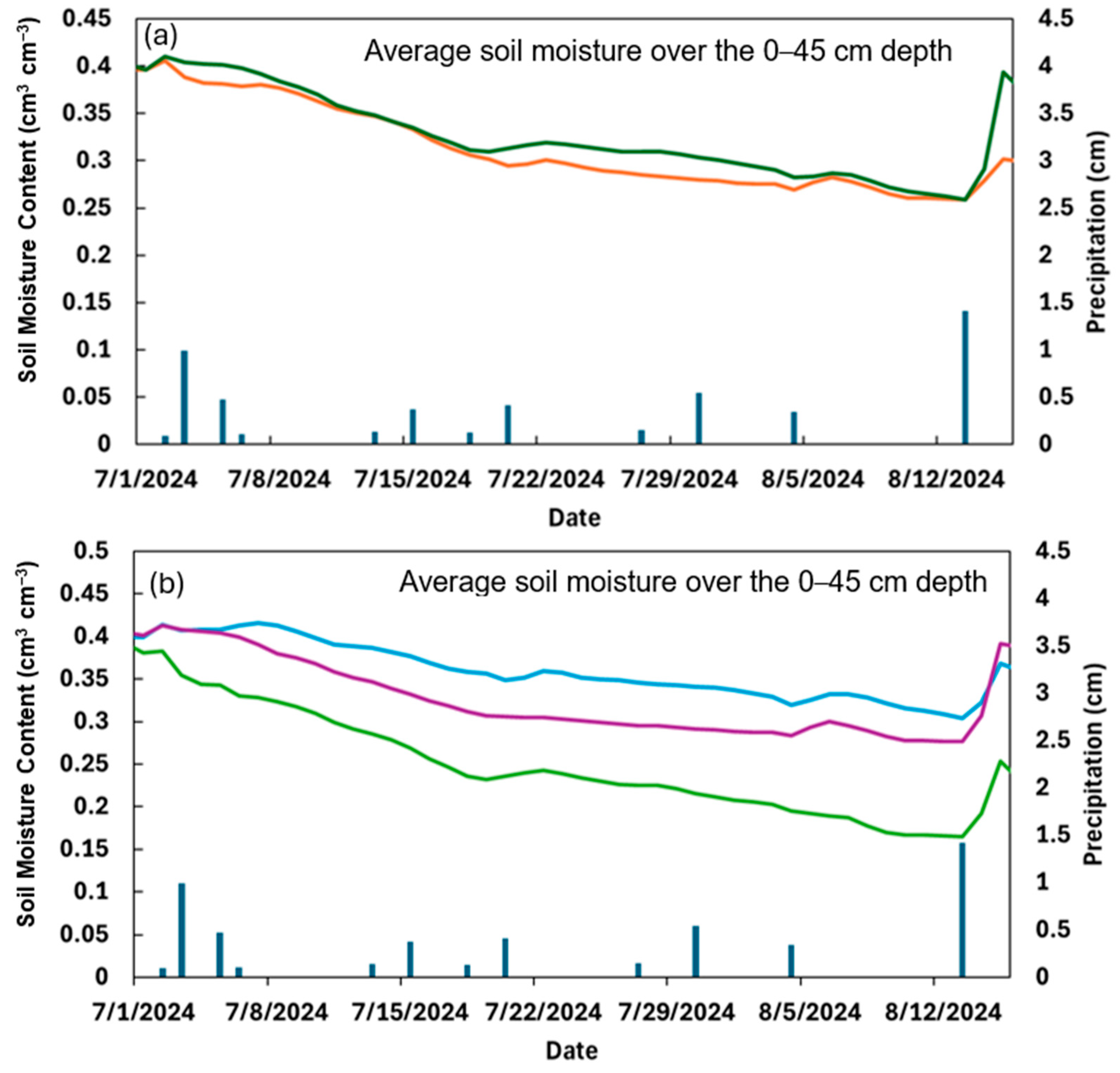
One of the most noteworthy findings of this study was the clear difference in soil moisture retention during extended dry periods, defined here as prolonged intervals between rainfall events. Because sustaining soil moisture during such rain-free conditions is critical for crop survival in dryland systems, continuous soil moisture data from HOBO profile sensors at the Roscoe site were analyzed to examine treatment-specific responses. Soil water content was monitored before and throughout a prolonged dry period between 1 July and 13 August 2024 (Figure 11). The lack of significant precipitation during this interval created a natural stress test, allowing a clear assessment of how soil moisture declined under different amendment practices. This period provided strong evidence of the comparative effectiveness of soil amendments and cover crop residue in moderating moisture loss under extended dry conditions.
On 1 July, the initial soil moisture content was nearly the same in both the cover crop (CC) and no cover crop (NCC) plots, measuring 0.3964 and 0.3965 cm3/cm3, respectively (Table 2). By 13 August, following the extended dry period, soil moisture decreased to 0.2589 cm3/cm3 in CC plots and 0.2584 cm3/cm3 in NCC plots. This indicates that cover crop residue had minimal effect on moisture retention during dry conditions, as both treatments showed nearly identical reductions in water content. This supports previous observations during the main crop growing season, where the effect of cover crop residue on moisture retention varied by site and environmental conditions.
In contrast, the role of soil amendments was more pronounced. Biochar-treated plots (B) had an initial water content of 0.3997 on 1 July and retained 0.3040 cm3/cm3 by 13 August. Organic manure-treated plots (M) started at 0.4015 and declined to 0.2764, while unamended plots (N) showed a more substantial drop from 0.3810 to 0.1646 cm3/cm3 over the same period. These results demonstrate that biochar was an effective amendment for retaining soil moisture during the extended dry spell, with the smallest decline (approximately 0.096 cm3/cm3), followed by organic manure (decline of ~0.125 cm3/cm3) and, finally, the no amendment plots, which experienced the largest moisture loss (~0.216 cm3/cm3). Biochar’s superior performance is due to its high porosity, large surface area, and ability to retain water in its internal pores, which slows evaporation and water movement through the soil.
These findings demonstrate that biochar enhances soil moisture retention during extended dry periods between rainfall events, making it an effective strategy for reducing drought stress in dryland farming systems. The results further indicate that, during prolonged rain-free conditions, soil amendments play a more significant role in maintaining available soil moisture than cover crop residue alone. The superior drought-buffering capacity of biochar is consistent with Ullah et al. [110], who reported that biochar improves water retention, pore continuity, and overall drought resilience across different soil types. Similarly, controlled experiments by Thao et al. [106] showed that biochar-amended soils sustain higher biological activity and moisture levels under repeated drying cycles, which aligns with the smaller decline in soil water content observed in the CB and UB treatments in this study.
Another merit of biochar is its long-term stability and persistence in soil. Biochar is a highly stable, carbon-rich amendment that decomposes very slowly, often remaining in soil for hundreds to thousands of years due to its resistant aromatic structure [111,112]. Its benefits, including improved soil structure, nutrient retention, and water-holding capacity, can persist for many years after a single application [113]. Over time, biochar undergoes gradual “aging,” where its surfaces oxidize and interact with organic matter and microbes, slightly modifying its properties [114]. However, its overall functionality is largely maintained, making it a durable amendment with long-term benefits for soil systems [111,112].

3.2.4. Statistical Analysis

A two-way repeated measures ANOVA conducted for the Fort Pierre site reinforces the observed soil moisture patterns by quantifying the relative influence of treatment and time. During the cover crop period, both treatment and time had significant effects on soil moisture (treatment: F (5,6) = 6.487, p = 0.021, η2 = 0.844; time: F (1,6) = 9.653, p = 0.021, η2 = 0.617), indicating strong impact from amendments. Post hoc analysis further showed that no cover crop biochar plots retained significantly higher moisture than cover crop biochar plots (mean difference = 3.27, p = 0.040), confirming that active cover crops reduce soil moisture while biochar enhances retention.
In contrast, during the main crop growing period, the control of soil moisture shifts toward seasonal factors. Time had an overwhelmingly strong effect (F (3,18) = 300.581, p < 0.001, η2 = 0.980), reflecting the dominant influence of rainfall patterns and evapotranspiration. However, treatment (F (5,6) = 0.912, p = 0.530) and the interaction effect (p = 0.877) were not statistically significant, indicating that differences among amendments were negligible during this stage. Although not statistically significant, biochar-treated plots consistently showed slightly higher moisture levels.
Overall, these results demonstrate a clear progression: soil amendments significantly influence soil moisture during the cover crop phase, but their relative impact diminishes during the main crop season as environmental controls dominate.

3.3. Numerical Modeling Using HYDRUS-1D

3.3.1. Soil Hydraulic Parameter Estimation

The Roscoe site was selected for HYDRUS-1D model development because continuous soil moisture sensor data were available, allowing robust parameter estimation through inverse modeling. Soil texture was determined using the hydrometer method (Table 3), indicating predominantly clay to clay loam soils with clay contents ranging from 42% to 60%. Clay content generally increased with depth, suggesting greater water retention potential in subsoil layers. The measured sand, silt, and clay fractions were entered into Rosetta Lite within HYDRUS to generate initial van Genuchten–Mualem parameters (θr, θs, α, n, and Ks), which were subsequently optimized through inverse modeling. The final calibrated parameters are presented in Table 4.
Saturated water content (θs) ranged from 0.360 to 0.4697 cm3 cm−3. Biochar-amended treatments showed consistently higher θs values, with UB ranging from 0.398 to 0.4359 and CB from 0.4191 to 0.4697, indicating increased porosity and improved moisture retention. Unamended treatments showed more variability; for example, θs in UN increased from 0.360 at 0–15 cm to 0.4655 at 30–45 cm, reflecting higher clay content at depth. Residual water content (θr) ranged from 0.034 to 0.100 cm3 cm−3 and was generally higher in deeper, clay-rich layers. The α parameter ranged from 0.0050 to 0.0174 cm−1; lower values in CN (0.0051–0.0053) indicate stronger capillary retention, whereas higher values in CB at 30–45 cm (0.0174 cm−1) suggest greater macroporosity. The n parameter ranged from 1.23 to 2.68, with the highest value in CN at 0–15 cm (2.68), indicating a steeper retention curve and faster drainage near saturation. Saturated hydraulic conductivity (Ks) varied from 0.88 to 50 cm day−1. UB showed high Ks at 0–15 cm (50 cm day−1) and 15–30 cm (46.68 cm day−1), while UM reached 38.14 cm day−1 at 15–30 cm and 48.27 cm day−1 at 30–45 cm. In contrast, CN had the lowest Ks (0.88 cm day−1 at 15–30 cm), indicating restricted drainage. Increases in Ks under biochar and manure treatments are attributed to improved soil structure. Biochar enhances pore formation and connectivity, while manure increases organic matter, stabilizes aggregates, and reduces bulk density. These structural improvements promote macropore development and facilitate water movement.
Overall, the calibrated HYDRUS-1D parameters demonstrate that increasing clay content with depth generally resulted in higher θr and θs values and lower n values, reflecting stronger water retention and reduced pore-size variability. Biochar amendments primarily enhanced saturated water content (0.4191–0.4697 cm3 cm−3), improving moisture storage capacity, while manure amendments substantially increased saturated hydraulic conductivity (up to 48.27 cm day−1), improving soil permeability and water movement. Unamended soils showed comparatively greater variability and less consistent hydraulic improvement. These calibrated parameters provide a mechanistic explanation of how different management practices influenced soil water retention and transmission at the Roscoe site.

3.3.2. Model Performance and Evaluation

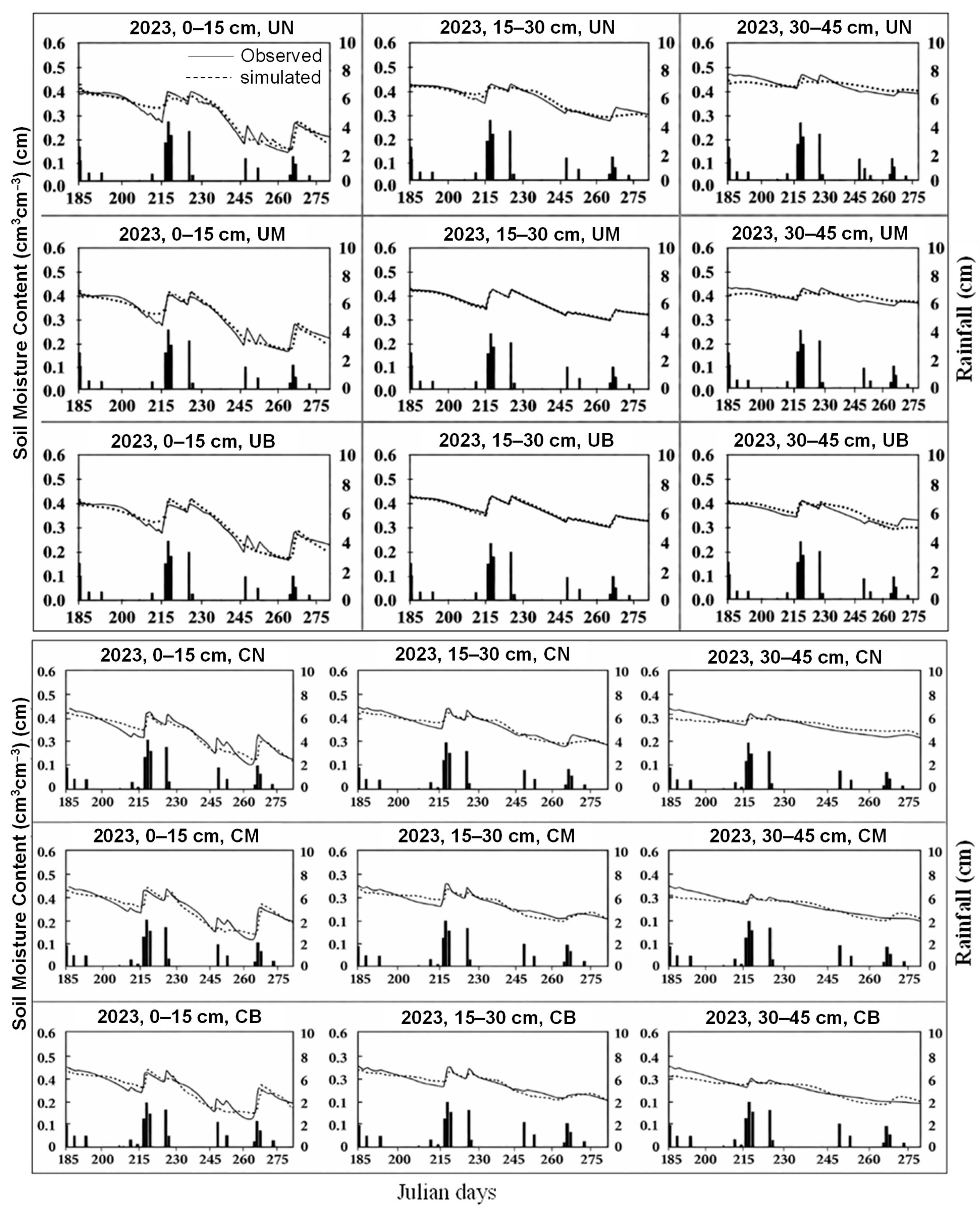
The HYDRUS-1D model was evaluated by comparing simulated soil moisture values with observed data collected from HOBO profile sensors at the Roscoe site. Six separate HYDRUS-1D models were developed, one for each treatment plot. Model performance was assessed using two statistical metrics: root mean square error (RMSE) and the coefficient of determination (R2). The calibration results are presented in Table 5. Time series plots comparing observed and simulated soil moisture values for the six treatments, based on available sensor data from 2023, are shown in Figure 12.
Model performance evaluation indicated variability in calibration results among treatments and depths. Coefficient of determination (R2) values ranged from 0.612 to 0.962, while RMSE values varied between 0.016 and 0.025 cm3 cm−3. In general, the model reproduced observed soil moisture dynamics reasonably well across most treatments, with several depth intervals showing strong agreement between measured and simulated values (R2 ≥ 0.86). For example, UB showed R2 values above 0.86 across depths with RMSE ≤ 0.020 cm3 cm−3, and CB at 15–30 cm achieved R2 = 0.912 with RMSE = 0.016 cm3 cm−3. Similarly, UM at 15–30 cm exhibited a high R2 of 0.962. However, lower predictive performance was observed in some deeper layers. For instance, CN at 30–45 cm had an R2 of 0.612 and RMSE of 0.025 cm3 cm−3, while CM at the same depth showed R2 = 0.686 and RMSE = 0.023 cm3 cm−3. These results indicate greater uncertainty in simulating soil moisture at depth compared to surface and mid-depth layers.
Overall, the calibration results were within acceptable ranges for field-scale HYDRUS-1D applications. Although calibration statistics varied among treatments and depths, the model performance was generally satisfactory for simulating soil water dynamics. Differences in calibration quality should be interpreted as variations in model fit rather than direct evidence of treatment-specific hydraulic behavior.

3.3.3. Soil Moisture Dynamics Under Different Amendments at the Roscoe Site

Soil moisture increased multiple times during the growing season in response to rainfall events. However, differences among treatments indicate that soil amendments influenced moisture retention and drainage patterns. Plots without amendments (UN, CN) exhibited greater fluctuations in soil moisture, particularly in the 0–15 cm layer. This higher variability likely reflects rapid wetting and drying cycles caused by increased evaporation and percolation in soils lacking the structural improvements and enhanced water-holding capacity provided by organic amendments. In the surface layer (0–15 cm), UN showed the greatest variation in soil moisture, indicating that unamended soils are more prone to rapid moisture loss, which may reduce water use efficiency. In contrast, plots amended with biochar and manure (UB, UM, CB, and CM) maintained comparatively higher and more stable soil moisture levels. Among these treatments, CB demonstrated the highest moisture retention, particularly during the dry period between day of year (DOY) 230 and 245, when no rainfall occurred. This observation supports the role of biochar in enhancing soil water-holding capacity, reducing surface evaporation, and improving moisture retention during dry periods.
At the 15–30 cm depth, soil moisture retention varied among treatments. UM maintained the highest moisture content, followed by UB and CB, whereas CN consistently showed the lowest values. The greater retention observed under UM suggests that manure additions improved water storage capacity at this depth. Biochar treatments (UB and CB) also enhanced moisture retention, although slightly less than manure in this layer. At the 30–45 cm depth, UN recorded the highest soil moisture, followed by UM, while CM and CB had comparatively lower values. This pattern suggests that unamended soils allow greater downward movement of water due to reduced retention in the upper layers. In contrast, amended soils, particularly those receiving biochar and manure, retained more moisture in the upper and middle layers, thereby reducing deep percolation. These findings are consistent with previous studies indicating that soil amendments enhance water retention within the root zone, improve plant-available water, and limit deep drainage losses. It should also be noted that manure and biochar were applied primarily to the surface layer; therefore, moisture distribution patterns may differ if these amendments are incorporated into deeper layers.
Overall, the results indicate that soil amendments, particularly biochar (CB) and manure (UM), improve soil moisture retention and reduce short-term moisture fluctuations. The integration of cover crops with amendments (CB, CM) further enhanced moisture conservation by stabilizing soil water dynamics and improving overall water availability.

3.4. Scenario Analysis

The calibrated HYDRUS-1D model was used to conduct scenario analyses to evaluate soil moisture dynamics under varying climatic and soil property conditions. Specifically, the model was applied to (1) simulate wet and dry climate scenarios and (2) assess the effects of uniformly applying calibrated top-layer hydraulic parameters across all soil depths. The latter approach represents a hypothetical homogeneous soil profile, such as uniformly mixing biochar throughout the soil column. This analysis provided insight into how homogeneous hydraulic properties may influence moisture retention, infiltration, and vertical water redistribution within the soil profile.

3.4.1. Wet and Dry Periods

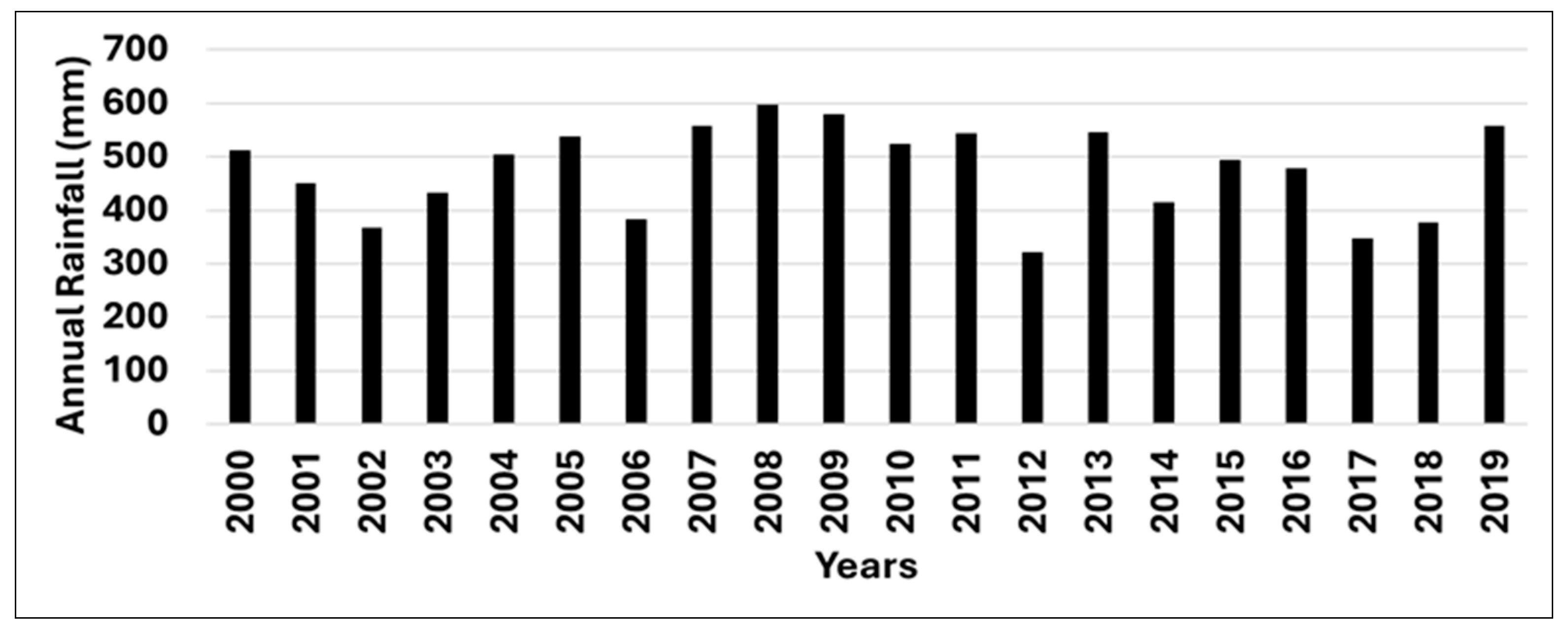
To evaluate soil moisture responses under contrasting climatic conditions, historical precipitation data over a 20-year period were analyzed for the growing season (April–October). Based on total rainfall during this period, 2012 was identified as the driest year and 2008 as the wettest year (Figure 13). Consequently, climate data from 2012 were used to represent dry-year conditions, while 2008 data were used to simulate wet-year conditions.
(a)
Wet-Year Analysis
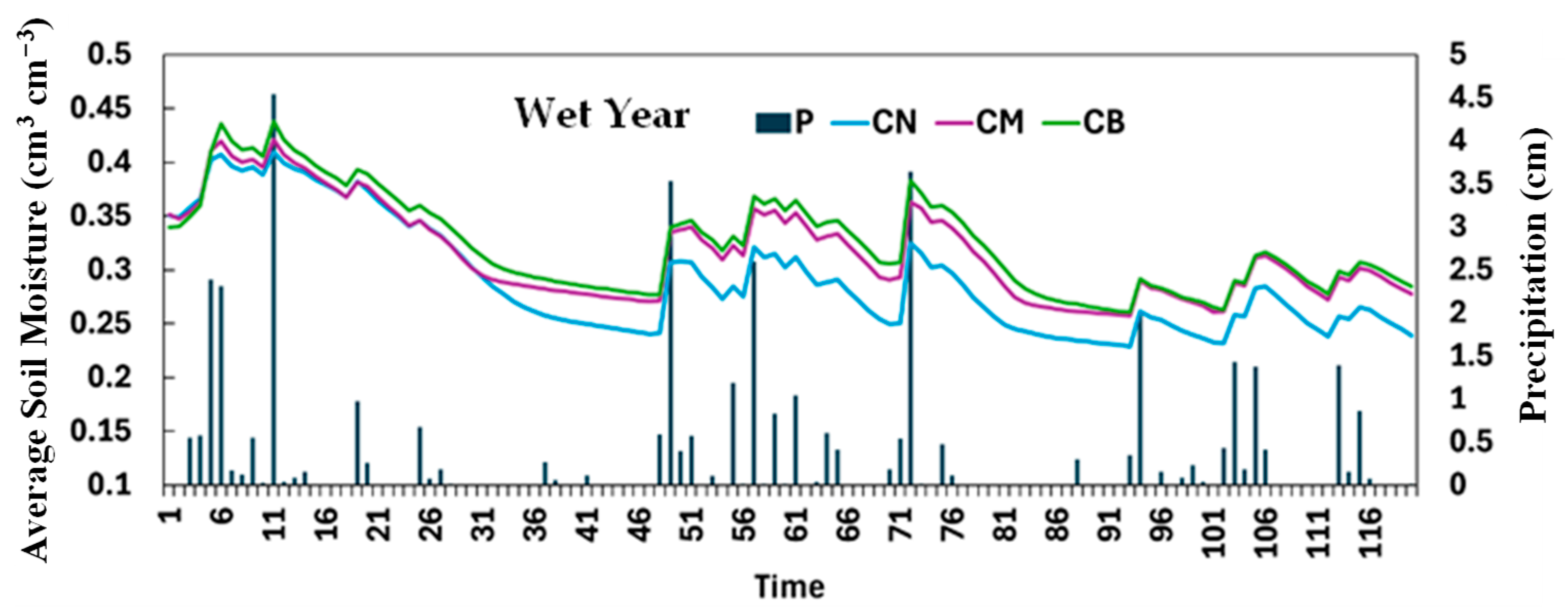
Soil moisture dynamics for the cover crop + no amendment (CN), cover crop + organic manure (CM), and cover crop + biochar (CB) treatments during the wet year are presented in Figure 14. The CB treatment exhibited the highest average soil moisture content (0.3395), followed by CM (0.3154) and CN (0.2904). The higher moisture levels under CB suggest that the combined effects of biochar and cover crops enhanced soil water retention. Biochar contributes to increased porosity and water-holding capacity, while cover crops reduce surface evaporation and improve soil structure. The CM treatment (0.3154) also showed substantial moisture retention, indicating that organic manure enhanced soil water storage, likely through increased organic matter and improved aggregation. In contrast, CN (0.2904) recorded the lowest average soil moisture, suggesting that cover crops alone were less effective than when combined with amendments.
Temporal trends indicate that all treatments responded to precipitation events with noticeable increases in soil moisture. However, differences were observed in the rate of moisture depletion following rainfall. The CB treatment showed the slowest decline in soil moisture, whereas CM exhibited a slightly faster reduction. CN experienced the most rapid moisture loss. The consistent advantage of biochar in maintaining higher soil moisture aligns with previous studies [104,107], which report improved pore structure and enhanced water retention associated with biochar across varying climatic conditions.
(b)
Dry-Year Analysis
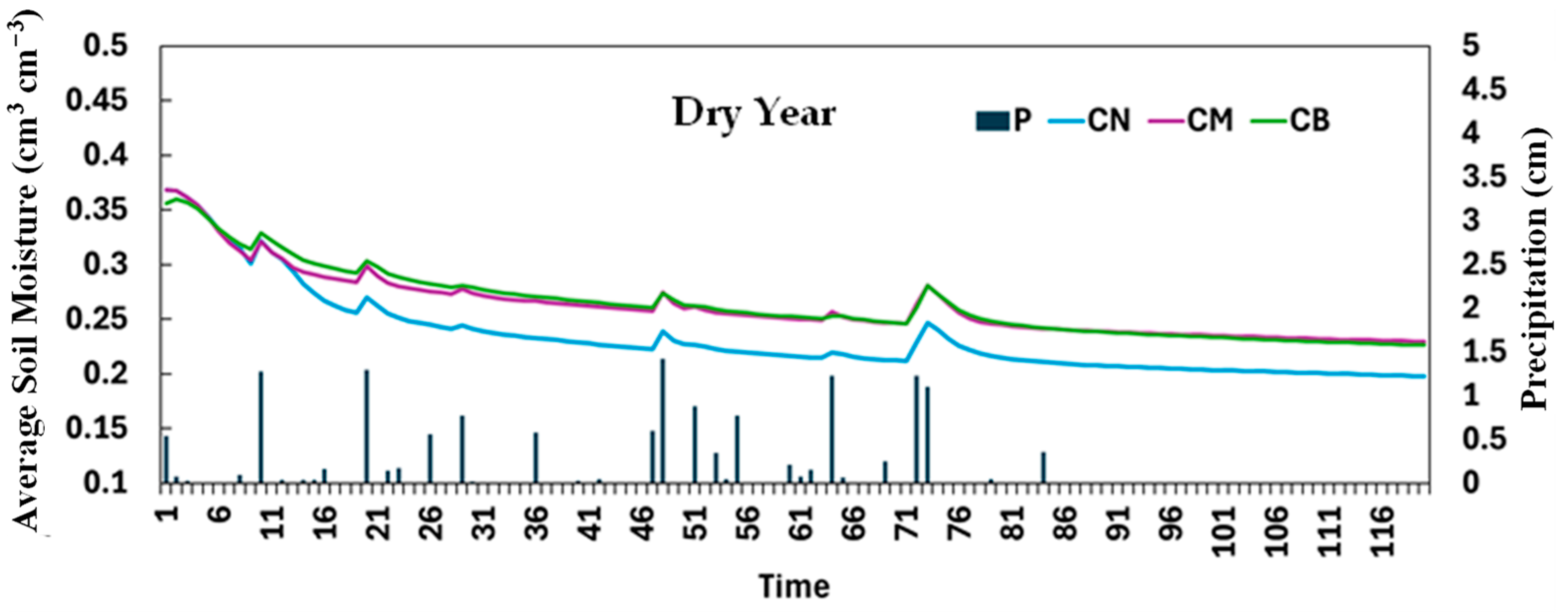
During the dry year, overall soil moisture levels were lower than those observed under wet-year conditions, reflecting reduced precipitation inputs. Among the cover crop treatments, CB maintained the highest average soil moisture (0.2638), followed closely by CM (0.2620), while CN recorded the lowest value (0.2337) (Figure 15). These results indicate that amendments contributed to improved soil moisture conservation under limited rainfall conditions.
Temporal analysis shows more rapid moisture depletion and reduced recovery following rainfall events compared to the wet year. Although all treatments experienced declining moisture trends, CB retained slightly higher moisture levels than CM and CN. CM also maintained greater moisture than CN, suggesting that manure improved soil water storage under drought conditions. In contrast, CN exhibited the fastest moisture decline, indicating limited buffering capacity against moisture stress in the absence of amendments. Overall, the scenario analysis demonstrates that soil amendments enhanced soil moisture retention under both wet and dry climatic conditions. Treatments incorporating biochar (CB) and manure (CM) maintained higher average moisture levels compared to CN. The results emphasize the importance of integrating soil amendments to improve water conservation and reduce vulnerability to climatic variability.

3.4.2. Impact of Uniform Top-Layer Parameterization on Soil Water Dynamics

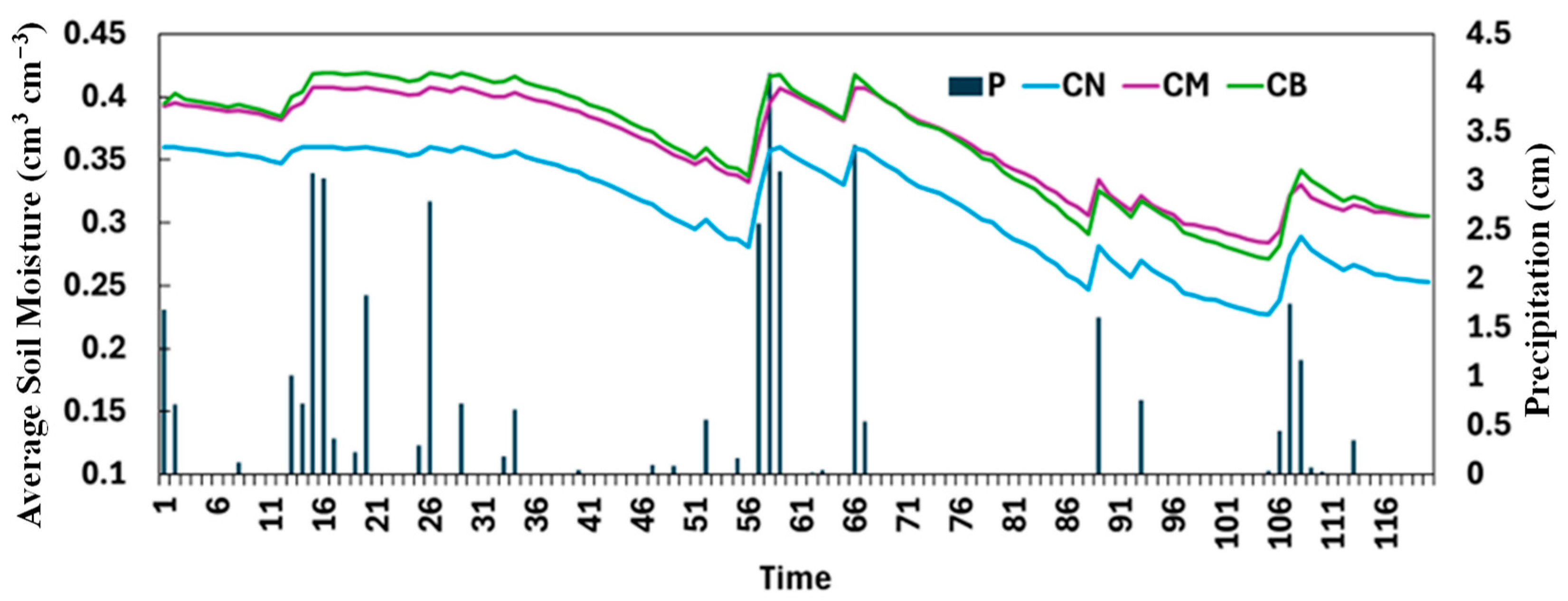
This scenario analysis evaluated the effect of uniformly applying calibrated top-layer hydraulic parameters across all soil depths for UN (no cover crop + no amendment), CM (cover crop + organic manure), and CB (cover crop + biochar). Conceptually, this approach represents increasing the depth of biochar and manure incorporation without conducting costly field experiments. By assuming a homogeneous soil profile and eliminating depth-dependent variability, the analysis clarifies how uniformly distributed amendment-related hydraulic properties would influence infiltration, soil water storage, and vertical moisture redistribution throughout the entire soil profile.
As shown in Figure 16, CB exhibited the highest average soil moisture retention, with moisture levels 10.5% higher than UN and 1.1% higher than CM. Both CB and CM maintained greater moisture than UN, indicating that hydraulic characteristics associated with biochar and organic manure enhanced water-holding capacity when extended uniformly through the soil profile. Differences in post-rainfall moisture response were also observed. UN showed the fastest decline in soil moisture, whereas CB retained moisture for longer periods, indicating reduced drainage and slower depletion. CM displayed intermediate behavior between CB and UN.
These results demonstrate that extending top-layer hydraulic properties to deeper layers alters the vertical distribution of soil moisture. The findings suggest that increasing the depth of biochar or manure incorporation could improve moisture retention and reduce drainage losses. Overall, CB maintained the highest moisture levels, followed closely by CM, while UN exhibited the most rapid drying.

4. Conclusions

This study addressed key knowledge gaps regarding the field-scale effects of cover crops, biochar, and organic manure on root-zone soil moisture dynamics in dryland agriculture. By combining multi-site field experiments (Roscoe, Selby, Fort Pierre), continuous multi-depth soil moisture monitoring, and calibrated HYDRUS-1D inverse modeling, the research provided integrated field-based and numerical evidence of how these practices influence soil water retention under variable climatic conditions.
Actively growing cover crops reduced soil moisture during the cover crop growth period due to increased transpiration, confirming that seasonal timing governs their short-term hydrologic effects. However, post-termination residue contributed to improved moisture stability in some cases, with responses varying by soil texture. In contrast, soil amendments produced clearer and more consistent impacts. Biochar-amended plots showed the smallest decline in soil moisture during an extended dry period (≈0.096 m3 m−3) compared with manure (≈0.125 m3 m−3) and unamended plots (≈0.216 m3 m−3), demonstrating enhanced drought-buffering capacity. Organic manure also improved moisture retention relative to no amendment, though generally to a lesser extent than biochar.
Inverse modeling with HYDRUS-1D yielded satisfactory performance (R2 up to 0.962; RMSE as low as 0.016 cm3 cm−3) and revealed amendment-related changes in hydraulic properties, including increased saturated water content and improved conductivity. Scenario analyses under representative wet (2008) and dry (2012) years confirmed that biochar- and manure-amended plots maintained higher average soil moisture across climatic extremes.
Overall, the findings provide strong evidence that biochar, and to a lesser extent manure, can enhance root-zone water availability and improve drought resilience in rainfed systems. While cover crops may temporarily reduce soil moisture during active growth, their structural benefits support long-term soil health, particularly when integrated with amendments. The combined use of field monitoring and process-based modeling offers a robust framework for guiding adaptive water-management strategies in dryland agriculture.

Author Contributions

Conceptualization, S.P., S.X. and M.G.; methodology, S.P., M.G. and S.X.; software, S.P.; validation, S.P., S.X. and M.G.; formal analysis, S.P.; investigation, S.P., S.X., A.M., V.K. and M.G.; resources, S.X. and M.G.; data curation, S.P.; writing, original draft preparation, S.P.; writing, review and editing, S.P., A.M., S.X. and M.G.; visualization, S.P. and A.M.; supervision, M.G.; project administration, M.G.; funding acquisition, S.X. and M.G. All authors have read and agreed to the published version of the manuscript.

Funding

This research was funded by the United States Department of Agriculture (USDA), Natural Resources Conservation Service (NRCS), through the Conservation Innovation Grants (CIG) Classic program, Award No. NR223A750013G033, titled “Overcoming Cover Crop Adoption Barriers in Dryland Production Systems by Enhancing Water Use Efficiency and Soil Health”.

Institutional Review Board Statement

Not applicable.

Informed Consent Statement

Not applicable.

Data Availability Statement

Climate data used in this study are publicly available from the South Dakota Mesonet (https://mesonet.sdstate.edu/, accessed on 12 April 2024). The experimental soil moisture and modeling datasets generated during the current study are available from the corresponding author on reasonable request.

Acknowledgments

The authors sincerely thank producers at Roscoe, Selby, and Fort Pierre research sites for providing test plots, for soil sampling, sensor installation, and data collection. We also acknowledge the South Dakota State University Mesonet program for providing access to high-quality climate data used in this study. Appreciation is extended to the laboratory staff at South Dakota School of Mines for assistance with sensor testing, soil texture analysis and hydrometer testing.

Conflicts of Interest

The authors declare no conflicts of interest. The funders had no role in the design of the study; in the collection, analyses, or interpretation of data; in the writing of the manuscript; or in the decision to publish the results.

References

  1. Koohafkan, P.; Stewart, B.A. Water and Cereals in Drylands; Food and Agriculture Organization of the United Nations (FAO): Rome, Italy; Earthscan: London, UK; Sterling, VA, USA, 2008. [Google Scholar]
  2. Laity, J. Deserts and Desert Environments; Environmental Systems and Global Change Series; Wiley-Blackwell: Chichester, UK; Hoboken, NJ, USA, 2008. [Google Scholar]
  3. Zhao, X.; He, H.; Siddique, K.H.M.; Gao, X. Synergizing Production and Ecology: Innovations in Sustainable Dryland Agriculture. Plant Soil 2024, 499, 1–8. [Google Scholar] [CrossRef]
  4. Safriel, U.; Adeel, Z.; Niemeijer, D.; Puigdefabregas, J.; White, R.; Lal, R.; Winslow, M.; Ziedler, J.; Prince, S.; Archer, E.; et al. Dryland Systems. In Ecosystems and Human Well-Being: Current State and Trends; Hassan, R., Scholes, R., Ash, N., Eds.; Island Press: Washington, DC, USA, 2005; pp. 623–662. [Google Scholar]
  5. Brouwer, C.; Heibloem, M. Irrigation Water Management: Irrigation Water Needs; Training Manual No. 3; Food and Agriculture Organization of the United Nations (FAO): Rome, Italy, 1986. [Google Scholar]
  6. Scholes, R.J. The Future of Semi-Arid Regions: A Weak Fabric Unravels. Climate 2020, 8, 43. [Google Scholar] [CrossRef]
  7. Prăvălie, R. Drylands Extent and Environmental Issues: A Global Approach. Earth Sci. Rev. 2016, 161, 259–278. [Google Scholar] [CrossRef]
  8. Plaza, C.; Zaccone, C.; Sawicka, K.; Méndez, A.M.; Tarquis, A.; Gascó, G.; Heuvelink, G.B.M.; Schuur, E.A.G.; Maestre, F.T. Soil Resources and Element Stocks in Drylands to Face Global Issues. Sci. Rep. 2018, 8, 13788. [Google Scholar] [CrossRef]
  9. Poulter, B.; Frank, D.; Ciais, P.; Myneni, R.B.; Andela, N.; Bi, J.; Broquet, G.; Canadell, J.G.; Chevallier, F.; Liu, Y.Y.; et al. Contribution of Semi-Arid Ecosystems to Interannual Variability of the Global Carbon Cycle. Nature 2014, 509, 600–603. [Google Scholar] [CrossRef] [PubMed]
  10. Ahlström, A.; Raupach, M.R.; Schurgers, G.; Smith, B.; Arneth, A.; Jung, M.; Reichstein, M.; Canadell, J.G.; Friedlingstein, P.; Jain, A.K.; et al. The Dominant Role of Semi-Arid Ecosystems in the Trend and Variability of the Land CO2 Sink. Science 2015, 348, 895–899. [Google Scholar] [CrossRef]
  11. Wang, L.; Jiao, W.; MacBean, N.; Rulli, M.C.; Manzoni, S.; Vico, G.; D’Odorico, P. Dryland Productivity under a Changing Climate. Nat. Clim. Change 2022, 12, 1070–1082. [Google Scholar] [CrossRef]
  12. Hag Mohamed Husein, H.; Lucke, B.; Bäumler, R.; Sahwan, W. A Contribution to Soil Fertility Assessment for Arid and Semi-Arid Lands. Soil Syst. 2021, 5, 42. [Google Scholar] [CrossRef]
  13. Silva, D.F.; Rodrigues, J.L.M.; Erikson, C.; Silva, A.M.M.; Huang, L.; Araujo, V.L.V.P.; Matteoli, F.P.; Mendes, L.W.; Araujo, A.S.F.; Pereira, A.P.A.; et al. Grazing Exclusion-Induced Changes in Soil Fungal Communities in a Highly Desertified Brazilian Dryland. Microbiol. Res. 2024, 285, 127763. [Google Scholar] [CrossRef] [PubMed]
  14. Zahra, N.; Farooq, M.; Siddique, K.H.M. Strategies for Improving Water Use Efficiency in Dryland Agroecosystems. Front. Agric. Sci. Eng. 2021, 8, 599–602. [Google Scholar] [CrossRef]
  15. Liu, K.; Li, X.; Wang, S.; Zhou, G. Past and future adverse response of terrestrial water storages to increased vegetation growth in drylands. Clim. Atmos. Sci. 2023, 6, 113. [Google Scholar] [CrossRef]
  16. Joly, F.-X.; Weibel, A.K.; Coulis, M.; Throop, H.L. Rainfall Frequency, Not Quantity, Controls Isopod Effect on Litter Decomposition. Soil Biol. Biochem. 2019, 135, 154–162. [Google Scholar] [CrossRef]
  17. Fu, Z.; Ciais, P.; Feldman, A.F.; Gentine, P.; Makowski, D.; Prentice, I.C.; Stoy, P.C.; Bastos, A.; Wigneron, J.-P.; Konings, A.G. Critical Soil Moisture Thresholds of Plant Water Stress in Terrestrial Ecosystems. Sci. Adv. 2022, 8, eabq7827. [Google Scholar] [CrossRef]
  18. Steward, D.R.; Bruss, P.J.; Yang, X.; Staggenborg, S.A.; Welch, S.M.; Apley, M.D. Tapping Unsustainable Groundwater Stores for Agricultural Production in the High Plains Aquifer of Kansas, Projections to 2110. Proc. Natl. Acad. Sci. USA 2013, 110, E3477–E3486. [Google Scholar] [CrossRef]
  19. Wang, X.; Jia, Z.; Liang, L.; Yang, B.; Ding, R.; Nie, J.; Wang, J. Impacts of manure application on soil environment, rainfall use efficiency and crop biomass under dryland farming. Sci. Rep. 2016, 6, 20994. [Google Scholar] [CrossRef]
  20. Turner, N.C. Agronomic Options for Improving Rainfall-Use Efficiency of Crops in Dryland Farming Systems. J. Exp. Bot. 2004, 55, 2413–2425. [Google Scholar] [CrossRef]
  21. Anyah, R.; Xia, S.; Semazzi, F. Influence of Water Table Dynamics on Spatial and Temporal Patterns of Hydroclimate Extremes over Lake Victoria Basin, East Africa: Comparison of Wet and Dry Years. Int. J. Climatol. 2022, 42, 7878–7898. [Google Scholar] [CrossRef]
  22. Marengo, J.A.; Cunha, A.P.; Cuartas, L.A.; Deusdará Leal, K.R.; Broedel, E.; Seluchi, M.E.; Michelin, C.M.; De Praga Baião, C.F.; Chuchón Ângulo, E.; Almeida, E.K.; et al. Extreme Drought in the Brazilian Pantanal in 2019–2020. Front. Water 2021, 3, 639204. [Google Scholar] [CrossRef]
  23. Briggs, L.J.; Shantz, H.L. The Water Requirement of Plants. I. Investigations in the Great Plains in 1910 and 1911. In Bulletin of the U.S. Bureau of Plant Industry; U.S. Government Printing Office: Washington, DC, USA, 1913. [Google Scholar] [CrossRef][Green Version]
  24. Hoover, D.L.; Abendroth, L.J.; Browning, D.M.; Saha, A.; Snyder, K.; Wagle, P.; Witthaus, L.; Baffaut, C.; Biederman, J.A.; Bosch, D.D.; et al. Indicators of Water Use Efficiency across Diverse Agroecosystems and Spatiotemporal Scales. Sci. Total Environ. 2023, 864, 160992. [Google Scholar] [CrossRef]
  25. Farquhar, G.D.; Ehleringer, J.R.; Hubick, K.T. Carbon Isotope Discrimination and Photosynthesis. Annu. Rev. Plant Physiol. Plant Mol. Biol. 1989, 40, 503–537. [Google Scholar] [CrossRef]
  26. Emmerich, W.E. Ecosystem Water Use Efficiency in a Semiarid Shrubland and Grassland Community. Rangel. Ecol. Manag. 2007, 60, 464–470. [Google Scholar] [CrossRef]
  27. Niu, S.; Xing, X.; Zhang, Z.; Xia, J.; Zhou, X.; Song, B.; Li, L.; Wan, S. Water-Use Efficiency in Response to Climate Change: From Leaf to Ecosystem in a Temperate Steppe. Glob. Chang. Biol. 2011, 17, 1073–1082. [Google Scholar] [CrossRef]
  28. Readyhough, T.; Neher, D.A.; Andrews, T. Organic Amendments Alter Soil Hydrology and Belowground Microbiome of Tomato (Solanum lycopersicum). Microorganisms 2021, 9, 1561. [Google Scholar] [CrossRef]
  29. Fageria, N.K.; Baligar, V.C.; Bailey, B.A. Role of Cover Crops in Improving Soil and Row Crop Productivity. Commun. Soil Sci. Plant Anal. 2005, 36, 2733–2757. [Google Scholar] [CrossRef]
  30. Sharma, P.; Singh, A.; Kahlon, C.S.; Brar, A.S.; Grover, K.K.; Dia, M.; Steiner, R.L. The Role of Cover Crops towards Sustainable Soil Health and Agriculture—A Review Paper. Am. J. Plant Sci. 2018, 9, 1935–1951. [Google Scholar] [CrossRef]
  31. Baxter, L.L.; West, C.P.; Brown, C.P.; Green, P.E. Cover Crop Management on the Southern High Plains: Impacts on Crop Productivity and Soil Water Depletion. Animals 2021, 11, 212. [Google Scholar] [CrossRef]
  32. Bietila, E.; Silva, E.M.; Pfeiffer, A.; Colquhoun, J. Cover Crop-Based No-Till Production Impacts Potato, Bell Pepper, and Snap Bean Production in Wisconsin. Renew. Agric. Food Syst. 2016, 32, 349–357. [Google Scholar] [CrossRef]
  33. Blanco-Canqui, H.; Shaver, T.M.; Lindquist, J.L.; Shapiro, C.A.; Elmore, R.W.; Francis, C.A.; Hergert, G.W. Cover Crops and Ecosystem Services: Insights from Studies in Temperate Soils. Agron. J. 2015, 107, 2449–2474. [Google Scholar] [CrossRef]
  34. Brust, J.; Claupein, W.; Gerhards, R. Growth and Weed Suppression Ability of Common and New Cover Crops in Germany. Crop Prot. 2014, 63, 1–8. [Google Scholar] [CrossRef]
  35. Büchi, L.; Gebhard, C.-A.; Liebisch, F.; Sinaj, S.; Ramseier, H.; Charles, R. Accumulation of Biologically Fixed Nitrogen by Legumes Cultivated as Cover Crops in Switzerland. Plant Soil 2015, 393, 163–175. [Google Scholar] [CrossRef]
  36. Hubbard, R.K.; Strickland, T.C.; Phatak, S.C. Effects of Cover Crop Systems on Soil Physical Properties and Carbon/Nitrogen Relationships in the Coastal Plain of Southeastern USA. Soil Tillage Res. 2013, 126, 276–283. [Google Scholar] [CrossRef]
  37. Thapa, R.; Tully, K.L.; Reberg-Horton, C.; Cabrera, M.; Gaskin, J.; Davis, B.W.; Fleisher, D.; Poncet, A.; Seehaver, S.A.; Hitchcock, R.; et al. Cover Crop Residue Decomposition in No-Till Corn Systems: Insights from Multi-State On-Farm Litter Bag Studies. Agric. Ecosyst. Environ. 2022, 326, 107823. [Google Scholar] [CrossRef]
  38. Basche, A.D.; Miguez, F.E.; Kaspar, T.C.; Castellano, M.J. Do Cover Crops Increase or Decrease Nitrous Oxide Emissions? A Meta-Analysis. J. Soil Water Conserv. 2014, 69, 471–482. [Google Scholar] [CrossRef]
  39. Abdalla, M.; Hastings, A.; Cheng, K.; Yue, Q.; Chadwick, D.; Espenberg, M.; Truu, J.; Rees, R.M.; Smith, P. A Critical Review of the Impacts of Cover Crops on Nitrogen Leaching, Net Greenhouse Gas Balance and Crop Productivity. Glob. Chang. Biol. 2019, 25, 2530–2543. [Google Scholar] [CrossRef] [PubMed]
  40. SARE Outreach. Managing Cover Crops Profitably, 3rd ed.; Clark, A., Ed.; Sustainable Agriculture Research and Education (SARE): College Park, MD, USA, 2007. [Google Scholar]
  41. Garba, I.I.; Bell, L.W.; Williams, A. Cover Crop Legacy Impacts on Soil Water and Nitrogen Dynamics, and on Subsequent Crop Yields in Drylands: A Meta-Analysis. Agron. Sustain. Dev. 2022, 42, 34. [Google Scholar] [CrossRef]
  42. Michel, L.M. On-Farm Cover Crop Trials in the Dryland Wheat Fallow Region of North-Central Washington. Master’s Thesis, Washington State University, Pullman, WA, USA, 2022. [Google Scholar] [CrossRef]
  43. Razzaghi, F.; Obour, P.B.; Arthur, E. Does Biochar Improve Soil Water Retention? A Systematic Review and Meta-Analysis. Geoderma 2020, 361, 114055. [Google Scholar] [CrossRef]
  44. Elangovan, R.; Shri Rangasami, S.R.; Murugaragavan, R.; Sekaran, N.C. Influence of Biochar on Soil Available Nutrient Contents in Cropping Sequence (Cotton-Maize-Mowpea). Int. J. Plant Sci. 2022, 17, 36–49. [Google Scholar] [CrossRef]
  45. Liao, W.; Halim, M.A.; Kayes, I.; Drake, J.A.P.; Thomas, S.C. Biochar Benefits Green Infrastructure: Global Meta-Analysis and Synthesis. Environ. Sci. Technol. 2023, 57, 15475–15486. [Google Scholar] [CrossRef]
  46. Brtnicky, M.; Hammerschmiedt, T.; Elbl, J.; Kintl, A.; Skulcova, L.; Radziemska, M.; Latal, O.; Baltazar, T.; Kobzova, E.; Holatko, J. The Potential of Biochar Made from Agricultural Residues to Increase Soil Fertility and Microbial Activity: Impacts on Soils with Varying Sand Content. Agronomy 2021, 11, 1174. [Google Scholar] [CrossRef]
  47. Sizmur, T.; Fresno, T.; Akgül, G.; Frost, H.; Moreno-Jiménez, E. Biochar Modification to Enhance Sorption of Inorganics from Water. Bioresour. Technol. 2017, 246, 34–47. [Google Scholar] [CrossRef]
  48. Kayes, A.; Araf, T.; Mustaki, S.; Islam, N.; Choudhury, S. Effects of Biochar and Chitosan on Morpho-Physiological, Biochemical and Yield Traits of Water-Stressed Tomato Plants. Int. J. Hortic. Agric. Food Sci. 2024, 8, 1–9. [Google Scholar] [CrossRef]
  49. Agbna, G.H.D.; Dongli, S.; Zhipeng, L.; Elshaikh, N.A.; Guangcheng, S.; Timm, L.C. Effects of Deficit Irrigation and Biochar Addition on the Growth, Yield, and Quality of Tomato. Sci. Hortic. 2017, 222, 90–101. [Google Scholar] [CrossRef]
  50. Mulcahy, D.N.; Mulcahy, D.L.; Dietz, D. Biochar Soil Amendment Increases Tomato Seedling Resistance to Drought in Sandy Soils. J. Arid Environ. 2013, 88, 222–225. [Google Scholar] [CrossRef]
  51. Xiao, L.; Lin, Y.; Chen, D.; Zhao, K.; Wang, Y.; You, Z.; Zhao, R.; Xie, Z.; Liu, J. Maximizing Crop Yield and Water Productivity through Biochar Application: A Global Synthesis of Field Experiments. Agric. Water Manag. 2024, 305, 109134. [Google Scholar] [CrossRef]
  52. Hasan, M.S.; Geza, M.; Vasquez, R.; Chilkoor, G.; Gadhamshetty, V. Enhanced Heavy Metal Removal from Synthetic Stormwater Using Nanoscale Zerovalent Iron–Modified Biochar. Water Air Soil Pollut. 2020, 231, 220. [Google Scholar] [CrossRef]
  53. Mortazavian, S.; Murph, S.E.H.; Moon, J. Biochar Nanocomposite as an Inexpensive and Highly Efficient Carbonaceous Adsorbent for Hexavalent Chromium Removal. Materials 2022, 15, 6055. [Google Scholar] [CrossRef] [PubMed]
  54. Hasan, S.; Geza, M.; Petersen, J.B.; Gadhamshetty, V. Chemosphere Graphene Oxide Transport and Retention in Biochar Media. Chemosphere 2023, 264, 128397. [Google Scholar] [CrossRef]
  55. Hasan, M.S.; Dong, J.; Gadhamshetty, V.; Geza, M. Modeling Graphene Oxide Transport and Retention in Biochar. J. Contam. Hydrol. 2022, 248, 104011. [Google Scholar] [CrossRef] [PubMed]
  56. Kalu, S.; Kulmala, L.; Zrim, J.; Peltokangas, K.; Tammeorg, P.; Rasa, K.; Kitzler, B.; Pihlatie, M.; Karhu, K. Potential of Biochar to Reduce Greenhouse Gas Emissions and Increase Nitrogen Use Efficiency in Boreal Arable Soils in the Long-Term. Front. Environ. Sci. 2022, 10, 914766. [Google Scholar] [CrossRef]
  57. Chludil, H.D.; Corbino, G.B.; Leicach, S.R. Soil Quality Effects on Chenopodium album Flavonoid Content and Antioxidant Potential. J. Agric. Food Chem. 2008, 56, 5050–5056. [Google Scholar] [CrossRef]
  58. Sherman, J.F.; Young, E.O.; Jokela, W.E. Factors Influencing Ammonia Concentrations above Corn Fields after Dairy Manure Application. Environments 2023, 10, 140. [Google Scholar] [CrossRef]
  59. Key, N.; Lim, T.; Massey, R.; McCann, L. Despite Challenges, Research Shows Opportunity to Increase Use of Manure as Fertilizer. Amber Waves Econ. Food Farming Nat. Resour. Rural Am. 2023, 2023, AP-109. [Google Scholar] [CrossRef]
  60. Domingo-Olivé, F.; Bosch-Serra, À.D.; Yagüe, M.R.; Poch, R.M.; Boixadera, J. Long Term Application of Dairy Cattle Manure and Pig Slurry to Winter Cereals Improves Soil Quality. Nutr. Cycl. Agroecosyst. 2016, 104, 39–51. [Google Scholar] [CrossRef]
  61. Rodríguez-Iturbe, I.; Porporato, A. Ecohydrology of Water-Controlled Ecosystems: Soil Moisture and Plant Dynamics; Cambridge University Press: Cambridge, UK, 2005. [Google Scholar] [CrossRef]
  62. Brady, N.C.; Weil, R.R. The Nature and Properties of Soils, 12th ed.; Prentice Hall: Upper Saddle River, NJ, USA, 2000. [Google Scholar]
  63. Letey, J. Relationship between Soil Physical Properties and Crop Production. In Advances in Soil Science; Stewart, B.A., Ed.; Springer: Berlin/Heidelberg, Germany, 1985; Volume 1, pp. 277–294. [Google Scholar] [CrossRef]
  64. Brouwer, C.; Goffeau, A.; Heibloem, M. Irrigation Water Management: Training Manual No. 1—Introduction to Irrigation; Food and Agriculture Organization of the United Nations (FAO): Rome, Italy, 1985. [Google Scholar]
  65. Wild, A. Soils and the Environment: An Introduction; Cambridge University Press: Cambridge, UK, 1993. [Google Scholar]
  66. Wild, A. Soils, Land and Food: Managing the Land During the Twenty-First Century; Cambridge University Press: Cambridge, UK, 2003. [Google Scholar]
  67. Wadleigh, C.H. Soil Moisture in Relation to Plant Growth. In Water: Yearbook of Agriculture 1955; U.S. Department of Agriculture: Washington, DC, USA, 1955; pp. 358–361. [Google Scholar]
  68. Strangeways, I. Measuring the Natural Environment, 2nd ed.; Cambridge University Press: Cambridge, UK, 2003. [Google Scholar]
  69. Schaffer, B. Effects of Soil Oxygen Deficiency on Avocado (Persea americana Mill.) Trees. In Seminario Internacional: Manejo del Riego y Suelo en el Cultivo del Palto; Instituto de Investigaciones Agropecuarias: La Cruz, Chile, 2006; pp. 1–12. [Google Scholar]
  70. Hale, M.G.; Orcutt, D.M. The Physiology of Plants Under Stress, 1st ed.; Wiley-Interscience: New York, NY, USA, 1987. [Google Scholar]
  71. Smith, J.A.C.; Griffiths, H. (Eds.) Water Deficits: Plant Responses from Cell to Community; BIOS Scientific Publishers: Oxford, UK, 1993. [Google Scholar]
  72. Linn, D.M.; Doran, J.W. Effect of Water-Filled Pore Space on Carbon Dioxide and Nitrous Oxide Production in Tilled and Non-Tilled Soils. Soil Sci. Soc. Am. J. 1984, 48, 1267–1272. [Google Scholar] [CrossRef]
  73. Skopp, J.; Jawson, M.D.; Doran, J.W. Steady-State Aerobic Microbial Activity as a Function of Soil Water Content. Soil Sci. Soc. Am. J. 1990, 54, 1619–1625. [Google Scholar] [CrossRef]
  74. Shock, C.C.; Wang, F.-X. Soil Water Tension, a Powerful Measurement for Productivity and Stewardship. HortScience 2011, 46, 178–185. [Google Scholar] [CrossRef]
  75. Vennam, R.R.; Ramamoorthy, P.; Poudel, S.; Reddy, K.R.; Henry, W.B.; Bheemanahalli, R. Developing Functional Relationships between Soil Moisture Content and Corn Early-Season Physiology, Growth, and Development. Plants 2023, 12, 2471. [Google Scholar] [CrossRef] [PubMed]
  76. Turmel, M.-S.; Speratti, A.; Baudron, F.; Verhulst, N.; Govaerts, B. Crop Residue Management and Soil Health: A Systems Analysis. Agric. Syst. 2015, 134, 6–16. [Google Scholar] [CrossRef]
  77. Fischer, R.A.; Turner, N.C. Plant Productivity in the Arid and Semiarid Zones. Annu. Rev. Plant Physiol. 1978, 29, 277–317. [Google Scholar] [CrossRef]
  78. Amir, J.; Krikun, J.; Orion, D.; Putter, J.; Klitman, S. Wheat Production in an Arid Environment. 1. Water-Use Efficiency, as Affected by Management Practices. Field Crops Res. 1991, 27, 351–364. [Google Scholar] [CrossRef]
  79. McCall, M.A.; Wanser, H.M. Dryland Research at the Adams Branch Experiment Station; Washington Agricultural Experiment Station: Pullman, WA, USA, 1924. [Google Scholar]
  80. Gebremedhin, T.; Haile, G.G.; Gebremicael, T.G.; Libsekal, H.; Reda, K.W. Balancing Crop Water Requirements through Supplemental Irrigation under Rainfed Agriculture in a Semi-Arid Environment. Heliyon 2023, 9, e18727. [Google Scholar] [CrossRef]
  81. Georgakakos, K.P.; Baumer, O.W. Measurement and Analysis of On-Site Soil Moisture Data. J. Hydrol. 1996, 184, 131–152. [Google Scholar] [CrossRef]
  82. Georgakakos, K.P.; Smith, D.E. Soil Moisture Tendencies into the Next Century for the Conterminous United States. J. Geophys. Res. Atmos. 2001, 106, 27367–27382. [Google Scholar] [CrossRef][Green Version]
  83. Guetter, A.K.; Georgakakos, K.P. Large-Scale Properties of Simulated Soil Water Variability. J. Geophys. Res. Atmos. 1996, 101, 7175–7184. [Google Scholar] [CrossRef]
  84. Robinson, D.A.; Campbell, C.S.; Hopmans, J.W.; Hornbuckle, B.K.; Jones, S.B.; Knight, R.; Ogden, F.; Selker, J.; Wendroth, O. Soil Moisture Measurement for Ecological and Hydrological Watershed-Scale Observatories: A Review. Vadose Zone J. 2008, 7, 358–389. [Google Scholar] [CrossRef]
  85. Western, A.W.; Grayson, R.B.; Blöschl, G. Scaling of Soil Moisture: A Hydrologic Perspective. Annu. Rev. Earth Planet. Sci. 2002, 30, 149–180. [Google Scholar] [CrossRef]
  86. Bell, V.A.; Rudd, A.C.; Kay, A.L.; Davies, H.N. Grid-to-Grid Model Estimates of Monthly Mean Flow and Soil Moisture for Great Britain (1891 to 2015): Observed Driving Data [MaRIUS-G2G-Oudin-Monthly]; NERC Environmental Information Data Centre: Lancaster, UK, 2018. [Google Scholar] [CrossRef]
  87. Knoben, W.J.M.; Freer, J.E.; Woods, R.A. Inherent Benchmark or Not? Comparing Nash-Sutcliffe and Kling-Gupta Efficiency Scores. Hydrol. Earth Syst. Sci. 2020, 24, 2671–2686. [Google Scholar] [CrossRef]
  88. Lane, R.A.; Coxon, G.; Freer, J.E.; Wagener, T.; Johnes, P.J.; Bloomfield, J.P.; Greene, S.; Macleod, C.J.A.; Reaney, S.M. Benchmarking the Predictive Capability of Hydrological Models for River Flow and Flood Peak Predictions across over 1000 Catchments in Great Britain. Hydrol. Earth Syst. Sci. 2019, 23, 4011–4032. [Google Scholar] [CrossRef]
  89. Nicolle, P.; Pushpalatha, R.; Perrin, C.; François, D.; Thiéry, D.; Mathevet, T.; Le Lay, M.; Besson, F.; Soubeyroux, J.-M.; Viel, C.; et al. Benchmarking Hydrological Models for Low-Flow Simulation and Forecasting on French Catchments. Hydrol. Earth Syst. Sci. 2014, 18, 2829–2857. [Google Scholar] [CrossRef]
  90. Fawcett, K.R.; Anderson, M.G.; Bates, P.D.; Jordan, J.P.; Bathurst, J.C. The Importance of Internal Validation in the Assessment of Physically Based Distributed Models. Trans. Inst. Br. Geogr. 1995, 20, 248–265. [Google Scholar] [CrossRef]
  91. Stephens, D.B. Vadose Zone Hydrology; CRC Press: Boca Raton, FL, USA, 1995. [Google Scholar]
  92. Rassam, D.; Šimůnek, J.; Mallants, D.; van Genuchten, M.T. The HYDRUS-1D Software Package for Simulating the Movement of Water, Heat, and Multiple Solutes in Variably Saturated Media: Tutorial, Version 1.00; CSIRO Land and Water: Canberra, Australia, 2018. [Google Scholar]
  93. Šimůnek, J.; van Genuchten, M.T.; Šejna, M.; Brunetti, G.; Jacques, D. Developments and Applications of the HYDRUS Computer Software Packages since 2016. Vadose Zone J. 2024, 23, e20310. [Google Scholar] [CrossRef]
  94. van Genuchten, M.T. A Closed-Form Equation for Predicting the Hydraulic Conductivity of Unsaturated Soils. Soil Sci. Soc. Am. J. 1980, 44, 892–898. [Google Scholar] [CrossRef]
  95. Šimůnek, J.; Šejna, M.; van Genuchten, M.T. The HYDRUS-1D Software Package for Simulating the One-Dimensional Movement of Water, Heat, and Multiple Solutes in Variably-Saturated Media; CSIRO—Land and Water: Golden, CO, USA, 1998. [Google Scholar]
  96. Wildenschild, D.; Hopmans, J.W.; Šimůnek, J. Flow Rate Dependence of Soil Hydraulic Characteristics. Soil Sci. Soc. Am. J. 2001, 65, 35–48. [Google Scholar] [CrossRef]
  97. Bitterlich, S.; Durner, W.; Iden, S.C.; Knabner, P. Inverse Estimation of the Unsaturated Soil Hydraulic Properties from Column Outflow Experiments Using Free-Form Parameterizations. Vadose Zone J. 2004, 3, 971–981. [Google Scholar] [CrossRef]
  98. Ali, M.; Abustan, I.; Islam, S. Simulation of upward flux from shallow water-table using UPFLOW model. J. Nat. Resour. Dev. 2013, 3, 123–127. [Google Scholar] [CrossRef]
  99. Nakajima, H.; Stadler, A.T. Centrifuge Modeling of One-Step Outflow Tests for Unsaturated Parameter Estimations. Hydrol. Earth Syst. Sci. 2006, 10, 715–729. [Google Scholar] [CrossRef]
  100. Laloy, E.; Weynants, M.; Bielders, C.L.; Vanclooster, M.; Javaux, M. How Efficient Are One-Dimensional Models to Reproduce the Hydrodynamic Behavior of Structured Soils Subjected to Multi-Step Outflow Experiments? J. Hydrol. 2010, 393, 37–52. [Google Scholar] [CrossRef]
  101. Glass, J.; Šimůnek, J.; Stefan, C. Scaling factors in HYDRUS to simulate a reduction in hydraulic conductivity during infiltration from recharge wells and infiltration basins. Vadose Zone J. 2020, 19, e20027. [Google Scholar] [CrossRef]
  102. van Genuchten, M.T.; Šimůnek, J.; Šejna, M. The HYDRUS-1D Software Package for Simulating the One-Dimensional Movement of Water, Heat, and Multiple Solutes in Variably Saturated Media; U.S. Salinity Laboratory: Riverside, CA, USA, 1999.
  103. Hopmans, J.W.; Šimunek, J.; Bristow, K.L. Indirect Estimation of Soil Thermal Properties and Water Flux Using Heat Pulse Probe Measurements: Geometry and Dispersion Effects. Water Resour. Res. 2002, 38, 1006. [Google Scholar] [CrossRef]
  104. Scholz, H.; Lischeid, G.; Ribbe, L.; Hernandez Ochoa, I.; Grahmann, K. Differentiating between Crop and Soil Effects on Soil Moisture Dynamics. Hydrol. Earth Syst. Sci. 2024, 28, 2401–2419. [Google Scholar] [CrossRef]
  105. Zhang, H.; Ghahramani, A.; Ali, A.; Erbacher, A. Cover Cropping Impacts on Soil Water and Carbon in Dryland Cropping System. PLoS ONE 2023, 18, e0286748. [Google Scholar] [CrossRef] [PubMed]
  106. Thao, T.; Diaz, G.C.; Gonzales, M.; Ryals, R.; Ghezzehei, T.A. Biochar Impacts on Soil Moisture Retention and Respiration in a Coarse-Textured Soil under Dry Conditions. Soil Sci. Soc. Am. J. 2024, 88, 1919–1931. [Google Scholar] [CrossRef]
  107. Pandian, K.; Vijayakumar, S.; Mustaffa, M.R.A.F.; Subramanian, P.; Chitraputhirapillai, S. Biochar—A Sustainable Soil Conditioner for Improving Soil Health, Crop Production and Environment under Changing Climate: A Review. Front. Soil Sci. 2024, 4, 1376159. [Google Scholar] [CrossRef]
  108. Khan, S.; Irshad, S.; Mehmood, K.; Hasnain, Z.; Nawaz, M.; Rais, A.; Gul, S.; Wahid, M.A.; Hashem, A.; Abd_Allah, E.F.; et al. Biochar Production and Characteristics, Its Impacts on Soil Health, Crop Production, and Yield Enhancement: A Review. Plants 2024, 13, 166. [Google Scholar] [CrossRef]
  109. Demo, A.H.; Bogale, G.A. Enhancing Crop Yield and Conserving Soil Moisture through Mulching Practices in Dryland Agriculture. Front. Agron. 2024, 6, 1361697. [Google Scholar] [CrossRef]
  110. Ullah, M.S.; Malekian, R.; Randhawa, G.S.; Gill, Y.S.; Singh, S.; Esau, T.J.; Zaman, Q.U.; Afzaal, H.; Du, D.L.; Farooque, A.A. The Potential of Biochar Incorporation into Agricultural Soils to Promote Sustainable Agriculture: Insights from Soil Health, Crop Productivity, Greenhouse Gas Emission Mitigation and Feasibility Perspectives—A Critical Review. Rev. Environ. Sci. Biotechnol. 2024, 23, 1105–1130. [Google Scholar] [CrossRef]
  111. Lehmann, J.; Joseph, S. (Eds.) Biochar for Environmental Management: Science, Technology and Implementation, 2nd ed.; Routledge: London, UK; New York, NY, USA, 2015. [Google Scholar]
  112. Lehmann, J.; Cowie, A.; Masiello, C.A.; Kammann, C.; Woolf, D.; Amonette, J.E.; Cayuela, M.L.; Camps-arbestain, M.; Whitman, T. Biochar in Climate Change Mitigation. Nat. Geosci. 2021, 14, 883–892. [Google Scholar] [CrossRef]
  113. Blanco-Canqui, H. Biochar and Soil Physical Properties. Soil Sci. Soc. Am. J. 2017, 81, 687–711. [Google Scholar] [CrossRef]
  114. Cheng, C.-H.; Lehmann, J.; Engelhard, M.H. Natural Oxidation of Black Carbon in Soils: Changes in Molecular Form and Surface Charge along a Climosequence. Geochim. Cosmochim. Acta 2008, 72, 1598–1610. [Google Scholar] [CrossRef]
Figure 1. Geographical location of the study area.
Sustainability 18 03868 g001
Figure 2. Site Layout at each site.
Sustainability 18 03868 g002
Figure 3. Six experimental plots with different cover crops and soil amendments.
Sustainability 18 03868 g003
Figure 4. HOBO profile sensor (a) schematic diagram showing segmented probe measuring three depths (0–15 cm, 15–30 cm, and 30–45 cm); (b) field installation at Selby, SD.
Sustainability 18 03868 g004
Figure 5. Monthly precipitation (P) and potential evapotranspiration (PET) trends.
Sustainability 18 03868 g005
Figure 6. Soil moisture content in cover crops (CC) and no cover crops (NCC).
Sustainability 18 03868 g006
Figure 7. Time series of sensor-based soil moisture and precipitation at Roscoe during the cover crop growing period.
Sustainability 18 03868 g007
Figure 8. Soil moisture content in cover crops (CC) and no cover crops (NCC) during the main crop growing period.
Sustainability 18 03868 g008
Figure 9. The graph shows average soil moisture content in Biochar (B), Manure (M), and No amendment (N) plots during the main crop growing period.
Sustainability 18 03868 g009
Figure 10. Sensor-based soil moisture and precipitation at Roscoe during the cover crop growing period, (a) comparing cover crop (CC) and no cover crop (NCC) plots, and (b) comparing B (Biochar), Manure (M), and No Amendment (N) plots.
Sustainability 18 03868 g010
Figure 11. Soil moisture and precipitation at Roscoe during the cover crop extended dry period, (a) comparing cover crops (CC) and no cover crop (NCC) plots, and (b) comparing B (Biochar), Manure (M), and No Amendment (N) plots.
Sustainability 18 03868 g011
Figure 12. Observed and Simulated Soil Moisture Content across different depths.
Sustainability 18 03868 g012
Figure 13. Annual rainfall during the growing period for different years (April to October).
Sustainability 18 03868 g013
Figure 14. Average soil moisture dynamics for different treatment plots during a wet year.
Sustainability 18 03868 g014
Figure 15. Soil moisture dynamics for different treatment plots during the dry year.
Sustainability 18 03868 g015
Figure 16. Graph showing the Soil moisture dynamics for different treatments (UN, CM, CB) under uniform layer properties.
Sustainability 18 03868 g016
Table 1. Overview of cropping practices at study sites.
SiteCover Crop (Type and Planting Date)Cover Crop TerminationCash Crop (Type and Planting DateHarvest Date
Fort PierreRye, Clover (11 August 2022)Frost Kill (15 October 2022)Sorghum (23 May 2023)10 October 2023
RoscoeMixed Species: Millet, Sudan Grass, Sunflower, Cowpeas (9 June 2023)Frost Kill (15 October 2023)Hayden Oats
(22 April 2024)
30 July 2024
Soybean (30 May 2024)25 October 2024
SelbyMixed Species: Sorghum Sudan, German Hay Millet, Rye, Turnip, Radish, Yellow Blossom Clover, Peas (9 June 2023)Natural Termination (30 July 2024)----
Table 2. Dry down at the Roscoe site during the main crop growing period.
DateSoil Moisture DateSoil Moisture
CC1 July 20240.39613 August 20240.259
NCC1 July 20240.39713 August 20240.258
B1 July 20240.40013 August 20240.304
M1 July 20240.40113 August 20240.276
N1 July 20240.38113 August 20240.165
Table 3. Soil Classification from the Hydrometer Method.
Soil TreatmentsDepth% Silt% Sand% Clay
UB0–15 cm381844
15–30 cm401248
30–45 cm34660
UN0–15 cm382042
15–30 cm352144
30–45 cm291853
CN0–15 cm342244
15–30 cm302248
30–45 cm341650
UM0–15 cm292348
15–30 cm321652
30–45 cm331453
CM0–15 cm322345
15–30 cm282448
30–45 cm302050
CB0–15 cm332245
15–30 cm302248
30–45 cm322543
Table 4. Parameters developed after HYDRUS-1D inverse modeling.
Soil TreatmentsDepth θ r θ s α nKs
UB0–15 cm0.03400.39800.00902.172150.00
15–30 cm0.09420.43590.00971.477646.648
30–45 cm0.10000.40620.01061.512810.216
UN0–15 cm0.03400.36000.00892.25467.7528
15–30 cm0.03400.40860.00671.737115.879
30–45 cm0.09790.46550.01331.234750.00
CN0–15 cm0.03400.37200.00532.68003.9582
15–30 cm0.03470.43210.00511.79360.8803
30–45 cm0.10000.44680.01081.350744.4630
UM0–15 cm0.10000.39870.00682.63364.3602
15–30 cm0.09920.44100.00731.495938.144
30–45 cm0.10000.44930.00791.273248.27
CM0–15 cm0.10000.40730.00501.758514.707
15–30 cm0.03420.45680.01151.31912.6193
30–45 cm0.10000.41990.01131.420223.324
CB0–15 cm0.03450.41910.00621.43329.0015
15–30 cm0.05490.46970.01391.30065.2298
30–45 cm0.10000.45930.01741.492115.988
Table 5. HYDRUS-1D Model Performance Table.
Soil AmendmentDepth R2RMSE (cm3 cm−3)
UB0–15 cm0.9130.017
15–30 cm0.9400.008
30–45 cm0.8600.020
UN0–15 cm0.9280.023
15–30 cm0.9170.015
30–45 cm0.8390.018
CN0–15 cm0.8890.027
15–30 cm0.9180.017
30–45 cm0.6120.025
UM0–15 cm0.9400.019
15–30 cm0.9620.010
30–45 cm0.7780.017
CM0–15 cm0.8940.024
15–30 cm0.8890.020
30–45 cm0.6860.023
CB0–15 cm0.8390.027
15–30 cm0.9120.016
30–45 cm0.8960.019
Disclaimer/Publisher’s Note: The statements, opinions and data contained in all publications are solely those of the individual author(s) and contributor(s) and not of MDPI and/or the editor(s). MDPI and/or the editor(s) disclaim responsibility for any injury to people or property resulting from any ideas, methods, instructions or products referred to in the content.