1. Introduction
The responses of the carbon and water cycles in terrestrial ecosystems to climate change have become a major global scientific issue that urgently requires attention in the fields of agricultural soil-water science and eco-hydraulics [
1]. Against the backdrop of global climate change, water scarcity has become increasingly prominent. Optimizing the circulation pathways of natural water resources is one of the core approaches to addressing this issue. As a key link in the natural water cycle, precipitation resources are critical for global ecological conservation and sustainable agricultural development. Their efficient utilization relies heavily on an in-depth analysis of precipitation patterns. Changes in precipitation characteristics—including magnitude, intensity, frequency, and randomness—can be indirectly reflected by alterations in vegetation physiological processes, phenological rhythms, and spatial distribution patterns [
2]. The Sixth Assessment Report (AR6) Synthesis Report by the Intergovernmental Panel on Climate Change (IPCC) states that the global mean surface temperature increased by 1.1 °C during 2011–2020 compared with the 1850–1900 period. The Global Tipping Points Report further warns that the world has already crossed the first climate tipping point. As warming approaches the critical threshold of 1.5 °C, humanity is facing severe challenges from a series of catastrophic climate tipping points. Climate warming not only accelerates the global water cycle but also intensifies the spatiotemporal variability and complexity of regional precipitation, thereby profoundly affecting the spatiotemporal distribution pattern of precipitation use efficiency.
According to previous studies on precipitation use efficiency (PUE), research areas have long been concentrated in two typical ecological regions: the alpine ecological region of the Qinghai–Tibet Plateau (an ecologically fragile zone) and dryland ecosystems at the global scale (The literature is mainly concentrated on alpine, dryland and grassland ecosystems, with a particular focus on studies conducted in plateau and arid regions of China). Ecosystems in both regions are particularly sensitive to climate change, and they have continuously dominated the temporal trends and variability characteristics of the global carbon budget over the past few decades [
3]. Most existing studies have focused on specific vegetation types such as grasslands and deserts, with relatively short time series. Nevertheless, research on PUE across different climatic zones and vegetation types has been conducted for more than 20 years [
4]. Dryland ecosystems are characterized by scarce precipitation and low stability of precipitation events. Precipitation serves as the primary direct water source for the growth of both natural and artificial vegetation (e.g., farmland) in these regions, and water shortage during the growing season is common. Therefore, efficiently storing limited precipitation in ecosystems and maximizing vegetation precipitation use efficiency is a key approach to improving vegetation productivity in drylands, i.e., enhancing vegetation productivity can be achieved by optimizing PUE [
5,
6]. In contrast, the core challenge for improving vegetation PUE in alpine ecosystems lies in phase-change losses of precipitation and spatiotemporal mismatch between water supply and demand. Although the mean annual precipitation in this region is significantly higher than that in drylands, most precipitation input occurs in solid form. It undergoes a complex transformation process of accumulation–melting–infiltration, during which associated precipitation losses and snowmelt runoff greatly reduce the proportion of available water resources. Meanwhile, the dual constraints of low-temperature environments and a short growing season further limit the improvement of vegetation productivity. Therefore, optimizing and enhancing PUE is critically important for maintaining the stability and sustainability of alpine vegetation ecosystems [
7].
To systematically review the research progress of precipitation use efficiency (PUE), this study conducted literature searches using the Web of Science and China National Knowledge Infrastructure (CNKI) databases, with search terms including “Precipitation Use Efficiency” and “PUE”. No temporal restrictions were applied, and only peer-reviewed journal papers indexed in the Chinese Core Journals (PKU Core) and SCI were retained. After retrieval, a “two-person independent screening plus cross-checking” procedure was adopted, with unified inclusion and exclusion criteria. Literature weakly associated with the connotation, quantification methods, and driving mechanisms of PUE was strictly excluded, resulting in a final set of 80 valid publications. Key information, including study regions, methodologies, and core conclusions, was extracted via content analysis to establish a basic information dataset for the review, ensuring reliable data sources and high thematic consistency to support subsequent integrated analysis and mechanistic interpretation. Based on a systematic synthesis of domestic and international research, this paper constructs a comprehensive review framework covering the ecological connotation, quantification approaches, spatiotemporal variations, driving mechanisms, enhancement strategies, and future prospects of PUE, and clarifies its scientific role as a key indicator of carbon–water coupling. The core contributions of this study are as follows: (1) defining the core ecological connotation of PUE; (2) systematically integrating and comparing mainstream quantitative methods of PUE, their inherent implications, and applicable research scenarios; (3) classifying and comprehensively analyzing multidimensional driving mechanisms; (4) summarizing practical pathways for PUE improvement; and (5) identifying current research limitations and future directions, thereby providing a standardized reference framework and integrated understanding for PUE-related studies. The results provide a foundation for the efficient utilization of regional precipitation resources, the regulation of ecological water-related processes, and sustainable water resource management.
2. Materials and Methods
To accurately clarify the research status, quantification methods, and driving mechanisms of precipitation use efficiency (PUE), this study adopts literature investigation and comprehensive analysis (i.e., content analysis) as the main approaches to systematically collect, screen, summarize, and integrate relevant research findings worldwide. A verifiable and standardized research design is implemented throughout the process, with detailed specifications presented in
Table 1.
Literature screening follows a strict protocol of “independent dual-review plus cross-checking”, with unified inclusion and exclusion criteria established in advance. The target literature is mainly retrieved from Web of Science Core Collection, the internationally mainstream academic database, and China National Knowledge Infrastructure (CNKI), the authoritative domestic academic database. No time restriction is set for the retrieval to ensure coverage of long-term research accumulation and the latest progress in this field.
“Precipitation Use Efficiency” and “PUE” are used as core keywords for the literature search. Only journal papers indexed in Chinese Peking University Core Journals and SCI journals are included, while conference abstracts, popular science articles, book reviews, non-core journal papers, and dissertations are explicitly excluded. This strategy ensures the authority of the literature while balancing the breadth and depth of research content.
After a full-scale retrieval, all retrieved documents are carefully read one by one to remove duplicates and evaluate thematic relevance. Studies focusing on the core contents of PUE, including its conceptual connotation, quantitative calculation methods, spatiotemporal variation characteristics, driving factor analysis, and improvement approaches, are preferentially retained. In contrast, literature with weak thematic relevance, repetitive research content, or insufficient data support is excluded. Finally, a total of 80 valid papers were determined as the analytical basis for this review.
Based on the screened core literature, key information from each study is systematically extracted and categorized, including research area, data source, PUE quantification formulas and research methods, types of driving factors, spatiotemporal differentiation patterns, and main conclusions. Through inductive comparison, integrated analysis, and logical sorting, this paper comprehensively elaborates the ecological connotation of PUE, differences between quantification and research methods, spatiotemporal pattern characteristics, multidimensional driving mechanisms, and practical improvement pathways. On this basis, the deficiencies in current research are summarized, and future research priorities are proposed, forming a complete, systematic, and reliable review framework.
3. Connotation of PUE
3.1. Conceptual Origin of Precipitation Use Efficiency
Precipitation is one of the key limiting factors regulating the structure and function of vegetation ecosystems. Interannual precipitation fluctuations exert significant impacts on vegetation activity by altering vegetation biomass [
4]; therefore, exploring the relationship between vegetation productivity and precipitation is a key component in revealing the formation mechanisms of ecosystem productivity [
3]. The concept of PUE is derived from water-use efficiency (WUE). WUE describes the amount of dry matter fixed by plants per unit of water consumed, and was initially focused on physiological studies of crops. In contrast, PUE is systematically defined as the ratio of net primary productivity (NPP) to precipitation, and is closely related to vegetation physiological traits and physical water cycle processes [
8], As a key indicator that comprehensively characterizes the carbon–water cycling and transformation processes of ecosystems, its dynamic changes allow for a more accurate prediction of how precipitation variability affects ecosystem productivity [
3], It also reflects the ability of vegetation to convert nutrients into net biomass using water, and characterizes the water consumption properties of the photosynthetic production process in plants [
9,
10], It is of great significance for evaluating climate-driven regional vegetation degradation or restoration, and has become an ideal ecological parameter for understanding the relationship between climate and vegetation productivity [
8].
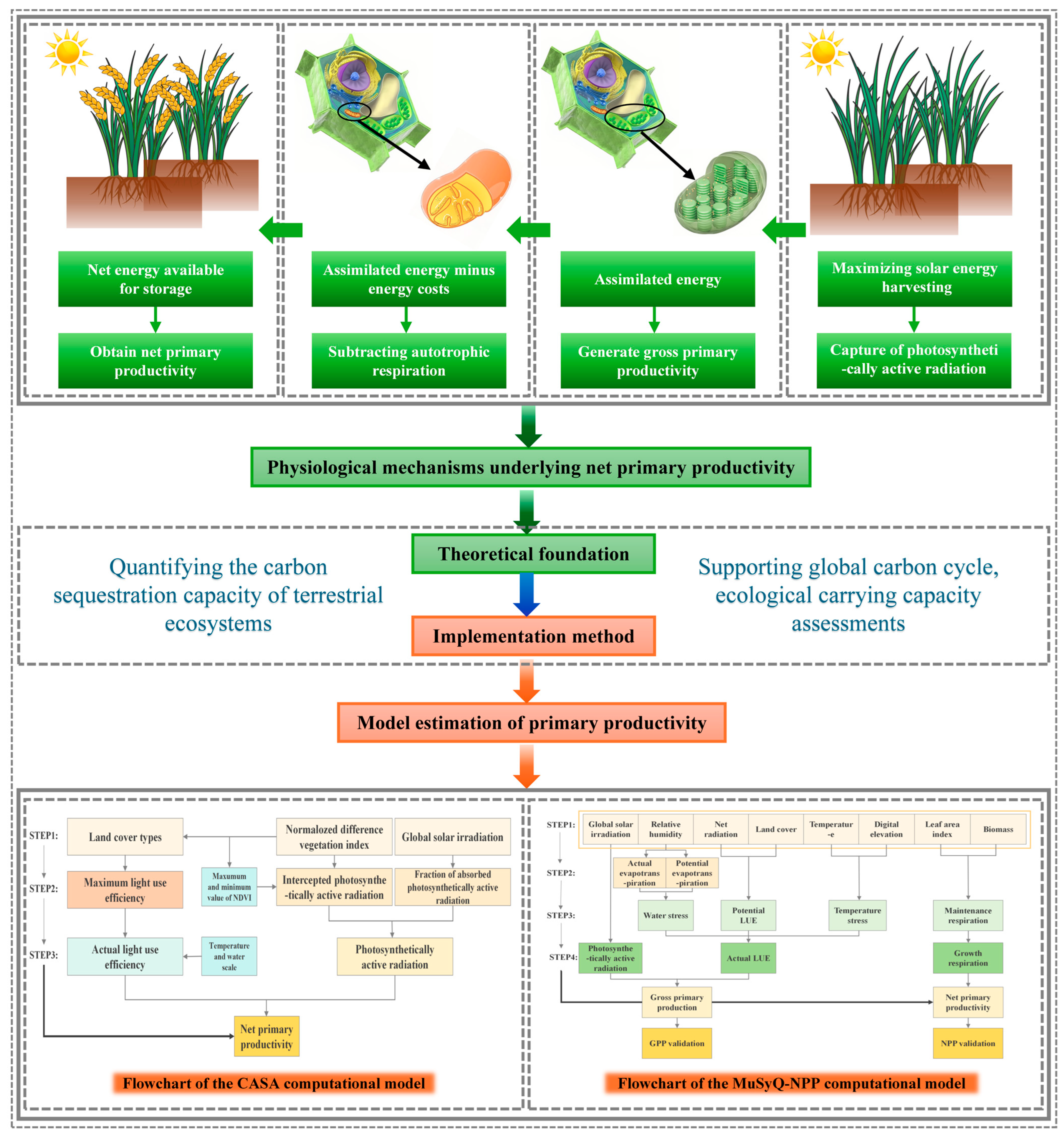
As a key indicator in PUE calculation, net primary productivity (NPP) can be subdivided into aboveground net primary productivity (ANPP) and belowground net primary productivity (BNPP). NPP is defined as the difference between the total amount of organic matter produced by green plants via photosynthesis and the consumption of autotrophic respiration per unit of time and area. It is the main pathway for terrestrial ecosystems to sequester atmospheric carbon for energy acquisition, and serves as the energy foundation for plant growth, development, and reproduction. Meanwhile, NPP also provides the material guarantee for the survival and reproduction of other organisms in ecosystems. It is widely adopted as a reliable indicator for ecosystem function assessment, and acts as a critical factor determining the carbon source or sink attribute of terrestrial vegetation. As a core ecosystem function, ANPP dominates energy flow within ecosystems and facilitates carbon–water cycling. Its dynamics (including interannual variation, asymmetry, and climate sensitivity) have been used as an indicator to identify ecosystem transitions triggered by anthropogenic disturbances and limiting factors at the regional scale. Moreover, the complementary analysis of ANPP and PUE dynamics is more conducive to detecting ecosystem state shifts and unraveling the underlying ecological mechanisms [
8,
9,
10,
11]. However, field-based direct measurement of NPP is difficult to implement at global or large regional scales. With the advancement of science and technology, remote sensing-based NPP estimation has been widely adopted due to its advantages of macroscopic coverage, high efficiency, and labor savings. Researchers from various countries have developed different models for estimating vegetation NPP based on distinct research scales, data sources, and calculation methods. These models mainly include process-based models, parametric models, and statistical models. Among them, the CASA model, as the most representative process-based model, is widely used in regional-scale vegetation biomass estimation, and the principle of the model is shown in
Figure 1. At present, several reliable remote sensing NPP data products have been released. Meanwhile, to compensate for the shortage of site observation data, regional-scale meteorological data products derived from spatial interpolation of multi-site meteorological observations are also available [
9,
10].
3.2. Sustainable Ecological Connotation of PUE
In recent years, abrupt climate changes have occurred frequently at various spatiotemporal scales, accelerating global warming and aridification. This has led to unforeseen shifts in the risk mechanisms of dryland and alpine ecosystems in terms of structure and function, and significantly prolonged the recovery time of these ecosystems from disturbance [
11]. Against this background, assessing the health status of these fragile ecosystems and quantifying the impacts of climate change and human activities on their functional stability has become an urgent scientific issue. Using PUE to evaluate the health of terrestrial ecosystems and reveal the effects of driving factors such as climate change and human activities on vegetation, PUE can provide critical support for understanding ecosystem functional fluctuations and ensuring their sustainable development. Therefore, PUE has become one of the core research hotspots in regional ecological studies [
5].
PUE serves as a key constraint in ecosystem productivity simulation models and is regarded as a comprehensive quantitative method for assessing the response of net primary productivity to spatiotemporal variations in annual precipitation. It can be used as a core indicator for regional ecological degradation. Specifically, relying on the ecosystem-specific correlation between NPP and precipitation, PUE is adopted to characterize ecosystem functions and regional land degradation, including desertification assessment, and reflect the adjustment of precipitation utilization strategies when ecosystems adapt to environmental changes [
2,
3,
4,
12,
13].
As a core link connecting the carbon and water cycles of ecosystems, PUE plays a vital role in regulating the adaptability of ecological populations and species richness to climate change. Meanwhile, analyzing the spatial differentiation characteristics of NPP and PUE along geographical and climatic gradients can provide scientific support for predicting the impacts of climate change on vegetation productivity [
8]. The CRD model (cumulative difference in PUE variation) can be adopted to quantitatively analyze the response patterns of vegetation and its dynamics to PUE, and reveal the process-effect coupling mechanism between vegetation and PUE, so as to reflect vegetation ecological restoration or degradation in light of regional land productivity [
14]. In addition, the application scope of PUE has been further expanded. It is not only used to study the efficiency of terrestrial ecosystems in absorbing atmospheric CO
2, but also widely applied to ecological research, such as drought response and pasture restoration after mining. Meanwhile, it provides an effective approach for quantifying precipitation-related carbon dynamics and reducing the uncertainty in estimating soil carbon sinks [
15].
Vegetation responds significantly to climate change through energy exchange, water exchange, and material cycling [
4]. Ecological resilience is closely related to environmental drought and low-temperature stresses. Quantifying the response characteristics of PUE to drought and low temperature essentially builds a bridge between the impacts of drought and low temperature and ecological hazards. Based on the rapid overall response characteristics of PUE, regional changes in dry–wet conditions can be indirectly monitored by collecting and analyzing vegetation PUE data [
2]. In addition, relevant studies have verified that the improvement of vegetation PUE can effectively reflect the effect of ecological restoration. Among them, the substitution effect of light and heat resources (i.e., solar radiation compensates for precipitation limitations) is the core mechanism driving the increase in PUE [
16]. Moreover, PUE has been gradually applied to crop yield improvement and dynamic monitoring of vegetation growth at the regional scale, so as to evaluate the vegetation health status in agricultural areas [
17].
PUE is also an important tool for evaluating the impacts of human activities and climatic factors on vegetation landscape functionality. In the vegetation landscapes of semi-arid regions, soil and nutrient losses will reduce the conversion efficiency of precipitation into primary productivity. Meanwhile, the regulatory effect of changes in landscape hydrological connectivity on PUE indicates that the integrated analysis of hydrological connectivity and PUE can serve as an important indicator for ecological health monitoring in arid regions, providing a scientific basis for early warning of whether ecosystems are approaching the tipping point of irreversible degradation [
18,
19,
20].
It is worth noting that the complexity of PUE as an indicator of ecosystem resilience is far beyond expectations. Both experimental studies and model simulations show that significant spatial differences in PUE may exist among different vegetation types due to the differences in their own constraint conditions [
2]. Studying the spatiotemporal differentiation characteristics and driving mechanisms of PUE can provide scientific support for dynamic monitoring of vegetation degradation and early warning of climate change risks, and offer theoretical references for formulating vegetation degradation mitigation strategies and optimizing regional ecological environment management schemes. This is a core research direction in the field of climate change impacts on regional ecosystems [
21].
4. Quantification Methods of PUE
4.1. Quantitative Calculation Methods
Currently, the research scale of vegetation PUE has been extended from the leaf physiological level of crops or the individual level of natural vegetation to the canopy, ecosystem, and even vegetation landscape levels [
22]. Due to the diversity of spatiotemporal scales in PUE research, the methods used to investigate its spatiotemporal differentiation patterns also vary. Previous studies mostly relied on experimental observations or single-point model simulations. For example, the direct field measurement method is the most accurate way to determine the effects of water availability on dry matter production, but it generally requires extensive and laborious work with high costs. In contrast, the application of remote sensing data offers advantages such as real-time performance, regional coverage, and multi-spatiotemporal resolution. It can be used to obtain key land surface and biophysical parameters, including large-scale vegetation growth and water status, effectively overcoming the limitations of traditional methods [
23].
Quantitative approaches for PUE exhibit considerable diversity, which represents a key issue for conducting systematic research on PUE, as summarized in
Table 2. PUE can be defined as the ratio of gross primary productivity (GPP) to precipitation. Since NPP is typically approximately half of GPP, GPP-based PUE and NPP-based PUE are theoretically positively correlated [
15,
24]. On this basis, some studies have further proposed the concept of PUE stability. This indicator mainly reflects the fluctuation characteristics and uncertainty of vegetation’s ability to utilize precipitation, and explores its response mechanism to external disturbances, which can provide more targeted theoretical guidance for the adaptive management of ecosystems [
25]. In the field measurement and calculation of PUE, traditional ecological observation methods have obvious limitations in obtaining vegetation NPP data. For this reason, some scholars use ANPP instead of NPP to calculate PUE, with the implicit assumption that there is a fixed proportional relationship between ANPP and NPP [
26]. Subsequent studies have found that the Normalized Difference Vegetation Index (NDVI) has a significant linear correlation with NPP, which makes NDVI an effective indicator to replace NPP for PUE calculation [
4]. At present, PUE has become a pivotal parameter for analyzing the relationship between precipitation and vegetation productivity. However, due to the uncertainty of underground processes, there are still certain limitations in calculating PUE based solely on ANPP. For instance, studies have demonstrated that the driving effect of global grassland PUE on the partitioning of ANPP and BNPP exhibits a bimodal threshold effect. When annual precipitation is below 441 mm (arid conditions), plants allocate limited biomass to aboveground parts, resulting in higher productivity per unit of precipitation; when annual precipitation exceeds 441 mm (humid conditions), plants shift to invest more in underground biomass [
27]. Therefore, incorporating BNPP into the quantitative calculation of PUE is of great significance for improving the accuracy and completeness of evaluation results.
4.2. Comparative Analysis of Quantitative Formula Systems
Based on the core calculation formulas of PUE summarized in this review, essential differences exist in the quantification logic, variable basis, and application scenarios of different formulations. Therefore, a systematic analysis is required from three dimensions: classification of the formula system, scale applicability, and complementary advantages and disadvantages, so as to clarify the application boundaries of each formula under specific research conditions. In terms of quantification logic and core variables, existing PUE calculation formulas can be divided into the following four categories (the formulas have been numbered in
Table 2 and are referred to by their numbers in the text): productivity-dominated, index-substituted, dynamic response, and standardized auxiliary types. Obvious divergences exist in the applicable scenarios, strengths, and limitations of each category.
Productivity-dominated formulas are represented by Formula (1) as the classic definition. Its core variables are net primary productivity (NPP) and annual precipitation (PPT), which directly reflect the core carbon–water coupling process of ecosystems. As the benchmark formula for PUE with the strongest ecological interpretability, its key advantages lie in clear mechanisms and a mature framework, supported by well-developed NPP/GPP data products. It is suitable for macro-mechanistic studies such as regional carbon–water cycle coupling and ecosystem carbon sink assessment under global change. However, this type of formula also has notable limitations. NPP/GPP retrievals often yield large estimation errors in regions with complex terrain or sparse vegetation. Formula (1) emphasizes net carbon fixation efficiency, while Formula (10) focuses on gross photosynthetic uptake efficiency, requiring a clear process-oriented selection based on research objectives. Meanwhile, its high demand for data quality restricts its application in data-scarce regions.
Index-substituted formulas are represented by Formulas (6) and (7), with core variables including the Normalized Difference Vegetation Index (NDVI), Soil-Adjusted Vegetation Index (SAVI), and annual precipitation. They essentially characterize precipitation use efficiency indirectly through vegetation growth activity. Their main advantages are low data accessibility thresholds and complete time series, making them suitable for long-term remote sensing monitoring at global or regional scales. By incorporating a soil adjustment coefficient, SAVI effectively reduces background interference from bare soil and sparsely vegetated areas, and performs significantly better than NDVI in arid and semi-arid regions. However, the key deficiency of such formulas is their weak mechanistic basis. Using vegetation indices to substitute carbon flux represents a substitution of essence by phenomenon, which cannot quantify actual changes in ecosystem productivity. Moreover, NDVI is prone to saturation in densely vegetated areas, leading to distorted PUE calculations. Therefore, these formulas are only applicable to scenarios such as large-scale vegetation dynamic assessment without flux observation data and small-scale plot analysis of the relationship between biomass and precipitation.
Dynamic response-type formulas are centered on Formula (5), whose core variables are the difference in aboveground net primary productivity between precipitation-manipulated and control conditions, as well as the absolute magnitude of precipitation change. Its quantification logic focuses on the ecological response to changes in precipitation itself. The main advantage lies in its clear causal relationship: it can accurately quantify the productivity response amplitude corresponding to per-unit precipitation change and directly reveal the marginal efficiency of precipitation use. This makes it a dedicated formula for artificial precipitation manipulation experiments and studies on the ecological effects of extreme droughts and floods. Nevertheless, the limitations of this formula are also distinct. It relies on artificial water-control experiments or extreme-event observations, which involve high data acquisition costs and long experimental periods. It only reflects the instantaneous response under specific precipitation gradients and cannot represent the long-term average utilization efficiency of ecosystems, making it difficult to extend to regional scales.
Standardized auxiliary formulas are represented by Formula (2), which focuses on the statistical standardization of raw PUE. Their key advantage is eliminating the influence of interannual precipitation fluctuations, enabling fair comparisons of PUE across years, regions, and ecosystems, making them suitable for statistical studies such as long-term PUE trend analysis and regional differentiation comparisons. However, as a relative efficiency indicator, this formula discards the absolute efficiency information of raw PUE and cannot directly reflect actual precipitation utilization levels, so it must be used in conjunction with absolute efficiency formulas. In addition, derivative formulas centered on ANPP (e.g., Formula (3)) emphasize aboveground available biomass, aligning better with practical demands in agricultural production and grassland ecosystem management. They are applicable to scenarios such as grazing intensity regulation and cropping system optimization. Nevertheless, they only reflect aboveground precipitation use efficiency and fail to characterize belowground carbon sink processes, resulting in incomplete process coverage.
To address the unresolved issue of formula selection for precipitation use efficiency in computational applications, overall, there is no single universally optimal formula for quantifying PUE, only differences in scenario applicability. For macro-mechanistic studies, productivity-dominated formulas based on NPP/GPP are preferred to ensure ecological rigor of conclusions. For large-scale remote sensing monitoring, index-substituted formulas based on SAVI are recommended to balance data availability and anti-interference performance. For mechanistic studies involving manipulation experiments, dynamic response-type formulas must be adopted to clarify causal relationships. For cross-regional and cross-year comparative analyses, standardized Z-score formulas should be incorporated to eliminate scale effects.
4.3. Technical Method Support
In the field of analyzing the driving mechanisms and spatiotemporal differentiation characteristics of Precipitation Use Efficiency (PUE), the inherent limitations of single research methods have become a critical bottleneck restricting the depth of relevant studies. The coupled integration of multiple methods and cross-scale validation has emerged as the core developmental direction for improving the scientific rigor and reliability of current research. Based on the existing methodological system, this study aims to achieve a comprehensive and in-depth interpretation of the multi-scale and multidimensional complex response mechanisms of PUE through the systematic integration of multiple technical approaches, including the analysis of spatiotemporal evolution characteristics, quantification of driving factor contributions, multifactor correlation tests, and deconstruction of complex causal relationships. The core methodologies are summarized in
Table 3.
4.3.1. Multi-Method Collaborative Identification of Spatiotemporal Evolution Characteristics of PUE
To investigate the spatiotemporal dynamic evolution of PUE, a coupled framework combining simple linear regression and Theil-Sen with Mann-Kendall (TS+MK) analysis is adopted to achieve complementary advantages. Simple linear regression can quantify the overall linear correlation strength between PUE and key driving factors, whereas the TS+MK combined method can accurately capture the long-term monotonic trends, statistical significance, and potential turning points of PUE. This approach effectively avoids the neglect of data volatility and phased changes inherent in single trend analysis methods, thereby improving the comprehensiveness and accuracy of spatiotemporal pattern identification. To characterize the threshold responses of PUE across different climatic zones and vegetation types, piecewise linear regression can effectively identify critical threshold points of core driving factors such as precipitation gradients and temperature variations. For instance, in alpine meadow regions of the Qinghai–Tibet Plateau, this method successfully detected a peak breakpoint of PUE at an annual precipitation range of 400–500 mm. This finding is consistent with the “coupled water and energy limitation” mechanism revealed by redundancy analysis (RDA), providing critical support for interpreting the nonlinear response patterns of PUE.
4.3.2. Multi-Model Collaborative Decomposition of Driving Factor Contribution Quantification
In the quantification of driving factor contributions, the combined application of the random forest regression model and the SHapley Additive exPlanations (SHAP) model demonstrates distinct advantages. As a nonparametric machine learning model, random forest does not require linear assumptions and can clarify the relative contribution weights of various factors (e.g., climatic factors, topographic conditions, and human activities) through its built-in variable importance ranking. In contrast, SHAP analysis, based on game theory, can accurately decompose the positive or negative driving effects of each factor on PUE at the individual sample level, clearly revealing the spatial heterogeneity of factor contributions and remedying the shortcoming of traditional models that only generate global average contributions. Taking a case study on the Loess Plateau as an example, coupled results from the first-difference regression model and the generalized linear model show that the implementation of major ecological restoration projects contributed 31.2% to the regional improvement of PUE, with this positive effect being more significant in areas with a slope <15°. This finding is highly consistent with the multifactor interaction mechanism of “topography–vegetation–soil” revealed by structural equation modeling, further verifying the reliability of multi-method coupling analysis.
4.3.3. Optimization Scheme for Multifactor Correlation Analysis and Cross-Scale Validation
In the process of multifactor correlation analysis, the complementary application of the Pearson correlation coefficient and the Spearman correlation coefficient can effectively distinguish linear relationships and monotonic nonlinear relationships among variables. In contrast, grey relational analysis compensates for the insufficient sensitivity of traditional statistical methods to nonlinear and small-sample data. Studies have shown that in arid and semi-arid regions of China, the grey relational degree between solar radiation and PUE (0.78) is significantly higher than the Pearson correlation coefficient (0.53), which directly reflects the complex nonlinear characteristics of the substitution effect of light and heat resources. This highlights the necessity of multi-method coupling in interpreting complex ecological relationships. For cross-scale validation, the fusion and calibration of in-situ measured data and remote sensing inversion results are realized through multiple linear regression models, which can effectively reduce the estimation biases of ecological models such as CASA and MuSyQ-NPP in sparsely vegetated areas. This improves the evaluation accuracy of regional PUE by 24.6–37.8%, providing a feasible technical approach for large-scale and high-precision assessment of the spatiotemporal patterns of PUE.
4.3.4. Research Value of Multi-Method Coupling
The core value of multi-method coupling in PUE research is reflected in the following four aspects. First, it overcomes the inherent limitations of single methods. Through complementary advantages and cross-validation, it compensates for the shortcomings of traditional individual methods—such as linear regression, TS+MK trend analysis, and conventional statistical models—in resolving nonlinear relationships, capturing staged fluctuations, adapting to small-sample data, and quantifying spatial heterogeneity. For example, the combination of linear regression and TS+MK enables accurate identification of long-term trends and quantification of linear correlations, while the synergy of random forest and SHAP analysis achieves global contribution ranking and reveals local driving heterogeneity, greatly improving the scientific rigor and reliability of research conclusions. Second, it allows the deconstruction of the multi-scale, multifactor, and nonlinear complex response mechanisms of PUE. By integrating trend analysis, contribution quantification, and other techniques, it realizes the leap from phenomenological description to mechanistic interpretation. For instance, precipitation thresholds identified by piecewise linear regression and hydrothermal coupling mechanisms revealed by redundancy analysis mutually verify each other; the combined use of the random forest-SHAP model and structural equation modeling clarifies multifactor interaction pathways, deepening the understanding of PUE-related ecological processes. Third, it meets multi-scale research requirements ranging from site observations to global assessments. Through cross-scale validation, it realizes the integrated correction of field measurements and remote sensing retrievals, reducing estimation biases in large-scale ecological models. This provides high-precision technical support for the efficient use of regional precipitation resources, optimization of agricultural layouts, and evaluation of ecological restoration projects. For example, quantitative results of PUE contributions from ecological restoration projects on the Loess Plateau have provided a quantitative basis for relevant policy-making. Fourth, it promotes methodological innovation and facilitates the application of emerging technologies such as machine learning and game theory in ecohydrology. For instance, the combination of SHAP values and random forest enables localized visual analysis of driving factor contributions; the complementarity of grey relational analysis and traditional correlation coefficients provides new ideas for quantifying nonlinear ecological relationships. This drives the iterative upgrading of PUE research methodologies and expands cutting-edge research directions.
4.3.5. Existing Controversies and Challenges in Method Combination
The application of combined methods in PUE research still presents numerous controversies and challenges. First, the selection of methods lacks a unified and standardized procedure. Different studies exhibit strong subjectivity in choosing coupled methods, and variations in parameter settings lead to inconsistent or even contradictory results regarding driver contribution rates, threshold points, and other indicators, undermining the comparability and reproducibility of research conclusions. Second, multi-method coupling entails the risk of overfitting. Some studies excessively pursue model fitting performance while neglecting ecological interpretability, resulting in outcomes disconnected from real ecological processes and conclusions that are “statistically significant but ecologically meaningless”. Meanwhile, the high computational complexity, large data requirements, and intensive computing demands of multi-method coupling restrict its application in small-sample and data-scarce regions. Third, scale effects and error propagation are prominent in cross-scale coupling. Spatial mismatches between in-situ measurements and remote sensing retrievals, as well as heterogeneous driving mechanisms of PUE across scales, make it difficult for multi-method coupling to eliminate scale bias. Error propagation further amplifies deviations and compromises the reliability of large-scale assessments. Fourth, confusion between correlation and causation remains unresolved. Although multi-method coupling improves the ability to analyze correlations, it cannot fundamentally solve the problem of causal inference. Some studies only establish statistical correlations among factors but fail to identify causal directions, which still requires validation through long-term in-situ observations and manipulation experiments. Fifth, a contradiction exists between the universality and regional applicability of methods. Most existing coupling schemes are developed for specific regions and ecosystems, leading to poor transferability across different climatic zones and ecosystem types. The lack of a unified multi-scenario coupling framework limits the broader application of research conclusions.
5. Analysis of Factors Driving PUE
The spatiotemporal variations in precipitation use efficiency (PUE) are closely correlated with numerous factors, including climatic zones, vegetation types, and soil properties. When exploring the driving mechanisms underlying the spatiotemporal heterogeneity of PUE, it is necessary to adopt in-depth correlation analysis methods. Only through the correlation analysis of multiple driving factors can the core issues in its driving process be accurately resolved, which is also an urgent research priority to be broken through in this field at present. For instance, existing studies have revealed that the dominant climatic factors controlling PUE vary significantly across altitudinal gradients: PUE in high-altitude areas is mainly regulated by wind speed, while specific humidity serves as the core driving factor in low-altitude areas [
24]; At the middle-elevation zone of 4313 m, warming significantly inhibits vegetation precipitation use efficiency (PUE) by increasing vapor pressure deficit (VPD) and reducing soil moisture (SM). In contrast, vegetation at high altitudes is insensitive to warming due to low-temperature limitation, resulting in no significant change in PUE [
33]. Therefore, quantifying the comprehensive and relative contributions of various variables to PUE will enable a clearer and more accurate assessment of the large-scale impacts of climate change on terrestrial carbon assimilation and water cycles, particularly in climate-sensitive regions [
15]. Notably, inconsistencies exist among the results reported in different studies, which mainly stem from discrepancies in spatial scales [
13].
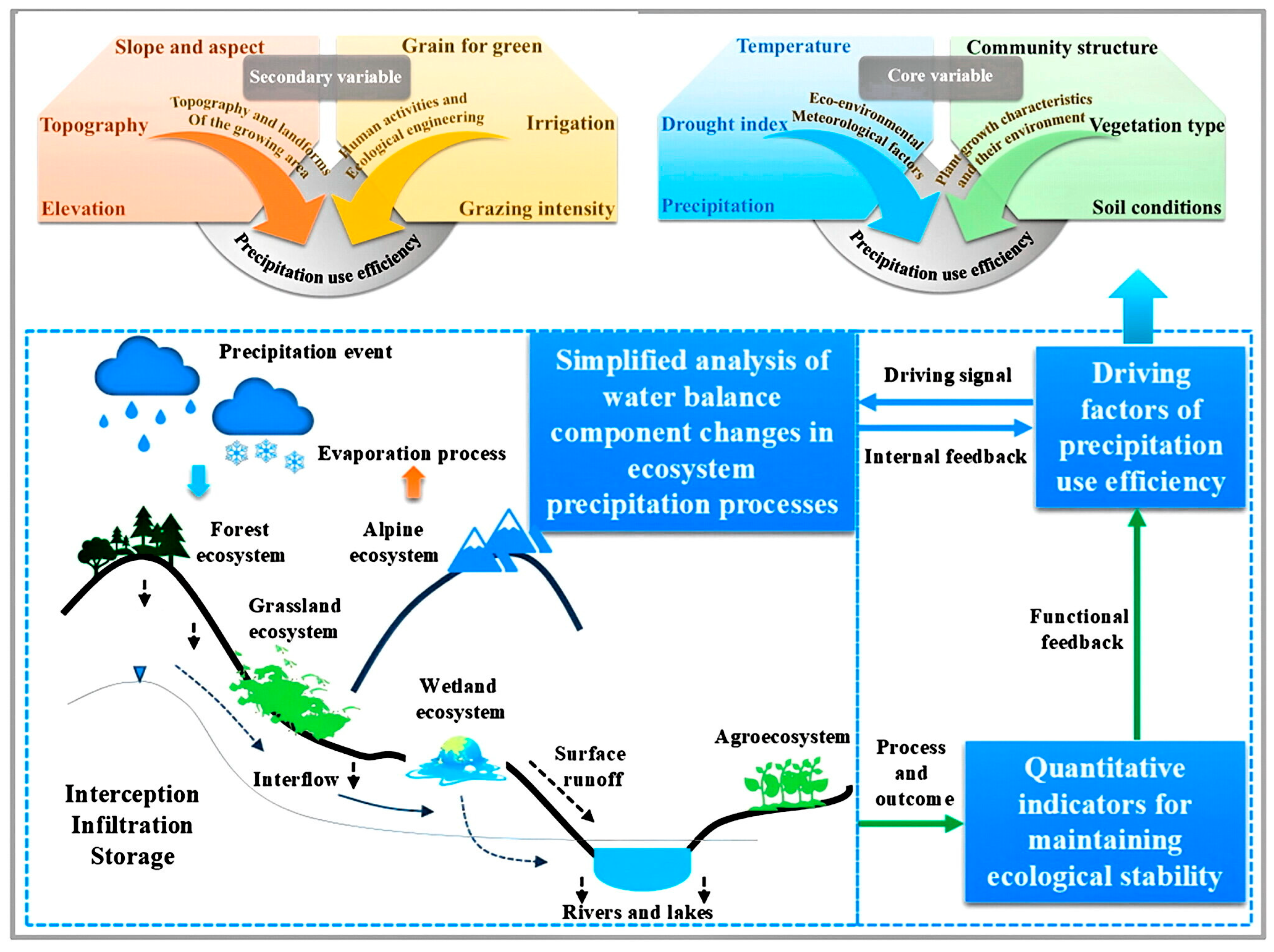
To highlight the importance of research on driving factors of precipitation use efficiency (PUE) and reflect its key role in the coupled relationship between ecosystem cycling and ecological stability, the coupled processes of ecosystem water cycling and PUE are illustrated in
Figure 2. As a schematic integrated model within the conceptual framework (rather than empirical evidence for macroscopic relationships), this figure reveals the intrinsic coupling between the multidimensional driving mechanisms of PUE and ecosystem hydrological cycling: Meteorological variables dominated by precipitation and temperature, together with auxiliary regulatory factors including altitude, slope gradient and aspect, vegetation community structure, soil conditions, and human activities such as grazing and irrigation, jointly form a coupled natural and anthropogenic driving network for PUE. Key hydrological processes—including precipitation events, evapotranspiration, interception, infiltration, subsurface flow, surface runoff, and water storage—clearly characterize the transformation pathways of precipitation and water balance characteristics within ecosystems, clarifying how effective water use and non-beneficial water loss regulate PUE. At the same time, this framework covers typical ecosystems such as forests, alpine regions, grasslands, wetlands, and farmlands, revealing divergent responses of PUE across different ecosystem types.
5.1. Meteorological Factors
Meteorological factors play a central role in exploring the driving mechanisms of vegetation precipitation use efficiency (PUE). Numerous studies have focused on two dominant factors: temperature and precipitation. Meanwhile, the influences of other meteorological factors, such as solar radiation, wind speed, and evapotranspiration, on vegetation PUE cannot be ignored, as presented in
Table 4 [
39,
40,
41].
5.1.1. Temperature
As a key meteorological factor influencing vegetation PUE, temperature exhibits distinct regional heterogeneity in its mechanism [
13]. As temperature shows strong spatial heterogeneity and regional differentiation, its regulatory effects on vegetation PUE are diverse. On the one hand, temperature can exert a direct positive regulation: rising regional temperature increases vegetation photosynthetic rate more significantly than evapotranspiration rate, thereby enhancing net primary production. This process reflects the potential beneficial effect of climate warming on vegetation photosynthetic efficiency [
21,
36]; On the other hand, temperature can also regulate PUE indirectly by modulating vegetation photosynthesis, evapotranspiration, and ecosystem water balance [
16]. For example, rising temperature significantly accelerates evapotranspiration, and the increased evapotranspiration directly leads to a reduction in PUE [
13]. Overall, the effect of rising temperature on vegetation PUE is dualistic. Moderate warming helps improve the optimal photosynthetic rate of vegetation, thus exerting a promoting effect on PUE in cold regions. However, continuous temperature increase accelerates soil-water loss and induces drought stress, thereby exerting a significant negative impact on vegetation PUE [
3].
5.1.2. Precipitation
Due to the differential characteristics along precipitation gradients, the relationship between PUE and precipitation amount is not simply linear, but exhibits alternating positive and negative correlations or a unimodal curve pattern [
2].
Variations in PUE show significant differentiation across intervals of total precipitation. In arid and semi-arid regions with low annual precipitation, precipitation is the dominant limiting factor for vegetation growth. Photosynthetic growth of vegetation with high production potential in these areas is highly sensitive to changes in precipitation. Moderate increases in precipitation can directly alleviate water stress, provide sufficient water for photosynthesis, and thus significantly improve vegetation PUE [
42]. In contrast, in regions with relatively high precipitation, soil moisture may become saturated during certain periods, causing episodic ecological stress. On the one hand, limited oxygen supply to roots and soil microorganisms significantly reduces biological activity, thereby inhibiting organic matter accumulation in plants. On the other hand, excessive precipitation tends to generate surface runoff, intensifying leaching and loss of key nutrients and weakening the ecosystem’s water and nutrient retention capacity, indirectly suppressing vegetation growth. Meanwhile, the high maintenance respiration and growth respiration costs associated with high production potential further offset photosynthetic carbon gain, ultimately leading to a decline in PUE with increasing precipitation [
42,
43,
44]. This negative correlation is particularly significant in riparian and lacustrine areas, indicating that excessive precipitation inhibits photosynthesis in vegetation, or that the proportion of ineffective precipitation lost through runoff and soil evaporation increases beyond that of effective precipitation absorbed and utilized by vegetation, resulting in reduced PUE [
3,
14]. When regional precipitation is subdivided along a gradient, the unimodal and piecewise linear pattern of vegetation PUE becomes more evident. For example, studies conducted on the Qinghai–Tibet Plateau with annual precipitation ranging from 100 to 700 mm have confirmed that PUE follows a unimodal pattern along the precipitation gradient: it increases with rising precipitation in arid zones, peaks at 400–500 mm of annual precipitation in relatively humid zones, and then gradually declines [
45,
46].
The regulatory effects of precipitation changes in different periods of the vegetation growth cycle on PUE also differ significantly, with late-growing-season precipitation exerting a critical regulatory role on PUE [
47]. Other studies have shown that PUE is co-affected by precipitation during the dormant season and growing season, and precipitation in the mid-growing season makes the most prominent contribution to ANPP [
32]. In addition, the Precipitation Concentration Index (PCI) can indirectly enhance vegetation NPP. The concentrated distribution of precipitation promotes the increase of ANPP by improving vegetation PUE, and its driving mechanism mainly includes two aspects: first, high-intensity precipitation can reduce surface evaporation and increase the proportion of vegetation transpiration; second, it facilitates deep soil-water recharge and prolongs the period of rapid vegetation growth [
30].
5.2. Topographic and Geomorphological Conditions
Topography and geomorphology regulate vegetation PUE through a complex process, which indirectly influences the spatial heterogeneity of vegetation PUE mainly by altering key factors such as hydrothermal redistribution, vegetation community characteristics, and soil environment. Topographic factors drive the spatial redistribution of precipitation, leading to differences in precipitation input and runoff generation across the landscape, which further cause spatial variations in soil moisture and ultimately result in significant spatial heterogeneity of vegetation PUE. For instance, glacial meltwater from high-altitude mountains can replenish surrounding vegetation, enabling it to maintain vigorous growth even under limited precipitation conditions [
16,
44]. Slope gradient and aspect also exert significant effects on vegetation PUE: PUE is higher on gentle slopes than on steep slopes, and it is notably higher on northeast-facing slopes than on southwest-facing slopes [
43].
As a key topographic factor, altitude regulates PUE through multiple pathways: First, changes in altitude directly alter air temperature, precipitation, and solar radiation intensity, which further regulate PUE. Second, altitudinal gradients drive shifts in vegetation species composition and functional traits, thereby modulating PUE. Third, rising altitude affects soil properties and microbial activities, indirectly influencing PUE by modifying the soil environment for vegetation growth [
6]. Specifically, altitude indirectly affects vegetation NPP and PUE mainly by influencing hydrothermal conditions, vegetation coverage, aboveground biomass, community characteristics, and distribution. With increasing elevation, unfavorable factors limiting vegetation growth—such as strong winds, short growing seasons, low temperatures, and intense solar radiation—gradually increase, leading to declining trends in aboveground biomass and biodiversity [
13]. Therefore, both NPP and PUE generally exhibit a decreasing trend with increasing altitude.
5.3. Vegetation Types and Soil Conditions
Vegetation PUE is constrained by vegetation characteristics, growth environment, soil conditions, and other factors, among which soil-water-holding capacity and status play a central role. Significant differences exist in precipitation use efficiency among different vegetation types. Forest vegetation has developed and deeply distributed root systems, which can efficiently absorb precipitation stored in deep soil and groundwater, providing a stable water supply for the fixation and conversion of photosynthetic products, resulting in relatively high PUE. Cropland, under artificial interventions such as pesticide and fertilizer application and irrigation, enjoys sufficient water and nutrient supply, with markedly improved productivity that indirectly elevates PUE. Wetland ecosystems maintain abundant water year-round and possess ecological functions including water retention, temperature regulation, and self-adjustment, making them less sensitive to meteorological fluctuations and weakly affected by external environmental changes in terms of internal vegetation PUE. Although alpine steppe regions receive relatively abundant precipitation, low temperatures and nutrient limitation jointly restrict water uptake and utilization by vegetation; most additional precipitation is lost via runoff, limiting PUE improvement. In contrast, alpine meadows, with high species richness, can respond rapidly to precipitation conditions and fully utilize available water resources, achieving a higher PUE level [
3,
21,
26,
37].
Under long-term soil-water-saturated conditions, vegetation growth may be inhibited due to limited oxygen supply, thereby reducing root and soil microbial activity. Particularly in areas far from water sources or with severe soil salinization, vegetation growth conditions are more stressful, resulting in low vegetation coverage [
42]. Under low vegetation coverage, precipitation is mostly lost through soil evaporation, and the proportion of ineffective precipitation exceeds that of effective precipitation, directly affecting vegetation NPP and PUE [
43]. Vegetation coverage shows a significant positive correlation with PUE and NPP, and this correlation becomes more pronounced at larger spatial scales. First, due to ecological complementarity effects, diverse species composition helps improve the utilization efficiency of precipitation resources. Second, higher vegetation coverage generally indicates more functional communities within the ecosystem that can respond to high precipitation conditions, further enhancing precipitation conversion and productivity supply capacity [
45,
46,
47,
48].
Soil texture indirectly influences vegetation growth status and PUE by regulating soil-water availability. Sandy soil has larger porosity and weaker water-holding capacity than loam, and water is easily lost through leakage or evaporation, resulting in a relatively low PUE of vegetation [
12,
45]. Soils supporting vegetation in desert regions are dominated by sandy texture with extremely low silt content. To adapt to extremely arid environments, such vegetation has generally evolved morphological and physiological characteristics, including a high root-to-shoot ratio, small leaf area, and low stomatal conductance. These traits restrict photosynthetic rate and relative growth rate to a certain extent, making vegetation NPP insensitive to changes in precipitation gradients and showing a pattern where PUE decreases with increasing precipitation. In contrast, alpine meadow soils have a higher silt content and stronger water-holding capacity, creating favorable conditions for vegetation to utilize precipitation efficiently, thereby forming an ecological scenario with high PUE [
21,
26].
Soil nitrogen and carbon contents are key to optimizing pathways for improving vegetation PUE [
2]. Scholars conducted field control experiments on grassland communities, and the results showed that there were significant interactions among precipitation, soil nitrogen, and biological factors. Experiments also confirmed that nitrogen application significantly increased PUE by 20%. This finding clarifies that improving nitrogen supply is a key pathway to break through the PUE threshold of natural vegetation [
31,
40]. Meanwhile, soils with high carbon content usually have a finer texture and better water-holding capacity, providing a favorable foundation for efficient precipitation use by vegetation and thus maintaining regional PUE at a relatively high level [
37,
45].
While exploring the driving factors of PUE, PUE itself also exerts reverse regulatory effects on vegetation physiological traits and soil conditions. Under low precipitation use efficiency (LPUE) conditions, soil-water content, soil nitrogen content, and other resources supporting vegetation growth undergo responsive changes. Such environmental stress promotes the formation of adaptive characteristics with a high root-to-shoot ratio in vegetation, and belowground biomass is more sensitive to these environmental changes. In addition, biodiversity can indirectly influence the vegetation root-to-shoot ratio by positively regulating aboveground biomass accumulation, showing that under high biodiversity, vegetation tends to adopt a growth strategy with a lower root-to-shoot ratio [
49].
5.4. Human Activity Intervention
Human activities exert a significant driving effect on the dynamic changes of regional natural vegetation PUE. Anthropogenic disturbances such as overgrazing, deforestation, increasing livestock numbers, and rapid urbanization are the core factors causing the reduction in vegetation NPP and the decline of PUE. Among these, the impact of livestock production is particularly prominent. Unreasonable livestock development models and overgrazing directly trigger the degradation of natural vegetation and the decline of productivity, thereby reducing vegetation PUE. Taking the southern slope of the Qilian Mountains in China as an example, the regional industrial structure is dominated by livestock farming based on natural rangelands, and the imbalance between forage supply and livestock demand has become a key driver of the local decrease in vegetation PUE. [
5,
14,
17].
Studies on PUE of cropland vegetation have shown that water diversion irrigation measures in farmland can effectively improve PUE. Taking the Hetao Plain cropland in the Inner Mongolia Autonomous Region as an example, reasonable irrigation practices such as Yellow River water diversion have significantly elevated the PUE of farmland vegetation [
21,
26]. In the semi-arid grassland pastoral areas of Inner Mongolia, irrigation can increase ANPP by 22–46% and significantly improve PUE. Additional nitrogen fertilizer application was found to synergistically enhance ANPP and PUE only under moist conditions, while markedly reducing the proportion of root biomass. However, after accounting for BNPP, the effects of nitrogen fertilizer on total NPP and PUE became weak. This highlights the importance of comprehensively evaluating belowground productivity for accurately understanding grassland resource-use efficiency, and provides a basis for assisting degraded grassland restoration through moderate nitrogen addition [
28].
A wide range of global ecological restoration initiatives have been implemented to mitigate soil erosion, conserve biodiversity, and improve dryland ecosystems, resulting in a distinct greening trend that has reversed desertification and land degradation. Meanwhile, these ecological measures have exerted substantial impacts on regional water-carbon cycles and vegetation patterns [
8]. Since 2000, the Chinese government has implemented a series of ecological projects, such as ecological restoration and the Grain for Green program (converting farmland to forest or grassland). Meanwhile, the trend toward a warmer and wetter climate has facilitated the recovery of vegetation coverage, contributing to the increase in vegetation PUE. These projects have effectively improved the ecological environment, with the most remarkable achievements observed in the ecologically fragile regions of the Qinghai–Tibet Plateau. They have further reduced human disturbance to natural grasslands and promoted a gradual rise in both NPP and PUE [
37].
6. Comprehensive Discussion of Driving Factors
The spatiotemporal differentiation of vegetation precipitation use efficiency (PUE) is not dominated by a single factor, but results from the hierarchical interactive coupling of four categories of factors: climate, topography, vegetation and soil properties, and human activities. Its response patterns can be clearly divided into universal mechanisms and regional heterogeneous characteristics. Although existing studies have reached a basic consensus on the core coupling logic, research gaps remain in some subdivided fields. Based on evidence from previous literature, this chapter systematically summarizes and prospects the key driving factors.
6.1. Coupling Effects of Hydrothermal Factors
Hydrothermal conditions constitute the core natural mechanism regulating PUE. Existing studies demonstrate that PUE exhibits a unimodal nonlinear variation with precipitation, peaking at an annual precipitation range of 400–500 mm. Temperature exerts a dual effect on PUE: “moderate warming promotes, while persistent high temperature inhibits”. A moderate temperature increase can elevate the optimal photosynthetic temperature of vegetation, thus significantly promoting PUE in cold regions. In contrast, persistent high temperature accelerates soil-water evapotranspiration and induces drought stress, thereby suppressing PUE. The coupling relationship between precipitation and temperature is key to determining the changing trend of PUE. Synchronized hydrothermal conditions (sufficient precipitation coupled with suitable temperature) create synergy between the water supply of precipitation and the photosynthetic promotion of temperature, which may improve the carbon–water conversion efficiency of ecosystems. Asynchronized hydrothermal conditions (dry-hot or cold-wet combinations) lead to antagonistic effects. In dry-hot environments, high evapotranspiration offsets the photosynthetic benefits of temperature; in cold-wet environments, low temperature restricts root water uptake, and excessive precipitation intensifies nutrient leaching. Both scenarios commonly result in reduced PUE. Current quantitative threshold studies on hydrothermal interactions remain fragmented, with only localized conclusions formed for typical regions such as the Qinghai–Tibet Plateau. No unified consensus has been reached on critical hydrothermal matching thresholds at the global scale or across different vegetation types, representing obvious research gaps. The universality of existing conclusions still requires further validation in future studies.
6.2. Regulatory Effects of Topography, Vegetation, and Soil on Hydrothermal Interactions
Topography, vegetation, and soil properties do not regulate PUE independently. Instead, they reshape local hydrothermal conditions to amplify or weaken the coupling effects of core hydrothermal factors, and such regulatory effects show obvious regional differences. Among topographic factors, altitude directly modulates hydrothermal matching by altering air temperature, precipitation, and solar radiation intensity. In regions without snowmelt supply, rising altitude deteriorates hydrothermal conditions, intensifies hydrothermal antagonism, and leads to a decreasing trend in PUE. In high-altitude areas supplied by snowmelt, glacial meltwater compensates for insufficient precipitation and acts synergistically with warming to optimize hydrothermal matching, thereby increasing PUE. Slope gradient and aspect indirectly regulate hydrothermal effects by controlling precipitation infiltration and solar radiation receipt. Gentle slopes have higher infiltration rates than steep slopes, and in the Northern Hemisphere, northeast-facing slopes receive milder solar radiation than southwest-facing slopes. Both conditions alleviate the suppression of PUE caused by hydrothermal asynchrony. The regulatory effects of vegetation and soil properties on hydrothermal interactions rely mainly on resource retention capacity. Soils with high vegetation cover and high clay content can alleviate hydrothermal antagonism in dry and hot environments and amplify the promoting effects of hydrothermal synchrony by enhancing water and nutrient retention. In contrast, low-cover and sandy soils have weak water-holding capacity, which exacerbates the inhibition of PUE by hydrothermal asynchrony. This pattern has been widely verified in arid and semi-arid regions, but relevant research in humid regions remains insufficient. In addition, soil carbon and nitrogen contents improve the efficiency of vegetation utilization of hydrothermal conditions by optimizing the vegetation growth environment, thus serving as important auxiliary regulators of hydrothermal interactions.
6.3. Directed Coupling Effects of Human Activities and Natural Factors
The driving effect of human activities on PUE does not exist independently of natural factors. Instead, through targeted intervention in natural factors, it superimposes on the coupling effects of hydrothermal conditions, topography, vegetation, and soil, and the intervention outcome is closely related to regional natural conditions. Among positive anthropogenic interventions, precision irrigation in arid regions can artificially compensate for insufficient precipitation and optimize local hydrothermal matching; ecological restoration projects (such as the Grain for Green program) can enhance vegetation cover, improve soil structure, and strengthen the ecosystem’s buffering capacity against hydrothermal asynchrony. Both can synergize with favorable natural coupling effects and significantly improve PUE, especially in ecologically fragile zones and arid irrigated areas. Nitrogen addition can enhance vegetation photosynthetic efficiency, but it only synergizes with natural factors under humid hydrothermal synchrony, and shows weak effects under dry hydrothermal asynchrony—a conclusion verified by controlled experiments in grassland ecosystems. Among negative anthropogenic disturbances, overgrazing and deforestation reduce vegetation cover, exacerbate soil degradation, weaken the ecosystem’s water and nutrient retention capacity, superimpose with hydrothermal antagonistic conditions such as dry heat, and accelerate the decline of PUE. Surface hardening caused by rapid urbanization reduces precipitation infiltration, increases surface runoff, and further intensifies hydrothermal asynchrony—a pattern documented in studies of grassland pastoral areas and semi-arid agricultural regions. Most existing studies focus on the effects of single human activities, and systematic research on the regulatory patterns of hydrothermal interactions under the superposition of multiple human activities has not yet been conducted.
6.4. Reconstruction of Hydrothermal Interactions and PUE Responses Under Future Climate Scenarios
Against the backdrop of global warming, regional temperature rise, and intensified spatiotemporal heterogeneity in precipitation patterns, there will be continuous changes in hydrothermal combinations, and vegetation PUE will accordingly show divergent response patterns constrained by regional baseline hydrothermal conditions. For instance, in alpine and high-latitude low-temperature regions, future warm-wet climatic trends will optimize hydrothermal conditions: rising temperatures will lift low-temperature constraints, increasing precipitation will alleviate water stress, and improved hydrothermal synchrony will drive an overall upward trend in vegetation PUE, with dual enhancements in both photosynthetic and water-use efficiency. In arid and semi-arid regions, a potential warm-dry trend will accelerate evapotranspiration and soil-water loss; insufficient precipitation recharge will exacerbate drought stress and hydrothermal imbalance, resulting in a significant decline in vegetation PUE. If regional precipitation increases synchronously to offset water deficits under warming, forming a warm-wet regime, the negative impacts of rising temperature can be mitigated, maintaining PUE stability or even a slight increase. In humid and sub-humid regions, future temperature rise combined with greater precipitation variability will increase the frequency of extreme precipitation, heatwaves, and droughts, making hydrothermal asynchrony more prominent. Short-term heavy rainfall will increase ineffective water loss and intensify nutrient leaching, while persistent high temperatures will trigger seasonal droughts. Their interactive effects will reduce vegetation water-use efficiency, leading to an overall slight downward trend in PUE. In addition, changes in future precipitation concentration and seasonal distribution, coupled with seasonal temperature fluctuations, will further alter hydrothermal allocation during the vegetation growing season. Hydrothermal mismatch in the mid-to-late growing season will become a key factor regulating interannual PUE variation. Frequent extreme climate events will also amplify PUE fluctuations and break the original unimodal pattern along precipitation gradients.
7. Practical Approaches to Enhancing PUE
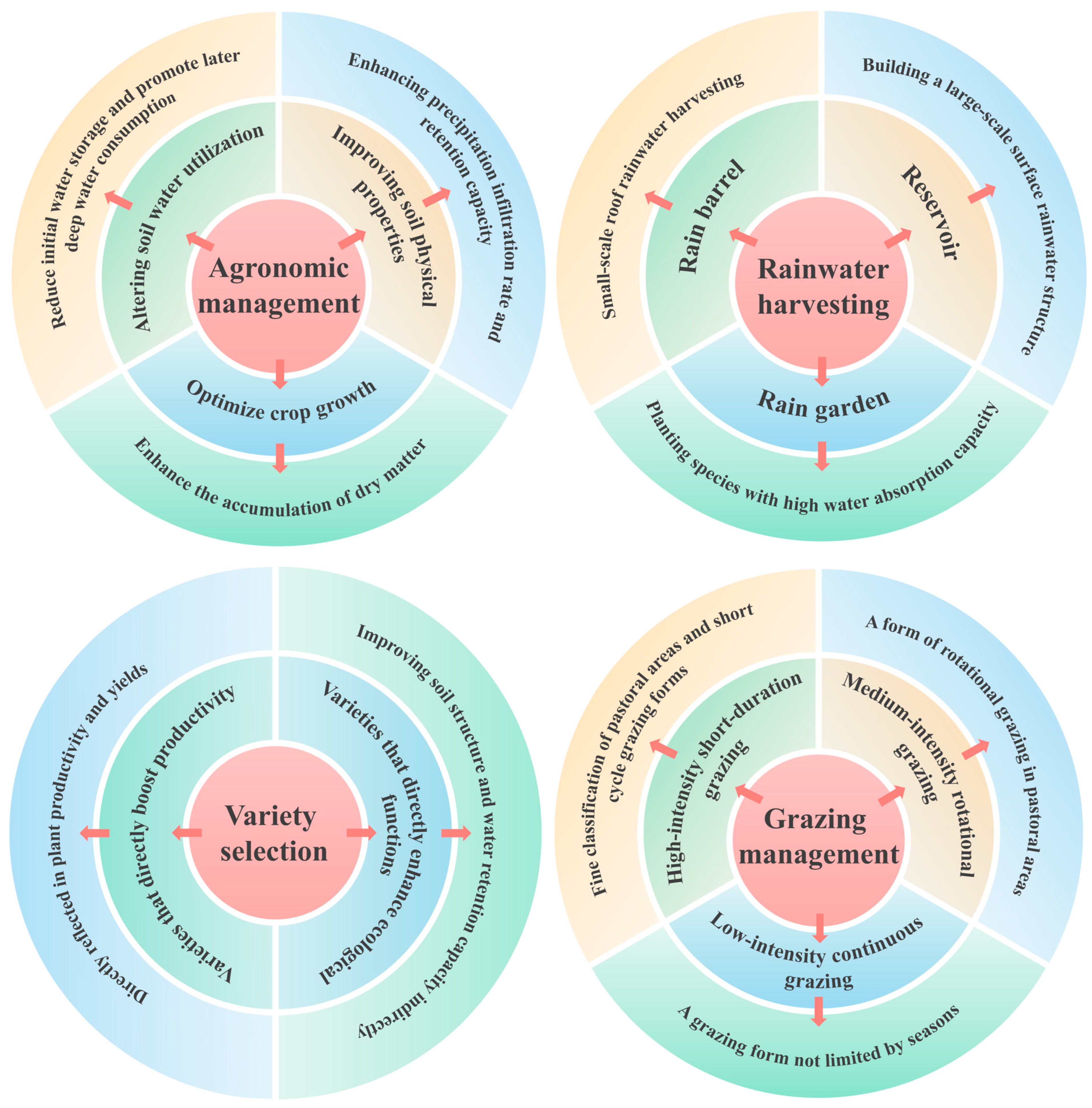
As shown in
Figure 3 [
4,
5,
6]. Agronomic management systems improve PUE and crop yield primarily by optimizing precipitation infiltration and storage (improving soil structure, enhancing synergies between infiltration and water retention) and regulating water consumption partitioning (suppressing ineffective evaporation during early growth stages and promoting effective transpiration during late growth stages). The core of such regulation does not rely on improvements in transpiration efficiency or harvest index. Instead, it achieves “water source expansion” (increasing soil-water storage) and “water loss reduction” (decreasing non-beneficial water consumption) in the precipitation utilization process through comprehensive management practices. This model is most applicable in arid, semi-arid, and rainfed agricultural regions. It can significantly enhance the conversion efficiency of limited precipitation resources, thereby providing important practical value for safeguarding regional grain production and ecosystem stability.
Rainwater harvesting technologies provide critical water supplementation for vegetation during dry spells through integrated regulation of rainwater collection, storage, and supplemental irrigation. They are mainly applied in arid regions of Northwest China, the Loess Plateau, rainfed agricultural areas of North China, and hilly and mountainous areas with frequent seasonal droughts. Their core application value lies in efficiently intercepting slope runoff, increasing available local water resources, alleviating water stress during critical growth stages, and substantially improving the PUE of farmland and artificial forest-grass ecosystems. Thus, they serve as important technical support for ecological restoration and stable agricultural production in water-scarce regions.
Planting drought-tolerant vegetation represents a core biological regulation measure for improving precipitation use efficiency, and it plays an irreplaceable role in arid and semi-arid regions, desert-oasis ecotones, desertified lands, and alpine water-scarce areas. Its application value lies in reducing luxurious water consumption and ineffective soil evaporation, simultaneously increasing soil-water content and structural stability, enhancing vegetation productivity and ecological functions of windbreak and sand fixation, thereby achieving synergistic improvement in ecological restoration and efficient water use.
Grazing intensity significantly affects grassland PUE and ecosystem sustainability, and different grazing strategies differ greatly in their applicable regions and application values. Continuous grazing represents a low-efficiency grazing mode that easily leads to grassland degradation, soil compaction, and increased runoff, thereby reducing PUE. It should be strictly restricted in ecologically fragile areas such as the northern temperate grasslands and the alpine grasslands of the Qinghai–Tibet Plateau to prevent continuous ecosystem degradation. Rotational grazing is a moderately optimized management strategy with outstanding applicability in the typical grasslands of Inner Mongolia, the meadow steppes of western Northeast China, and mountainous grassland regions. Its value lies in promoting forage regrowth and restoring soil health, improving photosynthetic efficiency and community stability, and balancing grazing utilization and PUE enhancement. Intensive management grazing is a high-intensity, high-efficiency regulation mode that performs best in cultivated grasslands, intensive grass-livestock demonstration zones, and valley grasslands with favorable water and soil conditions. It can maximize net primary productivity while minimizing soil disturbance and water loss, significantly improving photosynthetic efficiency and the comprehensive economic and ecological benefits of grasslands.
8. Research Limitations and Future Prospects
Based on the systematic review of precipitation use efficiency (PUE) above, combined with its current research status, core limitations, methodological inconsistencies, and knowledge gaps, this study proposes targeted new research directions for the future. Each path closely addresses key deficiencies in existing research, including insufficient depth of mechanism analysis, inadequate multi-scale coupling, inconsistent methodological frameworks, weak interdisciplinary collaboration, and lagging integration of cutting-edge technologies. These efforts aim to fill research gaps, resolve existing contradictions, and expand the boundaries of theory and technology. The details are as follows:
8.1. Future Research Directions
Based on the systematic review of precipitation use efficiency (PUE) above, combined with its current research status, core shortcomings, methodological contradictions, and knowledge gaps, this paper proposes targeted novel research paths for the future. Each direction closely addresses the key flaws existing in current studies, including insufficient in-depth mechanism analysis, a lack of multi-scale coupling, inconsistent methodological systems, weak interdisciplinary collaboration, and lagging integration of cutting-edge technologies. These paths are designed to fill research gaps, resolve existing contradictions, and expand the boundaries of theory and technology. The details are as follows:
8.1.1. In-Depth Interdisciplinary Collaborative Research
Vegetation precipitation use efficiency (PUE) serves as a key indicator linking the carbon and water cycles of terrestrial ecosystems. Its complex driving mechanisms require interdisciplinary collaboration across ecology, hydrology, remote sensing science, and other fields. Ecology focuses on revealing the biological regulatory mechanisms of PUE from the perspectives of plant physiology, community structure, and species diversity. Hydrology quantifies water partitioning characteristics such as infiltration, evapotranspiration, and runoff by investigating the transformation processes among precipitation, soil-water, and vegetation water, with particular attention to the impacts of special hydrological processes in arid and alpine regions on PUE. Remote sensing science relies on multi-source data to achieve PUE retrieval from regional to global scales, and conducts spatial analysis and dynamic simulation combined with GIS and ecohydrological models. Interdisciplinary integration not only clarifies microscale physiological and ecological mechanisms but also captures macroscale spatiotemporal patterns, providing a systematic scientific basis for water resource management and ecological restoration.
8.1.2. Multi-Regional, Large-Span, and Precision Remote Sensing Analysis
Under global climate change, conducting multi-climatic region and large-gradient PUE studies is crucial for revealing the vegetation response to precipitation. Research must break through the limitations of single-point observations and cover diverse ecosystems ranging from arid to humid zones and from plains to alpine regions. Using high spatiotemporal-resolution remote sensing as the core approach, integrating MODIS, Sentinel series satellites, and meteorological remote sensing data enables multifactor integration of NPP, precipitation, vegetation cover, and soil moisture. This allows accurate estimation of PUE at the pixel, ecosystem, and regional scales. This framework clearly reveals the spatial heterogeneity and nonlinear response characteristics of PUE, dynamically tracks interannual variations and the impacts of extreme climate events, and provides high-precision support for water resource regulation and ecological restoration in ecologically fragile areas.
8.1.3. “Human-Environment-Economy” Coordinated Development
PUE serves as an important indicator reflecting the coupled relationship among human activities, ecological conditions, and social economies. From a human perspective, breeding drought-resistant varieties, optimizing cropping structures, implementing the Grain for Green program, and carrying out ecological restoration projects can significantly improve precipitation conversion efficiency and strengthen the drought resistance of ecosystems. From an environmental perspective, elevated PUE contributes to increased vegetation coverage, enhanced soil carbon sequestration, and improved soil and water conservation, forming a positive ecological feedback loop. From an economic perspective, improved water-use efficiency reduces agricultural water consumption costs, while a high-quality ecological environment promotes the development of green industries such as ecotourism, achieving a win-win situation for ecological protection and sustainable economic development. Accordingly, a research framework can be established: major ecological engineering projects enhance regional PUE by improving vegetation structure and hydrological processes, thereby strengthening ecosystem services, including carbon sequestration and water conservation. Through the spillover of ecological benefits, these projects further promote coordinated socio-economic development, forming a chain transmission mechanism of “ecological engineering–environmental improvement–economic benefits”.
8.1.4. Cutting-Edge Exploration and Technology Integration
Current PUE research is advancing toward the frontier of multifactor interaction and multi-technology integration. Theoretically, studies are gradually shifting from single-factor analysis toward exploring “biotic–abiotic” interactions, with emphasis on plant functional traits, synergistic effects of soil microorganisms, and the response and recovery mechanisms of PUE under extreme climate conditions. Technologically, the main breakthrough pathways rely on the integration of high-resolution remote sensing, stable isotope tracing, ecohydrological modeling, and machine learning. These approaches allow detailed characterization of precipitation partitioning pathways, quantification of nonlinear effects from multiple factors, and reduction of estimation errors through data assimilation, thereby improving the accuracy of PUE simulation and prediction. The integration of cutting-edge technologies continues to drive PUE research toward clearer mechanisms, finer scales, and more reliable predictions, providing stronger technical support for climate change adaptation and optimized ecological management.
8.2. Limitations of Current Research
Despite the great potential of PUE in optimizing efficient utilization patterns and strategies of regional precipitation resources, several limitations still exist in current research. First, there is still a lack of systematic studies on the contribution weight of precipitation to vegetation productivity and its quantification methods across different regions and vegetation types. The calculation of vegetation PUE is usually based on the assumption that vegetation productivity is primarily driven by precipitation. However, due to climatic differences across China, actual precipitation distribution exhibits strong spatial heterogeneity, making this formula highly applicable in arid regions but subject to certain biases in other climate zones [
50]. Second, it is critical to expand the spatiotemporal scales of PUE research and improve its resolution. Large-scale integrated studies help overcome the limitations of short-term or local observations, thereby providing more universally applicable scientific support for ecological water resource management. The dynamic changes in PUE are jointly regulated by multidimensional factors. To further reveal its underlying mechanisms, in addition to continuing analyses of key climatic factors such as precipitation patterns and temperature variations, it is necessary to comprehensively quantify the synergistic effects of multifactor interactions on PUE. Specifically, focus can be placed on key coupling relationships such as hydrothermal coupling and water-light balance. Meanwhile, close attention should be paid to the time-lag effects of structural and functional adjustments in ecosystems along different precipitation gradients. Finally, frequent regional extreme climate events in recent years have exerted non-negligible impacts on natural ecosystems. Therefore, research on the driving relationship between extreme climates and PUE will become a key direction in the field of ecological water resource management.
9. Conclusions
In summary, based on a systematic review of relevant research literature worldwide, this paper provides an integrated analysis of the conceptual connotation, quantification methods, driving mechanisms, improvement approaches, and future prospects of precipitation use efficiency (PUE). The main conclusions drawn from this review are as follows:
(1) Commonly used PUE calculation formulas centered on NPP, GPP, ANPP, NDVI, and other core indicators were reviewed and compared. The applicable scenarios, advantages, and limitations of each formula were clarified, and a relatively mature methodological system for quantitative analysis and spatiotemporal characterization in current PUE research was summarized.
(2) Synthesized evidence indicates that the spatiotemporal patterns of PUE are jointly regulated by hydrothermal conditions, topographic factors, vegetation and soil properties, and human activities. Universal coupled driving patterns and significant spatial heterogeneity exist across regions. The synergistic and antagonistic effects of hydrothermal conditions and multifactor interactions represent key mechanisms governing PUE dynamics.
(3) Various practical measures for PUE enhancement were summarized, including agronomic water and nutrient management and grazing regime regulation, which can provide practical references for efficient precipitation utilization and ecosystem management.
(4) Limitations in current research were identified, including insufficient multi-scale mechanistic coupling, quantitative resolution of multifactor interactions, impact mechanisms of extreme climate events, and long-term continuous observation and modeling. Accordingly, future key research directions were proposed, such as interdisciplinary integration, large-scale high-precision remote sensing analysis, coordinated research on human–environment–economic systems, and integrated application of cutting-edge technologies.
Through systematic integration of existing findings, this paper further improves the overall framework of PUE research, deepens the scientific understanding of spatiotemporal variations in PUE and their driving mechanisms, and provides a fundamental reference for studies on regional precipitation resource management and ecological sustainable development.





 ,
,